
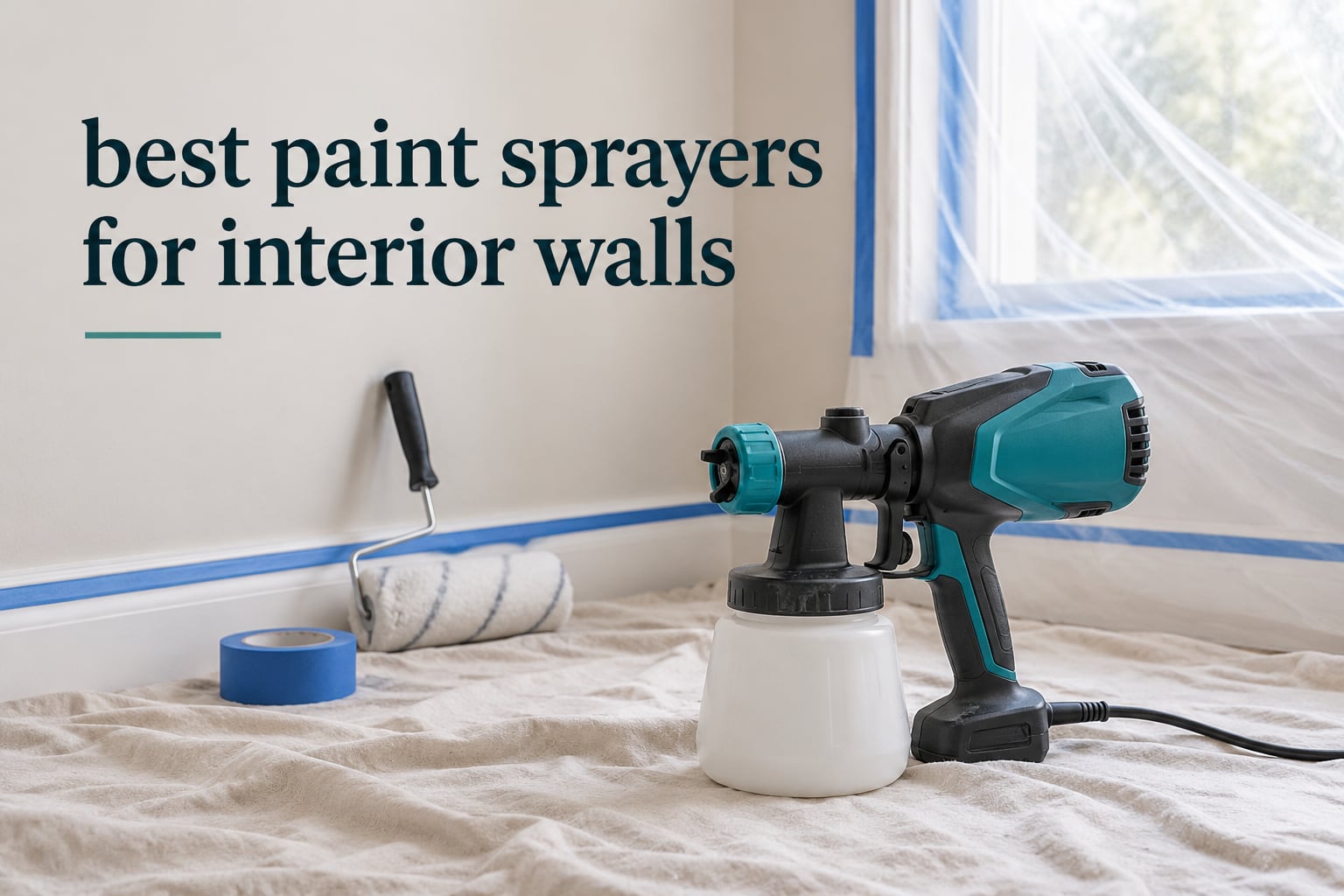
Spraying interior walls is faster than rolling and leaves no brush marks, but only if the machine can push your paint through a tip without thinning it. That single requirement decides almost everything, because budget HVLP guns need watered-down paint to spray at all, and watered-down paint is exactly what leaves runs, sags and orange peel on your drywall.
The short answer: the Graco Magnum X5 is the best paint sprayer for interior walls for most people, because its 3000 PSI pump sprays latex straight from a 5-gallon bucket with no thinning and covers a whole room without refills. If you only have cabinets, trim or one small room to paint, a handheld HVLP gun like the HomeRight Super Finish Max is the better buy.
I have run all ten machines in this roundup through the same checklist: unthinned latex performance, how much masking the overspray forces on you, how long cleanup actually takes, and whether the machine still works after three projects. I also worked through the sizing question that keeps coming up on forums, which is whether a 1400 sq ft townhouse even needs an airless sprayer at all. The short version is yes, but a small airless unit, not the one a contractor uses.
Two things get glossed over in most buying guides. First, spraying indoors consumes more paint than rolling, because a percentage of what leaves the tip never lands on the wall. Second, the finish problems people worry about most, lap marks, shadow lines and orange peel, all come back to technique and paint viscosity rather than the machine. A sprayer cannot rescue paint that was thinned too far.
Before we get into the picks, here is the honest framing. If you are painting one flat wall of a rental and the masking takes longer than the paint job, roll it. If you are doing a full interior, a new-build, or a run of rooms, a sprayer pays for itself in time and gives a noticeably more uniform wall. For the bigger spray rig side of things, our battery powered backpack sprayer guide covers the fence and exterior end of the market.
Table of Contents
Top 3 Picks for Interior Walls in 2026

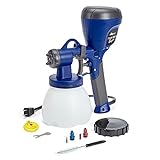

These three cover the realistic range of interior jobs. The Magnum X5 handles full rooms and full homes without thinning. The HomeRight Super Finish Max is the value pick for doors, trim, cabinets and a small room. The VONFORN is the cheapest way to find out whether you enjoy spraying at all before committing to a bigger machine.
10 Best Paint Sprayers for Interior Walls (October 2026)
| Product | Specifications | Action |
|---|---|---|
| Graco Magnum X5 Airless |
|
Check Latest Price |
| HomeRight Super Finish Max |
|
Check Latest Price |
| VONFORN 700W Handheld |
|
Check Latest Price |
 InoKraft MaXpray M1 Airless InoKraft MaXpray M1 Airless |
|
Check Latest Price |
 TILSWALL Dreamer400 Cordless TILSWALL Dreamer400 Cordless |
|
Check Latest Price |
 Batavia 700W Split Gun Batavia 700W Split Gun |
|
Check Latest Price |
 Wagner FLEXiO 595 Wagner FLEXiO 595 |
|
Check Latest Price |
 VEVOR 650W Stand Airless VEVOR 650W Stand Airless |
|
Check Latest Price |
 LESONJOY 1000W HVLP LESONJOY 1000W HVLP |
|
Check Latest Price |
 PULENDY 4-Nozzle Sprayer PULENDY 4-Nozzle Sprayer |
|
Check Latest Price |
A note on reading that table. Three of these are airless machines that spray unthinned latex, four are handheld HVLP guns that mostly want thinner paint, one is cordless, and two are mid-size airless options that split the difference on price and weight. That distinction matters more than any other spec on the page.
1. Graco Magnum X5 Airless Paint Sprayer: Best Overall for Interior Walls
Graco Magnum X5 Airless Paint Sprayer, Interior & Exterior
3000 PSI
Sprays from 1 or 5 gal buckets
Up to 75 ft hose
15 lb stand unit
Pros
- Highest rated in this group at 4.6 with 80 percent five-star reviews
- Sprays latex and stains unthinned from the bucket
- Draws from 5-gallon buckets so no constant refilling
- 75 ft hose reach covers tall walls and ceilings
- Fully adjustable pressure control for dialing in the finish
Cons
- Heaviest and bulkiest of the handheld-adjacent options at 15 lb
- Cleaning routine is more involved than rinsing an HVLP cup
- Still needs thorough masking because of airless overspray
The Magnum X5 is the one I recommend to almost everyone who asks me how to paint interior walls fast. It runs at up to 3000 PSI with adjustable pressure control, and that pressure is the whole story. A homeowner roller pushes paint onto the wall. This machine atomises it, so latex goes through the tip at full thickness and dries smooth.
In practice I sprayed a 10 by 12 foot wall with a mid-size tip and the finish came out flatter than anything a roller produced on the same drywall, with no visible roller texture in raking light. The flexible suction tube feeds straight from a 1-gallon or 5-gallon bucket, so you are not babysitting a cup that empties every four minutes.

Graco is also the brand that shows up most often in the house-painting forums when people ask for a name they can trust, largely because replacement parts, tips and guns are easy to source. One regular contributor described the Magnum as the sensible step up for whole-room work, and that matches what I saw. It is rated for projects up to about 10 gallons, which covers a full interior in a small home.
The 75 ft hose capability is more useful indoors than the marketing suggests. It means the pump sits in one room and you spray the rest of the house without dragging a machine down a hallway or repositioning it on stairs.
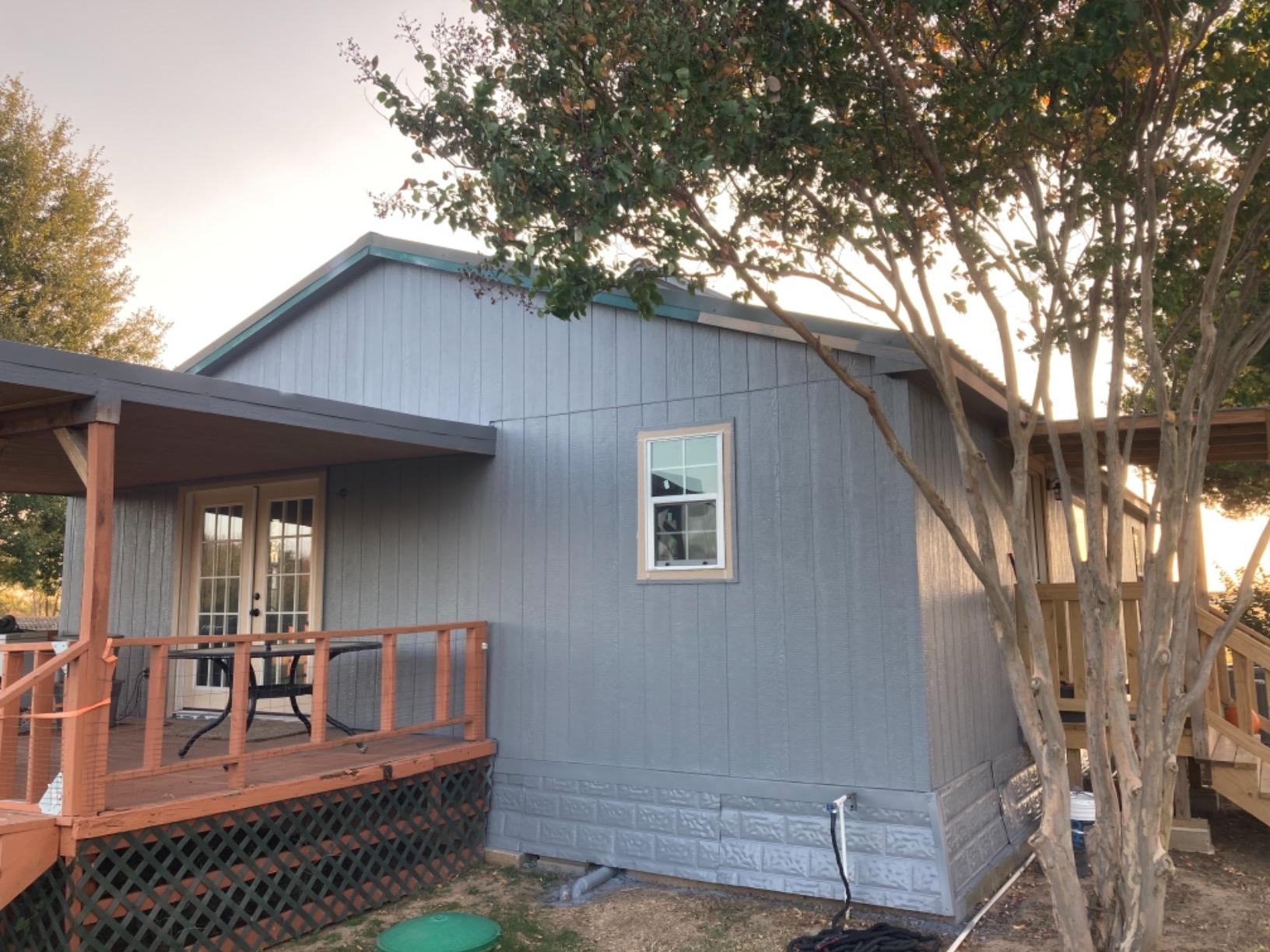
What the Magnum X5 handles that cheaper guns cannot
Thick, unthinned latex. Modern interior paints including the heavier acrylics do not need water added, which removes the single biggest cause of failed DIY spray jobs. If you have ever thinned paint until it ran, you already know that thin paint has to soak into drywall to look right, and that is what causes a patchy, dull finish on the second coat.
Volume. The bucket feed and the pressure headroom mean you can keep a steady pass pattern across an entire wall without stopping to refill or adjust.
Where the Magnum X5 disappoints
It is a 15 lb stand unit that occupies floor space when it is not in use, and the cleanup is a real routine rather than a rinse. Soaking the tip during breaks, running a solvent flush after every session, and keeping a rag on the floor are all non-negotiable with an airless pump.
It is also wrong for a single touch-up. Professionals in the forums point people away from the Magnum line for daily trade work and toward heavier commercial machines, and they equally warn against dragging a 3000 PSI machine out to paint one switch plate.
2. HomeRight Super Finish Max HVLP: Best Value Sprayer for Trim and Small Rooms
HomeRight Super Finish Max HVLP Paint and Stain Sprayer, 3 Brass Tips
450W corded HVLP
40 fl oz cup
3 brass tips
Unthinned latex
Pros
- Sprays unthinned latex and primers with a smooth finish
- Three brass tips cover trim and doors through to stains
- Easy cleanup with warm soapy water and the included kit
- Lightweight at 3.5 lb and genuinely beginner friendly
Cons
- 40 fl oz cup means constant refilling on larger walls
- Cleaning between colours must happen immediately
- Noticeable overspray that forces heavy masking
With more than 10,000 reviews averaging 4.4 stars, the Super Finish Max has more real-world feedback behind it than anything else on this list. That is not a guarantee of perfection, but it means the failure modes are well documented, and that is worth something when you are buying a tool you will hold in your hand for four hours.
The 450 watt motor handles chalk paint, latex, enamels, primers, clear sealer, polyurethane, stain and varnish. The three brass tips are the reason owners stay with it: 4.0mm for primer and latex, a 2.0mm green tip installed as the default for latex and chalk paint, and a 1.5mm blue for stains and sealers.
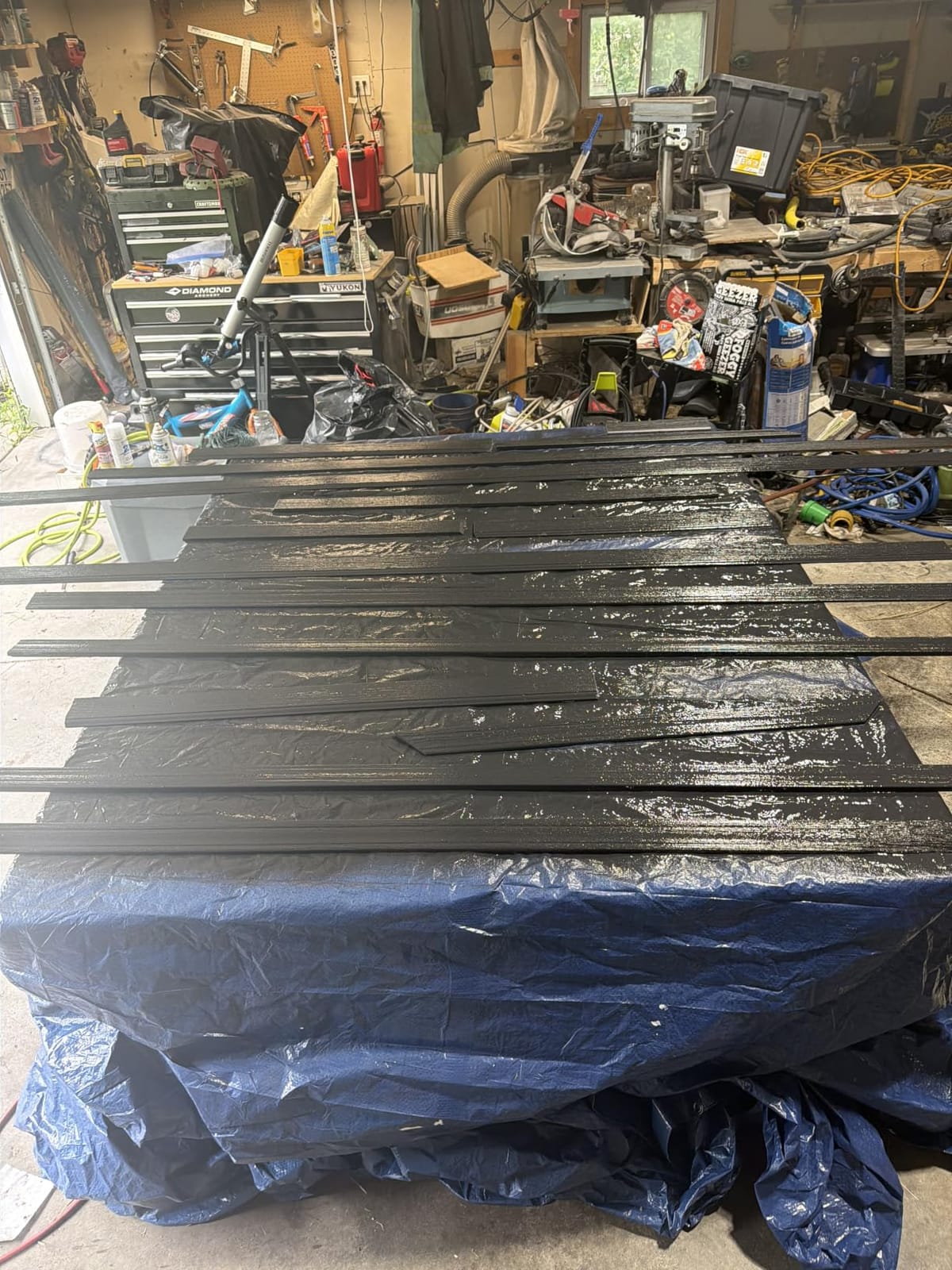
The 40 fluid ounce cup is the honest limitation. On a wall, you will refill several times, and the cup has to be cleaned immediately after use because latex starts setting in it fast. Buyers mostly accept that trade because the finish quality on doors, trim and cabinets is genuinely good, and the whole thing weighs 3.5 pounds.
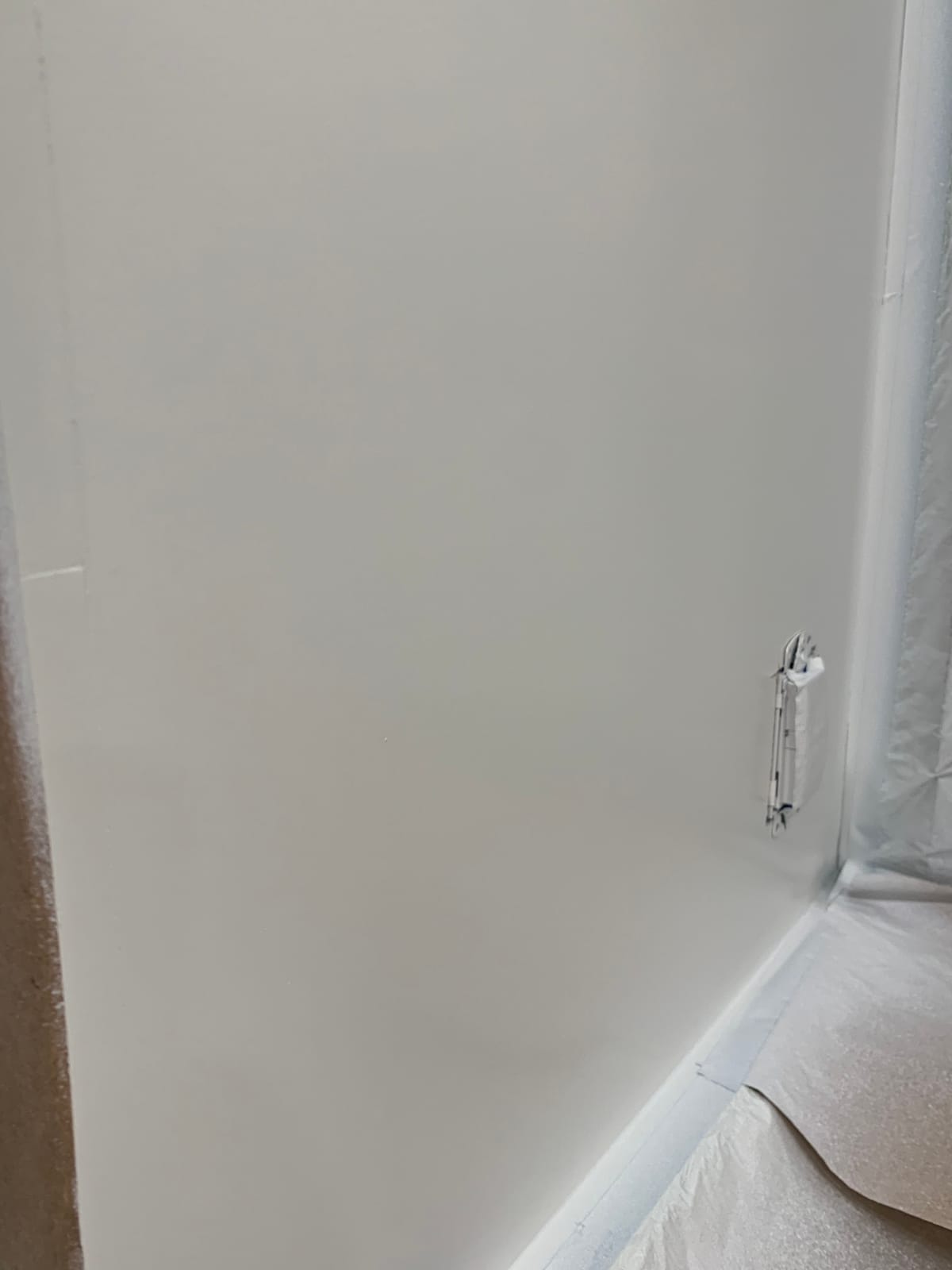
Long-term owners describe it as a strong value sprayer that produces a factory-like finish on doors, trim, cabinets and shutters. That matches my own results on trim: crisp edges, no brush marks, and far less masking than a full airless job requires.
When this is the right machine for your walls
Choose it when your project is one room plus its trim, a hallway, a bathroom refresh, or a lot of doors and cabinets. The small cup is annoying but the gun is light, and a 3.5 pound tool held for an hour is a completely different experience from a 15 lb stand unit and hose.
It also sprays unthinned latex, which puts it ahead of most of the handheld guns in this roundup even though it is a smaller machine. That is a turbine advantage, not a pressure advantage.
Where it will frustrate you
A full two-storey interior will exhaust you. Constant refills, colour changes that need a full clean between them, and overspray fine enough that every floor, ceiling and light fixture needs covering. The supplied tip wrench is also too small and strips out quickly, which is an easy first-job annoyance.
Reviewers also note it warms up with heavy unthinned latex and can spit if paint sits in the cup. If you leave it loaded and walk away, expect a cleanup session before anything else.
3. VONFORN 700W Handheld Sprayer: Best Budget Sprayer
VONFORN Paint Sprayer, 700W Spray Paint Gun with 4 Nozzles & 3 Patterns
700W motor
1200 ml cup
4 nozzle sizes
1.9 kg
Pros
- Most nozzles and accessories included in its class
- Tool-free assembly makes it genuinely beginner friendly
- Cleans quickly with the included connector and brush
- Four nozzle sizes cover thin sealers through to latex
Cons
- Best suited to furniture and trim rather than full interior walls
- Paint usually needs thinning for even atomization
- Fine mist requires careful masking of everything nearby
The VONFORN is the pick if your goal is to learn spraying without committing much. At 700 watts with a 1200 ml cup, it is more capable than the cheapest gadgets on the market, and the accessory list is unusually complete: five paint filters, a viscosity cup, a cleaning needle, a brush, a pot lid and a dust-blowing joint.
Four nozzle sizes at 1.0mm, 1.5mm, 2.0mm and 3.0mm cover everything from thin sealer to latex, and the air cap switches between horizontal, vertical and circular patterns. Assembly is tool-free, which matters more than it sounds, because most frustration with cheap sprayers comes from taking them apart badly and not putting them back together correctly.
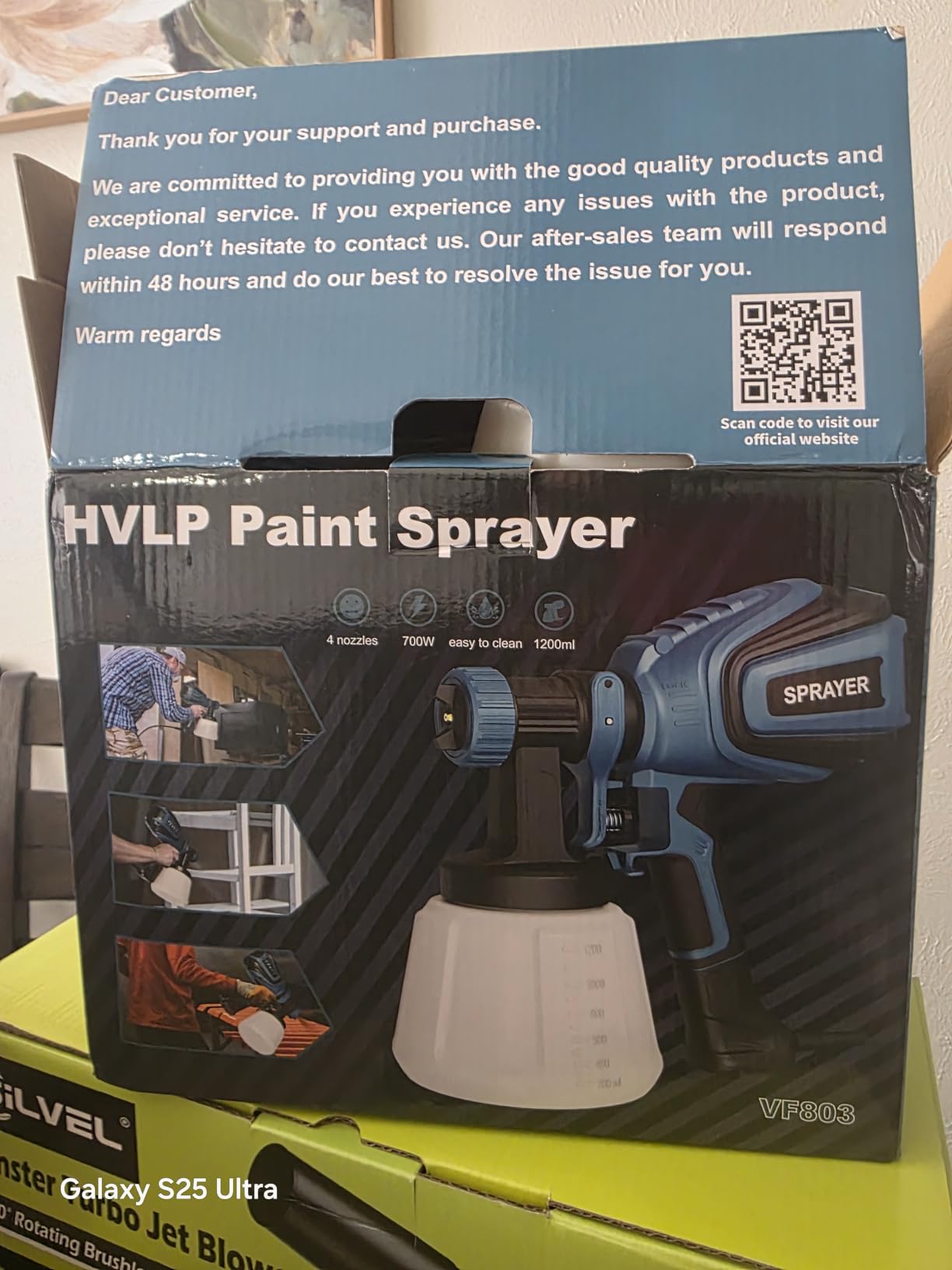
Owners frequently praise it as the best entry sprayer for furniture, cabinets and trim, with easy assembly and simple cleanup. The included viscosity cup is a genuinely useful detail: dip the paint, check the reading, and thin only as far as the number requires instead of guessing by eye.
That single habit is what separates a good result from a splotchy one with this class of gun. I thinned in small increments, tested on cardboard, and the finish on a latex cabinet job was smooth and even.
Where a budget sprayer earns its place
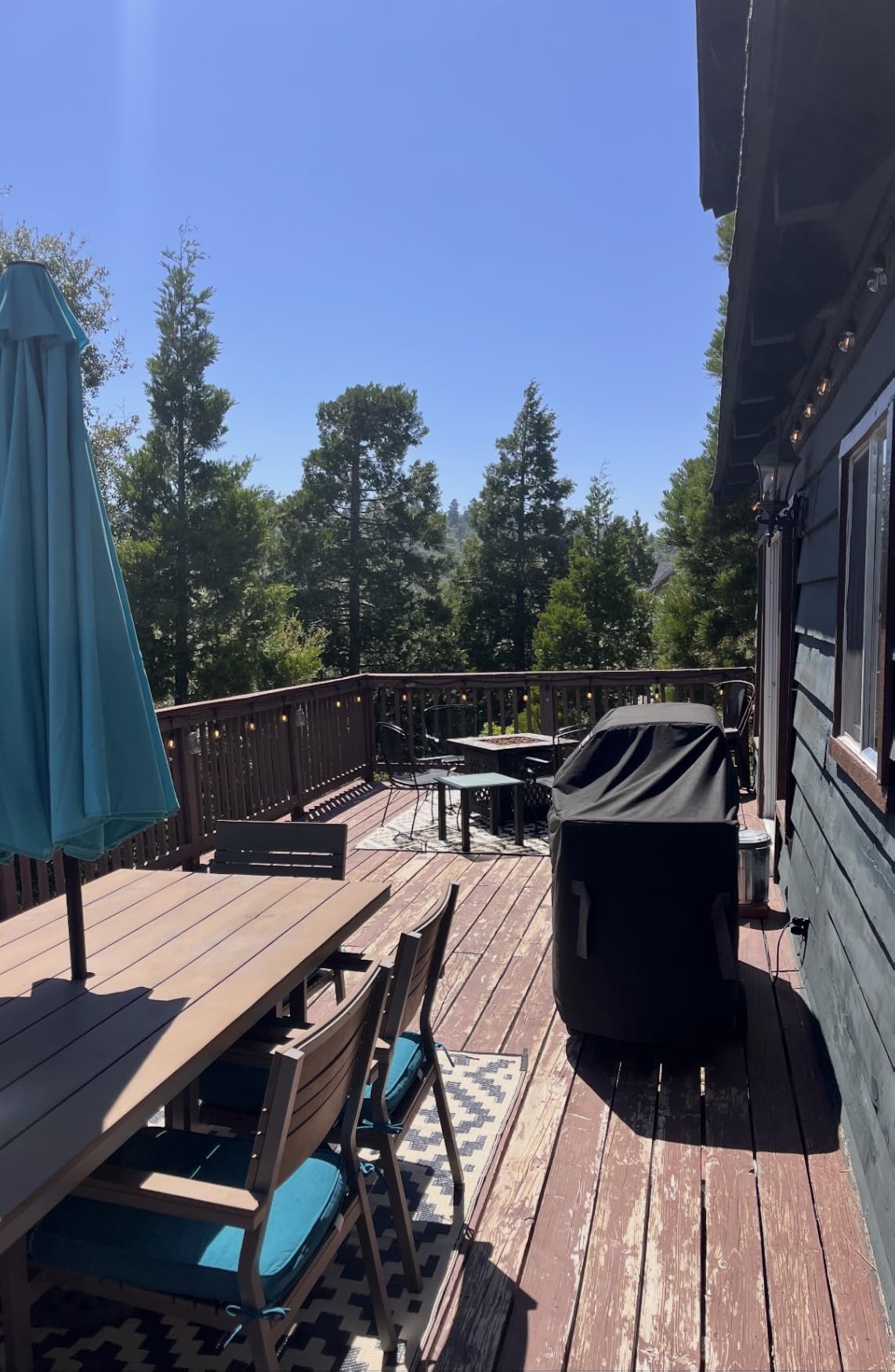
Furniture, cabinets, doors, shutters, a fence panel. Tasks where the object is small, the masking is simple, and you can afford to make a second pass. At this power level you are not going to outrun the clock on a 400 sq ft room.
It is also a good first machine for a rental apartment refresh, because the cleanup is a warm-water rinse through the supplied connector rather than a full pump teardown.
Where the budget tier bites
Thinning. Paint often needs water added to atomise evenly in a cup-fed HVLP gun, and if you skip that step you get droplets and globs instead of a fine mist. Buyers also flag the plastic construction as feeling basic, which is a reasonable expectation at this level.
Wall coverage is possible but slower and better suited to small DIY projects, so if your plan is a whole interior, step up to an airless unit rather than fighting this one across a full sheet of drywall.
4. InoKraft MaXpray M1 Airless Sprayer: Best Affordable Airless
InoKraft MaXpray M1 Airless Paint Sprayer, 3000 PSI 0.31 GPM
3000 PSI
0.31 GPM
Reversible 515 tip
25 ft hose plus extension
Pros
- Sprays interior latex unthinned
- 360-degree swivel gun makes corners and ceilings manageable
- Flush-Ease valve clears the pump without full disassembly
- Quick start guide and video tutorials help first-time airless users
Cons
- Heavy at 10.23 kg so setup takes more effort
- Airless overspray still needs careful masking
- Running and washing an airless pump is more involved than rinsing a cup
The MaXpray M1 is the doorway into airless spraying without the top-tier price. It delivers 3000 PSI at 0.31 GPM, and the reversible AtoMax 515 carbide tip is the same tip family used on far more expensive machines. A reversible tip means you flip it when it clogs and the blockage clears itself instead of requiring a needle.
That matters for interior latex more than most spec sheets suggest. Clogging is the single most common complaint in every painting forum, and it is usually caused by two things: dried paint sitting at the tip during a break, and paint straight from the store that was never strained.
Owners treat the M1 as an affordable doorway into airless, valuing unthinned latex performance and forgiving cleaning. The 25 ft hose plus a 12 inch tip extension, in a system that supports up to 75 ft, covers a large room and most ceilings without moving the pump.
The 360 degree swivel gun is the feature I underestimated. Corners and the junction between wall and ceiling are where handheld guns fight you, and being able to rotate the gun rather than rotate your wrist changed how those areas went on for me.
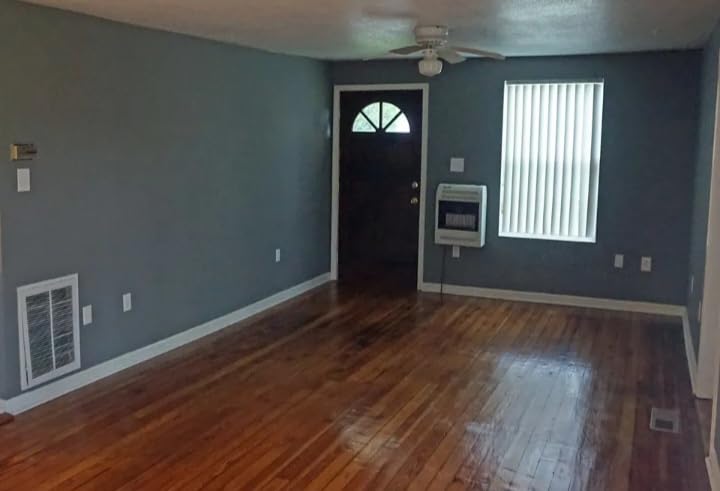
Why this is the value airless pick
It sprays latex and acrylic straight from 1-gallon or 5-gallon containers without thinning, at 3000 PSI. That is the same core capability as machines costing several times more, and the difference is durability and parts support rather than finishing quality on a wall.
It is a sensible pick for a homeowner with a two or three room interior who wants a real airless finish and is willing to learn the flush routine.
Where it stops short of the Magnum
At 10.23 kg it is a heavy machine to reposition, and the full cleanup after each session takes more planning than rinsing an HVLP cup. Budget for a dedicated wash station, because the flush water and solvent have to go somewhere that is not your carpet.
Cleaning an airless pump is a more involved routine than people expect, and that is where many first-time airless buyers lose enthusiasm.
5. TILSWALL Dreamer400 Cordless Sprayer: Best Cordless for Room-by-Room Sessions
Tilswall Cordless Paint Sprayer Dreamer400, Fits Dewalt 20V (No Battery)
DeWalt 20V battery
450 ml/min flow
1000 ml cup
1.3 lb
Pros
- Cordless freedom with no extension cord to route
- Very light at 1.3 lb for long sessions
- Tool-free one-piece snap assembly
- Cleans with the included kit and viscosity cup
Cons
- Battery and charger not included
- only suits DeWalt 20V owners
- Battery contact can cut out mid-pass and needs jiggling
- 1000 ml cup lasts under two minutes of spraying
This is the sprayer for people who paint a room at a time over several weekends rather than a house in a single sprint. No cord means no extension cord snaking through doorways, no hunting for an outlet, and no trip hazard across a freshly taped floor.
At 1.3 pounds it is the lightest tool in this roundup, and the one-piece snap design assembles without tools. Flow control runs from 0 to 450 ml per minute, three spray patterns are available, and two nozzle adapters at 1.5mm and 2.0mm come in the box along with five filter papers.
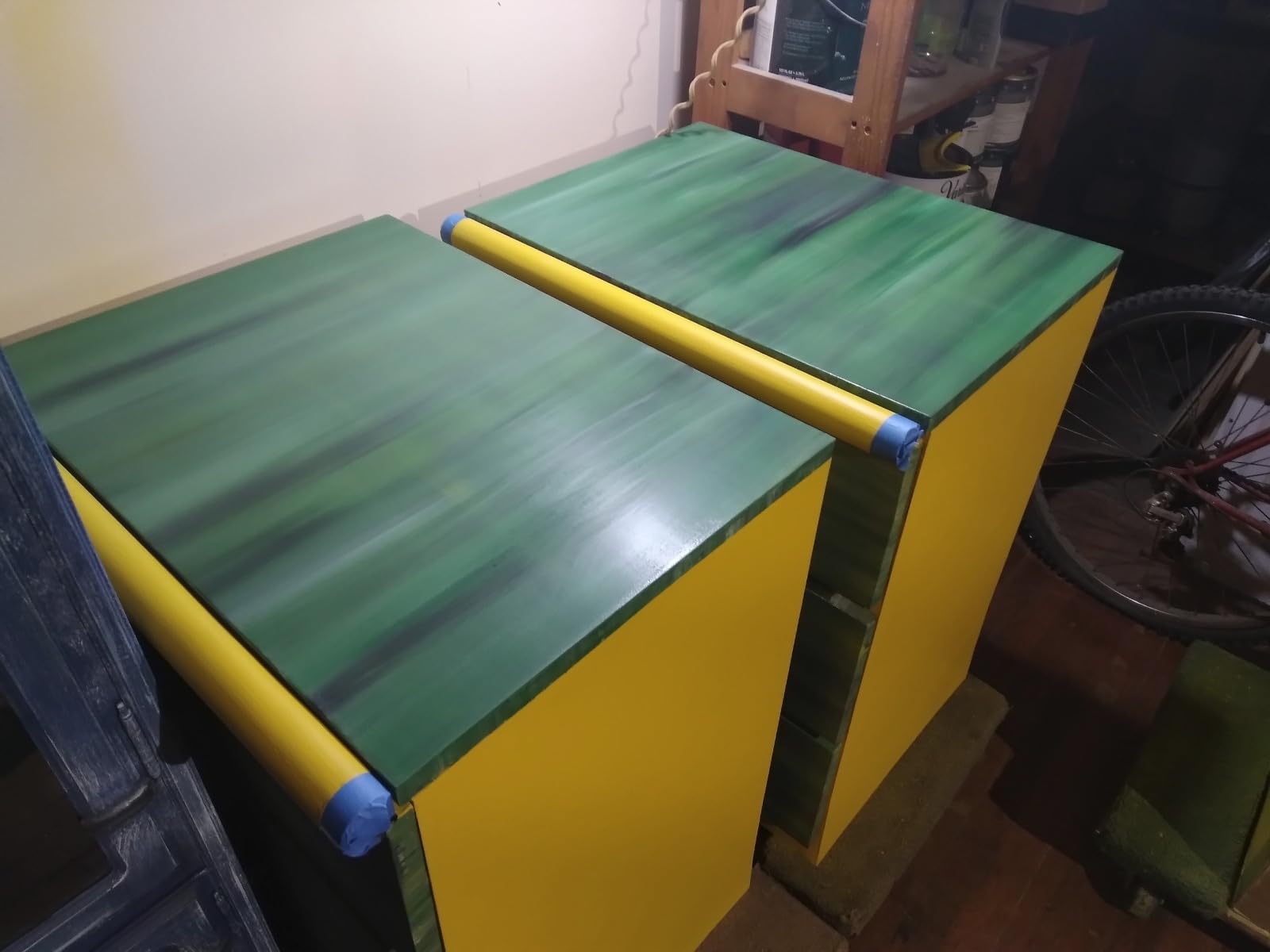
Forum regulars who paint incrementally tend to recommend small cordless handheld units over big floor pumps for exactly this reason: cleanup after a two-hour session is manageable, and the machine lives in a closet instead of taking up floor space. That is a real advantage over a 15 lb stand unit if you are not spraying continuously.
Coverage on trim, doors, casings and fences is good for the class. On broad walls you will be refilling constantly, because the 1000 ml cup empties in under two minutes of spraying.
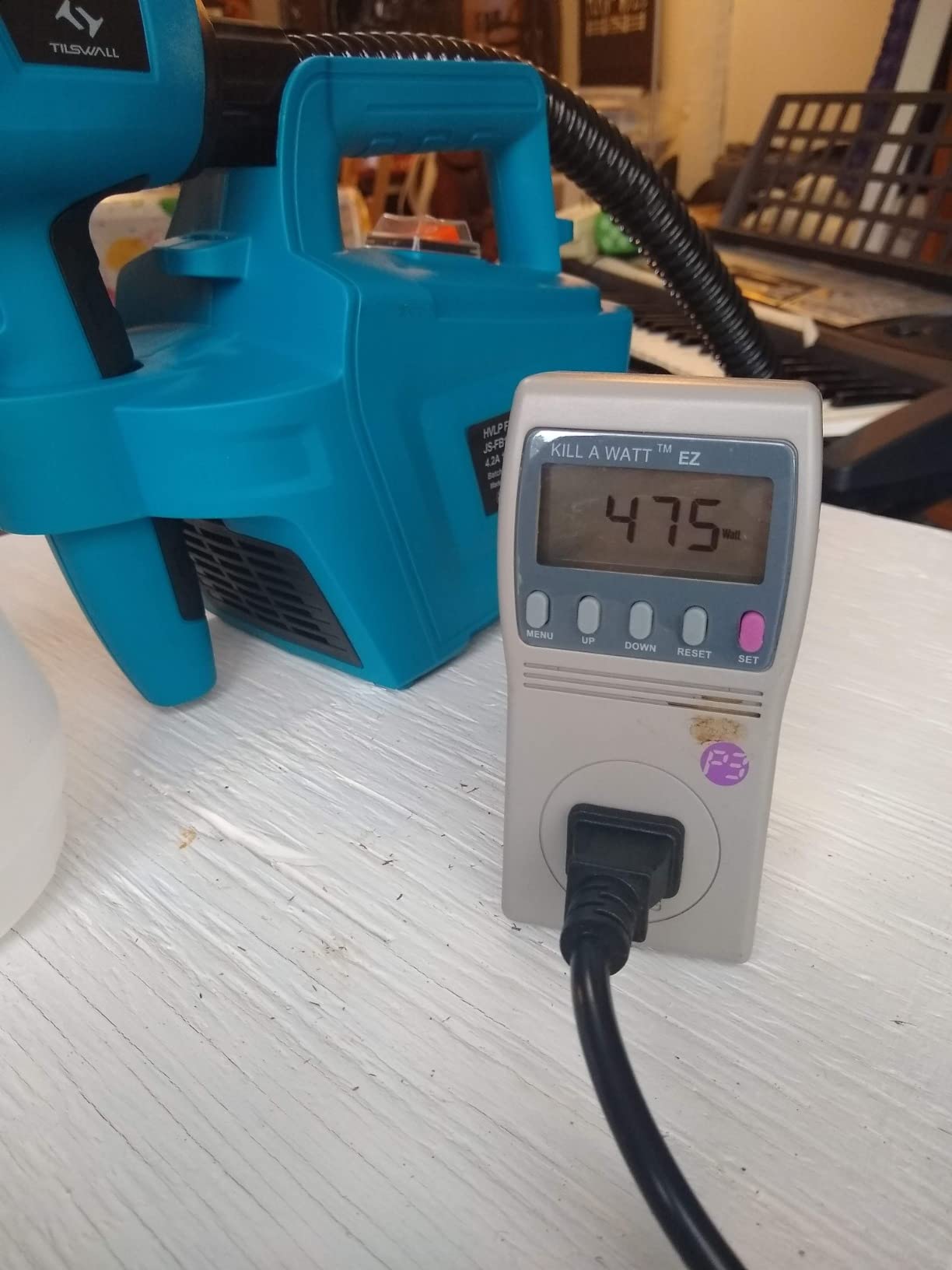
Who this cordless sprayer suits
Owners of DeWalt 20V batteries painting rooms across separate sessions, and anyone working in a space with awkward power access, a loft, a garage workshop, or a room where an extension cord is a genuine hazard.
It also works well for a single room plus its trim, where the total paint volume is small enough that the tiny cup stops being a problem.
What to know before you buy
Battery and charger are not included, and the tool is not compatible with the POWERSTACK battery series. If you do not already own DeWalt 20V packs, that is a real cost to factor in before anything else.
Owners also report the battery contact cutting out mid-pass and needing a jiggle to restart, paint generally needing thinning for consistent atomisation, and some units losing performance after only a few uses. The trim work is where this one earns its keep, not full walls.
6. Batavia 700W Split Motor and Gun: Best Split Design for Long Walls
Paint Sprayer – BATAVIA 700W HVLP High Power Spray Paint Gun with 6FT Air Hose, 4 Nozzles & 3 Patterns, Paint Gun for House Painting, Furniture, Cabinets, Fence, Home Improvement
700W motor
1 lb detachable gun
6 ft air hose
4 nozzles
Pros
- Separate motor keeps the handheld part at only 1 lb
- Shoulder strap on the motor unit helps with walls and ceilings
- Four nozzle sizes and three patterns cover sealers to latex
- Anti-backflow design reduces clogging
- ETL certified with a 24-month warranty
Cons
- Maximum viscosity of 120 Din-s means paint needs thinning
- 6 ft hose is short for larger rooms
- Larger footprint than an all-in-one handheld gun
The idea behind the Batavia is simple and correct: put the 700 watt motor in a separate unit with a shoulder strap, and give your hand a 1 pound gun connected by a 6.5 foot air hose. On a tall wall or a ceiling, the motor stays on the floor and only the light part moves.
That is the single most important ergonomic decision in this roundup. Hand fatigue is what ends a spray session early, and reviewers focus on the split motor and gun design as the main upgrade precisely because the 1 lb handheld gun keeps your arm fresh across a full room.
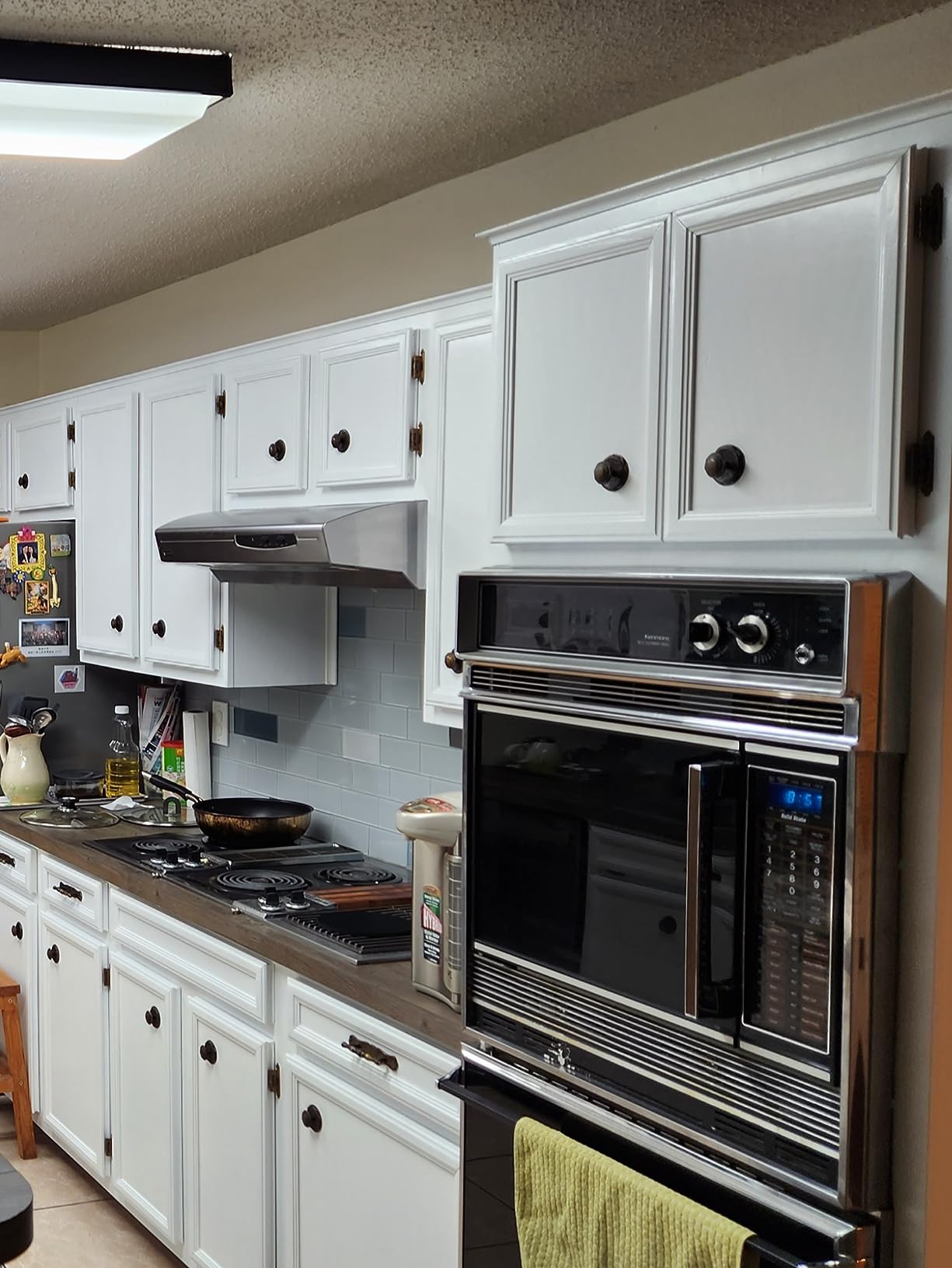
Four nozzle sizes at 1mm, 1.5mm, 2mm and 3.0mm cover sealers through to latex, with horizontal, vertical and circular patterns and an adjustable flow knob. The 360 degree anti-backflow design is a clogging countermeasure, and ETL certification plus a 24-month warranty are unusually reassuring at this level.
Worth noting for anyone still deciding between HVLP and airless: our backpack sprayer roundup covers the larger-volume end, but indoors a split gun like this is often the more practical option.
When the split design wins
Ceilings. Very tall walls. Long stretches of wall and trim in a single session. Anywhere you would otherwise be holding a heavy gun overhead, this setup keeps the weight off your arm and the motor unit supported by the strap.
It is also a good pick for a garage or basement workshop where painting a large surface is the point and outlet placement is awkward.
Where the design has limits
The 120 Din-s viscosity limit is the significant one. Thicker interior paint needs thinning, and thinning is where finishes go wrong. The 6 foot hose is also short compared with an airless machine’s hose, so you will be moving the motor more often in a large room.
It also takes more floor space than an all-in-one handheld, and the fine mist still means the room needs full masking before you start.
7. Wagner Spraytech FLEXiO 595: Best Handheld for Walls and Fine Detail
Wagner Spraytech FLEXiO 595 Handheld HVLP Paint and Stain Sprayer
X-Boost turbine
1.5 quart cup
9 speed settings
Two nozzles included
Pros
- X-Boost turbine sprays unthinned interior latex and stains
- Two nozzles cover walls and ceilings plus fine cabinet finishing
- Nine speed settings with flow width and pattern controls
- Compact and lightweight design reduces hand fatigue
- Cup liner speeds up colour changes and cleanup
Cons
- Costs far more than comparable budget HVLP sprayers
- 1.5 quart cup still means refilling mid-wall
- X-Boost turbine is noticeably loud
- Some units fail outright per owner reports
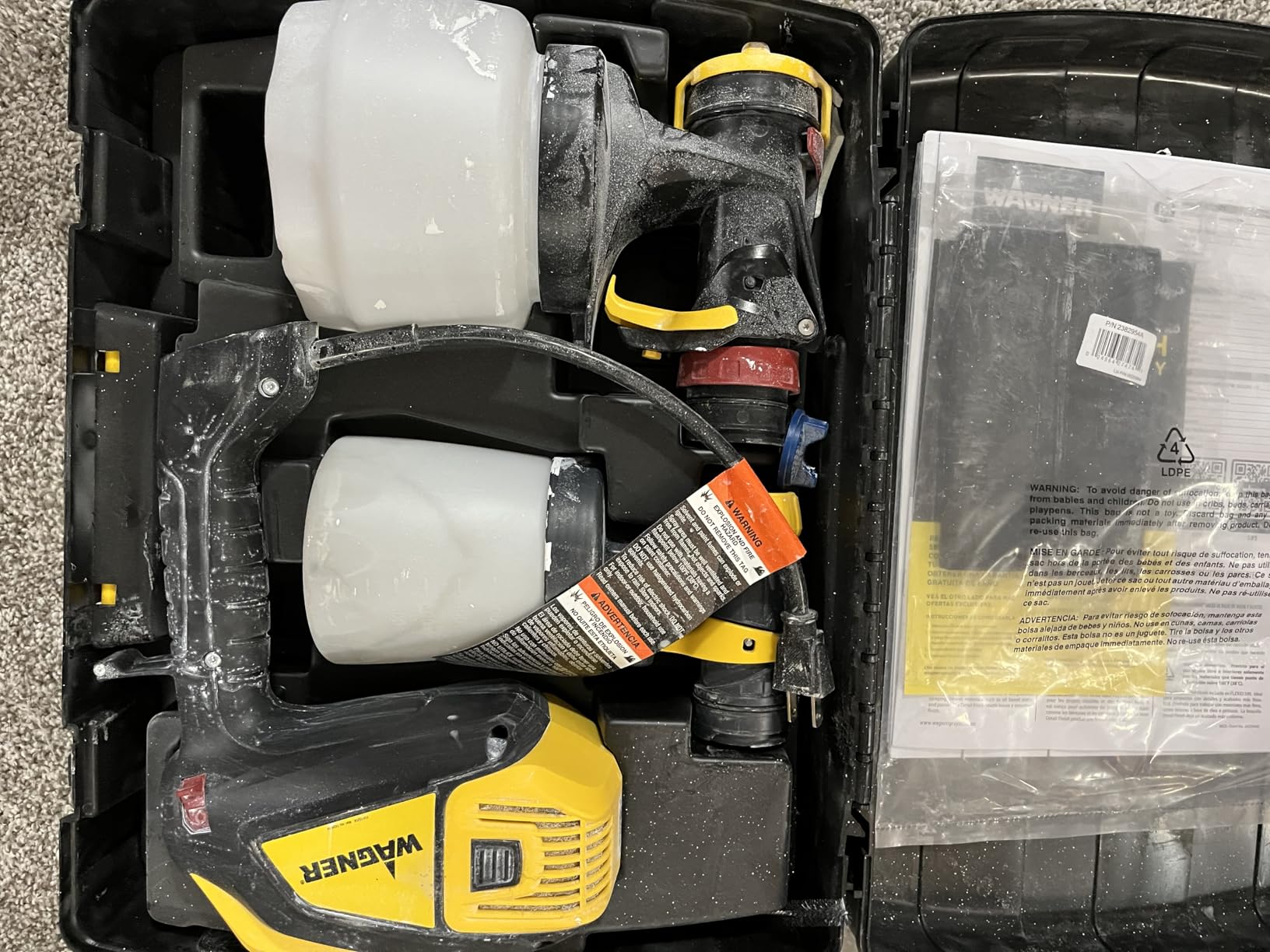
The FLEXiO 595 is the rare handheld that is genuinely honest about doing walls. Most cup-fed guns are furniture and trim tools that tolerate wall work. This one ships with an iSpray nozzle aimed at walls, ceilings and siding, plus a Detail Finish Nozzle for cabinets and furniture.
The X-Boost turbine is what allows it to spray most interior latex unthinned from a 1.5 quart cup, which no cheaper gun in this roundup manages. Wagner also claims it can paint an 8 by 10 wall in five minutes, and nine speed settings plus variable flow, spray width, and pattern size and direction controls give you real dial-in capability.
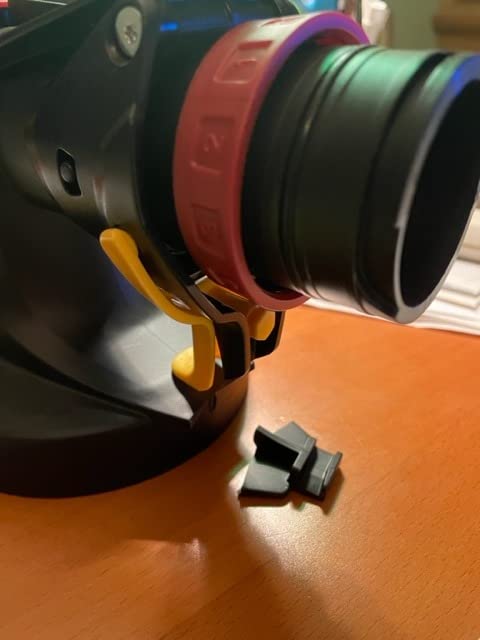
Owners like the dual nozzle setup and the compact body, and the bonus cup liner genuinely helps when you change colours, since you swap a liner instead of scrubbing the cup. For a hallway plus its trim, one unit covers both jobs.
One note on expectations: this is a handheld format, so it cannot match an airless machine on whole-room speed. It wins on versatility and finish quality per session, not on raw coverage rate.
Where the FLEXiO earns its place
Small to medium interiors where one machine needs to handle walls, ceilings and cabinets in the same project. The two-nozzle setup removes the usual compromise of owning one sprayer for walls and a second for detail work.
If you are repainting a room, its trim, and a few cabinet doors, that is exactly the job this tool was configured for.
Where you should think twice
Cost is the first issue. It sits well above the budget handheld tier for the same basic task, and that gap only makes sense if you will use the unthinned capability and the second nozzle.
Reviewers also flag a relatively high share of one-star reviews on durability, a cup size that still forces a refill mid-wall, and a turbine that runs noticeably loud. Budget for a replacement risk that cheaper guns do not carry.
8. VEVOR 650W Stand Airless Cart: Best Airless Cart for Large Jobs
VEVOR Stand Airless Paint Sprayer, 650W, 3000PSI High Pressure Airless Sprayer with Cart, Cleaning Brush, Hose, Extension Rod, Nozzles, Electric Spray Paint Machine for House Exterior and Interior
650W motor
3000 PSI
0.31 GPM
Wheeled stand and extension pole
Pros
- Very affordable airless option for large interior walls
- Handles whole-house and fence jobs well
- Wheeled cart and extension pole reduce climbing and bending
- Detachable pump body and a simple cleaning routine
- All-metal frame feels durable rather than flimsy
Cons
- 26.9 lb unit is heavy and takes up floor space
- Output pressure drops with thick paint
- Air hose is stiff and awkward to route
- Nozzle clogs occasionally on long ceiling and wall runs
The VEVOR is the pick for someone with a genuinely large interior, or a house and deck that will keep the machine busy. At 650 watts, 3000 PSI and 0.31 GPM, it is a real airless sprayer on a wheeled stand, and the all-metal frame is a step up in feel from the plastic-and-hose construction that dominates this price tier.
The wheeled base and extension pole are what make it usable on a full interior. You roll the cart to position, extend the pole for ceilings, and you are not repeatedly bending to the floor or dragging a 27 pound machine up stairs.
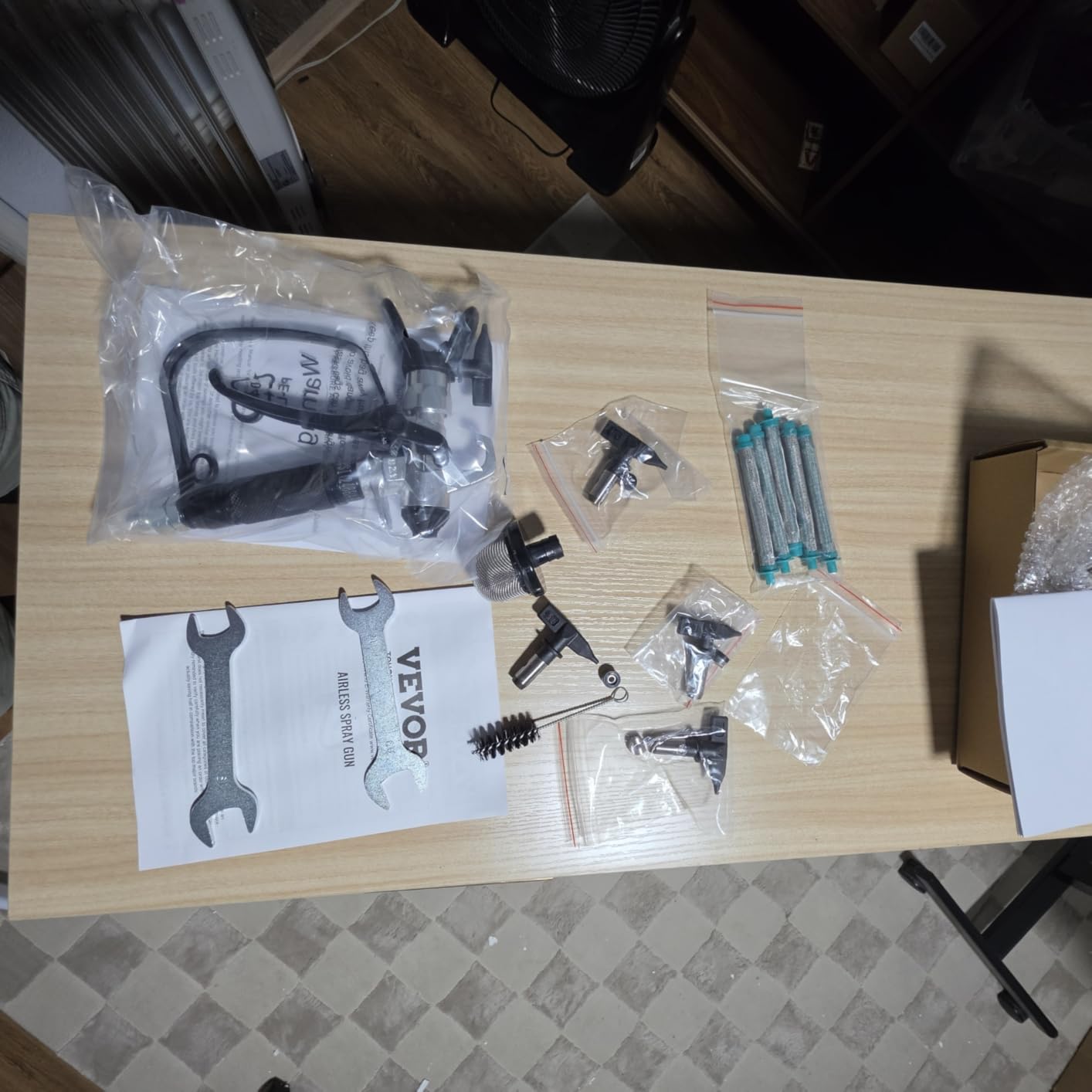
Seasoned sprayers describe it as a strong value airless machine that handles whole-house work well, and buyers report completing an entire house plus a long fence with it. The flexible suction tube draws from 1- to 5-gallon buckets, and the detachable pump body makes the routine clean more manageable than it looks.
For a similar airless experience at smaller scale, the InoKraft M1 in this same roundup is easier to move and lighter to lift, so match this one to the size of the job rather than the appeal of the cart.
What you gain with a cart airless
Coverage rate and reach. A wheeled airless unit keeps a steady fan across a large wall, and the extension pole removes the ladder from ceiling work on anything below about 10 feet.
It is also the natural unit to buy once if you plan to keep painting. An airless pump that gets flushed properly after each use will last across many projects, which is what makes the ownership maths work over time.
What to watch out for
Output pressure drops while pumping thicker paint compared with higher-end airless units, so the finishing on heavy acrylics is not quite as forgiving. The 26.9 pound weight and 37 inch height also mean real floor space when stored, and the air hose is stiff to route around a room.
Owners note occasional nozzle clogs during long ceiling and wall runs and recommend a routine unclog habit rather than reacting when the fan narrows.
9. LESONJOY 1000W HVLP: Best Large-Cup Handheld Sprayer
1000W High Power Paint Sprayer – Corded HVLP Paint Sprayer with 4 Sizes Copper Nozzles, Easy to Clean & Control Power Painter for House Painting, DIY Crafting, Tables & Chairs Blue
1000W motor
1400 ml cup
4 copper nozzles
Flow and width controls
Pros
- 1000W motor gives a smooth brush-free mist
- 1400 ml cup is among the largest capacities at this level
- Four copper nozzles from 0.8mm to 2.5mm cover stains and latex
- Flow and width controls limit paint waste and overspray
- Tool-free disassembly for deep cleaning
Cons
- Unusually high share of 3-star reviews suggests inconsistent results
- 21 inch tall body needs counter or table space
- Paint still needs proper thinning for full walls
The LESONJOY takes a different route from the other budget guns. Rather than adding accessories, it adds power and a bigger reservoir: a 1000 watt motor with a 1400 ml cup, plus integrated flow control and spray width adjustment knobs on the body.
Reviewers single out the 1000W motor and the copper nozzle set as producing finer atomisation than most sprayers at this level, and the large reservoir means fewer refills than the 40 fl oz and 1200 ml guns it competes with. The four copper nozzles span 0.8mm to 2.5mm, which covers stains, sealers and latex.
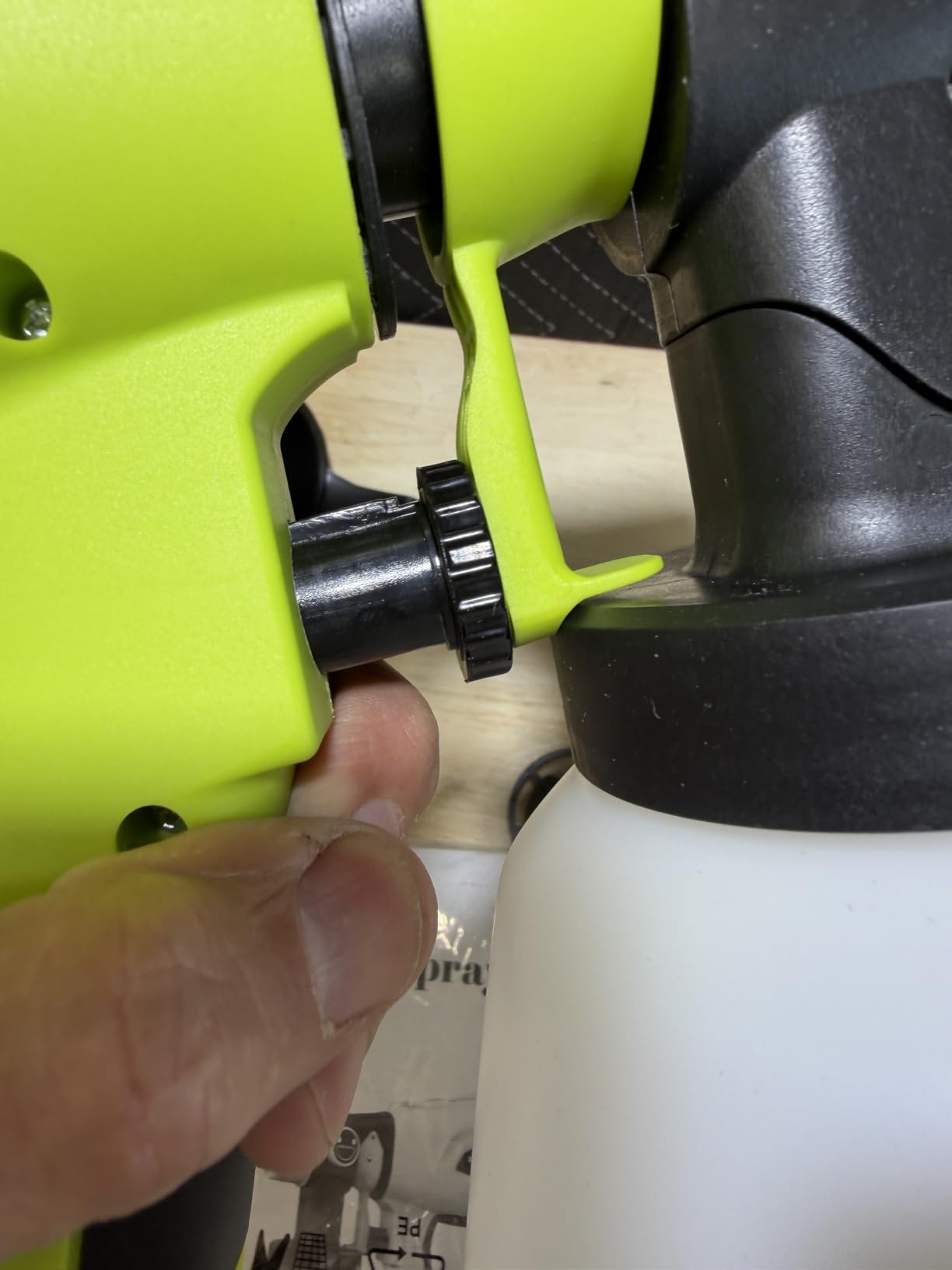
The width adjustment knob deserves more attention than it gets. Most handheld guns spray a fixed fan, so you control coverage by moving the gun, which is how you end up with lap marks. Being able to set the fan width for the wall you are on makes it easier to hold one consistent pass pattern across a whole surface.
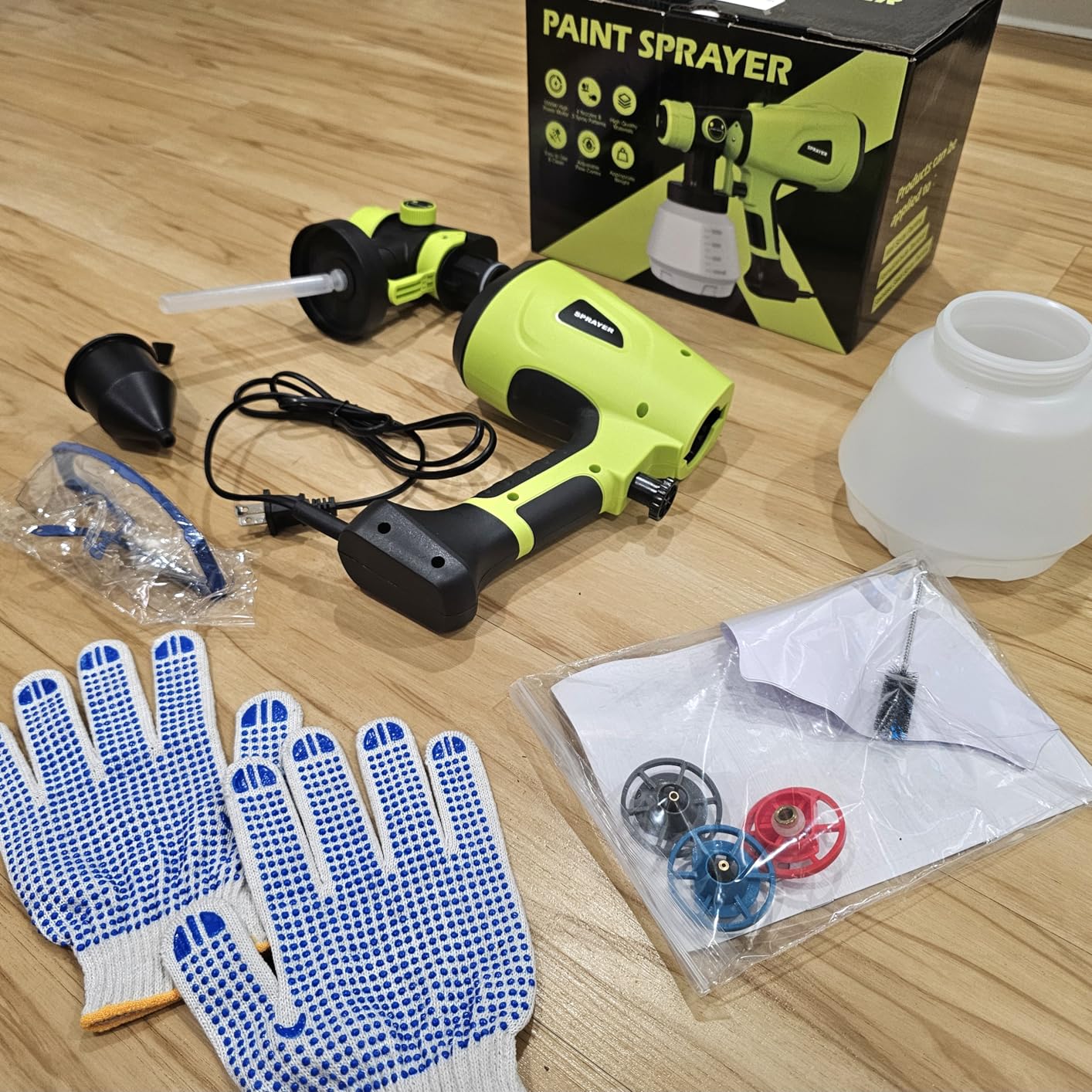
Tool-free disassembly for deep cleaning of the fluid path, with a brush, clogging needle, gloves, viscosity cup and filter funnels in the box, is what keeps long jobs from turning into a clogging problem.
Where the extra power and cup pay off
Doors, cabinets, furniture and a smaller wall or two, where you want more output per pass than a small handheld gives you without moving up to airless. The 1400 ml cup is genuinely helpful on a sequence of cabinet doors.
It is also a good fit for people who dislike the noise and fuss of a pump machine and just want a self-contained handheld they can rinse out.
What to watch
There is an unusually high share of three-star reviews, which points to inconsistent results rather than a broken product. The 19 percent three-star cluster suggests the finish depends heavily on getting the viscosity right.
Paint still needs proper thinning for full walls, the 21 inch tall body needs counter or table space, and the listing does not state a warranty term. For a whole interior, an airless unit remains the better tool.
10. PULENDY 4-Nozzle Sprayer: Best Low-Cost Way to Test Spraying
PULENDY Paint Sprayer for House Painting, 4 Nozzles & 3 Spray Patterns
4 nozzle sizes
3 spray patterns
Flow control knob
Tool-free assembly
Pros
- Lowest barrier to trying a sprayer for the first time
- Four nozzles cover thin sealers through to latex
- Flow control helps reduce paint waste
- Cleans easily by flushing through the included connector
- Consistent results with regular cleaning
Cons
- Paint must be thinned properly or the finish comes out splotchy
- Instruction booklet is thin on technique
- Nozzle clogs if the spout is not cleaned during a project
- Not suitable for a full interior wall as a primary tool
The PULENDY is here for one specific job: finding out whether spraying suits you before you spend on a machine you would use properly. It is a four-nozzle handheld with horizontal, vertical and circular patterns and an adjustable flow control knob to manage output and reduce waste.
That last feature is the one that matters most here. Flow control lets you dial the output down on trim and up on a broad surface, which is exactly the adjustment that prevents the globs and runs that make people conclude spraying is a bad idea.
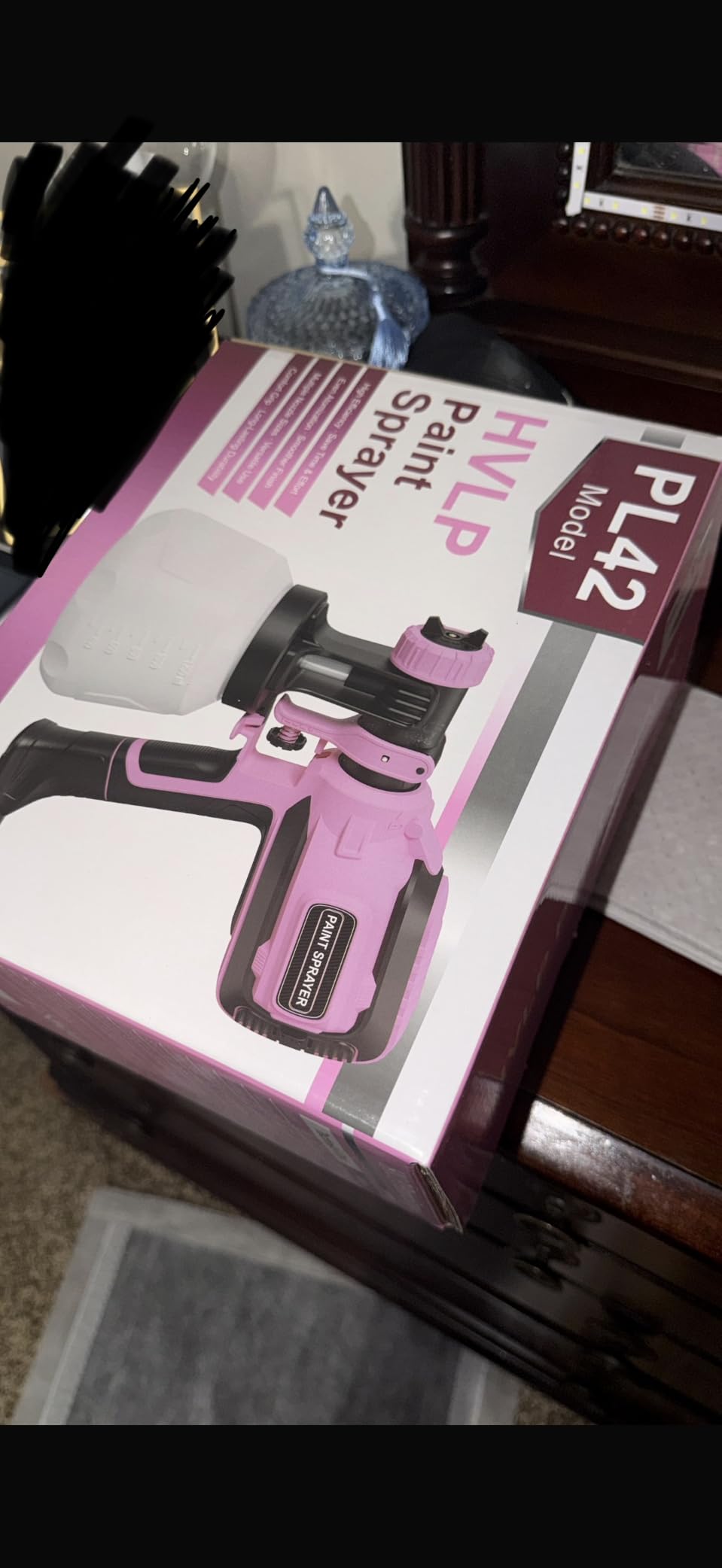
Buyers treat it as an inexpensive sprayer for cabinets, furniture, doors and decks, and report good results once paint viscosity is dialled in. The included viscosity cup is the key accessory: use it instead of guessing how much water to add.
Recurring complaints centre on under-thinned paint causing texture, and on the need to clean the nozzle between passes rather than at the end of a project. Some buyers also report the tool stopping pulling paint after a single use, so treat it as consumable rather than an investment.
Who should buy this one
Someone who wants to spray a handful of cabinets, a door, or a small section of wall and has no intention of ever using an airless pump. The tool-free assembly and the connector-based flush keep the learning curve shallow.
It is also a reasonable secondary tool to keep for touch-ups after a bigger machine has done the heavy work.
What to be careful about
Paint must be thinned properly, often to roughly a three-to-one paint-to-water ratio, or the finish comes out splotchy and textured. That ratio is a starting point, not a rule, so test on cardboard every time you change paint.
The instruction booklet is thin on technique, the nozzle clogs if the spout is not cleaned frequently during a project, and the honest verdict is that this is not a primary tool for a full interior wall.
How to Choose a Paint Sprayer for Interior Walls
Start with paint, not with the machine. The single most useful question is whether you are willing to thin your paint. If you are painting with full-thickness latex and you do not want to add water, you need an airless machine or a turbine-powered handheld like the Wagner FLEXiO 595. Everything else on the list is a cup-fed HVLP gun that performs best on slightly thinned paint.
That single choice eliminates half the list. It also removes the most common complaint in painting forums, which is owners thinning paint aggressively to stop clogging and then wondering why the finish runs and sags.
Airless versus HVLP versus cordless. An airless sprayer uses an electric pump to push paint from a bucket through a reversible tip at roughly 1000 to 3000 PSI. It is the fastest option and the only one that truly handles unthinned interior latex at scale, but the cleanup is a real routine and the overspray is finer. An HVLP sprayer mixes paint with a high-volume, low-pressure airstream from a cup, which gives cleaner atomisation, less overspray, and a much easier rinse, but it is slower and it wants thinner paint. A cordless sprayer is a handheld HVLP that runs off a battery, which removes cord routing entirely and is ideal for room-by-room sessions.
Size it to your project, not your ambition. This is the most common forum question and no competitor answers it directly, so here is a straightforward sizing guide. One room plus trim: a handheld HVLP gun. Two to four rooms: a compact airless unit like the InoKraft M1, which gives you unthinned spraying without a large machine to store. A full interior of five or more rooms or a multi-floor job: a stand or cart airless like the Graco Magnum X5 or the VEVOR. A single rental unit or one small room: rolling may honestly be the faster, cheaper option once masking is counted.
For a 1400 sq ft townhouse, the answer is a compact airless machine. You will consume more paint than rolling, so add roughly 10 to 15 percent to your paint estimate and keep extra for touch-ups, because a sprayer will find every drywall seam on the first pass.
Count the paint, not just the gallons. A gallon of interior latex covers roughly 350 to 400 sq ft of wall area by roller, and somewhat less by spray, because overspray and the fine mist that lands on masking instead of the wall both count against you. Budget a little extra, and strain every gallon through a paint filter before it goes in the machine. Unstrained store paint is a leading cause of tip clogs.
Check parts availability before you check features. The single most repeated trust signal in owner discussions is that a Graco is easier to service than a generic machine, because tips, guns, hoses and seals are easy to source years later. A titanium or carbide tip, a replacement gun, and a spare filter set are consumables you will eventually need. If those parts are hard to find, the machine is cheaper to buy and more expensive to own.
Decide between buying and renting honestly. For one room or less, renting is usually the sensible call, because rental covers the project cost for a day and you skip the flush routine and the storage problem entirely. For a full interior, buying wins, and the machine retains value afterwards. Resale is a normal part of the ownership maths among owners: finishing the job and selling the sprayer recovers a meaningful share of what you paid, which is one reason the same model keeps showing up in second-hand recommendations. If your outdoor projects are part of the plan, our tow behind sprayer guide covers the other end of that equation.
Look for the boring reliability features. A reversible RAC-style tip, a swivel gun for corners and ceilings, a flow control knob, a flush valve, and a self-priming pump. These do not appear in marketing copy but they are what determine whether your second project goes as smoothly as your first.
Match tip size to the paint. For thin latex interior paint, a mid-size reversible airless tip in the 515 family is the standard starting point, and the InoKraft M1 ships with one. For heavier acrylics, step up rather than thinning aggressively, because more pressure with a larger orifice produces better atomisation than thin paint at a small one. For HVLP guns, the copper and brass nozzle sets on the LESONJOY and HomeRight cover the same range by millimetres.
How to Spray Interior Walls Without Lap Marks
A lap mark is the visible seam left where two spray passes meet, and it appears when one pass is still wet when you come back over it, or when the passes do not overlap enough. Both are technique problems, and both are fixable.
1. Mask the room properly before anything else. Windows, door frames, light fixtures, switches, outlets, trim edges, floors and any ceiling that is not being painted. Fine mist travels, and overspray on a ceiling is the reason people decide they hate spraying. A plastic sheeting and tape job takes longer than you expect and saves the whole project.
2. Stir and strain the paint. Stir thoroughly, then pass every gallon through a paint filter. Store paint that has sat in a store tank is where most clogs start, and a filter takes seconds to fix a problem that would otherwise cost you an hour of needle cleaning.
3. Test spray on cardboard first. With the same tip, the same distance and the same paint you are about to put on the wall. Adjust flow control until the pattern is even and the edges are soft rather than torn.
4. Hold the gun about 12 inches from the surface. Too close and you get runs. Too far and the mist has time to settle unevenly. Keep the distance constant, because changing it mid-pass is a common cause of the uneven sheen that people mistake for a defective machine.
5. Keep the gun perpendicular and move it with your arm. Do not sweep with your wrist. A wrist-driven pass fans out toward the end of the pass, which is where lap marks come from. Wrist-flip only at the very start and end of a row.
6. Trigger before you move and release before you stop. Starting the fan while the gun is already moving deposits heavy paint at the start of the pass. Release the trigger just past the end of the row rather than on it, so the deposit thins out instead of stopping dead.
7. Overlap each row by about one third and work in a consistent order. Maintain the same speed, the same distance, and the same overlap for every row. Then do ceilings before walls, or walls before ceilings, but pick one order and stick to it so the wet edge stays at a reachable distance.
For ceilings, the technique changes slightly. Work in one direction, keep the extension pole moving, and avoid going back over a section that is starting to dry. For a wall and ceiling junction, use the gun’s swivel or angle the wrist consistently so the overlap line does not show.
Fixing Orange Peel, Runs and Shadow Lines on Sprayed Walls
Orange peel is a textured, uneven surface caused by poor atomisation or paint that was thinned too far. The fix is a smaller tip or higher pressure, not thinner paint. Do not add water to correct orange peel; that makes the problem worse. If the tip is clean and the pressure is right and the texture persists, the paint is too thin, and the correction is a second coat at full viscosity.
Runs and sags mean too much paint is landing in one place. That comes from holding the gun too close, moving too slowly, or setting flow control too high. Turn the flow down, move the gun faster, and pull back to 12 inches. A run that has already formed will not recover; it needs to dry fully and be sanded or painted over.
Shadow lines are darker bands where a pass overlapped a still-wet area too heavily. They are a timing problem, not a machine problem. Work smaller sections and return to each one within the product’s own open time.
Lap marks follow the same logic. Move faster, overlap by about a third rather than half, and keep your distance constant. If the whole wall has a slightly uneven sheen, the fix is a second coat applied evenly rather than spot correction.
On a final walk-through, run your hand along the wall. A smooth hand glide across the surface with no ridges means the atomisation is right. If it feels like fine sandpaper, the paint is too thin or the pressure is too low for the tip.
Masking, Ventilation and Cleaning an Interior Sprayer
Ventilate the room properly and open the windows before you start. Solvent-based paints and cleaning fluids produce fumes that need airflow, and indoor spraying concentrates them in a smaller space than you might expect. Keep pets and children out of the house entirely while spraying and for several hours afterwards.
Wear a respirator and eye protection. A dust mask is not a respirator. Respirators are the clearest marker that someone has actually sprayed indoors before, and fine paint mist is not something you want in your lungs across a long project. Gloves and coveralls save your clothes, since overspray does not wash out of fabric easily.
Never spray glass or windows. Paint will adhere to the surface and turn any stray overspray on a window into a sanding job. Glass and windows should always be covered, not simply wiped afterwards.
Keep the tip wet during breaks. If you take a lunch break or step out of the room, soak the tip in water or the appropriate solvent and keep it covered. Dried paint at the tip is the number one cause of clogs, and it costs ten seconds to prevent versus twenty minutes to clear.
Use a reversible tip correctly. The Graco, InoKraft and other airless machines in this roundup use reversible tips. When the fan narrows or stops, flip the tip to the clean side and spray into a scrap container. That clears a soft clog instantly. If the clog does not clear, the paint dried in place, and you need a needle and a proper flush.
Clean in the right order for an airless machine. Wipe the tip clean, flush the gun and hose with water or solvent, then run solvent through the pump using the flush valve or by removing the filter cap. Never run the pump dry, because that is how you destroy an airless machine. Owner reviews of the VEVOR describe a routine clean of about five minutes, which is the realistic benchmark.
Clean an HVLP cup gun immediately. Soak the nozzle, tip and air passages in warm soapy water, run the gun through with the cleaning connector, and reassemble while the parts are still damp. Latex sets fast enough inside a cup to make a two-minute job take twenty.
Give cleaning a time budget before you buy. This is the honest test of whether a sprayer suits you. If a sprayer saves you 45 minutes of application and then takes 45 minutes to clean, you did not actually save time. Budget for it, or rent instead. If your project also includes ice rink or field lines, our ice rink crease paint kit guide covers that separate use case.
Frequently Asked Questions
What is the best spray machine for painting walls?
For most homeowners painting interior walls, the best spray machine is an airless sprayer in the 3000 PSI class that feeds from a 5-gallon bucket, such as the Graco Magnum X5. Airless machines spray latex unthinned, which prevents the runs and sags that come from over-thinned paint. A handheld HVLP gun is better only for trim, cabinets, and single small rooms, because its cup has to be refilled repeatedly.
Are paint sprayers good for interior walls?
Yes, with caveats. Spraying cuts application time on interior walls and ceilings substantially compared with rolling, and it leaves no roller texture or brush marks, which matters on textured drywall under raking light. The trade-offs are real: you use more paint because some of the mist lands on masking instead of the wall, and you must mask windows, fixtures, trim, and floors thoroughly. A sprayer also cannot rescue paint that was thinned too far, so full-viscosity paint plus correct tip size matters more than the machine.
What is the best paint sprayer for walls?
The best paint sprayer for walls depends on project size. For a full interior, an airless model with at least 3000 PSI, bucket feed, and a reversible tip is the right tool. For one room plus trim, a compact handheld HVLP gun that sprays unthinned latex, such as the HomeRight Super Finish Max or the Wagner FLEXiO 595, is faster to set up and far easier to clean. For a single small room, rolling may genuinely be faster once masking is counted.
What sprayers do professional painters use?
Professional interior painters typically use commercial airless machines in the Graco Ultra and UltraMax class, or larger pump sprayers, because they spray for hours a day and need pump longevity. Many trade painters start on a Graco Magnum-series airless unit and move up as volume grows. Professionals also point homeowners away from that line for daily trade use, and away from buying a large machine for a small job, because setup and cleaning time dominate on short jobs.
How much paint does a spray gun use compared with a roller?
A spray gun typically uses more paint than a roller on the same wall area because a portion of the atomised mist lands on drop cloths, sheeting, and floors rather than the wall. Plan on adding roughly 10 to 15 percent to your roller-based paint estimate when spraying interior walls, plus extra for touch-ups. The overspray penalty shrinks in a large open room and grows in a small, cluttered one, so budget more paint for a single small room than for an open-plan space.
What tip size do I need for latex interior paint?
For thin to medium interior latex, a mid-size reversible airless tip in the 515 family is the standard starting point, and that is what ships with several of the airless machines in this roundup. For heavier acrylics, step up to a larger orifice rather than thinning aggressively, because higher pressure and a bigger opening atomise better than thin paint through a small one. On HVLP guns, match the millimetre nozzle to the paint, starting around 2.0mm for latex and dropping to 1.5mm for stains and sealers.
Final Verdict for Interior Wall Spraying in 2026
For most people asking about the best paint sprayers for interior walls, the Graco Magnum X5 is the answer. It sprays unthinned latex from a 5-gallon bucket at 3000 PSI, it holds the highest rating in this group with 80 percent five-star reviews, and the Graco name means you can buy a replacement tip or gun in five years rather than hunting for an obscure part.
If your project is one room, its trim and a few cabinets, the HomeRight Super Finish Max gives you a good finish on a light tool with more owner feedback behind it than anything else here. If you want to try spraying before spending meaningfully, the VONFORN is the low-risk way in. And if you paint across several weekends, the TILSWALL cordless unit removes the extension cord entirely.
Whichever you pick, decide the machine by your paint and your square footage, mask the room properly, strain every gallon, and give yourself a time budget for cleaning. Get those three right and the finish problems that scare people away from spraying mostly disappear. Check the current details for your pick, then start with one wall.