
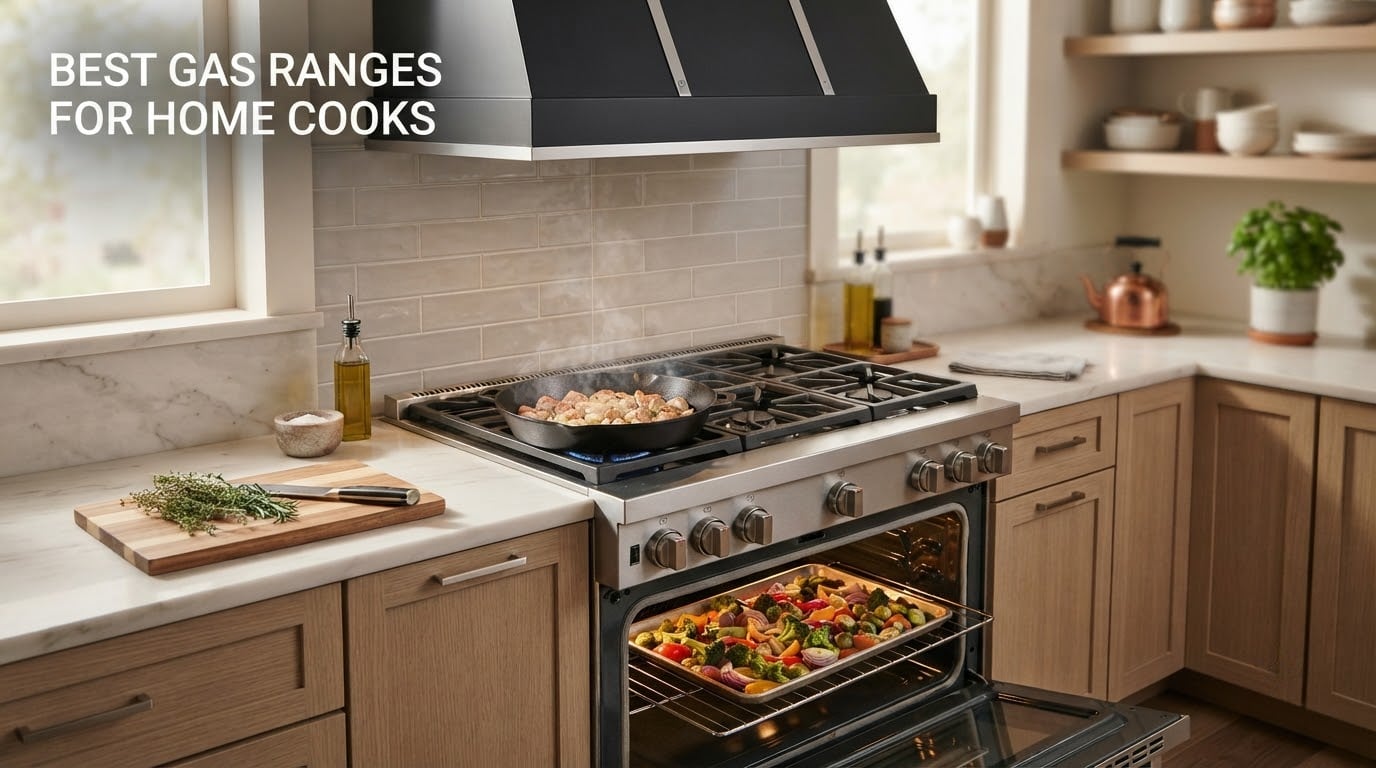
A gas range is the one appliance that quietly decides how you cook every single night. Flame response under a cast iron skillet, the spread between a 4,000 BTU simmer and an 18,000 BTU sear, and whether a sheet of cookies browns evenly on both trays — those are decisions the range makes for you, and reversing one is expensive.
We spent weeks comparing cooktop layouts, oven cavities, burner output, griddle coverage, and the number of electronic boards sitting behind the control panel, then weighed all of it against what owners report after a few years of real use. The result is our shortlist of the best gas ranges for home cooks in 2026: ten models that cover genuinely different kitchens, from a 20-inch apartment range to a six-burner 36-inch cooktop, and budgets that range from a straightforward stainless freestanding to a pro-style front control with true convection.
One note before we start. In US usage, a range and a stove are the same appliance, and a cooktop is the same burner section sold without the oven. If you are still narrowing the field, our broader picks for the best gas ranges cover a wider price spread, and our gas range picks under 1000 cover the entry end in more depth. This page is built around the cooking itself: what it feels like to cook on Monday night and what happens when you need a pan of onions down fast while a stockpot comes to a boil.
We also kept one rule that most roundups skip: every model here has to be honest about what it does badly. Each block below names the flaw, not just the feature, so you can rule a model in or out quickly.
Table of Contents
Top 3 Picks for Home Cooks Right Now (September 2026)
Three models stand above the rest for the widest range of home kitchens. The COSMO Haven is the one we would put in most houses, the Rangaire has the most capable cooktop in the set, and the Kenmore has the largest oven cavity in a 30-inch footprint.

COSMO Haven 30 in. Gas Range
- 5 sealed burners 4000 to 18000 BTU
- 4.8 cu ft convection oven
- Cast iron grates
- Knob controls with no motherboard

Rangaire RRG303TS
- 21000 BTU dual-ring center burner
- Five CleanSeal sealed burners
- 5.1 cu ft convection oven
- Telescoping EasyReach racks

Kenmore 5.6 cu ft Front Control
- 5.6 cu ft true convection oven
- Air-fry mode with basket
- 19000 BTU Turbo Boil+ burner
- Self-cleaning with hidden bake element
Best Gas Ranges at a Glance in 2026
All ten models, side by side. The feature column pulls the spec that matters most for how the range actually cooks, so you can scan this before reading the full reviews.
| Product | Specifications | Action |
|---|---|---|
| COSMO Haven 30 in. 5-Burner Gas Range |
|
Check Latest Price |
 Avanti 20 in. 4-Burner Compact Gas Range Avanti 20 in. 4-Burner Compact Gas Range |
|
Check Latest Price |
| Rangaire RRG303TS 30 in. Slide-In Gas Range |
|
Check Latest Price |
 COSMO Nebula 30 in. 5-Burner Gas Range COSMO Nebula 30 in. 5-Burner Gas Range |
|
Check Latest Price |
 VEVOR 30 in. Gas Range and Oven VEVOR 30 in. Gas Range and Oven |
|
Check Latest Price |
 Bosch 800 Series 30 in. Slide-In Gas Range Bosch 800 Series 30 in. Slide-In Gas Range |
|
Check Latest Price |
| Kenmore 5.6 cu ft Front Control Gas Range |
|
Check Latest Price |
 KOSTCH 30 in. Pro-Style Gas Range KOSTCH 30 in. Pro-Style Gas Range |
|
Check Latest Price |
 AAOBOSI 36 in. 6-Burner Gas Range AAOBOSI 36 in. 6-Burner Gas Range |
|
Check Latest Price |
 Empava 30 in. True Convection Gas Range Empava 30 in. True Convection Gas Range |
|
Check Latest Price |
1. COSMO Haven 30 in. 5-Burner Gas Range – The One Most Home Cooks Should Buy
30 in. Haven Coll 4.8 cu ft 5 Burner Gas Range, Convection, Stainless Steel
5 sealed burners 4000 to 18000 BTU
4.8 cu ft convection oven
Cast iron grates
Knob controls
Pros
- Wide 4000 to 18000 BTU burner spread
- Convection oven and generous 4.8 cu ft cavity
- Knob controls mean no motherboard to fail
- Same cooktop sold in 24 30 36 and 48 inch widths
Cons
- Oven igniter durability is the most common owner complaint
- Storage drawer feels cheap
- Runs on a 120V outlet not 220V
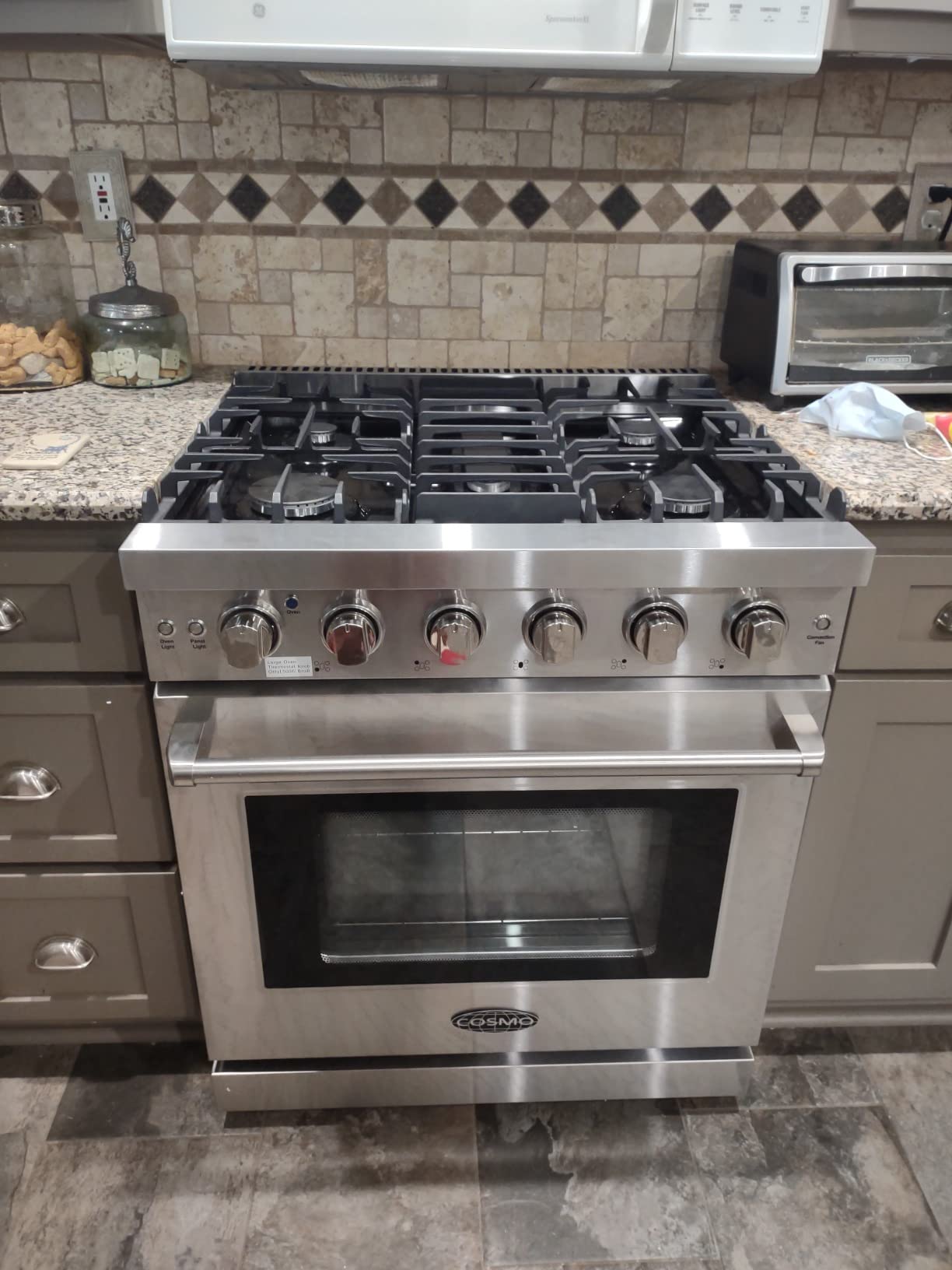
This is the range we keep coming back to, and the reason is boring in the best way. The cooktop gives you five sealed burners running from 4,000 BTU to 18,000 BTU, which means a sauce can hold at a whisper while the same cooktop still gets a cast iron pan to a hard sear. That spread is the whole game for weeknight cooking, and it is the first thing most buyers notice once the box is opened.
The second reason is what is missing. Every control on this gas range is a mechanical knob, including the oven. There is no control board, no touchscreen, and no firmware to go wrong. Owners who bought the Haven for that reason tend to still be praising it years later, and the same simplicity shows up in how the range behaves when the house power flickers.
The 4.8 cu ft convection cavity is larger than it looks and comfortably holds a whole chicken or a large roasting pan. Convection here is a fan-assisted bake rather than a true convection system with its own third heating element, so it speeds up cooking and evens things out but will not behave quite like a dedicated true convection oven. For weekday roasting and casseroles, that is plenty.
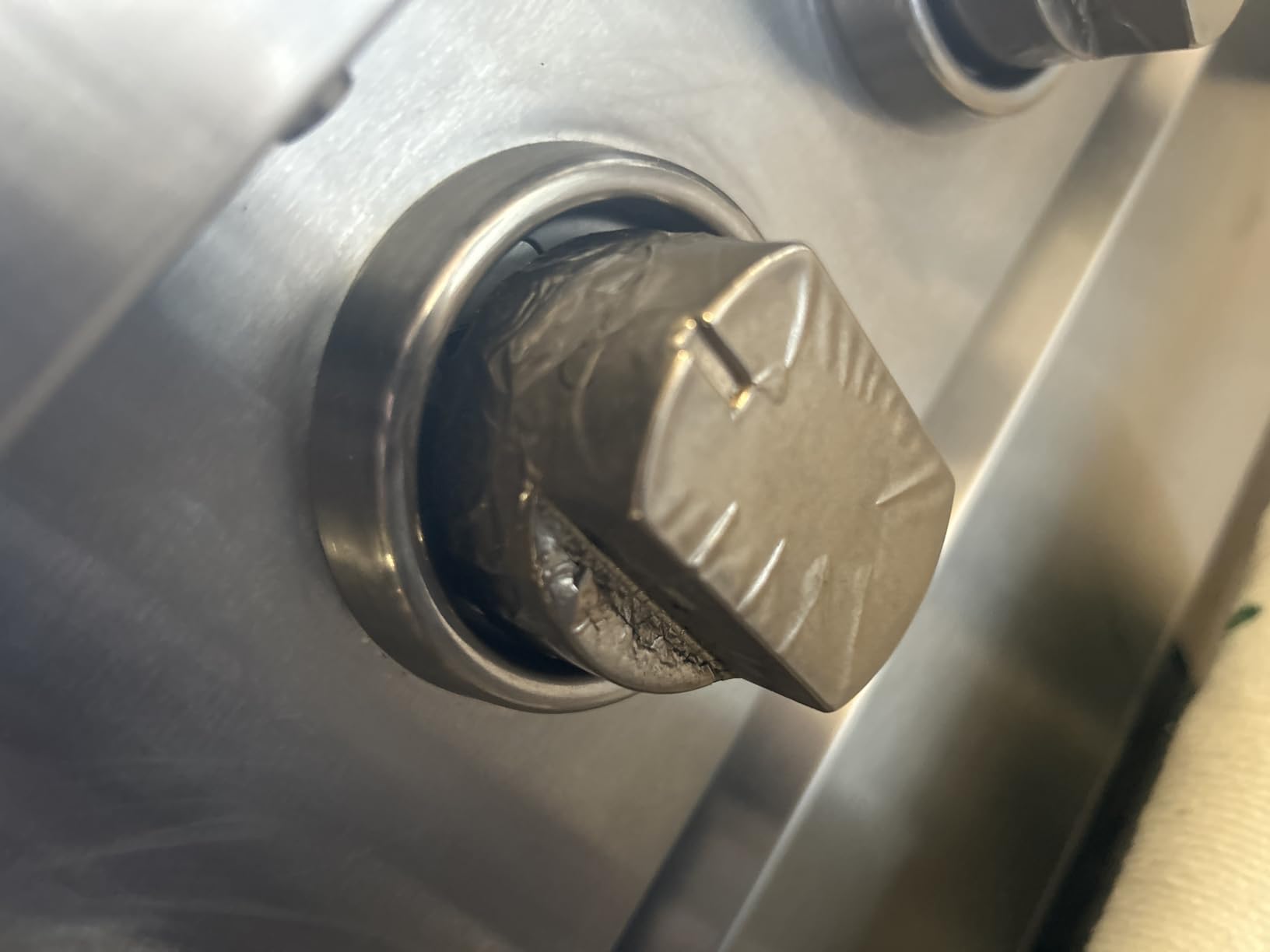
There is a real flaw, and it is the same one that shows up across this brand’s owner reviews: the oven igniter. A meaningful minority of owners report igniter problems and door hardware wear a few years in, and the rating distribution reflects that split, with a strong majority at five stars and a long tail of service complaints. If you buy this range, keep the model number and the warranty paperwork somewhere you will actually find them.
Who this gas range suits
It suits the person who cooks four or five nights a week, roasts on weekends, and wants a range that responds to the knob without an app, a screen, or a learning curve. If your cooking spans simmering, searing, and baking in equal measure, the burner spread and the 4.8 cu ft cavity cover all three without extra features.
It also suits anyone replacing a builder-grade range in a standard 30-inch opening, since the same cooktop is offered in narrower and wider bodies for different kitchens.
Who should look elsewhere
Skip it if you want true convection with a dedicated convection element, or if you bake enough that a small temperature offset would bother you. It is also not the choice for a rental or a high-turnover household, where the igniter complaint pattern is the wrong risk to carry.
And if your kitchen is small enough that a 30-inch body is a squeeze, read on: there is a 20-inch option further down that solves exactly that problem.
2. Avanti 20 in. 4-Burner Compact Gas Range – Built for Very Small Kitchens
Avanti Compact Gas Range Oven, 4 Sealed Burners, 20-Inch, Stainless Steel
20 inch freestanding footprint
2.1 cu ft oven
8800 BTU across four burners
LP kit included
Pros
- The one compact range in the set that fits a small opening
- Automatic electronic ignition with no standing pilot
- LP conversion kit included
- Lightest body here at 104 pounds
Cons
- Small 2.1 cu ft oven holds modest dishes only
- Oven temperature is hard to regulate
- Thin sheet metal dents easily and the oven flame can go out
This is the compact gas range in the group, built for a kitchen where a 30-inch range simply will not go, and that narrow job is why it exists. At 22 inches deep and 26 inches wide, it fits the galley kitchens, condo units, office break rooms, and vacation rental fit-outs where a full-size appliance would eat the only counter you have. The included LP conversion kit means it works on propane or natural gas out of the box.
Cooking on it is a compromise, and the compromise is mostly the oven. At 2.1 cu ft it is genuinely small, and owners consistently describe both the temperature regulation and the preheat time as the weak point. It is a two-rack oven. That is fine for a weeknight sheet pan and a small casserole, and it is not fine for a holiday turkey.
The cooktop is the more pleasant surprise. Four sealed burners totaling 8,800 BTU is not a searing range, but sealed ports wipe clean, the dial controls are unambiguous, and automatic electronic ignition means no standing pilot to manage. For a rental or a first apartment, that simplicity is worth more than power.
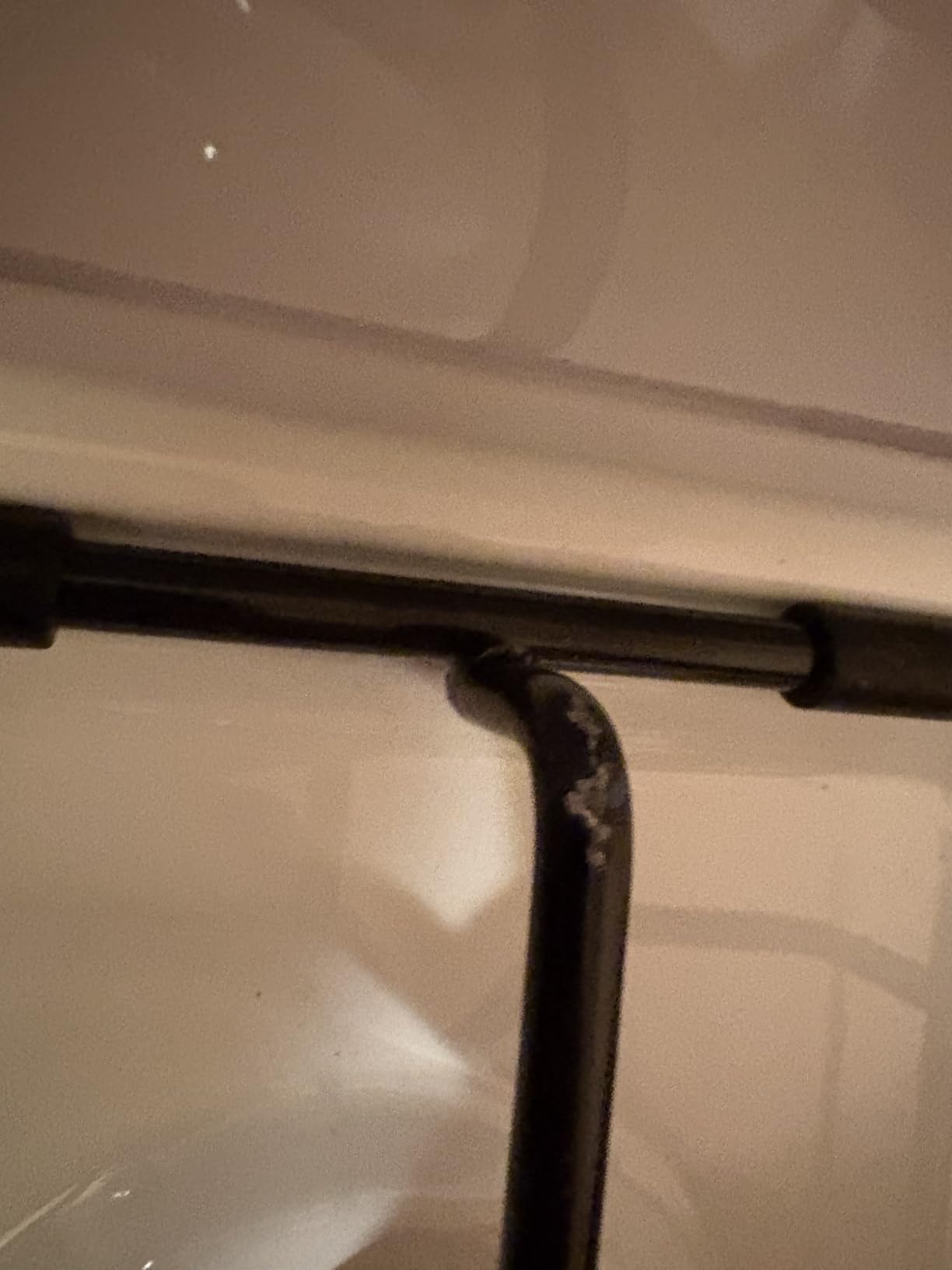
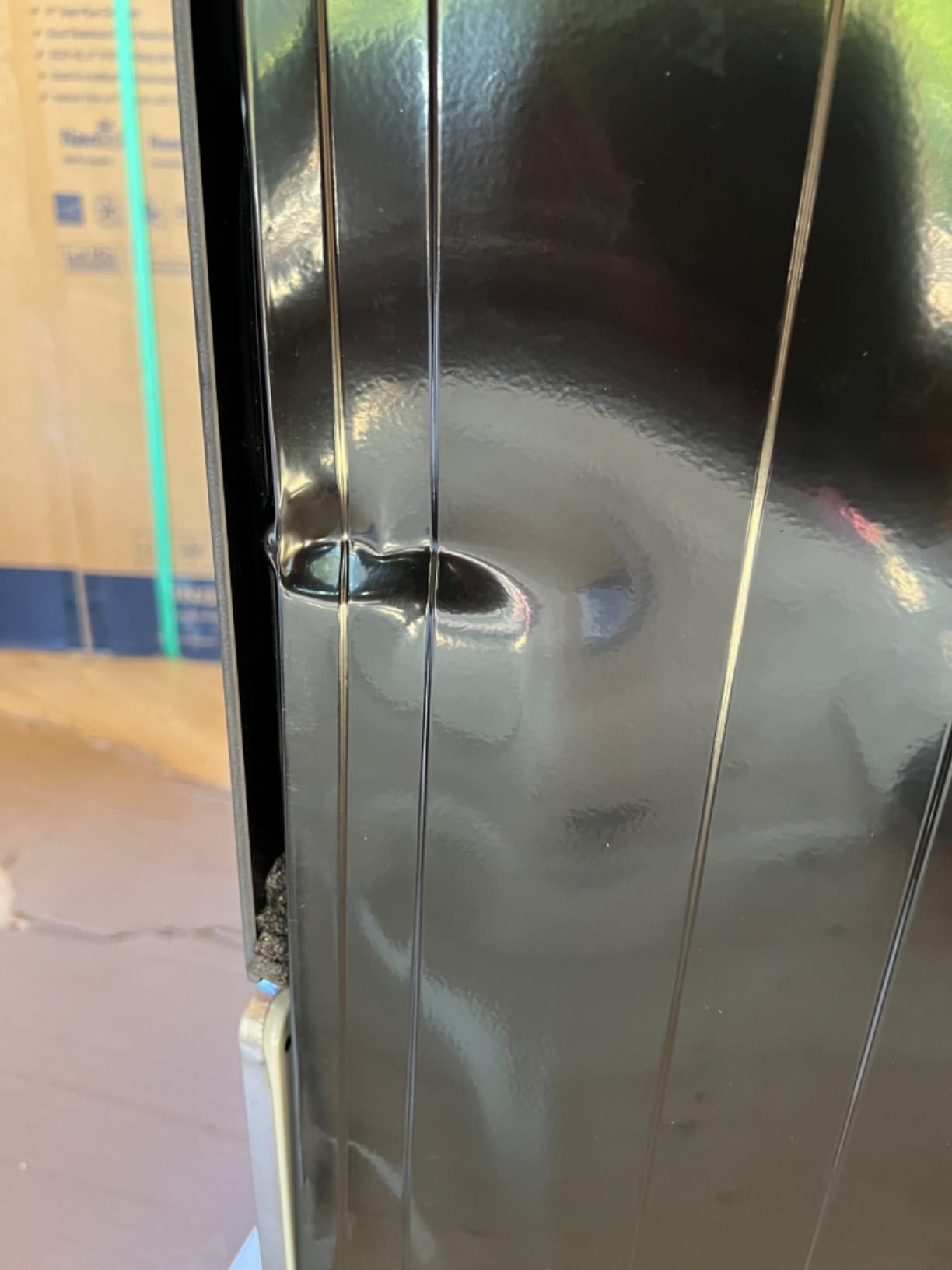
What to watch: the body is light sheet metal at 104 pounds, which owners report can arrive dented, and its shallow depth can conflict with an existing countertop overhang. The one-star share in its reviews is the highest in this set, driven by transit damage and oven flame issues rather than by bad cooking.
Who this gas range suits
It suits a condo, a rental, a studio, or a second kitchen where footprint matters more than capacity. It also suits anyone who wants to learn gas cooking without spending much or risking a premium appliance in a space they may not own for long.
Owners of older homes with a 20-inch or 22-inch opening will rarely find anything else that works, and that alone justifies the compromise.
Who should look elsewhere
Do not buy it as a primary family kitchen oven. If you bake, roast a large bird, or cook for more than two people most evenings, you will outgrow the cavity in a year and resent it every time.
And if you sear regularly, the total cooktop output will not keep up with a cast iron skillet. Look at the Rangaire or the AAOBOSI instead if heat is the priority.
3. Rangaire RRG303TS 30 in. Slide-In Gas Range – Best Cooktop Power in the Group
Rangaire RRG303TS 30″ Gas Range Oven with Timer – Stainless Steel, Sealed Burners, Convection Fan, Easy Reach Racks
21000 BTU dual-ring center burner
Five CleanSeal burners
5.1 cu ft convection oven
Manual knobs
Pros
- A 21000 BTU dual-ring burner in a 30 inch body
- Wok grate and air fry basket in the box
- Telescoping racks solve the reaching-into-a-hot-oven problem
- Dual valve center burner holds a low flame
Cons
- Oven runs hotter than the dial indicates
- A rattling cooling fan on some models
- Light knobs and only 34 reviews to judge from
The Rangaire is the cooktop-first choice. A 21,000 BTU dual-ring, dual-valve center burner sits under a removable wok ring, and a dual valve means you can pull that center burner down to a genuine low flame for a long braise without cranking it off. The four surrounding burners are sealed and easy to wipe, which is the CleanSeal design doing exactly what the name suggests.
It arrives as a slide-in with front controls, so it sits flush against a countertop rather than standing proud with a back guard. That means no shelf above the burners to trap grease, but it also means the cutout has to be measured carefully, because slide-in bodies have less tolerance for a sloppy opening than freestanding ones do.
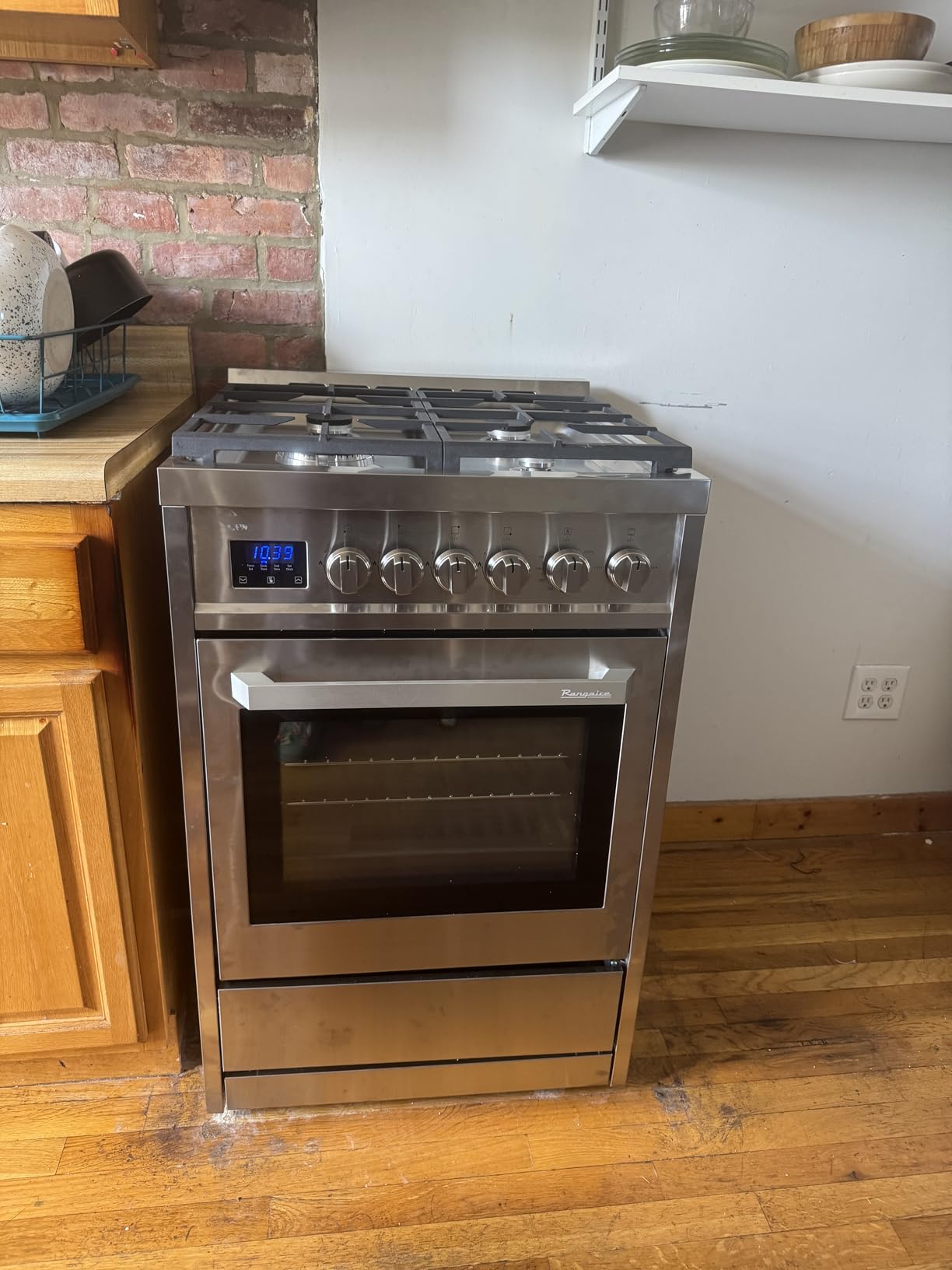
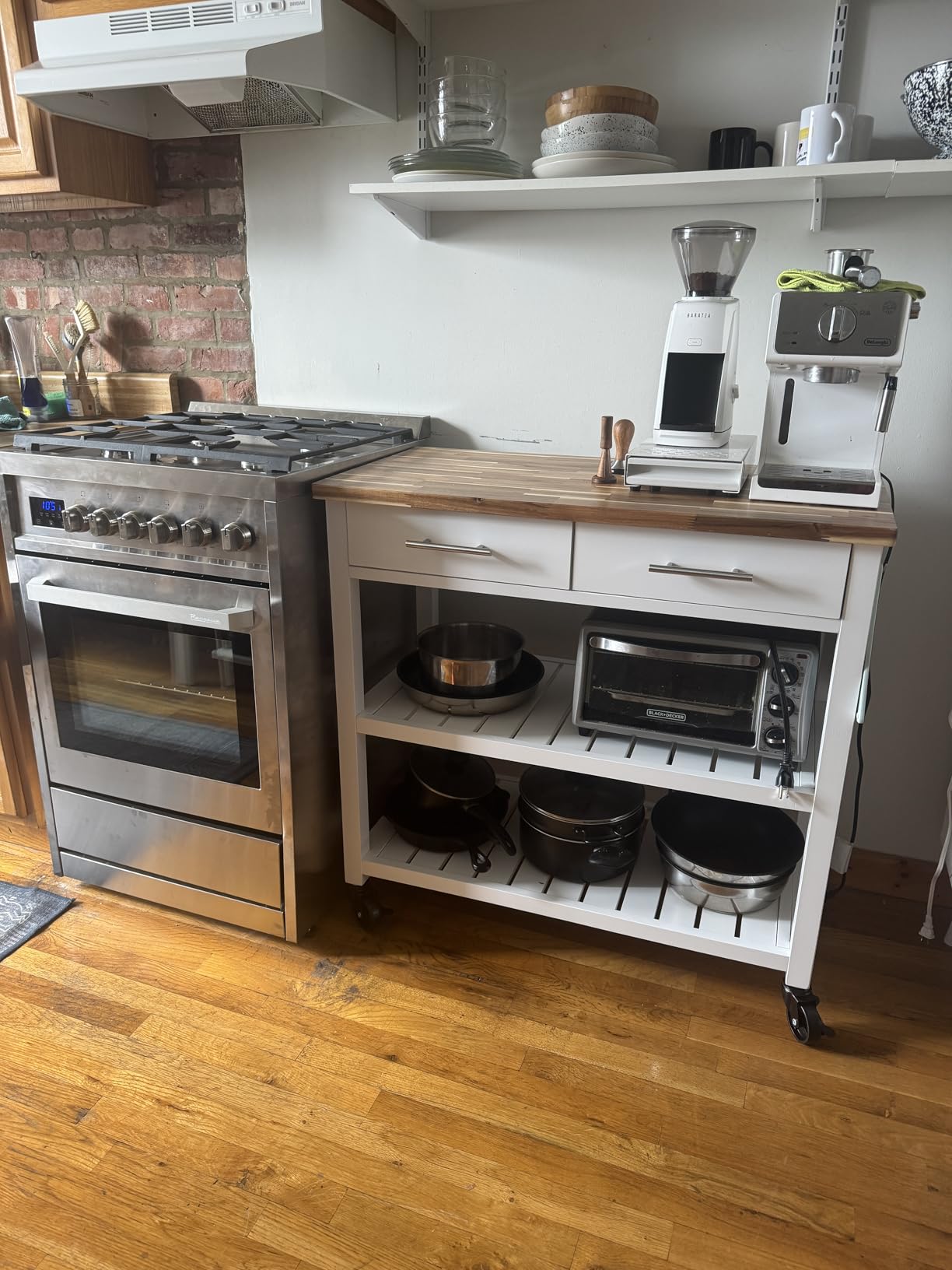
Convenience touches are unusually well judged by owners. The telescoping EasyReach racks pull out to meet you at the door, the air fry basket is in the box, and a glass touch timer with automatic shut-off handles the part of cooking nobody enjoys. Critically, the oven itself still runs on a mechanical knob, so the touch surface is a timer rather than the thing that decides whether food bakes.
The flaw is temperature calibration, and owners are consistent about it: the oven runs hotter than the dial indicates and a thermometer becomes part of your routine. A rattling cooling fan has also required warranty repairs on some models. Customer service, on the other hand, is repeatedly praised for replacing broken grates quickly, which is worth knowing when the sample is still small.
Who this gas range suits
It suits the cook who lives at the cooktop: stir-frying, searing, reducing a pan sauce, and running a wok ring without cooking one dish at a time. If you want real burner power in a 30-inch body and do not want to jump to a 36-inch cooktop, this is the pick.
It also suits anyone who bakes in small batches and hates reaching into a hot cavity, because the telescoping racks change that daily moment.
Who should look elsewhere
Skip it if oven accuracy is your top concern, since the running-hot report is the single most repeated complaint. Be cautious buying on a 34-review base as well; a good rating from a small pool tells you less than a middling rating from a large one.
And if you bake enough to want true convection with a dedicated convection element, the Kenmore and the Bosch both do that better.
4. COSMO Nebula 30 in. 5-Burner Gas Range – A 5.0 cu ft Oven on a Slide-In Frame
30 in. Nebula Coll 5 cu ft 5 Burner Gas Range, Convection, Stainless Steel
Five sealed burners to 18000 BTU
5.0 cu ft convection oven
15000 BTU bake burner
Slide-in frame
Pros
- 5.0 cu ft cavity is the largest from this brand with a 15000 BTU bake burner
- Convection with bake broil fan and light modes
- Cast iron grates on a corrosion-resistant body
- Compact electronics with a simple display
Cons
- Igniter and oven problems reported within one to two years
- Oven door detached on at least one model
- Bright clock with no dimmer and the lowest rating in this set
The idea behind this gas range is straightforward: take the same sealed-burner cooktop family and fit it into a slide-in frame with a 5.0 cu ft convection cavity and a 15,000 BTU bake burner. Owners generally like the cooking itself. When it works, this range heats quickly, roasts evenly with the convection fan on, and the sealed burner ports wipe down without a degreaser.
The layout is the other reason to consider it. It is a slide-in, so it sits flush under a countertop, and the extra-large burner sits at the front edge rather than dead center. That keeps the center of the cooktop clear for a wide pot, but it also means the front burner is the one you reach across the most.
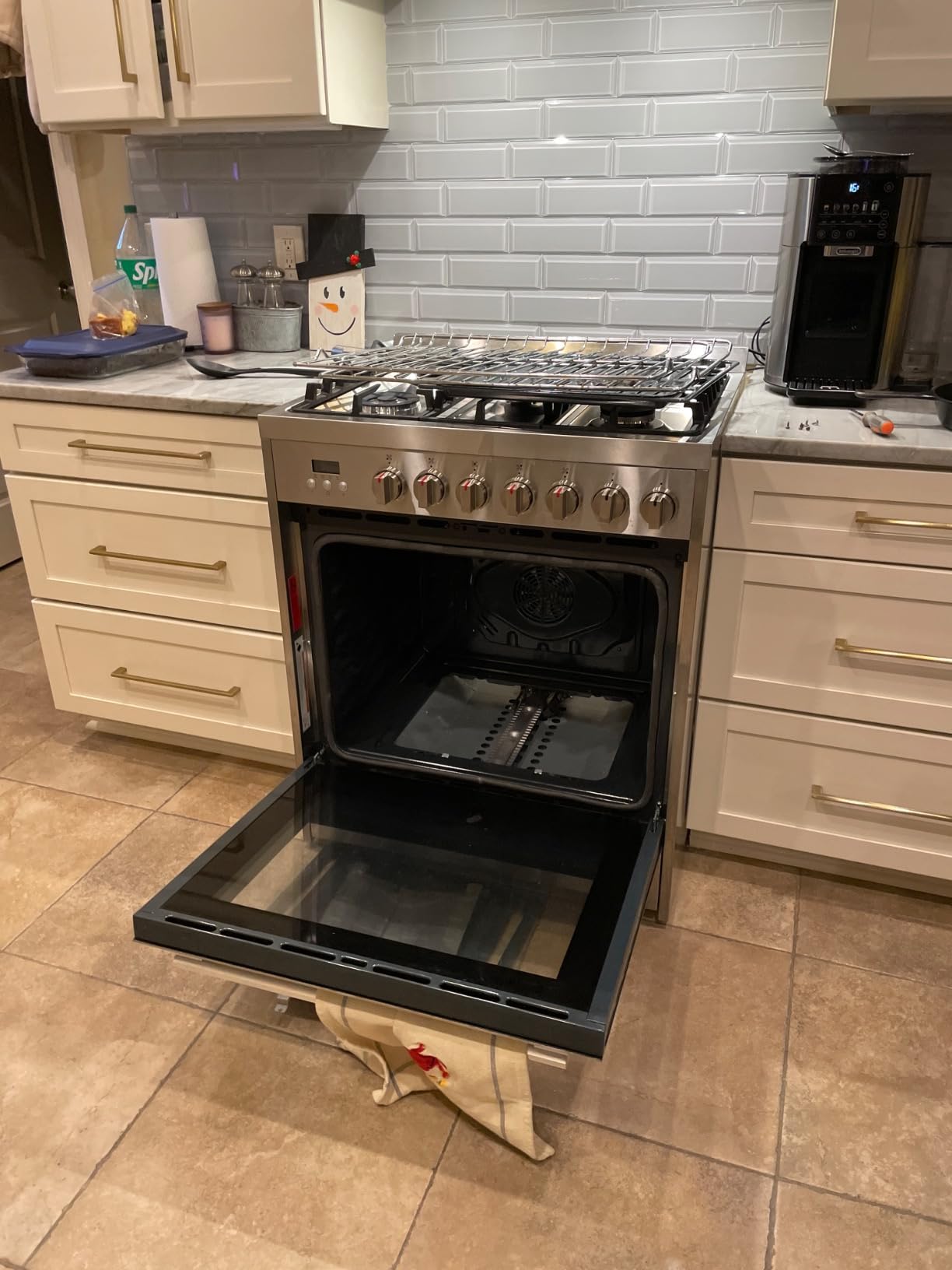
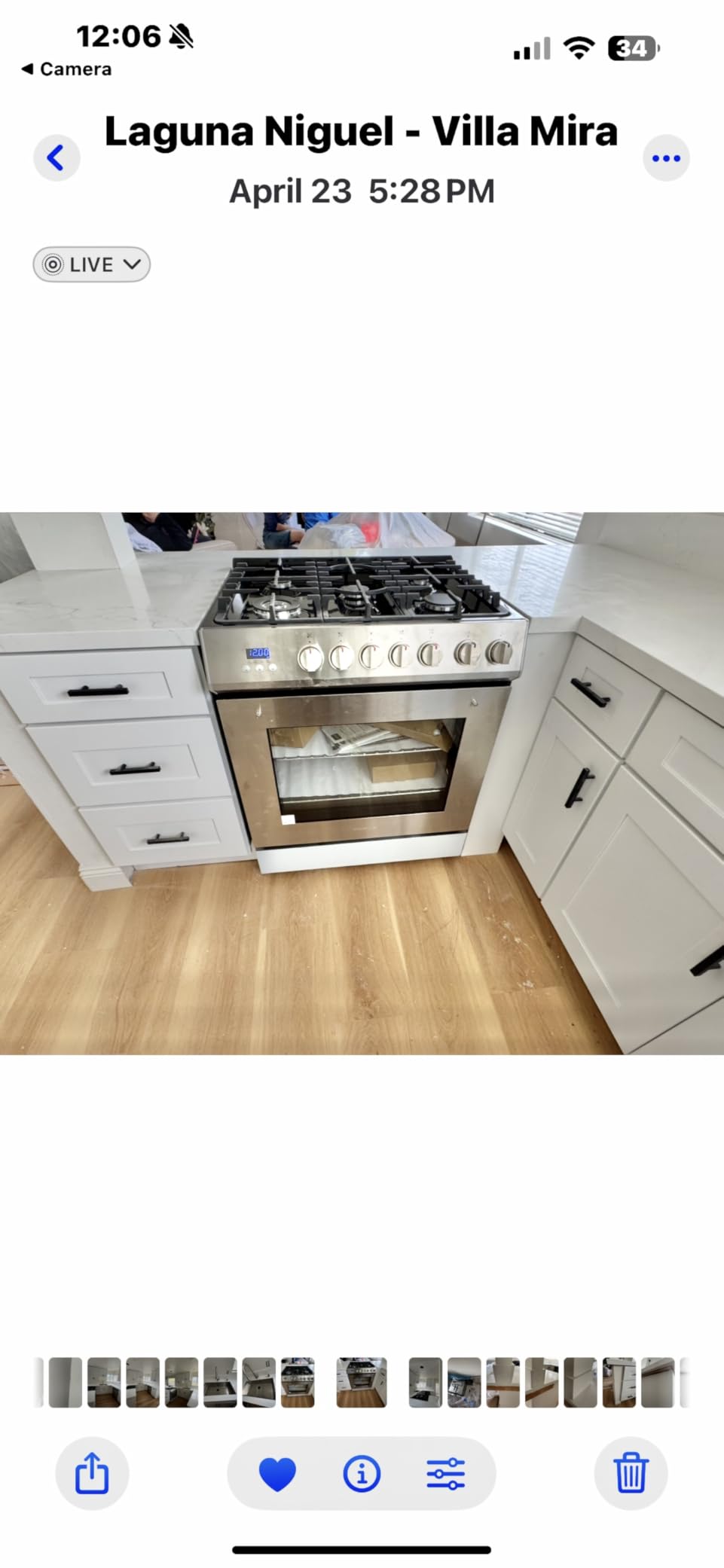
Now the part you should read before buying. This model carries the lowest average owner rating in our set, at 3.6 across 23 reviews, and the one-star concentration is not about taste. It is about igniters failing soon after the one-year warranty period, an oven door that came detached on at least one appliance, and owners describing warranty support as difficult to navigate.
There are smaller irritants too: the clock display is bright with no dimmer for a late-night bake, and the timer plus button sticks. The LP conversion kit is sold separately here, unlike most competitors in this guide.
Who this gas range suits
It suits a cook who wants a slide-in footprint and a large cavity, has a tight counter run with no overhead shelf, and is comfortable buying a model where the spec sheet is good and the owner feedback is mixed. Read the reviews yourself before committing.
It can also work for a rental or a second home where a sale on a discontinued-looking model is more attractive than a long warranty.
Who should look elsewhere
Pass on it if you are the kind of buyer who needs the service experience to be boring. The igniter and warranty patterns here are exactly the failure modes that turn a repair into a replacement argument two years into ownership.
If you want the same 5 cu ft class of oven with better owner feedback, the KOSTCH covers a similar cavity size and carries a three-year warranty.
5. VEVOR 30 in. Gas Range and Oven – Convection Without a Touchscreen
VEVOR Gas Range Oven, 30 Inches Width, Freestanding Stainless Steel Stove and Oven with 4 Sealed Cooktop Burners, Easy Reach Racks, Halogen Light, 4.8 Cu. Ft. Capacity, for Home Apartment Kitchen
Burners 3500 to 18000 BTU
4.8 cu ft convection oven
18500 BTU bake burner
Cast iron grates
Pros
- Genuine 3500 to 18000 BTU cooktop spread for a straightforward range
- 4.8 cu ft convection oven fits a whole chicken
- No touchscreen electronics to fail out
- Suit for RV and mobile home fit-ups
Cons
- Oven cavity is wider but shallower than buyers expect
- Some appliances arrive damaged and claims drag on
- Only 15 reviews and push-button controls feel plain
This gas range does something most of its competitors skip: it gives you a real convection oven and a wide burner spread while leaving the control surface alone. Four sealed aluminum burners run from 3,500 BTU to 18,000 BTU, which is a proper simmer-to-sear range, and the oven has bake, broil, convection bake, and convection roast without a single touchscreen driving them.
The oven hardware is unusually well specified for the money. An 18,500 BTU lower burner and a 13,500 BTU upper burner mean the cavity recovers temperature fast after you put a cold pan in, and the two detachable chrome racks on six adjustable positions handle a weeknight roast or a tray of cookies without argument.
Owners like the accurate oven temperatures, the easy hookup, and the fact that the sealed burners clean up quickly. The note that comes up most often is the cavity shape: it is wide but shallower than most buyers picture, so check that a tall casserole dish will clear the rack before you order.
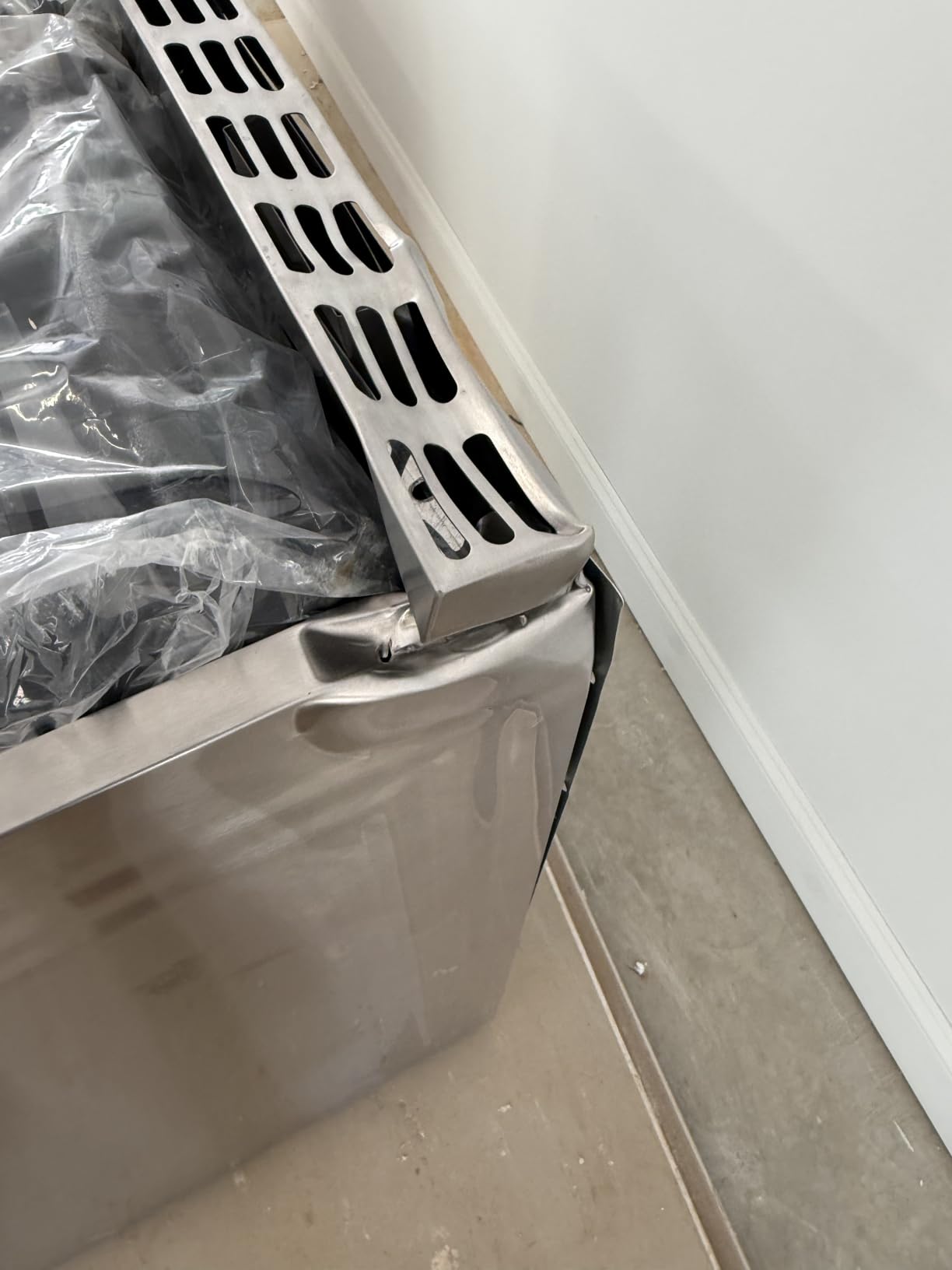
The honest weakness here is support, not cooking. The single most detailed negative review describes an appliance that arrived damaged and a claims process that dragged on. With 15 reviews to go on, long-term durability simply is not established yet.
Who this gas range suits
It suits a first home, a rental, an RV or mobile home fit-up, or any kitchen where a straightforward convection oven at a mid-tier cost beats a feature-loaded one. It also suits anyone who actively avoids touch controls because they have watched a friend lose an oven to a dead panel.
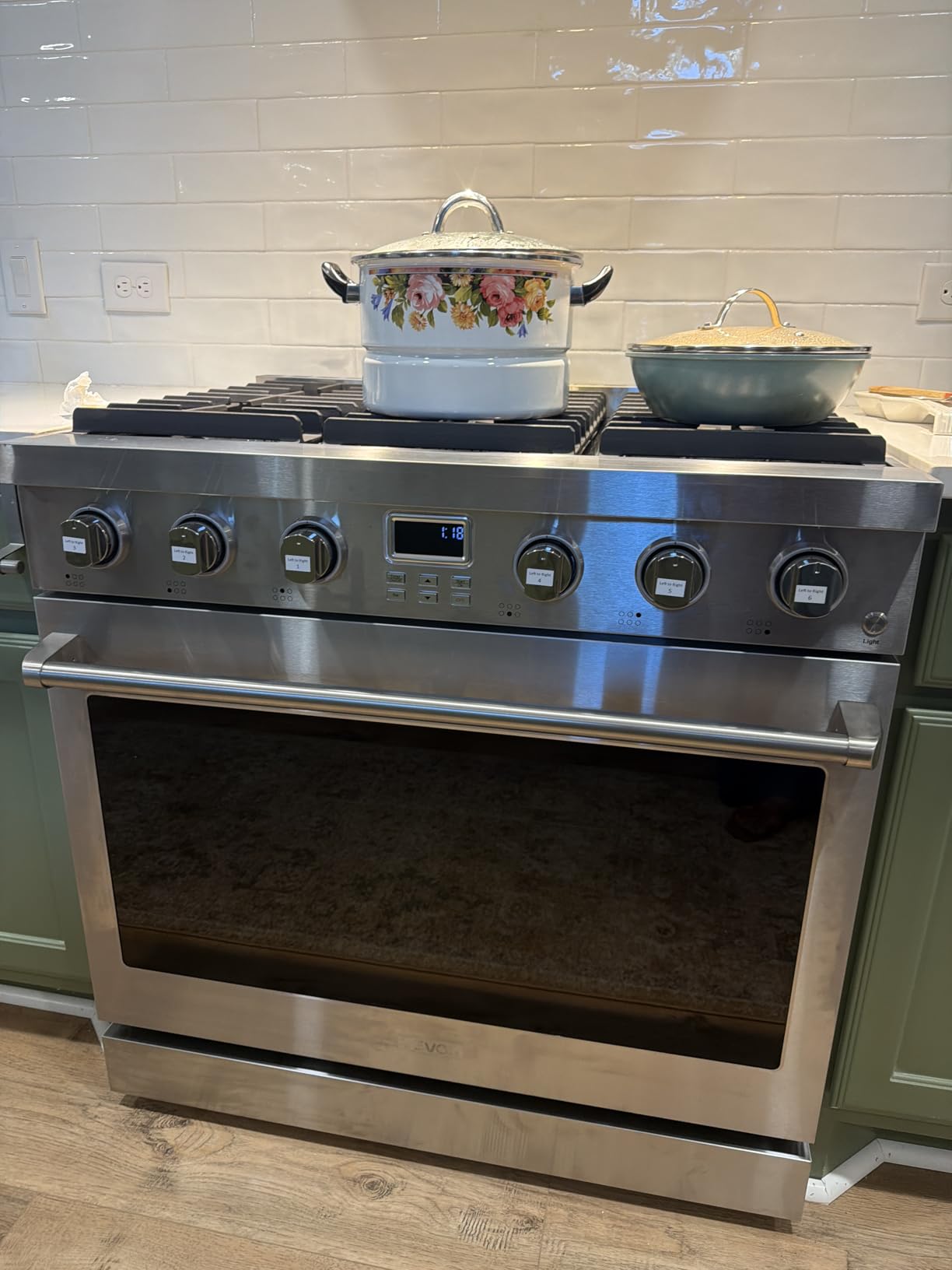
If you like the look, this is one of the few ranges here that reads as commercial from across the room.
Who should look elsewhere
Look elsewhere if you want a warranty longer than one year, or if you need a brand with a deep regional service network, because the reported claim friction is the real risk with a lightly reviewed import. If you bake heavily, the shallow cavity will annoy you.
The Empava covers a similar size class with a two-year US warranty if coverage length matters more to you than the burner count.
6. Bosch 800 Series 30 in. Slide-In Gas Range – True Convection With Self-Clean
800 Series 30 in. 5 Burner Slide-in Gas Range in Stainless Steel with 4.8 cu. Ft. True Convection and Self-Cleaning Oven
4.8 cu ft true convection, self-clean
Five sealed burners
Warming drawer
Touch controls
Pros
- True convection with a self-cleaning cavity
- Sealed burners with strong low and high output
- Owners report fast boiling and a clean simmer
- Simple to install and easy to clean
Cons
- Oven temperature runs 50 to 100 degrees above the setting
- Convection fan noise carries through the house
- Service billed as a trip fee plus time with control board failures
True convection is the distinction that matters on this gas range, and it is the one most shoppers misread. True convection means the fan has a dedicated third heating element behind the back wall, so the oven can cook at a lower temperature and in less time. Basic convection only moves air around with the existing bake and broil elements. If you bake, the first is a genuine upgrade.
The self-cleaning cavity is the other headline. It is a high-heat cycle rather than a steam cycle, which means it works well on baked-on grease but also means the oven locks during the run and the cavity reaches temperatures that stress the door seal over a lifetime of cycles.
Owners report that the sealed burners boil water quickly and simmer cleanly, and that installation is straightforward. The warming drawer and three racks are useful on a holiday when you need somewhere to rest a dish.
The complications are real and worth being blunt about. Owners report the oven running 50 to 100 degrees above the setting, which is a wide band for a baker, and a convection fan loud enough to hear through the house. Service calls are billed as a trip fee plus time, which owners describe as punitive, and electronic control board failures show up in the first months on some appliances.
One more caution. With only 13 reviews, the 4.2 average is inflated by a group of short, generic five-star ratings; the substantive written reviews skew negative. We would want a larger sample, and a thermometer, before committing to this for heavy baking.
Who this gas range suits
It suits a serious baker who bakes on several racks at once and wants true convection plus a self-cleaning cavity, and who has a local appliance service that will actually answer the phone. True convection at a 30-inch size is not common, and this is one of the clearest examples of it.
It also suits someone replacing a Bosch appliance already, where parts and service familiarity is already solved for them.
Who should look elsewhere
Do not choose it for a quiet house. A fan you can hear in the next room changes how you cook at 11pm, and owners say so repeatedly.
And if the trip-fee-plus-time service model is going to bother you in year four, the Kenmore gives you a self-cleaning cavity with a US warranty and no recurring temperature complaint in its owner feedback.
7. Kenmore 5.6 cu ft Front Control Gas Range – The Roomiest 30-Inch Oven Here
Kenmore 5.6 cu. ft. Front Control Gas Range Oven – Stainless Steel
5.6 cu ft true convection oven
19000 BTU Turbo Boil+ burner
Hidden bake element
Front controls
Pros
- Largest oven cavity of any 30 inch range in the set
- True convection with an air fry mode and basket
- 19000 BTU burner plus a simmer burner and wok ring
- Hidden bake element wipes clean in seconds
Cons
- Timer and cook time settings take practice to learn
- Front controls put the oven knob high on the range
- Only 11 reviews and a one-year warranty leave durability unproven
The Kenmore wins on the single number that limits most 30-inch ranges: oven capacity. At 5.6 cu ft it is the largest cavity among the 30-inch ranges in this guide, which means a full turkey, a sheet pan on two racks, or a casserole dish that would not clear a smaller oven. Owners consistently call out fast heating and even cooking, and the hidden bake element means there is no coil to wipe around.
The cooktop is properly built rather than an afterthought. A 19,000 BTU Turbo Boil+ burner brings a large pot to a boil quickly, a dedicated simmer burner handles a low flame without borrowing a corner burner, and a wok ring sits over the layout. The grates are dishwasher-safe cast iron, which removes the most tedious chore in gas cooking entirely.
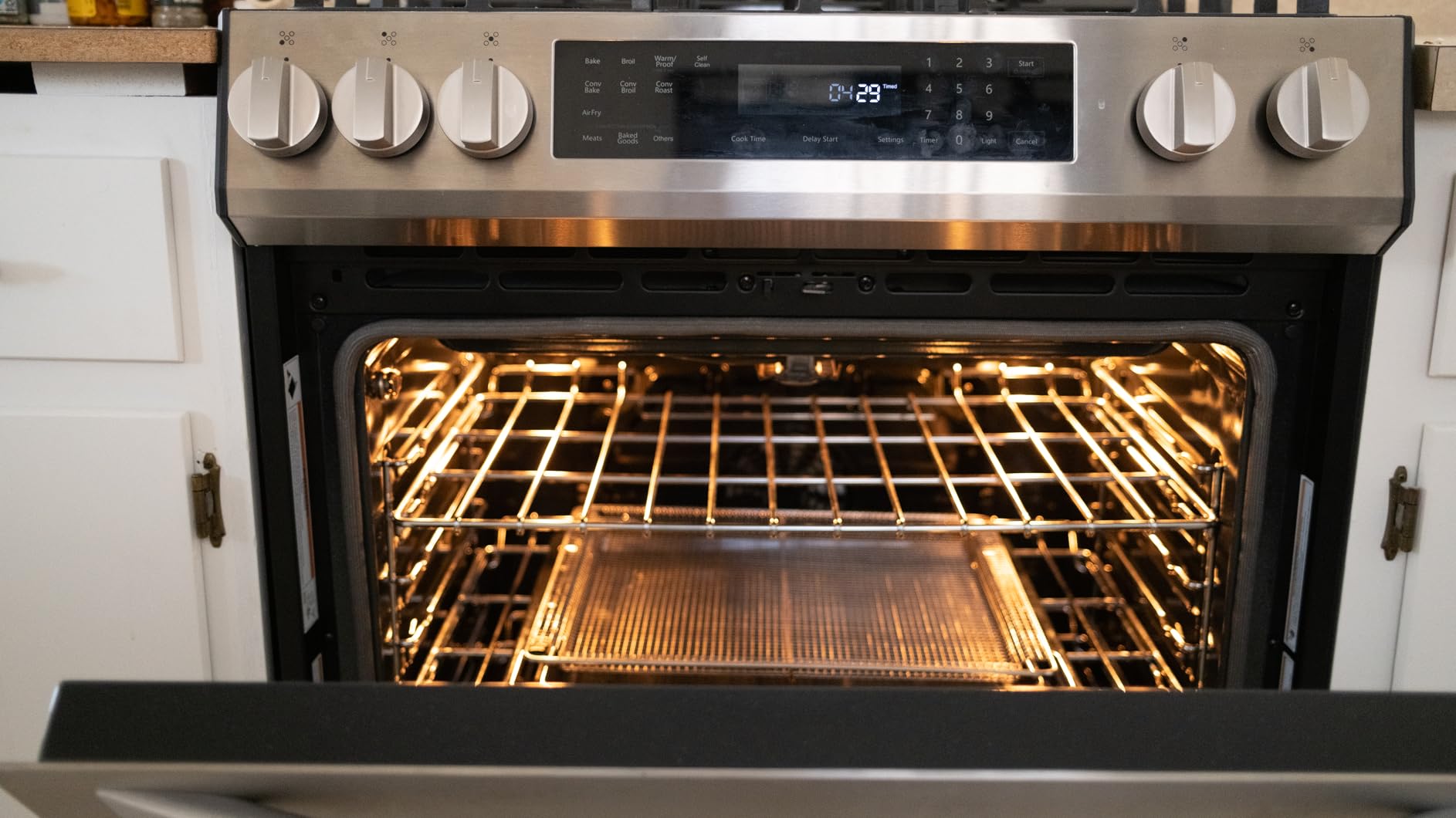
It is also a true convection oven with an air fry mode, and the basket is in the box along with a thermometer and the wok ring. That combination of a big cavity, a real convection system, and air fry is the closest thing to a one-appliance answer for a cook who does everything in a 30-inch footprint.
The honest catch is the interface. Owners report that the timer and cook time settings take real practice to work out, and that is the only friction appearing in an otherwise uniformly positive review set. The front controls also mean the oven knob sits at the top of the range, which is comfortable for most people standing at the cooktop and slightly awkward for shorter users reaching past a hot pan.
Who this gas range suits
It suits the cook who does everything: sears on the 19,000 BTU burner, roasts a whole bird, and air fries on a weeknight, all in a standard 30-inch opening. If you have ever bumped your head on an oven that was too small, this is the answer to that.
The self-cleaning cavity with a hidden element also suits anyone who does not want to scrub an oven by hand every month.
Who should look elsewhere
Be careful if you hate fiddly interfaces, because the timer is the part of this range most likely to frustrate you in the first two weeks. And with an 11-review base and a one-year warranty, there is not yet a track record here, so buy it with that in mind rather than treating a 4.9 average as settled fact.
If warranty length is the deciding factor for you, the KOSTCH and the Empava both carry longer coverage than this model.
8. KOSTCH 30 in. Pro-Style Gas Range – No Electronics, Longest Warranty
KOSTCH 30-inch Professional Freestanding Pro-Style Natural Gas Range or Liquid Propane Gas Range with 5 Burners, 4.55 cu.ft. Oven Capacity, in Stainless Steel – KOS-30RG03M (Stainless Steel)
9000 BTU oval center burner
4.55 cu ft convection oven
Mechanical knobs only
3-year warranty
Pros
- Fully gridded 30 inch cooktop with a fifth center burner
- No electronics at all beyond an LED light and fan button
- Enamel-coated oven door
- Three-year parts and labor warranty
- Adjustable legs make leveling easy
Cons
- Oven cavity is smaller than the exterior suggests
- Erratic preheating and no usable simmer on some appliances
- Knobs are plastic and the advertised LED lights were missing
This is the buy-it-for-life answer in the group, and it works by omission. There is no control board, no display, no oven sensor, and no firmware. A 360-degree energy regulator drives the burners, a fan button runs the convection, and an LED lights the oven. That is the entire list of things that can fail electronically, and owners who value repairability respond to that logic.
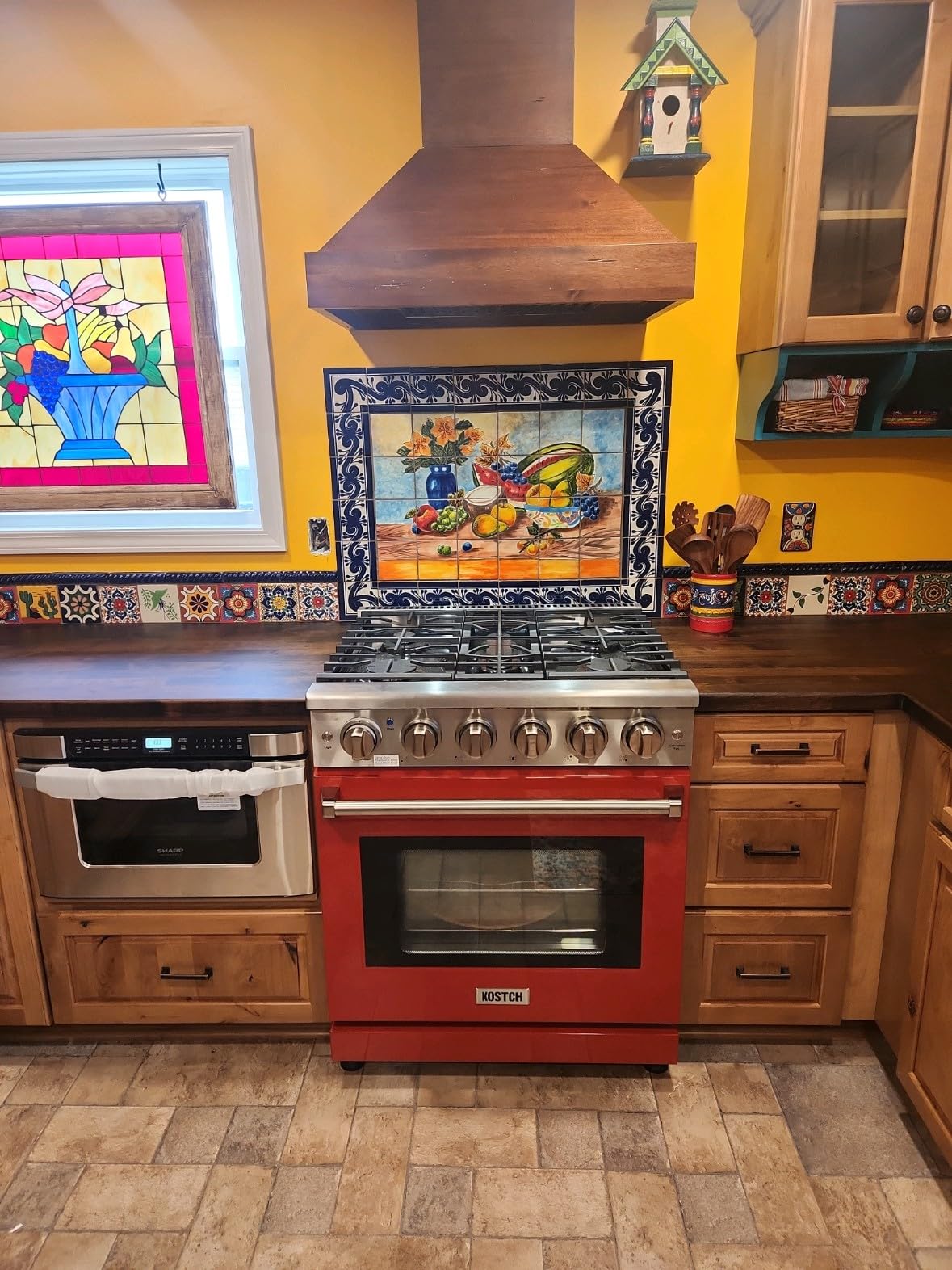
The cooktop layout is the best argument for it. It is fully gridded across the full 30 inches, with a 9,000 BTU oval fifth burner dead center under a grate you can lay a wok or a rectangular griddle over, plus an 18,000 BTU burner and three smaller ones. A center fifth burner is the feature that separates a real pro-style layout from a 30-inch range with four burners and a decorative fifth.
Warranty is the quiet headline. A three-year parts and labor warranty is the longest in this guide, and the manufacturer publishes spare part availability for three years, which tells you something real about how long the product is meant to last. The enamel-coated oven door is also described by owners as more durable than the powder-coated alternatives used elsewhere in this price class.
What to watch: the 4.55 cu ft cavity is smaller than the pro-style styling suggests, and it needs the convection fan to even out heat. There are also reports of erratic preheating and no usable low simmer on some appliances, and one reviewer found the advertised LED knob lights missing out of the box.
Who this gas range suits
It suits the cook who wants a griddle, a wok ring, and a fifth center burner more than they want a smart oven, and who would rather own the same range in fifteen years. It is also a strong pick for anyone restoring a kitchen where gas cooking is the point and electronics are a liability.
If you cook a lot of flat-top food, the continuous center grate is the feature that makes this range worth the step up.
Who should look elsewhere
Skip it if you want an oven that bakes evenly on its own. The cavity is small and the convection fan is doing more work than it ideally should, so plan to bake with the fan on.
And if precise low simmer control matters to you, the KOSTCH’s own report of no usable simmer on some appliances is exactly the failure mode to weigh. The COSMO Haven, with a 4,000 BTU low end, is the safer pick for long, low cooking.
9. AAOBOSI 36 in. 6-Burner Gas Range – Six Burners and a 6 cu ft Oven
AAOBOSI 36 Inch Gas Range with 6 Burners, 6.0 Cu. Ft. Convection Oven
Six sealed burners 3500 to 22000 BTU
6 cu ft oven with air fry
Self-clean cycle
Seven rack positions
Pros
- Six burners reaching a 22000 BTU top end
- Largest oven here at 6 cu ft with three heavy-duty dishwasher-safe grates
- Seven rack positions with probe and delayed start
- Triple-insulated door and anti-scald handle
- CSA certified with converter included
Cons
- Knobs feel inexpensive and self-clean runs close to three hours
- Storage drawer is shallow and heat level markings are stickers
- Uses a standard 120V outlet
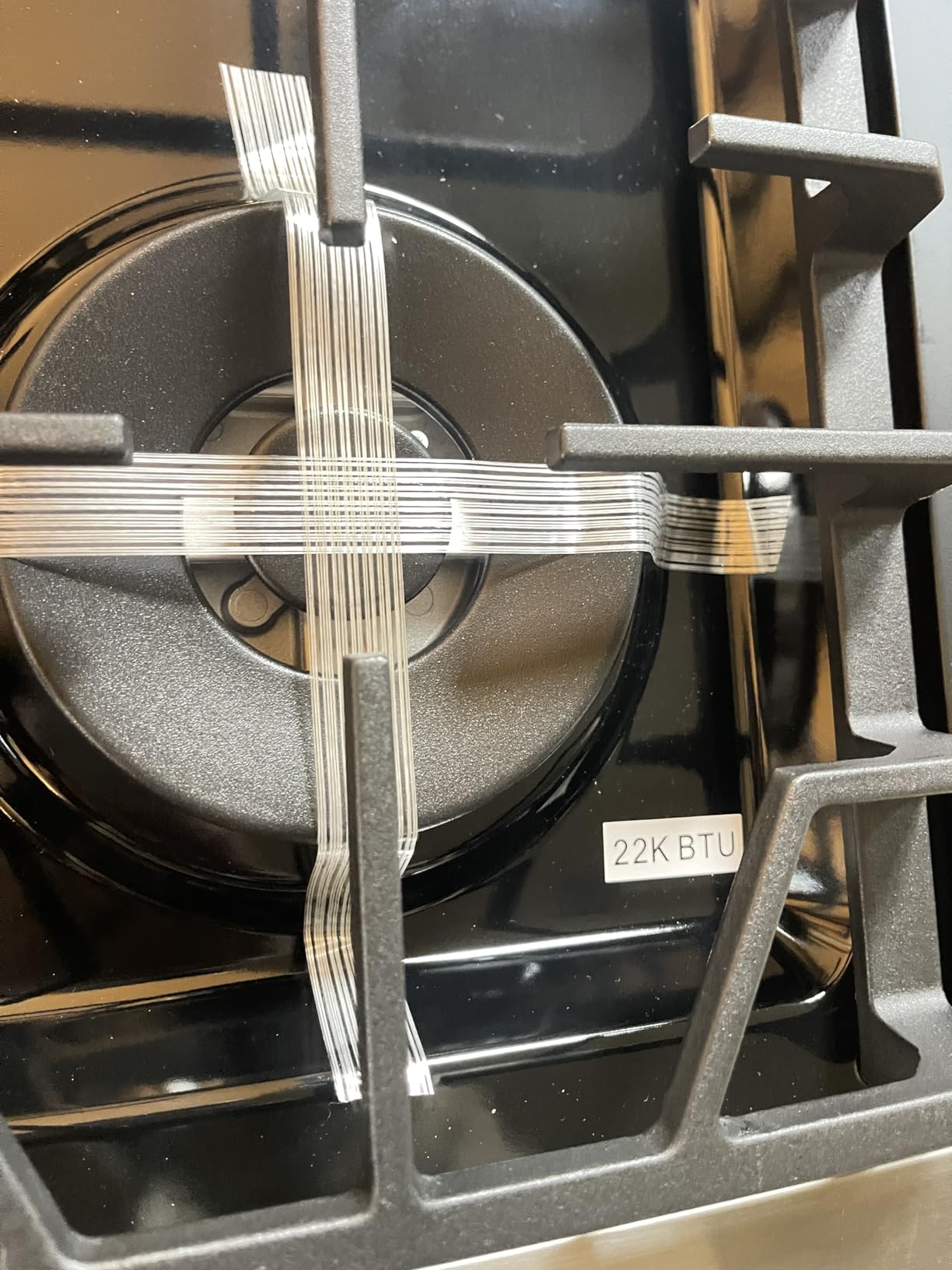
When people ask why a home cook should move up to 36 inches, this gas range is the answer. Six sealed burners spread from 3,500 BTU to 22,000 BTU, and that 22,000 BTU top end is the highest output anywhere in this guide. A center well plus the extra burner column means a big batch of onions, a pot of pasta, and a skillet all going at once without anyone crowding.
The oven is also the largest here at 6 cu ft, with seven rack positions, a temperature probe, delayed start, and timed cooking. It runs convection, air fry, convection grilling, and warming, and the triple-insulated glass door with an anti-scald handle means the front of the range is safer to brush past than most.
Owners are consistent and specific in their praise: the six-burner layout, the size of the oven, how easily it converts between natural gas and LPG with the included converter, and the premium look for the class. There are no one-star reviews in the set, which is a genuine positive signal even at a small sample size.
The complaints are all about finish rather than function. Knobs feel inexpensive and lack a satisfying click, the self-clean cycle runs closer to three hours than two, the storage drawer is shallower than most to pay for the oven cavity, and the burner heat level markings are stickers rather than permanent print. At 110 pounds it is the second-lightest body here, so budget in a second pair of hands for the move.
Who this gas range suits
It suits the cook who genuinely runs a six-dish dinner, a big-batch Sunday cook, or a canning setup, and who has already confirmed a 36-inch cutout and a hood that can move the air. Seven rack positions and a 6 cu ft cavity also make it the choice for a serious holiday or catering-scale bake.
The back cooling system and raised rear design that reduce flame spread into the wall are worth noting if your cooktop sits close to cabinetry.
Who should look elsewhere
Do not buy it for a standard 30-inch kitchen. A 36-inch body needs a wider cutout, a wider gas line check, and a larger hood, and the installation is not a weekend swap if you have never done it.
And be honest about the sample: seven reviews is a thin basis for a 4.7 average. If you want the 36-inch cooktop with a deeper review history and a name most service departments recognize, our picks for the best professional gas ranges are worth a look instead.
10. Empava 30 in. Gas Range With True Convection – Two-Year US Warranty
Empava 30 Inch Gas Range with True Convection, 4.55 Cu. Ft Oven
18000 BTU power burner
4.55 cu ft true convection
Fingerprint-resistant steel
Two-year warranty
Pros
- True convection circulates heat through a 4.55 cu ft cavity
- 18000 BTU power burner plus four more sealed burners
- Fingerprint-resistant stainless with cast iron grates
- Two-year US-based manufacturer warranty
Cons
- Oven door handle detached within weeks on one appliance
- LP conversion kit advertised but not in the box
- Cavity is small for a 30 inch range with only seven reviews
The Empava combines two things that rarely arrive together at this level: a real 18,000 BTU power burner for searing, and true convection that circulates heat through the whole cavity so you can bake on two racks without rotating the trays. The oven is 4.55 cu ft, which is on the smaller side of the group, but the convection system is the real European-style kind rather than a fan-assisted basic bake.
The body is specified well for the class. Commercial-grade fingerprint-resistant stainless steel means it will not show every handprint, the grates are heavy-duty cast iron, and the triple-pane glass door holds heat in and fingerprints out. Flame-failure protection is fitted to every burner, which is a safety feature worth insisting on in any gas range you buy.
Owners report accurate oven temperature calibration, which is more than several higher-positioned ranges in this guide can claim. The warranty is a two-year US-based manufacturer warranty, the second longest here, and the unit is CSA certified.
Who this gas range suits
It suits a cook who wants true convection and accurate baking in a standard footprint, and who will not use a fingerprint print as a reason to avoid stainless. The two-year US warranty is a real differentiator for anyone who expects to get a technician rather than a return label.
It is also a reasonable pick for a first range, where true convection is a feature that will grow with your cooking rather than a novelty.
Who should look elsewhere
Watch the assembly and completeness issues. One owner reported an oven door handle detaching within weeks, and another found the LP conversion kit and instructions were advertised but not actually in the box. Confirm what is in the carton before you accept delivery.
And if oven capacity is the deciding factor, 4.55 cu ft is tight. The Kenmore at 5.6 cu ft and the AAOBOSI at 6 cu ft give you materially more room to cook.
Buying Guide: Burner Power, Layout, and Cooking Style
The question “how many BTU do I need for a gas range?” has a simple answer: between 15,000 and 21,000 BTU on at least one burner, and something in the 3,500 to 6,000 BTU range for the low end. A gas burner is a controlled open flame, and what you want is a wide range of control on a single burner, not maximum heat everywhere.
Higher is not automatically better. Above roughly 25,000 BTU on a residential 30-inch range, the flame impingement and the gas pressure you need start to exceed what a standard residential line and a standard burner cap are designed for. A 22,000 BTU burner in a 36-inch body is a reasonable ceiling; a residential range pushing far beyond that is a commercial specification, not a home feature.
Match the layout to how you cook. A one-pot weeknight cook is fine with four burners and a wide spread. A big-batch weekend cook needs a fifth center burner so a stockpot does not crowd out the skillet. A griddle user needs continuous grate coverage across the middle or one side, not four narrow squares with gaps. A baker cares about the oven and mostly ignores the cooktop.
Sealed burners matter more than advertised. Sealed burner ports keep spilled food out of the gas jet and let you wipe the cooktop surface with a damp cloth. Open burners have visible ports and crevices that trap grease and are a recurring complaint in owner reviews. Every range in this guide has sealed burners, which is part of why the list looks the way it does.
Grates decide your cleaning life. Dishwasher-safe cast iron grates are the best case, and both the Kenmore and the AAOBOSI list them. Individual removable grates are easier to soak than one continuous slab. If you cook with a griddle, look for a center fifth burner under a wide grate, which is what the KOSTCH offers.
Buying Guide: Oven Capacity, Convection, and Self-Clean
Oven capacity is the spec that most often disappoints, because cubic feet on the box measures a cavity you may not be able to use fully. The practical thresholds are roughly 3 cu ft for a small household, 4.5 to 5 cu ft for regular weeknight cooking and a small roast, and 5.5 cu ft and up if you cook a whole turkey or bake on two racks at once.
True convection versus basic convection. True convection adds a dedicated heating element behind the back wall, so the fan and the element work together at a lower temperature. Basic convection just circulates air with the bake and broil elements. The Kenmore, the Bosch, and the Empava offer true convection; the others offer fan-assisted baking. For a weekly baker, that difference is real. For a cook who roasts and braises, it mostly is not.
Air fry is an oven mode, not a separate appliance. It is a fan and a heating element running at high temperature. A 5 cu ft cavity with true convection does a credible job. It will not match a dedicated countertop air fryer, and it is not a reason to pick one range over another.
Self-clean comes in two forms. High-heat self-clean pyrolyzes grease at extreme temperature and works very well, but the oven locks, the cavity gets hot enough to stress door seals over decades, and it uses a lot of energy. Steam clean uses lower heat and a water tray, which is gentler but needs a wipe afterward. There is no third option on the mainstream market, so decide which trade you prefer before you buy.
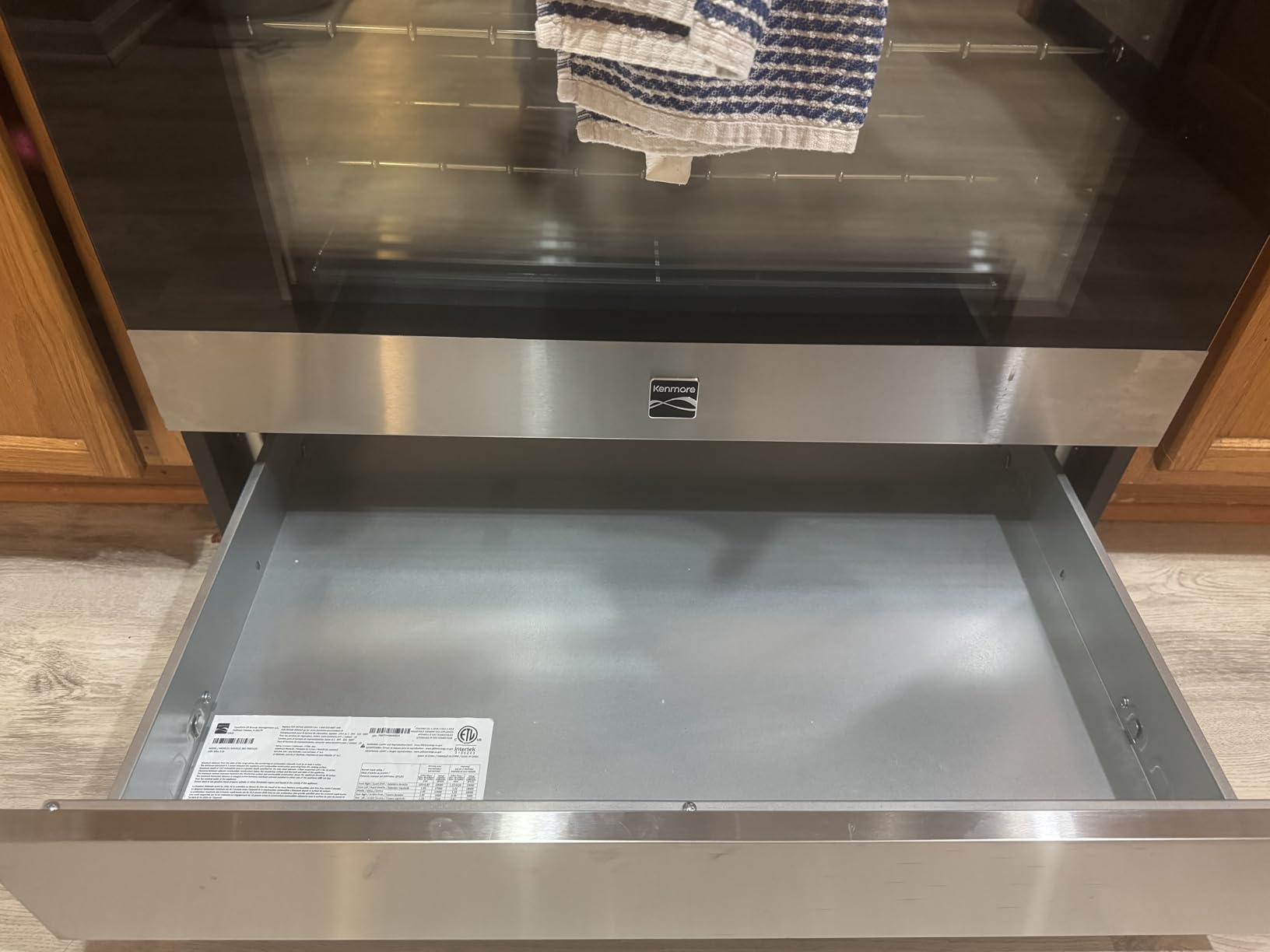
Do not ignore the storage drawer and broiler. The drawer is where the roasting pan lives, and a shallow drawer means buying a different pan. A drawer under a gas oven doubles as a broiler on some models and as a warming drawer on others, which is worth confirming on the spec sheet.
Reliability, Service, and What Actually Breaks
Home cooks who regret their gas range rarely regret the cooking. They regret the service call, the part that was discontinued, or the bill they were quoted.
Dealer-published service data is the most useful public reliability signal available. Yale Appliance, a New England dealer, publishes first-year service rates drawn from roughly 33,000 service calls: GE around 4.8 percent, LG around 5.5 percent, against a category average near 6.9 percent, with GE Profile around 10.1 percent and Cafe around 11.7 percent. Read that carefully. It says expensive tiers within a brand do not automatically mean more reliable, and that a dealer’s own regional data is exactly what it claims to be: data, not a ranking.
What actually breaks, in rough order of frequency. The igniter, which is a part that either lights or does not, and which can fail right as a warranty period ends. The oven temperature sensor, which drifts and makes everything bake hot. The control board, which on an appliance with a display is a single point of failure for both cooktop and oven. The gas valve, which is rare but expensive. And self-clean damage to door seals and racks, which is usually a slow, avoidable failure rather than a defect.
Notice the pattern. Nearly all of these are either an electronic component or a consumable part, which is why the low-tech ranges in this guide, and the analog recommendations that repeat in the buy-it-for-life communities, keep coming up in owner advice. Fewer boards means fewer ways for a fifteen-year appliance to die in year nine.
How long should a gas range last? A well-installed gas range commonly reaches thirteen to fifteen years of service. A heavily used one in a household that cooks twice a day may reach the end of that window sooner, and a low-use one often outlives it.
Repair or replace. The common rule of thumb in the appliance trade is that a repair is worth doing when the parts and labor come to no more than about a third of the cost of a comparable new appliance. Above that, replacing is usually the better economic call, and it is the only time a low-tech repairable range genuinely wins, because the part will still be sold in ten years.
Brands to approach carefully, and why. This is not a blacklist. The criterion is parts availability and service coverage in your own region, not brand prestige. A range whose control board is discontinued in year four, from a brand with no local technician, is a worse purchase than a mid-tier range from a brand with a fleet. Check that a service network serves your area, and check that spare parts are published for a reasonable number of years, before you buy on features.
Gas vs Induction: When You Should Skip a Gas Range Entirely
Some kitchens should not buy gas, and saying so is more useful than another roundup of gas ranges. Gas is being phased out of new residential sales and restricted in some jurisdictions, and that trend is driven by the same thing that shows up in the questions people actually ask: open flames and indoor air quality.
Combustion gas contributes nitrogen dioxide and benzene to indoor air, and homes with gas appliances consistently show higher concentrations. That is a genuine concern in small kitchens with poor ventilation, in homes with young children, and for anyone with asthma. A properly sized hood largely solves it. So does not having a gas range at all.
Choose induction if: your kitchen is small, your ventilation is poor, you want the easiest possible cleaning, or you mostly boil, simmer, and bake. Induction heats the pan rather than the air, and a glass cooktop wipes clean in seconds. Our picks for the best induction ranges cover that switch if you are considering it seriously.
Stay with gas if: you sear often, you cook with a wok or a griddle, you want instant flame response, or you are restoring a kitchen that is already plumbed for gas. The recurring experience in cooking communities is that cooks who move to gas rarely go back, and that says more about the way a flame responds than about any feature list.
There is a middle path. A sealed gas cooktop over an induction or electric oven gets you the burner response without combustion in the oven, which is where a lot of the measured exposure comes from. Our picks for the best electric ranges cover the wall-oven half of that idea.
Installation Checklist: Cutout, Gas Line, and Ventilation
Gas range installation is not a weekend project if you have never done it, and the cost of getting a licensed gas fitter out is far less than the cost of a leak. Before you order, confirm all six of these.
1. Measure the cutout, not the room. A 30-inch freestanding range usually needs roughly 30 inches of width and about 29 inches of depth behind the back guard. A 30-inch slide-in needs about 25 to 27 inches of depth and sits flush against the counter. A 36-inch cooktop range needs a genuinely wider opening and often a different cabinet.
2. Front control or back guard? A front-control slide-in sits flush under a countertop and has no shelf above the burners, which means no grease trap. A freestanding back-guard range stands proud and gives you a shelf, but takes more room in front of the cooktop. Slide-in bodies have less tolerance for an uneven cutout.
3. Confirm gas type and line capacity. Most of these ranges are convertible between natural gas and liquid propane, and several include the conversion kit. Some sell the kit separately, so check the box contents. A new gas line or a capacity upgrade has to be done by a licensed fitter, and that cost belongs in your budget before you order the appliance.
4. Size the ventilation to the BTU. A rule of thumb is roughly 100 CFM of hood capacity per 10,000 BTU of cooktop output, so a 40,000 BTU cooktop wants a hood in the 400 CFM range, ducted outside, not recirculating. This is the step most homeowners skip, and it is the one that determines whether your gas range is comfortable to cook on every night.
5. Check the electrical requirement. Several of the ranges here, including the COSMO Haven, run on a standard 120V outlet rather than a 220V circuit. Others need a dedicated supply. Know which one you are buying before the installer arrives.
6. Level it and test the safety features. Adjustable legs or a leveling kit matter more than they sound, because an unlevel oven cooks unevenly. On first power-up, test the flame-failure device on each burner, the oven lock during self-clean, and the electronic ignition, and confirm the burner levels against the markings before you cook a real meal on it.
Frequently Asked Questions
What is the best gas range for a home chef?
For most home cooks, the COSMO Haven 30 in. 5-Burner gas range is the strongest all-round choice in 2026. It gives you five sealed burners spreading from 4,000 to 18,000 BTU, a 4.8 cu ft convection oven, and mechanical knob controls with no control board to fail. If you want more burner power, the Rangaire RRG303TS has a 21,000 BTU dual-ring center burner. If oven size matters most, the Kenmore leads at 5.6 cu ft.
How many BTU do I need for a gas range?
You need between 15,000 and 21,000 BTU on at least one burner, plus a small burner in the 3,500 to 6,000 BTU range for simmering. The spread matters more than the maximum. Above roughly 25,000 BTU on a residential 30-inch range, you exceed what a standard gas line and burner cap are designed for.
How long does a gas range last?
A well-installed gas range commonly lasts 13 to 15 years. Ranges with the fewest electronic boards tend to reach the end of that window in better condition, because igniters, control boards, and oven sensors are the most common failures. A useful rule of thumb: repair a range when parts and labor cost no more than about a third of a comparable new appliance.
Is a slide-in range better than a freestanding range?
A slide-in range sits flush against a countertop, has front controls, and leaves no back guard shelf to trap grease. A freestanding range stands proud and gives you a shelf, but it is more forgiving of an imperfect opening. Slide-in models suit remodels with a tight counter run; freestanding models suit rental units, first homes, and tighter budgets.
Do gas ranges need a vent?
A gas range should be vented, and the hood should be sized to the cooktop. A common rule of thumb is about 100 CFM per 10,000 BTU, so a 40,000 BTU cooktop wants a hood near 400 CFM, ducted outside rather than recirculating. Ventilation is the single easiest way to reduce the nitrogen dioxide and benzene that combustion gas adds to indoor air.
Final Verdict: The Best Gas Ranges for Home Cooks in 2026
The COSMO Haven 30 in. 5-Burner gas range is the range most homes should buy. Five sealed burners with a genuine 4,000 to 18,000 BTU spread, a 4.8 cu ft convection oven, and knob-only controls give you the widest useful capability here without a single electronic board to fail. Read the igniter complaints before you buy, keep the paperwork, and you will have a range that still works in year twelve.
Buy the Rangaire RRG303TS instead if the cooktop is where you spend your time and you want a 21,000 BTU dual-ring center burner with a real low flame. Buy the Kenmore if oven capacity is your ceiling, because 5.6 cu ft with true convection, air fry, and a self-cleaning cavity is the most capable 30-inch oven in this guide. Buy the KOSTCH if you want a fifth center burner, a continuous griddle surface, and a three-year warranty with nothing to break electronically. Buy the AAOBOSI if six burners and a 6 cu ft cavity solve a real problem in your kitchen. And if your opening is 20 inches wide, the Avanti is the only sensible answer.
Whichever one you choose, measure the cutout, confirm the gas type, and size the hood to the BTU before the appliance arrives. Those three steps decide whether the range is a pleasure to cook on every night or a regret. Our gas range picks under 1000 cover the value end if you have not settled on a model yet.