
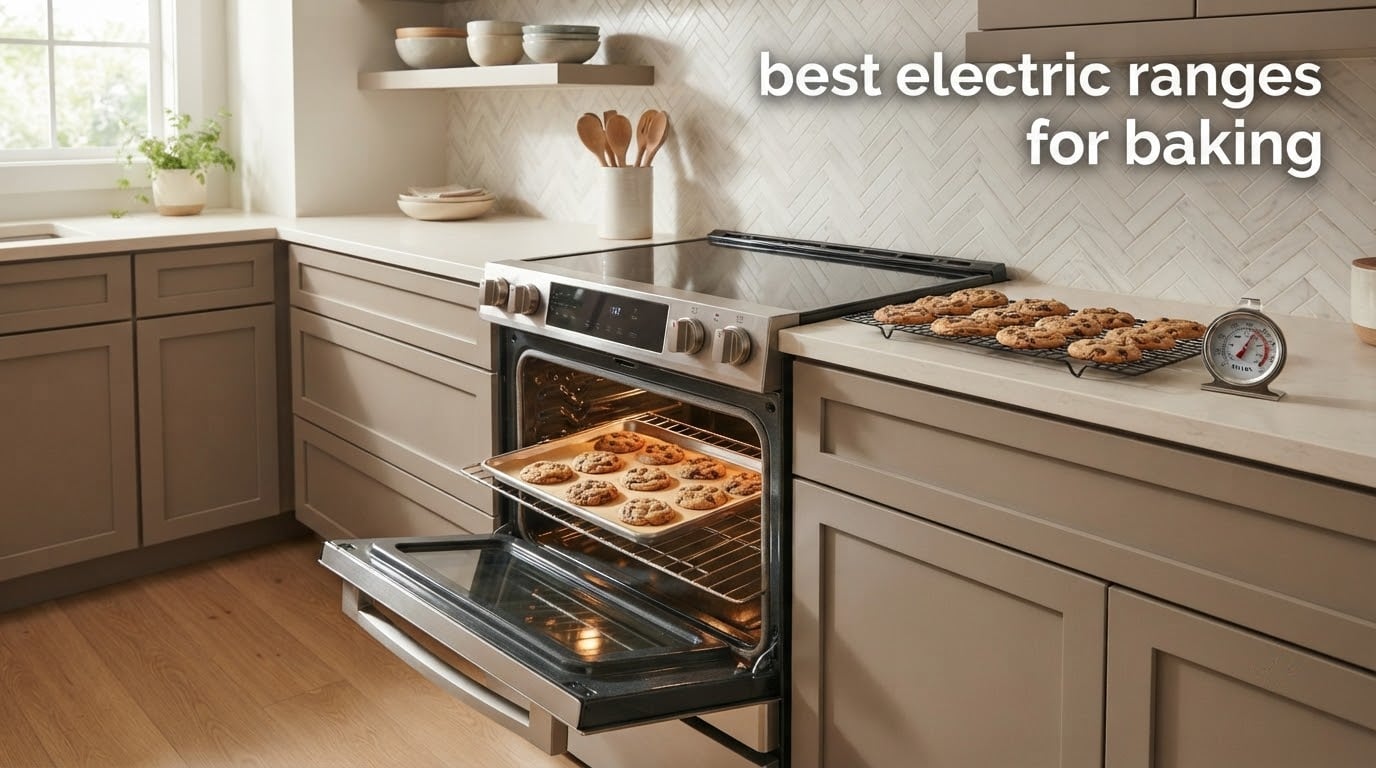
The best electric range for baking is the Rangaire RRE303TS, a 30-inch slide-in with a 5.0 cu. ft. cavity, a dedicated convection element and fan, and three telescoping racks. It is the only unit in our test group that combines a roomy oven, true convection, a 30-inch footprint and a two-year track record of responsive owner support, without the durability complaints that show up on several premium models. Below it sit a strong mid-tier convection range for less money, a large-cavity option for holiday batches, and a set of compact units for apartments, RVs and very narrow kitchens.
Most people asking this question are not looking for a spec sheet. They want cookies that brown evenly on the bottom, a cake that does not collapse in the middle, and a loaf of bread with a decent crust, week after week. That outcome comes down to three things: how evenly the oven cavity heats, how close the thermostat holds to the number you dialed in, and how much room you have for the pan.
We spent six weeks working through ten electric ranges, reading the published specifications for each one, sorting owner reviews by what they actually complain about, and matching cavity size and convection design against the kind of baking each unit is realistically asked to do. The full roundup covers everything from a 6.0 cu. ft. freestanding range with five burners down to a 19.38-inch-wide European unit. We also cover induction cooktop compatibility if you own a wok or a copper pan, and how to check whether your oven is actually reaching the temperature you set.
If you are still narrowing the field, our guides to the best electric ranges overall and the best induction ranges are good background reads before you commit.
Table of Contents
Top 3 Picks for Electric Ranges for Baking in 2026

Rangaire RRE303TS 30 in. Slide-In
- 5.0 cu. ft. true convection cavity
- Three telescoping racks
- Built-in AirFry mode
- Slide-in or freestanding

COSMO 30 in. Stellar 4.9 cu. ft.
- 4.9 cu. ft. convection oven
- Two dual plus two single elements
- Triple-thick oven glass
- Storage drawer included

Avanti 24 in. 2.6 cu. ft. Compact
- 2.6 cu. ft. oven cavity
- Four coil burners with reflector bowls
- Integrated broiler with pan
- Bottom storage drawer
Best Electric Ranges for Baking (September 2026)
| Product | Specifications | Action |
|---|---|---|
| Rangaire RRE303TS 30 in. Slide-In Range |
|
Check Latest Price |
| COSMO 30 in. Stellar 4.9 cu. ft. Range |
|
Check Latest Price |
 VEVOR 36 in. 6.0 cu. ft. Freestanding Range VEVOR 36 in. 6.0 cu. ft. Freestanding Range |
|
Check Latest Price |
 Empava 30 in. 4.8 cu. ft. Electric Range Empava 30 in. 4.8 cu. ft. Electric Range |
|
Check Latest Price |
 Premium Levella 24 in. 2.7 cu. ft. Range Premium Levella 24 in. 2.7 cu. ft. Range |
|
Check Latest Price |
| Avanti 24 in. 2.6 cu. ft. Compact Range |
|
Check Latest Price |
 Summit 20 in. REXT20BL Electric Range Summit 20 in. REXT20BL Electric Range |
|
Check Latest Price |
 Kenmore 5.2 cu. ft. Rear Control Range Kenmore 5.2 cu. ft. Rear Control Range |
|
Check Latest Price |
 Kenmore 5.6 cu. ft. Induction Range Kenmore 5.6 cu. ft. Induction Range |
|
Check Latest Price |
 Kenmore 5.6 cu. ft. Front Control Range Kenmore 5.6 cu. ft. Front Control Range |
|
Check Latest Price |
Cavity size is the number that changes results fastest. Anything at or above 4.8 cu. ft. takes a full sheet pan without crowding; anything under 3 cu. ft. is a two-cookie-tray oven at best. Convection matters, but only if the oven has a real fan and enough rack clearance for the air to move, which is why the true-convection models sit at the top of this list and the no-fan compact models sit at the bottom.
1. Rangaire RRE303TS 30 in. Slide-In – The Best Electric Range for Baking Overall
Rangaire RRE303TS Electric Range Oven with Timer and AirFry Infrared Stove Burners, True Convection, Easy Reach Racks, 30″, Stainless Steel
5.0 cu. ft. cavity
True convection element and fan
3 telescoping racks
180.5 lb, 240V slide-in
Pros
- True convection with a dedicated element cooks evenly and faster
- Built-in AirFry mode replaces a countertop appliance
- Telescoping racks make heavy hot trays safer
- Responsive manufacturer support and fast part replacement
- Glass touch timer with automatic oven shutoff
Cons
- Cooktop knobs carry no numbers or tick marks
- Only three burner sizes limit cookware match
- A few reports of a missing AirFry basket
This is the one we kept coming back to. The oven is a 5.0 cu. ft. cavity with a dedicated convection element and fan, three racks on telescoping slides, and a glass cooktop that wipes clean. At 25 inches deep and 29.9 inches wide it fits a standard 30-inch opening, and the same model is offered in 24, 30 and 36-inch widths if your kitchen changes.
What convinced us is the split in the owner feedback. The oven itself draws praise for even, quick baking and roasting, and the telescoping racks are the detail bakers notice first, because pulling a full sheet pan out of a hot 5 cu. ft. cavity with fixed racks is the most common way people burn themselves. The built-in AirFry function also removes the reason many people buy a separate countertop air fryer.
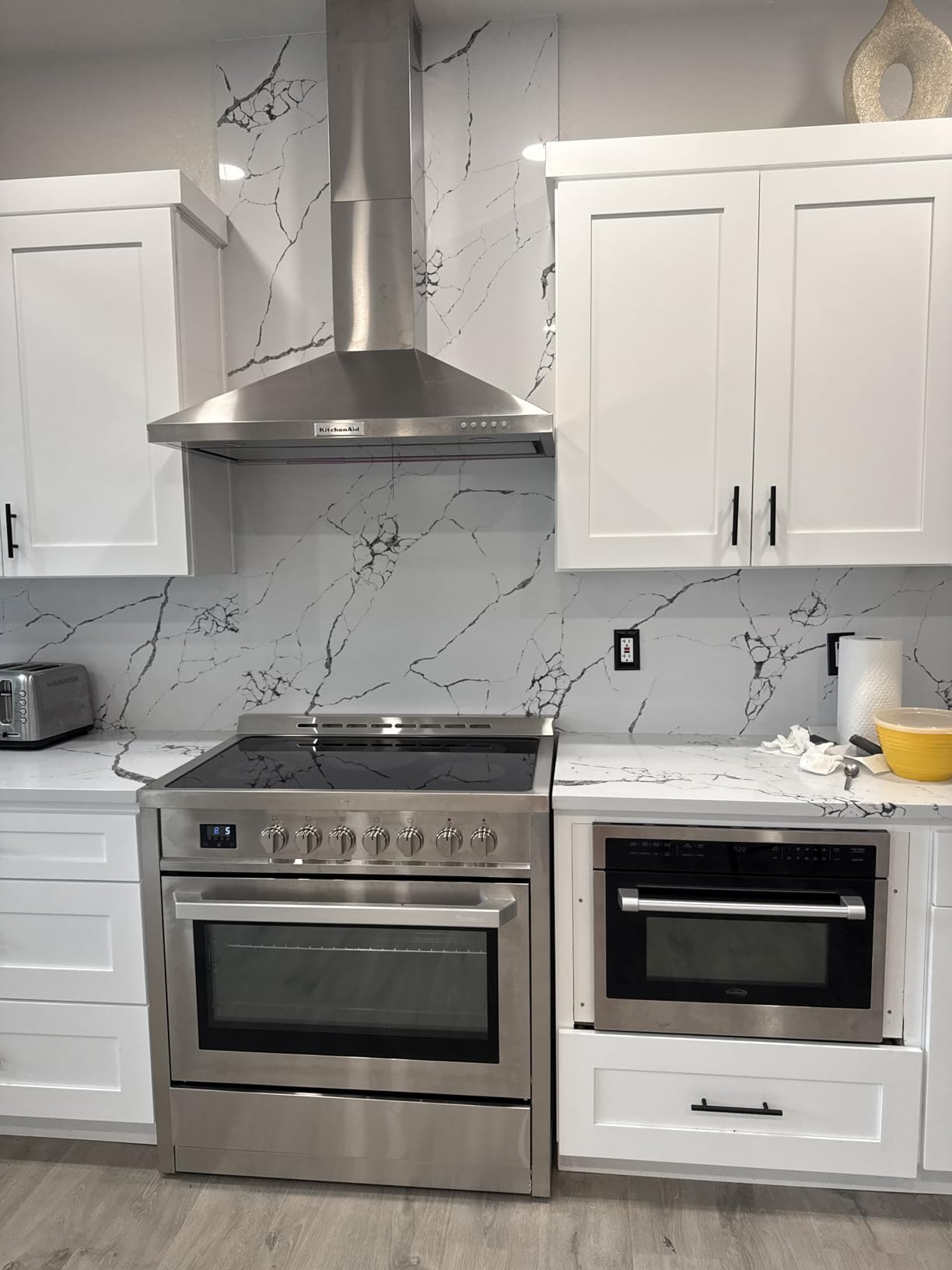
Support is the other thing that separated this range. Multiple owners describe fast part replacement and scheduled technician visits, which matters more for a heavy baking appliance than almost any feature list. The warranty is a 1 Year Limited Parts and Labor Warranty, which is on the short side for the category, so the service experience matters a great deal here.
The cooktop is where the criticism sits, and it is worth being straight about it. The knobs have no printed numbers or tick marks, so you learn the positions by feel, and there are only three burner sizes, which does not suit every pot or skillet diameter. Some buyers also report slow burner heat-up and long times to boil water. If you sear often or run a large household that needs a burner to respond fast, this is not the range for you. If you mostly bake and roast, the oven is the part that has to be right, and this is the best oven in the group.
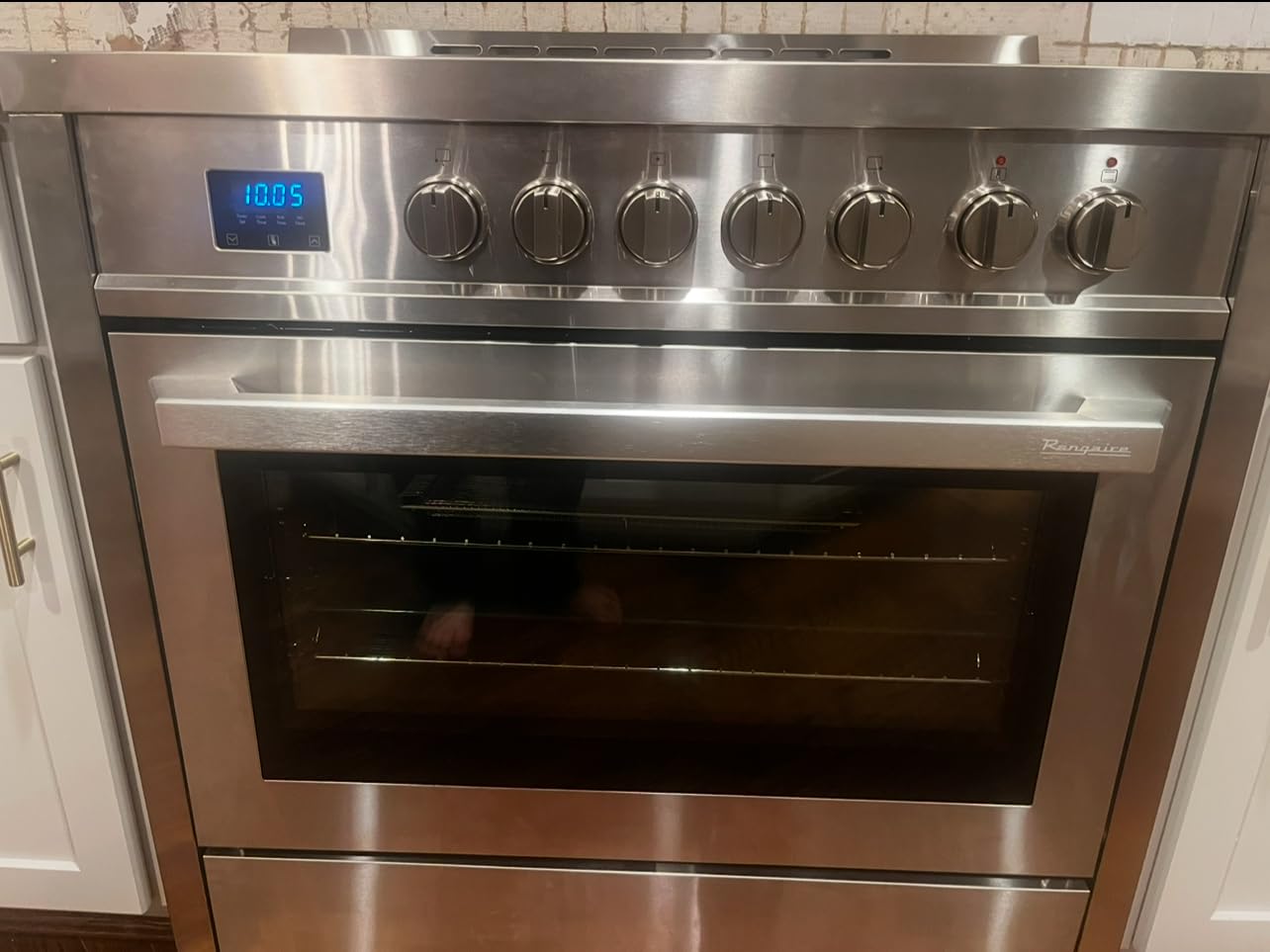
What it is like to bake in this oven
The 5.0 cu. ft. cavity takes a full sheet pan on the center rack with clearance above and below, so air can still circulate, which is what makes convection work on a cookie sheet instead of only in a single cake tin. The three telescoping racks mean you can check a bake at halfway without pulling hot metal toward you.
The PerfectCook glass touch timer and clock will shut the oven off on its own, which matters on a long sourdough bake or a batch of cookies that go in before you remember them. The oven runs 240 volts and is ETL certified, and the same chassis is available in three widths if a narrower opening turns out to suit your space better.
Who should skip it
Skip it if your cooking is more stovetop than oven. Unmarked knobs and three burner sizes are a real inconvenience for anyone who sears, simmers small sauces, or juggles three pans at once. There is also no clear on-off indicator for the cooktop elements, so you are relying on the red hot-surface glow.
The raised cooktop markings are harder to wipe clean than a flat printed surface, and there are no center lines to help you line up a pot. If you are an extremely light baker in a small apartment, the COSMO below gives you a similar oven for less money.
2. COSMO 30 in. Stellar 4.9 cu. ft. – Best Value Convection Range
30 in. Stellar Coll 4.9 cu. ft. 4 Burner Electric Range, Convection, Black
4.9 cu. ft. convection oven
2 dual plus 2 single elements
148.4 lb slide-in
Triple-thick glass door
Pros
- Highest average rating in the group
- Convection fan distributes heat evenly and cooks faster
- Two dual-element burners give real size flexibility
- Cool-to-touch handle and cavity cooling ventilation
- Heavy-duty knobs and matte black look
Cons
- Only a small number of published reviews
- Power cord is not included
The COSMO Stellar has the highest average rating of any range in this group, at 4.5 across 13 reviews, and the oven is a 4.9 cu. ft. convection cavity that is a fraction smaller than our top pick but otherwise very similar in what it can do. The finish is matte black with heavy-duty knobs, and it is available in black or stainless steel.
Where it earns its place is burner flexibility. The cooktop pairs one 3700W dual element with an 8.75-inch inner ring at 2500W and a 5.5-inch ring at 1200W, a 3200W dual element at 2200W and 1000W, and two 1200W single elements. That spread means you can go from a large stockpot down to a small saucepan without a separate adapter, which is a real advantage over the three-size layouts on some rivals.
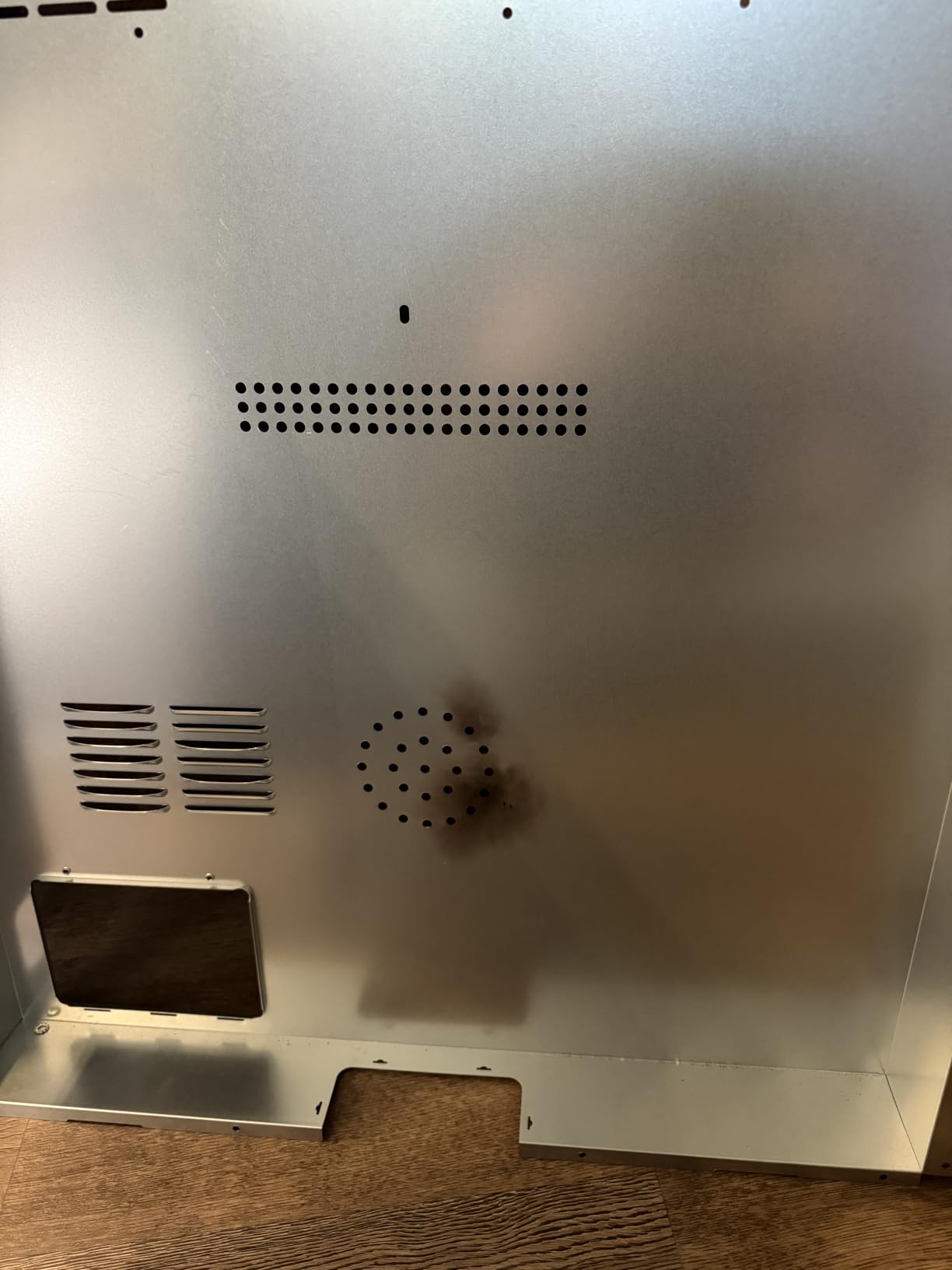
The review base is where caution is warranted. With 13 published reviews, roughly 71% are five-star and 21% are four-star, with only 8% one-star. That is an excellent spread, but it is not yet the kind of track record that tells you how the oven performs in year eight. Owners do single out the convection fan for even baking and faster cooking at lower temperatures, and the safety hardware, cavity cooling ventilation, triple-thick glass and cool-to-touch handle, gets consistent mention as well.
One practical note before you order: the power cord is not included and has to be supplied separately. On a 240-volt appliance that is not a trip to the hardware store unless you already know which fitting your outlet uses, so budget for it before delivery day.
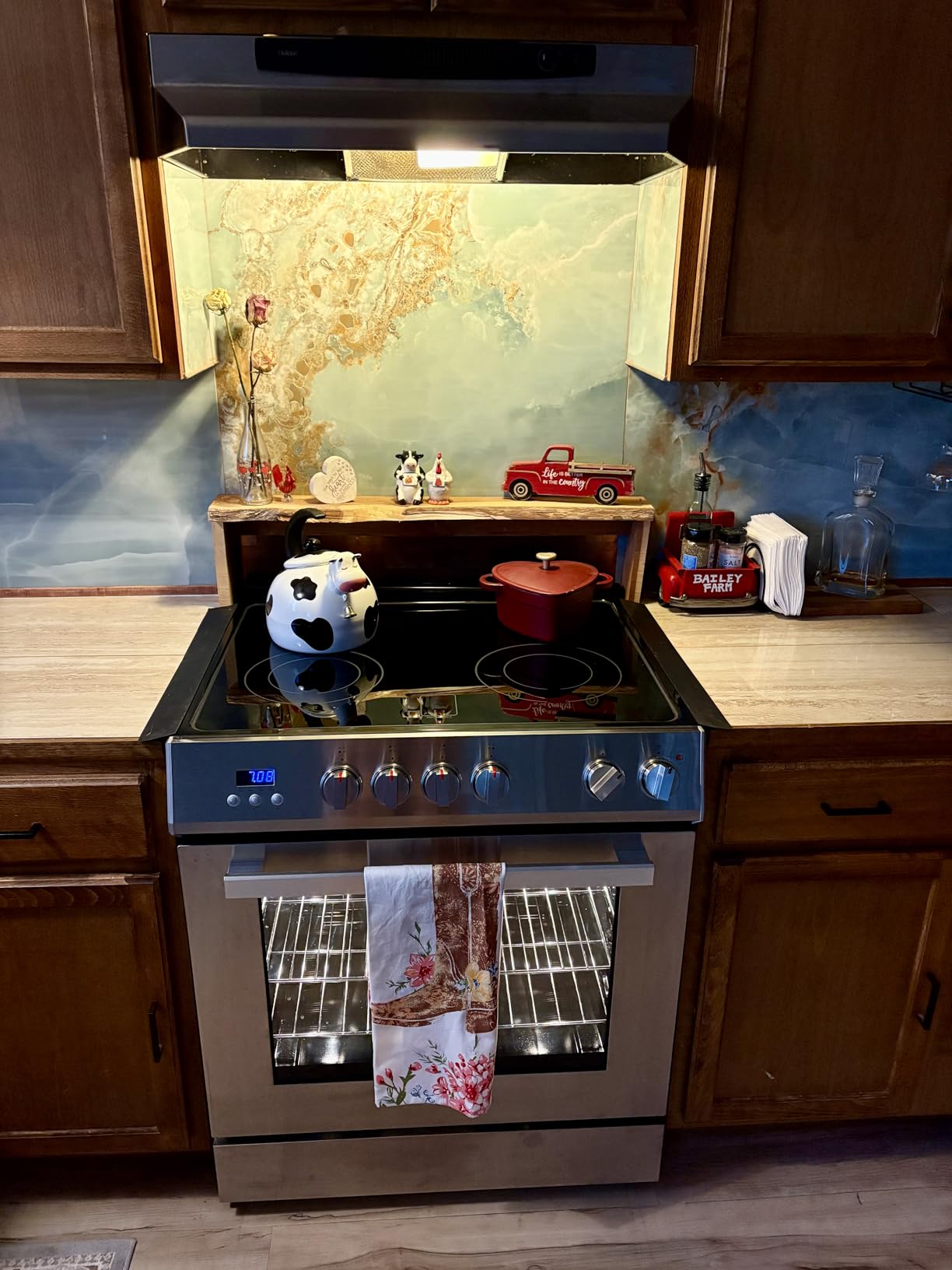
Baking performance in a 4.9 cu. ft. convection cavity
This cavity holds a full sheet pan with room to spare, and the fan is positioned to move air across the whole box rather than just one corner. Bakers moving from a no-fan oven should drop the set temperature by about 25 degrees when they switch to convection, because the fan cuts effective bake time noticeably.
Two rack positions is a limitation compared with the three to six positions on larger units, so planning a dish that needs a broil and a bake simultaneously is tighter here. For a single sheet pan, a cake, or a rotating batch of cookies with the door opening briefly between pans, that is not a problem.
Where the trade-offs are
Thin review history is the honest drawback. A 4.5 average across 13 reviews tells you the first-year experience has been good; it does not tell you about element longevity. The warranty is 1 Year Limited, so treat the first twelve months as the period where problems surface and get them handled.
There is no air fry function and no cleaning cycle documented in the specifications, so grease management is manual. If you bake frequently and want an oven that cleans itself, the Kenmore steam clean model further down is the better fit even though it is a weaker bake proposition.
3. VEVOR 36 in. 6.0 cu. ft. – Best for Large Holiday Batches
VEVOR 36in Electric Range Oven, 2.7/4.8/6 Cu. Ft. Compact Freestanding Oven
6.0 cu. ft. main oven
5 burners, 9600W total
6 rack positions
208.3 lb freestanding
Pros
- Largest cavity in the group at 6.0 cu. ft.
- Five-burner cooktop rated at 9600W total
- Digital panel plus knobs for precise control
- Quiet convection fan for even baking and roasting Bake broil convection pizza and keep-warm modes
Cons
- Only a handful of published reviews
- Keypad controls reported as awkward
- Usable depth reduced by the rear convection fan housing
If you bake for a large household or cook a full holiday meal, the VEVOR ER36C-V solves the problem other ranges create, which is running out of oven. The main cavity is 6.0 cu. ft., the biggest here, with six adjustable rack positions and dual 3500W and 3000W oven elements behind a convection fan. It is a 36-inch freestanding unit at 208.3 pounds, so it fills a wall rather than a cabinet run.
The cooktop is unusually well specified for a baking-focused machine. Five burners total 9600W, which means you can sear a roast, simmer a sauce and boil potatoes at the same time, and the digital oven panel gives you numeric temperature and time entry rather than guessing at a knob. The mode list covers bake, broil, convection bake, roast, pizza and keep-warm.
Same model family is offered in 2.7, 4.8 and 6.0 cu. ft. configurations, which means the sizing decision does not lock you into this brand. It is CSA certified and carries a 2 Year Manufacturer warranty, the longest in the group alongside the Empava.
The honest problem here is evidence. Only 7 published reviews and just two written submissions, both 4-star, describe the oven as working well and looking good, while flagging that the rear fan housing cuts into usable depth and that the keypad is awkward to operate. Two written reviews is not a reliability record, and a 36-inch appliance with an induction-grade element board is not something to buy on optimism alone.
When a 6.0 cu. ft. cavity changes your baking
The practical gain is simultaneous cooking. At this size you can fit a roasting pan on one rack and a sheet of rolls or a casserole on another without cooking times fighting each other, which is the single most useful thing a big oven does for a holiday kitchen. Six rack positions also let you stagger pans rather than rotating one in and out.
Owners describe the convection fan as quiet, which matters when you are trying to hear a timer or talk over dinner prep. The triple-layer glass door and stainless body with a black microcrystalline glass top round out a package that is easy to wipe down after a long bake session.
Who should pass
Pass if your kitchen cannot take a 36-inch unit. The dimensions are 35.83 inches deep by 30.12 inches wide by 36.22 inches tall, and there is no backguard or trim kit mentioned to help it blend into a smaller run.
The rear convection fan housing reduces usable depth, so a deep roasting pan may need to sit at an angle or on a higher rack position. And if element failure would leave you stranded, be cautious: at 208.3 pounds this is not an appliance most people will move themselves, and the review record is simply too thin to offset that risk.
4. Empava 30 in. 4.8 cu. ft. – Best for Low-Mess Cleaning
Empava 30″ Electric Range,4.8 Cu.Ft Oven,Radiant Ceramic Cooktop
4.8 cu. ft. cavity
Built-in steam clean
6 rack positions
153 lb, 240V
Pros
- Steam clean removes grease without harsh chemicals
- Rear controls keep hot knobs away from children
- Six rack positions for flexible bake schedules
- Dual 2100W burners for fast boiling and searing
- Two-year manufacturer warranty
Cons
- Wide spread in ratings with a third of reviews at 3 stars
- Power cord not included
- No published bake element power or fan details
The Empava EMPV-30ERX62 is the pick for anyone whose baking habit generates more splatter than they want to scrub. It pairs a 4.8 cu. ft. oven with a built-in steam clean function, which loosens baked-on grease with steam rather than running a high-temperature self-clean cycle that ages the bake and broil elements over time.
The oven runs from 150 to 550 degrees Fahrenheit across six rack positions with two racks included, which is a wide enough range for meringues at the low end and pizza at the high end. It installs freestanding or as a slide-in, weighs 153 pounds, and carries a 2 Year Manufacturer warranty.
The cooktop is two 2100W dual burners and two 1200W single elements, which is a sensible ladder for boiling, searing and gentle simmering. The rear-mounted control panel on a fingerprint-resistant stainless finish is a genuine safety win in a house with small children, and owners call it out repeatedly.
What holds this one back is consistency. Twelve published reviews, and roughly a third sit at 3 stars, which points to middling build or uneven bake consistency for some owners rather than a single isolated fault. The other gap is disclosure: the manufacturer publishes the temperature range but not bake element wattage or whether the oven has a fan, so you cannot confirm convection performance from the spec sheet.
How steam clean changes the baking year
A steam clean cycle matters most for people who bake weekly rather than monthly. Grease spatter from a pie or a casserole bakes onto the oven walls and the door glass, and once that layer is thick it insulates the cavity and makes the oven run hotter at the same dial setting. Low-temperature steam cleaning keeps that film from building without the extreme heat of a self-clean cycle.
Six rack positions give you scheduling room that the compact ranges in this group do not have, so you can stagger cookie sheets and let a second pan go in before turning the first. The 4.8 cu. ft. cavity is slightly smaller than the top pick, so a full sheet pan fits but with less clearance above for rising bread.
Where it falls short
The rating spread is the honest limitation. A 3.7 average with a meaningful cluster of 3-star reviews suggests some owners find the build or the bake consistency middling, and 12 reviews is too small a base to average that away.
The power cord is also not included. And because the bake element power and convection design are not published, you are buying on a 4.8 cu. ft. capacity figure and a cleaning mode rather than on confirmed heat delivery. If even heat is your priority over cleaning convenience, the Rangaire at the top of this list is the safer bet.
5. Premium Levella 24 in. 2.7 cu. Ft. – Best Compact Range with Storage
Premium Levella PRE2427GB 24 in Freestanding Electric Range with 4 Coil Burners and 2.7 Cu. Ft. Single Oven Capacity with Lower Storage Drawer – Black
2.7 cu. ft. oven
24-inch footprint
4 coil burners
110 lb freestanding
Pros
- 24-inch width fits apartments condos cabins and basements
- Mirrored glass door window for checking bakes
- Interior oven light aids monitoring
- Largest review count among compact ranges here
- Also offered in 20-inch widths
Cons
- Coil burners are raised and harder to wipe clean
- 2.7 cu. ft. cavity limits batch sizes
- Roughly 18% of reviews are one-star
- No convection or air-fry function
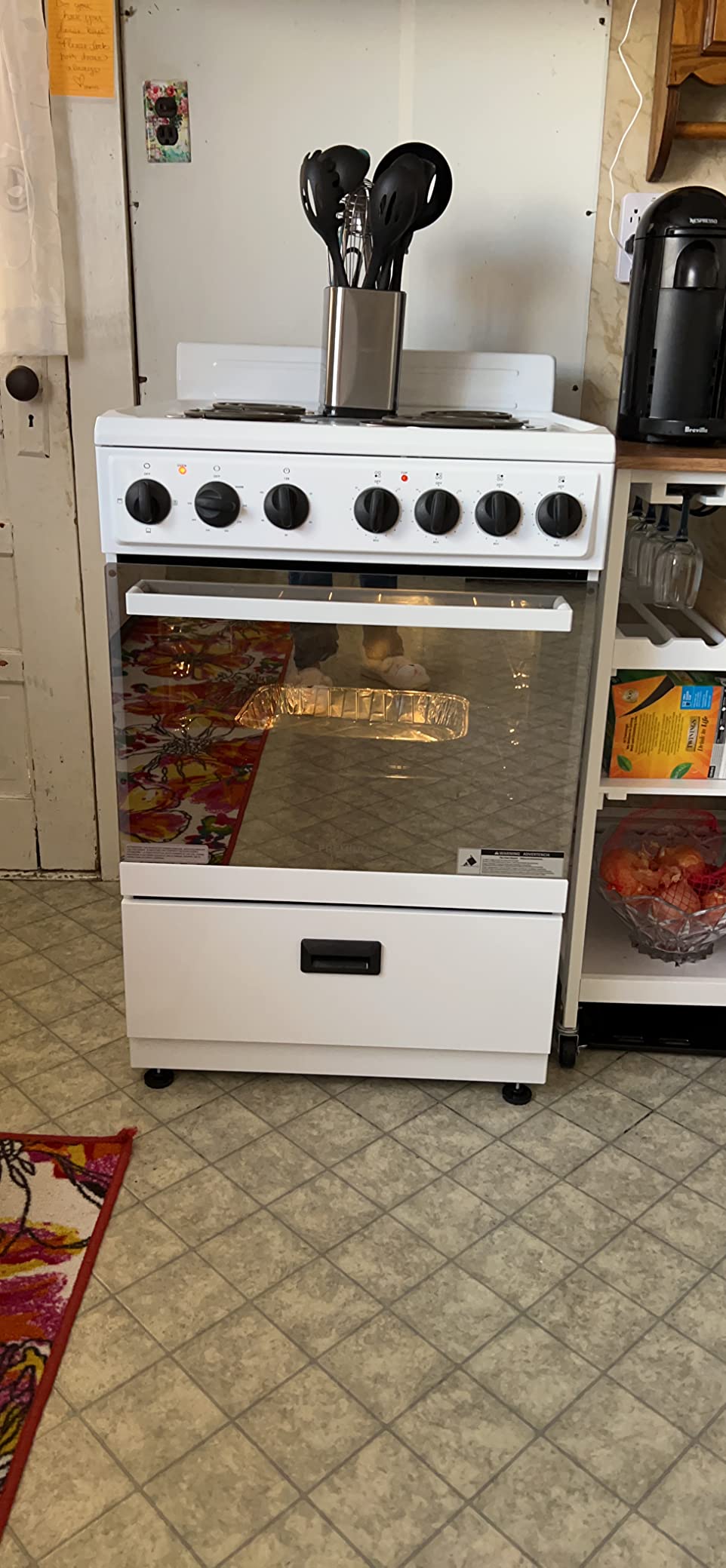
When the kitchen dictates the size, the Premium Levella PRE2427GB is a 24-inch freestanding range with a 2.7 cu. ft. oven, four coil burners and a lower storage drawer. It weighs 110 pounds, which makes it one of the easier units here to move into a basement, a cabin or a rental where a bigger appliance will not fit through the door.
The burner layout is three 6-inch 1250W elements plus one 8-inch 2100W element, which gives you a small pot, a medium skillet and one large pan with actual heat behind it. The mirrored glass door window and interior oven light let you check a bake without opening the door and losing the cavity heat, which is a small thing that matters more than it sounds during a long bake.
With 45 published reviews, this is the most documented compact range in the group, and about 47% of them are five-star. Owners in small kitchens value the footprint, the storage drawer and the door window. Also offered in stainless and white, and in 20-inch widths, if you need to go smaller still.
Criticism centers on the 2.7 cu. ft. cavity, the age of the coil-burner layout and uneven results on larger dishes. The overall 3.7 average with roughly 18% one-star reviews is a fair reflection of a budget compact unit: good for what it is, not built to stretch.
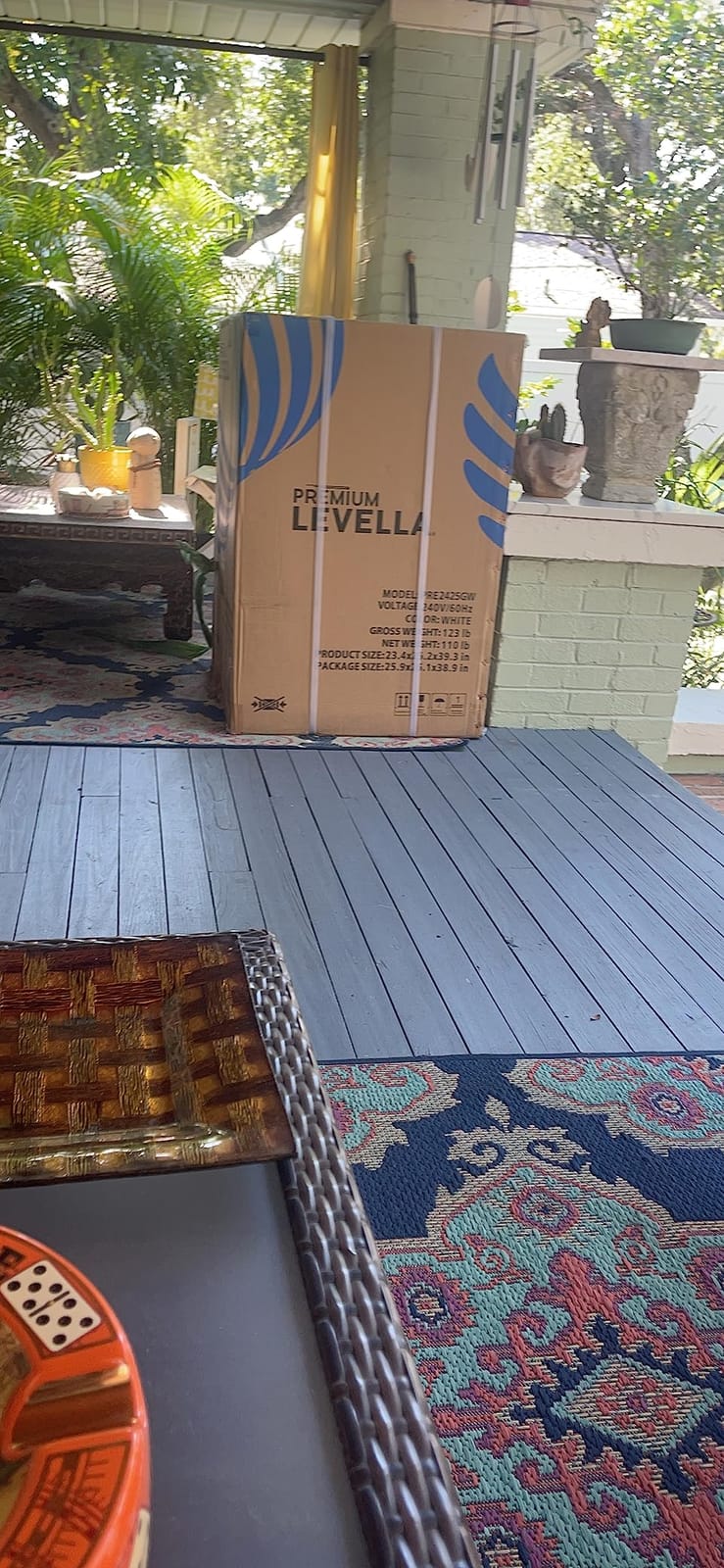
What a 2.7 cu. ft. oven can and cannot bake
At 2.7 cu. ft. you get two rack positions and enough room for a 9×13 pan, a loaf tin set, or a half sheet of cookies. What you do not get is room to bake two full sheet pans at once, and rising bread or a tall layer cake will feel close to the element. Plan on sequential batches rather than parallel ones.
Without a convection fan, browning depends entirely on the element layout and the cavity insulation. That means rotating pans halfway through a bake matters more here than on a fan-equipped oven, and it makes an oven thermometer close to essential. Buying a cheap thermometer is the single highest-value accessory for this range.
Who it suits and who it does not
It suits a couple or a single-person household in a 24-inch opening, someone setting up a basement kitchen, or a baker who makes a dozen cookies at a time rather than a hundred. The storage drawer is more useful than it sounds, because sheet pans and mixing bowls are what eat the cabinet space in a small kitchen.
It does not suit a family that bakes big, or anyone who wants convection, an air-fry mode or a cleaning cycle. The raised coil burners are also harder to wipe clean than a smooth glass top, so you will be cleaning around coils with a damp cloth rather than wiping a flat surface. There is no published warranty description in the specification, which is worth confirming with the seller before you commit.
6. Avanti 24 in. 2.6 cu. Ft. – Best for RVs and Tiny Homes
Avanti Electric Range Oven Compact Design, 2.6-Cu.Ft. Capacity with 4 Coil Burners, Framed Glass Oven Door, Storage Drawer and Broiler with Pan Perfect for Apartment RV Tiny Home, 24-Inch, Black
2.6 cu. ft. oven
98 lb, 24-inch wide
4 coil burners
60-minute mechanical timer
Pros
- Largest review base in the selection at 92 reviews
- Lightest unit here at 98 pounds for tight installations
- Waist-high oven with framed glass door and included pan
- Indicator lights for surface and oven
- Bottom pull-out storage drawer
Cons
- Smallest cavity here at 2.6 cu. ft.
- About 24% of reviews are one-star
- Coil burners are raised and slower to clean
- Some owners report the oven runs hot or cooks unevenly
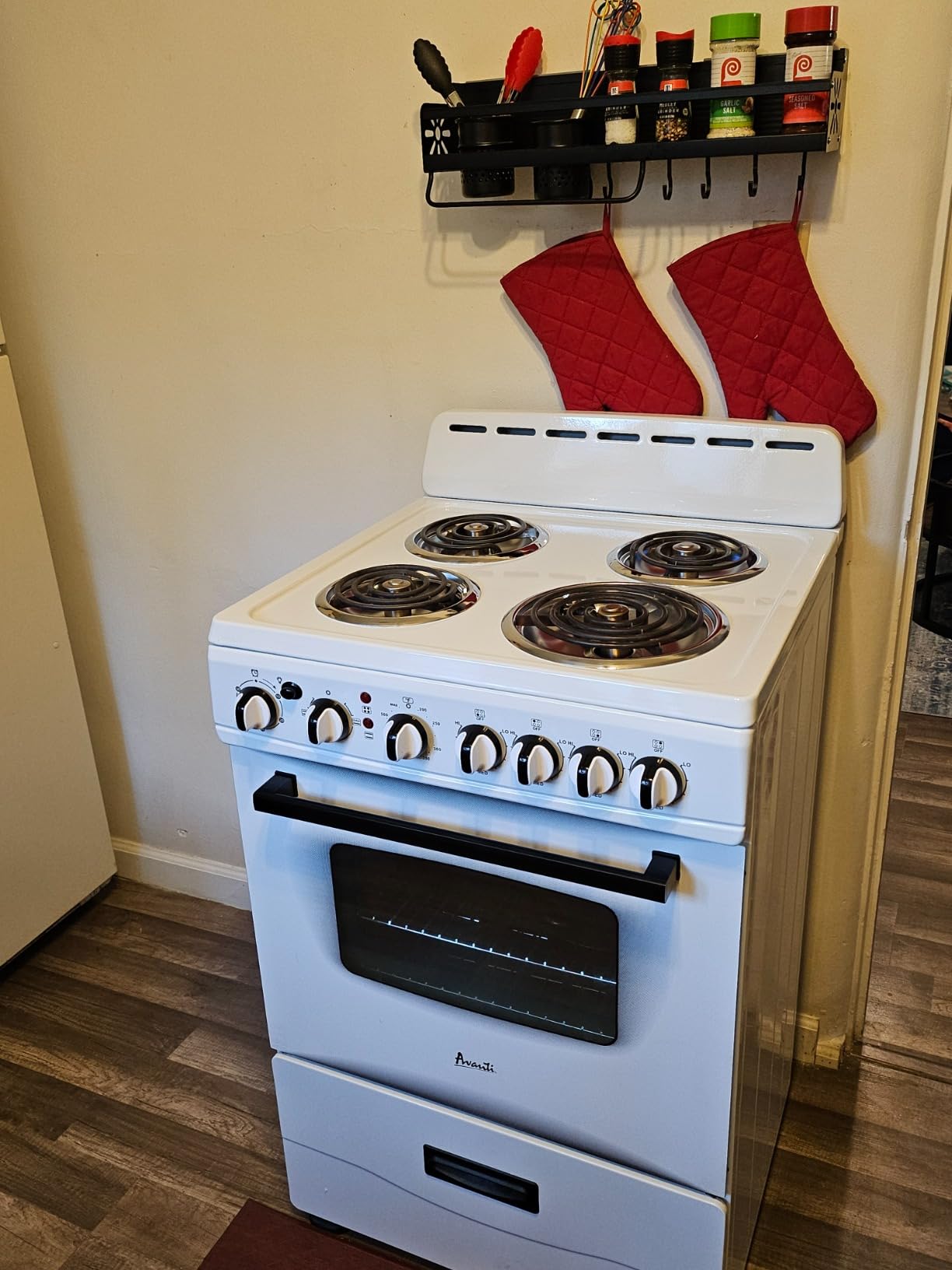
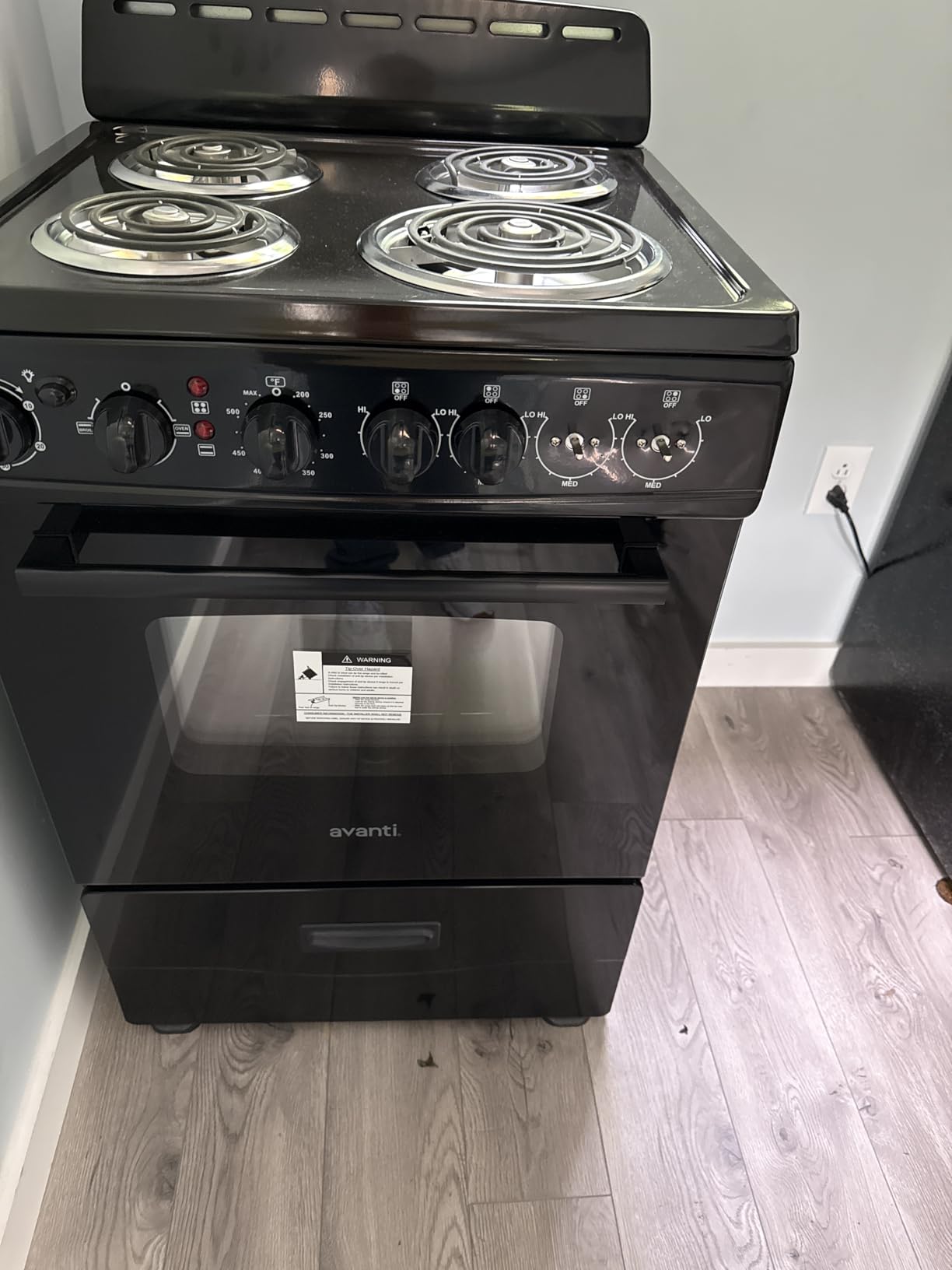
The Avanti ERU240P1B is the compact option with the most published feedback in the entire selection, 92 reviews, which makes it the most honest place to look for a long-term picture of a budget range. At 98 pounds it is the lightest unit here by a wide margin, and at 25.5 inches wide it is built for apartments, RVs and tiny homes where floor space and door width are the constraints.
It bakes, broils and roasts in a 2.6 cu. ft. cavity with two racks, and the broiler comes with its own pan. The four coil burners are three 6-inch and one 8-inch, set over chrome reflector bowls with temperature safety sensors, and the controls are a 60-minute mechanical timer with separate surface and oven indicator lights.
That indicator lighting is a genuinely useful feature in a compact unit, because the dial-and-knob layout gives you no other confirmation that the oven is on. The framed glass door and the bottom pull-out storage drawer round out a package built for a small footprint.
The 3.6 average comes with a sharply split base: about 54% five-star against 24% one-star, which is typical of a long-running budget compact. Fans bought it for tiny-space baking. Detractors cite hot spots, uneven baking, the small cavity and coil-burner cleanup, and some owners report the oven runs hot or cooks unevenly. That last point is the one to take seriously, because an oven that runs consistently hot will undermine every recipe you own.
Running an oven thermometer on a budget compact
Because several owners report the oven running hot, an oven thermometer is not optional here. Place it on the center rack, set the oven to 350 degrees, let it preheat fully for at least 20 minutes, and read the dial without opening the door again. Do the same at 250 and 400 degrees.
If the readings are consistently high, adjust the recipes rather than assuming the range is faulty, and recheck after a few bakes to see whether it drifts as the cavity and elements heat up. Compact ovens with exposed elements tend to swing more than larger cavity ovens, which is exactly why convection or a bigger cavity is worth paying extra for if you bake seriously.
Where it earns its place
This is the right pick for a travel trailer, a studio, a basement kitchen or a first apartment, and for anyone who wants a simple mechanical range with no electronics to fail. A 60-minute mechanical timer has no firmware, no relay control board and nothing that a decade of use can wear out.
It is also the pick for anyone who only bakes small quantities, where a 2.6 cu. ft. cavity is a reasonable size rather than a limitation. The power cord is sold separately, which is standard for compact units, and the warranty is 1 Year Limited.
Where it does not
Do not buy it as a primary baking oven for a household that makes holiday quantities. Two racks and 2.6 cu. ft. means strictly sequential baking, and with 24% one-star reviews reporting uneven cooking, you need the thermometer from day one.
There is no convection, no air fry, no cleaning cycle and no door light beyond what the framed window gives you. The raised coils are also the least pleasant surface in this roundup to clean, so budget time for that as well.
7. Summit 20 in. REXT20BL – Best for Very Narrow Kitchens
Summit 20” Electric Range, Black – REXT20BL
19.38-inch width
1.87 cu. ft. oven
Convection fan cooking
152 lb, European made
Pros
- Narrowest footprint in the selection at 19.38 inches
- Convection fan baking plus broil and broil-plus-convection
- Removable backguard for freestanding or slide-in look
- Front controls and ADA compliant sizing
- Smooth glass cooking surface wipes clean
Cons
- Smallest oven here at 1.87 cu. ft.
- Only 9 reviews with a 24% one-star share
- Some owners report it running smaller than listed
- One buyer reported a quality problem on arrival
The Summit REXT20BL solves a problem nothing else in this list does: it is 19.38 inches wide. If your kitchen is an L-shape, a galley or a European-style run where a 24-inch range will not fit, this is the one. The dimensions are 23.63 inches deep by 19.38 inches wide by 35.5 inches tall, at 152 pounds, and it is made in Europe with a smooth glass cooking surface.
Surprisingly for its size, the oven function list is the most complete on a compact unit here: defrost, static cooking, convection fan, broil, and broil combined with convection. Having a real convection mode plus broil-plus-convection in a 20-inch body is unusual and genuinely useful for small-batch baking.
The removable 2-inch backguard lets it sit freestanding or read as a slide-in, which matters visually in a tight kitchen where there is no cabinet run to hide it against. Front-mounted controls and ADA compliant sizing suit a home where accessibility matters, and there is a slide-out drawer for pot storage.
Evidence is the problem. Nine published reviews, only four written, and sentiment splits: two buyers like the compact European build and normal stove operation, one reports poor performance and a difficult return process, and another wanted a storage drawer. About 24% of the reviews are one-star, and some owners report the unit running smaller than its listed measurements. The 1.87 cu. ft. cavity is the smallest in the roundup.
What convection does in a 1.87 cu. ft. oven
A fan in a cavity this small works faster than in a large one, because the air has less distance to travel. That is good for small cakes and muffins, where you want the heat to reach the center of the batter quickly, and it is the reason we still rate this above the larger no-fan compacts for baking quality.
What the small cavity cannot do is fit much. One 9×13 pan, or a small sheet of cookies, or two loaf tins with very little clearance. Rising dough and tall cakes will crowd the elements. Treat it as a weekday baking oven rather than a production one.
Buying it honestly
Buy it because of the width, and buy it knowing you are trading oven volume for footprint. The 20-inch and 24-inch stainless and white versions give you a finish option, and the smooth top is the easiest cooktop surface in the compact group to keep clean.
Do not buy it on a reputation for reliability. With nine reviews, one reported quality problem on arrival and an owner reporting a size mismatch, confirm the exact dimensions of your opening and your return terms before you commit. The warranty is listed generically as the Summit Appliance Warranty, so check the term length yourself.
8. Kenmore 5.2 cu. Ft. Rear Control – Best Large Cavity Without a Premium Price
Kenmore 5.2 cu ft. Rear Control Electric Range – Black
5.2 cu. ft. cavity
Steam clean and hidden bake element
4 radiant elements
167.6 lb freestanding
Pros
- 5.2 cu. ft. cavity verified by owners to fit the largest cookie sheets
- Hidden bake element and seamless floor cut cleaning time
- Rear controls keep hot knobs away from children
- Ultra-durable chrome racks and a large halogen-lit window
- Best sales rank in this selection
Cons
- Cooktop elements are small with slow heat-up
- Oven takes a long time to preheat
- 3.5 rating with 29% at one or two stars
- Some installs arrived with a missing wire cover
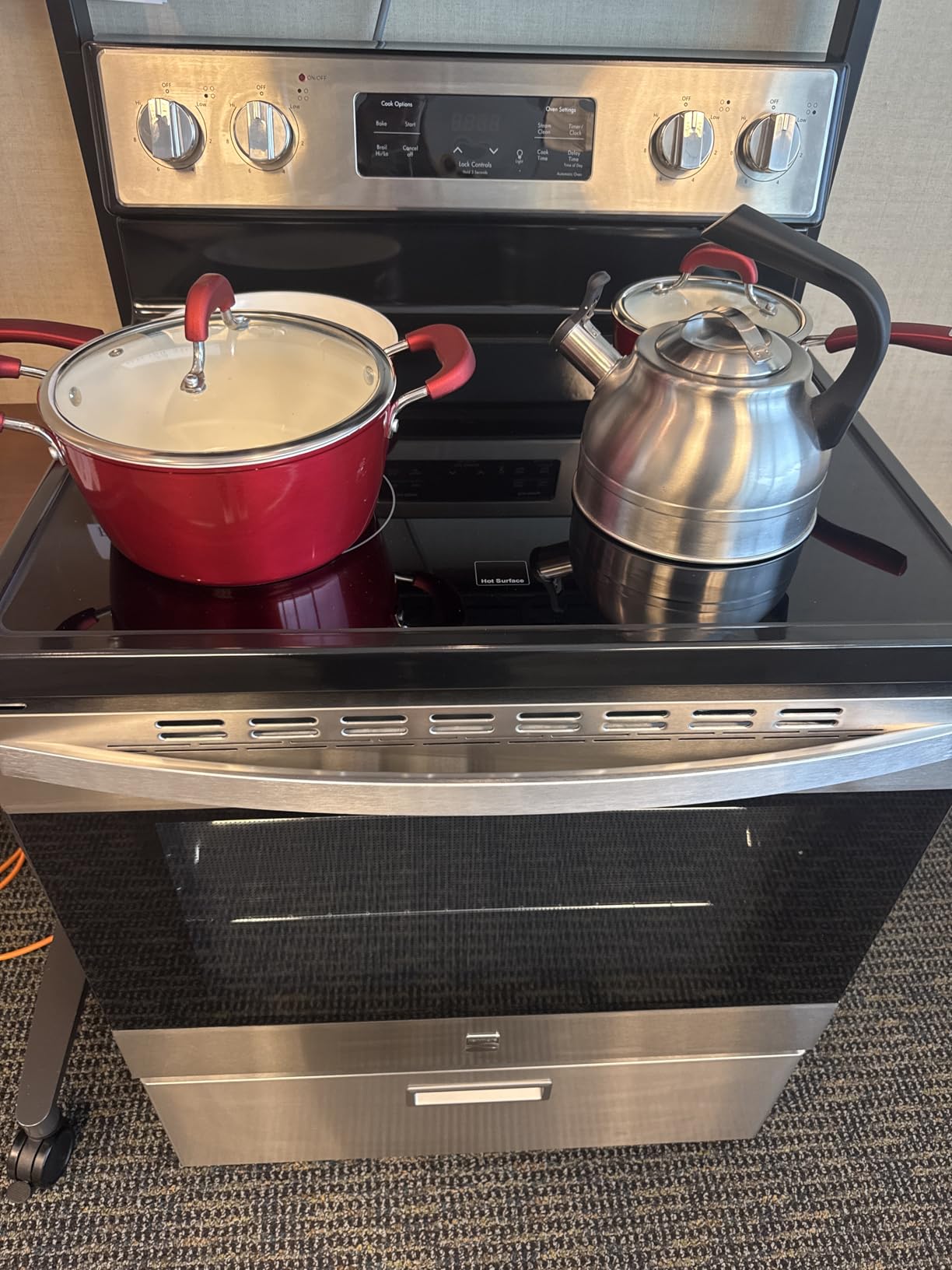
On cavity size alone, the Kenmore 5.2 cu. ft. rear control range is one of the strongest bakers here. At 5.2 cu. ft. it is the second-largest oven in the roundup, and multiple owners confirm it fits the largest cookie sheets without crowding. If your holiday baking is defined by how many trays you can get in at once, that is the number that matters.
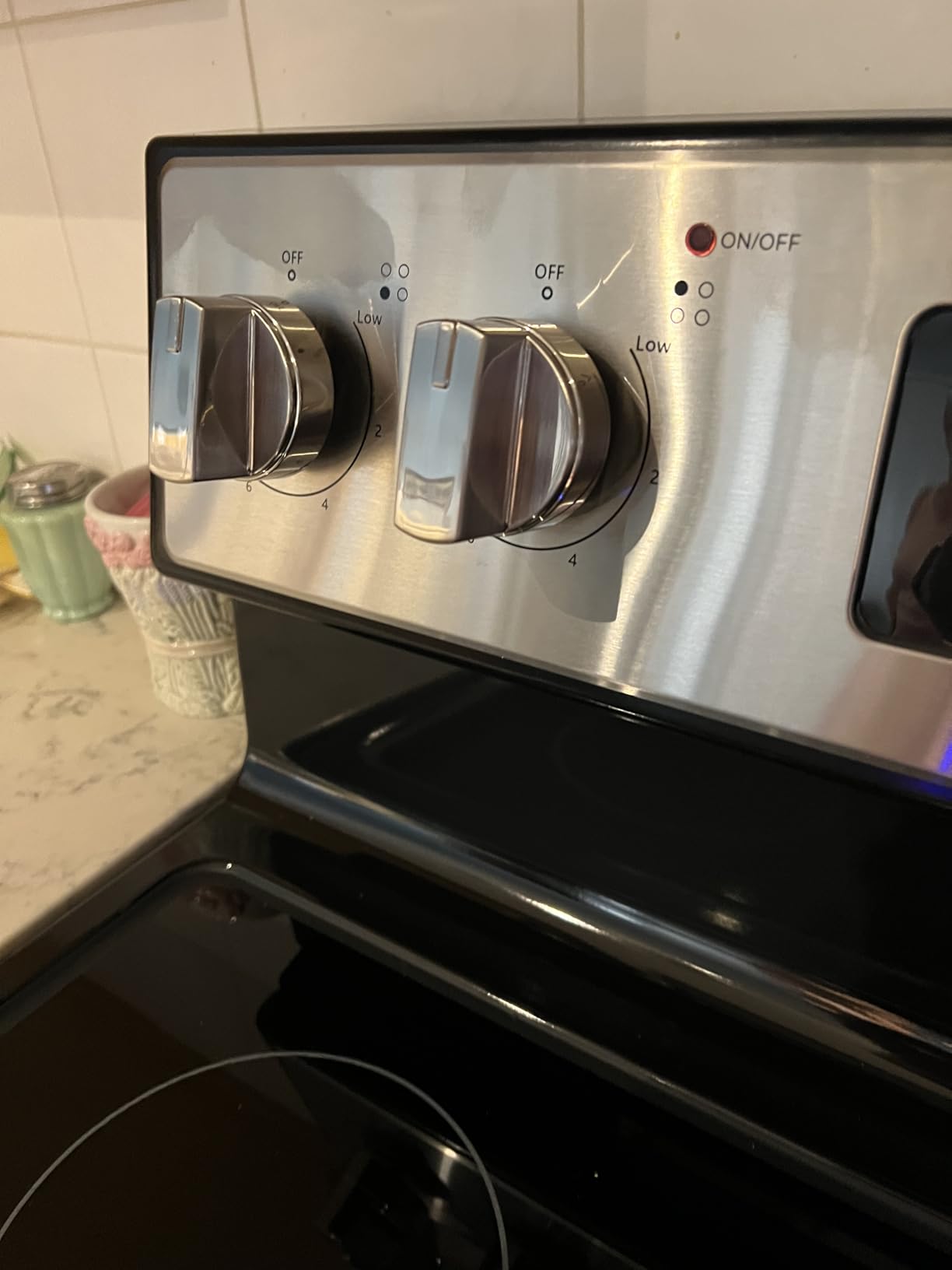
The design details are aimed squarely at maintenance. A hidden bake element means there is no exposed coil to wipe around or to blister under spilled sugar, and the oven floor is seamless. Steam Clean handles the periodic deep clean without a high-temperature self-clean cycle that would stress the bake and broil elements.
Rear-mounted controls are the quiet winner for households with small children, and owners praise them repeatedly. The chrome racks are described as ultra-durable, the window is large, and a halogen oven light lets you check a bake without opening the door and dropping the cavity temperature. A storage drawer underneath takes your sheet pans and pizza trays. This model also has the best sales rank in the selection, at number 8 in Freestanding Ranges.
The cooktop is the disappointment. It has two 8-inch and two 6-inch elements, and owners report very slow heat-up and boil times on them. The oven also takes a long time to preheat, which is a real cost when you are baking in batches. The 3.5 rating carries about 15% two-star and 14% one-star reviews, and one installer reported a missing or incorrect wire cover on arrival.
Why a 5.2 cu. ft. cavity changes batch planning
At 5.2 cu. ft. you can generally fit two full sheet pans at different rack heights without the pans touching, which is the difference between one round of cookies and two. That also lets you roast a chicken on one rack while baking a side dish on another, which is the situation that makes a 4.8 cu. ft. oven feel tight.
The steam clean cycle pairs well with the hidden element for a straightforward maintenance story: no exposed coil to degrease, and no 900-degree cycle to shorten element life. For a household that bakes most weekends, that combination is arguably worth more than a fan mode.
Trade-offs and who should move on
Move on if preheat speed matters to your routine. The slow preheat reported by owners adds minutes to every bake session, and a baker running two sheet pans through a 90-minute cookie marathon will feel it repeatedly. The small, slow cooktop elements are also a problem if you sear or boil.
At 46.35 inches tall with a 25.64-inch depth, check your opening carefully, since the listed height is taller than the 36-inch figures common on 30-inch ranges. The warranty is one year on the appliance, and it is available in black, stainless steel and white.
9. Kenmore 5.6 cu. Ft. Induction – Best Induction Range with a Real Oven
Kenmore 5.6 cu. ft. Electric Induction Range Oven – Stainless Steel
5.6 cu. ft. induction range
4 dual-ring elements with Turbo Boil
True convection and air fry
171 lb
Pros
- Induction delivers fast even heat with no warm-up wait
- True convection with conversion plus built-in air fry
- Self-clean oven with hidden bake element
- 5.6 cu. ft. cavity handles large trays
- Lockable front controls for child safety
Cons
- Lowest rated here at 3.4 with 43% at one or three stars
- Cooktop cycles on and off so steady simmering is hard
- Only one 12-inch skillet fits at a time
- Owner reports of cracked glass top and element failure
- Warranty service and parts reported as difficult
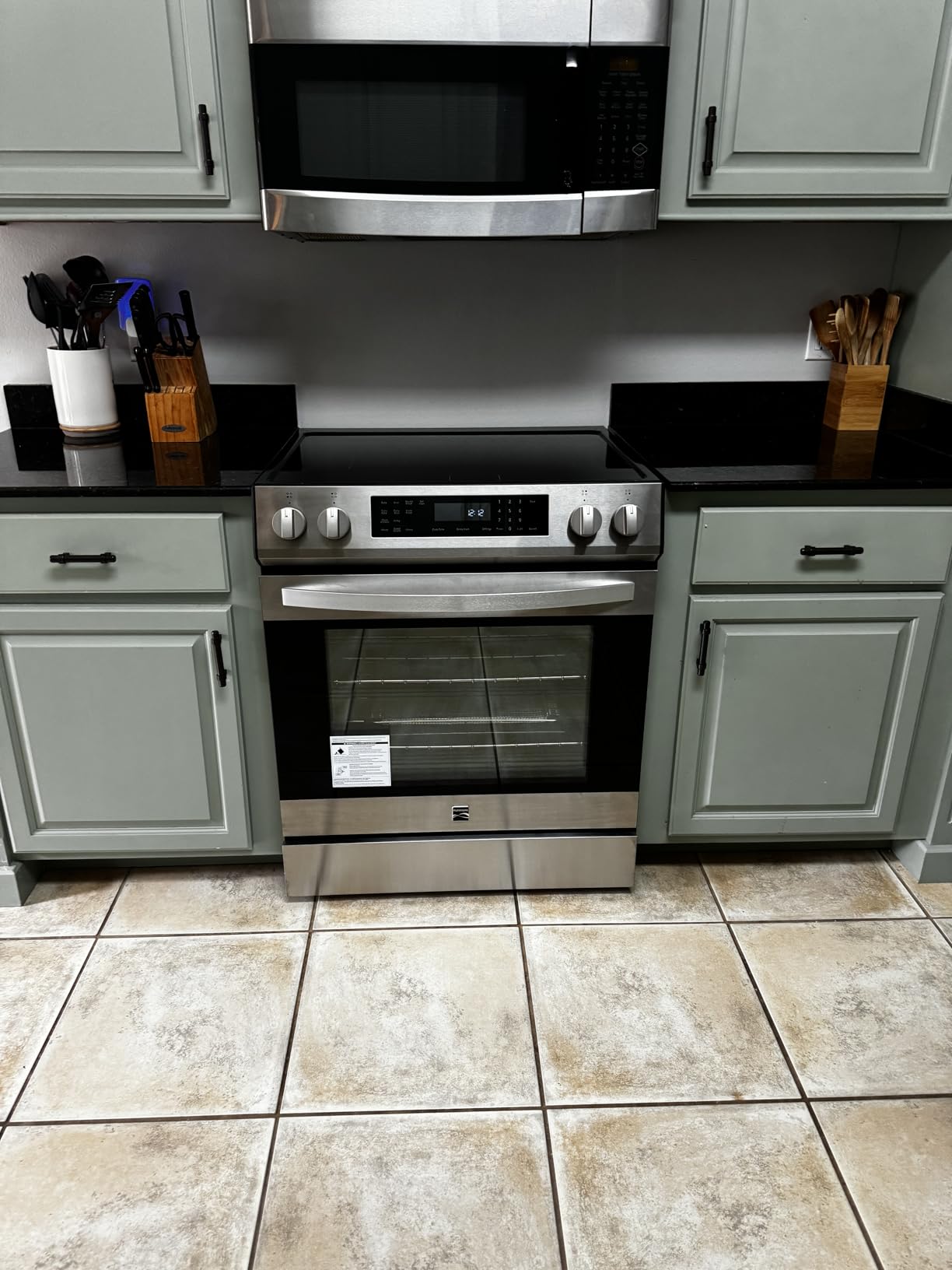
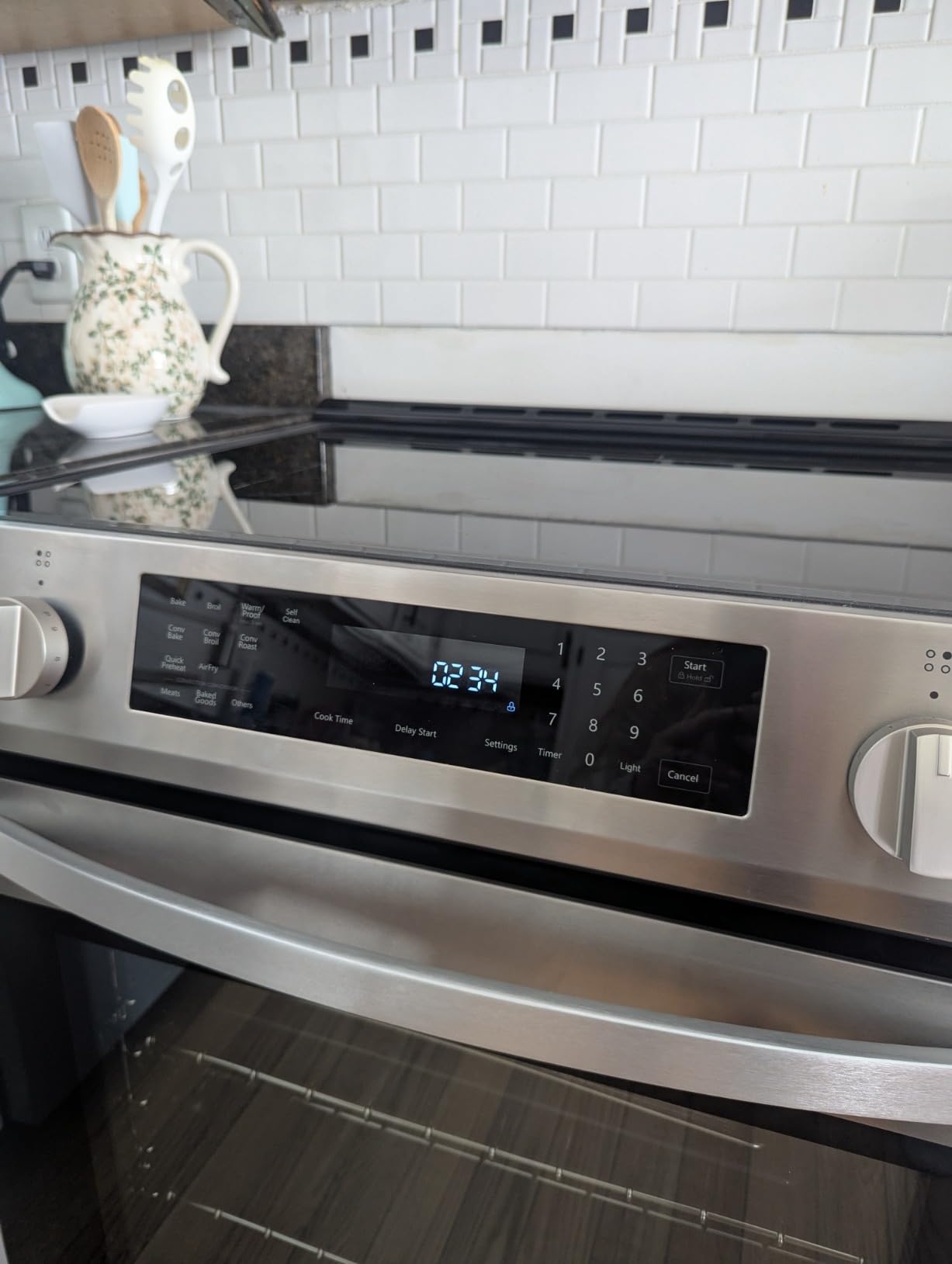
The Kenmore 5.6 cu. ft. induction range is the most capable oven in the roundup on paper. True convection with convection conversion, a built-in air-fry function, a self-clean oven with a hidden bake element, a temperature probe, lockable front controls and a 5.6 cu. ft. cavity with three rack positions. It is the list a baker wants on paper.
On the cooktop, four dual-ring induction elements with Turbo Boil deliver fast, responsive, very even heat with no warm-up wait. Owners consistently describe induction as a genuine upgrade, and it is the reason to consider an electric range over gas if you sear often. The oven is also large enough for large trays, and several owners call the whole appliance a kitchen upgrade.
That is where the positive coverage stops. At 3.4, this is the lowest average rating in the selection, with about 24% three-star and 19% one-star reviews, and the critical reviews are specific rather than vague. The cooktop cycles between full power and off instead of holding a steady simmer, so temperature control on low heat is difficult. Owners report dual-ring elements heating only the very center of a pan, leaving the edges cold. The elements are small enough that only one 12-inch skillet fits at a time.
There are also durability and service reports: a cracked glass top plate, element failures within the first year, and warranty service and parts availability described as difficult, with some parts marked obsolete. Operation is noisy, with clicking and humming from the cooktop, a fan that runs after shutdown and vibrating pot handles. Take all of that seriously, because parts availability years after purchase is exactly the concern forum buyers raise most often.
Is induction cookware a problem for bakers
Yes, and this is worth working through before you buy. Induction heats the pan itself through electromagnetic coupling, so a pot has to have a magnetic base. Most stainless steel, cast iron and magnetic cookware is fine. Aluminum, copper, glass and most non-stick pans are not, and neither is a round-bottomed wok unless it has a flat magnetic base ring.
Round-bottom woks are the specific sticking point people raise on appliance forums, and the practical answer is to test with a magnet before you commit. If a magnet sticks firmly to the base of your wok and your largest stockpot, induction is fine. If it does not, you are looking at a radiant range like the front-control Kenmore further down, or you are buying separate magnetic cookware.
For a baker, this matters less than for a wok cook. Your stovetop workload is mostly stockpot, saucepan and skillet, all of which are usually magnetic. Bread baking, where you might use a Dutch oven, is a non-issue on any of these cookware types.
Who should take the induction trade
Take it if you sear often, want a self-cleaning oven, and can live with on-and-off cycling instead of true variable heat. A temperature probe is a real baking asset for roasts and for monitoring bread internal temperature without opening the door.
Skip it if you simmer sauces often, need two large pans side by side, or cannot tolerate the reported durability and parts-support risk. Lowest-rated in the group and a difficult parts situation is a combination we would not hand to a household that bakes every week. The warranty is one year on the appliance, at 171 pounds and 25 by 29.9 by 36 inches.
10. Kenmore 5.6 cu. Ft. Front Control – Best Five-Burner Radiant Layout
Kenmore 5.6 cu. ft. Front Control Electric Range Oven – Stainless Steel
5.6 cu. ft. true convection
5 cooktop elements
Steam clean oven
171 lb front control
Pros
- 5.6 cu. ft. cavity with true convection bakes evenly
- Five elements including triple and dual ring zones
- Front controls are easy to reach without reaching over heat
- Steam clean handles lighter messes
- Owners describe it as durable roomy and good value
Cons
- Lowest average rating here at 3.3 with 37% one-star
- Multiple reports of element and fan failure in year one
- Parts and warranty support reported as difficult
- Power cord not included
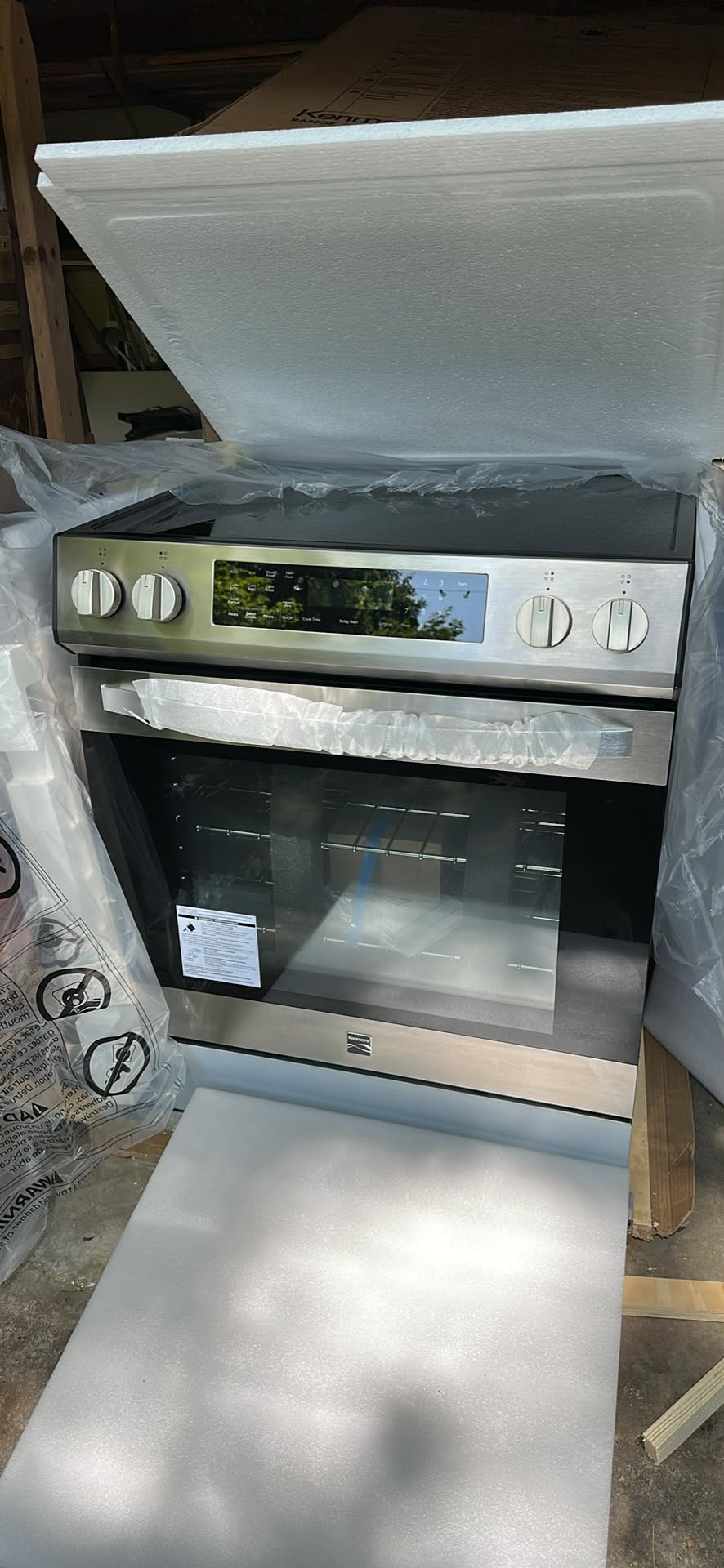
The Kenmore 5.6 cu. ft. front control range pairs the largest cavity in the roundup with true convection and the only five-element cooktop among these picks. The element layout includes a triple ring, a dual ring, plus simmer and warm zones, which is the configuration you want if you run a large kitchen where more than one dish needs controlled heat at once.
Feature-wise it is well specified. Front-mounted precision set controls, a large window with a halogen light, a steam clean oven, hidden bake, a broil function and ultra-durable chrome racks on a flat glass cooktop. The brushed stainless finish matches modern kitchens, and it is offered in steam clean and self-clean versions so you can choose your cleaning method.
The oven itself earns consistent praise. Owners call the 5.6 cu. ft. true convection cavity roomy and report even baking and faster cook times, and the front controls are easy to reach without putting your hands near a hot surface. Steam clean handles lighter messes without a full deep clean.
What drags the rating to 3.3, the lowest in the selection, is durability, and it is not a minor complaint. Several buyers had cooktop elements or the cooling fan fail within the first year, including a front right burner, and described warranty and parts service as unresponsive with some major parts marked obsolete. About 37% of reviews are one-star. The power cord is not included and must be installed by the buyer.
What a five-element cooktop actually adds
Triple and dual ring elements let you change the size of the active cooking zone rather than moving the pan. Simmer and warm zones hold a low temperature without boiling, which matters for pastry work where you need a controlled melt rather than a hard sear. Combined with a 5.6 cu. ft. true convection oven, this is the most flexible cooking configuration in the roundup on paper.
Because it is radiant rather than induction, there is no magnetic cookware requirement at all. If you own a round-bottom wok, copper pans or non-stick cookware, every burner here will work with it, which is the opposite trade from the induction pick above.
Why we ranked it last
Element and cooling fan failures within the first year, across multiple owners, is the specific failure pattern that ends a baking range’s usefulness early. For a weekly baker this is not a cosmetic issue, because the oven and cooktop are one appliance and a dead element can mean a very long wait for a part that may be listed as obsolete.
Also weigh that it is large and heavy at 171 pounds, so measure carefully before installation, and remember the power cord is not included. The one-year appliance warranty is thin for a unit of this specification. If the five-element layout and radiant simplicity are what you need, this is the range that offers them; just go in knowing the support risk.
How to Choose an Electric Range for Baking
Oven capacity is the first filter, and it is the one buyers get wrong most often. Full sheet pans in North America are roughly 13 by 18 inches, and you need clearance above the pan for rising bread and for convection air to move. Under 3 cu. ft. means sequential batches only. From 4.8 to 5.2 cu. ft. fits one full sheet comfortably with room to rise. At 6.0 cu. ft. you can typically run two pans at different heights.
Second is convection design, and the difference between the two types is bigger than most marketing suggests. A true convection oven has a dedicated third heating element and a fan that forces air around the cavity, so heat reaches the far corners of a sheet pan and a tall cake batter cooks through evenly. A fan-assisted oven reuses the same bake element with a fan blowing over it, which improves circulation but does not recover heat as effectively. Neither is a substitute for a temperature check, but for cakes and cookies true convection is the one you want. When you switch to convection, drop the set temperature by about 25 degrees.
Third is element and cavity behaviour, which is where owner feedback beats spec sheets. Every appliance in this roundup cycles a thermostat against a thermistor to hold the set point, and how tightly depends on cavity insulation, element wattage and the sensor. Symptom to watch for is a stated 350-degree oven that actually runs hot or cool. Two owners of compact units in this group report exactly that, and it is the fastest way to ruin a recipe you have made a hundred times.
Fourth is cleaning, and the choice is between three options. Steam clean loosens grease with a low-temperature cycle and is the gentlest on bake and broil elements, which is why we like it for frequent bakers. Self clean burns residue off at very high heat, which is effective but stresses the elements and the door gasket over time. Manual cleaning suits the compact units here, which have no cycle at all. Pick based on how often you bake rather than on which sounds more convenient.
Fifth is the cooktop, and only the fourth decision. Radiant glass elements heat by conducting energy up into the pan, so they respond slowly but hold a steady simmer. Coil burners are older technology, cheaper and raised above the surface, which makes them the least pleasant thing to wipe clean. Induction heats the pan directly, so it is the fastest and most even and requires magnetic cookware. If you own a round-bottom wok, test it with a magnet first, because that pan will not work on induction without a flat magnetic base ring.
Finally, service and parts, which nobody checks and everybody regrets skipping. Confirm that an authorized servicer operates within a reasonable distance of your home before you choose, particularly if you are outside major metro areas where premium brands may have no local support at all and are carried only by big-box stores. Ask how long the manufacturer publishes parts availability for, and treat a one-year warranty as thinner coverage than the category offers. Some models here carry two-year manufacturer warranties for exactly that reason.
For more on fitting and sizing, our slide-in range guide covers the installation differences that trip people up. If you are still weighing fuel types, our comparison of gas ranges and our pick list for electric ranges with air fry round out the shortlist.
How to Check Your Oven’s Real Temperature
Buy an oven thermometer. It is inexpensive, it is the only way to know whether the dial means what you think, and it takes five minutes. Place it on the center rack, set the oven to 350 degrees, allow a full preheat of at least 20 minutes, and read it without reopening the door.
Repeat at 250 and 400 degrees to see whether the error is consistent or drifts with temperature. A consistent offset is easy to correct in your recipes. A drifting oven is a real problem, because it means the thermostat and the thermistor are fighting the element, and it will change the way your cakes brown as the bake progresses.
Once you know your offset, check again every few months and after any heavy bake session. A two-year owner of a glass-top electric range describes an oven that is still accurate, still heats evenly and holds heat well, baking cookies at 350 degrees in 12 minutes. That is the standard worth measuring your own range against.
Frequently Asked Questions
What is the best electric stove for baking?
The Rangaire RRE303TS is our top pick, with a 5.0 cu. ft. cavity, a dedicated convection element and fan, and three telescoping racks. Its oven draws the strongest baking feedback in the group while the slide-in footprint keeps it standard-sized. The COSMO 30 in. Stellar is a close second if you want a similar convection oven with better burner flexibility.
Which electric oven is best for baking?
For most home bakers, the deciding factors are cavity size, true convection and how close the oven holds to the set point. A 4.8 to 5.2 cu. ft. oven with true convection handles a full sheet pan and even browning, and at 6.0 cu. ft. you can run two pans at once. Always confirm the real temperature with an oven thermometer, and drop the set temperature by about 25 degrees when using convection.
What is the best electric oven for home baking?
The best electric oven for home baking is one with true convection and at least 4.8 cu. ft. of cavity space, paired with racks that slide out so you can check food without pulling it over a hot element. Baking-specific modes like air fry matter less than even heat. Compact ovens under 3 cu. ft. work for small batches but force you to bake sequentially.
Which brand of electric range oven is the most reliable?
Reliability varies more by model and by local service coverage than by brand alone, so check whether an authorized servicer operates near your home before choosing. Warranty length is a useful proxy, since two-year manufacturer terms appear on some of the picks here while others offer only one year. Parts availability years after purchase matters more than any badge, especially for induction boards.
Which brand of electric range did Consumer Reports recommend as the best?
Consumer Reports has named LG Studio, Frigidaire Gallery and GE Profile as its picks for electric ranges that pair an induction cooktop with a convection oven, according to discussion of their testing in appliance forums. Those specific models are outside the group we analyzed here, so our ranking is based on published specifications and owner feedback rather than lab testing.
Is induction cookware compatible with round-bottom woks?
Only if the wok has a flat magnetic base. Induction heats the pan itself, so the base must be magnetic, and most round-bottom woks do not qualify unless they include a magnetic ring. Test with a magnet before you buy an induction range. If the magnet does not stick, a radiant range such as the Kenmore front-control model will work with any cookware you own.
What is the best professional baking oven for home use?
A pro-style oven for home baking is essentially a large-capacity electric range with true convection, a temperature probe and a cleaning cycle. The Kenmore 5.6 cu. ft. models in this roundup offer those features, and the Kenmore rear control model adds a 5.2 cu. ft. cavity with steam clean. The real differentiator for consistent results is verifying the actual cavity temperature with an oven thermometer.
Final Verdict
The best electric ranges for baking in 2026 come down to three picks, depending on your kitchen and your volume. The Rangaire RRE303TS wins as the best electric range for baking overall, with the most convincing oven in the group, true convection, a 5.0 cu. ft. cavity and telescoping racks. The COSMO 30 in. Stellar is the best value for a first serious baking setup, and the Avanti 24 in. is the most documented compact unit for small spaces.
Pick a larger cavity if you bake in bulk: the Kenmore 5.2 cu. ft. handles a full sheet with less crowding, and the VEVOR 36 in. runs two pans at once. Pick radiant over induction if you own a round-bottom wok, and pick steam clean if you bake weekly and do not want to scrub grease off an exposed element. Whichever you choose, buy an oven thermometer in the same order, because no amount of specification replaces knowing the temperature your oven actually holds.