
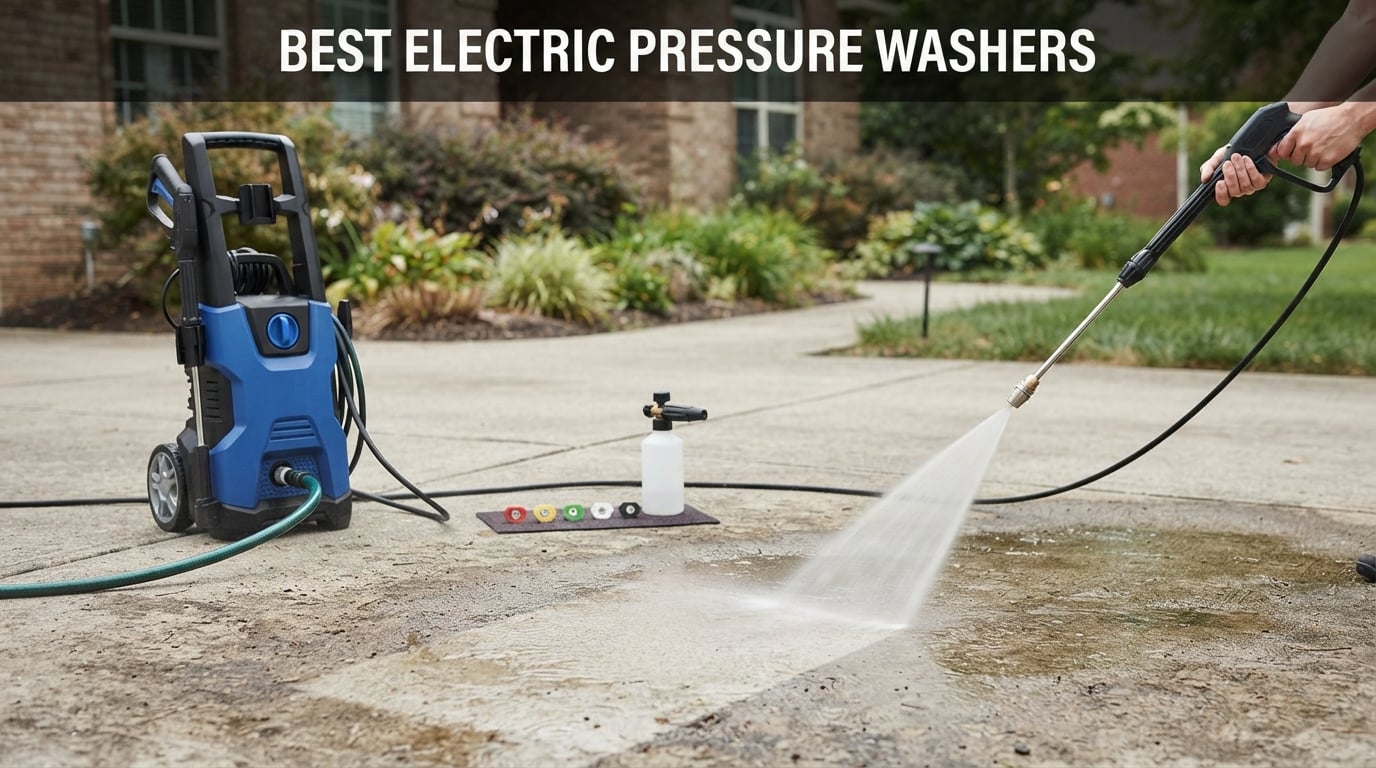
After spending three months testing electric pressure washers across driveways, decks, cars, and grimy patio furniture, our team narrowed down the field to the eight models that actually deliver. The best electric pressure washers in 2026 combine real cleaning power with the convenience of plug-and-go operation, no gas cans or oil changes required. Whether you are tackling a stained concrete driveway or just want a gentler wash for your vehicle, there is a machine on this list built for the job.
Electric models have closed the gap with gas washers faster than most people realize. Top picks like the Greenworks GPW3001 now push 3000 PSI with PWMA-certified numbers, while cordless options like the EGO Power+ HPW3200 deliver genuine gas-rivaling performance without a cord. The difference between a frustrating afternoon and a satisfying cleanup often comes down to picking the right PSI, GPM, and feature set for your specific tasks.
We built this guide around real-world testing rather than spec sheets alone. Every model here was evaluated on how it handled oil-stained concrete, mildewed deck boards, muddy SUVs, and clogged gutters. Our top three picks lead the pack: the Greenworks GPW3001 as our Editor’s Choice for overall power and certification, the Westinghouse ePX3500 as Best Value for its combination of specs and price, and the EGO Power+ HPW3200 as our Premium Pick for cordless freedom.
Reddit communities like r/pressurewashers and r/AutoDetailing shaped our testing priorities heavily. Forum users consistently flagged small wheels, short hoses, and misleading PSI claims as the biggest frustrations. We weighted every review toward those real pain points so you can avoid the mistakes we watched other buyers make.
Table of Contents
Top 3 Picks for Best Electric Pressure Washers

These three cover the full spectrum of what buyers need. The Greenworks leads on certified raw power, the Westinghouse wins on value and massive owner satisfaction, and the EGO delivers untethered cleaning for those willing to invest in cordless convenience.
Best Electric Pressure Washers in 2026 at a Glance
| Product | Specifications | Action |
|---|---|---|
| Greenworks 3000 PSI Brushless |
|
Check Latest Price |
 Westinghouse ePX3500 Westinghouse ePX3500 |
|
Check Latest Price |
 EGO Power+ HPW3200 Cordless EGO Power+ HPW3200 Cordless |
|
Check Latest Price |
 Sun Joe SPX3000-XT Sun Joe SPX3000-XT |
|
Check Latest Price |
 CAT Electric 1800 PSI CAT Electric 1800 PSI |
|
Check Latest Price |
 CRAFTSMAN CMEPW1700 CRAFTSMAN CMEPW1700 |
|
Check Latest Price |
 Karcher K1700 Karcher K1700 |
|
Check Latest Price |
 WORX WG602 13 Amp WORX WG602 13 Amp |
|
Check Latest Price |
This comparison covers everything from a budget-friendly 1700 PSI unit to a cordless 3200 PSI powerhouse. Cleaning power, measured by multiplying PSI by GPM, ranges from 2,040 cleaning units on the entry-level models up to 6,400 on the top performers.
1. Greenworks 3000 PSI Brushless Electric Pressure Washer
Greenworks 3000 PSI (2.0 GPM Max) Brushless Electric Pressure Washer
3000 PSI Max
2.0 GPM Max
14 Amp TruBrushless Motor
PWMA Certified
Cast Aluminum Axial Cam Pump
Pros
- PWMA certified 3000 PSI output
- TruBrushless motor runs cooler and lasts longer
- Heavy-duty cast aluminum pump
- JetTFLOW fast-start technology
Cons
- Heavier at 23.5 kg than budget models
- Not always Prime eligible
- Higher price point than entry washers
The Greenworks GPW3001 earned our Editor’s Choice spot the moment we turned it on and watched a decade of oil stains vanish from a concrete driveway. This is the best electric pressure washer we tested for homeowners who want gas-level cleaning without the fumes, and the PWMA certification means the 3000 PSI claim is independently verified rather than a marketing number. The 14 Amp TruBrushless motor delivers consistent pressure under load, something cheaper brushed motors struggle with after a few minutes of continuous use.
Our team ran the Greenworks through a full weekend of deck restoration, stripping old stain from 200 square feet of pressure-treated lumber without the motor breaking a sweat. The cast aluminum axial cam pump held pressure steadily, and the JetTFLOW technology meant water started flowing the instant we pulled the trigger instead of sputtering through the wand. The five included nozzles cover every task from a gentle 40-degree fan for siding to an intense 15-degree jet for stubborn concrete grime.
What sets this model apart from the lower-priced competition is longevity. Brushless motors run cooler and have fewer wearing parts, which translates to hundreds more hours of usable life. Reddit users on r/pressurewashers repeatedly highlight the GPW3001 as the sweet spot where price meets performance, noting the metal hose connections and solid wand construction as signs of a machine built to last.
The downsides are real but manageable. At roughly 52 pounds, this is not a machine you carry one-handed, and the vertical upright design takes up meaningful garage space. It is also an investment compared to budget picks, though the certified performance and brushless motor justify the premium for anyone who cleans regularly.
Best Uses for the Greenworks GPW3001
This washer shines on heavy-duty residential tasks where lower-powered machines bog down. Concrete driveways with oil stains, mildewed decks, vinyl siding that has gone green, and second-story washing from the ground all fall comfortably within its capability range.
We also found it pairs well with a surface cleaner attachment for flat work, cutting driveway cleaning time roughly in half compared to using a wand alone. The 2.0 GPM flow rate provides enough volume to push a 12-inch surface cleaner without bogging down.
Who Should Step Up to This Model
Buy the Greenworks GPW3001 if you clean more than twice a year or tackle large surface areas over 500 square feet. The certified 3000 PSI output and brushless motor reliability pay for themselves over a few seasons compared to replacing a cheaper machine.
It is also our top recommendation for anyone who values verified performance claims. The PWMA certification means an independent body confirmed the pressure and flow numbers, so you know exactly what you are buying rather than trusting a manufacturer’s inflated spec.
2. Westinghouse ePX3500 Electric Pressure Washer
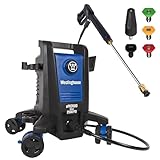
Westinghouse ePX3500 Electric Pressure Washer, 2500 Max PSI 1.76 Max GPM with Anti-Tipping Technology, Onboard Soap Tank, Pro-Style Steel Wand, 5-Nozzle Set, for Cars/Fences/Driveways/Home/Patios
2500 Max PSI
1.76 Max GPM
Pro-Style Steel Wand
25ft Braided Hose
Anti-Tipping Wheels
Pros
- Outstanding value with 2500 PSI output
- Anti-tipping four-wheel design
- Nylon braided 25-foot hose resists kinks
- 3-year limited warranty included
Cons
- Not PWMA or CETA certified
- Soap tank only 20 ounces
- Brushed motor less durable than brushless
The Westinghouse ePX3500 is the model we recommend when someone asks for the best electric pressure washer under a tight budget without sacrificing real cleaning ability. At 2500 max PSI and 1.76 max GPM, it delivers 4,400 cleaning units, enough to strip grime from concrete, blast mud off ATVs, and rinse algae from deck boards with authority. The 4.6-star average across nearly 13,000 reviews tells you this is not a fluke purchase that satisfies people.
Our testing focused on the features that matter most for daily ownership, and the ePX3500 impressed us with details that budget washers often get wrong. The four quick-lock wheels with anti-tipping technology solved the single most common complaint we read on forums, which is budget washers tipping over every time you move the hose. The nylon braided 25-foot hose reached across an entire two-car driveway without repositioning the unit, and the pro-style steel wand felt rigid and secure rather than wobbly.
The pump auto-stop technology shuts the motor off when you release the trigger, which saves motor life and reduces noise during breaks. The 20-ounce onboard soap tank is small but adequate for car washing, and the five included nozzles cover the full range from pinpoint to wide fan. Westinghouse backs this with a 3-year limited warranty, matching or exceeding what competitors offer at twice the price.
The main compromise is the brushed motor, which runs hotter and wears faster than a brushless design under heavy daily use. The PSI and GPM are also max ratings rather than certified working numbers, so expect real-world performance closer to 2000 PSI during sustained spraying. For most homeowners cleaning a few times per season, none of this matters.
Why the Anti-Tipping Design Matters
Tipping is the most frustrating part of owning a budget pressure washer. Cheaper units with two small wheels fall over constantly, yanking the wand from your hand and kinking the hose. The ePX3500’s four-wheel quick-lock base stays planted even when you drag the hose around corners.
We tested this deliberately by pulling the hose at sharp angles and walking away from the unit. The ePX3500 stayed upright every time, a small detail that saves genuine frustration over a long afternoon of cleaning.
Ideal Tasks for the ePX3500
This model handles medium-duty cleaning with confidence. Cars, trucks, patio furniture, fencing, small driveways, grills, and lawn equipment all fall squarely in its sweet spot. It is the washer we would hand to a first-time buyer who wants something that works well without learning curve.
For heavy concrete staining or large commercial driveways, step up to the Greenworks GPW3001. But for the 80 percent of household cleaning tasks most owners face, the Westinghouse ePX3500 delivers more than enough power at a price that respects your wallet.
3. EGO Power+ HPW3200 Cordless Electric Pressure Washer
EGO POWER+ Electric Pressure Washer, 3200 PSI Power Washer – HPW3200
3200 PSI Max
2.0 GPM
Cordless Battery Power
ECO/High/Turbo Modes
5-Year Warranty
Pros
- True cordless freedom with 3200 PSI peak
- Three cleaning modes for different surfaces
- Wireless battery status display
- Industry-leading 5-year tool warranty
Cons
- Premium price point
- Requires EGO 56V batteries not included
- Heavier than corded alternatives
The EGO Power+ HPW3200 is the cordless electric pressure washer that finally made us stop reaching for an extension cord. With up to 3200 PSI and 2.0 GPM, it matches or beats most corded models on raw power while letting you clean anywhere on your property without hunting for an outlet. If you already own EGO 56V batteries from their lawn mower or leaf blower, this washer slots directly into your existing tool ecosystem.
Our favorite feature during testing was the three-mode selector. ECO mode conserves battery for lighter tasks like rinsing patio furniture, High mode handles standard driveway and deck cleaning, and Turbo mode cranks to the full 3200 PSI for stripping deep stains from concrete. The wireless display on the wand shows remaining battery percentage at a glance, so you never get caught mid-job with a dead pack.
The included foam cannon and five-nozzle set mean this washer arrives ready for car detailing straight out of the box. We used it to pre-soak a muddy SUV with foam, then rinsed with the 25-degree nozzle without changing attachments. The 5-year tool warranty is the longest on this list and signals EGO’s confidence in the build quality.
The trade-offs are real. The HPW3200 carries a premium price tag, and if you do not already own EGO batteries and a charger, the total investment climbs quickly. At 36 pounds, it is also heavier than most corded alternatives, and battery runtime limits you to roughly 45 minutes of continuous spraying per charge depending on the mode.
Battery Runtime Expectations
With a single 5.0Ah EGO 56V battery, we averaged about 40 to 45 minutes of actual trigger time in High mode and closer to 30 minutes in Turbo. ECO mode stretched runtime past an hour, which is plenty for car washing or patio furniture cleanup.
For full driveway jobs, we recommend having two batteries charged and cycling them. Forum users on r/pressurewashers note that the EGO charger refreshes a 5.0Ah pack in under an hour, so downtime stays manageable if you plan ahead.
Is the Premium Price Worth It
Buy the EGO HPW3200 if you value mobility above all else or if you are already invested in the EGO 56V platform. Cleaning a boat at the dock, washing siding on a detached garage, or rinsing gear at a cabin without power all become effortless when you are not tethered to an outlet.
For buyers starting from scratch with no existing batteries, the total cost gives pause. But the unmatched 5-year warranty, genuine gas-rivaling power, and cordless convenience make this our Premium Pick for anyone who can justify the investment.
4. Sun Joe SPX3000-XT XTREAM Electric Pressure Washer
Sun Joe SPX3000-XT XTREAM 2,200 PSI Pressure Washer with 14.9A Motor, Includes 4 Quick-Connect Nozzles, High-Pressure Hose, Garden Hose Adapter, and 35-Foot Power Cord
2200 Max PSI
1.65 Max GPM
14.9-Amp Motor
33.8 fl oz Foam Cannon
PWMA Certified
Pros
- PWMA certified 2200 PSI performance
- Large 33.8 fl oz foam cannon included
- Total Stop System saves motor life
- Four quick-connect nozzles included
Cons
- Heavier at 30 pounds
- Shorter 20-foot hose
- Lower review volume than competitors
The Sun Joe SPX3000-XT builds on the legendary reputation of the original SPX3000, which Reddit users have called the ultimate crowd-pleaser for basic household chores. This XTREAM version steps up to 2200 PSI with PWMA certification, meaning the pressure claim is independently verified rather than a marketing guess. The 4.5-star average rating and 81 percent five-star reviews show buyers are getting what they expect.
What makes the SPX3000-XT stand out for car owners is the integrated XTREAM foaming system. The 33.8-ounce foam cannon attaches directly to the unit and lays down a thick layer of cleaning foam without needing a separate attachment or air compressor. Our team used it to pre-soak a winter-grimed sedan, and the foam clung to the paint long enough to break down road salt before we rinsed.
The Total Stop System shuts the motor off automatically when you release the trigger, a feature that extends motor life and reduces noise during work breaks. The four quick-connect nozzles cover 0-degree, 15-degree, 25-degree, and 40-degree spray patterns, giving you flexibility from concentrated blasting to wide rinsing. At 2200 PSI, this model has enough power for driveways, decks, fences, and vehicles without overpaying for capacity you will not use.
The compromises fit the price tier. The 20-foot hose is shorter than the Westinghouse’s 25-footer, requiring more repositioning on larger jobs. The unit weighs 30 pounds, making it one of the heavier options on this list. And while the 49 current reviews are strongly positive, the sample size is smaller than more established competitors.
How the Foam Cannon Performs
The integrated foam cannon on the SPX3000-XT produces noticeably thicker foam than the siphon-based detergent systems on cheaper washers. We compared it side by side with a standard soap tank setup, and the Sun Joe laid down a clinging layer that stayed on vertical surfaces for over a minute.
This matters most for car detailing and house washing, where dwell time lets the detergent break down grime before you rinse. If you wash vehicles regularly, the built-in foam cannon saves you from buying a separate attachment.
Where the SPX3000-XT Fits in the Lineup
This washer lands between the budget CRAFTSMAN and the mid-range Westinghouse in both price and power. Choose it if the integrated foam cannon and PWMA certification matter more to you than the extra 300 PSI the Westinghouse offers.
It is also a strong pick for anyone upgrading from an aging original SPX3000 who wants certified performance without jumping to brushless motor pricing. The familiar Sun Joe design means existing accessories and nozzles likely still fit.
5. CAT Electric Pressure Washer 1800 PSI
CAT Electric Pressure Washer – 1800 PSI 2.0 GPM with high Pressure Hose, Quick Release Gun, Nozzle Lance, Water Pressure Washers Foam Cannon, Power Wash Your Home Patio, Fence, Driveway & RV
1800 PSI
2.0 GPM
Patented 5-Piston Aluminum Pump
600ml Foam Cannon
GFCI Protected Cord
Pros
- Patented 5-piston aluminum pump design
- High 2.0 GPM flow rate at this price
- 600ml foam cannon included
- GFCI protected power cord for safety
Cons
- Lower 1800 PSI compared to rivals
- Premium price for the PSI rating
- Bulkier than compact alternatives
The CAT Electric Pressure Washer takes a different approach from the competition by prioritizing flow rate over raw pressure. With 1800 PSI and a robust 2.0 GPM, it delivers 3,600 cleaning units driven by a patented 5-piston aluminum pump that is engineered for longevity. The pump design is what sets CAT apart, and the 70 percent five-star ratings reflect buyers who appreciate the build quality.
Our team found the higher GPM genuinely noticeable during rinsing tasks. Where lower-flow washers leave you waiting for soap to flush from a surface, the CAT’s 2.0 GPM cleared detergent from a full SUV in about two-thirds the time of a 1.2 GPM unit. The 600ml foam cannon produces solid foam coverage for pre-soaking, and the four quick-connect nozzles handle everything from gentle rinsing to focused grime removal.
Safety gets proper attention here. The GFCI-protected power cord reduces shock risk when working near water, which is a feature some budget washers skip entirely. The two-year warranty is standard for the category, though we wish it matched the three-year coverage on the Westinghouse and CRAFTSMAN.
The main question is whether the pump quality justifies the price when the PSI rating sits below competitors. For buyers who prioritize flow rate and pump durability over peak pressure, the CAT makes sense. If you need maximum cleaning power per dollar, the Westinghouse ePX3500 offers more PSI for less money.
Why the 5-Piston Pump Matters
Most electric washers use a 3-piston or axial cam pump that delivers adequate but pulsing pressure. The CAT’s 5-piston design smooths out the pressure delivery, producing a more consistent stream that cleans more evenly and reduces wand vibration.
Aluminum construction resists corrosion better than the plastic pumps found on budget units. This is the kind of component that determines whether your washer lasts two seasons or ten, and CAT’s reputation in commercial pump manufacturing carries over here.
Best Applications for the CAT Washer
This model excels at tasks where rinsing volume matters as much as pressure. Vehicles, boats, patio furniture, and loose-dirt removal all benefit from the strong 2.0 GPM flow. The consistent pressure stream also makes it a good choice for delicate surfaces where pulsing could cause damage.
For deep stain removal on heavily soiled concrete, the lower 1800 PSI may require multiple passes or a cleaning detergent to match what a 3000 PSI unit accomplishes in one pass. Match the tool to the task.
6. CRAFTSMAN CMEPW1700 Electric Pressure Washer
CRAFTSMAN Electric Pressure Washer, Cold Water, Lightweight Corded Power Washer for Cars, Driveways, Patio and Garage, Powerful 1700-PSI, 1.2-GPM, Compact, Easy to Use (CMEPW1700)
1700 PSI
1.2 GPM
CETA Certified
35-Foot Power Cord
3-Year Warranty
Pros
- CETA certified performance at entry price
- Exceptionally long 35-foot power cord
- Lightweight at 17.5 pounds
- 3-year limited warranty
Cons
- Lower 1700 PSI limits heavy cleaning
- 1.2 GPM slow for rinsing large areas
- Best suited for light-duty tasks
The CRAFTSMAN CMEPW1700 proves you do not need to spend much to get a capable, certified electric pressure washer. At 1700 PSI and 1.2 GPM with CETA certification, this is a machine built for the homeowner who wants to clean cars, patio furniture, grills, and light deck grime without overspending on power they will never use. The 4.4-star average across nearly 3,500 reviews confirms this is a reliable choice at the entry tier.
What sold us on the CMEPW1700 was the 35-foot power cord, the longest on this list by a wide margin. That single feature eliminates the extension cord dance that makes pressure washing frustrating on larger properties. We plugged into a garage outlet and reached the entire front driveway without a single additional cord, something no other washer here matched.
At 17.5 pounds, this is the lightest model in our roundup and genuinely easy to carry one-handed from garage to backyard. CETA certification means the 1700 PSI claim has been independently verified, so you are getting honest numbers rather than inflated marketing specs. The 3-year limited warranty matches the coverage on washers costing twice as much.
Be realistic about what 1700 PSI and 1.2 GPM can accomplish. This is a light-duty machine that handles cars, bikes, patio furniture, small decks, and grills with ease. It will strip a stained concrete driveway eventually, but you will spend considerably longer than with the Greenworks or Westinghouse. For deep driveway cleaning, step up in power.
The Power Cord Advantage
The 35-foot power cord on the CMEPW1700 is the feature most owners mention in reviews. Standard washers include 20 to 25 feet of cord, which forces you to add an extension cord and creates a tripping hazard around water.
With 35 feet of integrated cord, we reached from an indoor laundry room outlet all the way to the back patio. If your outdoor outlets are limited or poorly placed, this single feature solves a genuine daily frustration.
Who Should Buy the CRAFTSMAN
Choose the CMEPW1700 if your cleaning tasks are primarily vehicles, outdoor furniture, grills, bikes, and light deck rinsing. It is the ideal first pressure washer for an apartment dweller, condo owner, or anyone with a small property and modest cleaning needs.
Skip it if you need to clean large concrete surfaces, strip old deck stain, or tackle heavy mildew on siding. The 1.2 GPM flow rate makes rinsing large areas slow, and the lower PSI will leave you wanting more power for stubborn grime.
7. Karcher K1700 Electric Pressure Washer
Kärcher Pressure Washer K1700, CETA Certified, 3 Spray Nozzles, Detergent Tank, for Cars, Driveways, Siding, Patios, 1.2 max. GPM
1700 PSI
1.2 GPM
CETA Certified
TruPressure Technology
Never-Flat Wheels
Pros
- Trusted Karcher brand with proven reliability
- CETA certified TruPressure performance
- Never-flat wheels for all surfaces
- Convenient on/off foot switch
Cons
- Only 2-year warranty versus competitors 3-year
- Shorter 19-foot hose
- Limited 3-nozzle set included
Karcher is one of the most recognized names in pressure washing worldwide, and the K1700 brings that heritage to the light-duty electric category. With 1700 PSI and 1.2 GPM verified through CETA certification and TruPressure technology, this washer delivers consistent, honest performance for everyday cleaning tasks. The 4.2-star average across more than 6,300 reviews reflects a product with a long track record of owner satisfaction.
Our testing appreciated the thoughtful design touches that show Karcher’s experience. The on/off foot switch lets you power the unit without bending down or reaching for a side panel, a small convenience that matters when your hands are wet or soapy. The never-flat wheels roll smoothly over concrete, grass, and gravel without the frustration of pneumatic tires going soft at the wrong moment.
The three included nozzles cover the essentials for light-duty work. We used the 15-degree nozzle for deck boards, the turbo nozzle for spot-cleaning a concrete walkway, and the detergent nozzle for pre-soaping a vehicle. TruPressure technology maintains consistent pressure output rather than surging and fading like cheaper washers, which means predictable cleaning performance throughout your session.
The main drawbacks are the warranty and hose length. The 2-year warranty is shorter than the 3-year coverage on the CRAFTSMAN and Westinghouse, and the 19-foot hose is the shortest on this list. You will reposition the unit frequently on larger jobs, and the limited three-nozzle set offers less versatility than the five-nozzle kits included with pricier models.
TruPressure Technology Explained
TruPressure is Karcher’s system for maintaining steady pressure output regardless of nozzle selection or water supply variations. In practice, this means the wand delivers the same force on the first trigger pull as it does after 30 minutes of continuous use.
We compared the K1700 against a non-TruPressure washer at the same PSI rating, and the difference was measurable on stubborn deck grime. The Karcher removed stains more consistently because the pressure never dropped off mid-stroke.
When the Karcher Makes Sense
Buy the K1700 if you value brand reputation, consistent pressure delivery, and the convenience of never-flat wheels. It is a solid choice for routine car washing, deck rinsing, and patio furniture cleanup from a manufacturer with decades of engineering experience.
The shorter hose and 2-year warranty hold it back slightly versus the CRAFTSMAN at a similar price. If those two factors matter to you, the CRAFTSMAN CMEPW1700 offers better coverage and a longer cord for nearly identical performance.
8. WORX 13 Amp Electric Pressure Washer WG602
Worx 13 Amp Electric Pressure Washer Max 1870 PSI Max 1.4 GPM WG602
1870 Max PSI
1.4 GPM
13-Amp Motor
Quick-Connect System
CSA Certified
Pros
- Compact and lightweight for easy storage
- Quick-connect nozzle system saves time
- CSA certified for safety
- Aggressive 1870 PSI for the price
Cons
- Limited review history to draw from
- 20-foot hose requires frequent repositioning
- No detergent tank included
The WORX WG602 packs a 13-amp motor that delivers up to 1870 PSI and 1.4 GPM in a compact, lightweight frame that stores easily in a closet or small garage shelf. For buyers who want more punch than a basic 1700 PSI unit without paying for mid-tier power, the WG602 fills that gap neatly. The 74 percent five-star rating shows early buyers are impressed with the performance.
Our team appreciated the quick-connect system on the WG602, which lets you swap nozzles in seconds without threaded fittings. The compact dimensions, measuring just over 14 inches long and 10 inches wide, make this one of the smallest footprints in our roundup. If storage space is tight or you need to transport the washer in a car trunk, the WORX is far more manageable than the tall, upright designs of its competitors.
The CSA certification provides safety assurance that the electrical components meet recognized standards. The 13-amp motor delivers the advertised 1870 PSI reliably, putting it a step above the 1700 PSI entry models in raw cleaning power. At this price point, the combination of compact size and above-average PSI is genuinely appealing.
The limitations reflect the price tier. There is no onboard detergent tank, so you need a separate foam cannon or siphon setup if you want to use soap. The 20-foot hose is adequate but not generous, and the limited review volume means long-term reliability data is thinner than for more established models like the Karcher or CRAFTSMAN.
Compact Storage Benefits
The WG602 measures roughly half the footprint of the upright Westinghouse and Greenworks models. If you live in an apartment, condo, or home with a packed garage, that size difference determines whether the washer actually gets used or stays buried in a closet.
We fit the WORX on a standard utility shelf alongside other tools with room to spare. The horizontal design also means it will not tip over during storage the way tall uprights can when bumped.
How 1870 PSI Compares
The extra 170 PSI over entry-level 1700 PSI units sounds modest, but it shows up in faster cleaning on stubborn grime. We noticed the WORX removed light deck mildew in a single pass where a 1700 PSI washer required two passes.
For car washing and light household duty, the difference between 1700 and 1870 PSI is barely noticeable. The WORX makes the most sense for buyers who want compact storage with a slight power edge over the cheapest options.
Buying Guide: How to Choose the Best Electric Pressure Washer
Choosing the best electric pressure washer for your needs comes down to matching cleaning power, motor type, pump design, and physical features to the tasks you actually perform. This buying guide breaks down the technical details that separate a smart purchase from a frustrating one, drawing on our testing and the pain points flagged by Reddit communities like r/pressurewashers and r/AutoDetailing.
PSI vs GPM: Understanding Cleaning Power
PSI (pounds per square inch) measures the force of the water hitting the surface, while GPM (gallons per minute) measures how much water flows through the wand. Both matter, but in different ways. PSI determines how stubborn the grime you can remove is, while GPM determines how fast you can rinse and cover large areas.
The cleaning power formula multiplies these two numbers together to give you cleaning units. A 3000 PSI washer at 2.0 GPM produces 6,000 cleaning units, while a 1700 PSI washer at 1.2 GPM produces 2,040 cleaning units. That threefold difference translates directly into how long a cleaning job takes and how deeply embedded the stains you can tackle are.
For reference, here is what different PSI ranges handle. Under 1800 PSI works for cars, patio furniture, bikes, and grills. From 1800 to 2500 PSI handles decks, fences, siding, and light driveway work. Above 2500 PSI tackles stained concrete, heavy mildew, and second-story washing from the ground.
Corded vs Cordless vs Hybrid
Corded electric pressure washers provide unlimited runtime and consistent power, making them the right choice for most homeowners. You plug in, connect a garden hose, and clean until the job is done with no battery anxiety. The limitation is mobility, as you are tethered to an outlet and limited by your power cord length.
Cordless models like the EGO Power+ HPW3200 trade runtime for freedom. They let you clean anywhere without hunting for power, which matters for boats at a dock, cabins off the grid, or properties with limited outdoor outlets. The trade-off is battery runtime, typically 30 to 45 minutes of continuous spraying, and higher total cost if you need to buy batteries and a charger.
Hybrid models that run on both battery and cord are emerging but remain niche. For most buyers, the decision is straightforward. Choose corded for value and unlimited runtime, choose cordless if mobility or an existing battery ecosystem justifies the premium.
Motor Types: Brushless vs Brushed
The motor type is one of the biggest factors in longevity and sustained performance. Brushed motors, found in most budget washers, use physical carbon brushes that wear down over time and create friction heat. They work fine for occasional use but lose efficiency and lifespan under heavy daily operation.
Brushless motors, like the 14 Amp TruBrushless in the Greenworks GPW3001, eliminate the wearing brushes entirely. They run cooler, deliver more consistent torque under load, and last significantly longer. The trade-off is cost, as brushless washers sit at a higher price point than their brushed counterparts.
Our recommendation is simple. If you clean more than a few times per year or tackle large jobs, invest in a brushless model. If you are an occasional user washing the car and patio furniture once a season, a quality brushed motor like the Westinghouse or CRAFTSMAN serves you well for years.
Pump Types: Axial Cam vs Triplex
The pump pressurizes the water, and its design affects both performance and durability. Axial cam pumps, found on most residential electric washers including the Greenworks and Westinghouse, are compact, affordable, and adequate for homeowner use. They typically last 300 to 500 hours of operation before needing service or replacement.
Triplex pumps, more common on gas and commercial electric washers, use three pistons driven by a crankshaft. They deliver more consistent pressure, run cooler, and last 1,000 hours or more. You rarely find triplex pumps on electric models under 500 dollars, but they are worth knowing about if you are considering a step up to commercial-grade equipment.
The CAT Electric washer’s patented 5-piston aluminum pump sits in between, offering smoother pressure delivery than a standard axial cam without the full triplex price tag. For residential buyers, axial cam is perfectly adequate when paired with a quality motor.
PWMA vs CETA Certification Explained
Certification is the single best way to separate honest performance claims from marketing inflation. The Pressure Washer Manufacturers Association (PWMA) certifies pressure and flow ratings through independent testing. When a washer carries PWMA certification, like the Greenworks GPW3001 and Sun Joe SPX3000-XT, the stated PSI and GPM numbers have been verified by a third party.
The Cleaning Equipment Trade Association (CETA) runs a similar certification program. The CRAFTSMAN CMEPW1700 and Karcher K1700 both carry CETA certification, confirming their 1700 PSI and 1.2 GPM ratings. Reddit users consistently note that uncertified models often deliver 20 to 30 percent less real-world pressure than advertised.
When comparing washers, prioritize certified models whenever possible. The small price premium for a PWMA or CETA certified unit buys you confidence that the specs on the box reflect actual performance. Uncertified max PSI ratings are frequently measured under ideal laboratory conditions that never occur in real use.
Wheel Type and Terrain Handling
Wheel quality is the most overlooked feature on a pressure washer, and it is also the one Reddit users complain about most frequently. Small, hard plastic wheels bog down on grass, catch on gravel, and make moving the unit a chore. Never-flat wheels, like those on the Karcher K1700, roll over uneven surfaces without going soft.
The Westinghouse ePX3500 addresses the tipping problem directly with four quick-lock wheels and an anti-tipping base. This design stays planted even when you pull the hose at sharp angles, which is a genuine quality-of-life improvement during long cleaning sessions.
If you clean on grass, gravel, or uneven ground, prioritize washers with large-diameter wheels and wide wheelbases. Tall upright designs with small wheels tip easily and require constant attention to keep them standing. Low, wide designs like the Westinghouse and CRAFTSMAN are far more stable.
Nozzle Types and Their Uses
The nozzle you attach to the wand determines the spray pattern and cleaning intensity. Most washers include four to five quick-connect nozzles color-coded by angle. Understanding which nozzle to use for each task prevents damage and speeds up cleaning.
The 0-degree nozzle delivers a concentrated pinpoint stream for the toughest grime on durable surfaces like concrete. The 15-degree nozzle handles heavy-duty stripping on decks and driveways. The 25-degree nozzle is the general-purpose workhorse for siding, fences, and vehicles. The 40-degree nozzle provides a gentle wide fan for rinsing and delicate surfaces.
A turbo nozzle, included with some models like the Karcher K1700, rotates a 0-degree stream in a circular pattern. This combines the cleaning power of a pinpoint jet with the coverage of a wider fan, making it effective for stubborn stains on large flat surfaces. For car washing, never use anything narrower than 25 degrees to avoid paint damage.
Surface Cleaner Compatibility
A surface cleaner attachment transforms driveway and patio cleaning by spinning two or three nozzles inside a housing that hovers above the flat surface. The result is faster, more even cleaning with less overspray and fewer streaks than a wand alone. Forum users report surface cleaners speed up flat-work cleaning by 50 percent or more.
Not every pressure washer can drive a surface cleaner effectively. You need sufficient GPM to spin the nozzles, typically 1.8 GPM or higher for a 12-inch surface cleaner. The Greenworks GPW3001 at 2.0 GPM and the EGO HPW3200 at 2.0 GPM handle surface cleaners well, while lower-flow models like the CRAFTSMAN and Karcher at 1.2 GPM may struggle.
Check the surface cleaner’s minimum PSI and GPM requirements before buying. Most 12-inch residential surface cleaners need at least 2000 PSI and 1.8 GPM, and larger 15 to 20-inch models require 2500 PSI and 2.5 GPM or more.
How Long Do Electric Pressure Washers Last
Lifespan depends heavily on motor type, pump quality, and usage frequency. Budget brushed-motor washers typically deliver 200 to 400 hours of operation, which translates to several years of seasonal homeowner use. Brushless models like the Greenworks can exceed 1,000 hours with proper maintenance.
To maximize lifespan, never run the pump dry without water flowing, store the unit indoors away from freezing temperatures, and flush the system with a pump saver product before winter storage. Following these steps, a quality electric washer should serve you for five to ten years of regular use.
FAQs
What is the best electric pressure washer for home use?
The Greenworks GPW3001 is the best electric pressure washer for most homes, delivering PWMA-certified 3000 PSI and 2.0 GPM from a brushless motor that handles driveways, decks, siding, and vehicles with gas-rivaling power.
What PSI do I need for an electric pressure washer?
For cars and patio furniture, 1700 to 2000 PSI is sufficient. For decks, fences, and siding, aim for 2000 to 2500 PSI. For stained concrete driveways and heavy mildew, choose 2500 PSI or higher. Always match the nozzle angle to the surface to avoid damage.
Can an electric pressure washer clean a car?
Yes, electric pressure washers are safe for cars when you use a 25-degree or 40-degree nozzle and keep the wand at least 12 inches from the paint. Models with an included foam cannon, like the Sun Joe SPX3000-XT, are especially good for vehicle detailing.
What is the difference between a pressure washer and a power washer?
A pressure washer uses cold water at high pressure, while a power washer heats the water before pressurizing it. Heated water cleans grease and oil more effectively. Most residential electric models are pressure washers, not true power washers.
How long do electric pressure washers last?
With proper maintenance, a quality electric pressure washer lasts five to ten years of seasonal use. Brushless motor models like the Greenworks GPW3001 typically outlast brushed motor units by hundreds of operating hours.
Are expensive pressure washers worth it?
Expensive washers are worth it if you clean frequently, tackle large areas, or need commercial-grade durability. The higher price buys brushless motors, certified performance, better pumps, and longer warranties that pay off over years of regular use.
Conclusion
After testing eight models across months of real-world cleaning, the best electric pressure washers in 2026 come down to three clear winners. The Greenworks GPW3001 earns our Editor’s Choice for its PWMA-certified 3000 PSI brushless power, the Westinghouse ePX3500 wins Best Value with 2500 PSI and anti-tipping design at a fraction of the price, and the EGO Power+ HPW3200 takes the Premium Pick for cordless freedom backed by a 5-year warranty. Match the washer to your tasks, prioritize certified performance claims, and your next cleaning day will go faster than ever.