
Finding the right water heater for a cold climate used to mean settling for high energy bills and inefficient electric tanks. That changed when heat pump water heaters entered the market, promising to cut heating costs by up to 70% while delivering reliable hot water even when temperatures drop below freezing.
Our team spent weeks comparing the best cold climate heat pump water heaters available in 2026. We looked at Uniform Energy Factor ratings, first-hour delivery numbers, cold weather performance, noise levels, and real user feedback from homeowners running these units through harsh winters. The result is this comprehensive guide that covers 10 models across different capacities, budgets, and heating needs.
Whether you live in Minnesota, Maine, or anywhere that sees sub-zero winter days, this guide will help you understand exactly how heat pump water heaters perform when the mercury drops. We cover what matters most: recovery rates during cold snaps, minimum operating temperatures, ducting strategies to prevent your basement from turning into an icebox, and which brands actually back up their efficiency claims with real-world results.
Table of Contents
Top 3 Picks for Best Cold Climate Heat Pump Water Heaters


MRCOOL 40-Gallon Electric Water Heater
- 4500W Dual Element
- Self-Cleaning
- High Efficiency
- 240V
Best Cold Climate Heat Pump Water Heaters in 2026
| Product | Specifications | Action |
|---|---|---|
| Rinnai REHP80 80-Gallon |
|
Check Latest Price |
 Rinnai REHP65 65-Gallon Rinnai REHP65 65-Gallon |
|
Check Latest Price |
 Rinnai REHP50 50-Gallon Rinnai REHP50 50-Gallon |
|
Check Latest Price |
| Senville 50-Gallon Hybrid |
|
Check Latest Price |
 ACiQ 50G-HP 50-Gallon Hybrid ACiQ 50G-HP 50-Gallon Hybrid |
|
Check Latest Price |
 Stiebel Eltron 300 E 80-Gallon Stiebel Eltron 300 E 80-Gallon |
|
Check Latest Price |
 Stiebel Eltron Accelera 220 E Stiebel Eltron Accelera 220 E |
|
Check Latest Price |
 Reliance 80-Gallon Hybrid Reliance 80-Gallon Hybrid |
|
Check Latest Price |
 Rheem PROE50 50-Gallon Rheem PROE50 50-Gallon |
|
Check Latest Price |
| MRCOOL 40-Gallon Electric |
|
Check Latest Price |
1. Rinnai REHP80 – Best Large-Capacity Pick for Cold Climates
Rinnai REHP80 Electric Heat Pump Water Heater ‚ 80 Gallon, 240V, 30A, Energy Star Certified, 4.00 UEF, 91 Gallon First Hour Delivery for Residential Use
80-Gallon
4.00 UEF
91 Gal First Hour
Energy Star
R134a Refrigerant
Pros
- Highest UEF at 4.00
- 91 gallons first hour delivery for large families
- Demand-response enabled for peak savings
- Zero clearance needed on sides and back
- 10-year residential warranty
Cons
- Mixed early reviews with only 2 ratings
- 270 lbs requires professional installation
The Rinnai REHP80 immediately caught our attention with its 4.00 Uniform Energy Factor, which is one of the highest ratings in the residential heat pump water heater category. For a cold climate installation, this kind of efficiency means the unit spends less time running the compressor to maintain water temperature, which directly translates to lower energy bills during winter months.
With an 80-gallon capacity and 91 gallons of first-hour delivery, this unit handles households of five or more people without breaking a sweat. We like that Rinnai designed this tank with zero clearance requirements on the top, back, and sides, which makes it easier to fit into tight basement spaces where cold climate homeowners typically install their water heaters.
The demand-response feature is particularly relevant for anyone dealing with time-of-use electricity rates that many northern utilities charge during winter. The unit communicates with your utility to shift heating cycles to off-peak hours, potentially saving hundreds of dollars per year on top of the base efficiency gains. The R134a refrigerant handles the heat exchange process well, and the glass-lined steel tank construction is backed by a 10-year residential warranty.
Installation and Space Requirements
At 270 pounds and measuring 25.69 inches wide by 74.56 inches tall, this is a tall unit that requires careful planning for delivery and placement. You will need at least two people and preferably a dolly rated for this weight. The 240V/30A electrical requirement is standard for HPWHs, but confirm your panel has capacity before purchasing. The zero-clearance design helps if your mechanical room is tight, and Rinnai includes standard 3/4-inch MNPT water connections.
Cold Weather Performance Details
Based on the compressor specs and R134a refrigerant, this unit should maintain efficient heat pump operation down to around 37 degrees Fahrenheit ambient temperature. Below that threshold, most heat pump water heaters switch to resistance heating mode, which uses significantly more electricity. If your installation space stays above 40 degrees year-round through ambient heat from a furnace or other waste heat sources, this Rinnai will deliver the full 4.00 UEF efficiency consistently.
2. Rinnai REHP65 – Balanced Capacity for Mid-Size Households
Rinnai REHP65 Electric Heat Pump Water Heater‚ 65 Gallon, 240V, 30A, Energy Star Certified, 3.90 UEF, 80 Gallon First Hour Delivery for Residential Use
65-Gallon
3.90 UEF
80 Gal First Hour
Energy Star
Glass-Lined Steel
Pros
- 3.90 UEF with strong energy efficiency
- 80 gallons first hour delivery for 4-5 person homes
- Demand-response enabled for utility savings
- 10-year warranty on tank and parts
Cons
- Only 1 customer review available
- Limited stock with only 3 units remaining
The Rinnai REHP65 hits a sweet spot between capacity and cost that makes it an appealing choice for families of four to five people. Its 3.90 UEF is strong, and the 80-gallon first-hour delivery means you can run two showers and a dishwasher simultaneously without anyone getting a cold surprise. We see this 65-gallon size as the best fit for most cold climate homes that do not need the brute capacity of an 80-gallon tank.
Like the larger REHP80, this model features demand-response capability, glass-lined steel construction, and the same reliable R134a refrigerant system. The zero-clearance requirement on the sides and back makes it forgiving in cramped basement installations where space is at a premium. At 250 pounds, it is 20 pounds lighter than the 80-gallon model, which makes installation slightly more manageable.
Who Should Consider This Size
Households with three to four bathrooms and four to five people will find the 65-gallon capacity hits the mark without paying for storage volume they will never use. The 80-gallon first-hour rating means the tank delivers more hot water than its actual capacity thanks to the heat pump maintaining temperature as water is drawn. In cold climates, this faster recovery becomes even more important since heat pump mode works harder in lower ambient temperatures.
Stock and Availability
With only three units remaining in stock at the time of our research, availability could be a concern. Rinnai heat pump water heaters have been gaining popularity in northern states, and demand tends to spike before winter. If this model fits your household size, we recommend not waiting too long to make a decision, especially if you are planning a fall installation before the heating season begins.
3. Rinnai REHP50 – Compact Efficiency for Smaller Homes
Rinnai REHP50 Electric Heat Pump Water Heater – 50 Gallon, 240V, 30A, Energy Star Certified, 3.75 UEF, 73 Gallon First Hour Delivery for Residential Use
50-Gallon
3.75 UEF
73 Gal First Hour
Energy Star
212 lbs
Pros
- 73 gallons first hour delivery exceeds tank capacity
- Compact 50-gallon size fits smaller spaces
- Lower cost than larger Rinnai models
- Wall-mount design saves floor space
Cons
- No customer reviews yet
- Only 1 unit left in stock
The Rinnai REHP50 is the entry point in the Rinnai heat pump water heater lineup, offering a 50-gallon capacity with a 3.75 UEF rating. Despite being the smallest in the series, it still delivers an impressive 73 gallons of first-hour hot water. That means the heat pump is actively reheating water as you use it, which is a big advantage in cold climates where incoming water temperatures are significantly lower.
We appreciate that Rinnai kept the same build quality and feature set across all three sizes. You still get the demand-response capability, glass-lined steel tank, 10-year warranty, and the zero-clearance installation design. At 212 pounds and 22 inches wide, this is the most manageable unit in the Rinnai lineup for tight mechanical rooms or retrofit installations.
Best Fit for Household Size
This 50-gallon model targets households of three to four people. In a cold climate, where incoming groundwater can drop to 40 degrees or lower in winter, having 73 gallons of first-hour delivery provides a comfortable buffer. A family of three can run back-to-back morning showers without the heat pump falling behind. For a two-person household, this tank provides more than enough capacity even on the coldest days.
Value Compared to Larger Models
The REHP50 costs less than the 65 and 80-gallon variants while maintaining the same core technology. If you do not need the extra storage for a large family, this smaller size delivers nearly the same energy efficiency. The wall-mount design also opens up installation possibilities that floor-mounted units cannot match. Just be aware that stock is extremely limited, with only one unit remaining at last check.
4. Senville SENWH-HP50US – Affordable 50-Gallon Hybrid
Senville 50 Gallon (189L) Hybrid Heat Pump Electric Water Heater, 4.5kW High Efficiency Tank, Energy Star®
50-Gallon
3.75 UEF
69 Gal First Hour
Energy Star
4.5kW Hybrid
Pros
- Cuts electricity use by up to 70%
- Most affordable option in the category
- UL and AHRI certified for quality assurance
- 7-year parts and 10-year compressor warranty
Cons
- No customer reviews yet
- Limited market penetration as a newer entry
Senville brings a compelling value proposition to the heat pump water heater market. At a lower price point than most competitors, the SENWH-HP50US still delivers the core benefits: a 3.75 UEF rating, Energy Star certification, and a 69-gallon first-hour rating from a 50-gallon tank. The unit uses advanced heat pump technology to extract heat from ambient air, which is exactly what you need in a cold climate installation where every watt of efficiency counts.
The 4.5kW hybrid heating system gives this unit a strong recovery rate when it needs to switch to electric resistance mode during very cold periods. Senville backs the product with a 7-year parts warranty and a separate 10-year compressor warranty, which tells us they have confidence in the heat pump components that matter most for long-term reliability.
Certifications and Quality Assurance
UL certification, AHRI certification, and Energy Star rating give this unit the same credential stack as more expensive options. These independent certifications matter because they verify that the efficiency claims are tested and validated, not just marketing numbers. For cold climate homeowners who want to take advantage of utility rebates, having Energy Star certification is often a requirement for eligibility.
Long-Term Reliability Outlook
Without customer reviews, we have to rely on the certifications and warranty structure to assess reliability. The 10-year compressor warranty is actually longer than the 7-year parts warranty, which suggests Senville expects the compressor to outlast other components. In cold climate applications, the compressor is the part that works hardest, so this warranty breakdown makes practical sense for the intended use case.
5. ACiQ 50G-HP – Quietest Operation for Indoor Installations
ACiQ Electric Residential Hybrid Hot Water Heater Electric 50 Gallon Tank | Heat Pump, Water Heater, Quiet Operation | 240V, 1Ph, 60Hz
50-Gallon
3.75 UEF
69 Gal First Hour
49.5 dB
LED Display
Pros
- Whisper-quiet at 49.5 dB
- Heat pump only mode uses just 600-800 watts
- 12-year warranty with online registration
- Demand Response for utility communication
Cons
- Very heavy and requires 3 people to move
- Tech support has been criticized by some users
The ACiQ 50G-HP stands out for one specific reason that matters enormously in cold climates: it operates at just 49.5 decibels. For context, that is quieter than a normal conversation. When your heat pump water heater is installed in a basement that sits below your living space, noise levels become a daily quality-of-life issue, especially in winter when the unit runs longer cycles to maintain temperature.
This unit has actual user feedback, which gives us real data to work with. The heat pump only mode draws just 600 to 800 watts compared to roughly 4,000 watts for traditional electric resistance heating. That five-to-seven-fold reduction in power draw is where the energy savings compound over a cold climate heating season. Users report the unit keeps up well with typical household demand in heat pump mode, only needing to engage the full 4,500-watt elements during heavy back-to-back usage.
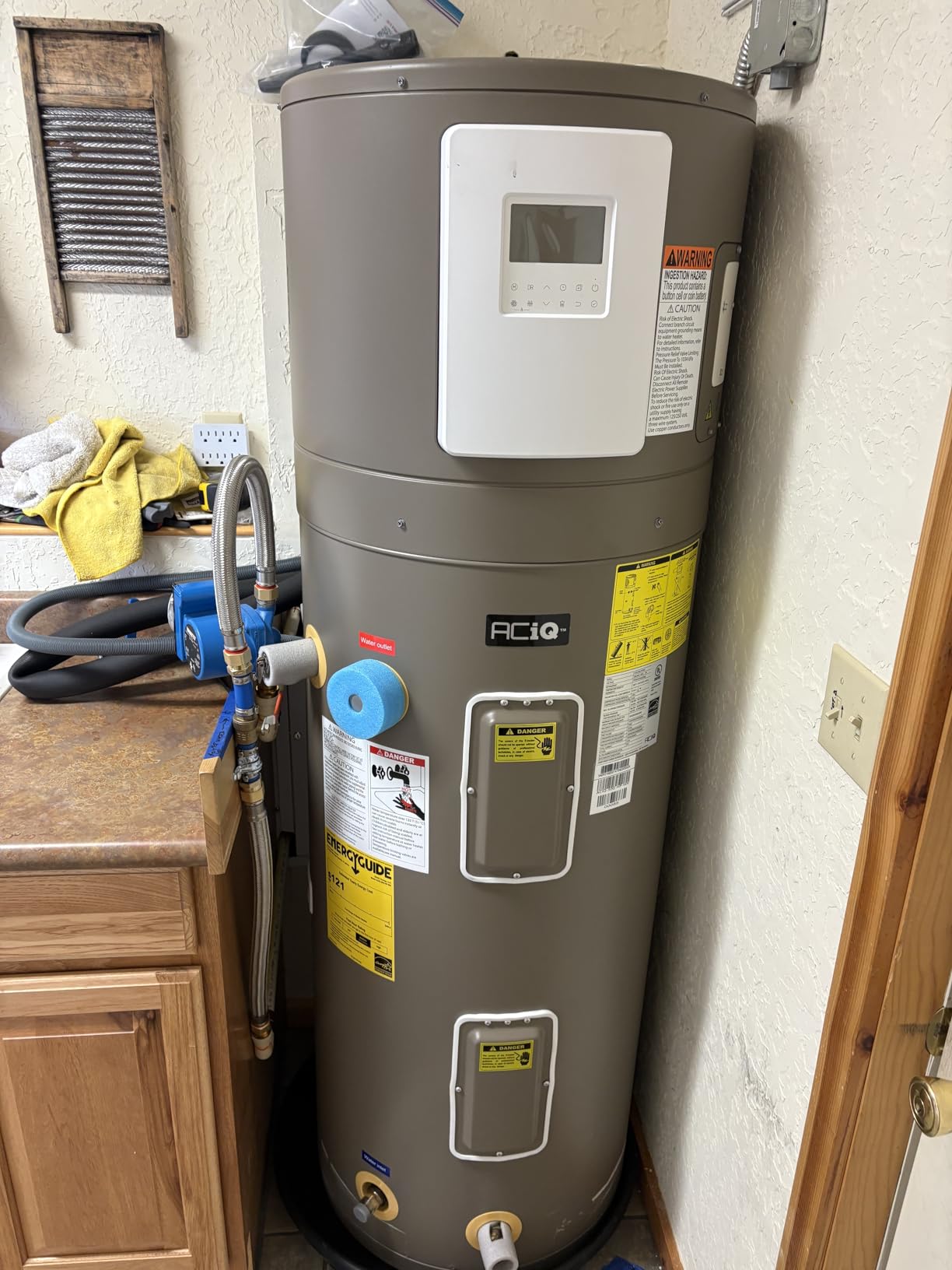
The LED display makes it easy to monitor water temperature and operating mode at a glance. ACiQ also includes a Demand Response feature that communicates with your utility grid, which can unlock additional savings through off-peak heating programs that many northern utilities offer during winter months.
Indoor Installation Requirements
ACiQ specifies this unit needs a space with 700 to 1,000 cubic feet of air circulation, which is typical for a basement or large utility room installation. This is important for cold climate setups because the heat pump draws warmth from the surrounding air. If you install it in a small closet, the space will cool down rapidly as the unit runs, eventually forcing the system into less efficient resistance heating mode. A basement with a furnace nearby actually works in your favor, as the waste heat from the furnace gives the heat pump warmer air to work with.
What to Know About Weight and Support
Multiple reviewers mention that this unit is extremely heavy and genuinely requires three strong people to move safely. Plan your delivery path carefully, especially if your installation involves going down basement stairs. On the support side, some users have expressed frustration with technical support responsiveness. If you are the type who prefers to handle issues through your installing contractor rather than calling a manufacturer support line, this is less of a concern. The 12-year warranty on tank and parts with online registration is among the longest in this category.
6. Stiebel Eltron 300 E – Premium German-Engineered 80-Gallon
233059 Model 300 E Heat Pump Water Heater, 80 Gal Storage, 220-240 V, Smart Display, Compact Cylinder Design, Indoor Use, 1″ Water Inlet; 87 psi Operating Pressure
80-Gallon
650W Compressor
1700W Heat Output
Smart Display
75.25 inch H
Pros
- German-engineered with premium insulation
- Dual heating with 1500W booster for peak demand
- Compact cylinder fits standard mechanical rooms
- Quiet operation designed for indoor installation
Cons
- No customer reviews yet
- Ships in 2-3 weeks with longer delivery time
Stiebel Eltron has been building heat pump water heaters for European winters for decades, and the 300 E brings that cold-climate engineering pedigree to the North American market. The 650-watt compressor delivers 1,700 watts of heating output, which gives it an impressive coefficient of performance. That ratio of output to input power is what makes heat pump technology so compelling for cold climate applications where energy costs run high during heating season.
The dual heating system is where this unit shows its engineering depth. The efficient heat pump handles day-to-day operation, while a separate 1,500-watt booster element kicks in during high-demand periods or when ambient temperatures drop too low for efficient heat pump operation. This is exactly the kind of redundancy you want in a cold climate, where a single heating mode might struggle during extreme cold snaps.
Build Quality and Longevity
The glass-lined tank, wrap-around condenser, and corrosion-protected evaporator are all designed for decades of service. Stiebel Eltron builds these units with premium insulation that reduces standby heat loss, which matters when the temperature difference between your hot water and the ambient basement air can exceed 100 degrees in winter. The wrap-around condenser design maximizes heat transfer surface area compared to traditional coil designs, improving both efficiency and recovery rate.
Smart Display and Monitoring
The digital display shows real-time performance data and available hot water volume, which takes the guesswork out of managing your hot water usage during cold snaps. Knowing exactly how much hot water is available before starting a load of laundry or a second shower is practical information that helps you avoid the frustration of running out during peak demand. The compact vertical cylinder measures 75.25 inches high by 27.125 inches in diameter, fitting standard mechanical rooms while still delivering 80 gallons of storage and 74.2 gallons of first-hour delivery.
7. Stiebel Eltron Accelera 220 E – Built-In Dehumidifier Function
233058 Accelera220 E Heat Pump Water Heater, 58 Gallon, 240V; Energy-Efficient; German Engineered; Digital Display; Maintenance-Free Anode; Dehumidifier Function
58-Gallon
Maintenance-Free Anode
Digital Display
Dehumidifier Function
German Engineered
Pros
- Cuts heating costs by up to 80% over conventional units
- Dual-function water heater and dehumidifier
- Maintenance-free anode reduces upkeep
- Smart digital display with performance monitoring
Cons
- No customer reviews yet
- Not Prime eligible with longer shipping
The Accelera 220 E solves two problems at once: it heats your water and dehumidifies the space where it is installed. For cold climate homeowners with damp basements, this dual functionality is a genuine advantage. The heat pump naturally removes moisture from the air as it extracts heat, and Stiebel Eltron engineered this unit to channel that dehumidification effect productively rather than just draining it away.
The claim of cutting hot water heating costs by up to 80% compared to conventional electric water heaters is aggressive, but German engineering standards and the company reputation suggest the efficiency is real. The maintenance-free anode is a practical touch that eliminates one of the routine maintenance tasks that conventional water heaters require, which is especially valuable if your water heater is in a hard-to-reach basement corner.
Basement Installation Benefits
In cold climates, basements tend to be both the logical installation location and the most challenging environment for a heat pump water heater. The Accelera 220 E turns this challenge into an advantage. The dehumidifier function keeps basement humidity in check, which protects stored items and prevents mold growth. Meanwhile, the premium insulation and wrap-around condenser ensure the heat pump extracts maximum energy from the ambient air, even when basement temperatures drop into the 40s during deep winter cold spells.
Digital Controls and User Experience
The smart digital display shows available hot water volume and performance metrics in real time. This transparency helps you plan hot water usage around the heat pump cycle rather than guessing and potentially triggering the resistance heating backup. The 58-gallon capacity targets a household of three to four people, and the optimized tank sizing means the heat pump runs efficiently without short-cycling or running excessively long recovery cycles.
8. Reliance 80-Gallon Hybrid – Large Capacity for High Demand
Water Heater Hybrid 80g
80-Gallon
High Efficiency
Indoor Installation
Corded Electric
Pros
- 80-gallon capacity for high-demand households
- Indoor installation design built for cold climates
- High efficiency hybrid technology
- Prime eligible with free shipping
Cons
- No customer reviews available
- Higher price point in the category
- Only 3 units left in stock
The Reliance 80-gallon hybrid water heater is built specifically for situations where a large capacity tank is non-negotiable. In cold climate applications, larger tanks compensate for the slower recovery rates that heat pump water heaters experience when ambient temperatures drop. The extra stored volume means you have a bigger buffer of pre-heated water to draw from during periods when the heat pump is working harder to maintain temperature.
Reliance has been in the water heater business for decades, and this model carries the indoor installation designation, meaning it is engineered for the temperature-controlled environments where cold climate homeowners install their water heating equipment. The 80-gallon capacity is ideal for households with five or more people, multiple bathrooms, or homes with large garden bathtubs and multiple shower heads that demand high hot water flow rates.
Why Large Tanks Matter in Cold Climates
When incoming groundwater temperature drops to 40 degrees or lower in northern states, your water heater has to raise the water temperature by a larger margin than in warmer regions. A bigger tank stores more already-heated water, reducing how often the heat pump needs to cycle on during the coldest days. This strategy works well when paired with a programmable timer that heats the tank during off-peak electricity hours, maximizing both comfort and savings.
Installation Considerations
With only three units in stock at last check, availability is tight for this model. The 80-gallon size means you need a clear path from your exterior door to the installation location, and basement stairwells should be measured carefully before ordering. Like other hybrid units in this size range, plan for a 240V electrical connection and adequate air circulation in the installation space to keep the heat pump operating efficiently throughout the winter.
9. Rheem PROE50 M2 RH95 – Trusted Brand with Solid Track Record
Rheem PROE50 M2 RH95 50-Gallon Professional Classic Medium Residential Electric Water Heater, Gray; Enhanced-flow Brass Drain Valve; 18.75 Amps; Automatic Thermostat; Anode Rod
50-Gallon
4.6 Star Rating
Brass Drain Valve
Auto Thermostat
InfoCue LED
Pros
- 4.6 out of 5 star average from verified buyers
- Enhanced-flow brass drain valve for reliability
- Automatic thermostat with InfoCue LED indicator
- Compact design takes less space than competitors
Cons
- Not a heat pump model
- Relies on resistance heating elements
Rheem is the global leader in water heating for good reason, and the PROE50 M2 RH95 shows why. With a 4.6-star rating from verified buyers, this 50-gallon electric water heater delivers consistent, reliable performance that homeowners trust. While this is a traditional electric water heater rather than a heat pump model, it earns a spot on our list as a reliable baseline option or supplementary unit for cold climate installations.
The enhanced-flow brass drain valve is a detail that experienced plumbers and homeowners appreciate. Cheap plastic drain valves are a common failure point on lesser water heaters, and Rheem upgrading to brass here shows attention to longevity. The automatic thermostat keeps water at your set temperature without fluctuation, and the isolated tank design reduces standby heat loss, which matters when the temperature difference between your hot water and the surrounding air is extreme during winter.
When to Choose This Over a Heat Pump
There are situations where a traditional electric water heater makes more sense than a heat pump model in a cold climate. If your installation space is too small to provide adequate air circulation for a heat pump, or if the space regularly drops below 37 degrees where heat pump efficiency collapses, a high-quality electric tank like this Rheem may actually deliver better overall value. It is also a strong choice as a secondary water heater for a garage workshop or remote bathroom where heat pump installation conditions are not ideal.
Build Quality and Warranty
The resistored stainless steel heating elements resist sediment buildup and last longer than standard elements, especially in areas with hard water common in northern states. The anode rod provides ongoing tank protection, and the temperature and pressure relief valve is included standard. The InfoCue LED indicator gives you a quick visual confirmation that the unit is operating normally, which is a simple but useful feature for monitoring without walking up to the unit and checking settings.
10. MRCOOL 40-Gallon Electric – Compact and Budget-Friendly
MRCOOL 40 Gallon Electric Water Heater 4500W Tank, High Efficiency Dual Element, Self Cleaning, Rare Earth Anode, 240V Home Use, Gray
40-Gallon
4500W Dual Element
Self-Cleaning
Rare Earth Anode
240V
Pros
- Most affordable option with solid build quality
- Dual 4500W elements for fast recovery
- Self-cleaning technology extends tank life
- Rare-earth anode rod keeps water fresh
Cons
- Not a heat pump water heater
- Smaller 40-gallon capacity limits household size
The MRCOOL 40-gallon electric water heater rounds out our list as the most budget-friendly option with surprisingly thoughtful engineering. While it is not a heat pump model, the dual 4500-watt heating elements deliver fast recovery times that smaller cold-climate households will appreciate. The self-cleaning technology and rare-earth anode rod are features typically found on more expensive units, showing that MRCOOL focused on the components that actually affect long-term ownership satisfaction.
For a two-person household or a small family with moderate hot water usage, the 40-gallon capacity provides enough stored hot water for typical daily use. The dual-element design means both the upper and lower elements can work simultaneously during recovery, cutting reheat time significantly compared to single-element tanks. This matters in cold climates where incoming water temperature can be 40 degrees or lower, requiring more energy to bring the tank back up to temperature after heavy use.
Best Use Cases in Cold Climates
This MRCOOL unit shines as a primary water heater for small households or as a dedicated unit for a specific zone like a garage apartment, guest suite, or in-law addition. In cold climate homes where a secondary heated space needs its own water supply, installing a smaller dedicated unit often makes more financial sense than running long hot water lines from a central heat pump water heater. The compact 25.2-inch by 45.5-inch footprint also fits in spaces where full-size heat pump units simply cannot go.
Maintenance Features That Matter
The self-cleaning technology injects water in a way that prevents sediment from settling at the bottom of the tank, which is a leading cause of efficiency loss and premature failure in traditional electric tanks. Combined with the rare-earth anode rod that neutralizes corrosive elements in the water supply, these two features work together to extend tank life beyond what you would expect at this price point. In cold climate areas with hard water from municipal systems or wells, this built-in protection pays dividends over the life of the unit.
Buying Guide: Choosing the Right Cold Climate Heat Pump Water Heater
Picking the best cold climate heat pump water heater for your home comes down to understanding a few key factors that directly affect winter performance. Our team has broken down the most important considerations below, drawing from real user experiences and installation data from homes in northern climate zones.
How Heat Pump Water Heaters Work in Cold Weather
Heat pump water heaters operate like a refrigerator running in reverse. They pull heat from the surrounding air using a refrigerant cycle, compress the refrigerant to raise its temperature, and then transfer that heat to the water in the storage tank. This process uses roughly one-third the electricity of conventional resistance heating because you are moving heat rather than generating it from scratch.
In cold climates, the challenge is straightforward: there is less heat in the air to capture. Most heat pump water heaters maintain efficient operation down to about 37 degrees Fahrenheit ambient temperature. Below that threshold, the unit switches to backup electric resistance elements, which use significantly more power. The key to maintaining efficiency through winter is keeping your installation space above this minimum temperature, either through natural waste heat from a furnace or through proper ducting strategies.
Understanding UEF and COP Ratings
The Uniform Energy Factor, or UEF, is the single most important number for comparing heat pump water heater efficiency. A UEF of 4.00 means the unit delivers four units of hot water energy for every one unit of electrical energy it consumes. Compare this to a standard electric tank with a UEF around 0.92, and you can see why heat pump models save so much money over time.
The Coefficient of Performance, or COP, measures the same efficiency but in real-time rather than as an annual average. In warm conditions, a heat pump water heater might achieve a COP of 3.5 to 4.0. In a cold basement during winter, that COP could drop to 2.0 to 2.5. Even at the lower end, you are still getting twice the heating output per dollar compared to resistance heating. This is why heat pump water heaters remain worthwhile in cold climates despite reduced winter performance.
First-Hour Rating and Recovery Rate
The first-hour rating tells you how much hot water the unit can deliver in the first hour of use starting with a fully heated tank. This number is always higher than the tank capacity because the heat pump continues heating water as you draw it. In cold climates, pay close attention to this number because incoming water temperatures are lower, which means the heat pump has to work harder to maintain tank temperature during heavy use.
Forum users consistently report that recovery rate is their biggest frustration with heat pump water heaters. A typical heat pump recovers about 8 gallons per hour in heat pump only mode, while a 4,500-watt electric element recovers roughly 20 to 25 gallons per hour. This is why hybrid mode exists: it combines both heat sources for faster recovery when you need it, then drops back to efficient heat pump mode for routine operation.
Ducting Strategies for Cold Climates
This is the single most overlooked topic in cold climate HPWH installation, and it can make or break your satisfaction with the system. When a heat pump water heater runs, it exhausts cool air. In summer, this is a bonus. In winter, it cools your basement further, which reduces heat pump efficiency and can make the space uncomfortable.
The solution many cold climate homeowners use is ducting. You can run a supply duct from a warm area like an attic or a room with a furnace to feed warmer air to the heat pump intake. A second exhaust duct directs the cool discharge air outside or into an unheated space. Some models support ducting directly, while others require aftermarket duct kits. Check the manufacturer specifications before you buy if ducting is part of your installation plan.
Noise Levels and Placement
Heat pump water heaters produce noise from two sources: the compressor and the fan. Typical noise levels range from 45 to 65 decibels, which is roughly the difference between a quiet library and a normal conversation. If your installation is in an unfinished basement away from living spaces, noise is rarely an issue. But if the unit sits near a bedroom, home office, or finished basement, pay attention to the decibel rating. The ACiQ at 49.5 dB is among the quietest we found, while some older models push well above 60 dB under heavy load.
Operating Modes Explained
Most hybrid heat pump water heaters offer three or four operating modes. Heat pump only mode is the most efficient, using just the compressor and fan to heat water. Hybrid mode combines the heat pump with electric resistance elements for faster recovery. Electric or boost mode uses only the resistance elements, which is useful when the ambient temperature drops too low for heat pump operation. Vacation mode maintains a minimum temperature to prevent freezing while you are away. Understanding when to use each mode is key to maximizing savings in a cold climate setting.
Frequently Asked Questions
Who makes the best cold climate heat pumps?
Rinnai, Stiebel Eltron, and Senville are among the top manufacturers for cold climate heat pump water heaters in 2026. Rinnai offers the highest UEF ratings up to 4.00 with their REHP series, while Stiebel Eltron brings decades of German engineering designed specifically for European winters. For budget-conscious buyers, Senville and ACiQ deliver solid efficiency at lower price points. Rheem also remains a trusted brand, though their Professional Classic series uses traditional electric resistance rather than heat pump technology.
Is there such a thing as a cold weather heat pump?
Yes, cold weather heat pump water heaters are specifically designed to operate efficiently in lower ambient temperatures. Most residential heat pump water heaters work effectively down to about 37 degrees Fahrenheit. Below that temperature, they switch to backup electric resistance heating elements. For homes in very cold climates, the key is installing the unit in a space that stays above this minimum threshold, such as a basement with waste heat from a furnace, or using ducting strategies to supply warmer air to the unit during winter months.
How do heat pump water heaters work in the winter?
Heat pump water heaters work in winter by extracting heat from the surrounding air using a refrigerant cycle, even when that air feels cold to you. As long as the ambient temperature stays above approximately 37 degrees Fahrenheit, the heat pump can efficiently capture thermal energy from the air and transfer it to the water tank. When temperatures drop below this threshold, the unit automatically switches to electric resistance heating elements to maintain hot water delivery. The system prioritizes heat pump mode for efficiency and only uses resistance heating as a backup.
What is the most energy efficient heat pump water heater?
The most energy efficient heat pump water heater in our analysis is the Rinnai REHP80 with a 4.00 Uniform Energy Factor (UEF), meaning it delivers 4 units of hot water energy for every 1 unit of electricity consumed. The Rinnai REHP65 follows closely at 3.90 UEF. For comparison, a standard electric water heater typically has a UEF around 0.92. Higher UEF ratings directly translate to lower operating costs, with Energy Star estimating savings of up to $550 per year for a family of four switching from a conventional electric tank to a heat pump model.
Final Verdict
After evaluating 10 models across capacity ranges, efficiency ratings, and cold weather performance, our top recommendation for the best cold climate heat pump water heater goes to the Rinnai REHP80. Its class-leading 4.00 UEF and 91-gallon first-hour delivery make it the most efficient and capable option for large households facing harsh winters. For mid-size families, the Rinnai REHP65 provides the same cold-climate engineering in a more affordable 65-gallon package.
Homeowners who want premium German engineering should look at the Stiebel Eltron models, particularly the Accelera 220 E with its built-in dehumidifier function. Those on a tighter budget will find strong value in the Senville SENWH-HP50US or the MRCOOL 40-gallon unit for smaller households. Whatever model you choose in 2026, focus on proper installation with adequate air circulation, consider ducting options for your climate, and take advantage of available utility rebates to offset the initial investment.
Making the switch to a heat pump water heater is one of the most impactful energy upgrades a cold climate homeowner can make. The savings compound year after year, and the technology has matured enough to handle northern winters reliably. Pick the capacity that matches your household, plan your installation carefully, and you will see the difference on your very first electric bill after installation.