
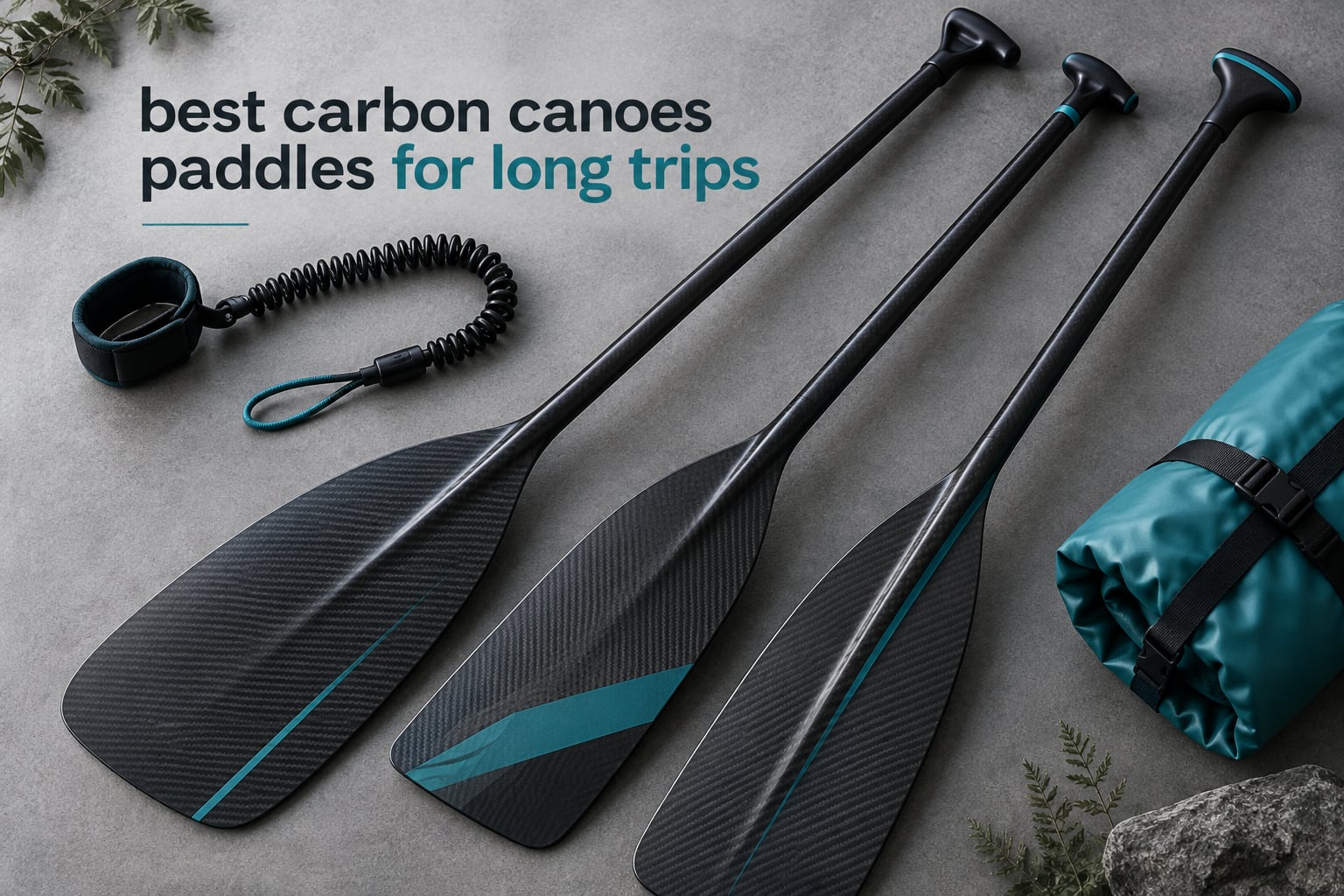
Ask any long-trip paddler what wears them out first, and the answer is almost never the boat, the weather or the portages. It is the accumulated weight of the paddle in their hands across several thousand strokes a day, repeated until day nine. That is the entire argument for carbon, and it is why we built this roundup of the best carbon canoe paddles for long trips around weight, joint quality and how a paddle behaves after a week of daily use rather than around marketing language.
There is a catch you should know before you read on. Every carbon paddle in this roundup is a double-blade, or kayak-style, paddle, because that is what dominates the carbon market right now. For a canoe, a double-blade needs to be noticeably longer than a kayak paddle, and a paddle built for a narrow sit-on-top kayak can feel short and twitchy in a 16 foot canoe with a high seat. We handle that in the sizing section, and each review tells you which hull width the paddle suits.
We spent weeks working through specifications, owner reviews and trip reports rather than lab sheets, and we cross-checked the community consensus out of the Boundary Waters Canoe Area gear forum, which has a long-running thread on exactly this question. If you are still choosing a hull, start with our canoe buying guide and the best canoes for every paddler roundup, then come back here for the paddle. We have updated this list for 2026 and it reflects what is actually available now.
Table of Contents
Top 3 Picks for Long Trip Canoe Paddling (September 2026)


All 10 Carbon Paddles at a Glance in 2026
The table below is the short version. Every paddle here weighs its blade-and-shaft construction differently, so read the material column before the weight column. A composite blade will always be heavier than full carbon at the same length, and it will usually be tougher.
| Product | Specifications | Action |
|---|---|---|
| Best Marine and Outdoors Carbon Fiber 2-Piece 234 |
|
Check Latest Price |
| OCEANBROAD Carbon Fiber 230cm |
|
Check Latest Price |
| WONITAGO Adjustable Carbon 220-240cm |
|
Check Latest Price |
 OCEANBROAD Adjustable Carbon 220-240cm OCEANBROAD Adjustable Carbon 220-240cm |
|
Check Latest Price |
 WONITAGO Carbon Shaft Nylon Blade 82-90in WONITAGO Carbon Shaft Nylon Blade 82-90in |
|
Check Latest Price |
 Hornet Watersports 26 oz Two-Piece Hornet Watersports 26 oz Two-Piece |
|
Check Latest Price |
 Bending Branches Angler Ace 240-280cm Bending Branches Angler Ace 240-280cm |
|
Check Latest Price |
 Wilderness Systems Pungo 220-240cm Wilderness Systems Pungo 220-240cm |
|
Check Latest Price |
 CN6 CROSSNOVA Full Carbon Greenland 220cm CN6 CROSSNOVA Full Carbon Greenland 220cm |
|
Check Latest Price |
 WONITAGO Full Carbon Greenland 220-230cm WONITAGO Full Carbon Greenland 220-230cm |
|
Check Latest Price |
1. Best Marine and Outdoors Carbon Fiber 2-Piece 234: The Best All-Rounder for Long Canoe Trips
Best Marine and Outdoors Kayak Paddle, Carbon Fiber Shaft & Fiberglass Reinforced Polypropylene Blades, 220cm, 234cm, 250cm, Lightweight Kayak Paddles for Adults (Black, 234)
Full carbon construction
Two-piece breakdown
18 x 6.75 in blades
1.125 in shaft diameter
Pros
- Very light for its size class
- Two-piece breakdown packs down small
- Blade angle clocks in 60 degree increments
- Stiff joint that feels solid in the water
- Large review base from real owners
Cons
- Sizing chart can steer you to the wrong length
- Some builds arrive with a loose blade-to-shaft joint
- More twist in the blades than premium paddles
This is the paddle we keep coming back to for the category because the combination of weight, joint solidity and owner history is hard to beat at this level. The listed weight of 0.95 kg sounds heavy next to the ultralight models, but a chunk of that is packaging and the wide 18 inch blades, and owners consistently report it as one of the lighter paddles they have used. On a long trip that balance matters more than a headline number.
The two-piece split is the design decision that matters most for a trip of ten days or more. It packs flat against a hull or a dry bag, and the joint between halves is described as tight and wobble-free once the pin is seated. If you have paddled an aluminium single with a spline joint, this is a noticeable change in how solid the catch feels.
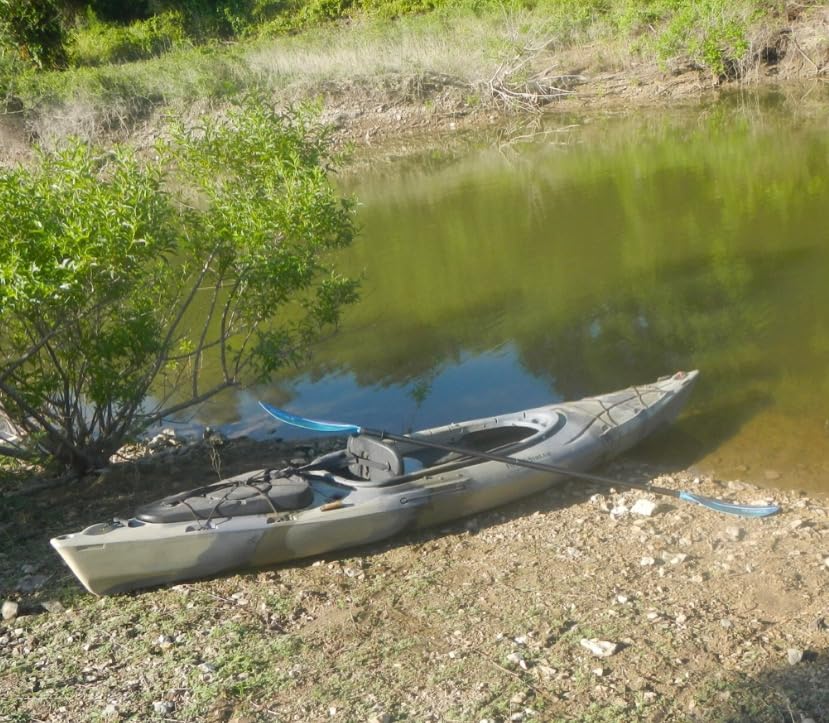
Clocking the blades in 60 degree increments gives you a workable spread of attack angles without a complicated leverlock mechanism, and it means you can set up a straight-shaft high-angle stroke for moving water and a feathered low-angle stroke for flat open-lake days. The 1.125 inch shaft diameter sits in the middle of the comfort range, thick enough to feel solid, thin enough that it does not fight small hands over a full day.
The honest weakness is fitment. Owners repeatedly report that the published sizing chart led them to a length that did not suit their boat, and the fix is the same every time: measure your canoe’s beam and seat height rather than trusting the chart. The second weakness is occasional build variation, where a small number of buyers report a blade not fully seated at the shaft. Check the joint in the first ten minutes of use, not at mile forty.
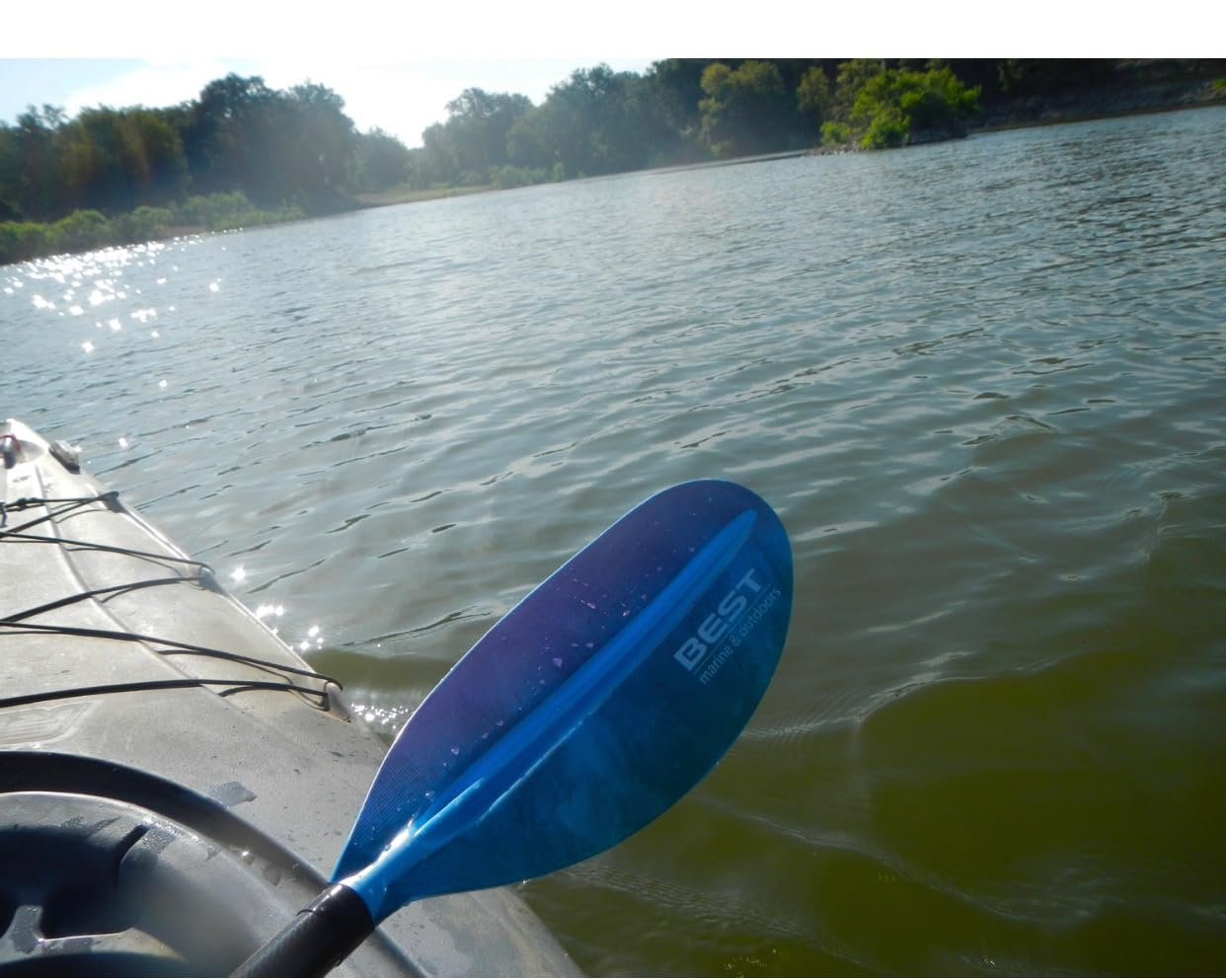
When this paddle makes sense on a long trip
This one suits solo and tandem paddlers on flat to moderate water who want one tool that handles wind, current and a portage without changing gear. The wide blade gives a solid catch in a headwind, which is the condition that actually decides your day on a big lake. It also works as a spare-free primary for a boat-and-paddle combination where you do not want two paddles in the hull.
Where it falls short
If you portage long distances with a heavy pack, the 0.95 kg listed weight is not the lightest option here, and you may be better served by one of the fixed-length ultralight models. It is also a double-blade, so in tight quarters with overhanging branches you will be snagging both ends. Use it as your main paddle on open routes rather than your paddle for narrow river miles.
2. OCEANBROAD Carbon Fiber 230cm: Best Value Paddle for a First Long Canoe Trip
OCEANBROAD Carbon Fiber Kayak Paddle 90.5in/230cm for Adults Kayaking Boating Canoeing Oar with Paddle Leash 1 Paddle, Black
Carbon fiber composite shaft
Glass fiber-reinforced PP blades
33 oz
0 or 60 degree feather
Pros
- Carbon shaft resists corrosion in salt and fresh water
- 33 oz is easy on the arms all day
- Leash
- drip rings and non-slip grips included
- 0 and 60 degree feather options help in wind
- Wide blade catches plenty of water
Cons
- Fixed length
- so sizing has to be right the first time
- Composite blades are less durable than full carbon
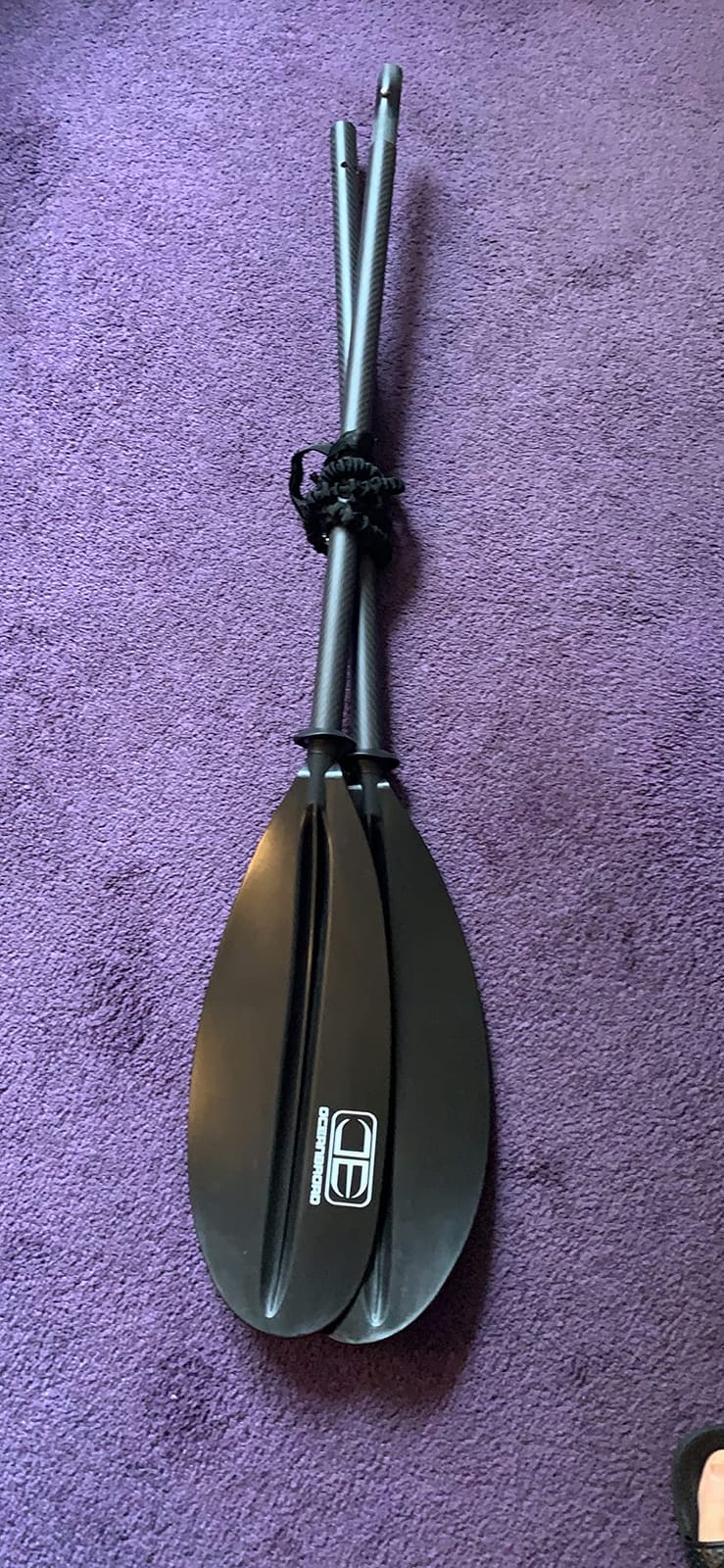
This is the most straightforward carbon-shaft paddle in the group and the one we would hand to someone moving from a plastic or aluminium paddle to something lighter for the first time. The shaft is carbon composite, the blades are glass fiber-reinforced polypropylene, and at 33 oz it is not going to transform your trip the way a full carbon blade will, but the weight saving against a typical 30-plus ounce all-aluminium paddle is real.
The included kit matters more than it sounds. Owners mention the bungee leash, the drip rings and the non-slip grips as the small things that make a long day less irritating, and the corrosion-resistant shaft means you do not need to rinse and obsess after a day on a lake with any mineral content to it.
Feathering at 0 or 60 degrees gives you the two settings that matter on open water. Flat zero degrees gives you a clean straight-ahead blade for following a shoreline or holding a line in a current. Sixty degrees is the one to use in a headwind or in a crosswind, because the leading blade is out of the way when the recovery happens.
The blades are the limiting factor on this paddle. Glass fiber-reinforced polypropylene is tougher than full carbon and will shrug off a rock strike, but it is a little heavier and a little less crisp in the catch. For a route that is mostly flat water with modest portages, that is the right trade. For a route with a lot of whitewater and rock gardens, think about a carbon blade instead.
Who should buy this one
This is the pick for a weekend warrior who has just committed to a five to ten day trip and wants a meaningful weight cut without a research project. It is also a strong option for paddlers on a tight gear budget who plan to keep the paddle for many seasons. The 230 cm length works well in a canoe of roughly 30 to 34 inch beam, where a full-length double-blade is not required.
Who should look elsewhere
If you already know your hull is wide, or if you are moving to a fast solo canoe where the boat is a hull-speed machine, the 230 cm length will feel short and the composite blades will feel dull. Those paddlers should look at the adjustable models in this list and stretch the length out before they buy anything.
3. WONITAGO Adjustable Carbon 220-240cm: Best Fit for Uncertain Boat and Paddler Size
WONITAGO Kayak Paddle Adjustable, Lightweight Carbon Fiber Kayaking Oar
20 cm of length adjustment
Three-piece construction
Fiberglass and PP blades
Pin button lock
Pros
- Twenty centimeters of length adjustment fits many hulls
- Three-piece build packs down very small
- Pin button lock adjusts in seconds
- Responsive feel through the water
- Owners report roughly 25 oz in the hand
Cons
- Composite blades not meant for rough offshore use
- Some grip handle breakage reported within a year
- Carrying bag quality varies
The pitch here is simple and genuinely useful: 20 cm of adjustment across a 220 to 240 cm range. Long-trip paddlers often do not know their final length until they have measured their own boat in the driveway, and this model lets them find the answer on the water instead of committing early. Owners who switched to it report a good pull through the water and a responsive feel that holds up under hard paddling.
Weight is the number to look at carefully here. The listed item weight is 2 lb, or 0.9 kg, while many owners describe it as far lighter in the hand, around 25 oz. We would size your expectation toward the owner reports, but we would not buy this expecting the ultralight feel of a fixed 590 g full carbon paddle.
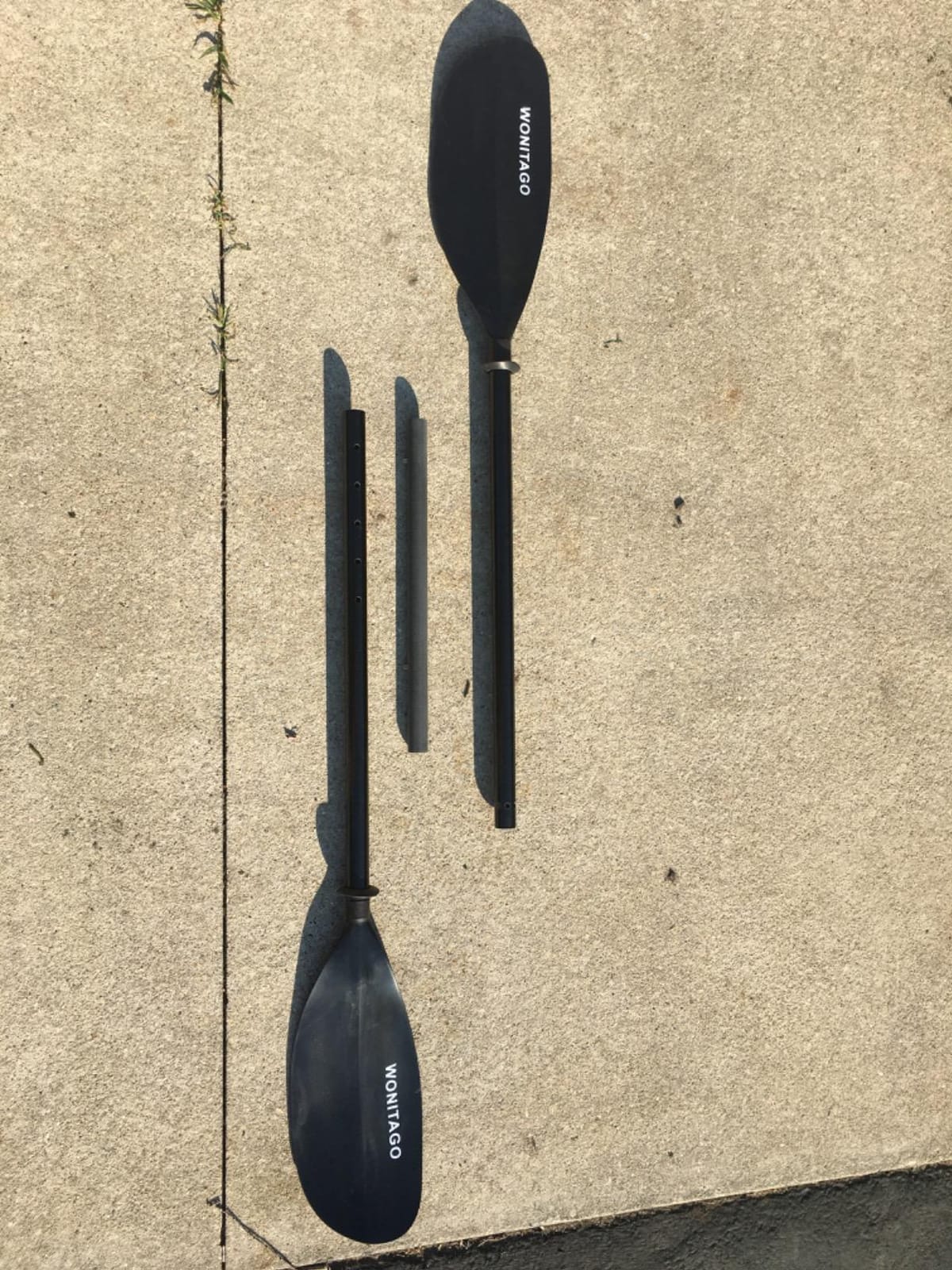
The three-piece breakdown is the feature that sells it for travel. Three short sections go in a pack bag without any awkward long tube, and the pin button lock means you can change length and angle at a launch without tools. That matters when you are sharing a boat with someone of a different size, or when you switch between a solo boat and a tandem hull on the same trip.
Blades are fiberglass and polypropylene reinforced, which makes this a tough paddle in a way that full carbon models are not. The trade is weight and edge definition. If your route is lake crossings and slow portages, you will not notice the difference. If your trip is a fast solo crossing in wind, you will.
Best for a route with mixed boat setups
Owners who carry one paddle for a whole trip love the adjustability, especially anyone paddling a tandem canoe with a passenger of a different height or switching boats at a resupply. The corrosion resistance on the blades also makes it a reasonable pick for coastal or brackish water itineraries where metal hardware would suffer.
Limits worth knowing
The grip handle is the component to watch. Several owners reported handle breakage inside a year, so if you are buying for a decade of trips, check the grip joint and the ferrule pins at the start of every season. The carrying bag is also inconsistent, so treat the bag as optional and buy your own.
4. OCEANBROAD Adjustable Carbon 220-240cm: Best Three-Piece Paddle for Air Travel and Gear Cubes
OCEANBROAD Adjustable Carbon Fiber Kayak Paddle 86in/220cm to 94in/240cm Kayaking Oar with Paddle Leash 1 Paddle, Black
35 oz total
Adjusts 220-240 cm
Three sections
0 or 60 degree feather
Pros
- Three-section breakdown fits any pack or gear cube
- Adjustable length suits different kayaks and canoes
- Leash
- angle lock and drip rings included
- Feathering helps in a headwind
- Light enough for long sessions
Cons
- Composite PP blades rather than full carbon
- Extra joints add play and wear over time
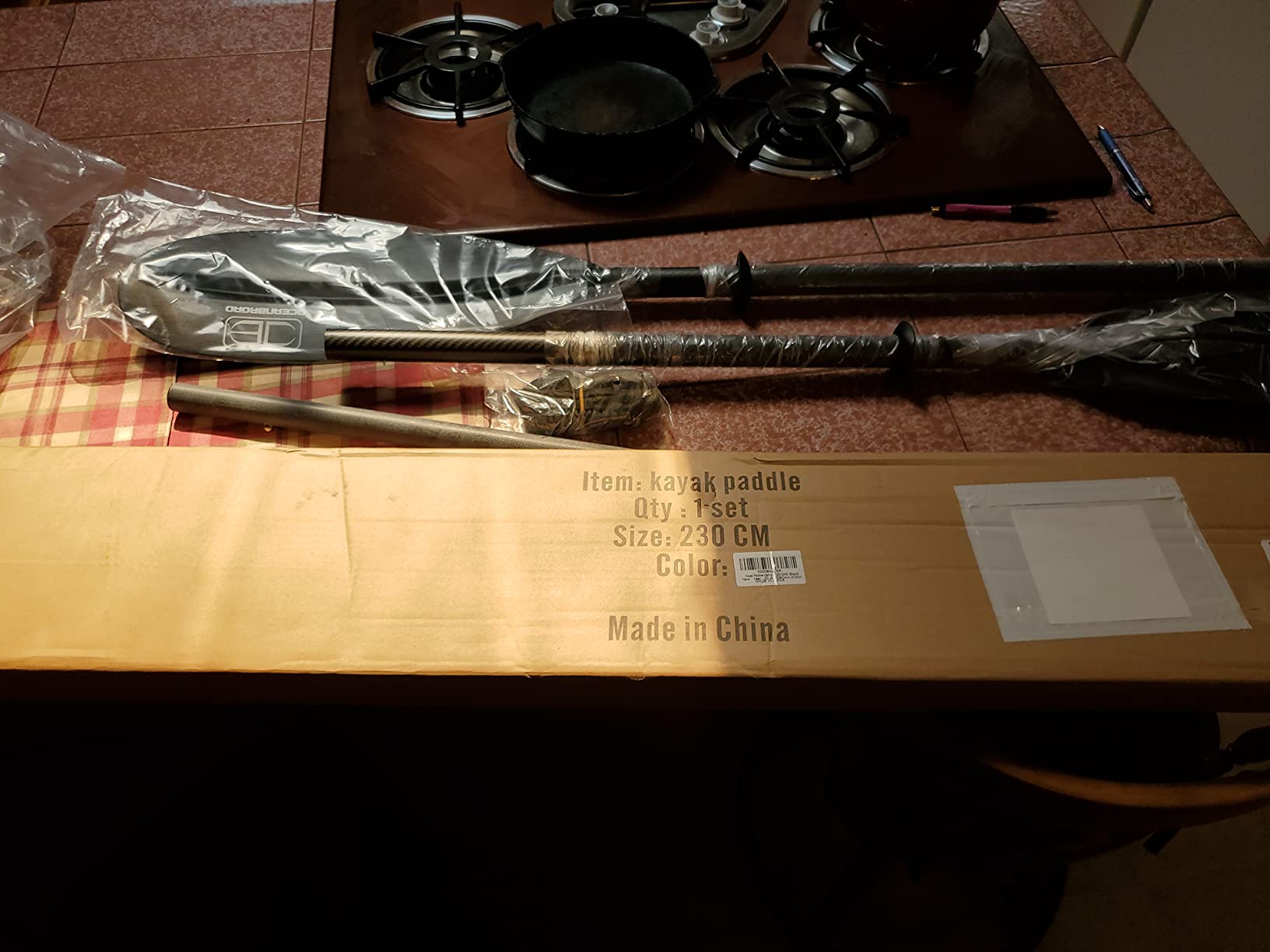
This is the sibling of the previous paddle with a different philosophy about how you carry it. Where that model optimised for adjustment range, this one optimises for packability, breaking into three compact sections that disappear into a gear cube rather than a long tube strapped to a roof rack. For a trip involving flights, canoes carried on a rack, or a boat that is not with you, that is the deciding factor.
Owners consistently point to the light feel, the three-piece portability and the fact that the leash, angle lock and drip rings are already in the box. At 35 oz it is mid-pack among the paddles here, light enough for long sessions without feeling like a toy.
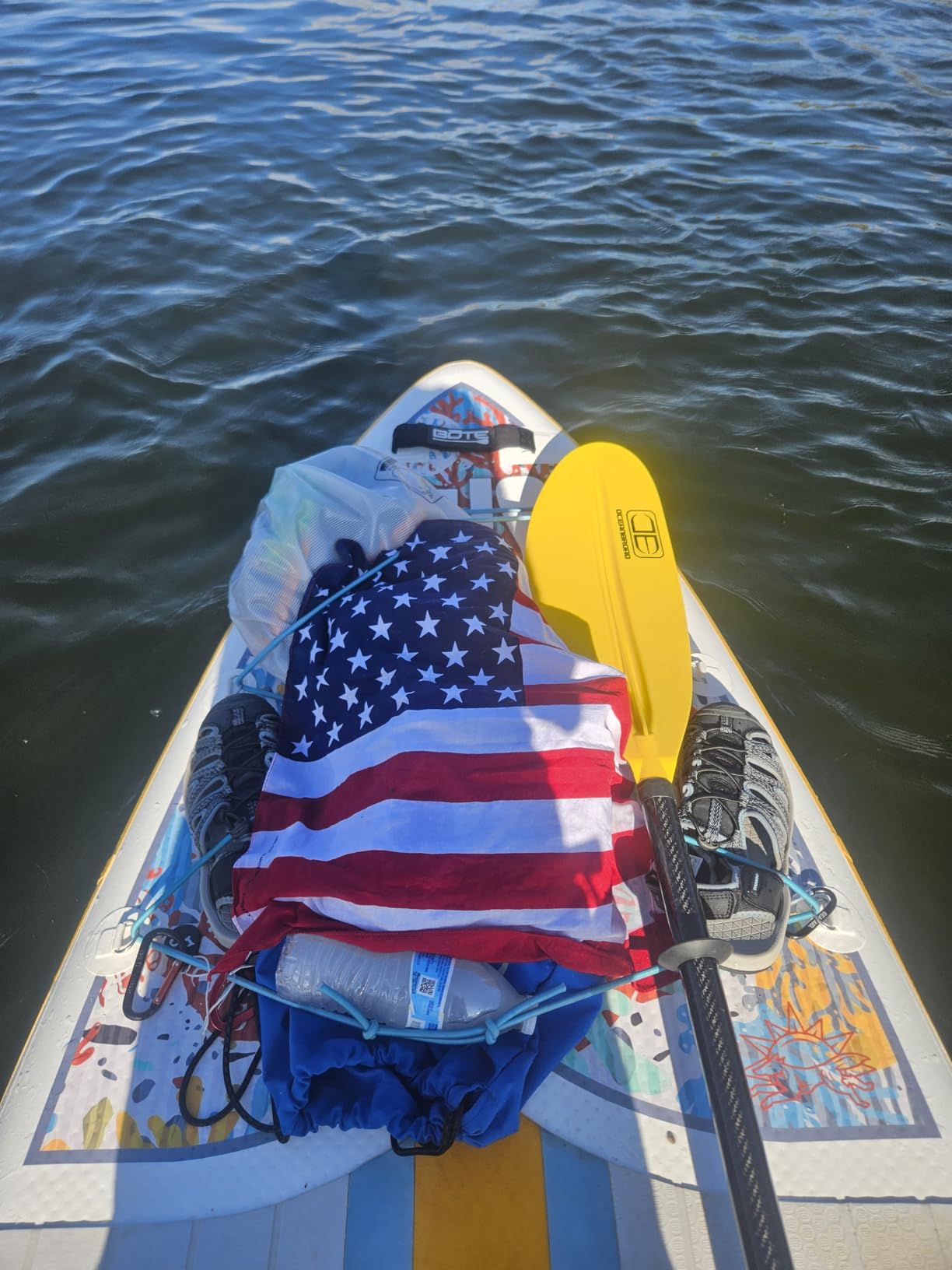
Feathering again runs 0 or 60 degrees, which covers the two positions that matter on a long trip. Set it to zero for a following stroke on a calm reach. Swing it to 60 when you are punching into a headwind and you want the trailing blade out of the airflow during the recovery. The three-position angle lock holds the setting without creeping.
Blades are UV-resistant polypropylene reinforced with fiberglass, which is the durable choice and the heavy one. Every extra joint in a three-piece paddle is another place for play to develop, so check the sections and pins at the start of each trip. Owners do report that the joints take up a little play over time, and keeping the pins clean and seated is the whole maintenance routine.
Where this configuration earns its place
If your trip includes a flight, a rented canoe, or a boat you are shuttling to and from a trailhead, three sections is the answer. It is also a good second paddle to stow in a hull, because it packs into a small volume that fits behind a thwart or under a deck. For a pair paddling a tandem canoe, having two people on the same adjustable paddle is a genuine advantage.
Where it is not the right call
Buyers who move to it expecting a full carbon blade response tend to be disappointed by the catch. It is also the heaviest of the adjustable models in this roundup, which matters if you are counting every ounce across a long portage chain. If your route is a single boat, single paddler, short portages and open water, the extra joint is weight without benefit.
5. WONITAGO Carbon Shaft Nylon Blade 82-90in: Best for Tough Blades and Heavy Use
WONITAGO Adjustable Kayak Paddle with Carbon Fiber Shaft and Nylon Blade
Carbon fiber shaft
16.5 x 7 in nylon blade
8 inch adjustment
Three-piece build
Pros
- Nylon blade takes abuse that carbon would not
- Corrosion resistant in salt and fresh water
- Carbon shaft keeps total weight reasonable
- Three-piece design suits travel
- Quick pin button assembly
Cons
- Nylon blade is heavier and less crisp than carbon
- 7 inch blade width suits general cruising
- Not a high-angle paddle
This is the paddle for people whose idea of a long trip includes rocks. The shaft is carbon fiber with some flex built in, and the blade is a chunky 16.5 by 7 inch nylon panel. Owners who use their paddle as a brace, as a pole, or who paddle shallow rocky shoals rate the durability of this combination very highly.
Adjustability runs 82 to 90 inches, or about 8 inches of range, on a three-piece detachable build with a pin button lock. That is a narrower range than some adjustable paddles, but it brackets the sizes most adult paddlers and mid-width boats need.
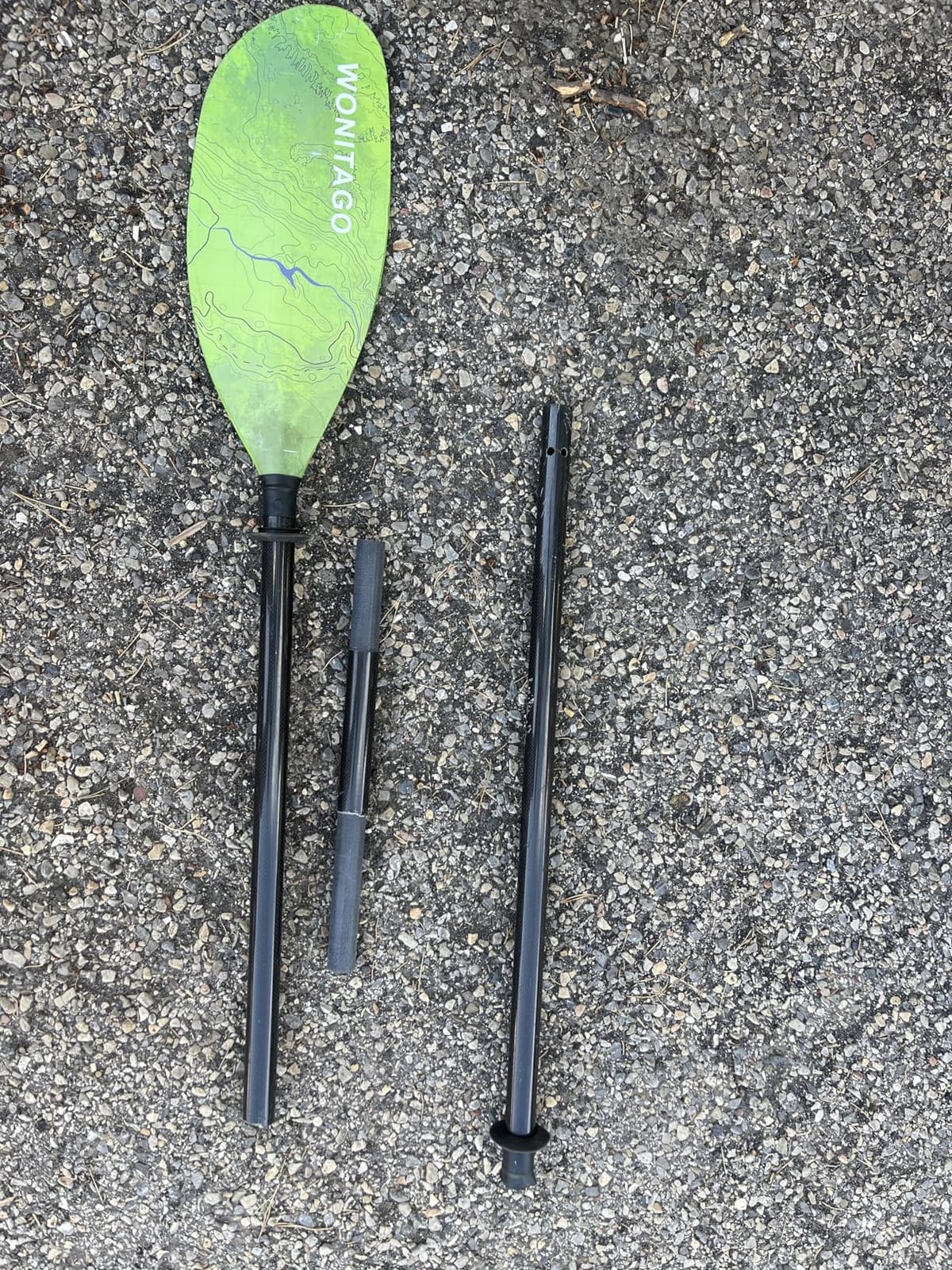
The 60 degree rotatable blade setup gives you the choice of orientation on the same paddle, which is genuinely useful when a group shares gear. Put it one way for a high-power stroke in current and the other for a relaxed low-angle cruise. For a canoe, that flexibility partly substitutes for choosing between a single and a double blade.
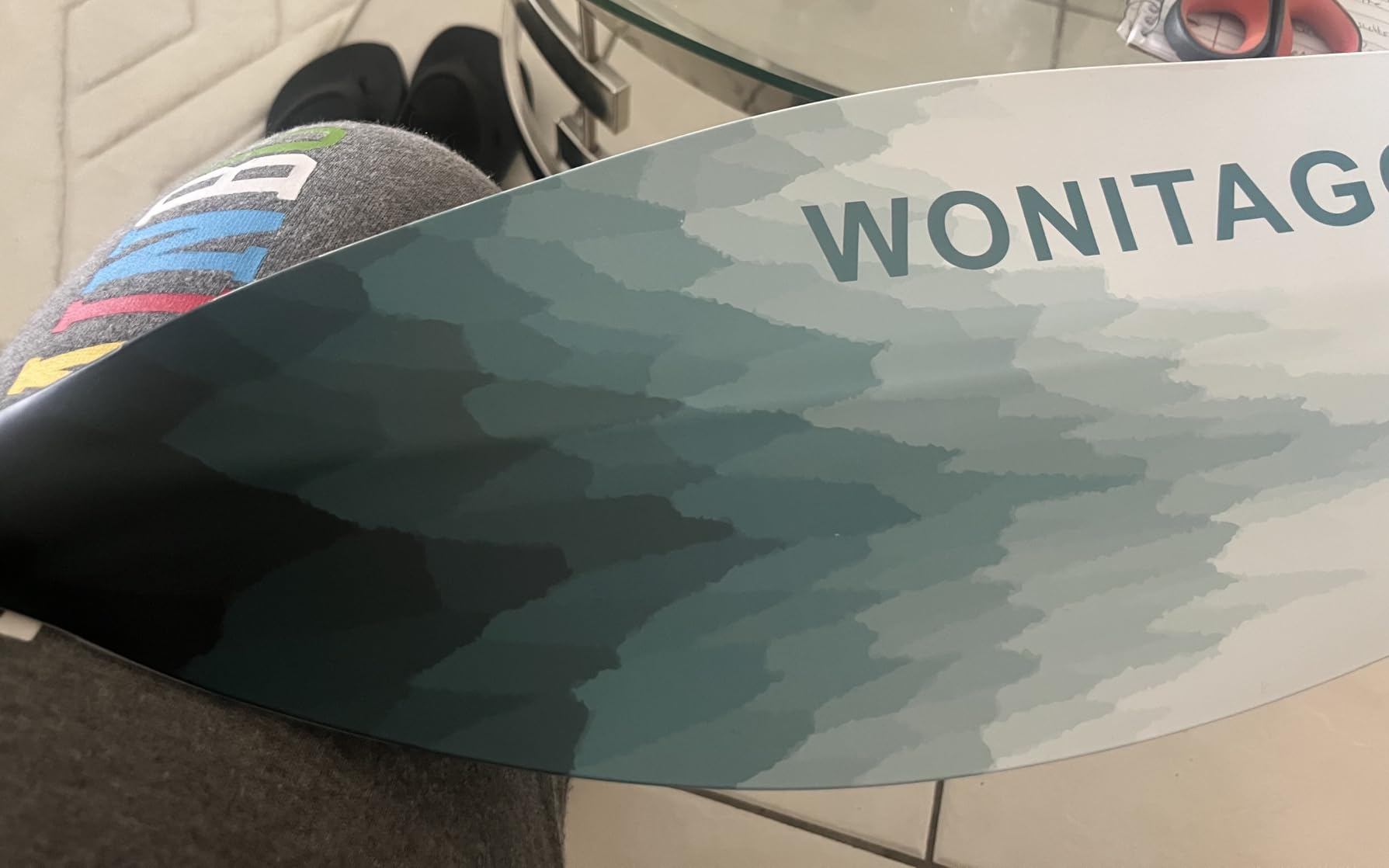
The 7 inch blade width is the thing to think about. A wide blade loads easily and moves a heavy boat, but it discourages the narrow, precise, high-angle strokes that experienced paddlers use for trim. If you have spent years refining a high-angle technique in a narrow canoe, this paddle will feel a bit agricultural, and a narrower blade suits you better.
Best for expedition-leaning itineraries
Paddlers running routes with shallow shoals, gravel bars, frequent launching off rocky banks, and heavy gear in the boat tend to love this one. The nylon blade is also forgiving in cold water, where a full carbon blade can be brittle at low temperatures. Combined with the corrosion resistance, it is a sensible coastal or northern-woods choice.
Trade-offs to accept
At 2.2 lb listed weight, this is not the lightest paddle here, and the weight sits in the blade. If you are fast in a solo canoe and chasing hull speed, the extra mass in the blade is dead weight. Buy it for durability, and only for durability.
6. Hornet Watersports 26 oz Two-Piece: Best Fine-Tuned Feathering on a Budget
Hornet Watersports Graphic Fiberglass Kayak Paddle- Ideal for Touring, Fishing and Boating- 90.5 inches / 230CM Adjustable with Carbon Fiber Shaft – Kayak Oars Kayaking Equipment (Blue Scales)
26 oz
Fiberglass blades with carbon and fiberglass shaft
Feathers 0-60 degrees
Adjusts 230-240 cm
Pros
- Very light at 26 oz while still feeling stiff
- Feathers in 15 degree steps for fine tuning
- Dihedral blade cuts cleanly in shallow water
- Grippy shaft texture works bare-handed
- Two-piece breakdown
Cons
- Fiberglass blades are heavier than carbon
- Minimal packaging means transit damage happens
This one is worth a look for a specific reason: it feathers in 15 degree increments, so you can land on 45 degrees or 30 degrees rather than being locked into zero and 60. On open water, where the canoe is moving straight and you want a relaxed, low-impact recovery, that middle setting is more comfortable than a 60 degree swing for many paddlers.
At 26 oz it is the second-lightest double-blade in this roundup, and owners describe it as feeling stiff and solid at that weight. The shaft blends carbon fiber and fiberglass, which gives a little more give in the catch than an all-carbon shaft, and the grippy shaft texture is a genuine asset when you are not wearing gloves on a hot day.
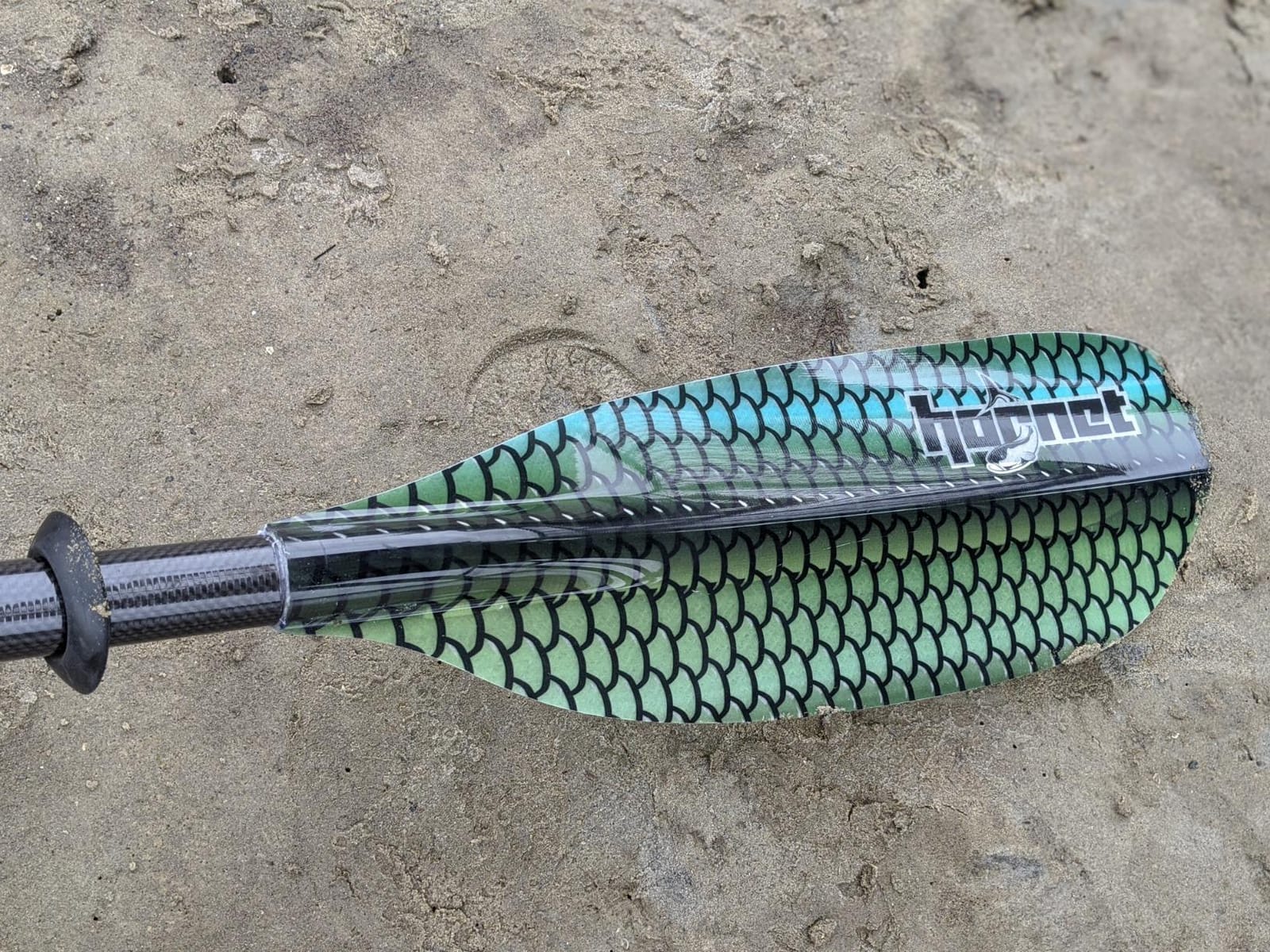
The dihedral blade shape is the quiet strength here. Owners report it cutting cleanly and holding up when they dig in shallow water to keep the boat tracking, which is a common move on a windy lake when you are trying to hold a line. The blade also adjusts in length from 230 to 240 cm, giving 10 cm of range on a two-piece build.
Be realistic about the material. The blades are fiberglass, not carbon, so you are buying a light, well-feathered paddle with a durable shaft rather than a full carbon rig. That is a good trade for most long-trip paddlers, and it is a much cheaper way to find out whether you like double-blade paddling at all.

Best for feather-angle experimenters
Paddlers who are training a low-angle stroke for long open-water days will appreciate having 15 degree steps available. It also works for anyone sharing gear with a partner whose stroke mechanics differ, since each person can dial in their own angle. The light weight makes it a good daily-use paddle even on shorter trips, so you learn the technique without a big commitment.
What you give up
Fiberglass blades limit the ceiling on responsiveness, and some owners report arriving with a cracked shaft from rough handling in transit because the packaging is thin. Check the paddle the moment you open the box, photograph it, and get a replacement sorted before your trip if anything is damaged.
7. Bending Branches Angler Ace: Best Carbon Paddle for Wide Canoes and Big Loads
BENDING BRANCHES Angler Ace Snap-Button Kayak Fishing Paddle – Lightweight Carbon Shaft, Carbon-Reinforced Nylon Blades, 2-Piece Design, Durable Performance for Fishing & Touring Kayaks
Carbon shaft with carbon-reinforced nylon blades
Five lengths from 240 to 280 cm
Snap-button two-piece ferrule
Pros
- Five length options cover very wide hulls
- Blades hold up to rocks and oyster beds
- Tight wobble-free two-piece join
- Shaft markings help with length setup
- Light enough to reduce arm fatigue
Cons
- Shorter lengths feel cramped above about 35 inch beam
- Minimal packaging leaves it exposed in transport
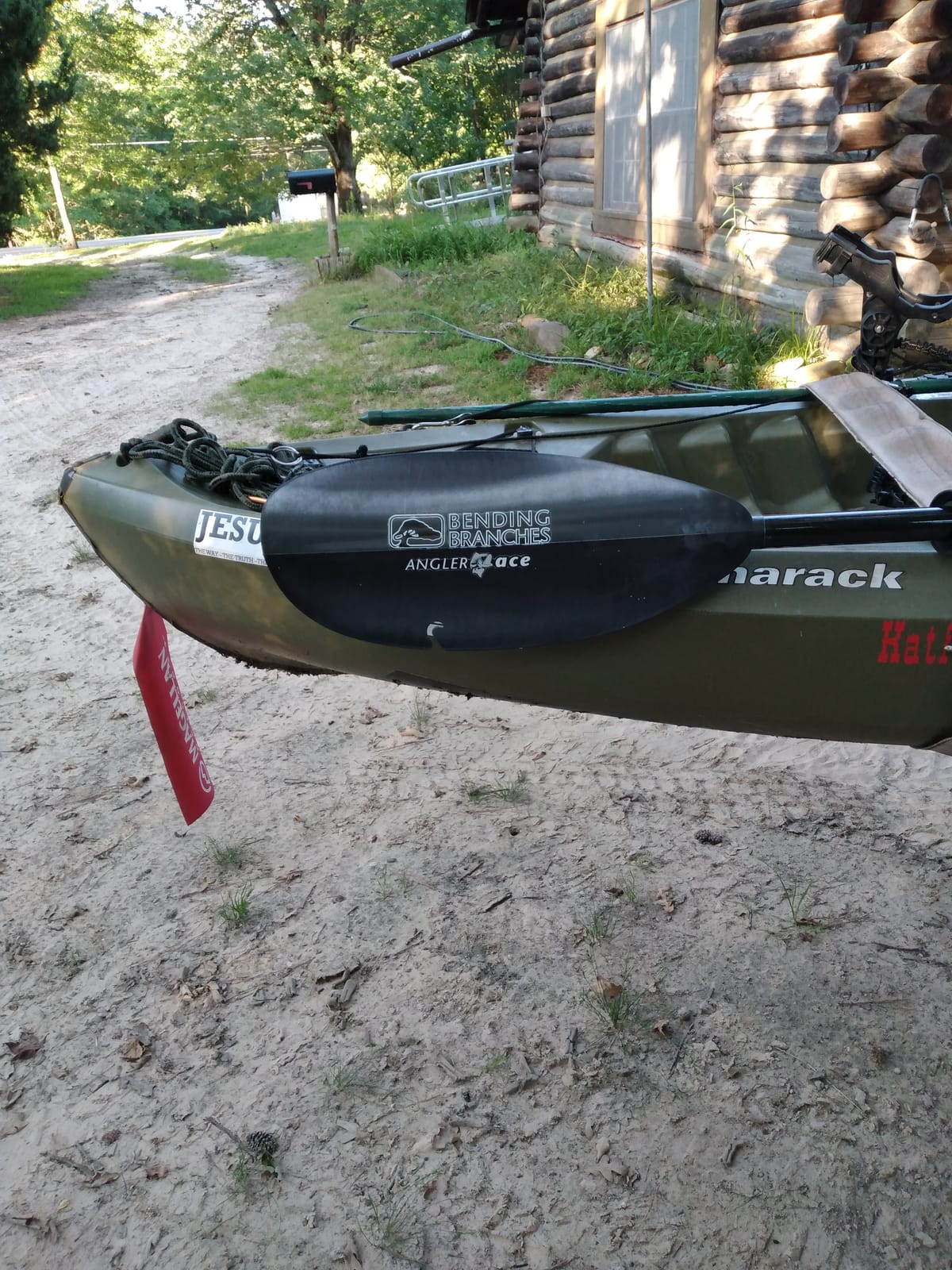
This is the only paddle in the roundup that comes in lengths all the way up to 280 cm, and that single fact is why it belongs here for canoe touring. Most double-blades on the market stop at 230 or 240 cm because they are designed for kayaks. A canoe has a higher seat and a wider beam, and a paddle sized for a kayak leaves you constantly reaching for a short catch.
Owners praise the durability more than anything, specifically reporting that the blades stand up to abuse including oyster beds and rocks. The carbon-reinforced nylon construction is a sensible answer to the carbon fragility question, giving you a carbon shaft for light weight and a nylon blade for impact resistance. It is also stiff enough to use as a brace getting in and out of the boat.
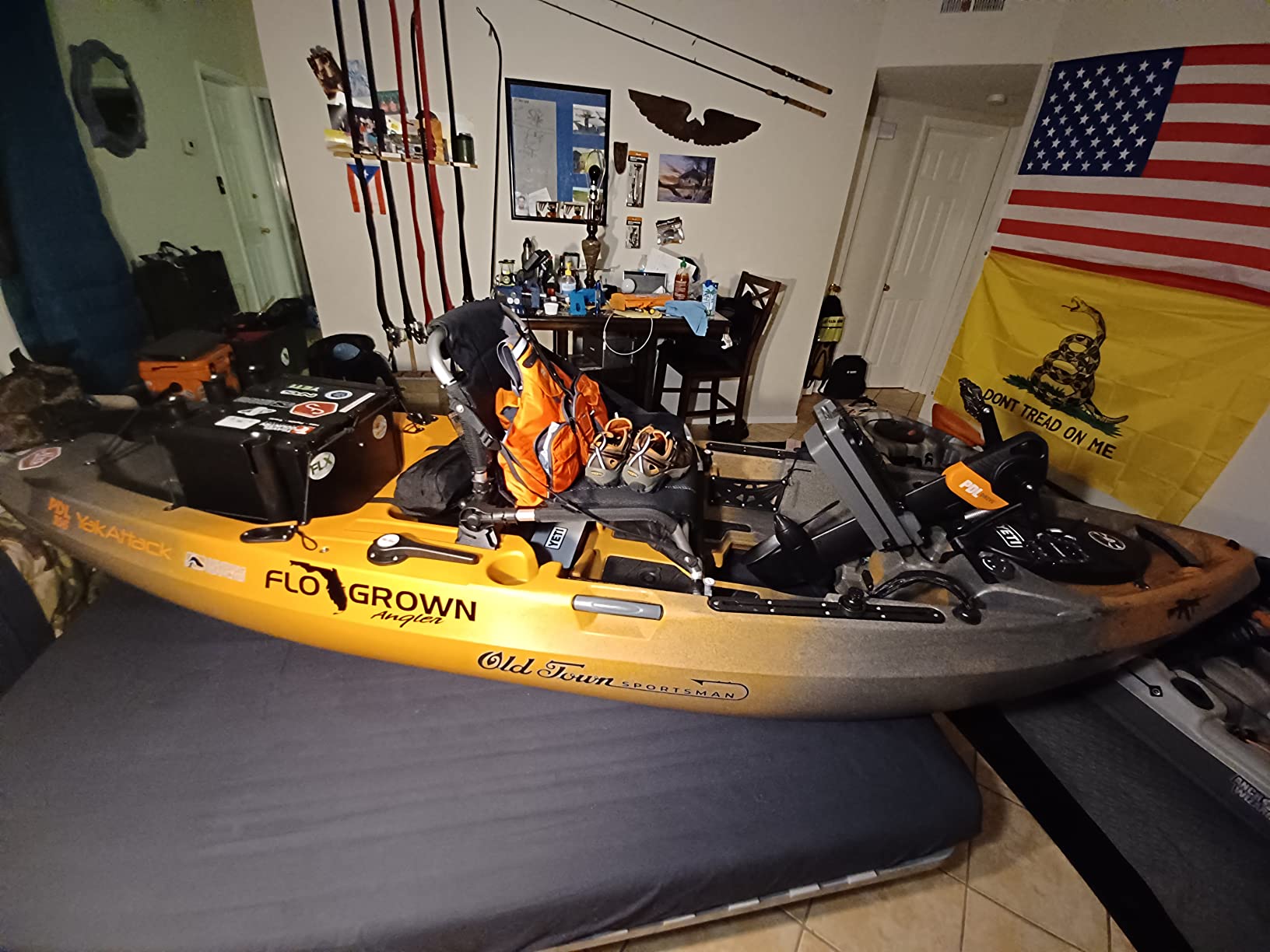
The snap-button ferrule is a two-piece design, so the paddle breaks into two halves rather than three, and the join is described as tight and wobble-free. Shaft ruler markings are a small touch that matters when you are setting length in the field with a group of paddlers who all need slightly different sizes.
Pick the length by hull, not by habit. Owners note that the shorter lengths feel cramped on boats wider than roughly 35 inches. If you paddle a tandem canoe with a wide beam, or a large solo canoe with a high seat, go up two or three sizes from what you would choose for a kayak of the same length.
Best for wide boats and heavy pack loads
The ovalized grip profile reduces hot spots over long days, which matters when the boat is heavily loaded and your stroke rate goes up to hold speed. This is a strong pick for a tandem canoe carrying a full load of gear, where the paddler in the bow needs enough reach to plant the blade cleanly on the first try.
Where it is not ideal
The 240 cm version is the shortest and suits narrow sit-on-top kayaks more than canoes. If your boat is narrow, the longer versions will feel like a lot of paddle to manage, and the extra weight of the bigger blade is dead mass. This is a paddle for big boats, bought deliberately for a big boat.
8. Wilderness Systems Pungo 220-240cm: Best for Owners of a Pungo Kayak
Wilderness Systems Pungo Glass Recreation/Touring Kayak Paddle | Fiberglass Blade | Adjustable Carbon/Fiberglass Shaft (220-240cm)
50 percent carbon and 50 percent fiberglass shaft
Fiberglass composite blade
Adjusts 220-240 cm
Pros
- Built for Pungo kayaks of all sizes and years
- Smooth power without flutter
- Adjustable range fits most paddlers
- Shaft blend gives a balanced response
- Durable fiberglass composite blade
Cons
- Fiberglass blade is heavier and less responsive
- Only one colour and style option listed
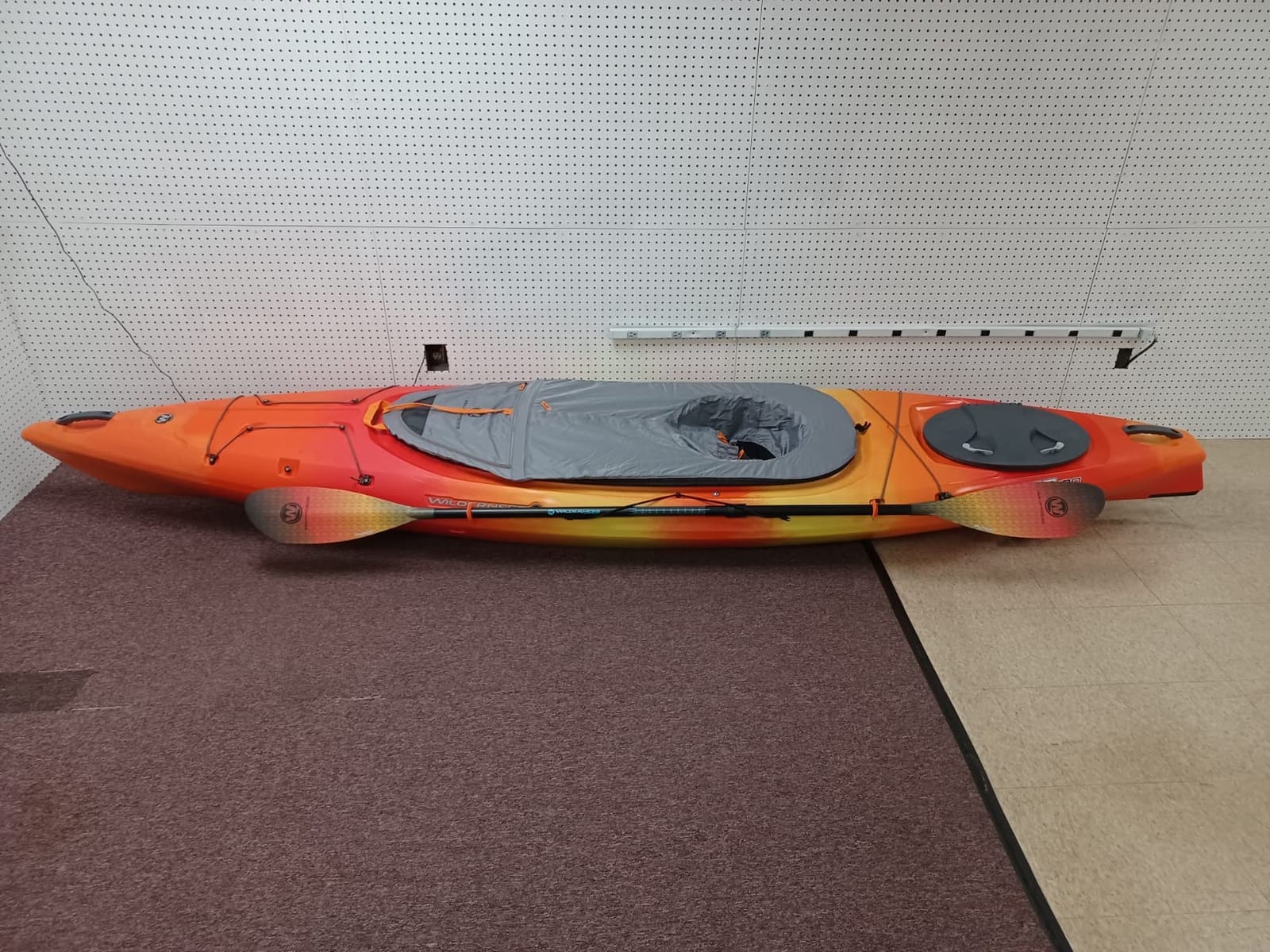
If you own a Pungo, this is the easy decision. The paddle was designed for that hull across all sizes and model years, and owners of those boats report a smooth, flutter-free power stroke from a first outing. It also works with other recreation kayak models, so it is not a dead end if you switch boats later.
The shaft is a 50/50 blend of carbon and fiberglass, which is a sensible durability compromise: stiff enough to give clean power, tough enough to take the knocks that come with launching off a sand beach or pushing off a submerged log. The blade is a durable fiberglass composite, and that is where the weight sits.
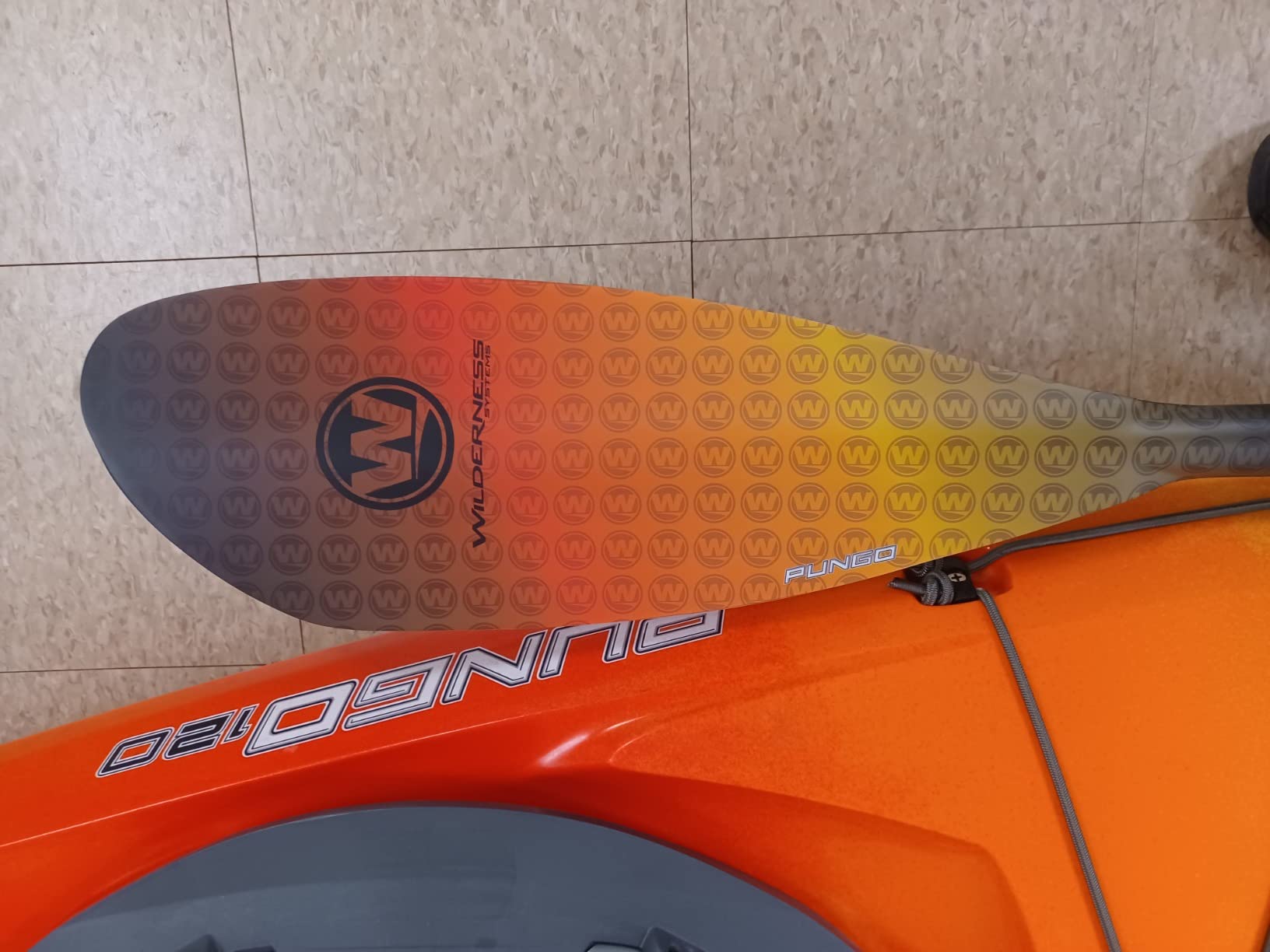
Adjustability runs from a 220 cm base length up to 240 cm, which is the standard range that fits most adult paddlers across most hull widths. If you are moving a Pungo into a canoe for a trip, a 240 cm upper limit is shorter than a canoe double ideally wants, so check your beam before committing.
There is also a one-year manufacturer warranty, which is thin compared with some paddlers would like but is at least stated. The single listed colour and style is a small frustration for anyone who wants a specific finish, though on a working boat most paddlers stop caring about colour within a season.
Best for brand-matched setups
If you are paddling a Pungo on a long trip, the fit and power delivery are already solved for you, and there is no reason to spend research time on fitment. The 50/50 shaft blend is also a good match for a boat that sees a lot of beach launches and gear loading. It is a solid recommendation for a recreational touring paddler who wants light weight without full carbon.
What limits it
The fiberglass composite blade is the honest limitation. It is heavier and less responsive than a full carbon blade, so a fast paddler in a light boat will find the limit of the boat before the limit of the paddle. If your goal is speed rather than comfort, spend up on a carbon blade instead.
9. CN6 CROSSNOVA Full Carbon Greenland 220cm: Best Full Carbon for High-Wind Open Water
CN6 CROSSNOVA Greenland Paddle 220cm/86.6 in, 590g /1.3 lb Extremely Lightweight Full Carbon Fiber Kayak Paddle for Kayaking (Matte Black Carbon Fiber)
590 g full carbon
Two-piece with push-pin joint
Narrow Greenland blades
Multi-layer top edge
Pros
- Extremely light with owner-verified weight
- Impressively stiff and holds shape
- Snug wobble-free joint with no play
- Greenland blade cuts spray and eases shoulder load
- Pretty carbon weave and clean finish
Cons
- No bag
- leash or tip protectors included
- Joint can be stiff to separate
- Fixed length with no adjustment
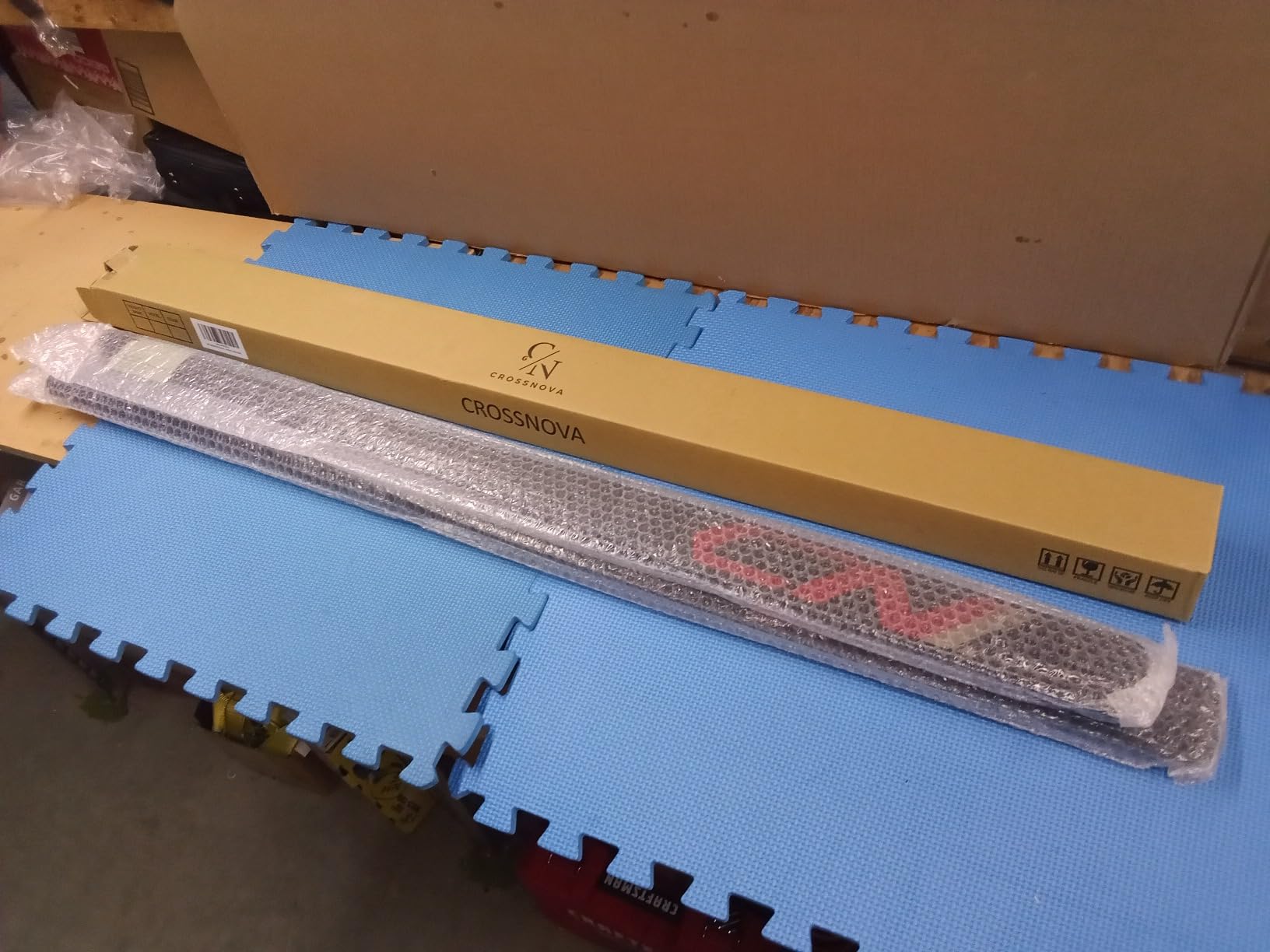
This is the stiffest paddle in the roundup, and one of only two where the blade is genuine full carbon rather than a nylon or fiberglass panel. Owners have weighed their units to confirm the 590 g figure, and they compare the result favourably to established European full carbon paddles. At 1.3 lb for a complete double-blade, that is an unusual amount of carbon for the money.
The Greenland blade shape is narrow and peaked, and that is not a style choice so much as a wind choice. A narrow blade presents less area to the air during recovery, which matters on a crossing where you are pushing into a headwind all day. Owners also report that it produces less spray, which keeps your hands and shoulders more comfortable over thousands of strokes.
Stiffness is the standout for anyone who has spent time on a shaft that feels like a spring. A stiff carbon shaft transfers more of your effort into moving the boat rather than into bending the paddle, and this one holds its shape under load in a way that lighter flexier paddles do not. The peaked blade also helps you set the boat straight, which is where a lot of open-water efficiency comes from.
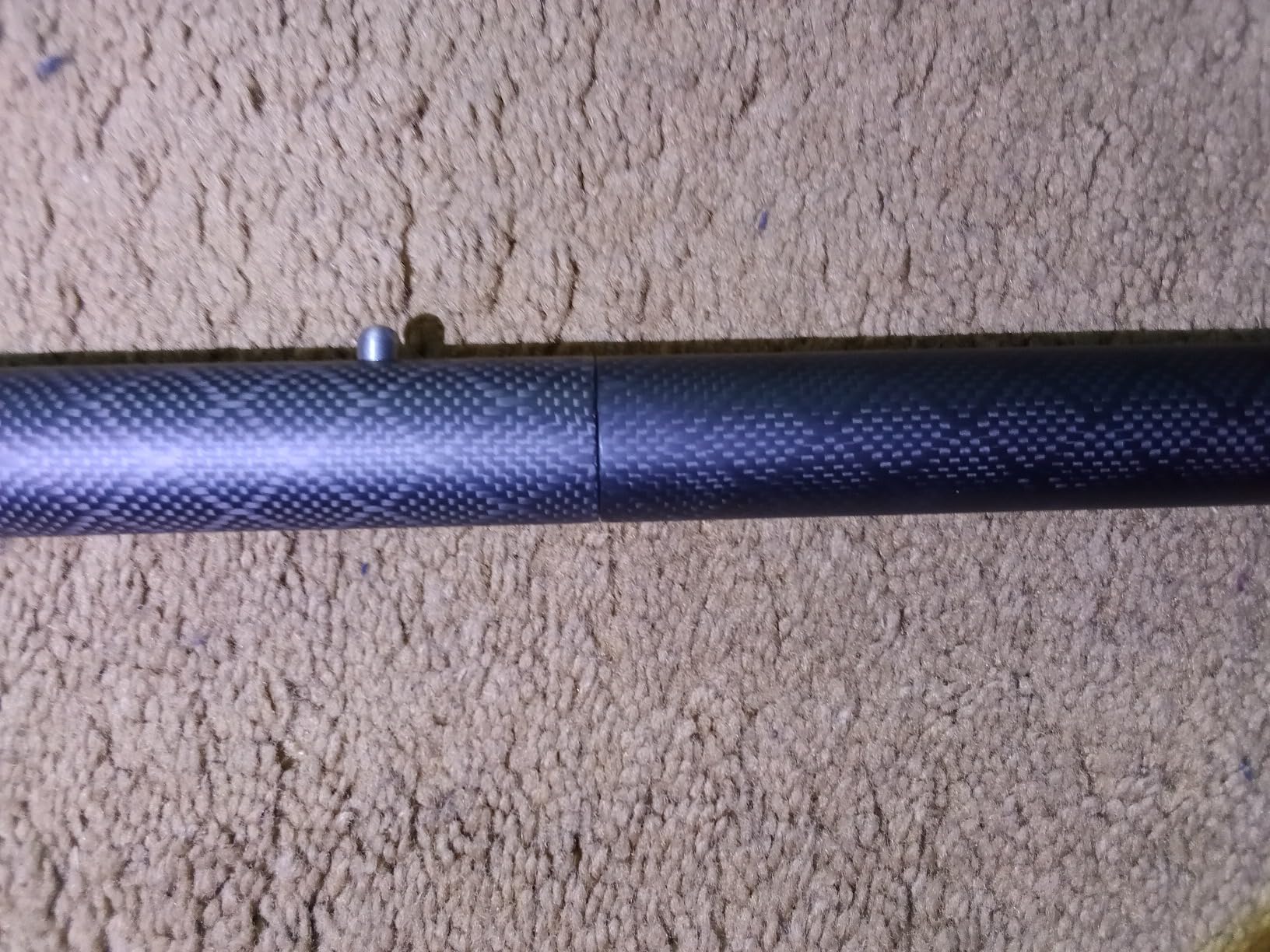
The build details are thoughtful for wilderness use. The top edge is a thickened multi-layer carbon fabric for impact resistance, and the construction is corrosion resistant for saltwater. The two-piece push-pin joint uses internal hex engagement, and owners report a snug fit with no play once it is seated, though they also report it can be sticky to separate after a season of mud.
Best for crossings and windy routes
This is the one to consider if your trip has long open-lake crossings, wind-exposed water, or a solo boat you need to move efficiently. The narrow blade suits high-angle, precise technique much better than the wide recreational blades in this list, so experienced paddlers will find it natural. It is also the top pick for anyone whose main goal is the lightest complete paddle they can find.
What to budget for and watch
No bag, leash or blade tip protectors are included, so add those to your packing list and budget. Because the length is fixed at 220 cm, you need to know your required length before you commit, and 220 cm is short for a wide-beam canoe with a high seat. Treat this as a kayak or narrow-boat paddle unless your hull is genuinely small.
10. WONITAGO Full Carbon Greenland 220-230cm: Best Starter Full Carbon Paddle
Full Carbon Fiber Greenland Paddle Lightweight Adjustable Kayak Paddle
Full carbon shaft and blade
23 oz
Adjusts 220-230 cm
Two-piece cam lock ferrule
Pros
- Full carbon at 23 oz for the weight
- Ten centimeters of adjustment to dial in fit
- Greenland blade makes fewer splashes
- Floats and resists corrosion
- Padded bag included
Cons
- Cam lock ferrule is thinner than premium fittings
- Limited shaft overlap at full extension
- Reports of finish flaws and loom flashing
- Loom section is short for larger hands
This is the cheapest route to genuine full carbon on this list, and at 23 oz it is the lightest paddle in the roundup by a clear margin. Full carbon on both the shaft and the blade is unusual at this level, and owners consistently describe it as an affordable entry into Greenland-style paddling that they find surprisingly capable.
The 10 cm of adjustment across 220 to 230 cm is more useful than it sounds. It lets you experiment with Greenland sizing on the water and settle into what suits your boat and your stroke, rather than gambling on a fixed length. The cam lock regulator holds firmly at any setting according to owners, with no creep during a long paddle session.
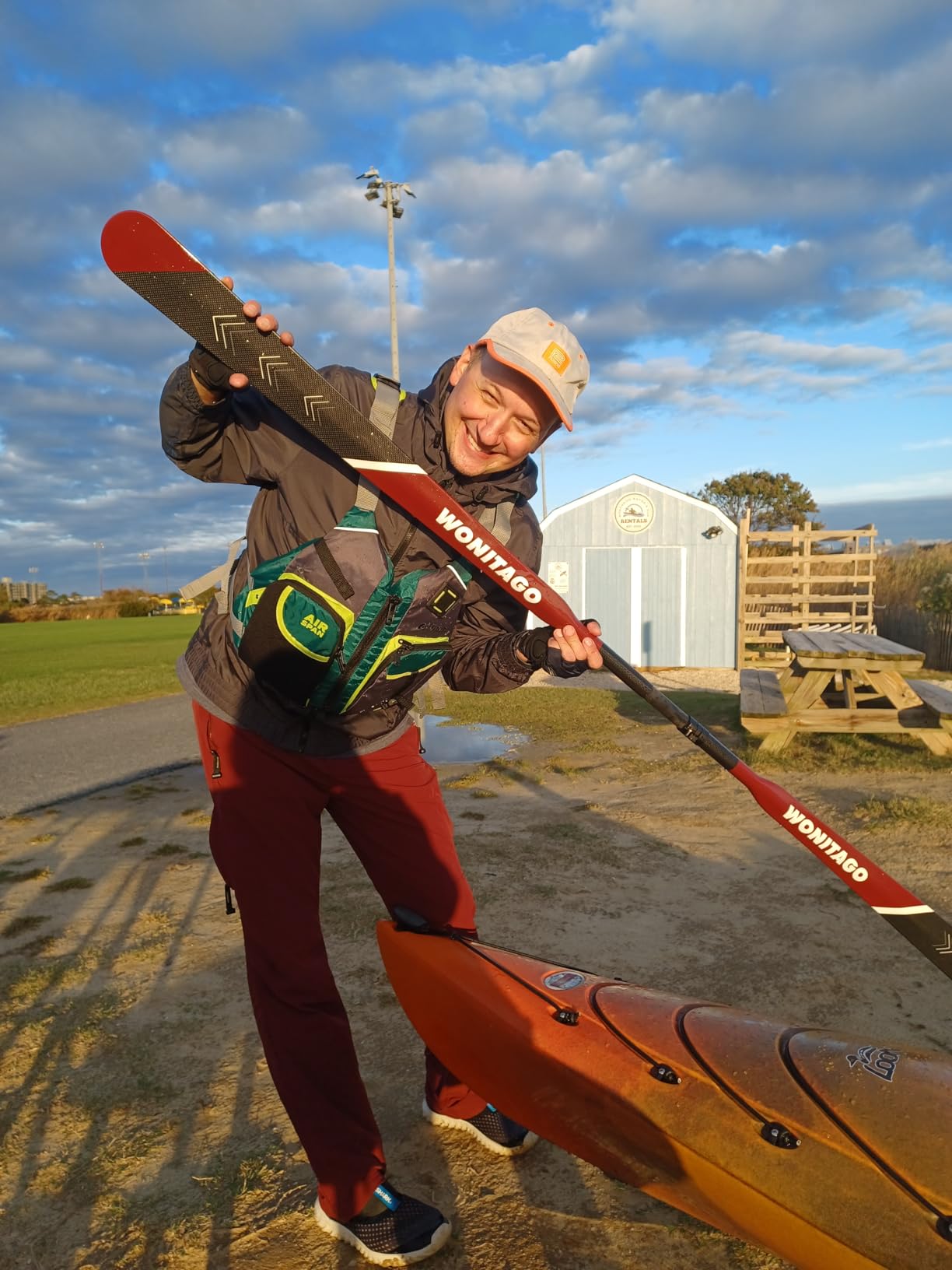
The blade makes fewer splashes than a Euro-style blade, which keeps your shoulders and hands more comfortable and reduces the mess in the boat on a long day. It also floats and is corrosion resistant, so losing it in moving water is not the disaster it would be with a heavy paddle.
There are finish complaints, and they are consistent enough to plan around. Several owners report scratches or cracking on arrival and even from the supplied padded bag, and some production batches show mould flashing along the loom. Inspect the paddle and the bag before the trip, photograph any damage immediately, and keep the bag away from the blade edges.
Best for a first taste of full carbon
If you have been paddling with composite blades and want to see whether full carbon changes your day, this is the least expensive way to find out. It suits flat water, mild wind and a paddler who is more interested in a light, splash-free stroke than in race technique. The included padded bag is a nice touch at this level that better-known makers often charge extra for.
Know the limits before you rely on it
Two details matter. The cam lock ferrule is thinner and less substantial than a premium fitting, so check it before every trip. And at full extension only about 3.75 inches of shaft overlap remains in the other half, which is a low ratio. The loom section is also short, so paddlers with larger hands may find the grip cramped. The lowest rating in this group reflects those real, if minor, issues.
Single Blade or Double Blade: What Long Canoe Trips Actually Reward
A canoe single blade and a kayak-style double blade solve the same problem in different ways, and the honest answer from experienced Boundary Waters paddlers is that both work. The double gives you more options: you can switch ends, use a power stroke on one side and a low-angle sweep on the other, and recover with less effort than a single ever will. The single gives you precise boat control, a cleaner catch in moving water, and no double-ended snagging on branches.
One paddler running a Boundary Waters route told the gear forum that a carbon bent-shaft single worked great even in rough open water, and that the double-blade carried along as a backup went unused on the return leg. That is a real result, and it is why we are not going to pretend a double-blade is automatically the right answer for a canoe.
Where doubles clearly win is wind and speed. A double blade generates power from both sides, which matters when you are fighting a headwind on a three mile crossing, and the other paddler in a tandem boat can do the same work with one less hand learning to switch. The catch is branch snagging in tight quarters and the fact that a double puts water in the boat on every stroke.
Anyone moving from a kayak to a canoe should know the length rule that trips people up. A kayak double typically runs 210 to 230 cm because kayak seats are low and the hull is narrow. A canoe double needs to be longer because the seat is higher and the beam is wider, and canoe doubles commonly run 270 to 280 cm. This roundup has exactly one paddle that reaches those lengths, which is worth understanding before you buy anything at 220 cm.
How to Size a Canoe Paddle: Beam, Seat Height and Torso
Paddler height alone is the wrong number. A 5 foot 4 inch paddler in a 36 inch beam canoe with a high seat needs a longer paddle than a 6 foot paddler in a narrow boat, because the distance from your shoulder to the water is set by the boat, not by your legs. Use this order: measure the beam, measure the seat height, then check the length against your torso.
Measure the beam at its widest point. This is usually amidships on a canoe. A boat under 30 inches wide behaves like a kayak; above 34 inches you want a noticeably longer paddle.
Measure the seat height above the bottom of the hull. A high seat or a kneeling setup adds length requirements that no height chart will capture.
Sit in the boat and mark where your hand sits at full reach. With the blade on the floor of the boat, your knuckles should be at the level of your mouth when your arm is straight forward.
Account for torso length. Longer torso, slightly longer paddle. A longer torso with a short paddle means you finish every stroke bent forward.
Add the offset for a canoe double. If you are paddling a wide-beam canoe with a double-blade, add roughly 20 to 40 cm over a kayak length for the same paddler.
Test before you commit. Adjustable paddles let you try two lengths in the first hour on the water, which is worth more than any chart.
If you can only measure one thing, measure your canoe’s beam and pick from the options above. Almost every sizing complaint we saw in owner reviews came from trusting a generic chart instead of measuring the actual boat.
Carbon, Carbon Composite or Fiberglass: What the Label Is Not Telling You
Are carbon paddles better? For a long trip, yes, because carbon’s stiffness-to-weight ratio means less of your effort disappears into shaft flex and less energy goes into lifting mass on every recovery. The catch is that carbon is less forgiving of impacts than fiberglass or nylon, and the cheapest paddles labelled carbon usually only have a carbon shaft. Read the material spec, not the product title.
Full carbon means carbon on both the shaft and the blade. It is the lightest option and the most expensive, and it is the one you should choose if weight is your priority and your route is smooth water. Carbon composite usually means a carbon shaft with a nylon, polypropylene or fiberglass-reinforced blade, which is a composite trade: slightly heavier, far tougher, and the right answer for most wilderness routes.
Fiberglass is heavier but nearly indestructible, and it remains the sensible choice for a boat that lives on a roof rack and takes abuse. A wood paddle is worth mentioning for the same reason, though you will not find one in this roundup. Metal hardware, particularly in an aluminium paddle, is what corrosion in a wet hull or a saltwater bay will ruin first.
One warning about buying by label: a paddle that lists carbon fibre in the title but shows a plastic blade in the specification section is a carbon-shaft paddle, and it will weigh like one. The paddles in this roundup that fall into that group are flagged clearly in each review.
Feather Angle and Blade Shape on Open Water
Feather angle is how far the second blade is rotated away from the first, and on a double-blade paddle the common settings are zero, 30, 45 and 60 degrees. Zero degrees puts both blades in line, which is precise and stable but means both blades cut the air on every stroke. Sixty degrees is the most efficient and the most committed, because the recovery blade is clear of the airflow.
For long flat days, 30 to 45 degrees is the comfortable middle ground that experienced paddlers settle into. It reduces air resistance on the recovery without the commitment of a full 60 degree feather, and it keeps the catch centred when you are correcting trim. Most of the paddles in this roundup offer zero and sixty only, so the Hornet model with its 15 degree steps is the one to look at if you want to fine-tune.
Blade shape matters just as much. An ottertail blade is narrow and long, with a large area that gives a smooth glide and makes a solid touring blade. A beavertail is wider and shorter, favoured for whitewater and for paddlers who like a strong bite and quick correction. Greenland blades are narrower still, built to minimise spray and air resistance in wind. For long flat days, an ottertail or a Greenland shape is the right answer; for rocky routes, a beavertail is tougher and more forgiving.
Portage Weight Budgeting: How Many Ounces Actually Matter
Here is the arithmetic that justifies spending money on carbon. A typical day on a lake route involves several thousand strokes per paddler, and a full portage day can add a lot more lifting. When paddlers on the Boundary Waters gear forum talk about it, the line that recurs is simple: lifting a two pound paddle ten thousand times leaves you more fatigued than lifting an eight ounce paddle the same number of times.
So the question is not whether twelve ounces matters, it is where those ounces sit. In the shaft, near your hands, twelve ounces of swing weight difference costs you a lot over a day. In the far end of a long blade, the same twelve ounces cost you very little, because leverage and the water carry most of the load. That is why a heavy composite blade on a light shaft can be perfectly reasonable, and why ultralight paddlers obsess about shaft diameter and blade mass separately.
The practical advice is to budget by trip type. A flat lake route with short carries barely notices a difference above about 26 oz. A route with a long portage chain, or a solo paddler carrying a loaded pack over rocks, will feel every ounce from about 20 oz downward. Match the paddle to the carry, not to the brochure.
Durability and Care: Where Full Carbon Is a Liability
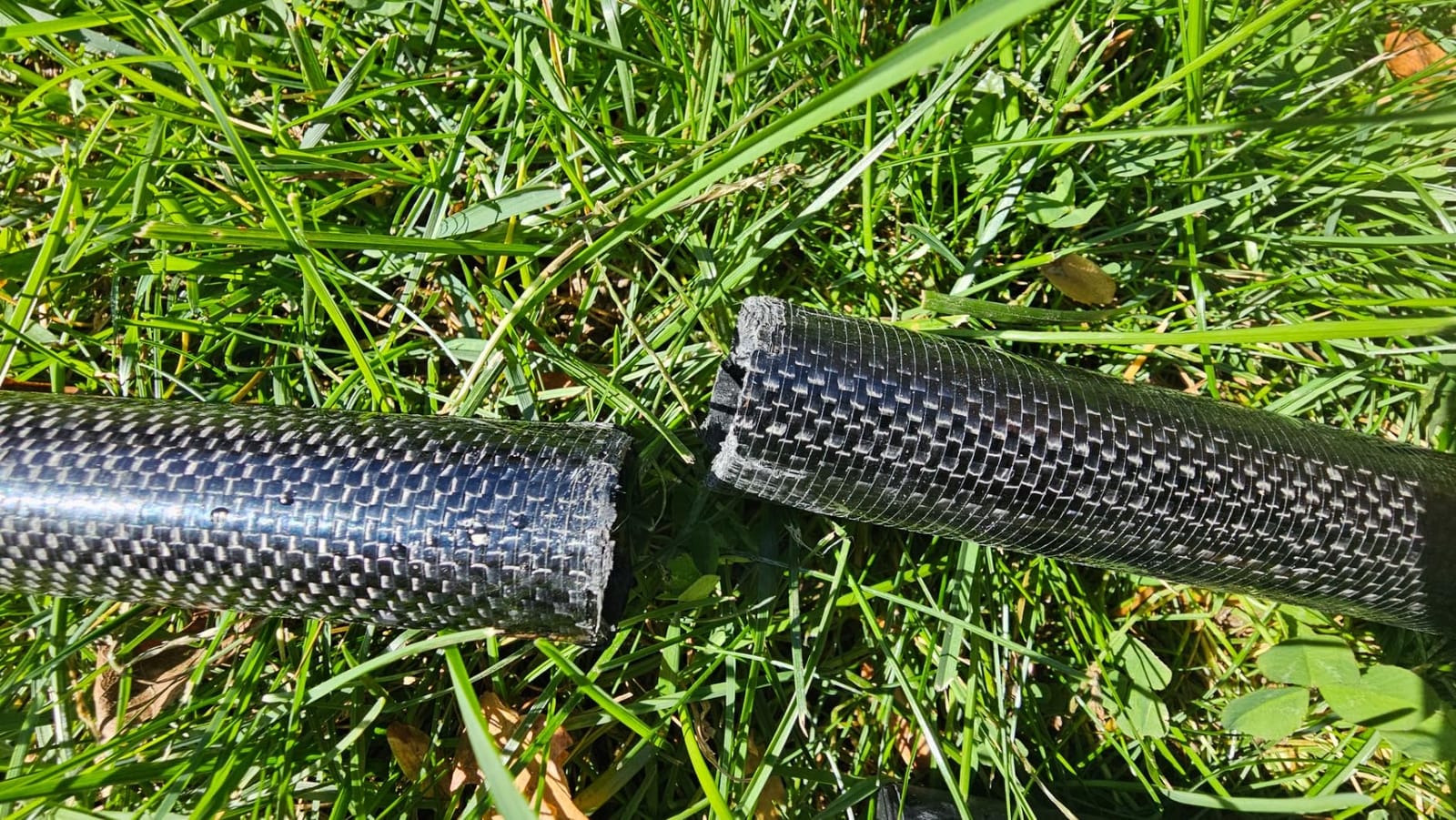
Carbon does not bend before it breaks. That is the honest headline for this section, and it is why forum users who love their carbon paddles also insist on carrying a backup. A fiberglass or nylon blade that takes a hit will chip, dent or crack and keep working. A carbon blade that takes the same hit can delaminate along the edge, and the failure can happen well after the impact rather than at the moment of it.
The common failure scenarios on a long trip are unglamorous. Dragging the paddle during a portage means scraping the blade edge along gravel and rock. A paddle leaned against a boulder while you sort a resupply cache can pick up a nick nobody sees. And the tarp pole scenario, using a blade to guy-line a tarp or hold a tent fly, puts full structural load through a blade edge that was never designed for it.
Two habits fix most of this. Keep blades leading edge up when you stow them in a hull bag, so the edges cannot take a hit from gear, and never use a carbon blade as a structural support. Then carry a real backup, not a token one. A cheap composite spare is a few hundred grams of insurance against a bent blade ending your trip at mile forty. The paddlers who finish long routes are the ones who planned for the paddle breaking rather than the ones who assumed it would not.
Who Should Skip Carbon Entirely
Carbon is the wrong purchase for a paddler whose trips are weekend afternoons on a flat lake reached from a car park. There, stroke count is low, pack weight does not matter, and the money is better spent on a boat that fits properly. Our carbon paddles for anglers roundup covers lighter-duty use where the priorities are different.
It is also the wrong purchase for anyone who buys a carbon paddle and then expects it to paddle better for them. Fitness, stroke technique and hull speed dominate trip pace. A paddler who cannot hold a relaxed efficient stroke will not out-paddle a heavier boat with a cheaper paddle, and no amount of carbon changes that. Buy the lighter paddle because your body is tired on day six, not because you expect to be faster on day one.
How to Choose a Carbon Paddle for a Multi-Day Trip in 6 Steps
Measure the boat first. Beam and seat height, not your height, decide the length. This is the step that prevents almost every bad purchase.
Decide single or double. If you will share a boat or if you have any headwind crossings, a double is the stronger long-trip choice. If precision and tight quarters matter more, buy the single and accept the switch cost.
Pick the blade material to match the route. Full carbon for smooth open water, carbon-reinforced nylon or composite for rock, shallows and heavy gear loading.
Match the breakdown to your trip. Two-piece for a boat that stays with you, three or four piece for flights, shuttles and rented canoes.
Set the feather angle before you leave the driveway. Zero and sixty cover most needs, but if you will be low-angling for hours a day, look for a paddle with 30 or 45 degree options.
Test the length on the water and buy a spare. Adjustable paddles let you settle the fit in an hour. Then put a cheap composite backup in your dry bag before the first portage.
Frequently Asked Questions
Are carbon paddles better for long trips?
Yes, for multi-day trips, because the lighter swing weight costs you less on every recovery lift across thousands of strokes. The trade-off is impact fragility, so carbon works best on smooth open water with a composite backup blade carried as insurance.
What is the ideal length for a canoe paddle?
Size by boat first, then body. Measure the canoe’s beam at its widest point and the seat height above the hull floor, sit in the boat with the blade on the floor, and check that your knuckles reach mouth level with a straight arm. For a canoe double-blade on a wide-beam hull, expect roughly 270 to 280 cm rather than the 210 to 230 cm used in kayaks.
Which type of paddle is better, carbon fiber or fiberglass?
Carbon is roughly 30 to 50 percent lighter and stiffer, which reduces fatigue across a long day. Fiberglass is heavier but far more impact-resistant and is the better choice on rocky routes. The most common useful middle ground is a carbon shaft with a carbon-reinforced nylon or composite blade.
What are the key differences between ottertail and beavertail paddles?
An ottertail blade is narrower and longer, with more area for a smooth glide, which suits long flat-water days. A beavertail is wider and shorter, gives a stronger bite and quicker correction, and is the traditional choice in moving water. For open-water touring, an ottertail or narrow Greenland shape reduces drag and spray.
Can you use a kayak paddle in a canoe?
Yes, but a kayak-length double will feel short in a canoe because the seat sits higher and the hull is wider. Canoe doubles commonly run 270 to 280 cm versus 210 to 230 cm for kayaks, so measure your beam and seat height before buying. In a narrow canoe, a kayak-length double works but costs you reach and a smaller catch.
Do carbon paddles break easily in the wilderness?
They do not bend gradually before failing, so damage can appear after an impact rather than during it. Most reported problems come from portage drags, rock strikes, using a blade as a tarp pole, or thin packaging damage in transit. Keep blades edge up in the hull, never use one as a support, inspect after rough carries, and carry a cheap composite spare.
The Best Carbon Canoe Paddle for Your Next Long Trip
After working through all ten, the best carbon canoe paddles for long trips come down to what your boat and your route demand. The Best Marine and Outdoors two-piece is our pick because it balances genuine carbon weight, a solid joint and a wide review history better than anything else in the group. The Bending Branches Angler Ace is the only one here that reaches true canoe-double lengths, so paddlers on a wide-beam hull should start there. The CN6 CROSSNOVA is the lightest and the best choice for a high-wind open-water crossing, while the Hornet model wins if you want to fine-tune your feather angle in 15 degree steps.
Measure your boat before you buy, choose a blade material that matches your rocks rather than your aspirations, and pack a cheap spare. Everything else is detail. Our paddler-by-paddler canoe picks are a good starting point for the hull itself, and this list is updated for 2026 as the market shifts.