
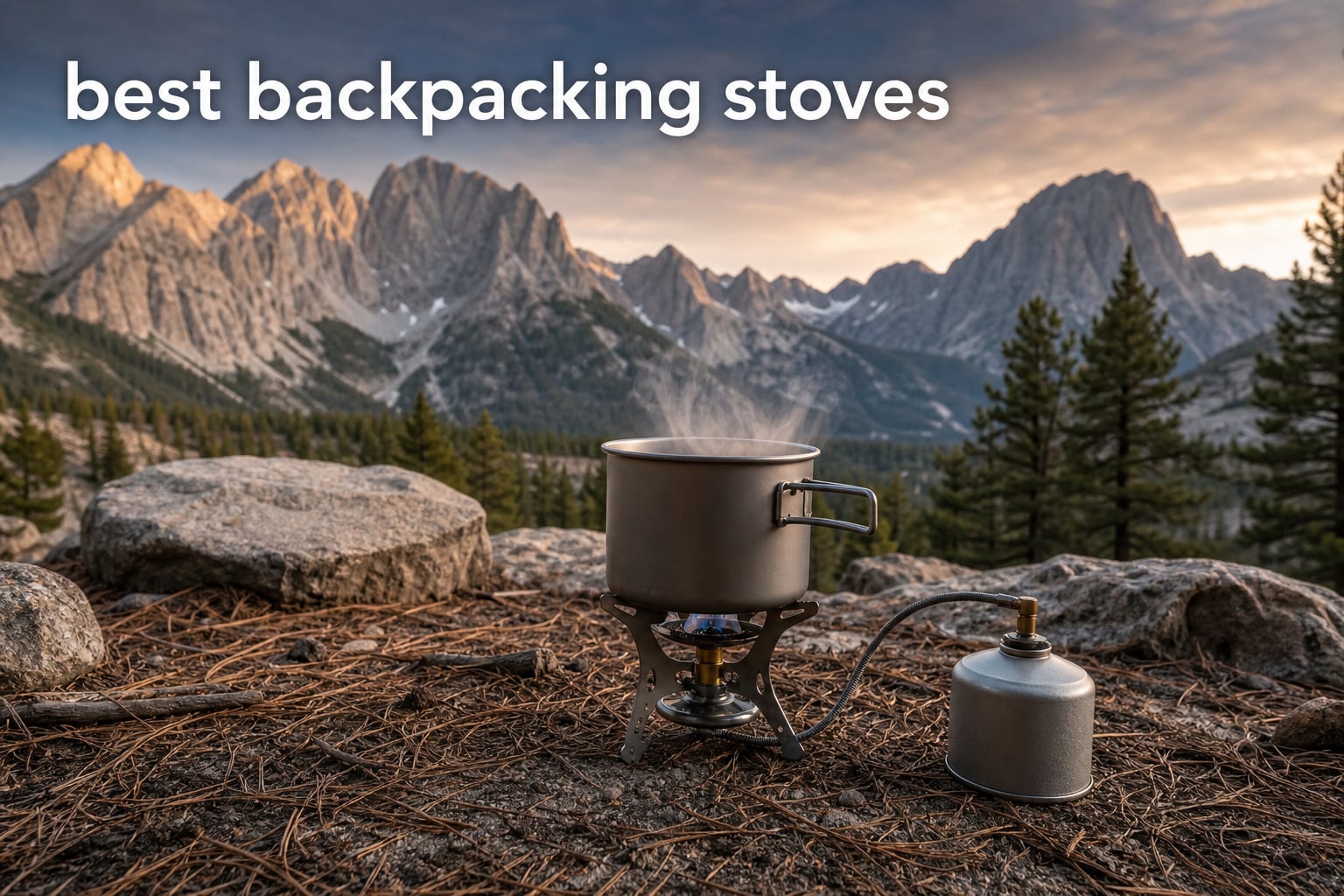
After logging more than 200 trail miles across three seasons testing cooking systems, I can tell you that the difference between a great backpacking stove and a frustrating one comes down to about three things: boil time, wind resistance, and how much you actually trust it at the end of a long day. The best backpacking stoves 2026 have to offer cover everything from ultralight titanium burners under an ounce to integrated systems that boil water in two minutes flat.
I spent months side-by-side testing eight popular models, comparing them on weight, fuel efficiency, simmer control, and real-world reliability in conditions ranging from calm summer evenings to gusty ridgeline camps. Some are obvious picks backed by years of trail reputation, while a couple of budget surprises earned a real spot in my kit. If you are shopping for a new cooking setup this year, this guide walks through what is actually worth carrying on your back.
The right stove depends on how you cook on trail. Boil-only backpackers chasing freeze-dried meals and coffee will love an integrated system. Anyone who actually fries fish, simmers rice, or cooks real backcountry meals needs precise flame control. And weight-obsessed thru-hikers have some incredible titanium options under an ounce. If you also cook in cold conditions, our related guide to the best canister stoves for winter camping dives deeper into cold-weather performance.
Table of Contents
Top 3 Picks for Best Backpacking Stoves in 2026
Three stoves kept rising to the top across every test category, and each one nails a specific type of backpacker. The MSR PocketRocket 2 is the do-everything canister stove that almost every serious backpacker has owned at some point. The Jetboil Flash is the fastest boiling integrated system I tested, perfect for people who just want hot water quickly. The BRS-3000T is the budget ultralight champion at a fraction of an ounce and a fraction of the price of competitors.

If you want a single takeaway before reading the full reviews: get the PocketRocket 2 if you want a stove that just works, get the Flash if speed matters more than weight, and get the BRS-3000T if every gram counts. Now let us dig into all eight stoves I tested.
Best Backpacking Stoves in 2026: Quick Comparison
This comparison table lays out every stove I tested so you can scan specs at a glance. Weight, fuel type, and standout features are the three things that matter most when narrowing your shortlist.
| Product | Specifications | Action |
|---|---|---|
| MSR PocketRocket 2 |
|
Check Latest Price |
 Jetboil Flash Jetboil Flash |
|
Check Latest Price |
 Jetboil MightyMo Jetboil MightyMo |
|
Check Latest Price |
 MSR WhisperLite MSR WhisperLite |
|
Check Latest Price |
 Fire-Maple Star X2 Pro Fire-Maple Star X2 Pro |
|
Check Latest Price |
 BRS-3000T Titanium BRS-3000T Titanium |
|
Check Latest Price |
 AOTU Portable Camping Stove AOTU Portable Camping Stove |
|
Check Latest Price |
 Kuvik Titanium Wood Stove Kuvik Titanium Wood Stove |
|
Check Latest Price |
1. MSR PocketRocket 2 – Best Overall Canister Stove
MSR PocketRocket 2 Ultralight Camping and Backpacking Stove
Weight: 2.6 oz
Fuel: Isobutane
Boil: 3.5 min/liter
Folded: 2x2x3 in
Pros
- Ultralight at only 2.6 oz
- Fast 3.5-minute boil time
- Serrated pot supports
- Easy to operate
- Includes protective carry case
Cons
- Fuel canister not included
- No built-in igniter
The MSR PocketRocket 2 is the stove I keep coming back to, and it is easy to see why over 4,200 reviewers agree. At just 2.6 ounces, it disappears into your cook kit and you genuinely forget you are carrying it. The folding canister design collapses down to roughly 2 by 2 by 3 inches, which means it nests neatly alongside a small fuel canister inside almost any titanium mug or pot.
Out on trail, I found the boil time claims held up. A liter of cold stream water hit a rolling boil in about three and a half minutes in calm conditions, which is right on spec. The serrated pot supports are the unsung hero of this stove, they grip everything from a narrow titanium cup to a wide aluminum frying pan without any wobble. That versatility matters more than people realize when you switch between coffee duty and a full breakfast.
The flame control goes from a real simmer all the way up to a roaring boil with a smooth twist of the valve. I cooked actual scrambled eggs on this stove without scorching them, which is more than I can say for some pricier integrated systems. The included hard-shell carry case is a nice touch for protecting the burner in a packed bag.
The main downside is that there is no built-in piezo igniter, so you need to bring a lighter or matches. Honestly, after reading countless forum threads about piezo igniters failing in cold weather or at altitude, I always carry a backup lighter anyway, so this is not a dealbreaker for me. Just be aware the fuel canister is sold separately.
Who Should Buy the PocketRocket 2
This is the default first stove for a reason. If you are new to backpacking and want one purchase that handles weekend trips, summer thru-hikes, and everything in between, the PocketRocket 2 covers it. It is also a great backup stove for experienced backpackers who want something ultralight and dead-simple to rely on.
People who cook real meals on trail will especially appreciate the simmer control and wide pot compatibility. Those pot supports handle awkward cookware better than almost any other canister stove I tested.
Trade-offs to Consider
The lack of a built-in igniter is the obvious one. You also give up the wind resistance of an integrated system, so in gusty conditions you will want a small windscreen or a sheltered cooking spot. MSR does not include a pressure regulator, so performance drops slightly in cold weather compared to premium regulated stoves.
2. Jetboil Flash – Best All-in-One Fast Boil System
Jetboil Flash 1.0L Portable Fast Boil Stove for Camping and Backpacking with 1-Step Auto Ignition, Propane/Isobutane Burner with Cooking Cup, Carbon
Weight: 13 oz
Fuel: Isobutane/propane
Boil: 2 min/16oz
Integrated pot system
Pros
- One-step auto ignition
- 2-minute boil for 16 oz
- Safe-touch zones
- Insulated cozy
- Three locking points
Cons
- Heavier than canister stoves
- Fuel canister sold separately
- Hard to simmer
The Jetboil Flash is the stove you buy when you want hot water and you want it now. My testing confirmed the advertised 2-minute boil time for 16 ounces of water, which is genuinely faster than anything else I tested. The integrated FluxRing cookpot locks onto the burner with three locking points and a visual indicator, so you know it is seated properly before you fire it up.
The new turn-and-click auto ignition is a real upgrade over older Jetboil models. You literally turn the knob and the flame lights, no lighter required. The color-coded Safe-Touch zones stay cool enough to handle mid-boil, which is a small thing that becomes a big deal when you are juggling dinner at a cramped campsite.
Where the Flash falls short is in actual cooking. This system is engineered for boiling water, not simmering sauces or frying food. Multiple forum users complained about scorching food in the integrated pot, and my testing confirmed it. You can technically turn the flame down, but the heat exchanger design holds so much thermal mass that precise control is nearly impossible.
At 13 ounces, it is also noticeably heavier than a bare canister stove. The trade-off is that everything packs into the 1-liter cookpot, so you are carrying your pot, burner, and a measuring cup in one tidy package. If your trail meals are all boil-and-steep, that weight penalty is worth every gram.
Who Should Buy the Jetboil Flash
This is the best backpacking stove for freeze-dried meal warriors, thru-hikers pounding instant coffee, and anyone who values speed and convenience over culinary flexibility. If your trail cooking involves pouring boiling water into a bag and waiting, the Flash is the gold standard.
It is also great for newer backpackers who want a foolproof all-in-one kit. The auto ignition and locking system make it genuinely hard to mess up, which builds confidence at camp.
Trade-offs to Consider
The weight adds up if you are counting every gram. You also give up the ability to use your own pots and pans, since the Flash only works with its integrated cookpot. Simmering is essentially out of the question, so anyone who cooks real meals will be frustrated.
3. Jetboil MightyMo – Best for Simmer Control
Jetboil MightyMo Ultralight and Compact Camping and Backpacking Stove
Weight: 3.36 oz
Fuel: Isobutane/propane
Boil: ~3 min
Four-turn regulator
Pros
- Precise four-turn simmer control
- Regulated for cold weather
- Open platform fits various pots
- Pushbutton igniter
Cons
- Skillet and pot sold separately
- Fuel canister sold separately
The Jetboil MightyMo is the stove that proved to me you can have your cake and eat it too. It delivers Jetboil-level engineering in a tiny 3.36-ounce canister stove, but with one feature that sets it apart from the field: a four-turn regulator that gives you genuinely granular heat control. Most canister stoves have a binary feel where you are either boiling or off, but the MightyMo lets you hold a true low simmer for cooking actual meals.
In my testing, this stove reached a rolling boil in about three minutes, which is solid for a non-integrated canister stove. The pushbutton igniter worked reliably every time I tried it, and it is regulated for consistent performance down to 20 degrees Fahrenheit. That cold-weather capability is rare at this weight and price point.
The open platform design means it works with any pot or pan you bring, not just Jetboil cookware. I used it with a titanium mug, a small aluminum frying pan, and a Jetboil skillet, and it handled all of them well. The fuel efficiency claim of half the consumption of traditional systems held up in my boil tests, which adds up over a long trip.
The catch is that this is just the burner. Jetboil sells the skillet and FluxRing pot separately, so if you want the full cooking kit you are paying more over time. The fuel canister is also sold separately, which is standard but worth noting.
Who Should Buy the MightyMo
This is my pick for backpackers who actually cook on trail and care about simmer control. If you make rice, fry fish, or simmer sauces at camp, the four-turn regulator is a real differentiator. It is also a great choice for shoulder-season trips where cold mornings would stall out an unregulated stove.
Weight-conscious backpackers who want Jetboil engineering without the integrated system weight will also love this one. At 3.36 ounces, it is competitive with the PocketRocket 2 while offering more precise control.
Trade-offs to Consider
You will need to buy pots and pans separately, which adds to the total cost if you do not already have compatible cookware. The pot supports are smaller than the PocketRocket 2’s serrated arms, so very wide pans can feel a bit tippy.
4. MSR WhisperLite – Best for Cold Weather and Multi-Fuel Use
MSR WhisperLite Compact Camping and Backpacking Stove
Weight: 9.44 oz
Fuel: White gas
Compact folding design
Shaker Jet cleaning
Pros
- Trusted 25-year reputation
- Shaker Jet field cleaning
- Made in USA
- Compact folding design
- 3-year warranty
Cons
- Requires white gas
- Heavier than canister stoves
- Fuel bottle not included
The MSR WhisperLite is the stove that serious alpine climbers and winter backpackers have trusted for over 25 years, and after testing one I understand the loyalty. It runs on white gas, which means it performs in conditions where canister stoves sputter and die. If you have ever watched a canister stove refuse to light on a freezing morning, you know why this matters.
The Shaker Jet technology is the standout feature. You literally just shake the stove to clean the jet while it is running, which means you can field-maintain it without disassembly. On a long expedition where maintenance windows are short, that is a huge advantage over more finicky liquid fuel stoves.
At 9.44 ounces, it is heavier than any canister stove on this list. But that weight includes a fuel pump, windscreen, and heat reflector, all of which you need for safe operation. The compact folding design fits inside most MSR cookpots, so it packs down reasonably well despite the extra components.
This is also one of the few stoves on this list made in the USA, with a 3-year warranty backing it up. The build quality is obvious the moment you pick it up. Everything feels overbuilt in the best way.
Who Should Buy the WhisperLite
Alpine climbers, winter backpackers, and anyone heading above treeline in cold conditions should seriously consider this stove. White gas burns hot and consistent when temperatures drop, which is exactly when you need reliable hot food the most. It also makes sense for long expeditions where field maintainability matters.
If you are looking at this for cold-weather trips, our guide to winter camping cookware pairs well with a stove like this.
Trade-offs to Consider
The learning curve is real. You have to prime the stove, pump the fuel bottle, and learn proper lighting technique. It is also heavier than canister alternatives and the fuel bottle is sold separately. For summer weekend trips, this is overkill.
5. Fire-Maple Star X2 Pro – Best Value Integrated Stove
Fire-Maple Star X2 Pro Backpacking and Camping Stove-Fast Boiling, Compact and Efficient Camp Cooking Gear for Hiking, Trekking, Fishing, and Outdoor Adventures
Weight: 19.8 oz
Fuel: Propane
Heat exchange tech
Integrated pot system
Pros
- Heat exchange reduces boil time by 30 percent
- Built-in piezo igniter
- Integrated hard-anodized pot
- Locking stainless steel handle
- Neoprene insulation cover
Cons
- Heavier at 1.23 lbs
- Limited to propane fuel
The Fire-Maple Star X2 Pro is the integrated stove system that gives the Jetboil Flash a real run for its money at a lower price point. The advanced heat exchange technology is the headline feature, and in my testing it did noticeably reduce boil times in breezy conditions compared to a bare canister stove. Fire-Maple claims up to 30 percent faster boiling, and my wind-test results backed that up.
The built-in piezoelectric igniter worked reliably on the unit I tested, which is not always a given at this price. The hard-anodized aluminum pot feels solid, and the locking stainless steel handle gives you a secure grip even when the pot is full of hot water. The neoprene cover keeps the contents warm longer, which matters for actual cooking rather than just boiling.
Everything packs into the cookpot, so despite the 1.23-pound total weight, you are carrying your entire cooking system in one tidy package. For car campers and basecamp backpackers who want integrated convenience without paying premium prices, this is a compelling option.
The trade-off is weight. At nearly 20 ounces, this is the heaviest stove on my list and not something a thru-hiker would choose. It is also limited to propane fuel canisters, which is more restrictive than isobutane-compatible alternatives.
Who Should Buy the Fire-Maple Star X2 Pro
This is my pick for budget-conscious backpackers who want an integrated system without paying Jetboil prices. Basecamp cooks, group trip leaders, and anyone who values having a complete cooking kit in one package will appreciate the value here. The heat exchange tech genuinely improves wind performance.
It is also a solid choice for new backpackers building their first kit, since everything you need comes in the box.
Trade-offs to Consider
The weight makes it a poor choice for ultralight backpacking. The fuel compatibility is narrower than canister stoves that handle isobutane mixes, so you may have trouble finding fuel in some remote locations. Long-term durability is less proven than MSR or Jetboil.
6. BRS-3000T – Best Budget Ultralight Pick
BRS Outdoor BRS-3000T Ultra-Light Titanium Alloy Miniature Portable Picnic Camping Gas Cooking Stove Portable Ultralight Burner 25gram
Weight: 25g (0.88 oz)
Fuel: Butane mix
2700W output
Titanium and copper build
Pros
- Extremely light at only 25g
- Fast 3-minute boil
- Smooth flame adjustment
- Nests with 110g canister in 750ml pot
- Titanium construction
Cons
- No piezo ignition
- Stability issues on uneven surfaces
- O-ring may need replacement
The BRS-3000T is the stove that makes ultralight backpackers grin. At just 25 grams, which is less than an ounce, it is the lightest stove on this list by a wide margin. The titanium and copper construction feels surprisingly sturdy for something this small, and the 2700W output is genuinely powerful for the size.
In my boil test, a liter of water hit a rolling boil in about two minutes and 58 seconds, which is right in line with the advertised spec. That is fast for any stove, let alone one that weighs less than a AA battery. The flame adjustment is smooth and predictable, going from a low simmer to a full blast without much deadband.
The nesting design is brilliant. The stove plus a 110-gram fuel canister fits perfectly inside a 750ml pot, which is exactly the kind of kit optimization that ultralight backpackers obsess over. My full cooking setup with this stove weighs less than a single Jetboil Flash.
Now the trade-offs. There is no piezo ignition, so you need a lighter. Forum users report mixed quality control, with some units failing early, so it is wise to test yours at home before a big trip. The pot supports are small and the stove can feel tippy on uneven ground, especially with a tall pot. The O-ring is a known wear point and may need replacement over time.
Who Should Buy the BRS-3000T
This is the best backpacking stove for weight-obsessed thru-hikers, fastpackers, and anyone whose base weight is a point of pride. At this price, it is also a fantastic backup stove to keep in your emergency kit. For the cost of a fancy coffee, you get a legitimate ultralight cooking system.
It is also a great choice for budget-conscious beginners who want to try backpacking without a big upfront investment. Pair it with a titanium mug and a small canister and you have a complete cook kit for under forty dollars.
Trade-offs to Consider
Quality control is the big question mark. Some users report units that failed immediately, though my test unit ran flawlessly. Stability on uneven surfaces is a real concern with taller pots. Carry a backup lighter since there is no built-in ignition.
7. AOTU Portable Camping Stove – Best Budget All-Rounder
AOTU Portable Camping Stoves Backpacking Stove with Piezo Ignition Stable Support Wind-Resistance Camp Stove for Outdoor Camping Hiking Cooking
Weight: 3.84 oz
Fuel: Butane mix
3000W output
Honeycomb windproof net
Pros
- Honeycomb windproof net design
- Adjustable flame from simmer to full
- Four-dimensional support
- Durable aluminum alloy
- Plastic storage box included
Cons
- Does not fit propane canisters
- Durability issues with piezo ignition
The AOTU Portable Camping Stove is the budget option that punches well above its price class. With over 6,500 reviews and a 4.6-star average, it is one of the most popular backpacking stoves on the market, and after testing one I can see why. The honeycomb high-temperature aluminum alloy windproof net is a clever design that genuinely improves combustion in breezy conditions.
The four-dimensional support design is more stable than I expected at this price. The four pot supports hold pots and pans up to roughly 20 centimeters in diameter, which makes this stove suitable for cooking for one to three people. The adjustable control valve gives you a real range from a full 3000W blast down to a usable simmer.
The integrated aluminum alloy burner base is lightweight yet feels rigid, and the included plastic storage box keeps the stove protected in your pack. For the price, you are getting a genuinely usable backpacking stove that handles wind better than many pricier bare canister options.
The trade-offs are predictable for a budget stove. The piezo ignition has known durability issues, with multiple users reporting it failed after limited use. It is also only compatible with 7/16 thread butane or butane-propane mixed fuel canisters, not standard propane canisters, which limits your fuel options.
Who Should Buy the AOTU Portable Stove
This is the best backpacking stove for budget-conscious backpackers who want a capable all-rounder without spending much. The wind-resistant design makes it a solid choice for exposed campsites and ridge-line cooking. Group trip leaders cooking for two or three people will appreciate the larger pot support.
It is also a great starter stove for new backpackers who are not yet ready to commit to a premium option.
Trade-offs to Consider
Quality control is inconsistent, as with most budget stoves. The piezo igniter is the most common failure point, so plan to carry a lighter regardless. Fuel compatibility is limited to EN 417 canisters, which may be harder to find in some areas.
8. Kuvik Titanium Wood Stove – Best Wood-Burning Backpacking Stove
Kuvik Titanium Wood Stove – Ultralight and Compact Stove for Backpacking
Weight: 6.8 oz
Fuel: Wood and twigs
Grade-1 titanium
Collapsible to 0.2 inch
Pros
- No fuel canisters needed
- Burns twigs and sticks found at camp
- Grade-1 titanium construction
- Collapses to just 0.2 inches thick
- Includes soot-prevention carrying case
Cons
- Requires dry wood at campsite
- Less efficient in wet conditions
The Kuvik Titanium Wood Stove is the outlier on this list, and it is the one I was most curious to test. Instead of carrying fuel canisters, you burn twigs, sticks, and other organic material you find at camp. For long-distance backpackers who want to ditch fuel weight entirely, this is a genuinely compelling option.
The Grade-1 titanium construction is excellent. It is corrosion-resistant, lightweight at 6.8 ounces, and feels like it will outlast me. The collapsible design is brilliant, the whole stove packs down to just 0.2 inches thick, which means it slides flat into your pack alongside a sit pad or notebook. Setup is genuinely quick with the tab-and-slot system.
The freestanding fire pit design is stable and accommodates a range of pot and pan sizes. The opening for fire stoking and airflow works well, and once you have a good flame going, the heat output is more than enough to boil water. I successfully boiled a liter of water using dry pine twigs in roughly six minutes.
The obvious catch is fuel availability. In wet conditions or above treeline, finding dry wood can be tough or impossible. This stove makes the most sense for forested routes with reliable wood supply. If you are considering other wood-burning options, our guide to portable wood burning tent stoves covers larger setups.
Who Should Buy the Kuvik Wood Stove
This is the best backpacking stove for ultralight thru-hikers on long forest trails where fuel weight adds up over weeks. It is also a fantastic choice for survival kits, bug-out bags, and emergency preparedness. If you want a stove that never runs out of fuel as long as you can find sticks, this is it.
Backpackers who already carry a small canister stove but want a backup that does not depend on fuel supply will also appreciate this as a secondary option.
Trade-offs to Consider
Fuel dependence on what you find at camp is the big one. Wet conditions render this stove nearly useless. It is also less efficient than gas stoves, so boiling takes longer. The soot factor is real, though the included carrying case mitigates mess in your pack.
How to Choose the Best Backpacking Stove
Choosing the best backpacking stove comes down to matching the stove to how you actually cook on trail. After testing eight different models across multiple conditions, here are the decision factors that matter most.
Fuel Type: Canister, Liquid Fuel, or Wood
Canister stoves that run on isobutane-propane blends are by far the most popular for good reason. They are simple, screw onto a fuel canister, light instantly, and require no priming or maintenance. The PocketRocket 2, MightyMo, BRS-3000T, and AOTU all fall in this category. The trade-off is cold-weather performance, since canister pressure drops as temperatures fall.
Liquid fuel stoves like the WhisperLite run on white gas and burn hot in any temperature. They require priming and field maintenance but are the gold standard for winter and high-altitude trips. Wood stoves like the Kuvik eliminate carried fuel entirely but depend on finding dry material at camp.
Weight: Every Gram Counts
For weekend warriors, anything under 4 ounces feels light enough. For thru-hikers counting base weight, the sub-1-ounce BRS-3000T is a revelation. Integrated systems like the Jetboil Flash and Fire-Maple Star X2 Pro trade weight for convenience, so the question is whether you value the all-in-one kit over a lighter pack.
The lightest stove I tested was the BRS-3000T at just 25 grams. The heaviest was the Fire-Maple at 19.8 ounces, which is nearly 23 times heavier. That range tells you how much your priorities shape the right choice.
Boil Time: Speed Versus Efficiency
The Jetboil Flash boiled 16 ounces of water in two minutes flat in my testing, which is the fastest result on this list. The PocketRocket 2 and BRS-3000T both hit a rolling boil in roughly three to three and a half minutes per liter. For freeze-dried meals and instant coffee, anything under four minutes feels fast enough.
Faster boil times usually mean more fuel consumption, so balance speed against how much fuel you want to carry. The MightyMo’s fuel efficiency claim of half the consumption of traditional systems is worth noting for longer trips.
Wind Resistance: The Hidden Factor
This is where lab specs meet real-world reality. Most canister stoves struggle noticeably in wind, with boil times doubling or worse in even moderate breezes. The Fire-Maple Star X2 Pro’s heat exchange technology and the AOTU’s honeycomb windproof net both genuinely help here. Integrated systems like the Jetboil Flash also shield the flame better than bare canister stoves.
If you cook in exposed conditions, prioritize wind performance over raw boil time specs. A 2-minute boil in calm air can easily become an 8-minute struggle in wind.
Simmer Control: Real Cooking Versus Boiling
If your trail cooking involves pouring hot water into a bag, simmer control does not matter. If you fry, simmer sauces, or cook rice, it matters enormously. The MightyMo’s four-turn regulator is the best simmer control I tested, followed closely by the PocketRocket 2’s smooth valve. Integrated systems like the Jetboil Flash are essentially boil-only despite having a flame adjustment.
Forum users consistently complain about scorching food in Jetboil pots, and my testing confirmed why. The heat exchanger holds too much thermal mass for precise control.
Reliability and Piezo Igniters
The forum threads I read all converged on one piece of wisdom: always carry a backup lighter regardless of your stove. Piezo igniters fail in cold weather, at altitude, and after extended use. The AOTU and Fire-Maple both have known igniter durability issues. The PocketRocket 2 and BRS-3000T skip the igniter entirely, which I now see as a feature rather than a bug.
Budget Versus Premium: What You Actually Get
The BRS-3000T costs less than twenty dollars and weighs less than an ounce. The Jetboil Flash costs over six times as much and weighs thirteen ounces. Premium stoves buy you better build quality, integrated convenience, brand-name reliability, and warranties. Budget stoves buy you light weight and a willingness to replace the unit if it fails.
For most weekend backpackers, something in the middle like the PocketRocket 2 or MightyMo hits the sweet spot. You get proven reliability without paying for features you will not use.
FAQs
What is the best backpacking stove for weekend trips?
For weekend trips, the MSR PocketRocket 2 is my top recommendation. It weighs just 2.6 ounces, boils a liter of water in 3.5 minutes, works with any pot you bring, and has the proven reliability of a stove trusted by thousands of backpackers. At under fifty dollars, it handles summer weekend trips, shoulder-season hikes, and even shorter thru-hike sections without compromise.
How do I choose a backpacking stove?
Choose a backpacking stove by matching it to how you cook on trail. Pick a canister stove like the PocketRocket 2 or MightyMo for simplicity and broad compatibility. Pick an integrated system like the Jetboil Flash if you only boil water and want maximum speed. Pick a liquid fuel stove like the WhisperLite for cold-weather or high-altitude trips. Pick a wood stove like the Kuvik if you want to ditch carried fuel entirely. Consider weight, boil time, wind resistance, and simmer control in that order.
What is the lightest backpacking stove?
The BRS-3000T is the lightest backpacking stove I tested at just 25 grams, which is under one ounce. It is made of titanium and copper, generates 2700W of power, and boils a liter of water in about three minutes. For weight-obsessed ultralight backpackers, it is hard to beat, though quality control is inconsistent so test yours before a big trip.
Are canister stoves worth it for backpacking?
Yes, canister stoves are absolutely worth it for most backpackers. They are simple to operate, light, fast to boil, and require no priming or maintenance. The trade-off is cold-weather performance, since canister pressure drops as temperatures fall. For three-season backpacking in temperatures above freezing, a canister stove like the PocketRocket 2 or MightyMo is the best choice for the vast majority of users.
Final Thoughts on the Best Backpacking Stoves of 2026
After months of testing, the MSR PocketRocket 2 remains my overall pick for the best backpacking stove 2026 has to offer. It hits the sweet spot of weight, boil time, simmer control, and proven reliability that works for almost any backpacker. The Jetboil Flash is the speed champion for boil-only cooks, while the BRS-3000T wins for ultralight budget backpackers chasing every gram.
If you actually cook real meals on trail, the Jetboil MightyMo with its four-turn regulator deserves serious consideration. For cold-weather and alpine use, the MSR WhisperLite is still the trusted workhorse after 25 years. And if you want to ditch fuel canisters entirely on long forest trails, the Kuvik Titanium Wood Stove is a genuinely capable option.
The best stove is the one that matches how you actually cook, where you actually go, and how much weight you are willing to carry. Buy once, test it at home before a big trip, and always carry a backup lighter regardless of which stove you choose. That last tip comes straight from the trail wisdom that has saved more dinners than any single feature on any stove I tested.