
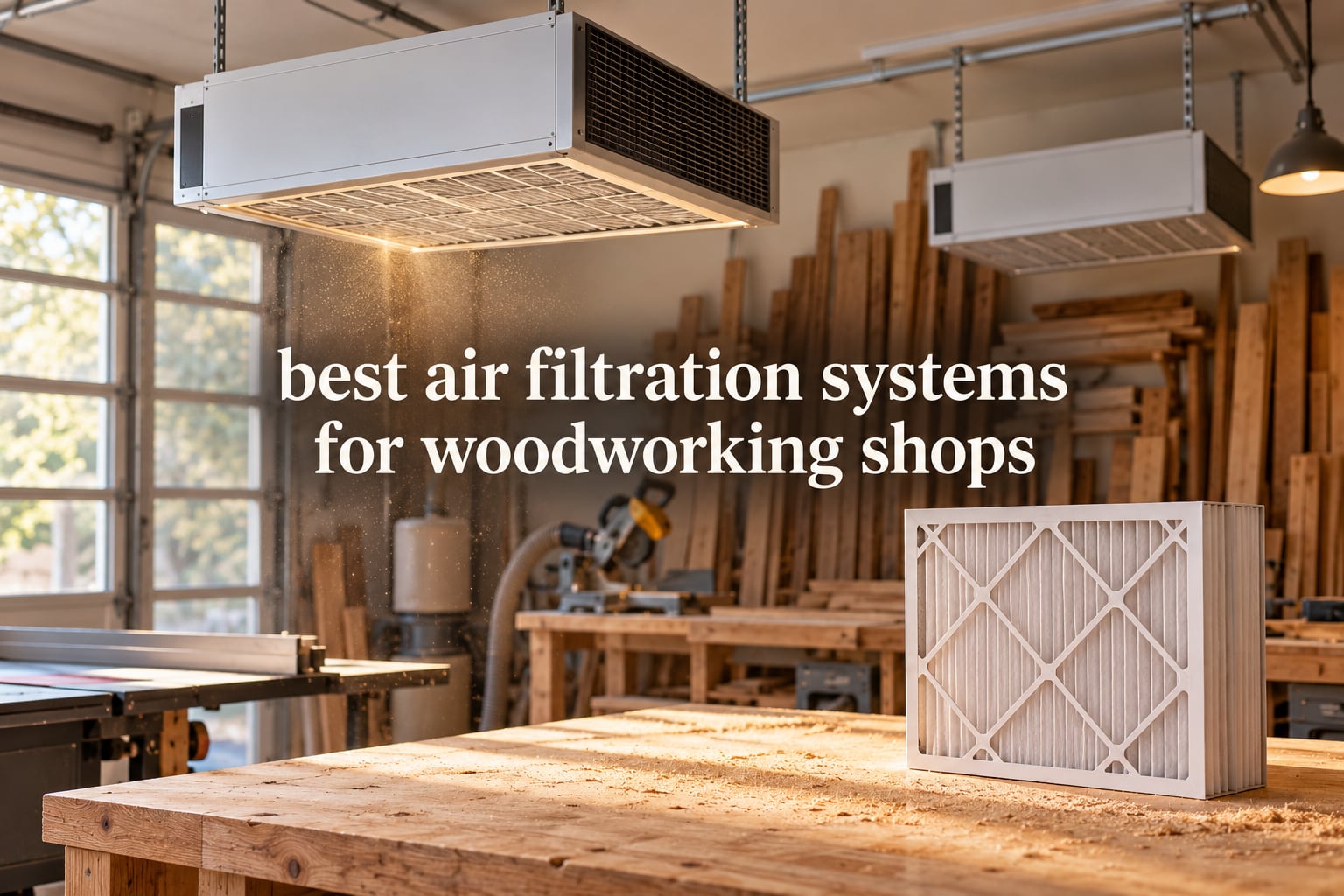
Fine wood dust is the quiet hazard of every shop. Sanding, routing and sawing put particles into the air that stay suspended for hours, settle into unfinished surfaces, and get mixed into every coat of finish you spray afterwards. The NIOSH and American Lung Association both link long-term exposure to chronic bronchitis, reduced lung function and asthma, and fine hardwood dust carries a nasal cancer risk. A good dust collector catches chips at the machine, but the dust that misses it is still in the room, and that is what an air filtration system is built to handle. We compared the ten best air filtration systems for woodworking shops currently on the market, pulled the published CFM, filter grade and noise figures for each, and worked out which one belongs in which kind of shop.
Before we get into the picks, the thing that trips up most new buyers is sizing. Units are sold by CFM, and a nameplate number alone will not tell you whether it covers your shop once the filter loads up. The formula is simple, the arithmetic takes thirty seconds, and skipping it is how people end up buying a second collector a year later. We walk through it in the buying guide below, with a worked example and the ACH numbers we use for different levels of shop dust.
One more distinction worth making early, because it comes up on nearly every forum thread about this topic. Air filtration cleans the air in the room. Dust collection captures debris at the machine. They are not competitors, and neither one replaces the other. If you are picking up a router for the first time, the power carving tools guide is worth a look, but the dust problem starts on day one regardless of which machine you own.
Table of Contents
Top 3 Air Filtration Picks for Woodworking Shops in 2026
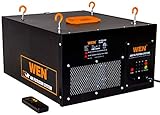
WEN 3410 (400 CFM)
- 1-micron filter plus 5-micron pre-filter
- 300/350/400 CFM three-speed
- RF remote and programmable timer

Abestorm DecDust 1350
- 1050 and 1350 CFM vortex fan
- MERV-11 filter
- 360-degree intake
- up to 1700 sq ft
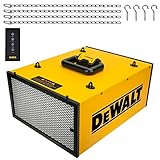
DeWALT DWXAF101 HEPA
- H11 HEPA two-stage filtration
- Captures over 95% of 0.3 micron particles
- Auto mode with air quality sensor
- 3-year warranty
The WEN 3410 takes the top slot because it is the most proven design in this group by a wide margin. It carries a 4.6 rating across more than 5,600 ratings, and the architecture, a 5-micron outer pre-filter feeding a 1-micron inner filter, is the same one most of the higher-capacity machines use.
The Abestorm DecDust 1350 is the one to buy if raw airflow matters more than refinement. Its 360-degree intake and vortex fan move 1,350 CFM and cover rooms up to 1,700 sq ft, which is more than double what the 400 CFM class can do.
The DeWALT DWXAF101 is the one mainstream ceiling model here with HEPA-grade filtration built in, at over 95% capture of 0.3 micron particles across two stages. It also auto-adjusts to air quality, which is genuinely useful on heavy sanding days.
10 Best Air Filtration Systems for Woodworking Shops (October 2026)
| Product | Specifications | Action |
|---|---|---|
| WEN 3410 3-Speed Remote-Controlled Air Filtration System |
|
Check Latest Price |
| DEWALT DWXAF101 HEPA Air Filtration System |
|
Check Latest Price |
 MOUNTO HEPA500 Commercial Air Scrubber MOUNTO HEPA500 Commercial Air Scrubber |
|
Check Latest Price |
| ABESTORM DecDust 1350 360 Degree Intake Air Filter |
|
Check Latest Price |
 Abestorm DecDust 1080 Air Filtration System Abestorm DecDust 1080 Air Filtration System |
|
Check Latest Price |
 PURISYSTEMS PuriCare 500IG Air Filtration System PURISYSTEMS PuriCare 500IG Air Filtration System |
|
Check Latest Price |
 POWERTEC AF4001C 3-Speed Air Filtration System POWERTEC AF4001C 3-Speed Air Filtration System |
|
Check Latest Price |
 Abestorm DecDust 780S Tabletop Dust Collector Abestorm DecDust 780S Tabletop Dust Collector |
|
Check Latest Price |
 OUKEETO FJ250 Portable 2 Stage Air Filtration System OUKEETO FJ250 Portable 2 Stage Air Filtration System |
|
Check Latest Price |
 JET AFS-1000C Air Filtration System JET AFS-1000C Air Filtration System |
|
Check Latest Price |
If you are in a hurry, the short version is that the 400 CFM class covers roughly 200 to 300 sq ft of hobby shop, the 780 to 1,080 CFM machines cover a single-car garage, and anything above 1,300 CFM is built for a two-car garage or a professional production space.
1. WEN 3410 (400 CFM) – Best All-Rounder for Small Shops
WEN 3410 3-Speed Remote-Controlled Air Filtration System (300/350/400 CFM), Basic w/ RF Remote (400 CFM) , Black
300/350/400 CFM
1-micron inner plus 5-micron pre-filter
50 to 60 dB
17 x 20.5 x 10 inch
31 lb
2-year warranty
Pros
- Most proven design in the class
- rated 4.6 stars across 5627 ratings
- Three speeds with a programmable auto-off timer
- RF remote works through obstructions from up to 26 ft
- Both the filter and the pre-filter are easy to replace
Cons
- 400 CFM is a real ceiling in a large or very dusty shop
- Filter media needs regular replacement in heavy-dust work
The WEN 3410 is the unit we see recommended most often in shop forums, and after working through the specs of this whole category it is easy to understand why. It does the two things that matter: it pulls a stated 400 CFM at the top setting, and it puts that air through a 1-micron inner filter backed by a 5-micron outer pre-filter that catches the chunkier chips before they reach the fine media.
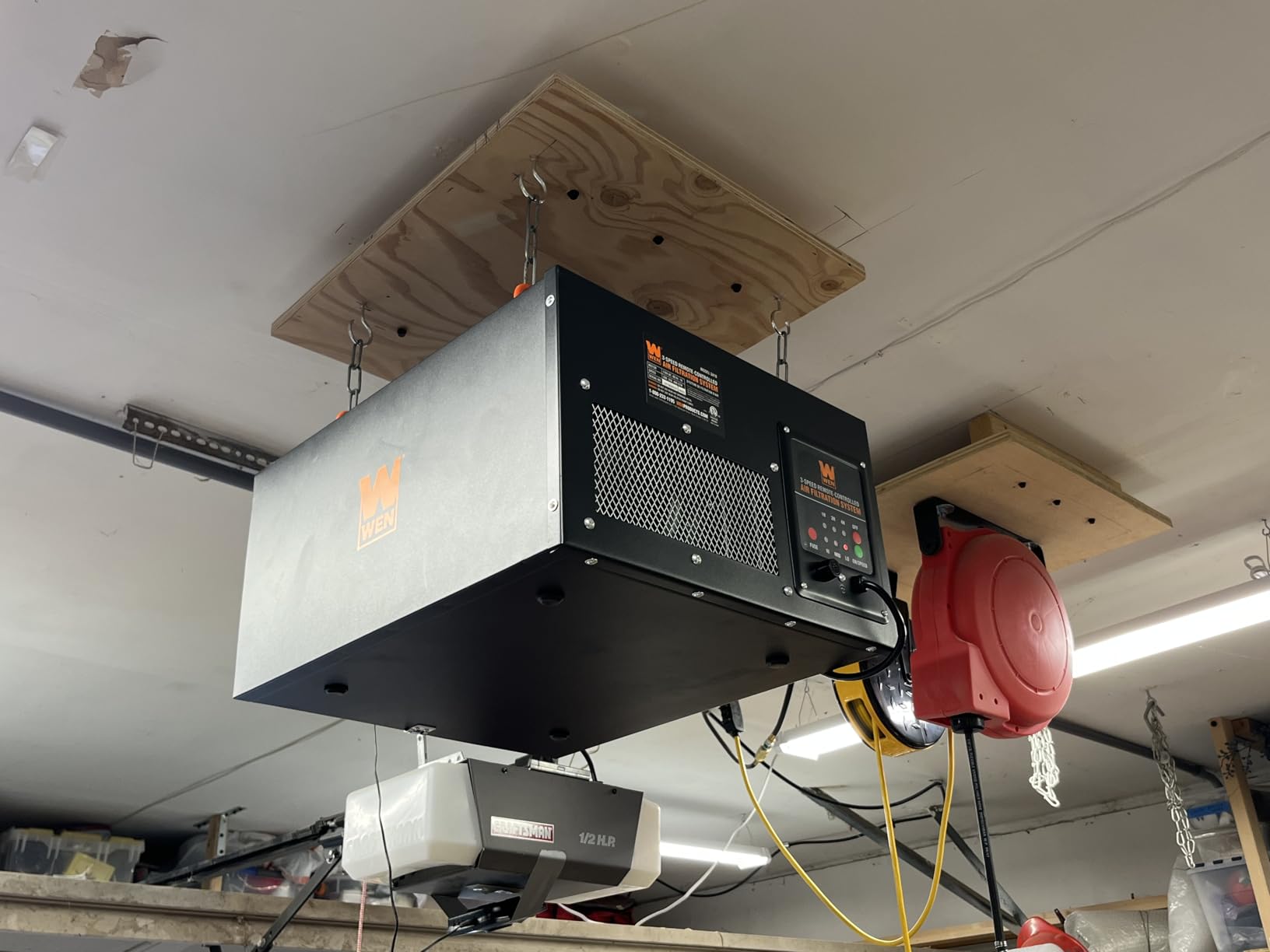
Control is simple and it works. Three speeds at 300, 350 and 400 CFM, a programmable timer that shuts the machine down after the interval you set, and an RF remote with a 26 ft range that does not need line of sight. The body is a 17 by 20.5 by 10 inch black case at 31 lb, so it hangs from joists easily and can still be carried between the shop and the garage.
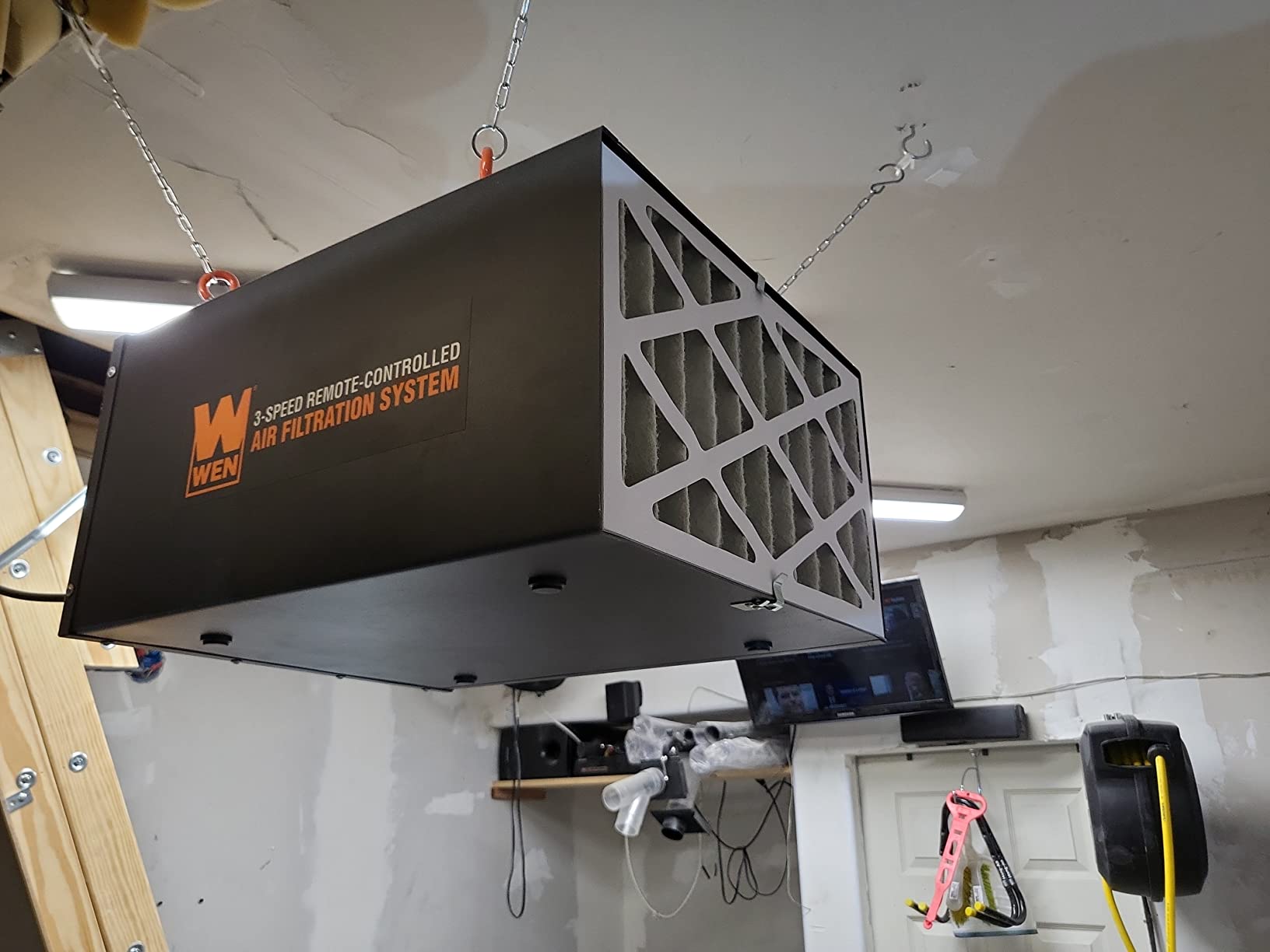
The published noise range is 50 to 60 dB, which keeps the unit below the level of a shop vacuum and around normal conversation across its three speeds. In practice the low speed is fine for background cleanup, and the top speed is audible during quiet finish work but not overwhelming. The two-year warranty is shorter than the three years on the DeWALT and the five years on the JET.
What we like most is how predictable it is. The nameplate CFM, the filter specification and the coverage claim of 400 sq ft all describe the same machine. It also runs on 12.42 watts, so leaving it on through a workday is a modest draw.
How much shop this actually covers
Manufacturers rate this model for rooms up to 400 sq ft, and that figure assumes roughly 8 air changes per hour. A 200 sq ft shop with an 8 ft ceiling is about 1,600 cubic feet, which needs around 213 CFM for 8 air changes, so a 400 CFM machine clears that comfortably with headroom for doors opening and a shop vacuum running elsewhere.
Push that to 350 sq ft and the same math lands near 373 CFM, which is right at the ceiling of what this model delivers. At that size you should plan on running it at high speed nearly all day, and you should expect the filter to load up on a schedule you track yourself rather than by sensor.
Where it falls short for a working shop
The honest limitation is scale. A 400 CFM ceiling is roughly a third of what the 1,350 CFM machines move, so in a two-car garage with a drum sander you will spend a lot of your day chasing dust that a larger machine would have pulled down in minutes. Buying two of these and staggering them across the room is a common workaround in forum threads, and it works better than one bigger machine in an L-shaped space.
The other catch is filter cost as a recurring line item. The media is a consumable, and in a shop that runs the machine through sanding season you should plan on replacements on a schedule you track, with cleaning in between.
2. DeWALT DWXAF101 – Best HEPA Filtration with Auto Mode
DEWALT Air Filtration System Dust Collector for Woodworking DWXAF101
H11 HEPA plus washable cotton pre-filter
95% of 0.3 micron particles
HI, MID, LO and AUTO modes
105 watts
20.9 lb
3-year warranty
Pros
- Ceiling-hung model here with true HEPA-grade capture
- Air quality sensor drives auto speed switching on its own
- Timer up to 8 hours plus IR remote
- Washable pre-filter and a filter-change indicator light
- Three-year warranty
Cons
- 64 dB is clearly audible during quiet finish work
- Ceiling hanging needs real overhead clearance and sound mounting points
The DWXAF101 is the pick for shops where the air itself is the problem, not just the dust. Its two-stage stack is a washable static cotton pre-filter feeding an H11 HEPA filter rated to capture over 95% of 0.3 micron particles. That is a different class of capture from the 1-micron media most hanging collectors use, and it matters if you work with woods that produce very fine airborne residue or if anyone in the shop has asthma.
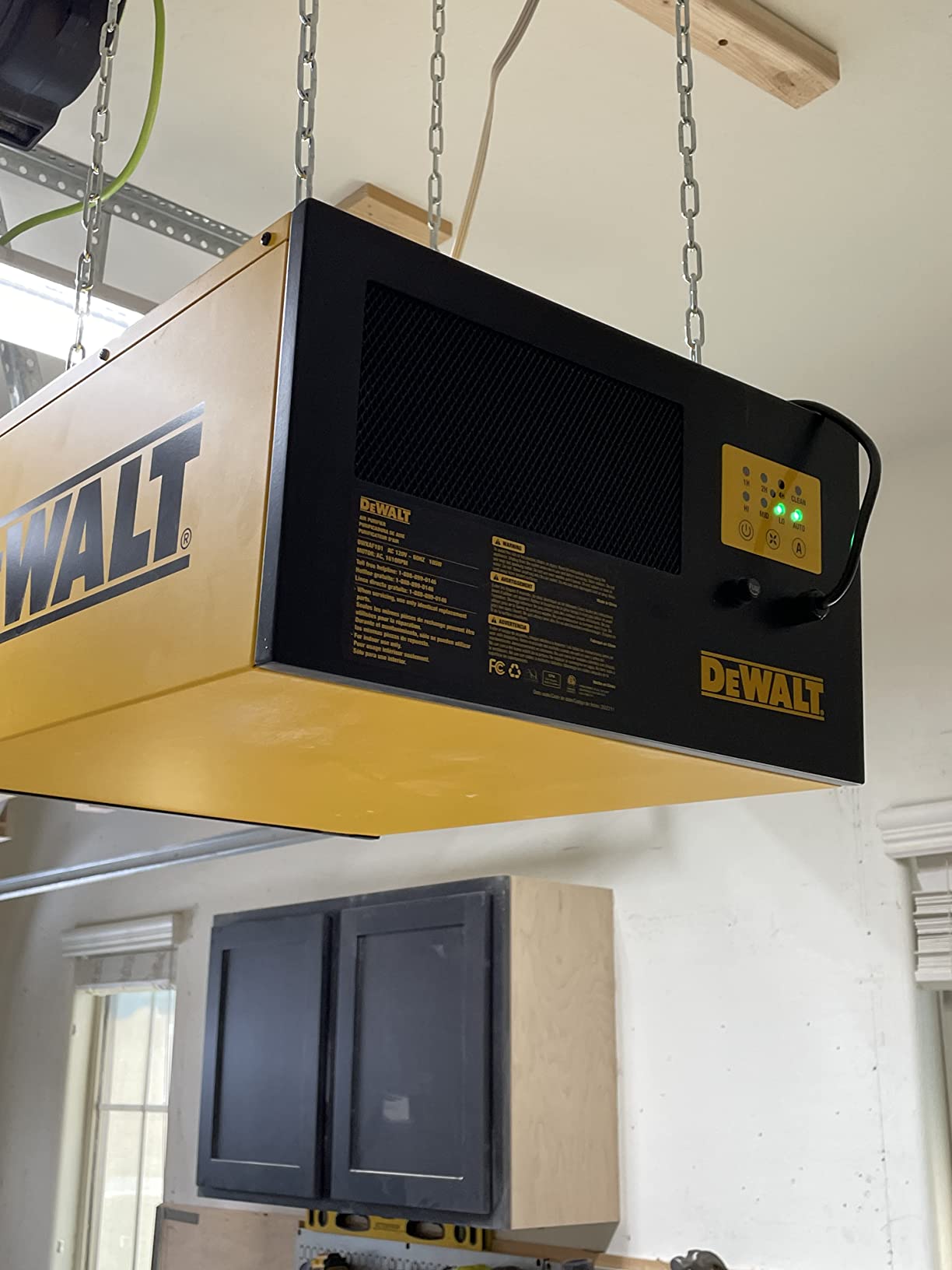
The controls are unusually thorough for a hanging collector. Four modes, HI, MID, LO and AUTO, and the AUTO mode reads an onboard air quality sensor and shifts speed on its own as the room loads up. The timer runs to 8 hours, and the IR remote handles adjustments from the floor. There is also a filter replacement indicator light on the housing, which removes the guesswork that comes with judging media life by eye.
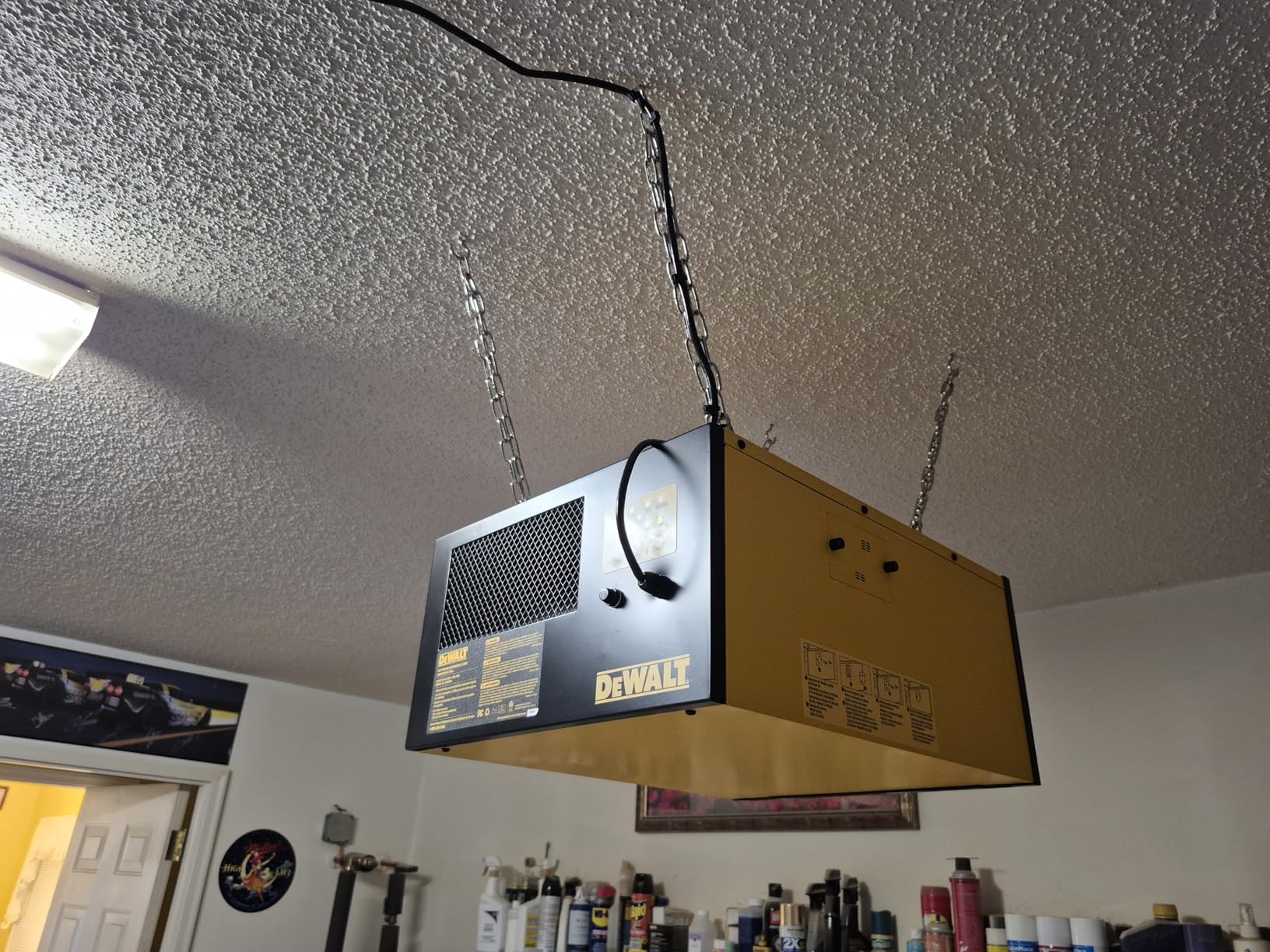
Physically it is a 10.2 by 15.9 by 20 inch yellow unit at 20.9 lb, designed to hang from four hooks and chains so it consumes no floor space. Draw is 105 watts, which is a substantial load for a machine this size but reasonable given the motor has to pull through a HEPA surface. Published noise is 64 dB, so on MID and LOW it stays unobtrusive and on HI it competes with a shop vacuum.
Owners in the reviews single out the fine-dust capture and the auto mode as the two features that make a difference in daily use, and the washable cotton pre-filter means the part you touch most often costs nothing to maintain.
Who benefits most from HEPA-grade media
HEPA is not about smelling better in the room. It is about the fraction of sub-micron particles that never make it back into circulation, and for anyone with a diagnosed sensitivity or a shop that runs MDF and composite panels, that fraction is the whole point. It also captures fine sanding aerosol from orbital and belt sanders that coarser media lets through.
The other thing a sensor-driven unit buys you is consistency. Instead of remembering to bump the speed before a long sanding session, the unit notices the dust and responds, which is exactly the failure mode people describe in forum threads where a machine that was fine on Monday is overwhelmed by Saturday.
What you give up for that filtration
HEPA media is dense, and dense media means more static pressure across the filter face. The result is lower real airflow than a comparable MERV-11 machine once the filter carries a load of dust, so the rated performance is the ceiling rather than the everyday number.
Cost is the other trade. It is a more expensive piece of equipment than the 400 CFM class, and replacement HEPA cartridges are a pricier consumable than disposable MERV media. If your shop is large enough to need 1,000 CFM or more, you are better served by a high-CFM particle machine than by a HEPA unit of this size.
3. MOUNTO HEPA500 Commercial Air Scrubber – Best for Multiple Machines and Job Sites
MOUNTO HEPA500 500 CFM Commercial Air Scrubber, Variable Speed, Blue
500 CFM HEPA negative air machine
25 x 16 x 25 inch rotomolded body
41.35 lb
Dual GFCI outlets
1-year parts, 10-year housing
Pros
- 500 CFM of HEPA airflow in a single cabinet
- Stackable rotomolded housing survives being moved room to room
- Dual GFCI outlets let you daisy-chain or power a tool
- Filter change indicator light plus variable speed
- cETL listed with a circuit breaker protector
Cons
- The 41 lb cabinet is hard to reposition alone
- Some reviews report slow customer support responses
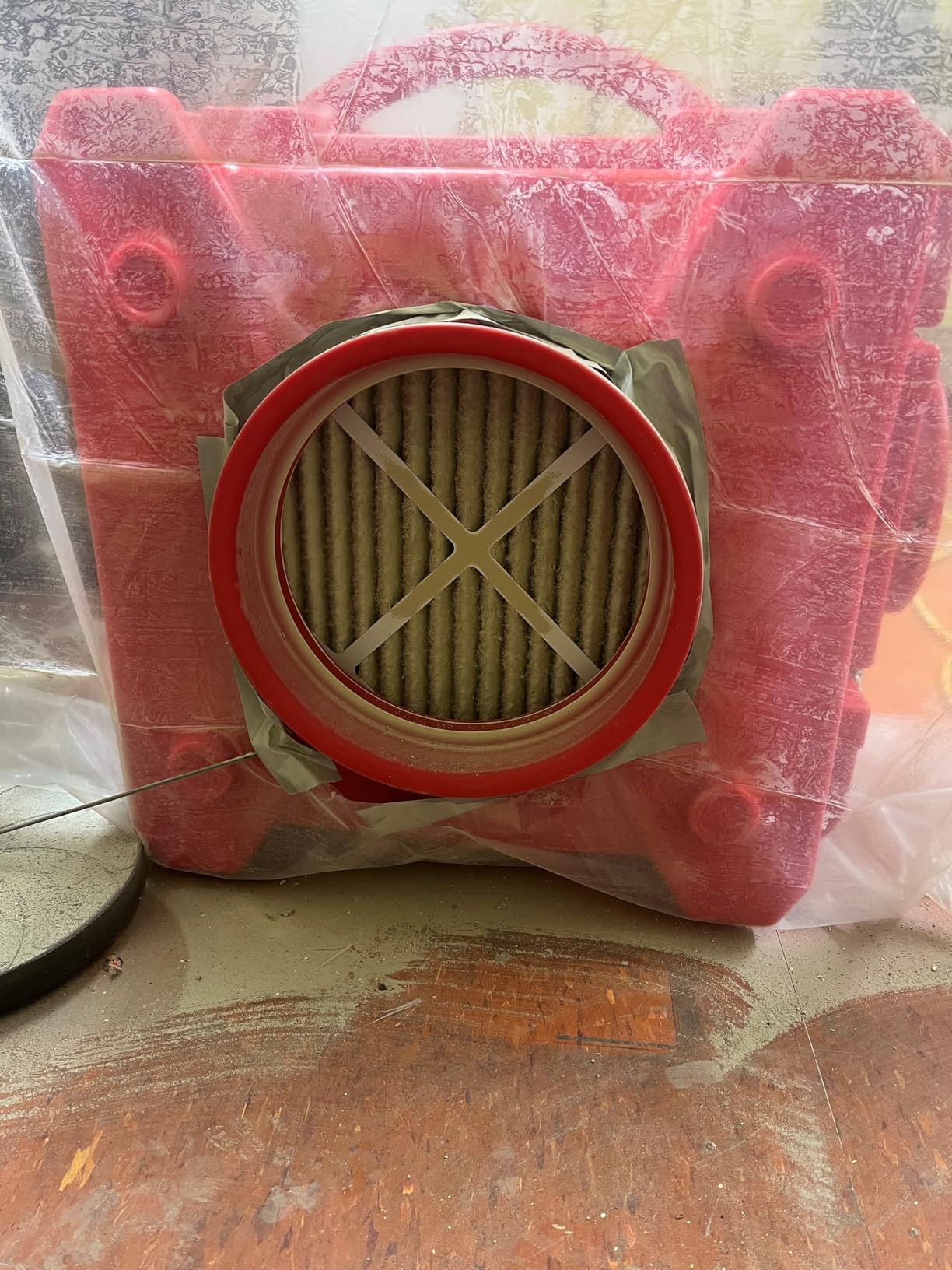
This is the odd one out in the list, and that is exactly why it is here. Where every other machine on this page is a fixed ceiling or benchtop collector, the HEPA500 is a commercial negative air machine with 500 CFM of HEPA filtration, built for remediation work, and it suits a woodshop for one specific reason: it has dual GFCI outlets on the housing.
Those outlets mean you can plug a second collector into it, or more usefully, run a power tool while the machine is filtering. If you have ever wanted a filtered sanding station that you could roll next to the work instead of hanging over it, the outlet pair is what makes that possible. The filter change light and the variable speed control are both standard, and the filter changes through a quick-access panel.
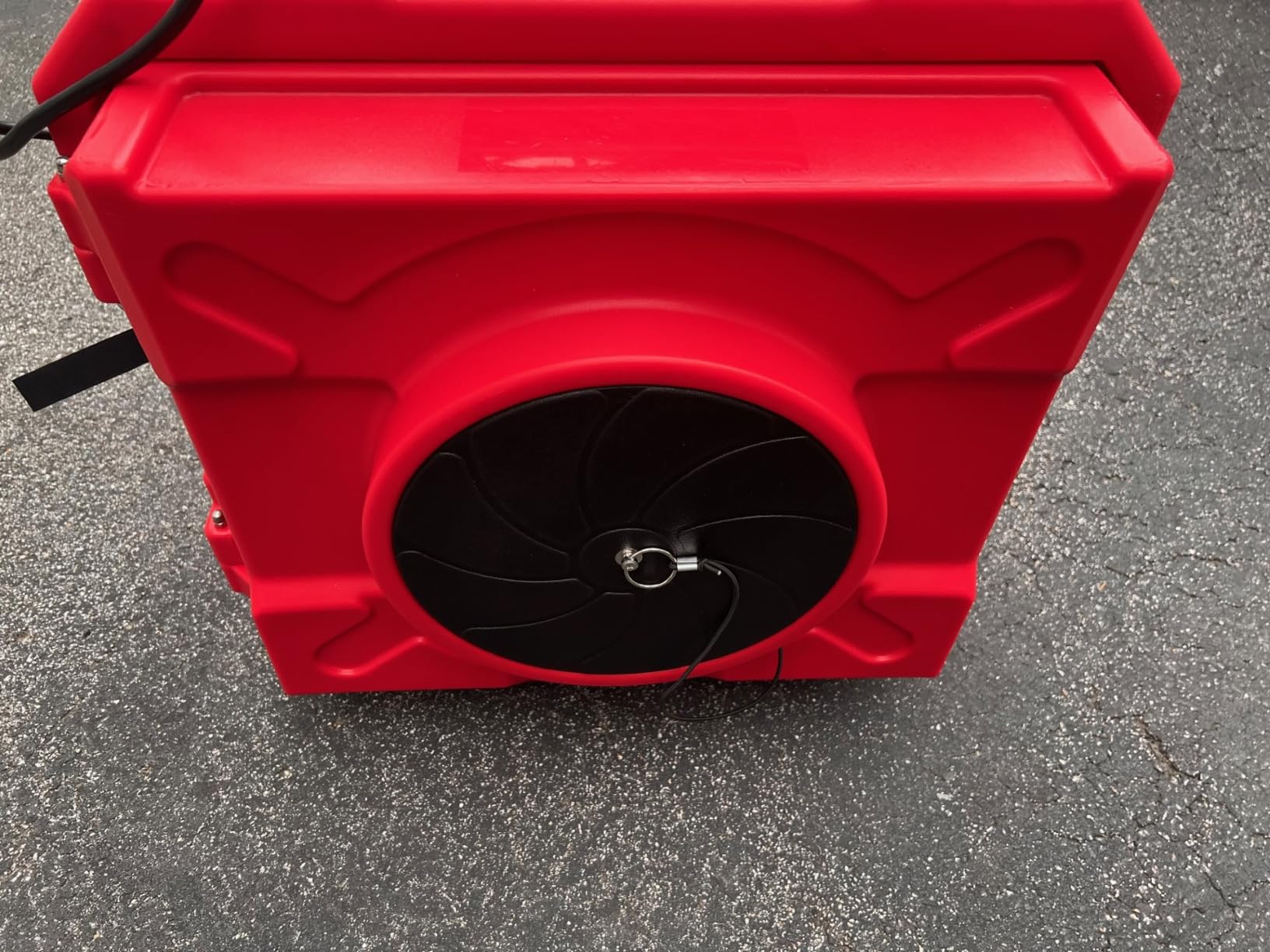
Build quality is a step above the sheet-metal hanging units. The blue cabinet is rotomolded plastic and stackable, and at 41.35 lb with dimensions of 25 by 16 by 25 inches it is a substantial unit. That mass is the trade-off, because you are not carrying it up onto a joist. The warranty splits into 1-year parts and labor with a 10-year housing warranty, which is a sign the manufacturer expects the shell to outlast the motor.
It is also cETL listed with a circuit breaker protector, so it is the right machine for a shop where water, finish and sawdust share a floor.
When a negative air machine beats a hanging collector
Ambient air cleaners work by drawing air in from every direction and exhausting it back into the same room, which is why mounting height and placement drive results. A negative air machine is designed to be placed in the breathing zone of the work, filtered on the way in and exhausted away from the face. For a student teaching shop, a benchtop finishing area or a short-term job, that difference is real.
Because it is not permanently mounted, you can reposition it as the work moves. A sanding session in the back corner, then glue-up at the bench, then a cleanup pass at the end. Hanging collectors cannot follow you around the room.
Where it is the wrong purchase
At 500 CFM it sits in the middle of the airflow range here, so it is underpowered for a full two-car garage and about right for a single-car space or a basement shop. The size and the 41 lb weight also make it a poor fit for a low-ceiling shop where you would want something hung above head height.
Its feature set leans toward remediation and print shop work rather than woodworking, so you are paying for a durable cabinet and GFCI convenience more than for wood-specific performance. If your shop is a normal fixed-layout space, a purpose-built hanging collector will move more air for the money.
4. ABESTORM DecDust 1350 – Best Value for Large Shops
ABESTORM 1350 CFM 360° Air Filtration System for Woodshop & Garage Black
1050 and 1350 CFM two speeds
MERV-11 filter, 85% of 1 micron
Up to 1700 sq ft
60 to 69 dBA
27 lb
1-year warranty
Pros
- Highest published airflow of any ceiling unit in this group
- 360-degree intake visibly pulls dust toward the filter
- Two speeds let you trade noise for airflow
- Touch panel plus 27 ft IR remote with timer
Cons
- Loud
- comparable to a shop vacuum at the higher setting
- Strong downdraft can blow debris at your head if mounted above the work area
- Filters load quickly in heavy use
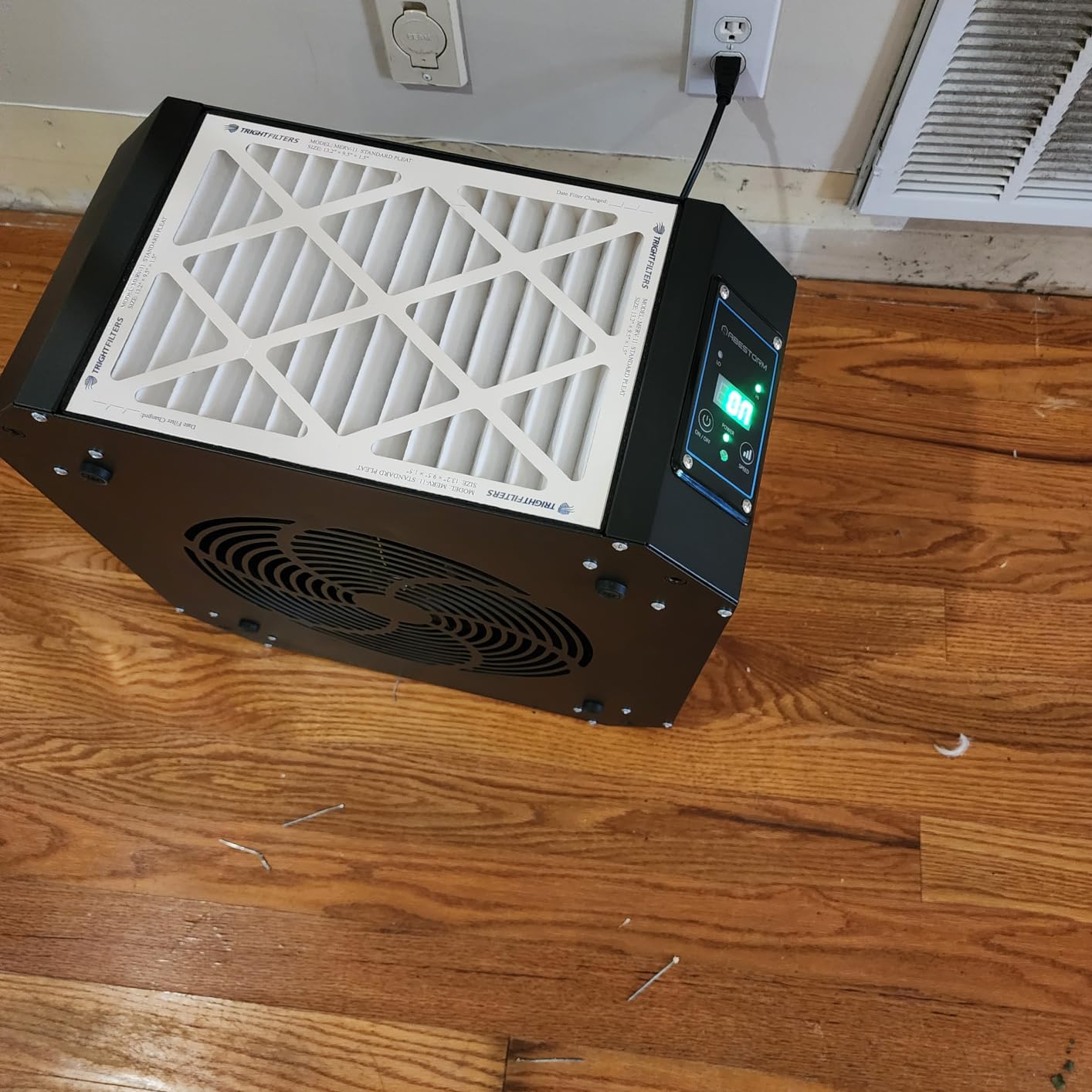
The DecDust 1350 is the unit we would put in a two-car garage with a drum sander. It delivers 1,350 CFM at the top setting and 1,050 CFM at the lower one, and the manufacturer rates it for rooms up to 1,700 sq ft. Nothing else in this list moves that much air, and it does it with a single MERV-11 filter rather than a dense HEPA stack.
It is assembled with a 360-degree intake and a vortex fan. Rather than pulling from one face, the housing draws from all sides and the fan geometry creates visible inward flow. In practice that means you do not have to aim the machine at the dusty zone, which removes the single most common placement mistake people make with flat-face collectors.
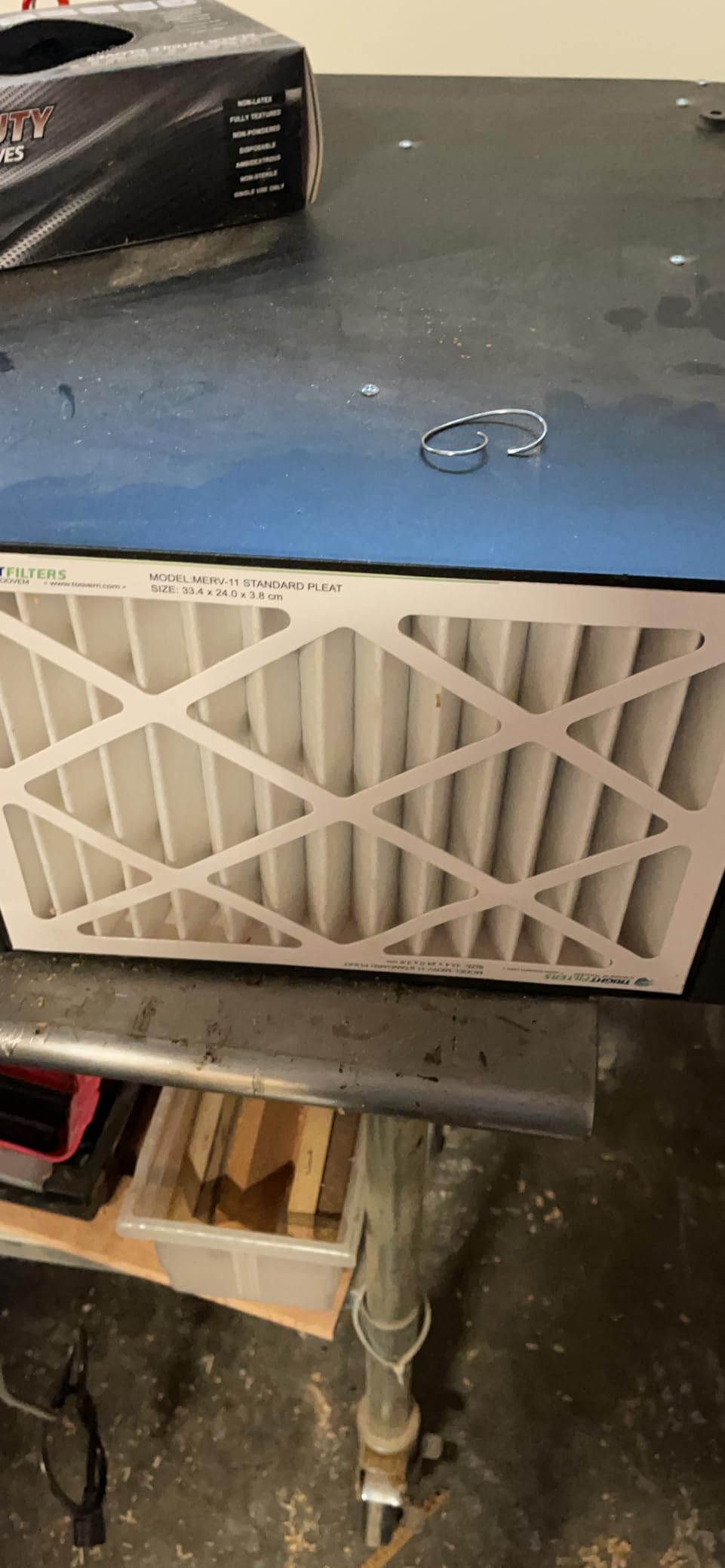
The filter specification is unusually specific for the category: the MERV-11 media stops 90% of 3 to 10 micron particles and 85% of 1 micron particles, and it measures 13.2 by 9.5 by 1.5 inches. Control is via a panel touch interface and an IR remote with a 27 ft range, with a timer for scheduled shutdown. The body is 20.5 by 20.5 by 9.8 inches at 27 lb, and it hangs from a hook and chain or stands on a bench.
Noise is the trade, and it is a real one. The published range is 60 to 69 dBA, which puts the high setting in shop vacuum territory. Owners in the reviews love the dust capture and are blunt about the volume, and they also warn about the downdraft pushing debris at your head when it is mounted directly over a work surface.
How two of these change a shop
At 1,350 CFM, a single unit handles a two-car garage on its own, but two lower-speed collectors placed at opposite ends of a room are often the better arrangement. Two units at 1,050 CFM create a loop that moves air along the long axis of the shop and into both intake faces, and the lower speed keeps the noise down while you work.
The hook-and-chain mount makes that arrangement easy, since you can hang each unit at 6 to 7 ft without cutting joists or running conduit. Neither collector needs a dedicated circuit at 115V and 1.5A, so two on one wall outlet is realistic.
What you trade away for the airflow
Static pressure is the honest issue. A 1,350 CFM nameplate number is measured with a clean filter, and once the MERV-11 media carries a real dust load the delivered airflow drops. The honest way to read this number is as clean-filter output, which is also how you should read the 400 CFM figure on the WEN 3410 and the 1,000 CFM on the JET.
The second limitation is the downdraft. Mount it over the saw table and it will push sawdust and offcuts back at you. Offset it a few feet, or hang it over a walkway where nobody works, and the problem disappears.
5. Abestorm DecDust 1080 – Best Balance for Single-Car Garage Shops
Abestorm 1080 CFM Air Filtration System with Remote, DecDust 1080
780 and 1080 CFM two speeds
Three MERV-11 filters
Up to 1100 sq ft
Under 60 dBA
19.4 x 9.6 x 9.6 inch
UL certified
Pros
- 270-degree three-sided intake widens the capture zone
- Two speeds of 780 and 1080 CFM suit normal and dusty days
- Slide-out filter design makes changes quick and toolless
- Touch panel and 26 ft remote with mounting chains included
Cons
- Manufacturer calls for filter replacement every 4 to 6 months
- MERV-11 is particle filtration rather than HEPA for hazardous fine dust
- Lower 4.1 rating reflects durability and filtration expectations
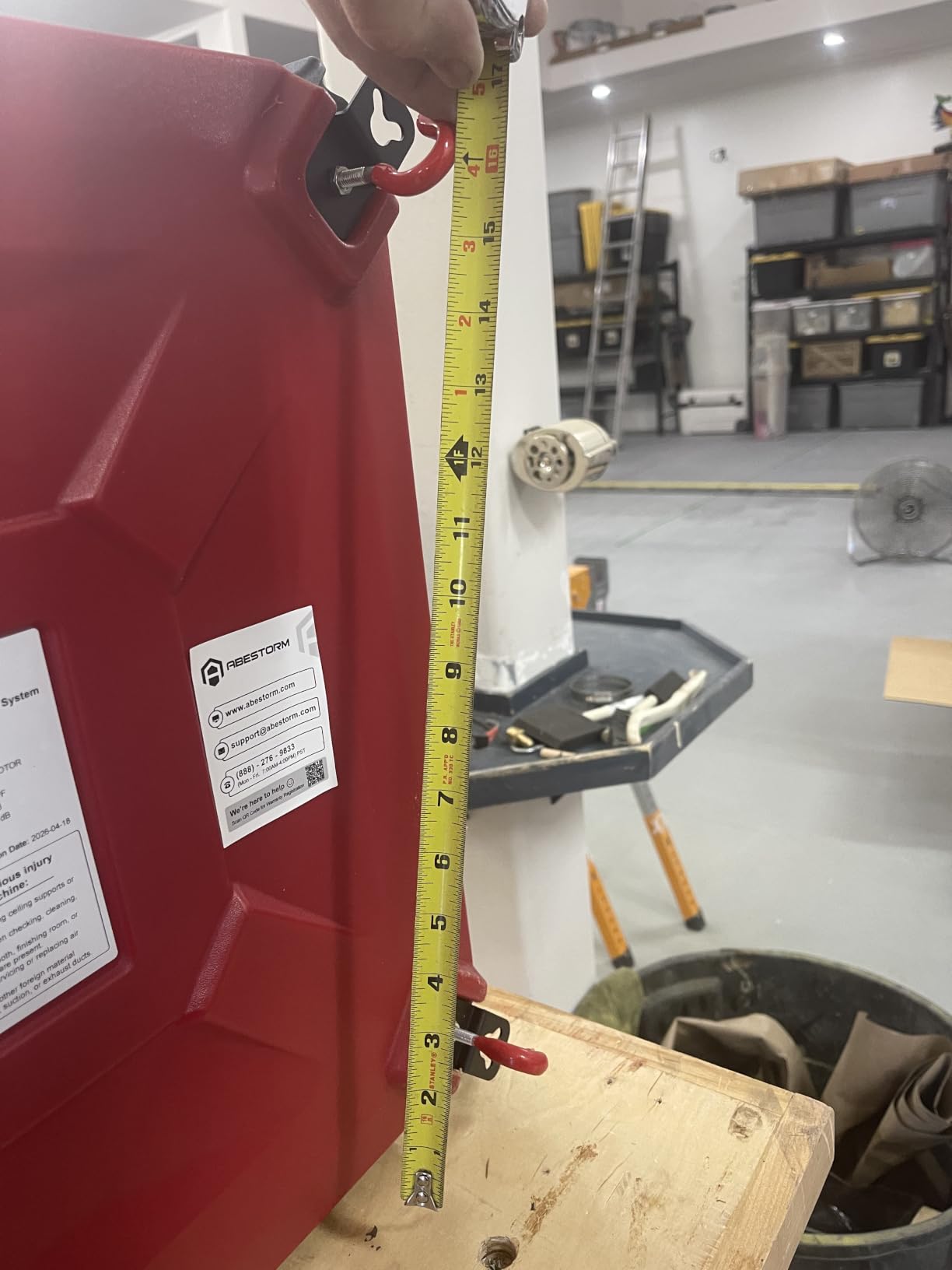
The DecDust 1080 sits exactly where most real shops need to be. With 780 CFM on the lower setting and 1,080 CFM on the higher one, and a stated coverage of up to 1,100 sq ft, it covers a single-car garage or a mid-size hobby shop without the noise penalty of a 1,350 CFM machine. Published sound is under 60 dBA, roughly conversational speech level, which makes it one of the quieter ceiling units in this group.
The intake is 270 degrees across three sides, so it draws from almost everything except directly behind the mounting point. That is enough of a vortex pattern to make placement forgiving in a rectangular room where the dust source moves around. Three MERV-11 filters do the trapping, each rated to stop 90% of 3 to 10 micron particles.
Maintenance is handled through a slide-out filter design, which is the feature owners mention most often. You pull the cassettes out from the side rather than unscrewing a housing, and the manufacturer suggests replacement every 4 to 6 months. Control is a touch panel with a 26 ft remote, and ceiling or wall mounting hardware with chains and nails is included. The body is 19.4 by 9.6 by 9.6 inches, and it is UL certified.
The 4.1 rating across 82 reviews is the lowest of the ten machines here, and the pattern in the reviews is consistent: people are happy with the size, the two speeds and the easy filter access, but a higher share of one-star ratings reflects expectations around filtration level and long-term durability.
Where 1,000 CFM sits in real shops
Run the sizing math for a typical one-car shop, 10 by 20 ft with an 8 ft ceiling, and you get 1,600 cubic feet. At 8 air changes per hour that is 12,800 cubic feet of air moved per hour, or 213 CFM as a bare minimum. The 1,080 CFM high setting is about five times that figure, which is exactly the margin you want for a shop that occasionally runs a wide belt sander or a thickness planer.
For a 400 sq ft shop, 20 by 20 feet, the same math gives about 427 CFM minimum, and you would want a real margin above that because the formula assumes perfect mixing. At 780 CFM low speed this machine covers a 400 sq ft shop with headroom, and at 1,080 CFM it handles a 500 sq ft space without straining.
Why the rating is lower than the alternatives
Two things separate this from the machines rated higher. First, MERV-11 is a particle filter, not a HEPA unit, so it is the wrong choice if your concern is sub-micron exposure rather than visible dust. Second, the 4 to 6 month replacement interval is aggressive enough that running it daily in a dusty shop can mean quarterly media costs.
If you are comparing it against the DecDust 1350, the tradeoff is straightforward. The 1350 moves 250 CFM more at the top setting and has a wider intake; the 1080 is quieter, smaller, and covers fewer square feet. In a single-car garage with mostly hand-tool and router work, the quieter machine is the better buy.
6. PURISYSTEMS PuriCare 500IG – Best for Shops That Want an Ionizer
PURISYSTEMS Air Filtration System 3-Speed Remote, Built-in Ionizer, PuriCare 500IG Hanging Air Filter w/RF Remote for Woodworking, Garage and Shop Dust Collector, up to 500 sq. ft (350/450/500 CFM)
350/450/500 CFM three speeds
Built-in ionizer
1 to 6 hour timer
26 ft RF remote
20.1 x 17 x 11 inch
25.5 lb
Pros
- Built-in ionizer adds charge to the two-stage particle filtration
- RF remote works from any angle without line of sight at 26 ft
- Works on a benchtop or hangs from the ceiling
- Rubber feet protect a finished bench surface
Cons
- MERV-rated particle filtration only rather than HEPA grade
- 500 CFM ceiling coverage is modest for larger shops
It is the only machine here with a built-in ionizer, and it is worth understanding what that feature does and does not do before you decide it matters to you. The unit outputs up to 15 million negative and 10 million positive ions per second, which gives particles a charge so the filter media captures them more readily. It improves capture efficiency of the media already installed. It does not upgrade a MERV-rated filter into a HEPA filter, and it is not a substitute for source dust collection.
Basic specifications are solid. Three speeds at 350, 450 and 500 CFM, coverage for rooms up to 500 sq ft, a timer from 1 to 6 hours, and an RF remote with a 26 ft range that works through obstructions. Two reusable filter stages handle the dust, an outer catching larger particles and an inner trapping the smaller ones.
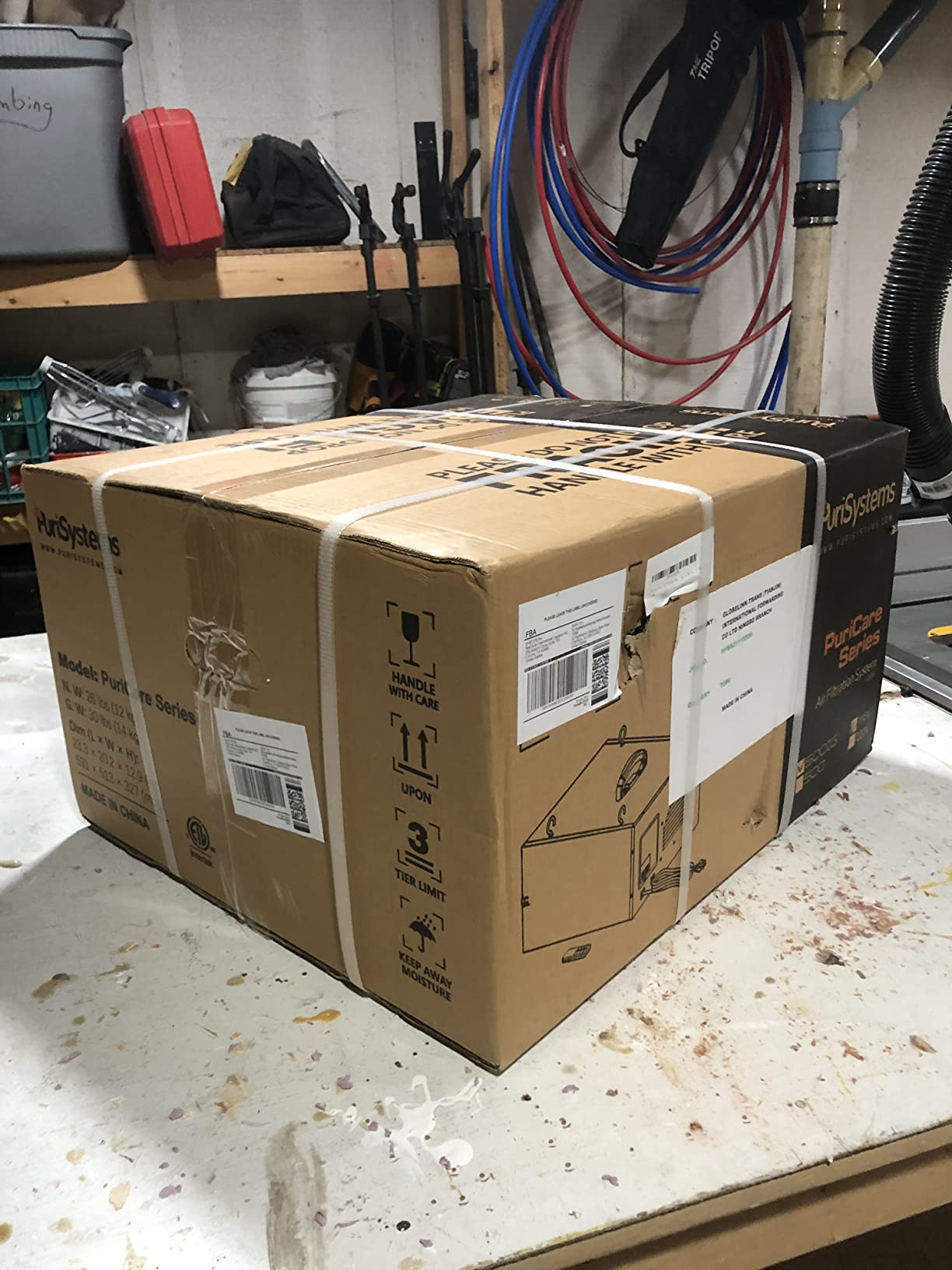
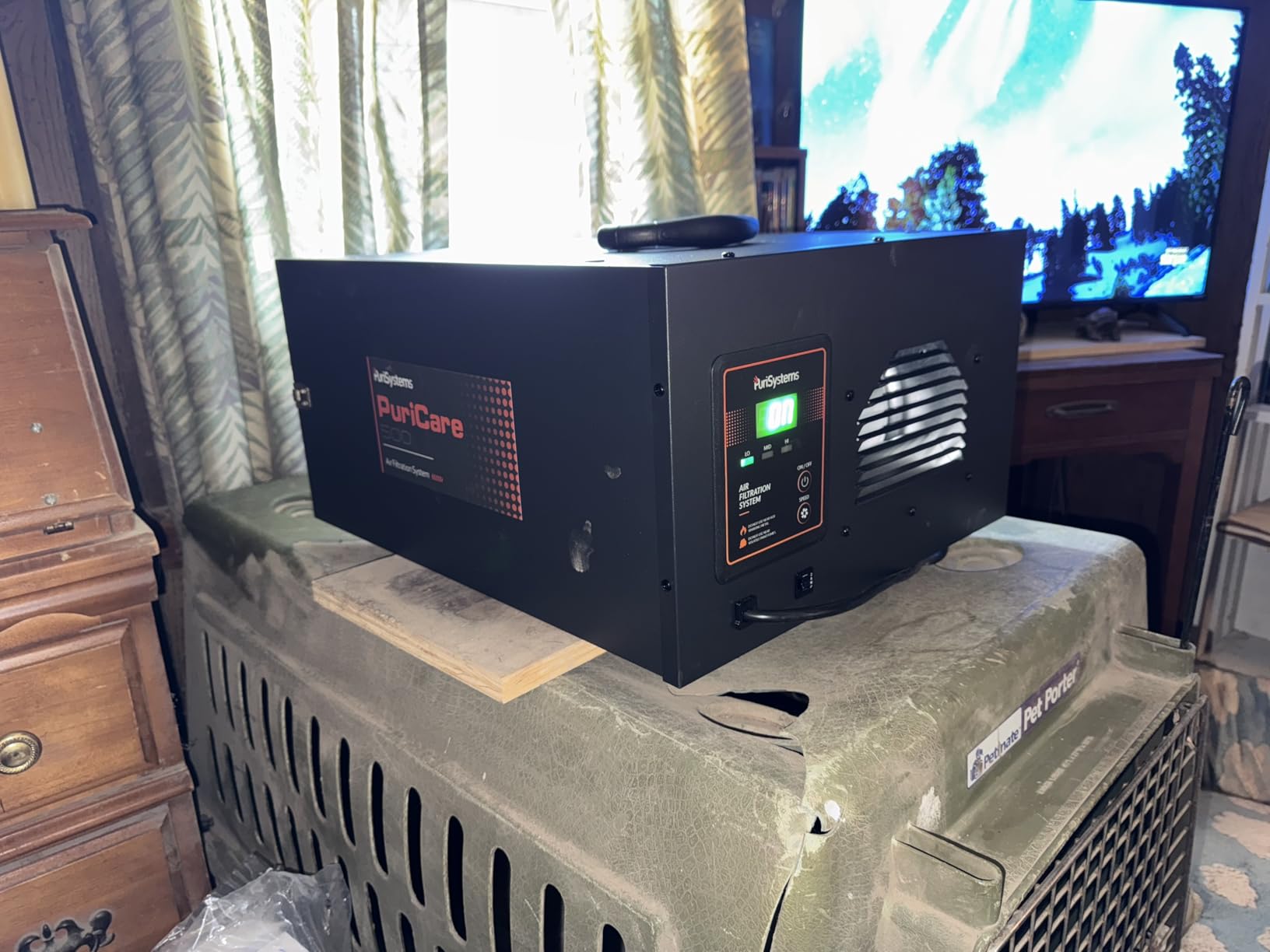
What makes it flexible is the form factor. At 20.1 by 17 by 11 inches and 25.5 lb, with easy grip handles and rubber feet, it can sit on a bench or hang from the ceiling. That matters in basement shops and low-ceiling spaces where a hung machine is not an option. Owners in the reviews point to the ionizer, the long timer and the flexibility of placement as the reasons they keep it.
Noise is published at 61 dB, so it is not the quietest option here, but the low speed is a background presence rather than a distraction.
What ionization actually does in a shop
The honest framing is that ionization is an efficiency booster, not a filtration stage. Charged particles are held to the filter face more firmly, so a given filter can pass more air for the same capture rate. In a shop where you are running the unit on a timer and not always at full blast, that is a genuine efficiency gain.
The safety question comes up constantly in forums, and the answer is that properly designed ionizers that charge particles and recollect them are not the same as consumer ozone generators. What matters is that this is a negative air machine recirculating the room, not an ozone-producing purifier. If you are sensitive to air quality, run it for an hour and leave the room to see how you feel, and keep the unit off while you are actively working at a bench directly under the downdraft.
Where the 500 CFM ceiling becomes the limit
Five hundred CFM covers a 200 to 250 sq ft shop generously and a 300 sq ft shop adequately. Beyond that you are asking the machine to do the work of a 1,000 CFM unit, and the 500 CFM figure is measured at the filter face with clean media.
That is why the model is best suited to basement shops, sheds and single-bench hobby spaces where placement flexibility and the timer matter more than raw volume. If you need to move serious volume, one of the high-CFM vortex machines is a better fit.
7. POWERTEC AF4001C – Best With Spare Filters in the Box
POWERTEC 3-Speed Remote Controlled Air Filtration System (300/350/400 CFM) w/Extra Inner & Outer Filter (2 of Each) Replacement, Hanging Air Filter for Woodworking, Workshop & Garage (AF4001C)
300/350/400 CFM three speeds
MERV 10 outer plus MERV 11 inner
99% particulate removal claim
Two spare filters of each type included
Tool-free hook mount
Pros
- Includes two spare inner and two spare outer filters
- Filter dimensions match common WEN 3410 and Shop Fox units
- RF remote with 1
- 2 and 4 hour timer settings
- Tool-free hook installation for ceilings
Cons
- Same 300/350/400 CFM ceiling as the entry-level hanging units
- Dry disposable filters that cannot be washed
- Replacement filter cost adds up in high-dust shops
The most common complaint in woodshop forums about any air cleaner is the ongoing cost of filter media, and the AF4001C is the only machine here that attacks that problem at the point of purchase. It includes two extra outer filters and two extra inner filters, so a shop that runs this machine hard has a full set of spares on the shelf before the first reorder.
Filtration itself is the familiar two-stage arrangement: a 5-micron outer filter rated MERV 10 at 424 by 246 by 45 mm, and a 1-micron inner filter rated MERV 11 in a 16-5/8 by 9-1/2 inch frame. The manufacturer claims 99% removal of airborne particulates across the two stages. Control is an RF remote for power and speed with 1, 2 and 4 hour timer options, and installation is tool-free via hooks.
One detail worth flagging: the filter dimensions are deliberately compatible with common 400 CFM hanging collectors, including the WEN 3410, the POWERTEC AF4000 and AF4001, and the Shop Fox W1830. If you already own one of those machines, this is a straightforward way to keep spares on hand across brands without tracking three part numbers.
The 4.2 rating across 36 reviews reflects what buyers say: satisfaction centers on the bundled spares and the drop-in compatibility, and the main reservation is the 400 CFM airflow ceiling.
What the spare-filter bundle is really worth
For a shop that runs it daily, having four replacement filters on hand removes the most irritating part of ownership. You are not driving to a supplier mid-project, and you are not tempted to push a loaded filter past the end of its useful life because the alternative is downtime.
The compatibility claim has a second use. If you own a WEN 3410 or a Shop Fox W1830 already and like the machine but not the media cost, these filters keep that machine running without committing you to one brand’s parts. It is a small thing that adds up over years of use.
Where the 400 CFM ceiling shows
Three speeds at 300, 350 and 400 CFM is the entire capacity of this machine, and no setting change will extend it. In a 200 sq ft shop with a sanding habit, 400 CFM is entirely adequate.
In a 400 sq ft shop with a drum sander, it will be working constantly and the filters will load on a schedule you have to manage.
Also note that the media is dry disposable type and cannot be washed, so there is no way to extend filter life beyond the replacement interval. Plan media into your operating cost from day one rather than treating it as an occasional expense.
8. Abestorm DecDust 780S – Best for Shops With No Ceiling Space
Abestorm Tabletop Dust Collector with Timer for Woodworking Shops
580 and 780 CFM two speeds
MERV-13 filter rated to 6 months
Timer up to 120 minutes
14.57 x 9.45 x 11.81 inch metal body
19.96 lb
Pros
- MERV-13 media is a higher grade than the MERV-11 units in this class
- Compact tabletop form factor needs no ceiling mounting
- Two speeds at 580 and 780 CFM
- Side-ejected airflow can be aimed away from your face
- Auxiliary outlet lets you daisy-chain a second collector
Cons
- Replacement filters are small and costly relative to their size
- Some owners report filters clogging well before the 6-month claim
- 120-minute timer is short for a full workday
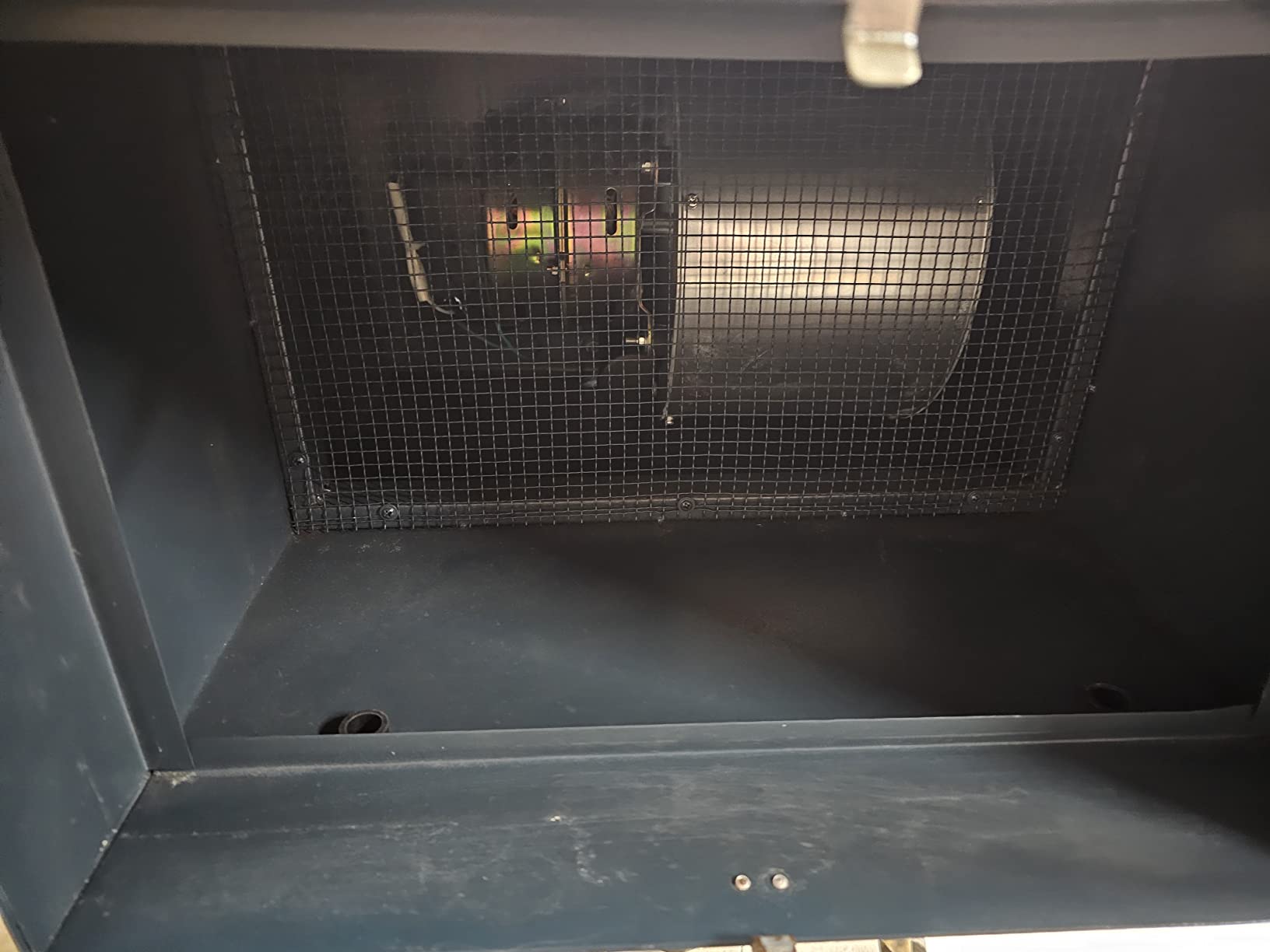
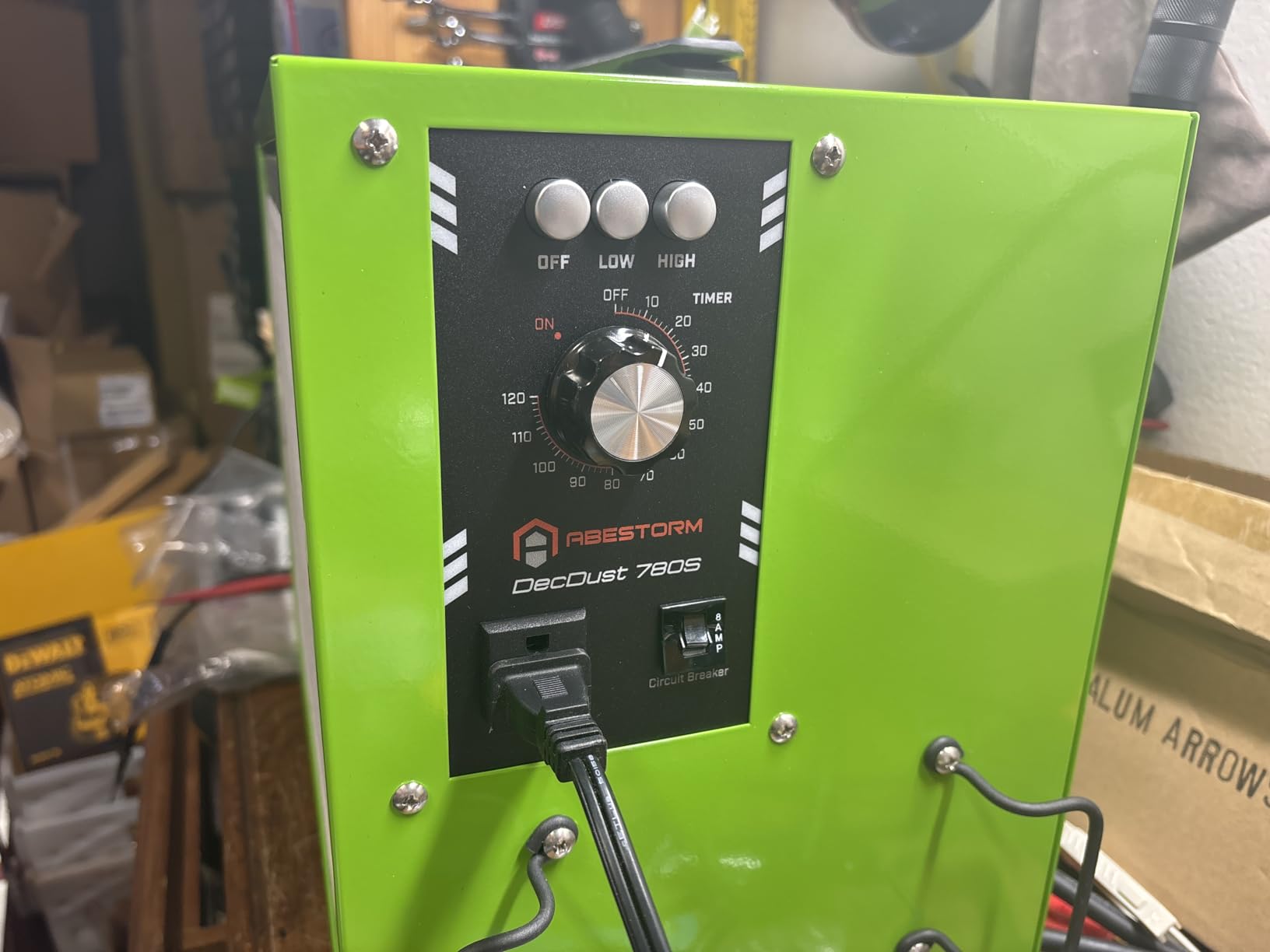
The DecDust 780S solves a problem the hanging units cannot: shops where there is no joist to hang from, or no clear ceiling height above the bench. At 14.57 by 9.45 by 11.81 inches and 19.96 lb, it is a metal-bodied tabletop collector with a carry handle, and it delivers 580 or 780 CFM depending on the setting.
The filter is the interesting part. It is a MERV-13 unit rated by the manufacturer to last up to 6 months, which is a higher grade and a longer claimed service interval than the MERV-11 media used by most machines in this airflow range. A backward-tilt motor with a circuit breaker safety cut-off, a 115 volt draw of 0.9A, and a two-position piano key switch with a timer up to 120 minutes round out the controls.
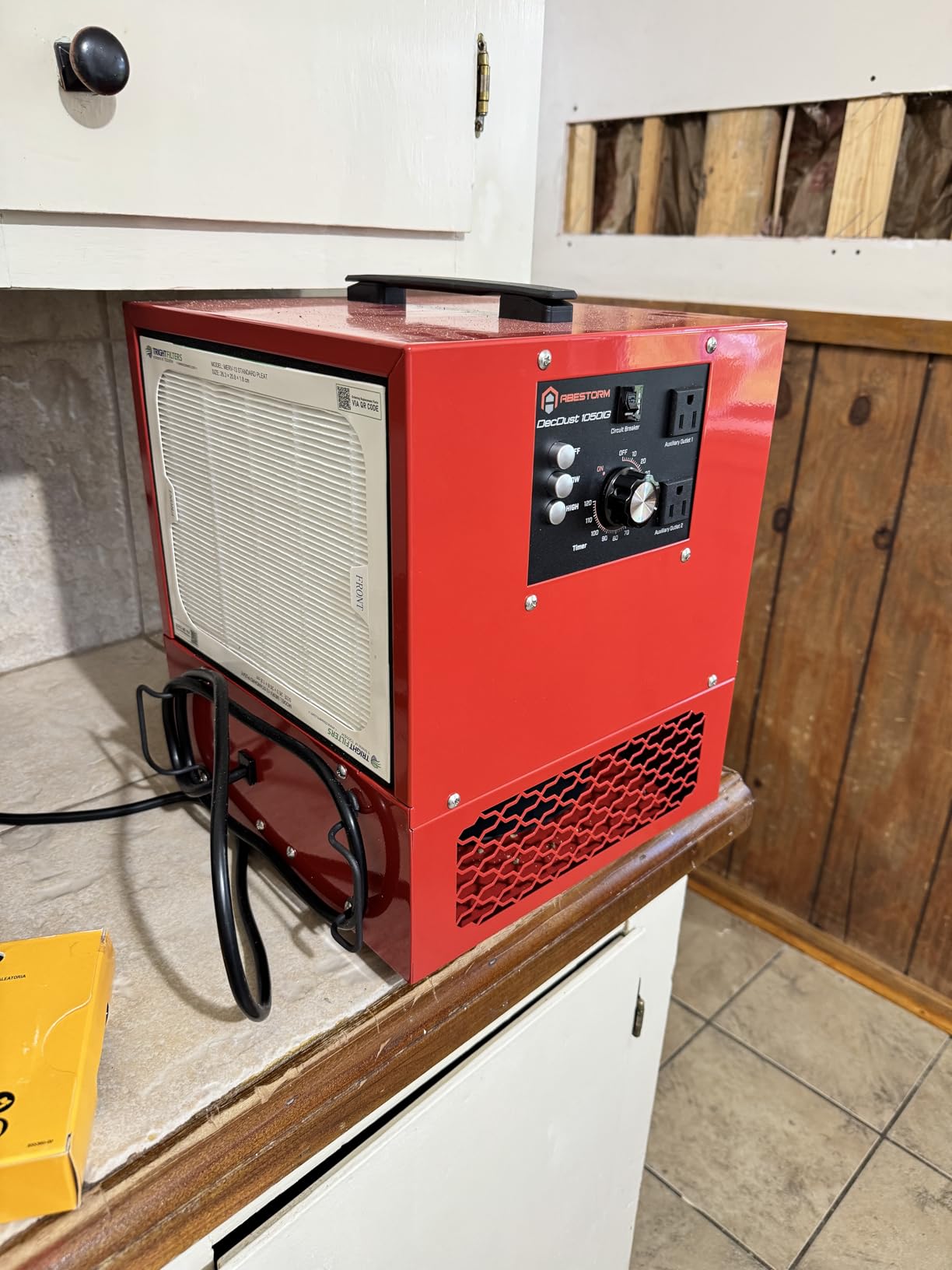
Two practical touches make it work well in a small space. Side-ejected airflow lets you point the output away from your face when you are working, and an auxiliary outlet under the control panel lets you daisy-chain a second Abestorm collector, so a small shop can scale up without new circuits. There is also a side cord wrap for the 11.5 ft power cord, which is more thoughtful than it sounds in a shop with a crowded bench.
Owners frequently call it quiet for the airflow it delivers, and the 4.2 rating across 63 reviews reflects a strong showing for a machine in this size class.
Where a tabletop collector beats a hung machine
Placement flexibility is the whole argument. A tabletop machine can sit beside the work rather than above it, which matters enormously for a basement shop with exposed joists, a shed with a sloped roof, or a school shop where you cannot drill into the structure. It can also be moved to whichever corner is generating dust today.
For a finish or glue-up area, that proximity is a real advantage. A collector running a few feet from a finishing bench pulls fumes and dust into the intake rather than pushing them across the room, and the MERV-13 grade gives finer capture on aerosol overspray than a MERV-11 unit of the same size.
Where the compromises show up
The complaints in the reviews are consistent enough to plan around. The filters are physically small and priced high for their size, and multiple owners report them clogging well before the 6-month figure, particularly in high-dust use. Vacuuming the surface clears the loose dust but does not open the tiny pores, so airflow keeps falling until the media is replaced.
The 120-minute timer is also short. Hanging units in this list run to 4, 6 and even 16 hours, and a full sanding session can exceed two hours. Plan on resetting it, or budget for a unit with a longer timer if you intend to set and forget.
9. OUKEETO FJ250 – Best for Quiet Shops and Low Ceilings
OUKEETO Portable 2 Stage Intake Air Filtration System – Tabletop Dust Collectors (850-1250CFM) for Woodworking, Air Filter with Strong Vortex Fan, Garage Works Shop Benchtop Dust Collection Systems
850 and 1050 CFM two speeds
HEPA carbon filter, 99.5% of 0.3 micron
Under 55 dB
16.1 x 9.4 x 12.7 inch benchtop
115V
Pros
- Lowest published noise figure in the group
- under 55 dB
- 850 and 1050 CFM is real airflow for a benchtop form factor
- HEPA carbon media at 99.5% capture of 0.3 micron particles
- Side exhaust lets you aim airflow away from your face
- Leather handle
- cord storage and daisy-chain outlets included
Cons
- Touch-button controls only
- no remote in the box
- Replacement interval is about four months in high-dust use
- Only 14 ratings
- so the long-term track record is thin
The FJ250 has the lowest published top-speed noise figure in this group at under 55 dB, and for some shops that is the only criterion that matters. It still moves 850 or 1,050 CFM, a combination few benchtop collectors in this airflow range manage.
Filtration is a HEPA media with an activated carbon deodorization net, rated to stop 99.5% of 0.3 micron particles with replacement recommended about every four months. The carbon stage is genuinely useful in a finish-heavy shop because it handles solvent and adhesive odor rather than just particulate. Airflow adjusts between two speeds by touch button, and the timer goes to 90 minutes.
The physical design is built for shops without overhead space. At 16.1 by 9.4 by 12.7 inches on 115V, it has a durable leather handle for repositioning, built-in cord storage, and on-unit auxiliary power outlets for daisy-chaining. The side exhaust means you can direct the discharge away from your face while you work at the bench.
Why quiet operation changes what you can do
Noise is a productivity issue, not just an annoyance. A collector at 65 dB or above becomes something you turn off when you are doing close detail work, and a collector you turn off is not capturing while you work. The FJ250 can stay running through glue-up, marking out and finish inspection, which is precisely the time you least want background noise.
Under 55 dB also matters if your shop shares a wall with a living space or a bedroom, which is common in basement setups. Owners in the reviews consistently single out quiet operation and portability as the two things that made the machine work in their space.
Where the record is thin
With only 14 ratings, the long-term durability picture is largely unknown, and one reviewer reported that it behaved more like an air circulator than a shop dust collector in practice. Controls are touch buttons on the unit with no remote in the box, so adjustments mean walking over to the machine.
The four-month replacement interval is short in heavy sanding use, and the dry filters are meant to be vacuumed rather than washed. If you need a remote and a longer timer, the PURISYSTEMS 500IG covers a similar footprint with both, at the cost of the quiet rating and the HEPA capture.
10. JET AFS-1000C – Best Sensor Control for Professional Shops
JET Air Filtration System, 1-Micron Filter, 1000 CFM, 120V 1Ph (AFS-1000C)
1000 CFM, 120V single phase
Air quality sensor with six speeds
1-micron inner and 5-micron outer filter
67 dB at top speed
33 lb
5-year warranty
Pros
- Automatic air quality sensor adjusts six speeds on its own
- 16-hour timer and RF remote for hands-off operation
- Filter status indicator shows when media needs replacing
- Injection molded housing and BLDC motor dampen noise
- Five-year warranty for shop use
Cons
- The most expensive machine in this group
- 67 dB at the highest speed is clearly audible
- 33 lb body needs solid mounting hardware and adequate joist support
The AFS-1000C is the machine to buy when the shop runs like a business rather than a weekend hobby. It moves 1,000 CFM, and the thing that separates it from cheaper 1,000 CFM claims is the automatic air quality sensor, which adjusts across six speeds based on measured conditions rather than a fixed setting you choose yourself.
Filter performance is a 5-micron outer stage capturing 99% of 5-micron particles feeding a 1-micron inner filter capturing 85% of 1-micron particles. A filter status indicator on the control panel tells you when the media needs replacing, which removes the eyeballing that keeps filters in service long past they should come out.
Control is thorough: an RF remote sets all six speeds and a 16-hour timer, which is longer than any other machine here. The LED display is angled for reading from below when the unit is ceiling mounted, a detail that sounds trivial until you are craning your neck. The housing is injection molded plastic with a quiet BLDC motor, and noise is published at 67 dB at the highest speed.
Warranty is five years for shop use, dropping to two years for commercial or industrial duty. Four eye bolts and a set of inner and outer filters are included in the box. Owners consistently cite the sensor-driven control, the long timer and the build quality as the deciding factors.
Why six sensor-driven speeds change a production day
A fixed two-speed machine is a compromise in both directions. Set it high and it is loud all day for no benefit during quiet periods. Set it low and fine dust accumulates during sanding. Sensor-driven control removes the compromise, because the machine responds to actual dust loading and you stop thinking about the setting.
The 16-hour timer makes that automatic behavior practical. You can set the unit to run through a full working day without anyone remembering to shut it off, and the filter status indicator means maintenance is prompted rather than discovered when airflow has collapsed.
What the build quality costs you
This is the most expensive machine in the group, and the 33 lb, 30.13 by 24.25 by 15.38 inch body means ceiling mounting is not a casual job. You need eye bolts into joists that can carry the load plus the dynamic load of the running fan, and in a garage with light-duty framing that is worth verifying before you drill.
At 67 dB on the top speed it is louder than every unit here except the Abestorm 1350. The sensor logic mitigates this because you will rarely sit on high continuously, but if your shop is quiet by nature and you want a machine you can leave running through detail work, the FJ250 is the opposite choice.
How to Choose the Best Air Filtration System for a Woodworking Shop
What size air filtration system for a shop? Multiply volume by air changes, then divide by 60
The formula is CFM = (shop length x width x height x air changes per hour) divided by 60. Worked example: a 20 by 10 foot shop with an 8 ft ceiling is 1,600 cubic feet. At 8 air changes per hour that is 12,800 cubic feet per hour, which is about 213 CFM minimum. Multiply that result by roughly two for comfortable margin, which puts a 400 CFM machine in a 200 sq ft shop and a 1,000 CFM machine in a 400 sq ft shop. Use 6 air changes per hour for casual hobby work and 10 for shops running a drum sander, a lathe or a thickness planer most days.
Shop size reference points, all assuming an 8 ft ceiling and 8 air changes per hour:
200 sq ft shop, 1,600 cu ft: about 213 CFM minimum, 400 CFM recommended
400 sq ft shop, 3,200 cu ft: about 427 CFM minimum, 600 to 800 CFM recommended
600 sq ft shop, 4,800 cu ft: about 640 CFM minimum, 1,000 CFM recommended
800 to 1,200 sq ft shop: 1,000 to 1,350 CFM recommended
Basement and low-ceiling shops need the same math run on the real ceiling height, not the nominal one. A 7 ft basement ceiling loses more than 12% of the volume versus an 8 ft ceiling, and shops with 6 ft ceilings lose closer to a quarter. Run the number honestly before you buy.
What MERV rating for a wood shop? MERV 11 is the floor, MERV 13 is better
For fine wood dust, MERV 11 is the practical minimum and MERV 13 is the better buy. MERV 10 filters rated at about 5 microns handle sawdust and chips from table saw work but let too much of the sanding aerosol through. MERV 11 media, which catches 1-micron particles at roughly 85% efficiency, is the standard in purpose-built shop collectors. MERV 13 pushes capture efficiency further on the smallest particles and is what the Abestorm DecDust 780S uses in its tabletop design.
HEPA is a different category rather than a step up the same ladder. A true HEPA filter is rated at 99.97% capture of 0.3 micron particles, which is a far tighter specification than any MERV rating. In this group the DeWALT DWXAF101 captures over 95% of 0.3 micron particles on H11 HEPA media, and the OUKEETO FJ250 is rated at 99.5% of 0.3 micron with a carbon stage. HEPA is worth it when someone in the shop has asthma or a diagnosed sensitivity, or when you work with MDF and composite panels that produce very fine residue. It is not worth the extra cost and the added static pressure for a shop doing solid wood work and hand-tool finishing.
Never wash a dry MERV or HEPA cartridge. Vacuum the surface and replace it on schedule. Washing collapses the media and destroys the electrostatic charge that makes fine filters efficient.
What a real CFM number means versus the nameplate
Every CFM figure in this article is a nameplate number measured with a clean filter. The number you experience in month three, after the media has loaded with dust, is lower. This is the most repeated complaint in shop forums and the reason experienced owners check airflow by feel rather than trusting a sticker. Treat nameplate CFM as a ceiling.
Related is static pressure, the resistance your fan pushes against across the filter face. A dense HEPA stack has much higher static pressure than a MERV-11 pad, so a HEPA unit of a given nameplate CFM delivers less real airflow once you are a few weeks into a dusty project. This is the single biggest reason not to size purely on the CFM sticker.
How loud is too loud? Benchmark against a shop vacuum
Use a shop vacuum as your 70 dB reference and normal conversation as your 60 dB reference. Anything at or above 70 dB is intrusive during quiet work. The OUKEETO FJ250 publishes under 55 dB, which is why it stands out on this point.
Most 400 CFM hanging units publish a 50 to 60 dB range across their three speeds, so the useful trick is running the low setting for general cleanup and the high setting for active sanding rather than living on high.
Where to mount a ceiling air filter
Mount at 6 to 7 ft above the floor, which places the intake in the breathing zone without anyone working directly underneath it. Check joist capacity for the weight, since several machines here weigh 27 to 33 lb and light-duty garage or shed framing may need a spreader board or a dedicated beam. Use the included eye bolts or hook-and-chain hardware rather than drywall anchors.
Offset the unit a few feet from the work surface rather than directly over it, because a strong downdraft pushes debris and offcuts back at you. On a rectangular floor plan, the best results come from two units mounted at opposite ends, each on the lower speed, which creates an air loop along the long axis of the shop. If you have a compressor or a dust collector exhausting into the room, keep the air filter intake downwind of that discharge rather than next to it.
What filters cost over a year
Treat filter media as an operating expense you budget for annually, not as a repair that comes up rarely. Manufacturer replacement intervals in this group run from about four months on the OUKEETO FJ250, to four to six months on the Abestorm DecDust 1080, to six months on the DecDust 780S. In a shop running a filter 8 hours a day through sanding season, budget two to three replacements per year per machine.
Two strategies reduce that cost. Washable pre-filters, which only the DeWALT DWXAF101 has among these machines, cut the replacement frequency because the outer stage never gets loaded with chips. And buying a machine that ships with spare media, as the POWERTEC AF4001C does, defers the first replacement rather than reducing the total. Neither changes the underlying math: if your shop generates heavy dust, annual media cost is a real number you should know before buying the unit, not after.
Are ionizers worth it in a woodshop?
Verdict: mildly useful, not a deciding factor. A built-in ionizer charges particles so the filter captures them more efficiently, which is a real gain when the unit is not running at full speed. It does not turn particle media into HEPA media and it does not replace source collection. Only one machine in this group has one, and it is not the reason we would buy it.
Commercial shops and the two-unit alternative
If you run a production shop with multiple machines, ambient units are a complement to industrial dust collection, never a replacement for it. Wood chips and shavings must be captured at the machine, and no ceiling unit substitutes for a properly ducted collector. A practical scaling path is two high-CFM vortex machines staggered at opposite ends of the floor, both on low speed, which moves more air through the room and generates less noise than one machine at full output.
When a DIY box fan and furnace filter is enough
A box fan with a high-MERV furnace filter clamped to the intake can do a surprising amount of work in a small shed shop, and it is the most common approach discussed in forum threads. Where it falls short is real: there is no filter change indicator, no timer, no remote, and the box fan has to be dismantled to change media. If you want a set-and-forget installation with published noise figures and a warranty, a purpose-built machine is the better purchase.
Air Filtration vs. Dust Collection: What Each One Actually Does
The best dust collection system for a woodworking shop is a ducted collector connected directly to the machines, with blast gates and a properly sized hose run to each one. That is the system that captures chips, shavings and dust at the source before it ever enters the room. Air filtration is the second layer, capturing the fine dust that escapes ducting, leaks, and gaps around workpieces, and that hangs in the air after a sanding pass.
You need both, in this order of priority. A shop with a good collector and no air filtration still has airborne fine dust from sanding, routing and cleanup sweeping. A shop with a good air filter and no collector is filling a drum with dust while the air cleaner tries to chase it around the room.
Placement matters as much as either purchase. The air filtration unit should sit across the room from the dust collector discharge, in a loop that moves air from the collector outlet back through the filter intake. That way the machine is continuously cleaning air that has already passed the collector, and you are not fighting your own exhaust.
One more note for shops working with reactive species. MDF, cedar, sassafras and a handful of other woods are known respiratory sensitizers, and no air cleaner makes them safe to breathe at full concentration. Keep dust generation low at the source, use a properly rated respirator when the material demands it, and treat any air filtration unit as a second line of defense rather than the whole answer.
Frequently Asked Questions
What size air filtration system does a wood shop need?
Multiply your shop length by width by height to get cubic feet, multiply by your air changes per hour, then divide by 60. A 20 by 10 by 8 foot shop is 1,600 cubic feet, and at 8 air changes per hour that is about 213 CFM minimum. For a 200 sq ft hobby shop, a 400 CFM unit is a sensible starting point.
What MERV rating should I use for wood dust?
MERV 11 is the practical floor for fine wood dust, and MERV 13 is better if you can find it. MERV 10 handles chips and coarse sawdust but lets too much sanding aerosol through. A true HEPA filter is a separate category, rated at 99.97% of 0.3 micron particles, and is worth it mainly for shops with asthma or chemical sensitivity in the family.
Do I still need a dust collector if I buy an air filtration system?
Yes. A ducted dust collector captures chips and shavings at the machine, before they enter the room. An air filtration system captures the fine dust that escapes ducting and leaks and hangs in the air after sanding. Neither one replaces the other, and the collector is the more important of the two.
What is the best air filtration system for a small workshop?
For a workshop under about 200 sq ft, a 400 CFM hanging unit is the right size, and the WEN 3410 is the most proven design in that class. Under about 500 CFM, look for a 1-micron inner filter with a 5-micron pre-filter, a timer, and a remote so you can run it without touching it.
How often should I change the filters?
Replacement intervals published for these machines run from about four months to six months, but a heavy-dust shop loads media faster than that. Vacuum the outer pre-filter weekly, and replace the inner filter whenever airflow drops noticeably or on the manufacturer’s schedule, whichever comes first. Budget two to three inner filters per year per machine.
Are ionizers safe to use in a wood shop?
Ionizers on properly designed negative air machines charge particles so the filter captures them more efficiently, which is different from consumer ozone generators. They are not a substitute for HEPA media or for source dust collection. If you are sensitive to air quality, run one for an hour while you are out of the shop and see how you feel before working beneath it.
Final Verdict: Which Shop Air Filter Should You Buy in 2026?
The WEN 3410 is our pick as the best air filtration system for woodworking shops overall. It has the highest rating of the ten at 4.6 stars across more than 5,600 ratings, a filter stack that matches its airflow claim, a timer and remote so it can run unattended, and a footprint that suits hobby shops and single-bench garages. If your shop is 200 to 300 sq ft, that is the machine.
Move up in size as the dust does. The Abestorm DecDust 1080 covers a single-car garage with headroom and stays under 60 dBA, which makes it the better choice when the shop is quiet or the space is smaller than the raw CFM suggests. The Abestorm DecDust 1350 is the answer for a two-car garage with a drum sander, and the JET AFS-1000C is what a production shop should be running, with sensor-driven speeds, a 16-hour timer and a five-year warranty.
Filter grade matters more than the badge on the box. MERV 11 at minimum, MERV 13 if you can get it, and true HEPA only when someone in the shop has a respiratory sensitivity. In every case, budget annual filter media as part of the purchase, because it is the cost that decides whether you actually keep the machine running.