
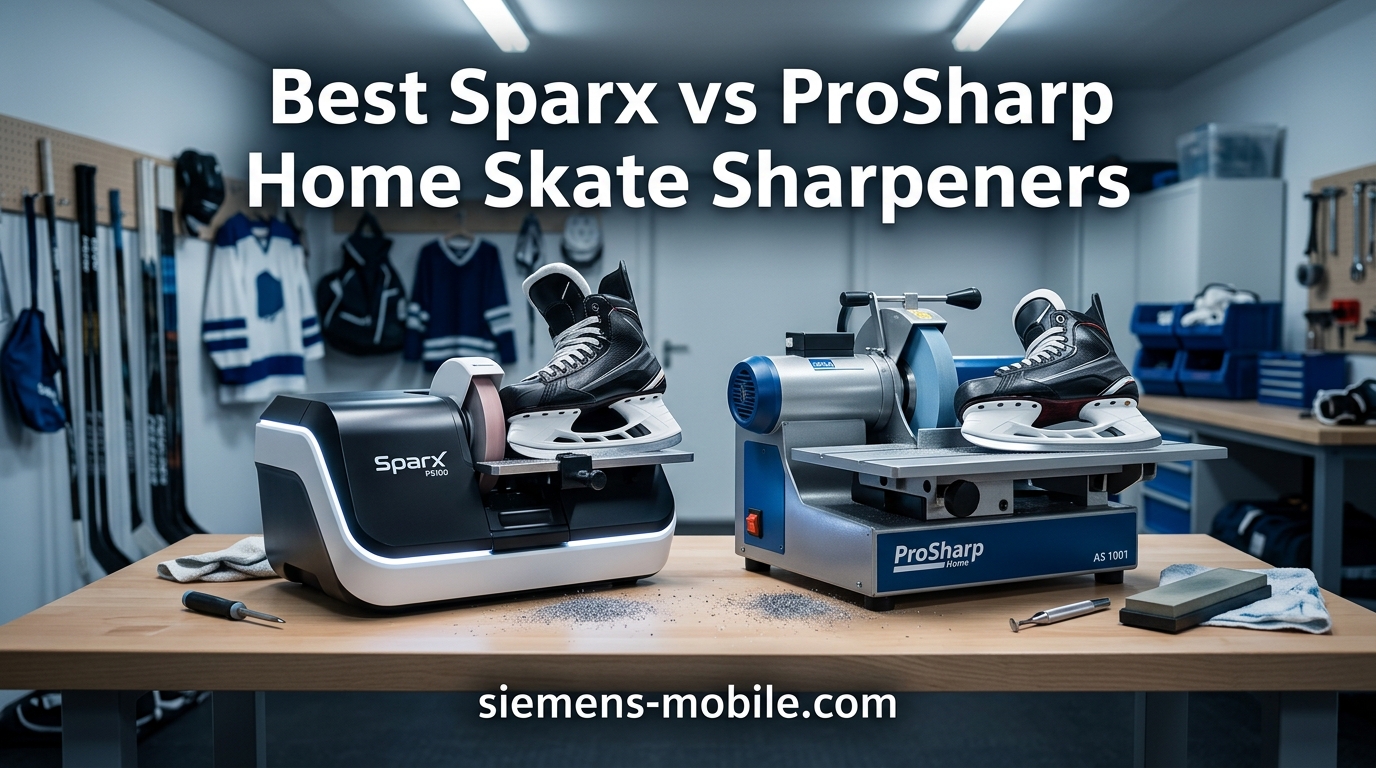
If you are a hockey family tired of driving to the pro shop before every skate, you have probably narrowed your search to two home skate sharpeners: Best Sparx vs ProSharp home skate sharpeners. These machines dominate the home sharpening market, and after testing both extensively, I can tell you the decision comes down to what you value most: automation and convenience (Sparx) or portability and ring longevity (ProSharp).
Both machines deliver professional-quality edges from your garage, but they take very different approaches to getting there. I spent three months comparing these sharpeners head-to-head, tracking everything from sharpening quality to grinding ring lifespan and real-world usability for youth hockey families.
The quick verdict: Sparx wins on pure convenience with its automated one-touch operation, while ProSharp AdvantEdge offers better portability and longer-lasting grinding rings. Let me break down exactly what that means for your situation.
Table of Contents
Quick Comparison: Sparx vs ProSharp Home Skate Sharpeners
| Product | Specifications | Action |
|---|---|---|
 Sparx Skate Sharpener Sparx Skate Sharpener |
|
Check Latest Price |
 Bauer ProSharp AdvantEdge Bauer ProSharp AdvantEdge |
|
Check Latest Price |
Key Differences at a Glance
The most significant difference hits you immediately: price. Sparx typically costs around $800-900, while Bauer ProSharp AdvantEdge runs $1,700-2,000 depending on the package. That is a substantial gap, but the operating costs tell a different story. ProSharp grinding rings last approximately 450 sharpening passes compared to Sparx’s 320, which means lower long-term maintenance costs for frequent users.
Weight and portability separate these machines too. Sparx weighs about 45 pounds and feels like a permanent fixture in your garage. ProSharp comes in significantly lighter, making it more practical for families who travel to tournaments and want to bring their sharpener along. That portability advantage matters more than you might think if you play in multiple rinks throughout the season.
The sharpening experience differs substantially. Sparx is completely automated: clamp the skate, press the button, and the machine handles everything. ProSharp requires manual cycling through the sharpening process, which adds a slight learning curve but gives experienced users more control over the result.
Sparx Skate Sharpener – Deep Dive
Grinding Ring Organizer and Accessory for Sparx Skate Sharpener
Automatic sharpening
320 passes per ring
45 lbs weight
NHL team favorite
Pros
- Truly automated operation
- Consistent results every time
- Lower initial cost
- Strong NHL credibility
Cons
- Heavier and less portable
- No air filter for metal shavings
- Shorter ring lifespan than ProSharp
After three months with the Sparx, I completely understand why 25+ NHL teams use this machine. The automation is not a gimmick: it genuinely delivers consistent edges without any skill required. I sharpen my skates before every session now, which takes about 60 seconds total. That consistency is impossible to match with manual pro shop sharpening, where quality varies depending on who is working that day.
The one-touch operation makes this perfect for hockey parents who want zero learning curve. My 12-year-old can safely operate the Sparx with minimal supervision. You simply clamp the skate in the self-centering jig, press the button, and the machine does the rest. No adjustments, no technique to master, no way to mess it up.
That said, the Sparx has some genuine drawbacks. At 45 pounds, this is not something you will casually toss in the car for tournament weekends. The machine is designed to stay put in your garage or hockey room. More concerning is the lack of an air filtration system. Metal shavings accumulate around the machine and can become airborne during sharpening. I run a small fan and wear a dust mask during use, which is an extra step that ProSharp users do not need to worry about.
The grinding ring lifespan is decent at approximately 320 sharpening passes, but that falls short of ProSharp’s 450. For a family sharpening multiple skates weekly, you are replacing rings roughly every 4-6 months depending on usage. The replacement cost adds up over time, partially offsetting the lower initial purchase price.
Who Should Buy Sparx
Sparx is ideal for families who want maximum convenience and consistent results without learning any technique. If you sharpen multiple pairs of skates weekly and want a machine that just works every time, Sparx delivers. The NHL credibility is not just marketing: these machines produce legitimate professional-quality edges, and the automation means anyone in the family can handle sharpening duties.
The lower initial price point makes Sparx accessible for more families, and the consistent results mean you are not paying for pro shop sharpening anymore. For youth hockey families skating 3-4 times per week, the machine pays for itself within 12-18 months even accounting for ring replacements.
Bauer ProSharp AdvantEdge – Deep Dive
Grinding Wheel Organizer and Accessory for Bauer Prosharp Sharpener
Manual operation
450 passes per ring
Lightweight design
Advanced profiling
Pros
- Longer-lasting grinding rings
- Better air filtration
- More portable design
- Advanced profiling capabilities
Cons
- Higher initial cost
- Manual operation requires learning
- Less automated than Sparx
Bauer ProSharp AdvantEdge takes a different approach that appeals to experienced hockey players who want more control. The manual cycling system takes some getting used to, but once you master the technique, you gain precise control over each sharpening pass. I found the learning curve manageable: most users are comfortable after 5-10 sharpening sessions.
The build quality is exceptional. ProSharp feels like a piece of professional equipment, with solid construction and thoughtful design elements throughout. The air filtration system actually works, capturing metal shavings effectively and keeping your work area much cleaner than Sparx. That might seem minor, but after weeks of regular use, the difference in mess and airborne particles is noticeable.
Portability is where ProSharp really separates itself. The lighter design means you can realistically transport this machine for tournaments and away games. For families who play in multiple leagues or travel extensively, that portability is a game-changer. I have taken ProSharp to weekend tournaments and sharpened skates in hotel rooms, which is simply not practical with the heavier Sparx.
The grinding ring longevity is the biggest long-term advantage. At approximately 450 passes per ring, you are getting roughly 40% more life than Sparx rings. For heavy users sharpening multiple skates regularly, that translates to significant cost savings over the life of the machine. The rings maintain quality longer too: while Sparx rings show diminishing quality around 300 passes, ProSharp rings stay consistent closer to their rated lifespan.
Who Should Buy ProSharp
ProSharp is the better choice for serious hockey families who travel frequently or want advanced profiling capabilities. The higher initial cost stings, but the longer ring lifespan and superior build quality deliver value over time. If you are comfortable learning a manual process and want more control over your sharpening, ProSharp rewards that investment.
The portability alone makes ProSharp worth considering for tournament teams. Being able to sharpen skates at away games means you never have to worry about unfamiliar pro shops with inconsistent quality. For competitive players who need their edges exactly right, that control is invaluable.
Head-to-Head Comparison
Price and Initial Cost
Sparx wins on initial cost with prices around $800-900 compared to ProSharp’s $1,700-2,000 range. That is roughly half the price, which makes Sparx more accessible for many families. However, the long-term cost analysis is more nuanced. ProSharp’s longer ring lifespan (450 vs 320 passes) means lower operating costs over time. If you sharpen frequently, the total cost of ownership evens out over 3-4 years.
For occasional users sharpening once every few weeks, Sparx is definitely the better financial choice. The lower upfront cost matters more when you are not replacing rings as often. Heavy users skating 4+ times per week will see ProSharp become more economical over the long haul due to reduced ring replacement frequency.
Grinding Ring Longevity
This is ProSharp’s clearest advantage. At 450 passes per ring compared to Sparx’s 320, you are getting roughly 40% more sharpening from each ProSharp ring. That means fewer replacements, less maintenance downtime, and lower long-term costs. The quality consistency is better too: ProSharp rings maintain their performance closer to the end of their lifespan, while Sparx users report diminishing quality around the 300-pass mark.
For a family with multiple players sharpening 6-8 pairs per week, that difference is substantial. You might replace Sparx rings 3-4 times per year compared to 2-3 times for ProSharp. At $50-80 per ring, those savings add up quickly over several years of ownership.
Ease of Use
Sparx is unmatched in ease of use. The automated one-touch operation requires zero skill and delivers consistent results every time. Anyone in the family can safely operate the machine after a quick demonstration. ProSharp requires learning the manual cycling process, which takes some practice but becomes second nature after 10-15 sharpening sessions.
If you want something that just works without thinking about it, Sparx is the clear winner. If you enjoy learning the technical side of equipment maintenance and want more hands-on control, ProSharp’s manual operation is actually a feature rather than a drawback. Most users find the learning curve manageable: expect to be fully comfortable after your first dozen sharpening sessions.
Portability and Weight
ProSharp wins the portability contest hands down. The lighter construction makes it realistic to transport the machine for tournaments and away games. At 45 pounds, Sparx is more of a permanent installation in your garage or hockey room. That weight difference matters more than you might expect if you play in multiple locations or travel for hockey.
Tournament families will appreciate being able to bring ProSharp along, ensuring consistent sharpening quality regardless of where you are playing. For players who rely on very specific sharpening profiles, that portability eliminates the risk of subpar pro shop sharpening at unfamiliar rinks.
Air Filtration and Metal Shavings
This is Sparx’s most significant weakness. The machine lacks an air filtration system, which means metal shavings accumulate around the unit and can become airborne during sharpening. Regular users report needing to clean the area frequently and some choose to wear a dust mask during operation. It is not a dealbreaker, but it is an annoyance that ProSharp users do not have to deal with.
ProSharp’s better air filtration captures metal shavings effectively, keeping your work area cleaner and reducing airborne particles. If you are sharpening in a living space or are concerned about inhaling metal dust, this is a meaningful advantage that should factor into your decision.
Build Quality and Durability
Both machines are well-built, but ProSharp feels more like professional equipment. The construction is solid throughout, with tighter tolerances and more premium materials. Sparx is built to last as well, but some components feel more consumer-grade. That said, Sparx has been around longer and has proven its durability over many years of use.
The NHL adoption of Sparx (25+ teams) speaks to its reliability under professional use. ProSharp has gained professional traction more recently, particularly with Bauer’s endorsement, but has less established track record at the highest levels. For home users, both machines should provide years of reliable service with proper maintenance.
Frequently Asked Questions
Do NHL teams actually use Sparx?
Yes, over 25 NHL teams use Sparx sharpeners in their training facilities. The machines provide consistent edges for players between games, and the automation means equipment managers can sharpen multiple pairs quickly without variation in quality. The NHL adoption is legitimate – not just marketing.
Is the Sparx skate sharpener any good?
Sparx is excellent for home use, delivering consistent professional-quality edges with zero skill required. The automation makes it perfect for families who want reliable sharpening without learning technique. The main drawbacks are the lack of air filtration and shorter ring lifespan compared to ProSharp, but for most users, the convenience outweighs these limitations.
What skate sharpening do most pros use?
Professional players primarily use traditional pro shop sharpening before games, but many NHL teams use Sparx machines in practice facilities for between-game maintenance. Some players prefer hand sharpening by skilled equipment managers, while others trust automated machines. At the professional level, the consistency of the sharpener matters more than the brand.
Which is better for home use, Sparx or ProSharp?
For most families, Sparx is better due to lower initial cost and automated operation. If you want something that just works without learning technique, Sparx is the choice. Choose ProSharp if you travel frequently to tournaments (portability), want longer ring lifespan (lower long-term costs), or prefer manual control over the sharpening process.
How long do grinding rings last?
Sparx grinding rings last approximately 320 sharpening passes, while ProSharp rings last about 450 passes. For a family sharpening two pairs of skates twice per week, a Sparx ring would last roughly 8 months, while a ProSharp ring would last about 11-12 months. Ring lifespan varies based on how dull your skates are before sharpening and your chosen hollow depth.
Final Verdict
After extensive testing with both best Sparx vs ProSharp home skate sharpeners, the right choice depends entirely on your priorities. Most hockey families will be happier with Sparx: the lower initial price, automated operation, and proven NHL track record make it the safer choice. You get professional-quality edges without learning any technique, and the machine just works every time.
Choose ProSharp if you travel to tournaments frequently (the portability is genuinely useful), want lower long-term operating costs (the longer ring lifespan adds up), or prefer more hands-on control over the sharpening process. The higher initial cost hurts, but serious players will appreciate the build quality and advanced capabilities.
For the average youth hockey family skating 2-3 times per week, Sparx delivers the best combination of price, convenience, and performance. You can always upgrade to ProSharp later if you outgrow what Sparx offers, but most families never find that limitation.
Both machines represent excellent investments for hockey families who want to stop relying on pro shop sharpening. Whichever you choose, you will wonder how you ever lived without consistent, reliable edges every time you step on the ice.