
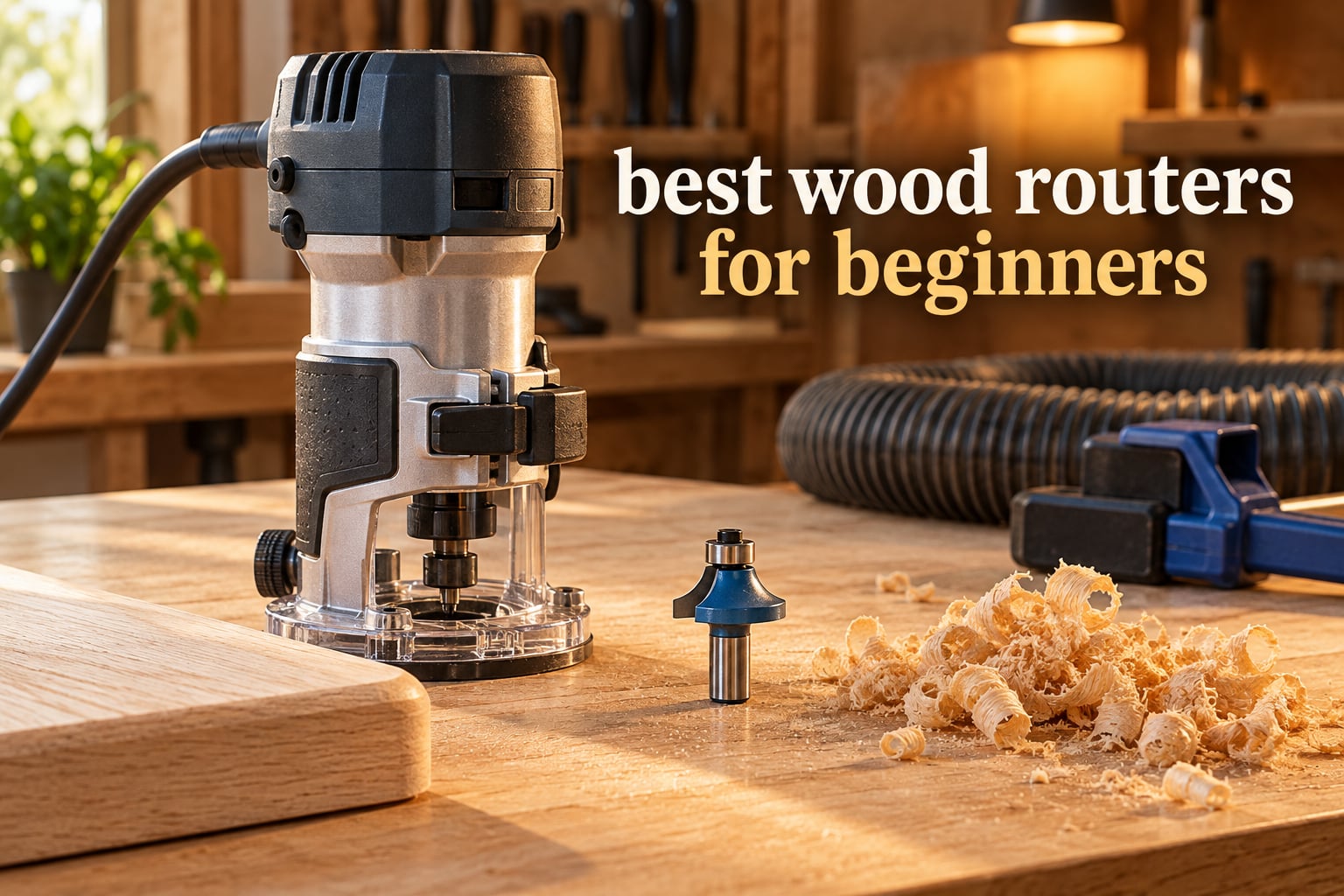
The best wood router for beginners is a variable-speed model rated between 1-1/4 HP and 2-1/4 HP, with a collet that accepts 1/2-inch bits and a base that suits the work you plan to do. That combination covers edge profiles, flush trims, grooves, dados and mortises without outrunning your skills.
Routers punish impatience more than any other power tool. The bit grabs, the tool walks across your workpiece, and the cut that was supposed to take ten minutes ends with a burn mark and a sore hand. So the beginner question is not which router is the strongest, it is which one makes mistakes survivable.
We spent weeks comparing these twelve routers on the things that actually change a first project’s outcome: motor headroom, collet size, base type, speed range, weight in the hand and how forgiving the controls feel. Every pick below carries enough power for hardwoods and enough feedback to tell you the cut is going wrong. If you want the wider market for comparison, our general wood router roundup covers more use cases than a beginner needs.
Table of Contents
Top 3 Picks for the Best Wood Routers for Beginners (October 2026)

DEWALT DCW600B 20V Max XR Cordless Router
- Brushless motor
- Variable-speed dial
- Depth adjustment ring
- Dual LED work lights

Bosch 1617EVS 2.25 HP Fixed-Base Router
- 12 Amp motor
- 8000-25000 RPM
- 1/4 and 1/2 inch collets
- Threaded three-hole base

Milwaukee 2723-20 Cordless Compact Router
- 1.25 HP motor
- Fixed base
- Large base plates
- 18V battery platform
The DEWALT DCW600B takes the top slot because it is the only cordless router here with a brushless motor, a depth adjustment ring and an electronic brake, and it carries more reviews than any other product in this roundup. The Bosch 1617EVS and Milwaukee 2723-20 round out the top three for raw power and shop durability respectively.
12 Best Wood Routers for Beginners (October 2026)
How We Picked These Routers
Every router here was judged on motor headroom first. A router that bogs down in hardwood burns the bit and the workpiece, and heat damage cannot be sanded out, so power was our first filter.
Collet size came next. Routers with a 1/2-inch collet can hold the larger shanks that beginners want for edge work, while 1/4-inch-only tools limit which bits you can buy. Forum buyers consistently look for 1/2-inch capacity for exactly this reason.
We also weighed speed range, depth adjustment clarity, dust port fit, weight and whether the base matches the work described. Finally we read reviews for the two things spec sheets never mention: whether the motor holds speed under load, and whether the controls stay precise after an hour of use.
1. DEWALT DCW600B 20V Max XR Cordless Router – The Best All-Round Beginner Router
DEWALT 20V Max XR Cordless Router, Brushless, Tool Only (DCW600B)
Brushless motor
Variable-speed dial
Depth adjustment ring
4.15 lbs
20V battery platform
Pros
- Brushless motor with electronic braking
- Depth adjustment ring makes height changes fast
- Two LED lights show the cutting edge
- Compact 4.15 pound body works one or two handed
Cons
- Tool only so a battery and charger are separate purchases
- Fixed base limits you to edge profiles until you add a plunge base
The DCW600B is the router we would hand a beginner first. It weighs 4.15 pounds, it fits in one hand, and the depth adjustment ring changes height in a single motion instead of the fine threading most fixed-base routers demand.
That ring matters more than it sounds. On a beginner router the depth setting is the single thing you adjust constantly, and a ring you can move with one thumb removes an entire class of mistakes.

Owners consistently point to the brushless motor and the electronic brake. The brake stops the bit quickly after you release the trigger, which means you are not waiting on a spinning bit while you reposition, and the variable-speed dial lets you slow down for small-diameter bits where high RPM burns wood.
The dual LED lights sit low and aim straight at the bit, which matters in a cabinet interior or under a shelf where a shop light will not reach. For a first project list, it handles round-overs on scrap pine, flush trimming on prefinished edging and straight dados with a 1/4-inch bit.
Is this the right first router if you have no corded tools?
If you already own 20V MAX batteries and a charger, yes, and the savings are immediate. The platform is broad, packs are inexpensive relative to buying a charger, and a dead battery mid-cut is a five-second swap rather than a stopped workday.
Be realistic about power limits. This is a compact router, so aggressive cuts in thick hardwood will stall it. Take shallower passes and it stays well ahead of a beginner’s needs.
Where it falls short for a beginner
It ships as tool only, which means your first purchase also covers a battery and charger, and that is the part that surprises first-time buyers. It is also a fixed-base design, so grooves that start mid-board are out of reach until you add a plunge base.
If you want one tool that starts cuts anywhere on the board without a second purchase, look at the SKIL combo below instead.
2. Bosch 1617EVS 2.25 HP Fixed-Base Router – The Power and Longevity Benchmark
Bosch 1617EVS 2.25 HP Electronic Fixed-Base Router
2.25 HP 12 Amp motor
8000-25000 RPM
1/4 and 1/2 inch collets
Microfine depth adjustment
Pros
- Constant Response circuitry holds speed under load
- Soft start avoids a jolt on first contact
- Accepts both 1/4 inch and 1/2 inch bits
- Threaded three-hole pattern mounts to router tables
Cons
- Heavy at 4.5 kg
- which tires the hand on long handheld work
- Vernier depth knob is awkward with large fingertips
- Motor-to-base slide can bind when swapping bases
The 1617EVS has been in production for decades, and that is not marketing, it is a parts and knowledge advantage. Parts exist, forums are full of owners, and the design has been refined longer than most beginners have been woodworking.
The 12 Amp motor is the reason it endures. It pushes large rail-and-stile bits and deep rabbets through hardwood without bogging, and the Constant Response feedback system keeps RPM steady as the load changes.
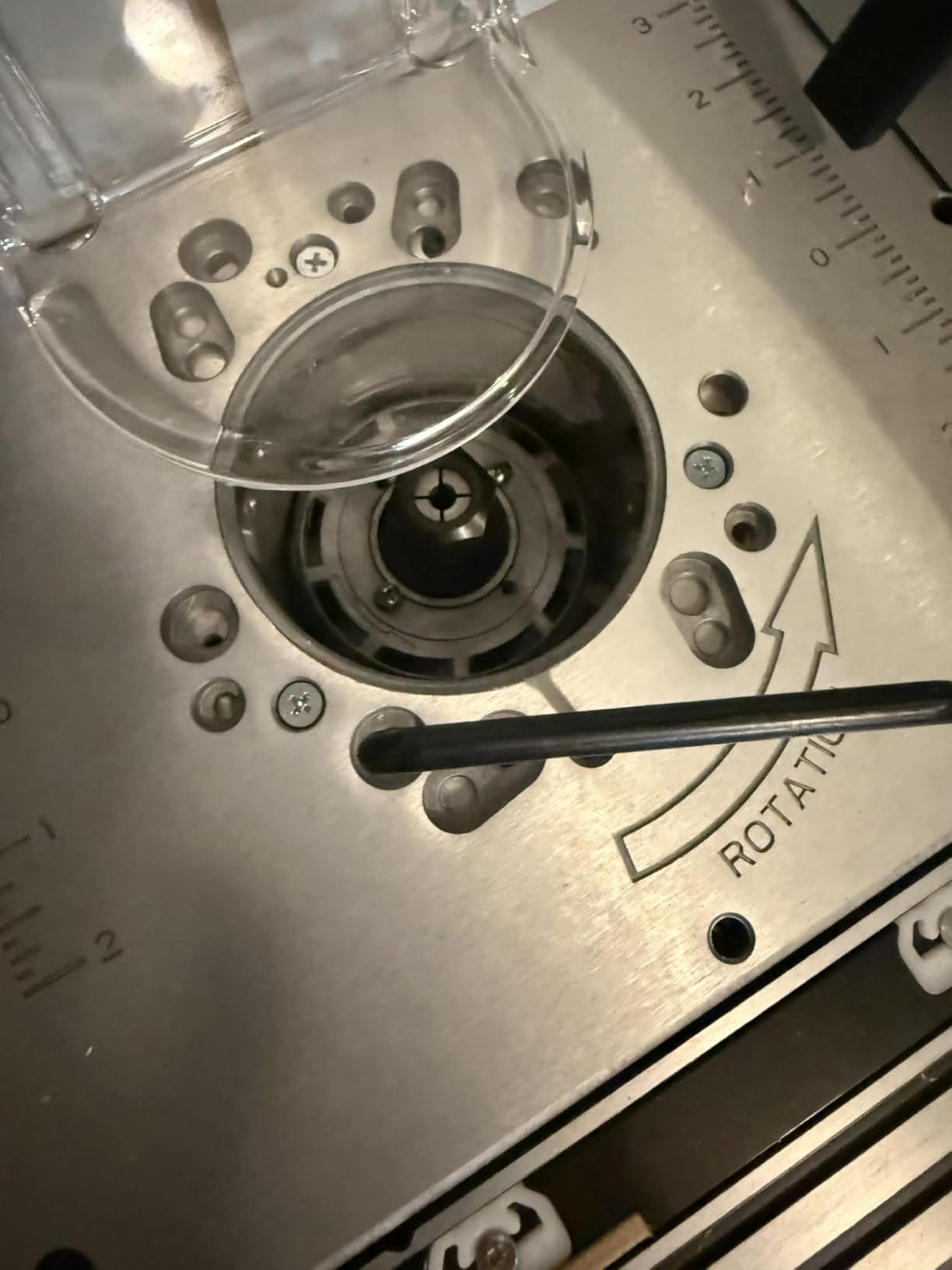
Both collets ship in the box, which removes the single most common first-router complaint. Owners repeatedly describe buying a 1/2-inch bit and having the collet shear it because the tool only accepted 1/4-inch shanks. That problem does not exist here.
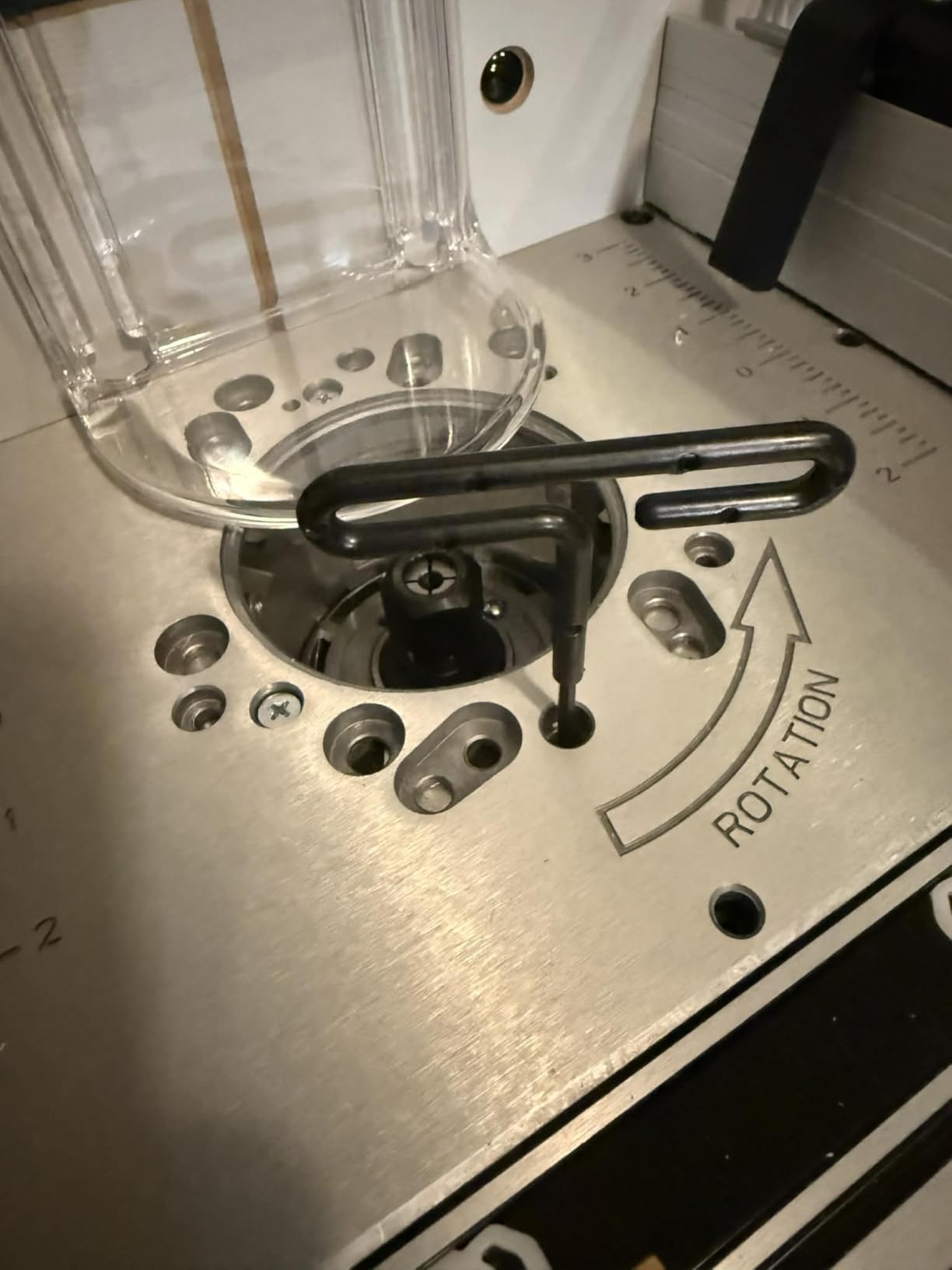
The microfine depth adjustment gives repeatable cuts at fine increments, and the three-hole threaded base pattern mounts under a router table without adapters. Owners on forums pair this motor with a Kreg-style insert and treat the router as a stationary machine most of the time.
Is this router too heavy for a beginner?
At 4.5 kg it is one of the heavier handheld options here, and that is a real tradeoff for people with grip issues or long sessions. In practice it feels planted rather than tiring, because the mass is in the motor and the base stays flat.
If you already own a corded router and mainly want a table machine, this is an excellent buy. If hand control is your weak point, a lighter compact router will teach you faster.
What new owners should know
The varnier-style depth knob is fiddly if your fingertips are large, so budget a few minutes to get used to it. The motor-to-base slide is also the part most often criticised, and it can bind when you change bases.
Because this is a fixed base, starting a cut in the middle of a panel still needs a plunge base or a jig. Many owners buy the Bosch plunge base later and keep this motor for both.
3. Milwaukee 2723-20 Cordless Compact Router – The One Built for Daily Shop Use
Milwaukee Cordless Compact Router,18.0 Voltage
1.25 HP 5 Amp motor
Fixed base
3.21 by 6.88 inch body
4.9 pounds
Pros
- Compact body fits the hand for trimming
- Build quality survives daily shop use
- Reaches full speed quickly
- Large base plates aid stability
Cons
- Body is wide and can fatigue hands on long sessions
- Included acrylic base has a notch that can catch
- Dust port fit is loose out of the box
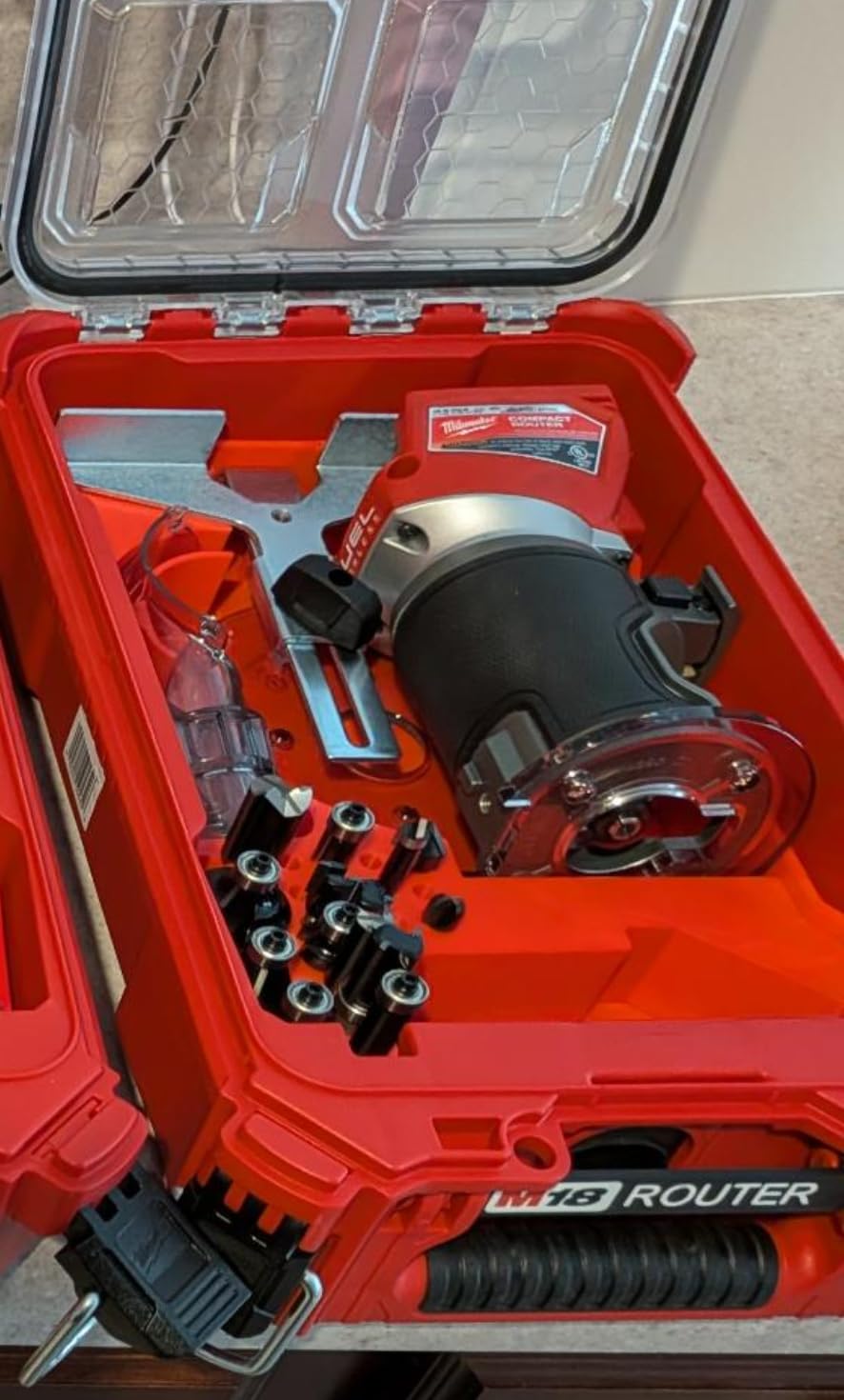
Milwaukee built this one for people who use routers daily rather than occasionally. The 1.25 HP motor reaches full speed quickly, and owners on forums talk about buying multiples for separate stations in the shop.
The compact body is 3.21 inches wide by 6.88 inches tall, small enough to work inside a cabinet or between clamps. Large base plates help stability, and different plates are available for different materials.
At 4.9 pounds it is balanced rather than light, and the smooth cuts owners report come from that balance. Accuracy stays consistent across a run instead of drifting as your arm tires.
For a first project list, this is a natural fit for edge rounding on thicker stock and trimming plywood edges, where the extra mass over a small palm router helps keep the tool tracking straight.
Does it fit an 18V battery you may already have?
If you own any M18 battery, this drops straight into your setup and the cost of getting started drops with it. Runtime on 5Ah packs is good enough for a typical evening of trimming and shaping.
Battery age matters more than brand here. Older high-capacity packs reduce run time noticeably compared with newer ones, so factor that into your plans for long sessions.
What owners complain about
The body is wide for a compact router, and that grip width becomes uncomfortable on long uninterrupted routing sessions. The included acrylic base also carries a notch that some owners say can catch on a workpiece edge.
The dust port fits loosely out of the box, which weakens suction until you secure it, and the depth adjustment rod is plastic rather than metal. None of these stop the cuts, but all three are annoying on day one.
4. Makita RT0701C 1-1/4 HP Compact Router – The Detail and Template Workhorse

Makita RT0701C 1-1/4 HP Compact Router, Fixed Base
1.25 HP 6.5 Amp motor
10000-30000 RPM variable speed
3.9 pounds
Quick release cam lock
Pros
- Slim ergonomic body that is easy to control
- Variable speed with electronic control under load
- Quick release cam lock for fast base changes
- Aluminum motor housing for durability
Cons
- Tool only
- with plunge and tilt bases sold separately
- Small stock base feels tippy until a larger sub-base is added
- Speed dial can drift during long CNC runs
The RT0701C is the compact router most often recommended on woodworking forums for handheld detail work, and the slim body is why. At 3.9 pounds it is light enough to hold one-handed and narrow enough to see past in tight spots.
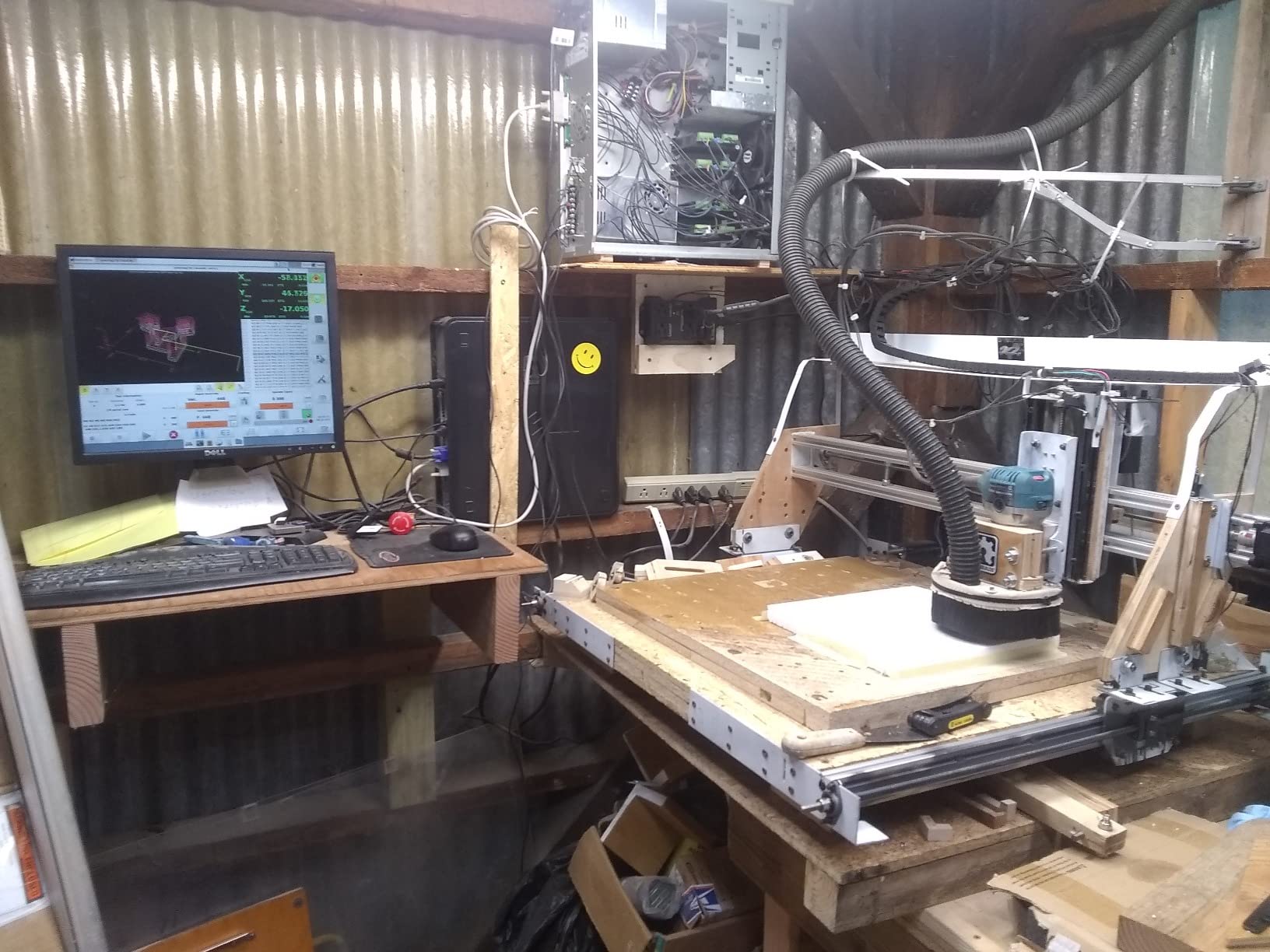
Despite the 1-1/4 HP rating, owners report it chewing through 1/8-inch and 1/4-inch aluminum and running long CNC jobs. The 10,000 to 30,000 RPM range with electronic speed control under load is wider than the headline horsepower suggests.
The quick release cam lock is the feature beginners notice most. Swapping bases and adjusting depth takes seconds rather than the repeated unscrewing a threaded rod demands, so you spend more time cutting and less time setting up.
Template work is where it shines. A solid acrylic base, an aluminum housing and a smooth rack-and-pinion fine adjustment make it a good companion to a template guide or an edge guide for repetitive trim work.
Is 1-1/4 HP enough power for a first router?
For light and medium work, yes. Small-diameter bits at shallow depths, trimming, edge work on box stock and thin hardwoods are all within range, and the variable speed dial keeps you out of burn territory.
It runs out of headroom with large-diameter bits in thick stock. If your plan is large profiles in solid walnut, step up to a 2-1/4 HP midsize instead.
What to watch out for
This is the bare tool. Plunge, tilt and offset bases are separate purchases, and that is the most common regret owners report. Plan on adding a plunge base early rather than discovering the limit mid-project.
The stock base is small enough to feel tippy on a large workpiece until you fit a larger sub-base, and the speed dial can loosen and drift over long automated runs.
5. SKIL RT1322-00 Plunge and Fixed Base Combo – The Most Complete Starter Package
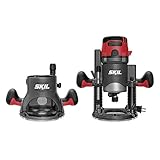
SKIL 14 Amp Plunge and Fixed Base Router Combo — RT1322-00
14 Amp 2.42 HP motor
Fixed and plunge bases included
8000-25000 RPM
LCD speed display
Pros
- Both fixed and plunge bases in one package
- Parallel guide and dust adapters included
- 1/4 and 1/2 inch collets supplied
- Live tool indicator lights when powered
Cons
- Combo package weighs over 14 pounds
- Plunge turret feels coarse beside premium plunge routers
This is the kit that answers the question a beginner cannot yet answer: which base do I need? You get both. The fixed base handles edge profiles, and the plunge base lets you start a groove or dado in the middle of a panel without a jig.
The 14 Amp motor carries more current than most routers in this roundup, and the combination of a fixed base, a plunge base, both collets, a parallel guide and dust adapters means very few accessory purchases in the first year.
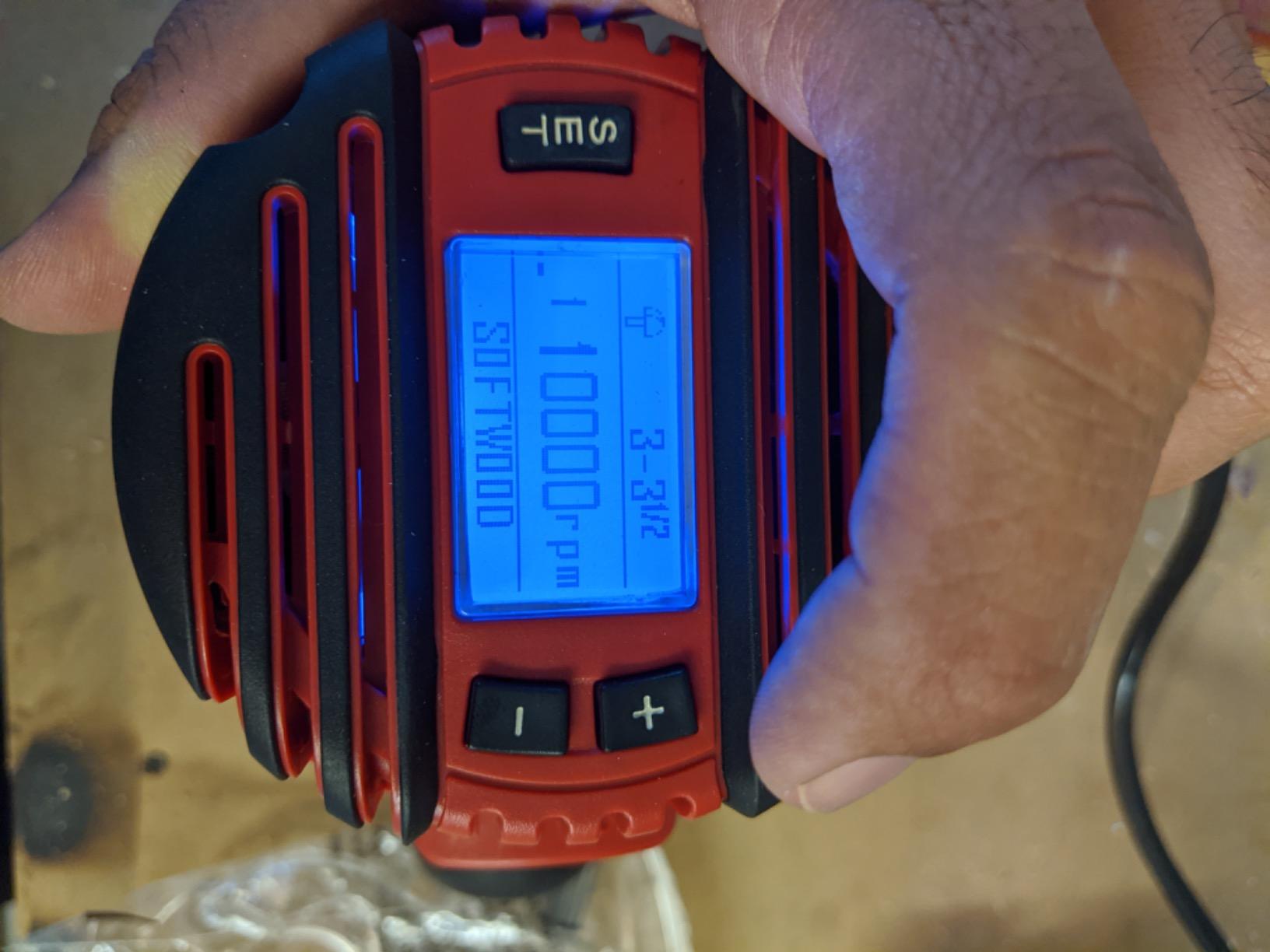
The LCD speed display is aimed squarely at new users. You select the bit type and material and it suggests a speed setting, which removes the guesswork that causes burned edges and chipped bits in early cuts.
For a first project list, this is the kit that can cut a hinge mortise on day one and then move straight into flush trimming on the same motor, which is more than a single-base router can do.
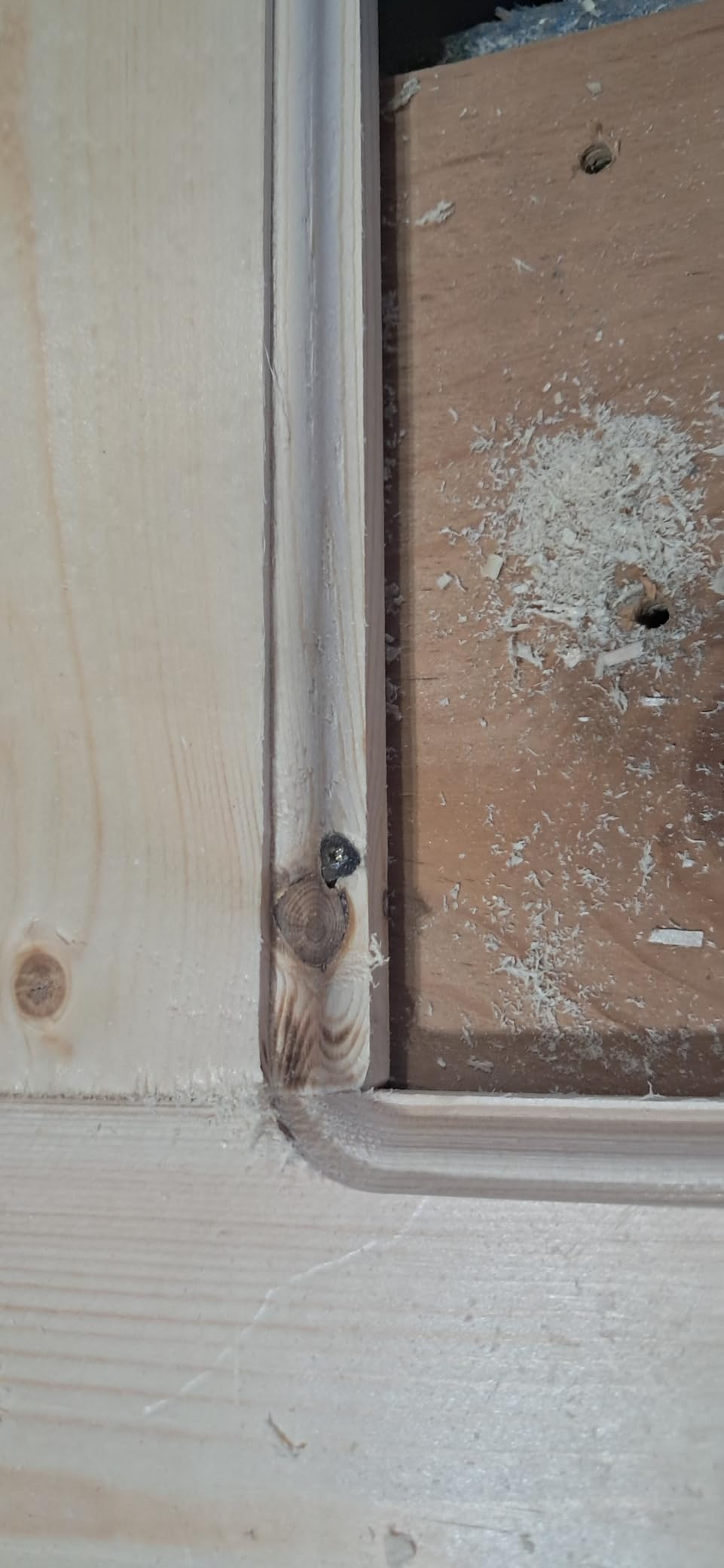
Does a beginner really need both bases?
You need one base now and the other within a year, and buying them together is usually less costly than a second purchase later. The plunge base is what unlocks grooves, dados and stopped cuts partway across a board.
If you genuinely only plan to round edges on small stock, a single compact router does the job and stays lighter in the hand.
What you give up for the kit
Weight. The package tips past 14 pounds, and handheld maneuverability suffers compared with a slim compact router. Many owners keep it bench-mounted rather than carrying it around the shop.
The plunge mechanism and turret also feel coarser than on a dedicated premium plunge router, so fine depth changes take practice. The LCD guidance compensates for part of that for newer users.
6. Bosch PR20EVS Colt Palm Router – The Best Tool for Edge Trimming

BOSCH PR20EVS Colt 1.0 HP Variable-Speed Palm Router, Quick-Clamp System
1.0 HP 5.6 Amp motor
16000-35000 RPM
3.3 pounds
Edge guide included
Pros
- Quick clamp system moves the motor between bases fast
- Straight edge guide included for cuts up to 3-5/8 inch from the edge
- Angled cord exit keeps the cord out of the cutting path
- Macro and micro depth adjustment
Cons
- Ships with a 1/4 inch collet only
- 1 HP motor is not for heavy plunge or thick hardwood work
- Plastic body feels lighter than the all-metal Bosch routers
The Colt is a palm router, and that means it does one job extremely well: trimming and profiling edges. The short body gives your hand a natural grip close to the bit, and the included straight edge guide handles repetitive line work.
Speed range is the surprise. The dial runs from 16,000 to 35,000 RPM, which is wider than the 1.0 HP headline implies, and it lets you slow down for small bits to avoid burning.
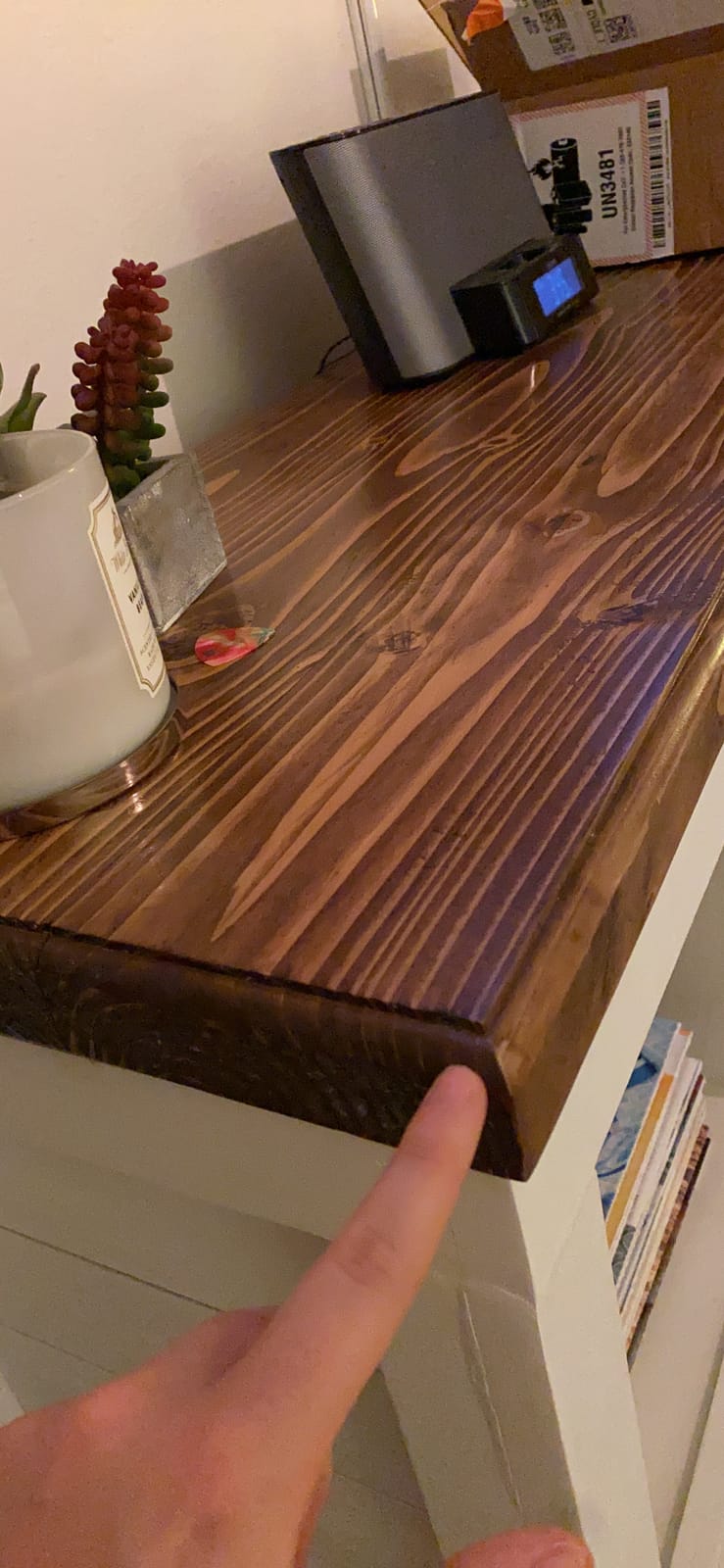
The quick clamp system is what makes it versatile. The motor releases from the base without tools, so moving between trimming, a template setup or a table-mounted position takes under a minute rather than an argument with screws.
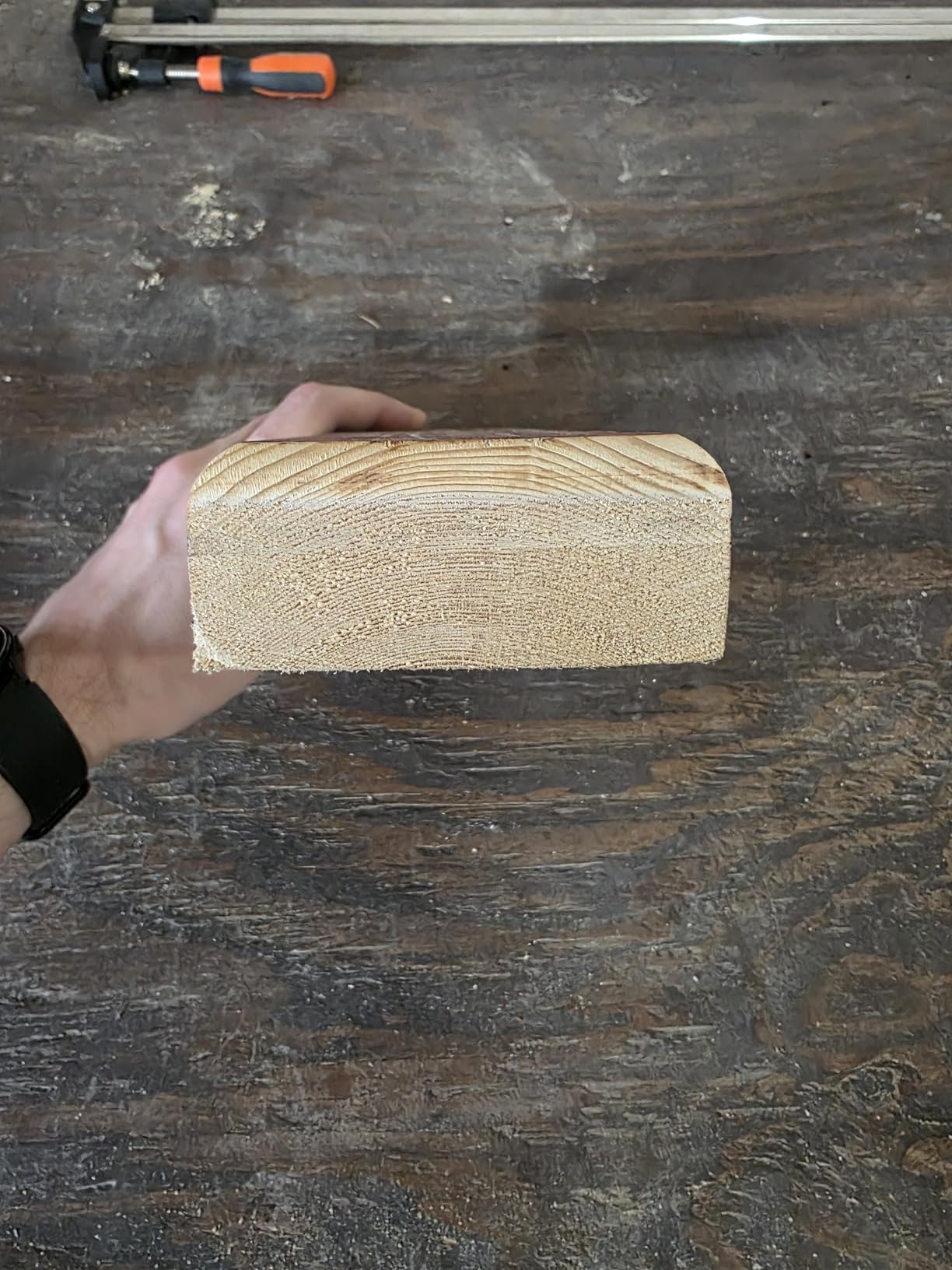
For a beginner, the finger support pockets on the fixed base give both hands a defined place to rest, which improves control on a rounded edge more than most spec sheets suggest.
Can a 1 HP router handle hardwood?
It handles edge work in hardwood well, especially with small-diameter bits at shallow depths. What it will not do comfortably is heavy plunge cuts or thick stock with wide profiles, where a 2-1/4 HP motor is the right tool.
Treat it as a companion or a first tool for trimming, not as the only router you will ever own.
What new buyers should check
Only a 1/4-inch collet ships in the box. If you want 1/2-inch shank bits, buy the larger collet before your first project rather than discovering the limitation mid-cut.
The plastic body feels lighter in the hand than the all-metal Bosch fixed-base routers, and the fixed base accepts bits only up to 1-5/16 inch in diameter, which sets a ceiling on profile size.
7. Makita 3709 Laminate Trimmer – The Lightest Option for Clean Edges

Makita 3709 1/4″ Fixed Base Laminate Trimmer Teal
4.0 Amp motor
30000 RPM
1.5 kg
Transparent base
Double insulated
Pros
- Only 3.3 pounds
- easy on the hand during long trims
- Transparent base gives a clear view of the cutting edge
- Top-mounted cord stays out of the cutting path
Cons
- 4.0 Amp motor is for light trimming rather than shaping
- Fixed base only
- with no plunge or tilt option
The Makita 3709 predates the modern plunge revolution and does one job extremely well: trimming laminate and prefinished edging flush. At 1.5 kg it is the lightest full router in this roundup, and light tools are forgiving tools when you are learning.
The transparent base is the feature that earns its place. On a flush trim against a glued-down laminate, you need to see the bit edge and the cut line simultaneously, and a clear base removes guesswork.
The cord exits from the top rather than the side, which keeps it away from the trim line and reduces the chance of the base tipping as you drag the tool along an edge. That is a genuine safety benefit in tight corners.
Smooth rack-and-pinion adjustment gives fine depth changes, and the rubberized grip stays comfortable across a long countertop trim.
Is a laminate trimmer enough as a first wood router?
For a specific list of projects, yes. Flush trimming laminate, scribing shelves to a wall and cutting prefinished panels are all within reach, and the low weight makes those cuts steadier.
It is not enough if you want grooves, dados, mortises or edge profiles. Those need more power and usually a plunge base, so many owners treat it as a second tool rather than a first.
What the motor cannot do
The 4.0 Amp motor is a trimming motor. Push it into thick hardwood with a wide bit and it will bog and heat the workpiece, which is how beginners burn their first project.
There is also no plunge or tilt option in this configuration, so every cut must start from an edge. That single constraint limits which joinery is even possible.
8. AVID POWER 6.5 Amp Compact Router – The Most Complete Budget Kit

AVID POWER 6.5 Amp 1.25 HP Compact Router Tools for Woodworking, Fixed Base Wood Router with Trim Router Bits, 6 Variable Speeds, Edge Guide, Roller Guide, Dust Hood (Red, 65mm)
800W 1.25 HP 6.5 Amp motor
10000-32000 RPM
Fixed base with dust hood
4.4 pounds
Pros
- Kit includes 5 bits
- edge guide
- roller guide and both collets
- Six speed settings cover hardwoods without burning
- Dual LED lights illuminate the cutting path
- Dust hood connects to a standard shop vac
Cons
- Aluminum and ABS construction is lighter duty than all-metal rivals
- Trigger and speed dial can feel imprecise to some buyers
The AVID POWER is the kit-first option. Alongside the router you get five bits, an edge guide, a roller guide, both 1/4-inch and 3/8-inch collets, spare carbon brushes and wrenches, which is normally the largest single cost of getting into routing.
The six speed settings span 10,000 to 32,000 RPM, which is a wide enough range to handle oak, pine and laminate without burning the edge. Many beginners start cutting too fast and blame the tool; having the dial there fixes that.
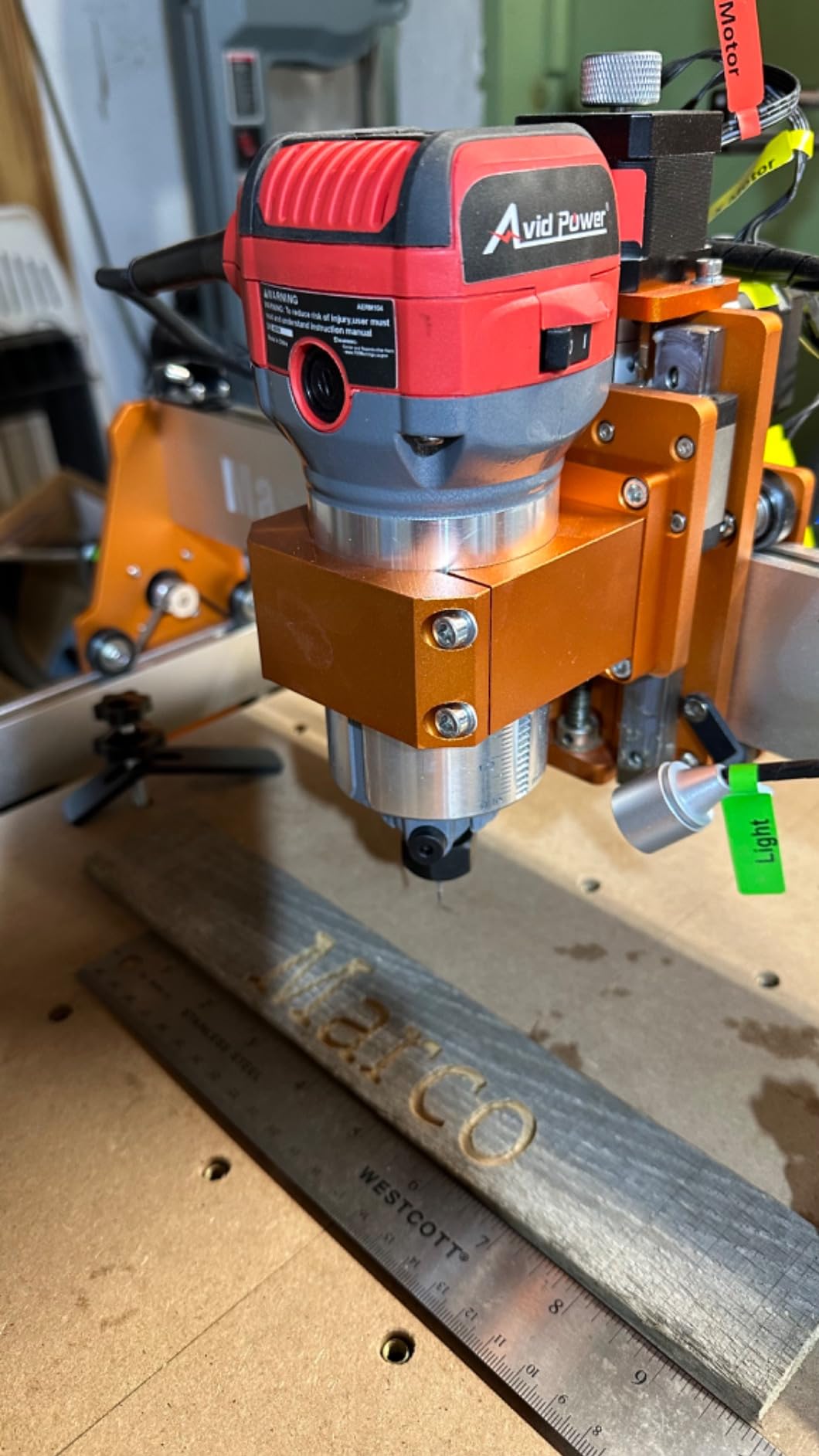
The rack-and-pinion depth system locks tight during a cut, so the setting you set is the setting you get. That repeatability matters more to a beginner than any headline feature, because it removes the reason cuts come out uneven.
The dust hood hooks to a standard shop vac, which keeps chips off the bit and off your line of sight. That single accessory removes the most common cause of kickback for new users.
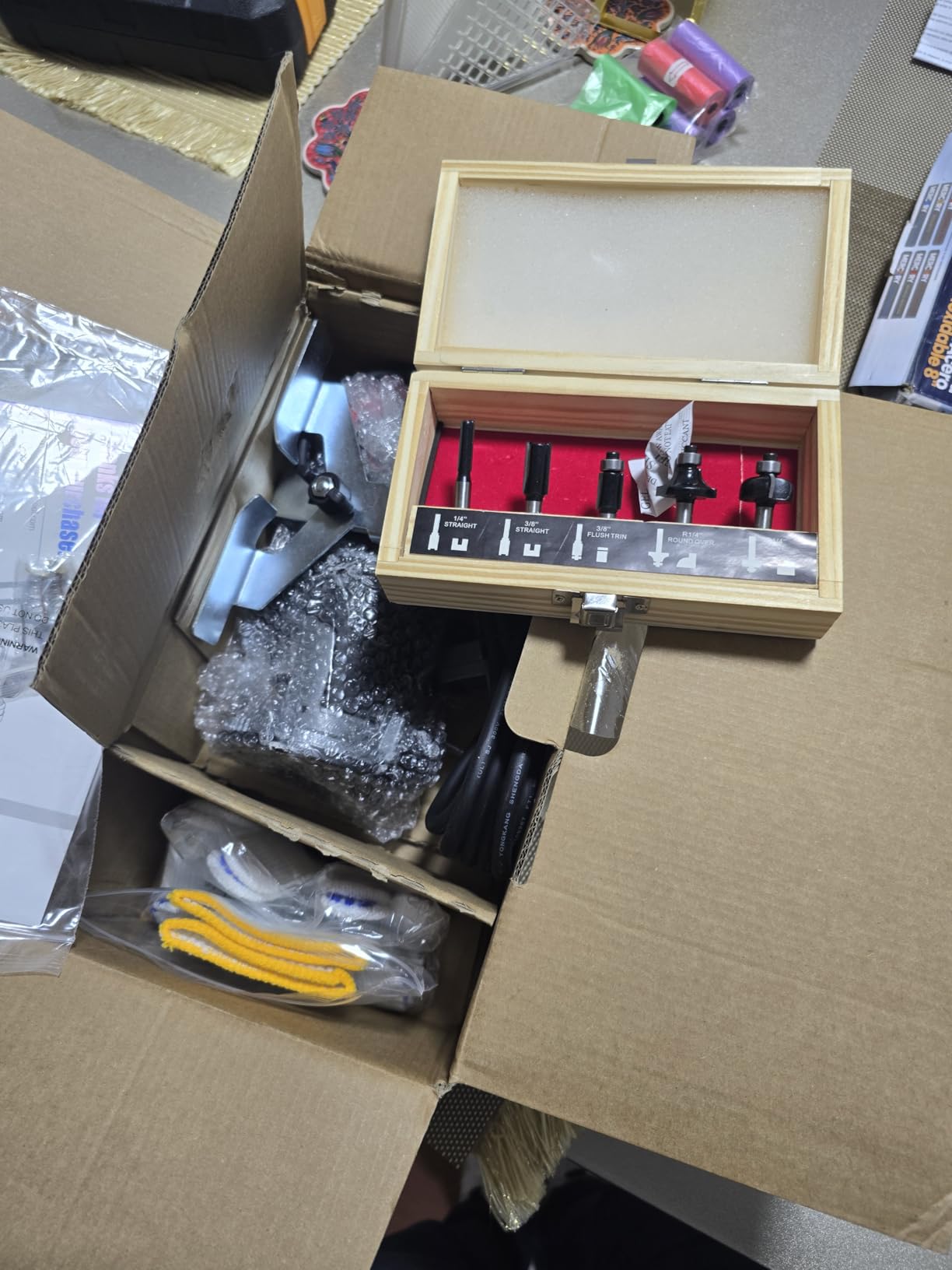
Is a budget kit router good enough to learn on?
Yes for light and medium hobby work on pine, poplar, MDF and laminate, and yes for learning depth control and speed matching. It will not be the router you keep for large hardwood projects, and many owners say exactly that.
Treat it as a learning tool with accessories included, not as a lifetime purchase you will refuse to replace.
What to know before you buy
Construction is aluminum and ABS, lighter duty than the all-metal bodies on professional tools. Expect it to feel less rigid under heavy load, and take thinner passes in hardwood.
Some buyers report a stiff trigger and an imprecise speed dial. Check both settings before committing to a full-depth cut, and keep the spare brushes from the kit nearby.
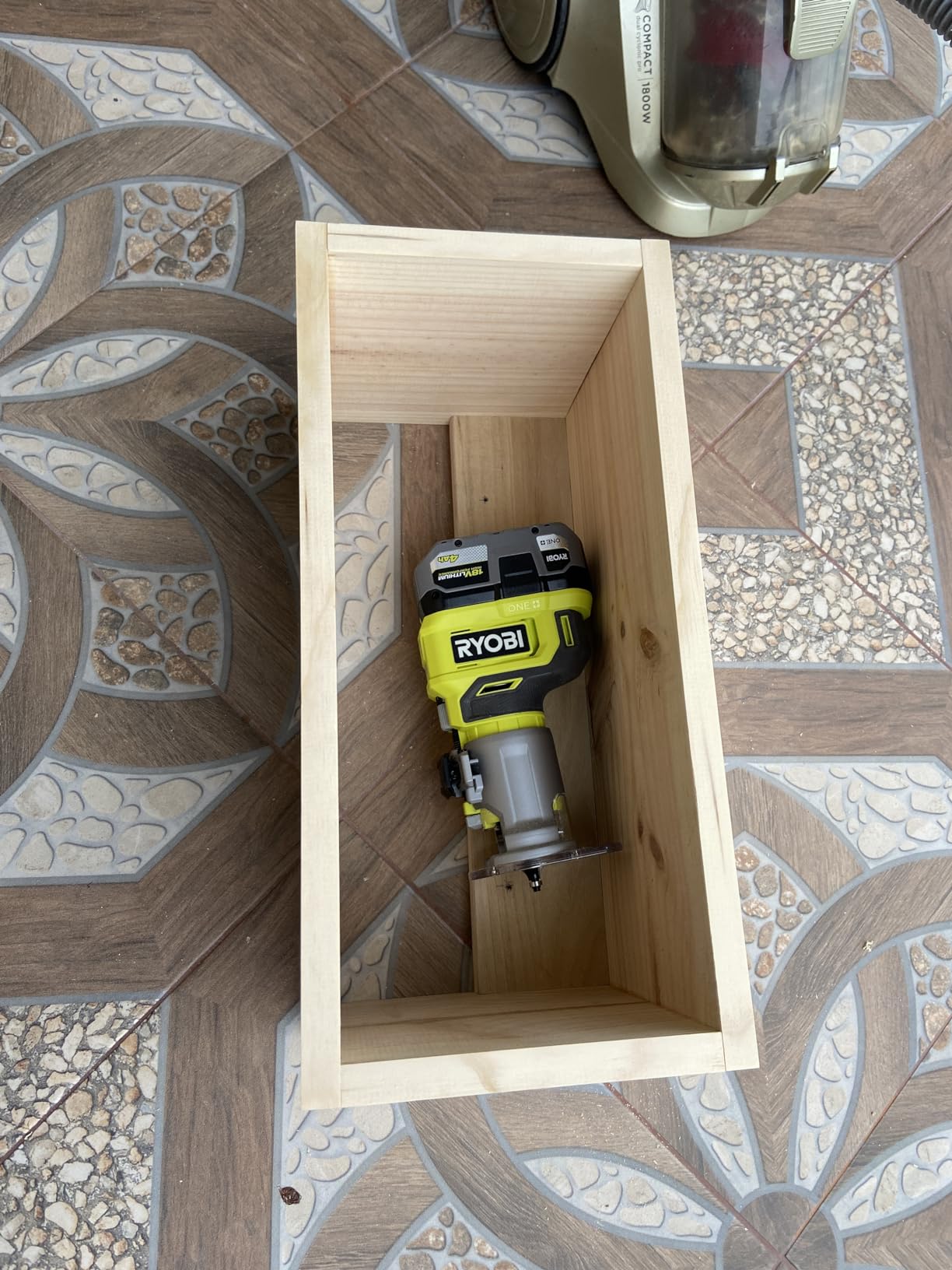
9. RYOBI ONE+ PCL424B Cordless Compact Router – The Cordless Starter on a Budget Platform

RYOBI ONE+ 18V Cordless Compact Fixed Base Router Tool Only (Battery Not Included) – PCL424B
18V ONE+ battery platform
20000-30000 RPM
3.2 pounds
Micro dial depth adjustment
Pros
- Only 3.2 pounds tool-only
- easy in tight spaces
- Micro dial and quick-release lever for fast depth settings
- Runs smoothly with low vibration at full speed
- Dust port and LED light included
Cons
- Battery not included
- and runtime drops on 2Ah and 3Ah packs
- Not intended for heavy single-pass work in thick stock
- Only a 30 day limited warranty
If you already own ONE+ packs, the PCL424B is the cheapest path into cordless routing we found in this roundup. At 3.2 pounds it is the lightest tool here, and weight is the raw material of control.
The micro dial and quick-release lever make depth changes fast and repeatable, which is the other half of control. You set a depth once and the lever holds it while the dial handles fine adjustments.
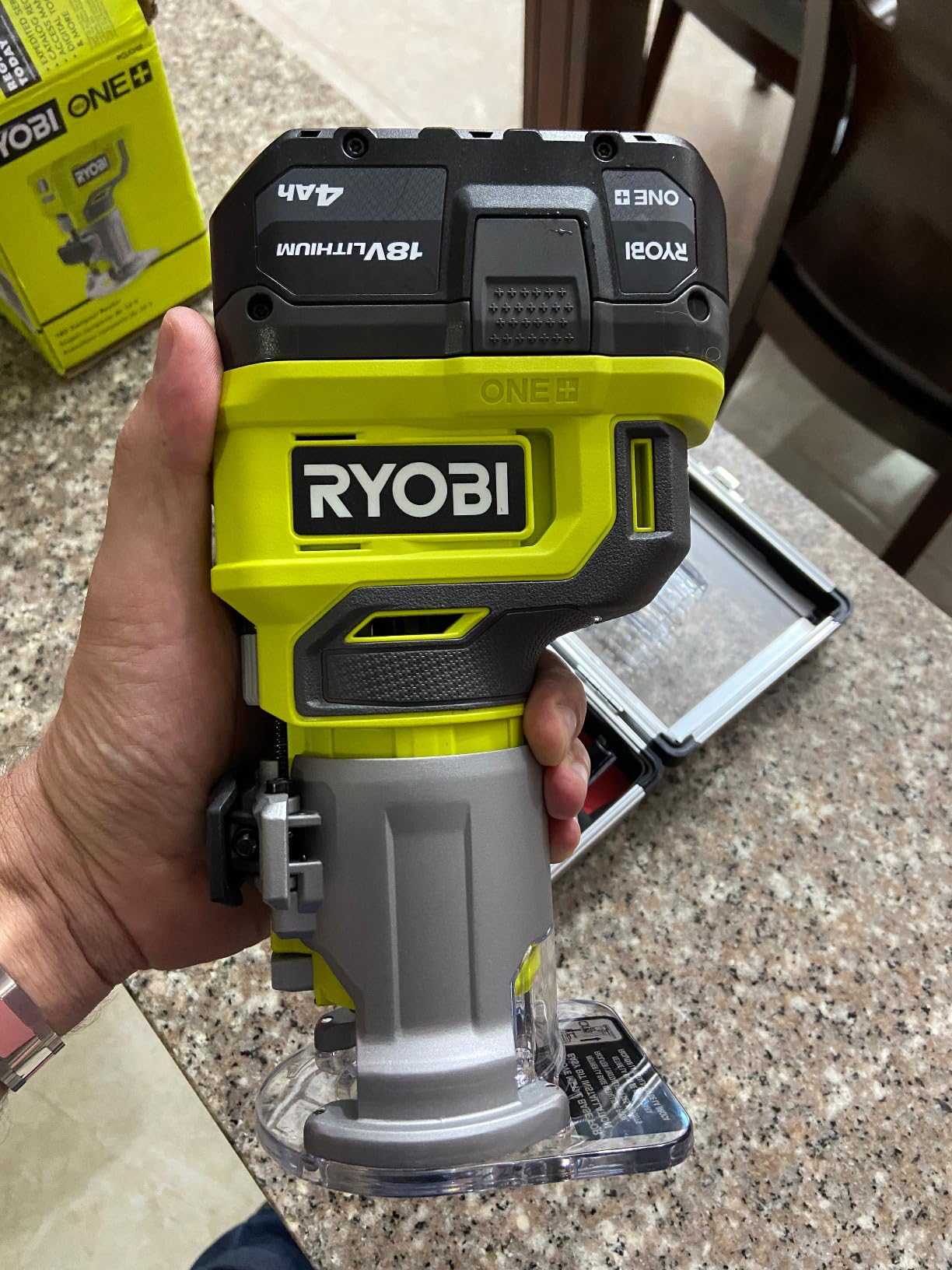
Owners with existing batteries call it a capable everyday addition rather than a shop-only tool. It runs smoothly with little vibration at full speed, which keeps lines clean on thin stock.
First project fits include edge rounding on lightweight hardwood, flush trimming of trim molding and cutting shallow grooves in plywood. It also fits inside cabinets and other spaces where a cord is a trip hazard.
How much runtime should you expect?
It depends almost entirely on pack capacity. On small 2Ah and 3Ah packs the tool finishes noticeably shorter jobs, while higher capacity packs handle a full evening of light work. Buy the largest pack your platform offers.
Battery age matters too. Packs that have sat unused for a few years deliver less than their rating, so factor that into a session plan.
What new owners should be aware of
The 30 day limited warranty is the shortest here, so treat it as a lighter-duty tool and expect a shorter service life under heavy use. Keep multiple light passes on thicker stock rather than one deep cut.
The dust port leaves part of the view window open, which some owners see as a finger-safety concern, and attaching a vacuum hose makes the tool unbalanced. Routers work best with a vacuum running, so plan your routing position around the hose.
10. WEN RT6033 15-Amp Plunge Router Kit – The Most Features per Dollar
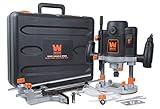
WEN RT6033 15-Amp Variable Speed Plunge Woodworking Router Kit with Carrying Case & Edge Guide
15 Amp motor
8000-23000 RPM variable speed
Plunge depth up to 2-3/8 inches
Hard-shell case included
Pros
- Largest current draw in this roundup at 15 Amps
- Plunge base locks down to work as a fixed router too
- 7-stop turret plus macro and micro dials for depth control
- Kit includes a case
- edge guide
- template guide and dust duct
Cons
- Heavier than expected
- with a mostly plastic body
- Trigger switch is easy to bump and has no lock-on
- No router bits included in the kit
The WEN RT6033 answers a question the combo kits leave open: can you get a genuine plunge router without a separate plunge base purchase? Yes, because this base locks in the down position and functions as a fixed router too.
The 15 Amp motor is the highest current rating in this group, and it accepts both 1/4-inch and 1/2-inch bits with plunge depth up to 2-3/8 inches. That combination handles dados, grooves and stopped cuts straight out of the box.
Depth control is thorough: a 7-stop turret plus macro and micro dials gives fine control in small steps, which is what stopped grooves and inlay work need. Builders describe it as holding plunge depth under load.
The kit is unusually complete around the tool: a hard-shell case, a multi-function straight edge fence, a template guide, a circle-cutting centering pin, a fence scale and a 1-1/2-inch dust duct. That is most of a first-year accessory list in one box.

Is it a reasonable choice for a very first plunge router?
Yes, because the plunge function is there from day one rather than after a second purchase. The 8000 to 23,000 RPM range and soft start also give a controlled entry into the material, which beginners appreciate.
The circle-cutting centering pin expands what you can do with one tool, and the template guide covers repetitive shapes without a full jig.
What could frustrate a new owner
There are no bits in the kit, so plan a bit purchase alongside it. The trigger switch has no lock-on and sits where it can be bumped during a plunge, which is a genuine handling concern in the exact situation where you need both hands.
Owners also note the tool is heavier than expected with a mostly plastic body, and the power cord is short for unrestricted maneuvering. Some units have arrived missing small hardware such as fence guide knobs and a dust port nut.
11. CRAFTSMAN V20 CMCW400B Cordless Router – The Logical Add-On for V20 Owners

CRAFTSMAN V20 Router Tool, Cordless, Variable Speed, Fixed Base Router with Depth Adjustment, Bare Tool Only (CMCW400B)
Brushless motor
16000-30000 RPM variable speed
Depth adjustment knob
4.1 pounds
Pros
- Brushless motor with longer runtime
- Variable speed dial covers 16000 to 30000 RPM
- Knob-based depth adjustment is fast and precise
- LED light and edge guide included
Cons
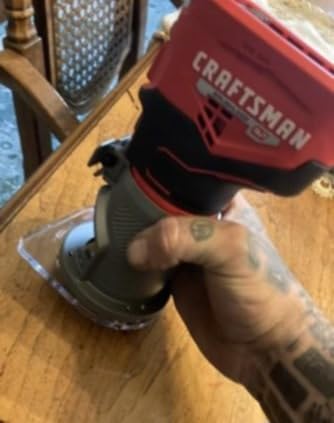
- Clear plastic dust shield distorts the view of the bit
- Shield mounts with a small plastic anchor that feels fragile
- Bare tool only
- so a battery and charger are separate
The CMCW400B exists for one clear reason: if you already run V20 batteries, this adds routing to your platform without a new charger or battery ecosystem. Owners with existing packs describe it as an inexpensive addition to a kit they have already invested in.
Performance surprised reviewers who expected less from a compact cordless router. The brushless motor provides enough torque to edge wood without bogging down, including for users accustomed to corded tools.
The variable speed dial spans 16,000 to 30,000 RPM, which is a practical range for most first projects, and the depth adjustment knob makes height changes fast without fine threading.
At 4.1 pounds it sits in the middle of this roundup on weight, which is a reasonable compromise between a full-size fixed base and a palm router. A LED light handles dim interiors and an edge guide is included for straight line work.
Is it worth buying for V20 users only?
If you own V20 packs, the cost of entry drops sharply because no battery or charger is needed. If you have no CRAFTSMAN tools at all, that saving disappears and a corded option becomes the simpler route.
Because the review base is smaller than the other picks here, treat the long-term durability picture as less settled.
What owners are critical of
The dust collection assembly is the recurring complaint. The clear plastic eye shield distorts the view of the bit, so many owners remove it, which then removes dust collection entirely. Mounting it uses a small plastic anchor dowel that several reviewers describe as fragile.
It is also a fixed base, so no plunge capability, and the bare-tool configuration means the first purchase is not a complete setup.
12. TwoWin 3701 800W Compact Router – The Cheapest Way to Own 15 Bits

TwoWin Router Tool, 110V-120V 800W Compact Wood Router Tool for Woodworking
800W 1.25 HP 6.5 Amp motor
30000 RPM
Fixed base with clear window
4.8 pounds
Pros
- Fifteen tungsten carbide bits in a wooden index case
- 800W motor handles routing and trimming in wood and veneer
- Transparent base gives a clear view of the trimming edge
- Straight and trimming guides included
Cons
- Widest spread of one-star reviews in this group
- Trigger has no lock-on and the guard is finicky
- Plastic base can flex under load
- No dedicated dust collection port
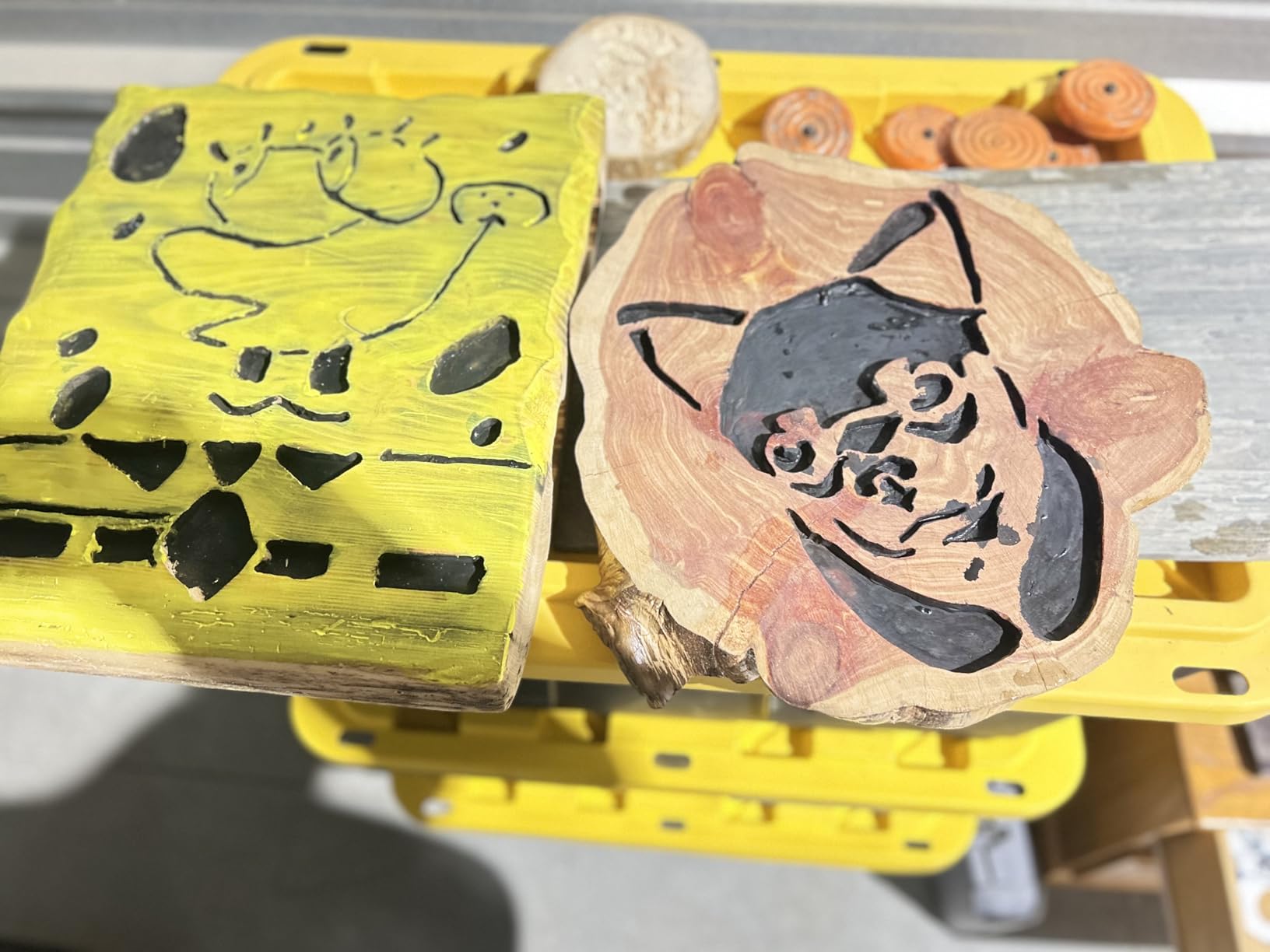
The TwoWin 3701 is included here because of what comes in the box. Fifteen tungsten carbide bits in a wooden organizer would ordinarily cost as much as the router itself, and a beginner without bits has a tool and nothing to cut with.
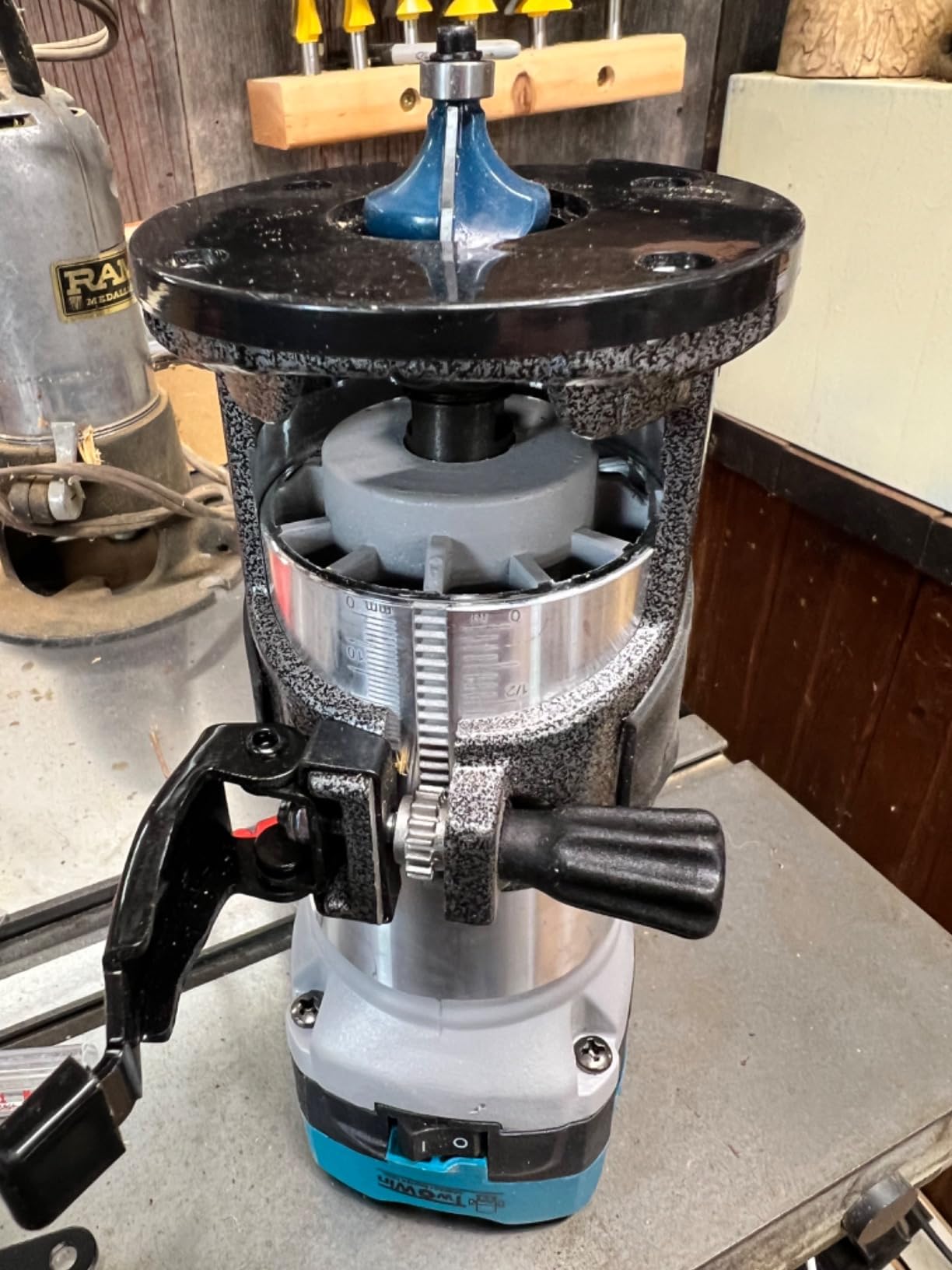
The 800W motor at 30,000 RPM handles routing and trimming across wood, veneer, plastic sheeting and cabinet work. The clear base shows the trimming edge, and both a straight guide and a trimming guide are included.
A lift knob with a scale handles depth adjustment, which is simpler than a fine-thread mechanism and easy to read at a glance. That simplicity suits a first tool.
The bundled bit set covers edging, trimming, veining, grooving and curve cutting, so a beginner can finish a real project without a second shopping trip for carbide bits.
Is it a safe choice for a first-time buyer?
It is a safe choice in the practical sense. The clear base shows the cutting area, the guides keep the tool tracking straight, and tungsten carbide bits hold an edge better than the cheap steel bits that often ship with budget routers.
Buy it as a practice tool with a full bit set and treat it as expendable learning equipment rather than a shop centerpiece.
Where the quality varies
This has the widest negative review band in our group, which points to uneven unit-to-unit consistency rather than a design fault. Buyers who receive a good unit rate it well on value for the accessory bundle.
The plastic base can flex under load, there is no dedicated dust port, and the trigger has no lock-on with a switch guard some buyers find awkward. Chips left on the bit are the main cause of poor cuts, so hook up extraction another way or clean the bit often.
What Is the Difference Between a Fixed-Base and a Plunge Router?
A fixed-base router sets its cutting depth before the bit touches the wood, so the base rests on the edge of the workpiece and travels along it. It is stable, repeatable and fast for edge profiles, flush trims and template work on the edge of a board.
A plunge router sets depth above the workpiece and lowers the spinning bit into the material, which means you can start a cut anywhere on a panel rather than only at an edge. That is the difference between routing a groove with a jig and routing one without.
For a beginner, a combo kit gives both. The SKIL RT1322-00 and the WEN RT6033 cover this ground, and forum owners repeatedly recommend starting with one motor and both bases rather than replacing a whole router later. If your projects are edge-only, a single fixed base is enough, and our router picks under a tighter budget covers the cheaper fixed-base options.
How Much Horsepower Does a Beginner Wood Router Need?
Roughly one horsepower per inch of cutter diameter is the working rule, so a 1-1/4 HP router comfortably runs a 1-1/4-inch bit and a 2-1/4 HP router handles a 2-inch bit. Buy more power than the bit needs rather than less.
The 1-1/4 HP tier covers trim routers, palm routers and light compact work: edge rounding, flush trimming, small dados in thin stock. The 2 to 2-1/4 HP tier covers general woodworking, larger profiles, deeper rabbets and hardwood.
Amperage tells the same story more directly, because current draw is what determines whether the motor bogs. A 12 Amp or 14 Amp motor has real headroom in hardwood, while a 4 to 5 Amp motor is a trimming motor no matter what the listing says.
Owners on woodworking forums consistently recommend buying the strongest router you can reasonably justify, because most beginners outgrow a small trim router within a year. Also remember the collet size, since a 1/2-inch collet is what lets you use the larger bits that need the extra power.
Do You Need Variable Speed, and Corded or Cordless?
Yes on variable speed. Large-diameter bits need low RPM to avoid burning, small bits need high RPM to cut cleanly, and hardwoods need less speed than pine. A router without a dial forces one compromise that shows up as burn marks or a stalled motor.
Corded routers deliver unbroken power and run all day, which is why most full-size models in this roundup are corded. Cordless routers remove the cord snag hazard and work between clamps without an extension lead.
Cordless makes more sense if you already own batteries from one platform, since that is when the cost of entry makes sense. There are four cordless options here across 20V MAX, M18, V20 and ONE+, and each varies on runtime, weight and warranty rather than on core capability. Our wood planer guide covers the other large-power-shop tool a beginner usually pairs with a router.
Five Mistakes Every Beginner Makes With a Router
Trying to remove more than a few thousandths of an inch per pass. This is the number one cause of burnt edges, stalled motors and snapped bits. Make two or three shallow passes instead of one deep one, and the cut looks the same when you sand it.
Starting a plunge in the middle of a board without a jig or a fence. A plunge router needs something to push against. Build a simple fence from a scrap board clamped to the workpiece, or use the plunge only with a template.
Leaving chips on the bit. A loaded bit heats fast, smokes and grabs. Clear it every few inches on softwood, stop and clear it on every pass in MDF or chipboard, and connect dust extraction if you can.
Forgetting to score the cut line. On prefinished trim and laminate, a light score with a marking knife along the line stops the bit from lifting the top fibres and tearing out. It takes ten seconds and changes the finish completely.
Flattening a slab with a router sled as a first project. Forum threads describe snags, kickback and injuries from exactly this. The cord catches under the sled, the router tips and the bit finds a hand. Leave slab flattening until you have a track record with the tool.
Two habits cover most of the rest: clamp the workpiece before routing, and keep both hands on the tool with a firm grip and a slow feed. A router runs away when the bit grabs and the operator lets go, and every incident we saw described in forums started with one of those two missing.
What Not to Buy as Your First Router
Do not start with an underpowered trim router if you have any intention of working in hardwood. A 1 HP palm router is a fine second tool, but as a first router it teaches you to fight a stalling motor instead of learning to control a cut. Owners on forums say beginners outgrow that limit quickly.
Do not buy a bare motor with no base flexibility if you can avoid it. Plunge, tilt and offset bases sold separately turn a modest first purchase into a running accessory bill within months, which is the most common complaint in the review data here.
Do not buy a tool with no variable speed and no soft start. Both features exist at every price level we looked at, and their absence shows up as burn marks and a jolt on startup.
Do not buy bits before you own the router, and do not buy a router without budget for bits. The AVID POWER and TwoWin kits include bits for this reason, and it is worth paying attention to that line on any listing. If you want a structured list of starter tools alongside the router, our beginner wood carving tool guide covers the chisels and grips that pair well with one.
Frequently Asked Questions
What is the best router for basic home use?
A variable-speed compact or midsize router between 1-1/4 HP and 2-1/4 HP with a fixed base handles almost all home projects, from trimming laminate to cutting dados and rounding edges. Add a plunge base later if you need to start cuts in the middle of a panel. Choose a 1/2-inch collet so larger bits fit.
Do I need variable speed on a wood router?
Yes. Large-diameter bits need low speed to avoid burning, small bits need high speed to cut cleanly, and hardwood needs less speed than softwood. A router without a dial forces one compromise, which shows up as smoke, burn marks or a stalled motor. Every router in this roundup has a speed dial.
Do I need a fixed-base or plunge router as a beginner?
Start with a fixed base for edge work, then add a plunge base when you want to cut grooves, dados and stopped cuts in the middle of a board. Combo kits such as the SKIL RT1322-00 and the WEN RT6033 include both bases, which is usually the cheapest route to covering everything.
How much horsepower do I need in a wood router?
Use roughly one horsepower per inch of cutter diameter. That means a 1-1/4 HP router handles bits up to 1-1/4 inches comfortably, while a 2-1/4 HP router handles 2-inch bits, deep rabbets and hardwood work. More power than the bit needs is safer than less, since an overloaded motor burns the workpiece.
Which router is better, Bosch or Dewalt?
Bosch 1617EVS offers a 2.25 HP 12 Amp corded motor with 8000-25000 RPM and both 1/4 and 1/2 inch collets, which suits router tables and hardwood work. The DEWALT DCW600B is cordless with a brushless motor, an electronic brake and a fast depth ring, which suits jobsite and off-grid work. Bosch wins on raw power, Dewalt wins on portability.
What safety precautions should I take when using a router?
Clamp the workpiece, take several shallow passes instead of one deep cut, clear chips from the bit every few inches, score cut lines on prefinished trim to prevent tear-out, and keep the power cord clear of the base. Avoid router sled slab flattening until you have experience, since forum threads document kickback injuries there.
Final Verdict: Which Router Should You Buy First?
Buy the DEWALT DCW600B if you already run 20V MAX batteries or want a cordless tool you can take anywhere, because the brushless motor, depth adjustment ring and electronic feedback make it the most forgiving router on this list. If you have no battery platform at all, buy the Bosch 1617EVS and accept the weight, because 12 amps and a 1/2-inch collet will not let you down.
For the best wood routers for beginners specifically, we would steer most new woodworkers to the SKIL RT1322-00 combo, since both bases and both collets remove the guesswork from your first year. Whatever you choose, buy bits alongside it, take shallow passes, and leave slab flattening to a later chapter.