
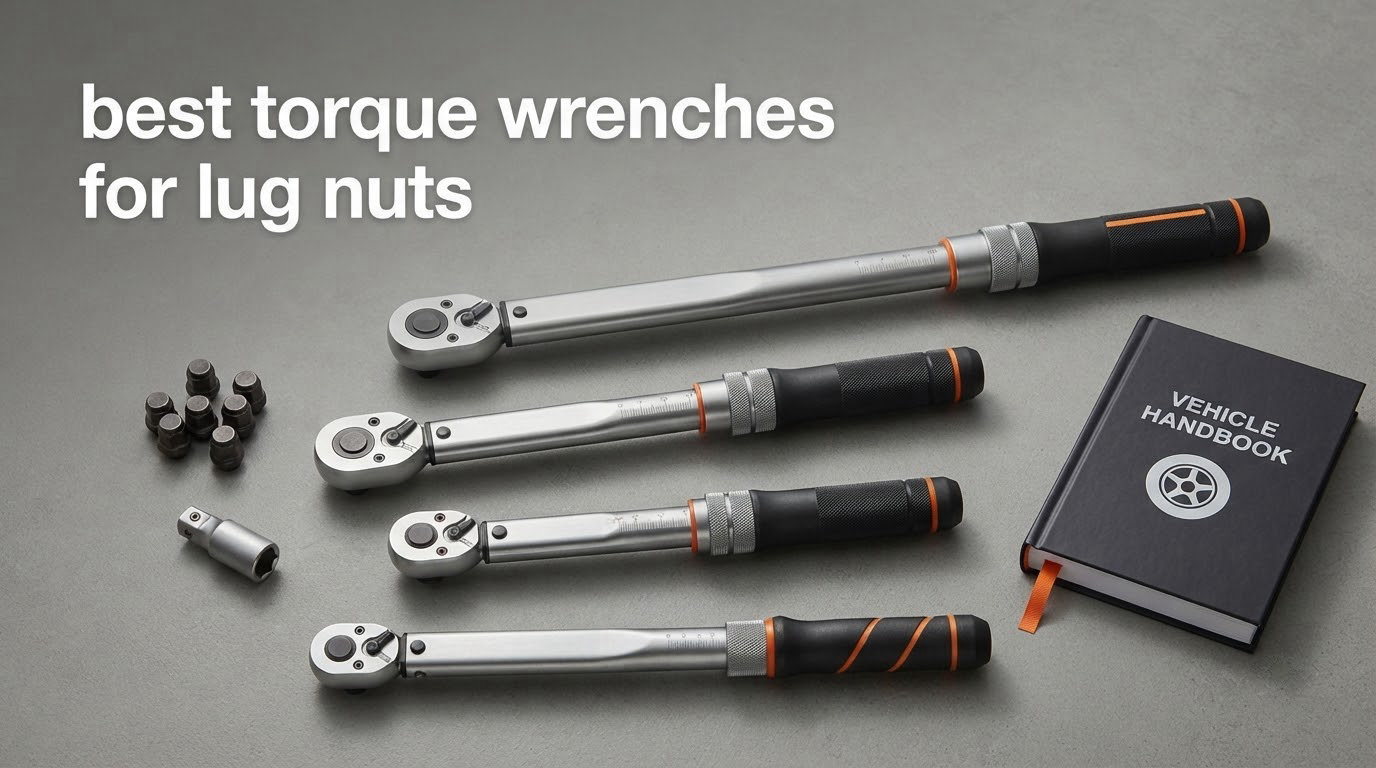
For most car lug nuts, the right tool is a 1/2-inch drive click-type or preset torque wrench covering roughly 80-150 ft-lb. That is the range where the vast majority of passenger car, crossover, and light truck wheel torque specs sit, and 1/2-inch drive gives you the leverage and socket strength that 3/8-inch drive cannot. The wrench should carry a published accuracy percentage, a ratchet head, and a reversible direction so you can work inside a tight wheel well.
That is the short answer to the best torque wrenches for lug nuts question. The longer answer is that the best torque wrench for lug nuts is not the one with the biggest number printed on the handle, it is the one whose usable window covers the specs you actually tighten to, and whose accuracy is specified over that window rather than across the whole scale.
We put ten 1/2-inch drive torque wrenches side by side for this guide, covering click-type, digital, and complete tire change kits across the range from small motorcycle work up to 300 ft-lb wheel nuts. A few of these are the wrenches that show up in nearly every home torque wrench discussion we read, and one of them ended up carrying the most review history of any pick here by a wide margin.
One honesty note before we start. We did not lab-calibrate these wrenches against a reference standard. What follows is manufacturer-published specification, cross-checked against owner review data and long-running forum discussion about the same failure modes. Where a manufacturer states an accuracy figure and the valid range of that figure, we give you both, because a bare percentage without its range is close to meaningless.
If your other priority right now is breaking fasteners loose instead of tightening them to spec, our guide to the best cordless impact wrenches covers the run-down side of a wheel change properly. The two tools do very different jobs, and buying an impact wrench thinking it will torque your lug nuts is the most common expensive mistake in this whole category.
Table of Contents
Top 3 Torque Wrenches for Lug Nuts in 2026

EPAuto ST-010-1 1/2-Inch Click Wrench
- 10-150 ft-lb range
- Plus or minus 4% pre-calibrated
- Chrome vanadium ratchet head
- Storage case included
LEXIVON LX-183 1/2-Inch Click Wrench
- 10-150 ft-lb range
- Plus or minus 4% pre-calibrated
- Calibration certificate included
- Reversible ratchet head

eTORK C3250 50-250 ft-lb Wrench
- 50-250 ft-lb range
- High-visibility torque window
- Dual-direction torque delivery
- Carrying case included
The EPAuto leads because it carries more owner feedback on the same model number than any other pick here, and its 10-150 ft-lb window sits squarely over typical car wheel torque. The LEXIVON is the pick if the calibration certificate and serial traceability matter to you more than anything else, and the eTORK earns its spot for anyone whose vehicle spec runs above 150 ft-lb.
Best Torque Wrenches for Lug Nuts (October 2026)
| Product | Specifications | Action |
|---|---|---|
| EPAuto ST-010-1 1/2-Inch Click Torque Wrench |
|
Check Latest Price |
| LEXIVON LX-183 1/2-Inch Click Torque Wrench |
|
Check Latest Price |
 UYECOVE UETW112250S-BL 1/2-Inch Click Torque Wrench UYECOVE UETW112250S-BL 1/2-Inch Click Torque Wrench |
|
Check Latest Price |
| eTORK C3250 1/2-Inch Torque Wrench |
|
Check Latest Price |
 Amazon Basics DS-DTW-5 Heavy-Duty Torque Wrench Amazon Basics DS-DTW-5 Heavy-Duty Torque Wrench |
|
Check Latest Price |
 Matework MT9067 1/2-Inch Click Torque Wrench Matework MT9067 1/2-Inch Click Torque Wrench |
|
Check Latest Price |
 SUZUME SM3201 Digital Torque Wrench SUZUME SM3201 Digital Torque Wrench |
|
Check Latest Price |
 GEARWRENCH 85066 Micrometer Torque Wrench GEARWRENCH 85066 Micrometer Torque Wrench |
|
Check Latest Price |
 VEVOR 18250FTLB Click Torque Wrench Set VEVOR 18250FTLB Click Torque Wrench Set |
|
Check Latest Price |
 DEWALT DWMT45012 Tire Change Kit DEWALT DWMT45012 Tire Change Kit |
|
Check Latest Price |
Every wrench above is 1/2-inch drive, which is deliberate. That is the correct drive for factory lug torque on cars, crossovers, light trucks, and most full-size trucks, and it is the reason none of the picks here is a 3/8-inch wrench.
1. EPAuto ST-010-1 1/2-Inch Click Wrench – Best for Most Cars
EPAuto 1/2-inch Drive Click Torque Wrench, 10-150 ft/lb, 13.6-203.5 N/m
10-150 ft-lb range
Plus or minus 4% pre-calibrated
16.25 inch long
Chrome vanadium ratchet head
Pros
- Most owner feedback of any pick in this guide
- Pre-calibrated to plus or minus 4% with dual range scale
- Includes storage case and a 5 inch extension bar
- Knurled handle gives a secure grip
Cons
- 150 ft-lb ceiling leaves it short of heavier truck and SUV specs
- Dual ft-lb and Nm scale takes practice to read quickly
The EPAuto ST-010-1 is the wrench I recommend to someone buying their first torque wrench, and the reason is volume of evidence rather than any single spec. It has accumulated more owner reviews than anything else on this list by a wide margin, which means the failure modes are well known. They are also minor and mostly cosmetic.
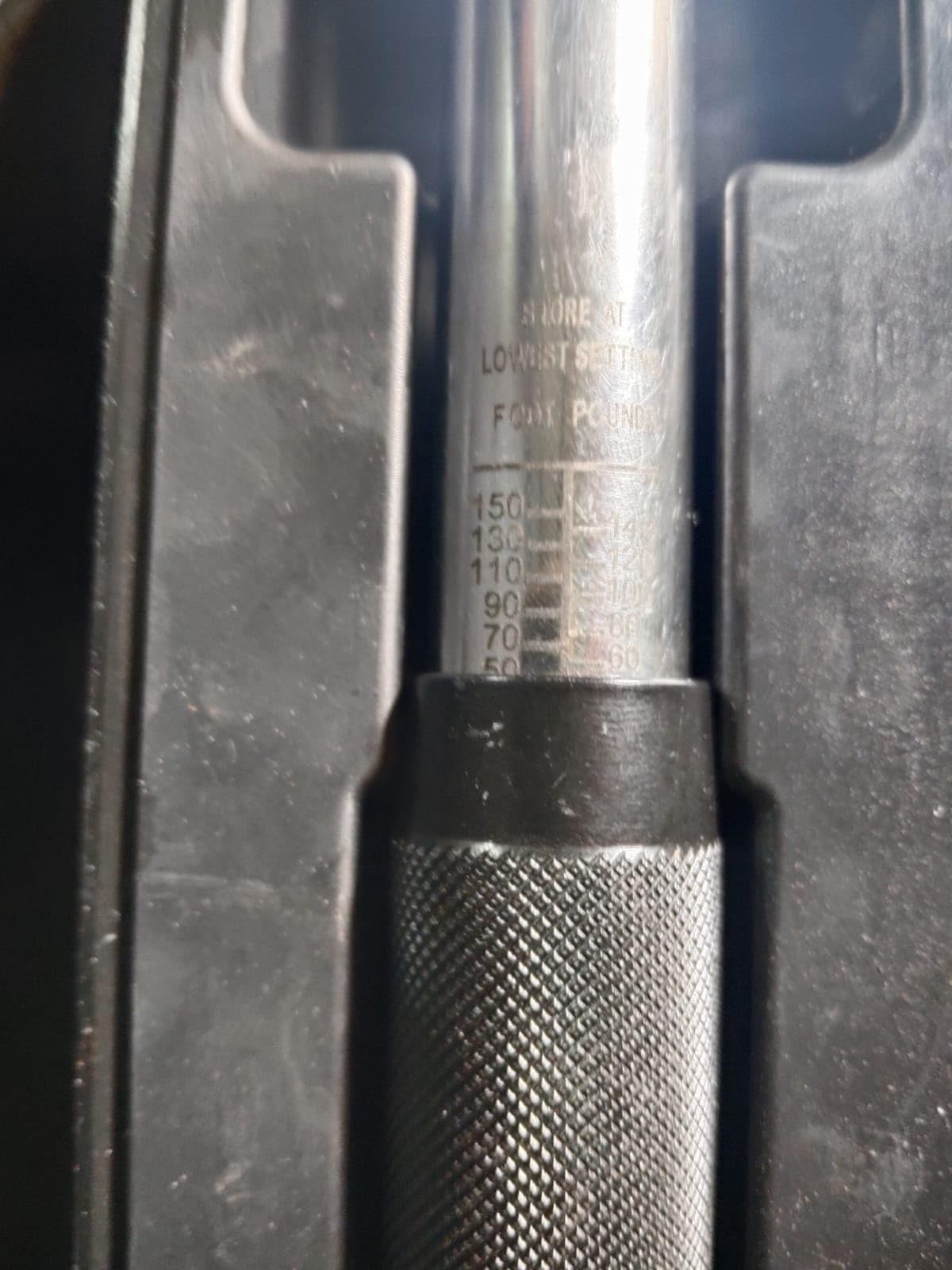
The mechanism is a straightforward click type. You unlock the handle, set the torque on the graduated scale, lock it back, and pull smoothly. At the set value it clicks audibly and tactically. Range is 10-150 ft-lb, and the factory accuracy claim is plus or minus 4 percent, pre-calibrated, on a dual-range scale showing both ft-lb and Nm.
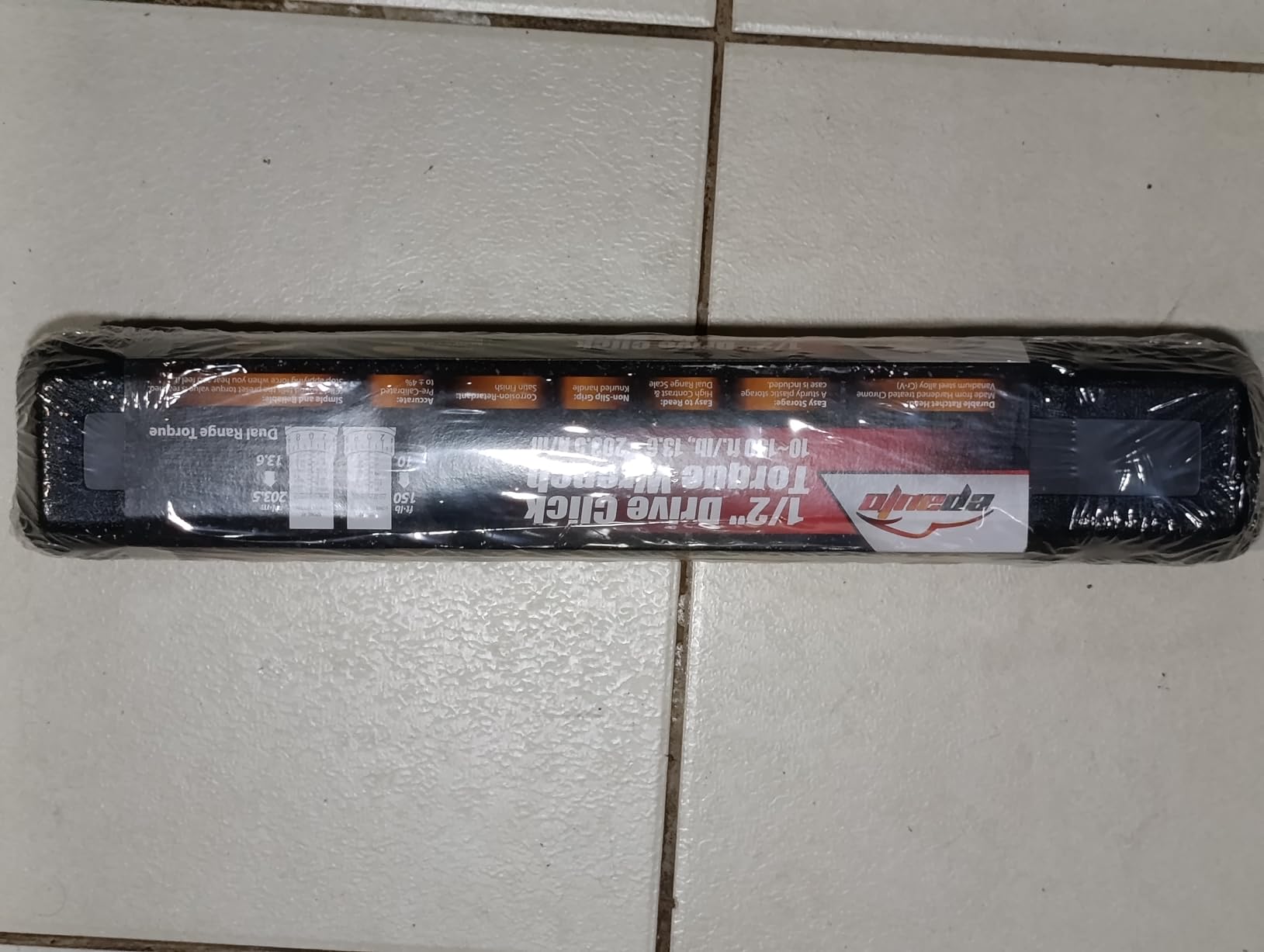
Construction is a hardened, heat-treated chrome vanadium steel ratchet head with a satin corrosion-retardant finish, and the whole tool is 16.25 inches long and 3.5 pounds. It ships with a plastic storage case and a 5 inch 1/2-inch drive extension bar, which is more than most competitors include at this level.
What you give up for the 150 ft-lb ceiling is real. If you drive a full-size truck or a heavy SUV with a high factory lug spec, you will hit the top of this scale and the wrench becomes a lever with no click. That is the one scenario where I would point you at pick four or pick six instead.
The dual scale is genuinely a two-sided trade. Metric and imperial on one handle is convenient when you are reading a European service spec, but a lot of owners report needing a moment to find the right row when they are in a hurry. The knurled handle is doing real work here, because a torque wrench that slips in your hand at 95 ft-lb is a torque wrench that gets set wrong.
Is the EPAuto accurate enough to trust on wheel work?
At its claimed plus or minus 4 percent, a 95 ft-lb lug spec carries a tolerance of roughly 3.8 ft-lb either side. That is a tighter band than most factory torque spreads allow, which means the wrench is not your limiting factor on a typical car. The practical risk is not the calibration, it is the technique: jerking the handle instead of pulling it smoothly, or re-clicking a nut that has already been torqued.
Who should skip the EPAuto and buy something else?
Skip it if your vehicle needs more than 150 ft-lb, if you work on heavy trucks or trailers regularly, or if you want a documented calibration certificate with a traceable serial number. It is also not the wrench for delicate fasteners where a 10 ft-lb floor is still too coarse, such as delicate hardware or light assembly work.
2. LEXIVON LX-183 1/2-Inch Click Wrench – Best With a Traceable Certificate
LEXIVON Torque Wrench 1/2-Inch Drive Click 10~150 Ft-Lb/13.6~203.5 Nm (LX-183)
10-150 ft-lb range
Plus or minus 4% pre-calibrated
17 inch long
Chromium molybdenum steel
Pros
- Calibration certificate with traceable serial number
- High contrast yellow-on-black dual range scale
- Electro-Black corrosion resistant finish
- Reversible ratchet head with knurled handle
Cons
- Measures torque in the clockwise direction only
- 150 ft-lb maximum is light for heavy truck wheels
The LEXIVON LX-183 solves a specific problem that most budget and mid-range wrenches ignore entirely. It ships with a calibration certificate carrying a trackable serial number, which means if you ever need to prove when the wrench was last verified, or get it recalibrated, the paperwork exists. That matters more than most buyers expect at the moment they need it.
Otherwise it is a well-built 1/2-inch click wrench with a 10-150 ft-lb range and the same plus or minus 4 percent pre-calibration claim as the EPAuto. The ratchet head is reinforced hardened chrome vanadium alloy steel, and the body has an Electro-Black coating for rust and corrosion resistance.
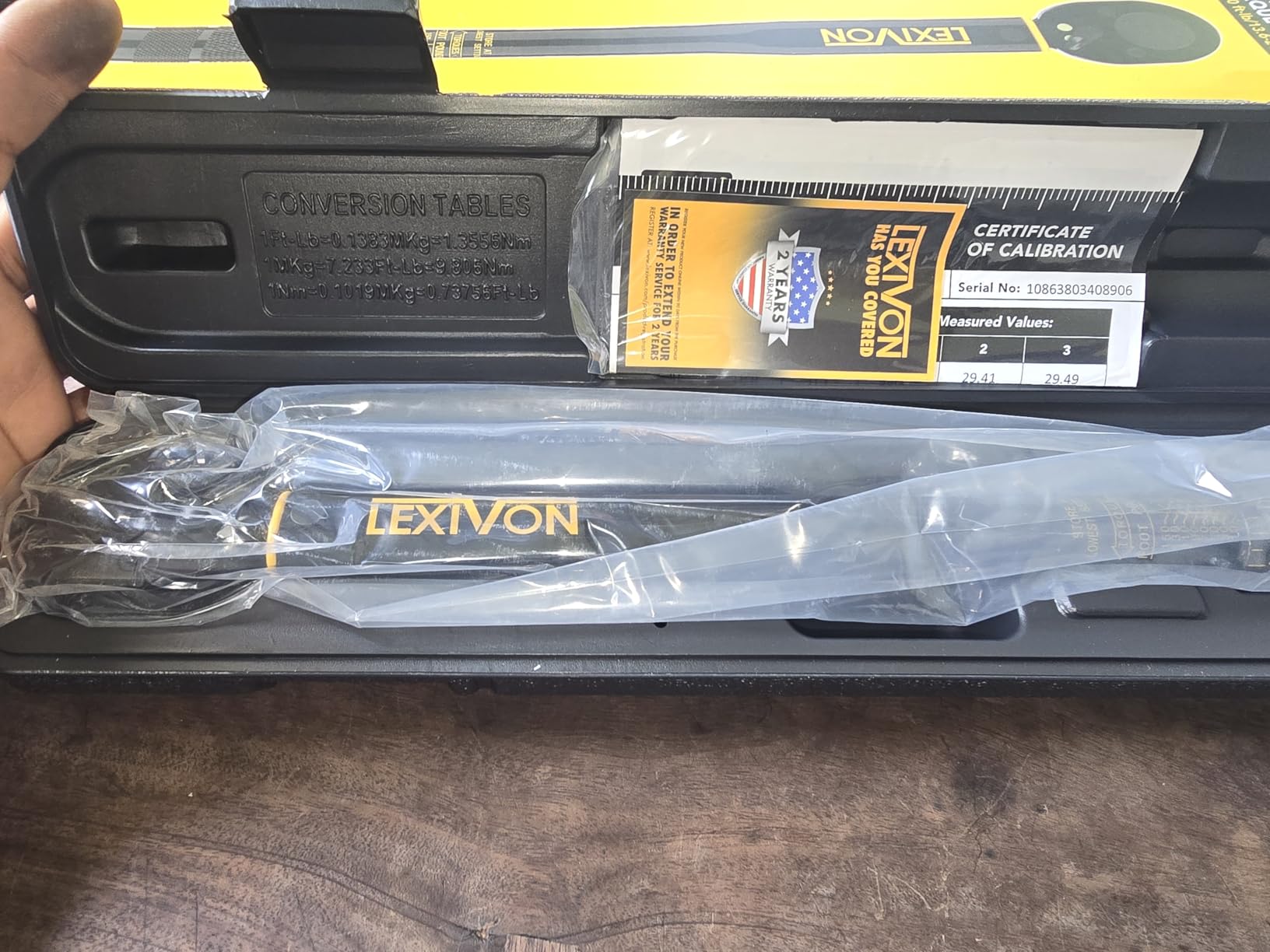
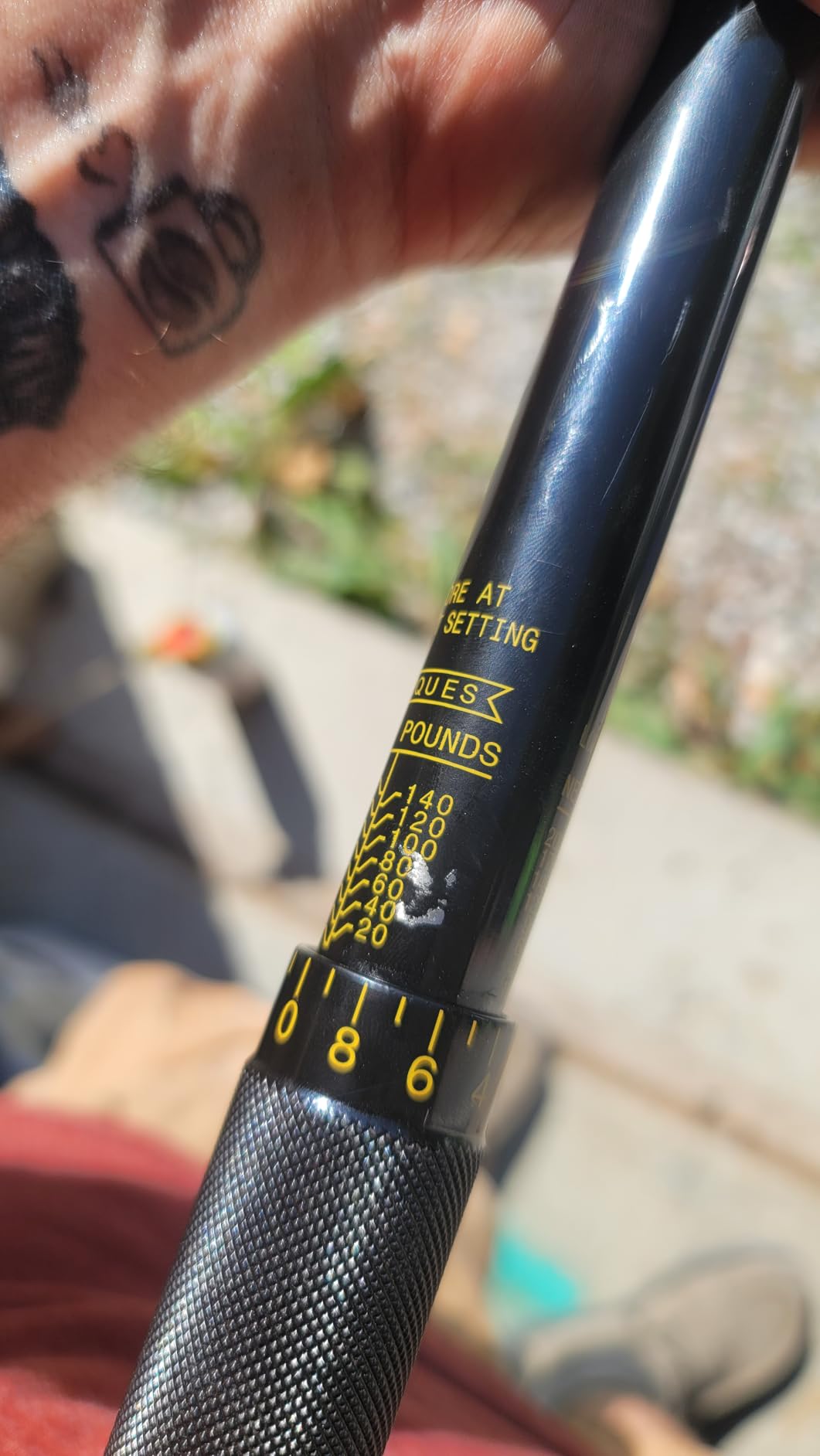
Owner feedback concentrates on one feature above all others: the scale. The patent-pending dual-range markings are yellow on black with high contrast, and owners repeatedly single that out as the easiest scale in this group to read quickly. At 17 inches and 3 pounds it is slightly longer and slightly lighter than the EPAuto, which is a reasonable trade for the readability.
There is one specification detail here that gets misread constantly, and it is worth being precise about. The ratchet head is reversible, which means you can flip the drive to work around a wheel well. That does not mean the wrench measures torque in both directions. The LX-183 is rated clockwise only for measurement, so loosening is not a task this tool performs accurately.
Does the calibration certificate actually add value at home?
For a single car owner, the practical value is modest but real. It confirms the wrench was checked before it shipped, and it gives you a reference point for noticing drift later. If you ever start using the wrench for brake caliper bolts or suspension hardware rather than just wheels, that paper trail stops being a novelty.
What are the drawbacks worth knowing before you buy?
The 150 ft-lb ceiling is the same limitation the EPAuto carries, so heavier vehicle specs still put this wrench out of range. Clockwise-only measurement rules it out for anything where you need to verify a loosening torque, and it costs more than some mechanically equivalent alternatives without a certificate.
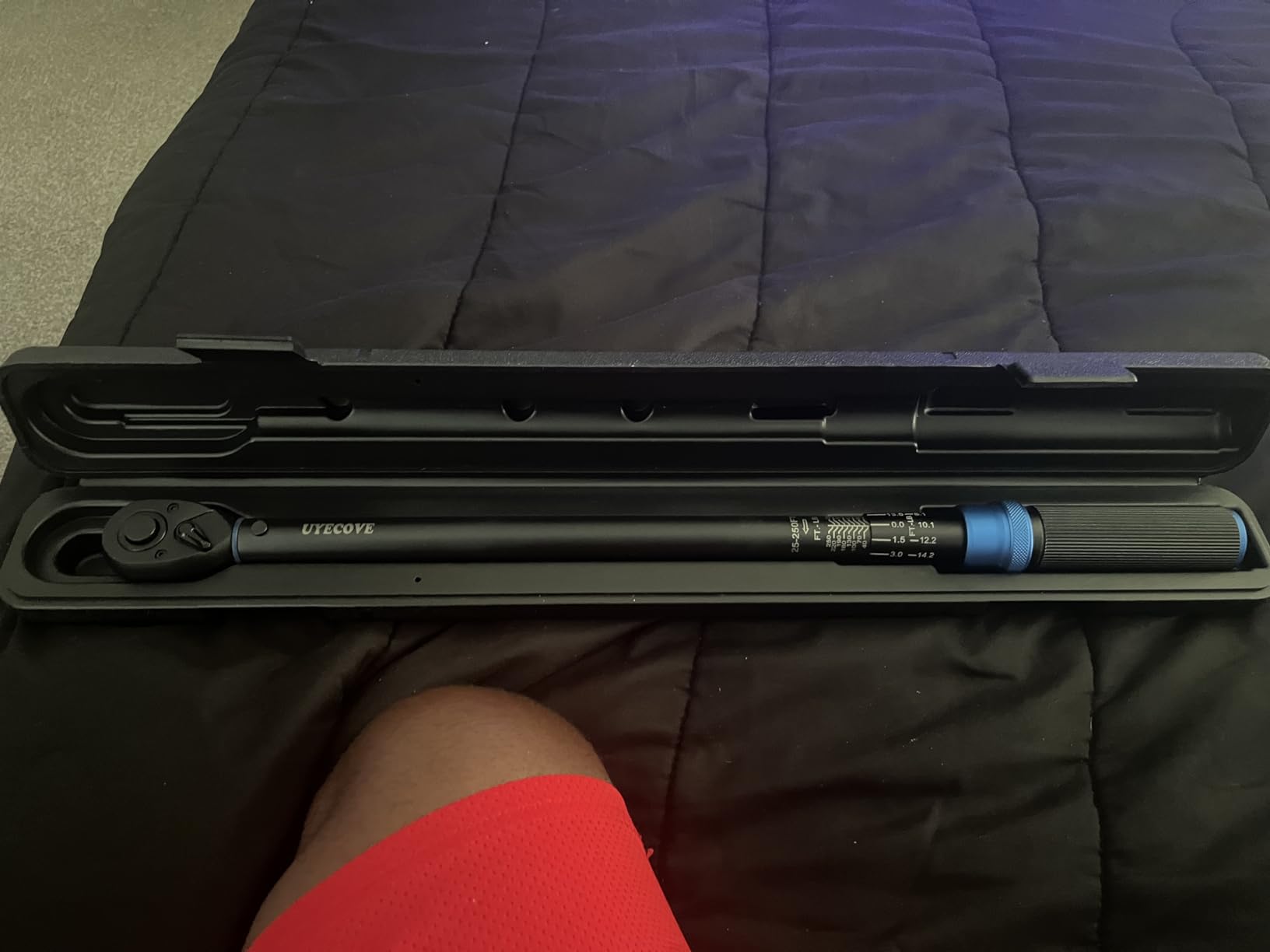
3. UYECOVE UETW112250S-BL – Best for 300 Ft-Lb Wheel Work
UYECOVE 1/2-Inch Drive Click Torque Wrench, Dual-Direction Click Professional Torque Wrench 40-300FT.LB/54.2-406.8N.M, Dual Range Scales Graduated in FT.LB and N.M, Blue
40-300 ft-lb range
Plus or minus 3% pre-calibrated
22.2 inch aluminum handle
72-tooth reversible head
Pros
- 300 ft-lb ceiling covers heavy truck and SUV specs
- 72-tooth reversible head with 5 degree ratchet arc
- Lightweight aluminum handle resists corrosion
- Owners report good results spot-checking against a digital wrench
Cons
- Locking ring must be set correctly or the setting drifts
- SAE scale etching is faint compared with the metric scale
- Paint finish scratches with normal use
The UYECOVE is the answer to the question we get most often from full-size truck and heavy SUV owners, which is what happens when 150 ft-lb is not enough. Its 40-300 ft-lb range overlaps almost every factory wheel spec in that class, and the accuracy claim of plus or minus 3 percent is tighter than most of the mechanical wrenches here.
The ratchet head is the standout feature. Seventy-two teeth working through a 5-degree ratchet arc is genuinely tight, which matters when a lug nut is tucked behind a brake caliper and you cannot keep your thumb off the head to reverse it. The 22.2 inch aluminum handle keeps the listed weight at 0.9 kg, well under the steel-bodied wrenches in this group.
The critical operating detail is the locking ring. You unlock it to set torque, adjust, and lock it back before pulling. Owners report that when the ring is not seated properly the setting can drift mid-pull, which is the one failure mode here that could genuinely get a lug nut over-torqued. Treat the lock as a step you do every single time rather than something you do when you are being careful.
A number of buyers have spot-checked this wrench against a digital tool and reported good agreement, which is reassuring corroboration of the published figure. The manufacturer states each tool is calibration tested and backs it with a four-month service warranty.
Is a 40-300 ft-lb wrench too coarse for a car?
Not quite, but it is close to the edge. The low end of the range is 40 ft-lb, and your car is probably specified somewhere around 90 to 100 ft-lb, which sits comfortably inside the window. A wrench specified 25 percent of its way up the scale is in its accurate region, so a 95 ft-lb lug on a 300 ft-lb tool is a valid use, not a stretch.
What should you watch out for with this wrench?
The faint SAE engraving is a genuine annoyance for anyone working from a US factory spec, since the metric scale is noticeably easier to read. The powder coat scratches cosmetically with normal use, and a small number of units have had issues with the socket-retaining ball and quick-release button assembly, so check the socket retention early.
4. eTORK C3250 – Best for Trucks and SUVs
eTORK 1/2 Inch Drive Foot Pound Torque Wrench (50-250 ft-lb / 70-340 Nm)
50-250 ft-lb range
Plus or minus 3% accuracy
20.5 inch long
High-visibility torque window
Pros
- 50-250 ft-lb range suits truck and SUV wheel work
- Very readable high-visibility torque window
- Crisp audible and tactile click at the set value
- Dual-direction torque delivery with a calibration certificate
Cons
- Lock knob can be bumped mid-pull on higher settings
- Does not loosen fasteners despite the counter-clockwise rating
- Lifetime warranty applies to personal use only
The eTORK C3250 is the wrench I would choose if I owned a truck and did my own maintenance. Its 50-250 ft-lb window is sized for exactly that work, the click is described as genuinely crisp by owners, and the scale window is unusually easy to read at a glance, which is the detail that actually determines whether you set the wrench correctly the first time.
Accuracy is stated at plus or minus 3 percent for dual-direction torque delivery, and a calibration certificate is included. Mechanic-level users report the wrench holding within 2 percent on accuracy checks after a year of daily use, which is a real-world result rather than a spec-sheet number.
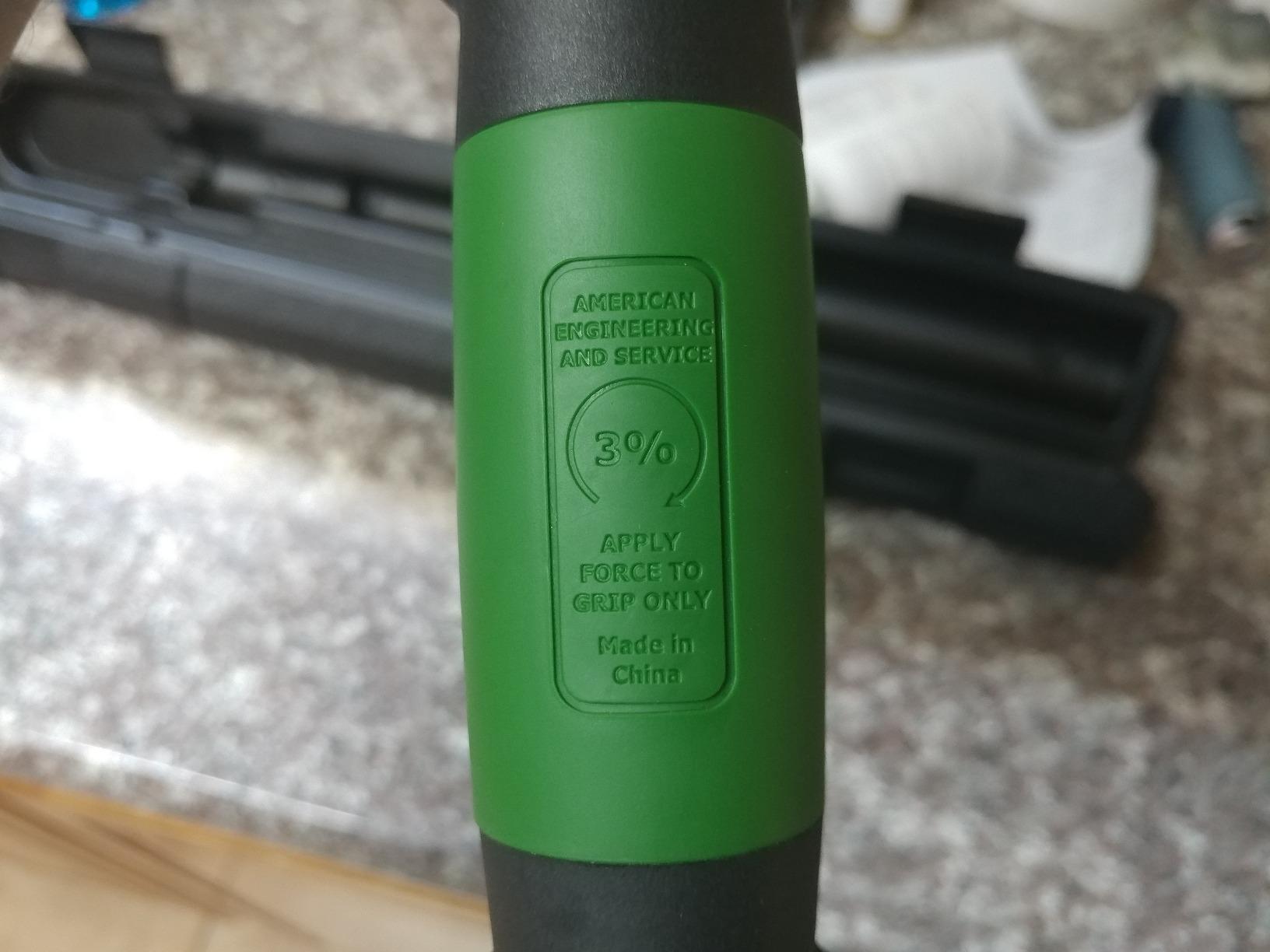
The 50 ft-lb floor is the tradeoff. If you do a lot of smaller work, engine bay fasteners, or suspension work below that number, this wrench is out of its accurate region and you would need something smaller alongside it. For a truck owner who mostly works on wheels, brakes, and suspension, that is rarely a problem.
Two owner complaints are worth taking seriously. The lock knob sits where a large hand can bump it during a hard pull on high settings, which can change the setting mid-use, so keeping your grip lower on the handle helps. And despite the counter-clockwise rating, this is not a loosening wrench, which is a distinction that catches out a lot of buyers.
Is the high-visibility window worth the premium?
Yes, and the reason is frequency. If you are torquing a wheel once a year, scale readability barely matters. If you are rotating tires every few months or working on brakes regularly, it is the feature you will touch every single time, and a misread scale is a mis-set wrench.
Who should look elsewhere?
Anyone working below 50 ft-lb regularly, anyone who needs a 300 ft-lb ceiling for a heavy-duty application, and anyone who wants a warranty that transfers beyond personal use. The lifetime warranty on this one is written for personal use only, which is a real limitation if you ever plan to resell it or use it commercially.
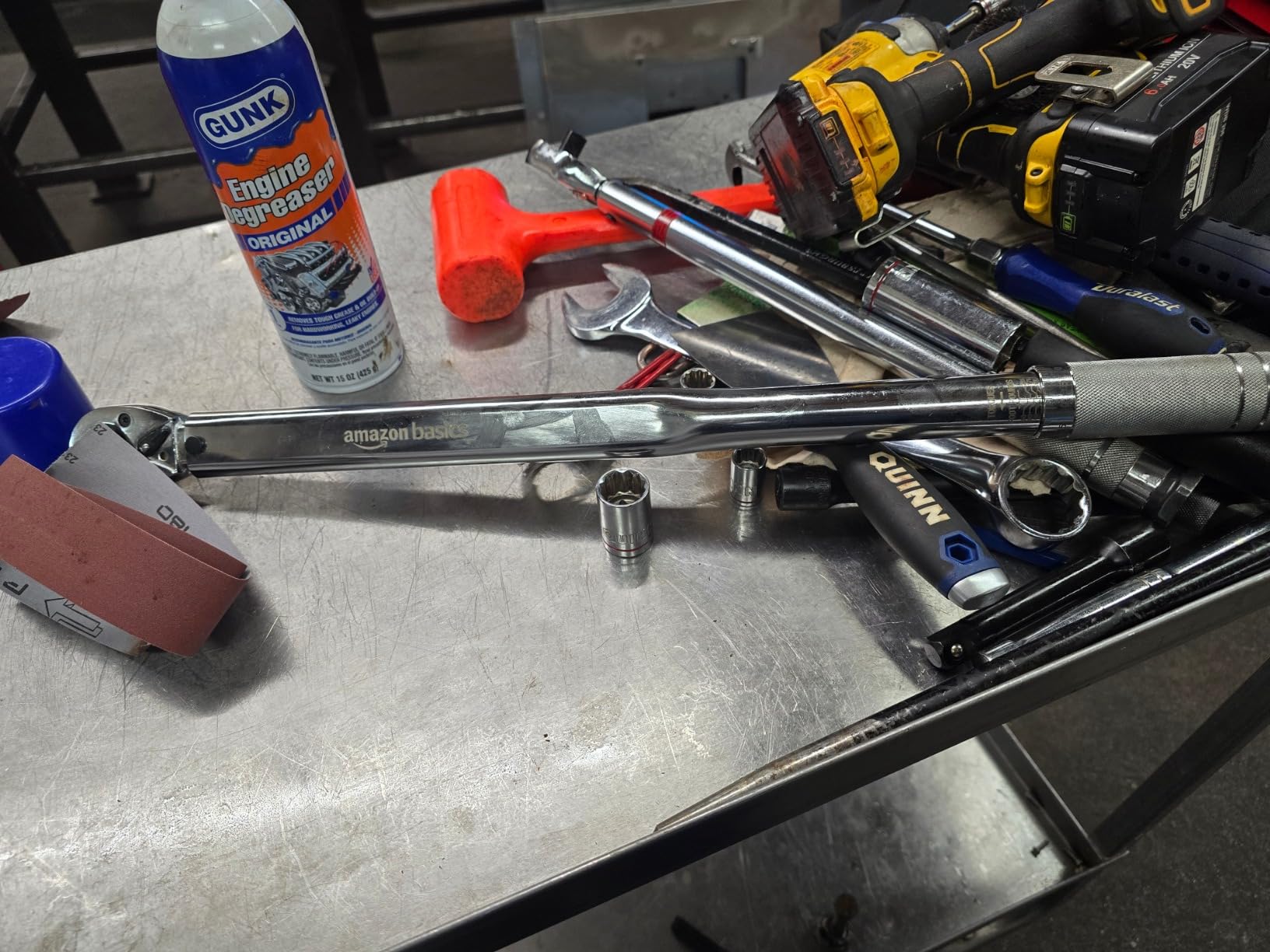
5. Amazon Basics DS-DTW-5 – Best Wide-Range Click Wrench on a Budget
Amazon Basics 1/2-Inch Drive Click Heavy-Duty Torque Wrench with Audible Click, High Accuracy, 25-250 ft-lb, 33.9-338.9 Nm
25-250 ft-lb range
Plus or minus 4% pre-calibrated
Long body for leverage
Storage case included
Pros
- 25-250 ft-lb reaches axle nut and suspension torque
- Long body provides real leverage on tight fasteners
- Dual range scale pre-calibrated to plus or minus 4%
- Storage case included
Cons
- Click is soft and hard to feel at the set torque
- Laser-etched numbers are faint
- Locking mechanism can slip under sustained pressure
The DS-DTW-5 has one of the widest ranges among the mechanical wrenches here at 25-250 ft-lb, and its long body is the feature owners consistently praise. That length translates directly into leverage, and multiple buyers report reaching 129-130 ft-lb with very little effort, which is exactly what you want when a fastener is already tight.
It is a hardened, heat-treated chrome vanadium steel ratchet head with a dual range scale pre-calibrated to plus or minus 4 percent, and it comes with a plastic storage case. On paper it covers a lot of ground for the money.
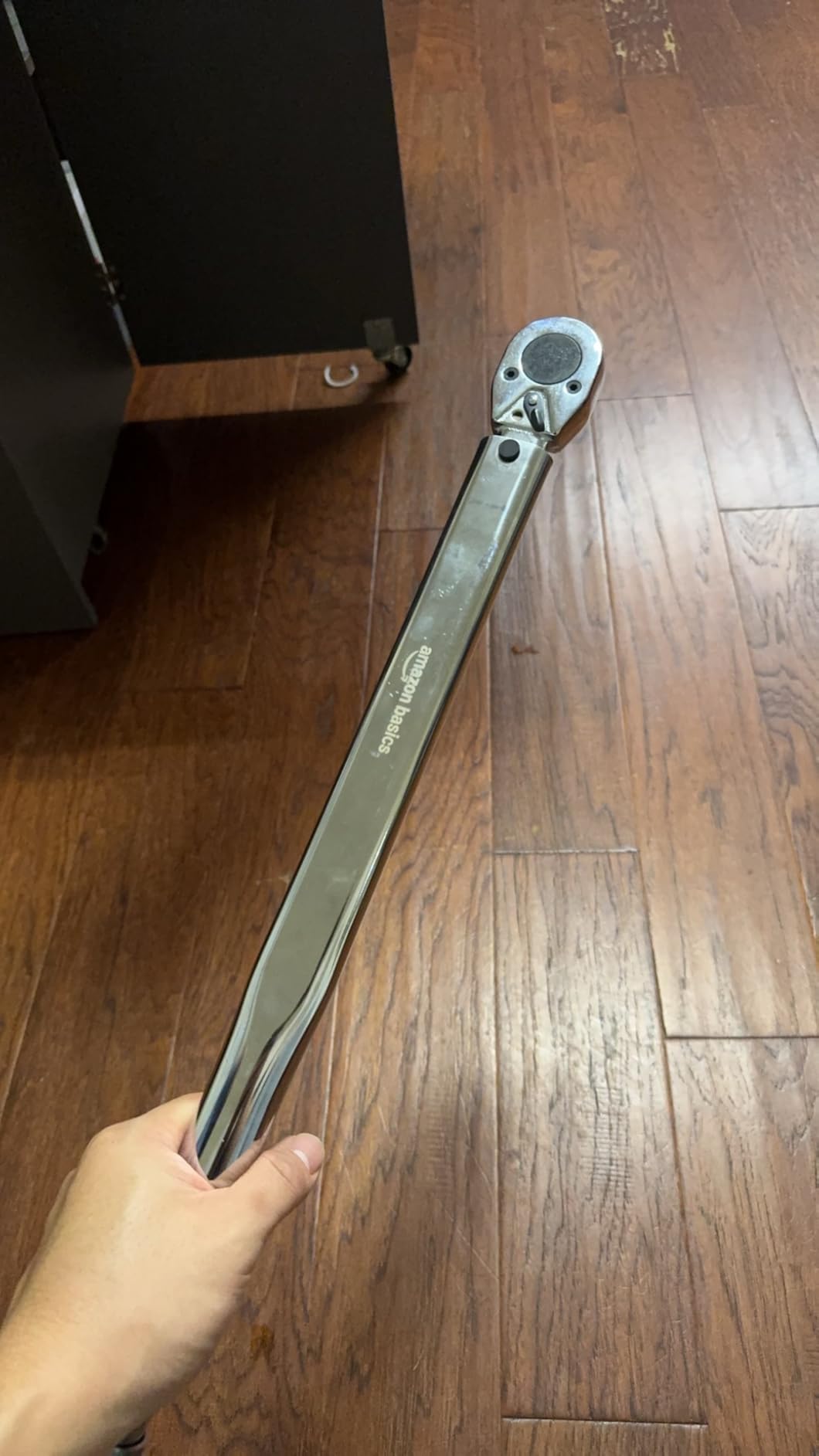
It is also the lowest-rated pick in this group at 4.3 stars, and the reason shows up in the feedback rather than the spec sheet. The click is described as soft and subtle, meaning you can genuinely fail to feel it arrive. The laser-etched numbers are faint, the locking mechanism can slip under sustained pressure, and the knurling on the handle is shallow and uneven. A few buyers report units that were outright inaccurate, including one describing a broken wheel stud as a result.
Read side-by-side comparisons claiming this reads close to a much more expensive tool, and understand what that means. A soft click is a feedback problem rather than a calibration problem, and on a lug nut a click you cannot feel is a click you can miss.
Is the 25-250 ft-lb range a genuine advantage?
For axle nuts and suspension hardware, yes. The 25 ft-lb floor is among the lowest on any wrench in this group, so it reaches below the eTORK while still going to 250 ft-lb. If your work spans small hardware and heavy suspension, the coverage is genuinely attractive on paper.
What should make you cautious about this one?
The soft click is the deciding factor for most buyers. A torque wrench depends on you knowing the moment the target is reached, and if the feedback is hard to feel in a dark garage with a wheel on the ground, that is a meaningful risk on a lug nut. The slipping lock is a second concern for the same reason.
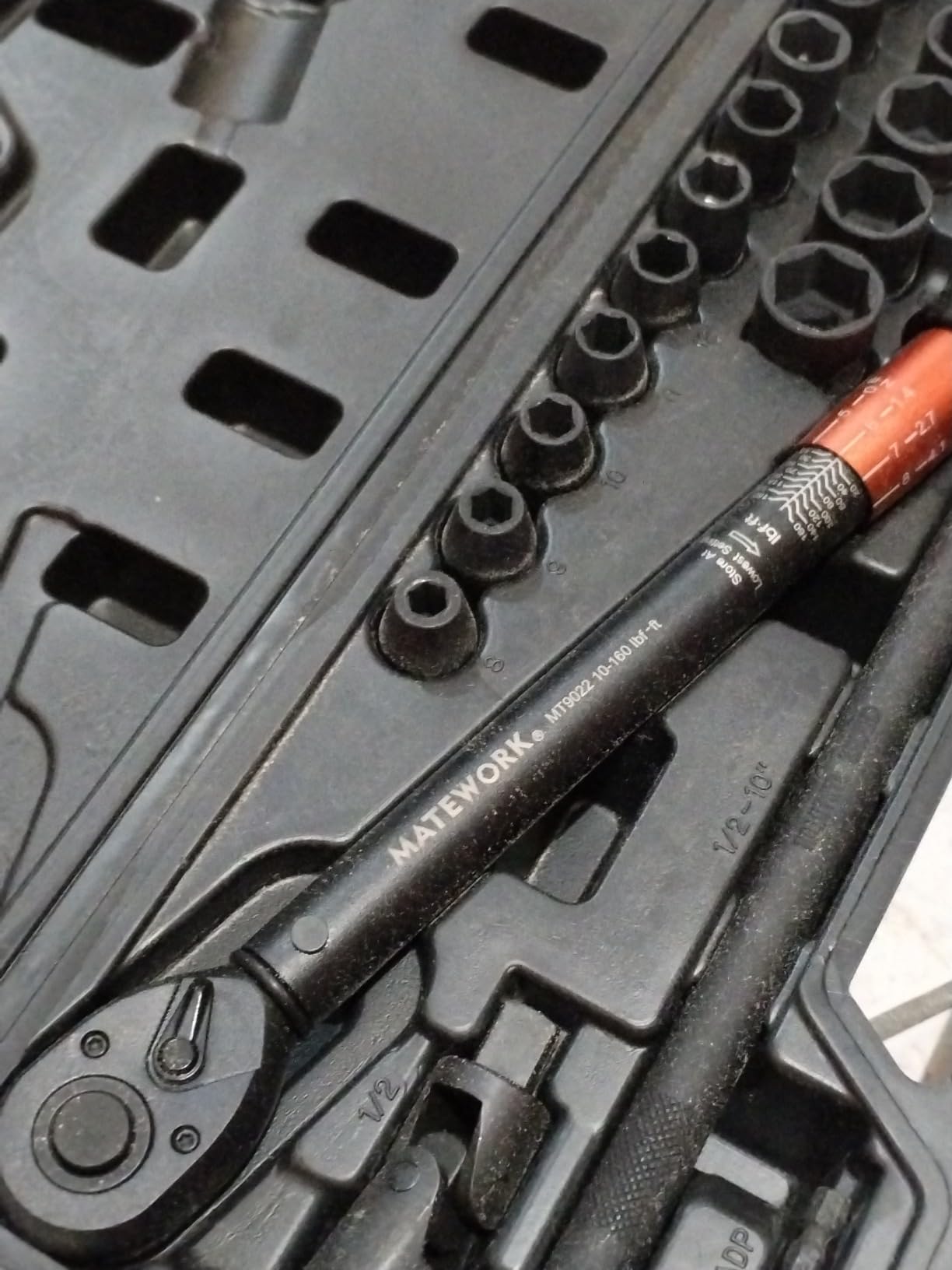
6. Matework MT9067 – Best for Motorcycles and Low-Torque Work
Matework 1/2 Inch Drive Click Torque Wrench, 10-180 ft.lb/13.6-244.1 Nm, ±3% High Precision Lug Nut Torque Wrench with 72 Tooth Dual-Direction for Moto, Wheel Tire and Car Repair
10-180 ft-lb range
Plus or minus 3% accuracy
12 inch handle
72-tooth dual-direction head
Pros
- 72-tooth dual-direction ratchet with quick-release socket loading
- Laser-engraved dual range scale with serial-numbered certificate
- Aluminum-titanium handle stays comfortable over long sessions
- Storage box included
Cons
- Soft breakaway feel reported on some variants
- Isolated reports of a unit breaking on first use
- Too coarse for plastic or delicate fasteners
The Matework MT9067 is the pick for anyone whose largest wheel fastener is not a car lug nut. Motorcycles, small trailers, and compact vehicles sit in the 10-180 ft-lb window, and a 12 inch handle at 1.6 kg is light enough to work accurately on a small wheel without the effort that heavy steel wrenches demand.
Accuracy is stated at plus or minus 3 percent with a laser-engraved dual range scale, and the tool includes a serial-numbered verification certificate. The ratchet is a 72-tooth dual-direction head with quick-release socket loading, and the handle is an aluminum-titanium alloy with knurling that owners say stays comfortable through long sessions.
This one is genuinely popular for brake jobs and tire rotations, which is a reasonable signal for a wrench in this class. The dual-direction head is the useful detail here, since it lets you flip the drive in a confined space rather than pulling the socket off and re-seating it.
The complaints to weigh are a soft breakaway feel reported on some variants and isolated reports of a unit breaking on first use. Neither is a pattern, but both are the kind of thing that only surfaces after the fact. The clearest warning is that this is not a wrench for plastic or delicate fasteners, where the coarse 10 ft-lb floor makes over-tightening very easy.
Can one wrench cover both motorcycles and a car?
Often, yes. Most motorcycle axle and lug specs fall inside 10-180 ft-lb, so if your car is a compact model with a spec in that same window, this single wrench genuinely covers both. If your car runs past 180 ft-lb you will need something larger, and that is where the limit of a one-wrench garage shows up.
What are the real drawbacks?
Soft breakaway feedback on some variants is the main one, for the same reason it matters everywhere: you need to know the click arrived. The isolated first-use breakage reports are worth a quick inspection out of the box. And for anyone doing fine work on softer materials, the range is simply too coarse.
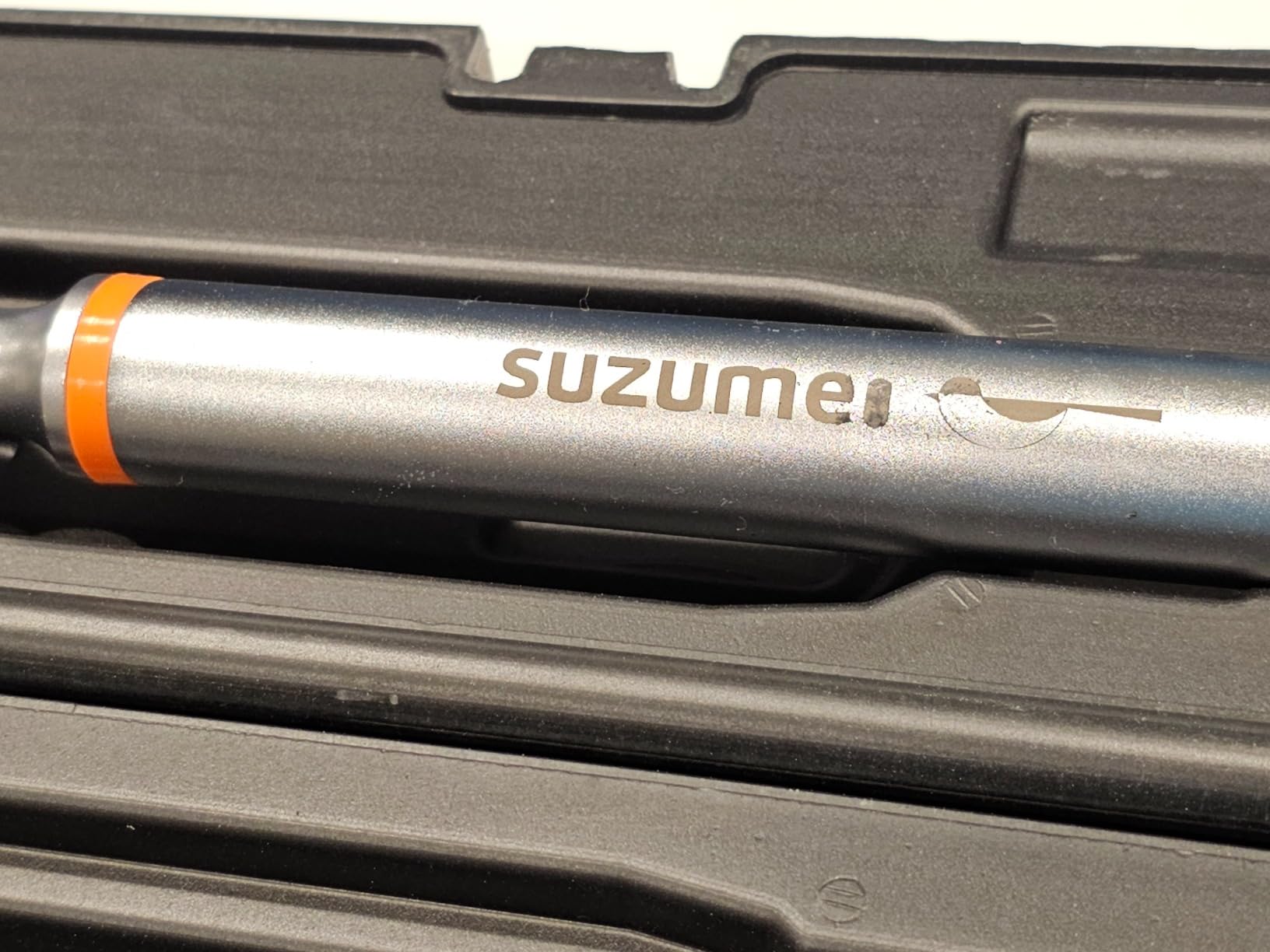
7. SUZUME SM3201 – Best Digital Torque Wrench for Lug Nuts
SUZUME Digital Torque Wrench 1/2 Drive (12.5-250.7 Ft. Lb/ 17-340 N.m)
12.5-250.7 ft-lb range
Plus or minus 2% accuracy
Digital readout with LED alerts
Four measurement units
Pros
- Plus or minus 2% accuracy with certificate of correction
- Beep ramps up approaching target then goes continuous
- Green and red LED indicators at 85-90% and 100%
- Supports Nm
- ft-lb
- in-lb and kg-cm units
Cons
- Requires batteries that can fail when you need the tool
- Included batteries reported to die quickly
- Handle control section is plastic rather than metal
The digital question comes up constantly in home mechanic forums, and the honest answer is that digital is not automatically more accurate. It is more informative. The SUZUME SM3201 makes that case cleanly, with a stated plus or minus 2 percent accuracy, a certificate of correction, and a display that tells you where you are rather than asking you to interpret a needle-like scale.
Its feedback system is the best-designed in this group. The audible beep ramps up as you approach the target and goes continuous at the set value, and LED indicators show green at 85-90 percent and red at 100 percent. You are never guessing whether you got there.
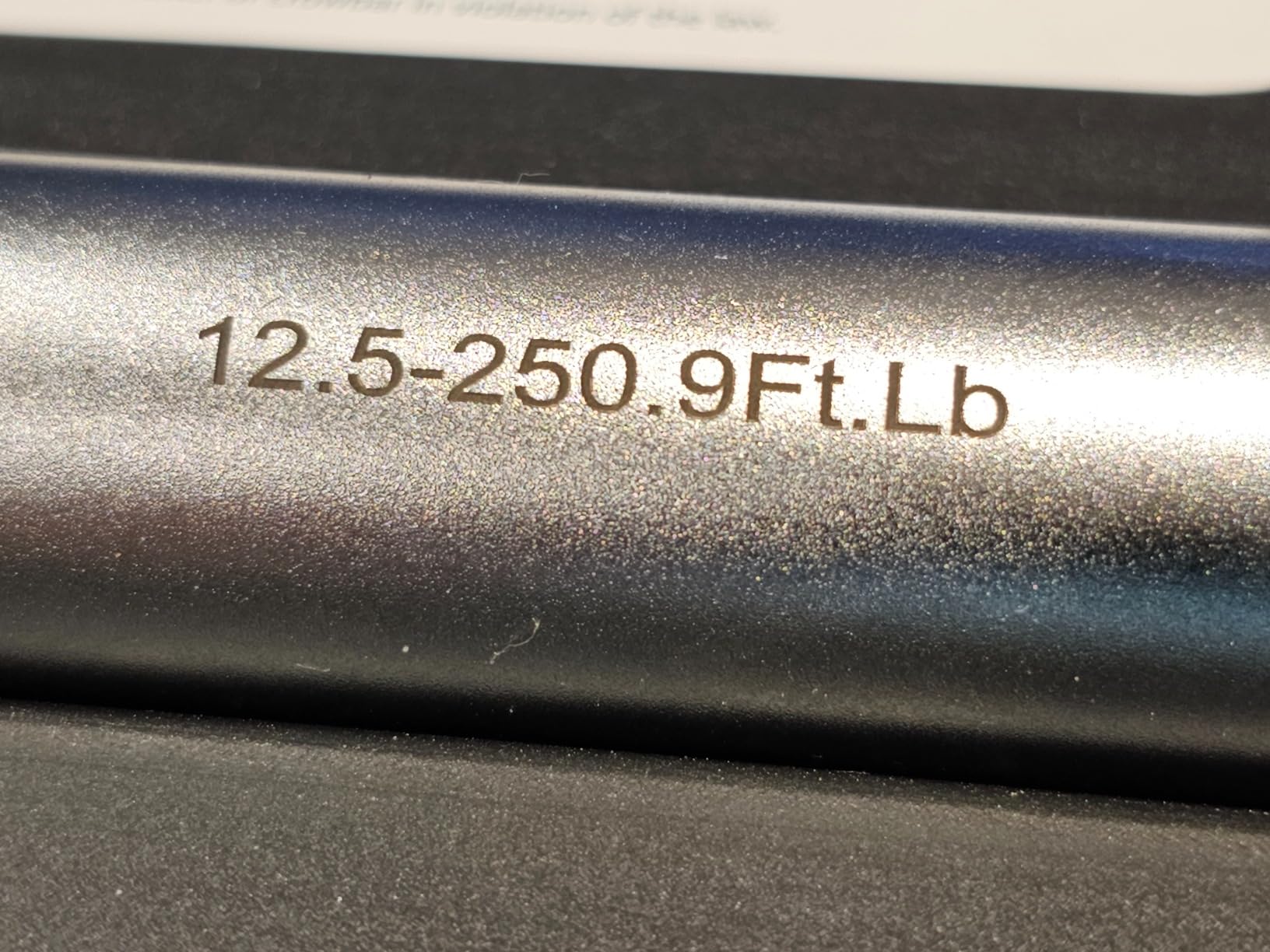
The range is 12.5-250.7 ft-lb, which covers everything from a small car to a light truck, and the 72-tooth reversible head with a 5-degree swing works well in tight wheel wells. Unit switching covers Nm, ft-lb, in-lb, and kg-cm, and it stores peak and track data so you have a record of what was done to the wheel.
Owners report it handles over 180 ft-lb of axle nut torque without complaint and that it holds up well after repeated bench-height drops, which is a meaningful durability signal for a tool that gets dropped. The digital approach also removes the effort problem that mechanics mention about mechanical click wrenches, since you are not fighting to feel a subtle breakaway.
The dependency on power is the real weakness. A digital torque wrench needs batteries, and a small number of buyers reported the included batteries dying quickly. That creates a scenario where the tool that is supposed to save you from a stripped stud is the tool that will not wake up. The plastic handle control section is a second, smaller complaint, and the tool is heavy at 5.6 pounds and 26.57 inches long.
Is digital actually more accurate than a click wrench?
Not inherently. Accuracy comes from calibration, and the published numbers here are plus or minus 2 percent for the SUZUME against plus or minus 3 or 4 percent for the mechanical picks, which is a real difference but a modest one. What digital adds is confidence that you reached the target, not a fundamentally better measurement.
Who should skip a digital wrench?
Skip it if you work in conditions where batteries are a liability, if you want a tool with no failure modes beyond a mechanical spring, or if your budget is better spent on a second mechanical wrench covering a different range. A digital tool also does not solve the range problem, it just makes the numbers more legible.
8. GEARWRENCH 85066 – Best Long-Body Wrench for Stubborn Lug Nuts
GEARWRENCH 1/2″ Drive Micrometer Torque Wrench 30-250 ft/lbs. – 85066
30-250 ft-lb range
Plus or minus 3% from 20% of range
26.75 inch long
Pull adjustment collar
Pros
- Plus or minus 3% accuracy from 20% to 100% of range
- 26.75 inch body gives strong leverage on seized fasteners
- 30-250 ft-lb covers most car and light truck wheel specs
- Backed by a 1-year warranty and 90-day calibration coverage
Cons
- Accuracy spec applies clockwise and only above 20% of range
- Click feel is subtle at the low end of the scale
- Premium price versus comparable 250 ft-lb wrenches
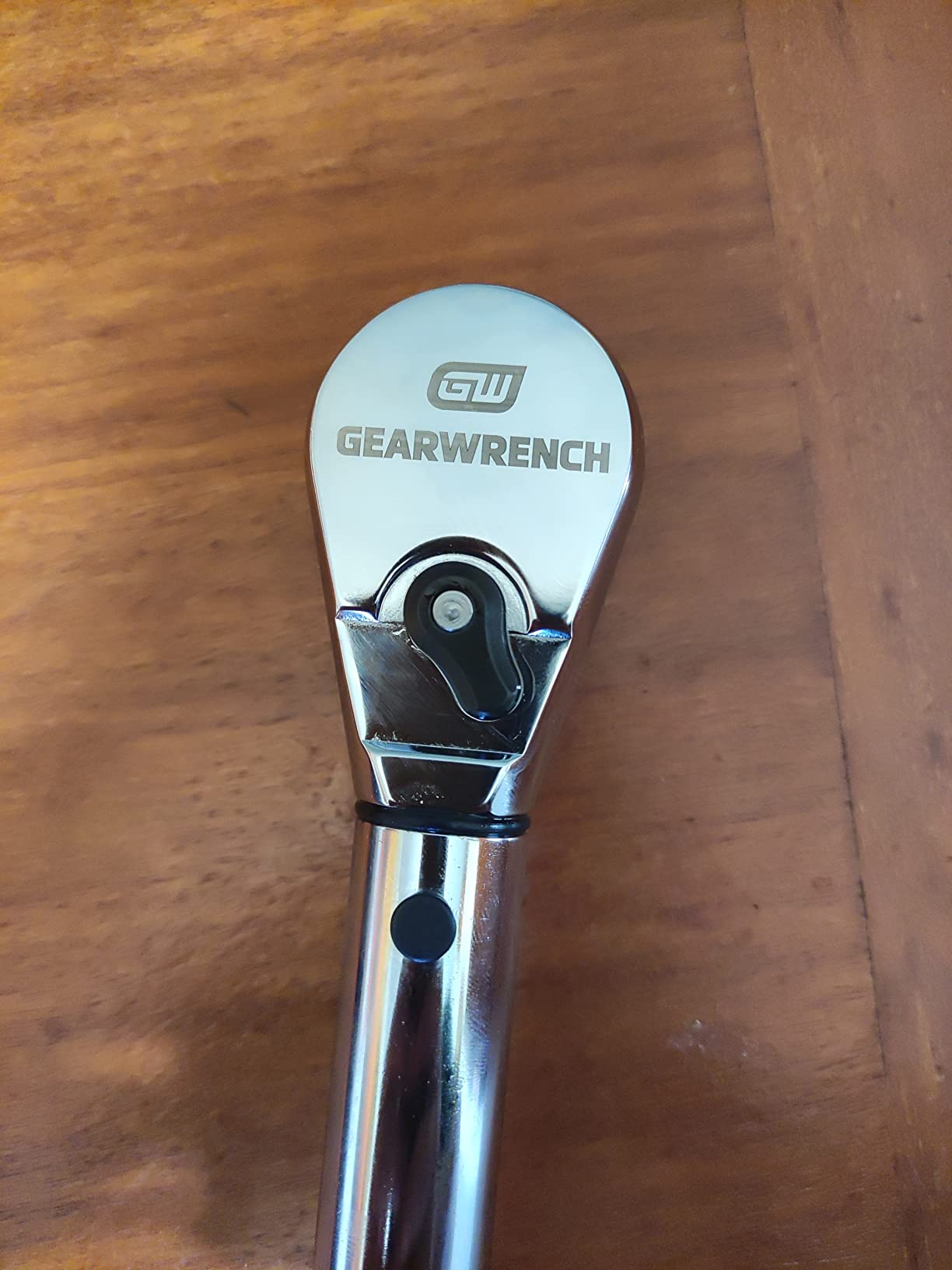
The GEARWRENCH 85066 is the mechanic-grade option here, and its distinguishing physical feature is length. At 26.75 inches it is the longest wrench in this group, and that extra body is leverage. When a lug nut has been on a car through a winter with a shop air gun at full blast, length is the difference between the wrench turning and you giving up.
The accuracy claim is unusually well specified, which is where this brand earns its reputation. It states plus or minus 3 percent clockwise accuracy valid from 20 percent to 100 percent of the 30-250 ft-lb range, which is the exact wording that lets you know where the tool is trustworthy. It is backed by a 1-year manufacturing defect warranty and 90-day calibration coverage.
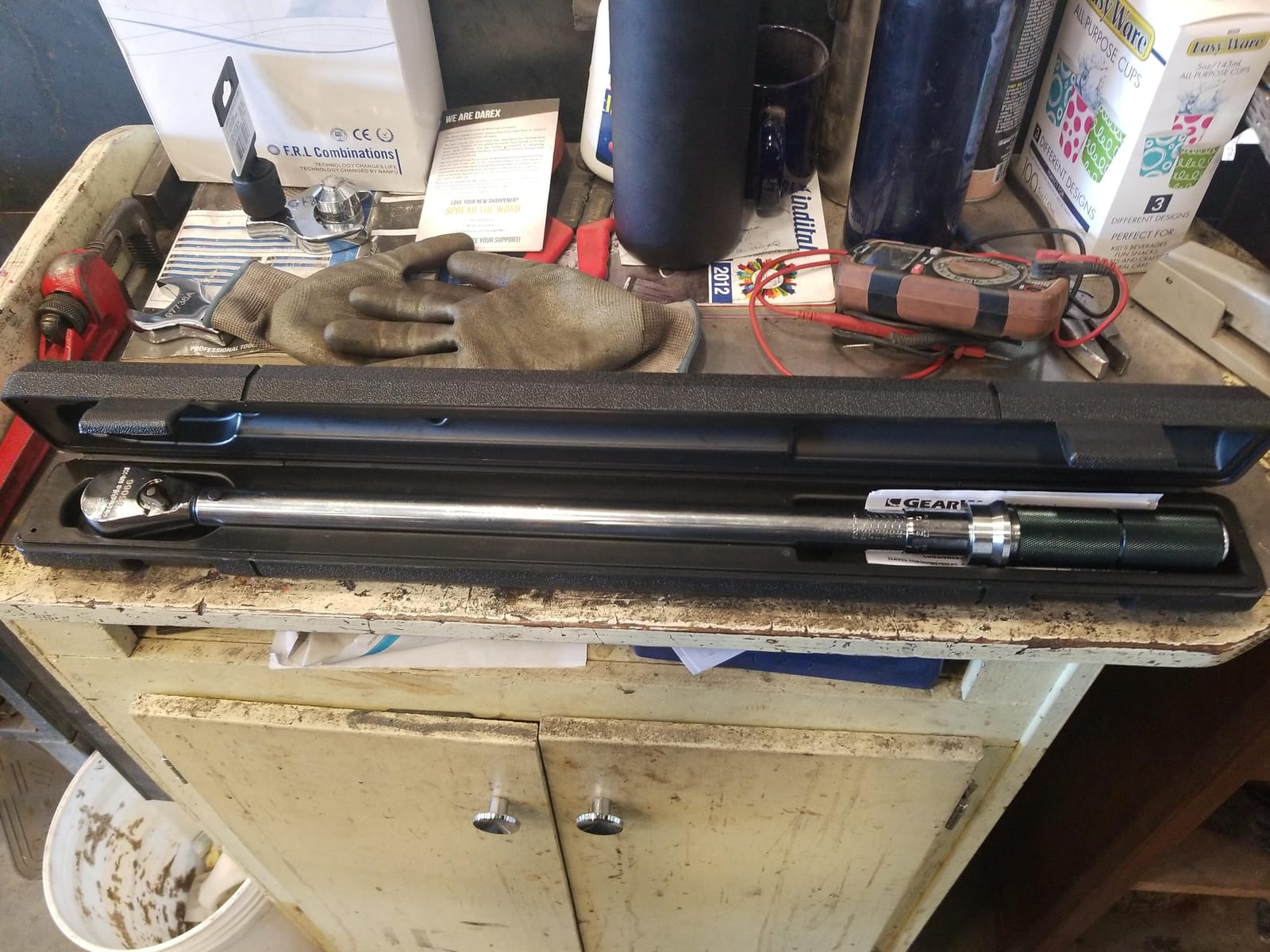
The pull adjustment collar makes setting changes quick, and owners cite dependable accuracy, a smooth ratchet, and the length for high-torque work as the main reasons they keep using it. For a professional or a serious home mechanic doing suspension and brake work alongside wheels, that is a coherent package.
Two honest caveats. The accuracy spec is clockwise only and only above 20 percent of range, which means the bottom of the scale is not spec’d, and the micrometer click can be subtle at lower settings. It is also priced well above mechanically comparable 250 ft-lb click wrenches, and that premium is paying for the brand, the accuracy documentation, and the warranty rather than for a mechanism advantage.
Why does wrench length matter so much on a lug nut?
Torque is force multiplied by lever length. A longer handle means less force from your arm to reach the same torque, which matters in two ways: it lets you hold the wrench square to the fastener without leaning your body weight on it, and it reduces the chance of a small set-to-set error, because a steep-feeling pull is a pull where precision is hard.
Is the premium over a generic 250 ft-lb wrench justified?
For a working mechanic, usually yes, because the documented accuracy range and the calibration coverage are the difference between a tool you trust and a tool you hope. For a single car owner doing tire rotations, the honest answer is that a less expensive wrench covers the same job, and the premium is optional rather than necessary.
9. VEVOR 18250FTLB – Best Set for 1/4-Inch and 1/2-Inch Work
VEVOR 1/2-inch Drive Click Torque Wrench 25-250ft.lb/34-340n.m, Dual-Direction Adjustable Torque Wrench Set with Mechanical Dual Range Scales and Adapters Extension Rod
25-250 ft-lb range
Plus or minus 3% accuracy
Works with 1/4 and 1/2 drive
Calibration certificate included
Pros
- Bundle includes 1/2-to-1/4 adapter plus 3 and 5 inch extension rods
- Calibration certificate included with each wrench
- Chrome vanadium steel with six-stage heat treatment
- Laser-engraved dual range scale readable in low light
Cons
- Feels heavy for a 250 ft-lb wrench at the listed 5.5 pounds
- Listed item length does not match the actual wrench length
- Less long-term calibration support than premium makers
The VEVOR 18250FTLB is the only pick here that comes as a working set, and the reason that matters is the adapter. A 1/2-to-1/4 inch drive adapter plus 3 inch and 5 inch extension rods means the same wrench can handle smaller accessory fasteners in a cramped engine bay and reach a recessed lug nut, without buying a second torque wrench to do it.
Accuracy is stated at up to plus or minus 3 percent across a 25-250 ft-lb range, with a calibration certificate included. The ratchet head is reversible for one-handed socket changes, and the body is chrome vanadium steel with six-stage heat treatment and chrome plating for rust resistance.
Owners particularly like the laser-engraved dual range scale for readability in low light, which is the situation you are actually in more often than you would think, working under a car in a driveway at dusk. The certificate-per-wrench is also a nice touch at this level, and the deep well of included pieces means you can start working the day the box opens.
There are honest gripes. At the listed 5.5 pounds it feels heavy for a 250 ft-lb wrench, and some buyers note the listed item length does not match what actually arrived, so treat the dimensions on the listing with suspicion. More significantly, as an entry-level brand it has less long-term calibration support than the established makers, which is a real factor if you want to send a wrench for recalibration in five years.
Are extension rods safe to use with a torque wrench?
This is an important distinction people miss. The rods included here are for socket access, and using them changes the effective lever length, which is exactly what the factory calibration did not account for. For many fasteners the difference is negligible, but the safest habit is to pull using the wrench handle itself, straight through, with the socket as close to the fastener as the clearance allows.
When is this set the wrong choice?
Skip it if you need long-term recalibration support from an established manufacturer, if a light tool matters for repeated overhead work, or if you want the reassurance of a long published track record. It is the right choice when you want a lot of included access hardware and a certificate without buying each piece separately.
10. DEWALT DWMT45012 – Best Tire Change Kit With a Torque Wrench
DEWALT Torque Wrench Tool Set, Tire Change Kit, 50-250 FT-LB, 12 Piece with Storage Case (DWMT45012)
50-250 ft-lb range
Twelve piece tire change kit
Breaker bar included
Forward and reverse torque
Pros
- Highest rated pick in this group with 89% five-star reviews
- Twelve-piece set covers wrench
- breaker bar and eight sockets
- Breaker bar handles stubborn lug nuts the wrench should not touch
- Hardshell case keeps every piece organized
Cons
- Included sockets are short so the wrench can touch the tire
- No straight extension included in the kit
- Sockets are not impact-rated
The DEWALT DWMT45012 is the highest-rated pick here at 4.8 stars, and it takes a different approach from every other wrench on this list. It is a 12-piece tire change kit: a 50-250 ft-lb 1/2-inch micrometer torque wrench, a 1/2-inch breaker bar, and eight sockets covering SAE 3/4, 13/16, 7/8, 15/16, and 1 inch plus metric 18, 19, 21, 22, and 24 mm.
That breaker bar matters more than it might look. The torque wrench is a precision instrument and should never be used to break a seized lug nut loose, but a wheel change needs a tool that can do that job properly. Having both in one case, correctly separated, removes the temptation to do it wrong with the wrong tool.
The wrench itself has forward and reverse torque capability with a locking trigger that controls the applied torque, a protective head bumper, and a bi-material grip for comfort. The finish is polished chrome vanadium, the set is ASME, ISO, and TAA compliant, and the sockets use DirectTorqueTechnology with knurled control rings and hard stamped markings that stay readable after a year of abuse.
Owners repeatedly praise the accurate, easy-to-adjust wrench, the breaker bar leverage, and how well the hardshell case keeps everything organized. That last point is not trivial, because a torque wrench that lives loose in a toolbox drawer is a torque wrench that gets dropped and knocked out of calibration.
The most common complaint is that the bundled sockets are short, which on some vehicles lets the wrench body touch the tire sidewall during a pull. That is a real clearance issue and the main reason buyers add an extension separately. There is no straight extension in the kit, the sockets are not impact-rated, and the listing understates the actual size of the wrench.
Is a kit better than buying a wrench on its own?
For a first-time buyer who changes tires and does oil changes, the kit is the efficient path. You get a wrench that covers 50-250 ft-lb, the sockets you need for the wheel, and a breaker bar for the seized lug nut that would otherwise tempt you to abuse the wrench. For someone who already owns deep sockets and a breaker bar, the individual wrench route is cheaper and better.
What is the 50 ft-lb floor like in practice?
It is fine for a truck or SUV, which is what this kit is aimed at, and poor for smaller cars. A compact car specified at 60-70 ft-lb still works because it sits inside the 50-250 ft-lb window, but if you also want to do suspension or brake work on something smaller, you will want a second, lower-range wrench alongside this one.
How to Torque Lug Nuts Correctly
Owning the right wrench is half the job. The other half is a sequence that takes about three minutes and eliminates most of the damage people attribute to over-torquing. What usually goes wrong is not the final number, it is the sequence and the way the handle is pulled.
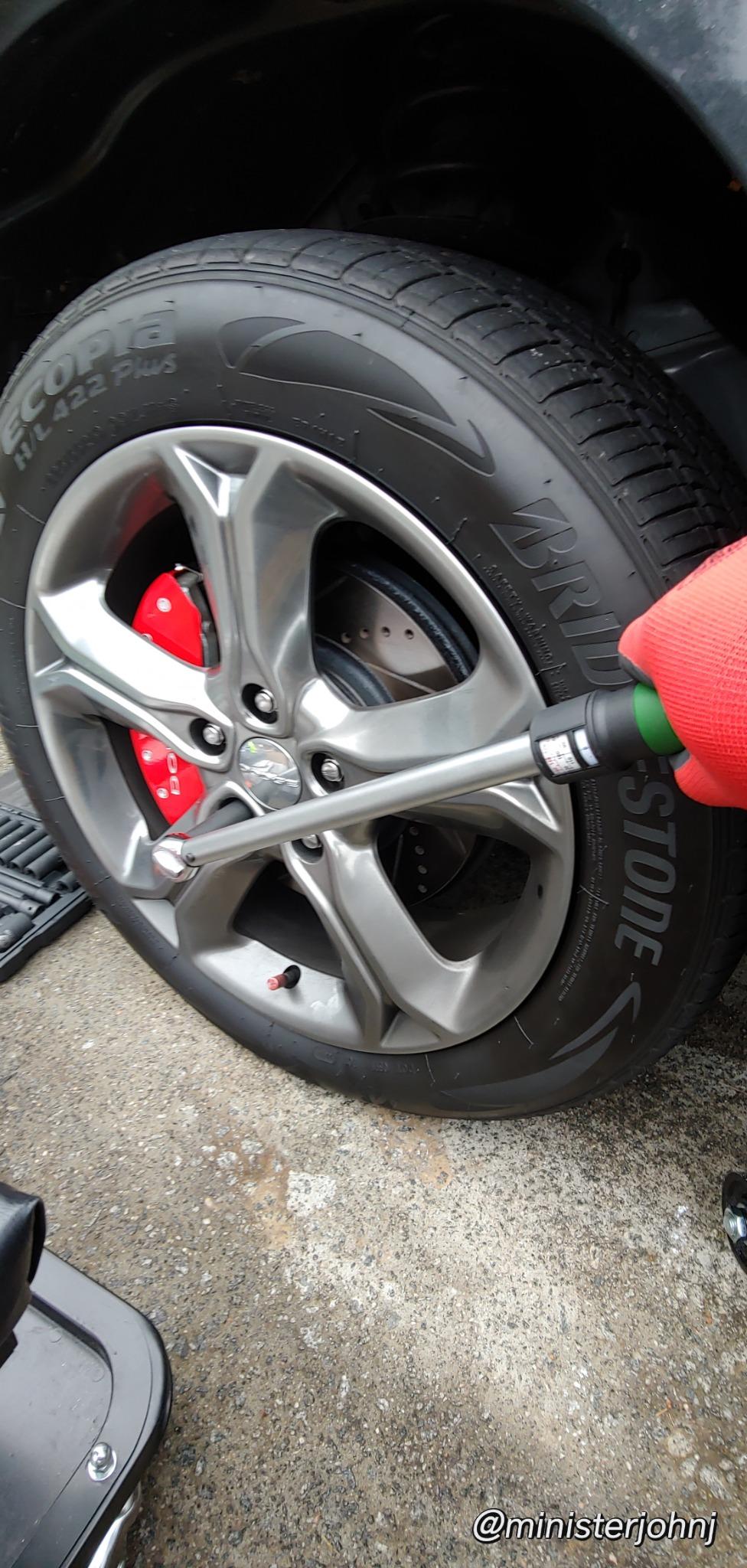
Start by hand-threading every lug nut. Crank the wheel in a couple of turns so it is fully seated against the hub, then torque in a star or cross pattern rather than going around in a circle. A circle sequence tightens one nut completely before the next, which tilts the wheel and prevents proper clamp load at three of the five positions. A star pattern pulls the wheel into square evenly as you go.
Tighten in two stages. Take every nut to about half the final torque in star order, then go around again to the full value. This second pass is what actually pulls the joint to spec, because the first pass has already taken up the slack. Pull smoothly and steadily in one continuous motion, bracing your forearm against your leg for stability rather than leaning the wrench with your upper body.
Stop at the first click. Once the click arrives, the torque has been met and further force is pure over-torque, which is precisely how studs get stretched. Never re-click a nut to make sure. And never use a torque wrench as a breaker bar or for loosening: the calibration assumes the specific handle length it was built with, and a levering or reverse-direction load on a precision spring is a fast way to lose accuracy permanently.
Two more habits worth building. Never add an extension bar to lengthen the pull, because that changes the effective lever length the calibration was set for. And always unlock the handle before adjusting it, then lock it again before pulling, or the setting can move under load.
What Torque Do Your Lug Nuts Actually Need in 2026?
Buy the wrench after you find the number, not before. The spec is vehicle-specific, and a range that covers most cars is still wrong for yours. The number lives in three places, in this order of reliability: the driver-side door jamb sticker, the owner’s manual, and the service manual section for your model year.
The door jamb sticker is the fastest and most common. It usually states the torque for the wheels and may list different values for steel and aluminum wheels, which is a genuine difference rather than a formality. If the sticker is missing or unreadable on an older car, the owner’s manual is next, and a dealer service department can look up the factory value by VIN if both are unavailable.
As a general guide to the ranges these wrenches are built for, passenger sedans commonly sit between 80 and 100 ft-lb, crossovers and small SUVs tend to land between 90 and 120 ft-lb, and full-size trucks and heavy SUVs commonly run 120-160 ft-lb or higher. Light truck and trailer wheel hardware runs higher still, often into the 150-250 ft-lb band. Electric vehicles generally follow their platform’s convention rather than anything unique to electrification, so the same sticker lookup applies.
That range is exactly why a 1/2-inch drive wrench with a 10-150 ft-lb window is the default recommendation, and why the 40-300 ft-lb and 50-250 ft-lb options exist for the vehicles that sit above it. A wrench whose accurate window brackets your actual spec is the whole purchase decision.
Understanding Torque Wrench Accuracy and the 20 Percent Rule
The single most misunderstood number in this category is the accuracy percentage. A wrench rated plus or minus 4 percent sounds like it is off by 4 percent of your target torque, and it is not. It is 4 percent of the maximum value of the scale, which means the actual error margin on your lug nut depends on where that lug nut sits on the scale.
This produces what is known as the 20 percent rule. Most manufacturers only guarantee their accuracy specification from 20 percent of maximum torque up to 100 percent. Below that floor, the internal spring is not loaded enough for the mechanism to read reliably, and the accuracy claim simply does not apply.
Worked through on the wrenches here, it changes which tool suits which car. A 10-150 ft-lb wrench guarantees its plus or minus 4 percent only from 30 ft-lb upward, and a 95 ft-lb lug spec sits comfortably above that floor, so the real margin is about 3.8 ft-lb. The same 4 percent claim on a 25-250 ft-lb wrench is valid only from 50 ft-lb, and on a 30-250 ft-lb wrench the floor is 60 ft-lb. On a larger wrench covering a small car’s spec, you are closer to the floor than the headline number suggests.
Two accuracy terms show up and are worth separating. Full Scale accuracy means the percentage applies to the maximum rated value of the wrench. Indicated Value accuracy means it applies to the value currently shown on the scale, which is a tighter and more useful claim. The GEARWRENCH 85066 states its range explicitly as 20 to 100 percent of capacity, which is the most honest phrasing you will find on a spec sheet.
Finally, a calibration certificate and a recalibration service are different things. A certificate proves the wrench was checked when it shipped. A recalibration service means the manufacturer or an authorized center will check and adjust it later, usually for a fee, and that is what keeps a five-year-old tool trustworthy. Brands with a long-lived calibration relationship are worth more here than brands with a slightly better headline percentage.
1/2-Inch vs 3/8-Inch Drive for Lug Nuts
1/2-inch drive is the correct answer for lug nuts, and the reasons are physical rather than preference. First, range. A 3/8-inch torque wrench that tops out around 80 ft-lb cannot reach a 100 ft-lb factory spec at all, and owners who discover this mid-job end up with a precision instrument that cannot do the one job they bought it for.
Second, leverage and socket strength. A 1/2-inch drive ratchet head and socket wall are stiffer and less likely to slip or round under a high-torque pull, and the longer handle typical of a 1/2-inch wrench means you can reach spec without fighting the tool. On a stubborn lug nut, that difference decides whether the job is annoying or impossible.
A 3/8-inch wrench is still worth owning, just for different work. Suspension components, caliper hardware, valve covers, and smaller fasteners regularly sit in the 15-70 ft-lb band where a 1/2-inch wrench is genuinely too coarse. The common forum mistake is the reverse one, owning only a 3/8-inch wrench and discovering the lug spec is above its ceiling.
If you want one wrench, make it 1/2-inch drive. If you want to cover a car properly, a 3/8-inch and 1/2-inch pair with overlapping but distinct ranges removes every gap, and that is a more sensible garage than a single do-everything wrench with a wide range and a coarse floor.
Click vs Breakover vs Preset vs Digital Torque Wrenches
Click type is what every pick on this list is, and it is the default for a reason. You set a value, pull, and the wrench signals when it arrives. It is simple, repairable, needs no power, and has decades of calibration history behind it. The tradeoff is that accuracy depends entirely on your ability to feel the click and stop pulling at exactly that point.
Breakover wrenches use a hinge and a sprung indicator that deflects and settles into a stable reading. They are easier to read precisely than a click because the indicator settles rather than slamming past, which makes them popular for critical assembly work. They are less common in the automotive range and tend to cost more.
Preset wrenches arrive with factory-set torque values and usually a selector rather than a continuous scale. They are the fastest correct option for pure lug work, since you pick your vehicle’s spec instead of reading a number off a scale in bad light. The limitation is rigidity, since they cover fixed values rather than a continuous range.
Digital wrenches give a numeric readout, unit switching, and often LED or audible target alerts. As noted above, digital is not inherently more accurate, it is more legible. The costs are battery dependency, a heavier body, and a higher price. For a home mechanic who fumbles scales in a dark driveway, the legibility is a genuine safety win rather than a luxury.
One category worth naming so you can rule it out: impact wrenches and torque-angle tools are for shops running production torques. They are fast and repeatable at high volume and inappropriate for a single wheel on a driveway.
ft-lb, in-lb and Nm: The Unit Cheat Sheet
Confusing foot-pounds with inch-pounds is one of the most reliable ways to destroy a fastener, so the conversions are worth committing to memory. One foot-pound equals 12 inch-pounds. One foot-pound equals 1.3558 newton-metres. A 100 ft-lb wheel spec is 1,200 in-lb, and a torque wrench set to the inch-pound scale while you think you are reading foot-pounds is a twelve-fold over-tightening error.
Always pair the number with its unit when you write it down, and check whether your wrench’s scale is marked in ft-lb, in-lb, or both. Dual-scale wrenches avoid conversion entirely, which is the practical argument for choosing one of them even if you only ever work in one unit system.
Newton-metres appear on European and Japanese vehicle specs, and most modern dual-scale wrenches handle the conversion for you. If a service manual gives you a newton-metre figure and your wrench is inch-based only, the conversion is the safer path than eyeballing the number.
Storage, Calibration and Retorque After a Wheel Change
Return the handle to its lowest setting after every use. This is the single storage instruction that appears in every torque wrench manual and the one most often ignored, because a wrench left dialed to 150 ft-lb keeps its internal spring compressed and stores energy that can damage the mechanism over time. It also removes the risk of picking up a loaded wrench and pulling it by accident.
Store it in a case, not loose. A torque wrench that slides around a toolbox drawer or falls off a shelf can lose calibration permanently, and calibration damage from a drop is not something you can see or undo. Several picks here, including the DEWALT kit, the eTORK, and the EPAuto, ship with a case for exactly this reason.
Have it checked periodically rather than assuming. A wrench that is used weekly, dropped, or used on seized fasteners should be recalibrated more often than one that lives in a case and gets used twice a year. Manufacturers with an established calibration service, and brands that ship a serialized certificate, are the ones worth forming a relationship with.
Re-torque after the first 50 to 100 miles of driving on a new wheel installation, and check again periodically after that. Shop mechanics report that the difference in thermal expansion between steel and aluminum wheels changes clamp load enough to require re-torquing at intervals in the region of every 10,000 kilometres. Check your vehicle’s guidance for its own interval, and treat a lug nut that needs more than a small amount of extra torque to reach spec as a signal to investigate the stud and the seating surface rather than simply tightening harder.
Frequently Asked Questions
What size torque wrench should I use for lug nuts?
Use a 1/2-inch drive torque wrench. For most passenger cars, crossovers, and light trucks that means a click-type or preset wrench covering roughly 10-150 ft-lb, with a range that brackets your vehicle’s actual lug torque spec. 3/8-inch drive wrenches usually top out around 80 ft-lb, which is below many factory specs, and they have less leverage and weaker sockets.
What is the best torque for lug nuts?
Most passenger sedans sit around 80-100 ft-lb, crossovers and small SUVs around 90-120 ft-lb, and full-size trucks and heavy SUVs commonly run 120-160 ft-lb or more. The correct figure for your vehicle is on the driver-side door jamb sticker, in the owner’s manual, or in the service manual. Never assume a number, because the spec is vehicle and wheel specific.
What is the 20 percent rule for torque wrenches?
Most manufacturers only guarantee their stated accuracy from 20 percent of the wrench’s maximum torque up to full scale, because the internal spring is not loaded enough to read reliably below that. On a 10-150 ft-lb wrench rated plus or minus 4 percent, accuracy is only guaranteed from 30 ft-lb upward, and a 95 ft-lb lug spec sits well above that floor with a real margin of about 3.8 ft-lb.
Can over-torquing lug nuts warp rotors?
Yes. Over-torquing stretches wheel studs past their elastic limit so they never fully return, and the uneven clamp load that follows is a common cause of warped and cracked brake rotor hats. It also rounds off lug nut hexes and strips hub and rotor threads, which is why a torque wrench matters as much on reassembly as on removal.
Is 300 ft lbs enough to remove lug nuts?
Only for the toughest cases, and it is the wrong tool for the job. A torque wrench is a precision instrument and should never be used to break a seized lug nut loose, because levering load permanently damages its calibration. Use a breaker bar or a torque multiplier for run-down, and reserve the torque wrench for the final tightening pass to spec.
Can I use a torque wrench to loosen lug nuts?
Generally no. Most click torque wrenches are rated clockwise for measurement, and even those rated for reverse operation are not designed to absorb the shock of loosening a seized fastener. Use a breaker bar or impact wrench for removal, then torque wrench the nuts back on in a star pattern in two stages to the factory value.
Do I need a digital torque wrench?
Not for accuracy, which comes from calibration rather than from a digital readout. What digital adds is legibility: a numeric display, unit switching, and audible or LED target alerts remove the chance of misreading a scale. Many home mechanics find that confidence genuinely useful in a dark driveway, but the tradeoff is battery dependency, extra weight, and a higher price.
How often should I retorque lug nuts?
Check them after the first 50 to 100 miles following a wheel installation, and periodically thereafter. Shop mechanics report that the difference in thermal expansion between steel and aluminum wheels changes clamp load enough to require re-torquing at intervals in the region of every 10,000 kilometres. Check your vehicle’s own guidance, and investigate any lug that needs substantially more than a little extra torque to reach spec.
The Best Torque Wrenches for Lug Nuts: Final Verdict
For most people, the EPAuto ST-010-1 is the right first torque wrench. Its 10-150 ft-lb window covers typical car and crossover wheel specs, the plus or minus 4 percent pre-calibration is tighter than the damage tolerance at those numbers, and it has more real-world owner history than anything else we looked at. Buy it, store it in its case, and return it to the low setting every time.
If traceability matters to you, the LEXIVON LX-183 is the pick, since it ships with a calibration certificate carrying a trackable serial number. If your vehicle spec runs above 150 ft-lb, go to the eTORK C3250 for trucks and SUVs or the UYECOVE for a 300 ft-lb ceiling. The SUZUME SM3201 is the digital option for anyone who wants a readout and LED alerts rather than a scale.
Whichever one you choose, find your actual lug torque spec before you buy, tighten in a star pattern in two stages, and stop at the first click. That habit matters more than the model number, and it is what keeps a tire change from becoming a rotor and stud replacement. These are the best torque wrenches for lug nuts in 2026 because each one holds up on the numbers that actually matter.