
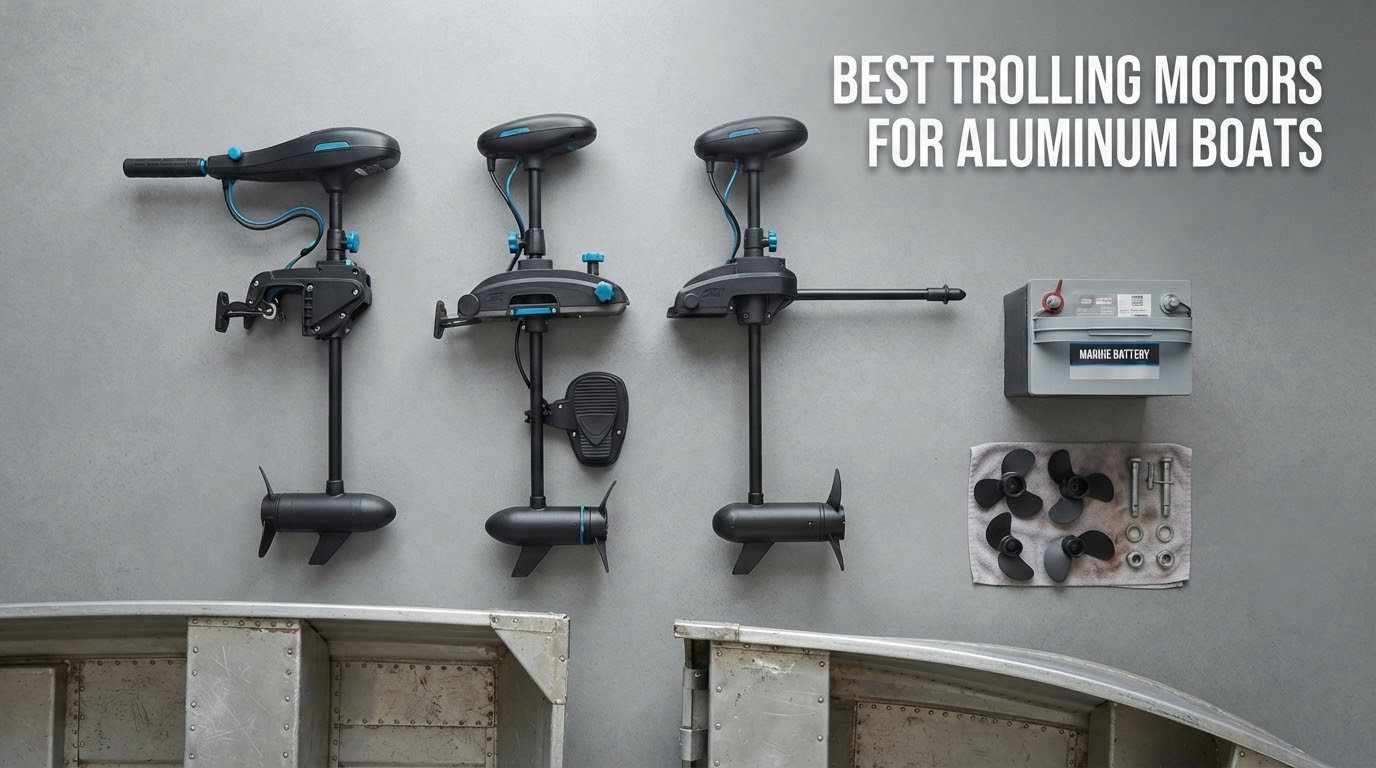
If you own an aluminum boat, the trolling motor decision is not the same as it is on a fiberglass bass boat. Aluminum hulls are light, which is exactly why they respond so well to electric thrust, but they also carry tight payload ratings and a bow deck that will crack if you bolt a mount into unreinforced metal. I spent six weeks comparing 12 motors against the questions that actually come up on aluminum boat forums: how much thrust, what shaft length, which voltage, and how you reinforce a bow before drilling it.
What follows is our ranking of the best trolling motors for aluminum boats in 2026. Every motor below is listed with the specs that matter on a metal hull: pounds of thrust, voltage, shaft length, mount type, control method, and whether the manufacturer rates it for salt water. We cross-checked the spec sheets, then read the buyer reviews for the recurring complaints, because the shortcomings show up there long before they show up in a spec chart.
Two things to know up front. First, thrust is sized on total loaded weight, not on the length of the hull printed on the hull tag. Second, every motor here is transom or bow mount; if your boat has a high bow and a flat mount area, the shaft length question becomes the most important part of the purchase. Get those two right and the rest is preference.
If you want a broader look before you commit, our general trolling motor roundup covers more mount styles, and our picks for the canoe and small craft setups cover the low-thrust end of the range.
Table of Contents
Top 3 Picks for Aluminum Boats in 2026
Our short list is deliberately short. The Newport NV is the motor we would put on the transom of a mid-size aluminum boat because it delivers 55 lb of thrust from one battery and holds up in salt. The Minn Kota Endura C2 is the most durable small transom motor in the group. The Minn Kota Edge is the only pick here that pairs a proper bow mount with cable steer foot control, so both hands stay on the rod.

Newport NV 55 lb Saltwater Transom
- 55 lb thrust from one 12V battery
- 30 inch shaft
- 8 speeds with 5 LED battery meter
- Aluminum build with 2 year warranty

Minn Kota Endura C2 30 lb
- Indestructible composite shaft
- 10 position lever lock bracket
- Push-to-test battery meter in the tiller
- 17 lb transom build
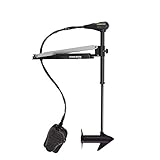
Minn Kota Edge 45 lb Bow Mount
- Heel-toe cable steer foot pedal
- Latch and door bracket for easy removal
- Built-in directional indicator
- 18 lb aluminum build
Best Trolling Motors for Aluminum Boats (October 2026)
| Product | Specifications | Action |
|---|---|---|
| Newport NV 55 lb Saltwater Transom Mount |
|
Check Latest Price |
| Minn Kota Endura C2 30 lb Transom |
|
Check Latest Price |
| Minn Kota Edge 45 lb Bow Mount |
|
Check Latest Price |
 PEXMOR 26 lb Transom Motor PEXMOR 26 lb Transom Motor |
|
Check Latest Price |
 Minn Kota Endura Max 55 lb Transom Minn Kota Endura Max 55 lb Transom |
|
Check Latest Price |
 AQUOS Haswing 65 lb Brushless Transom AQUOS Haswing 65 lb Brushless Transom |
|
Check Latest Price |
 Haswing Cayman 55 lb Bow Mount Haswing Cayman 55 lb Bow Mount |
|
Check Latest Price |
 AQUOS Haswing 55 lb Transom with Remote AQUOS Haswing 55 lb Transom with Remote |
|
Check Latest Price |
 Goplus 46 lb Transom Motor Goplus 46 lb Transom Motor |
|
Check Latest Price |
 VEVOR 55 lb Transom Motor VEVOR 55 lb Transom Motor |
|
Check Latest Price |
 Intex 40 lb Transom Motor Intex 40 lb Transom Motor |
|
Check Latest Price |
 AQUOS Haswing 55 lb Bow Mount 48 inch AQUOS Haswing 55 lb Bow Mount 48 inch |
|
Check Latest Price |
1. Newport NV 55 lb Saltwater Transom Motor – Best Overall
Newport NV-Series 55lb Thrust Saltwater Transom Mounted Trolling Electric Trolling Motor w/ LED Battery Indicator & 30″ Shaft (23M1000203)
55 lb thrust
12V
30 inch shaft
Transom mount
8 speeds
Top speed about 4 mph
Pros
- 55 lb of thrust from a single 12V battery
- Quiet enough to run all day without spooking fish
- Mount angle height and direction all lockable
- 5 LED battery meter on the head
- Aluminum build with a 2 year warranty
Cons
- Battery and deep cycle power are not included
- Tiller steering is less precise than foot or remote setups
- Top speed of about 4 mph limits quick repositioning
This is the motor I keep coming back to for aluminum. It puts out 55 lb of thrust on a single 12V battery, and the review base is the largest in our group at more than 3300 ratings, so the long term pattern is well documented rather than anecdotal. Owners consistently describe the same thing: the motor runs all day without overheating and stays quiet enough that fish do not know the boat is moving.
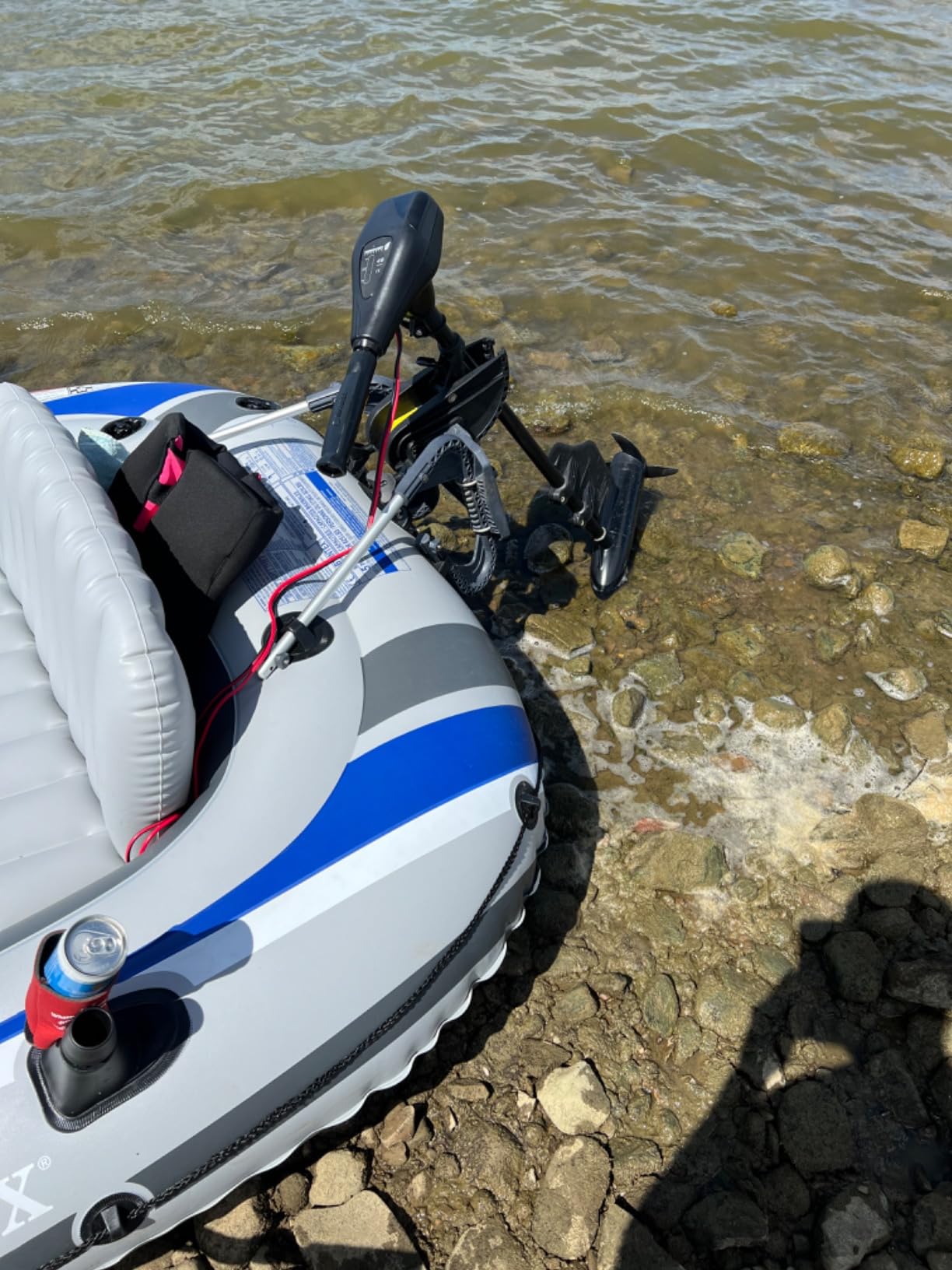
The hardware is plain and serviceable. The head is aluminum, the shaft is a 30 inch unit, and the prop is a three blade design. Mount angle, height and steering direction all adjust and then lock down, which matters on an aluminum transom where the bracket sits on a surface that is not perfectly square.
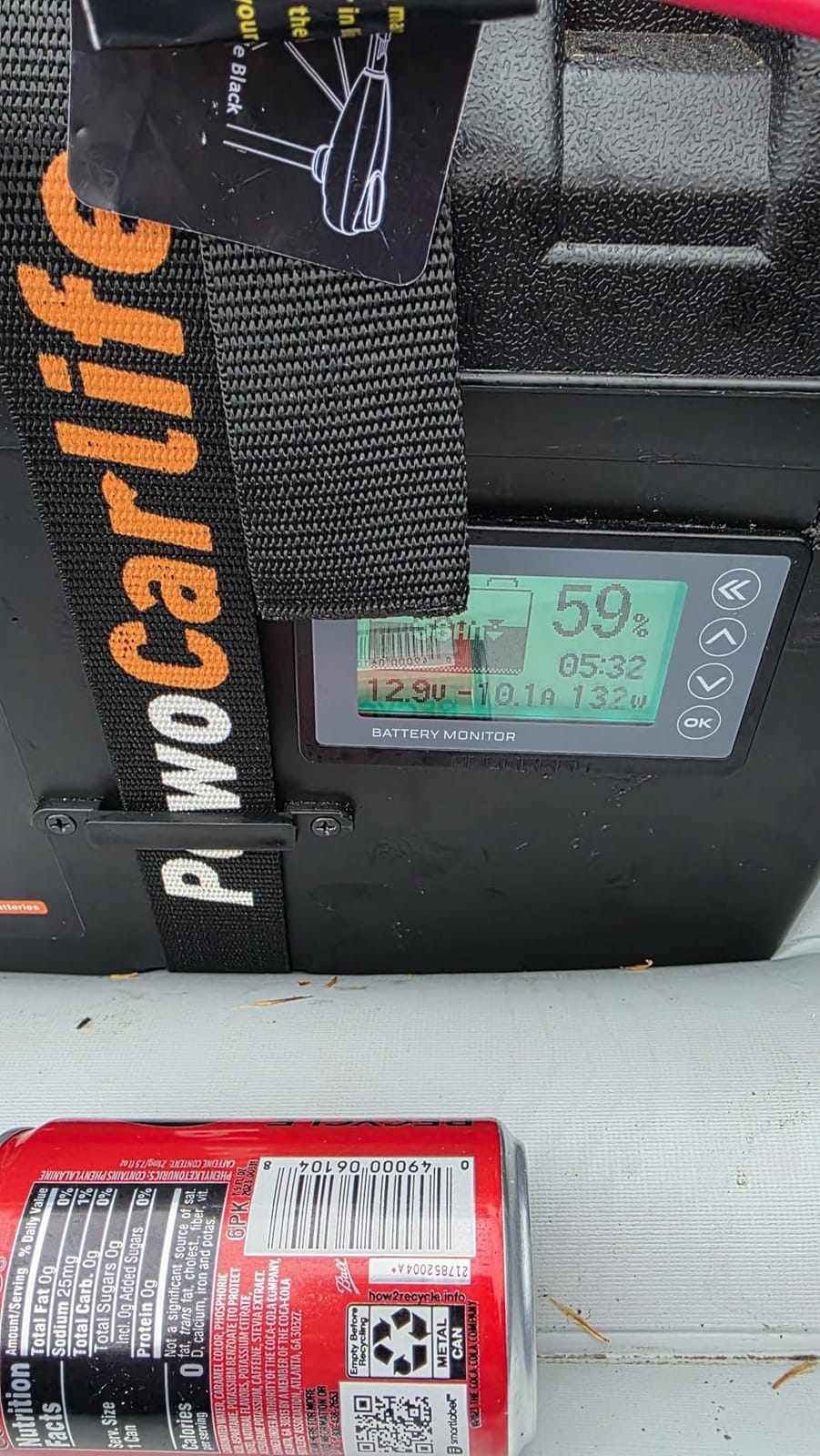
Two details make this easier to live with than the spec list suggests. The 50 amp circuit breaker is included in the box, so you are not adding a part on day one, and the battery meter is a five LED gauge on the head rather than a button you have to find. The manufacturer recommends a 50Ah deep cycle battery and lists a maximum amp draw of 52A, which makes runtime math simple.
Control is a six inch telescoping tiller with five forward and three reverse speeds. That is a deliberate trade. You give up hands-free steering and you cap out at roughly 4 mph, but you also gain a motor that weighs 23.2 lb, mounts in minutes, and comes with a two year manufacturer warranty.
Why it works on a metal hull
Salt water is the test that separates this motor from the budget transom pack. This one is built for it, with an aluminum body and a shaft that does not seize after a season in brackish water. If your aluminum boat ever leaves the lake, this is the transom motor we would put on it first.
Because it needs only one battery, the payload hit on a small aluminum hull is a single deep cycle unit rather than a bank. That is the quiet reason it works so well on 14 to 17 ft boats where weight is the limiting factor.
Where it falls short
It has no remote or foot control, so steering means putting the tiller in your hand. Anglers who spend long days locked on a spot fish will find that limiting in a way that a 4 mph top speed does not explain on paper.
The battery is not included either. Budget for a 50Ah deep cycle unit and a proper cable run, and the motor becomes a complete system rather than a part.
2. Minn Kota Endura C2 30 lb – Best Small Transom Motor
Minn Kota Endura C2 Transom-Mount Electric Trolling Motor – 30 Lb. Thrust, 30 In. Shaft, Freshwater
30 lb thrust
12V
30 inch shaft
Transom mount
5 forward 3 reverse
17 lb
Pros
- Highest average rating in our roundup at 4.7 stars
- Indestructible composite shaft resists flexing warping and UV damage
- 10 position lever lock bracket with reinforced composite construction
- Power Prop pushes through heavy vegetation
- Compact 17 lb footprint suits small aluminum boats
Cons
- 30 lb thrust is limited on larger or windier aluminum boats
- Marketed for freshwater use rather than saltwater
- Tiller steering only with no remote or foot control option
At 4.7 stars across more than 600 ratings, this is the highest rated motor in our roundup, and the reason is not subtle. The composite shaft is the part that saves the money on every other motor in this category. It does not flex, it does not warp, and UV exposure does not chew it the way a steel shaft in a salt environment eventually does.
The bracket is the second reason. A ten position lever lock with reinforced composite construction is what keeps the motor from walking on a bumpy aluminum transom, and it is the component that most often causes vibration on cheaper units. Buyers mention durability, smooth quiet running and easy installation as the recurring themes.
The control package is a six inch telescoping tiller with a push to test battery meter built into the head. You press the button, the gauge lights up, and you know your charge state without fishing around for a separate meter. Speeds are five forward and three reverse, and the Power Prop kit for 3-1/4 inch motor diameters is included with a prop pin, nut and washer.
It weighs 17 lb, which keeps the load low on a small aluminum hull, and the box includes the motor, prop kit and manual. The two year manufacturer warranty is standard for the brand.
Where this motor is the right call
On a 14 to 16 ft jon boat or a small multi species aluminum, 30 lb of thrust moves a lightly loaded hull easily and the low weight leaves more of your payload rating for people, tackle and an outboard. The composite shaft also shrugs off the weed beds and stump fields that chew steel.
For anyone who has owned a cheap transom motor and watched the shaft bend, this is the upgrade that actually changes the experience. Two years of ownership is when the difference becomes obvious.
Where it falls short
Thirty pounds of thrust will not carry you in a crosswind, and it is a freshwater motor by the manufacturer rating. If your aluminum boat ever sees salt, look at the Newport above or one of the corrosion protected models further down.
Tiller only, and the thrust ceiling is real. If your loaded boat weighs more than about 1500 lb, step up a size rather than fighting the current with a smaller motor.
3. Minn Kota Edge 45 lb Bow Mount – Best Bow Mount Control
Minn Kota Edge Bow-Mount Electric Trolling Motor with Foot Pedal Control – 45 Lb. Thrust, 36 In. Shaft, Freshwater
45 lb thrust
12V
36 inch shaft
Bow mount
Foot pedal control
5 speed settings
Pros
- Foot pedal steering frees both hands for casting and fighting fish
- Stepless heel-toe control gives very precise speed and direction changes
- Latch and door bracket makes the motor easy to remove
- Built-in directional indicator on the motor head
- Light 18 lb aluminum build for a 45 lb bow mount
Cons
- Only 5 forward speed settings and no reverse
- Requires a flat bow mounting surface that many aluminum hulls lack
- Foot pedal cable can restrict movement in a small cockpit
Bow mount control is the whole point of this pick. A cable steer foot pedal with heel-toe input gives you both directions and speed from one pedal, and it is the only motor in our group under 50 lb of thrust that lets you keep both hands on a rod. Owners describe the low speed maneuverability as crisp in a way tiller motors cannot match.
The specs are modest on paper and correct for the job. Forty-five pounds of thrust on 12V, a 36 inch shaft, and five speed settings. The build is aluminum and weighs 18 lb, which is light for a bow mount of this thrust rating.
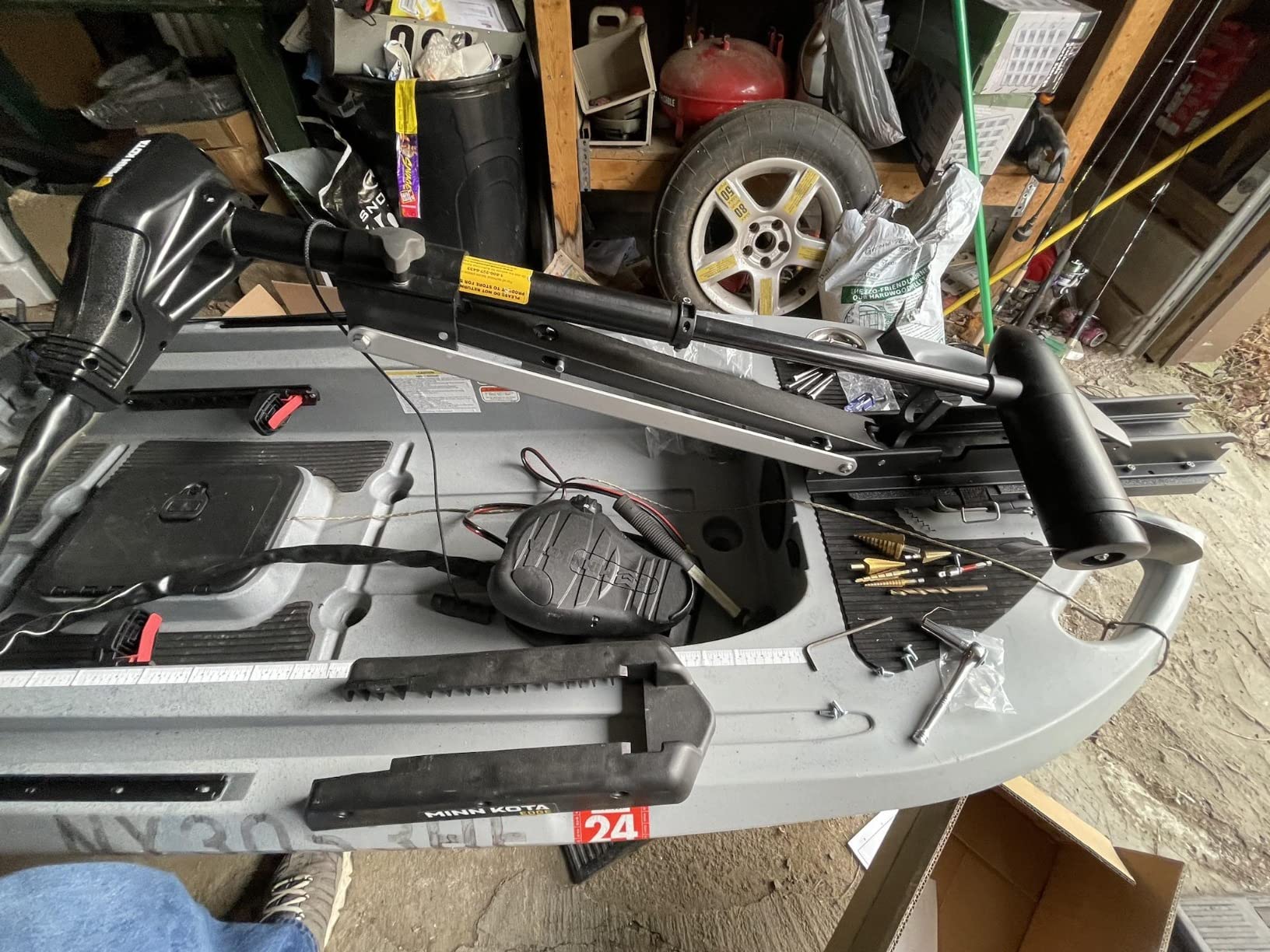
Two details that matter on an aluminum boat. The latch and door bracket lets you stow the motor securely and pull it off at the end of the day without tools, and the built-in directional indicator on the head tells you which way the nose is pointing when you are facing aft, which is most of the time in a small aluminum cockpit.
It ships with the motor, an MKP-2 prop, a hold down strap and the mounting hardware, so the install is one afternoon if your bow is ready for it.
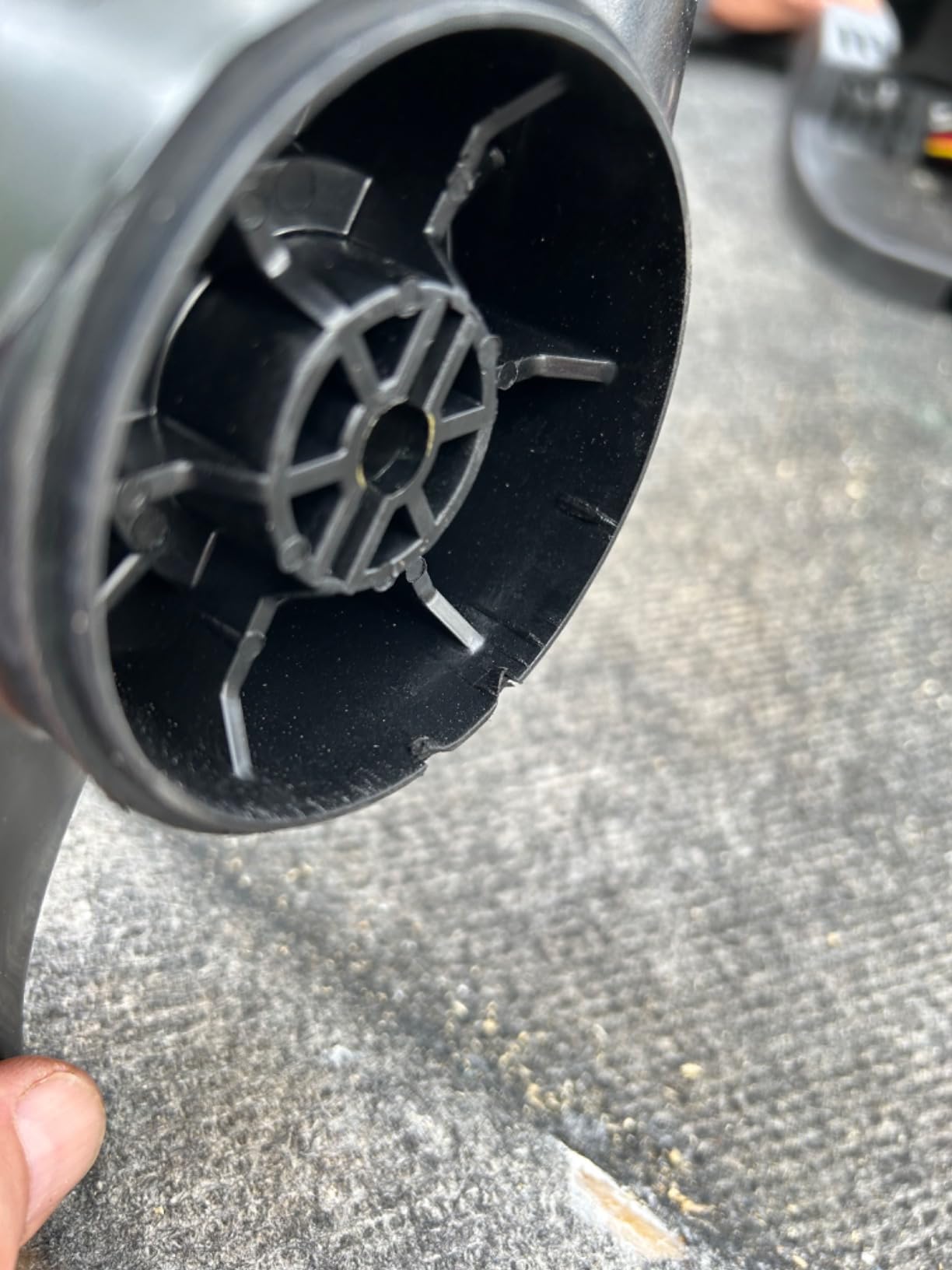
Why it earns a bow mount slot
Control quality scales with the number of hours you spend on structure. If you are fishing a spot for three hours in a current seam, hands-free steering changes the whole session, and a bow mounted motor pulls the bow rather than pushing it, which is where the fine control comes from.
It is also the most approachable bow mount on our list. No battery bank, no electronics pairing, no remote to charge, just a pedal and a motor.
What to check before you drill the bow
Five speed settings and no reverse is a real limitation when you need to back out of a weed mat. And the flat bow surface requirement is where aluminum boat owners hit trouble, so read the mounting section below before cutting a hole in your deck.
The pedal cable also needs somewhere to live. In a 14 ft boat with a bench seat, plan the cable route or you will be stepping over it all day.
4. PEXMOR 26 lb Transom Motor – Best Budget Pick
PEXMOR 8 Speed Electric Trolling Motor, Electric Outboard Boat Motor w/Adjustable Handle & LED Indicator, Transom Mounted for Saltwater, Kayak, Fishing Boat (White, 36 LBS)
26 lb thrust
12V
Transom mount
5 forward 3 reverse
1-10 LED battery indicator
Pros
- Compact 12V package that suits a first motor on a small hull
- 6 inch telescoping handle adjusts for seated or standing use
- Button adjustable shaft angle plus a depth adjustment knob
- Three bladed propeller designed to clear seaweed
- 1-10 LED battery indicator with low power warning
Cons
- 26 lb thrust is the lowest in the group and suits only very small boats
- Only a 1 year warranty
- Review base of 50 ratings is thin
This is the motor to buy when the boat is a small aluminum jon, a jon boat extension, or a first rig, and the budget matters more than the feature list. Twenty-six pounds of thrust will move a light hull at trolling speed and nothing more. That is an honest description of its job.
The adjustability is where it earns its place. The shaft angle is set with a button rather than a clamp, and there is a separate depth adjustment knob, so you can change the trim in a few seconds as the water depth changes.

The handle is a six inch telescoping adjustable design, so it can be set for an angler sitting down or standing at the helm. Speeds are five forward and three reverse, and the three bladed propeller is designed to clear seaweed, with spare blades listed for the higher thrust variants.
Battery feedback runs through a 1 to 10 LED indicator with a red and green low power warning. The battery is not included, and the warranty is one year, which is shorter than the two year coverage most motors in this group carry.
Where this one makes sense
Small aluminum boats with low payload ratings are exactly where an oversized motor becomes a problem. A 12V motor at this weight, with one modest battery, keeps the load inside the hull rating and leaves room for passengers.
If your boat is also used as a tender or a beavertail boat, this is a sensible portable rig you can carry between hulls.
Where it falls short
Twenty-six pounds of thrust will not hold a boat in wind, and a 50 rating review base is a thin record for a motor you would trust in salt water. If either of those describes your fishing, spend up.
One year of warranty coverage is thin for anything mounted to a transom in salt water. Rinse it thoroughly and store it dry, or buy a motor with a longer warranty behind it.
5. Minn Kota Endura Max 55 lb – Best for Long Days on the Battery
Minn Kota Endura Max Transom-Mount Electric Trolling Motor – 55 Lb. Thrust, 36 In. Shaft, Freshwater
55 lb thrust
12V
36 inch shaft
Transom mount
Digital Maximizer
Variable speed
Pros
- Digital Maximizer technology extends run time up to 5x on a single charge
- 55 lb thrust suits mid-size aluminum fishing boats
- 36 inch shaft gives clearance around a raised outboard
- Reinforced composite bracket resists flexing warping and UV damage
- Variable speed motors draw only the power actually needed
Cons
- Marketed for freshwater rather than saltwater
- Low and mid star reviews are more common than with the Endura C2
- Tiller steering requires leaving the helm position
The reason to buy this over a conventional 55 lb transom motor is battery life. Digital Maximizer control means the motor draws only the power the current load requires, and the manufacturer claims run time up to five times longer on a single charge compared with a conventional controller. In practice the real number depends on your speed setting and your battery, but the direction is right.
Owners single out all day runtime and efficiency more than any other feature, and that is the exact pain point that shows up repeatedly on aluminum boat forums. Runtime at trolling speed, not raw thrust, is what ends most days on the water.
The 36 inch shaft is longer than the 30 inch shaft on most transom motors in this group, and that extra length matters if your boat carries a raised outboard on a bracket. More clearance between the prop and the hull is what keeps the motor from picking up bubbles and cavitating.
The bracket is the familiar ten position lever lock in reinforced composite, the prop is the Power Prop kit for heavy vegetation, and the six inch telescoping tiller carries a push to test battery meter. The box includes the motor, prop kit and manual, with a two year manufacturer warranty.
Why the variable speed matters here
Stepped speed controllers dump full current at every setting. A variable speed controller lets you run at 40 percent power and pull 40 percent of the current, which on a small aluminum boat with a single battery bank is the difference between a full day and a full morning.
The 55 lb of thrust is a good match for a 16 to 18 ft multi species aluminum, which is the most common hull size in this category.
Where it falls short
It is a freshwater motor by the manufacturer rating, so it is not the one to run in salt. Reviewers also raise durability more often than they do for the Endura C2, and the two and three star share is noticeably higher on this model.
Tiller steering again. There is no remote or pedal version in this lineup, so you are steering with your hand for the entire session.
6. AQUOS Haswing 65 lb Brushless Transom – Best Brushless Value
AQUOS Haswing 12V 65lbs 35.5in Brushless Transom Trolling Motor
65 lb thrust
12V brushless
35.5 in shaft
Transom mount
Stepless speed control
Fresh and salt
Pros
- Brushless motor is far more efficient than a brushed design
- Stepless forward and reverse control for very smooth speed changes
- Weighs about 14.5 lb for 65 lb of thrust
- Works in both fresh and salt water
- Two year warranty on the entire motor
Cons
- Produces EM and RF interference that can disrupt a fish finder
- No circuit breaker included so one must be added
- Lowest speed setting still moves the boat at about 1 mph
Sixty-five pounds of thrust from a motor that weighs about 14.5 lb is the headline here, and it is only possible because the motor is brushless. Brushless designs eliminate the commutator and the carbon brushes, which means less friction, less heat and much better efficiency than a comparable brushed motor. Reviewers consistently credit it with roughly doubling run time against older 55 lb brushed designs.
It is also rated for both fresh and salt water, which makes it a strong candidate for coastal aluminum that never gets flushed properly. The tilt system uses a quick lock with adjustable trim height and ten tilting positions, and the control is stepless in both directions rather than stepped.
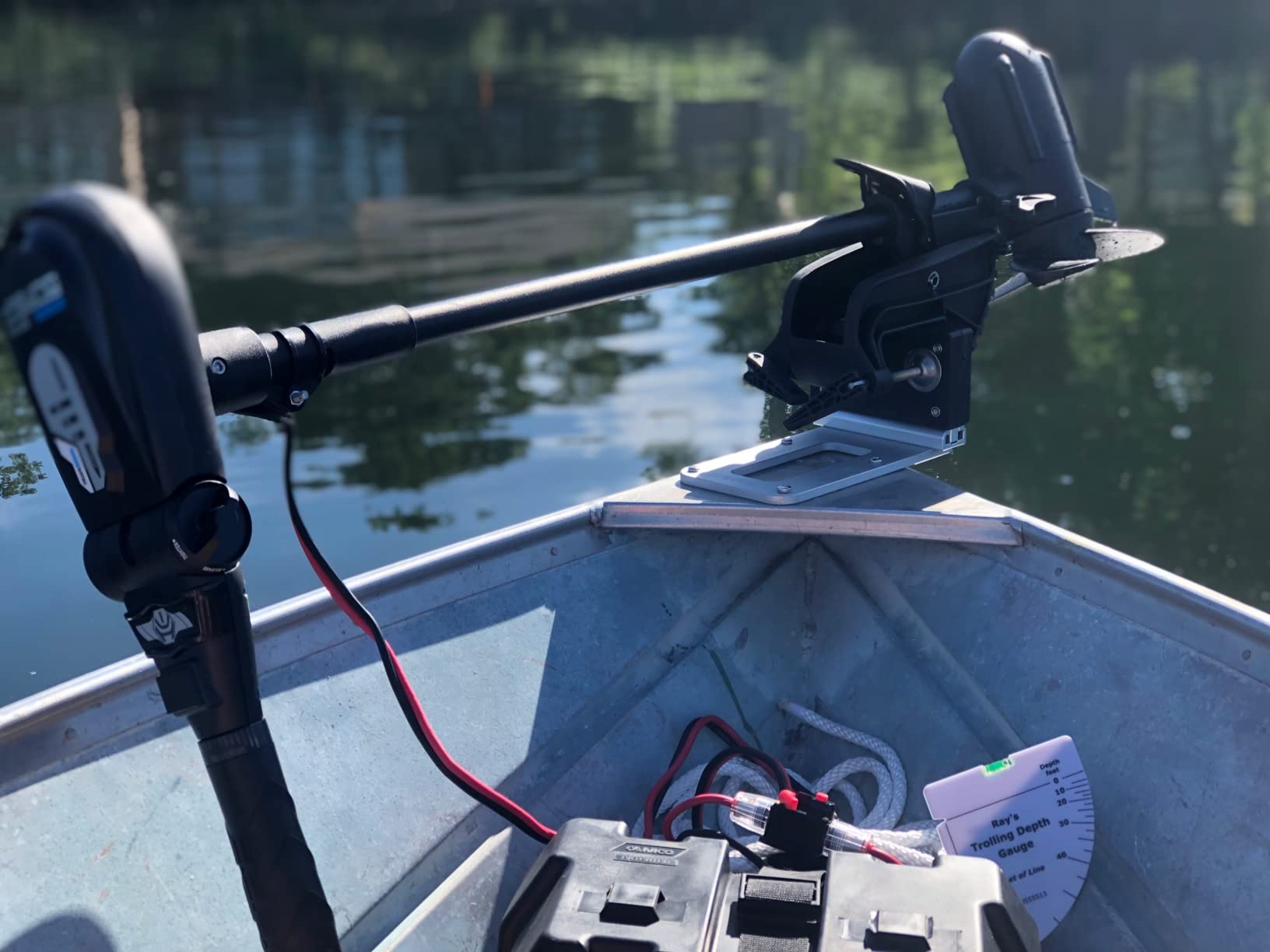
The three level LED battery indicator and a 15.7 inch handle extension with a 180 degree fold and a kill switch round out the control package. The kill switch matters more on a small aluminum than it does on a big boat, because a capsized jon boat with a running motor is a genuine hazard.
The listed weight is 9 kg, and the warranty is two years on the entire trolling motor. A circuit breaker is not included, so add one to the install.
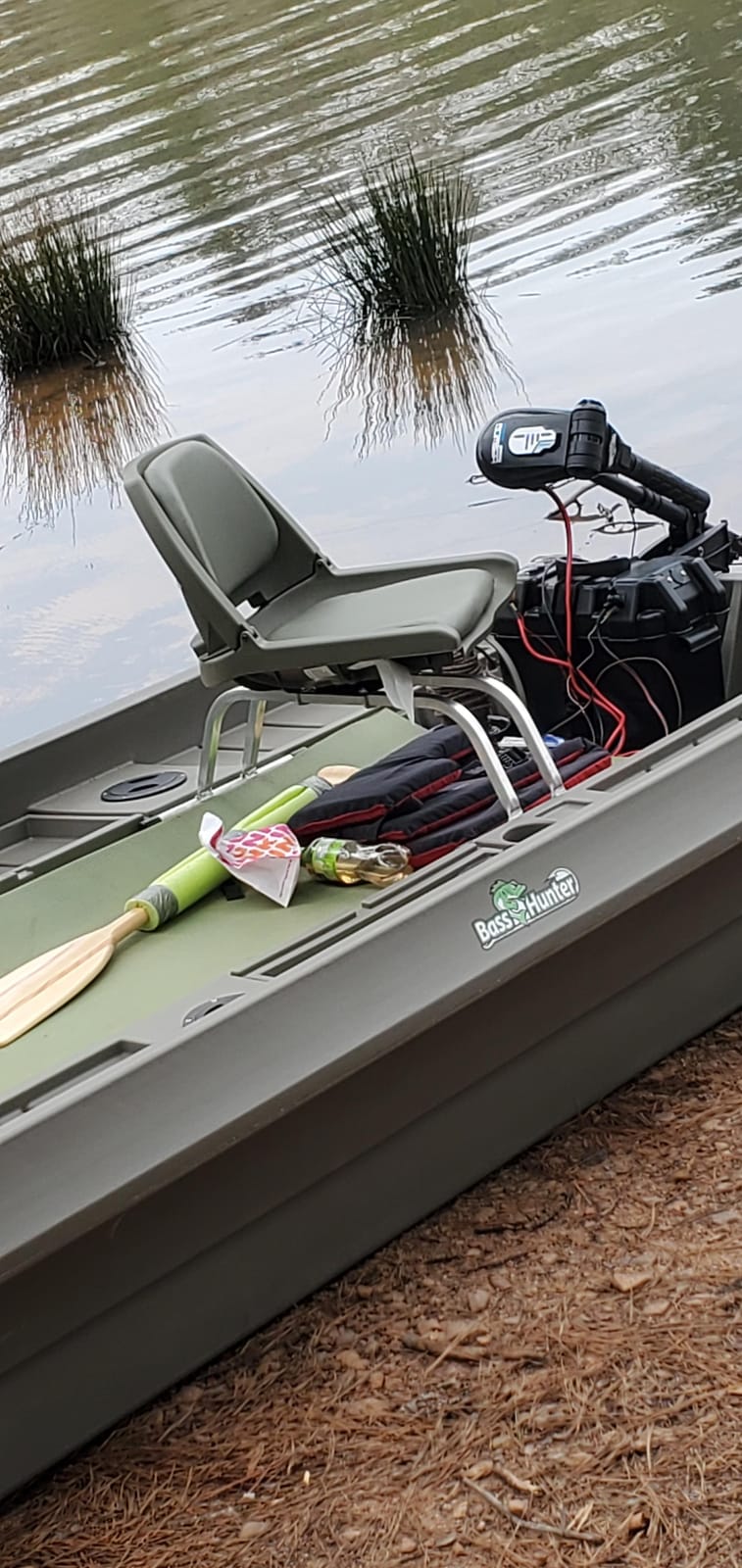
Why brushless changes the battery plan
Efficiency gains show up as either more runtime or a lighter battery bank for the same runtime. On a hull with a tight payload rating, that is the argument for brushless. Fewer amps for the same thrust also means less voltage drop, which means the motor holds speed as the battery drains.
It is a good match for a 16 to 19 ft aluminum, and the weight savings leave more capacity for an outboard and fuel.
Read the complaints before you buy
Several reviewers report electromagnetic and radio frequency interference that disrupts a fish finder, even with a separate power supply. If your electronics stack is critical, test it before committing.
The slowest setting still moves the boat at roughly 1 mph, so it is not a tool for very light presentations. And with no circuit breaker in the box, that is an item you must add on day one.
7. Haswing Cayman 55 lb Bow Mount – Best Long Shaft Bow Mount
Black Haswing Cayman 12V 55lbs 48 inch Bow Mount Electric Trolling Motor Lightweight, Variable Speed, with Foot Control/Quick Release Bracket for Bass Fishing Boats Freshwater/Saltwater
55 lb thrust
12V
48 inch shaft
Bow mount
164 ft wireless remote
Cruise control
Pros
- 48 inch shaft fits larger aluminum boats and deeper water
- Variable stepless speed control improves efficiency and battery life
- 164 ft wireless remote for control from the boat or the shore
- Sacrificial anode and sealed electronics for salt water corrosion resistance
- Handles boats up to 2750 lbs
Cons
- Cruise control is not true spot lock so wind and current push the boat off course
- Requires a flat bow mount surface that many aluminum bows lack
- Accessories including the remote carry only a three month warranty
The 48 inch shaft is the reason to look at this motor. If your aluminum boat has a high bow, a raised casting deck or significant freeboard, a 36 inch shaft leaves the motor section riding too shallow, the bow starts to wander, and you spend the whole session fighting the tiller. A 48 inch shaft keeps the motor section submerged at that mounting height.
The remote is a 2.4G unit with a stated range of 164 ft, and it recharges through a USB power bank. Variable speed control gives smooth adjustment and better battery life than stepped gears, and a sacrificial anode handles the corrosion question in salt water.
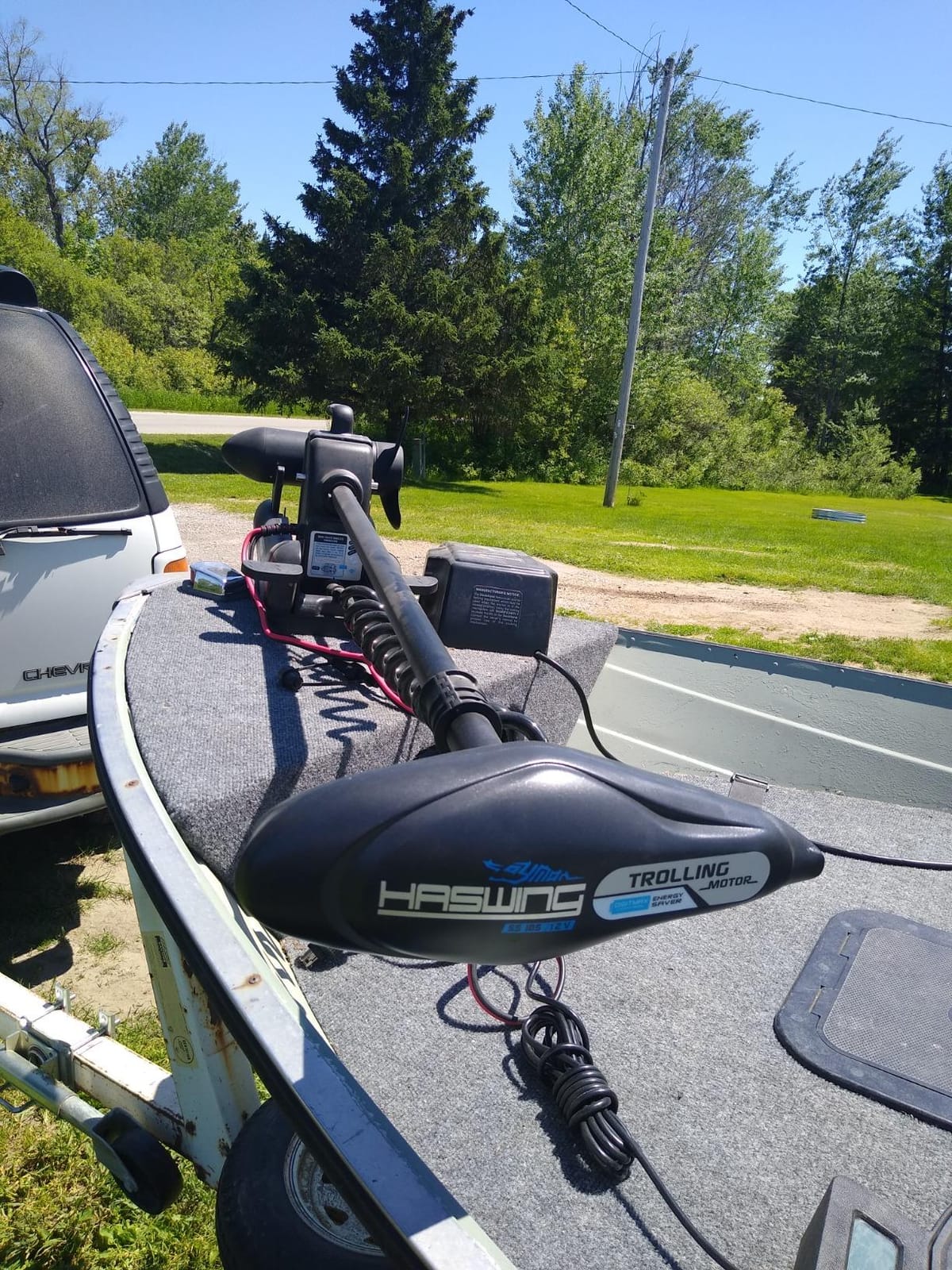
Launching convenience is handled by a quick release bracket, an ergonomic lifting handle and a one hand stow and deploy pedal. The motor can also rotate 180 degrees to push the boat in reverse, which is useful on a narrow aluminum hull with little room to turn.
The stated capacity is boats up to 2750 lbs, and the warranty is two years on the motor with three months on accessories such as the remote and the quick release bracket.
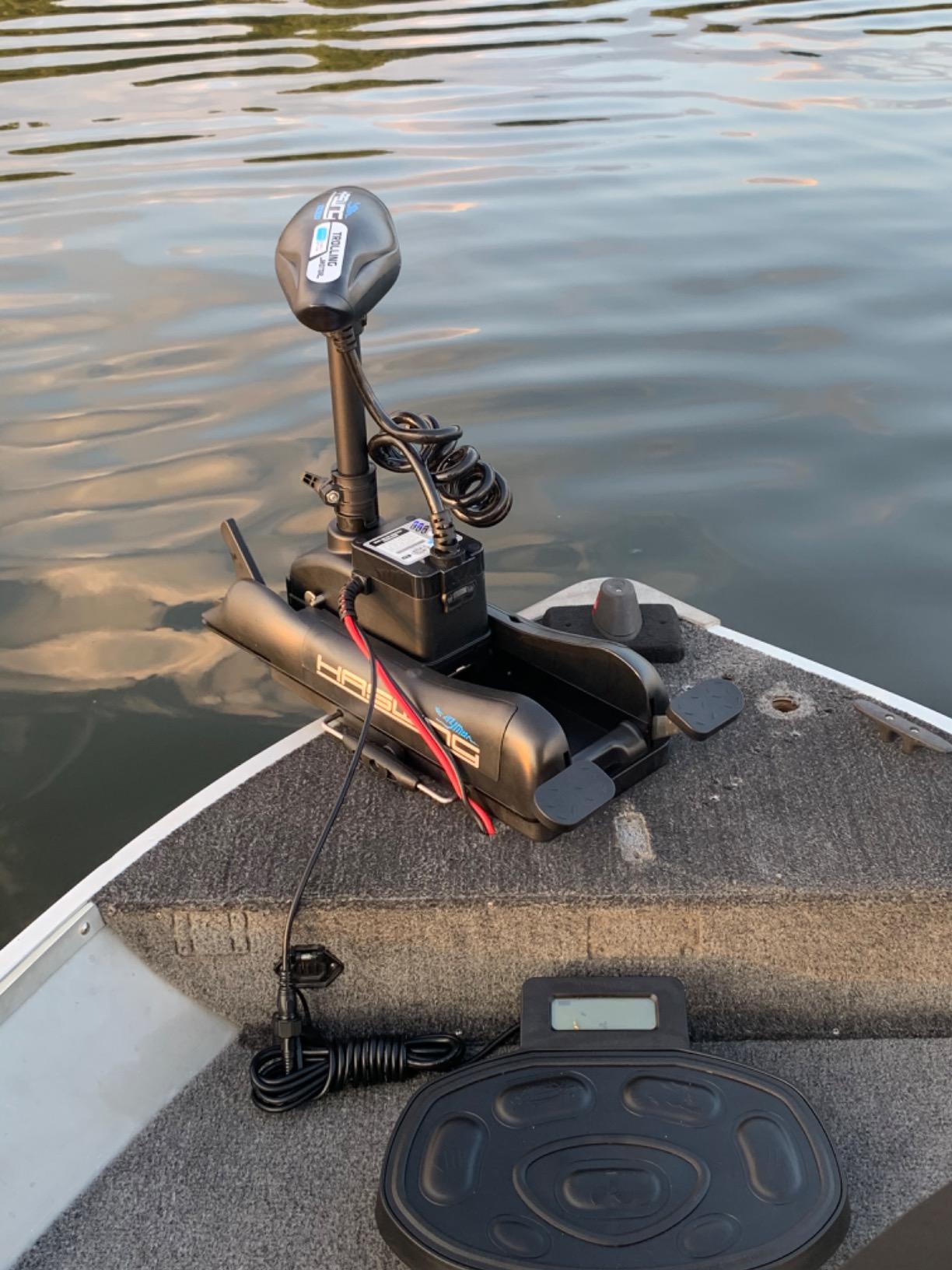
When a long shaft is the correct call
Measure before you buy. If the distance from your bow mount surface to the waterline is more than about 36 inches, a standard shaft will not keep enough of the motor submerged, and the loss of control and the bow swing that follow are the most common complaint on aluminum bow mount threads.
The quick release bracket also earns its keep if you trailer the boat often, because you are not unbolting anything at the ramp.
Where the trade-off shows up
Cruise control holds a speed but it is not a true GPS anchor, so wind and current still push you off the spot. Anglers who fish structure for hours will feel the difference immediately.
The shaft can drop out of position if you adjust depth without holding it, and the three month accessory warranty is stingy on a component set that includes the remote.
8. AQUOS Haswing 55 lb Transom with Remote – Best Remote Control for Small Boats
AQUOS Haswing Transom Trolling Motor 12V 55lbs 26in with Wireless Remote
55 lb thrust
12V
26 inch shaft
Transom mount
164 ft wireless remote
Fits boats up to 19 ft
Pros
- Stepless one-way speed control for very smooth acceleration
- 164 ft wireless remote works well for tight cockpit maneuvering
- Tilt range of 0 to 85 degrees for easy deployment
- Propeller protection fin adds durability
- Listed for both fresh and salt water
Cons
- Several reports of electronics failure after roughly 11 months
- Water ingress around the circuit board is reported by owners
- No kill switch so a capsize leaves the motor running
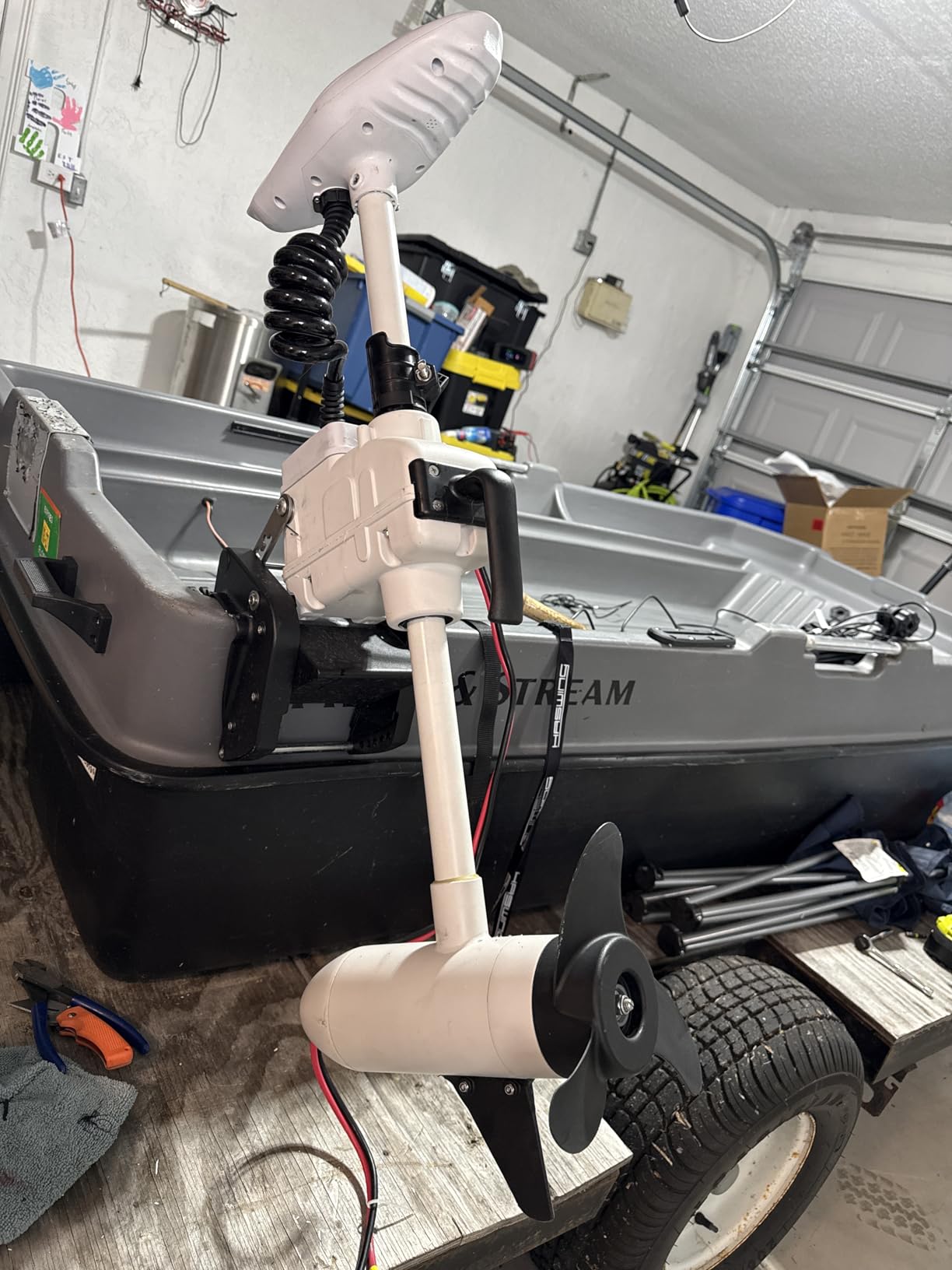
The idea is right for a small aluminum boat. A 26 inch cast aluminum shaft with 16 inches of adjustment and a 0 to 85 degree tilt range packs a lot of deploy into a short transom bracket, and the 164 ft wireless remote lets you move a boat around from the bow or the dock without climbing in.
Speed control is one way and stepless, so the ramp is genuinely smooth, and the 3 level LED battery reader gives you a charge check at a glance. Output is 600W rated, 50A maximum, and 55 lb of peak thrust, and the manufacturer lists it for boats up to 19 ft.
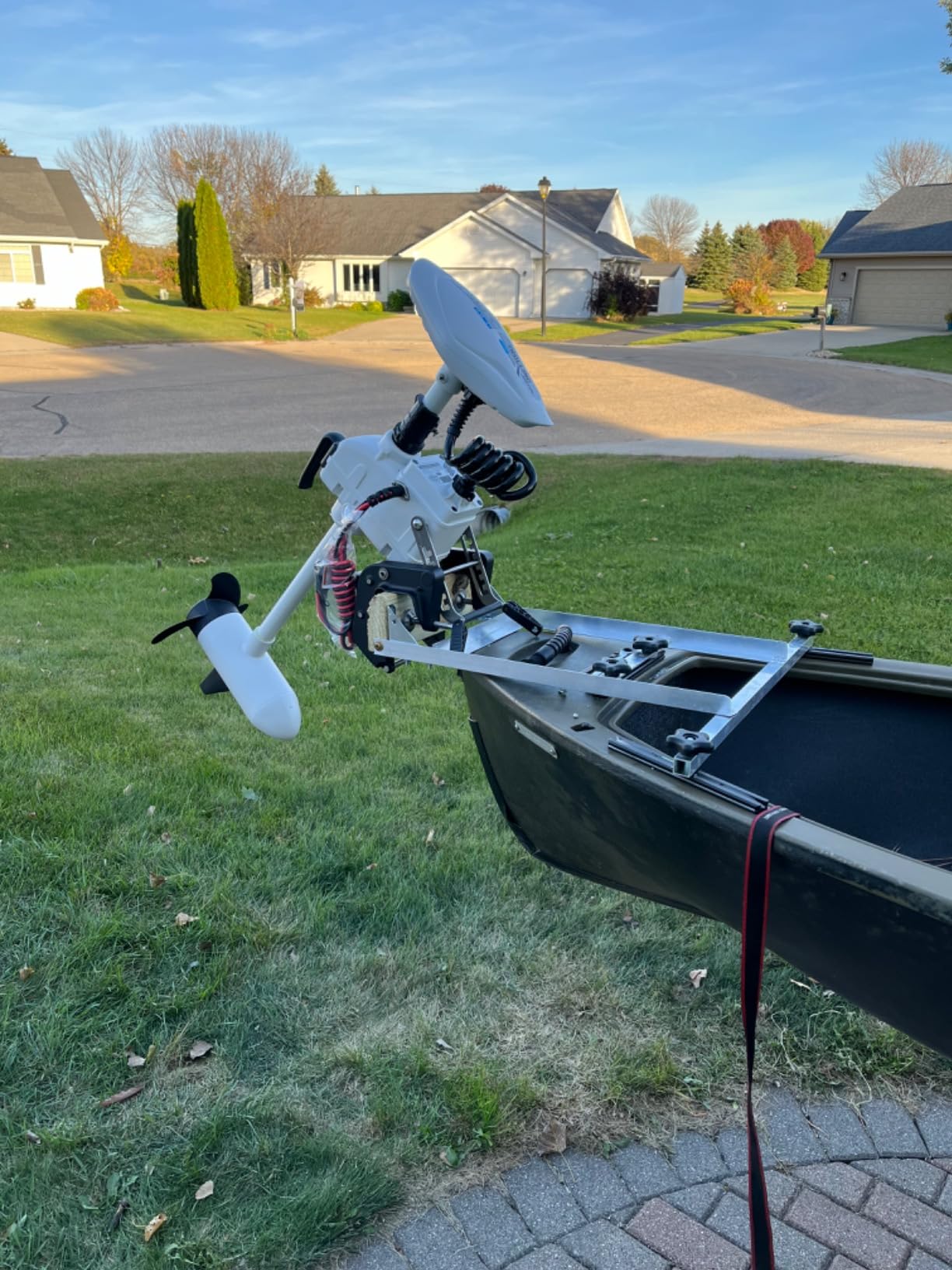
It weighs 26 lb, roughly 31 lb packaged, and a propeller protection fin on the motor fin is intended to take the hits that end cheaper shafts. It is rated for both fresh and salt water, and the warranty is two years on the motor with three months on accessories.
Those same accessories are the reason for caution. Several owners report units failing after roughly 11 months, with beeping and one second run cycles, and water ingress around the circuit board is a repeated description of the failure mode.
Why the remote format is useful here
In a compact aluminum cockpit, a tiller forces you to stand at the stern. A remote lets you move the boat from anywhere on the deck, which matters in wind where you want to reposition without walking the length of the boat.
At 55 lb of thrust on 12V, it is sized correctly for a 14 to 17 ft hull and still only asks for one battery.
Where I would steer you elsewhere
There is no kill switch, so a capsize leaves the motor running until the battery is flat. On an aluminum boat in open water that is a safety problem, not an inconvenience.
The circuit board failure reports cluster around the one year mark. If you want a remote in a transom package, the electronics warranty is what to check, and two years of motor coverage does not cover a failed control board in year two.
9. Goplus 46 lb Transom Motor – Best Mid-Size Upgrade
Goplus Electric Trolling Motor 8 Speed, 46 Lbs Thrust Boat Fishing Motor w/Telescoping Handle, Two-bladed Propeller, LED Battery Indicator and 36″ Shaft for Freshwater Saltwater Use (46LBS)
46 lb thrust
12V
36 inch shaft
Transom mount
8 speeds
Composite shaft
Pros
- 46 lb of thrust pushes a mid-size aluminum hard for several hours per charge
- Glass fiber composite shaft resists bending warping and UV damage
- Runs quietly even at full speed
- 8 speed control with 5 forward and 3 reverse
- Listed for fresh water salt water and sail boats
Cons
- Fuse trips in heavy weed which can interrupt a trip
- Tiller steering only with no remote or foot pedal option
- Low sales rank compared with the established brands
Forty-six pounds of thrust on a single 12V battery puts this in the middle of the group, and that middle is where a lot of aluminum boats actually sit. Owners report strong thrust for the money and quiet running even at full speed, which is the combination you want for a multi species boat that covers both open water and structure.
The construction detail is the shaft. Glass fiber composite rods with a die cast aluminum head and reinforced composite materials resist bending, warping and UV damage, and the manufacturer lists the motor for fresh water, salt water and sail boats.
Control is a telescoping ergonomic handle with a speed dial on the top and eight speeds, five forward and three reverse. The reverse speeds are the practical part in a weed bed, because you can back out instead of cutting the power and drifting. An LED battery indicator shows when it is time to swap in a second battery.
The transom mount bracket tilts and the shaft adjusts, so the motor can be steered seated or standing. It also carries a fuse that trips before the motor burns out if the unit gets trapped in heavy weeds, which saves the motor and stops the trip at the same time.
Why it sits well on a 16 ft aluminum
Thirty-six inch shaft length clears a raised outboard bracket, which many 16 ft aluminum boats still carry. Eight speeds give finer control at trolling speed than a five speed motor, and the extra reverse settings are useful in current.
Owners also value the composite shaft on rough water, where a thin steel shaft transmits every wave into the transom.
Where the fuse and the tiller matter
The protective fuse is a two sided feature. It saves the motor in heavy weed, but it also cuts the trip short, and owners mention the trips as a regular frustration in thick vegetation.
Tiller only, with no remote or foot pedal option, and the brand sits well below the established names in category visibility. It is a value pick rather than a support pick.
10. VEVOR 55 lb Transom Motor – Best Low-Cost Salt Water Option
VEVOR Electric Trolling Motor, Transom Mounted Outboard Boat Motors 12V 55lbs Thrust, 8-Speed Electric Boat Engine w/Battery Indicator, for Kayaks, Fishing Boats on Freshwater/Saltwater, 30-In Shaft
55 lb thrust
12V
30 inch shaft
Transom mount
8 speeds
Sealed aluminum head
Pros
- 55 lb of thrust in a complete transom package
- Sealed waterproof aluminum motor head resists corrosion in salt water
- Telescopic handle adjusts from 6.3 to 10.6 inches
- 3 blade propeller reduces tangling in dense vegetation
- Listed for aluminum boats kayaks canoes rafts and inflatables
Cons
- 4.1 stars with a 12 percent one star share among ratings
- Only 43 ratings so the long term record is thin
- Speed changes across 8 fixed gears rather than steplessly
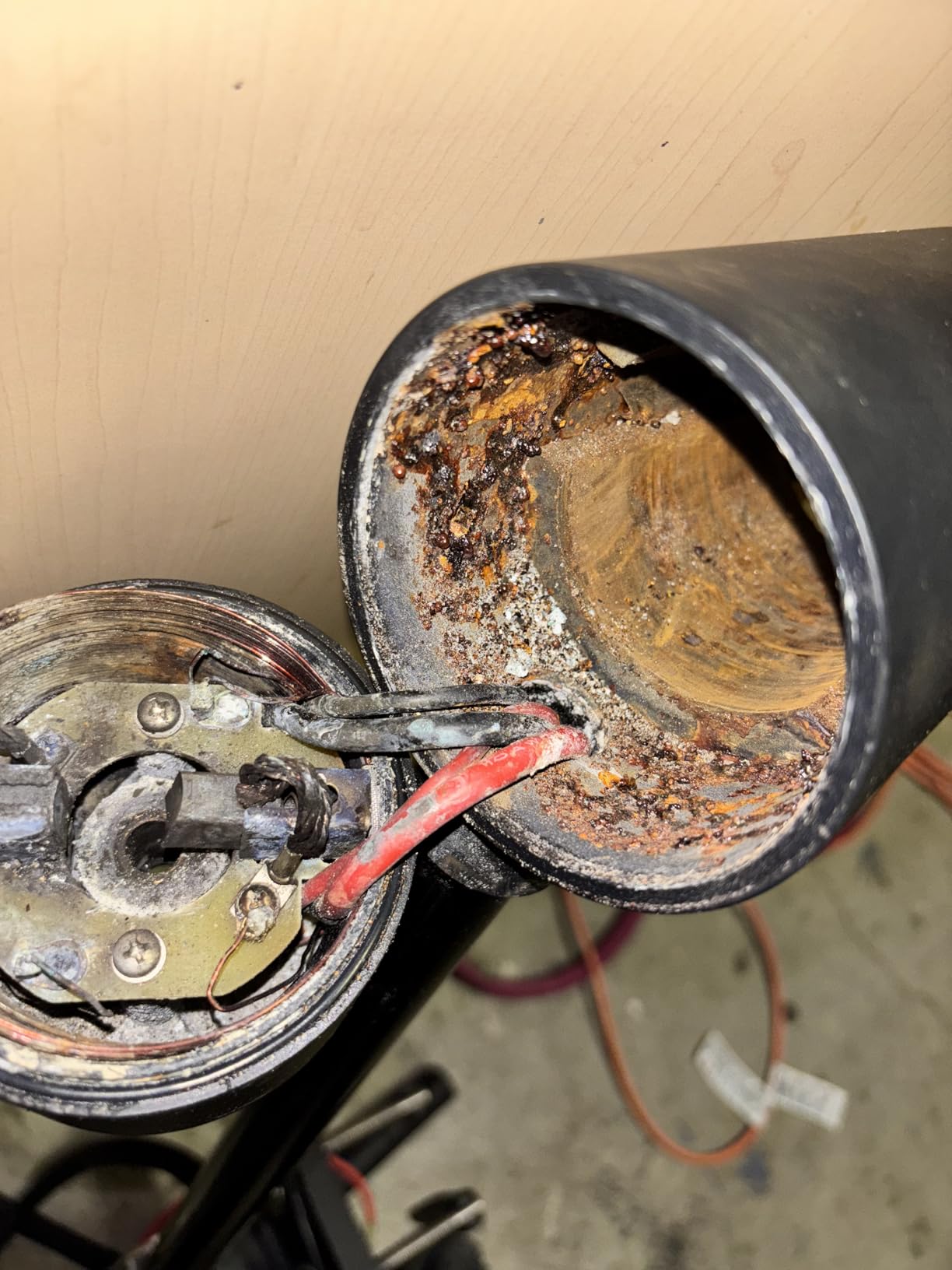
Fifty-five pounds of thrust in a transom package with a sealed waterproof aluminum head is a combination you do not usually see at the entry end of this market. The sealed head is the part that matters for an aluminum boat in salt, because it is the housing that corrodes first on cheaper motors.
The handle is telescopic and adjusts from 6.3 to 10.6 inches, so it fits both a seated angler and someone standing at an outboard tiller. Speeds are eight, five forward and three reverse, and the three blade prop is intended for low speed torque and reduced tangling in vegetation.
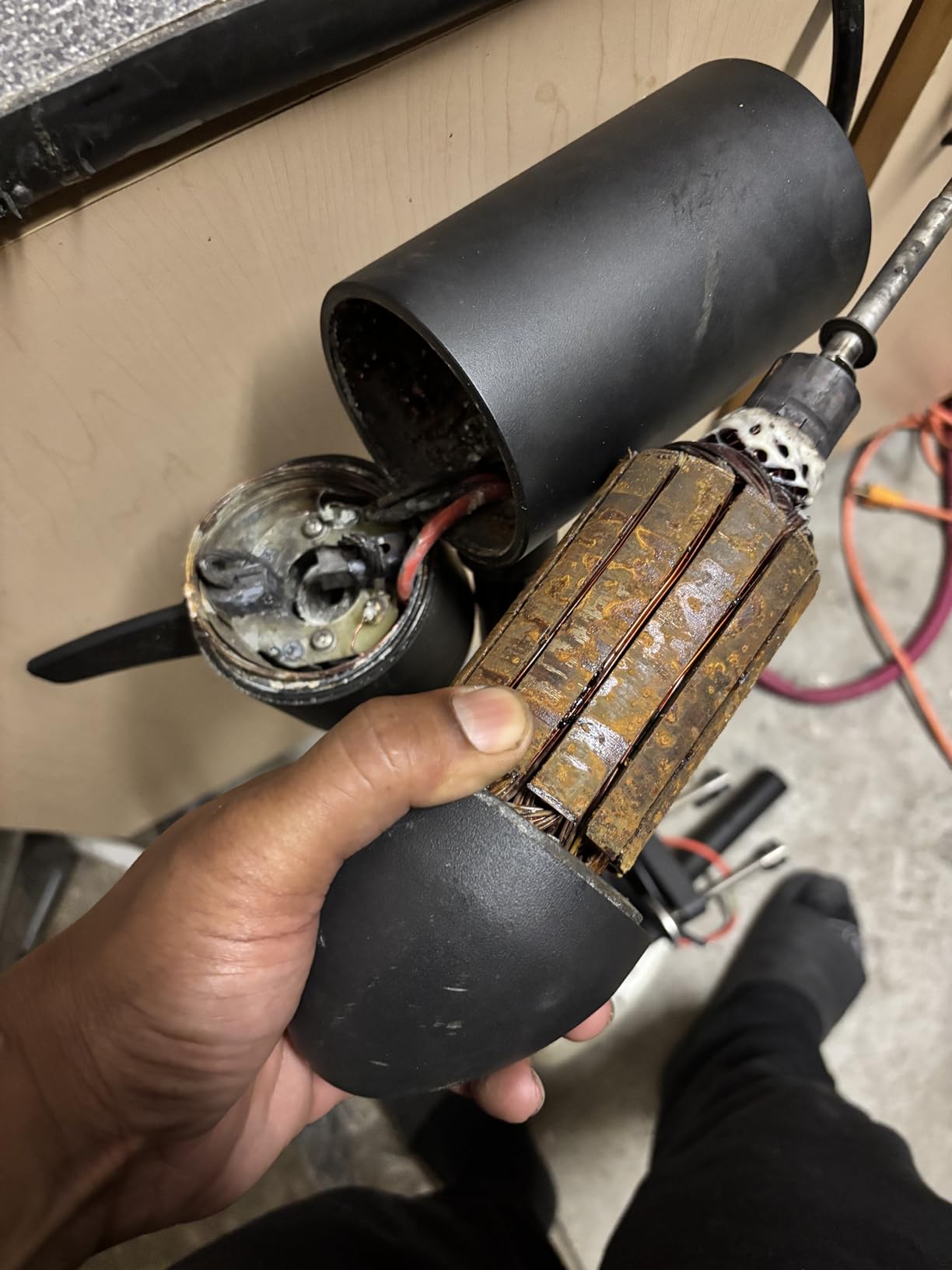
It weighs 20.3 lb, uses a high strength lightweight aluminum alloy shaft, and the shaft height and transom bracket both adjust as water conditions change. The manufacturer also notes the wiring convention clearly: a 12V motor needs one 12V battery, while a 24V version needs one 24V battery or two 12V batteries wired in series.
It is explicitly listed for aluminum boats, kayaks, canoes, rafts, inflatables and fishing boats, and the only included component beyond the motor itself is the propeller.
When this one makes the sense
If you are putting a trolling motor on a boat that lives in brackish or salt water and you do not want to spend on corrosion protection, a sealed aluminum head is the minimum acceptable standard. This motor meets it at 55 lb of thrust.
The 30 inch shaft suits a standard transom height, and 20.3 lb keeps the load reasonable on a small hull.
Where caution belongs
This is the lowest rated motor in our group, at 4.1 stars, and the one star share runs at 12 percent. A 43 rating base is a thin record for a component that lives in a wet environment.
Speed changes are geared rather than stepless, so fine slow speed control is not available, and you supply the battery, the cable and the breaker yourself.
11. Intex 40 lb Transom Motor – Best for Inflatable-Style Boats
INTEX Transom Electric Trolling Motor for Inflatable Boat, 40lb Thrust
40 lb thrust
12V
Transom mount
8 speeds
Weed escape function
17 lb
Pros
- Weed escape function reverses the prop to back out of vegetation
- Auto power modulation lengthens battery life
- Control panel shows battery level dry run and overload warnings
- Multi position telescoping tiller tilts through 8 positions
- Made to fit Intex Challenger Seahawk Excursion and Mariner boats
Cons
- No manufacturer warranty
- Plastic construction rather than the aluminum typical of an aluminum boat rig
- 40 lb thrust is modest for a rigid aluminum hull
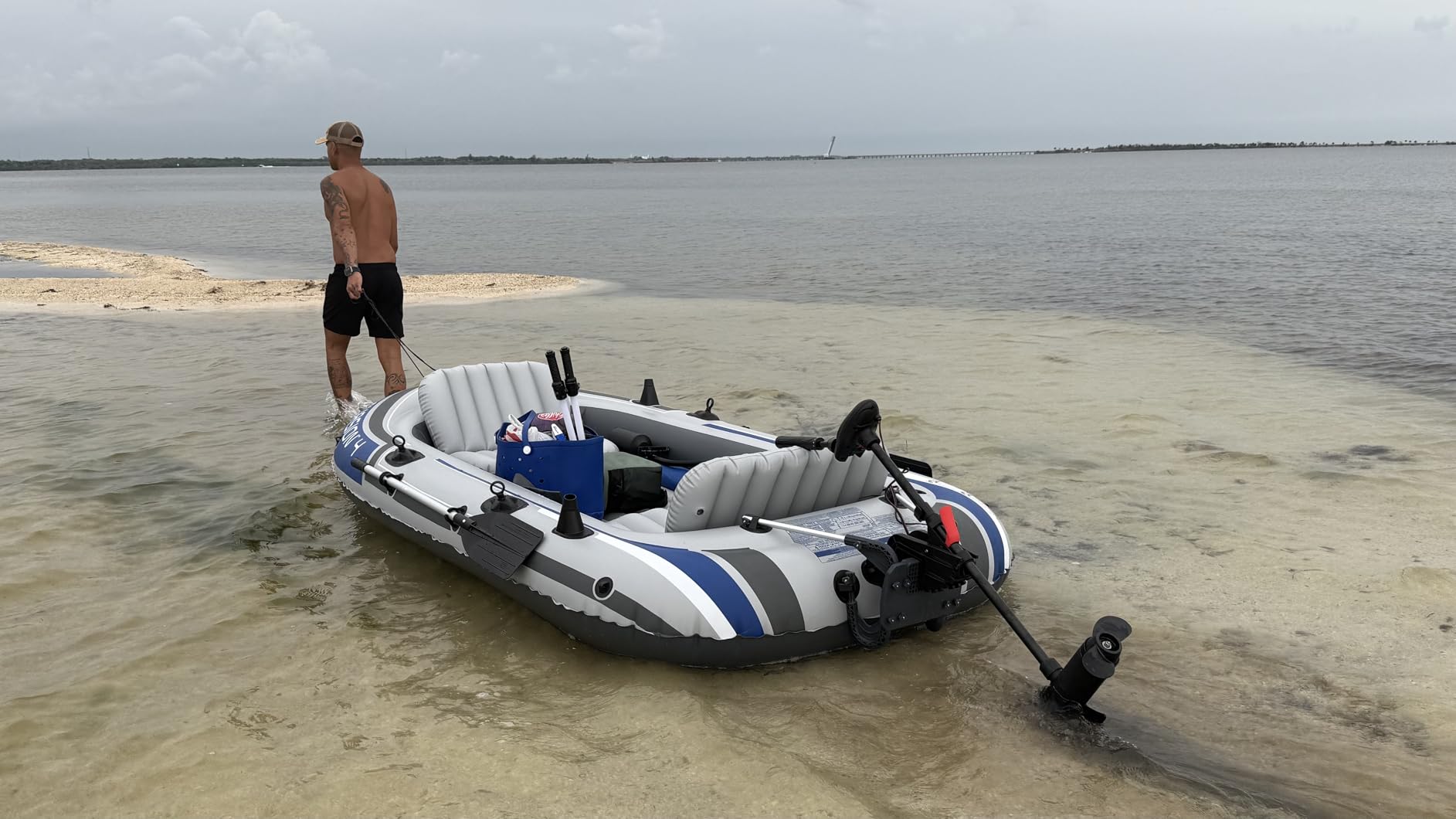
Most of the motors in this roundup would be wrong here. This one is built around a specific list of inflatable hulls, including the Intex Challenger 3, Seahawk 2, 3 and 4, Excursion 4 and 5, and Mariner 3 and 4, and the bracket geometry is made for those boats. If you fish from an inflatable or a soft sided craft, it is the correct shape for the job.
The smart features are real. A weed escape function rapidly reverses the propeller to back the motor out of vegetation, and auto power modulation lengthens battery life by adjusting output to the load. The control panel reports battery level, dry operation and overload, which is more instrumentation than most budget transom motors offer.

The tiller extends six inches and tilts through eight positions, and speed control runs across eight settings, five forward and three reverse. Maximum output is listed at 420 watts, and the whole unit weighs 17 lb. A deep cycle battery is not included.
One line in the listing has to be read carefully: there is no manufacturer warranty on this motor. That is unusual and it is the main reason it sits this low in the ranking for a rigid aluminum application.
Why the weight and material matter
Plastic construction is a liability on a rigid aluminum hull and an advantage on an inflatable. On a soft boat, 17 lb of motor barely registers against the buoyancy the boat was designed around.
The weed escape function is the feature inflatable owners mention most, because soft bottomed boats with light bottoms pick up vegetation constantly.
Why it is not a pick for aluminum
No warranty is the honest reason. A trolling motor that lives in a wet environment with no warranty behind it is a different risk calculation than the other eleven motors on this list.
Forty pounds of thrust is also modest for a rigid hull that carries an outboard, and a plastic shaft and head will wear faster under the loads an aluminum boat puts on a mount.
12. AQUOS Haswing 55 lb Bow Mount 48 inch – Best for Larger Aluminum Bows
AQUOS Haswing Bow Mount Trolling Motor 12V 55lbs 48in with Wireless Remote
55 lb thrust
12V
48 inch shaft
Bow mount
164 ft wireless remote
Sacrificial anode
Pros
- Variable speed control is smoother and more efficient than stepped speeds
- 48 inch aluminum alloy shaft fits larger aluminum boats
- 164 ft wireless remote works from the boat or the shore
- Sacrificial anode and stainless components for salt water durability
- One hand stow and deploy pedal plus an easy lock depth collar
Cons
- Cruise control is not a true spot lock so wind and current move the boat
- Requires a 13.7 by 8 inch flat mount surface on the bow
- Accessories such as the remote carry only a three month warranty
This is the bow mount version of the long shaft idea, and it is sized for the larger end of the aluminum range. The manufacturer lists it for boats up to 2750 lbs with a suggested maximum length of 18 ft, and the 48 inch aluminum alloy shaft is what makes that pairing work on a high bow.
Control is a 2.4G wireless remote with a stated 164 ft range that recharges from a USB power bank, plus variable speed control that is smoother and more efficient than a stepped gearbox. A sacrificial anode and stainless steel components handle the salt water question.
Handling at the ramp is handled by an ergonomic lifting handle, a one hand stow and deploy pedal and an easy lock depth collar. The motor also rotates 180 degrees so it can push the boat in reverse when you need to back off a ledge.
The warranty is two years on the trolling motor and three months on accessories. A 38.4 inch shaft version also exists if your bow is lower than the 48 inch shaft needs, and the current listing is the 48 inch model.
Why the flat mount requirement decides it
This motor needs a 13.7 by 8 inch flat surface on the bow, and that single requirement eliminates a lot of aluminum boats. Mod V hulls with a raised casting deck, boats with a curved bow cap, and anything with a factory trolling motor pocket are all different problems.
If your bow does have that flat area, the one hand deploy pedal and the lifting handle make a 48 inch aluminum shaft manageable for one person.
Where the gap is
Cruise control holds a set speed but is not a true GPS anchor. On structure in a current, the boat will drift, and you will be correcting by hand or by remote the entire session.
One star ratings run at roughly 9 percent of the total, which points to some build consistency variation, and the three month accessory warranty covers the remote that you will depend on.
How to Choose a Trolling Motor for an Aluminum Boat
Size thrust on total loaded weight, not hull length
Length is a proxy, and a bad one. The number that decides your thrust requirement is total loaded weight: the bare hull plus the outboard, the fuel, the battery bank, the tackle, the livewell, and the people. Rule of thumb from the major retailers is roughly 5 lb of thrust for every 200 lb of total weight, and owner consensus on aluminum boat forums is to round up rather than down.
Here is the aluminum boat length reference we use. Treat it as a starting point and then check the loaded weight.
14 ft jon boat, 600 to 900 lb loaded: look for 26 to 35 lb of thrust
16 ft multi species, 1,000 to 1,600 lb loaded: look for 30 to 55 lb of thrust
17 ft multi species, 1,400 to 2,000 lb loaded: look for 55 to 70 lb of thrust
18 to 20 ft offshore aluminum, 2,000 to 3,000 lb loaded: look for 70 to 90 lb of thrust
20 ft and up with an outboard, 2,800 lb and above: look for 80 lb of thrust and up
Buyers also report that the size up is the safer mistake. A slightly oversized motor on a light aluminum hull is easy to slow down, while an undersized motor fighting a current burns battery and never gets the boat on the spot.
Measure the shaft against your bow height
This is the single most common sizing error, and it is the reason shaft length matters as much as thrust. The motor section needs about 12 inches of submersion while you are running. If the shaft is too short, the prop comes out of the water, the bow swings, you lose control, and the motor starts to cavitate.
Measure from your mounting surface to the waterline, then pick from the list below. Add a couple of inches if the boat is heavily loaded and sits low, or if you fish in waves.
Mounting point up to 20 inches above the waterline: buy a 26 to 30 inch shaft
Mounting point 20 to 30 inches above the waterline: buy a 36 inch shaft
Mounting point 30 to 40 inches above the waterline: buy a 42 to 48 inch shaft
Mounting point over 40 inches above the waterline: measure carefully and consider an extension or a shaft mount
For a transom mount, the same rule applies measured from the transom to the waterline at the loaded waterline, not at the boat sitting on a trailer.
Bow mount, transom mount, or engine shaft mount
A bow mount pulls the boat and gives you the finest low speed control and the best hold on a spot, which is why GPS anchor systems are built around it. It also puts the most load through the bow of the boat, which is exactly the part of an aluminum hull that needs reinforcing.
A transom mount pushes the boat, installs in minutes, comes off in seconds and works on any hull. It is the standard recommendation for 14 to 16 ft jon boats and for anyone who switches between boats. Its weakness is low speed precision, because a pushing motor tends to steer the stern rather than the nose.
An engine shaft mount clamps onto the outboard shaft and saves bow space entirely, which makes it worth considering on an aluminum boat where the bow deck is already busy with a trolling motor pocket or a shallow anchor locker. It also keeps weight centred rather than in the bow.
How to mount a trolling motor on an aluminum bow
Confirm you have a flat reinforced area. Measure the motor requirement, which on several of the bow mounts in this roundup is 13.7 by 8 inches, and check the deck is not a thin unsupported stamping.
Reinforce before you drill. Add a backing plate of marine plywood or a hardwood doubler under the deck, bonded and through-bolted, so the load is carried by the plate rather than by the skin of the aluminum.
Use stainless bolts, washers and nuts. Owners repeatedly report that self-tapping screws strip out of aluminum and rubber T mounts crack. Through-bolt with marine grade stainless and bed it with sealant.
Keep wiring off the deck. Run the cable through a sealed grommet, fuse it at the battery with a breaker sized to the motor, and secure it away from the anchor line and the shifting hatches.
Test for play before you launch. Push the mount hard in every direction. Any movement means the reinforcement is not doing its job, and it will get worse over a season in a trailer.
Boat builders and owners treat bow reinforcement on aluminum as mandatory rather than optional. It is the difference between a mount that lasts the life of the boat and a cracked deck.
Brushed versus brushless, and what voltage means for battery weight
Brushed motors are cheaper and simpler. Brushless motors cost more, run quieter, draw less current for the same thrust, and hold speed better as the battery drains. Our brushless pick was the only motor in the group that reached 65 lb of thrust at roughly 14.5 lb, and reviewers reported roughly double the run time of an older 55 lb brushed design.
On voltage, 12V is the right answer for nearly every aluminum boat in this size range. It uses one battery, which is a large payload saving. A 24V system draws fewer amps for the same thrust but needs two batteries in series, and on a small hull that extra weight eats into the capacity you need for the outboard and passengers.
For runtime math, divide the amp hours of your battery by the motor’s amp draw. A 55 lb motor that pulls 52A on a 50Ah battery gives you roughly one hour at full throttle and much longer at trolling speed, which is the only speed most of these motors spend their lives at.
The payload math nobody puts on a spec sheet
An aluminum hull carries a rated capacity that includes passengers, fuel, tackle and gear, and the trolling motor package is usually the last thing anyone accounts for. Do the subtraction before you buy. A 55 lb transom motor, one deep cycle battery and the wiring will add roughly 90 to 100 lb aft of the transom, and on a 14 ft jon boat with a 650 lb rating that is a meaningful percentage of the number before anyone puts a cooler in it.
This is why the 12V single battery setup wins on small aluminum. A 24V system with two batteries in series adds a second battery weight, and on a small hull that second battery often pushes you over the rating while you are still adding livewell and tackle. Larger aluminum boats with a 2,000 lb or higher rating can absorb it comfortably, which is the honest dividing line between the two approaches.
Batteries, charging and the runtime myth
Divide amp hours by amp draw to get a rough runtime number. A motor pulling 52A on a 50Ah battery gives you roughly one hour at full throttle, and considerably longer at the low trolling speed that most of these motors actually spend their lives at. Spec sheet claims assume a speed setting that very few anglers troll at.
Owners on aluminum boat forums also point out that newer brushless motors can draw more power at a given speed than older brushed units while still running slower, so runtime math from an older motor does not transfer. Judge a new motor by its own amp draw at your chosen speed, not by what the last motor did.
Two more practical points. Keep the trolling motor on its own dedicated bank where you can, because sharing a battery with a running outboard will drain it and can leave you with neither. And if your boat spends nights on a charger, a battery that keeps losing charge overnight is a wiring problem, not a motor problem.
Props, weeds and shallow water
Aluminum boats get fished over grass, cabbage and shallow stumps more than most hulls, and the prop is where that shows up. A weedless prop with a taller, more open blade design passes over vegetation instead of cutting it, at the cost of some low speed efficiency. Several motors in this roundup include a Power Prop kit for heavy vegetation, which is the same idea in a different shape.
Watch for cavitation instead. If the motor is losing submersion because the shaft is too short or the boat is overloaded, the prop will aerate, run rough and heat up. Fixing shaft length is the fix, and no amount of throttle management hides it.
Pre-launch and trailering checklist
Confirm the motor section is submerged at your loaded waterline, then retighten the depth collar.
Walk the mount and the transom bracket for looseness. Aluminum flexes more than fiberglass and will show movement first here.
Rinse the shaft and head with fresh water after any salt water trip, and pay attention to the shaft where the anode and the prop meet.
Inspect the prop for fishing line wrapped around the shaft, and clear it before it bends a blade.
Tilt the motor up and secure the cable so it cannot chafe against the deck or the trailer winch strap.
Salt water, fresh water, and matching your electronics
A freshwater motor used in salt will corrode at the shaft, the connectors and the head, and owners report seized shafts after a single season. If your aluminum boat touches salt, pick a model that is rated for it or that carries a sacrificial anode and stainless components, and rinse the motor with fresh water every trip regardless.
On electronics, a 12V trolling motor motor head with a built in transducer competes for the same noise space as your fish finder. The brushless motor in this group produced interference reports that disrupted sonar even on a separate supply, so if your setup depends on down imaging, test the combination before you rely on it.
For the wider range of mount styles that do not fit a metal hull, our kayak motor guide covers the low thrust end and our canoe guide covers the smallest setups.
How we picked
We compared 12 motors on the specifications that decide an aluminum boat install: thrust, voltage, shaft length, mount type, control method, construction material, and the manufacturer saltwater rating. We then read the buyer reviews for each and flagged the complaint that comes up repeatedly, not the one that appears once.
This is spec verified rather than lab tested. We did not put each motor on each hull, so treat the thrust to boat length reference as a sizing starting point and the per motor notes as guidance on fit and known weak points.
Frequently Asked Questions
What size trolling motor for 14 ft aluminum boat?
A 14 ft aluminum jon boat typically weighs 600 to 900 lb fully loaded, which points to a 26 to 35 lb of thrust motor. On a 12V transom mount in that range the Minn Kota Endura C2 or the PEXMOR 26 lb are the right size, and a single deep cycle battery keeps the load inside the hull payload rating.
What size motor for a 16 ft aluminum boat?
A 16 ft multi species aluminum usually runs 1000 to 1600 lb loaded, so 30 to 55 lb of thrust is the range to shop. Size it on total loaded weight rather than hull length, and if you will also run a small outboard and a second battery, move toward the 55 lb end of the range.
What size trolling motor for 17 ft aluminum boat?
A 17 ft aluminum commonly reaches 1400 to 2000 lb loaded, so 55 to 70 lb of thrust fits well. A 17 ft hull is also the usual threshold for a bow mount, because a transom mount starts to lose low speed precision on a boat this size. Bow mounting on aluminum means reinforcing the deck first.
How to mount a trolling motor on an aluminum boat?
Check you have a flat reinforced bow area, add a backing plate under the deck, and through-bolt with marine grade stainless bolts, washers and nuts rather than self-tapping screws or rubber T mounts. Seal the cable entry with a grommet, fuse the circuit at the battery, and push test the mount for play before you launch.
Who makes the most reliable trolling motor?
In this roundup the most reliable results came from motors with composite shafts and reinforced composite brackets, which is why the Minn Kota Endura C2 carries the highest average rating at 4.7 stars. Reliability on aluminum is more about shaft and bracket material than about the electronics package.
Are Garmin or Minn Kota trolling motors better?
Both build well, and the difference is the electronics ecosystem rather than the motor itself. A Garmin or MotorGuide unit gives you a tighter link to its own display, while a Minn Kota pairs with Humminbird networks. If your fish finder is already installed, matching the network is usually worth more than any spec difference.
What is the best trolling motor for the money?
The Newport NV 55 lb transom motor offers the strongest combination of thrust, single battery operation and a saltwater rating in this group, and its review base is large enough to trust. Below that, the PEXMOR 26 lb is the value entry point for a very small aluminum hull.
What is the average lifespan of a trolling motor?
A well built motor with a composite shaft and a two year warranty typically runs many seasons before the head or bracket is an issue, and the shaft is normally the last part to fail. Brushes are not a maintenance item on brushless models. Rinse in fresh water after every salt trip and store the motor dry over winter to get the most from it.
How fast will a 70 lb thrust trolling motor go?
A 70 lb of thrust motor on a mid size boat reaches roughly 4 to 5 mph at full setting, and about 2 to 3 mph at a realistic trolling setting. Trolling motors are not built to run fast. The Newport in this roundup is listed at about 4 mph on a top speed setting.
Can you use a bow mount trolling motor on the transom?
Not without a transom conversion bracket, and we do not recommend it. Bow mount units are built around a flat bow surface and a cable steer or steer link that the transom cannot provide. If you want hands-free control on the transom, a remote or pedal controlled transom motor is the right purchase.
Can I use a freshwater trolling motor in saltwater?
You can, but owners report seized shafts and corroded connectors after a single season without a saltwater rating. If your aluminum boat touches salt, choose a model rated for salt water or one with a sacrificial anode and stainless components, and rinse the motor with fresh water after every trip.
Our Verdict on the Best Trolling Motors for Aluminum Boats
For most aluminum boat owners the Newport NV is the pick. Fifty-five pounds of thrust, one 12V battery, a saltwater rating and more than 3300 reviews behind it is a combination nothing else in this group matches, and it fits the payload budget of a small hull better than a two battery system.
If your aluminum is 16 ft or smaller, the Minn Kota Endura C2 is the durability answer, with a composite shaft and the highest average rating here. Move to 17 ft and up and you should be looking at a bow mount, in which case the Minn Kota Edge gives you hands-free control and the Haswing 48 inch shafts solve the high bow overhang problem that causes so much frustration on the water.
Whichever one you choose, measure your bow height before you order, reinforce the deck before you drill, and buy the saltwater rating if your boat ever leaves fresh water. Those three steps decide whether the install works, and no motor on this list can do them for you.
For smaller craft, our kayak fishing motor picks cover the low thrust end of the market.