
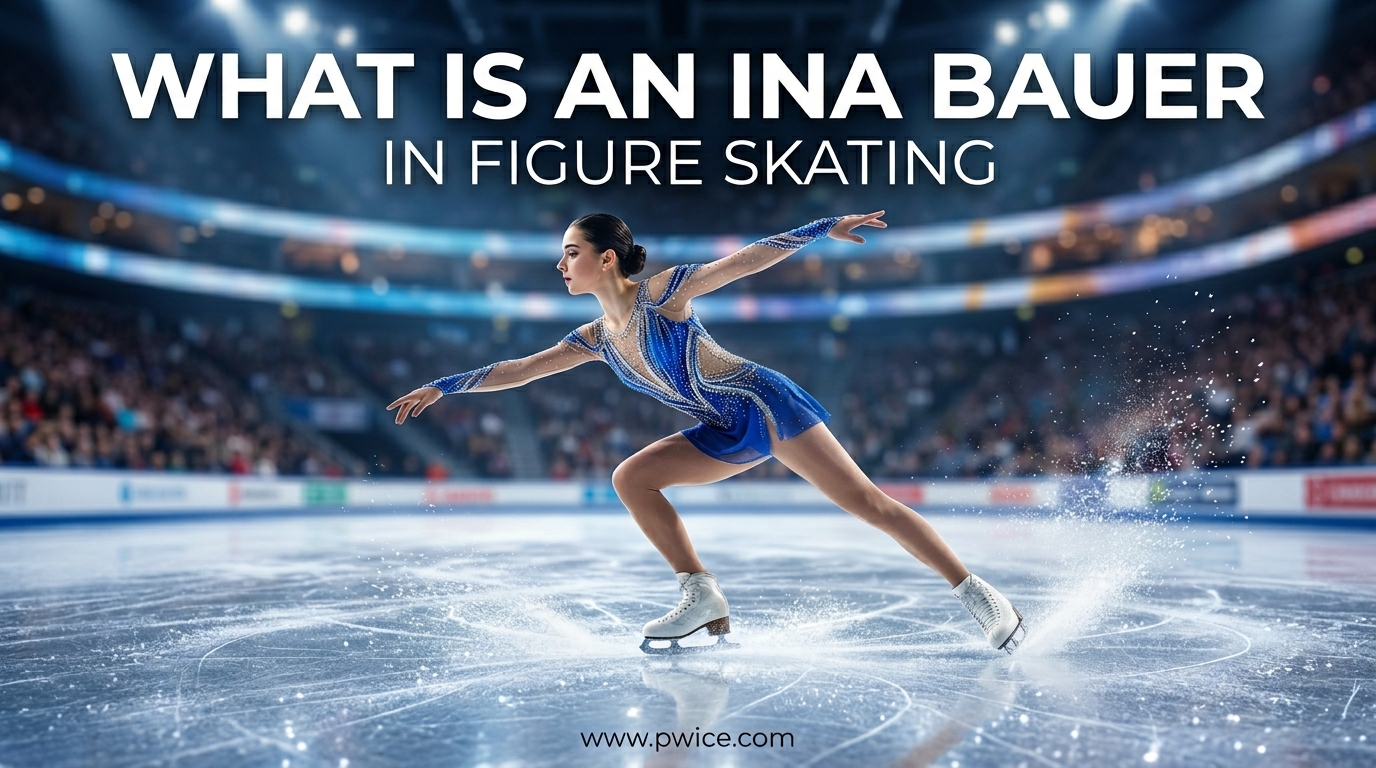
An Ina Bauer is a moves in the field element in figure skating where a skater glides on two parallel blades. One foot skates on a forward edge while the other leg traces a backwards parallel edge. The forward leg is bent slightly at the knee, and the trailing leg remains straight, creating one of the most graceful positions in the sport.
If you have ever watched figure skating and wondered how skaters create that beautiful, stretched position while gliding across the ice, you are looking at an Ina Bauer. This move appears in programs at every level, from amateur competitions to Olympic medal performances.
In this guide, I will break down exactly what an Ina Bauer is, why it is called that, the different variations skaters perform, and how you can learn this elegant element yourself. Whether you are a skater wanting to add this to your repertoire or a fan wanting to understand what you are watching, this article covers everything.
Table of Contents
What is an Ina Bauer in Figure Skating?
An Ina Bauer is classified as a moves in the field element, which means it is a skating movement performed as part of a program rather than a jump or spin. The defining characteristic is that the skater rides on two parallel blades simultaneously, with each foot traveling in opposite directions.
The technical setup looks like this. The skater places one foot on a forward-moving edge, either inside or outside depending on the variation. The other foot rides backward on a parallel edge, maintaining the same curve direction. This creates the signature stretched position that fans recognize immediately.
The forward leg bends at the knee in a shallow lunge position. The back leg stays completely straight, with the toe pointing backward. The skater’s torso can remain upright or bend backward into a layback position for more advanced variations. The arms typically extend gracefully to complete the visual line.
The Connection to Ballet’s Fourth Position
Many skaters and coaches compare the Ina Bauer to the fourth position in ballet. The similarity is clear when you look at the leg placement. Both positions require the legs to extend in opposite directions with one foot forward and one back.
The key difference is that ballet fourth position happens in a static pose on flat feet. An Ina Bauer happens while gliding across ice on knife-thin blades, with each foot traveling in opposite directions. The turnout required for a proper Ina Bauer is significant, usually around 180 degrees between the feet.
Skaters with ballet training often pick up the Ina Bauer faster because they understand the hip rotation and leg alignment. However, the balance challenge on ice is unique and requires dedicated practice regardless of dance background.
How It Differs From a Spread Eagle
People often confuse the Ina Bauer with the spread eagle, but these are distinct moves. A spread eagle involves both feet traveling in the same direction on opposite edges, creating a wide stance with the heels facing each other.
In an Ina Bauer, the feet travel in opposite directions on parallel edges. The blades run parallel to each other rather than diverging. This creates a completely different visual effect and requires different edge control.
Some skaters actually transition from a spread eagle into an Ina Bauer during their programs. This combination showcases exceptional edge control and adds difficulty to the choreography.
Types and Variations of the Ina Bauer
Not all Ina Bauers are created equal. The move has several distinct variations, each with its own difficulty level and visual character. Understanding these differences helps you appreciate what you are watching and plan your own learning progression.
Inside Edge Ina Bauer (The Foundation)
The inside edge Ina Bauer is the easiest variation and where most skaters start. The forward foot rides on an inside edge while the trailing foot skates backward on a matching inside edge. The natural lean of the inside edge helps the skater find balance.
This variation feels more stable because the skater leans into the circle, which aligns with the direction of movement. The inside edge provides a natural platform for the bent knee position.
Most coaches teach this version first because it builds the foundational skills without the counterintuitive balance challenges of the outside edge. Intermediate skaters typically master this variation before moving on.
Outside Edge Ina Bauer (Intermediate Challenge)
The outside edge Ina Bauer increases the difficulty significantly. Here, the forward foot rides on an outside edge while the trailing foot skates backward on a parallel outside edge. The skater must lean away from the direction of travel, which feels counterintuitive.
This variation requires stronger edge control and better ankle stability. The lean direction creates a less stable platform, demanding more core engagement to maintain the position.
Many competitive skaters use the outside edge variation in their programs because it demonstrates higher technical skill. The visual effect is also more dramatic due to the outward lean.
Layback Ina Bauer (The Advanced Showstopper)
The layback Ina Bauer represents the pinnacle of this element. The skater performs either an inside or outside edge Ina Bauer while bending their upper body backward until their head is nearly parallel to the ice. This creates a stunning visual line that audiences remember.
This variation demands both excellent edge control and significant back flexibility. The layback position shifts the center of gravity, requiring even more balance compensation through the hips and core.
Shizuka Arakawa’s layback Ina Bauer at the 2006 Olympics remains one of the most celebrated examples of this variation in history. The image of her arched back while gliding smoothly across the ice became iconic.
Reverse and Upright Variations
Beyond the three main types, skaters have developed additional variations. The reverse Ina Bauer switches the foot positions, with the right foot forward instead of left (or vice versa). This creates symmetry requirements for competitive programs.
The upright Ina Bauer eliminates the backbend entirely, focusing purely on the edge work and leg position. This variation proves that flexibility is not required to perform an Ina Bauer, a point many forum discussions emphasize for adult skaters.
Difficulty Ranking
If you are wondering which variation to learn first, here is the standard difficulty progression. The inside edge upright Ina Bauer is the easiest, suitable for skaters who have mastered basic moves in the field. The outside edge upright ranks next, introducing the counterintuitive lean. The layback versions represent the most difficult, with the outside edge layback being harder than the inside edge layback.
This progression aligns with how most coaches structure their teaching. Each step builds the skills needed for the next level, creating a logical learning path.
History and Origin of the Ina Bauer
The Ina Bauer takes its name from German figure skater Ina Bauer, who competed in the 1950s and 1960s. She was not the first skater to perform this position, but she performed it with such consistency and grace that the move became associated with her name.
Ina Bauer was a two-time German national champion and competed at the 1960 Winter Olympics in Squaw Valley. Her elegant style and controlled edge work made her performances memorable. The element she popularized became a staple of figure skating vocabulary.
The naming convention in figure skating often follows this pattern. When a skater performs an element with particular distinction, their name may become attached to it. This honors their contribution to the sport’s technical development.
Cultural Impact in Japan
The Ina Bauer holds special significance in Japanese figure skating culture. Shizuka Arakawa’s legendary performance at the 2006 Turin Olympics cemented the move’s place in Japanese skating history. Her layback Ina Bauer during the free skate became one of the most replayed moments of those Games.
The move’s popularity in Japan extends beyond competitive skating. It appears frequently in exhibitions, ice shows, and even pop culture references. Japanese orthopedic surgeons actually studied Shizuka Arakawa’s unique vertebrae structure to understand how she achieved her extreme backbend.
Contrary to popular belief, Shizuka was not naturally flexible. She trained her flexibility extensively to achieve that position. This should encourage skaters who worry they are not flexible enough for the layback variation.
ISU Judging System Classification
Under the current International Skating Union (ISU) Judging System, the Ina Bauer is classified as a move in the field rather than a difficult turn or step. It can be performed in the step sequence of a free skate program.
While the Ina Bauer itself does not receive a direct point value, it can increase the difficulty level of a step sequence when performed with control and good edge quality. The move also serves as a beautiful entrance to jumps, adding choreographic difficulty to jump combinations.
The current 2026 judging system evaluates moves in the field based on edge quality, control, and integration into the choreography. A well-executed Ina Bauer demonstrates the skater’s mastery of edge control and body alignment.
Famous Skaters Known for Their Ina Bauer
Certain skaters have become synonymous with exceptional Ina Bauers. Their performances set standards that others aspire to match and created memorable moments in skating history.
Shizuka Arakawa: The Gold Standard
When figure skating fans discuss the greatest Ina Bauers ever performed, Shizuka Arakawa’s name comes up immediately. Her layback Ina Bauer at the 2006 Olympics combined extreme flexibility with perfect edge control.
What made Shizuka’s version special was the sustained hold and the smooth entrance and exit. She did not just hit the position briefly. She glided through it with the confidence of a skater who had practiced it thousands of times.
Forum discussions frequently cite Shizuka’s performance as their “favorite Olympic moment of all time.” The image of her arching backward while maintaining perfect control became iconic for a generation of skaters.
Yuna Kim: Controlled Elegance
Yuna Kim’s Ina Bauer was praised for looking controlled rather than what some fans call “flopping back.” Her version demonstrated that the move can be elegant without extreme flexibility.
Kim used the Ina Bauer effectively as a transition element in her programs. The move flowed naturally into her jumps and spins, showing how Ina Bauers can serve choreographic purposes beyond pure display.
Some forum users noted that Yuna’s version looked “rushed in transitions,” but this was strategic. She used the position to build speed and momentum for the elements that followed.
Yuzuru Hanyu: Artistic Expression
Yuzuru Hanyu incorporated the Ina Bauer into his programs with distinctive hand movements that made his versions immediately recognizable. His artistic interpretation showed that the element can express emotion, not just technical skill.
Hanyu’s Ina Bauers often appeared during pivotal moments in his program music. The position allowed him to extend his body line while maintaining connection to the emotional arc of his performance.
Fans on skating forums frequently mention Yuzuru’s hand movements when discussing his Ina Bauers. This shows how personal style can make a standard element uniquely individual.
Other Notable Performers
Sasha Cohen’s flexibility made her Ina Bauers visually stunning. Her background in rhythmic gymnastics contributed to the extreme positions she could achieve.
Julia Lipnitskaia brought the Ina Bauer to Olympic team event gold in 2014. Her youthful energy combined with technical precision created memorable performances.
Johnny Weir and Jeffrey Buttle demonstrated that male skaters can perform Ina Bauers with equal grace. Their versions proved the element is not gender-specific and can enhance any skater’s program.
Patricia Neske, a German skater from the 1980s and 1990s, also received recognition for her consistent and beautiful Ina Bauers during her competitive career.
How to Learn an Ina Bauer
If you are a skater wanting to add this element to your repertoire, understanding the learning progression helps you approach it methodically. This section addresses the common questions and concerns that appear in skating forums.
Prerequisites: What You Need First
Before attempting an Ina Bauer, you should have solid basic skills. You need controlled forward and backward edges, the ability to hold a spiral position, and preferably some experience with spread eagles.
Coach Amy Brolsma, whose Ina Bauer tutorials are widely respected, recommends mastering the hockey stop position first. This teaches the knee bend and weight distribution needed for the forward leg.
You do not need extreme flexibility to start. The upright Ina Bauer is accessible to skaters with average flexibility. You can add the layback later if you choose to develop that aspect.
Step-by-Step Learning Progression
Start with the inside edge variation on a circle. Push onto a forward inside edge and allow the free leg to settle behind you on a backward inside edge. Focus on getting the feet parallel rather than worrying about depth or backbend.
Many skaters struggle with determining which leg should lead. The answer depends on your dominant direction and personal comfort. Try both and see which feels more natural. Most skaters have a preferred side, but competitive skaters must learn both for program requirements.
Common forum advice emphasizes that Ina Bauers should have a slight curve to them. They are not meant to travel in a perfectly straight line. The curve follows the natural arc of the edges.
The Flexibility vs Balance Misconception
One of the most frequent questions on skating forums is whether you need to be flexible to do an Ina Bauer. The answer is no for the basic version. The upright Ina Bauer requires balance and edge control, not flexibility.
Forum users frequently clarify this point for newcomers. As one experienced skater noted, “A skater does not have to be flexible at all to do an Ina Bauer.” The layback variation does require back flexibility, but that is an advanced option, not a requirement.
The real challenge is finding the balance point where both edges grip the ice simultaneously. Many skaters with good spirals still struggle with the Bauer because it requires different weight distribution.
Common Mistakes to Avoid
Excessive curving is a frequent problem. If your Ina Bauer curves too much, check that your feet are actually parallel. One foot may be drifting outward, creating a snowplow effect rather than a true parallel glide.
Another mistake is focusing too much on the backbend and losing edge strength. The layback should come from the upper back only, not from compromising the hip and leg position.
Many beginners try to force the turnout. Let your natural hip rotation determine your foot position. Forcing turnout beyond your range creates strain and instability.
Training Drills and Exercises
Off-ice training helps develop the position. Practice the fourth position stretch on the floor, focusing on opening the hips. Backbends over a stability ball build the strength needed for layback variations.
On-ice drills include the “hockey dot” exercise where you practice the knee bend position stationary. Boards can help skaters learning the layback by providing support for the backward bend.
Adult skaters should be patient with their progression. The forum community emphasizes that adult learners can absolutely master this move with consistent practice, even if development takes longer than for younger skaters.
Frequently Asked Questions
How hard is an Ina Bauer?
An Ina Bauer’s difficulty depends on the variation. Inside edge Ina Bauers are the easiest to learn, suitable for intermediate skaters who have mastered basic moves in the field. Outside edge Ina Bauers are more difficult due to the counterintuitive lean away from the direction of travel. The layback Ina Bauer is the most difficult, requiring both excellent edge control and significant back flexibility. Most skaters can learn the upright inside edge version within a few months of dedicated practice.
What is an Ina Bauer in ice skating?
An Ina Bauer is a moves in the field element in figure skating where a skater glides on two parallel blades. One foot skates forward on an edge (inside or outside) while the other foot skates backward on a parallel edge. The forward leg is bent slightly at the knee and the trailing leg remains straight. The skater’s torso can remain upright or bend backward into a layback position. The move creates a graceful, stretched position that is often used as a transition between elements or as a jump entrance.
What is the rarest move in figure skating?
While the Ina Bauer is not the rarest move in figure skating, the quadruple axel is generally considered the most difficult and rarest jump successfully landed in competition. The Ina Bauer itself is a relatively common connecting move seen at various skill levels. However, the layback variation of the Ina Bauer is less frequently seen in competition due to its difficulty. Other rare elements include the hydroblade, cantilever, and certain complex spin variations that require exceptional flexibility or balance.
Can you jump out of an Ina Bauer?
Yes, skaters frequently use the Ina Bauer as an entrance to jumps. The glide position builds momentum and flow that can carry into a jump takeoff. Skaters like Shizuka Arakawa and Yuna Kim have used Ina Bauer positions to enter jumps in their competitive programs. This adds difficulty to the jump combination and creates beautiful choreography. The transition requires precise timing to maintain the flow from the glide position into the jump takeoff edge.
Conclusion
An Ina Bauer in figure skating is a moves in the field element where a skater glides on two parallel blades, one foot moving forward and the other backward. The move comes in three main variations, inside edge, outside edge, and layback, each offering different difficulty levels and visual effects.
Whether you are watching competitive skating or learning the element yourself, understanding what is an Ina Bauer in figure skating adds appreciation for the skill involved. From Shizuka Arakawa’s legendary layback to the foundational inside edge version beginners learn, this element remains one of the most beautiful positions in the sport.
If you are learning this move, remember that balance matters more than flexibility for the basic versions. Start with the inside edge upright variation, practice consistently, and progress at your own pace. The Ina Bauer rewards patient practice with one of the most graceful positions you can achieve on the ice.