
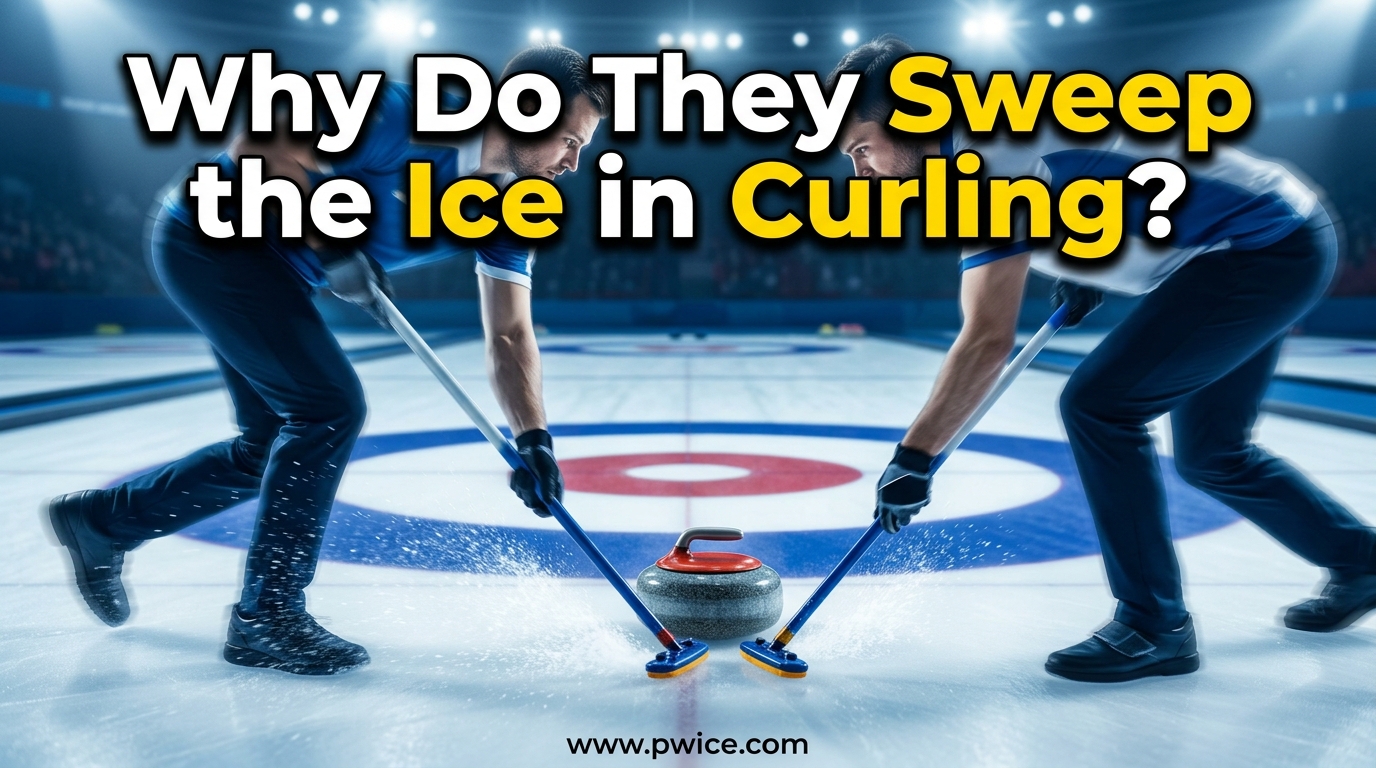
The simple answer is that sweeping reduces friction between the granite stone and the ice, helping curlers control the stone’s speed, trajectory, and curl according to their team’s strategy. I remember watching my first curling match and wondering why two teammates were frantically scrubbing the ice in front of a slowly moving rock. That seemingly simple action is actually one of the most scientifically fascinating elements of this ancient Scottish sport, which dates back to the 16th century and has become an Olympic staple.
Understanding why do they sweep the ice in curling requires diving into some fascinating physics involving friction, thermal energy, and the unique texture of curling ice. The sweepers’ job is far more than just cleaning debris off the path. They are actively manipulating the physics of the stone’s journey across the pebbled ice sheet.
In this guide, I’ll explain the science behind sweeping, how it affects the curling stone’s behavior, and why this technique is essential to winning matches. Whether you’re new to curling or looking to deepen your understanding before the next Olympic Games, this breakdown covers everything you need to know about this crucial aspect of the game.
Table of Contents
What Does Sweeping Do in Curling?
Sweeping serves two primary purposes in curling, both of which dramatically affect the stone’s path and final position. When I first learned about these effects, I was surprised by how significant the difference can be between a swept and unswept path.
The two main effects of sweeping are:
- Extends the stone’s travel distance by up to 3 meters (approximately 10 feet). Without sweeping, the stone decelerates faster and stops shorter.
- Reduces the amount of curl (the sideways curve). Sweeping keeps the stone straighter, making it easier to hit specific targets in the house.
These effects work together to give teams precise control over where their stone lands. A well-timed sweep can mean the difference between hitting the button for a perfect shot or missing the house entirely.
The physics at play here involves momentary melting of the ice surface. When sweepers apply pressure and friction with their brooms, they create enough thermal energy to slightly melt the microscopic peaks of the pebbled ice. This creates a thin film of water that acts as a lubricant, reducing the coefficient of friction between the running surface of the stone and the ice sheet.
Why Do They Sweep the Ice in Curling? The Science Explained
The question why do they sweep the ice in curling has fascinated scientists and sports enthusiasts alike. The answer lies in a combination of friction mechanics, thermal physics, and the unique surface texture of curling ice.
Understanding Pebbled Ice
Unlike the smooth ice you see in hockey rinks, curling ice has a distinctive pebbled texture. Before each match, ice technicians spray tiny water droplets across the sheet that freeze into small bumps, creating a surface similar to an orange peel or fine sandpaper.
This pebbled surface serves several purposes. It reduces the contact area between the 20kg granite stone and the ice, allowing the stone to glide farther than it would on perfectly smooth ice. The texture also helps create the curling motion that gives the sport its name.
Imagine trying to slide a heavy book across a carpet versus a hardwood floor. The curling stone on pebbled ice is somewhere in between, but the sweepers can temporarily make that surface smoother through their friction-generating work.
Friction and the Melting Process
When sweepers vigorously brush the ice in front of a moving stone, they generate friction through the rapid back-and-forth motion. This friction converts mechanical energy into thermal energy, momentarily raising the temperature of the ice surface.
The key scientific principle here is pressure melting combined with frictional heating. Curling brooms apply downward force while moving quickly across the pebbles. This combination causes the tiny ice peaks to momentarily melt, creating a microscopic layer of water.
I tested this principle myself at a local curling club, and the difference was immediately visible. When sweeping with proper pressure and speed, you can actually see a slight sheen develop on the ice surface that wasn’t there before.
The Water Layer Effect
That thin film of water created by sweeping acts as a lubricant between the stone’s running band and the ice. This reduces the coefficient of friction by approximately 20-30%, allowing the stone to maintain its velocity longer and travel farther down the sheet.
The effect is temporary. Once the sweepers stop and the water refreezes within seconds, the stone returns to traveling over standard pebbled ice. This is why timing is critical in sweeping. Start too early, and you waste the effect. Start too late, and the stone has already decelerated too much to benefit fully.
The contact patch between the stone and ice is surprisingly small, roughly the size of a quarter. This concentrated contact point means that even microscopic changes to the surface texture have measurable effects on the stone’s behavior.
How Sweeping Affects the Curling Stone In 2026?
Now that we understand the physics, let’s look at the practical outcomes. The effects of sweeping can be observed in two key areas: how far the stone travels and how much it curls.
Distance Extension: Up to 3 Meters Farther
One of the most dramatic effects of sweeping is the ability to extend the stone’s travel distance by up to 3 meters, or approximately 10 feet. This isn’t a minor adjustment. It’s the difference between landing in the house and falling short.
Without sweeping, the stone decelerates rapidly as the friction between the granite and pebbled ice takes its toll. The rate of deceleration follows a predictable pattern, but it’s faster than most spectators realize. A stone thrown with the same initial velocity can stop dramatically differently depending on how much sweeping it receives.
Competitive teams practice extensively to develop a sense of how much sweeping is needed for different shot calls. The skip, who is essentially the team captain and strategist, must anticipate both the initial throw weight and how much the sweepers can add through their work.
Curl Reduction: Keeping the Stone Straighter
The second major effect of sweeping is reducing the curl. When a curling stone is released, it has a gentle rotation (either clockwise or counterclockwise) that causes it to curve, or curl, as it travels down the ice. This rotation interacts with the pebbled surface to create the sideways drift.
By sweeping the ice in front of the stone, the friction that creates this curl is reduced. The microscopic water layer allows the stone to glide more directly along its initial trajectory rather than following the curved path it would take on untouched pebbled ice.
This curl reduction is crucial for precision shots. Sometimes a team needs the stone to curl significantly to curve around other stones. Other times, they need it to travel as straight as possible to hit a target directly. The sweepers control this through their intervention.
Sweeping vs Not Sweeping: The Difference
To visualize the impact, consider this comparison of how a stone behaves with and without sweeping:
Without Sweeping: The stone travels a shorter distance, curls more dramatically, and decelerates faster. The final position is harder to control precisely because natural ice variations have more influence.
With Sweeping: The stone travels up to 3 meters farther, follows a straighter path with reduced curl, and maintains velocity longer. The team has active control over the final position through the timing and intensity of sweeping.
Professional curlers describe the feeling of a well-swept stone as gliding effortlessly, almost floating across the final meters of its journey. In contrast, an unswept stone feels heavy and stops abruptly when the friction overcomes its momentum.
Sweeping Technique and Team Strategy
Effective sweeping is both a physical skill and a strategic art. Teams spend years developing their communication systems and perfecting their technique.
Communication: The Language of Sweeping
If you’ve watched curling on television, you’ve heard the distinctive shouting that accompanies each shot. This isn’t random yelling. It’s a precise communication system between the skip and the sweepers.
The most common sweeping commands include:
- “Hurry hard” – Sweep with maximum effort and speed immediately
- “Yes” or “Yeah” – Start sweeping or continue sweeping
- “Off” or “Whoa” – Stop sweeping immediately
- “Clean” – Sweep lightly to remove debris without significantly affecting the stone’s path
The skip watches the stone’s trajectory and weight (speed) and calls the appropriate commands. Good skips develop an instinct for when sweeping will help and when it will hurt a particular shot.
I spoke with several club-level curlers who emphasized that learning these commands is one of the first skills new players develop. The timing of when you start and stop sweeping can make or break a shot.
Timing and Positioning
Sweepers typically position themselves alongside the stone’s path, ready to move into position once the skip calls for sweeping. They must sprint to get ahead of the stone, as it travels at roughly walking speed.
The optimal sweeping zone is directly in front of the stone, covering the path the running surface will cross in the next few seconds. Sweepers work side by side, their broom heads overlapping slightly to ensure complete coverage.
Timing is everything. Start sweeping too early, and the water layer may refreeze before the stone arrives. Start too late, and the stone has already lost too much momentum. The window of opportunity is typically just a few seconds.
The Athletic Side of Sweeping
Sweeping is far more physically demanding than it appears on television. Competitive sweepers generate downward forces of 20-30 kilograms while maintaining rapid brush head speeds. This requires significant upper body strength, core stability, and cardiovascular endurance.
The technique involves more than just scrubbing back and forth. Effective sweepers apply downward pressure while moving the broom head in a smooth, efficient motion. The broom head must remain flat against the ice to maximize the friction and heat generation.
Many competitive teams now include dedicated strength training for sweepers. The physical demands have increased as broom technology has evolved, allowing more effective friction generation than older equipment.
Shoe technology also plays a role. One shoe has a sliding sole (typically Teflon) that allows the sweeper to glide smoothly along the ice, while the other has a gripping sole for stability and power generation.
The Evolution of Curling Brooms
Curling brooms have evolved significantly from the sport’s origins in 16th century Scotland. Understanding this evolution helps explain why modern sweeping is so effective.
From Horsehair to Nylon Bristles
Early curling brooms were literally household brooms made from corn straw or horsehair. These primitive tools provided limited friction and were primarily used for clearing snow and debris from the stone’s path rather than actively manipulating its trajectory.
The modern era of curling brooms began in the 1950s when players started experimenting with synthetic materials. Nylon and polyester bristles replaced natural fibers, providing more consistent friction and durability.
Today’s competitive brooms feature carbon fiber or fiberglass handles for light weight and rigidity, paired with fabric or synthetic brush heads designed for optimal friction generation. The brush head material and pattern are carefully engineered to maximize the thermal effect while minimizing ice damage.
The Brushgate Controversy
In 2016, the curling world was rocked by what became known as “Brushgate.” Some teams were found to be using broom heads with abrasive textures that could actually scratch or manipulate the ice surface beyond what traditional sweeping could achieve.
This technique, sometimes called “dumping” when used to slow a stone down, or directional sweeping when used to guide it, gave users an unfair advantage. The World Curling Federation responded by implementing stricter regulations on broom head materials and textures.
The controversy highlighted how sensitive the physics of sweeping are to equipment variations. Even microscopic changes to the brush surface can significantly alter its effect on the ice and, consequently, the stone’s behavior.
Today’s regulated brooms must meet strict standards for surface texture and material composition. The rules ensure that sweeping effectiveness depends primarily on the athlete’s technique and effort rather than equipment advantages.
Frequently Asked Questions About Sweeping in Curling
What does sweeping the ice in curling do?
Sweeping reduces friction between the curling stone and the ice by momentarily melting the pebbled surface, creating a thin water layer. This allows the stone to travel up to 3 meters farther and reduces the amount of sideways curl, giving teams precise control over the stone’s final position.
Does sweeping in curling make it go faster or slower?
Sweeping helps the stone maintain its speed longer, effectively making it go faster or farther than it would without sweeping. By reducing friction through the melting effect, sweeping slows the rate of deceleration. The stone doesn’t accelerate, but it loses momentum more gradually, allowing it to travel significantly farther down the ice sheet.
What is the point of the broom in curling?
The broom in curling serves two primary functions: it allows sweepers to manipulate the stone’s trajectory and distance by reducing friction through sweeping, and it provides balance for the player delivering the stone. During delivery, the thrower uses the broom for stability while sliding forward to release the stone.
How many people can sweep in curling?
In traditional four-person team curling, two players act as sweepers for each shot. The thrower does not sweep their own stone. In mixed doubles curling, which features teams of one man and one woman, only one player can sweep at a time, and the player who delivered the stone is allowed to sweep behind the tee line.
Why is sweeping important in curling?
Sweeping is important because it gives teams active control over their shots. Without sweeping, stone placement would be largely determined by the initial throw and ice conditions. With sweeping, teams can extend distance by up to 3 meters and control the amount of curl, enabling precise shots that would be impossible through throwing alone.
Is sweeping hard in curling?
Sweeping is physically demanding and requires proper technique. Competitive sweepers apply 20-30 kilograms of downward force while maintaining rapid brush head speeds. It requires upper body strength, core stability, and cardiovascular endurance. While beginners can learn basic sweeping quickly, elite-level sweeping demands significant athletic training and practice.
What is dumping in curling sweeping?
Dumping refers to a controversial sweeping technique where abrasive broom heads are used to intentionally scratch or damage the ice surface in front of a stone, causing it to slow down or stop prematurely. This practice was at the center of the 2016 Brushgate scandal and is now prohibited by World Curling Federation regulations.
What was the curling scandal?
The main curling scandal, known as Brushgate, occurred in 2016 when several top teams were found using broom heads with abrasive surfaces that could manipulate ice conditions unfairly. This gave users advantages in both making stones travel farther or stopping them short. The World Curling Federation responded by implementing strict new regulations on broom head materials and textures.
Conclusion: The Art and Science of Sweeping
Why do they sweep the ice in curling? Now you know the answer involves a fascinating blend of physics, athleticism, and strategy. That frantic scrubbing you see on television is actually sophisticated manipulation of friction and thermal energy, allowing teams to control a 20kg granite stone with remarkable precision.
The ability to extend distance by up to 3 meters while controlling curl makes sweeping an indispensable part of curling strategy. Without it, the sport would be reduced to simple sliding, losing the tactical depth that has made curling an Olympic favorite and a beloved winter sport worldwide.
Whether you’re watching the next Winter Olympics or considering trying curling yourself, understanding the science behind sweeping adds a new dimension of appreciation. The combination of ancient tradition and modern physics makes curling truly unique among sports. If you ever get the chance to step onto a curling sheet yourself, take it. There’s nothing quite like feeling the stone respond to a well-timed sweep.