
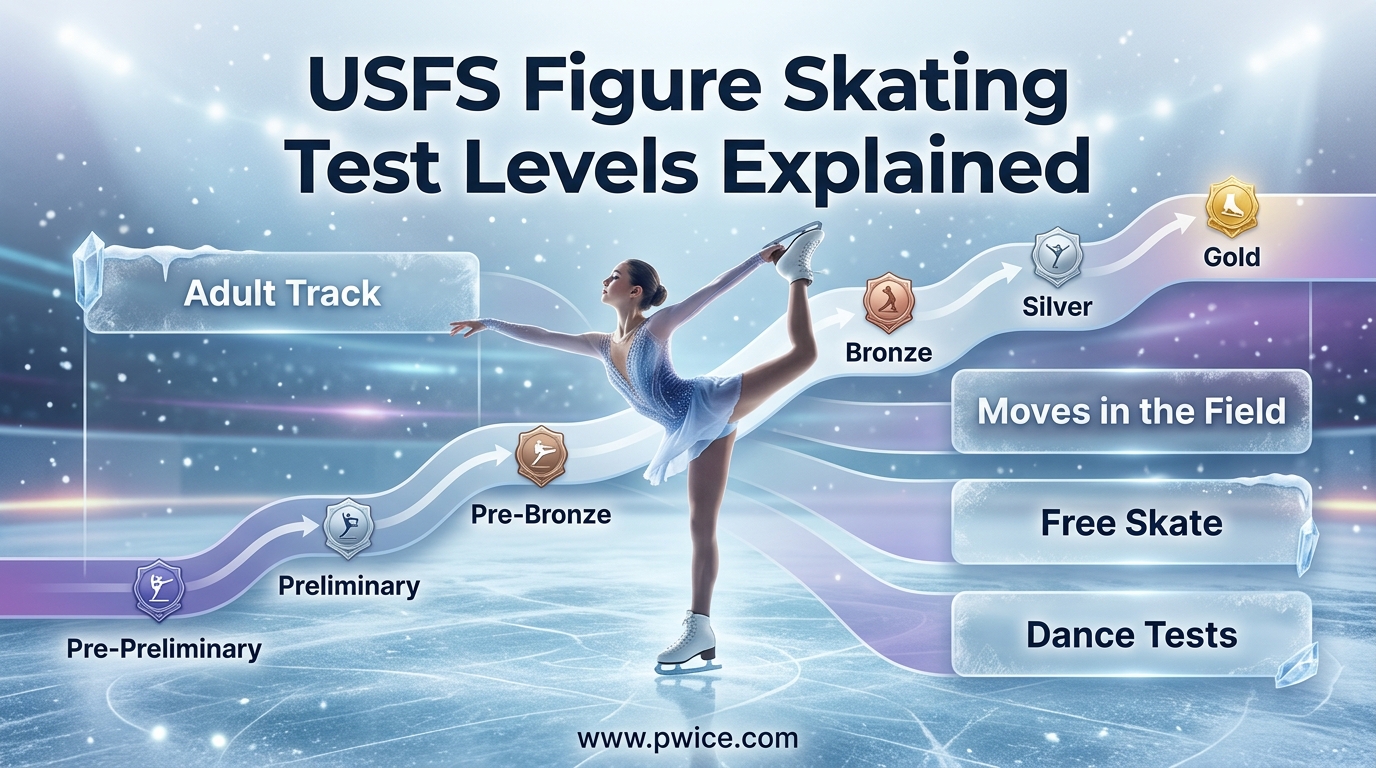
USFS figure skating test levels explained simply: they are a nationally standardized progression of skill-based assessments that measure your abilities across four disciplines – skating skills, singles, pairs, and ice dance. Whether you are a six-year-old dreaming of Olympic gold or a sixty-year-old returning to the ice after decades away, understanding how the U.S. Figure Skating test structure works is essential for setting goals and tracking your progress.
I have worked with skaters at every level of this system, from nervous first-timers attempting their Pre-Preliminary skating skills test to accomplished adults finally achieving their Gold Medalist designation after years of dedication. In this guide, you will learn exactly how the test levels work, what each discipline requires, the difference between adult and standard tracks, and how to prepare for your first (or next) test session.
Table of Contents
What Is USFS Testing and Why Does It Matter?
U.S. Figure Skating (USFS) operates the official testing system for figure skating in the United States. The test structure provides a standardized way to measure skill progression across multiple disciplines, with tests serving as both personal achievement milestones and prerequisites for competition participation.
Testing matters for three key reasons. First, it gives you structured goals to work toward with your coach, transforming vague “I want to get better” wishes into concrete “I want to pass my Preliminary skating skills test by March” objectives. Second, passing specific tests qualifies you to enter competitions at corresponding levels, ensuring fair and safe competition groupings. Third, achieving the highest test level – the Gold Medalist designation – represents one of the most respected accomplishments in the skating community.
From my experience, skaters who test consistently improve faster than those who do not. The testing deadline creates accountability. You show up to practice differently when you know judges will evaluate your three-turns in six weeks.
Who Should Test?
Testing is optional for purely recreational skaters who have no interest in competition. Many adult skaters enjoy skating for fitness and fun without ever testing, and that is completely valid.
However, if you have any competitive aspirations – even at the local level – testing becomes essential. USFS requires specific test certificates as prerequisites for competition entry. Additionally, many coaches recommend testing even for non-competitive skaters because the structured progression prevents gaps in fundamental skills.
USFS Figure Skating Test Levels Explained: The Three Main Tracks
The USFS testing system organizes skills into discipline-specific tracks that skaters progress through sequentially. Each track contains multiple test levels, with each level becoming progressively more difficult. Skaters cannot skip levels – you must pass the Preliminary test before attempting the Pre-Juvenile test, for example.
The Four Test Disciplines
USFS offers tests in four distinct disciplines. Skating Skills (formerly called Moves in the Field) tests your fundamental edge quality, turns, and skating power. Singles tests evaluate your free skating abilities including jumps, spins, and step sequences in a program format. Pairs tests assess skills performed with a partner including lifts, throws, and side-by-side elements. Ice Dance tests measure your ability to perform specific pattern dances and original dance programs, either with a partner or solo.
Most skaters focus on one or two disciplines. Competitive singles skaters typically test in both Skating Skills and Singles. Adult skaters often gravitate toward Ice Dance for its musical and social aspects. Pairs skaters must maintain proficiency in both singles and pairs tests.
Adult Track vs Standard Track
This distinction confuses many new skaters. USFS offers two parallel testing structures: the Standard Track and the Adult Track. The Standard Track follows the traditional Pre-Preliminary through Senior progression familiar to competitive skating. The Adult Track, available to skaters age 21 and older, uses Bronze, Silver, and Gold nomenclature similar to the old test system.
Adult skaters may choose either track, and the choice matters for your long-term goals. The Adult Track offers age-appropriate test elements and judging standards, often feeling more achievable for skaters who began skating as adults. However, the Standard Track provides the full competitive pathway if you aspire to test beyond the Gold level into Intermediate, Novice, Junior, or Senior.
Discipline-Specific Test Tracks
Each discipline follows its own progression with unique skills and requirements. Understanding what each discipline tests helps you choose your focus areas and set realistic preparation timelines.
Skating Skills Tests (Formerly Moves in the Field)
Skating Skills tests evaluate your fundamental skating quality without jumps or spins. Judges assess your edge depth and quality, turn precision, extension, flow, and power. These tests form the foundation for all other disciplines – poor skating skills make advanced jumps and spins nearly impossible.
The eight Skating Skills levels follow this progression: Pre-Preliminary, Preliminary, Pre-Juvenile, Juvenile, Intermediate, Novice, Junior, and Senior. Each test consists of specific patterns performed on designated circles and lines across the ice. Early levels focus on basic turns like forward and backward three-turns. Senior tests include complex multi-turn combinations performed at high speed with deep edges.
Most skaters find Skating Skills tests more difficult than they initially appear. The tests reveal flaws in basic technique that jumps might mask. I have seen skaters land double jumps yet struggle with the edge quality required for Intermediate skating skills.
Singles Tests (Free Skate/Freestyle)
Singles tests showcase your ability to perform jumps, spins, and step sequences in a program format set to music. Unlike Skating Skills tests which follow prescribed patterns, Singles tests require you to choreograph a program meeting specific element requirements.
The Singles track shares the same eight levels as Skating Skills: Pre-Preliminary through Senior. Each level specifies minimum jump and spin requirements. Pre-Preliminary singles requires only basic jumps like waltz jumps and single salchows. Senior singles demands double axels, triple jumps, and complex spin combinations.
Program duration increases with level. Preliminary programs last 1:40 maximum, while Senior programs extend to 4:00 plus or minus 10 seconds. Music must meet USFS regulations regarding lyrics and content.
Pairs Tests
Pairs tests evaluate skills performed with a partner. The six test levels are Preliminary, Juvenile, Intermediate, Novice, Junior, and Senior. Each test requires specific pair elements performed side-by-side or together.
Required elements include lifts (where the man lifts the woman overhead), throw jumps (where the man throws the woman into a jump), death spirals (a dramatic pivot where the woman skates a large circle nearly horizontal to the ice), pair spins, and side-by-side jumps and spins. Higher tests add more complex variations and combinations.
Unlike other disciplines, pairs testing requires finding a compatible partner with similar goals and commitment levels. This partner search adds complexity to the testing process that solo disciplines avoid.
Ice Dance Tests
Ice Dance tests measure your ability to perform specific pattern dances and, at higher levels, original dances and free dances. The six levels are Pre-Bronze, Bronze, Pre-Silver, Silver, Pre-Gold, and Gold.
Pattern dances form the foundation of ice dance testing. Each dance follows a specific pattern – typically a circle or oval – with precise step sequences performed in time with the music. The Dutch Waltz, Rhythm Blues, and Argentine Tango represent classic pattern dances skaters learn at early levels.
At higher levels, dancers transition from set pattern dances to more creative free dance formats. Solo dance options exist for skaters without partners, with separate but related test structures. Ice dance particularly appeals to adult skaters because the focus on musicality and partnership often feels more social and less physically punishing than jump-intensive singles skating.
Adult Track vs Standard Track: Which Should You Choose?
If you are 21 or older, you face an important decision: should you follow the Adult Track or the Standard Track? This choice affects your test options, judging standards, and long-term progression possibilities.
Understanding Your Options
The Adult Track uses the familiar Bronze, Silver, Gold terminology. Adult skaters can test in Skating Skills, Singles, Dance, and Pairs through Gold level. The Adult Track features age-appropriate test elements – for example, adult singles tests do not require double jumps until Gold level, whereas Standard Track skaters face double jump requirements much earlier.
The Standard Track follows the traditional Pre-Preliminary through Senior progression. Adult skaters on this track compete against the same standards as younger skaters. While this presents greater difficulty, it also opens the full competitive pathway including testing beyond Gold into Junior and Senior levels.
Key Differences at a Glance
Age requirement represents the most obvious difference – Adult Track requires skaters be 21 or older, while Standard Track has no age restrictions. Element difficulty differs significantly between tracks at equivalent levels. Adult Bronze roughly corresponds to Standard Preliminary, but with reduced jump and spin requirements. Judging panels for adult tests often include adult-specific perspectives on technique and artistry.
Perhaps most importantly, Adult Track skaters can continue testing beyond Gold level into what USFS calls “masters” levels – essentially continuing on the Standard Track Intermediate through Senior tests. Many accomplished adult skaters eventually transition to Standard Track to pursue these higher achievements.
Making Your Decision
Choose the Adult Track if you started skating as an adult, primarily skate for recreation and personal goals, prefer age-appropriate judging standards, or want a more achievable path to Gold Medalist status. The Adult Track respects the physiological realities of adult learning curves.
Choose the Standard Track if you began skating young and maintained strong fundamentals, have competitive aspirations requiring Standard Track tests, want the full pathway to Junior and Senior tests, or simply prefer the traditional progression structure.
Remember that your choice is not permanent. Many skaters begin on Adult Track and transition to Standard Track later. Some clubs even offer “hybrid” preparation addressing both tracks simultaneously.
Figure Skating Levels in Order: Complete Breakdown
Understanding the exact progression of test levels helps you plan your long-term skating journey. Each discipline follows a specific sequence, and knowing what each level requires helps set realistic preparation timelines.
Skating Skills Levels (8 Tests)
The Skating Skills track contains eight progressive tests, each building on the previous level’s foundations. Pre-Preliminary introduces forward skating, basic turns, and simple patterns. Preliminary adds backward skating and more complex three-turn sequences. Pre-Juvenile introduces mohawks and choctaws – turns that change feet while moving.
Juvenile level demands improved speed and edge depth with multi-turn combinations. Intermediate introduces difficult turns like brackets and counters performed on deep edges. Novice requires complex multi-turn sequences with excellent flow and extension. Junior tests include all turn types performed at high speed with precise control. Senior represents the pinnacle of skating skills achievement, with patterns that would challenge even professional skaters.
From my coaching experience, most skaters spend 3-6 months preparing for each Skating Skills test through Juvenile level, then 6-12 months for Intermediate and beyond. The jump from Novice to Junior Skating Skills often represents the biggest difficulty increase in the entire test structure.
Singles Test Levels (8 Tests)
Singles tests parallel the Skating Skills structure with eight levels from Pre-Preliminary through Senior. Each level specifies required jumps, spins, and step sequences performed in a choreographed program.
Pre-Preliminary and Preliminary singles focus on single rotation jumps – waltz jump, salchow, toe loop, and loop. Spins remain simple upright positions. Juvenile adds the flip jump and introduces flying spins. Intermediate requires the Lutz jump and combination spins. Novice demands all single jumps including the Axel, which represents skating’s gateway jump.
Junior singles requires double Salchow and double Toe Loop as minimums, with most skaters also presenting double Loop and attempts at double Flip. Senior singles requires double Axel and multiple triple jumps for competitive viability, though the test technically only mandates specific double jumps.
Dance Test Levels (6 Tests)
Ice Dance uses a six-level Bronze-based system regardless of whether you choose Adult or Standard Track for other disciplines. Pre-Bronze introduces basic pattern dances like the Dutch Waltz and Canasta Tango. Bronze adds more complex rhythms and patterns including the Rhythm Blues and American Waltz.
Pre-Silver and Silver levels introduce international dances and more complex pattern variations. Free dance elements enter at these levels. Pre-Gold and Gold demand mastery of complex pattern dances plus original and free dance programs showing creativity and musical interpretation.
Dance tests uniquely allow you to test with different partners for different dances, though you must complete all required dances at a level before advancing. Solo dance tests follow a similar structure with slightly modified requirements.
The Gold Medalist Achievement
Passing your final Gold-level test in any discipline earns you the designation of “Gold Medalist” in that discipline. This represents a significant achievement requiring years – often decades – of dedicated practice. According to USFS statistics, only about 3% of annual tests occur at the Gold or Senior level.
Gold Medalist status brings recognition within the skating community, eligibility for certain coaching certifications, and the personal satisfaction of achieving mastery in your discipline. Adult skaters particularly treasure Gold Medalist achievements because they represent overcoming the adult learning curve in a sport dominated by early starters.
Some skaters achieve “Gold Medalist” status in multiple disciplines – a rare and respected accomplishment showing true skating mastery. The most dedicated may eventually pass Senior tests beyond Gold, though this represents competitive-level achievement few recreational skaters pursue.
How Does Figure Skating Testing Work?
Understanding the logistics of testing helps reduce anxiety and ensures you arrive prepared. The testing process involves registration, preparation, the test session itself, and receiving results.
Finding and Registering for Test Sessions
USFS test sessions occur at rinks nationwide throughout the year. EntryEeze serves as the primary registration platform for finding and registering for test sessions. You can search by location, date, and test type to find sessions convenient for you.
Most clubs host test sessions quarterly or biannually. Popular sessions fill quickly, especially in regions with limited rink availability. I recommend registering at least 4-6 weeks in advance, though some skaters book several months ahead for high-demand sessions.
Your coach must approve your test registration. USFS requires coach sign-off confirming you are prepared for the level you are attempting. This prevents unprepared skaters from wasting judges’ time and their own money on premature test attempts.
In-Person vs Virtual Testing
USFS offers two testing formats. In-person testing remains the traditional method – you perform your test live before a judging panel at a scheduled session. Virtual testing, expanded significantly during 2026, allows submission of competition protocols or video submissions for evaluation.
In-person testing provides immediate feedback and the traditional test day experience many skaters value. Virtual testing offers flexibility for skaters in remote areas or those with scheduling constraints. Not all test levels qualify for virtual testing, and requirements change periodically – check current USFS rules before planning a virtual test.
Test Day Process
Test day follows a predictable pattern. Arrive 30-60 minutes early to check in, warm up, and mentally prepare. The test session coordinator organizes skaters in testing order, usually grouping by discipline and level.
When your name is called, you approach the judges’ table and present yourself. The judges verify your identity and test level. You then take the ice and perform your test. For Skating Skills and Dance tests, you perform patterns on designated ice areas. For Singles and Pairs, you perform your program to music.
After completing your test, you wait while judges complete their evaluation sheets. Results are typically announced within 15-30 minutes. Pass, and you receive a test certificate and pin. Do not pass, and judges provide feedback on what needs improvement before your next attempt.
Passing Requirements and Scoring
Each test has specific judging criteria outlined in the USFS rulebook. Judges evaluate required elements using standardized criteria. For most tests, you need to demonstrate acceptable quality on all required elements to pass – one severely failed element typically results in a “retry” designation.
Judges complete test sheets marking each element as Pass, Conditional, or Retry. Conditional indicates the element barely met standards. Too many Conditional marks result in an overall test retry. The judging panel typically includes 2-3 judges for lower tests and 3-5 judges for Gold and Senior tests.
What Happens If You Fail
Failing a test – called receiving a “retry” – disappoints but does not derail your progress. USFS allows you to retest after a waiting period, typically 28 days. There is no limit on retest attempts, and many accomplished skaters have retested multiple times at various levels.
Judges provide specific feedback on what needs improvement. Work with your coach to address these issues before your next attempt. Many skaters actually benefit from a retry – the extra preparation time often results in stronger fundamentals than skaters who pass on their first try.
Test Preparation Timeline: From First Lesson to Test Day
Successful test preparation requires planning. Rushing leads to poor performance and potential failure. Based on my experience helping skaters prepare for hundreds of tests, here is a realistic timeline for test preparation.
Six Months Before: Foundation Building
Begin serious work on test elements six months before your target test date. For Skating Skills tests, this means drilling patterns weekly, recording video for analysis, and addressing edge quality issues. For Singles tests, you should be landing required jumps consistently in practice and running through program segments.
This period establishes your technical foundation. Do not rush this phase. Weak fundamentals become obvious under test pressure. I have seen skaters attempt tests with shaky jumps that “usually” land – the stress of judging makes those shaky jumps fall apart.
Three Months Before: Registration and Focus
Register for your test session through EntryEeze approximately three months ahead. This creates your deadline and commits you to the preparation process. Finalize your music for Singles tests and confirm costume compliance with USFS regulations.
Increase lesson frequency if possible. Many skaters add a second weekly lesson during the final three months. Focus lessons specifically on test elements rather than general skill building. Run full test simulations at least monthly to build endurance and identify weak points.
One Month Before: Polish and Mock Tests
The final month focuses on performance quality and consistency. For Singles tests, you should run full programs multiple times weekly. For Skating Skills, perform complete tests without stopping, treating each run like the real thing.
Schedule a mock test if possible – perform your test before your coach or visiting judges for feedback. Mock tests reveal issues you might not notice in practice. Nerves, stamina, and mental focus all behave differently under simulated test conditions.
Address any equipment issues now. Breaking in new boots the week before your test creates disaster. Ensure your costume fits comfortably and allows full range of motion.
Test Week: Final Preparations
Taper your training during test week. Heavy practice sessions create fatigue that hurts test performance. Focus on consistency rather than learning new skills. Visualize successful test performance daily.
Confirm logistics: know the rink location, parking situation, check-in time, and warmup ice availability. Prepare your test bag with backup tights, blade towels, water, healthy snacks, and your USFS membership card.
Get adequate sleep and eat nutritious meals. Avoid major dietary changes that might upset your stomach. Many skaters under-eat from nerves – force yourself to consume adequate calories for energy.
Test Day: Managing Nerves
Arrive early to avoid rushing. Complete your normal warmup routine without changes – test day is not the time to experiment. Stay warm between warmup and your test time; cold muscles perform poorly.
Expect nerves – they are normal and even helpful in moderate amounts. Deep breathing exercises help manage anxiety. Focus on process rather than outcome: think about edge quality, not “I must pass this test.”
Trust your preparation. You have practiced these elements for months. The test simply demonstrates what you already know how to do.
Understanding Test Costs and Fees
Testing requires financial investment beyond regular coaching and ice time. Understanding these costs helps you budget appropriately and avoid surprises.
USFS Test Fees
USFS charges official test fees that vary by level. As of 2026, Pre-Preliminary through Preliminary tests cost approximately $35-45. Juvenile through Intermediate tests run $50-65. Novice through Senior tests cost $75-100. Gold tests typically cost $100-150 due to larger judging panels.
These fees go directly to USFS and judges. They do not include any coaching or ice time costs. Fees are non-refundable if you withdraw after the registration deadline, so commit only when truly prepared.
Coaching Costs
Your coach’s time represents the largest testing expense. Most coaches charge for test day presence – typically their normal lesson rate plus travel time if the test session is at a different rink. Budget 2-3 hours of coach time on test day: pre-test warmups, the test itself, and post-test feedback.
Additional lessons during test preparation add costs. Many skaters increase lesson frequency from weekly to twice-weekly during the two months before testing. At $50-100 per lesson, this adds $400-800 to your preparation costs.
Ice Time and Additional Expenses
Practice ice time costs add up during intensive preparation periods. Freestyle sessions typically cost $15-25 per hour. Testing-specific practice – running programs, pattern drilling – requires dedicated ice time beyond normal lessons.
Travel expenses apply if you test at distant rinks. Hotel costs, gas, meals, and time off work add significantly to test expenses. Some skaters travel hours to find available test sessions or preferred judging panels.
Costume and equipment costs hit Singles testers hardest. Test dresses and suits range from $100 for basic options to $500+ for custom designs. Music editing services cost $50-100. Blade sharpening, costume alterations, and replacement equipment add miscellaneous expenses.
ISI vs USFS Testing: What’s the Difference?
Many skaters encounter both ISI (Ice Sports Industry) and USFS testing options, particularly at rinks offering learn-to-skate programs. Understanding the differences helps you choose the right pathway for your goals.
ISI Recreational Focus
ISI operates a recreational skating program designed primarily for group lesson skaters and casual participants. ISI tests emphasize fun and achievement recognition without the rigor of USFS testing. Many rinks integrate ISI testing into their group lesson programs as motivational tools.
ISI offers test levels from Tot 1-4 through Freestyle 10, plus specialty tests in figure skating, ice dance, pairs, and speed skating. The tests cost less than USFS testing and use more relaxed judging standards. ISI welcomes skaters of all ages and abilities.
However, ISI tests do not qualify you for USFS-sanctioned competitions. They represent personal achievement only, without pathway to competitive figure skating. Many skaters begin with ISI testing in group lessons, then transition to USFS testing when they develop competitive or serious recreational goals.
USFS Competitive Pathway
USFS testing provides the official pathway to competitive figure skating in the United States. USFS test certificates serve as prerequisites for competition entry at corresponding levels. The testing standards maintain consistency nationwide, ensuring that a Juvenile skater in California faces equivalent requirements to a Juvenile skater in New York.
USFS tests require higher technical standards and more rigorous judging. The organizational structure supports competitive skating from local competitions through national championships and international teams.
Can You Do Both?
Absolutely. Many skaters participate in both ISI and USFS programs simultaneously, particularly during early training years. ISI competitions offer lower-pressure competitive experience for developing skaters. Some skaters test in both organizations to maximize achievement recognition.
Eventually, serious competitive skaters focus exclusively on USFS testing. The time and financial investment of dual testing rarely justifies the benefits once competitive goals emerge. Recreational adult skaters might maintain ISI membership for rink social activities while pursuing USFS testing for structured goals.
Frequently Asked Questions
What are the levels of figure skating testing?
How long does it take to pass USFS tests from first test to Senior level?
Can adults test in figure skating?
What is a gold medalist in figure skating?
How much do USFS tests cost?
What happens if I fail a figure skating test?
Which is harder, Axel or Lutz?
What is 6.0 in figure skating?
Is 5.9 a good score in figure skating?
How do I choose between adult track and standard track?
Conclusion: Start Your Testing Journey
USFS figure skating test levels explained simply provide a roadmap for your skating journey. Whether you aim for the Gold Medalist achievement or simply want structured goals for personal improvement, the testing system offers a nationally recognized framework for measuring your progress.
Start by discussing your goals with your coach. Identify which discipline interests you most – many skaters begin with Skating Skills tests to build fundamental quality before attempting Singles tests. If you are an adult skater, carefully consider whether the Adult Track or Standard Track better serves your long-term aspirations.
Remember that testing is a marathon, not a sprint. The skater who progresses steadily through levels with solid fundamentals eventually surpasses the skater who rushes through tests with barely-passing quality. Your test certificates represent permanent achievements – earn them with pride and patience.
Your first test session awaits. Register through EntryEeze, commit to your preparation timeline, and join the community of skaters working toward their personal best on the ice.