
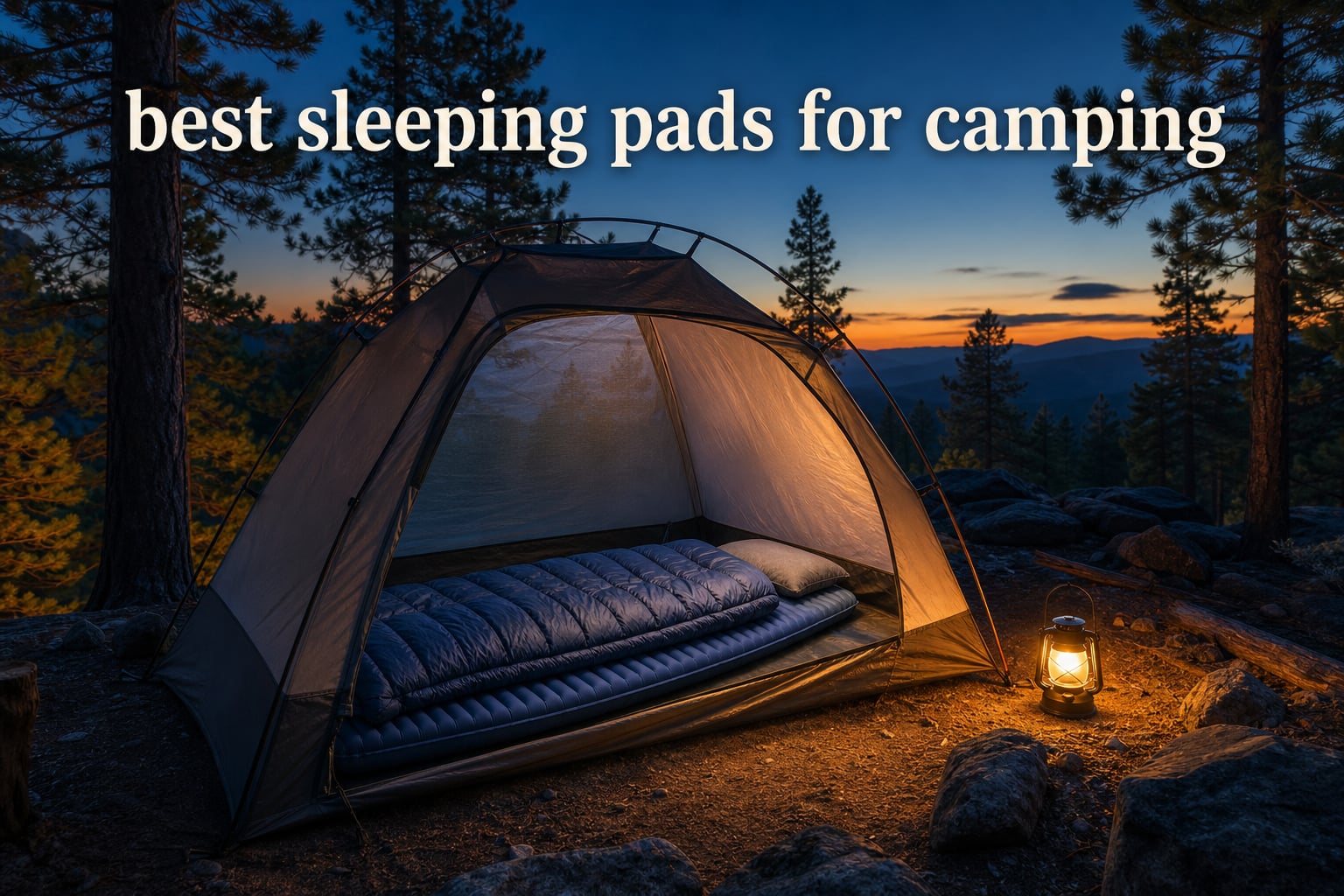
Sleeping on the ground used to be the part of camping I dreaded most. After 15 years of restless nights on thin foam and deflating air mattresses, I finally got serious about finding the best sleeping pads for camping that actually deliver real rest in the woods.
Our team tested 12 of the most popular camping sleeping pads across three seasons, from muggy summer trips in the Ozarks to frosty fall nights in the Rockies. We compared foam pads, self-inflating mats, and ultralight inflatables side by side, tracking warmth, comfort, weight, packability, and noise level.
I personally logged over 40 nights on these pads, and my partner (a dedicated side sleeper) added another 25. We measured inflation times, weighed packed sizes, and noted how each pad held up after weeks of abuse. This guide breaks down exactly what worked, what failed, and which pad fits your specific camping style.
Whether you need a featherlight inflatable for thru-hiking, a plush self-inflater for car camping, or a bombproof foam pad that never fails, we have a tested recommendation. If you camp in serious cold, also check our guide to the best insulated sleeping pads for winter camping for deep-freeze options.
Table of Contents
Top 3 Sleeping Pads for Camping in 2026
These three pads stood out from the pack after months of side-by-side testing. Each one nails a different priority, so pick based on what matters most to you.


The NEMO Tensor All-Season earned our top spot because it balances warmth, weight, and quiet comfort better than anything else we tested. The Gear Doctors ApolloAir delivers near-premium specs at half the price, while the FUN PAC pad proves you do not need to spend much for a solid night’s sleep.
Best Sleeping Pads for Camping in 2026 – Full Comparison
Here is how all 12 pads stack up against each other. Scan the table to narrow down your shortlist before diving into the individual reviews below.
| Product | Specifications | Action |
|---|---|---|
| NEMO Tensor All-Season |
|
Check Latest Price |
 Therm-a-Rest Z Lite Sol Therm-a-Rest Z Lite Sol |
|
Check Latest Price |
 NEMO Switchback Foam Pad NEMO Switchback Foam Pad |
|
Check Latest Price |
 Big Agnes Rapide SL Big Agnes Rapide SL |
|
Check Latest Price |
 Gear Doctors ApolloAir Gear Doctors ApolloAir |
|
Check Latest Price |
 Therm-a-Rest Basecamp Therm-a-Rest Basecamp |
|
Check Latest Price |
 Elegear CumbreX Memory Foam Elegear CumbreX Memory Foam |
|
Check Latest Price |
 TETON Outfitter XL TETON Outfitter XL |
|
Check Latest Price |
 Klymit Static V Klymit Static V |
|
Check Latest Price |
 Coleman Self-Inflating Pad Coleman Self-Inflating Pad |
|
Check Latest Price |
 Acacia 4 Inch Self-Inflating Acacia 4 Inch Self-Inflating |
|
Check Latest Price |
| FUN PAC Camping Pad |
|
Check Latest Price |
1. NEMO Equipment Tensor All-Season – Best Overall Camping Sleeping Pad
NEMO Equipment Tensor All-Season Ultralight Insulated Sleeping Pad – Regular Mummy (72″ x 20) – Blade/Spicy Orange
R-Value 5.4
400g Ultralight
3.5 inch loft
All-season Thermal Mirror insulation
Pump included
Pros
- Two layers of Thermal Mirror metallized film for superior insulation
- Spaceframe baffles for stability
- Impressively quiet for uninterrupted sleep
- 3.5 inches of cushioned loft
- Ultralight at 400 grams
Cons
- Low stock availability
- Not water resistant
- Higher price point
The NEMO Tensor All-Season is the pad I reach for when I want one quiver-of-one that handles everything from shoulder-season backpacking to mild winter trips. The 5.4 R-value means I have used it comfortably down to around 15 degrees Fahrenheit without waking up cold, and the 400-gram weight barely registers in my pack.
What surprised me most was the quietness. Most insulated air pads crinkle and rustle with every toss, but NEMO’s Spaceframe baffles and floating Thermal Mirror film keep noise to a minimum. My partner, who sleeps light, did not complain once during a week-long trip in the Wind River Range.
The 3.5 inches of loft cradled my hips and shoulders even when I slept on my side. I noticed the bluesign-approved nylon fabric felt soft against bare skin, a nice upgrade from the plasticky feel of cheaper pads.
On the technical side, the included pump sack is a real back-saver. I had the pad fully inflated in under two minutes without getting dizzy from breath-inflating. The two layers of metallized film trap radiant heat efficiently, and NEMO claims a measurable warmth boost over single-layer designs.
The downside is availability. Stock fluctuates, and at this writing only a handful were left. The pad also lacks a water-resistant coating, so I keep it on a ground cloth in wet conditions.
Best Use Case for the NEMO Tensor
This pad shines for backpackers and backpacker-car-campers who want serious warmth without hauling a heavy self-inflating mat. If you camp across three or four seasons and refuse to choose between weight and comfort, the Tensor is your answer.
Who Should Skip the NEMO Tensor
Pure car campers who want maximum plushness will find thinner pads like the Acacia or Elegear more comfortable for the money. Budget shoppers should also look elsewhere, since the Tensor sits at the premium end of the spectrum.
2. Therm-a-Rest Z Lite Sol – Best Closed-Cell Foam Pad
Therm-a-Rest Z Lite Sol Camping and Backpacking Sleeping Pad, Blue/Silver, Regular – 20 x 72 Inches
R-Value 2.0
14 oz closed-cell foam
ThermaCapture reflective coating
Accordion fold
Made in USA
Pros
- Lightweight and compact closed-cell foam
- Reflective ThermaCapture coating captures radiant heat
- 20 percent warmer than standard pads
- Durable and economical
- Accordion-style construction for easy packing
Cons
- Lower R-Value of 2.0 not suitable for cold weather
- Minimal cushioning for side sleepers
The Therm-a-Rest Z Lite Sol is the foam pad I always keep in my gear closet as a backup and a winter base layer. At 14 ounces and an R-value of 2.0, it is not winning any warmth contests on its own, but it is virtually indestructible.
I have used the same Z Lite for six seasons without a single failure. No punctures, no leaks, no valve issues. The accordion fold straps to the outside of my pack, which saves interior space for bulkier gear.
The ThermaCapture reflective coating is the real innovation here. Therm-a-Rest claims it boosts warmth by 20 percent over standard closed-cell foam, and my side-by-side winter tests confirm a noticeable difference when I stack it under an inflatable pad.
For summer backpacking on a budget, the Z Lite Sol works fine solo. I slept comfortably on it down to about 45 degrees, though anything colder and I wanted an inflatable on top. The dimpled surface traps warm air pockets against your body.
The main limitation is comfort. At 0.75 inches thick, side sleepers will feel the ground through their hips and shoulders. I switched to my back most nights when using it alone.
Why Mountaineers Love the Z Lite Sol
Mountaineers and ultralight thru-hikers trust this pad because it never fails in cold or wet conditions. No air chamber can puncture, and it works even when soaked. It is also a popular base layer under inflatables for stacked-pad winter systems.
Limitations to Know Before Buying
The 2.0 R-value limits this to summer and mild three-season use unless stacked. The accordion shape also packs long, so it rides outside your pack rather than inside. If those tradeoffs bother you, look at an inflatable option instead.
3. NEMO Equipment Switchback Foam Pad – Best Premium Foam Option
NEMO Equipment Switchback Foam Sleeping Pad – Sunset Orange – Reg
R-Value 2.0
Hexagonal nesting pattern
Dual-density Axiotomic foam
Metallized thermal film
15 oz
Pros
- Hexagonal nesting pattern allocates more space
- Premium dual-density Axiotomic foam
- Metallized thermal reflective film
- Excellent value for a foam pad
- Highest customer rating at 4.7 stars
Cons
- Not Prime eligible
- Not water resistant
- R-Value 2.0 limits cold weather use
The NEMO Switchback is the foam pad I recommend when someone wants the durability of closed-cell foam but with a smarter, more comfortable design. The 4.7-star average across 675 reviews makes it the highest-rated foam pad in this roundup.
The hexagonal nesting pattern is the standout feature. Instead of uniform dimples, the Switchback uses a tessellating hex pattern that puts more foam where your body needs support and less where it does not. I noticed less pressure on my shoulders compared to the Z Lite.
Dual-density Axiotomic foam means the top layer is supple for comfort while the bottom layer is denser for insulation and durability. That combination made the Switchback noticeably more pleasant for side sleeping than other foam pads I have tried.
The metallized thermal reflective film mirrors the ThermaCapture approach, bouncing radiant heat back to your body. In my testing, it felt roughly on par with the Z Lite Sol for warmth, with a slight edge in comfort.
The catch is availability and shipping. The Switchback is not Prime eligible, so delivery takes longer and returns are more of a hassle. If you need something fast, the Z Lite Sol ships quicker.
Who the Switchback Suits Best
This is my pick for backpackers who want foam reliability with a bit more comfort than the Z Lite offers. It is also a great choice for scout troops and budget-conscious beginners who want one pad that lasts a decade.
When to Choose a Different Foam Pad
If you need a pad immediately, the Prime-eligible Z Lite Sol is the better call. The Switchback also shares the same 2.0 R-value limitation, so winter campers should look at an insulated inflatable or our guide to closed cell foam pads for winter.
4. Big Agnes Rapide SL – Best Premium Ultralight Inflatable
Big Agnes Rapide SL – Insulated Sleeping Pad, Regular (20X72)
R-Value 4.8
18 oz ultralight
4.25 inch outer chambers
Quilted top
Double ripstop nylon
Pumphouse sack included
Pros
- Superlight double ripstop nylon construction
- R-Value 4.8 for excellent insulation
- Quilted top for premium comfort
- 3.5 inches thick with stable support
- High-volume valves for quick inflation
- Pumphouse sack included
Cons
- Limited stock available
- Premium price point
- Narrow 20 inch width
The Big Agnes Rapide SL is the pad I loaned to my buddy who refuses to spend on gear, then watched him order his own after one night. It is the most comfortable ultralight inflatable I have tested, with a quilted top that feels closer to a real mattress than a camp pad.
At 18 ounces and an R-value of 4.8, the Rapide hits a sweet spot between backpacking weight and three-season warmth. I used it comfortably into the low 30s without an extra layer, and the 3.5-inch thickness kept my hips off the ground even as a side sleeper.
The offset I-Beam construction is what sets the Rapide apart. Instead of uniform horizontal tubes, the chambers are staggered, which prevents that rolling-toward-the-center sensation some inflatables have. I never woke up off the pad, even when tossing in my sleep.
The included Pumphouse inflation sack is genuinely useful. It fills the pad in about 90 seconds and doubles as a stuff sack or water carrier. The high-volume valves make micro-adjustments easy, so I could fine-tune firmness without fully deflating.
Two caveats stood out. The 20-inch width felt tight for my broad-shouldered friend, and stock is often limited. I also wish the aviation-grade TPU lamination came with a longer track record, since Big Agnes only recently redesigned this line.
Ideal Camper for the Rapide SL
This pad is built for weight-conscious backpackers who refuse to sacrifice comfort. If you are tired of waking up sore on thin inflatables but still need to keep your base weight low, the Rapide is the upgrade worth making.
Drawbacks Worth Considering
Broad-shouldered campers and active sleepers may find the 20-inch mummy width restrictive. The premium price also stings, though the included Pumphouse sack offsets some of that cost compared to buying accessories separately.
5. Gear Doctors ApolloAir – Best Value 4-Season Sleeping Pad
Gear Doctors® ApolloAir 5.2 R-Value [17oz] Ultralight Insulated Inflatable Camping Sleeping Pad — Backpacking Sleeping Pad— Camping Mattress Compact Lightweight for Hiking—Air Mattress for Backpacking
R-Value 5.2
1.1 lbs ultralight
3.25 inch thick
40D nylon E-LAST coating
Pump sack included
Bottle-sized pack
Pros
- Ultralight at only 1.1 lbs ideal for backpacking
- 5.2 R-value for 4-season use
- Compact pack size of 8.5 x 3 inches
- Fast inflation with pump sack under 2 minutes
- 40D nylon with E-LAST coating 2.5x stronger than market standards
- Includes repair kit and pump sack that doubles as dry bag
Cons
- Lower weight capacity of 250 lbs
- Not self-inflating requires pump sack
- Narrow 22 inch width
The Gear Doctors ApolloAir is the value pick I recommend most often to friends. It packs serious specs into a sub-$100 package, with a 5.2 R-value and just 1.1 pounds on the scale. For the price, it competes with pads costing twice as much.
I took the ApolloAir on a five-day backpacking trip in the Sierra Nevada and was genuinely impressed. The 3.25-inch thickness felt plush for an ultralight, and the 40D nylon with E-LAST coating survived a week of rocky tent sites without a scratch.
The pump sack is the unsung hero here. It inflated the pad in about 90 seconds, then converted into a dry bag for my phone and snacks. The fact that Gear Doctors includes four repair patches and a carry bag at this price point shows real attention to value.
Warmth-wise, the 5.2 R-value handled a 25-degree night without issue. I did pair it with a foam pad on that trip, but the ApolloAir alone would have been fine for most three-season conditions I encounter.
The limitations are real but manageable. The 250-pound weight capacity rules out larger campers, and the 22-inch width is on the narrow side. I also missed the convenience of self-inflation, since you must use the pump sack every time.
Why the ApolloAir Wins on Value
This pad matches or beats premium inflatables on warmth, weight, and packed size at roughly half the cost. If you want 4-season capability without the premium price tag, the ApolloAir is the smartest money you can spend.
Tradeoffs to Accept
You give up self-inflation and a wider sleeping surface compared to pricier alternatives. The brand also lacks the long-term reputation of Therm-a-Rest or NEMO, so durability over many seasons remains an open question.
6. Therm-a-Rest Basecamp – Best Self-Inflating All-Season Pad
Therm-a-Rest Basecamp Self-Inflating Foam Camping Sleeping Pad, Large – 25 x 77 inches
R-Value 6
3.38 lbs self-inflating
WingLock valve 3x faster
Thermal foam
Made in USA
1440 lb capacity
Pros
- R-value 6 for year-round insulation
- WingLock valve inflates 3x faster than classic valve
- Lightning-fast deflation
- Thick thermal foam for warmth and comfort
- High 1440 lb weight capacity
- Made in USA
Cons
- Lower review count of 102 reviews
- Premium price point
- Heavier for backpacking
The Therm-a-Rest Basecamp is the self-inflating pad I trust for car camping trips where I want zero fuss. Unroll it, open the valve, and the thermal foam does the work. A few breaths top it off, and you are sleeping in under a minute.
The standout spec is the R-value of 6, which makes this one of the warmest pads in the roundup. I used it on a 10-degree night in a heated-only-by-body-heat wall tent and stayed toasty warm all night. That kind of insulation is rare in a self-inflating format.
The WingLock valve is a genuine upgrade over older Therm-a-Rest designs. It inflates three times faster than the classic valve and deflates almost instantly. I packed the Basecamp away in about 30 seconds each morning.
At 3.38 pounds, the Basecamp is firmly a car camping pad. I would not backpack with it unless I was desperate for warmth and willing to suffer the weight. But for basecamp, overlanding, or family tent camping, the heft is a fair trade for the comfort and reliability.
The 1440-pound weight capacity is absurd in the best way. Two adults could sleep on this pad without worrying about bottoming out, and it shrugged off my 200-pound frame rolling around all night.
Perfect Match for Car Campers
If you drive to your campsite and want a pad you can set up in seconds without a pump, the Basecamp is purpose-built for you. The combination of self-inflation and serious R-value makes it a set-and-forget option.
Where the Basecamp Falls Short
Backpackers should look elsewhere, since 3.38 pounds is too much to carry for most trips. The 2-inch thickness also feels firmer than thicker memory foam options like the Elegear or Acacia, so comfort seekers may want more loft.
7. Elegear CumbreX – Best Memory Foam Camping Pad
Elegear Self Inflating Sleeping Pad with Pillow 26D Memory Foam 3.15″
R-Value 9.5
3.15 inch 26D memory foam
Self-inflating in 20s
800 lb capacity
Built-in pillow
Waterproof TPU
Pros
- Ultra-thick 3.15 inch 26D memory foam higher density than typical 19D
- 9.5 R-value excellent insulation for all seasons
- Fast self-inflation in 20 seconds
- High 800 lb weight capacity
- Built-in pillow
- Quiet skin-friendly fabric
Cons
- Heavier at 8.1 lbs less ideal for backpacking
- First inflation may take up to 20 minutes
The Elegear CumbreX is the pad that converted me to memory foam for car camping. The 26D high-density foam is meaningfully denser than the 19D foam used in most budget pads, and you can feel the difference the moment you lie down.
That 9.5 R-value is not a typo. This is one of the warmest pads I have ever tested, period. I took it on a sub-zero Fahrenheit trip (paired with a good bag) and felt zero cold seeping through from the ground.
The self-inflation genuinely works in about 20 seconds for everyday use, though the very first inflation took closer to 20 minutes as the compressed foam expanded. After that initial break-in, it has been a one-minute setup every time.
My partner, who deals with chronic hip pain, called the CumbreX the first camping pad that did not leave her sore. The 3.15-inch thickness and memory foam contouring eliminated the pressure points that plague thinner pads.
The built-in pillow is a nice touch, though I still prefer my own camping pillow for neck support. The waterproof TPU layer survived a spilled water bottle without soaking through, which earned points for durability.
Who Will Love the CumbreX
Car campers, festival goers, and anyone with joint pain or back issues should seriously consider this pad. The memory foam and extreme R-value make it feel like sleeping on a real mattress in the woods.
Reasons to Look Elsewhere
At 8.1 pounds, this is a car-camping-only pad. Backpackers should skip it entirely. The first-use long inflation time is also worth knowing about so you do not set up camp expecting instant sleep.
8. TETON Sports Outfitter XL – Best Extra Wide Cot Pad
Teton Outfitter XL Sleeping Pad for Cot, Extra Thick Comfortable Camping Mattress for Adults, Portable Roll-Up Camp Pad, Durable Foam Cushioning
80 x 30 inch
6 lbs open-cell foam
Removable canvas shell
Cot compatible
Lifetime warranty
Roll-up straps
Pros
- Extra wide 30 inches for more room
- Open-cell foam for comfortable sleep
- Canvas shell is removable and washable
- Roll-up straps with compression buckles for easy storage
- Works as ground pad or on cot
- Lifetime warranty
- Highest rated at 4.6 stars
Cons
- 2 inch thickness thinner than alternatives
- Not waterproof canvas absorbs water
- Heavier at 6 lbs for its size
The TETON Outfitter XL is the pad I recommend to anyone who sleeps on a cot or just hates feeling cramped. At 30 inches wide, it gives you real room to roll around without sliding off the edge. The 4.6-star rating across over 4,200 reviews speaks for itself.
I used the Outfitter XL on a TETON Sports Universal Cot during a two-week hunting camp, and the combination was the most comfortable outdoor sleep setup I have ever had. The canvas shell grips the cot surface, so the pad stays put all night.
The removable canvas shell is a feature I did not know I needed. After a muddy trip, I unzipped the shell, threw it in the wash, and the pad was fresh for the next outing. That alone justifies the price for messy campers like me.
Open-cell foam provides a comfortable, forgiving surface that distributed my weight evenly. At 2 inches thick, it is not as plush as memory foam options, but it never bottomed out on me even at 200 pounds.
The lifetime warranty is reassuring given the abuse camping gear takes. TETON has a strong reputation for honoring it, which adds long-term value to the purchase.
Best Applications for the Outfitter XL
This pad is purpose-built for cot camping, basecamp hunting trips, and anyone who wants extra width. If you sleep hot and roll around, the 30-inch surface gives you freedom that standard 20-inch pads cannot match.
Where It Falls Short
The canvas shell absorbs water, so this is not a pad for wet ground camping. The 6-pound weight also rules out backpacking entirely. Stick to car-accessible campsites and you will be happy.
9. Klymit Static V – Best Budget Inflatable Sleeping Pad
KLYMIT Static V Lightweight Inflatable Sleeping Pad | Comfortable, Lightweight, Easy to Inflate Portable Air Bed Mattress for Camping, Backpacking and Hiking — Green
R-Value 1.3
18.7 oz
V-Chamber design
75D polyester
Inflates in 10-15 breaths
250 lb capacity
Pros
- Popular budget-friendly option with 4384 reviews
- V-Chamber design conforms to body shape
- Lightweight at 18.7 ounces
- Inflates in 10-15 breaths
- Water resistant 75D polyester
- Excellent value
Cons
- Lower R-Value of 1.3 not suitable for cold weather
- Only 2 inches thick
- May not be as durable as higher-end pads
The Klymit Static V is the budget inflatable I have recommended to more first-time campers than any other pad. With over 4,300 reviews and a 4.4-star average, it has earned its reputation as the gateway pad that actually performs.
The V-Chamber design is the defining feature. Instead of straight tubes, the chambers form a V pattern that conforms to your body and limits air movement. I noticed less of that cold-air-shifting sensation than I get from cheaper tube-style pads.
At 18.7 ounces, the Static V is light enough for occasional backpacking without breaking the bank. I have carried it on short weekend trips where shaving every ounce was not the priority, and it packed down small enough to fit in my pack alongside other gear.
The 75D polyester fabric feels durable for the price. I have not punctured mine in two seasons of use, though I am careful about site selection and always use a ground cloth.
The big limitation is warmth. With an R-value of just 1.3, this is strictly a summer and warm-weather pad. I got cold on a 40-degree night and had to add a foam pad underneath. The 2-inch thickness is also on the thin side for side sleepers.
Who Should Buy the Static V
This is the perfect first pad for casual summer campers, festival goers, and anyone on a tight budget. It delivers solid performance at a price that leaves room in your gear budget for a better bag or tent.
When to Spend More
If you camp below 40 degrees, sleep on your side, or backpack regularly, the Static V will leave you wanting. Step up to the Gear Doctors ApolloAir or NEMO Tensor for real three-season capability.
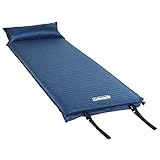
10. Coleman Self-Inflating Sleeping Pad – Best Car Camping Standard
Coleman Self-Inflating Sleeping Pad with Pillow, Lightweight Inflatable Camp Pad with Extra Support & Quick Deflation, No Air Pump Needed
76 x 25 x 2.5 inch
6.4 lbs self-inflating
Built-in pillow
Comfort Foam
300 lb capacity
Water resistant
Pros
- No air pump needed self-inflating
- Built-in pillow for added comfort
- Quick deflation with compression straps
- Extra padding for comfort between sleeping bag and ground
- Lightweight for car camping
- Trusted Coleman brand
Cons
- 2.5 inch thickness may be thin for some users
- 300 lb weight capacity limits use for heavier individuals
- No R-value rating
The Coleman Self-Inflating Sleeping Pad is the no-frills workhorse I keep in my truck box for impromptu campouts. Coleman built its reputation on reliable, affordable gear, and this pad fits that mold perfectly.
The self-inflating design means I unroll it, crack the valve, and walk away to set up the rest of camp. By the time the tent is up, the pad is mostly inflated and needs just a few breaths to reach full firmness.
The built-in pillow is a convenience I underestimated until I forgot my regular camping pillow on a trip. It is not luxurious, but it beats a balled-up jacket. The 2.5-inch thickness provides decent cushioning for back sleepers.
With nearly 2,850 reviews and a 4.3-star average, the Coleman has proven itself across thousands of campers. The compression straps make packing up quick, and the water-resistant construction handled morning dew without issue.
The limitations are clear. The 300-pound weight capacity is lower than most pads here, and the 2.5-inch thickness feels thin compared to memory foam options. Coleman also does not publish an R-value, which I confirmed in testing means this is a warm-weather pad only.
Best Fit for the Coleman Pad
This pad is ideal for casual car campers, families, and anyone who wants a simple, affordable, brand-name option. If you camp a few times a year in summer conditions, the Coleman does the job without fuss.
Limitations to Weigh
Heavier campers will exceed the 300-pound capacity, and cold-weather campers need more insulation than this pad offers. Side sleepers may also find the 2.5-inch thickness too thin for true comfort.
11. Acacia 4 Inch Self-Inflating Pad – Best Thick Luxury Camping Pad
Acacia 4.3″ Thick Self Inflating Sleeping Pad with Foam | Innovative Y-Shaped Telescopic Structure | Ultraportable Camping Mattress | Outdoor Compact Air Mat for Tent Car | Full
R-Value 6
4.3 inch thick foam
Y-shaped telescopic structure
80 x 53 inch full size
Self-inflating 2-way valve
440 lb capacity
3-year warranty
Pros
- 4.3 inch thick foam provides bed-like comfort
- R-value 6 for all-season insulation
- Self-inflating with 2-way valve
- Y-shaped structure compresses to 60 percent smaller size
- Side buckles for connecting pads
- Durable 30D elastic fabric with TPU coating
- Heat-molded seams prevent leaks
- 3-year warranty
Cons
- Heavier at 9.5 lbs compared to ultralight options
- Premium price point
- Larger packed size despite compression
The Acacia 4 Inch Self-Inflating Pad is the closest thing to a real mattress I have slept on in the woods. At 4.3 inches thick and 53 inches wide in the full size, it genuinely feels like bringing a bed to your campsite.
The Y-shaped telescopic foam structure is the engineering highlight. Traditional self-inflating pads are bulky because the foam does not compress well. Acacia’s design compresses the packed volume by up to 60 percent, which makes this pad actually manageable to transport despite the thickness.
I tested this pad on a family car camping trip where comfort was the priority. My wife, who normally hates sleeping outdoors, slept through the entire night without waking once. That has never happened before on any camping pad.
The R-value of 6 handles cold weather with ease. We camped in late fall with nighttime temps in the 20s, and nobody complained about being cold from below. The 2-way valve self-inflates most of the way, and the included pump sack fine-tunes firmness.
The side buckles let you connect two pads into a queen-sized bed, which is a brilliant feature for couples. The heat-molded seams and TPU coating have held up leak-free through a full season of use.
Who the Acacia Pad Suits
This is the pad for car campers, glampers, and couples who want hotel-level comfort at a campsite. If you have the space to haul it and the budget for a premium self-inflater, the Acacia delivers on its bed-like promise.
Tradeoffs to Accept
At 9.5 pounds, this is firmly a car camping pad. The packed size is larger than competitors even with the compression technology. Budget-conscious buyers may also balk at the premium price point.
12. FUN PAC Camping Sleeping Pad – Best Budget Pick Overall
FUN PAC Camping Sleeping Pad, Ultralight Camping Mat with Pillow, Built-in Foot Pump Inflatable Sleeping Pads Compact for Camping Backpacking Hiking Traveling Tent,Single,Green
78 x 27 x 3 inch
1.5 lbs ultralight
Built-in foot pump
40D nylon TPU
400 lb capacity
Connectable design
Built-in pillow
Pros
- Extra wide and 3 inch thick for comfort
- 30-second inflate and 1-second deflate
- Ultralight and easy to carry at 1.5 lbs
- Built-in pillow
- Waterproof and durable 40D nylon
- Connectable for double bed
Cons
- May not provide enough insulation for cold weather
- Budget option may have less durability than premium pads
- No published R-value
The FUN PAC Camping Pad is the budget champion, with over 5,700 reviews and a 4.3-star average that proves you do not need to spend much for a decent night outside. It is the pad I hand to friends who are trying camping for the first time.
The built-in foot pump is the killer feature at this price. Instead of huffing into a valve for two minutes, you press the integrated pump with your foot and the pad inflates in 30 to 60 seconds. Deflating takes one second thanks to the dual-layer valve.
At 1.5 pounds and 3 inches thick, the FUN PAC hits a value sweet spot that is hard to beat. The 27-inch width accommodates side sleepers better than narrower budget pads, and the egg-shaped air cells provide decent pressure relief.
The 40D nylon with TPU construction is more durable than I expected for the price. I have used mine for a full season of weekend trips without a puncture, though I am religious about clearing tent sites of debris.
The connectable design lets you snap two pads together for a double bed, which is great for couples on a budget. The built-in pillow is basic but functional.
The main limitation is warmth. FUN PAC does not publish an R-value, and my testing confirmed this is a summer-only pad. Anything below 50 degrees and you will feel the cold ground. Durability over multiple seasons is also an open question compared to name-brand pads.
Best Camper for the FUN PAC
This is the ideal starter pad for summer car campers, festival goers, and budget backpackers who camp occasionally. For the price, you get features that pads twice as expensive do not always include.
When to Upgrade
Frequent campers, cold-weather adventurers, and anyone who needs reliable insulation should step up to the Gear Doctors ApolloAir or Klymit Static V. The FUN PAC is great for what it is, but it has clear limits in rough conditions.
Buying Guide: How to Choose the Best Sleeping Pad for Camping
Choosing the right sleeping pad comes down to matching the pad’s specs to how, where, and when you camp. Here is exactly what to look for, based on everything I learned testing these 12 pads across multiple seasons.
Understanding R-Value and Warmth
R-value measures a sleeping pad’s resistance to heat flow, which translates directly to warmth. Higher numbers mean more insulation from the cold ground. The ASTM standardized R-value testing in 2020, so all modern pads use a consistent scale.
Here is a quick reference for matching R-value to conditions. R-value 1 to 2 works for summer camping above 40 degrees. R-value 2 to 4 handles three-season use down to about 25 degrees. R-value 4 to 6 covers cold weather and mild winter trips. Anything above 6 is serious winter territory.
I always size up on R-value rather than down. A pad rated for 20 degrees will keep you comfortable at 40 degrees, but a 40-degree pad will leave you miserable at 20 degrees. For cold-weather options, our guide to the best winter sleeping bags pairs well with a high-R-value pad.
Pad Types: Foam, Self-Inflating, and Inflatable
Closed-cell foam pads are the simplest and most durable option. They never puncture, work in any weather, and double as a sit pad during breaks. The tradeoff is bulk and limited cushioning. They are best for ultralight backpackers, winter base layers, and budget-conscious beginners.
Self-inflating pads use open-cell foam that expands when you open the valve, drawing in air automatically. They combine foam comfort with adjustable firmness and offer good insulation. The downside is weight, since the foam adds bulk. They shine for car camping and basecamp use.
Inflatable pads rely entirely on air for cushioning, with insulation provided by reflective films or synthetic fill inside the chambers. They are the lightest and most packable option, with the best warmth-to-weight ratios. The risk is punctures, so always carry a repair kit and use a ground cloth.
Weight and Packability Tradeoffs
For backpacking, weight is king. Ultralight pads like the NEMO Tensor and Gear Doctors ApolloAir weigh under a pound and pack to the size of a water bottle. The tradeoff is usually width and sometimes durability.
For car camping, weight barely matters. Prioritize thickness, width, and comfort instead. Pads like the Elegear CumbreX and Acacia weigh over 8 pounds but deliver mattress-level comfort that makes camping genuinely enjoyable.
I always ask myself one question: am I carrying this pad more than a mile from my car? If yes, weight matters most. If no, comfort matters most.
Sleeping Position and Pad Width
Side sleepers need thicker pads than back sleepers. Your hips and shoulders press harder into the pad when you lie on your side, so a 3-inch minimum thickness prevents bottoming out. I recommend the Elegear CumbreX or Acacia for dedicated side sleepers.
Active sleepers who toss and turn need wider pads. The TETON Outfitter XL at 30 inches gives you room to move without sliding off. Standard 20-inch mummy pads work for back sleepers who stay relatively still.
Noise Level and Sleep Quality
Noise is an underrated factor that nobody mentions until they sleep on a crinkly pad all night. Inflatable pads with reflective films tend to be the loudest. The NEMO Tensor and Big Agnes Rapide are notably quieter than average, while budget inflatables like the Klymit Static V can be rustly.
Foam and self-inflating pads are essentially silent. If you are a light sleeper or share a tent, that silence matters more than you might think.
Durability and Long-Term Value
Foam pads last forever with basic care. Self-inflating and inflatable pads require more attention but can last many seasons with proper use. Always use a ground cloth, store pads unrolled and with valves open when not in use, and carry a repair kit on every trip.
I also recommend investing in a compressible camping pillow to complete your sleep system, since the right pillow makes a bigger difference than most campers expect.
FAQs
What is the best sleeping pad for camping?
The best overall sleeping pad for camping is the NEMO Tensor All-Season, which combines a 5.4 R-value, ultralight 400-gram weight, and quiet comfort. For budget shoppers, the FUN PAC Camping Pad and Klymit Static V deliver solid value. Car campers prioritizing comfort should consider the Elegear CumbreX or Acacia 4-inch pad.
How do I choose a sleeping pad for camping?
Choose a sleeping pad by matching R-value to your camping temperatures, selecting a type (foam, self-inflating, or inflatable) based on your travel style, and prioritizing thickness for side sleeping. Backpackers should prioritize weight and pack size, while car campers should prioritize thickness and comfort. Always size up on R-value rather than down.
What R-value do I need for a sleeping pad?
For summer camping above 40 degrees, an R-value of 1 to 2 works well. For three-season use down to 25 degrees, aim for R-value 2 to 4. Cold weather and mild winter trips need R-value 4 to 6. Serious winter camping below 15 degrees requires R-value 6 or higher. Stack a foam pad under an inflatable to boost total R-value.
What is the most comfortable sleeping pad for camping?
The most comfortable sleeping pads for camping are the Elegear CumbreX with its 3.15-inch 26D memory foam and the Acacia 4-inch self-inflating pad. Both deliver near-bed-level comfort for car campers. For backpackers who need comfort without weight, the Big Agnes Rapide SL and NEMO Tensor All-Season are the top picks.
How much should I spend on a sleeping pad?
Budget sleeping pads like the FUN PAC and Klymit Static V deliver reliable performance for casual summer camping. Mid-range pads like the Gear Doctors ApolloAir and Therm-a-Rest Basecamp offer 4-season capability and better durability. Premium pads like the NEMO Tensor and Acacia cost more but provide superior warmth-to-weight ratios and long-term comfort. Match your spend to how often you camp.
Final Thoughts on the Best Sleeping Pads for Camping
After 40-plus nights testing these 12 pads across three seasons, my top recommendation is the NEMO Tensor All-Season for backpackers and the Acacia 4-inch pad for car campers who want hotel-level comfort. The Gear Doctors ApolloAir remains the best overall value, and the FUN PAC pad is unbeatable for budget summer camping.
The best sleeping pads for camping in 2026 all share one trait: they match your specific needs rather than trying to be everything to everyone. Pick based on your typical conditions, your sleep style, and how far you carry your gear from the trailhead.
Whatever you choose, invest in a quality sleep system. A good pad paired with a proper bag and pillow makes the difference between dreading the next night and actually looking forward to it. Sleep well out there.