
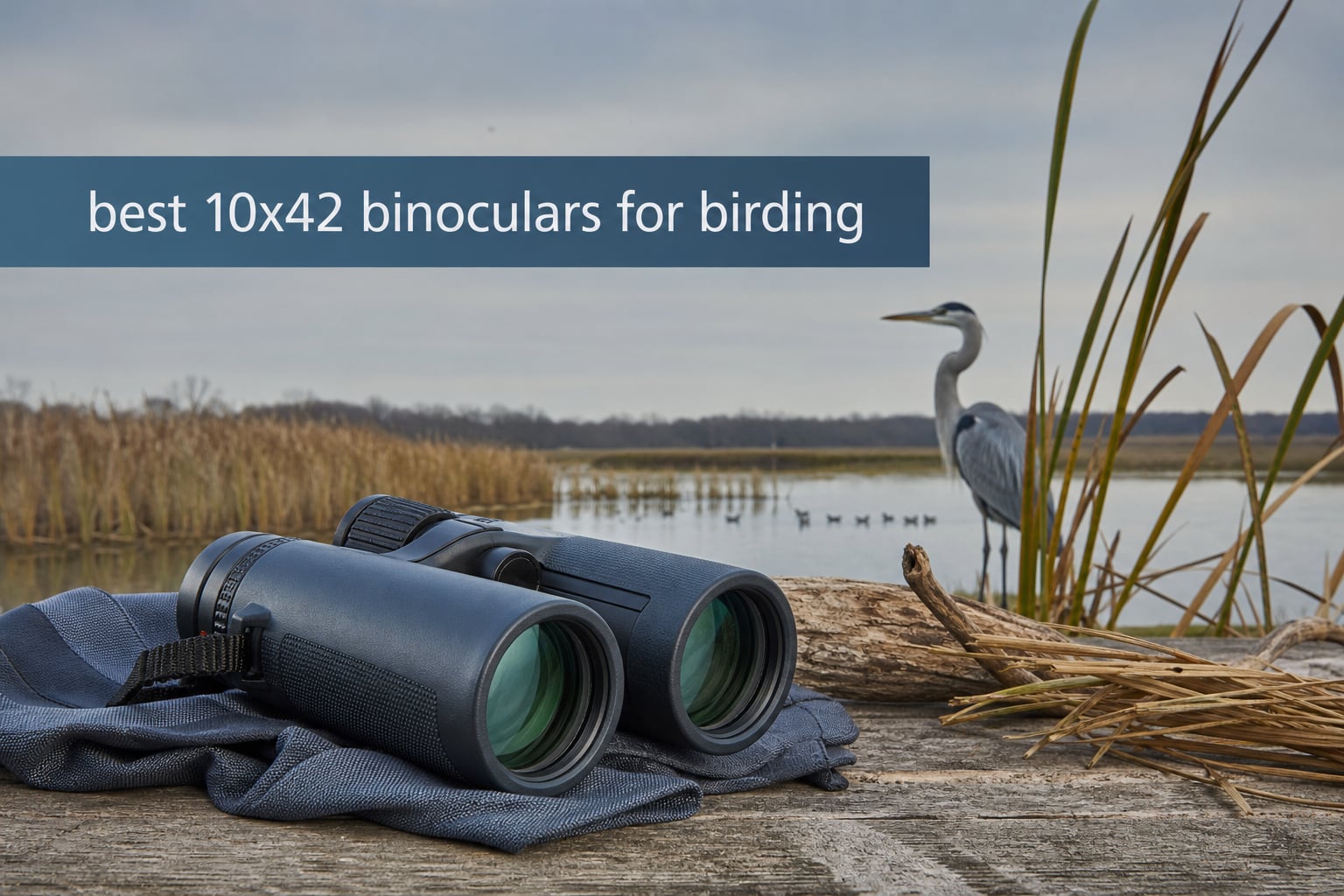
The best 10×42 binoculars for birding give you enough reach to study distant field marks without giving up the light-gathering that makes early starts and late walks enjoyable. The first number means 10x magnification, while the second is the 42 mm objective-lens diameter; together, they produce a 4.2 mm exit pupil when the specification is stated conventionally.
That combination works especially well for wetlands, shorebirds, raptors, open fields, and safari-style wildlife viewing. It is less forgiving than 8×42 when a bird is hopping close in dense cover, so steady hands, a supported posture, or a harness can matter as much as a headline optical claim.
I reviewed the supplied product specifications, stated features, ratings, review counts, and customer-feedback summaries for all 10 models here. Rather than pretend that one binocular fits every birder, I separated the models by the traits that change a morning in the field: image detail, field of view, eye relief, weather protection, focus layout, weight, and the strength of the warranty.
The short answer is that 10×42 is a strong birding format for people who regularly watch at distance and can hold 10x steady. Birding discussions repeatedly raise hand shake, weight fatigue, and the tighter view versus 8×42, so this guide calls out those trade-offs rather than burying them beneath generic marketing language.
Table of Contents
Top 3 picks answer the most common birding needs
My Editor’s Choice is the Vortex Triumph HD because the verified listing combines HD, fully multi-coated optics, 17 mm eye relief, nitrogen-purged waterproof and fogproof construction, a tripod-adaptable body, a GlassPak harness, and a lifetime VIP warranty. The Bushnell Prime is the value choice for its 341-foot field of view, protective EXO Barrier coating, and 4.7 rating, while the Hontry is the budget pick for users who prioritize IPX7 protection and a lighter listed weight.
- Editor’s Choice: Vortex Triumph HD 10×42 — a feature-rich, weather-sealed option with 4.8 stars from more than 2k reviews.
- Best Value: Bushnell Prime 10×42 — a broad 341-foot view and EXO Barrier lens protection for practical birding use.
- Budget Pick: Hontry 10×42 — IPX7 waterproof protection, floating capability, and a 4.6 rating from more than 1k reviews.
10×42 binoculars for birding in 2026 compare by the details that matter
The comparison below is a fast way to narrow the field, not a substitute for matching binoculars to your hands and habitat. Look first at the field of view and eye relief if you scan woodland or wear glasses, then check the stated weather rating and body weight for the conditions you expect.
| Product | Specifications | Action |
|---|---|---|
 Vortex Triumph HD 10×42 Vortex Triumph HD 10×42 |
|
Check Latest Price |
 Nikon Prostaff P7 10×42 Nikon Prostaff P7 10×42 |
|
Check Latest Price |
 Bushnell Prime 10×42 Bushnell Prime 10×42 |
|
Check Latest Price |
 SVBONY SV202 ED 10×42 SVBONY SV202 ED 10×42 |
|
Check Latest Price |
 Hontry 10×42 Hontry 10×42 |
|
Check Latest Price |
 PEIKETAO ED HD 10×42 PEIKETAO ED HD 10×42 |
|
Check Latest Price |
 TRV 10×42 TRV 10×42 |
|
Check Latest Price |
 Bushnell Explorer 10×42 Bushnell Explorer 10×42 |
|
Check Latest Price |
 MIXIO UHD 10×42 MIXIO UHD 10×42 |
|
Check Latest Price |
 Three Triping ED 10×42 Three Triping ED 10×42 |
|
Check Latest Price |
1. Vortex Triumph HD is the most rounded birding choice
Vortex Triumph HD 10×42 Binoculars
HD optics
17mm eye relief
Waterproof fogproof
Pros
- HD fully multi-coated optics
- 17mm eye relief
- GlassPak harness
- Tripod adaptable
- Lifetime VIP warranty
Cons
- Listed at 2.3 pounds
- May feel heavy over long walks
The Triumph HD earns the first spot because its specifications cover the basics that birders tend to notice over time rather than only on the first clear afternoon. It has a 10×42 roof-prism layout, fully multi-coated HD optics, a stated 4.2 mm exit pupil, center focus, and 17 mm eye relief.
Its 4.8 rating is supported by more than 2k reviews in the supplied data, and the review summary repeatedly praises resolution, color fidelity, edge-to-edge sharpness, and durable construction. A GlassPak harness and neck strap are included, which is meaningful for a full-size binocular that the listing puts at 2.3 pounds.
The weather-ready body suits changing birding conditions
Nitrogen purging, waterproofing, fogproofing, full rubber armor, and a polycarbonate chassis make this a sensible candidate for damp trails and variable weather. I also like that it is tripod adaptable, since a rest can make the most of 10x magnification during long scans of a lake or distant ridge.
The unlimited, unconditional lifetime VIP warranty is another practical trust signal. Community discussions often put warranty support near the top of the buying decision, and this is one area where the supplied product data is unusually clear.
The weight is the trade-off to consider before a long hike
A 2.3-pound listing weight can become noticeable on an all-day walk, even when the binocular rides in a harness. That does not make it unsuitable for birding; it means a user who is sensitive to neck or shoulder fatigue should try a harness or use a rest during extended sessions.
For a birder who wants a verified feature set, weather protection, and a large review base in one model, this is my clearest all-purpose recommendation. It is especially persuasive for open habitats where extra reach helps identify a perched bird’s field marks.
2. Nikon Prostaff P7 is the strongest choice for coatings and controls
Nikon 10×42 PROSTAFF P7 Waterproof Roof Prism Binocular with 7 Degree Angle of View
Dielectric prisms
367ft view
Locking diopter
Pros
- Phase-corrected prisms
- Dielectric coating
- 367ft field of view
- Locking diopter
- Oil-repellent lenses
Cons
- 15.7mm eye relief
- Smaller review sample
The Prostaff P7 is a bird-focused 10×42 with several specific optical and handling details that separate it from basic roof-prism binoculars. Nikon lists advanced multilayer lens coating, phase-correction-coated roof prisms, and a dielectric high-reflective multilayer prism coating.
Those are the features I would look for when color accuracy and contrast matter on a distant bird against bright water or a pale sky. The supplied feedback summary describes bright, vivid views and strong edge-to-edge clarity, and the 367-foot field of view is one of the broadest stated figures in this group.
The locking diopter keeps a personal adjustment in place
A locking diopter ring is a quietly useful feature when your eyes differ slightly or you share binoculars only occasionally. Once the right-eye adjustment is set, the lock helps prevent it from being bumped out of place in a bag or while moving through brush.
Turn-and-slide eyecups, a fiberglass-reinforced polycarbonate body, and shock-resistant rubber armor round out the handling package. The listing also specifies oil- and water-repellent lens coatings, which can make cleanup less frustrating after mist, fingerprints, or a wet morning.
The 15.7 mm eye relief needs a glasses check
The stated eye relief is 15.7 mm, so this one deserves a careful fit check for birders who wear glasses. The review summary says some users would prefer more eye relief, although the turn-and-slide eyecups give non-glasses users room to set a comfortable viewing distance.
With a 4.6 rating from 299 reviews, the Prostaff P7 has a smaller feedback pool than the Vortex but a distinct feature story. Pick it when phase-corrected and dielectric prism coatings, broad stated viewing width, and a locking diopter matter more than the longest listed eye relief.
3. Bushnell Prime is the value pick for wide-view scanning
Bushnell Prime 10×42 Binoculars for Adults, Waterproof & Fogproof, for Hunting, Birdwatching, and Outdoor Activites, Black
341ft field of view
18mm eye relief
EXO Barrier
Pros
- 341ft field of view
- 18mm eye relief
- EXO Barrier protection
- Waterproof fogproof
- Rubber grip
Cons
- Individual focus listed
- 131-review sample
The Bushnell Prime makes a strong case when you want established birding basics with a wide 341-foot field of view at 1,000 yards. The listing includes fully multi-coated lenses, waterproof and fogproof construction, O-ring-sealed optics, a roof-prism design, and a rubber-armored housing.
Its stated 18 mm eye relief is generous on paper and is a highlight for glasses wearers. With a 4.7 rating from 131 reviews, the product-data summary describes views as sharp, bright, and true to life, while users also call out the rugged feel.
The EXO Barrier is useful for exposed lenses
EXO Barrier Protection is designed to protect the exterior lens surfaces from water, oil, dust, and scratches. That is relevant to birding because front lenses collect spray near water, fine dust on dry paths, and fingerprints whenever you quickly pass binoculars to a companion.
It also gives this model a practical edge for a user who keeps binoculars accessible rather than packed away. A non-slip rubber grip and a stated 24-ounce weight support that everyday, grab-and-scan role.
The listed focus type deserves attention from fast-action birders
The supplied product details list individual focus, even though most birders prefer center focus for following birds that move from a nearby branch to a distant treetop. Before choosing it for warblers or other fast, close subjects, confirm that focus behavior suits the way you watch.
For broad scans of water, fields, and woodland edges, the 341-foot stated view is an attractive specification. This is the right direction for a buyer who wants good stated eye relief and lens-surface protection without moving to a more specialized model.
4. SVBONY SV202 ED is the ED-glass alternative for detail seekers
SVBONY Upgraded SV202 10×42 ED Binoculars, Binoculars with Extra-Low Dispersion Objective Lenses for Adults Birdwatching, BAK4 & FMC Optic System, Wide Field of View, IPX7 Waterproof for Cruise Ship
ED glass
IPX7 waterproof
6.5 degree field
Pros
- ED glass
- BAK4 and FMC optics
- IPX7 rating
- Tripod mount
- 6.5 degree view
Cons
- Manual focus listed
- 41-review sample
The upgraded SV202 puts extra-low-dispersion glass at the center of its birding pitch. ED glass is intended to reduce chromatic aberration, which is the colored fringe that can show around a dark bird against a bright sky or around high-contrast wing edges.
The supplied details pair that glass with BAK4 prisms, fully multi-coated optics, phase-correction technology, internal light masking, and a 6.5-degree field of view. Its 4.7 rating comes from 41 reviews, so the feedback is positive but less extensive than the top two models.
The optical specification favors color-fringe control
Birders who spend time studying fine plumage differences have a good reason to prioritize ED glass over a generic “HD” claim. This listing specifically says the ED objectives provide sharp, clear, vibrant views from center to edge and calls out low-light performance.
The stated 4.27 mm exit pupil is close to the expected 10×42 figure, and the wide 6.5-degree view can make it easier to locate a bird before concentrating on its markings. An integrated tripod mount adds a supported-viewing option for distant shorebirds.
The 15.2 mm eye relief and manual focus affect fit
The stated 15.2 mm eye relief is not automatically a problem, but eyeglass wearers should test whether they can see the full field. Adjustable rotating eyecups help with fit, yet eye relief is personal and should not be guessed from a specification alone.
Manual focus is the other decision point. If you mostly watch perched birds, raptors, or subjects at steady distance, it may be acceptable; if your usual target is a constantly shifting flock in close cover, a faster center-focus experience may be more comfortable.
5. Hontry is the budget pick for water-focused outings
Hontry 10×42 Binoculars with IPX7 Waterproof Protection for Bird Watching, Hunting, Cruise Ship, Travel and Safari
IPX7 waterproof
Floats in water
Center focus
Pros
- IPX7 waterproof
- Floating capability
- Center focus
- Glasses-friendly eyecups
- 1.6-pound listed weight
Cons
- 288ft field of view
- 365-day warranty
The Hontry is easy to understand: it is a 10×42 roof-prism binocular built around basic bird-watching coverage, center focus, an anti-reflective coating, and IPX7 waterproof protection. Its most unusual listed feature is that it floats in water, a reassuring trait around docks, kayaks, marshes, and boats.
More than 1k reviews give this model a larger feedback base than most of the non-major-brand entries, and its 4.6 rating is solid. The review summary says users appreciate its comfort, portability, low-light performance, and glasses-compatible eyecups.
The lighter listed weight helps with hand-held 10x viewing
At a listed 1.6 pounds, the Hontry is lighter than several models in this roundup. That can help a birder hold a 10x view steady for longer, though good posture still matters: elbows tucked in, a strap or harness taking some load, and brief pauses against a tree or rail all help.
The 4.2 mm exit pupil matches the standard 10×42 arithmetic, and a center focus system is easier to work with when a bird changes distance. The rubber body also gives a secure grip in wet conditions.
The 288-foot view is the main limitation for quick tracking
The listed field of view is 288 feet at 1,000 yards, which is materially narrower than the Nikon’s 367 feet or the Bushnell Prime’s 341 feet. A tighter view is not inherently poor, but it asks more of the user when finding a fast or close bird.
The 365-day warranty is also shorter than the lifetime coverage offered on several other choices. I would choose this one for a first 10×42 used around water and open terrain, while keeping expectations realistic about viewing width and long-term coverage.
6. PEIKETAO ED HD is the best fit for many eyeglass wearers
Premium ED HD Binoculars 10×42 for Adults, Waterproof & Fogproof with Magnesium Alloy Body, BAK4 Prism – High Power Binoculars for Bird Watching, Hunting, Travel & Outdoor Sports, Compact
ED glass
17.5mm eye relief
Magnesium body
Pros
- 17.5mm eye relief
- ED glass
- Dielectric coating
- Argon purged
- Magnesium body
Cons
- 49-review sample
- Manual focus wording
The PEIKETAO Premium ED HD model brings together a combination that will stand out to birders who wear glasses: 17.5 mm eye relief, adjustable twist-up eyecups, ED glass, and a stated 393-foot field of view. The listing also identifies a magnesium-alloy body, BAK4 prisms, phase coating, and a dielectric prism coating.
In plain terms, it aims at a bright, color-accurate view with room to position your eyes comfortably behind glasses. The listing claims the dielectric coating reflects more than 99% of light, while the review data gives it a 4.6 average from 49 reviews.
The long eye relief supports a more relaxed glasses fit
Eye relief is the distance your eyes can sit from the eyepieces while still taking in the full image. At the listed 17.5 mm, this model has more space than the Nikon Prostaff P7 and SVBONY SV202, making it a stronger starting point for users who keep spectacles on while birding.
Its 393-foot field-of-view claim is also the widest stated linear figure among the models here. That could be useful for locating a bird against a wide expanse of reeds or following a bird across the edge of a wood.
The build details suit wet and rough field use
The product data specifies argon purging for waterproof and fogproof performance, plus a magnesium body for shock resistance and grip. An integrated tripod mount is welcome when you want to watch a stationary subject without holding 10x magnification in the air.
There are two cautions: only 49 reviews are represented, and the listing includes both manual-focus wording and center-focus information. Treat it as a high-specification contender whose real handling should be checked carefully before making it your regular binocular.
7. TRV is the coastal birding option with a phone adapter
TRV 10×42 Waterproof Binoculars for Adults, Cruise & Travel
331ft field of view
BAK4 prisms
Phone adapter
Pros
- 331ft field of view
- BAK4 prisms
- IPX5 fogproofing
- Phone adapter
- 17.2mm eye relief
Cons
- 728g listed weight
- 30-review sample
The TRV is marketed for marine and coastal observation, but its stated 10×42 configuration, 331-foot field of view, BAK4 prisms, fully multi-coated optics, and rubber armor also fit shorebird and seabird watching. It includes a phone adapter, a small bag, lens cloth, and a user manual.
The product details describe an IPX5 waterproof and fogproof design with O-ring sealing and nitrogen purging. That does not replace care around saltwater, but it is relevant for spray, drizzle, and changing weather near the coast.
The 331-foot view helps with moving subjects
For gulls, terns, whales, and birds moving across an open shoreline, a broader viewing window makes initial acquisition easier. The 331-foot stated field is competitive in this group and matches the product’s focus on tracking moving subjects.
The stated 17.2 mm eye relief is another favorable number for users who need a bit of space behind the eyepieces. Its center focus setup with right-eyepiece adjustment is familiar territory for many binocular users.
The 728-gram weight trades portability for stability
The listing calls its 728-gram build solid and balanced for stability. That may feel reassuring on a windy headland, but it also puts more weight around your neck or in your hands than a lighter option such as the Hontry.
With a 4.6 rating based on 30 reviews, there is less feedback to work from than on the Vortex or Hontry. Choose it when the included phone adapter, coastal orientation, and broad view are more meaningful to you than the lowest possible carry weight.
8. Bushnell Explorer is the entry-level waterproof build
Bushnell Explorer 10×42 Waterproof Roof Prism Binoculars
IPX7 rating
BAK4 prisms
17.5mm eye relief
Pros
- IPX7 waterproof
- BAK4 prisms
- 17.5mm eye relief
- Aluminum body
- Lifetime warranty
Cons
- Multicoated wording
- 4mm exit pupil
The Bushnell Explorer is a straightforward 10×42 roof-prism option with a listed 22.2-ounce weight, 17.5 mm eye relief, 6.8-degree field of view, adjustable diopter, and center focus. It also comes with a case, strap, and lens covers, which removes a few immediate accessory needs.
Its weather claim is specific: IPX7 protection tested at 1 meter for 30 minutes. The supplied review summary gives it a 4.5 rating from 121 reviews and highlights a lightweight aluminum body, soft-touch rubber grip, and a lifetime warranty.
The waterproof rating is clear and meaningful
IPX7 is a useful standard for a binocular that may be caught in a rain shower or briefly dropped near water. It does not mean every wet-weather situation is carefree, but it provides more concrete information than a generic waterproof label.
BAK4 prisms and an all-glass optical system are good fundamentals at this level. The 6.8-degree stated view is also broad on paper, which can make a first 10x binocular less intimidating when trying to center a bird.
The coating wording sets expectations for low-light use
One product field calls the optics fully multi-coated, while another describes them as multicoated. The supplied analysis flags that distinction, so I would not assume the same transmission performance as a model explicitly specified as fully multi-coated throughout.
The 4 mm listed exit pupil is lower than the conventional 4.2 mm result of a 10×42 calculation, and it is another reminder to judge the published data carefully. This is a sensible basic option for rain-ready casual birding, not a reason to skip comparison with stronger optical specifications.
9. MIXIO UHD is the grip-focused choice for wet hands
10×42 UHD Binoculars for Adults High Powered Waterproof Large View with Clear Vision Binocular Essentials for Hunting Camping Cruise Travel Bird Watching Sport
BAK4 prisms
Fully multi-coated
Non-slip focus
Pros
- BAK4 prisms
- Fully multi-coated optics
- Non-slip focus knob
- Waterproof
- Adjustable eyecups
Cons
- 2.3-pound listed weight
- Objective specification conflicts
The MIXIO listing is packed with features that matter for outdoor handling: BAK4 prisms, fully multi-coated anti-reflective lenses, waterproof construction, rubber armor, adjustable eyecups, a central focus wheel, and a non-slip texture intended to work with wet hands or gloves.
The supplied review summary reports a 4.5 rating from 88 reviews and calls out the bright-view claim, shock-resistant build, and accessory bundle. Its product details list a 4.2 mm exit pupil, 305-foot field of view, and a stated 2.3-pound weight.
The focus wheel design favors cold and wet outings
A focus wheel that remains easy to turn with damp hands or gloves is an underrated field feature. A bird does not wait while you fight a slippery control, so a textured wheel can be more practical than an extra line of vague optical marketing.
The adjustable eyecups are intended for both glasses wearers and non-wearers, while the rubber-armored, ergonomic body aims for a secure hold. For winter outings, our cold weather binocular tips can help you think through gloves, fogging, and carrying comfort.
The conflicting objective-lens specification needs verification
Although the title says 10×42 and the exit-pupil figure is consistent with 42 mm objectives, one supplied product-detail field states a 25 mm objective lens diameter. Those figures cannot both describe a conventional 10×42 configuration, so verify the exact unit specification before purchase.
That discrepancy matters because objective diameter affects the size of the exit pupil and expected low-light behavior. I would only select this model after confirming the dimensions on the current manufacturer or retailer listing, even though its grip and stated optical features are appealing.
10. Three Triping ED is the phone-adapter bundle with ED glass
10×42 ED Binoculars for Adults High Powered with Phone Adapter, Waterproof Binoculars with ED Lenses, Super Bright Clear for Bird Watching, Hiking, Cruise Ship, Wildlife Viewing and Outdoor Activities
ED glass
IPX7 waterproof
Phone adapter
Pros
- ED glass
- Dielectric coating
- IPX7 rating
- Magnesium body
- Phone adapter
Cons
- 4.4 rating
- 58-review sample
- Manual focus wording
The Three Triping model combines ED glass, fully multi-coated lenses, dielectric coating, a magnesium-alloy body, and IPX7 waterproof and fogproof protection. It is also supplied with an iPhone phone adapter, appealing to birders who want to try simple documentation of a stationary bird.
The product data lists 16.5 mm eye relief, 18 mm BAK4 prisms, a 325-foot field of view at 1,000 yards, adjustable rubber eyecups, and tripod compatibility. It has a 4.4 rating from 58 reviews, the lowest rating in the roundup but still a broadly positive average.
The ED and dielectric combination targets image cleanliness
ED glass is intended to limit color fringing, while the dielectric coating is described as supporting accurate color reproduction and edge-to-edge sharpness. Those specifications speak directly to the kinds of details birders want when separating similar plumage tones or studying a distant bird against high contrast.
The listing’s IPX7 claim is specific enough to indicate submersion resistance up to 1 meter for 30 minutes. Along with the magnesium body, that makes it a credible candidate for damp walks where a phone adapter is also genuinely useful.
The smaller review base and lower rating call for restraint
A 4.4 rating from 58 reviews is not a reason to dismiss this model, but it is less persuasive evidence than a 4.8 rating from more than 2k reviews. The supplied feedback also notes a higher share of low ratings than several alternatives and limited availability at the time the data was collected.
Manual-focus wording appears in the specifications, so verify the focusing experience before choosing it for very active birds. I would see it as an accessory-friendly ED-glass alternative for a patient viewer, not the first choice for someone who needs the deepest feedback history.
10×42 selection comes down to habitat, steadiness, and fit
The first question is not which specification sounds most technical; it is where you find birds. A 10×42 format is at its best in open country, wetlands, shorelines, broad grassland, and safari settings where distance makes extra magnification useful.
In dense woodland, a small fast bird can be harder to locate at 10x because the view is narrower and hand movement appears larger. The people in birding and binocular communities make this point often: 10x is popular for reach, while 8x is commonly recommended for a steadier view and easier tracking.
A 10×42 gives reach while an 8×42 gives steadier tracking
Both sizes use 42 mm objectives, so they gather light through the same front-lens diameter. A 10×42 normally produces a 4.2 mm exit pupil, whereas an 8×42 produces a 5.25 mm exit pupil; the 8x can therefore feel more relaxed in dimmer conditions and is less demanding to hold still.
Choose 10×42 when birds are often distant and you want to inspect field marks without closing the gap. Choose 8×42 when you are new to binoculars, have unsteady hands, bird primarily in woods, or value a wider, easier-to-hold view over maximum reach.
A field of view determines how quickly you find the bird
Field of view is the width of the scene visible at a given distance, often stated as feet at 1,000 yards or degrees. Wider views help you acquire a flying or close bird, then keep it in sight while you identify it.
Within this group, the listed figures range from 288 feet on the Hontry to 393 feet on the PEIKETAO, with some models stated in degrees instead. Do not treat one number as the whole story, but do favor a broader stated view when your birding involves flight paths, dense edges, or children and beginners sharing the binoculars.
An exit pupil explains part of low-light comfort
Exit pupil is calculated by dividing objective diameter by magnification. For a conventional 10×42, 42 divided by 10 equals 4.2 mm, which is a useful middle ground for the dawn and dusk conditions common in bird watching.
Coating quality, prism construction, cleanliness, and your own eyes also shape perceived brightness, so exit pupil alone does not rank binoculars. It is best used as one of several checks alongside fully multi-coated lenses, ED glass where offered, stated weather sealing, and a field of view that suits your habitat.
ED glass and prism coatings improve detail in difficult contrast
ED glass addresses chromatic aberration, the colored fringing that can soften a sharp boundary. In this roundup, the SVBONY SV202, PEIKETAO, and Three Triping explicitly list ED glass, while the Vortex emphasizes an HD optical system and the Nikon lists phase-corrected and dielectric-coated prisms.
Phase correction and dielectric coatings are meaningful roof-prism terms because they concern contrast and light reflection through the prism system. They do not make a binocular right for every person, but they are more informative than a vague “high powered” label.
Eye relief and eyecups decide whether glasses users see the full view
Glasses wearers should start with eye relief, then use twist-up or turn-and-slide eyecups to find a position that shows the whole image without black rings at the edges. The PEIKETAO and Bushnell Explorer list 17.5 mm, the Vortex lists 17 mm, the TRV lists 17.2 mm, and the Bushnell Prime lists 18 mm.
Specifications are a starting point, not a guarantee of comfort. If you wear glasses, test the binocular with them on, set the diopter for your eyes, and look at the edge of the field before deciding that a published eye-relief figure works for you.
Weight and weather sealing determine whether binoculars get carried
A binocular left at home cannot help identify a bird. The product data lists the Hontry at 1.6 pounds, the Bushnell Explorer at 22.2 ounces, the Nikon at 21.2 ounces, and several options around 2.3 pounds or 728 grams, so carry comfort is not a minor detail.
For weather, IPX7 claims on the SVBONY, Hontry, Bushnell Explorer, and Three Triping offer a defined water-resistance standard, while Vortex and Nikon specify waterproof and fogproof construction. A harness spreads load better than a neck strap, and a dry cloth plus sensible lens care will matter as much as a rating over the long term.
A sensible budget choice prioritizes fundamentals over hype
For a first 10×42, prioritize a credible optical specification, a comfortable grip, center focus where fast changes of distance are common, adequate eye relief, and weather protection that matches your outings. A wide review base and a clear warranty are also useful signals when two models have similar feature lists.
Do not assume a more expensive-looking specification is automatically the right purchase for a beginner. Forum discussion consistently points to comfort, steady handling, and dependable support as more important than chasing the strongest magnification claim or an accessory bundle.
These birding binocular questions have direct answers
What is the best magnification for bird watching binoculars?
Eight-power and 10-power are the common birding choices. Choose 8×42 for a steadier, wider view in woods and for beginners; choose 10×42 for more reach in open habitats, wetlands, shorelines, and distant wildlife viewing. A 10×42 works best when you can hold it steady or use a harness or support.
Are 10×42 binoculars good for birding?
Yes. A conventional 10×42 combines 10x magnification with 42 mm objectives, producing a 4.2 mm exit pupil. It is a strong balance for birders who want to see distant field marks while retaining useful light gathering for dawn, dusk, and overcast conditions.
What is the difference between 8×42 and 10×42 binoculars?
Both use 42 mm objective lenses, but 8×42 has lower magnification, a wider and steadier view, and a 5.25 mm exit pupil. A 10×42 gives more reach but makes hand shake more visible and commonly provides a narrower field of view. Woodland birders often prefer 8x, while open-country birders often prefer 10x.
How much should I spend on birding binoculars?
Start with the features that affect every outing: clear optics, comfortable eye relief, a field of view that fits your habitat, weather protection, and a warranty you understand. A beginner does not need every premium feature; a well-fitting binocular that is regularly carried and held steady is the better choice.
What brands make the best binoculars for birding?
The strongest brand depends on the model and your needs. In this reviewed group, Vortex stands out for its lifetime VIP warranty and large review base, Nikon for specified prism coatings and control features, and Bushnell for multiple weather-ready choices. Compare the actual model specifications, fit, and warranty instead of buying a name alone.
The best 10×42 binoculars for birding match your real field conditions
For the broadest blend of verified optics, weather protection, accessories, review history, and warranty, I would start with the Vortex Triumph HD. The Nikon Prostaff P7 is compelling for its specified prism coatings, locking diopter, and 367-foot stated view, while the Bushnell Prime makes sense for users who prioritize its 341-foot view, 18 mm eye relief, and EXO Barrier protection.
For the best 10×42 binoculars for birding in 2026, do not select only from a badge. Match the binocular to the birds you watch, test the eye relief with your glasses if needed, and be honest about whether 10x feels steady in your hands; that is how the specifications turn into better time in the field.