
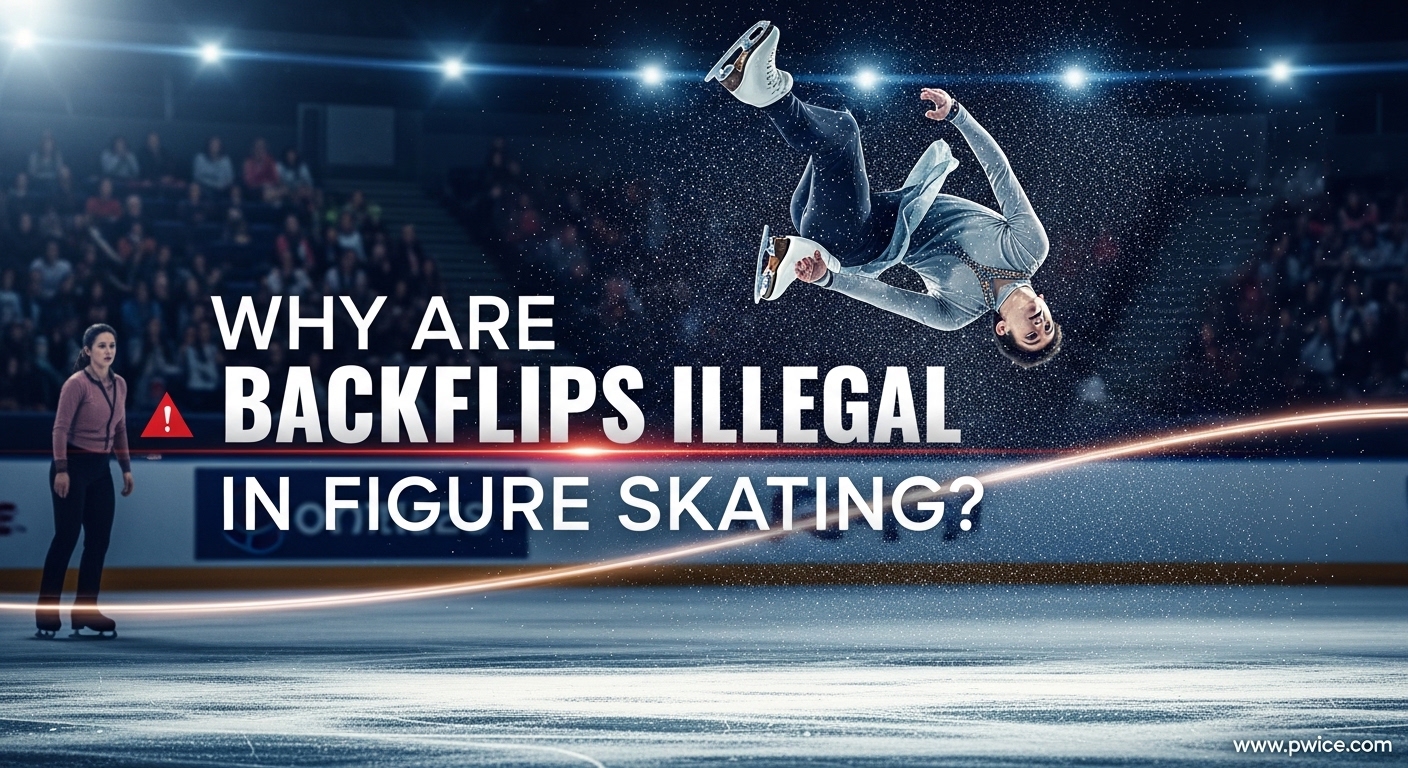
The International Skating Union banned backflips from figure skating competition in 1977. They deemed the move too dangerous and ruled that it violated the sport’s fundamental one-foot landing principle. The ban lasted nearly 50 years until the ISU reversed the decision in 2024.
If you watched the 2026 Winter Olympics in Milan-Cortina, you witnessed history when Ilia Malinin became the first athlete to land a legal backflip in Olympic competition. But this moment came after decades of controversy, protest, and a rule that shaped the sport’s identity.
In this guide, I will explain exactly why backflips were illegal, who broke the rules anyway, and what changed to finally bring them back.
Table of Contents
What Is a Backflip in Figure Skating?
A backflip in figure skating is a somersault-type jump where the skater launches backward, completes a full rotation in the air, and lands on the ice. Unlike standard figure skating jumps that rotate vertically around an axis, the backflip rotates horizontally like a gymnast’s flip.
The execution requires specific technique. The skater skates backward to build momentum, throws both arms upward for lift, dips deeply into the knee for power, then kicks one leg back while tucking to initiate the rotation. The landing can occur on one foot or both feet, which became a central point of controversy.
Skaters performed backflips in professional ice shows throughout the ban years. Champions on Ice and Stars on Ice regularly featured the move as part of exhibition performances where ISU competition rules did not apply.
The First Olympic Backflip: Terry Kubicka at the 1976 Innsbruck Games
American skater Terry Kubicka made history at the 1976 Winter Olympics in Innsbruck, Austria. He became the first and only skater to perform a backflip in Olympic competition during the 20th century.
Kubicka landed the backflip cleanly during his free skating program. The move electrified the audience and drew immediate attention from officials. At that time, no explicit rule prohibited the backflip, though judges could penalize elements they considered unsportsmanlike or dangerous.
The International Skating Union convened shortly after the Olympics to address what they viewed as a dangerous precedent. Kubicka himself later acknowledged that his performance directly triggered the rule change. The ISU had to decide whether figure skating should embrace acrobatic spectacle or maintain its traditional balletic foundation.
They chose tradition with a swift rule addition.
Why Were Backflips Banned? The Two Reasons Behind ISU Rule 610
The International Skating Union officially banned backflips in 1977 by adding them to Rule 610. The rule prohibited “somersault type jumps” from all ISU-sanctioned competitions. Two distinct reasons drove this decision.
Safety Concerns: The Risk of Catastrophic Injury
The ISU cited injury risk as the primary justification for the ban. A failed backflip attempt sends the skater head-first toward the ice with no natural way to break the fall. The hard ice surface beneath skates offers no cushion for impact.
Figure skating blades are sharp and unforgiving. A skater landing incorrectly on their head or neck could suffer paralysis or death. The ISU determined that the entertainment value did not justify the potential for life-altering injury.
During the 1970s, skating technology and safety equipment were less advanced than today. Helmets were not used in competition. Medical response at skating venues was more limited. The ISU erred on the side of caution.
The One-Foot Landing Principle
The second reason involved figure skating’s fundamental technique philosophy. For decades, the ISU required all jump landings to occur on one foot with the free leg extended.
This one-foot landing principle served multiple purposes. It demonstrated the skater’s control and balance upon completing difficult aerial rotation. It created the elegant body lines that distinguish figure skating from acrobatics. It maintained consistency across all jump types.
Backflips naturally lend themselves to two-foot landings. The rotation ends with the skater facing forward, making a one-foot landing structurally awkward and less stable. Most skaters who performed backflips landed on both feet to distribute impact and maintain balance.
The ISU viewed this two-foot landing as a violation of skating’s artistic standards. The backflip represented a break from tradition that officials were unwilling to accept.
Surya Bonaly’s 1998 Olympic Protest: Breaking the Rules for Justice
French skater Surya Bonaly delivered the most famous backflip in figure skating history at the 1998 Nagano Olympics. She performed the move during her free skate despite knowing it was illegal and would cost her points.
Bonaly entered the Nagano Games nursing an Achilles tendon injury that limited her jumping ability. More importantly, she had spent her career battling what she and many observers perceived as discriminatory judging. Bonaly brought power, athleticism, and innovation to a sport that valued delicate artistry and traditional presentation.
She landed her final jump with room to spare. Rather than skating to a standard closing pose, Bonaly paused, faced the judges, and executed a clean backflip. She landed on one foot, directly addressing the ISU’s stated objection to two-foot landings.
The crowd erupted. Judges immediately deducted points for the illegal element. Bonaly finished 10th in what would be her final Olympic appearance.
Years later, Bonaly described the backflip as an act of defiance against a system she felt never accepted her. She wanted to prove she could execute the banned move flawlessly and send a message about artistic freedom. Her performance transformed the backflip from a technical violation into a symbol of protest against rigid judging standards.
47 Years of Show Skating: Where Backflips Never Disappeared
While competition judges penalized backflips, professional ice shows embraced them. Champions on Ice, Stars on Ice, and Holiday on Ice regularly featured backflips as highlight moments in their productions.
Professional skaters who retired from ISU competition often added backflips to their repertoire. The move became a staple of exhibition skating, performed for audiences who wanted spectacle over strict technical evaluation. Scott Hamilton, Brian Boitano, and Kurt Browning all incorporated backflips into their professional routines.
This split personality created tension within the sport. Young skaters trained in competition programs that excluded backflips while watching their heroes perform the move in touring shows. The prohibition affected only a narrow slice of skating life while the broader culture celebrated the very element that competition banned.
Why Were Backflips Unbanned in 2024? The ISU Reverses Course
At the 59th ISU Ordinary Conference in Las Vegas in October 2024, delegates voted to remove backflips from Rule 610. The ban that had shaped the sport for nearly five decades ended with a single procedural change.
Multiple factors drove the reversal. The sport had evolved significantly since 1977. Skaters now regularly attempt quadruple jumps that carry equal or greater injury risk than backflips. Safety equipment and medical protocols at competitions have improved dramatically.
The ISU faced pressure to modernize. Skaters and coaches argued that figure skating needed to remain relevant to contemporary audiences. Other action sports had embraced acrobatic progression while skating maintained rigid boundaries. Social media clips of professional show backflips consistently outperformed competition footage in engagement metrics.
Most importantly, French skater Adam Siao Him Fa demonstrated that backflips could work within competition programs. At the 2024 European Championships, he performed a backflip during his choreographic sequence. Though it earned no technical points, the crowd response was immediate and overwhelming. The ISU recognized that skaters would incorporate the move regardless of rules, and formal permission would allow better safety oversight.
The rule change took effect immediately, allowing backflips in all ISU-sanctioned events starting in late 2024.
Backflips at the 2026 Olympics: Ilia Malinin Makes History
American skater Ilia Malinin landed the first legal Olympic backflip at the Milan-Cortina Winter Olympics in February 2026. The moment arrived 50 years after Terry Kubicka’s pioneering performance and fulfilled the promise that had been denied to generations of skaters.
Malinin, nicknamed the “Quad God” for his unprecedented quadruple jumps, incorporated the backflip seamlessly into his free skate program. The move came during a choreographic sequence rather than as a scored jump element, reflecting current ISU scoring guidelines.
The backflip currently earns no base value in the technical element score. It functions purely as a choreographic element, similar to spread eagles or Ina Bauers. This means skaters perform backflips for audience impact and program composition rather than point accumulation.
Malinin’s Olympic backflip generated massive media coverage and social media engagement. It represented a symbolic reconciliation between figure skating’s traditional values and its appetite for athletic daring.
Frequently Asked Questions
Why can’t figure skaters do backflips?
Figure skaters were prohibited from doing backflips in ISU competition from 1977 to 2024. The International Skating Union banned the move because it was deemed too dangerous and because it violated the one-foot landing principle that defines proper figure skating technique. Backflips became legal again in October 2024.
When did backflips become legal in figure skating?
Backflips became legal in figure skating on October 10, 2024. The International Skating Union removed the backflip from Rule 610 at their 59th Ordinary Conference in Las Vegas, ending a ban that had existed since 1977.
What jump is banned in figure skating?
Somersault-type jumps, including backflips, were banned under ISU Rule 610 from 1977 until 2024. Currently, no jumps are completely banned in figure skating competition, though all jumps must meet technical requirements and safety standards.
Are you allowed to do backflips in figure skating?
Yes, backflips are now allowed in figure skating competition as of October 2024. The International Skating Union reversed the decades-long ban, making backflips legal in all ISU-sanctioned events including World Championships and the Olympic Games.
Why is Ilia Malinin allowed to do backflips?
Ilia Malinin is allowed to do backflips because the International Skating Union legalized the move in October 2024. At the 2026 Winter Olympics in Milan-Cortina, Malinin became the first skater to land a legal backflip in Olympic competition.
Why were backflips unbanned?
The ISU unbanned backflips in 2024 to modernize the sport and reflect current athletic capabilities. Skaters now perform quadruple jumps that carry similar risk to backflips. The rule change also responded to audience demand for spectacular elements and allowed the ISU to regulate the move with proper safety oversight.
Why Are Backflips Illegal in Figure Skating? Understanding the Full Picture
Backflips were illegal in figure skating for 47 years because the International Skating Union prioritized safety and tradition over acrobatic innovation. The 1977 ban reflected legitimate concerns about head and neck injuries. It also protected the one-foot landing principle that distinguished figure skating from gymnastics and circus performance.
The prohibition created strange contradictions. Skaters performed backflips nightly in professional shows while risking disqualification for the same move in competition. Surya Bonaly sacrificed Olympic placement to make a statement about artistic freedom. Generations of athletes trained under rules that prevented them from executing a move their professional idols performed regularly.
The 2024 reversal acknowledged that figure skating had outgrown the 1977 rationale. Modern skaters attempt jumps of comparable difficulty and risk. Safety protocols have evolved. Most importantly, the ISU recognized that banning an element does not eliminate audience desire to see it.
Today, the backflip exists in a unique position. It remains legal but technically unrewarded, performed for artistic impact rather than points. This middle ground may shift as the sport continues adapting to what skaters can actually achieve.
The story of why backflips were illegal reveals something essential about figure skating. The sport constantly negotiates between its balletic heritage and athletic ambition. The backflip ban represented one extreme position in that negotiation. Its reversal suggests a sport willing to evolve, even if it takes half a century to change its mind.