
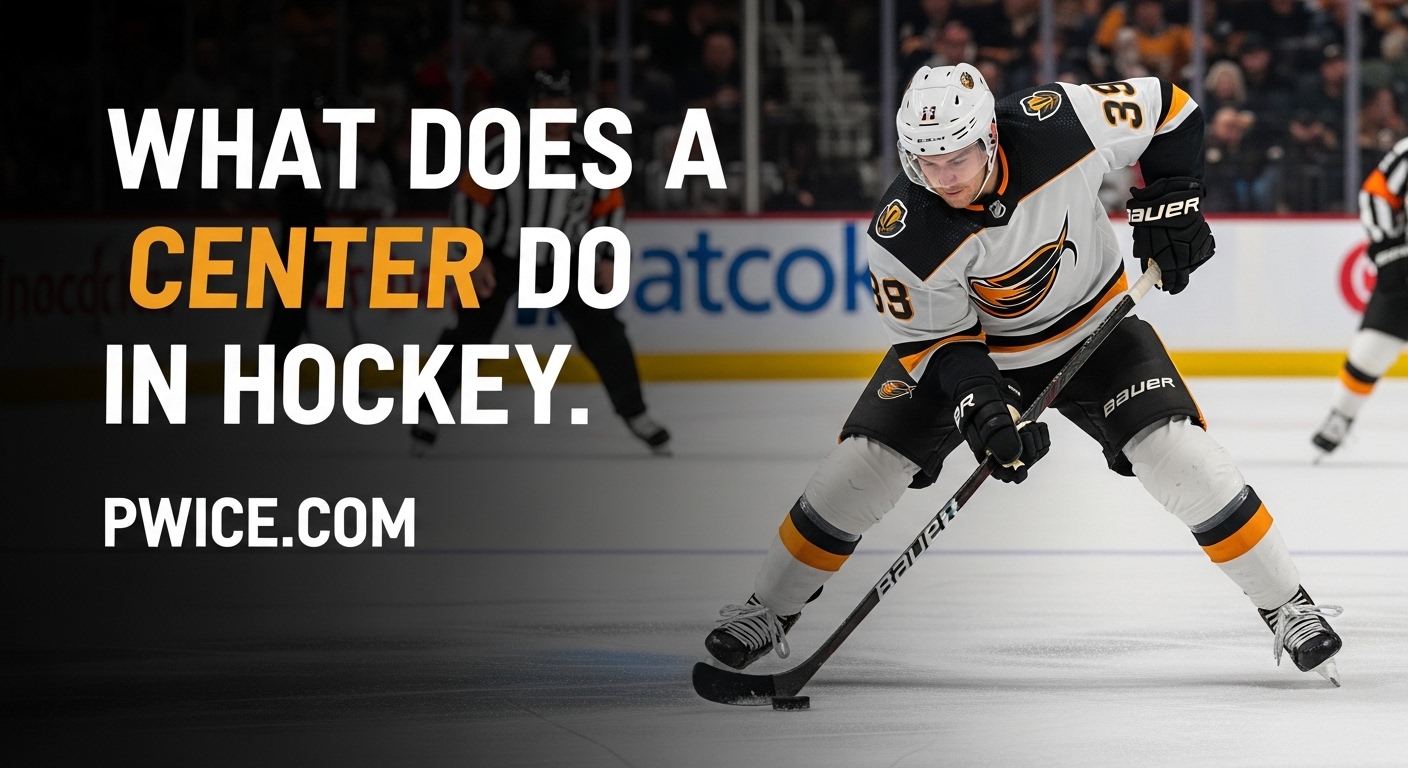
A center in hockey serves as the team’s playmaker, quarterback, and third defenseman all rolled into one position. They operate primarily in the middle of the ice, orchestrating both offensive attacks and defensive coverage while taking every faceoff to start play. The center position demands the most ice coverage, the highest hockey IQ, and the greatest two-way responsibility of any forward role on the team.
I have played and coached hockey at various levels for over fifteen years, and I can tell you that the center is the heartbeat of any successful team. When fans watch games, they often notice the flashy wingers who score goals. But coaches watch the center. They see who wins the faceoffs, who covers the slot defensively, and who makes the smart breakout pass that starts the rush the other way.
In this guide, I will break down exactly what a center does in hockey across all three zones of the ice. You will learn why coaches call centers the “third defenseman,” why faceoff skill matters so much, and what separates average centers from elite ones. Whether you are learning the game as a new player, coaching youth hockey, or just want to understand the sport better, this comprehensive breakdown will answer every question you have about the hockey center position.
Table of Contents
What Is a Center in Hockey
The center (or centerman) is a forward position in ice hockey whose primary zone of play runs through the middle of the rink, away from the boards. Unlike wingers who typically hug the sides of the ice, centers have freedom to roam the entire neutral zone and slot area while coordinating play between teammates.
Centers act as the link between defense and offense on every transition. When your team gains possession in the defensive zone, the center often initiates the breakout. When you are attacking, the center distributes the puck to wingers and jumps into open space for scoring chances. This connector role explains why coaches frequently call centers the “quarterback” of their forward group.
The position requires exceptional stamina. Centers cover more ice than any other forward because they must support play at both ends of the rink. While wingers can cheat slightly toward offense or defense depending on their role, centers have no such luxury. They must be the first forward back on defense and the primary play driver on offense.
What Does a Center Do in Hockey – Zone Responsibilities
Understanding what a center does in hockey means breaking down their role in each of the three zones on the ice. The center’s responsibilities change dramatically depending on whether the puck is in the offensive zone, defensive zone, or neutral zone. Let us examine each area in detail.
Offensive Zone Responsibilities
In the offensive zone, the center functions as the primary playmaker and distributor. When your team has possession below the opponent’s blue line, your center should position themselves in the slot area or high slot, ready to receive passes from wingers along the boards and distribute pucks to open teammates.
The slot area is the prime scoring real estate directly in front of the net, extending from the crease to the hash marks on the faceoff circles. Elite centers like Sidney Crosby and Nathan MacKinnon dominate this area because it provides the best angles for both shooting and passing. When wingers cycle the puck down low or behind the net, the center fills the soft space in the slot to become a passing option.
Supporting wingers along the boards is another critical responsibility. When a winger digs for the puck in the corner, the center must read the situation and provide immediate support. This means positioning yourself in a triangular passing lane where you can receive a pass from the corner or jump in to help win the puck battle if needed. Good centers never stand still in the offensive zone, they constantly adjust their positioning based on where the puck is and where their teammates are moving.
Centers also handle much of the “dirty work” in front of the opponent’s net. This includes screening the goalie so the goaltender cannot see shots from the point, tipping pucks on net, and collecting rebounds for second-chance opportunities. Many of the goals scored from in tight around the crease come from centers who have parked themselves in the goalie’s line of sight.
Backdoor coverage is another key concept. When the puck is on one side of the ice in the offensive zone, smart centers drift to the weak-side backdoor area, the space on the far side of the net that opens up when defenders collapse toward the puck carrier. A well-timed backdoor pass from the strong side to a center cutting behind the defense often results in easy tap-in goals.
Defensive Zone Responsibilities
The defensive zone is where the center earns their reputation as the “third defenseman.” When the opposing team has possession in your end, the center has defensive responsibilities that often take priority over any offensive thinking. Understanding this concept separates good centers from defensive liabilities.
The most important job in the defensive zone is covering the slot area in front of your net. While your two defensemen typically handle the corners and the perimeter, the center must patrol the high-danger area directly in front of the crease. This means intercepting cross-ice passes, blocking shooting lanes, and tying up opposing forwards who try to set up screens or tip points shots.
Helping defensemen in the corners is another key duty, but with an important caveat. The center should support corner battles when needed, but never get caught too deep. If you chase the puck aggressively into the corner and lose the battle, the slot area you just vacated becomes wide open for the opponent to exploit. Smart centers use a “low and slow” approach, staying higher in the zone until they see a clear opportunity to help win the puck without compromising net-front coverage.
When your team does win possession in the defensive zone, the center transitions immediately into breakout mode. As the forward with the most central positioning, you become the primary target for defensemen looking to advance the puck. Centers must present themselves as passing options in the middle of the ice, read pressure from forecheckers, and make smart decisions with the puck to exit the zone cleanly.
Blocking passing lanes and disrupting the opponent’s cycle is ongoing work throughout any defensive zone shift. Centers use their sticks actively to take away passing options, forcing the opposition to move the puck into less dangerous areas. When the puck is along the boards, the center should position their body to deny cross-ice passes through the slot, funneling everything to the outside where shots are less threatening.
Finally, centers must be ready to tie up opposing forwards in front of the net during scramble situations. When shots come from the point, your job is to find the opponent’s best net-front player and prevent them from getting a stick on the puck. This requires strength, positioning awareness, and a willingness to battle in tight spaces.
Neutral Zone Responsibilities
The neutral zone is where centers showcase their ability to control transition play. In this area between the blue lines, the center functions as the link between your team’s defensive efforts and offensive attack.
Leading breakouts is the primary neutral zone duty when your team is moving from defense to offense. After your defensemen win the puck in your own end, the center provides the first passing option up the middle of the ice. You must time your skating to arrive at the blue line with speed while presenting yourself as a target for the breakout pass. A clean neutral zone breakout often starts with the center receiving a pass in stride and either carrying it into the offensive zone or making a quick pass to a winger entering with speed.
When your team is attacking through the neutral zone on the rush, the center fills one of the three lanes entering the offensive zone. Typically, the center takes the middle lane while wingers attack wide. This central positioning allows you to receive drop passes, distribute pucks to streaking wingers, or carry the puck yourself if the middle lane opens up. Reading which lane has the most space and filling it quickly is a skill that separates elite centers from average ones.
Backchecking is the defensive responsibility centers must embrace in the neutral zone. When the opponent turns the puck over and starts their own rush, the center is usually the forward highest in the zone and therefore responsible for getting back quickly to support the defensemen. Strong backchecking from the center position can break up odd-man rushes before they develop into dangerous scoring chances.
Centers must also manage the red line intelligently during neutral zone play. The NHL’s two-line pass rule means you cannot pass from your own defensive zone across the red line to a teammate. Centers help facilitate the “stretch pass” by positioning themselves near the red line to receive shorter passes from defensemen, then quickly moving the puck forward to wingers who have gotten behind the opponent’s defense.
Faceoffs – The Center’s Signature Skill
Faceoffs represent the one responsibility that belongs almost exclusively to centers. While other forwards can take draws in emergencies, every team relies on their centers to win the puck drops that start play after stoppages. Faceoff skill directly impacts possession, zone time, and scoring opportunities.
Winning faceoffs matters because it gives your team immediate puck control. Offensive zone faceoff wins lead directly to shots on goal. Defensive zone faceoff wins allow your team to clear the puck and change tired players. Neutral zone faceoff wins start transitions the other direction. At the NHL level, elite faceoff centers win 55 to 60 percent of their draws, while average centers win around 45 to 50 percent. That 10 percent difference translates to dozens of extra possessions over a season.
Basic faceoff technique starts with your stance. Most centers line up with their strong hand low on the stick, blade angled to direct the puck where they want it to go. The key is timing, the first player to clamp down on the puck usually wins. Centers watch the linesman’s hand and try to time their stick drop the instant the puck leaves his fingers. Being early results in a penalty for false starts. Being late means you are chasing the puck.
Communication before faceoffs is critical at higher levels. Centers often talk with their wingers to plan where the puck should go if they win clean. Some teams have set plays for faceoff wins in the offensive zone, with wingers knowing exactly where to go when the center directs the puck to a specific spot. Defensive zone faceoffs require similar communication, with everyone knowing who is covering which opposing player and where the puck should be directed to exit the zone safely.
What you do after a faceoff matters as much as winning it. On a clean win, the center follows the puck to support the play. On a loss, you immediately transition to your defensive responsibility. In the defensive zone, that means finding your coverage assignment. In the offensive zone, it means pressuring the opponent’s defensemen to prevent a clean breakout. The best centers turn faceoffs into 50-50 battles when they cannot win them clean, using their body to tie up the opponent’s stick and allow a teammate to jump in for the puck.
Key Skills and Attributes of Elite Centers
What separates average centers from elite ones comes down to a specific set of skills and attributes. These qualities allow top centers to handle the heavy responsibility this position demands.
Hockey IQ and vision top the list of essential attributes. Centers must read plays developing before they happen, anticipating where the puck will go and positioning themselves accordingly. Elite centers seem to have eyes in the back of their heads, making passes to teammates they cannot even see because they understand positioning patterns and have developed timing through thousands of hours on the ice. This mental processing happens constantly, every time the puck moves, the center is calculating three moves ahead.
Skating ability and agility are physical requirements that cannot be compromised. Centers need explosive first steps to win races to loose pucks. They need tight-turn agility to navigate traffic in the slot. They need backward skating proficiency to defend against rush attacks. And they need endurance to maintain these physical demands through 60-minute games. When you watch Connor McDavid dominate games, his skating is the foundation that makes everything else possible.
Passing and stickhandling skills allow centers to distribute the puck effectively. You need the hands to handle tough passes in traffic, the vision to find open teammates, and the accuracy to put pucks on their tape through tight windows. Centers touch the puck more than any other forward, so puck management skills directly impact your team’s offensive efficiency.
Two-way responsibility is the mindset that separates offensive-minded players from true centers. Elite centers take pride in their defensive work. They backcheck hard. They block shots. They win board battles in their own end. This commitment to playing both ends of the ice is what coaches mean when they talk about “200-foot games.”
Communication and leadership often fall to the center because of their central positioning. Centers can see the entire ice surface and are positioned to direct teammates. At higher levels, centers quarterback the power play, organize defensive coverage, and provide the vocal leadership that keeps everyone on the same page.
Center vs Other Positions – Comparison Table
Understanding the center position means understanding how it differs from the other roles on the ice. This comparison table breaks down the key differences between centers, wingers, and defensemen.
| Aspect | Center | Winger | Defenseman |
|---|---|---|---|
| Primary Zone | Middle of ice, slot area | Boards, corners, circles | Blue line to goal line |
| Ice Coverage | Entire rink (most skating) | One side primarily | Defensive zone focus |
| Faceoffs | Takes all draws | Emergency only | Rarely |
| Defensive Role | Third defenseman, slot coverage | Point coverage, boards | Primary net defense |
| Offensive Role | Playmaker, distributor | Shooter, board battles | Point shots, breakouts |
| Key Skill | Hockey IQ, vision, faceoffs | Shooting, board work | Gap control, physicality |
| Special Teams | Power play QB, penalty kill | Net front, half-wall | Point, penalty kill anchor |
Centers cover significantly more ice than wingers because they must support play across the entire width of the rink. While a left winger can focus primarily on the left side, the center must be ready to help on both wings, cover the middle lane on transitions, and defend the slot in their own end. This explains why cardio and conditioning matter more for centers than for any other forward position.
The “third defenseman” concept applies only to centers among the forward positions. Wingers have defensive responsibilities, but they are secondary to the center’s role in protecting the net front. When coaches evaluate defensive reliability in forwards, they look at the center first.
Is Center the Hardest Position in Hockey
Many hockey players and coaches consider center the most difficult position to play well, and there are legitimate reasons for this assessment. While all positions have their challenges, the center faces unique demands that combine physical, mental, and technical requirements.
The coverage demands alone make centering physically exhausting. Centers are the only position required to play below both red lines at both ends of the ice. Defensemen focus primarily on their own zone. Wingers can specialize in offensive or defensive roles depending on their strengths. Centers have no such luxury, they must excel in all three zones while covering more total ice than anyone except maybe the goaltender.
The mental load centers carry is equally demanding. You must memorize faceoff plays, read defensive coverage schemes, anticipate forechecking pressure, and make split-second decisions about when to attack and when to defend. Every time the puck moves, you are recalculating positioning, coverage assignments, and offensive opportunities. This constant mental processing while skating at high speed requires elite hockey IQ.
Two-way responsibility means centers are evaluated on both their offensive production and defensive reliability. A winger who scores 30 goals but struggles defensively can still have a valuable career. A center with the same profile becomes a liability that coaches limit to sheltered minutes. To earn top-six ice time and power play opportunities, centers must prove they will not hurt the team in their own end.
That said, “hardest position” depends on what skills a player possesses naturally. Players with elite vision and hockey IQ often find center easier than wing because they can influence the game more. Physical players who lack playmaking instincts might struggle more at center than they would on the wing. And goaltending is arguably more technically difficult despite covering less ice, given the reaction times and pressure involved.
My assessment after fifteen years around the game is this: center is the most demanding forward position because of the combination of ice coverage, mental processing, and two-way expectations. It requires the most complete skill set and offers the least opportunity to hide weaknesses.
Famous NHL Centers to Study
Studying how elite NHL centers play the position offers valuable lessons for aspiring players at any level. These three players represent different styles of elite centermen, and each demonstrates key attributes worth emulating.
Wayne Gretzky redefined what a center could be during his career. His vision and anticipation were unmatched, he seemed to know where everyone would be before they got there. Gretzky rarely got hit because he was always two steps ahead of the play mentally. His positioning was revolutionary, he set up behind the net (now called “Gretzky’s office”) to use the net as a screen and create passing angles no one had exploited before. For young centers, the lesson from Gretzky is that hockey IQ can overcome physical limitations. You do not need to be the biggest or fastest if you can outthink everyone on the ice.
Sidney Crosby represents the complete two-way center every coach dreams of. He dominates faceoffs, wins board battles against bigger players, backchecks like a demon, and still produces over a point per game in his late thirties. Crosby’s work ethic and attention to detail in the defensive zone set the standard for modern centers. Watch how he protects the puck along the boards, using his lower center of gravity and elite edge work to maintain possession against multiple defenders. His commitment to playing both ends of the ice is what makes him a coach’s ideal.
Connor McDavid shows what modern speed and skill look like at the center position. His acceleration and top-end speed force defenses to back off, creating space for his linemates. McDavid leads the rush through the neutral zone with speed that was unheard of even a decade ago. For young players, McDavid demonstrates the importance of skating development, if you can skate like that, every other aspect of the game becomes easier because you have more time and space to make decisions.
Beyond these three, modern players should also study Patrice Bergeron for defensive excellence, Nathan MacKinnon for power skating and offensive creativity, and Anze Kopitar for size and board protection. Each elite center has developed specific skills that complement their natural abilities while maintaining the core responsibilities every center must fulfill.
Beginner Tips and Common Mistakes
New centers make predictable mistakes that hold back their development. After coaching youth hockey for years and talking with hundreds of players on forums like Reddit’s r/hockeyplayers, I see the same errors repeated at every level. Here is what to avoid and how to fix it.
The most common mistake is chasing the puck too deep into the corners in the defensive zone. Young centers see the puck in the corner and naturally want to go get it. But when you chase deep, you leave the slot exposed. The opponent passes to the open man in front of your net, and suddenly you are blaming your goalie for giving up an easy goal when it was actually your positioning error. Fix this by staying higher in the zone, trusting your defensemen to handle corners, and only helping when you are certain you can win the puck without abandoning your coverage.
Forgetting backchecking duties is another frequent error. After an offensive rush, new centers sometimes stay at the far blue line hoping for a stretch pass. When the opponent turns the puck over and starts their own rush, you are caught too high and create an odd-man rush against your team. Fix this by developing the habit of backchecking hard every single time the puck moves the other direction. Get back to support your defensemen first, then look for offense.
Poor faceoff stance costs beginners draws they should win. Many new centers stand too upright, hold their stick incorrectly, or fail to watch the linesman’s hand for timing. Spend time practicing your stance without an opponent. Get comfortable with your weight distribution, hand placement, and blade angle. Then work on timing by practicing with a teammate or coach dropping the puck. Faceoff skill is teachable, but it requires deliberate practice.
Communication with wingers before faceoffs is something beginners often neglect. You should be talking to your linemates about the plan before every draw. Where do you want the puck to go if you win? Who is covering which opposing player if you lose? These conversations prevent confusion and lead to better outcomes regardless of the faceoff result.
Standing still in the offensive zone kills offensive creativity. New centers often park themselves in one spot waiting for something to happen. Elite centers are constantly moving, adjusting their positioning based on puck location and teammate movement. You should be drifting to open space, cycling through the slot, and presenting yourself as a passing option rather than waiting for the puck to come to you.
Finally, many beginners do not understand the importance of cardio training for the center position. Because you cover the most ice, you need better conditioning than your wingers. If you are gasping for air after your first shift, you cannot think clearly and your positioning suffers. Off-ice conditioning matters as much as on-ice skill for centers who want to play significant minutes.
Conclusion
Understanding what a center does in hockey means recognizing the most demanding forward position in the sport. The center serves as the team’s playmaker in the offensive zone, the third defenseman protecting the slot in their own end, and the link connecting defense to offense through the neutral zone. They take every faceoff, cover more ice than any other forward, and must excel at both ends of the rink to earn their coach’s trust.
If you are learning to play center, focus on the fundamentals that matter most. Master your positioning in the defensive zone first, a reliable center who protects the net front will always find ice time. Develop your faceoff skills through deliberate practice. Build your conditioning so you can maintain mental clarity when you are tired. And study how elite NHL centers like Crosby, McDavid, and the legends before them approach the position.
The center position rewards players who embrace responsibility. When you accept that your job is to support everyone else on the team, to cover the areas others cannot, and to make the players around you better, you are thinking like a true centerman. The skills take years to develop, but the foundation starts with understanding exactly what the position demands.