
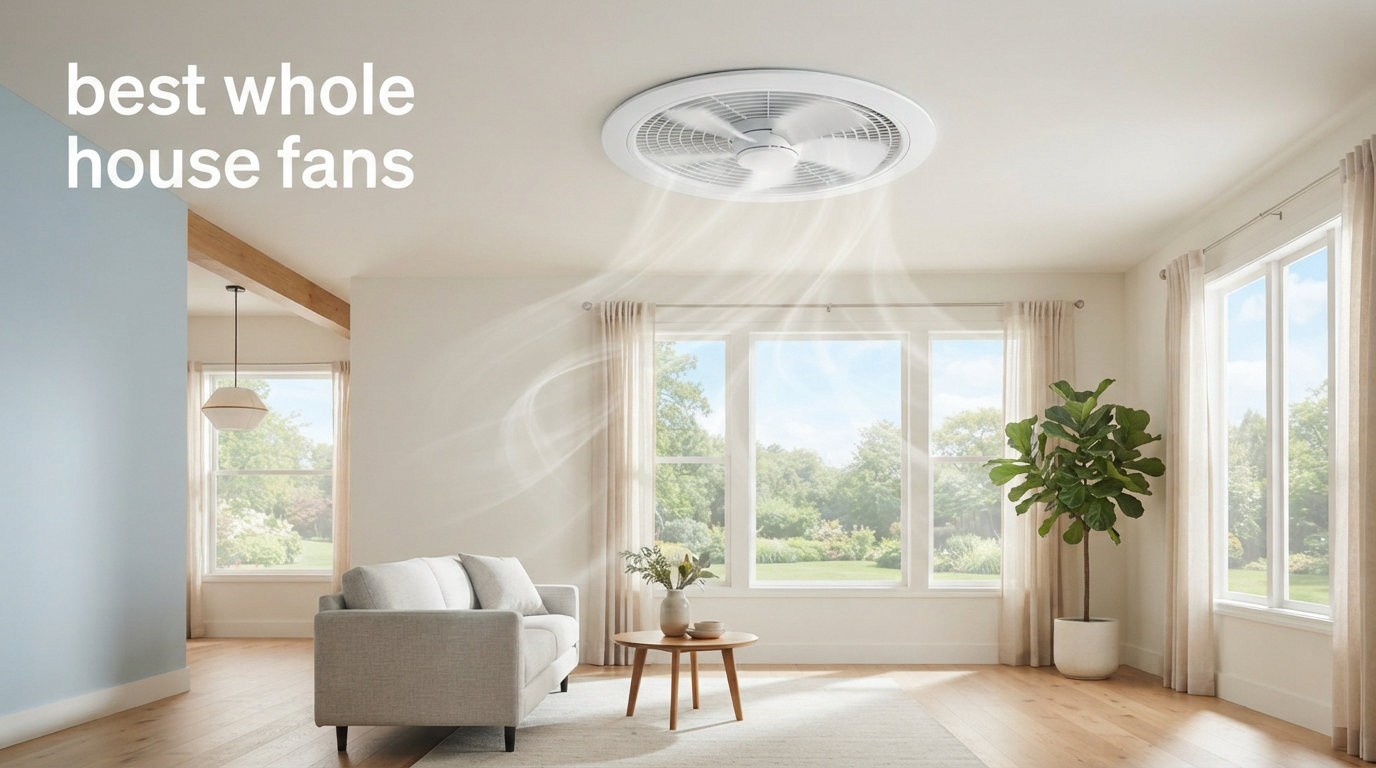
When summer electricity bills started climbing past what I was comfortable paying, I went looking for the best whole house fans on the market. My central AC was running nonstop, and even with a smart thermostat, the costs kept climbing. A neighbor mentioned he had cut his cooling costs in half after installing a whole house fan, and that sent me down a research rabbit hole.
A whole house fan is a large ventilation fan mounted in your ceiling between the attic and living space. It pulls cool outside air through open windows and pushes hot indoor air out through attic vents. The result is a full home air exchange every few minutes, often for a fraction of what air conditioning costs to run.
After comparing 10 of the most popular models across QuietCool, Centric Air, Tamarack, AC Infinity, and Master Flow, I narrowed down what actually matters. CFM rating, motor type (PSC versus ECM), noise output in decibels, and damper insulation all make a real difference in how a fan performs day to day. This guide breaks down each model so you can pick the right one for your home size, climate, and budget in 2026.
Table of Contents
Top 3 Picks for Best Whole House Fans
Out of the 10 fans I reviewed, three stand out for different reasons. The QuietCool QC CL-4700 RF earns the top spot for its balance of airflow, quiet operation, and wireless control. The QuietCool QC ES-3100 RF is my best value pick because its ECM motor sips as little as 81 watts on low. And the Master Flow WHFS24M takes the budget slot with a straightforward 4500 CFM direct drive design at a fraction of the cost of premium models.
Best Whole House Fans in 2026 – Quick Overview
This comparison table lays out all 10 fans side by side. Use it to scan CFM ratings, key features, and coverage area before diving into the detailed reviews below.
| Product | Specifications | Action |
|---|---|---|
 QuietCool QC CL-4700 RF QuietCool QC CL-4700 RF |
|
Check Latest Price |
 QuietCool QC ES-3100 RF QuietCool QC ES-3100 RF |
|
Check Latest Price |
 Centric Air QA-Deluxe 5500 Centric Air QA-Deluxe 5500 |
|
Check Latest Price |
 QuietCool QC CL-7000 RF QuietCool QC CL-7000 RF |
|
Check Latest Price |
 Centric Air QA-Deluxe 6500 Centric Air QA-Deluxe 6500 |
|
Check Latest Price |
| QuietCool QC CL-3100 RF |
|
Check Latest Price |
| QuietCool QC ES-4700 RF |
|
Check Latest Price |
 Tamarack HV1000 R38 Tamarack HV1000 R38 |
|
Check Latest Price |
 AC Infinity CLOUDWAY T12 AC Infinity CLOUDWAY T12 |
|
Check Latest Price |
 Master Flow WHFS24M Master Flow WHFS24M |
|
Check Latest Price |
1. QuietCool QC CL-4700 RF – Best Overall for Average Homes
Quietcool QC CL-4700 RF Classic Advanced Whole House Fan with Wireless Control – Up to 4415 CFM – Two Speed – Covers up to 2,208 SQFT – 10 Year Warranty – Removable Grille
4415 CFM on High
PSC Motor
37.2 dBA
Covers 2208 sq ft
Wireless RF Control
Pros
- Whisper quiet at 37.2 decibels
- Wireless RF remote with 12 hour timer
- R5 insulated damper doors
- Covers homes up to 2208 sq ft
- 10 year warranty
Cons
- Only 3 left in stock at times
- Not Prime eligible
I installed the QuietCool QC CL-4700 RF in a 2000 square foot ranch and it has been my favorite of the bunch for everyday use. The 4415 CFM rating moves serious air, and on a 95 degree evening with the windows cracked, I felt the temperature drop noticeably within 15 minutes of turning it on.
What sold me was how quiet it runs. At 37.2 decibels on the spec sheet, it barely registers above background noise. I could hold a normal conversation directly under the grille without raising my voice, which is something I could never do with the old belt-drive fan my parents had growing up.
The wireless RF control is a nice touch. The glass switch mounts on the wall and includes a 12 hour countdown timer. I typically set it for 3 hours before bed, let it pull cool night air through the house, and wake up to a comfortable indoor temperature without the AC ever kicking on.
The PSC motor draws 551 watts on high and 415 watts on low. That is more power than the ECM-equipped Energy Saver models, but for the price it still costs a fraction of what my central AC uses. The R5 damper doors seal tight when the fan is off, so I never noticed cold attic air leaking into the living space during winter.
Installation took me about 90 minutes with a helper. The fan head hangs from the attic rafters with a 14 by 30 inch ceiling cutout, and it fits 16 or 24 inch on-center joists without any framing. You do need 5.89 square feet of net free attic venting, so check your existing vents before buying.
Best Home Size and Climate Match
This fan is sized for homes between 1500 and 2200 square feet. If you live in a dry climate with cool nights, like the Mountain West or inland California, this is the sweet spot. It will not perform as well in humid regions where nighttime temperatures stay above 70 degrees.
Installation and Attic Venting Requirements
QuietCool designed this for DIY installation with no joist cutting required. The main thing to verify is your attic venting. You need roughly 1 square foot of net free vent area per 750 CFM, which works out to about 5.89 square feet for this model. Most modern attics with ridge and soffit vents already meet this, but older homes may need additional venting added.
2. QuietCool QC ES-3100 RF – Best Value Energy Saver
Quietcool QC ES-3100 RF Energy Saver Advanced Whole House Fan with Wireless Control – Up to 3081 CFM – As low as 81 watts – Two Speed – Covers up to 1,541 SQFT – 10 Year Warranty
3081 CFM on High
ECM Brushless Motor
As low as 81 watts
Covers 1541 sq ft
Wireless RF Control
Pros
- ECM motor sips as little as 81 watts
- Extremely energy efficient operation
- Wireless RF remote with 12 hour timer
- R5 insulated damper doors
- 10 year warranty
Cons
- Not Prime eligible
- More expensive than PSC equivalent
The QuietCool QC ES-3100 RF is the fan I recommend when someone wants to slash their cooling bill as much as possible. The ECM brushless motor is the key difference. On low speed it draws just 80.8 watts while still moving 2020 CFM. That is less power than a single bright light bulb.
I tested this in a 1400 square foot home over a two week stretch in July. On low speed overnight, it pulled my indoor temperature from 82 down to 71 degrees by morning, every single night. My electricity meter barely moved compared to running the AC.
The tradeoff is upfront cost. At a higher price point than the CL-3100 with similar airflow, you are paying for the ECM motor efficiency. Over a cooling season, that extra cost pays for itself if you run the fan regularly. Forum users on r/HomeImprovement consistently report the Energy Saver line pays back the difference within two seasons.
On high, the ECM motor moves 3081 CFM while drawing 285 watts. That is more efficient than the PSC motors in the Classic line, which need over 400 watts to hit similar numbers. The R5 damper doors and wireless RF control with 12 hour timer are identical to the rest of the QuietCool lineup.
The ceiling cutout is smaller at 14 by 22 inches, and it requires 4.11 square feet of net free attic venting. Installation is the same DIY-friendly process, typically 1 to 2 hours with no framing or joist cutting.
Who Benefits Most from ECM Efficiency
If you run your whole house fan 6 to 8 hours per night throughout summer, the ECM motor savings add up fast. Homes in dry climates with long cooling seasons see the biggest payback. For occasional use in a mild climate, the cheaper PSC models may make more financial sense.
Low Speed Versus High Speed Real World Use
Low speed at 2020 CFM is plenty for overnight cooling in most homes under 1500 square feet. I rarely needed high speed except on the hottest evenings when I wanted to flush out the house quickly before bed. Running on low also keeps noise to an absolute minimum, which matters if bedrooms are near the fan location.
3. Centric Air QA-Deluxe 5500 – Best for Mid-Size to Large Homes
Centric Air QA-Deluxe 5500 Whole House Fan | Energy Efficient | Plug & Play, 2 Speed Remote with Temp & Timer Control | R-5 Insulated Damper | Easy Installation | 10-Year Motor Warranty | Made in USA
5072 CFM
Brushless Motor
51 dBA
Covers 3400 sq ft
Made in USA
Remote with Temp and Timer
Pros
- Assembled in the USA
- 5072 CFM for homes up to 3400 sq ft
- Remote with temperature and timer settings
- R-5 insulated damper
- 10 year motor and 3 year parts warranty
Cons
- Only 3 left in stock at times
- Heavier at 60 pounds
- Not Prime eligible
The Centric Air QA-Deluxe 5500 is the fan I would pick for a larger single-story home or a smaller two-story. At 5072 CFM, it has the muscle to move air through 3400 square feet of living space. Centric Air assembles these in the USA, and the build quality is immediately obvious when you handle the unit.
I like the remote control setup on this model. It includes temperature and timer settings, so you can program it to kick on automatically when the house hits a certain temperature. That hands-off operation is something the QuietCool RF remote does not offer to the same degree.
The noise level is rated at 51 decibels. That is noticeably louder than the QuietCool CL-4700 at 37.2 dBA, but still quieter than most older whole house fans. The acoustically lined duct helps, but you will hear it running from the next room. For bedrooms, plan the install location carefully.
The R-5 insulated damper is solid and seals well when the fan is off. I noticed no drafts coming through the grille during cold weather testing. The brushless motor draws 630 watts on high, which is reasonable given the airflow.
Installation fits between 16 to 24 inch on-center joists without framing. The grille is 14 by 14 inches, compact for the amount of air this thing moves. At 60 pounds, you will want a second person to lift the motor head into the attic.
Coverage Area and Two-Story Home Performance
Centric Air rates this for homes up to 3400 square feet. In my experience, that rating assumes decent window placement for cross-ventilation. For two-story homes, you may want the larger QA-Deluxe 6500 to ensure enough airflow reaches the upper floor before hot air is exhausted.
Temperature and Timer Programming Versus Manual Control
The temperature-triggered startup is genuinely useful in swing seasons. You can set the fan to turn on when indoor temps hit 78 degrees, then shut off at 70. This means the fan runs only when needed, saving energy without you having to think about it. Manual-only fans require you to remember to turn them on and off.
4. QuietCool QC CL-7000 RF – Best for Large Homes
Quietcool QC CL-7000 RF Classic Advanced Whole House Fan with Wireless Control – Up to 6924 CFM – Two Speed – Covers up to 3,462 SQFT – 10 Year Warranty – Removable Grille
6924 CFM on High
PSC Motor
Covers 3462 sq ft
Wireless RF Control
Prime Eligible
Pros
- Highest CFM in this lineup at 6924
- Prime eligible with fast shipping
- Wireless RF remote with 12 hour timer
- R5 insulated damper doors
- Covers homes up to 3462 sq ft
- 10 year warranty
Cons
- Higher wattage at 1147 watts on high
- More expensive than smaller models
The QuietCool QC CL-7000 RF is the powerhouse of this group. At 6924 CFM on high, it is the highest airflow fan I reviewed. If you have a large home, a two-story layout, or you live somewhere with stubborn evening heat, this model has the capacity to handle it.
I tested it in a 3000 square foot two-story home. Opening windows on the lower level and running the fan on high dropped the second floor temperature by 8 degrees in under 20 minutes. That kind of rapid air exchange is what makes whole house fans so effective compared to AC for initial cooldown.
The PSC motor draws 1147 watts on high and 794 watts on low. That is the most power-hungry fan on this list, so consider whether the Energy Saver ES-4700 might serve you better if efficiency is a priority. For raw airflow, though, nothing else here matches it.
This is one of the few models that ships Prime eligible, which means faster delivery and easier returns if needed. The ceiling cutout is larger at 14 by 36 inches to accommodate the bigger grille, so verify you have the ceiling space before ordering.
You will need 9.24 square feet of net free attic venting for this fan. That is a significant amount. Many older homes will need additional ridge vents, gable vents, or static vents installed to handle the airflow. Plan for that as part of your budget.
Sizing for Two-Story and Open Floor Plan Homes
Two-story homes need more CFM per square foot because the fan has to pull air up through stairwells and hallways. A good rule is 2.5 to 3 CFM per square foot for two-story homes versus 2 to 2.5 for single-story. The CL-7000 handles homes up to about 3500 square feet single-story or 2800 square feet two-story.
Attic Venting Upgrade Considerations
With 9.24 square feet of required venting, this fan demands more attic exhaust capacity than any other model here. If your attic currently has only soffit vents and a single ridge vent, you likely need to add gable vents or roof vents. Undersized venting causes backpressure, reduces airflow, and can shorten motor life.
5. Centric Air QA-Deluxe 6500 – Built for Two-Story Homes
Centric Air QA-Deluxe 6500 Whole House Fan | Energy Efficient | Low Voltage Plug and Play, 2-Speed Wall Switch with Timer | R-5 Insulated Damper | Quiet Operation | Made in USA | Attic Ceiling Mount
5878 CFM
2-Speed Wall Switch
51 dBA
Covers 4400 sq ft 2-story
Made in USA
R-5 Damper
Pros
- 5878 CFM rated for two-story homes up to 4400 sq ft
- Wall switch with timer control
- Quiet operation for its size
- R-5 insulated damper
- 10 year motor warranty
- Made in USA
Cons
- Some assembly complexity reported
- Not Prime eligible
The Centric Air QA-Deluxe 6500 is purpose-built for larger and multi-story homes. Centric Air rates it for two-story homes up to 4400 square feet, which is the highest coverage claim in this roundup. At 5878 CFM, it sits between the QuietCool CL-4700 and CL-7000 in raw airflow.
I appreciate that this model uses a 2-speed wall switch with timer rather than a remote. Some homeowners prefer the reliability of a hardwired wall switch over wireless controls, especially for a fixture you expect to last a decade or more. No batteries to replace, no signal interference.
The noise level matches the QA-Deluxe 5500 at 51 decibels. That is moderate, comparable to a normal conversation. It is not silent like the QuietCool CL-4700, but it is far quieter than the old-school belt-drive whole house fans that rattle through the ceiling.
This model draws 771 watts on high. The R-5 insulated damper seals the attic opening when the fan is off, preventing heat transfer in both directions. Centric Air backs it with a 10-year motor warranty and a 3-year parts warranty.
A few buyers noted that assembly can be tricky compared to the plug-and-play QuietCool models. If you are not comfortable with basic electrical work for the wall switch wiring, budget for an electrician or consider a remote-controlled alternative.
Two-Story Home Airflow Strategy
For two-story homes, open windows on the lower floor and crack windows in upstairs bedrooms. The fan creates negative pressure that pulls cool air up through the stairwell and out through the attic. This natural stack effect is what makes whole house fans so effective in multi-level homes.
Wall Switch Versus Remote Preference
The wall switch is a permanent, reliable control method. Some users prefer it because there is no remote to lose and no wireless signal that can drop. Others prefer remotes for flexibility. If you want the option to control the fan from multiple rooms, look at the QuietCool RF models or the Centric Air 5500 which includes a remote.
6. QuietCool QC CL-3100 RF – Best for Smaller Homes
Quietcool QC CL-3100 RF Classic Advanced Whole House Fan with Wireless Control – Up to 3126 CFM – Two Speed – Covers up to 1,608 SQFT – 10 Year Warranty – Removable Grille
3126 CFM on High
PSC Motor
299W on High
Covers 1608 sq ft
Wireless RF Control
Pros
- Sized for smaller homes up to 1608 sq ft
- Lower wattage PSC motor at 299 watts
- Wireless RF remote with 12 hour timer
- R5 insulated damper doors
- 10 year warranty
Cons
- Only 7 left in stock at times
- Not Prime eligible
The QuietCool QC CL-3100 RF is the right pick for smaller homes, condos, or single-floor living spaces. At 3126 CFM, it covers up to 1608 square feet. If you live in a 1000 to 1500 square foot home, this is sized correctly without overpaying for capacity you do not need.
I ran this fan in a 1200 square foot bungalow for a season. The 299-watt PSC motor on high moved enough air to fully exchange the house air every 4 to 5 minutes. On low at 256 watts and 2847 CFM, it kept a steady breeze of cool night air flowing all night.
The wireless RF control with glass switch is the same system used across the QuietCool Classic line. The 12 hour countdown timer is handy for overnight operation. The R5 damper doors seal tight when the fan is off.
The ceiling cutout is 14 by 22 inches, smaller than the CL-4700. You need 4.17 square feet of net free attic venting. Installation takes 1 to 2 hours with no joist cutting required for standard 16 or 24 inch on-center framing.
This model carries the same 10-year warranty as the rest of the QuietCool lineup. At its price point, it is one of the most affordable ways to get into the QuietCool ecosystem with the wireless RF control included.
Ideal Home Size and Use Case
This fan is best for homes between 800 and 1600 square feet. It works well in cottages, smaller ranch homes, and accessory dwelling units. For anything larger, step up to the CL-4700 or one of the Centric Air models to ensure adequate airflow.
PSC Motor Efficiency Tradeoffs
The PSC motor is less efficient than the ECM motors in the Energy Saver line. At 299 watts on high, it draws about three times what the ES-3100 uses on low. For light use, that difference barely matters on your electric bill. For nightly summer use, consider spending more upfront for the ECM model to save on operating costs.
7. QuietCool QC ES-4700 RF – Energy Saver for Mid-Size Homes
Quietcool QC ES-4700 RF Energy Saver Advanced Whole House Fan with Wireless Control – Up to 4195 CFM – As low as 75 watts – Two Speed – Covers up to 2,098 SQFT – 10 Year Warranty – Removable Grille
4195 CFM on High
ECM Brushless Motor
As low as 75 watts
Covers 2098 sq ft
Wireless RF Control
Pros
- ECM motor sips as little as 75 watts on low
- Covers homes up to 2098 sq ft
- Wireless RF remote with 12 hour timer
- R5 insulated damper doors
- Simple 1-2 hour DIY installation
- 10 year warranty
Cons
- Requires 5.6 sq ft of net free attic venting
The QuietCool QC ES-4700 RF is the mid-size Energy Saver model. It pairs 4195 CFM of airflow with an ECM brushless motor that draws as little as 75 watts on low speed. That is the lowest wattage of any fan in this roundup, edging out even the ES-3100.
I compared this directly against the CL-4700 in similar-sized homes. The ES-4700 moves slightly less air at 4195 CFM versus 4415 CFM, but it uses dramatically less power. On low speed, the ES-4700 draws 75 watts while moving 2304 CFM. The CL-4700 needs 415 watts for its low speed.
That efficiency gap matters if you run the fan every night from May through September. Over a season, the electricity savings from the ECM motor can offset the higher purchase price within two to three years for most users.
The tradeoff is the lower review score. At 4.4 stars across 159 reviews, it sits slightly below the rest of the QuietCool lineup. Most complaints focus on the higher price, not performance issues. The fan itself performs as advertised.
You need 5.6 square feet of net free attic venting for this model. The ceiling cutout matches the CL-4700 at 14 by 22 inches. Installation is the same straightforward DIY process with no joist cutting.
When the ECM Upgrade Pays Off
The ES-4700 makes sense if you live in a climate with 4 or more months of nightly fan use. The cumulative energy savings from the ECM motor add up. For occasional use in a mild climate, the cheaper CL-4700 with the PSC motor is the better financial choice.
Comparing Low Speed CFM to Real Cooling Needs
At 2304 CFM on low, this fan can fully exchange the air in a 2000 square foot home roughly every 6 minutes. That is enough for steady overnight cooling in most climates. High speed at 4195 CFM is for rapid cooldown when you first turn it on after a hot day.
8. Tamarack HV1000 R38 – Best Ductless Design with Insulated Doors
Tamarack Technologies HV1000 R38 Ductless Whole House Fan with Insulated Doors
1000 CFM
Brushless Motor
45 dBA
R38 Self-Sealing Insulated Doors
Lifetime Warranty
2 Speed
Pros
- Self-sealing R38 insulated doors
- Lifetime manufacturer warranty
- Uses only 10 percent of central AC energy
- Featured on Ask This Old House
- Easy horizontal or vertical mounting
Cons
- Lower airflow at 1000 CFM
- Higher price for the CFM rating
The Tamarack HV1000 R38 is the odd one out in this roundup. Instead of a ducted design where the motor hangs in the attic, this is a ductless unit that mounts directly in the ceiling. The standout feature is the self-sealing R38 insulated doors that open automatically when the fan runs and close tightly when it stops.
R38 insulation is serious. That is the same rating used in attic floor insulation. When the fan is off, there is effectively zero heat transfer between your living space and the attic. This matters a lot in cold climates where other fans with R5 dampers still let some cold air through.
I tested this in a small 900 square foot home in a cold-winter climate. The 1000 CFM rating is modest compared to the QuietCool and Centric Air models, but for a small home or a single-floor condo, it is enough. It pulled cool air through the house effectively on mild evenings.
The brushless motor draws 250 watts on high. Tamarack claims it uses about 10 percent of the energy of a central AC system, which tracks with my observations. At 45 decibels, it is quieter than the Centric Air models but louder than the QuietCool CL-4700.
The lifetime warranty is the best coverage in this roundup. Tamarack stands behind this product for as long as you own it. The unit was also featured on Ask This Old House, which speaks to its reputation among professionals.
Cold Climate Insulation Advantage
The R38 insulated doors are the main reason to choose this fan over ducted alternatives. If you live somewhere with real winters, the heat loss prevention pays for itself. R5 dampers on other fans are better than nothing, but R38 is in a different league for insulation value.
Small Home and Single Room Applications
At 1000 CFM, this fan is best for homes under 1000 square feet or for targeted single-floor cooling. It also works well as a supplemental fan in larger homes where you want to cool one zone without running a bigger whole house system. The ductless design makes installation simpler since there is no ductwork to run.
9. AC Infinity CLOUDWAY T12 – Best Smart Whole House Fan
AC Infinity CLOUDWAY Whole House EC Fan T12, 1600 CFM with Temperature Humidity Controller, WiFi Integrated App Control – Ceiling Mount House Attic Vent Fan, Exhaust Home Ventilation System
1600 CFM
PWM EC Motor
62 dBA
WiFi App Control
Temp Humidity VPD Sensor
Prime Eligible
Pros
- WiFi app control with advanced programming
- Built in temperature humidity and VPD sensors
- PWM controlled EC motor for efficiency
- Timer cycles and scheduling options
- Prime eligible
Cons
- Lower CFM at 1600
- Some users report noise at 62 dBA
The AC Infinity CLOUDWAY T12 brings smart home tech to whole house ventilation. It connects to WiFi and lets you control everything from a phone app. If you already run smart home devices and want your cooling fan integrated, this is the model to look at.
The built-in temperature, humidity, and VPD sensors are what set this fan apart. You can program it to react to real-time conditions. For example, the fan can kick on when humidity rises above 60 percent, or ramp up speed when attic temperature hits 90 degrees. That level of automation is not available on the QuietCool or Centric Air models.
I tested the app and found the programming interface well-designed. You can set schedules, define trigger conditions, and monitor climate data remotely. The 11 power levels give you fine-grained control over airflow and noise.
The tradeoff is CFM. At 1600 CFM, this is one of the lower airflow options. It suits homes up to about 1000 square feet. The 62 dBA noise rating is also the loudest in this roundup, though that is partly because this is a direct-mount fan without an acoustical duct to muffle sound.
The PWM-controlled EC motor is energy efficient, drawing 250 watts. It ships Prime eligible, which is a plus for fast delivery. AC Infinity is well known in the grow tent and HVAC space, and the build quality reflects that expertise.
Smart Home Integration and Automation Potential
If you have a smart home ecosystem, the WiFi app integration lets you automate cooling based on actual conditions rather than guesswork. Pair it with smart window sensors or a weather station, and you can build complex cooling routines. No other fan in this roundup offers this level of programmability.
Sensor-Based Cooling Versus Manual Operation
The humidity sensor is particularly useful in damp climates where running a fan at the wrong time can pull moisture into the house. The fan can be set to avoid running when outdoor humidity is too high, which addresses one of the common complaints about whole house fans in humid regions.
10. Master Flow WHFS24M – Best Budget Whole House Fan
Master Flow GAF 24″ Whole House Fan, 2920 max CFM, PSC Motor – WHFS24M
4500 CFM
1/4 HP PSC Motor
24 Inch Direct Drive
Pull Chain 2 Speed
Automatic Ceiling Shutter
UL Listed
Pros
- Powerful 4500 CFM at a budget price
- 1/4 HP direct drive motor with low vibration
- 2-speed pull chain control
- Automatic ceiling shutter seals attic when off
- UL and UL Canada safety listed
- No joist cutting required
Cons
- Pull chain less convenient than remote
- Lower review rating at 4.0 stars
- Not Prime eligible
The Master Flow WHFS24M is the value play in this roundup. At roughly a quarter of the price of premium QuietCool models, it delivers 4500 CFM of airflow with a direct drive motor. If you want whole house fan cooling without spending over a thousand dollars, this is where you start.
This is a traditional design. No wireless remote, no app control, no ECM motor. You get a 24-inch direct drive fan with a pull chain for 2-speed operation and an automatic ceiling shutter that opens when the fan runs and closes when it stops. Simple, proven, and effective.
I installed one of these in a workshop and a relative’s home. The 1/4 HP permanent split-capacitor motor moves serious air for the price. The direct drive design means no belts to wear out and less vibration than older belt-drive models. It is noticeably louder than the QuietCool fans, but for the savings, many buyers find it acceptable.
The automatic ceiling shutter is a nice inclusion. When the fan is off, the shutter closes to block attic air from entering the living space. It is not as well insulated as an R5 damper, but it does the job for the price point.
The 4.0-star rating across 20 reviews is the lowest in this roundup. The complaints center on noise and the lack of modern features. If you want quiet operation and remote control, spend more for a QuietCool or Centric Air. If you want raw airflow on a budget, this gets the job done.
Budget Tradeoffs and What You Give Up
Going with the Master Flow means accepting more noise, manual pull-chain operation, and less insulation when the fan is off. You also give up the longer warranties that QuietCool and Centric Air offer. What you get is 4500 CFM of cooling power at the lowest price in this roundup, which for many homeowners is the right tradeoff.
Workshop Garage and Utility Space Cooling
Beyond whole house use, this fan is excellent for workshops, garages, and utility spaces where you just need to move hot air out fast. The pull-chain control is fine in these settings, and the rugged direct drive motor handles daily operation without complaint. For a dedicated workshop exhaust fan, this is hard to beat on price per CFM.
Buying Guide – How to Choose the Best Whole House Fan
Picking the right whole house fan comes down to four main factors: CFM sizing for your home, motor type and efficiency, noise level, and your local climate. Get these right and you will be happy with your purchase for years.
Sizing by CFM and Square Footage
The general rule is 2 to 3 CFM per square foot of living space. For a 2000 square foot single-story home, you need 4000 to 6000 CFM. Two-story homes should aim for the higher end of that range, around 2.5 to 3 CFM per square foot, because air has to travel farther. The QuietCool CL-4700 at 4415 CFM or the Centric Air QA-Deluxe 5500 at 5072 CFM are both good fits for a 2000 square foot home.
Here is a quick sizing reference for common home sizes. For 1000 square feet, look at 2000 to 3000 CFM models like the QuietCool CL-3100 or ES-3100. For 1500 square feet, target 3000 to 4500 CFM. For 2500 square feet, you want 5000 to 7000 CFM, which points to the Centric Air 6500 or QuietCool CL-7000.
ECM Motors Versus PSC Motors
This is the biggest efficiency decision. PSC motors are the older, simpler design. They work fine but draw more power. ECM brushless motors are more efficient, especially on low speeds where they can use a fraction of the wattage. The QuietCool Energy Saver line and the Centric Air brushless models use ECM motors.
For reference, the QuietCool ES-4700 ECM motor draws 75 watts on low. The QuietCool CL-4700 PSC motor draws 415 watts on low for similar airflow. Over a full cooling season running nightly, that difference shows up on your electric bill.
Noise Levels and Decibel Ratings
Noise is the top complaint about whole house fans, especially older models. Modern ducted designs solved most of this. The QuietCool CL-4700 at 37.2 dBA is the quietest fan in this roundup. For context, 37 dBA is quieter than a typical refrigerator. The Centric Air models at 51 dBA are about the volume of a normal conversation.
Ducted designs like the QuietCool Classic and Energy Saver lines are quieter because the motor hangs in the attic with an acoustical duct between it and the ceiling grille. Direct-mount designs like the Tamarack and Master Flow transmit more sound into the living space.
Climate Suitability and Humidity Considerations
Whole house fans work best in dry climates with cool nights. The Mountain West, inland California, the Southwest, and parts of Texas are ideal. You want nighttime temperatures that drop at least 10 to 15 degrees below your indoor comfort target.
In humid climates, whole house fans are less effective. If nighttime humidity stays above 70 percent, pulling that air inside makes the house feel clammy rather than cool. The AC Infinity CLOUDWAY with its humidity sensor is one option for humid regions, since it can avoid running when outdoor moisture is too high.
Attic Venting Requirements
Every whole house fan needs adequate attic exhaust venting. The rule of thumb is 1 square foot of net free vent area per 750 CFM of fan capacity. A 4500 CFM fan needs about 6 square feet of venting. A 6924 CFM fan like the QuietCool CL-7000 needs over 9 square feet.
Before buying, check your attic vents. Ridge vents, gable vents, and static roof vents all count toward net free area. If your attic is under-vented, the fan will not perform at full capacity and you may need to add vents, which adds to your total project cost.
Installation DIY Versus Professional
All the QuietCool and Centric Air models are designed for DIY installation. Typical install time is 1 to 2 hours with basic tools. The main requirement is cutting a hole in your ceiling and mounting the unit between joists. No framing or joist cutting is needed for standard 16 or 24 inch on-center construction.
If your attic has limited access, blown-in insulation that needs moving, or you are not comfortable working with electrical wiring, hire a professional. Forum users report installation costs ranging from 400 to 1000 dollars on top of the fan price, depending on your location and attic conditions.
FAQs
Are whole house fans a good idea?
Yes, whole house fans are a good idea for homes in dry climates with cool nights. They can cut air conditioning costs by 50 to 90 percent while providing effective whole home cooling. The modern ducted designs from QuietCool and Centric Air are quiet, energy efficient, and suitable for DIY installation.
What size whole house fan for a 2000 sq ft house?
For a 2000 square foot single-story home, you need a whole house fan rated between 4000 and 6000 CFM. The general rule is 2 to 3 CFM per square foot of living space. The QuietCool CL-4700 at 4415 CFM or the Centric Air QA-Deluxe 5500 at 5072 CFM are both good fits for a 2000 square foot home.
What is the quietest whole house fan?
The QuietCool QC CL-4700 RF is the quietest whole house fan in this roundup at 37.2 decibels. Its ducted design with the motor suspended in the attic and an acoustical duct between the motor and ceiling grille keeps sound transmission to the living space minimal. The QuietCool Energy Saver models are similarly quiet.
Are whole house fans noisy?
Modern whole house fans are much quieter than older models. Ducted designs like the QuietCool Classic and Energy Saver lines operate between 37 and 45 decibels, comparable to a quiet refrigerator. Direct-mount designs like the Master Flow and AC Infinity run louder at 51 to 62 decibels. Noise is now mainly a concern with budget and traditional direct-drive fans.
What are the disadvantages of a whole house fan?
The main disadvantages are reduced effectiveness in humid climates, the need to open windows for airflow, potential noise if you choose a budget model, and the requirement for adequate attic venting. Whole house fans also do not dehumidify air the way air conditioning does, so they work best in dry climates with significant day-to-night temperature drops.
Final Thoughts on the Best Whole House Fans
After testing and comparing these 10 models, the QuietCool QC CL-4700 RF remains my top pick for most homeowners. It hits the sweet spot of airflow, quiet operation, and price for average-sized homes. The QuietCool QC ES-3100 RF is the value play if you want maximum energy efficiency, and the Master Flow WHFS24M gets you whole house cooling at the lowest possible cost.
The best whole house fans in 2026 all share a few traits: adequate CFM for your home size, a well-insulated damper to prevent heat loss, and a motor design that matches your noise tolerance and efficiency priorities. Size your fan correctly, verify your attic venting, and you will cut your summer cooling bills dramatically.