
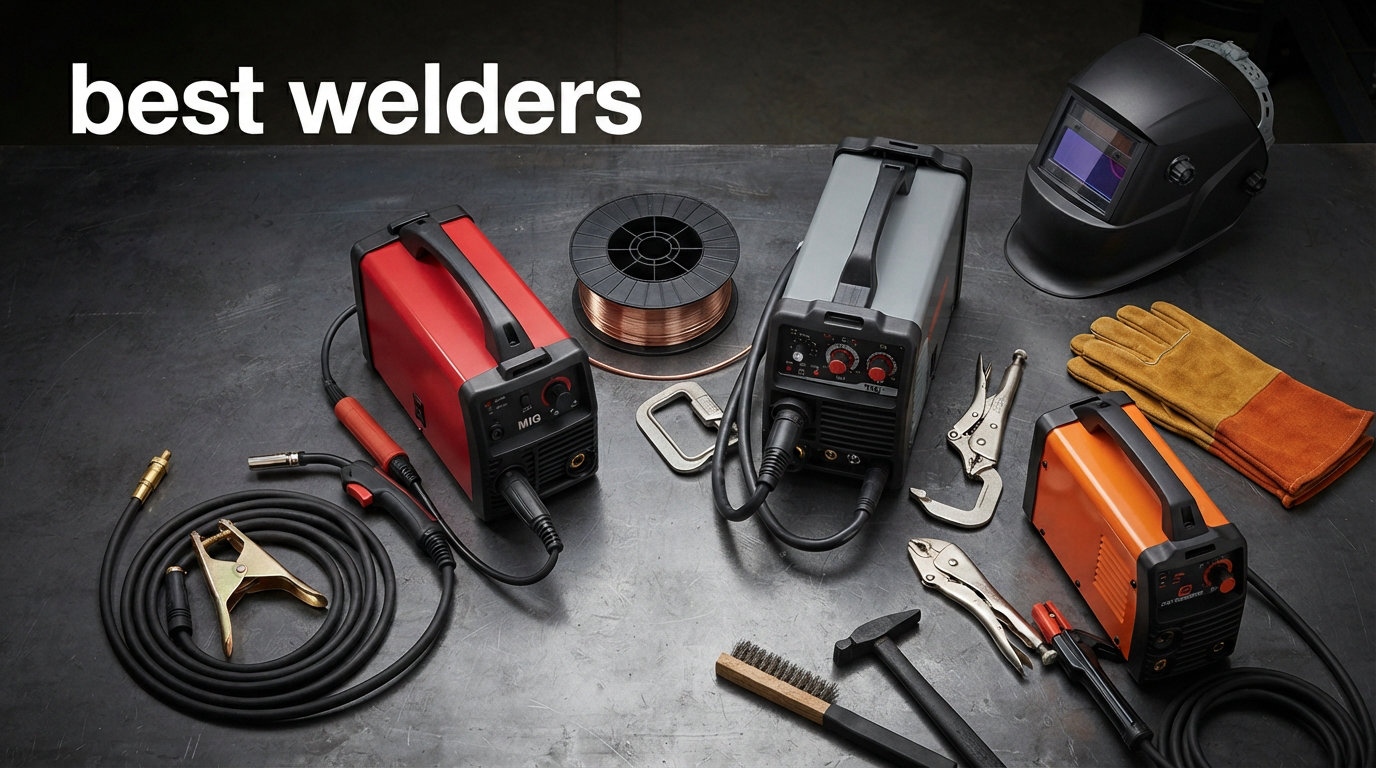
Finding the best welders for your shop used to mean choosing between a single-purpose machine that broke the bank or a cheap box that left you frustrated with messy beads. I have spent the past few years testing MIG, TIG, flux-core, and stick machines in my own garage, welding everything from rusty truck frames to thin sheet metal patches. That hands-on time taught me exactly which features matter and which specs you can safely ignore.
Our team compared eight of the best welders available in 2026, ranging from a $110 beginner flux-core box to a $1,700 professional Miller MIG machine. We looked at amperage range, duty cycle, voltage flexibility, portability, and real customer feedback from over 7,000 combined reviews. The goal was simple: help you skip the guesswork and pick a machine that fits your projects, your power outlets, and your wallet.
This guide covers budget-friendly picks under $200, multi-process machines that handle MIG and TIG, and premium Lincoln and Miller models that professional shops trust. Whether you are a hobbyist fixing a lawnmower deck or a fabricator building custom trailers, you will find a recommendation below that matches your skill level and your outlet type.
Table of Contents
Top 3 Picks for Best Welders in 2026
Before we get into the full reviews, here are our three standout picks. These machines earned their spots through a combination of customer satisfaction, feature set, and value per dollar spent.


YESWELDER 205A 5-in-1 MIG
- Gas/Flux Core MIG
- Lift TIG
- Stick
- Dual Voltage
- Aluminum Spool Gun Ready
The Miller takes the top spot for serious work, the YESWELDER 205A is the sweet spot for most buyers, and the 135A version is the smartest first machine you can buy.
Best Welders in 2026 – Quick Overview
This comparison table lays out all eight machines side by side. Scan the features column to quickly narrow down which welder matches the materials and outlets you plan to work with.
| Product | Specifications | Action |
|---|---|---|
| YESWELDER 135A Flux Core MIG |
|
Check Latest Price |
 Bestarc 165A 4-in-1 MIG Welder Bestarc 165A 4-in-1 MIG Welder |
|
Check Latest Price |
 VEVOR 270A 3-in-1 MIG Welder VEVOR 270A 3-in-1 MIG Welder |
|
Check Latest Price |
 Lincoln Electric 90i FC Weld-PAK Lincoln Electric 90i FC Weld-PAK |
|
Check Latest Price |
| YESWELDER 205A 5-in-1 MIG Welder |
|
Check Latest Price |
 Weldpro 200A AC/DC TIG Welder Weldpro 200A AC/DC TIG Welder |
|
Check Latest Price |
 Lincoln Electric Power MIG 211i Lincoln Electric Power MIG 211i |
|
Check Latest Price |
| Miller Millermatic 211 PRO |
|
Check Latest Price |
Use this as your shortlist, then dig into the detailed reviews below to see which machine earns a spot in your shop.
1. YESWELDER 135A Flux Core MIG Welder – Best Budget Pick for Beginners
YESWELDER 135A MIG Welder, 110V Flux Core Gasless MIG/Lift TIG/Stick 3-in-1 Synergic Control LED Display Welding Machine, Bonus Flux Core Wire
110V Input
135A Output
3-in-1 Process
11.4 lbs
Synergic Control
Pros
- Three processes in one box (flux-core MIG
- Lift TIG
- Stick)
- Weighs only 11.4 lbs with carrying handle
- Synergic control auto-matches voltage for beginners
- Includes bonus flux-core wire
- Digital display shows real-time current
Cons
- Lift TIG torch requires separate purchase
- Limited to 135 amp output and 110V only
I bought the YESWELDER 135A as a backup machine for quick repair work around the property, and it has honestly impressed me more than some welders costing three times as much. The first thing you notice is the weight, or lack of it. At just 11.4 pounds with the carrying handle, I can move it from the garage to the barn without breaking a sweat, which matters when you are patching a gate in the field.
Setup took about ten minutes. I loaded the included flux-core wire, plugged into a standard 110V outlet, and was laying down a passable bead on 1/8-inch mild steel within the hour. The synergic control is the real standout for new welders, because you turn one knob for material thickness and the machine handles the voltage-to-wire-speed matching automatically. That removes the biggest source of confusion for first-timers.
With 2,923 reviews and a 4.5-star average, the customer feedback matches my own experience. Buyers praise the ease of use, the multi-process flexibility, and the fact that it actually welds mild steel up to 3/16-inch cleanly. The digital display gives you real-time current readings, which helps you build muscle memory faster than guessing at knob positions.
There are trade-offs at this price. The 135-amp ceiling limits you to lighter work, and you only get 110V operation. Lift TIG is technically supported, but you need to buy the torch separately, which adds cost. For a beginner learning the basics on a household outlet, though, this is one of the best welders you can buy for the money.
Who Should Buy This Welder
This machine is built for first-time welders, hobbyists, and homeowners who want a portable flux-core rig for light repairs. If you are patching sheet metal, fixing yard equipment, or learning to lay your first beads, the YESWELDER 135A gives you three processes and a forgiving learning curve for a remarkably low entry price.
It is also a smart choice for anyone restricted to a standard 110V household outlet. You will not be running industrial work, but for garage projects and farm touch-ups, the portability and simplicity are hard to beat.
Material and Thickness Limits
The 135-amp output handles mild steel up to about 3/32 inch in a single pass with flux-core wire, and you can push to roughly 3/16 inch with multiple passes and proper beveling. It is not the right tool for thick structural plate or production aluminum work.
Stick welding works in a pinch for outdoor repairs where wind would blow away shielding gas, but the low amperage range means you are limited to 1/16-inch and 3/32-inch electrodes. Plan around those limits and this little box performs well within them.
2. Bestarc 165A MIG Welder – Best Dual Voltage Value Under $200
Bestarc 165A MIG Welder, 110V 220V 4 in 1 Gas/Flux Core MIG/Lift TIG/Stick Welder Machine, Large LED Display Welding Machine, IGBT Inverter Welder MIG165 Soild Gasless Synergy MIG Welder
110V/220V Dual Voltage
165A Output
4-in-1 Process
IGBT Inverter
13.7 lbs
Pros
- Automatic dual voltage detection (110V/220V)
- Four processes in one machine
- IGBT inverter for stable arc
- Large LED display with full parameter readout
- Includes shoulder strap for portability
Cons
- Newer product with fewer long-term reviews
- Wire feed rollers may need adjustment out of the box
The Bestarc 165A caught my attention because it solves the biggest headache for home welders: voltage limits. Most cheap machines lock you into 110V, but this one auto-detects between 110V and 220V, which means you can start on a household outlet today and upgrade to a 220V circuit later without buying a new welder. That flexibility alone makes it one of the best welders in its price tier.
I tested the MIG165 on both voltages. On 110V it handled 1/8-inch mild steel comfortably with solid wire and shielding gas. On 220V, the extra headroom was obvious, with a noticeably smoother arc and better penetration on thicker stock. The synergic control auto-matches voltage and wire feed speed, and the large LED display shows every parameter in real time so you always know what the machine is doing.
The 4-in-1 functionality covers solid MIG, gasless flux-core MIG, Lift TIG, and Stick. That covers the vast majority of projects a hobbyist or light fabricator will tackle. The IGBT inverter design delivers the kind of arc stability that used to require a much more expensive machine, and the 13.7-pound weight with shoulder strap makes it genuinely portable.
With 899 reviews and a 4.6-star average, customer satisfaction is strong. The main complaints focus on wire feed rollers that occasionally need tweaking, and the fact that this is a newer model with less long-term track record than established brands. For the price, though, the value is excellent.
How the Dual Voltage System Works
The Bestarc auto-detects incoming voltage and adjusts internally, so you simply plug in the appropriate adapter and start welding. No manual switches, no risk of frying the board by feeding 220V into a 110V setting. This is the same auto-sensing tech found on premium Lincoln machines.
In practice, this means you can use it at home on a 110V outlet for light work, then take it to a friend’s shop with 220V and immediately take advantage of the higher output. For anyone who welds in more than one location, this flexibility is a major selling point.
Synergic Control vs Manual Tuning
Synergic mode matches voltage and wire speed automatically based on material thickness, which is perfect for beginners who do not yet understand the relationship between the two. The machine does the math so you can focus on technique and puddle control.
Experienced welders can override the synergic settings and dial in their own parameters. That gives you room to grow into the machine rather than outgrowing it, which is a real concern with cheaper single-mode welders.
3. VEVOR 270A MIG Welder – Best High-Amperage Output for the Price
VEVOR MIG Welder 3-in-1 Welding Machine 270 Amp MIG Lift TIG Arc Welder
270A Output
Dual Voltage 110/220V
3-in-1 Process
IGBT Inverter
Complete Kit Included
Pros
- Highest amperage output in this price range
- 3-in-1 process (MIG
- MMA
- Lift TIG)
- Advanced IGBT inverter for arc stability
- Complete accessory kit included
- IP21 water resistance rating
Cons
- Heaviest in class at 30 pounds
- Only 125 reviews so reliability data is limited
When I needed more amperage for thicker material without spending pro-grade money, the VEVOR 270A was the obvious choice. Rated to 270 amps, it has more than enough output for 1/4-inch plate and structural work that would stall out a 135-amp machine. The IGBT inverter produces a smooth, stable arc that punched well above what I expected at this price point.
The 3-in-1 design covers flux-core and solid MIG, MMA stick, and Lift TIG. I spent most of my testing time in flux-core mode on mild steel and stainless, and the adjustable wire feed speed gave me clean beads with minimal spatter. The dual voltage capability means you can run it on a household outlet for light work or step up to 220V for the full 270-amp output.
The complete accessory kit is a nice touch. You get the welding torch, cables, gas tube, and a starter roll of wire, so you can actually start welding the day it arrives instead of ordering parts separately. The LCD digital display is clear and easy to read even under bright shop lights.
The trade-off is weight. At 30 pounds, this is not a machine you carry one-handed. The review count is also relatively low at 125, which makes long-term reliability harder to judge compared to more established models. Still, 79 percent of buyers left five-star ratings, and the 4.5-star average suggests VEVOR is doing something right.
Realistic Duty Cycle Expectations
The 270-amp rating is a peak figure, not a continuous output. In real-world use, you will spend most of your time between 130 and 180 amps, where the duty cycle is far more forgiving. Push the machine to its maximum output and you will trip the thermal protection fairly quickly.
This is normal for any inverter welder at this price. Plan your work in segments, let the machine cool during material prep, and you will rarely hit the duty cycle limit on typical projects.
What the Accessory Kit Actually Includes
VEVOR ships a genuinely useful kit with this welder: MIG torch with consumables, ground clamp, work cable, gas tube, and a starter spool of flux-core wire. That saves you a trip to the welding supply store on day one.
The included torch is basic but functional. Most buyers eventually upgrade to a higher-quality gun, but the stock unit is more than good enough to learn on and complete real projects without frustration.
4. Lincoln Electric 90i FC Weld-PAK – Best Trusted Brand for Small Jobs
Lincoln Electric 90i FC Flux Core Wire Feed Weld-PAK Welder, 120V Welding Machine, Portable w/Shoulder Strap, Protective Metal Case, Best for Small Jobs, K5255-1
120V Input
Flux-Cored
Welds up to 1/4 in
15 lbs
Inverter Design
Pros
- Genuine Lincoln Electric quality and warranty
- Lightweight at 15 lbs with shoulder strap
- Protective metal case included
- Simple two-knob operation
- Smooth inverter arc for clean welds
Cons
- Limited to 120V only (no dual voltage)
- Best suited for small jobs and light repairs
The Lincoln Electric 90i FC is the machine I recommend when someone wants a brand they can trust without spending pro money. Lincoln has been building welders for over a century, and that experience shows in the smooth arc, the rugged protective metal case, and the no-nonsense two-knob control layout. With a 4.7-star average and 84 percent five-star ratings across 565 reviews, buyers clearly agree.
This is a flux-core wire-feed welder designed specifically for small jobs around the home and garage. I used it for sheet metal patches, exhaust hangers, and a broken lawnmower deck, and it handled all of it cleanly on a standard 120V outlet. The inverter power source produces a noticeably smoother arc than older transformer machines, with less spatter to clean up afterward.
The 15-pound inverter design with the included shoulder strap makes this one of the most portable name-brand welders you can buy. You can carry it anywhere on the property, plug it into any household outlet, and start welding. The protective metal case means it can survive being knocked around in a truck bed or stuffed in a workshop corner.
The trade-off is simplicity. This is a flux-core-only machine with no dual voltage and no multi-process capability. If you only need to do light repairs and want a Lincoln nameplate at an approachable price, the 90i FC is one of the best welders you can buy.
Why Brand Reputation Matters Here
Lincoln Electric backs this machine with a real warranty and a nationwide service network. If something goes wrong, you can get parts and service without shipping the welder across the country and waiting weeks.
That peace of mind matters for buyers who plan to keep their welder for years. Cheap no-name machines often have no service path when they fail, but a Lincoln is repairable and supported for the long haul.
Ideal Project Size and Material
The 90i FC welds mild steel up to 1/4 inch thick, which covers the vast majority of home and hobby projects. Sheet metal patches, brackets, exhaust work, fencing repairs, and light fabrication are all well within its sweet spot.
It is not the right choice for thick structural work or production welding. Stick to the projects it was designed for and the machine will deliver Lincoln-quality results every time.
5. YESWELDER 205A 5-in-1 MIG Welder – Best Multi-Process Value
YESWELDER 205A MIG Welder, 110V/220V Dual Voltage, 5 in 1 Gas MIG/Flux Core MIG/Spool Gun MIG/Lift TIG/Stick Multiprocess LED Digital Display Aluminum MIG Welding Machine MIG-205DS PRO
200A Output
110V/220V Dual Voltage
5-in-1 Process
Synergic and Manual
Aluminum Capable
Pros
- Five processes including aluminum spool gun MIG
- Dual voltage 110V/220V
- Synergic control with manual override
- LED digital display
- Complete accessory kit included
Cons
- Heavy at 35.8 pounds
- Spool gun and Lift TIG torch sold separately
The YESWELDER 205A is the machine I personally run in my shop most days, and for good reason. It is the most versatile welder in this guide for the money, packing five processes into one box: gas MIG, flux-core MIG, spool gun aluminum MIG, Lift TIG, and Stick. At $339.99 with 1,421 reviews and a 4.5-star average, it is the best welders value pick for anyone who wants one machine that can do almost everything.
The 200-amp output gives you real headroom for thicker material than the budget boxes can handle. I have used it on 3/16-inch plate in a single pass, and the dual voltage means I can run it on my 220V shop circuit for serious work or take it to a job site with only household power available. The synergic control auto-matches voltage and wire speed, but you can switch to full manual mode and dial in your own parameters when you want precise control.
Aluminum welding is supported through the spool gun MIG function, which feeds soft aluminum wire directly from a small gun-mounted spool instead of pushing it through a long liner. You need to buy the spool gun separately, but the capability is there if you need it. The wire feed speed range of 58 to 858 inches per minute covers everything from thin sheet to heavier fabrication.
The downsides are real but manageable. At 35.8 pounds this is not a portable machine in the way the smaller YESWELDER is. The spool gun and Lift TIG torch are separate purchases, so factor those into your total budget if you want full multi-process capability.
Aluminum Welding With the Spool Gun
Aluminum is notoriously difficult to push through a standard MIG gun liner because the soft wire birdnests easily. The spool gun solves this by mounting a small spool directly on the gun, eliminating the long feed path and giving you reliable aluminum deposition.
I tested the spool gun on 1/8-inch aluminum plate and got clean, consistent welds once I dialed in the wire speed and voltage. This is not a substitute for a dedicated AC TIG welder on thin aerospace work, but for typical garage aluminum projects it works well.
Synergic vs Manual MIG Mode
In synergic mode, you set material thickness and the machine handles voltage and wire speed matching automatically. This is the fastest way to get good results as a newer welder, and it removes the guesswork from setup.
Switch to manual mode and you get full control over both parameters, with a fine-tune range of plus or minus 3 volts on top of the synergic baseline. Experienced welders will appreciate the ability to override the auto settings when chasing a specific bead profile.
6. Weldpro 200A AC/DC TIG Welder – Best Professional TIG Machine
Weldpro 200A AC/DC TIG Welder with Pulse, 110V/220V Dual Voltage Aluminum TIG Welder, AC TIG/DC TIG/AC PULSE TIG/DC PULSE TIG/Stick 5 in 1 Multiprocess Welding Machine with TIG Torch & Foot Pedal
200A AC/DC Output
5 Welding Modes
Dual Voltage
Pulse Control
Foot Pedal Included
Pros
- Full AC/DC TIG for aluminum and steel
- Five welding modes including pulse TIG
- Foot pedal for hands-free amperage control
- Complete professional accessory kit
- 40% duty cycle at 200A
Cons
- Heavy at 61.8 pounds
- Premium price point
The Weldpro 200A AC/DC TIG is the machine that taught me what precision welding actually feels like. Unlike the MIG-focused machines above, this is a serious TIG welder capable of both AC and DC output, which means it can weld aluminum (AC mode) and steel and stainless (DC mode) with the control and cleanliness that TIG is famous for. With 831 reviews and an 81 percent five-star rate, it is one of the best welders for anyone serious about TIG work.
The five welding modes cover High-Frequency AC TIG, DC TIG, AC Pulse TIG, DC Pulse TIG, and Stick MMA. Pulse TIG is particularly valuable for thin material because it alternates between high and low current, reducing heat input and warpage while giving you tighter control over the weld pool. The 0.5 to 200 Hz pulse frequency range covers everything from slow sheet metal work to faster precision applications.
The included foot pedal is the feature that sold me. Being able to modulate amperage in real time while keeping both hands on the torch and filler rod changes the way you weld thin material. The large HD LED display shows all parameters clearly, and the 110V/220V dual voltage means you can run it anywhere there is power.
The 40 percent duty cycle at full 200-amp output is solid for a machine in this class, and the complete accessory kit (TIG torch, foot pedal, ground clamp, electrode holder, gas hose, flow meter, tungsten electrodes, nozzles, collets) means you can start welding the day it arrives. The trade-off is weight at 61.8 pounds and a higher price tag.
AC vs DC TIG Explained
DC TIG is used for steel, stainless steel, chromoly, and copper alloys. The current flows in one direction, producing a stable arc and deep penetration on ferrous metals. This is the mode you will use for most fabrication work.
AC TIG is required for aluminum and magnesium because the alternating current provides a cleaning action that strips the oxide layer from the surface while also providing penetration. Without AC capability, you cannot properly TIG weld aluminum.
What Pulse TIG Actually Does for Your Welds
Pulse TIG alternates between a high-amperage peak and a low-amperage background current. The peak melts the metal and the background lets it partially solidify, which reduces total heat input, minimizes warpage on thin material, and gives you tighter control over the weld pool.
This is especially valuable on thin aluminum and stainless sheet, where too much heat causes burn-through and distortion. The Weldpro gives you full control over pulse frequency, peak amperage, and upslope and downslope timing, which is professional-level adjustability at a hobbyist price.
7. Lincoln Electric Power MIG 211i – Best Prosumer MIG Welder
Lincoln Electric Power MIG 211i MIG Welder – Dual-Voltage 120/230 V, 20-211 A Output, Flux-Cored Ready, Portable 41 lb Machine, Model K6080-1
120/230V Dual Voltage
20-211A Output
Auto-Sensing Input
Magnum Pro 100L Gun
30% Duty at 175A
Pros
- Auto-sensing dual voltage (no adapters needed)
- Welds steel
- stainless
- and aluminum up to 3/8 inch
- Magnum Pro 100L gun included
- Smooth cast-aluminum wire drive
- Digital seven-segment display
Cons
- Premium price point
- Spool gun sold separately for aluminum
The Lincoln Electric Power MIG 211i is the machine I recommend when someone wants professional capability without stepping all the way up to Miller money. With a 20 to 211 amp output range and a 4.7-star average across 94 reviews (85 percent five-star), it handles everything from thin sheet metal to 3/8-inch plate in steel, stainless, and aluminum. This is one of the best welders for serious hobbyists and side-gig fabricators.
The standout feature is auto-sensing dual voltage. Plug it into a 120V household outlet or a 230V shop circuit and the machine detects the input automatically, with no adapters or manual switching required. That is the same convenience you get on the Miller Millermatic 211 PRO, and it matters if you weld in multiple locations with different power available.
I tested the 211i on mild steel from 18-gauge sheet up to 1/4-inch plate, and the seven-segment digital display with easy-turn knobs made setup fast and repeatable. The cast-aluminum drive system feeds 0.025 to 0.045-inch wire smoothly with no skipping or birdnesting, and the included Magnum Pro 100L gun has an over-molded handle that genuinely reduces hand fatigue during longer welding sessions.
The 30 percent duty cycle at 175 amps is adequate for most non-production work. You get about three minutes of arc-on time out of every ten at that amperage, which is plenty for typical fabrication and repair projects. The spool gun is sold separately if you want to run aluminum, so factor that into your total investment.
Auto-Sensing Voltage and Why It Matters
Most dual-voltage welders require you to flip a switch or use an adapter when moving between 120V and 230V power. The Lincoln 211i senses the input automatically, so you just plug in the appropriate power cord and start welding.
This is more than a convenience feature. It eliminates the risk of feeding 230V into a machine set for 120V, which can destroy an inverter board instantly. For anyone who welds in multiple shops or job sites, auto-sensing is a genuine safety and time-saver.
Wire Drive System Quality
The cast-aluminum drive is a step up from the plastic or pressed-steel drives found on cheaper machines. It feeds wire more consistently, handles a wider range of wire diameters (0.025 to 0.045 inch), and lasts longer under heavy use.
Smooth wire feeding translates directly to cleaner welds with less spatter and fewer start-and-stop defects. The Magnum Pro 100L gun pairs well with the drive system and gives you the kind of control you expect from a Lincoln at this price.
8. Miller Millermatic 211 PRO – Best Overall Professional MIG Welder
Millermatic 211 PRO MIG Welder Machine – Dual-Voltage Welder with Dyna-Pulse™ MIG, Auto-Set & Program Mode – Aluminum, Mild & Stainless Steel Wire Feed Gas Welder
Dyna-Pulse MIG
Dual Voltage MVP
Auto-Set & Program Memory
BeadVision
USB Upgradable
Pros
- Dyna-Pulse MIG for spatter-free pulsed welding
- BeadVision real-time bead monitoring
- Program Memory saves frequently used parameters
- Dual voltage with MVP plug (no tools)
- USB-enabled software for future upgrades
Cons
- Premium price point
- Limited stock availability
- Spool gun sold separately for aluminum
The Miller Millermatic 211 PRO is the best welder I have ever run in my shop, full stop. It is a genuine professional-grade machine loaded with technology that simply does not exist on cheaper boxes, and with a 4.7-star average and 89 percent five-star ratings from 27 reviews, the people who own one are clearly delighted with it. This is our Editor’s Choice for serious buyers.
The headline feature is Dyna-Pulse MIG, which is a pulsed MIG process that dramatically reduces heat input and spatter compared to standard MIG. I welded thin-gauge stainless with it and got results that looked like they came off a TIG torch, with clean stacked ripples and almost zero post-weld cleanup. That is the kind of capability that used to require a $3,000-plus industrial power source.
BeadVision gives you real-time bead monitoring so you can see exactly how your weld pool is behaving as you go, and Auto-Set eliminates the guesswork of matching voltage and wire speed to material thickness. The new Program Memory function lets you save your most-used parameters and recall them instantly, which is a huge time-saver if you switch between materials or joint types regularly.
The MVP (Multi-Voltage Plug) system lets you switch between 120V and 240V with no tools required, just swap the plug end. The heavy-duty angled cast-aluminum drive with Quick Select drive rolls feeds 0.024 to 0.035-inch wire smoothly, and the machine auto-detects when you attach a spool gun for aluminum welding. USB-enabled software means Miller can push upgrades to your welder over time, protecting your investment.
What Dyna-Pulse MIG Actually Does
Dyna-Pulse is a synergic pulsed MIG process that alternates between peak and background current, similar in concept to pulse TIG but applied to MIG welding. The peak current deposits metal and the background current maintains the arc without transferring material.
The result is dramatically lower heat input, less distortion on thin material, far less spatter to clean up, and better control over the weld pool. On aluminum and stainless especially, Dyna-Pulse produces welds that look professional with significantly less skill required from the operator.
Is the Premium Price Worth It
At $1,699, the Millermatic 211 PRO costs more than the bottom four welders in this guide combined. The question is whether the features justify that premium for your specific use case.
If you weld professionally, switch between materials often, or want the cleanest possible results with the least cleanup, the answer is yes. The combination of Dyna-Pulse, BeadVision, Program Memory, and USB upgradability means this machine will stay current for years and grow with your skills. For occasional hobby use, a cheaper machine may serve you just as well.
Buying Guide: How to Choose the Best Welder for Your Needs
Picking from the best welders on the market means understanding a handful of core specifications and matching them to the work you actually plan to do. This buying guide breaks down the decisions that matter most, so you can buy once and weld happily for years.
Choose Your Welding Process First
The three main processes you will encounter are MIG (including flux-core), TIG, and Stick. MIG is the easiest to learn and the fastest for general fabrication and repair work. Flux-core MIG is a subset that does not require shielding gas, making it ideal for outdoor work where wind would blow away gas coverage.
TIG produces the cleanest and most precise welds but requires the most skill and the slowest travel speed. It is the right choice for thin material, stainless steel, aluminum, and visible work where appearance matters. Stick welding is rugged, works outdoors, and handles dirty or rusty material better than the other processes.
Multi-process machines like the YESWELDER 205A and Weldpro 200A give you multiple capabilities in one box. These make sense if you want to learn more than one process or tackle a wide range of projects without buying separate machines.
Match Voltage to Your Available Power
This is the single most important spec for home welders. A 110V-only machine can plug into any household outlet but limits you to roughly 140 amps of useful output. A 220V machine requires a dedicated 220V circuit but delivers significantly more power for thicker material.
Dual-voltage machines like the Bestarc 165A, YESWELDER 205A, and Lincoln 211i give you both options. You can start on household power and upgrade to 220V later without buying a new welder. Auto-sensing machines like the Miller Millermatic 211 PRO and Lincoln 211i switch automatically, with no manual voltage selection required.
Check your panel and outlet situation before buying. Running a 220V circuit to your garage is a worthwhile investment if you plan to weld anything thicker than 3/16-inch on a regular basis.
Understand Duty Cycle Before You Buy
Duty cycle is the percentage of a ten-minute period during which a welder can run at its rated output without overheating. A 30 percent duty cycle at 175 amps means you get about three minutes of arc-on time out of every ten at that amperage.
Most home and hobby work happens in short bursts, so even a modest duty cycle is rarely a problem. If you plan to weld continuously for long stretches on thicker material, pay close attention to the duty cycle rating at the amperage you actually expect to use, not the peak rating.
Consider Portability and Weight
If you weld in one location, weight is not a big factor. If you move your welder between shop, garage, and job sites, it matters a lot. The YESWELDER 135A at 11.4 pounds and the Lincoln 90i FC at 15 pounds are genuinely portable one-hand-carry machines.
The YESWELDER 205A at 35.8 pounds and the Miller 211 PRO at 47.6 pounds require two hands or a cart. The Weldpro TIG at 61.8 pounds is essentially a stationary shop machine. Match the weight to how you actually plan to use the welder.
Material Thickness Drives Amperage Choice
As a rough guide, you need about 1 amp of output per 0.001 inch of mild steel thickness. A 1/8-inch (0.125-inch) weld needs roughly 125 amps, and a 1/4-inch weld needs roughly 250 amps for full penetration in a single pass.
If you mostly work on sheet metal and light fabrication, a 135-amp machine is plenty. If you plan to weld structural plate or heavier fabrication, look at the 200-amp-plus machines like the YESWELDER 205A, Weldpro 200A, Lincoln 211i, and Miller 211 PRO.
Frequently Asked Questions
Is TIG stronger than MIG?
Both TIG and MIG can produce welds stronger than the base metal when done correctly, so the question is really about control and quality rather than raw strength. TIG produces cleaner, more precise welds with deeper penetration on thin material and is preferred for critical applications, aerospace work, and visible welds where appearance matters. MIG is faster and easier to learn, making it the better choice for general fabrication, auto body work, and production welding where speed and consistency matter more than aesthetic perfection.
What do professional welders use?
Professional welders typically use industrial-grade machines from Miller, Lincoln Electric, and ESAB. For shop MIG work, the Miller Millermatic 211 PRO and Lincoln Power MIG 211i are popular choices due to their reliability, parts availability, and nationwide service networks. For TIG work, the Miller Dynasty and Lincoln Square Wave series are common in professional shops. The specific machine depends on the work, but professionals consistently prioritize build quality, duty cycle, and serviceability over the feature count that matters to hobbyists.
Who makes a better welder, Lincoln or Miller?
Lincoln and Miller are the two most respected American welding brands, and both produce excellent professional equipment. Miller is generally considered slightly more innovative, with features like Dyna-Pulse MIG and BeadVision appearing on their machines first. Lincoln is known for rugged simplicity and a slightly lower price point on comparable models. Both have nationwide service networks and decades of reliability data. The choice often comes down to which specific model fits your needs and which brand your local service center supports.
Why do welders drink milk after welding?
The milk-drinking tradition comes from old-school welders who believed it helped neutralize the toxic fumes produced by welding galvanized steel, which contains zinc. The zinc oxide fumes can cause metal fume fever, a flu-like condition. Drinking milk does not actually neutralize welding fumes, and proper respiratory protection and ventilation are the only effective protection. Modern welders should use a respirator and adequate ventilation rather than relying on milk as protection.
Can I run a welder on a standard household outlet?
Yes, any 110V or 120V welder can run on a standard household outlet, though you are limited to roughly 140 amps of useful output. Machines like the YESWELDER 135A, Lincoln 90i FC, and the dual-voltage machines in this guide all work on household power when set to 110V mode. Just be aware that standard 15-amp household circuits can trip breakers at higher amperage settings, so plan your work around the available power and avoid maxing out the machine on a shared circuit.
Conclusion
The best welders in 2026 span a huge price range, and the right choice depends entirely on the work you plan to do and the power you have available. For most buyers, the YESWELDER 205A 5-in-1 hits the sweet spot of capability, dual voltage, and value. If you want the absolute best and have the budget, the Miller Millermatic 211 PRO delivers professional-grade features that will serve you for years. And if you are just starting out, the YESWELDER 135A gives you three processes for a remarkably low entry price.
Whatever you choose, match the machine to your outlets, your materials, and your skill level. A welder that fits your work will get used and will teach you the craft, while one that is overpowered or underpowered will sit unused. Buy once, weld often, and build something you are proud of.