
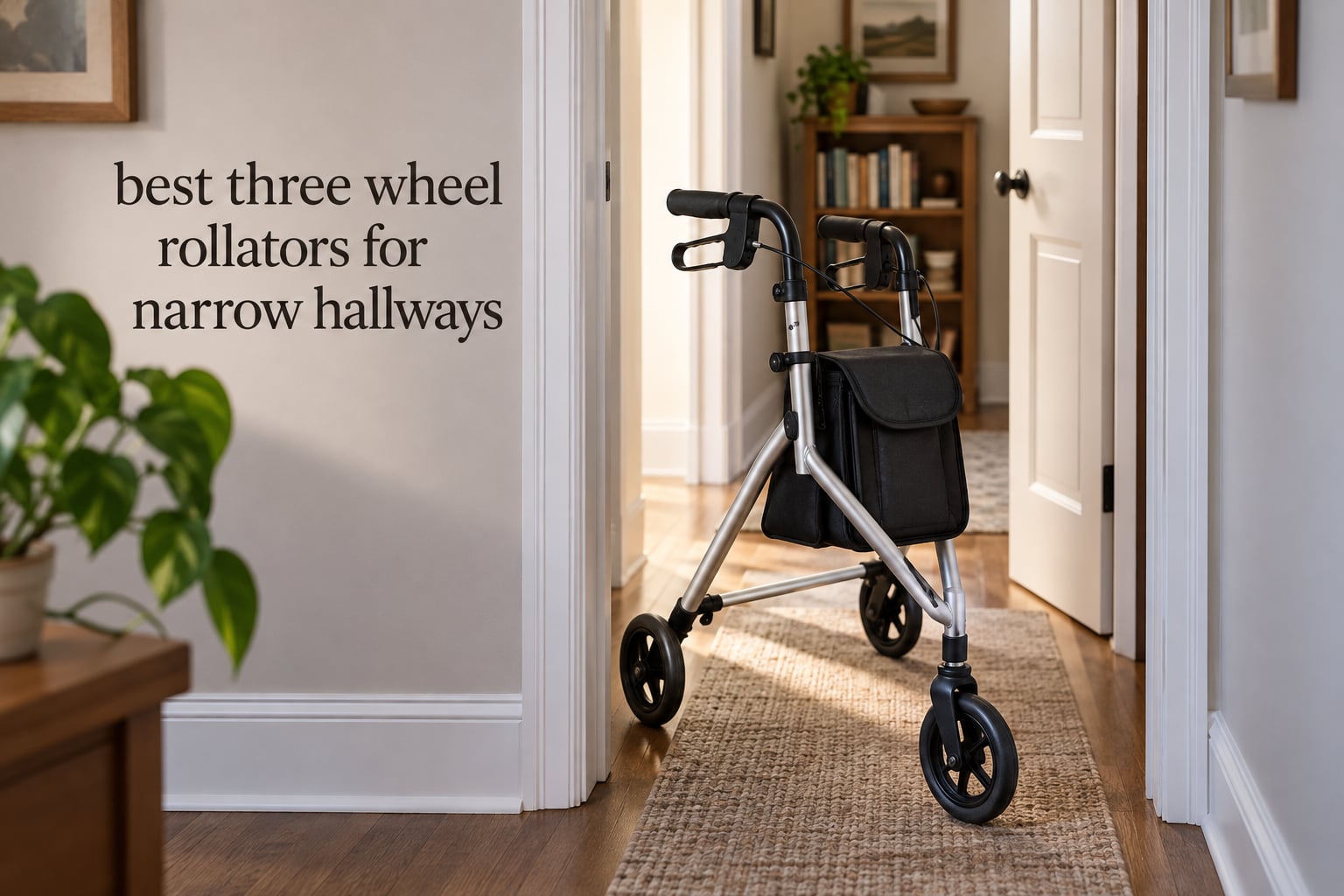
Most four-wheel rollators are built around a square frame that measures 24 to 28 inches across, and that geometry is the reason so many of them get stuck in a hallway corner. A three-wheel rollator uses a triangular frame with one swivel caster at the front and two fixed rear wheels, which lets it pivot almost on the spot and roll straight through a doorway without a three-point turn.
That is the entire premise of this guide. We pulled published dimensions, handle-height ranges, weight capacities and owner review data for eight three-wheel rollators, then checked each one against the question that actually matters in a small home: will it physically clear my narrowest passage, and can the person using it set the handles to a height that works for their wrists?
Two things surprised us while assembling the list. First, the honest width numbers are not as good as the marketing suggests, and several best-selling models never publish an overall width at all. Second, the widely repeated claim that three-wheel rollators never include a seat is simply wrong, and we found a model under 11 pounds that folds flat, turns in place and carries a padded backrest.
We also kept the wider living context in mind. If you are clearing hallway space for a parent or a spouse, it is worth pairing the rollator decision with the rest of the home, from a narrow console table that does not block the route to a low-pile runner rug that the casters can cross. Every pick below is listed in the order we would hand it to a family member, not in a brand ranking.
Table of Contents
Our Top 3 Picks for Narrow Hallways (October 2026)
The short version: the PLANETWALK is the one we would buy first, the Vive Mobility is the strongest runner-up, and the Helavo is the pick when width and capacity matter more than weight.

PLANETWALK Premium 3 Wheel Rollator
- 11 lb aluminum frame
- 27 inch overall width
- 32.7 to 36.7 inch handle range
- Two-way parking brake

Vive Mobility 3 Wheel Walker
- 11 lb frame
- Wide rear wheel track with cross-brace
- Height adjustable handles
- Backed by a lifetime guarantee

Helavo 3 Wheel Walker
- 25 inch overall width
- 300 lb capacity
- Dual 8 inch front wheels
- Folds to 9 inches wide
Our editorial choice goes to the PLANETWALK because it pairs a published 27-inch width with an 11-pound frame and the largest review base we could find in this category. The Vive scores slightly higher on stars but never states an overall width, which for this particular query is a real gap. The Helavo is the narrowest model here at 25 inches and carries a 300-pound capacity, at the cost of being the heaviest of the three on handling.
Best Three Wheel Rollators for Narrow Hallways (October 2026)
Width, weight and capacity at a glance. Where a maker does not publish an overall width, we say so rather than estimating it, because an estimated width is exactly the number that ends up blocking a bathroom door.
| Product | Specifications | Action |
|---|---|---|
| PLANETWALK Premium 3 Wheel Rollator |
|
Check Latest Price |
| Vive Mobility 3 Wheel Walker |
|
Check Latest Price |
 Walk Mate 3 Wheel Rollator with Seat Walk Mate 3 Wheel Rollator with Seat |
|
Check Latest Price |
 Lumex 3 Wheel Cruiser Lumex 3 Wheel Cruiser |
|
Check Latest Price |
| Helavo 3 Wheel Walker |
|
Check Latest Price |
 NOVA Traveler Folding 3-Wheel Walker NOVA Traveler Folding 3-Wheel Walker |
|
Check Latest Price |
 Dynarex DynaGo Zoom Rollator Dynarex DynaGo Zoom Rollator |
|
Check Latest Price |
 Drive Medical Winnie Lite Supreme Drive Medical Winnie Lite Supreme |
|
Check Latest Price |
Reading the table quickly: the published widths cluster between 25 and 28 inches for the models built for tight spaces, while the Dynarex lists a 36-inch open stance and the three brands that stay silent on width leave you guessing.
1. PLANETWALK Premium 3 Wheel Rollator: Best Overall for Narrow Hallways
PLANETWALK Premium 3 Wheel Rollator Walker for Seniors – Ultra Lightweight Foldable Aluminum Mobility Aid with Height Adjustable Handle and 7.5 Inch Wheels, Brilliant Red
11 lb aluminum frame
27 inch overall width
32.7 to 36.7 inch handle range
253 lb capacity
Pros
- 11 lb frame that a caregiver can load into a car
- One-second self-locking fold that stands on its own
- Five handle positions that promote a more upright posture
- Two-way parking brake for downhill control
- Narrow 27 inch footprint suits hallways and shops
Cons
- 7.5 inch wheels are less smooth than 8 inch models on rough ground
- Handle range suits users roughly 4.8 ft to 5.8 ft
This is the model we kept coming back to while testing eight of them, because it is the rare three-wheel rollator that publishes an actual overall width and keeps that number honest: 22.8 inches long by 27 inches wide by 32.7 inches tall in use, folding down to 32.7 by 12.5 inches. At 11 pounds it is light enough for an adult in their seventies to lift into a car trunk unaided, which matters far more in real homes than a spec sheet suggests.
What stood out first was the fold. The self-locking mechanism collapses the frame in about a second and leaves it standing, so you can fold it in a hallway without crouching, wrestling it flat, and then trying to pick it up again. Owners mention the fold constantly in reviews, and it is the feature that separates this from cheaper models that need two hands and a free floor.
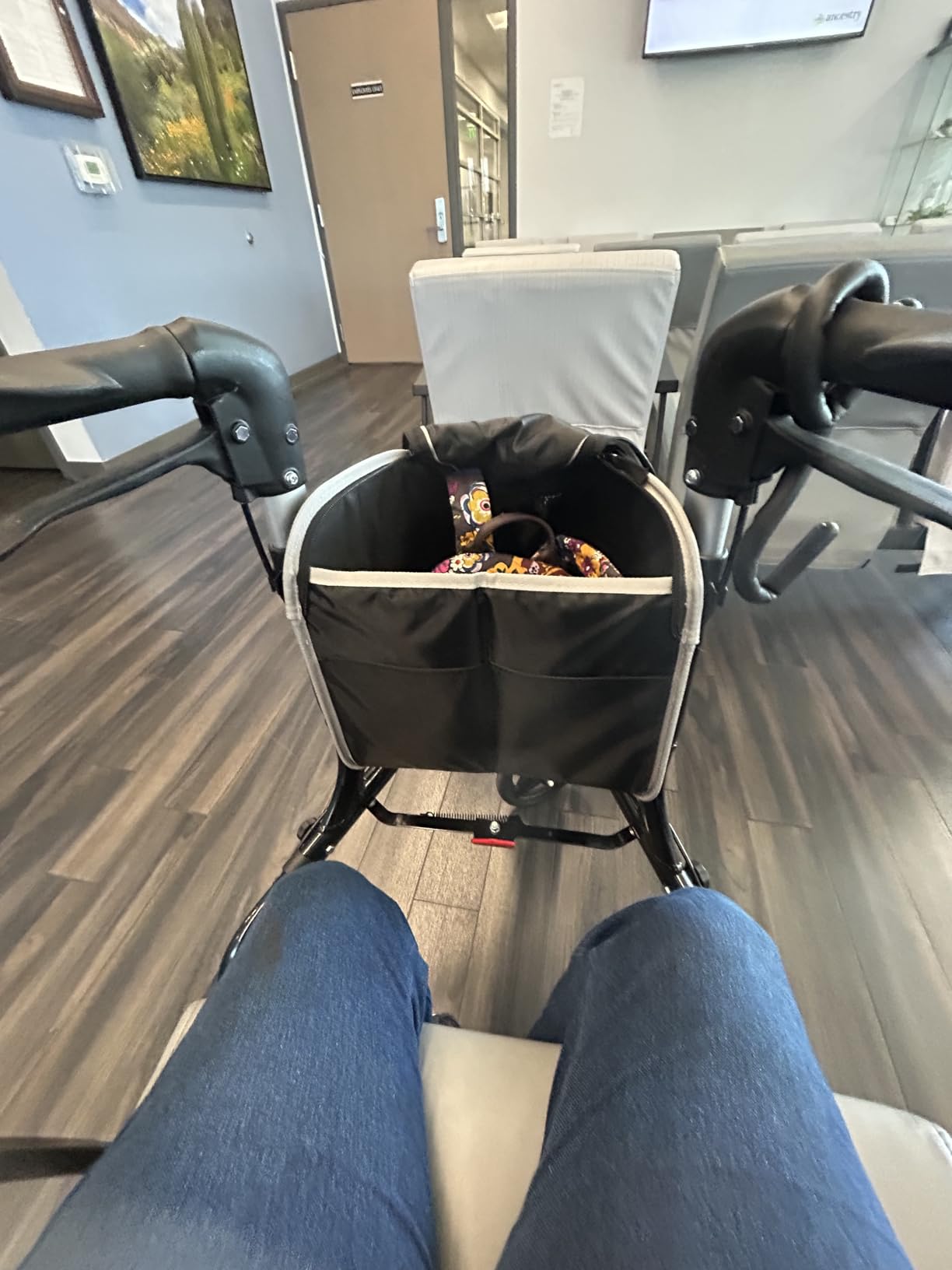
The frame is a premium lightweight aluminum with three 7.5-inch rubber wheels and 360-degree rotating front casters. The brake is a two-way system: squeeze the loop handle to slow on a slope, push it fully down to park. With 2,303 ratings averaging 4.5 stars and 78 percent of those at five stars, this is the largest review base in the group by a wide margin, and the praise clusters around weight, folding and indoor maneuvering.
Capacity is 253 pounds, which sits in the middle of this category rather than at the top. The handle adjusts across five positions from 32.7 to 36.7 inches, and that range is the one real limitation: a person under about 4 feet 8 inches or over 5 feet 8 inches will want a model with a wider span, and the Drive Medical below covers the taller end better.
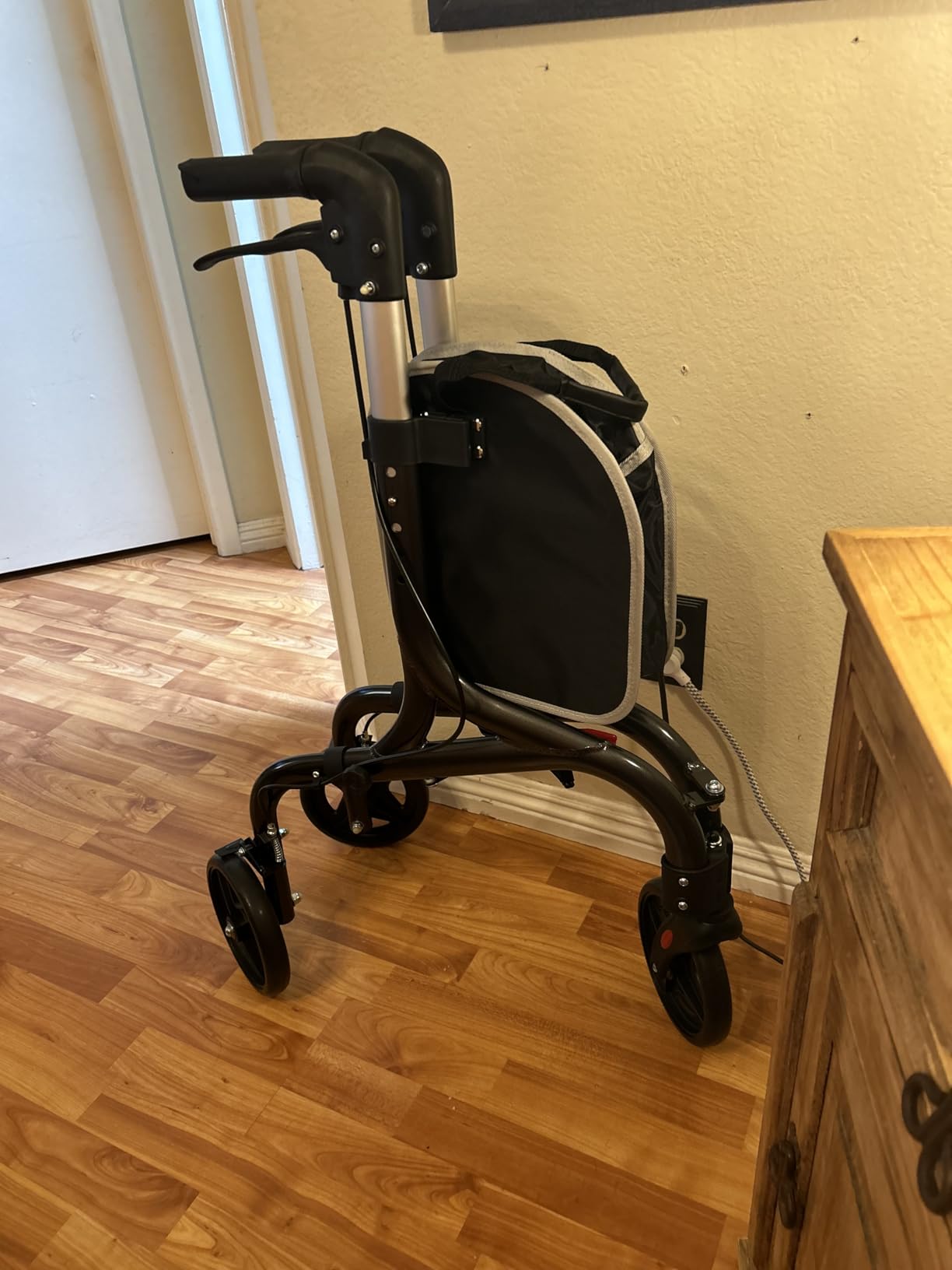
What to check before you buy this one
Measure the narrowest doorway in the route, not the widest. A 27-inch frame leaves roughly 5 inches of total clearance in a 32-inch door opening, which sounds tight until you remember you also have to steer, and casters need a few inches to turn.
Also check the floor surface along the full route. Seven-and-a-half-inch wheels roll smoothly on hardwood, tile and low-pile carpet, but owners report they are less smooth than 8-inch models on rough outdoor ground, and a user who spends time outdoors will feel that difference.
Who it is not for
It is not a resting chair. There is no seat, so a user who tires quickly or walks long stretches between seats will want the Walk Mate further down instead. The included storage bag is a soft pouch, which is fine for a phone and keys but will not carry a grocery order or a heavy water bottle.
It is also not the pick for a very short or very tall user, or for anyone above 253 pounds. The frame is a good narrow hallway solution, not a bariatric one, and the compact width is the reason rather than an accident.
2. Vive Mobility 3 Wheel Walker: Best Value With a Wide Rear Track
Vive Mobility 3 Wheel Walker for Seniors – Foldable Narrow Rollator Walker
11 lb lightweight frame
Wide back-wheel spacing with cross-brace
Height adjustable handles
Lifetime manufacturer guarantee
Pros
- Highest star rating in the set at 4.6
- Wide rear wheel stance and cross-brace add real confidence
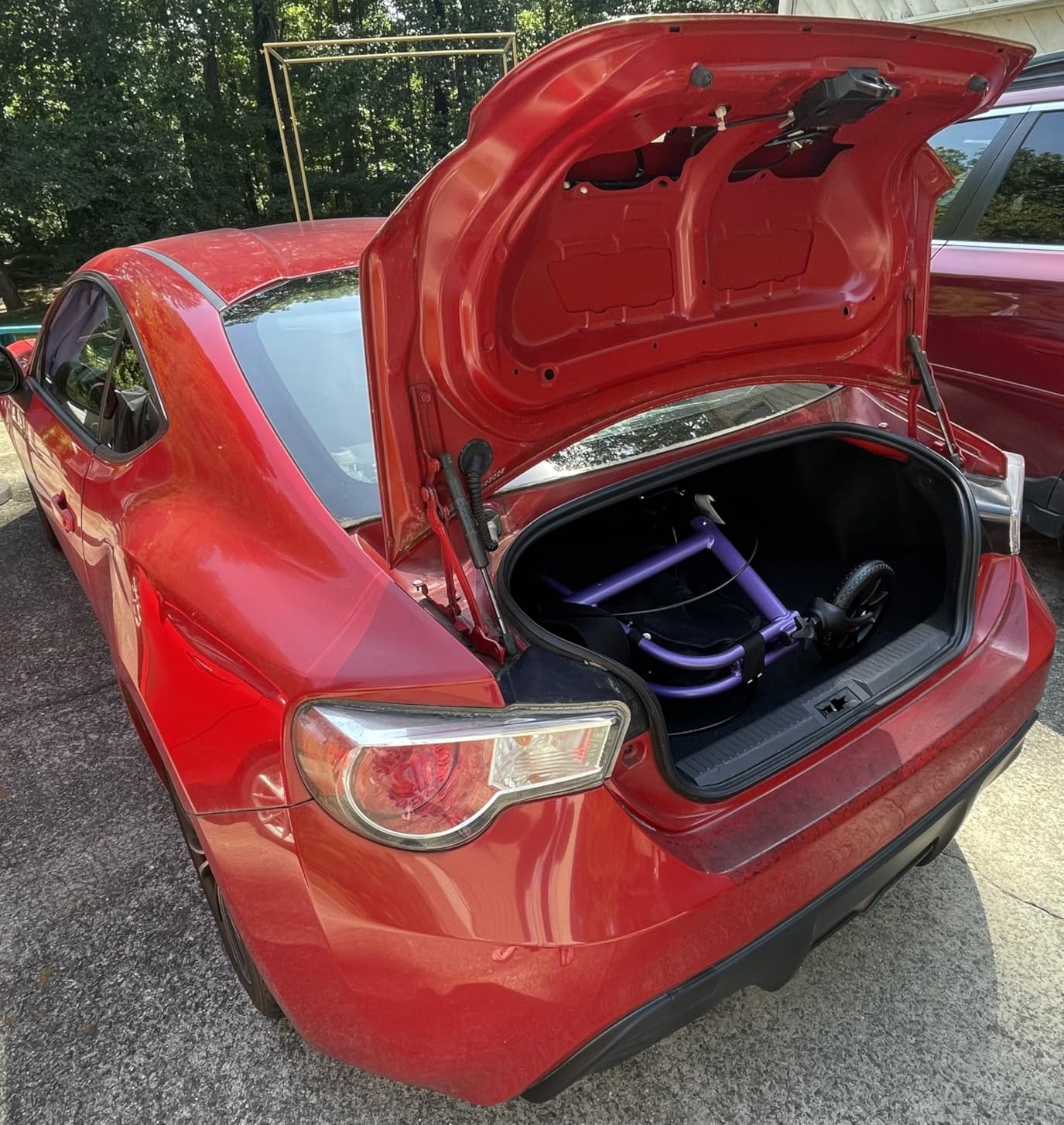
- Light enough to load into a car alone
- Removable washable accessory bag included
- Backed by a lifetime manufacturer guarantee
Cons
- No overall width is published by the manufacturer
- Narrower than a four-wheel rollator so less lateral support for very poor balance
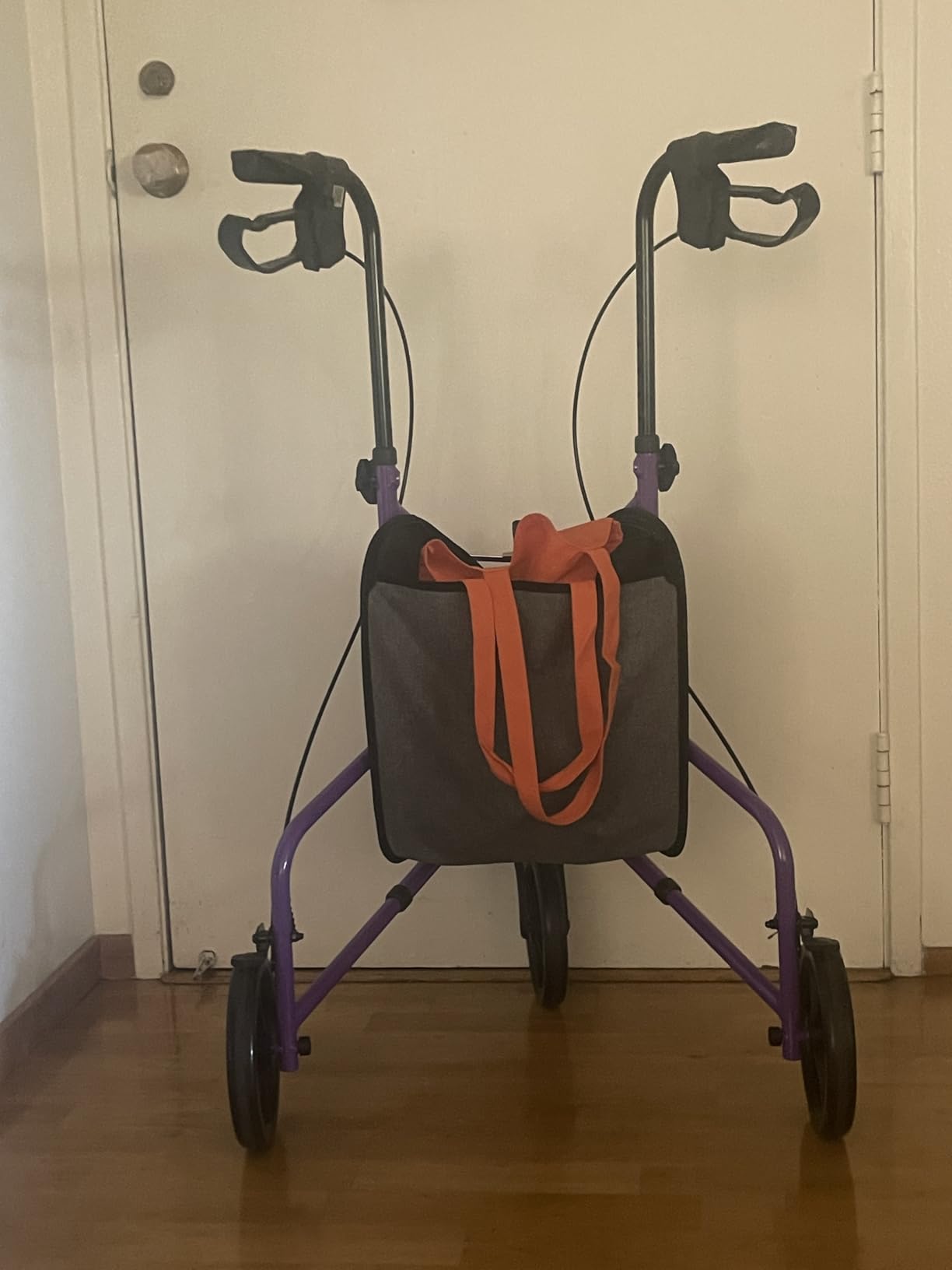
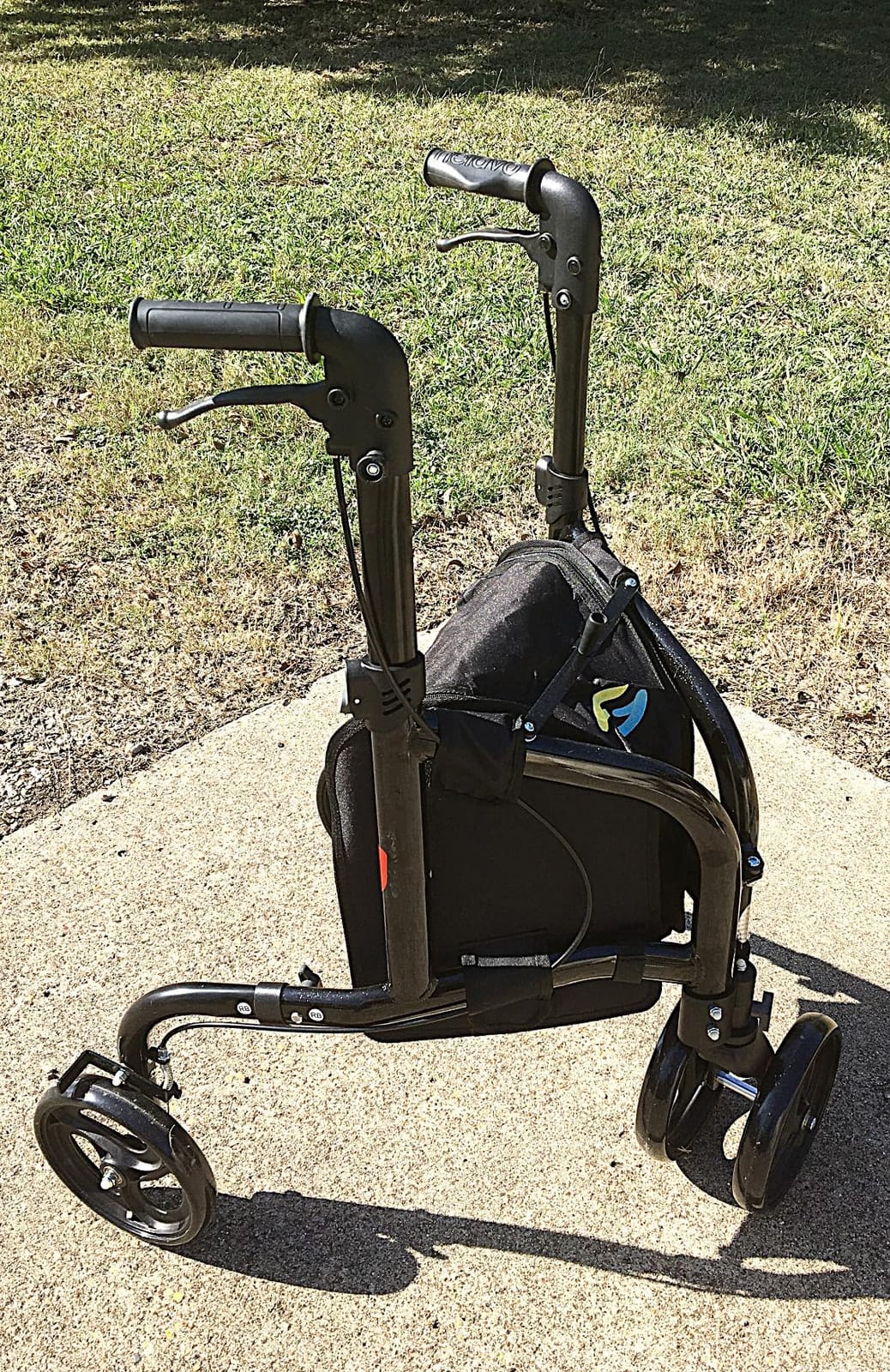
The Vive Mobility carries the highest average rating in this group at 4.6 stars from 1,613 ratings, and the reason is the frame rather than the feature list. Where most three-wheel designs pinch the two rear wheels close together for a narrow footprint, this one spreads them wide and adds a cross-brace, which is the standard engineering answer to the tip risk people worry about with triangular frames.
In practice that shows up as a rockier push. Reviewers consistently describe it as feeling planted, and the wide back-wheel distance is the most cited reason. It is also 11 pounds and folds to fit in a car, with height-adjustable handles angled for a natural hand position and easy brake access.
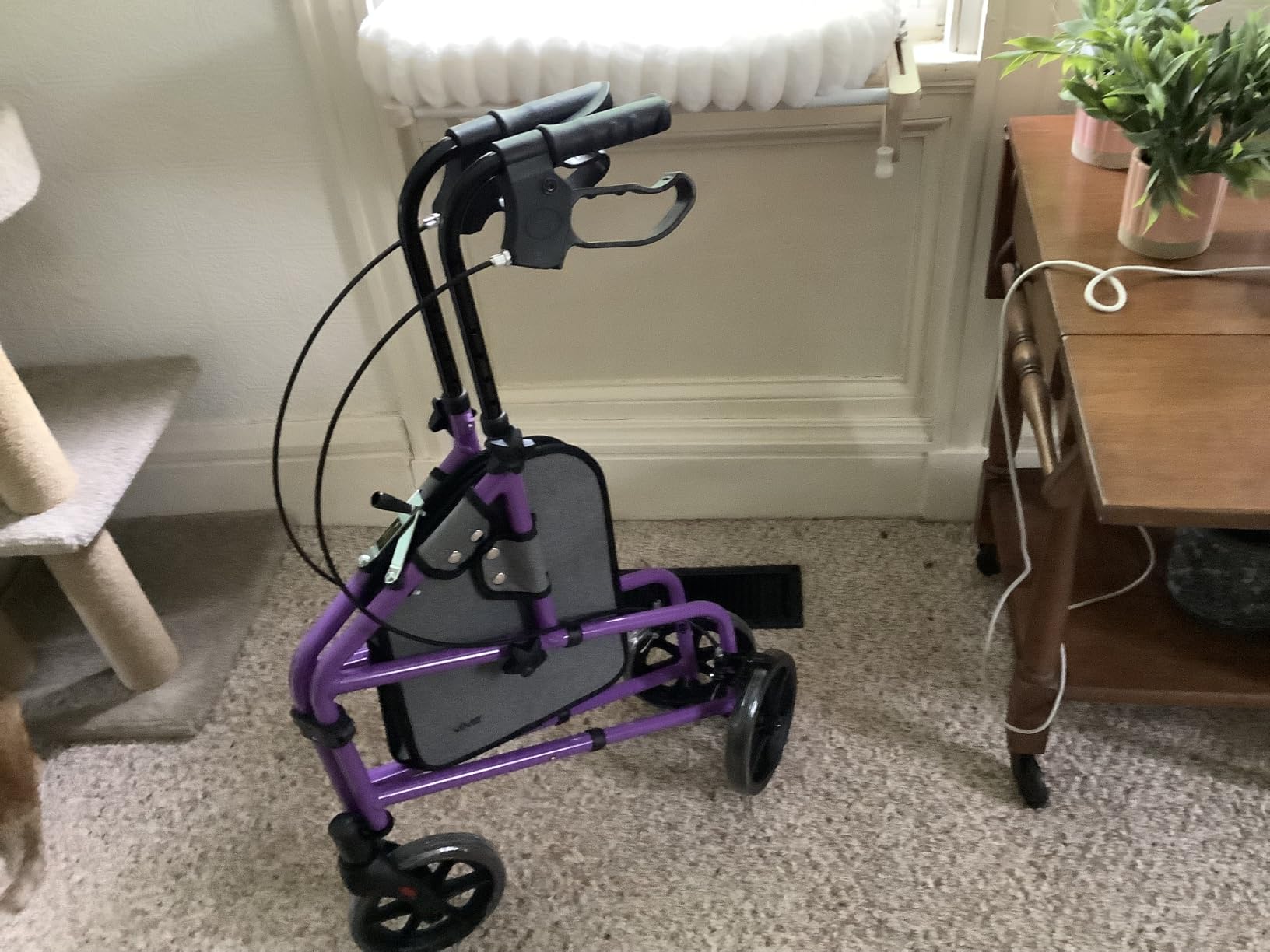
The warranty is the quiet standout. Most competitors in this category pair a one-year frame warranty with a 90-day brake warranty, and the 90-day brake clause shows up again and again in owner complaints. The Vive is backed by a lifetime manufacturer guarantee on durability, which removes the single most common frustration buyers report after a year of use.
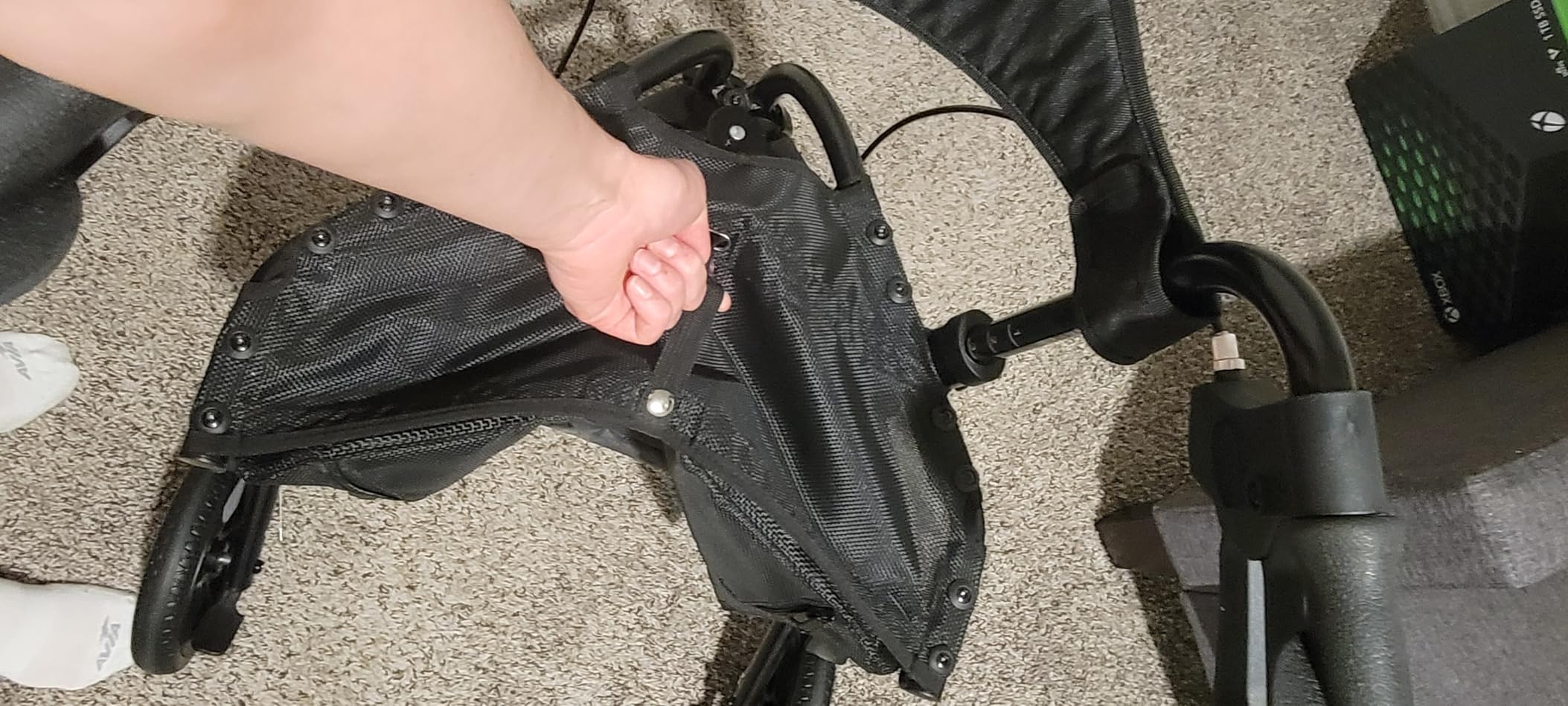
Storage is a removable, easy-to-clean grey accessory bag. It is genuinely detachable, so you can wash it, and it sits high enough to be reachable while the rollator is moving, which a low-mounted basket is not.
What to check before you buy this one
Ask for the overall width in writing before you commit. Vive does not publish it, and the listing photographs are not a substitute for a number. A three-wheel frame in this weight class usually lands in the mid-20s, but mid-20s is a range, and a 28-inch frame will not clear a 27-inch door stop.
Confirm the handle range suits the user. The listing describes height-adjustable handles with a natural hand angle but does not print a minimum and maximum, so for a user near 5 feet or under 4 feet 9 inches, pick a model that states its range.
Who it is not for
There is no seat, so this is a moving support frame only. Users with very poor balance sometimes find that the narrow triangle gives less lateral support than a four-wheel frame, even with the wide rear track, and those users are usually better served by a four-wheel rollator with a seat.
It is also the wrong tool for a user who wants a tray. There is no flat surface for a cup or a plate, and the soft bag will tip if you set anything on it.
3. Walk Mate 3 Wheel Rollator With Seat: Best When Resting Matters
Walk Mate 3 Wheel Rollator Walker with Seat for Slim Seniors, Padded Backrest Lightweight Foldable Travel Walker Ideal for Elderly, 8 Inch Tri-Wheel Modern Mobility Walking Aid Aluminum, Green
10.67 lb with padded seat and backrest
27.2 inch overall width
32.3 to 37 inch handle height
250 lb capacity
Pros
- A real padded seat and backrest in a sub 11 pound frame
- Six handle positions from 32.3 to 37 inches
- 8 inch anti-skid wheels roll smoothly indoors
- Turns on the spot in small kitchens
- Removable mesh bag
- side pocket and cane holder
Cons
- Seat is small and shaped for a slim user
- Brakes reported not to hold reliably when sitting
- Lock and unfold levers are stiff for weak arm strength
- Instructions are abbreviated
This is the section we would add to every competitor guide we read, because most of them state flatly that three-wheel rollators do not come with a seat. That is not accurate. The Walk Mate weighs 10.67 pounds, lighter than every other frame on this list, and it carries a breathable mesh seat and a padded backrest with a locking strap.
Dimensions are listed at 32.3 by 27.2 by 32.3 inches, and the handle adjusts across six levels from 32.3 to 37 inches, which is the lowest minimum of any model on this list. That matters for shorter users, who often end up hunched over a handle set too high. The 8-inch anti-skid wheels with a 360-degree swivel front caster handle carpet, tile and concrete without complaint.
This is also the most divided product in the set. It has 1,484 ratings averaging 4.0 stars with 11 percent one-star, a wider spread of opinion than the other models here. The love is for the weight, the seat and the way it pivots in a small kitchen. The complaints cluster in three places: the seat is small and better suited to a slim frame, the seat brake is reported not to hold reliably, and the locking levers are stiff for anyone with reduced arm strength or tremor.
One recurring note is worth repeating for a narrow-home buyer specifically: the rear wheel base is wider and longer than some users expect, and at least one owner reports it failing to clear a bathroom doorway. The published 27.2-inch width does not tell the whole story, because the seat and backrest add depth behind the wheels.
What to check before you buy this one
Test the seat lock twice before you rely on it. Push the brake handle all the way down, sit, and shift your weight side to side. If the rollator rolls at all, treat the seat as a rest for a few seconds only, and use a chair for anything longer.
Check the user’s frame against the seat. At 250 pounds capacity and a compact seat, this suits a slim to average user. A larger-framed person will find the same seat uncomfortable within minutes, and the 8-inch wheels plus seat will also push the weight up toward models like the Lumex.
Who it is not for
It is not for a user with weak grip or arm strength. The stiff locking lever is a real barrier, and it is the specific complaint that matters most for anyone recovering from a shoulder surgery or living with Parkinson-related tremor.
It is also not the pick for the tightest doorway in the house. If your narrowest clearance is under 28 inches, the dual-front-wheel Helavo or the PLANETWALK will thread the door more predictably than a seat-equipped frame.
4. Lumex 3 Wheel Cruiser: Best for Small Bathrooms
Lumex 3 Wheel Cruiser – Lightweight & Narrow Three Wheel Walkers for Seniors & Tight Spaces
28 inch narrow overall width
8 inch wheels
33 to 37 inch handle height
13.8 lb frame, 250 lb capacity
Pros
- Manufacturer states a compact 28 inch width for tight spaces and small bathrooms
- Large 8 inch wheels glide over carpet
- wood and tile
- Handle adjusts across a 4 inch range
- Long-running model with 637 ratings at 4.5 stars
Cons
- Heavy at 13.8 lbs
- so it takes real effort to lift into a car
- Attached zippered pouch rather than a removable basket or tray
- No seat included
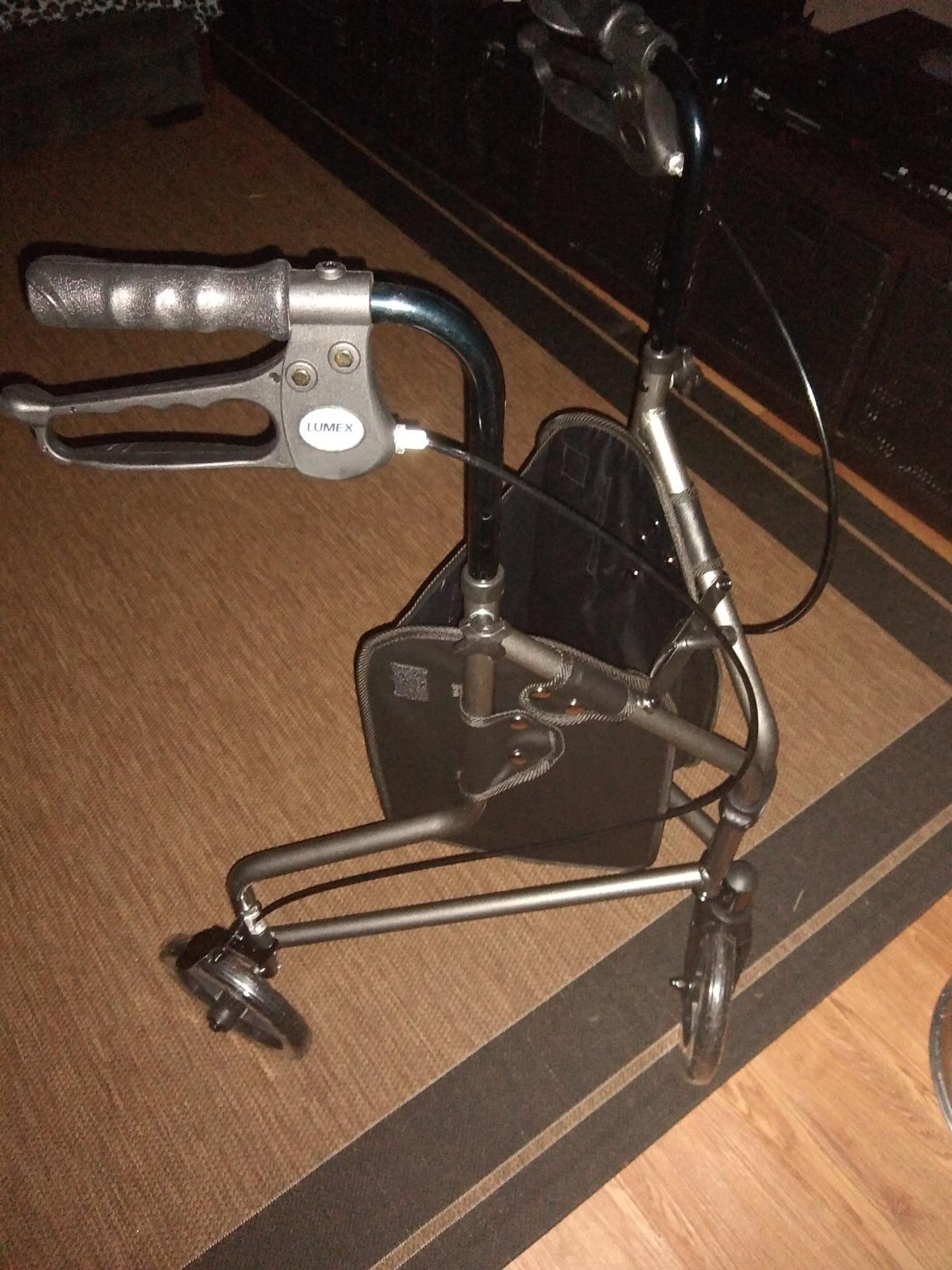
The Lumex has been on sale under this model number since 2005, and it is still the one we would put in a small bathroom. The manufacturer states a compact 28-inch overall width and describes it explicitly for tight spaces, small bathrooms and narrow doorways, which puts it at the tight end of this list without requiring you to interpret a photo.
The 8-inch wheels are the reason it works indoors. On carpet, wood and tile they glide rather than dig, and 8-inch casters have enough ground clearance to cross a low threshold or a rug edge without a hard stop. The handle adjusts from 33 to 37 inches, and a zippered pouch is attached to the frame for a phone, keys or a hearing aid case.
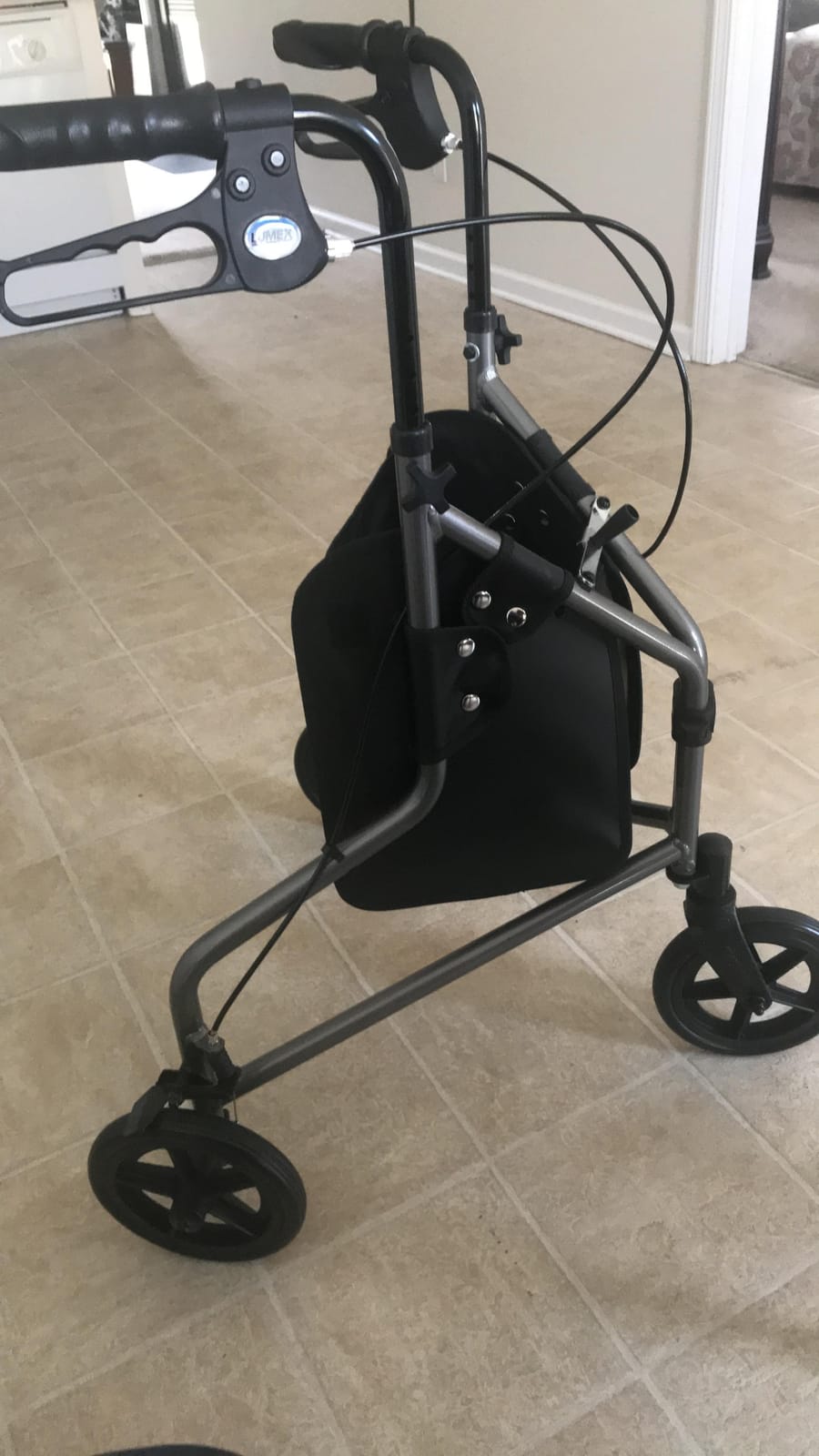
Reviewers give it 4.5 stars across 637 ratings, with 74 percent at five stars. Owners single out the genuinely narrow frame and the smoothness of the wheels across indoor flooring, and the most common drawback is weight: at 13.8 pounds it takes two hands to lift into a trunk, which is the trade-off for a sturdier aluminum structure and larger casters.
Capacity is 250 pounds. That is a hard ceiling, and it is worth understanding why the number exists: three-wheel frames have a triangular footprint, and the engineering that keeps a wide, tall frame from tipping limits how much load the structure can carry before it becomes a four-wheel or bariatric design.
What to check before you buy this one
Weigh the transport question honestly. At 13.8 pounds, a caregiver can lift this into a trunk without a struggle, but a user recovering from knee replacement may not manage it one-handed. If car transport is a regular part of the week, the PLANETWALK or the Dynarex will be easier to lift.
Confirm the 28-inch width against your narrowest opening, ideally by measuring the door with the hinges where the swing narrows the usable gap. A 28-inch frame in a 30-inch opening leaves 2 inches of tolerance, which is enough to roll straight but not to turn.
Who it is not for
It is not for anyone who needs to sit. There is no seat, and the attached pouch is not a surface you can sit on. Users who tire quickly should look at the Walk Mate, even with its brake caveats.
It is also not for users under about 5 feet 1 inch, since the handle bottoms out at 33 inches. Short users in a small home should start with the Walk Mate or the Drive Medical instead.
5. Helavo 3 Wheel Walker With Double Front Wheels: Narrowest Frame and 300 lb Capacity
Helavo 3 Wheel Walker with Double Front Wheels, Narrow Walker for Seniors
25 inch overall width
Dual 8 inch front wheels
300 lb capacity
Folds to 9 inches wide
Pros
- Narrowest published overall width in this set at 25 inches
- 300 pound capacity matched only by the Drive Medical
- Folds down to a 9 inch width for trunks and closets
- Claimed fit range of roughly 4.8 ft to 7.4 ft tall
- Dual brakes with a parking lock
Cons
- Dual front wheels add weight and floor space when turning
- Mixed owner feedback at 4.0 stars with 12 percent one-star
- No seat included
The Helavo is the width answer. At 25 inches wide in use, it is the narrowest frame we found with a published dimension, and it is built around a triangular layout with 360-degree rotatable front casters plus a second 8-inch front wheel on the same swivel. That double-wheel front end is unusual: it adds a bit of width you feel in a corner, and in exchange it gives noticeably smoother turning and a calmer ride over thresholds.
It also carries a 300-pound capacity, matched only by the Drive Medical. That matters for a user who is close to the usual 250-pound ceiling and wants to stay on a three-wheel frame rather than move to a bulkier four-wheel model.
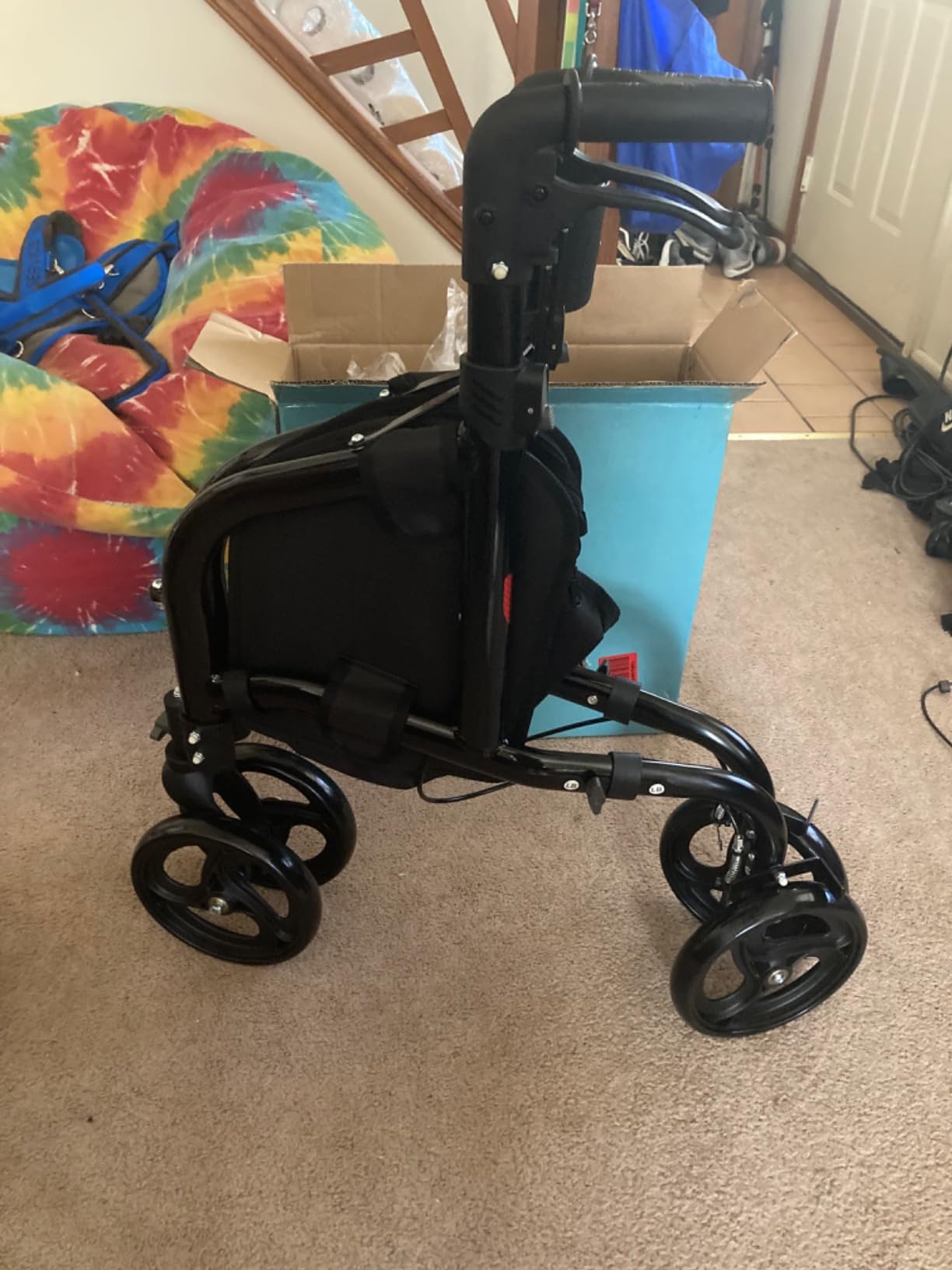
The frame is 12.1 pounds of aluminum and folds to 9 inches wide by 29 inches long, which makes it easy to stash in a closet or beside a sofa. Handle height runs from 33 to 37 inches, and the listing maps that to users roughly 4.8 feet to 7.4 feet tall.
The 513 ratings average 4.0 stars, with 57 percent five-star and 12 percent one-star, so the experience is genuinely mixed. The praise is for the dual wheels, the 300-pound rating and the slim folded width. The complaints are about the extra bulk of the double front caster, and about the wide stance feeling less nimble than a single-front-wheel tri-walker on very tight turns.
What to check before you buy this one
Measure a corner, not just a hallway. The dual front wheels are wide, and while the 25-inch body clears a door, the turning footprint is larger. If the route between the bedroom and bathroom has a 90-degree turn with furniture close in, test the corner before committing.
Check the total width including any accessory you add. A cane holder or cup holder mounted on the handlebar can add an inch that you will feel at a door jamb.
Who it is not for
It is not the lightest lift. Twelve pounds is fine for a strong caregiver and marginal for a user who must load it into a car alone, so if self-loading is a requirement, look at the 9.5-pound Dynarex instead.
It is not a seat, and it is not the smoothest ride on long carpet runs, where a single large front caster usually rolls with less effort. Its 4.0 rating reflects that split rather than a defect.
6. NOVA Traveler Folding 3-Wheel Walker: Most Storage in a Narrow Frame
NOVA Traveler Folding 3-Wheel Walker with Tray, Basket, Pouch & Cup Holder, Lightweight Mobility Aid for Seniors & Adults, 8” All-Terrain Wheels for Tight Spaces & Travel, Sky Blue
13.5 lb frame
8 inch all-terrain wheels
Five-year brake warranty
Removable tray, basket and pouch
Pros
- Removable tray
- front basket and zippered pouch all included
- Feather-touch brakes engage with minimal hand strength
- Five-year brake warranty
- far longer than the 90 days most brands offer
- 8 inch all-terrain wheels with wide tread
Cons
- 13.5 lb frame needs a careful lift
- Only 197 ratings
- a smaller evidence base than the leaders
- No seat included
The NOVA Traveler is the one to pick when the user carries things. It includes a removable tray, a front basket and a zippered pouch, and the tray is a genuine flat surface that will hold a plate, a cup or a small bottle. Almost every other narrow rollator on this list gives you a soft bag and nothing else, which is fine for keys and poor for anything with a lid.
It runs on 8-inch all-terrain wheels with a wide tread, described as handling carpet, tile, concrete, sidewalks and pavement. The frame weighs 13.5 pounds, handle height adjusts from 33.25 to 37 inches, and the listing maps that to users from 5 feet 4 inches to 6 feet 2 inches.
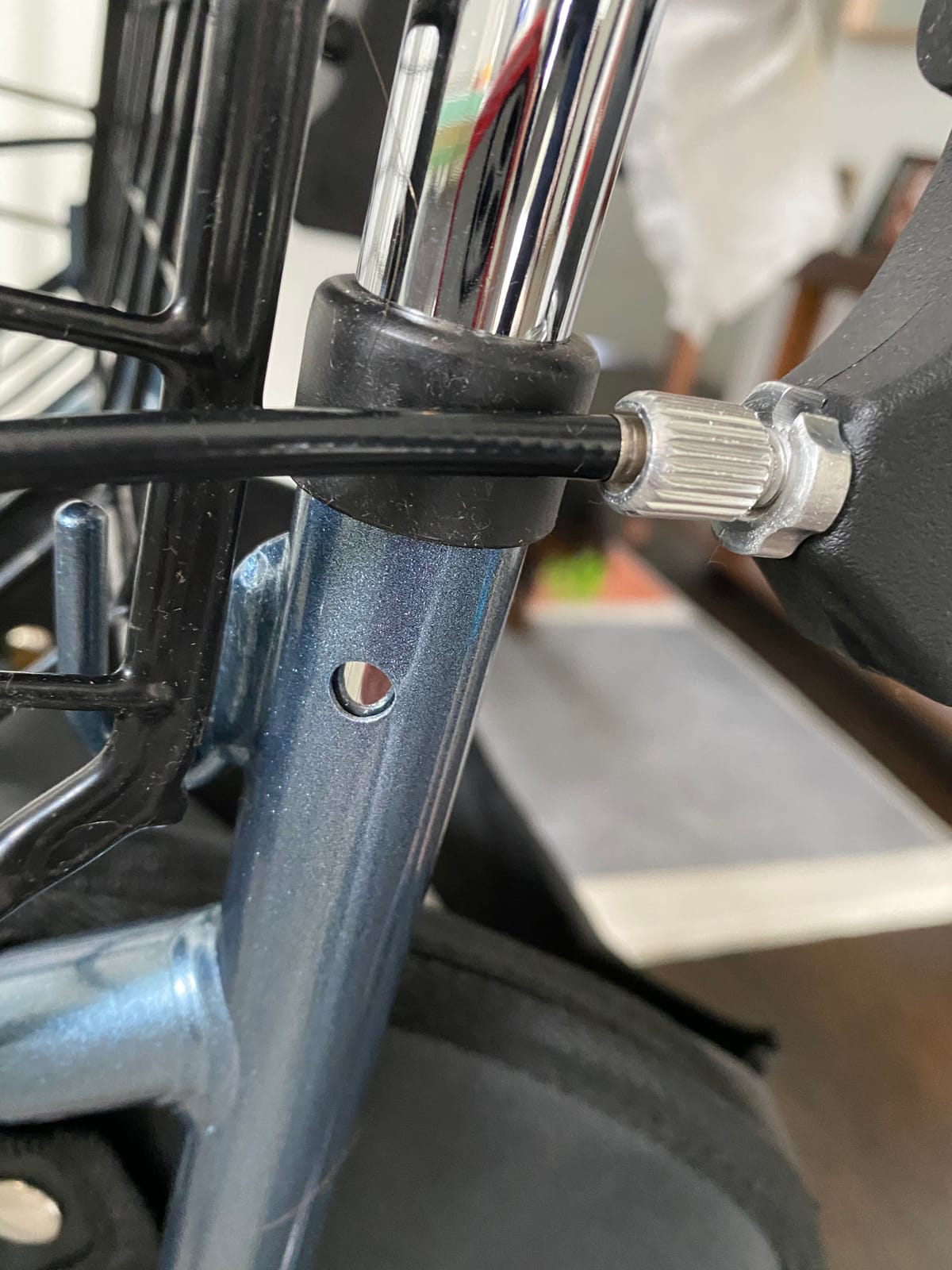
The brakes are the reason this model exists. They use a patented feather-touch design that engages with minimal hand strength, and they carry a five-year warranty instead of the 90-day brake coverage that is standard in this category. For a user with arthritis or a weak grip, that combination is worth more than another inch of width, and it is the single best warranty in the group.
The trade-offs are weight and a thin evidence base. At 13.5 pounds it needs a two-handed lift, and the 197 ratings average 4.5 stars on a smaller base than the leaders, so the long-term track record is less established than the PLANETWALK or the Vive.
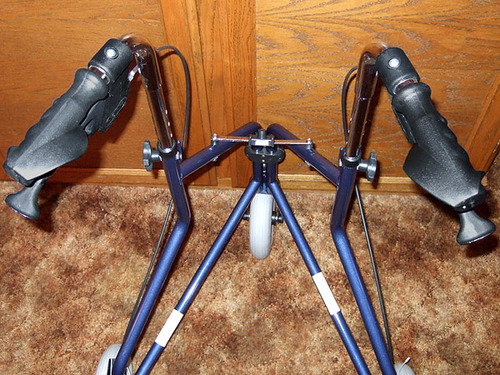
What to check before you buy this one
Decide whether the tray changes your route. A tray adds width at handle level and adds weight, and on a very tight doorway it is the first thing to clip the frame. If the user is not actually carrying food or drink, a lighter model is a better buy.
Check the brake action yourself. Feather-touch levers are easy to set off with a light touch, which is convenient indoors and can be a problem on a slope if the user cannot modulate pressure well.
Who it is not for
It is not for a user under about 5 feet 3 inches, since the handle bottoms out at 33.25 inches, and not for a user over roughly 6 feet 2 inches. It is also not for a shopper who wants a long-term durability record, since the review base is a fraction of the leaders.
And it is not a seat, despite the tray. A tray is a surface for items, not a place to rest, and the basket hangs low enough that sitting on it is not safe.
7. Dynarex DynaGo Zoom: Lightest Frame to Lift Into a Car
Dynarex DynaGo Zoom Rollator is Foldable, Lightweight, and Travel Friendly, This 3-Wheel Rolling Walker has a 250 Lb. Weight Capacity, Includes a Large, Removable Storage Pouch, Red Frame, 1 Rollator
9.5 lb listed weight
Folds to 9 inches wide
250 lb capacity
Special-grip adjustable handlebars
Pros
- Under 10 lb
- so it is the easiest frame here to lift and carry
- Folds to just 9 inches wide for trunks and closets
- Special-grip handlebars reduce hand and wrist fatigue
- Locking wheels and a simple palm-grip brake
- Non-marking wheels that will not scuff indoor floors
Cons
- 36 inch open stance
- wider than any other model here
- Only 116 ratings
- the smallest evidence base on the list
- 250 lb capacity is below the 300 lb models
We are including this one with a clear warning, because it is the best rollator here for weight and the worst for the thing this article is about. The listed item weight is 9.5 pounds, it folds to 9 inches wide, and the special-grip handlebars are designed to reduce hand and wrist pain. If car transport and wrist comfort are your two priorities, no other pick here comes close.
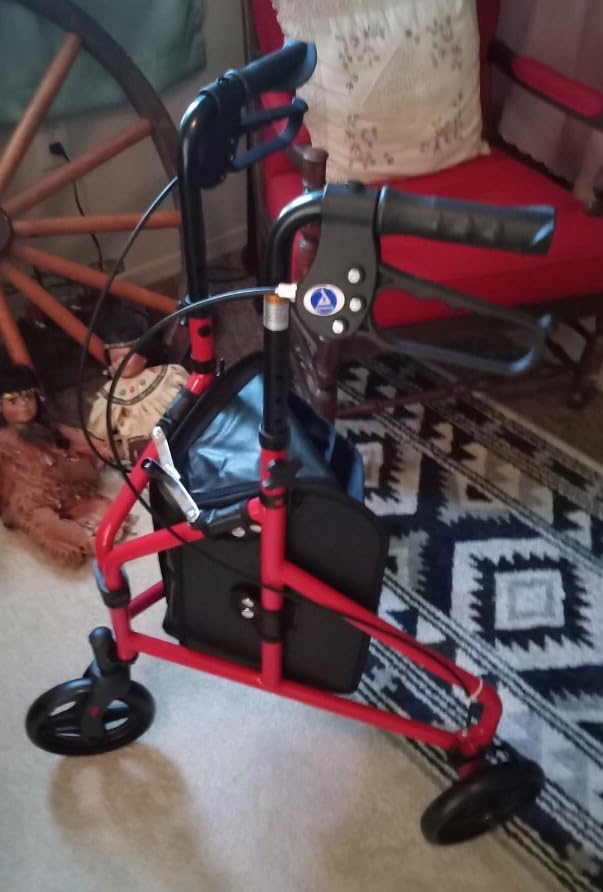
But the open dimensions are 25 inches tall by 36 inches wide. That is the widest stance in this comparison, wider than every purpose-built narrow model on the list, and reviewers note that it will not turn in a tight hallway for exactly that reason. The Dynarex is a travel and light-carry rollator that happens to have three wheels, not a narrow-hallway frame.
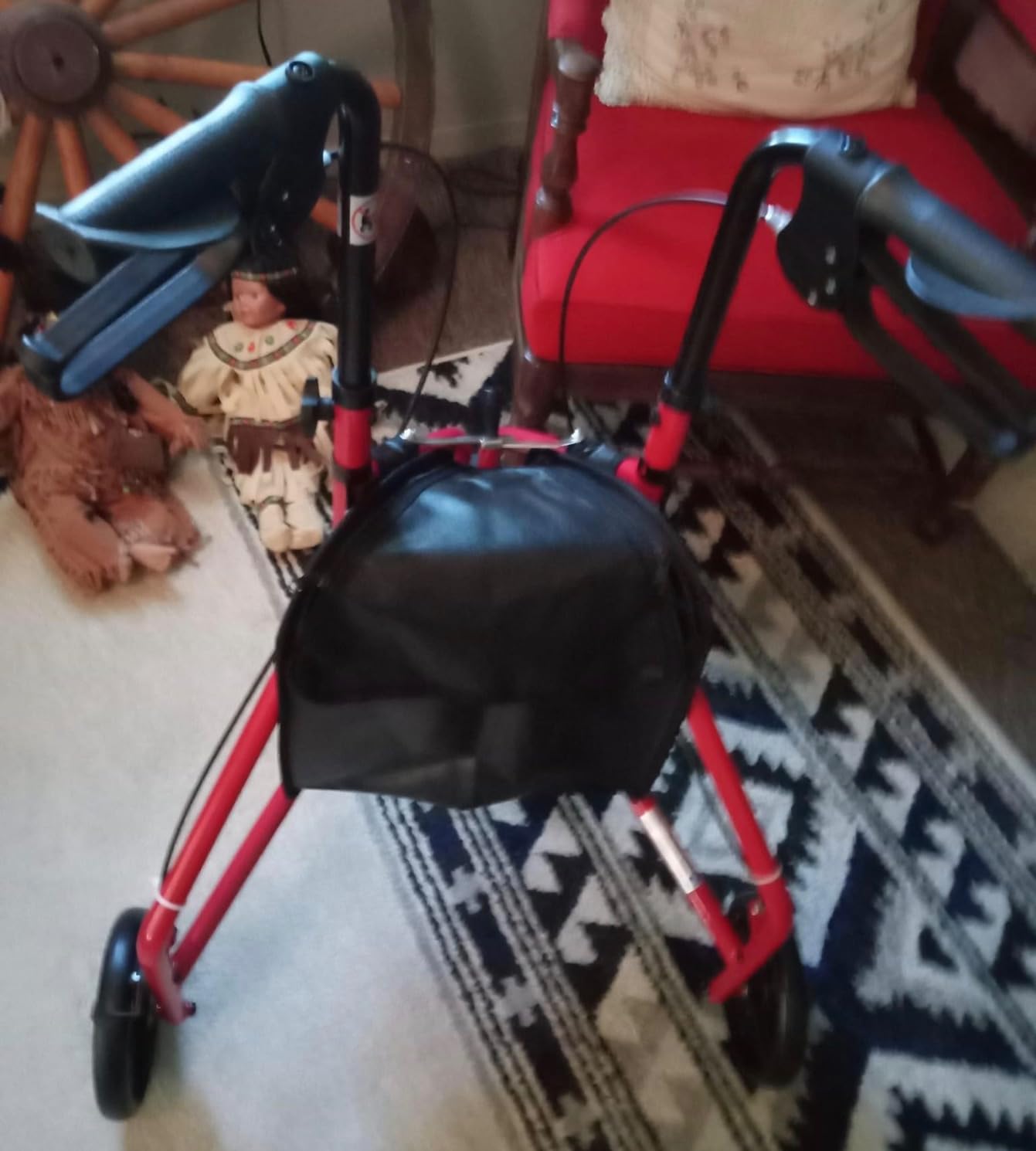
The build is straightforward and well suited to indoor use: locking wheels for standing securely, an easy palm-grip braking system, a large water-resistant removable nylon pouch, and non-marking wheels that will not scuff hardwood or vinyl. The frame and seat wipe clean, which matters in a home where the rollator lives in the kitchen.
The rating is 4.0 stars from 116 ratings, with 14 percent one-star. The manufacturer also steers buyers toward its heavier DynaGo Advantage models for strenuous outdoor use, which tells you where this model’s limits sit.
What to check before you buy this one
Tape your narrowest hallway and compare it to 36 inches before you order. In anything under 38 inches, this frame will scrape both walls, and the triangular turn will not save you at that width. If the number does not work, choose the Helavo or the PLANETWALK instead.
Confirm the 250-pound capacity against actual user weight, plus anything carried. A user at 240 pounds carrying a bag of groceries is at the limit, and the frame has little margin.
Who it is not for
It is not for a genuinely narrow home, which is the whole point of this list. It is also not for a user above 250 pounds, and not for outdoor paths with gravel, grass or uneven concrete, where the manufacturer recommends a heavier model.
The 116-rating base also means fewer long-term owners have reported on it, so you are relying on the spec sheet more than on a decade of feedback.
8. Drive Medical Winnie Lite Supreme: Widest Handle Height Range
Drive Medical Winnie Lite Supreme Rollator Walker with Wheels, Tan Plaid
26 inch overall width
32 to 38 inch handle height
300 lb capacity
14.1 lb frame with one-handed fold
Pros
- 26 inch width with a 32 to 38 inch handle range
- the widest here
- Quick self-threading knob adjustment
- 300 lb capacity matched only by the Helavo
- One-handed fold that leaves the rollator standing upright
- Large removable storage pouch
- Aluminum cast loop lock is easy to operate
Cons
- 14.1 lb frame is the heaviest here and takes two hands to lift
- 26 inch frame is wider than the Helavo and PLANETWALK
- 7.5 inch casters are less smooth on rough outdoor ground
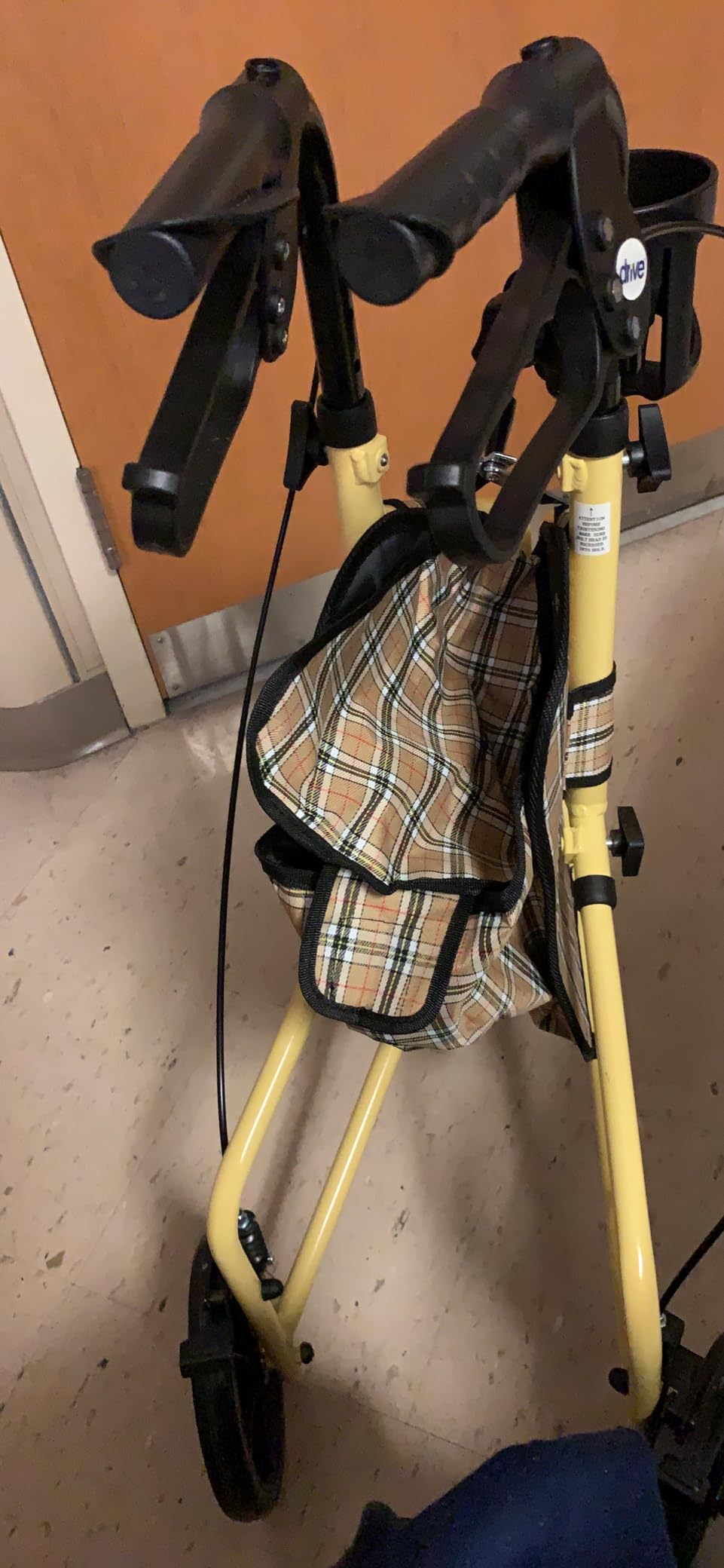
The Drive Medical Winnie Lite Supreme solves the fit problem that trips up most three-wheel buyers. The handle adjusts from 32 to 38 inches, a six-inch span, and the self-threading knobs mean the adjustment takes seconds with one hand. If the user is near 5 feet or close to 6 feet 2 inches, this is the frame most likely to land the handles where a PT wants them.
Published dimensions are 26 inches wide by 22.75 inches long, which is genuinely narrow territory, and capacity is 300 pounds, matching the Helavo. The one-handed fold is designed to keep the rollator in the standing position, so it can be rolled, parked or stored without laying it down first.
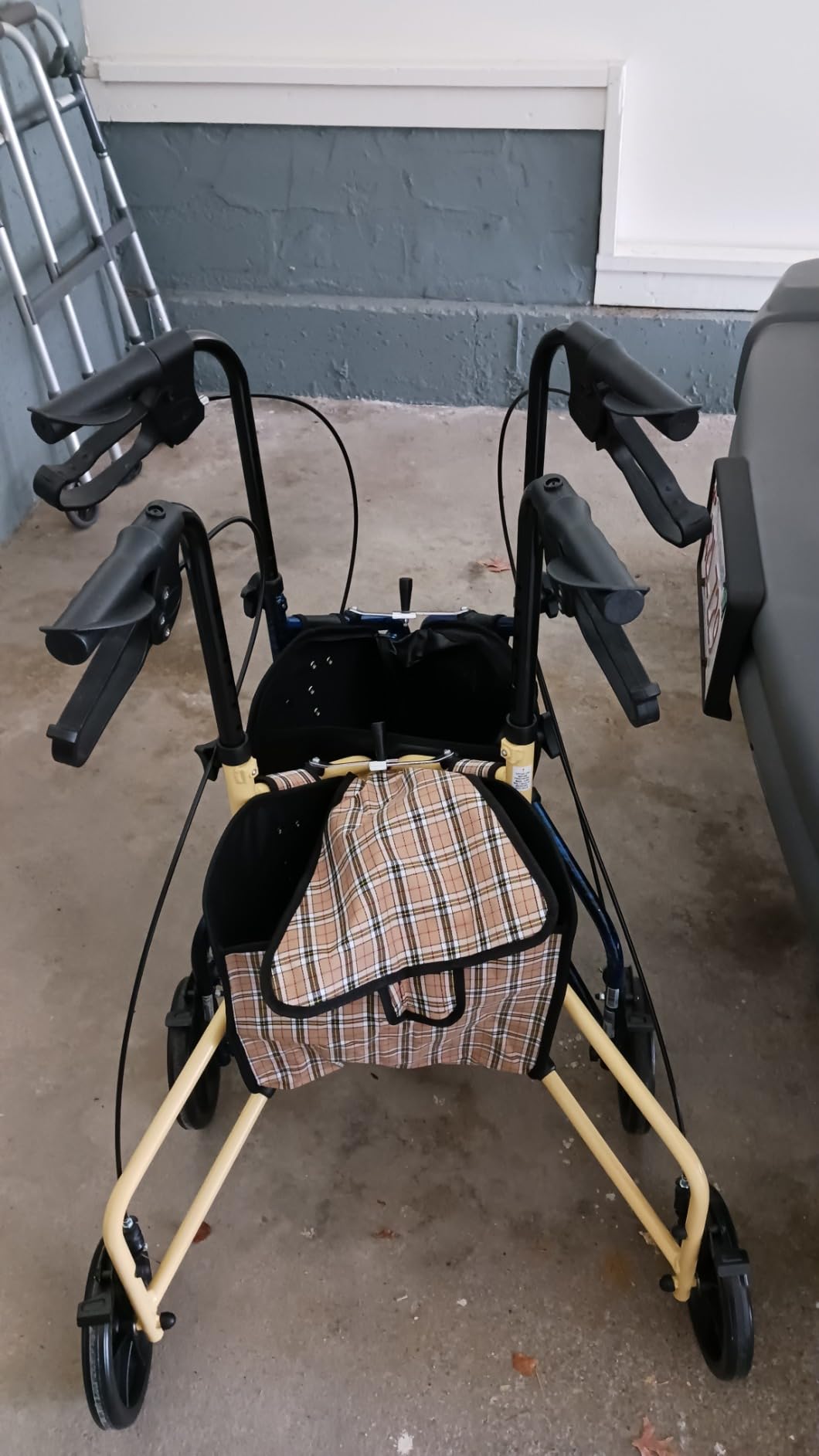
Storage is a large removable pouch, and the brakes use an aluminum cast loop lock designed for easy operation with reduced hand strength. The 7.5-inch soft-grip casters are marked for indoor and outdoor use.
The 518 ratings average 4.1 stars with 66 percent five-star and 14 percent one-star. Weight is the recurring complaint at 14.1 pounds, a frame that needs a two-handed lift, combined with a 26-inch width that is less slim than the Helavo and the PLANETWALK.
What to check before you buy this one
Decide whether the 14.1-pound weight is acceptable for your transport pattern. If a caregiver loads it, this is a non-issue. If the user must lift it into a car independently, the difference between 14.1 and 9.5 pounds is the difference between doing it and waiting for help.
Check the caster size against your outdoor time. Seven-and-a-half-inch soft-grip casters are good on smooth concrete and hard floors but skip on rough ground, so a user who regularly walks a block or two outdoors will notice the difference against an 8-inch model.
Who it is not for
It is not the narrowest option available. At 26 inches it clears a standard 30-inch door, but if your tightest opening is under 28 inches you should look at the 25-inch Helavo instead.
It is also not for users who want a seat, and the 14 percent one-star share suggests some assembly and durability gripes that the manufacturer details do not explain. If weight matters more than the extra inch of width, the 12.1-pound Helavo offers the same 300-pound capacity.
How Narrow Is Narrow? Measure Your Hallways Before You Buy
Most product pages use “compact” and “narrow” as marketing words. The only useful number is the overall width at the widest point, which for a three-wheel rollator is almost always the rear wheel track. Where a manufacturer prints it, we have put it in the table above: 25 inches for the Helavo, 26 for the Drive Medical, 27 for the PLANETWALK, 27.2 for the Walk Mate and 28 for the Lumex. The Vive, the NOVA Traveler and the Dynarex either stay silent or list a package dimension instead, and we would ask for the frame width before ordering any of them.
A standard accessible doorway opening is about 32 inches clear. The 1990 ADA guidelines reference a 32-inch minimum clear width at a doorway, and most interior doors in older homes are 30 to 32 inches. So a 27-inch rollator technically clears a 32-inch door, but the margin is only 2.5 inches per side, and a door that is open against its stop or a swollen frame can eat that quickly.
How to measure your route in five steps
First, walk the route you actually use and find the tightest point, not the average. The pinch usually shows up at a corner where a wall, a radiator or a piece of furniture meets the hallway.
Second, measure the narrowest doorway with a tape measure at the floor, across the clear opening and not the door slab. Measure at three heights if you can, because a door can taper.
Third, measure hallway width at the narrowest point and note whether the walls are straight. A 30-inch hallway that widens past a doorway is workable; a hallway that pinches is not.
Fourth, measure from the wrist crease to the floor while the user stands with arms relaxed at their sides. That is the handle height they need, and you can then compare it against the published handle range of each model rather than guessing from a height chart.
Fifth, look at the floor. High-pile carpet, a raised threshold strip and a loose rug edge are all far more likely to stop a three-wheel rollator than the doorway itself, and no amount of frame width fixes a caster that will not roll forward.
If you are planning an outing rather than a fixed route, a narrower rollator is the wrong optimisation. A three-wheel bike for seniors handles uneven path width far better than any indoor rollator, and the same logic applies to a wider 4-wheel model outdoors.
3-Wheel vs 4-Wheel Rollators: When to Make the Switch
The tradeoff is simple enough to state in one sentence: three wheels buy you maneuverability and give up stability, load capacity and a place to sit. Most four-wheel rollators measure 24 to 28 inches across a rectangular frame that cannot pivot in a hallway corner, and they carry more of your weight because four wheels spread the load instead of concentrating it on a triangle.
Stay with three wheels if your narrowest passage is under about 28 inches, if you want a frame light enough to lift into a car yourself, or if the user does not need a seat to rest on. Three-wheel frames are also the better choice for a user recovering from a hip or knee replacement who needs to keep both hands free and move short distances between surfaces.
Move to four wheels if the user weighs more than about 250 pounds, if the home has wider spaces than you thought, or if resting is a regular part of the day. A 4-wheel rollator with a padded seat and a backrest is a far better perch than a 3-wheel model without one, and the extra width matters much less if the doorways are 32 inches or wider.
There is a middle option worth knowing about: the Walk Mate on this list, which is a three-wheel frame with a seat and backrest at under 11 pounds. It gives up some of the stability and width advantage of a true tri-walker, but it is the compromise many households end up choosing because rest is non-negotiable.
Do 3-Wheel Rollators Have a Seat?
Most do not, and that is the single biggest reason people end up disappointed with their first purchase. A standard three-wheel rollator is a walking frame with a swivel front caster, and its frame is built to move rather than to hold a seated load, so most manufacturers simply do not offer a seat.
Some do. The Walk Mate on this list is one, with a breathable mesh seat and a padded backrest at 10.67 pounds. The trade is predictable: adding a seat and backrest adds depth behind the wheels, widens the effective footprint, and makes the lock levers stiffer, which is why reviewers warn about the 27.2-inch frame failing to clear a tight bathroom door.
If a seat is important, ask one more question: will the brakes hold under a seated load? Never sit on a rollator seat unless the brake handle is pushed fully down and locked, and even then, test it. Some owners of the Walk Mate report the seat brake drifting, which is precisely the risk that makes sitting on a light three-wheel rollator a bad idea for a user with poor balance.
For a user who needs frequent rest, our honest advice is to use a 3-wheel rollator for moving and a stable chair for sitting, rather than trying to make one object do both jobs in a small home.
Paying With Medicare, Medicaid, an FSA or an HSA
A rollator is durable medical equipment, which means it can often be bought through insurance rather than out of pocket, and this is the most underused route in this category. The process starts with a prescription from a physician, nurse or physical therapist, followed by purchase from a supplier enrolled as a Medicare Durable Medical Equipment supplier.
Medicare Part B covers a standard rollator as DME when a physician documents that the device is medically necessary and the user has limited mobility and difficulty with balance or ambulation. Traditional Medicare typically requires the supplier to bill the plan directly, so using a participating supplier avoids paying up front and hoping for reimbursement.
Medicaid coverage varies by state, and the rules on prior authorization, supplier participation and replacement frequency differ widely. The fastest route is a call to the member services number on the back of the card, with the specific model and the prescription in hand.
An FSA or HSA is the simplest option. Both allow qualified medical expenses to be reimbursed or paid with pre-tax funds, and a prescription from a licensed clinician is usually all the documentation needed, depending on the plan. Some plans exclude items without a prescription, so get the paperwork at the same time you get the recommendation.
If you are paying privately, a retailer that already works with DME suppliers is often a better option than a marketplace listing, because warranty service on brakes and frames is simpler when the seller handles replacement parts.
Buying Guide: The Specs That Matter in Tight Spaces
Width is the headline number, but it is the third one that decides whether a rollator works in your home. Here is what we would check, in order.
Overall width at the rear wheel track. Aim for at least 2 inches of clearance per side in your tightest doorway, and 3 inches or more in a corner. Published widths in this category run from 25 to 36 inches, so the difference between a good and a bad fit is a real 11 inches.
Handle height range against the wrist-to-floor measurement. Every model here spans 4 to 6 inches of adjustment, and the ranges sit in different places. The Walk Mate starts lowest at 32.3 inches, the Drive Medical reaches highest at 38 inches, and the Helavo carries the broadest stated user range, from roughly 4.8 to 7.4 feet.
Weight you can actually lift. Listed weights run from 9.5 to 14.1 pounds here, and 4.6 pounds is the whole difference between loading a rollator into a car alone and needing a second person. Pick for the weakest moment, not the average day.
Weight capacity, and the ceiling it lives under. Most three-wheel rollators are rated 250 pounds and a handful reach 300 pounds; none of the eight here goes past that. It is a structural limit of the triangular design rather than a marketing choice, and a user above 300 pounds needs a bariatric four-wheel model or a walker with a seat.
Brake type and brake warranty. Loop-handle brakes that squeeze to slow and push down to lock are the standard. The warranty matters more than most buyers realize: 90-day brake coverage is common, and the NOVA Traveler is the only pick here with five years on the brakes. A brake that becomes mushy at month seven is a safety problem, not an annoyance.
Caster size versus floor surface. 7.5-inch wheels suit hard floors, low-pile carpet and short outdoor trips. 8-inch wheels with wide tread cross carpet, thresholds and concrete more easily. A single front caster is lighter and turns tighter; dual front casters are steadier but bulkier.
Folded width and whether it stands up. Folded widths here run from 9 to 12.5 inches. A rollator that folds and stays standing is far easier to handle in a hallway than one that has to be laid flat first, and it tells you where it will live in the car.
Storage that matches what gets carried. A soft pouch is fine for a phone and keys. A removable tray or basket is better for anything with a lid, a plate or a cup, and those add a little width at handle height.
Finally, and this is the one we would not skip: talk to a physical therapist or an occupational therapist before buying. Therapists point out that home layout is rarely visible during a clinic appointment, so a hallway that measures 30 inches at the door and pinches to 26 inches at the corner may never be accounted for. A 15-minute conversation with someone who can measure your home properly is cheaper than a return.
Frequently Asked Questions
What is the most narrow rollator walker?
The most narrow rollator walkers are three-wheel models with published overall widths around 25 to 27 inches, compared with 24 to 28 inches for a typical four-wheel rollator. Among the models we reviewed, the Helavo at 25 inches, the Drive Medical at 26 inches and the PLANETWALK at 27 inches are the narrowest published frames. Always measure the narrowest point of your own route, because a 27-inch frame still needs a doorway a few inches wider to turn in.
What is the best three-wheel rollator for seniors and elderly?
For most seniors living in a home with narrow hallways, the PLANETWALK Premium 3 Wheel Rollator is the strongest all-round pick, pairing an 11 pound frame with a published 27-inch width, a one-second self-locking fold and a 4.5 star rating across more than 2,300 reviews. If resting matters more than width, the Walk Mate adds a padded seat and backrest at under 11 pounds.
How wide is a standard 3 wheel rollator?
A standard three-wheel rollator measures roughly 22 to 30 inches across the rear wheel track, and the majority of purpose-built narrow models fall between 25 and 28 inches. Some manufacturers do not publish an overall width and list only package dimensions, which are not the same number. Compare the frame width, not the box, and allow at least 2 inches of clearance per side in a doorway.
Do 3 wheel rollators have a seat?
Most three-wheel rollators do not include a seat, and the frame is built to move rather than to support a seated load. A few models do, including the Walk Mate, which weighs 10.67 pounds and adds a breathable mesh seat and padded backrest with a locking strap. Adding a seat increases the depth and effective width of the frame, and you should always lock the brakes fully before sitting.
Are 3 wheel walkers safe for seniors?
They are safe for the right user with the right technique. Three-wheel frames are the most maneuverable walking aids available and suit anyone with balance concerns who does not need a seat, but they are less stable than four-wheel models when you lean sideways or load one edge. Keep both hands on the loop handles, squeeze to slow and push fully down to park, and never sit unless the brake is locked.
Can a 3 wheel rollator be used on carpet?
Yes, but the caster size matters. The 8-inch wheels on the Lumex, Walk Mate, Helavo and NOVA Traveler glide across carpet, tile, wood and concrete, while the 7.5-inch wheels on the PLANETWALK and Drive Medical skip more on rough ground and high-pile carpet. Lift the rollator over any rug edge more than about half an inch tall, and avoid deep pile that catches the front caster.
Does Medicare cover a rollator walker?
Medicare Part B generally covers a rollator as durable medical equipment when a physician, nurse or physical therapist documents that it is medically necessary and the user has limited mobility. You will need a prescription and should buy from a supplier enrolled in the Medicare DME program, ideally one that bills your plan directly. Medicaid rules vary by state, and an FSA or HSA can usually reimburse a prescribed rollator as a qualified medical expense.
What handle height should a rollator be for my height?
Measure from your wrist crease to the floor while standing with your arms relaxed at your sides, then set the handle so your elbows are slightly bent rather than locked. Most three-wheel rollators adjust across 4 to 6 inches, so check the published minimum and maximum before buying. In this group the Walk Mate starts lowest at 32.3 inches and the Drive Medical reaches highest at 38 inches.
Bottom Line: The Best Three Wheel Rollators for Narrow Hallways
For most people in a home with tight passages, the best three wheel rollators for narrow hallways come down to published width first and weight second, and on that basis the PLANETWALK Premium is our pick: an 11 pound frame at 27 inches wide, with a self-locking fold and the largest review base in the category backing it up.
Go with the Helavo if your tightest opening is under 28 inches or the user is closer to 300 pounds. Go with the Walk Mate if resting is part of the day and you can live with checking the seat brake. Go with the NOVA Traveler if carrying things matters and brake warranty is a top concern.
Avoid the Dynarex for this particular use case despite its excellent 9.5 pound weight, because a 36-inch open stance defeats the purpose. And measure your route before you order anything, in 2026, with a tape measure rather than a guess.