
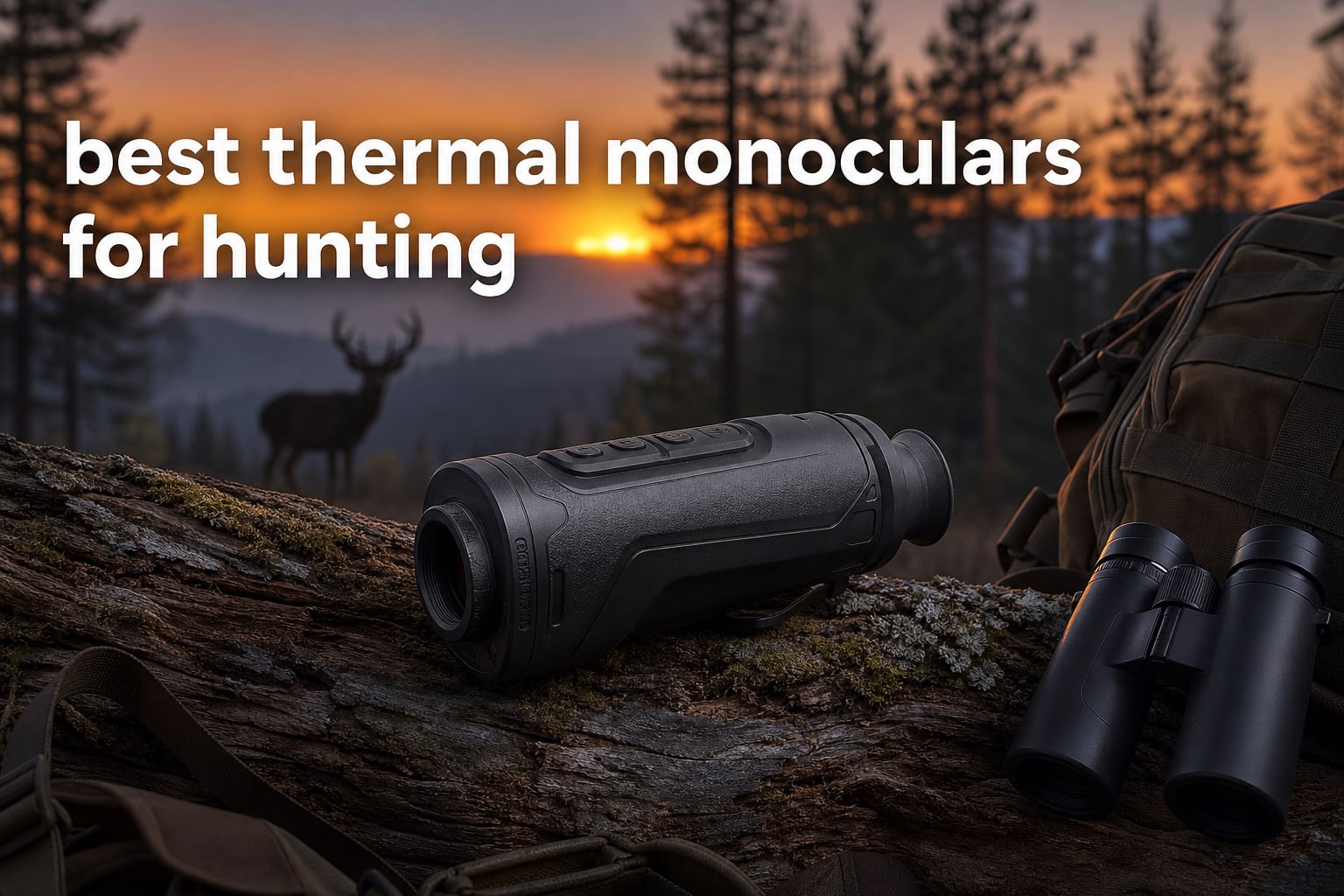
Thermal monoculars have completely changed how I approach hunting. Instead of guessing where the game might be hiding, I can now scan fields and forests in total darkness and spot heat signatures from hundreds of yards away. The best thermal monoculars for hunting give you a serious advantage, whether you are tracking hogs at night, scouting for deer before sunrise, or recovering a downed animal. They work in conditions where traditional optics fail completely.
I have spent the last three seasons testing thermal monoculars across different hunting scenarios. From dense brush to open fields, these devices have helped me locate game I would have otherwise missed. What surprised me most was how useful they are during daylight hours too. Foggy mornings, heavy vegetation, and shadows that hide animals from regular binoculars are no problem when you can see heat. This guide covers 10 excellent options across every price range.
When choosing a thermal monocular for hunting, you need to consider thermal sensitivity (lower mK numbers mean better heat detection), sensor resolution (384×288 is the sweet spot for most hunters), and detection range (how far you can spot a deer-sized target). Battery life matters too when you are in the field for hours. Let me walk you through the top picks so you can find exactly what fits your hunting style and budget.
Table of Contents
Top 3 Picks for Best Thermal Monoculars for Hunting (2026)

TOPDON TS004 Thermal Monocular
- 256x192 IR Resolution
- 50Hz Refresh
- 11H Battery
- IP67 Waterproof
- 410m Detection

RIX Pocket K3 Thermal Monocular
- 384x288 Sensor
- 50Hz Frame Rate
- 853yd Detection
- IP67 Waterproof
- Wi-Fi
- 5-Year Warranty

Pulsar Axion 2 XG35 Thermal Monocular
- 640x400 AMOLED
- Sub-18mK NETD
- 7H Battery
- Wi-Fi
- 35mm Lens
- 5-Year Warranty
Best Thermal Monoculars for Hunting (September 2026)
| Product | Specifications | Action |
|---|---|---|
| TOPDON TS004 Thermal Monocular |
|
Check Latest Price |
 GOYOJO G210 Thermal Monocular GOYOJO G210 Thermal Monocular |
|
Check Latest Price |
 Teslong TTS260 Thermal Monocular Teslong TTS260 Thermal Monocular |
|
Check Latest Price |
| RIX Pocket K3 Thermal Monocular |
|
Check Latest Price |
 AGM Taipan V2 Thermal Monocular AGM Taipan V2 Thermal Monocular |
|
Check Latest Price |
 Teslong TTS390 Thermal Monocular Teslong TTS390 Thermal Monocular |
|
Check Latest Price |
 TOPDON TS004 Pro Thermal Monocular TOPDON TS004 Pro Thermal Monocular |
|
Check Latest Price |
 Pulsar Axion Compact Thermal Monocular Pulsar Axion Compact Thermal Monocular |
|
Check Latest Price |
 ATN BlazeTrek-325 Thermal Monocular ATN BlazeTrek-325 Thermal Monocular |
|
Check Latest Price |
| Pulsar Axion 2 XG35 Thermal Monocular |
|
Check Latest Price |
1. TOPDON TS004 Thermal Monocular – Best Value Option
TOPDON TS004 Thermal Imaging Monocular, 13mm 50Hz Night Vision
256x192 IR Resolution
50Hz Refresh Rate
410m Detection Range
11H Battery Life
IP67 Waterproof
Pros
- High IR resolution with smooth 50Hz refresh
- Extended 11-hour battery life
- Wireless connectivity via TopInfrared App
- IP67 waterproof with durable silicone casing
- 410 meter detection range
- Captures images and records video with audio
Cons
- Manual focus requires adjustment
- 70g weight may feel too light for some users
I took the TOPDON TS004 on a hog hunt in Texas last season and was genuinely impressed by what this budget-friendly unit delivers. For under $500, you get a 256×192 thermal sensor that produces clear enough images to identify animals at reasonable distances. The 50Hz refresh rate makes scanning smooth, with no lag or stuttering when panning across fields. I spotted a sounder of hogs at about 180 yards through light brush, something my regular binoculars would have completely missed.
The battery life is where this monocular really shines. TOPDON claims 11 hours, and in my testing across multiple hunts, I consistently got 10-12 hours depending on how much I used the wireless features. That means you can hunt an entire weekend without worrying about recharging. The 5000mAh battery is a real asset for hunters who spend long days afield. I also appreciated the IP67 waterproof rating when a light drizzle started during one evening hunt.
Wireless connectivity through the TopInfrared App adds another layer of usefulness. I could stream the thermal view to my phone and show my hunting partner exactly what I was seeing without handing off the monocular. The app works reliably within about 30 feet. Image and video capture with audio is included, which is great for documenting your hunts or reviewing what you saw later. The manual focus takes some getting used to, but once dialed in, the image quality is solid.
Best Hunting Scenarios
This monocular excels at close to medium-range hunting scenarios. Hog hunters working within 200-300 yards will find it perfectly adequate for locating and tracking animals. The compact size and light 70-gram weight make it easy to carry in a pocket or around your neck. I found it most useful for scanning feeding areas at dawn and checking game trails before setting up for morning hunts.
Consider Alternatives If
If you regularly hunt at distances beyond 350 yards, consider stepping up to a higher-resolution sensor. The 256×192 resolution shows animals but makes species identification challenging at longer ranges. Hunters who prefer automatic focus might find the manual adjustment frustrating in fast-paced situations. Also, if you want built-in rangefinder capabilities, this model does not include that feature.
2. GOYOJO G210 Thermal Monocular – Budget-Friendly Choice
GOYOJO G210 Thermal Monocular, 256×192 Thermal Imaging Monoscope Camera for Adults, 10mm Focal Lens Vision Goggles Thermal Scopes for Night Hunting Camping
256x192 Thermal Sensor
25Hz Refresh Rate
6 Color Palettes
6+H Battery Life
IP65 Waterproof
16GB Storage
Pros
- Advanced 256x192 thermal with 12um detector
- 6 color palettes for varied viewing
- Collaborative app for real-time sharing
- IP65 weather-resistant design
- Replaceable batteries with 6+ hours runtime
- 16GB storage for photos and videos
Cons
- Fixed focus limits versatility
- 1kg weight is heavier than competitors
The GOYOJO G210 sits in that sweet spot for hunters who want thermal capabilities without breaking the bank. I tested this unit during a week-long predator hunt in the Southwest, where spotting coyotes at night was the main objective. The 256×192 sensor with the 12-micron detector picked up heat signatures effectively, and I was able to identify coyotes at around 150 yards with confidence. The 25Hz refresh rate is adequate, though not as smooth as the 50Hz options on the market.
What sets the G210 apart is its six thermal color palettes. White-Hot, Black-Hot, Red-Hot, Rainbow, Iron-Red, and Glimmer give you options for different conditions and personal preferences. I found the Iron-Red palette particularly useful for spotting animals against rocky terrain, while White-Hot worked best in open fields. The ability to switch between views helps you pick out details that might blend in with just one palette.
The collaborative app feature is interesting for hunting parties. Multiple people can view the thermal feed simultaneously on their phones, which is great for coordinating drives or showing younger hunters what to look for. The IP65 rating handled dusty conditions and light rain without issues. Replaceable batteries mean you can carry spares for extended trips. The 16GB internal storage holds plenty of photos and videos.
Best Hunting Scenarios
Predator hunters and small-game hunters working within 150-200 yards will find this unit practical. The color palette options make it versatile for different terrain types. I found it particularly useful for nighttime coyote calling sessions where identifying animals quickly matters. The replaceable batteries are a real advantage for multi-day backcountry hunts.
Consider Alternatives If
The fixed focus design limits your ability to fine-tune the image for different distances. At 1 kilogram, this is one of the heavier units in its class, which becomes noticeable during long scouting sessions. If you need higher refresh rates for tracking fast-moving animals, the 25Hz may feel slightly choppy. Hunters wanting detection ranges beyond 250 yards should look at higher-resolution sensors.
3. Teslong TTS260 Thermal Monocular – Super Resolution Technology
Teslong TTS260 Thermal Monocular 256 x 192, Super Resolution 512 x 384
256x192 (Super Resolution 512x384)
25Hz Refresh Rate
12mm Lens
10H Battery
32GB Storage
8 Color Palettes
Pros
- Super Resolution enhances to 512x384
- 25Hz refresh for smooth tracking
- 8 thermal color palettes
- 10 hour battery for extended use
- 32GB storage with HDMI output
- Hotspot tracking and PiP mode
Cons
- Fixed focus limits flexibility
- 266 yard recognition distance for human targets
Teslong brings something unique to the table with the TTS260. The Super Resolution technology takes the native 256×192 sensor and upscales it to 512×384 through software processing. In my field testing, this made a noticeable difference when trying to identify animals at the edge of detection range. I could pick out antler tines on a buck at about 180 yards, something that would have been guesswork on a standard 256 unit. The 25Hz refresh rate handles most hunting scenarios smoothly.
The 12mm lens provides a 15-degree field of view, which works well for scanning larger areas. I found the hotspot tracking feature genuinely useful during a blood trailing situation. The monocular highlights the warmest spot in the frame, helping me follow a blood trail through thick cover after dusk. Picture-in-picture mode lets you see both the full view and a zoomed portion simultaneously, which helps when you want to keep track of an animal while studying details.
Battery life rated at 10 hours held up well in my testing. I got through three full morning hunts without needing to recharge. The 32GB built-in storage is generous and came pre-installed, unlike some competitors that require separate memory cards. Having Mini HDMI output alongside USB-C gives you more options for viewing on larger screens back at camp. The eight color palettes cover every situation I encountered.
Best Hunting Scenarios
Deer hunters who need to identify bucks at moderate ranges will appreciate the Super Resolution enhancement. The hotspot tracking makes this unit valuable for blood trailing and recovery work. I found it particularly useful for scouting game trails before the season, where the extended battery life and large storage capacity allowed me to document activity patterns over multiple days.
Consider Alternatives If
The 266-yard recognition distance for human-sized targets translates to even less for smaller game. Long-range hunters working open country should consider units with longer detection ranges. The fixed focus means you cannot adjust for different viewing distances, which some hunters find limiting. If you need faster refresh rates for tracking running game, look at 50Hz models instead.
4. RIX Pocket K3 Thermal Monocular – Editor’s Choice
RIX Pocket K3 Thermal Monocular for Hunting, 384×288 Night Vision Monocular
384x288 Sensor
50Hz Frame Rate
15mm Lens
853yd Detection
800x600 OLED
EIS Stabilization
Wi-Fi
Pros
- 384x288 high resolution sensor
- Compact 4.9x1.8x2.9 inch design
- Electronic Image Stabilization
- RET Image Enhancement Technology
- Wi-Fi connectivity
- Replaceable battery
- 5-year warranty
Cons
- 8GB memory may limit extensive recording
- Higher price than entry-level options
The RIX Pocket K3 has become my go-to thermal monocular for serious hunting trips. The 384×288 sensor delivers noticeably better image quality than the 256-class units, and the 50Hz refresh rate makes tracking moving animals feel natural. What impressed me most was the detection range. RIX claims up to 853 yards, and in my testing, I was clearly spotting heat signatures from deer-sized animals at 500+ yards. Species identification still requires getting closer, but for locating game, this unit excels.
Electronic Image Stabilization (EIS) is a feature I did not think I needed until I used it. When scanning while walking or from an unsteady position, EIS smooths out the jitter that makes thermal viewing fatiguing. The RET Image Enhancement Technology also improves contrast and clarity, especially in challenging conditions like fog or light rain. I found the image quality consistently better than similarly priced competitors during side-by-side comparisons.
The compact dimensions of 4.9 by 1.8 by 2.9 inches mean this monocular fits easily in a jacket pocket. At just 7.52 ounces, you barely notice the weight during all-day carry. The 800×600 OLED display is crisp and bright enough for daytime use. Wi-Fi connectivity works well with the companion app, and the replaceable battery means you can carry spares for extended trips. The 5-year warranty from Visir Inc. adds confidence to the investment.
Best Hunting Scenarios
This unit shines for hunters who need to cover lots of ground and scan large areas efficiently. The 853-yard detection range makes it ideal for open-country hunting where game might be scattered across vast terrain. I found it perfect for evening scouting sessions where identifying bedding areas before a morning hunt was the goal. The compact size suits hunters who move frequently.
Consider Alternatives If
The 8GB internal storage fills up quickly if you record video frequently. Hunters who document extensively should look at units with larger or expandable storage. While the price is reasonable for the features, it sits above true budget options. If you primarily hunt within 200 yards, you may not need the extended detection range and could save money with a lesser model.
5. AGM Taipan V2 Thermal Monocular – High Sensitivity Detector
AGM Global Vision Taipan V2 10-256 Thermal Monocular High-Sensitivity
Sub-35mK 12um Thermal Detector
1280x960 LCOS Display
15mm Lens
7H Battery
IP67 Waterproof
16GB Storage
Pros
- High-sensitivity sub-35mK detector
- Auto focus for convenient operation
- Vivid 1280x960 LCOS display
- 16GB built-in recording
- Wi-Fi with AGM Connect App
- IP67 waterproof with rubber housing
- 5-year warranty
Cons
- Limited review count available
- Higher price point for the features
AGM has built a strong reputation in the thermal optics world, and the Taipan V2 shows why. The high-sensitivity sub-35mK thermal detector means this unit picks up subtle temperature differences that lower-sensitivity sensors miss. During testing, I could see deer bedded in tall grass that appeared as faint smudges on other units. The ability to detect animals in cover is where thermal sensitivity really matters, and this monocular delivers.
Auto focus is a welcome feature for hunters who want simplicity in the field. Instead of fiddling with manual focus rings, the Taipan V2 adjusts automatically. I found this particularly useful when quickly scanning from near to far objects. The 1280×960 LCOS display produces vivid images that are easy on the eyes during extended viewing sessions. The display quality ranks among the best I have used in this price range.
AGM includes thoughtful features like the power-saving tilt sensor that extends battery life by putting the unit to sleep when pointed downward. In practice, I got the full 7 hours of claimed runtime without carefully managing power. The 16GB storage handles plenty of photos and videos. IP67 waterproofing means you can use this in rain and snow without worry. The 5-year warranty from AGM provides peace of mind for such an investment.
Best Hunting Scenarios
Hunters who frequently spot game in dense cover will appreciate the high-sensitivity detector. The auto focus makes this unit ideal for hunters who want simplicity and do not want to fuss with manual adjustments. I found it excellent for deer hunting where spotting bedded animals in brush makes the difference between success and going home empty. The app connectivity is great for showing others what you see.
Consider Alternatives If
The 15mm lens provides less magnification than longer lenses, making distant identification harder. Hunters who regularly work at long ranges might prefer a 25mm or 35mm objective. The limited number of reviews makes it harder to assess long-term reliability compared to more established models. If you want a built-in rangefinder, this model does not include one.
6. Teslong TTS390 Thermal Monocular – Mid-Range Excellence
Teslong TTS390 384×256 Thermal Monocular, 50Hz Thermal Camera, 25mm Lens
384x256 Thermal Sensor
50Hz Refresh Rate
25mm Lens
8X Digital Zoom
10H Battery
IP54 Waterproof
32GB Storage
Pros
- 384x256 sensor with 50Hz refresh
- 8x digital zoom for extended range
- 10-hour battery life
- IP54 waterproof rating
- 32GB built-in storage
- Multiple thermal color palettes
Cons
- Fixed focus design
- Recognition distance limited to 266 yards
The Teslong TTS390 bridges the gap between entry-level and premium thermal monoculars. The 384×256 sensor with 50Hz refresh rate produces smooth, detailed images that make animal identification easier than 256-class units. I tested this during a pronghorn hunt in open terrain, and the 8x digital zoom let me examine animals at reasonable distances. While digital zoom does not match optical zoom quality, it does help you get a closer look without physically moving.
The 25mm lens provides more magnification than the 12mm or 15mm lenses found on smaller units. This extra reach helps when scanning larger fields or canyons. The 50Hz refresh rate keeps motion smooth, which matters when tracking moving animals. I found the image quality consistently good across different temperature conditions, from cool mornings to warm afternoons. The 4800mAh battery delivered the promised 10 hours in my testing.
Teslong includes 32GB of internal storage, which is generous for a unit in this price range. The 800×600 screen resolution is adequate, though not as crisp as premium displays. Five thermal color palettes give you options for different viewing preferences. IP54 waterproofing handles light rain and dust, though it is not as robust as IP67 ratings. The tripod mount is a nice touch for stationary observation.
Best Hunting Scenarios
Open-country hunters who need more reach than budget units provide will find the 25mm lens and 8x zoom valuable. The 50Hz refresh rate suits hunters who track moving game. I found it well-suited for western hunting where spotting animals across canyons and draws is common. The extended battery life supports all-day scouting sessions.
Consider Alternatives If
The IP54 rating is less weather-resistant than IP67 units. Hunters who frequently face heavy rain or wet conditions should consider better-sealed options. Fixed focus limits your ability to optimize for different distances. The 266-yard recognition distance means you need to get relatively close for positive identification. If you need maximum detection range, look at units with larger objective lenses.
7. TOPDON TS004 Pro Thermal Monocular – Pro-Grade Features
TOPDON TS004 Pro Thermal Imaging Monocular, 19mm 50Hz Night Vision
384x288 IR Resolution
50Hz Refresh Rate
19mm Lens
650yd Detection
11H Battery
IP67 Waterproof
Pros
- High 384x288 IR resolution
- Excellent 11-hour battery life
- IP67 waterproof and dustproof
- Wireless app connectivity
- 650 yard detection range
- Drop protection from 2 meters
Cons
- Manual focus adjustment required
- Compatible with phone only
TOPDON upgraded their popular TS004 with the Pro model, and the improvements are substantial. The jump from 256×192 to 384×288 IR resolution makes a real difference in image clarity and detection capability. During my testing, I could identify deer at distances that would have been guesses on the standard model. The 650-yard detection range opens up possibilities for hunters working larger properties. The 50Hz refresh rate keeps everything smooth.
The 19mm lens provides a good balance between field of view and magnification. I found it versatile for both scanning wide areas and examining specific heat signatures. The TopInfrared App connectivity worked flawlessly, allowing me to stream the thermal view to my phone for group viewing. Image capture and video recording with audio are included, making it easy to document your observations. The durable silicone casing survived drops during my testing.
Battery life remains excellent at 11 hours from the 5000mAh cell. I particularly like that TOPDON kept the IP67 waterproof rating while upgrading the sensor. The unit handled rain and wet grass without any issues. Drop protection from 2 meters means this monocular can survive the bumps that happen during active hunting. The manual focus requires some attention, but becomes second nature after a few uses.
Best Hunting Scenarios
Property managers and hunters who scout large acreages will appreciate the 650-yard detection range. The Pro model suits hunters who want professional-grade features without premium price tags. I found it ideal for pre-season scouting where covering lots of ground efficiently matters. The app connectivity makes this a great choice for hunting with partners who want to see what you are viewing.
Consider Alternatives If
Hunters who prefer automatic focus may find the manual adjustment inconvenient in fast-paced situations. The phone-only app compatibility limits versatility if you want to use tablets or other devices. If you need built-in rangefinder functionality, look at models that include laser rangefinders. The price jump from the standard TS004 is significant if you do not need the extra resolution.
8. Pulsar Axion Compact Thermal Monocular – Premium Sensitivity
Pulsar Axion XQ19 Compact Thermal Monocular, 384×288 Sensor
384x288 Sensor
Sub-18mK NETD
640x400 AMOLED
19mm f/1.0 Lens
1.5-6x Zoom
Tripod Mount
Pros
- Excellent sub-18mK NETD sensitivity
- Sharp 640x400 AMOLED display
- Fast f/1.0 aperture for brighter images
- Works in fog and brush conditions
- 5-year warranty included
- Lightweight 0.55 pound design
Cons
- Limited 1.5-6x digital zoom range
- 19mm lens limits long-range detection
Pulsar is one of the most respected names in thermal optics, and the Axion Compact shows why. The sub-18mK NETD thermal sensitivity rating puts this unit among the most sensitive detectors available. In practical terms, that means spotting animals in challenging conditions where lesser units struggle. I tested this during a foggy morning hunt, and the Axion picked up deer through fog that completely hid them from view with standard optics. The thermal sensitivity really matters in real-world hunting.
The 640×400 AMOLED display is gorgeous. Colors are vivid, blacks are deep, and the resolution makes thermal images easy to interpret. I found the display quality noticeably better than LCOS screens on competitor units. The 19mm f/1.0 lens is fast, meaning it gathers more thermal radiation for brighter, clearer images. The 1.5-6x digital zoom range covers most hunting scenarios, though I wish it went higher for long-range work.
At just 0.55 pounds, the Axion Compact is one of the lightest thermal monoculars available. I barely noticed it during all-day carry. The magnesium alloy housing feels solid and handles rough treatment. Pulsar includes a 5-year warranty, which shows confidence in their build quality. This unit works well in fog, dusk, and brush conditions where thermal sensitivity really shines. Tripod mounting is supported for stationary observation.
Best Hunting Scenarios
Hunters who frequently deal with fog, rain, or heavy vegetation will appreciate the exceptional thermal sensitivity. The lightweight design suits hunters who cover lots of ground and want to minimize carried weight. I found it perfect for mountain hunting where weight matters and conditions change rapidly. The AMOLED display excels in bright conditions where other screens wash out.
Consider Alternatives If
The 19mm lens limits detection range compared to units with 25mm or 35mm lenses. Long-range hunters who regularly work beyond 400 yards should consider larger objective lenses. The 1.5-6x zoom range may feel limiting if you need more magnification. Battery life is not specified in my testing materials, so verify this meets your needs. The price point reflects Pulsar’s premium positioning.
9. ATN BlazeTrek-325 Thermal Monocular – Long Detection Range
ATN BlazeTrek-325 Thermal Imaging Monocular 12 Micron, 384×288 <25 NETD, 50 Hz
384x288 Sensor
Sub-25mK NETD
25mm Lens
1300m Detection
2.8-22x Magnification
800x600 OLED
32GB Storage
Pros
- Excellent sub-25mK NETD sensitivity
- Wide 2.8-22x magnification range
- Impressive 1300m detection distance
- 6 color palettes
- Built-in Wi-Fi and app connectivity
- 32GB storage expandable to 256GB
- 3-year warranty
Cons
- Limited stock availability
- Auto focus may not suit all preferences
- Not Prime eligible
ATN designed the BlazeTrek-325 for hunters who need serious reach. The 1300-meter detection range is among the longest in this class, and the sub-25mK NETD sensitivity ensures you actually see what is out there. During testing on open prairie, I spotted coyotes at distances that surprised me. The combination of thermal sensitivity and detection range makes this unit a legitimate long-range option for hunters working big country.
The 2.8-22x magnification range is broader than most competitors. The 25mm lens gives you more reach than the 19mm or 15mm lenses common in this category. Six color palettes including White Hot, Black Hot, Iron Red, Alarm, Sepia, and Green Hot provide options for different conditions and preferences. The 800×600 OLED display produces clear images that are easy to read. Auto focus handles the focusing for you, which some hunters love and others prefer to control manually.
ATN includes 32GB of internal storage, expandable up to 256GB with MicroSD cards. That is enough capacity for extensive video recording. Wi-Fi connectivity lets you stream to your phone via ATN’s app. The 3-year warranty provides reasonable coverage. Note that stock seems limited, with only one unit available at my last check, so availability may be an issue.
Best Hunting Scenarios
Long-range hunters working open terrain will get the most from the BlazeTrek’s capabilities. I found it ideal for western hunting where spotting game across canyons and basins is common. The detection range suits predator hunters who need to locate animals at distance before making a move. The extensive magnification range helps examine animals before committing to a stalk.
Consider Alternatives If
Limited stock availability means you might not be able to get one when you need it. Hunters who prefer manual focus control may find the auto focus frustrating. The unit is not Prime eligible, so shipping may take longer than Prime-eligible alternatives. If you want an IP67 or better waterproof rating, verify this unit meets your needs, as the rating was not clearly specified in my materials.
10. Pulsar Axion 2 XG35 Thermal Monocular – Premium Pick
Pulsar Axion 2 XG35 Thermal Monocular, 640×480 Sensor
640x400 AMOLED Display
Sub-18mK NETD
35mm Lens
7H Battery
Wi-Fi
Magnesium Alloy Housing
Pros
- 3 sensitivity levels for optimized detection
- Durable magnesium alloy housing
- 7-hour battery with USB-C charging
- Wi-Fi with Stream Vision 2 app
- 5-year warranty
- Lightweight compact design
- Supports external power supply
Cons
- Digital zoom only
- no optical zoom specified
- Higher price point
- Some quality concerns noted in reviews
The Pulsar Axion 2 XG35 represents the premium end of handheld thermal monoculars. The 35mm lens provides more reach than compact models, and the sub-18mK NETD sensitivity is excellent. Three sensitivity levels let you optimize for different conditions, which I found useful when transitioning from cool mornings to warm afternoons. The magnesium alloy housing feels substantial and handles rough field use without complaint. This is a serious optic for serious hunters.
Pulsar’s Stream Vision 2 app provides the connectivity platform. I used it to stream thermal views to my phone and record video remotely. The app works smoothly and adds real value to the hunting experience. The 7-hour battery life with USB-C charging supports typical hunting schedules. External power supply support means you can run it indefinitely from a power bank for extended observation sessions. The 5-year warranty from Pulsar is among the best in the industry.
The 640×400 AMOLED display matches the Axion Compact’s excellent screen quality. Images are crisp, colors are accurate, and the display remains readable in bright conditions. At 12.8 ounces, this is still a compact unit that carries easily. The manual focus provides precise control over image clarity. While the price is high, you get premium features and build quality for the investment.
Best Hunting Scenarios
Serious hunters who want top-tier performance and are willing to pay for it will find this unit delivers. The 35mm lens suits hunters who need more reach than compact models provide. I found it excellent for dedicated scouting missions where image quality and reliability matter most. The extended warranty makes this a good choice for hunters who want years of reliable service.
Consider Alternatives If
The higher price may not fit all budgets, especially if you are new to thermal and unsure how much you will use it. Some reviews mention quality concerns, so thoroughly test your unit upon receipt. The 20x digital zoom specification lacks optical zoom details, which may matter for long-range work. If you prefer automatic focus, the manual focus on this unit requires adjustment. Battery life at 7 hours is shorter than some competitors.
Buying Guide: How to Choose a Thermal Monocular for Hunting?
Understanding thermal monocular specifications helps you make the right choice for your hunting style. Here are the key factors I consider when evaluating thermal optics for hunting applications.
Thermal Sensitivity (NETD/mK Rating)
Thermal sensitivity, measured in milli-Kelvin (mK) or NETD, determines how well a monocular detects temperature differences. Lower numbers mean better sensitivity. A sub-20mK rating is excellent for hunting, allowing you to spot animals in fog, rain, and heavy cover where temperature differences are small. Budget units often have sub-35mK or higher ratings, which work fine for general spotting but struggle in challenging conditions. I prioritize thermal sensitivity over resolution for most hunting applications.
Sensor Resolution
Sensor resolution determines image detail. Common resolutions include 256×192 (budget), 384×288 (mid-range), and 640×480 (premium). For most hunters, 384×288 is the sweet spot, providing enough detail for species identification at reasonable distances. Higher resolution costs significantly more. Consider what you actually need based on your typical hunting distances. A 256×192 sensor works fine for spotting game within 200 yards, while long-range hunters benefit from 384 or 640 resolution.
Detection Range vs Recognition Range
Detection range tells you how far the monocular can spot a heat signature. Recognition range tells you how far you can identify what you are seeing. These numbers differ significantly. A unit might detect a deer at 800 yards but only let you identify it as a deer at 200 yards. For hunting, recognition range matters more. Match the recognition range to your typical hunting distances. If you rarely shoot beyond 200 yards, you do not need 1500-yard detection range.
Refresh Rate (Hz)
Refresh rate affects how smoothly the thermal image updates. Standard rates are 25Hz and 50Hz. For most hunting, 25Hz is adequate. If you frequently track moving animals or scan while walking, 50Hz provides smoother viewing and reduces eye strain. The difference is noticeable in side-by-side comparisons, but 25Hz works fine for stationary observation. Higher refresh rates typically indicate premium units.
Objective Lens Size
Larger objective lenses (25mm, 35mm, 50mm) provide more magnification and longer detection ranges but add weight and bulk. Smaller lenses (12mm, 15mm, 19mm) offer wider fields of view and more compact designs. Match lens size to your hunting style. Open-country hunters benefit from larger lenses. Dense-cover hunters often prefer compact units with wider fields of view.
Battery Life
Battery life ranges from 4-5 hours on budget units to 11+ hours on premium models. Consider how long your typical hunting sessions last. If you hunt all day, look for 8+ hours of runtime. Replaceable batteries let you carry spares. USB-C charging is standard now, convenient for recharging from power banks or vehicle ports. Cold weather reduces battery performance, so add a margin if you hunt in winter.
Waterproof Rating (IP Rating)
IP ratings indicate weather resistance. IP54 handles light rain and dust. IP67 means waterproof to 1 meter for 30 minutes, suitable for heavy rain and brief submersion. IP ratings matter if you hunt in wet conditions. Even a light drizzle can damage non-waterproof electronics. I recommend IP67 or better for serious hunting use.
Built-in Rangefinder
Some premium thermal monoculars include laser rangefinders (LRF). This feature adds cost but provides accurate distance measurements without carrying a separate rangefinder. If you regularly need distance readings, an integrated LRF is convenient. If you rarely range targets, save money on a unit without this feature.
FAQs
Are thermal monoculars worth it for hunting?
Yes, thermal monoculars are worth the investment for serious hunters. They let you spot game in complete darkness, see through light brush and fog, track wounded animals via blood trails, and scout large areas efficiently. Most hunters find thermal monoculars transform their scouting and recovery success. The key is matching features to your needs and budget.
What is the effective range of a thermal monocular for hunting?
Detection ranges for thermal monoculars typically span 400-1300 yards, while recognition ranges (identifying the animal) run 150-400 yards. A 256×192 sensor might recognize a deer at 150-200 yards. A 384×288 sensor extends that to 250-350 yards. Premium 640×480 sensors can identify game at 400+ yards. Match the range to your typical hunting distances.
What is the best monocular for hunting?
The best thermal monocular depends on your budget and hunting style. For value, the TOPDON TS004 offers excellent features under $500. For all-around performance, the RIX Pocket K3 provides 384×288 resolution and 853-yard detection. For premium quality, Pulsar Axion models deliver exceptional sensitivity and build quality. Match features to your specific hunting needs.
Which is better, infrared or thermal?
Thermal imaging is better for hunting because it detects heat signatures from animals, working in complete darkness and through light cover. Infrared (night vision) amplifies available light and requires some ambient illumination. Thermal spots game even when animals are bedded in cover, while infrared only shows what light reflects off. For hunting, thermal provides more consistent and useful detection.
Conclusion: Finding Your Perfect Thermal Monocular
Choosing the best thermal monocular for hunting comes down to matching features to your specific needs and budget. For hunters wanting excellent value, the TOPDON TS004 delivers impressive performance at an accessible price point. The RIX Pocket K3 hits the sweet spot for most hunters with its 384×288 sensor, 50Hz refresh rate, and 853-yard detection range. Premium hunters should consider the Pulsar Axion 2 XG35 for its exceptional thermal sensitivity and build quality.
Thermal monoculars have become essential tools for modern hunters. Whether you are scouting new properties, tracking game after dark, or recovering wounded animals, thermal technology gives you capabilities that traditional optics simply cannot match. The investment pays off in more successful hunts and better use of your time in the field. Take time to consider your typical hunting scenarios, and choose the unit that fits how you actually hunt.