
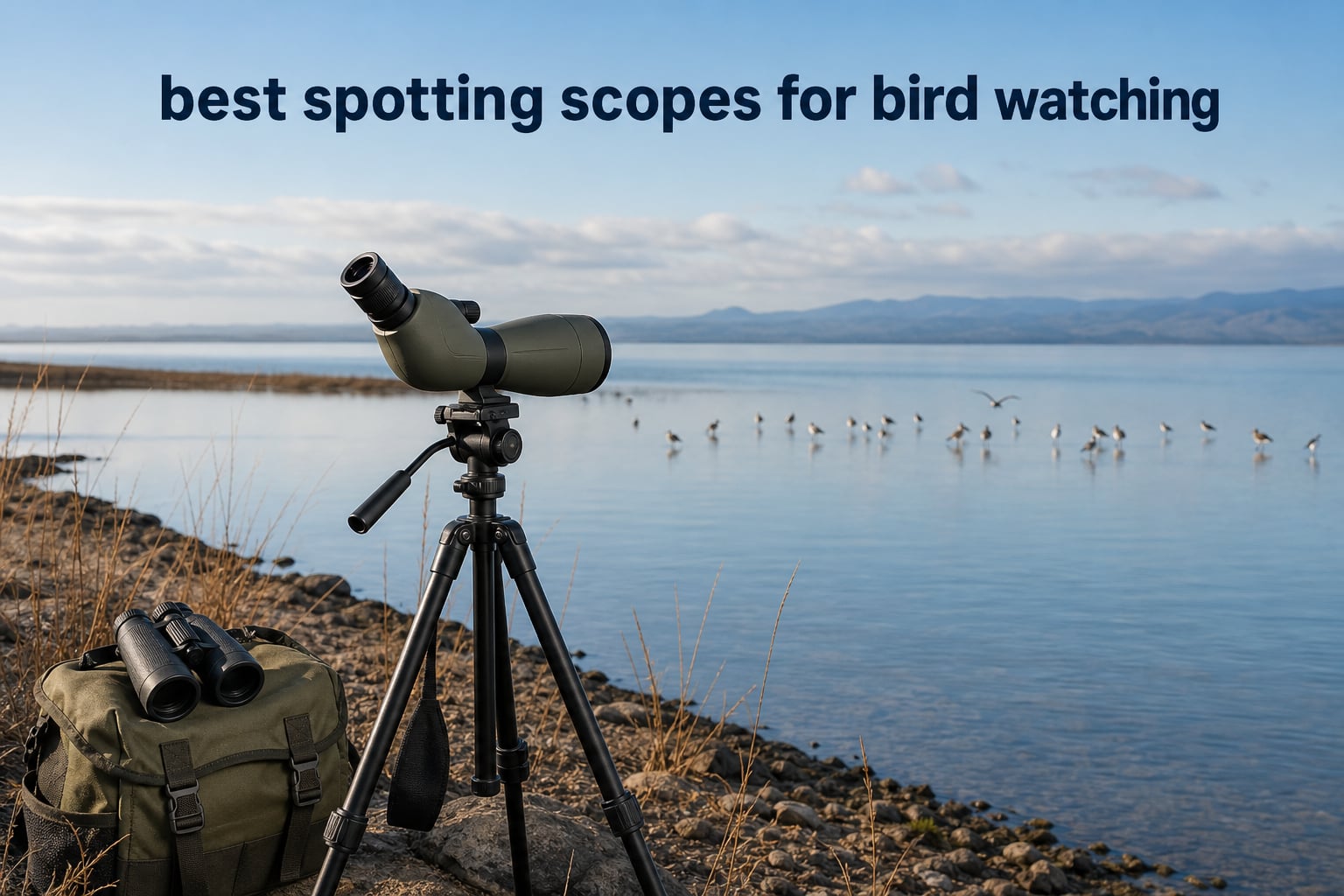
The best spotting scopes for bird watching give you the reach binoculars cannot: enough magnification to study a distant shorebird’s bill, a raptor’s markings, or a flock across an open field. A spotting scope is a terrestrial telescope, usually with variable magnification, that uses a larger front lens to collect more light for distant observation.
I ranked the eight scopes here from their published specifications, included equipment, warranty terms, and buyer-rating data rather than pretending every large magnification number produces the same view. The practical winner is the scope you can focus quickly, hold steady on a tripod, and carry to the places where you actually watch birds.
For most new birders, I would begin around 20x to 25x, then increase power after the bird is centered. That approach speaks to a recurring forum concern: a very high maximum magnification sounds attractive, but moving birds become much harder to find and keep framed when the view narrows.
Every scope in this guide is weather protected in some form or designed for outdoor use, but their optical claims, body weights, objective lenses, and supplied tripod systems differ sharply. Read the short list first, then use the reviews and buying guide to match the scope to woodland walks, open-country birding, travel, or phone-based digiscoping.
Table of Contents
The top 3 picks answer the most common birding needs
The Vortex Crossfire HD is my all-around pick because its 20-60×80 configuration combines HD optics, a 3.3-pound aluminum body, an angled view, a sunshade, and an Arca-Swiss-compatible foot. The Athlon Forerunner brings an ED focal lens and dual focus, while the URBANCOAST is the compact choice at 1.48 pounds.
Those three are not identical substitutes. Pick the Vortex for the most complete mounting and warranty package, the Athlon when ED glass and a supplied tripod lead your checklist, or the URBANCOAST when a small 60mm scope is more likely to make it into a daypack.
These bird-watching spotting scopes make comparison simple in 2026
Use the comparison below as a map, not a substitute for fit. The larger 80mm to 100mm objectives favor bright, distant viewing, while the 60mm URBANCOAST prioritizes carry weight; none of the listed specifications says these scopes include image stabilization.
| Product | Specifications | Action |
|---|---|---|
 Gosky 25-75×85 Gosky 25-75×85 |
|
View Details |
 Athlon Forerunner 20-60×80 Athlon Forerunner 20-60×80 |
|
View Details |
 Vortex Crossfire HD 20-60×80 Vortex Crossfire HD 20-60×80 |
|
View Details |
 LULOLO 30-90×92 LULOLO 30-90×92 |
|
View Details |
 URBANCOAST 20-60×60 URBANCOAST 20-60×60 |
|
View Details |
 WOSPORTS 25-75×85 WOSPORTS 25-75×85 |
|
View Details |
 SVBONY SV28 25-75×100 SVBONY SV28 25-75×100 |
|
View Details |
 GUANIEE 25-75×80 GUANIEE 25-75×80 |
|
View Details |
1. Vortex Crossfire HD 20-60×80 is the strongest all-around birding choice
Vortex Crossfire HD Spotting Scopes (20-60×80 Angled)
20-60x
80mm HD optics
3.3 pounds
Pros
- Arca-Swiss compatible foot
- Helical focus
- Sunshade
- VIP lifetime warranty
Cons
- Tripod not included
- Standard shipping only
The angled Vortex Crossfire HD pairs a 20-60x zoom with an 80mm objective and an aluminum housing weighing 3.3 pounds. Its published 4.7 rating is based on 335 reviews, which is a far broader buyer sample than most of the scopes in this roundup.
Its feature set makes sense for a birding spotting scope that may move between a car, a hide, and a trailhead. HD optical elements, fully multi-coated lenses, a built-in sunshade, and nitrogen purging address the usual problems of contrast, glare, and damp field conditions.
I would keep this scope at the low end of its zoom when scanning a marsh, then use the helical focus to refine the image before increasing magnification. The twist-up eyecup is also a meaningful detail for birders who alternate between glasses and bare-eye viewing.
The limiting factor is simple: a scope is supplied with covers, a neoprene cover, and a lens cloth, not a tripod. The upside is its Arca-Swiss-compatible foot, which is made for a direct, quick connection to a compatible tripod head rather than adding a separate mounting plate.
The Arca-Swiss foot makes this model easier to deploy from a proper tripod
A steady support is what makes 60x useful for a perched raptor or a distant wader. The Arca-Swiss-compatible foot is the standout distinction here because it can shorten the setup routine for birders who already use that common quick-release system.
The lifetime VIP warranty makes this model a strong long-term equipment choice
Vortex lists an unlimited, unconditional lifetime VIP Warranty for this model. Forum discussions repeatedly show that warranty support matters to buyers, especially for gear likely to ride in vehicles and encounter rain, dust, and knocks.
2. Athlon Forerunner 20-60×80 is the ED-glass-focused alternative
Athlon Optics 20-60×80 Dual Focus Forerunner Spotting Scope – ED Focal Lens with Tripod
20-60x
80mm ED lens
Dual focus
Pros
- ED focal lens
- Argon purged
- Dual focus
- Tripod included
Cons
- 2.47 kilogram package weight
- Standard shipping only
The Athlon Forerunner is a 20-60×80 spotting scope with an Extra Low Dispersion focal lens, fully multi-coated lenses, and an included tripod. Its 4.8 rating comes from 13 reviews, so it is encouraging feedback but a relatively small sample.
ED glass matters because it is intended to reduce chromatic aberration, the color fringes that can show around high-contrast edges. That is a sensible feature to seek when you are trying to separate subtle plumage tones rather than merely spot a bird’s silhouette.
The Forerunner’s dual focus system is its practical birding advantage. A fast control helps find the point of focus, while a finer adjustment helps when you are trying to distinguish eye-ring, feather edges, or distant leg color.
Athlon lists a rotating ring, twist-up eyecup, rubber armor, argon purging, and waterproof and fog-proof construction. The published package weight is 2.47 kilograms, so I would view it as a car-to-viewing-site setup rather than a minimal backpacking scope.
The ED focal lens can help when color detail drives identification
Extra Low Dispersion glass is not a promise that every distant image will be perfect at maximum zoom. It does give this model a focused technical case for birders who place color accuracy and reduced fringes near the top of their shortlist.
The included tripod gives a new birder a complete starting platform
High magnification reveals tripod shake as readily as it reveals feather detail. Having a tripod in the package removes one immediate compatibility question, though its steadiness and working height should still be checked against your typical terrain.
3. URBANCOAST 20-60×60 is the lightest choice for hikes and travel
Urbancoast Spotting Scope 20-60x60mm – Waterproof IPX7 Spotter Scope with Phone Adapter and Tripod, Portable for Bird Watching Wildlife observing and Hiking, Black
20-60x
60mm lens
1.48 pounds
Pros
- Very light body
- IPX7 waterproof
- Phone adapter
- Tripod included
Cons
- Smaller 60mm objective
- Manual focus only
The URBANCOAST 20-60×60 weighs 1.48 pounds and measures 12 by 3.5 by 4 inches, making it the lightest published body in this eight-scope group. It combines a 60mm objective, multi-coated optics, an integrated zoom-and-focus design, a tripod, a phone adapter, and a carrying case.
That small objective lens is the tradeoff. A 60mm front lens gathers less light than the 80mm, 85mm, 92mm, and 100mm alternatives here, so I would favor this model for daylight walks and travel rather than demanding dawn or dusk observation.
The specification sheet lists true IPX7 waterproof protection, a retractable sunshade, a non-slip base, and a 120-foot field of view. Those are useful outdoor details when you want one compact spotting scope for birding, wildlife stops, and an occasional phone clip.
Its 4.6 rating is based on 61 reviews. The scope uses manual focus only, so the compact design asks you to accept a simpler focusing arrangement than the dual-focus Athlon or helical-focus Vortex.
The low carry weight is the reason to choose this scope over a larger objective
Weight is one of the most common frustrations raised by hiking birders. A scope left in the car cannot help with an unexpected owl or a distant migration watch, and 1.48 pounds is a concrete portability advantage.
The 60mm objective works best for daylight rather than low-light specialization
Start around 20x and use the supplied tripod for the clearest view. At higher power or in fading light, a larger objective generally gives a birding scope more light-gathering headroom, which is why this compact option belongs in a daylight-first role.
4. Gosky 25-75×85 is a complete angled kit with a broad zoom range
Gosky 25-75×85 High Powered Spotting Scope – Upgrade Spotting Angled Scopes with Tripod, Phone Adapter & Carrying Bag – BAK4 Waterproof Spotter Scope for Bird Watching Wildlife Scenery
25-75x
85mm lens
Angled dual focus
Pros
- 85mm objective
- Full-size tripod
- Phone adapter
- Nitrogen purged
Cons
- Plastic housing
- Weight not specified
The Gosky is an angled 25-75×85 scope built around an 85mm objective and BAK4 prism, with a full-size tripod, phone adapter, and carrying bag included. Its 4.8 rating is drawn from 27 reviews, and the review distribution listed for the product is heavily weighted toward five-star feedback.
The 85mm objective aims at the bright-viewing role that birders want for distant water, open fields, and low-angle evening light. Gosky also specifies O-ring sealing and nitrogen purging for waterproof and fog-proof performance, plus a dual-speed focus system.
I see the package as a straightforward choice for someone who does not want to assemble accessories one at a time. The angled body can be more comfortable for extended viewing and can make it easier for people of different heights to share the eyepiece on one tripod.
The material listed is plastic, unlike the aluminum housings cited for several competitors. Gosky does not publish a product weight in the available data, so a hiker cannot make an honest pack-weight comparison from the specification alone.
The bundled full-size tripod makes the 75x setting more realistic to use
At 75x, even a small touch at the focus control can shake the view. A full-size tripod is a practical inclusion because it gives the scope a chance to show distant detail instead of becoming a high-power, unstable image.
The phone adapter supports casual digiscoping without extra hardware
A supplied phone adapter can capture a record shot of a bird, but alignment takes patience and the tripod remains part of the process. Treat it as an entry point to digiscoping, not a replacement for a dedicated camera adapter and a stable head.
5. SVBONY SV28 25-75×100 is the large-objective pick for bright distant views
Pros
- 100mm aperture
- FMC optics
- Phone adapter
- Lifetime warranty
Cons
- 5.6 pound weight
- Desktop tripod included
The SVBONY SV28 brings the largest objective in this selection: a 100mm aperture paired with 25-75x magnification, FMC fully multi-coated optics, and a BAK4-Porro prism. It also has the deepest buyer-feedback pool here, with a 4.4 rating from 3.4k reviews.
More front-lens area is especially relevant when light is weak or a bird is far enough away that you need a bright image before increasing magnification. The published data describes the 100mm aperture as having 2.3 times the focusing power of a 65mm lens, though field conditions and tripod steadiness still shape what you can see.
This is not a scope I would choose for a long, weight-sensitive hike. At 2,560 grams, or 5.6 pounds, its body takes a noticeable commitment, and the included support is described as a desktop tripod rather than a full-height field tripod.
The angled design, twist-up eyecups, anti-lost eyepiece cover, universal quarter-inch threaded mount, smartphone adapter, and lifetime warranty make it a feature-rich stationary-viewing package. It suits the birder who observes from a fixed site, vehicle, deck, or hide and wants the largest listed objective.
The 100mm aperture gives this scope the most low-light potential in this group
A larger objective does not override haze, heat shimmer, or poor focus. It does give the SV28 the strongest published light-gathering starting point among these eight models, which matters most at moderate power in dimmer conditions.
The 5.6-pound body asks for a full-height tripod plan
A desktop tripod is useful on a table, vehicle hood, or low hide opening, but it is not the same as a comfortable standing setup. Plan on a sturdy full-height tripod and head if distant shorebirds or raptors are your main goal.
6. LULOLO 30-90×92 is the high-magnification option for long-range viewing
LULOLO 30-90×92 UHD Spotting Scope with Tripod Carrying Bag & Upgraded Phone Adapter – Super Bright BAK4 Prism Waterproof Spotting Scopes for Target Shooting, Hunting, Bird Watching
30-90x
92mm objective
1.8 kilograms
Pros
- 92mm objective
- 90x maximum
- Tripod and bag
- Phone adapter
Cons
- Starts at 30x
- High power needs stability
The LULOLO 30-90×92 has the biggest stated zoom range in the list, along with a 92mm objective, BAK4 prisms, aluminum housing, a tripod, carrying bag, and a phone adapter. It is rated 4.6 from 67 reviews and weighs 1.8 kilograms.
Its 30x minimum is the feature to consider before its 90x maximum. Starting at 30x means a narrower initial view than 20x or 25x scopes, which can slow the process of locating a fast-moving warbler, a flying raptor, or a bird close to the observer.
For a distant perched bird, target, or fixed wildlife subject, the broad zoom range is more appealing. The 92mm objective is designed to collect a generous amount of light, while waterproof and shock-resistant construction supports outdoor use.
I would treat 90x as a condition-dependent setting rather than a default birding setting. Atmospheric shimmer, wind, a light tripod, and a tiny focus movement all become more visible at the top of the zoom range.
The 30x minimum suits open terrain better than close-range woodland birding
Open water, mudflats, and distant ridges give you time to locate a subject and build magnification. Dense woodland often rewards a lower starting power and wider field of view, so the 30x floor is a real fit consideration.
The 92mm lens and tripod help, but high power still exposes vibration
The bundled tripod is a welcome part of the kit, yet tripod height, head stiffness, and wind conditions decide how calm the image feels. Use a delayed phone shutter or hands-off capture method for steadier smartphone digiscoping at high magnification.
7. WOSPORTS 25-75×85 is the simple full-kit option with lifetime coverage
WOSPORTS 85mm Spotting Scopes with Tripod, Carrying Bag, Phone Adapter, HD BAK4 Porro Prism, Waterproof Spotter Scope for Hunting, Target Shooting, Bird Watching, Wildlife Viewing
25-75x
85mm objective
4.7 pounds
Pros
- BAK4 Porro prism
- Fully multi-coated
- Swivel tripod
- Lifetime warranty
Cons
- 4.7 pound weight
- 27 review sample
The WOSPORTS scope combines a 25-75x zoom with an 85mm objective, HD BAK4 Porro prism, fully multi-coated optics, and rubber armor. The package includes a smartphone adapter, a portable 360-degree swivel tripod, a carrying bag, and a lifetime warranty.
This is a conventional big-objective field kit for birders who want accessories in the box. Its listed 4.5 rating is based on 27 reviews, enough to show a direction but not enough to carry the same statistical weight as the Vortex or SVBONY feedback totals.
Nitrogen sealing, waterproof and fog-proof construction, and shock-resistant rubber armor are sensible features for a scope that may travel between wet grass, a vehicle, and a shoreline. The published field of view is 102 feet, and the central focus is described as smooth.
The stated weight is 4.7 pounds, so portability means transportability rather than ultralight hiking. I would pack it for a planned observation point, where the 85mm objective and angled viewing position can be used comfortably for a longer session.
The 360-degree swivel tripod helps when several people share one viewing position
A swivel tripod can make it quicker to redirect the scope as a bird moves across a marsh or along a treeline. It is helpful for teaching or family birding, though its stability at the highest magnification remains more important than its range of motion.
The lifetime warranty adds reassurance, but the optical fit still comes first
Long coverage is a meaningful ownership benefit, and forum users often weigh service support strongly. Before making it the deciding point, check that the 4.7-pound weight and 25x starting power match the way you plan to bird.
8. GUANIEE 25-75×80 is the full-height-tripod kit for comfortable angled viewing
25-75×80 Spotting Scope with Full Size Tripod Carrying Bag and Phone Adapter Spotter Scope for Target Shooting for Bird Watching Wildlife Viewing Green
25-75x
80mm lens
45 degree eyepiece
Pros
- Full-size adjustable tripod
- BAK4 prism
- Angled eyepiece
- Extendable sunshade
Cons
- 3.46 kilogram weight
- One-year warranty
The GUANIEE pairs a 25-75x zoom and 80mm fully multi-coated objective with a BAK4 roof prism and a 45-degree angled eyepiece. Its package includes a phone adapter, carrying bag, cleaning cloth, extendable sunshade, and an adjustable tripod listed from 18.3 to 59.3 inches.
The full-height tripod is the clearest reason to consider this model. An angled bird watching scope at roughly standing height can be more comfortable for prolonged sessions and easier to share without constantly changing tripod legs.
Its waterproof and fogproof design is appropriate for outdoor observation, while the 80mm objective places it in the versatile middle ground between compact 60mm scopes and the largest 92mm to 100mm bodies. The 4.4 rating comes from 181 reviews, a more substantial sample than several bundled-kit competitors.
Weight is 3.46 kilograms and the warranty is listed for one year, so it is less appealing for minimal travel and offers less long-term coverage than the lifetime-warranty models. In return, it presents a ready-to-use, full-height support package for a fixed birding location.
The 45-degree eyepiece helps reduce neck strain during long observation sessions
Angled scopes are commonly preferred by serious birders because they let the tripod sit lower while the eyepiece remains comfortable. A 45-degree design is especially convenient when observers of different heights take turns at the scope.
The 18.3-to-59.3-inch tripod range supports seated and standing positions
Tripod height affects more than comfort: an awkward stance makes it harder to focus smoothly and hold the image steady. This range gives the GUANIEE a clear practical advantage for birders who move from a seated hide to an open shoreline.
The right birding scope depends on distance, light, comfort, and support
The shortest useful buying rule is this: choose the lowest magnification that shows the detail you need, then choose the largest objective and steadiest tripod you are genuinely willing to carry. The apparent reach on a box matters less than a clear, stable view in the places you bird.
Magnification works best when you begin low and increase only after finding the bird
For a spotting scope, 20x to 25x is a practical starting range because the field of view is wider and the image is brighter. Once the bird is centered, increasing toward 40x, 50x, or higher can reveal more detail if the air is calm and the tripod is steady.
How far a 20-60×80 spotting scope can see has no single distance answer. You can see objects far beyond normal birding distances, but useful identification is limited by haze, heat shimmer, light, the bird’s size, lens quality, and the vibration of the support.
Do not mistake maximum power for optical quality. A stable 40x image can show more usable feather detail than a wavering 75x or 90x image, and that is why experienced users warn newcomers not to shop by the largest number alone.
Objective-lens diameter sets the low-light margin and the carry burden
The objective lens is the large front lens, and its diameter is stated in millimeters. A 60mm scope such as the URBANCOAST can be lighter and easier to carry, while 80mm and 85mm models offer a broader light-gathering margin for general birding.
The 92mm LULOLO and 100mm SVBONY lean toward bright, long-range viewing, but their larger glass and heavier bodies work best from a planned observation point. Bigger is not automatically better if it means the scope stays home during the walks where you want it.
ED glass and fully multi-coated optics are worth seeking, especially when a bird is backlit or has fine contrasting markings. ED glass is intended to reduce chromatic aberration, while coatings support light transmission and can improve the clarity of the image reaching your eye.
Angled bodies are usually more comfortable for sharing and extended watching
An angled spotting scope directs the eyepiece upward, which lets a user keep the tripod lower and often reduces neck strain over time. It also makes a single tripod height work better for several observers, a pattern that aligns with the preference many serious birders voice in community discussions.
A straight spotting scope puts the eyepiece in line with the barrel. Some birders find it more intuitive for quickly pointing from a distant landmark to the subject, especially from a vehicle, but no straight model is among the eight selected products here.
Choose an angled body if comfort, shared viewing, or a lower tripod setup matters most. Choose straight only if you have tried both and consistently locate targets faster with the in-line orientation; neither shape rescues a poor tripod or excessive magnification.
Tripods and focus controls decide whether the advertised power is usable
A spotting scope tripod should be stiff enough for the scope’s weight and tall enough for the position you use most. A fluid or quality pan head is helpful for following birds, while a quick-release system such as the Vortex’s Arca-Swiss-compatible foot speeds mounting.
Full-size tripods included with the Gosky and GUANIEE remove a major first purchase decision. The SVBONY’s desktop tripod is better suited to low or tabletop positions, and compact supplied tripods should be treated carefully when you expect to use the top of a zoom range.
Focus layout shapes the experience too. Dual focus, as on the Athlon, separates quick and precise adjustment; helical focus, as on the Vortex, is designed for fast and fine changes through one control. Manual focus is not a flaw, but it requires a calmer hand at high power.
Digiscoping requires stable alignment rather than just a phone adapter
Digiscoping means recording through a spotting scope with a phone or camera. The Gosky, LULOLO, URBANCOAST, WOSPORTS, SVBONY, and GUANIEE include a smartphone adapter, which reduces the number of extra parts needed to begin.
For a usable result, center the phone lens over the eyepiece, lock the scope on a solid tripod, focus the scope before recording, and avoid rushing to extreme magnification. A shutter delay or remote trigger helps because touching the phone can introduce visible movement.
A phone adapter is best for documentation and sharing, not a guarantee of professional bird photography. If digiscoping is your main purpose, check adapter fit with your phone case, eyepiece diameter, and tripod head before making a final choice.
Image stabilization is absent from these published specifications and cannot replace good support
Image stabilization is barely discussed in competing birding-scope guides, but it deserves a direct answer here. None of the eight product records provided for this article lists image stabilization, so do not assume a high-power scope has it.
Even where stabilization exists in other optics, it does not replace a stable tripod for extended spotting-scope observation or phone-based recording. A modest magnification, a solid tripod, careful focus, and shelter from wind are the dependable route to a detailed view.
These spotting-scope answers resolve the most common birding questions
How far will a 20-60×80 spotting scope see?
A 20-60×80 scope can show objects at very long distances, but there is no fixed useful distance for bird identification. Haze, heat shimmer, light, bird size, optical quality, and tripod stability set the practical limit. Begin at 20x to find the bird, then increase power only when the image remains sharp and steady.
Is 8 or 10 magnification better for birding?
Eight and 10 magnification normally describe binoculars, not spotting scopes. Eight power offers a wider, steadier view for close woodland birding, while 10 power shows slightly more detail across open ground. For spotting scopes, begin around 20x to 25x and raise magnification after locating the bird.
Which is better, Leupold or Vortex spotting scopes?
The better brand is the one whose current model fits your viewing needs, tripod system, and warranty preference. In this group, the Vortex Crossfire HD stands out for HD optics, an Arca-Swiss-compatible foot, helical focus, a sunshade, weather protection, and a lifetime VIP Warranty. Compare actual model specifications rather than choosing by brand alone.
What is better, straight or angled spotting scopes?
Angled scopes are usually better for long sessions, shared viewing, and lower tripod positions because the eyepiece points upward. Straight scopes can feel quicker to aim from a vehicle or when following a subject from binoculars. Comfort and how you bird matter more than one universally better shape.
What is the best spotting scope for birdwatching?
The Vortex Crossfire HD 20-60×80 is the strongest all-around pick here because it combines HD optics, an angled body, helical focus, a sunshade, an Arca-Swiss-compatible foot, weather protection, and a lifetime VIP Warranty. Choose the URBANCOAST instead when low carry weight matters most, or the SVBONY for a 100mm objective at a fixed viewing site.
The best bird-watching scope is the one you can hold steady and use often
For a capable all-around setup, I would choose the Vortex Crossfire HD 20-60×80 and pair it with a solid compatible tripod. The Athlon Forerunner is compelling for its ED focal lens and included tripod, while the URBANCOAST is the sensible lightweight option.
The best spotting scopes for bird watching in 2026 are not decided by the highest zoom alone. Match objective size to your light, body weight to your travel habits, and tripod system to your viewing position, then use low magnification first and let clear technique do the work.