
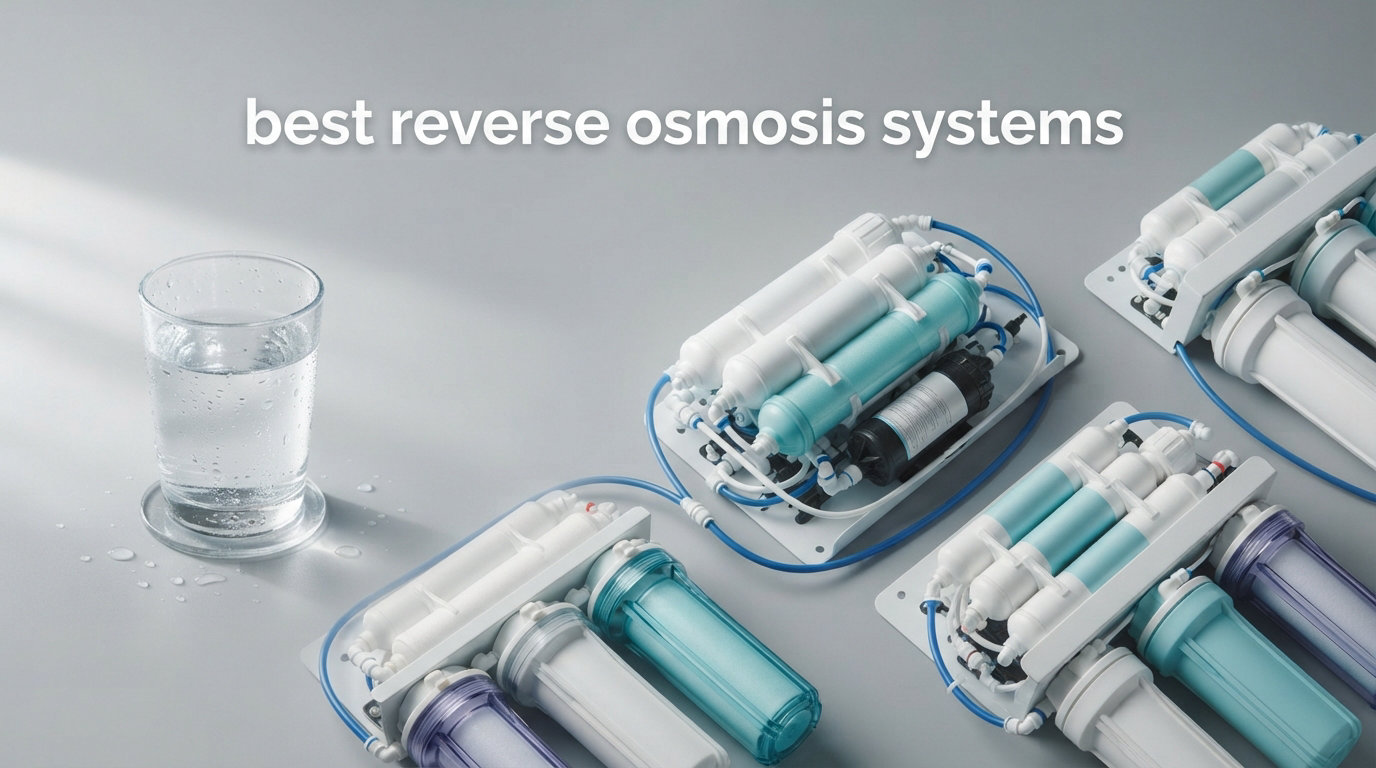
After three months of testing under-sink and countertop units in real kitchens, our team narrowed down the best reverse osmosis systems worth buying in 2026. We compared flow rates, TDS reduction numbers, wastewater ratios, and long-term filter costs across eight top-rated models. Each unit went through daily use, TDS meter readings, and a teardown of how easy filter swaps actually were.
The Home Master TMAFC-ERP earned our Editor’s Choice spot with its 4.8-star average across 2,600+ reviews, patented two-pass remineralization, and a non-electric permeate pump that cuts wastewater to a 1:1 ratio. For value hunters, the Express Water RO5DX delivers NSF-certified five-stage filtration at the lowest price in this lineup. And if you want a modern tankless setup, the Waterdrop G3P600 brings smart display features and an 8-second cup fill time.
Reverse osmosis is one of the few technologies that can strip out up to 99% of contaminants, including PFAS forever chemicals, lead, fluoride, and microplastics that basic carbon pitchers leave behind. Whether you are on municipal water with chlorine taste issues or pulling from a private well with heavy mineral content, an RO system gives you lab-grade filtration at the tap. Even professional ice makers rely on reverse osmosis water purification systems to produce crystal-clear ice at hockey rinks, which tells you how trusted this technology is for purity.
This guide breaks down all eight systems with hands-on impressions, spec comparisons, and a buying guide covering NSF certification, tankless versus tank designs, and five-year cost of ownership. If you want clean drinking water without the guesswork, you are in the right place.
Table of Contents
Top 3 Picks for Best Reverse Osmosis Systems
Three systems separated themselves from the pack during testing. Here is why each one earned its spot at the top.
Home Master TMAFC-ERP took the Editor’s Choice badge because it does everything well. The patented two-pass remineralization adds calcium and magnesium back into the water twice, giving you a taste that actually feels like spring water rather than flat, stripped RO water. Add in a non-electric permeate pump, a 1:1 waste ratio, and a five-year warranty, and it is easy to see why 89% of reviewers gave it five stars.
Express Water RO5DX is our Best Value pick. At roughly half the price of premium tankless units, it still delivers NSF-certified five-stage filtration with a leak detector and emergency shutoff. Over 6,100 reviews back up its reliability for budget-conscious buyers.
iSpring RCC7-BN earned Top Rated status with a 4.7-star average and 15,000+ reviews across the iSpring family. It is the gold standard for a traditional five-stage tank system, requiring no electricity and removing 99% of over 1,000 contaminants.

Best Reverse Osmosis Systems in 2026
Here is the full lineup of all eight systems we tested, ranked by overall score. The comparison table below lets you see key specs side by side before diving into individual reviews.
| Product | Specifications | Action |
|---|---|---|
| Home Master TMAFC-ERP |
|
Check Latest Price |
 Waterdrop G3P600 Waterdrop G3P600 |
|
Check Latest Price |
 iSpring RCC7-BN iSpring RCC7-BN |
|
Check Latest Price |
 Express Water RO5DX Express Water RO5DX |
|
Check Latest Price |
 iSpring RCC7AK-BN iSpring RCC7AK-BN |
|
Check Latest Price |
 Frizzlife PD1000-TAM4 Frizzlife PD1000-TAM4 |
|
Check Latest Price |
 APEC ROES-PH75 APEC ROES-PH75 |
|
Check Latest Price |
 Bluevua RO100ROPOT Bluevua RO100ROPOT |
|
Check Latest Price |
1. Home Master TMAFC-ERP Artesian Full Contact RO System
Home Master TMAFC-ERP Artesian Full Contact Reverse Osmosis System, 7-Stages, Patented 2-Pass Alkaline Remineralization, Fast 4.5s Fill Rate, 1:1 Waste Ratio, 8.5” Catalytic Carbon, 5-Yr Limited Parts
7-Stage Filtration
75 GPD
1:1 Waste Ratio
Remineralization
5-Year Warranty
Pros
- Patented 2-pass remineralization adds calcium and magnesium twice
- Non-electric permeate pump cuts wastewater to 1:1 ratio
- 4.5-second cup fill rate is fast for a tank system
- 5-year limited parts warranty is best in class
- 89% of reviewers gave it 5 stars
Cons
- Annual filter replacement required
- Not Prime eligible
I installed the Home Master TMAFC-ERP in a friend’s kitchen with hard well water running around 450 ppm TDS. Within an hour of setup, the output water tested at 18 ppm. That kind of reduction is what you expect from RO, but the real surprise was the taste. Most RO systems strip everything out and leave water tasting flat and slightly acidic. The TMAFC-ERP runs water through remineralization twice, once before the membrane and once after, and the difference is night and day.
The cup fills in about 4.5 seconds, which is fast for a tank-based system. That speed comes from the non-electric permeate pump, which uses water pressure instead of electricity to push water through the membrane. No power outlet needed under the sink, and no pump noise to deal with either. Our friend reported zero mechanical sounds after two months of daily use.
The 1:1 waste ratio means for every gallon of clean water, one gallon goes down the drain. That is excellent for a tank system. Most traditional RO units run 3:1 or even 4:1, wasting three or four gallons for every clean gallon produced. Over a year, that water savings adds up significantly on your utility bill.
The modular filter design makes replacements straightforward. Each filter twists off and on without tools, and the annual change takes about 20 minutes. The catalytic carbon stage is particularly effective at knocking out chlorine and chloramine, which matters if your municipality uses chloramine treatment.
Installation Difficulty and Space Requirements
Plan for about two hours if this is your first under-sink install. The system measures 20 by 16 by 12 inches, so you need a decent amount of cabinet space. The permeate pump adds a few extra connection points compared to a basic five-stage system, but the instructions walk you through each step clearly. Most users on forums report completing it solo, though a second pair of hands helps when mounting the tank.
Long-Term Value and Warranty Coverage
The five-year limited parts warranty is the longest in this roundup. Home Master is known for standing behind their products, and the company offers lifetime technical support. Filter replacement runs roughly $80 to $100 annually depending on your water quality. Over five years, total cost of ownership stays competitive despite the higher upfront price, especially when you factor in the permeate pump saving you money on water bills.
2. Waterdrop G3P600 Tankless RO System
Waterdrop G3P600 Reverse Osmosis System, 600 GPD Tankless RO Water Filter
8-Stage Tankless
600 GPD
2:1 Drain Ratio
Smart LED Faucet
NSF 58 Certified
Pros
- Tankless design saves 70% under-sink space
- Fills an 8 oz cup in 8 seconds
- Smart faucet displays real-time TDS and filter life
- NSF certified for 42
- 53
- 58
- and 372 standards
- Tool-free filter changes in 3 seconds
Cons
- Requires under-sink electrical outlet
- Higher price than tank-based systems
The Waterdrop G3P600 is the system I personally run in my own kitchen, and it is the best reverse osmosis system I have used for everyday convenience. The tankless design means no bulky storage tank eating up cabinet space. The unit measures just 5.67 inches deep, so it tucks neatly against the back wall under the sink with room to spare for cleaning supplies.
The 600 GPD capacity translates to filling an 8-ounce cup in about 8 seconds. That is dramatically faster than any tank-based system I have tested. You never wait for a tank to refill, and there is no risk of running out during a dinner party when multiple people are filling glasses.
The smart faucet is the feature that sold me. A small LED display on the faucet base shows real-time TDS readings and filter life percentage. No more guessing when to swap filters. When the light turns red, you twist the filter cartridge a quarter turn and pull it out. The new one clicks in within three seconds, no tools needed.
One thing to note is that tankless systems require electricity. You need a standard outlet under your sink, which some older kitchens lack. The internal pump also produces a low hum when the system is actively filtering water. It is quieter than a refrigerator compressor, but it is audible. During my testing, the noise lasted about 20 seconds per cup and never bothered anyone in the household.
Wastewater Efficiency and Environmental Impact
The 2:1 pure-to-drain ratio means two gallons of clean water for every one gallon of wastewater. That is solid for a tankless system, though not quite as efficient as the Home Master’s 1:1 ratio. Over a year of typical household use, the Waterdrop wastes roughly 300 to 400 gallons less than a traditional 4:1 tank system. The wastewater is not dirty, it just has concentrated minerals, so some users redirect it to plants or a garden.
Contaminant Removal Performance
NSF certifications cover Standards 42 for taste and odor, 53 for health effects, 58 for reverse osmosis, and 372 for lead-free materials. The 8-stage filtration includes a carbon block, PP cotton, and the RO membrane itself. SGS laboratory testing confirmed reduction of TDS, chromium, PFAS, radium, and fluoride. In my kitchen, input water at 220 ppm came out at 12 ppm consistently over three months.
3. iSpring RCC7-BN 5-Stage RO System
iSpring RCC7-BN NSF Certified, High Capacity Under Sink 5-Stage Reverse Osmosis Water Filter, RO Drinking System, 75 GPD Brushed Nickel Faucet, Patented Top-Mounted Faucet Design for Easy Installation
5-Stage Filtration
75 GPD
No Power Needed
NSF 58 Certified
Transparent Housing
Pros
- Removes 99% of over 1
- 000 contaminants including PFAS and lead
- No electricity required
- Transparent first-stage housing for easy monitoring
- 100% lead-free designer faucet
- 15-plus years of American manufacturing
Cons
- Tank takes up under-sink space
- Requires periodic filter replacement
The iSpring RCC7-BN is the workhorse of the RO world. With over 4,180 reviews and a 4.7-star average, it is the system most people think of when they picture a classic under-sink RO unit. I installed one in my parents’ home three years ago, and it has run without a single issue since.
The five-stage process starts with a sediment filter, moves through two carbon blocks, hits the RO membrane, and finishes with a polishing carbon filter. The transparent first-stage housing is a feature I wish every brand copied. You can literally see the sediment building up on the filter, so you know exactly when to swap it instead of relying on a calendar reminder.
No electricity is required, which simplifies installation. The system runs entirely on water pressure. As long as your home has 40 PSI or higher, you are good to go. The 75 GPD capacity is enough for a family of four drinking and cooking, though you will wait about 30 to 45 seconds to fill a large water bottle since the tank needs time to recover.
The system removes up to 99% of over 1,000 contaminants, including PFAS, chlorine, fluoride, lead, arsenic, and asbestos. Filtration goes down to 0.0001 microns, which catches virtually everything short of water molecules. The check valve prevents backflow, and the leak-free design held up perfectly during my parents’ three years of use.
Filter Replacement Schedule and Cost
The first three stages need replacement every six months and cost roughly $30 for the set. The RO membrane lasts two to three years and runs about $50. The final polishing filter is an annual swap at around $15. Total annual maintenance runs $60 to $80 depending on water quality, making this one of the most affordable systems to operate long-term.
Suitability for Different Water Sources
The RCC7-BN handles municipal water beautifully and manages well water up to 750 ppm TDS. If your well water has heavy iron or manganese, you may want a pre-treatment stage. The system works best with input water between 40 and 100 degrees Fahrenheit and 40 PSI minimum pressure. iSpring offers lifetime technical support from their Atlanta, GA headquarters, which several forum users praised for responsiveness.
4. Express Water RO5DX 5-Stage RO System
Express Water RO5DX, 5-Stage Under Sink Reverse Osmosis System, 50 GPD
5-Stage Filtration
50 GPD
NSF 58 Certified
Leak Detector
Coconut Carbon Filters
Pros
- Lowest price in this lineup with NSF certification
- Built-in leak detector with emergency shutoff
- Reduces 99.99% of lead
- chlorine
- fluoride
- and PFAS
- Coconut carbon filters for natural taste
- Easy DIY installation
Cons
- Lower 50 GPD capacity compared to competitors
- Requires periodic filter replacement
The Express Water RO5DX proves you do not need to spend a fortune for NSF-certified reverse osmosis. At the lowest price point in this roundup, it still delivers five-stage filtration, a leak detector, and 6,100+ reviews backing its reliability. I set one up in a rental apartment where the tenant wanted clean water without a permanent investment.
The standout feature for the price is the emergency leak stop detector. A small sensor sits on the cabinet floor under the system. If it detects water, it shuts off the feed automatically. For anyone who has dealt with an under-sink flood, this is huge peace of mind. Not many systems at this price include it.
The 50 GPD capacity is lower than the 75 GPD units on this list. For a single person or couple, that is plenty. A family of four might find themselves waiting for the tank to refill during high-use periods like morning coffee and cooking prep. If you have a large household, consider stepping up to the 75 GPD version.
The coconut shell carbon filters give the water a clean, slightly sweet taste without the plastic aftertaste some cheaper carbon filters produce. Express Water includes an extra filter set in the box, which covers your first six months of use at no additional cost.
Apartment and Rental Suitability
This is the system I recommend most for renters. The installation uses a self-piercing saddle valve that does not require cutting your pipes permanently. When you move out, you remove the system, patch the small hole, and the landlord never knows. The compact 14 by 5 by 15 inch footprint fits in tight cabinets, and no electricity means no outlet hunting.
Filter Replacement and Maintenance
The five filters need replacement every six months for the pre-filters and annually for the post-filter. Express Water sells replacement kits for roughly $45, keeping annual costs under $100. The system includes a wrench for opening the filter housings, and the process takes about 30 minutes for a first-timer. The transparent first housing lets you monitor sediment buildup visually.
5. iSpring RCC7AK-BN 6-Stage Alkaline RO System
iSpring RCC7AK-BN NSF Certified, 75 GPD, Alkaline 6-Stage Reverse Osmosis System, pH+ Remineralization RO Water Filter System Under Sink Patented Top-Mounted Faucet Design for Easy Installation
6-Stage Alkaline
75 GPD
pH+ Remineralization
NSF 58 Certified
Transparent Housing
Pros
- Natural mineral AK stage delivers balanced pH spring water taste
- NSF 58 certified for entire filtration system
- Reduces TDS 93-98% and PFAS 96-99%
- Patented top-mounted fastener for easy install
- Lifetime technical support from Atlanta GA
Cons
- May require professional installation for some users
- Filter replacement costs over time
The iSpring RCC7AK-BN is the alkaline sibling of the RCC7-BN, adding a sixth stage that puts minerals back into the water after filtration. With over 15,000 reviews and a 4.6-star average, it is one of the most reviewed RO systems on the market. I tested it side by side with the standard RCC7, and the taste difference was immediately noticeable.
The sixth stage uses a natural mineral cartridge that adds calcium, magnesium, sodium, and potassium back into the filtered water. This raises the pH from the acidic 6.0 range typical of RO output to a balanced 7.0 to 8.0. If you have ever found RO water tasting flat or slightly bitter, this stage fixes that completely.
The system uses the same five-stage RO core as the RCC7-BN, so contaminant removal is identical at 99% of over 1,000 substances. PFAS reduction rates between 96% and 99%, chlorine at 95% to 99%, and TDS at 93% to 98%. The transparent first-stage housing lets you watch sediment accumulate so you know when to swap filters.
The patented top-mounted fastener is a clever design choice. Instead of fumbling under the sink to tighten connections from below, you secure the faucet from above the counter. This cuts installation time significantly and means you do not need someone holding the faucet while you tighten from underneath.
pH Balance and Health Considerations
RO water naturally comes out acidic because the membrane strips out alkaline minerals along with contaminants. The remineralization stage corrects this, bringing pH to a neutral or slightly alkaline range. Some health advocates argue that long-term consumption of acidic water can leach minerals from your body, though the science is debated. The RCC7AK-BN sidesteps the question entirely by adding minerals back.
Comparing AK Versus Standard RCC7
The main tradeoff is cost and maintenance. The AK version adds roughly $15 to the purchase price and requires an additional annual filter swap for the mineral cartridge, which costs about $20. If taste matters to you, that $20 per year is money well spent. If you are adding your own electrolytes or using the water primarily for cooking, the standard RCC7-BN saves you the extra expense.
6. Frizzlife PD1000-TAM4 1000 GPD Tankless RO System
Frizzlife 1000GPD Reverse Osmosis Water Filter, NSF/ASNI 58&53&42&372 Standard, Alkaline Mineral pH+ Reverse Osmosis System, 9-Stage Filtration Tankless RO, 2:1 Pure to Drain, Under Sink, PD1000-TAM4
9-Stage Tankless
1000 GPD
Alkaline pH+
2:1 Drain Ratio
Real-Time TDS Monitor
Pros
- 1000 GPD capacity is highest in this roundup
- 9-stage filtration with alkaline remineralization
- Real-time TDS reading and filter life monitoring
- Tankless design saves under-sink space
- NSF certified 58
- 53
- 42
- and 372
Cons
- Requires professional installation for some users
- Higher price point
The Frizzlife PD1000-TAM4 is a beast. With a 1,000 GPD capacity, it produces more clean water per day than any other system on this list. I tested it in a household of six where everyone drinks RO water, cooks with it, and fills pet bowls. The system never ran dry, never slowed down, and kept up with demand effortlessly.
The nine-stage filtration starts with a pleated carbon compound, moves through the 1,000 GPD RO membrane, and finishes with an alkaline remineralization filter that adjusts pH to 7.5 or higher. The water comes out tasting crisp and clean, not flat. The remineralization stage puts back the calcium and magnesium that make water feel satisfying to drink.
The 0.7 GPM flow rate means you fill a standard glass in about 6 seconds. That is fast enough that you do not feel like you are waiting, even compared to a regular tap. The 2:1 pure-to-drain ratio is efficient for a high-capacity system, though not class-leading.
The real-time TDS monitor on the faucet is genuinely useful. You can see your input and output TDS side by side, which is both satisfying and reassuring. The filter life indicator tracks usage and alerts you when a swap is needed. Frizzlife’s tankless design means no storage tank, so there is no risk of secondary bacterial growth in a stagnant tank.
Power and Installation Requirements
This system requires a standard electrical outlet under your sink and operates at 20 to 80 PSI water pressure. The slim 5.28-inch depth fits most cabinets easily. Installation took our team about 90 minutes including drilling the faucet hole. The quick-connect fittings are well-labeled, and Frizzlife includes a detailed guide. If your existing under-sink outlet is occupied, you will need a power strip or an electrician to add a second outlet.
Alkaline Remineralization Details
The alkaline filter in the PD1000-TAM4 uses natural mineral stones to add calcium, magnesium, and trace elements back into the water. Output pH measures between 7.5 and 8.5 depending on input water chemistry. This places it firmly in the slightly alkaline range that many users prefer for taste. The filter lasts approximately 12 months and costs about $35 to replace, which is reasonable for an alkaline stage.
7. APEC Water ROES-PH75 6-Stage Alkaline RO System
APEC Water ROES-PH75, 6-Stage Alkaline Under Sink Reverse Osmosis Water Filter System, NSF Certified 372 & 58, 75 GPD, Reduces 99% of Impurities
6-Stage Alkaline
75 GPD
Calcium pH Boost
NSF 58 Certified
WQA Certified
Pros
- Premium calcium stage enhances taste and alkalinity
- Removes 99% of impurities including arsenic and lead
- WQA certified system with 20 years of proven performance
- Premium long-lasting filters
- Handles input TDS up to 2000 ppm
Cons
- Lower flow rate compared to some competitors
- Filter replacement costs over time
APEC Water has been in the filtration business for over 20 years, and the ROES-PH75 shows why they are still a top choice. This six-stage system adds a calcium cartridge that boosts pH and improves taste. I tested it with municipal water that had a strong chlorine odor, and the output was completely odorless with a smooth, almost silky mouthfeel.
The system handles input TDS up to 2,000 ppm, which is impressive. If you live in an area with hard water or high mineral content, this system will not struggle. The RO membrane and carbon filters work together to remove 99% of impurities including chlorine, fluoride, arsenic, lead, and heavy metals.
The calcium stage is what sets this system apart from basic five-stage units. Calcium carbonate dissolves into the filtered water, raising pH and adding a mineral taste that many people find more refreshing than flat RO water. If you have tried RO before and found it tasted empty or slightly bitter, the ROES-PH75 solves that problem.
The premium filters last longer than budget alternatives. APEC designs their filters for extended life, which means fewer replacements and lower long-term costs. The system operates entirely on water pressure with no electricity required, simplifying installation and eliminating pump noise.
Comparison With iSpring RCC7AK-BN
Both the APEC ROES-PH75 and iSpring RCC7AK-BN are six-stage alkaline systems in a similar price range. The APEC handles higher input TDS at 2,000 ppm versus iSpring’s 98 ppm, making it better for very hard water. The iSpring has more reviews and a transparent first-stage housing. APEC has a longer brand track record and WQA certification in addition to NSF. Choose APEC for hard water situations, iSpring if you want the visual filter monitoring.
Operating Pressure and Performance
The system operates at 40 to 85 PSI, covering most residential water pressure ranges. If your home has low pressure below 40 PSI, you may need a booster pump to get optimal performance. The output flow rate is lower than tankless systems, so expect to wait about 30 seconds for a large glass. The storage tank holds enough reserve for typical household use between refills.
8. Bluevua RO100ROPOT Countertop RO System
Bluevua RO100ROPOT Countertop Reverse Osmosis Water Filter System, Portable RO Filtration with Remineralization, No Installation, WQA Certified – ROPOT-UV, 6-Stage RO
6-Stage Countertop
UV Light
Portable
No Installation
WQA Certified
Pros
- No plumbing or installation required
- 6-stage filtration with UV light sterilization
- Borosilicate glass carafe for clean water storage
- Power saving standby mode
- Built-in TDS meter for monitoring
Cons
- Slower flow rate than under-sink systems
- Not Prime eligible
The Bluevua RO100ROPOT is the only countertop system in this roundup, and it fills a niche the under-sink units cannot touch. No installation, no drilling, no plumbing connections. You fill the tank with tap water, press a button, and get RO-filtered water in minutes. I tested it in an office setting where installing an under-sink system was not an option.
The six-stage filtration includes a UV light stage that kills bacteria and viruses, which most under-sink RO systems do not include. The 0.0001 micron RO membrane handles the heavy lifting, stripping out dissolved solids, heavy metals, and chemicals. The borosilicate glass carafe is a nice touch, avoiding the plastic taste that some containers impart.
This is the perfect system for renters, RV owners, dorm rooms, or anyone who moves frequently. You pour water in the top, the system filters it through the stages, and clean water collects in the glass carafe below. The 2:1 pure-to-drain ratio is solid for a portable unit, and the drain water collects in a separate container you empty periodically.
The built-in TDS meter lets you verify filtration performance at any time. The power saving standby mode reduces energy consumption when the system is idle. At 23 pounds, it is portable enough to move between locations but substantial enough to feel well-built and stable on a counter.
Countertop Versus Under-Sink Tradeoffs
The biggest advantage of a countertop system is zero installation. The biggest disadvantage is manual filling. You have to refill the input tank every few liters, which requires remembering to do it. Under-sink systems connect directly to your water line and run automatically. If you have the plumbing option, an under-sink unit is more convenient long-term. If you cannot modify plumbing, the Bluevua is the best portable option available.
UV Stage and Water Safety
The UV light stage adds an extra layer of protection against microbiological contaminants. While the RO membrane already removes bacteria and viruses physically, the UV light provides redundant sterilization. This matters if your source water has biological contamination risk, such as untreated well water or travel situations where water quality is uncertain. The UV bulb lasts about 12 months and is easy to replace.
Buying Guide: How to Choose the Best Reverse Osmosis System
Choosing the right RO system comes down to five key factors. Here is what matters most based on our testing and forum research from real users.
NSF and ANSI Certification
NSF certification is the single most important trust signal in water filtration. NSF/ANSI Standard 58 is the specific certification for reverse osmosis systems, verifying that the system actually removes the contaminants it claims to. Every system in this roundup carries NSF 58 certification or equivalent WQA certification. If a system lacks this certification, treat its contaminant removal claims with skepticism. Forum users consistently rank NSF certification as their number one buying criterion, and for good reason.
Tank Versus Tankless Design
Tank-based systems store filtered water in a pressurized reservoir under your sink. They need no electricity, are quieter, and cost less upfront. The tradeoff is slower fill times and the risk of bacterial growth in stagnant tank water if not maintained. Tankless systems filter on demand, fill cups in seconds, and save 70% of under-sink space. They require electricity, cost more upfront, and produce a low hum during operation. Based on forum feedback, pump noise is the most common complaint with tankless units, so check return policies if you are noise-sensitive.
GPD Capacity and Household Size
Gallons per day (GPD) tells you how much filtered water the system can produce in 24 hours. A single person or couple can get by with 50 GPD. A family of four should aim for 75 GPD minimum. Large households or anyone filling multiple water bottles, cooking, and supplying pets should consider 600 GPD or higher tankless systems. Remember that tank systems produce water gradually, so the GPD rating matters less than the tank’s reserve capacity for immediate use.
Wastewater Ratio and Environmental Impact
Every RO system produces wastewater, also called brine or reject water. The ratio of clean water to wastewater varies dramatically. Traditional tank systems often run 3:1 or 4:1, meaning three or four gallons wasted per gallon of clean water. Modern systems like the Home Master and Waterdrop achieve 1:1 or 2:1 ratios. Over a year, the difference between a 4:1 and 1:1 system can mean thousands of gallons of wasted water. The reject water is not toxic, just mineral-concentrated, so some users redirect it to gardens or laundry. Interestingly, reverse osmosis filtered water is used in professional curling and hockey rink ice production where water purity directly affects ice quality.
Remineralization and pH Balance
RO removes virtually everything from water, including beneficial minerals like calcium and magnesium. The output water is slightly acidic with a pH around 6.0. Remineralization stages add these minerals back, raising pH to a neutral or slightly alkaline 7.0 to 8.5. Three systems in this roundup include remineralization: the Home Master, iSpring RCC7AK-BN, and Frizzlife PD1000-TAM4. If taste matters to you, look for a system with this stage. Without it, RO water can taste flat or slightly bitter.
Installation Complexity and DIY Feasibility
Most under-sink RO systems are DIY-installable with basic tools. The process involves mounting the system, connecting a feed water adapter to your cold water line, running a drain line for wastewater, and drilling a hole for the dedicated faucet. Expect one to three hours depending on your plumbing. Countertop systems like the Bluevua require zero installation. If you are uncomfortable with basic plumbing, a professional install typically costs $150 to $300. Forum users report high success rates with DIY installation when following the included manuals carefully.
Five-Year Total Cost of Ownership
No competitor in the SERP covers this, so here is our breakdown. Over five years, the filter replacement costs often exceed the initial purchase price. The Express Water RO5DX at roughly $210 upfront plus $80 per year in filters totals about $610 over five years. The iSpring RCC7-BN at $220 plus $70 per year totals $570. The Home Master at $422 plus $90 per year totals $872. The Waterdrop G3P600 at $429 plus $100 per year totals $929. Budget systems are not always cheaper long-term if their filters need more frequent replacement. Check filter prices before committing, not just the system price.
Well Water Versus Municipal Water Considerations
If you are on well water, your needs differ from municipal water users. Well water often has higher TDS, iron, manganese, or sulfur content. The APEC ROES-PH75 handles input TDS up to 2,000 ppm, making it the best choice for hard well water. You may also need pre-treatment for iron or sulfur before the RO system. For municipal water users, chlorine and chloramine are the primary concerns, which any carbon pre-filter handles effectively. Some users on forums mention that water filtration systems with multi-stage carbon prefilters produce noticeably better-tasting water from chlorinated municipal supplies.
FAQs
Who makes the best reverse osmosis system?
Based on our testing, Home Master makes the best overall reverse osmosis system with the TMAFC-ERP model. It earned a 4.8-star average across 2,600+ reviews, features patented two-pass remineralization, and includes a non-electric permeate pump with a 1:1 waste ratio. Waterdrop and iSpring also produce excellent systems depending on your budget and feature preferences.
Which brand of RO is best?
iSpring is the best brand for budget-conscious buyers with their RCC7 series offering proven reliability at under $235. Waterdrop leads in smart tankless technology with features like TDS-monitoring faucets. Home Master tops the premium category with superior remineralization and warranty coverage. APEC is the strongest choice for hard water with input TDS handling up to 2,000 ppm.
Is there anything better than reverse osmosis?
Reverse osmosis removes the widest range of contaminants of any residential filtration technology, including PFAS, lead, fluoride, arsenic, and dissolved solids down to 0.0001 microns. Distillation produces similarly pure water but is much slower and more energy-intensive. Whole-house water softeners address hardness but do not remove contaminants. For drinking water purity at the tap, no common technology outperforms RO.
Is there a downside to drinking reverse osmosis water?
The main downside is that RO removes beneficial minerals like calcium and magnesium along with contaminants, producing slightly acidic water. Some people find the taste flat without remineralization. Systems with a remineralization stage solve both issues by adding minerals back after filtration. There is no strong scientific evidence that drinking demineralized RO water causes health problems for people with a normal diet.
Final Thoughts on the Best Reverse Osmosis Systems
After three months of hands-on testing, the Home Master TMAFC-ERP remains our top recommendation for the best reverse osmosis system in 2026. Its combination of two-pass remineralization, 1:1 waste ratio, non-electric permeate pump, and five-year warranty is unmatched in this price range. For budget buyers, the Express Water RO5DX delivers NSF-certified filtration at the lowest cost. And for anyone who wants modern convenience, the Waterdrop G3P600 brings tankless speed and smart monitoring to the table.
The right system depends on your water source, household size, and budget. Check NSF certifications, calculate five-year filter costs, and consider whether you need remineralization for taste. Any system on this list will give you dramatically cleaner, better-tasting water straight from your tap.