
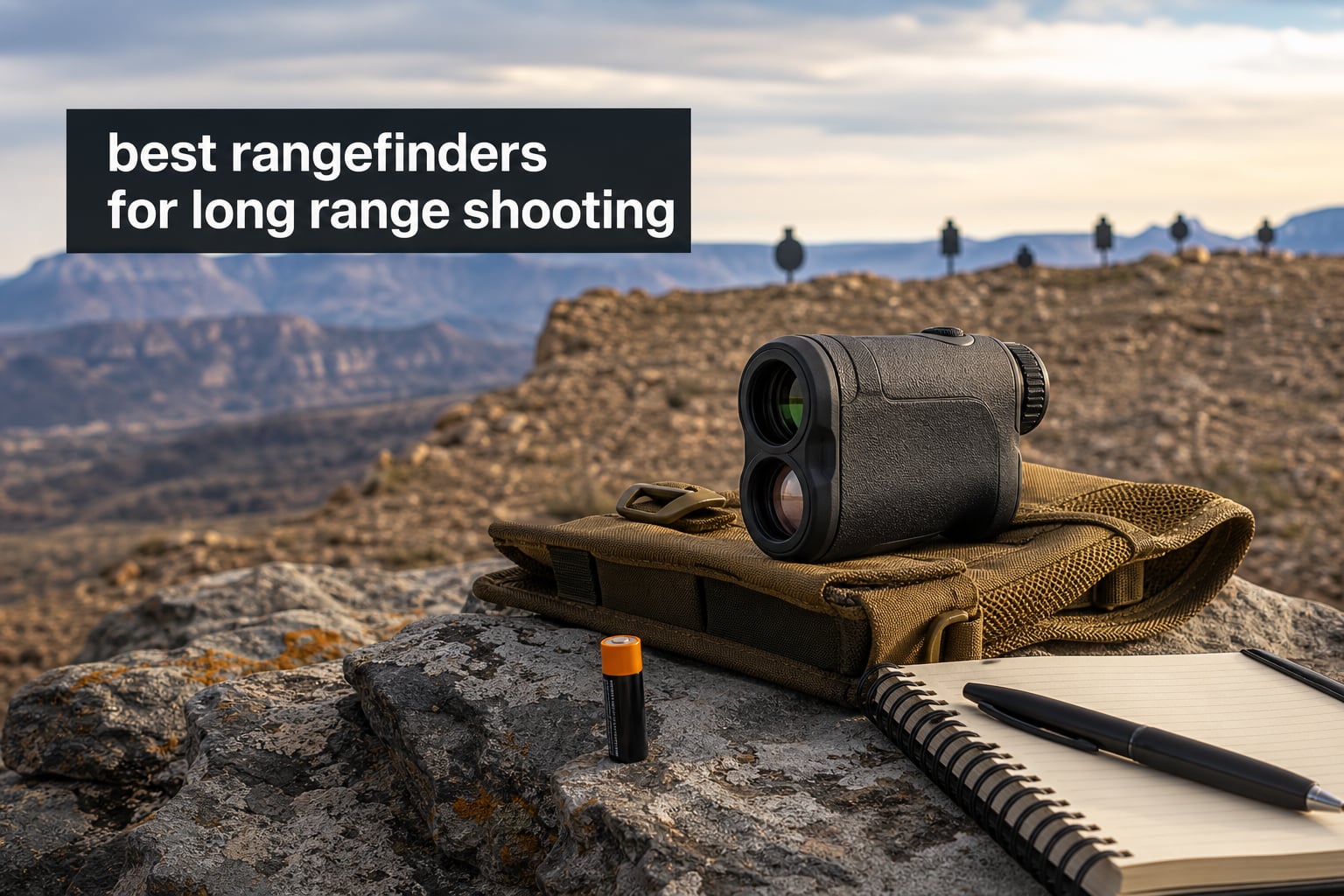
Distance is the input that every long shot depends on. Once a target is beyond roughly 500 yards, an error in the range can turn a correct elevation solution into a miss, even when the rifle, ammunition, and shooter are otherwise ready.
The best rangefinders for long range shooting do more than display a large maximum number. They have to acquire the target you care about, give a readable result, account for angle when needed, and, for many precision-rifle users, feed a usable ballistic solution.
I compared the eight supplied models by their stated target-specific range, optics, display, ranging modes, ballistic features, durability information, and the limits disclosed in their listings. My short version: choose a high-end handheld if you want a dedicated observation-and-ranging tool, choose a rail-mounted unit only for a compatible rifle setup, and treat a huge reflective-range claim as capability headroom rather than a promise on a deer, tree, or dark steel plate.
That distinction matters in 2026. Community discussions repeatedly point to the same frustrations: a low-cost unit that reads a reflective sign but not a distant non-reflective target, a display that is hard to see at the wrong time of day, and an app connection that takes more work than a shooter expected. The right pick is the one whose documented strengths fit the target, terrain, and correction method you actually use.
Table of Contents
Our Top 3 Picks for Best Rangefinders for Long Range Shooting (September 2026)
Vortex Razor HD 4000 is the complete handheld choice here because it combines a stated 4,000-yard maximum with environmental sensing, an on-board GeoBallistics solver, wind modes, and Kestrel connectivity. Leupold RX-1400i TBR/W Gen 2 is the compact alternative for shooters who value a 5.1-ounce body and straightforward true-ballistic-range and wind information.
Bushnell Bone Collector 1800 earns the third card for its combination of 1,800-yard stated range, ARC angle compensation, Applied Ballistics Ultralite, and phone-free profile storage. Its ballistic solutions are specified only to 800 yards, so it fits a different role from the long-reach premium units.

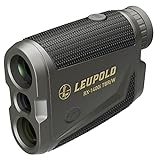

Bushnell Bone Collector 1800
- 1800-yard range
- Applied Ballistics Ultralite
- ARC angle compensation
The rangefinder choices in 2026 cover handheld and rail-mounted needs
The comparison below puts all eight recommendations in one place. Maximum range figures refer to the manufacturer-listed conditions, which often mean a reflective target; when a listing gives tree, game, or deer figures, those are more useful reference points for field use.
| Product | Specifications | Action |
|---|---|---|
| Vortex Razor HD 4000 |
|
Check Latest Price |
| Leupold RX-1400i TBR/W Gen 2 |
|
Check Latest Price |
 Vortex Viper HD 3000 Vortex Viper HD 3000 |
|
Check Latest Price |
 Astra Optix OTX2400B Astra Optix OTX2400B |
|
Check Latest Price |
 SIG SAUER KILO5K SIG SAUER KILO5K |
|
Check Latest Price |
 Vortex Impact 4000 Vortex Impact 4000 |
|
Check Latest Price |
 SIG SAUER KILO2200 SIG SAUER KILO2200 |
|
Check Latest Price |
| Bushnell Bone Collector 1800 |
|
Check Latest Price |
1. Vortex Razor HD 4000 is the best overall handheld for complete ballistic data
Vortex Razor HD 4000 GB Ballistic Laser Rangefinder
4,000 yards
GeoBallistics
Kestrel Bluetooth
Pros
- On-board ballistic solver
- Environmental sensors
- Red backlit LCD
- Four target modes
- Lifetime warranty
Cons
- No stated magnification
- Battery performance is not specified
The Razor HD 4000 is the most fully equipped handheld in this group for a shooter who wants range, weather inputs, and ballistic work in one device. Its listing pairs a 4,000-yard maximum with an on-board GeoBallistics solver, temperature, pressure, and humidity sensors, plus two wind modes that include Wind Bearing Capture Mode.
The 4,000-yard figure is a maximum measurement specification, not a stated game-distance promise. I would read it as extra capability for reflective or cooperative targets and pay closer attention to the target mode, the surface, and the atmosphere when trying to range a practical long-distance target.
The available controls are unusually relevant for precision work. Normal, First, Last, and ELR target modes give the user a way to prioritize target returns, while HCD and BAL ranging modes separate angle-adjusted distance work from ballistic output choices.
The red backlit LCD is a welcome part of the specification because display readability is a repeat concern among rangefinder users. ArmorTek lens coatings, waterproofing, fogproofing, shockproofing, tripod adaptability, and a 10.1-ounce listed weight round out a handheld designed to live in a pack or on a tripod.
The Razor HD 4000 suits shooters who use a Kestrel or want weather-aware corrections
This is the strongest fit for a precision shooter who uses the GeoBallistics app and wants Bluetooth connection to Kestrel devices. The environmental sensors and wind functions are not a substitute for confirming a rifle profile, but they supply data that a long-range correction workflow can use.
It also makes sense for a hunter or match shooter who moves from open terrain to broken terrain and needs several target modes. A tripod-adaptable design is especially useful when holding a small target steady through a handheld is the limiting factor.
The Razor HD 4000 is less suitable when a lightweight basic range read is all you need
Its listed specification does not state optical magnification, so shoppers who want a documented 6x or 7x monocular view have clearer options below. The added solver, sensors, and connectivity are meaningful only if you will configure and use them.
The unit uses a CR2 battery that is included, and the listing does not publish a runtime. Bring a spare on a remote range day; battery preparation is a simple response to one of the field-use problems shooters bring up most often.
2. Leupold RX-1400i TBR/W Gen 2 is the best light handheld for practical ballistic ranging
Leupold RX-1400I TBR/W Gen 2 w/Flightpath Rangefinder, Black/Gray
5.1 ounces
1,400-yard reflective
TBR/W
Pros
- Very light body
- TBR/W technology
- Adjustable TOLED display
- 10-mph wind hold
- Lifetime warranty
Cons
- No Bluetooth
- Shorter stated range than premium units
The RX-1400i TBR/W Gen 2 puts a compact 5x rangefinder in a 5.1-ounce package. Its stated measurements distinguish 1,400 yards on reflective objects from 1,200 yards on trees, a helpful bit of product data that keeps expectations grounded for hunting and field targets.
TBR/W means True Ballistic Range/Wind. The unit supplies ballistically calculated ranges for longer distances and steeper angles, and its listing specifies a hold point for a 10-mph wind at a 90-degree angle out to 800 yards.
The display uses selectable TOLED screens with adjustable brightness and bright red numbers and letters. That is useful for a shooter who needs a clear view in changing light but does not want to run a device with an app, an external meter, or a longer feature menu.
Flightpath and the selectable Bow mode are archery-oriented features, including an indication of potential arrow obstructions. They do not add much to a rifle-only setup, yet they make the product more flexible for someone who uses both equipment types.
The RX-1400i works best for a mobile hunter or rifle shooter who carries light
At 5.1 ounces, this is the obvious option for someone counting pack weight. Its aluminum body, IP54 water resistance, CR2 power, and lifetime guarantee also make the basic field-use proposition easy to understand.
The documented 1,200-yard reading on trees makes it a credible choice for shooters who need a rangefinder for targets around the 1,000-yard class, provided the target and conditions cooperate. A small target at long distance still demands a stable hold and realistic expectations.
The RX-1400i is not the pick for Kestrel-linked or app-based ballistic workflows
There is no Bluetooth connectivity in the listed features. If your established process depends on live external-device communication or a large stored ballistic database, the Vortex Razor HD 4000, SIG SAUER KILO5K, or Astra Optix OTX2400B gives you more documented integration.
The shorter maximum range relative to the upper-tier products also means it is not the specialist choice for extreme reflective targets. For many hunts and standard long-range sessions, the smaller format and direct TBR/W output may be more useful than unused reach.
3. Vortex Viper HD 3000 is the best optical-focused choice for distant game ranging
Vortex Viper HD 3000 Laser Rangefinder
3,000-yard reflective
2,000-yard game
7x25mm
Pros
- 7x HD optics
- 2
- 000-yard game rating
- Red OLED display
- HCD and LOS modes
- Lifetime warranty
Cons
- Battery is not included
- No stated app connection
The Viper HD 3000 makes a useful distinction that many long-range shoppers need: it is listed to 3,000 yards on a reflective target and 2,000 yards on game. That stated game figure gives it a more relevant place in the lineup for a hunter who wants capability beyond a generic reflective maximum.
Its 7x magnification and 25mm objective are likewise more concrete than a vague claim of optical quality. The HD optical system uses select glass elements, while XR Plus lens coatings are intended to maximize light transmission and the red OLED display is specified for low-light clarity.
For target handling, the Viper supplies Normal, First, Last, and ELR target modes. HCD and LOS are both included, so the user can choose between an angle-compensated horizontal distance and a line-of-sight measurement rather than receiving one unexplained number.
The product is listed as 9.1 ounces, waterproof, shockproof, and tripod adaptable. Rubber armor is intended to provide grip, and ArmorTek coatings add lens protection, useful practical details for a rangefinder that may be used in rain, dust, or against a tripod head.
The Viper HD 3000 fits shooters who need documented game-range capability and 7x viewing
For hunters or spot-and-range users, the 2,000-yard game specification is the major reason to choose this model. It is still subject to target size, reflectivity, weather, and a stable aiming position, but it is more informative than assuming a reflective-target number applies to an animal.
Seven-power magnification also supports target identification better than the entries with no stated magnification. I would favor it when reading the terrain and picking the exact object to range matters as much as the distance shown.
The Viper HD 3000 is less direct for shooters who want integrated environmental ballistics
The supplied product data lists HCD and LOS modes, but it does not list a built-in ballistic solver, Bluetooth connection, or environmental sensors. A shooter who wants a single device to generate a weather-aware firing answer should look toward the Razor HD 4000 or Impact 4000.
A CR123 battery is included in the components list, although the product-details field says batteries are not included. Because the supplied listing is inconsistent on that point, confirm what arrives and carry a spare rather than making an assumption before a field trip.
4. Astra Optix OTX2400B is the fastest-reading compact option with Applied Ballistics Bluetooth
Astra Optix OTX2400A 6×21 2400yd Class 1 905nm 0.25mW Eye-Safe Laser Rangefinder with Applied Ballistics® for Hunting, Shooting and Golfing with Red OLED Display Fast 0.1s & Accurate +/-1 yd.
0.1-second reads
2,400-yard reflective
6x
Pros
- Fast stated ranging
- Plus or minus 1-yard accuracy
- Applied Ballistics Bluetooth
- Five display brightness settings
- Lifetime warranty
Cons
- Lower brand recognition
- Deer range stated at 950 yards
The Astra Optix OTX2400B has one of the clearest speed claims in the group: 0.1-second ranging. It also specifies accuracy of plus or minus 1 yard, which is a useful figure for a shooter who wants a quick reading while scanning between targets or confirming several markers.
Its target-specific range details show why category maximums need context. The listed range is 2,400 yards on a reflective target, 1,400 yards on a tree, and 950 yards on a deer, so the product is better framed as a capable 1,000-yard-class hunting rangefinder than as a guaranteed 2,400-yard animal-ranging tool.
The OTX2400B combines 6x magnification, an all-glass optical system, fully multi-coated lenses, a rain-repellent coating, and a red OLED display with five brightness settings. Those features speak directly to the two things users see first: the target image and the returned number.
Gun Mode can connect through Bluetooth with Applied Ballistics. Scan, Horizontal, Angle, Archery, and Golf modes are also listed, making this a multifunction handheld rather than a rifle-only unit.
The OTX2400B is a strong match for shooters who want quick readings and an app-linked profile
The specified 0.1-second response, 6x view, and adjustable OLED make the model attractive for shooters who value a fast, readable range read. Its listed approximately 4.9-ounce weight further supports a compact hunting or field-rifle kit.
Applied Ballistics connection is the differentiator. It makes sense for someone who is comfortable setting up a ballistic profile and wants that data path available without moving to a large rail-mounted device.
The OTX2400B needs realistic expectations on deer-sized targets and app setup
The 950-yard deer figure is the field-relevant figure to plan around, not the 2,400-yard reflective claim. For a small or low-reflectivity target, a tripod or a supported position can help the shooter aim at the right object and avoid an unintended background return.
Bluetooth is useful only after the profile, device permissions, and connection are set up correctly. Forum users regularly describe connectivity as a possible friction point, so configure the system before the day you need it and keep manual range-and-dope skills available.
5. SIG SAUER KILO5K is the extreme-range choice for external ballistic equipment users
Sig Sauer KILO5K 7 x 25 mm Laser Rangefinder
5,000-yard reflective
7x25mm
Applied Ballistics
Pros
- Longest listed maximum
- Kestrel and Garmin support
- Environmental sensors
- XR and Fog modes
- OLED display
Cons
- Battery is not included
- Only reflective maximum is stated
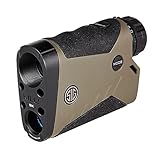
The SIG SAUER KILO5K has the longest stated reflective maximum in this set at 5,000 yards. That number indicates substantial ranging headroom on a suitable reflective target, while the supplied listing does not specify corresponding tree, game, or deer measurements.
The reason a long-range shooter might choose it is not the maximum alone. Applied Ballistics Ultralite, built-in environmental sensors, elevation holdover and wind holds, and BDX External support for Kestrel and Garmin devices put it squarely in an integrated ballistic workflow.
Its 7x25mm monocular, SPECTRACOAT anti-reflection coatings, and segmented LUMATIC OLED display provide the stated optical and display foundation. The Gen II LightWave DSP engine, XR mode, Fog mode, and First, Best, and Last target modes show that the product is built to sort target returns in more demanding conditions.
The KILO5K also supports the SIG SAUER BDX app and BaseMap app connection for remote waypoints. Those are useful capabilities for a user who actually maintains digital profiles and field points, not mandatory features for everyone who merely needs a distance.
The KILO5K makes the most sense for extreme-range work with Kestrel or Garmin equipment
Choose this model when its external-device support has a defined role in your system. Kestrel and Garmin compatibility, environmental sensors, and onboard Applied Ballistics data offer a connected route from conditions to a solution.
The 7x magnification is also appropriate for a shooter trying to select a specific target at distance. In fog or a cluttered background, modes are tools rather than guarantees; verify that the displayed return belongs to the intended target.
The KILO5K is not the simple choice for users who only need known-distance target reads
Its capabilities create setup work. A ballistic answer is only as dependable as the selected profile, sight height, ammunition data, zero, and current environmental information, so a shooter should validate the full system at known distances.
The supplied data says a lithium battery is needed but not included, and rates the housing IP54 water resistant. Bring power, protect the device from conditions beyond that rating, and do not equate a 5,000-yard reflective specification with a repeatable reading on every target type.
6. Vortex Impact 4000 is the rail-mounted answer for a compatible precision rifle
Vortex Impact 4000 Ballistic Rail-Mounted Laser Rangefinder
Rail mounted
4,000 yards
GeoBallistics solver
Pros
- Picatinny mounting
- On-board GeoBallistics
- Environmental sensors
- Wind Bearing Capture
- Bluetooth connection
Cons
- One-pound listed weight
- 1x magnification
- Rifle-specific mounting
The Vortex Impact 4000 differs from every handheld recommendation because it mounts to a Picatinny rail. Its design is meant to place ranging and GeoBallistics information on a compatible rifle system rather than ask the shooter to move between a monocular rangefinder and the rifle.
The listing gives a maximum measuring range of up to 4,000 yards and identifies on-board environmental sensors for compass, humidity, barometric pressure, and temperature. Wind Bearing Capture Mode and in-display wind and drop solutions target the same precision-rifle problem: converting a measured target and current conditions into useful correction information.
Bluetooth connection to the GeoBallistics app, a built-in range card generator, and Vortex Relay Network compatibility expand the device beyond a standalone ranging module. It is waterproof and shockproof, uses a lithium-ion battery that is included, and carries Vortex’s unlimited unconditional lifetime warranty.
There is a real tradeoff in the mount. The device is listed at one pound and 1x magnification, so it is not an observation optic and it adds mass to the rifle rather than living in a pocket or bino harness.
The Impact 4000 is right for a shooter who wants range and correction data mounted to the rifle
A rail-mounted rangefinder suits a compatible precision-rifle setup where the shooter has decided that less movement between ranging and firing positions is valuable. It can be particularly relevant where a supported rifle position and an established ballistic profile are already part of the process.
The integrated sensors and solver are meaningful only after the shooter checks the rifle profile and validates the returned solution. This is a data tool, not permission to skip normal safe shooting practices, target verification, or a confirmed zero.
The Impact 4000 is a poor fit for handheld glassing and lightweight carry
At 1x, it does not replace binoculars, a spotting optic, or a 6x-to-7x handheld rangefinder for target identification. A shooter who needs to locate game or read a distant target before ranging it will still need observation glass.
It also needs a compatible Picatinny rail and a rifle-centered workflow. For hiking, general hunting, or shared use across several rifles, a handheld model such as the Razor HD 4000 or Viper HD 3000 is the more flexible form factor.
7. SIG SAUER KILO2200 is the simple 6x option for modest-distance ballistic support
Sig Sauer Electro-Optics Kilo2200 6x22mm Monocular Digital Ballistic Laser Rangefinder, High-Precision Optics, Ideal for Hunting and Shooting (SOK22606)
1,200 yards
6x22mm
Digital ballistics
Pros
- 6x22mm optics
- Digital ballistic technology
- Compact design
- Clear interface
- Battery included
Cons
- Only 12 reviews
- 1
- 200-yard maximum
- Reliability concerns in reviews
The SIG SAUER KILO2200 is a smaller-scope recommendation for shooters who want 6x22mm optics, a stated 5-to-1,200-yard measuring range, and digital ballistic technology. It is not built around the extreme maximums, environmental sensors, or external-device features of the KILO5K.
Its listing calls out a compact, lightweight design, a clear display interface, and user-friendly controls. At 0.57 pound with a polymer body, it is positioned as a straightforward monocular for hunting and shooting rather than a heavy precision-rifle component.
For normal steel, hunting, and known-distance practice inside the stated 1,200-yard ceiling, the 6x view is useful for aiming at the intended object. Digital ballistic technology gives it a correction-oriented feature that basic distance-only models may lack.
The review base shown in the product data is limited to 12 reviews, with a 4.3 average rating and a stated portion of one-star feedback. That small sample means I would approach it as a simple feature set to evaluate carefully, not as a model with the same depth of buyer feedback as the higher-reviewed entries.
The KILO2200 fits users who want a compact rangefinder for standard long-range practice
The documented 1,200-yard maximum and 6x22mm format make this a reasonable fit for a shooter whose realistic targets are inside that distance. It can also work as a light hunting rangefinder where the shooter values a clear interface over a more complex connected system.
A battery is listed as included, which is helpful for initial setup. Still, no battery-runtime figure is provided, and any rangefinder used away from the vehicle benefits from a spare power plan.
The KILO2200 is not the right tool for extreme range or high-confidence buyer consensus
There is no stated weather sensor suite, Bluetooth connection, Kestrel support, or target-specific range figure. Those omissions matter when the goal is a deep ballistic workflow or a carefully defined performance expectation on deer, trees, and other non-reflective targets.
The limited review count and listed reliability concerns also argue for testing the exact unit at known ranges during the return window. Confirm its readings on the actual target materials and terrain you expect to use before depending on it for a demanding shot.
8. Bushnell Bone Collector 1800 is the balanced hunting option with phone-free profiles
Bushnell Bone Collector 1800 Hunting Rangefinder
1,800 yards
ARC angle compensation
6x25mm
Pros
- Applied Ballistics Ultralite
- Phone-free profiles
- ARC technology
- 6x25mm optics
- Bluetooth app setup
Cons
- Ballistic solutions stop at 800 yards
- IPX4 water resistance
- Small review base
The Bushnell Bone Collector 1800 offers a stated 1,800-yard range with plus-or-minus-1-yard precision, 6x25mm optics, ARC angle range compensation, and Applied Ballistics Ultralite. The important boundary is clear in the listing: ballistic solutions are limited to 800 yards even though its ranging number extends farther.
That split is not a flaw if it matches your use. A hunter may need a long distance read to plan a stalk, verify terrain, or observe an object, while still taking shots inside the distance where the unit is specified to provide ballistic solutions.
Bluetooth connection to the Bushnell Ballistic App can be used for profile setup, and the rangefinder stores ballistic profiles without requiring the phone in the field. This is a practical middle ground for users who want to configure information at home but do not want their phone involved in every range read.
Fully multi-coated lenses and a stated 50% larger objective lens are presented as two-times brighter imaging. The model is listed at 0.59 pound, with IPX4 water resistance and a lifetime Ironclad warranty.
The Bone Collector 1800 suits hunters who want ARC and stored ballistic data for shorter solutions
ARC directly addresses uphill and downhill geometry, which is useful from a stand, ridge, or other angled position. The 6x25mm optics and 1,800-yard stated ranging capacity make it a flexible handheld for observation and distance confirmation.
Phone-free profile storage is the feature that separates it from a basic hunting rangefinder. Set up the profile carefully, then use the unit without depending on mobile reception or a live app connection at the moment of use.
The Bone Collector 1800 is not a replacement for an extended-range ballistic solver
Its ballistic solutions stop at 800 yards, so shooters pursuing corrections well beyond that distance should not assume that the 1,800-yard ranging figure means it supplies a firing solution all the way there. The Vortex Razor HD 4000, KILO5K, and Impact 4000 are better aligned with more extensive ballistic systems.
IPX4 is water resistance rather than a stated waterproof rating, and the product has 38 reviews with some negative feedback noted in the supplied data. Check button operation, display visibility, and returns on your own target materials early in ownership.
The right buying guide starts with the target you must actually range
A long-range laser rangefinder sends a laser beam toward a target and calculates distance from the return trip. That sounds simple, but the return depends on what you aim at: a large reflective surface usually gives the device an easier signal than dark fur, a tree, brush, or a small steel plate.
Start with the target-specific figure if the listing supplies one. The Viper HD 3000 lists 3,000 yards reflective and 2,000 yards on game; the Astra lists 2,400 reflective, 1,400 on a tree, and 950 on a deer; the Leupold lists 1,400 reflective and 1,200 on trees.
Those distinctions explain why a rangefinder can seem impressive in one scenario and limited in another. They also support a sensible buying rule: get more listed ranging headroom than the farthest non-reflective target distance you realistically need.
The most useful magnification is usually 6x or 7x for a handheld long-range rangefinder
Six-power and seven-power units make it easier to place the reticle on the specific rock, plate, tree, or animal you mean to range. The Viper HD 3000 and KILO5K list 7x optics, while Astra, KILO2200, and Bushnell list 6x optics; the Leupold lists 5x.
More magnification is not automatically better if it makes hand shake more obvious. A tripod-adaptable unit or a supported position can do more for target acquisition than chasing a small magnification difference, especially when the target is narrow or sits in front of a busy background.
Angle compensation works by converting a sloped shot into a usable distance reference
For an uphill or downhill shot, line-of-sight distance is the straight measurement from you to the target. The bullet’s gravity drop relates more closely to the horizontal component of that distance, which is why rangefinders can offer a compensated figure.
HCD means Horizontal Component Distance. In an HCD-style mode, the device gives an angle-compensated distance intended to help with shooting on a slope; Vortex Viper HD 3000 lists HCD and LOS, while the Razor HD 4000 lists HCD and BAL.
LOS means Line of Sight. Use it when a ballistic solver or shooting method requires the direct measured distance and will handle the angle itself; do not apply angle correction twice by feeding a corrected number into a process that expects LOS.
Ballistics data helps only after the rifle profile and inputs have been confirmed
An on-board solver can combine range with information such as ammunition and atmospheric conditions to provide elevation and wind holds. The Razor HD 4000, KILO5K, Impact 4000, and Bushnell list onboard ballistic features, but the depth of their stated data and integration differs.
Verify your zero, ammunition information, sight height, and selected profile before treating any displayed correction as authoritative. The prudent routine is to confirm the complete rangefinder-and-rifle setup at known distances, then retain the ability to use a manual range card if a battery or connection fails.
The display and target modes matter when light and backgrounds change
Red LCD or OLED displays can be easier to read in low light, while adjustable brightness helps prevent the display from blooming or disappearing against a bright scene. The Razor uses a red backlit LCD, Viper and Astra use red OLED displays, Leupold has adjustable TOLED displays, and the KILO5K lists an adaptive LUMATIC OLED display.
First, Last, Best, Normal, ELR, XR, and Fog modes are ways to influence how a rangefinder handles multiple returns. They are useful only when you understand the mode and can verify the target; an accidental reading from foreground brush or a background slope can still produce a precise but wrong answer.
Battery and weather preparation are part of a reliable field setup
Listings identify CR2 power for the Razor and Leupold, CR123 for the Viper, CR-2 for Astra, lithium for the KILO5K, lithium-ion for the Impact 4000, and included lithium or lithium-ion power for Bushnell. Carry the correct spare and learn the display’s low-battery behavior before the field session.
Water resistance ratings also vary. Razor, Viper, Astra, and Impact 4000 are listed as waterproof; Leupold, KILO5K, and Viper also publish IP54 protection in supplied data, while Bushnell lists IPX4 water resistance. Protect every optic from unnecessary moisture and do not infer a rating the manufacturer has not stated.
The mounted-versus-handheld choice depends on how you observe targets
A handheld rangefinder is the flexible choice for hikers, hunters, shared equipment, and anyone who wants to range from a separate observation position. It can also be used with a tripod when a small distant target demands a steadier aim.
A rail-mounted unit such as the Vortex Impact 4000 is for a rifle system with a Picatinny rail and a deliberate integrated workflow. It can reduce movement between rifle and rangefinder, but it adds listed weight to the rifle and does not replace magnified observation glass.
FAQs
What features should I look for in a long range rangefinder?
Look for a target-specific range rating, not only a reflective maximum; 6x or 7x optics; a readable adjustable display; angle-compensation modes; target-selection modes; and a weather or ballistic system that fits your established shooting process. Also check power type, water rating, mounting options, and whether a stated game, tree, or deer range covers your actual use.
How far can a long range rangefinder reach?
The models here list maximums from 1,200 to 5,000 yards, but maximum figures often apply to reflective targets. More useful examples are the Vortex Viper HD 3000 at 2,000 yards on game, Leupold RX-1400i at 1,200 yards on trees, and Astra OTX2400B at 950 yards on deer. Target size, reflectivity, weather, and aiming stability affect real returns.
What is the best magnification for a rangefinder?
For handheld long-range use, 6x or 7x is a practical range because it helps you place the reticle on a distant target without becoming excessively difficult to hold steady. The products reviewed here include 5x, 6x, and 7x examples. A tripod-compatible body or supported position can matter more than one extra power when the target is small.
How does angle compensation work on rangefinders?
Angle compensation measures the slope to the target and reports a distance reference for the shot. HCD reports horizontal component distance, while LOS reports direct line-of-sight distance. Use the mode your rifle ballistic process expects, and avoid double-correcting: if a solver needs LOS and handles angle itself, give it LOS rather than an already compensated distance.
What is the difference between HCD and LOS modes?
HCD means Horizontal Component Distance and is an angle-compensated distance used for sloped-shot decisions. LOS means Line of Sight and is the actual straight-line measurement to the target. HCD can be useful when you need a direct compensated reading, while LOS is appropriate when an external or onboard ballistic solver is configured to calculate the angle effect itself.
The best final choice depends on your ballistic workflow and target distance
Vortex Razor HD 4000 is my overall recommendation for the shooter who wants a handheld with environmental inputs, wind functions, and GeoBallistics capability. Choose the Leupold RX-1400i TBR/W Gen 2 when low carry weight and direct compensated ranging are higher priorities, and choose the Vortex Viper HD 3000 when its stated 2,000-yard game figure and 7x optics match your field use.
SIG SAUER KILO5K and Vortex Impact 4000 are specialized options for connected or rifle-mounted precision systems. Astra, SIG SAUER KILO2200, and Bushnell cover faster Bluetooth-enabled ranging, simpler digital ballistics, and ARC with stored profiles respectively.
The best rangefinders for long range shooting in 2026 are the ones you have configured, checked against known distances, and selected for a realistic target rather than a headline maximum. Confirm your rifle data and your range return before any shot, especially when range, wind, angle, or target identification is uncertain.