
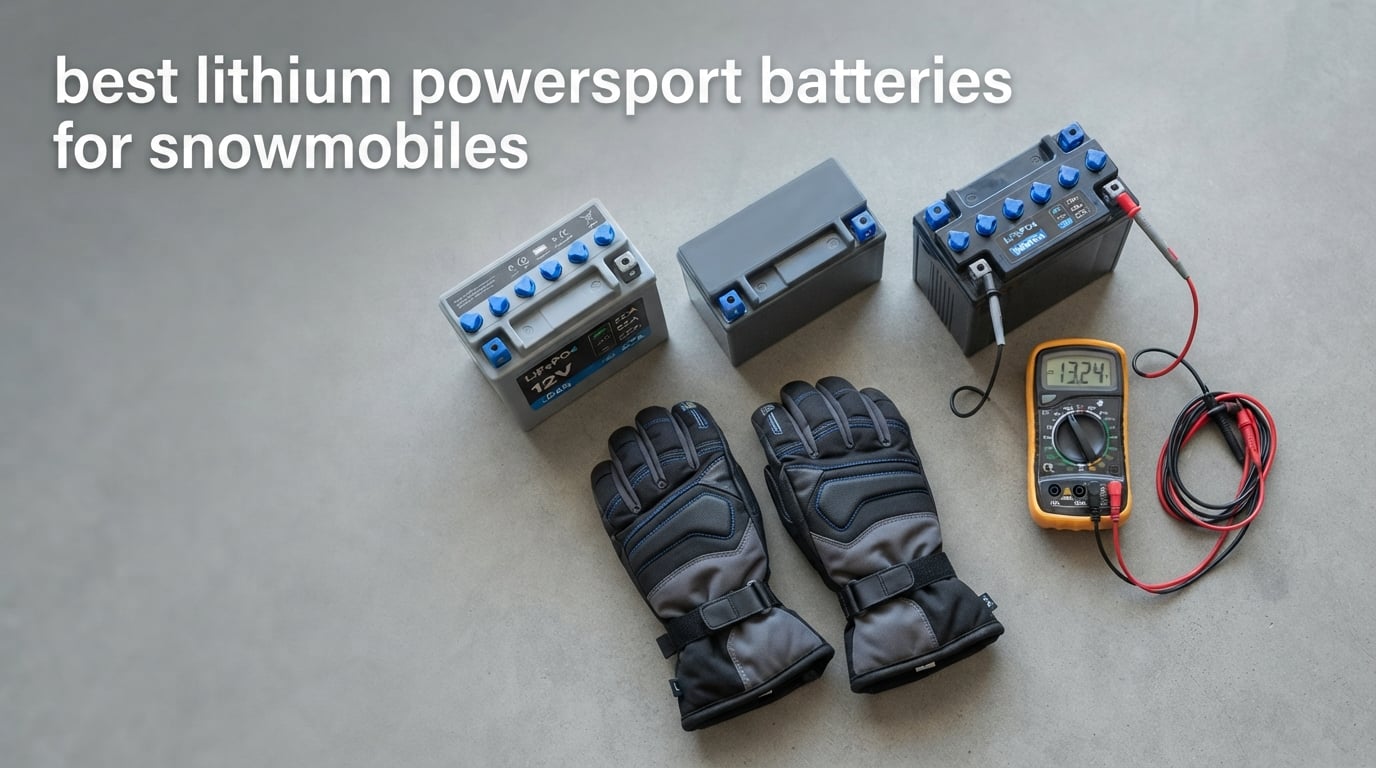
The best lithium powersport batteries for snowmobiles are not a one-size-fits-all upgrade. A good pick must match the tray, terminal layout, capacity and starting demand of the sled, while also working with its charging system when winter temperatures make every battery work harder.
For this 2026 guide, I compared eight listed lithium batteries by their published fit information, stated CCA or start-power figures, capacity, weight, protection features, warranty language, and customer-rating data. My short answer is that lithium can be a smart snowmobile choice for a properly matched sled, but a battery should never be chosen by a high amp number alone.
Weight savings and no-acid upkeep are real attractions, particularly on a mountain sled or a machine that gets moved often. Still, cold-soaked cranking and below-freezing charging are the deciding issues, which is why I would check the owner manual, the old battery label, and regulator output before ordering.
A battery is only one part of a dependable pre-ride setup. If you are refreshing other wear items at the same time, our guide to carbon fiber drive belts for snowmobiles is a useful companion checklist.
Table of Contents
Our top three lithium powersport battery picks answer three snowmobile needs
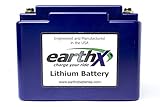
The EarthX ETZ14C gets the dedicated-snowmobile nod because its listing expressly calls out snowmobile use and combines a 2.5-pound weight with a published 330 CCA figure. NOCO’s NLP20 is the flexible Group 20 choice for riders who need a 7Ah battery, multi-terminal hardware, a smart BMS, and a five-year limited warranty, while LIYON is the standout when a listing specifically states 420 CCA at -25°C.
These eight lithium powersport batteries give snowmobile riders distinct fit and output options in 2026
This overview puts the published numbers in one place, but it also shows why they need context. Some manufacturers state CCA, others state peak cranking amps or generic start power, so I would not treat every number as a directly equivalent cold-start measurement.
Physical dimensions, terminal polarity, tray clearance, and the sled’s original battery specification remain the first filters. The comparison card is a starting point for a snowmobile battery comparison, not a substitute for the service manual or an actual measurement of the removed battery.
| Product | Specifications | Action |
|---|---|---|
 EarthX ETZ14C EarthX ETZ14C |
|
View Details |
 LIYON LP16-BL-6AH LIYON LP16-BL-6AH |
|
View Details |
 NOCO NLP20 NOCO NLP20 |
|
View Details |
 TYKOOL LFP20L-BS-STD TYKOOL LFP20L-BS-STD |
|
View Details |
 WEIZE YTX20L-BS WEIZE YTX20L-BS |
|
View Details |
 Autocessking YTX20L-BS Autocessking YTX20L-BS |
|
View Details |
 DOUKAS DKL12 DOUKAS DKL12 |
|
View Details |
 Skyrich HJ-01 Skyrich HJ-01 |
|
View Details |
1. EarthX ETZ14C is the snowmobile-specific lightweight pick
EarthX ETZ14C Lithium Iron Phosphate Battery (LiFePo4) Motorcycle/Snowmobile 2.5# 330CCA!
LiFePO4
2.5 lb
330 CCA
Snowmobile use
Pros
- 2.5 pound weight
- Snowmobile application listed
- No acid or sulfation
- 2 to 3 times lead-acid life
Cons
- Catalog battery-type conflict
- Only 1 year coverage
EarthX is the clearest match in this group for a rider seeking a lithium snowmobile battery rather than a battery that merely lists snowmobiles among many vehicle types. The ETZ14C product name calls it a motorcycle and snowmobile LiFePO4 battery, and the feature list says it is great for snowmobile applications.
I also like the simple published numbers: 2.5 pounds and 330 CCA. Its listing separately advertises 690 peak cranking amps, but peak amps and CCA are different labels, so I would use the 330 CCA figure for a cautious comparison and confirm the sled’s original cranking requirement.
Its described benefits are sensible for winter ownership: no freezing, boiling over, corrosion, leakage, or sulfation are claimed, along with a stated life of two to three times lead-acid. The analyzed rating is 4.5 from 15 reviews, with feedback noted for low weight and reliable starts, though that is still a small review base.
It fits best when the sled needs a compact dedicated snowmobile listing
The ETZ14C measures 5.9 by 3.4 by 4.5 inches, so I would compare those dimensions and terminal locations with the old battery before treating it as a drop-in part. A compact 2.5-pound unit can be appealing when removing mass is a real goal, not just a spec-sheet preference.
EarthX’s vehicle-specific snowmobile positioning makes this the first battery I would investigate for a smaller tray that calls for this shape. It still needs the same fitment check as any universal replacement because the listing’s compatible-vehicle field is broader and less specific.
Its catalog details need one careful verification before installation
The product title and feature list call this battery lithium iron phosphate, while the analyzed product-details field lists its battery type as lead acid. That conflict is likely a catalog-data issue, but I would confirm the chemistry and the exact ETZ14C fitment with the manufacturer before connecting it to a sled.
The listing provides one year of full coverage, which is shorter than several alternatives here. That makes correct installation, a healthy regulated charging system, and retaining the purchase documentation more important for this particular choice.
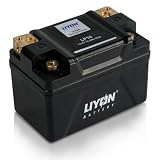
2. LIYON LP16-BL-6AH is the pick with a stated sub-freezing CCA figure
LIYON Lithium YTX14-BS/YTX9-BS/YTZ10S-BS Motorcycle ATV Battery, 12v 6Ah LiFePO4 Powersports Battery, Instant-Start 600A 420 CCA(-25°C) – with 4 Universal-Fit Spacers, ADV UTV PWC Cruiser Snowmobile
6Ah
420 CCA at -25C
Universal spacers
IP65
Pros
- 420 CCA stated at -25C
- Four fit spacers
- Smart BMS
- 2 year replacement promise
Cons
- Universal fit still needs measuring
- Small review base
The LIYON is unusually useful for cold-weather shoppers because its title states both 600A instant-start output and 420 CCA at -25°C. Most listings in this roundup do not attach a temperature to their CCA figure, so this one gives a more relevant published reference point for a cold-start discussion.
It is a 12V, 6Ah LiFePO4 powersports battery with a listed weight of 2.79 pounds. Four universal-fit spacers and a multi-terminal design give it a wider installation range, but I would read that as installation flexibility, not proof that it belongs in every snowmobile tray.
LIYON claims 2,000-plus cycles, IP65 dust and water resistance, pre-charged delivery, and BMS protection against overcharge, over-discharge, short circuit, and overheating. Its analyzed 4.6 rating comes from 46 reviews, with cold-weather performance called out positively, and it includes a two-year manufacturer replacement promise.
It answers the cold-start question better than a generic amp claim
A listed 420 CCA at -25°C is the most directly cold-related cranking statement among these products. I would still treat it as the maker’s claim rather than a guarantee for a specific engine, oil viscosity, or overnight temperature, because those conditions change how much current a sled needs.
Forum discussions repeatedly describe lithium packs becoming sluggish when cold-soaked. A stated cold figure is helpful, but it does not erase the need to start with a fully charged battery and to understand how the machine behaves after sitting outside.
Its adjustable mounting hardware solves space but not polarity
The published case dimensions are 5.91 by 3.43 by 3.66 inches. The included spacers can take up empty tray space, which is useful when replacing several YTX and YTZ sizes, but they cannot correct a reversed terminal layout or cables that do not safely reach.
I would place the old battery next to the dimensional drawing, check positive and negative cable routing, and fasten the pack so it cannot move over rough trail sections. Those mundane checks matter more than an advertised universal-fit label.
3. NOCO NLP20 is the adaptable Group 20 choice for many sled layouts
NOCO Lithium NLP20: Ultra-Light 12V Lithium Powersport Battery – Group 20 – 7Ah – 600A Start Power – Intelligent BMS – UL Certified
Group 20
7Ah
600A start power
Intelligent BMS
Pros
- 7Ah Group 20 format
- Multi-terminal hardware
- Intelligent BMS
- 5 year limited warranty
Cons
- Spacer may be needed
- Start power is not listed as CCA
The NOCO Lithium NLP20 is a 12V Group 20 battery rated at 7Ah and listed at 2.38 pounds. It is explicitly listed for snowmobiles along with other powersports uses, and its supplied mounting block, 12mm spacer, 15mm spacer, and three-way terminals make it one of the more adaptable packages here.
NOCO publishes over 600 amps of starting power rather than a CCA figure. That is a strong output claim, but I would not convert it into CCA or assume it beats a battery with a different rating method; use the sled’s factory battery spec and exact physical requirements as the tie-breaker.
The NLP20’s intelligent BMS is claimed to balance cells actively and protect against overcharge, short circuit, over-discharge, and extreme temperatures without a reset. The listing also claims up to 50,000 starts and 2,000 cycles, while the analyzed rating is 4.2 from 1,775 reviews and the warranty is five-year limited.
It suits Group 20 replacements that need terminal flexibility
NOCO lists a long replacement group list that includes YTX20L, YTX20L-BS, YTX20HL, and several BTX, GYZ, and ETX models. That makes it a plausible candidate for a Group 20-style snowmobile battery bay, but a part-number match does not replace comparing the actual enclosure and cable reach.
I would particularly check the listed dimensions, 7.83 by 7.64 by 8.15 inches, against the available area. The supplied hardware is an advantage only if the battery can sit flat, stay restrained, and avoid contact with a seat base or body panel.
Its charging convenience still depends on winter conditions
NOCO says five minutes of charging can provide enough current to crank an engine, and it recommends charging before installation even though it ships pre-charged. Fast recovery can be handy, but a lithium battery should not be charged below the temperature range permitted by its manufacturer or charger.
For off-season storage, I would follow NOCO’s battery instructions and disconnect parasitic loads where the sled manual calls for it. A BMS is a protection system, not a reason to connect any charger or leave a known charging-system problem unresolved.
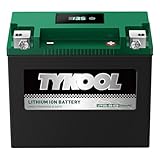
4. TYKOOL LFP20L-BS-STD is the direct YTX20L replacement with an LCD
Pros
- Direct YTX20L-BS replacement
- LCD system display
- IP66 rated
- Low self-discharge claim
Cons
- Output must stay below 15V
- 1 year warranty
TYKOOL’s LFP20L-BS-STD is built around a clearer fit target than most generic listings: it is described as a direct replacement for YTX20L-BS and a list of equivalent batteries. It combines 8Ah, a published 480 CCA, and a 3.3-pound listed weight, which puts it in a useful middle ground for a larger replacement format.
The built-in LCD digital readout is its practical differentiator. I like having an immediate system-health indicator available at the battery, especially when diagnosing a machine that has sat for months, although a display cannot tell you whether a sled’s regulator is operating within lithium-safe limits.
TYKOOL claims IP66 off-road protection, vibration-resistant construction, a flame-retardant ABS case, and self-discharge below one percent a month. The analyzed customer score is 4.2 from 173 reviews; the product comes with a one-year warranty, so its detailed fit and diagnostic features carry more weight than warranty length here.
It is strongest when the original battery is a confirmed YTX20L format
The stated case size is 6.9 by 3.42 by 6.1 inches, and the listing says no spacer is required for its direct-replacement application. I would still measure the battery compartment and check terminal polarity, because a nearly identical case can have a cable-routing problem on a particular sled.
Its listing names snowmobiles and also mentions Polaris among compatible brands. That is useful lead information for a Polaris owner, but it is not enough to declare universal Polaris fitment across model years or engine packages.
Its voltage warning is the reason to test the charging system first
TYKOOL specifically says the battery is for regulated systems with output below 15.0V and tells buyers to verify that output with a multimeter. This is the most explicit electrical warning in the roundup, and I would take it seriously rather than installing first and troubleshooting later.
If voltage rises beyond the battery’s limit, the BMS may protect the pack or the cells may be stressed. A technician or a competent owner with a meter can check charging voltage at the terminals according to the sled manual before making the switch.
5. WEIZE YTX20L-BS is the 8Ah option with published charge-temperature limits
Weize Lithium YTX20L-BS, Group 20, 600A LiFePO4 Motorcycle Battery, 12V 8AH ATV, UTV, Jet Ski, 4 Wheeler, Snowmobile, Personal Watercraft, Seadoo, Polaris, Generator and Riding Lawn Mower Battery
600 CCA
8Ah
Group 20
5 year warranty
Pros
- 600 CCA claim
- Published charge temperatures
- Built-in BMS
- 5 year warranty
Cons
- Measure before buying
- CCA must match original need
The WEIZE YTX20L-BS is a Group 20, 12.8V LiFePO4 battery listed at 8Ah, 600 CCA, and 6.2 pounds. It is marketed for snowmobiles, personal watercraft, ATVs, UTVs, and other powersports equipment, so its broad application needs to be narrowed by the old battery size and terminal orientation.
What separates this listing from many alternatives is an explicit temperature line: charging from -20°C to +45°C and discharging from -20°C to +60°C. Those are published product claims, but they give a buyer a better starting question than a vague promise of cold-weather readiness.
WEIZE also claims 50,000-plus starts and 2,000 charge cycles, with automatic BMS protection against overcharge, over-discharge, overcurrent, short circuits, and temperature problems. Its analyzed 4.2 rating is based on 1,698 reviews, and the listing provides a five-year warranty.
It makes sense when an 8Ah Group 20 battery matches the sled
The specified dimensions are 6.93 by 3.43 by 6.1 inches, with an M6 terminal arrangement shown as negative left and positive right. I would compare that layout, not just the Group 20 label, with the factory part because batteries that fit the tray can still have inconvenient or unsafe cable routing.
WEIZE itself says to measure the old battery and keep CCA close to the original requirement. That is exactly the right approach for a snowmobile with a larger engine or accessories that add demand at the moment of starting.
Its published cold limits make charger selection part of the purchase
The stated charging range reaches -20°C, yet riders should still follow the supplied instructions and use a charger approved for the battery chemistry. User forums often point to BMS charge shutoff below freezing as the reason a battery will not accept a charge, so the individual battery instructions matter more than a general internet rule.
I would bring a cold battery into a suitable temperature range only when the maker permits it and keep the charger connection clean and dry. The key point is not to force charge into an unknown cold lithium pack after a trail day.
6. Autocessking YTX20L-BS is the high-cycle-claim Group 20 alternative
Pros
- 8Ah Group 20 form
- Built-in BMS
- 2
- 000 cycle claim
- 5 year warranty
Cons
- Mixed review distribution
- Check terminal and dimensions
Autocessking’s YTX20L-BS is another 12V, 8Ah Group 20-style option that lists snowmobiles and Polaris equipment among its applications. The listing states 600A in the product title and 600 CCA in its feature set, plus 50,000-plus starts and 2,000 charge cycles, so I would first confirm which stated output measure applies to the exact battery.
It weighs 5.91 pounds and measures 6.93 by 3.43 by 6.1 inches, closely matching the large-format direction of the WEIZE model. A built-in BMS and claims of no acid, sulfation, activation, water, or routine maintenance make it attractive for someone moving away from a lead-acid unit.
This is the most heavily reviewed listing in the group, with a 4.3 average across 2,577 reviews. The review data also shows 12 percent one-star ratings, so I would take the larger sample as useful context while giving the lower-score reports proper weight rather than calling it an automatic recommendation.
It works best when capacity and Group 20 dimensions have been confirmed
An 8Ah case may be a better physical and electrical starting point for a sled that originally used a larger YTX20L-style battery than a compact 2Ah or 4Ah model. The correct choice is still the battery whose measured size, capacity requirement, terminal arrangement, and stated cranking specification meet the factory requirement.
Autocessking lists an M6 terminal. I would verify whether the sled’s cable ends sit flat on that terminal and whether the positive lead can reach without tension or contact with the chassis.
Its many reviews are useful context rather than a replacement for fitment
A high review count gives more owner feedback to consider, but it cannot confirm performance on one particular engine after a very cold night. The 12 percent one-star share in the analyzed data is a reason to read the instructions, maintain realistic expectations, and keep warranty information.
For a snowmobile that sees long storage periods, I would also inspect for parasitic drain and check the battery at the intervals recommended by the maker. A low self-discharge chemistry cannot offset a persistent electrical draw.
7. DOUKAS DKL12 is the 4Ah lightweight choice with a battery indicator
DOUKAS DKL12 YTX12-BS 550A LiFePO4 Motorcycle Lithium Battery, 12V 4Ah Powersports Battery, Compatible Jet Ski, Lawn Mower, Scooter, Generator Battery, Snowmobile
4Ah
550A
3.08 lb
BMS indicator
Pros
- 550A start-power claim
- 3.08 pound weight
- Built-in BMS indicator
- Broad brand list
Cons
- 4.4 rating
- Long-term concerns in reviews
The DOUKAS DKL12 is a 12V, 4Ah LiFePO4 battery with a stated 550A starting-power figure and a 3.08-pound listed weight. Its compact capacity and low mass make it a logical model to examine for a sled whose original specification is in the YTX12-BS range, not a substitute for a larger battery just because the advertised amp figure looks impressive.
DOUKAS says the pack provides three times the starting power and five times the service life of lead-acid, along with faster charging. It also includes an easy-to-read BMS indicator, which can help a rider spot battery status before a trip, though it does not diagnose fuel, spark, starter, or regulator faults.
The listing names Arctic Cat, BRP, Polaris, Yamaha, Kawasaki, and other powersports brands among a broad compatibility list. Its analyzed rating is 4.4 from 43 reviews, with lower-star feedback noted for longevity concerns, so I would see the brand list as a prompt to check fitment rather than a broad approval.
It is appropriate when the factory battery capacity is close to 4Ah
Battery capacity matters in addition to cold cranking output. A sled with an original battery above this class may need more reserve for electronic fuel injection, gauges, accessories, repeated starts, or time spent with the engine off.
I would use the vehicle-specific fit claim as a reason to verify the DKL12 against the owner manual and old case, then compare actual terminal placement before buying. A physically restrained battery with correct cable routing is safer than a loosely adapted smaller pack.
Its indicator is useful for checks before a ride, not a cold-weather cure
The BMS indicator is a welcome convenience when the sled is stored in a garage. It can encourage a quick pre-ride check, but it cannot change lithium’s lower cold-soaked output or make charging below the permitted temperature safe.
Rider comments from snowmobile communities are consistent on this point: lithium’s weight benefit can be large, but a very cold morning is where its starting behavior needs the most thought. I would choose this 4Ah model only when its class clearly matches the machine.
8. Skyrich HJ-01 is the ultra-compact option for small OEM-style applications
Pros
- Very light 0.4 kg form
- 150 CCA claim
- IP67 water rating
- 12G vibration resistance
Cons
- Only 2Ah capacity
- Fit is limited to small applications
Skyrich’s HJ-01 is the smallest battery in this selection: 12V, 2Ah, 150 CCA, and 0.4 kilograms. Its product title calls it a genuine OEM-type part compatible with Kawasaki scooter and snowmobile applications, but the feature list is especially specific to several Kawasaki motocross models, so a sled owner needs an exact part match.
It has a listed case size of 4.2 by 2.2 by 3.35 inches and claims IP67 waterproof protection plus 12G vibration resistance. That combination makes sense for a small battery compartment exposed to vibration and snow, provided the capacity is actually appropriate for the starter and electrical system.
Its analyzed rating is 4.8 from 13 reviews, with 89 percent five-star feedback in the available review summary. I would read that positive score as early evidence rather than broad proof because 13 reviews cannot show multi-season reliability across a wide range of snowmobile conditions.
It belongs on the shortlist only when the original battery is this small
A 2Ah battery is not a general replacement for every snowmobile. It is best viewed as a specialized, lightweight choice for a model whose factory battery dimensions, capacity requirement, terminal arrangement, and starting demand line up with the HJ-01.
Skyrich lists a universal-fit field while also naming precise OEM applications. I would trust the specific part-number and physical checks over the generic label, particularly when the difference between a correct fit and an undersized pack can be substantial.
Its protection rating helps in wet conditions but does not add reserve capacity
IP67 and vibration-resistance claims address environmental exposure, while the integrated safeguards cover overcharge, over-discharge, and temperature concerns. Those are worthwhile protections for a powersport battery, but they do not increase the published 2Ah capacity or 150 CCA starting figure.
If the sled has added heated accessories, electronic equipment, or an engine that needs more starting reserve, I would move to a battery that matches the factory class instead. The lightest snowmobile battery is only the best choice when the electrical fit is right.
The right lithium snowmobile battery starts with fitment and cold-weather planning
The right battery for a powersport machine is the one that matches the required case size, terminal position, capacity, starting specification, and charging system. Lithium offers low weight, no acid, and low-maintenance ownership, but it is not automatically better than AGM for every snowmobile or every temperature.
Fitment matters more than a snowmobile brand listed on a product page
Listings in this roundup name snowmobiles and, in some cases, Polaris, Arctic Cat, BRP, or Kawasaki. That is useful screening information, yet no battery should be selected solely because a brand appears in a long compatibility list; model year, engine, battery tray, terminal side, and original part number matter.
Start by photographing the old battery in place. Record its length, width, height, terminal polarity, terminal type, group number, and amp-hour or CCA labels, then compare those details to the manual and the candidate battery.
Next, inspect the hold-down and cable reach. A spacer can fill a gap in a tray, but the battery must be secured against vibration and the cables must not be stretched, pinched, or able to short against metal.
CCA is useful only when its label and testing context are comparable
Cold cranking amps describe a battery’s ability to provide current at a specified cold condition. It is an important snowmobile number, but this roundup includes products labeled with 150 CCA, 330 CCA, 420 CCA at -25°C, 480 CCA, 600 CCA, 550A, 600A start power, and peak-cranking figures.
Those labels are not automatically interchangeable. I would compare CCA to CCA where the test condition is available, then use the original battery specification as the baseline instead of assuming that a larger unqualified amp number will solve a hard-start issue.
A struggling start can also come from thick oil, a poor ground, corroded cables, a worn starter, fueling issues, or an engine problem. Replacing a battery may hide none of those faults, so diagnose a repeated problem instead of continually chasing more advertised output.
Cold-soak behavior is the main lithium tradeoff for snowmobile riders
Lithium batteries can lose available cranking power when cold-soaked. The forum research behind this guide includes riders who praise the major weight reduction but report sluggish starts on very cold mornings, a useful warning that lines up with the need for a temperature-aware battery choice.
That does not mean every lithium battery fails in winter. The LIYON listing, for example, states 420 CCA at -25°C, and WEIZE states its own charge and discharge temperature ranges. The right conclusion is to check the specific battery’s documentation and match it to the conditions where the sled actually sits overnight.
Riders who spend long periods below -20°F, leave their sled outside, or require maximum first-start certainty may reasonably prefer a battery type and capacity with a proven fit for that routine. Do not let a low-weight claim outweigh the starting confidence you need far from home.
Charging below freezing needs the battery maker’s instructions
A lithium BMS may stop charging at low temperatures to protect the cells. This is why snowmobile forums repeatedly warn that a battery can start a sled yet refuse a charge while cold, and why a generic charger is not a safe default for a LiFePO4 pack.
Use a charger that the battery manufacturer approves, follow its temperature limits, and do not bypass BMS protection. The battery and charger instructions control here because product limits differ; do not rely on a rule taken from a different chemistry or brand.
Before installation, check the snowmobile’s regulated charging voltage if the battery gives an upper limit. TYKOOL explicitly calls for a regulated output below 15.0V, while other products use BMS protection language without publishing that same number, so a healthy regulator is part of battery compatibility.
Off-season storage works best with a clean battery and no hidden drain
Clean and dry the terminal area, secure the leads, and follow the battery maker’s storage guidance. If the sled manual allows it, disconnecting or isolating a known parasitic draw can matter just as much as the battery’s self-discharge characteristics.
Check the state of the pack at the recommended interval instead of assuming that lithium never needs attention. A machine stored with a faulty accessory draw, damaged wiring, or a regulator issue can still end the season with a depleted battery.
While planning the rest of a winter kit, it is worth reviewing practical trail gear too. Our guides to snowmobile helmet communicators and winter sunglasses for snowmobiling cover two items that can make long rides easier and safer.
AGM remains the sensible answer for some cold-weather snowmobile setups
AGM and lithium both have a place. Lithium reduces weight and avoids acid-related concerns, while AGM is familiar, widely fitted to older charging systems, and often preferred by riders who prioritize conservative cold-weather behavior over shedding pounds.
If a lithium model has an uncertain fit, no stated cold guidance, or a charging-system concern, staying with the factory-specified AGM class can be the sounder decision. The best snowmobile battery lithium choice is therefore not a brand contest; it is the model that fits the sled and the way you ride it.
Answers to common lithium snowmobile battery questions
What is the best battery for a Powersport?
The best powersport battery matches the vehicle’s required case size, terminal layout, capacity, cranking specification, and regulated charging system. For a snowmobile, also check the battery maker’s cold-weather and charging-temperature guidance before choosing lithium or AGM.
Which brand of lithium battery is the best?
There is no single best brand for every snowmobile. EarthX is notable here for an explicit snowmobile application, NOCO for its adaptable Group 20 hardware and BMS, and LIYON for a stated 420 CCA figure at -25°C; exact fitment should decide among them.
Are lithium batteries good for snowmobiles?
Lithium batteries can be good for snowmobiles when their dimensions, terminals, capacity, output, temperature limits, and charging-system requirements match the sled. They are light and maintenance-free, but cold-soaked cranking and charging below the maker’s permitted temperature need special attention.
What is the holy grail of lithium batteries?
For snowmobilers, the ideal lithium battery would combine an exact drop-in fit, adequate verified cold-start output, clear cold-charge protection, a compatible regulated charging system, and dependable warranty support. No single advertised amp number can provide all of that by itself.
The best snowmobile lithium choice is the one that matches your sled
For a snowmobile-specific lightweight listing, I would start with the EarthX ETZ14C after confirming its catalog details and factory fit. For a Group 20 replacement, the NOCO NLP20 offers adaptable hardware and a long limited warranty, while LIYON gives the clearest published cold CCA statement of the group.
The best lithium powersport batteries for snowmobiles in 2026 still need a final measurement, terminal-polarity check, and charging-voltage check. Use the overview to narrow the field, read the manufacturer instructions for the exact model, and choose the battery that matches the machine before the next cold start.