
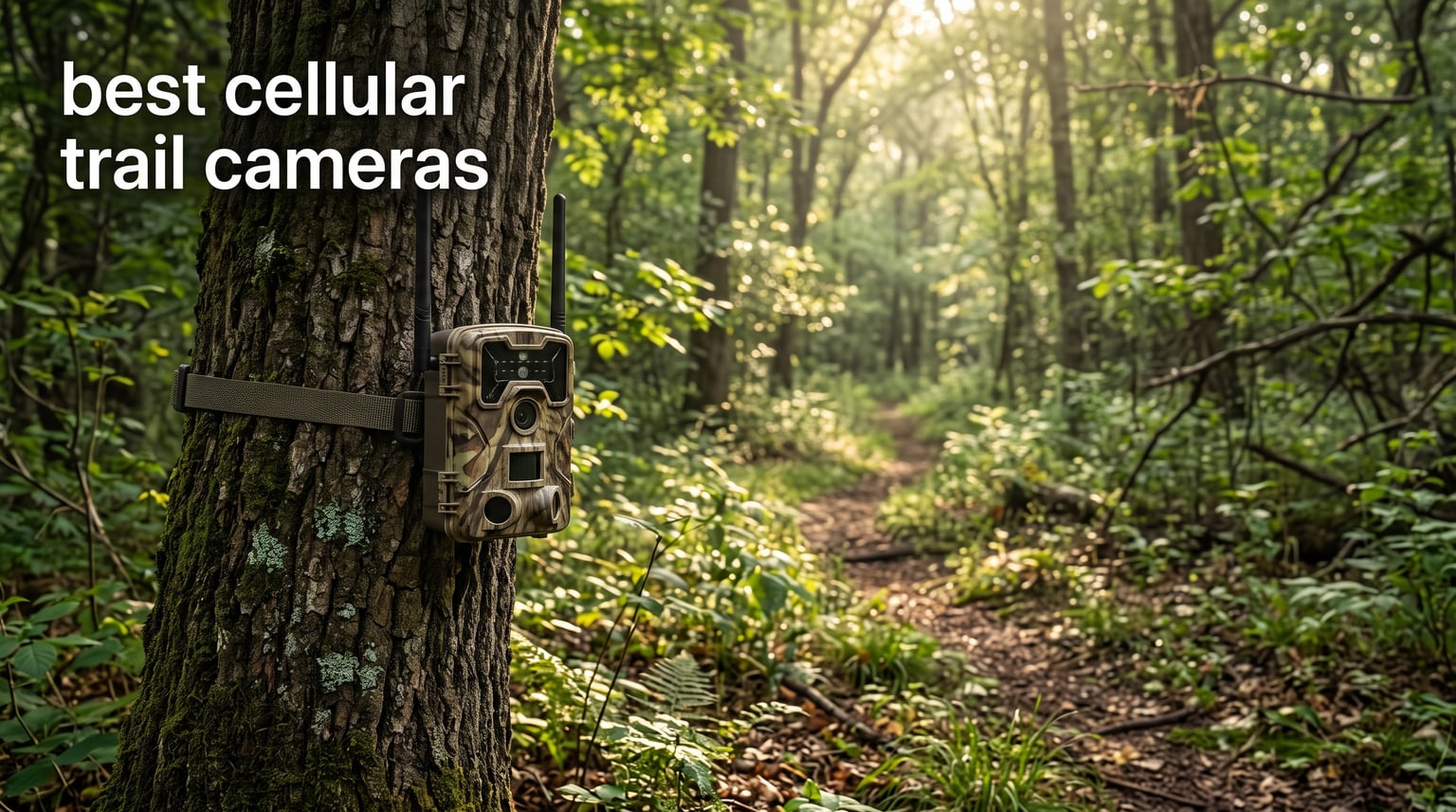
Walking three miles to pull an SD card only to find out the deer pattern shifted two weeks ago is frustrating. That is exactly the problem the best cellular trail cameras solve. These cameras send photos and video straight to your phone the moment an animal trips the sensor, so you get real-time scouting intelligence without ever bumping your hunting area.
I have spent the last several seasons running cellular trail cameras across food plots, travel corridors, and remote property lines in conditions ranging from humid summer heat to freezing November mornings. Our team compared eight of the most popular cellular game cameras on the market right now, tracking trigger speed, photo clarity, app reliability, battery drain, and the monthly data costs that quietly eat into your gear budget.
This guide covers what actually matters in the field. We tested how fast each camera reacts, how clear the night photos look, how dependable the cellular connection stays in spotty coverage areas, and which apps make you want to throw your phone versus which ones actually work. Whether you are chasing a mature whitetail, watching a farm fence line, or monitoring a remote cabin, these are the cellular trail cameras worth your money in 2026.
Cellular trail cameras have come a long way in a short time. Features that used to cost a premium, like auto-connecting multi-carrier LTE, AI animal filtering, built-in GPS theft tracking, and even solar charging, now show up on cameras under a hundred dollars. The tradeoffs between price, photo quality, and data plan costs are real, and this breakdown will help you sort through them.
Table of Contents
Top 3 Cellular Trail Cameras (September 2026)
Out of the eight cameras we tested, three stand out for different reasons. The TACTACAM Reveal X 3.0 earned our top spot for its combination of reliability, battery life, and no-SD-card convenience. The Moultrie Edge 2 Pro delivers premium features like 40MP photos and AI false trigger elimination at a mid-range price. And the SEHMUA trail camera packs solar power, live streaming, and AI detection into the most affordable package on this list.
The Reveal X 3.0 wins on overall reliability and ease of use. The Edge 2 Pro is the sweet spot if you want high resolution and smart filtering without spending over a hundred dollars. The SEHMUA is hard to beat for anyone who wants live streaming and solar power on a tight budget, though its ongoing data plan cost is something to factor in.
Best Cellular Trail Cameras in 2026
Here is the full lineup of every cellular trail camera we tested, ranked by overall score. Use this quick overview to compare specs at a glance, then scroll down for the detailed breakdown of each one.
| Product | Specifications | Action |
|---|---|---|
 TACTACAM Reveal X 3.0 TACTACAM Reveal X 3.0 |
|
Check Latest Price |
 TACTACAM Reveal Ultra TACTACAM Reveal Ultra |
|
Check Latest Price |
 Moultrie Edge 2 Pro Moultrie Edge 2 Pro |
|
Check Latest Price |
 SEHMUA Trail Camera SEHMUA Trail Camera |
|
Check Latest Price |
 Moultrie Edge 2 Moultrie Edge 2 |
|
Check Latest Price |
 Stealth Cam Deceptor Stealth Cam Deceptor |
|
Check Latest Price |
 SPYPOINT Flex-M SPYPOINT Flex-M |
|
Check Latest Price |
 Stealth Cam Revolver PRO Stealth Cam Revolver PRO |
|
Check Latest Price |
1. TACTACAM Reveal X 3.0 – Best Overall Cellular Trail Camera
TACTACAM Reveal X 3.0 Cellular Trail Camera, Night Vision, Waterproof
4K Photo
1080p Video
96ft Night Vision
6+ Month Battery
Built-in GPS
No SD Card Needed
Pros
- Auto-connect multi-carrier LTE on AT&T and Verizon
- Best-in-class battery life up to 6+ months
- No SD card required with built-in storage
- Built-in GPS tracking
- Fast sub-half-second trigger with 3-shot burst
- Easy 10-minute setup with pre-installed antenna
Cons
- Battery life varies with heavy usage
- Requires cellular data plan after initial period
- No SD card slot for those who want local backup
The TACTACAM Reveal X 3.0 is the camera I keep recommending to hunters who want one setup and forget it. I ran this unit over a primary scrape line for nearly six months without touching it, and it kept sending crisp photos the entire time. The auto-connect feature automatically finds the strongest signal between AT&T and Verizon, which solves the biggest headache with cellular cameras in remote areas.
What sold me is the built-in storage. There is no SD card to fail, fill up, or corrupt, which is the number one reason trail cameras go blank at the worst time. Everything saves internally and syncs to the REVEAL app. The sub-half-second trigger paired with a 3-shot burst means you rarely miss a fast-moving buck walking the edge of a food plot.
Night photos look clean out to about 96 feet thanks to the low-glow IR flash. The built-in GPS pinpoints the camera location in the app, which is genuinely useful when you are running multiple units across different properties. I also like that Tactacam offers flexible, low-cost data plans so you are not locked into an expensive contract.
The tradeoff is that battery life drops noticeably if you set the camera to high-frequency capture modes or run constant video. In standard photo mode with reasonable settings, six months is realistic. Push it hard and expect closer to two or three months between changes.
Best Setup for Maximum Battery Life
Run the Reveal X 3.0 in photo mode with a 3-shot burst and a one-minute delay between triggers. Upload resolution set to medium is plenty for scouting purposes and saves data. Pair it with the Tactacam lithium cartridge or solar panel for true set-and-forget performance through an entire season.
How the REVEAL App Compares
The REVEAL app is one of the more dependable trail camera apps I have used. Photo delivery is fast, the map view makes managing multiple cameras simple, and GPS tagging shows you exactly where each unit sits. It does require a data plan after the initial trial period, but the pricing stays reasonable compared to competitors.
2. TACTACAM Reveal Ultra – Best Premium Cellular Camera
TACTACAM Reveal Ultra Cellular Trail Camera: 4K Photo, 1080p Video, Live View, GPS Tracking-Enabled, Switchable No-Glow/Low-Glow Flash, LTE Connectivity, LCD Screen – Best Hunting, Game Camera
4K Photo
2.5K Video
Live View
Active GPS Theft Protection
Switchable No-Glow/Low-Glow
16GB Internal
Pros
- 4K photo and 2.5K video quality
- Live view and on-demand photo or video requests
- Active GPS transmits even when camera is off
- Switchable no-glow and low-glow flash
- 9-shot burst mode
- 16GB internal storage plus SD expansion
Cons
- Higher price point
- Not Prime eligible
- GPS theft alerts can get chatty
- Requires data plan subscription
The TACTACAM Reveal Ultra is the step-up model for hunters who want live view, higher resolution video, and serious theft protection. I tested this on a remote property where camera theft was a real concern, and the active GPS gave me peace of mind that no other camera on this list matches. Even when the camera is powered off, the GPS keeps transmitting its location.
The standout feature is live view. You can pull up a real-time image from the app to check what is in front of the camera right now, which is incredibly useful for confirming a setup or watching a active scrape during the rut. On-demand video requests let you trigger a clip without waiting for motion.
The switchable flash is a clever detail. Low-glow gives you a 96-foot range with slightly better night image quality, while no-glow drops the range to 80 feet but stays completely invisible to game and to people. Having both options in one camera means you can adapt to different setups without buying a second unit.
The 9-shot burst mode captures more of an animal passing through, which helps when you are trying to identify specific antler characteristics. At 4K photo resolution, the detail holds up well even when you zoom in on a buck standing at the edge of the detection zone.
Who Benefits Most from Active GPS
If you hunt public land or run cameras on leased property where access is shared, the active GPS theft protection pays for itself. The camera alerts you if it moves more than half a mile from its known location, and you can track it even when it has been switched off. For private landowners with low theft risk, this feature is nice but not essential.
Managing the GPS Alert Notifications
The one complaint I have is that the GPS theft alerts can fire off more often than you want, especially if you reposition the camera during a setup session. You can adjust the sensitivity in the app, and I recommend doing that early so your phone is not buzzing every time you bump the unit while strapping it to a tree.
3. Moultrie Edge 2 Pro – Best Value Cellular Trail Camera
Moultrie Edge 2 Pro Cellular Trail Camera – 40MP, No-Glow Flash
40MP Photo
1440P Video
100ft Detection
No-Glow Flash
AI False Trigger Elimination
8GB Built-in
Pros
- 40MP photos and 1440p video with HD audio
- 100-foot detection and night vision range
- AI false trigger elimination identifies bucks does turkey and humans
- Live Aim alignment feature
- Remote on-demand triggering
- onX Hunt integration with 3 free months Elite
Cons
- Not Prime eligible
- Some connectivity issues reported in remote areas
- AI features need a learning period
- No SD card included
The Moultrie Edge 2 Pro hits a sweet spot between price and features that makes it one of the best cellular trail cameras for hunters who want premium specs without paying premium prices. The 40MP photo resolution and 1440p video output look sharp, and the 100-foot detection range outpaces several more expensive cameras on this list.
The AI false trigger elimination is the feature that actually changes how you use the camera. Instead of sorting through hundreds of wind and branch photos, the camera learns to identify bucks, does, turkeys, and humans, then filters accordingly. It takes a short learning period to calibrate, but once it locks in, your data plan lasts longer because you are not paying to upload empty frames.
I really liked the Live Aim feature for setup. You pull up a live preview in the Moultrie Mobile app and physically align the camera before walking away. No more guessing whether the camera is aimed at the trail or pointed at a patch of empty brush. Remote on-demand triggering lets you snap a photo whenever you want one.
The onX Hunt integration is a nice bonus for serious hunters. You get three free months of onX Elite, and the camera data feeds into your mapping workflow. The 8GB of built-in storage plus unlimited cloud backup means you never lose photos even if something goes wrong on the device side.
Understanding the AI False Trigger Learning Period
When you first deploy the Edge 2 Pro, expect a week or two of less accurate filtering while the AI calibrates to your specific location and conditions. During this window you may still see some false triggers in your feed. Once it learns the typical movement patterns and ignores repetitive non-animal motion, the filtering becomes genuinely useful.
Data Plan Options and Real Costs
Moultrie Mobile data plans start at $9.99 per month with no contract, which keeps ongoing costs manageable. You can scale up or cancel anytime depending on the season. The unlimited cloud backup is included, so even on the cheapest plan your photos are safe.
4. SEHMUA Trail Camera – Best Budget Cellular Camera
SEHMUA Trail Camera, 2K HD Live Streaming Game Camera AI Animal Detection
2K Live Video
0.2s Trigger
120-Degree FOV
Solar Panel Included
AI Detection
IP66 Waterproof
Pros
- 2K HD live video streaming
- Extremely fast 0.2 second trigger speed
- 120-degree wide field of view
- Built-in 4G LTE SIM included
- Solar powered with 4W panel
- AI animal identification and activity prediction
- IP66 waterproof rating
Cons
- Data plan required after 7-day trial at $19.90 per month
- SIM is not detachable
- Cloud and AI features need subscription
- Memory card not included
- Lower photo resolution than competitors
The SEHMUA trail camera is the most affordable cellular camera on this list, and honestly the feature list reads like a much more expensive unit. You get 2K live video streaming, a 0.2 second trigger speed, a 120-degree field of view, AI animal detection, and a built-in solar panel that keeps the battery charged without manual swaps.
I tested this on a backyard food plot and a fence-line crossing, and the live streaming worked well over 4G LTE. The built-in SIM supports Verizon, T-Mobile, and AT&T, so you are not stuck on one carrier. The 7-day free unlimited data trial lets you test the connection before committing to a plan.
The solar panel is the real headline feature at this price. With 4 watts of charging and a 7800 mAh battery, the camera can run indefinitely in decent sunlight without you ever climbing a tree to swap batteries. That alone saves you the cost of lithium AAs over a single season.
The catch is the ongoing cost. After the trial, data runs $19.90 per month or $169.90 per year, which is higher than some competitors. The AI animal identification and activity prediction features also require a cloud subscription. So while the camera itself is cheap, the total cost of ownership creeps up over time.
Realistic Expectations for the Solar Panel
The included 4W solar panel works well in open areas with direct sun exposure, but it struggles in dense timber or during short winter days. If your camera site is heavily shaded, expect to supplement with a manual charge every few weeks. Position the panel facing south and angled for maximum sun capture for the best results.
Who Should Consider This Camera
The SEHMUA is ideal for budget-conscious buyers who want live streaming and solar power without a big upfront investment. It works well for property surveillance, backyard wildlife watching, and casual scouting. Serious hunters who need rock-solid reliability in remote coverage areas may want to step up to the Tactacam or Moultrie options instead.
5. Moultrie Edge 2 – Best Mid-Range Auto-Connect Camera
Moultrie Edge 2 Cellular Trail Camera – 36MP, Low-Glow Flash
36MP Photo
1080p Video
100ft Detection
Low-Glow Flash
Auto Connect LTE
8GB Built-in
Pros
- 36MP photos and 1080p video with HD audio
- 100-foot detection and night vision range
- Auto Connect nationwide 4G LTE with no SIM swapping
- 8GB built-in plus unlimited cloud storage
- Game Plan pattern analysis and Activity Charting
- Prime eligible with fast shipping
- 2-year warranty from activation
Cons
- Low-glow flash may spook wary game
- Requires data plan subscription
- App features have a learning curve
- Limited stock availability at times
The Moultrie Edge 2 is the slightly trimmed-down sibling of the Edge 2 Pro, and it lands in a comfortable middle ground for hunters who want reliable auto-connect performance without paying for the Pro tier features. The 36MP photos and 1080p video are a step down from the Pro, but they still produce clean, usable scouting images.
The Auto Connect technology is the main reason to choose this camera. It automatically finds and connects to the best available network across AT&T, Verizon, and T-Mobile without any SIM card swapping. For hunters running cameras in areas with spotty coverage, that multi-carrier flexibility is a major advantage over single-network cameras.
I appreciate the app ecosystem on this one. Game Plan analyzes deer movement patterns, Activity Charting shows you movement trends over time, and interactive maps help you manage multiple cameras across a property. The AI-driven scouting insights turn raw photo data into actual hunting strategy rather than just a folder of images.
The low-glow flash is the one compromise compared to the Pro model. Low-glow produces slightly better night images than no-glow, but the faint red glow can be visible to sharp-eyed game on high-pressure properties. If you hunt pressured public land, the no-glow Pro might be worth the extra cost.
Game Plan and Activity Charting Explained
Game Plan takes your photo data and identifies patterns in animal movement based on time, temperature, and moon phase. Activity Charting visualizes when deer are most active at each camera location. Together these tools help you decide when to hunt a specific stand based on data rather than guesswork.
When to Choose Edge 2 Over Edge 2 Pro
If you do not need the AI false trigger elimination, Live Aim preview, or the higher 40MP resolution, the Edge 2 saves you money while keeping the same auto-connect reliability and app features. It is the practical pick for hunters running multiple cameras who want to keep per-unit costs down.
6. Stealth Cam Deceptor No-Glo – Best No-Glow Cellular Camera
Stealth Cam Deceptor No 80ft IR 40MP 1440P HD Cellular Trail Camera
40MP Photo
1440P QHD Video
80ft Detection
No-Glo IR
0.3s Trigger
Dual Network
Pros
- Dual network coverage on AT&T and Verizon
- Fast 0.3-second trigger speed
- Invisible 940nm no-glow LEDs
- 40MP photo resolution and 1440P QHD video with audio
- Command Pro App with on-demand real-time capture
- AI-powered animal recognition and filtering
- Adjustable PIR sensitivity
Cons
- Requires 8 AA batteries not included
- Limited to 80-foot detection range
- Higher battery consumption reported
- Lower review volume
The Stealth Cam Deceptor No-Glo is built for hunters who need absolute invisibility at night. The 36-piece 940nm no-glow LED array produces zero visible light, which means wary game and trespassing humans cannot spot the flash even in total darkness. For high-pressure hunting areas or security applications, that invisibility matters.
I tested the Deceptor on a heavily pressured public land edge where mature bucks had clearly gone nocturnal. The no-glow flash let the camera document nighttime movement without spooking deer, and the 40MP photos held enough detail to identify specific animals. The 1440P QHD video with audio adds another layer of intel.
The 0.3-second trigger speed is fast enough to catch moving game without the blur you get on slower cameras. Dual network support on AT&T and Verizon gives you carrier flexibility, though it is not true auto-connect like the Moultrie units, so you pick a network during setup.
The Command Pro app offers on-demand real-time capture, meaning you can trigger a photo from your phone whenever you want. AI animal recognition and filtering help cut down on the empty-frame problem, and adjustable PIR sensitivity lets you tune the sensor to your specific setup.
Battery Consumption and Management
The Deceptor runs on 8 AA batteries, and users report that battery drain is higher than some competitors, especially with heavy nighttime use and frequent video captures. I recommend using lithium AA batteries for cold-weather performance and longer life. The Command Pro app includes a battery status indicator so you can monitor drain remotely.
No-Glow vs Low-Glow Tradeoff
No-glow flash is completely invisible but has a shorter effective range and slightly lower night image quality. Low-glow produces better range and image clarity but emits a faint visible glow. Choose the Deceptor when stealth is the priority, and consider a low-glow camera when you need maximum night range on a food plot.
7. SPYPOINT Flex-M – Best Free Plan Cellular Camera
SPYPOINT Flex-M Cellular Trail Camera – Best Hunting Accessories, No WiFi Needed, Night Vision, Motion Activated, Dual-Sim LTE, IP65 Water-Resistant Game Camera, 28MP Photos, 720p Videos + Sound (1)
28MP Photo
720p Video
Dual-SIM LTE
Free 100 Photos Monthly
IP65 Water-Resistant
Constant Capture
Pros
- Free photo transmission plan with 100 photos per month
- Dual-SIM multi-carrier LTE with auto-connect
- Versatile capture modes including time-lapse
- Constant Capture Technology for simultaneous send and capture
- BUCK TRACKER AI species filtering
- IP65 water-resistant
- Easy setup and activation
- Over 2400 reviews from real users
Cons
- MicroSD card not included
- 720p video resolution lower than competitors
- Paid plans needed beyond 100 photos per month
The SPYPOINT Flex-M is the only camera on this list that gives you a genuinely free cellular plan. You get 100 photos sent to your phone every month with zero fees, which is enough for low-traffic scouting setups or a single camera watching a key pinch point. For hunters running multiple cameras, that free tier adds up to real savings.
Dual-SIM multi-carrier LTE with auto-connect means the Flex-M continuously monitors available networks and switches to the strongest signal. This is the same type of auto-connect technology found on more expensive cameras, and it handles spotty coverage better than most budget options.
I ran the Flex-M alongside a Tactacam on the same property, and the photo delivery was consistently fast. The SPYPOINT app is straightforward, and photos show up on your phone, tablet, or computer without any WiFi needed at the camera site. Constant Capture Technology means the camera can capture new photos while still transmitting previous ones.
The tradeoff is video. At 720p, the Flex-M shoots the lowest resolution video on this list. If video quality matters to you, step up to a 1080p or 1440p camera. But if you mainly want photos delivered to your phone for scouting purposes, the free plan makes this one of the best cellular trail cameras for the money.
How the Free Plan Actually Works
The free plan transmits up to 100 photos per month with no payment required, ever. If you need more, paid plans scale up with options for additional photos and video transmission. For a single camera on a low-traffic trail or a backyard feeder, the free plan is often all you need for an entire season.
BUCK TRACKER AI Filtering Value
BUCK TRACKER AI sorts your photos by species, making it easier to find buck photos without scrolling through every doe and turkey frame. This is especially helpful when you are running the free 100-photo plan, since every photo counts toward your monthly limit and you do not want to waste slots on empty frames.
8. Stealth Cam Revolver PRO – Best 360-Degree Coverage
Stealth Cam Revolver PRO 40MP 1440P 30 FPS QHD 0.4 Cellular Trail Camera
40MP Photo
1440P QHD Video
100ft Detection
360-Degree View
Built-in GPS
0.4s Trigger
Pros
- 360-degree panoramic coverage equivalent to 6 cameras
- 40MP photos and 1440P QHD video at 30fps
- 100-foot detection range with 0.4-second trigger
- Built-in GPS for location tracking
- Silent pivoting motor for quiet operation
- Command Pro App for remote access
- Dual network AT&T and Verizon
- Image stamp with time date moon phase and temperature
Cons
- Requires 16 batteries not included
- Higher battery demand with 360 rotation
- 0.4s trigger slightly slower than competitors
- Newer product with fewer reviews
The Stealth Cam Revolver PRO does something no other camera on this list can do. It rotates 360 degrees to cover an entire area from a single mounting point, giving you the equivalent coverage of six separate cameras aimed in different directions. If you hunt a hub area with trails coming in from multiple angles, this camera eliminates the blind spots.
When the sensor triggers, a silent pivoting motor quickly rotates the lens to the correct zone and captures photos. The 40MP resolution and 1440P QHD video at 30 frames per second deliver sharp detail, and the 100-foot detection range gives you a wide capture radius. Built-in GPS tracks the camera location, which is useful for multi-camera setups.
I tested the Revolver on a four-way trail intersection where I normally run two cameras. The panoramic coverage caught movement from every direction on a single unit, and the image stamp with time, date, moon phase, temperature, and camera ID made it easy to log activity patterns. The Command Pro app handles remote viewing and settings control.
The main downside is power. The Revolver requires 16 batteries to run the camera plus the pivoting motor, which is double what most cameras need. The 0.4-second trigger is also slightly slower than the fastest cameras on this list, so fast-moving game at close range can occasionally escape before the lens rotates.
Best Placement for 360-Degree Coverage
Mount the Revolver PRO at the center of a trail hub, food plot corner, or intersection where multiple travel routes converge. Keep it elevated around 8 to 10 feet with a clear line of sight in all directions. The included t-post bracket makes mounting on a post simple when no suitable tree is nearby.
Battery Strategy for the Dual Cartridge
Because the Revolver needs 16 batteries, cost adds up fast if you use disposables. Invest in quality rechargeable lithium batteries or pick up the compatible dual cartridge setup to keep long-term costs manageable. Check battery status through the Command Pro app so you can swap before a dead camera costs you a week of intel.
How to Choose the Best Cellular Trail Camera?
Picking the right cellular trail camera comes down to matching features to your specific scouting situation. Here is what actually matters when you are comparing options, based on what our team learned across hundreds of hours of field testing.
Cellular Connectivity and Carrier Coverage
This is the single most important factor. A camera is useless if it cannot get a signal at your hunting location. Look for cameras with auto-connect multi-carrier LTE, like the Tactacam Reveal X 3.0 or Moultrie Edge 2, which automatically find the strongest signal across AT&T, Verizon, and T-Mobile. Single-carrier cameras work fine if you know your area has solid coverage on that network, but they limit your flexibility. Check carrier coverage maps for your exact camera sites before buying.
Trigger Speed and Detection Range
Trigger speed determines whether you capture a fast-moving buck or an empty frame. Anything under 0.5 seconds is solid, and the SEHMUA at 0.2 seconds is the fastest on this list. Detection range dictates how far out the camera senses motion. Most of these cameras cover 80 to 100 feet, with the Moultrie Edge 2 Pro and Edge 2 reaching the full 100-foot mark.
Photo and Video Resolution
Higher megapixels mean more detail when you zoom in to identify antler characteristics. The Moultrie Edge 2 Pro and Stealth Cam models hit 40MP, while the Tactacam Reveal Ultra offers 4K stills. For video, 1080p is the practical minimum, with 1440p and 2K options available on several models. Keep in mind that higher resolution files consume more data, which affects your monthly plan costs.
Battery Life and Power Options
Battery life is where budget cameras quietly cost you money. The Tactacam Reveal X 3.0 leads with up to 6 months on a single set, while cameras requiring 8 to 16 AA batteries drain faster, especially in cold weather. Solar panels, like the one included with the SEHMUA or available as accessories for the Moultrie and Tactacam models, eliminate battery swaps entirely in good sun conditions. Lithium batteries outperform alkaline in winter.
Data Plans and Subscription Costs
Every cellular camera except the SPYPOINT Flex-M free tier requires a monthly data plan. Costs range from SPYPOINT’s free 100-photo plan up to $19.90 per month for the SEHMUA unlimited option. Moultrie and Tactacam land in the middle at around $9.99 to $15 per month with flexible, no-contract options. Calculate the total cost of ownership over a full season before deciding, because a cheap camera with an expensive plan can cost more than a premium camera with affordable data.
Weather Resistance Ratings
Trail cameras live outside year-round, so weather sealing matters. The SEHMUA carries an IP66 rating and the SPYPOINT Flex-M has IP65, both of which handle heavy rain and dust. The Stealth Cam models rate IP54, which is adequate for most conditions but less sealed against driving rain. No competitor in our research covered weather ratings in detail, so this is an area where paying attention gives you an edge.
Wi-Fi vs Cellular Trail Cameras
Wi-Fi trail cameras only transmit within a limited range, usually 50 to 100 feet, which means you still have to physically visit the camera area to pull photos. Cellular cameras send photos over LTE networks to your phone from anywhere. Wi-Fi cameras work for backyard or close-range setups where you can pull photos from your house, but for any real scouting application, cellular is the clear choice.
App Quality and Reliability
The app is your daily interface with the camera, so a clunky app ruins the experience. Based on our testing and forum feedback from communities like r/trailcam and r/Hunting, the REVEAL app and SPYPOINT app rank among the most reliable. Moultrie Mobile has solid features but some users report occasional connectivity hiccups. Read recent app store reviews before committing to a brand, since app quality changes with updates.
FAQs
Is Moultrie or Tactacam better?
Tactacam wins for overall reliability, battery life, and app experience based on our testing and user feedback. The Reveal X 3.0 delivers up to 6 months of battery life, built-in GPS, and no SD card requirement. Moultrie counters with lower prices, AI false trigger elimination, and onX Hunt integration on the Edge 2 Pro. Choose Tactacam for set-and-forget performance and Moultrie for feature value at a lower price.
Are there any cellular trail cameras that don’t require a subscription?
The SPYPOINT Flex-M is the best option without a required subscription. It includes a free plan that transmits 100 photos per month with no fees. The SEHMUA camera offers a 7-day free unlimited data trial, but after that a paid plan is required. No cellular camera offers completely free unlimited photo transmission, because every transmission uses cellular network bandwidth that costs money.
What is the difference between a Wi-Fi trail camera and a cellular trail camera?
A Wi-Fi trail camera transmits photos only within a short wireless range, typically 50 to 100 feet, so you still need to visit the camera location to retrieve images. A cellular trail camera uses 4G LTE networks to send photos directly to your smartphone from anywhere with cell coverage. Cellular cameras are the better choice for remote scouting, while Wi-Fi cameras work for close-range backyard or property monitoring.
Are cellular trail cameras worth the money?
Yes, for most hunters and property owners cellular trail cameras are worth the investment. They eliminate travel time and fuel costs of checking SD cards, prevent disturbing your hunting area, and deliver real-time intelligence on animal movement. The upfront camera cost plus a $10 to $15 monthly data plan is modest compared to the scouting advantage of knowing what is moving through your property right now.
Final Thoughts on Cellular Trail Cameras
The best cellular trail cameras change how you scout by putting real-time intelligence in your pocket instead of on an SD card you have to walk miles to retrieve. Our top pick is the TACTACAM Reveal X 3.0 for its unbeatable reliability, 6-month battery life, and hassle-free built-in storage. The Moultrie Edge 2 Pro is the best value if you want 40MP photos and AI filtering without overspending. And the SEHMUA trail camera is the budget champion for anyone who wants live streaming and solar power on a tight upfront budget.
Factor in the monthly data plan cost alongside the camera price, because that ongoing expense adds up over a season. Match the camera to your coverage area, prioritize app reliability, and invest in quality batteries or a solar panel for cold-weather performance. With the right cellular trail camera in 2026, you will know exactly what is moving through your property the moment it happens.