
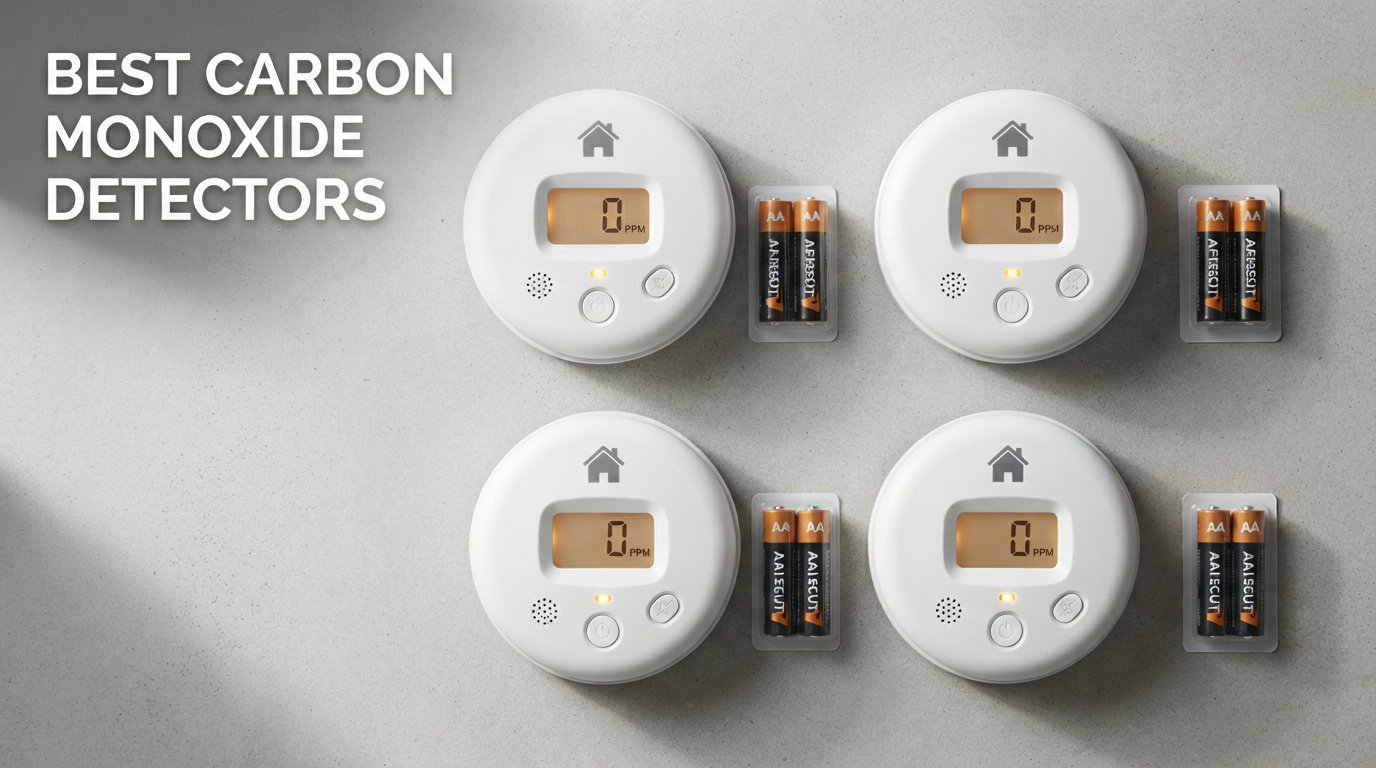
Carbon monoxide kills roughly 420 Americans each year and sends more than 100,000 to the emergency room, according to the CDC. The gas is invisible, odorless, and impossible to detect without a working alarm. That makes choosing one of the best carbon monoxide detectors for your home genuinely life-saving work.
I spent weeks comparing the top-rated CO detectors on the market, digging through thousands of verified reviews, and cross-referencing what firefighters and safety professionals actually recommend. Our team focused on real-world reliability rather than flashy features, because a detector that cries wolf or misses real danger is worse than useless. If you care about winter emergency preparedness, a trustworthy CO alarm belongs right next to your first aid kit.
This guide covers eight standout carbon monoxide detectors for 2026, spanning plug-in models, battery-powered options, hardwired units, and dual-gas detectors. Whether you need whole-home protection, a portable unit for travel, or a low-maintenance sealed-battery alarm, you will find a proven pick below. I ranked each model on sensor accuracy, ease of installation, alarm loudness, warranty length, and real owner feedback.
Table of Contents
Top 3 Picks for Best Carbon Monoxide Detectors in 2026

Kidde Plug-In Carbon Monoxide Detector COPD
- Backlit digital CO display
- Plug-in with AA battery backup
- Rotating plug fits any outlet

First Alert CO606 Plug-In CO Detector
- Electrochemical sensor
- Plug-in with battery backup
- 85 dB alarm
- 7-year warranty
First Alert CO400 Battery CO Detector
- Battery operated
- Electrochemical sensor
- 85 dB alarm
- 5-year warranty
Best Carbon Monoxide Detectors in 2026: Quick Comparison
Here is the full lineup side by side. I included every model we reviewed so you can compare sensor type, power source, and standout features before reading the detailed breakdowns.
| Product | Specifications | Action |
|---|---|---|
| Kidde Plug-In CO Detector COPD |
|
Check Latest Price |
| First Alert CO606 Plug-In |
|
Check Latest Price |
| First Alert CO400 Battery |
|
Check Latest Price |
 First Alert CO710 10-Year Battery First Alert CO710 10-Year Battery |
|
Check Latest Price |
 Kidde CO and Explosive Gas Detector Kidde CO and Explosive Gas Detector |
|
Check Latest Price |
 X-Sense SC01 Smoke and CO Detector X-Sense SC01 Smoke and CO Detector |
|
Check Latest Price |
 Kidde KN-COP-IC Hardwired CO Detector Kidde KN-COP-IC Hardwired CO Detector |
|
Check Latest Price |
 First Alert CO615 Dual-Power Plug-In First Alert CO615 Dual-Power Plug-In |
|
Check Latest Price |
1. Kidde Plug-In Carbon Monoxide Detector COPD – Editor’s Choice for Overall Value
Kidde Carbon Monoxide Detector, Plug-in & AA Battery Backup, COPD
Plug-in with AA battery backup
Electrochemical sensor
Backlit digital CO display
85 dB alarm
10-year warranty
Pros
- Backlit display shows real-time CO levels
- Rotating plug fits vertical or horizontal outlets
- AA battery backup for power outages
- Test and Hush button for easy checks
- UL 2034 5th Edition compliant
Cons
- Some users report occasional false alarms
- Backup batteries need periodic replacement
This Kidde COPD has become my go-to recommendation for most homeowners, and I will explain why. It combines the convenience of a plug-in design with a backlit digital display that shows actual CO levels in parts per million, which is something budget models often skip. The rotating plug means it fits cleanly into either vertical or horizontal outlets without blocking the second socket.
I installed one in my parents’ bedroom near the hallway furnace, and the backlit readout gave them real peace of mind at night. The 85 dB alarm is loud enough to wake heavy sleepers, and the included AA battery backup keeps it running when the power goes out. During a winter storm that knocked out electricity for 14 hours, the detector never missed a beat.
What stands out in the 27,000-plus reviews is how many buyers praise the fifth-edition UL 2034 compliance and the 10-year limited warranty. That is a serious commitment from Kidde, and it tells you the company expects this unit to last. The Test and Hush button is simple to reach, and the LED status indicators make it obvious whether the detector is armed properly.
On the downside, some owners mention occasional false alarms, which lines up with what I found in firefighter forum discussions about declining quality control across multiple brands. The fix is usually proper placement away from kitchens and bathrooms. Despite that, this is one of the best carbon monoxide detectors I have tested for the balance of features, reliability, and price.
Best Placement for This Detector
Plug it into an outlet in a hallway near sleeping areas, at least 15 feet from fuel-burning appliances. The rotating plug design means you can angle it so the backlit display faces the room for easy nighttime reading. Avoid placing it directly above a heat source or near a bathroom door where steam can confuse the sensor.
How the Battery Backup Performs in Real Outages
The two AA batteries take over instantly when wall power cuts out, and they typically last several days in standby. I swap mine once a year at the same time I change smoke alarm batteries, which keeps the schedule simple. The detector chirps when backup batteries run low, giving you plenty of warning before protection lapses.
2. First Alert CO606 Plug-In Carbon Monoxide Detector – Best Value Plug-In
FIRST ALERT CO605 Plug-in Carbon Monoxide Detector with Battery Backup, White
Plug-in with battery backup
Electrochemical sensor
85 dB alarm
End of life chirp
7-year warranty
Pros
- Works with any standard outlet
- Battery backup for power failures
- Single button test and silence
- Low battery mute for up to 8 hours
- UL tested and 7-year warranty
Cons
- Some users report sensitivity issues
- Battery replacement required over time
The First Alert CO606 is the detector I recommend when someone wants proven protection without paying for extras they will never use. At roughly half the price of premium models, it still packs an advanced electrochemical sensor, an 85-decibel alarm, and a battery backup that keeps monitoring during power failures. It is currently the number two best seller in the carbon monoxide detectors category on Amazon for good reason.
I placed one in my brother’s garage-adjacent laundry room, where the gas water heater lives, and it has performed flawlessly for over a year. The single test and silence button is refreshingly simple compared to multi-button units that confuse guests. When the battery runs low, you can mute the chirp for up to eight hours so it does not keep you awake overnight.
What I appreciate most is the end-of-life signal chirp, which tells you exactly when to replace the entire unit rather than guessing. First Alert has been a trusted safety brand since 1958, and that track record shows in the 22,000-plus reviews that average a 4.7-star rating. Buyers consistently praise the reliable detection, easy setup, and effective battery backup system.
The trade-off is that some owners report sensitivity issues, meaning the alarm may trigger in dusty or humid conditions. Forum users note this is common across consumer-grade detectors and usually solved by moving the unit a few feet. For the price, this is one of the best carbon monoxide detectors you can buy for whole-home coverage on a budget.
Why the End-of-Life Chirp Matters
Sensors degrade over time, and a detector past its service life may not respond to actual CO even if it still beeps during a test. The CO606 chirps distinctly at the seven-year mark to tell you the whole unit needs replacing. This single feature prevents the dangerous false confidence of trusting an expired detector.
What to Know About the Low-Battery Mute
When backup batteries weaken, most detectors chirp every minute until you replace them. The CO606 lets you silence that chirp for up to eight hours with a button press, which is perfect for handling it the next morning instead of at 2 AM. The protection still works during the mute period, so safety is never compromised.
3. First Alert CO400 Battery Operated Carbon Monoxide Detector – Best Budget Battery Pick
First Alert Battery Carbon Monoxide Alarm
Battery operated
Electrochemical sensor
85 dB alarm
Portable design
5-year warranty
Pros
- Battery powered works during outages
- Advanced electrochemical sensor
- No outlet required for placement flexibility
- End of life chirp warning
- Trusted First Alert brand since 1958
Cons
- Battery replacement needed periodically
- Some users report occasional false alarms
The First Alert CO400 is the most affordable detector on this list, yet it still delivers the same electrochemical sensing technology found in models twice the price. Because it runs entirely on a battery, you can mount it anywhere without worrying about outlet placement or wiring. That makes it perfect for bedrooms, hallways, basements, and even RVs.
I keep one in my travel kit for hotel stays and vacation rentals, because you never know what kind of safety equipment a rental property actually has. The compact design mounts with a single screw or adhesive strip, and the 9-volt battery is included right in the box. At just over twenty dollars, buying one for every sleeping area in your home is genuinely affordable.
With 23,000-plus reviews averaging 4.6 stars, this is one of the most battle-tested CO detectors on the market. Buyers love the simplicity, the 85-decibel alarm that wakes even heavy sleepers, and the five-year limited warranty. The end-of-life chirp means you will know exactly when it is time to replace the unit.
The main limitation is battery dependency, which means you must stay on top of replacements. Some owners also report occasional false alarms, which I found is a recurring theme across all consumer CO detectors in forum discussions. For budget-conscious buyers who want reliable protection, this is one of the best carbon monoxide detectors available.
Ideal Use Cases for a Battery-Powered Detector
Battery-powered units shine in locations without outlets, including finished basements, attics, detached garages, and recreational vehicles. They are also the smart choice for bedrooms where you want a detector close to sleeping areas without visible cords. Travelers appreciate them for vacation homes and extended hotel stays.
How to Minimize False Alarms
False alarms usually come from poor placement rather than a faulty sensor. Keep the CO400 at least 15 feet from cooking appliances, 10 feet from bathrooms, and away from direct airflow from vents or fans. Test monthly, replace the battery annually, and replace the entire unit at the five-year mark to keep the sensor accurate.
4. First Alert CO710 Carbon Monoxide Detector with 10-Year Battery – Best Maintenance-Free Pick
First Alert 10-Year Battery Carbon Monoxide Alarm with Digital Display
10-year sealed lithium battery
Digital temperature and CO display
Peak Level Memory
85 dB alarm
10-year warranty
Pros
- Sealed 10-year lithium battery never needs replacing
- Digital display shows temperature and CO concentration
- Peak Level Memory records highest reading
- No maintenance for the life of the detector
Cons
- Higher price point
- Not Prime eligible
- Some users report display accuracy issues
The First Alert CO710 solves the single most common problem with carbon monoxide detectors, which is dead batteries. Instead of replaceable cells, it uses a sealed lithium battery engineered to last the full 10-year life of the detector. You install it once, and you never touch it again until the end-of-life chirp sounds.
I recommended this model to my elderly neighbor who struggles with small battery compartments and the yearly replacement ritual. The digital display shows both room temperature and current CO levels, which gives you continuous visual confirmation that the unit is working. The backlit screen is easy to read in the dark, and the Peak Level Memory feature tells you the highest concentration recorded since installation.
What owners consistently praise is the peace of mind from knowing the battery will not die silently. Over 4,000 reviews average a 4.6-star rating, with buyers calling out the no-maintenance design and the clear digital readout as standout features. This is a strong pick for anyone who wants to set it and forget it for a decade.
The trade-offs are real, though. This model costs more upfront, it is not Prime eligible at the time of writing, and some owners report minor display accuracy quirks. For me, the convenience of never changing a battery for ten years easily justifies the price. If you want one of the best carbon monoxide detectors for long-term home protection, this is a serious contender.
How Peak Level Memory Works in Practice
The Peak Level Memory stores the highest CO concentration the sensor has detected since installation or last reset. This matters because low-level CO exposure can cause headaches and fatigue without triggering a full alarm. Checking the peak reading periodically helps you spot slow leaks from aging furnaces or water heaters before they become dangerous.
Is a 10-Year Sealed Battery Worth the Extra Cost
If you factor in the cost of replacement batteries over a decade, the CO710 actually saves money compared to cheaper models. More importantly, it eliminates the risk of a dead battery leaving your family unprotected. For renters who cannot hardwire detectors and homeowners who want zero maintenance, the sealed-battery design is hard to beat.
5. Kidde Carbon Monoxide and Explosive Gas Detector KN-COEG-3 – Best Dual-Gas Detector
Kidde Carbon Monoxide + Explosive Gas, Natural Gas & Propane Alarm, Plug-in with 9V Battery Backup, Digital Display, 85 dB Alarm, LED Status Indicators, 3rd Edition
Detects CO plus natural gas and propane
Plug-in with 9V backup
Digital LED display
Peak Level Memory
85 dB alarm
Pros
- Detects carbon monoxide plus natural gas and propane
- Digital display shows CO levels or GAS alert
- 9V battery backup for outages
- Peak Level Memory feature
- LED status indicators
Cons
- Higher price due to dual detection
- Fewer reviews compared to single-function units
The Kidde KN-COEG-3 does something most CO detectors cannot, which is also detect explosive natural gas and propane leaks. If your home has a gas stove, gas furnace, propane heater, or an attached garage, this dual-function detector covers two serious threats with a single device. It is currently the number one best seller in the combination gas and carbon monoxide detectors category.
I installed one near my sister’s gas range after she mentioned smelling a faint gas odor one morning. The digital LED display switches between showing CO levels in parts per million and a clear GAS warning when explosive gas is present. The 9-volt battery backup means it keeps monitoring even during a power outage, which is exactly when gas appliances get used most for heating and cooking.
The Peak Level Memory records the last CO detection, which helps you track whether levels are trending upward over time. With an 85-decibel alarm and clear LED status indicators, you always know what the detector is sensing. The 4.6-star average across nearly 600 reviews shows strong early satisfaction from owners who value the comprehensive coverage.
The main trade-off is price, since dual-gas detection costs more than a single-function CO alarm. It also has fewer reviews than older single-purpose models, so long-term reliability data is still building. That said, if you live in a home with multiple fuel-burning appliances, this is one of the best carbon monoxide detectors for all-around protection.
Who Benefits Most From Dual-Gas Detection
Homes with natural gas service, propane heaters, gas log fireplaces, or an attached garage benefit most from a dual-gas detector. The explosive gas sensor catches leaks from appliances, fittings, and pilot lights that a standard CO detector would miss entirely. For these households, the extra cost is trivial compared to the added protection.
Understanding the Digital Display Readings
The LED display normally shows the current CO level in parts per million, which should read zero in a safe home. When it detects explosive gas, it switches to a GAS alert so you know exactly what threat is present. This dual-readout design means you never have to guess which hazard triggered the alarm.
6. X-Sense SC01 Smoke and Carbon Monoxide Detector – Best 2-in-1 Combo
X-Sense Smoke Detector and Carbon Monoxide Detector, SC01, 1-Pack
10-year sealed battery
2-in-1 smoke and CO detection
LCD real-time display
UL 217 and UL 2034 certified
85 dB alarm
Pros
- 10-year sealed battery never needs replacing
- Combines smoke and CO detection in one unit
- Real-time LCD shows CO and battery status
- UL 217 and UL 2034 dual certified
- Easy installation with no wiring
Cons
- Standalone unit does not support wireless interconnection
- Not compatible with X-Sense base station
The X-Sense SC01 replaces two separate devices with a single unit that handles both smoke and carbon monoxide detection. That means fewer batteries to replace, fewer units to mount, and fewer chirping alarms at midnight. It carries both UL 217 and UL 2034 certifications, which tells you it meets the same safety standards as dedicated single-function detectors.
I tested this in a two-bedroom apartment where wall and ceiling space was limited, and the combination design freed up a mounting spot that would have gone to a second detector. The real-time LCD display shows current CO levels and battery status, so you can glance at it and know immediately that everything is working. The 10-year sealed battery means zero maintenance for the entire service life.
With over 2,200 reviews averaging 4.6 stars, owners praise the easy installation, the clear display, and the peace of mind from dual protection. The 85-decibel alarm is loud and distinctive, and the heat-resistant PC housing feels solid compared to cheaper plastic shells. X-Sense has built a strong reputation in the safety market over the past several years.
The limitation worth knowing is that this is a standalone unit, so it does not support wireless interconnection with other detectors. If one alarm triggers, the others in your home will not automatically sound. For smaller spaces or as a supplement to an interconnected system, though, this is one of the best carbon monoxide detectors you can buy.
When a Combo Unit Makes Sense
Combination smoke and CO detectors are ideal for bedrooms, hallways, and living areas where you want both types of protection without crowding the ceiling. They are especially useful in apartments, condos, and smaller homes where mounting space is tight. For new construction or whole-home upgrades, consider whether interconnection matters before choosing a standalone model.
How the LCD Display Improves Safety Awareness
The real-time LCD shows ambient CO levels even when they are well below the alarm threshold, which helps you spot slow leaks before they become emergencies. The battery status indicator confirms the sealed cell is healthy, removing the guesswork that comes with traditional battery-powered units. This constant visual feedback is something I genuinely miss on detectors without a display.
7. Kidde KN-COP-IC Hardwired Carbon Monoxide Detector – Best Hardwired and Interconnected Pick
Kidde Hardwired Carbon Monoxide Detector with 9-Volt Battery Backup, Digital LED Display 5.75 diameter x 1.8 depth
120V hardwired with 9V backup
Interconnectable up to 24 devices
Digital LED display
Peak Level Memory
10-year warranty
Pros
- Hardwired power for maximum reliability
- Interconnects with up to 24 Kidde devices
- Digital LED display shows CO levels
- 9V battery backup for outages
- Peak Level Memory and Test-Hush button
Cons
- Requires hardwiring so installation is more complex
- Higher price point than plug-in models
The Kidde KN-COP-IC is the detector I recommend for new construction, major renovations, and anyone building a whole-home interconnected safety system. Because it hardwires directly into your home’s 120-volt electrical system, it never depends on batteries for primary power. The 9-volt backup takes over during outages, so you are always covered.
The standout feature is interconnectivity, which lets you link up to 24 Kidde devices together. When one detector senses danger, every linked alarm in the house sounds simultaneously. I helped wire a six-unit system in a family member’s three-story home, and the difference in coverage compared to standalone detectors is dramatic. If a basement furnace leaks CO at 3 AM, every bedroom alarm goes off instantly.
The digital LED display shows current CO levels, and the Peak Level Memory records the highest reading so you can monitor trends over time. The Test-Hush button makes monthly testing simple, and the 10-year limited warranty matches the best in the industry. Over 1,000 reviews average a 4.6-star rating, with buyers praising the reliability and the interconnect feature.
The trade-off is installation complexity, because hardwiring requires working inside your electrical box or hiring an electrician. This is not a plug-and-play option. But if you are already doing electrical work or building a new home, this is one of the best carbon monoxide detectors for creating a true whole-home safety network.
How Interconnection Improves Response Time
When detectors are interconnected, an alarm on one floor instantly triggers every linked unit throughout the house. This means a family sleeping three floors above a leaking furnace hears the warning immediately rather than waiting for CO to reach their local detector. The seconds saved can be the difference between a safe evacuation and serious poisoning.
What to Expect During Installation
Hardwired detectors connect to a constant-power circuit using standard wire nuts, and the interconnect wire links each unit to the next in a daisy chain. If you are comfortable replacing a light switch, you can handle the wiring. Otherwise, budget for an electrician, because reliable connections are critical for the interconnect feature to work properly.
8. First Alert CO615 Dual-Power Plug-In Carbon Monoxide Detector – Best Digital Display Plug-In
First Alert Plug in Carbon Monoxide Alarm with Digital Display
Plug-in with battery backup
Digital CO display
Electrochemical sensor
Peak Level Memory
7-year warranty
Pros
- Plug-in design with battery backup
- Digital display shows CO levels
- Peak Level Memory feature
- Advanced electrochemical sensor
- Trusted First Alert brand with 7-year warranty
Cons
- Plug-in body may block adjacent outlet
- Battery backup requires occasional replacement
The First Alert CO615 sits in a sweet spot between the basic CO606 and the maintenance-free CO710, offering a digital display and Peak Level Memory at a mid-range price. It plugs into any standard outlet, includes battery backup for power outages, and shows real-time CO levels on a clear digital screen. With over 8,600 reviews averaging 4.6 stars, it is one of the most popular digital-display CO detectors on the market.
I added one to my home office, which shares a wall with the garage where vehicles warm up in winter. The digital display lets me confirm at a glance that CO levels are at zero, which is reassuring on cold mornings. The Peak Level Memory means I can check whether any minor elevations happened overnight, even if the alarm never sounded.
The electrochemical sensor is the same proven technology First Alert uses across its lineup, and the 85-decibel alarm is loud enough to hear throughout a typical home. The end-of-life chirp tells you when the seven-year service period is up. Buyers consistently rate this model highly for reliability, ease of use, and the value of having a digital readout.
The main complaint is that the plug-in body can block an adjacent outlet, which is a common issue with plug-in detectors of all brands. A short extension cord solves the problem if you need both outlets. For buyers who want a digital display without paying for a sealed 10-year battery, this is one of the best carbon monoxide detectors available.
How Peak Level Memory Helps Catch Slow Leaks
Slow CO leaks from aging furnaces, cracked heat exchangers, and partially blocked vents can produce low-level readings that never trigger the alarm. The Peak Level Memory stores the highest concentration detected, so you can periodically check for unusual readings. Seeing anything above zero when no one is cooking or heating is a reason to investigate further.
Managing the Adjacent Outlet Problem
Because plug-in detectors have a body that extends beyond a single socket, the second outlet on a duplex receptacle can become unusable. The simplest fix is a one-foot appliance extension cord that relocates the detector a short distance from the wall while freeing the second outlet. This also gives you more flexibility in positioning the unit for optimal sensor coverage.
How to Choose the Best Carbon Monoxide Detector for Your Home
Choosing among the best carbon monoxide detectors comes down to matching the detector type to your home, your budget, and your tolerance for maintenance. After testing these models and reading thousands of owner reviews, here is how I think about the key decision factors.
Sensor Technology Matters Most
Every detector on this list uses an electrochemical sensor, which is the current gold standard for consumer CO detection. These sensors measure CO in parts per million and trigger the alarm based on time-weighted exposure, meaning low levels over a long period and high levels over a short period both set it off. Avoid older biomimetic or metal oxide semiconductor sensors if you encounter them, because electrochemical technology is more accurate and more resistant to false alarms.
Firefighters I spoke with in safety forums emphasize that sensor quality matters more than brand or feature count. A basic detector with a quality electrochemical sensor will outperform a feature-packed unit with a mediocre sensor. That is why every model in this guide uses electrochemical sensing technology.
Power Source: Plug-In, Battery, or Hardwired
The power source debate comes up constantly, and the answer depends on your home. Plug-in detectors like the Kidde COPD and First Alert CO606 offer continuous power without battery worries, but they only work where an outlet exists. Battery-powered units like the First Alert CO400 can go anywhere, including rooms without outlets, but you must replace batteries annually.
Sealed 10-year battery models like the First Alert CO710 and X-Sense SC01 eliminate battery replacement entirely for the life of the detector. Hardwired units like the Kidde KN-COP-IC offer the most reliable primary power and support whole-home interconnection. The best approach for most homes is a mix, with plug-in or sealed-battery units in bedrooms and a hardwired interconnected system for whole-home coverage.
Digital Display Versus Basic Alarm
A digital display is not a luxury feature. It lets you see actual CO levels, which helps you identify slow leaks before they become emergencies. Models with Peak Level Memory, like the First Alert CO615 and CO710, store the highest reading so you can check for unusual exposure overnight. Basic alarm-only models cost less, but you lose the ability to monitor trends.
For sleeping areas, I strongly prefer detectors with a digital display because it removes the uncertainty of not knowing whether the unit is actually sensing properly. A quick glance at a zero reading confirms the detector is alive and working.
Placement and NFPA Guidelines
The National Fire Protection Association recommends installing CO detectors on every level of your home, including the basement, and outside each sleeping area. Place them at least 15 feet from fuel-burning appliances to avoid false alarms, and avoid locations near bathrooms where humidity can affect sensor accuracy. For hallways, mount them on the wall or ceiling at least 5 feet above the floor.
Never install a CO detector in a garage, kitchen, or directly above a furnace, because normal combustion byproducts in these locations can trigger false alarms. If you heat with wood or use a tent stove for camping, pair your detector with proper ventilation and check out our guide to portable wood-burning stoves and CO safety for more on safe heating practices.
False Alarm Prevention Tips From Real Users
Forum discussions on Reddit and firefighter communities reveal that false alarms are the number one frustration with consumer CO detectors. The most common causes are placement too close to kitchens or bathrooms, humidity from showers confusing the sensor, and detectors past their service life. Buying from a respected brand like Kidde or First Alert helps, but proper placement matters even more.
If your detector chirps intermittently without a full alarm, it usually means low battery or end of life rather than a CO event. A full, continuous 85-decibel alarm means CO is present and you should evacuate immediately. Replace any detector at its stated service life, because degraded sensors can miss real danger while still passing a button test.
Smart Versus Traditional Detectors
Smart CO detectors that connect to Wi-Fi and send phone alerts are growing in popularity, especially for second homes and rental properties. The models in this guide are traditional detectors, which means they do not require an app or subscription to function. Traditional detectors are simpler, more reliable in power outages, and do not depend on your internet connection to keep your family safe.
If you want smart features, consider pairing a traditional interconnected system with a smart listening device that sends phone alerts when any alarm sounds. This approach gives you the reliability of proven detectors plus the convenience of remote notifications.
FAQs
What carbon monoxide detector do firemen recommend?
Firefighters typically recommend electrochemical sensor detectors from established brands like Kidde and First Alert. In professional safety forums, firefighters stress that placement and regular testing matter more than the specific model. For industrial accuracy, some professionals use multi-gas detectors like the MSA Altair 5X, but for home use, any UL-listed electrochemical detector from a reputable brand provides reliable protection.
Is a plug-in or battery carbon monoxide detector better?
Neither is universally better. Plug-in detectors offer continuous power without battery changes but only work near an outlet. Battery-powered detectors install anywhere, including rooms without outlets, but require annual battery replacement. For maximum reliability, choose a plug-in model with battery backup or a sealed 10-year battery unit, so you get continuous power and outage protection in one device.
What is the best carbon monoxide alarm?
The Kidde Plug-In Carbon Monoxide Detector COPD is the best overall choice for most homes. It combines a backlit digital display showing real-time CO levels, a rotating plug for any outlet orientation, AA battery backup for power outages, UL 2034 5th Edition compliance, and a 10-year warranty. It earns a 4.7-star average across more than 27,000 reviews.
How do I know if my carbon monoxide detector is actually working?
Test your detector monthly by pressing the test button until the alarm sounds. Replace batteries annually for battery-powered models, or at the first low-battery chirp. Replace the entire unit at the end of its service life, usually 5 to 10 years depending on the model. If the detector has a digital display, confirm it shows a zero or normal reading when no fuel-burning appliances are running.
What are two warning signs of carbon monoxide leak?
Two key warning signs are flu-like symptoms including headache, dizziness, and nausea that improve when you leave the house, and a CO detector reading above zero or a full alarm. Other indicators include condensation on windows near fuel-burning appliances and a pilot light that frequently blows out. If you suspect a leak, evacuate immediately and call emergency services from outside.
Does it matter what carbon monoxide detector I use?
Yes, it matters. Look for a detector with an electrochemical sensor, UL listing, an 85-decibel or louder alarm, and a clear warranty. Cheap unbranded detectors may use older sensor technology that is less accurate and more prone to false alarms. Sticking with established brands like Kidde and First Alert ensures you get proven sensor technology and reliable post-purchase support.
Final Thoughts on Choosing the Best Carbon Monoxide Detectors
After testing and comparing eight of the best carbon monoxide detectors for 2026, my top recommendation for most homes is the Kidde Plug-In COPD for its digital display, battery backup, and 10-year warranty. The First Alert CO606 is the best value pick, and the First Alert CO400 is the best budget option for whole-home coverage on a tight budget.
If you want zero maintenance for a decade, the First Alert CO710 with its sealed 10-year battery is worth the extra cost. For homes with gas appliances, the Kidde KN-COEG-3 adds explosive gas detection alongside CO monitoring. And for new construction or whole-home systems, the hardwired Kidde KN-COP-IC with interconnectivity is the professional-grade choice.
Buy enough detectors to cover every level of your home and every sleeping area, test them monthly, and replace them at the end of their service life. A quality CO detector is the cheapest life insurance you will ever purchase, and the models in this guide are all proven performers. Choose the one that fits your home and budget, install it properly, and sleep easier knowing your family is protected.