
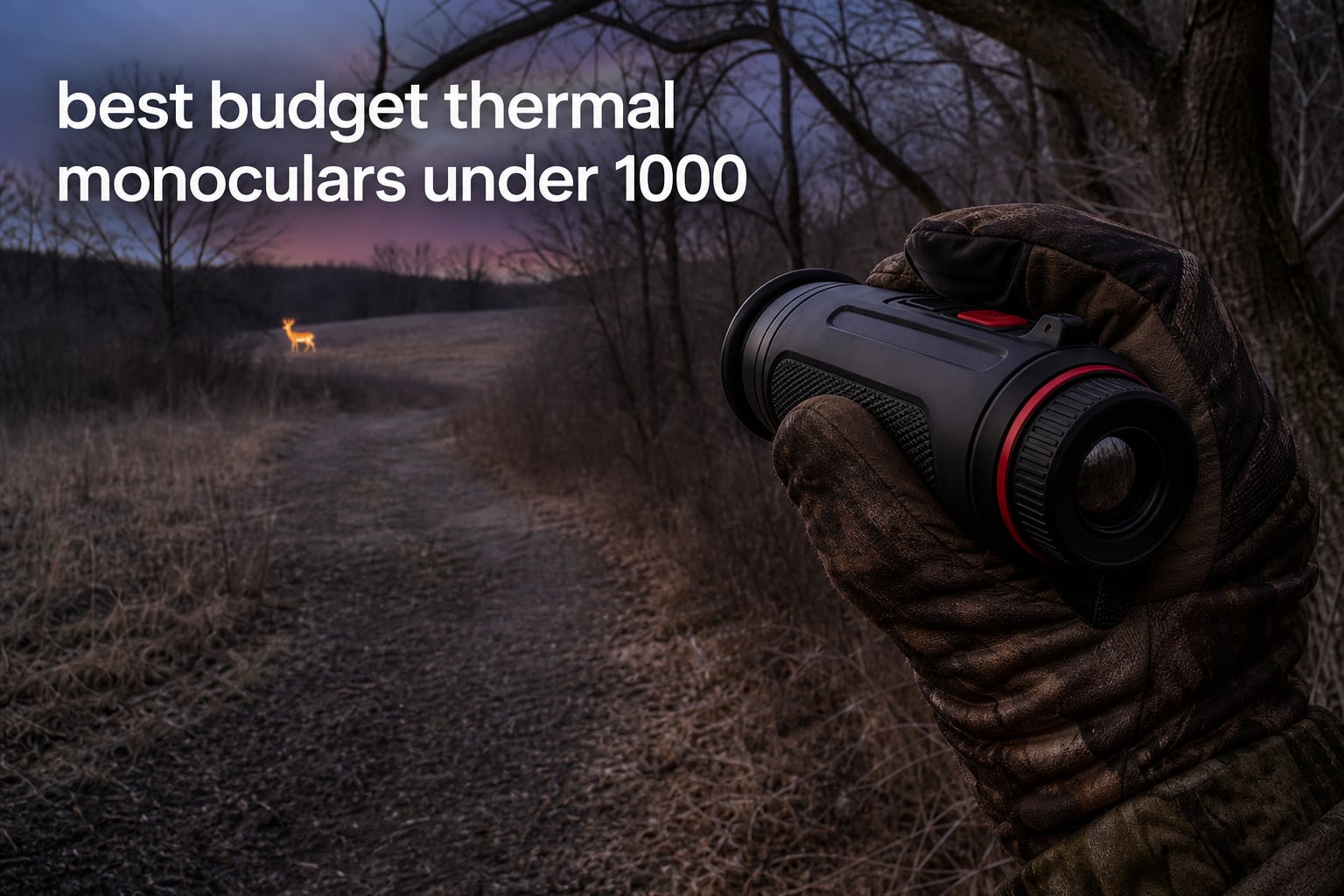
The best budget thermal monoculars under 1000 make sense when your first goal is finding a warm animal, person, or vehicle after dark rather than identifying fine detail at extreme distance. A thermal monocular detects differences in heat; it is not the same thing as a light-amplifying night-vision device, and it works without a visible illuminator.
I approached this list by putting the supplied specifications ahead of big range claims. That matters because experienced hunters in forum discussions repeatedly say that advertised detection is only a starting point: humidity, brush, background temperature, animal angle, and your ability to interpret the screen change what you can actually do in the field.
Every model here is a handheld thermal spotter with real product data behind it. I compare sensor resolution, thermal sensitivity where published, refresh rate, lens and field of view, battery claims, recording, connectivity, weather rating, review history, and warranty information so you can match the tool to wildlife observation, farm monitoring, property scanning, or night hunting where lawful.
Table of Contents
Our Top 3 Picks for Budget Thermal Monoculars Under 1000 (September 2026)
The TOPDON TS004 Pro is my Editor’s Choice because its 384 by 288 sensor, 19 mm objective, 50 Hz refresh rate, long stated detection claim, and 11-hour battery claim form the strongest all-around specification set here. The AGM Taipan V2 is the better choice for someone who values low thermal sensitivity, automatic focus, a 5-year transferable warranty, and a broad feature package.
For a compact carry option, I would start with the RIX Pocket K2. It combines a 200-gram body, 50 Hz operation, an 800 by 600 OLED display, sub-25 mK sensitivity, image stabilization, and a 5-year manufacturer warranty, though its fixed focus asks you to accept less control over distance work.
Budget thermal monoculars in 2026 are easiest to compare by core specs
This overview puts all eight options in one place. A higher sensor resolution helps preserve useful shape information as you zoom, while sensitivity, written as NETD in millikelvin, describes how small a temperature difference the sensor can separate; lower published NETD numbers are preferable.
| Product | Specifications | Action |
|---|---|---|
 TOPDON TS004 Pro TOPDON TS004 Pro |
|
Check Latest Price |
 AGM Taipan V2 AGM Taipan V2 |
|
Check Latest Price |
 RIX Pocket K2 RIX Pocket K2 |
|
Check Latest Price |
| RIX Pocket K3 |
|
Check Latest Price |
 TOPDON TS004 TOPDON TS004 |
|
Check Latest Price |
 MiLESEEY TNV10PRO MiLESEEY TNV10PRO |
|
Check Latest Price |
 ATN BlazeSeeker-207 ATN BlazeSeeker-207 |
|
Check Latest Price |
 GOYOJO G210 GOYOJO G210 |
|
Check Latest Price |
1. TOPDON TS004 Pro gives the clearest long-range-oriented specification set
TOPDON TS004 Pro Thermal Imaging Monocular, 19mm 50Hz Night Vision
384x288 IR
19mm objective
50Hz refresh
11h claimed battery
Pros
- 384x288 sensor
- 50Hz refresh
- 11h claimed runtime
- IP67 rating
- wireless app
Cons
- Manual focus
- 1-year warranty
The TS004 Pro earns the first position because a 384 by 288 infrared resolution is a meaningful step up from the 256 by 192 units in this group. It also pairs that sensor with a 19 mm objective lens and 50 Hz refresh rate, a sensible mix for scanning open ground and following a moving heat signature without as much visible stutter.
TOPDON lists detection out to 650 yards and detail visibility to 146 yards. I would treat those as controlled-condition reference points, not as a promise that you will identify a coyote or hog at that distance through wet air, grass, or timber.
The listed 11-hour continuous runtime and IP67 weather protection speak directly to two field concerns that come up often: battery anxiety during a long night and exposure to rain or dust. Wireless support through the TopInfrared app is useful when you need to share a view or transfer captures rather than pass the monocular around.
The 4.5-star average is drawn from 377 reviews in the supplied record, which is more feedback than several alternatives here. The main compromise is manual focus, so plan to make focus adjustment part of your observation routine whenever the distance changes.
Its 384 by 288 sensor suits detail-focused scanning
A 384 by 288 sensor has more thermal pixels than a 256 by 192 sensor, giving it more information to work with before digital zoom enlarges the image. That does not turn detection into positive identification, but it can make body shape, direction of travel, and separation between animals easier to read.
For coyote hunting, wild boar observation, or a large-property scan, I would favor this added resolution over a smaller sensor if you expect to zoom. The 50 Hz rate is also a better fit for panning across a field than a slower refresh specification.
Its manual focus requires a deliberate field routine
Manual focus is not automatically a flaw; it lets the user tune the scene instead of relying on automation. It does mean you should practice finding the focus control with gloves on and check it after changing from a near fence line to a distant tree line.
The supplied listing provides a 1-year warranty. If long ownership coverage is your deciding factor, compare it closely with the AGM and RIX models that list 5-year coverage.
2. AGM Taipan V2 balances sensitivity, features, and long warranty coverage
AGM Global Vision Taipan V2 10-256 Thermal Monocular High-Sensitivity
Sub-35mK detector
15mm lens
1.5x-12x zoom
16GB memory
Pros
- Sub-35mK sensitivity
- auto focus
- 16GB recording
- IP67 rating
- 5-year warranty
Cons
- Only 16 reviews
The AGM Taipan V2 is the most rounded option for a buyer who wants a thermal monocular that can be simple to operate but still capture evidence and connect to a phone. AGM specifies a sub-35 mK 12-micron detector, automatic focus, a 15 mm objective lens, and 1.5x through 12x digital zoom.
That sub-35 mK figure is a useful published sensitivity marker. In practical terms, a lower NETD number means the sensor can distinguish smaller differences in infrared radiation, which may help an animal stand out from a similarly warm background.
The feature set is unusually complete: 16 GB of internal memory records photos and videos with sound, Wi-Fi works with the AGM Connect App, and the menu includes distance measurement, picture-in-picture, hot tracking, automatic flat-field correction, and four palettes. The 1280 by 960 LCOS display gives the user a high-resolution viewing panel, though display resolution is not the same as sensor resolution.
I also place weight on the 5-year transferable manufacturer warranty and IP67 rating. The 4.7 rating is strong, but it comes from 16 reviews, so I would not treat the average as equivalent to a product with hundreds of ratings.
Its automatic focus helps new thermal users scan sooner
Automatic focus can reduce the number of controls a new owner has to manage in darkness. That is particularly helpful while learning thermal interpretation, since a person has to separate a heat pattern from terrain, branches, rocks, and retained daytime warmth.
The 10-degree listed field of view favors a more concentrated view than the wide-angle RIX Pocket K2. It can suit deliberate scanning, but a broader view can be more comfortable when you are checking close ground or trying to acquire a target quickly.
Its recording and warranty make it a long-term ownership candidate
Built-in 16 GB storage means you can record without immediately adding a card. Recorded clips are useful for reviewing what you saw, sharing wildlife encounters, or documenting a property incident, subject to applicable laws and privacy rules.
AGM claims up to seven hours of continuous use with its energy-saving tilt sensor. Like all battery claims, that is best used for planning rather than as a guarantee, because cold conditions and display use can change real runtime.
3. RIX Pocket K2 makes portability and thermal sensitivity its strongest case
RIX Pocket K2 Portable Thermal Monocular for Hunting, 256×192 (50Hz), Wi-Fi, Handheld Night Vision Monocular
256x192 sensor
Sub-25mK NETD
50Hz OLED
200g body
Pros
- 200g lightweight body
- sub-25mK NETD
- 50Hz refresh
- OLED display
- 5-year warranty
Cons
- Fixed focus
- 256x192 sensor
The RIX Pocket K2 is the option I would look at first when a thermal spotter needs to disappear into a pocket or ride easily in a small kit. At 200 grams and 4.9 by 1.8 by 2.9 inches, the supplied dimensions are compact without stripping away practical field features.
Its 256 by 192, 12-micron sensor is supported by a published NETD below 25 mK and 50 Hz refresh rate. That sensitivity number is lower than the AGM and ATN figures supplied here, while the OLED display is listed at 800 by 600 for high-contrast viewing.
RIX also includes Resolution Enhanced Technology and electronic image stabilization. Those features can make a hand-held scene easier to watch, but they do not create raw sensor pixels; I would still keep digital magnification modest when identification matters.
The product record gives it a 4.4 rating from 205 reviews, IP67 water protection, Wi-Fi, and a 5-year manufacturer warranty. Its key limitation is fixed focus, which is an acceptable trade for fast, casual spotting but less attractive when you regularly study subjects across varied distances.
Its light body fits mobile wildlife and property checks
A light handheld thermal monocular is more likely to be with you when you need it. For a quick check of a pasture, trail, shed line, or yard boundary, low carry weight can matter more than a large objective lens.
The K2 has a listed 19.4-degree field of view, the widest figure in this lineup. A wide field helps with near-to-medium-distance scanning because more of the scene appears on screen at once.
Its fixed focus favors quick spotting over distance adjustment
Fixed focus means there is no focusing step when you raise the unit, which supports quick observations. The trade-off is that the image can be less tailored to a particular range than a manually focused monocular.
The seven-times listed zoom ratio should be interpreted carefully: digital zoom enlarges what the sensor already captured. I would scan at the lowest useful magnification, then increase only enough to inspect a heat source.
4. RIX Pocket K3 adds a 384 by 288 sensor in a compact layout
RIX Pocket K3 Thermal Monocular for Hunting, 384×288 Night Vision Monocular
384x288 sensor
15mm lens
50Hz OLED
8GB recording
Pros
- 384x288 sensor
- 50Hz refresh
- EIS stabilization
- 8GB recording
- Wi-Fi
Cons
- Controlled-condition range claim
- field performance varies
The RIX Pocket K3 is for the reader who likes the compact Pocket format but wants more sensor resolution. It has a 384 by 288 thermal sensor, 15 mm objective lens, two-times base magnification, 17.5-degree field of view, and a 50 Hz frame rate.
Those specifications place it in the higher-detail tier of this group alongside the TOPDON TS004 Pro. The base magnification and 15 mm lens are worth noticing because they shape how the unit feels before digital zoom enters the picture.
RIX lists an 800 by 600 OLED display, electronic image stabilization, RET image enhancement, Wi-Fi, and 8 GB for photo, audio, and video recording. It also uses a replaceable power supply unit, a practical advantage for longer outings if you prepare spare power in advance.
The supplied review summary shows a 4.4 average from 106 reviews. RIX states detection up to 853 yards under controlled conditions; I would use that figure only to compare the maker’s test setup, then make a local assessment at the distances and weather conditions that matter to you.
Its higher-resolution sensor benefits deliberate observation
The K3’s 384 by 288 sensor offers more source information than the K2’s 256 by 192 sensor. If you routinely watch a larger area and need more confidence in the shape of a distant heat signature, that difference matters before any digital zoom is applied.
The 50 Hz refresh rate is a welcome specification for moving animals and for steady hand-held panning. It will not solve blur from fast hand movement by itself, which is where the included EIS can help the viewing experience.
Its replaceable power approach supports longer sessions
Battery planning is one of the least glamorous parts of thermal ownership, but it decides whether a device is useful at the end of the night. A replaceable power supply lets you plan around field duration instead of relying only on a recharge opportunity.
Before buying, I would confirm what replacement power is supplied or readily available and learn the change procedure in daylight. That small preparation prevents a rushed first battery swap in the dark.
5. TOPDON TS004 offers long stated battery life and straightforward controls
TOPDON TS004 Thermal Imaging Monocular, 13mm 50Hz Night Vision
256x192 IR
13mm lens
50Hz refresh
11h claimed battery
Pros
- 11h claimed runtime
- 50Hz refresh
- 410m detection claim
- IP67 rating
- wireless app
Cons
- Manual focus
- 256x192 sensor
The standard TOPDON TS004 is a sensible pick for a buyer who wants a 50 Hz thermal imaging monocular with a published 11-hour battery claim and does not need the Pro model’s higher listed resolution. It uses a 256 by 192 infrared resolution, 13 mm objective lens, manual focus, and an 8x listed zoom ratio.
TOPDON gives this model a 410-meter detection claim and says detail visibility reaches 100 yards. The distinction is important: detection means noticing something warm, while recognition or detail visibility is the more useful measure when you are trying to decide what it is.
The device connects wirelessly to the TopInfrared App and has IP67 water and dust protection. The supplied features also claim drop resistance up to two meters, which adds reassurance for an item likely to be handled with gloves, used near a vehicle, or carried over uneven ground.
Its 4.5 average from 377 reviews gives this unit one of the broader feedback pools in the list. I would still learn manual focus early, because changing focus is the main user task that separates a quick thermal scan from a clean view of a warm subject.
Its 50 Hz refresh rate supports moving-target scanning
Refresh rate is how often the view updates each second. A 50 Hz device updates more frequently than a 25 Hz device, which can make a moving animal or a panning scene appear smoother.
For a stationary building check, the difference may be less important. For night hunting or following wildlife along a tree line, the smoother update rate is a useful feature to prioritize.
Its detection claim needs an identification reality check
A thermal sensor can reveal a warm object well before the viewer can responsibly identify species, direction, or context. Never use a detection claim as a safe shooting-distance claim, and always follow local laws and safe target-identification practice.
I would test a new monocular against known landmarks near home. Look at a person, dog, deer-shaped target, or vehicle at measured distances in different weather, then note when you can detect, recognize, and identify each one.
6. MiLESEEY TNV10PRO focuses on true 320 by 240 imaging and endurance
MiLESEEY TNV10PRO Thermal Monocular, 400×300 SR 320×240 IR Resolution, Aircraft Mg-Al Alloy, 13mm 50Hz Handheld Thermal Camera, Night Vision Imager, Hot Spot Tracking
True 320x240 IR
50Hz OLED
12h claimed battery
32GB memory
Pros
- True 320x240 sensor
- 50Hz refresh
- 12h claimed runtime
- 32GB memory
- hotspot tracking
Cons
- 46 reviews
- more 2-star feedback
The MiLESEEY TNV10PRO stands out because the listing explicitly calls out a true 320 by 240 infrared sensor rather than upscaling. That sits between 256 by 192 and 384 by 288 on paper, paired with a 12-micron detector, 50 Hz refresh rate, and an 800 by 600 OLED display.
For sessions that may run long, the stated runtime of up to 12 hours from a 4500 mAh battery is its headline feature. The unit also lists IP65 protection and an operating range from minus 20 C to 60 C, specifications that speak to users concerned about heat, cold, and outdoor exposure.
Five palettes, hotspot tracking with auto-lock, 4x digital zoom, and 32 GB built-in memory give it a feature-rich setup. MP4 recording is listed at 400 by 300, so a user who documents observations has room to work without adding media immediately.
The rating is 4.2 from 46 reviews, and the supplied data reports a larger 2-star share than the other models’ summaries. I would read current owner feedback closely and assess support information before treating its excellent endurance specifications as the deciding factor.
Its true 320 by 240 sensor offers a middle ground
A true 320 by 240 sensor supplies more raw data than 256 by 192, although it remains below 384 by 288. It can be a reasonable compromise for an owner who needs a bit more image information but does not need the largest sensor on this list.
Its UHD mode is described as offering up to 50 percent more definition. Enhancement modes may make edges and contrast easier to see, but I would compare them against the standard view instead of assuming they add new detail.
Its environmental specification suits exposed outdoor use
The stated operating range provides a concrete planning point for people who work or observe outdoors in more demanding weather. Batteries still tend to be the variable to watch in low temperatures, so keep the device warm when possible and begin with a full charge.
IP65 means the manufacturer lists protection against dust and water jets, while IP67 products are rated for temporary immersion under their stated standard. Neither rating removes the need to protect a lens, cap ports, and dry the device after wet use.
7. ATN BlazeSeeker-207 is a compact starter with recording and Wi-Fi
ATN BlazeSeeker-207 Thermal Imaging Monocular 256×192; 1-8.8X 12 Micron <35 NETD 50 Hz
256x192 sensor
Sub-35mK NETD
Wi-Fi
MicroSD up to 256GB
Pros
- Sub-35mK NETD
- photo and video
- Wi-Fi app
- MicroSD support
- 3-year warranty
Cons
- 7mm lens
- 345m detection claim
The ATN BlazeSeeker-207 is a compact entry into thermal viewing for a person who values smartphone connection and expandable recording. Its listed core is a 256 by 192, 12-micron sensor with thermal sensitivity below 35 mK and a 7 mm objective lens.
ATN lists still-image and video capture, built-in Wi-Fi and app connectivity, plus MicroSD card support up to 256 GB. That combination is useful for someone who expects to record more than the unit’s internal capacity would otherwise allow.
The BlazeSeeker offers multiple listed variants, while this supplied record identifies the 1x through 8.8x version. Its five stated palette options include White Hot, Black Hot, Iron Red, Alarm, Sepia, and Green Hot; test a few palettes in familiar terrain because the clearest one depends on your background and visual preference.
It has a 4.2 rating from 203 reviews and a 3-year manufacturer warranty. The published detection figure is up to 345 meters, but the small 7 mm lens makes this a more natural fit for close-to-medium scanning than for asking maximum distance from a compact thermal scope alternative.
Its expandable MicroSD recording suits frequent capture
MicroSD support up to 256 GB is a genuine convenience for owners who record wildlife behavior, property observations, or training sessions. Carrying a spare card also lets you archive clips without waiting to move files in the field.
Recording is not a substitute for a clear live view, however. Set the time to learn the menus, confirm the card is recognized, and verify that the device records the type of media you expect before taking it out at night.
Its short objective lens favors closer scanning tasks
A 7 mm objective lens is compact, which helps keep the device small and easy to handle. A larger lens generally narrows the field of view and can support longer-range observation, but it also changes size and how easily the scene is acquired.
For home security checks, short walks, or a nearby field edge, a compact lens can be practical. If your usual view is a long, open pasture, compare it against the 15 mm and 19 mm options above.
8. GOYOJO G210 provides wide-view fixed-focus thermal observation
GOYOJO G210 Thermal Monocular, 256×192 Thermal Imaging Monoscope Camera for Adults, 10mm Focal Lens Vision Goggles Thermal Scopes for Night Hunting Camping
256x192 sensor
10mm lens
6 palettes
replaceable batteries
Pros
- 256x192 sensor
- six palettes
- 16GB storage
- replaceable batteries
- IP65 rating
Cons
- Fixed focus
- 1kg listed weight
The GOYOJO G210 is an option for users who want a simple fixed-focus thermal monocular with multiple display palettes, 16 GB image storage, and replaceable batteries. It uses a 256 by 192 thermal sensor with a 12-micron detector and 10 mm focal lens.
Its listed 17.5-degree field of view is generous for seeing a broad slice of ground. That makes the G210 worth considering for nearby wildlife observation, camping checks, or locating a heat signature before a closer look, rather than treating it as a dedicated long-distance detail tool.
The product offers six palettes: White Hot, Black Hot, Red Hot, Rainbow, Iron Red, and Glimmer. It also has 4x zoom, IP65 protection, real-time image sharing through its app, and a claim of more than six hours of continuous use from replaceable batteries.
The supplied record lists a 4.4 rating from 279 reviews, but it also lists the item weight at one kilogram. That is much heavier than the RIX Pocket K2’s 200 grams, so I would consider where and how long you will carry it before making the G210 your regular night-vision monocular alternative.
Its wide field of view works best for close-area searches
A wider field of view lets you take in more terrain without panning. That can help when looking for a pet, checking a backyard, moving along a wooded trail, or watching a nearer wildlife feeding area.
Wide views show targets smaller at the same distance, so use them to locate a warm subject first. After that, move closer or use careful zoom only when you need more context.
Its replaceable batteries require spare-power planning
Replaceable batteries can be useful when charging access is limited, especially on a camping trip or long property check. The listed runtime is more than six hours, but actual endurance can change with temperature and display demand.
My practical rule is to carry known-good spare batteries in a protected pocket and rehearse the change in daylight. It is also wise to confirm the exact battery type and approved charging practice in the manufacturer instructions.
Choose a budget thermal monocular by sensor, use distance, and power plan
Start with the job, not a marketing range number. A person scanning a compact property needs a broad field of view, easy controls, and enough battery for short checks, while someone watching open ground benefits from a stronger sensor, a more purposeful lens, and smooth refresh performance.
Sensor resolution answers how much image information you begin with
Sensor resolution is the raw grid of heat data the monocular receives. In this group, 256 by 192 is adequate for basic detection and nearby observation, 320 by 240 provides a middle step, and 384 by 288 gives more information for inspection before enlargement.
More resolution is helpful, but it does not cancel weather, vegetation, or poor target contrast. A warm animal behind brush may be detectable without being identifiable regardless of the number on the specification sheet.
NETD answers how well the sensor separates small temperature differences
NETD means noise-equivalent temperature difference, commonly stated in millikelvin. A lower figure, such as the RIX Pocket K2’s sub-25 mK claim, indicates the sensor is specified to distinguish smaller temperature differences than a higher number.
That matters at dawn, in damp conditions, or when a warm object and its background are close in temperature. Still, manufacturers may state NETD under particular test conditions, so treat it as one comparison signal rather than a full field-performance verdict.
Detection range differs from recognition and identification range
Detection is the distance where you may notice a warm presence. Recognition is where you can tell the category or shape with more confidence, and identification is where you can determine exactly what you are looking at.
This distinction is one of the most important safety lessons for thermal users. For hunting, never make a decision based on a heat blob alone; confirm the target and what is beyond it with a safe, lawful process.
Refresh rate answers how natural motion looks while scanning
A 50 Hz refresh rate updates the image 50 times per second and is well suited to panning across a field or tracking moving wildlife. The TOPDON models, both RIX Pockets, and the MiLESEEY list 50 Hz, whereas the GOYOJO product record lists 25 Hz.
For slow property checks, lower refresh may be acceptable. If fast movement is a regular part of your use, 50 Hz is a feature I would put near the top of the buying list.
Lens size and field of view should match the terrain
Broad field-of-view models make nearby searching easier because they display more of the scene. Longer lenses or more magnified base views can be more comfortable for open areas, though they can make it harder to find a subject quickly.
Use the listed figures as a map: the RIX K2’s 19.4-degree field is wide, the GOYOJO G210 and RIX K3 list 17.5 degrees, the TS004 lists 13.5 degrees, and the Taipan V2 lists 10 degrees. Your familiar terrain is the right reference point for deciding which view feels useful.
Battery claims should become a conservative field plan
Manufacturers list up to 11 hours for both TOPDON units, up to 12 hours for the MiLESEEY, up to seven hours for the AGM, and more than six hours for the GOYOJO. Those figures are helpful planning data, yet cold weather, Wi-Fi, recording, and screen brightness can reduce runtime.
Charge fully before leaving, carry approved spare power where the design permits it, and do not let the first outing be your first experience with its battery system. Forum users consistently value real battery behavior over a headline figure, and that is the right instinct.
Recording, connectivity, and weather ratings decide the practical extras
Built-in memory and Wi-Fi are useful if you share clips, transfer observations, or document an incident. The AGM has 16 GB, the RIX K3 has 8 GB, the GOYOJO has 16 GB, and the MiLESEEY has 32 GB; ATN’s MicroSD support is an alternative for more frequent capture.
IP67 is the stronger weather specification in this set, listed for AGM, TOPDON, and RIX Pocket K2, while GOYOJO and MiLESEEY list IP65. Pick the rating that matches your exposure, but keep lens surfaces clean and protect the device from unnecessary impacts in every case.
Warranty coverage and review volume should temper the final choice
Warranty is easy to skip until a device needs support. AGM lists a 5-year transferable warranty; RIX lists 5-year manufacturer coverage; ATN lists three years; TOPDON TS004 Pro and GOYOJO list one year; and the MiLESEEY record does not provide a warranty description.
Ratings are useful but need context. A 4.7 average from 16 reviews is encouraging but less established than a 4.5 average from 377 reviews, so read recent owner comments and confirm the exact version, included accessories, and support terms before ordering.
FAQs
What is the best budget thermal monocular under $1000?
The TOPDON TS004 Pro is the strongest all-around pick in this comparison because it combines a 384×288 sensor, 19mm objective lens, 50Hz refresh rate, IP67 rating, wireless connection, and an 11-hour claimed battery life. Choose the AGM Taipan V2 instead if automatic focus, sub-35mK sensitivity, 16GB recording, and a 5-year transferable warranty matter more.
What thermal monocular do professionals use for hunting under $1000?
For serious hunting-oriented observation, prioritize a 384×288 sensor, 50Hz refresh rate, appropriate field of view, and a conservative understanding of detection distance. In this group, the TOPDON TS004 Pro and RIX Pocket K3 supply 384×288 sensors, while the AGM Taipan V2 adds a sub-35mK detector and automatic focus. Always identify a target safely and follow local laws.
What is the best thermal monocular for the money?
The AGM Taipan V2 presents a strong feature balance with sub-35mK sensitivity, automatic focus, 16GB recording, Wi-Fi, IP67 protection, and a 5-year transferable warranty. The RIX Pocket K2 is the better compact alternative if low carry weight, a sub-25mK specification, 50Hz viewing, and a 5-year warranty are your main priorities.
Is a $1000 thermal monocular worth it?
A thermal monocular is worth considering when finding heat signatures in darkness, fog, or visual clutter will genuinely help with lawful wildlife observation, property checks, farm monitoring, or hunting. It is not worth treating as a guaranteed identification tool at long range. Match sensor resolution, field of view, power setup, and weather rating to your actual use before buying.
What is the best thermal imaging monocular for the money?
The best choice depends on whether you value sensor detail, compact carry, battery claims, or warranty coverage. The TOPDON TS004 Pro is the best overall specification-led choice, AGM Taipan V2 has the broadest feature and warranty mix, and RIX Pocket K2 is particularly appealing for lightweight wide-view scanning.
The TOPDON TS004 Pro is the best all-around choice for 2026
The TOPDON TS004 Pro is my first recommendation for readers who want the strongest blend of 384 by 288 resolution, 50 Hz viewing, a 19 mm lens, weather protection, and a long stated runtime. The AGM Taipan V2 is the better match for automatic focus, built-in recording, and 5-year transferable warranty coverage, while the RIX Pocket K2 is the easy carry pick.
Use this guide to compare the best budget thermal monoculars under 1000 against the distances, terrain, and weather you actually face. Check the current listing details, then spend time practicing target recognition in safe, familiar surroundings before relying on any thermal device after dark.