
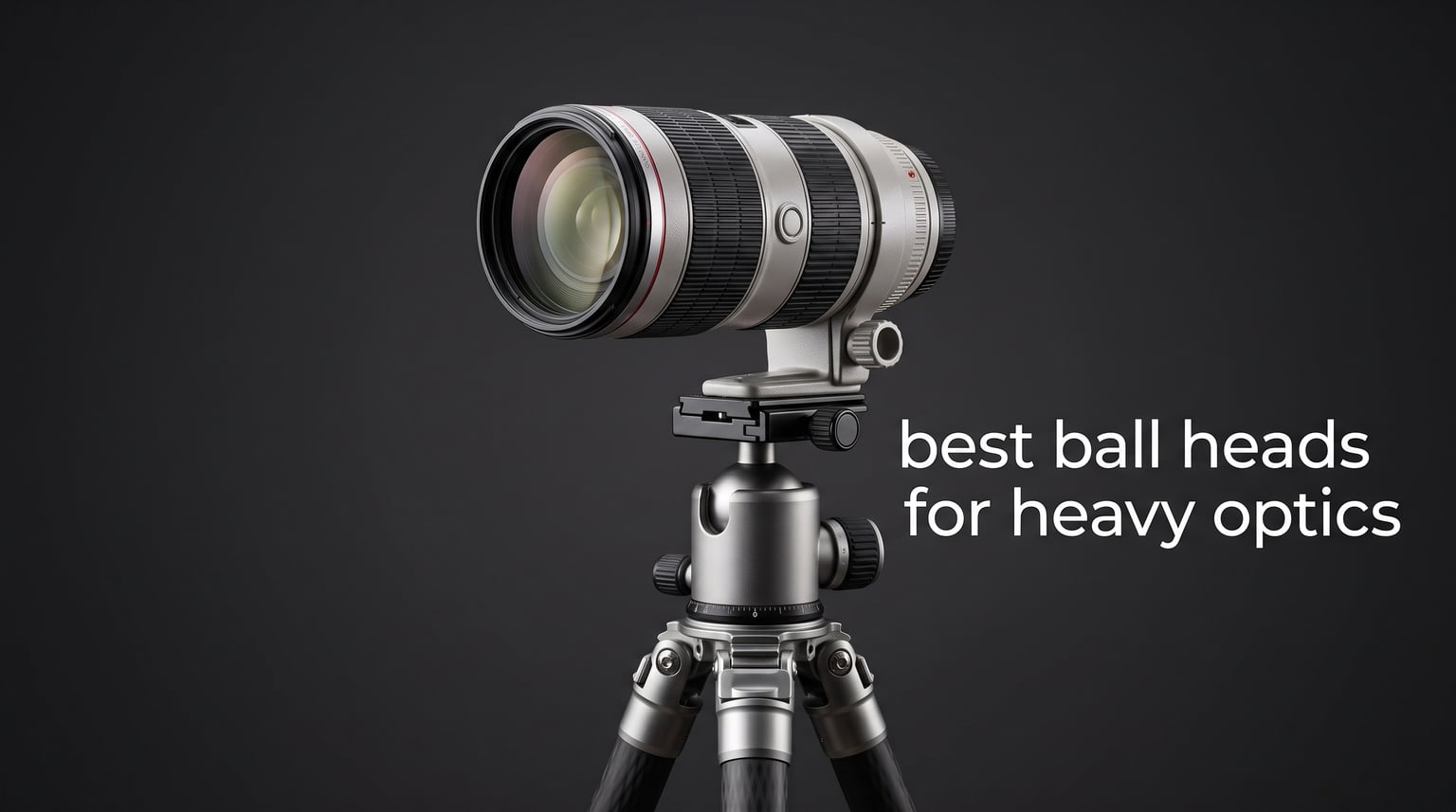
The best ball heads for heavy optics have a secure clamp, a sensible safety margin over the complete rig, and controls you can trust with a front-heavy lens. For a 600mm lens, spotting scope, or heavy camera-and-lens combination, I begin with ball size, stated load capacity, head weight, and the plate interface.
A ball head is the tripod mounting mechanism that uses a spherical joint to position a camera or optic at almost any angle, then locks that position with one or more controls. This guide compares eight models using their published specifications and rating data, so I treat a maker’s load claim as a starting point rather than a promise of drift-free use with every lens and tripod.
Heavy-telephoto users repeatedly identify drift, loose clamps, and the weight-versus-capacity trade-off as the problems that matter. The tripod legs, center column, lens foot, plate, and head all share the job; our guide to tripod equipment for filming peewee hockey games can also help when you are assembling a complete video support setup.
Table of Contents
The Top 3 Picks for Heavy Optics Give Clear Starting Points
I put the WEYLLAN CH55 first because its 55mm ball and 88-pound stated capacity give it the largest published support claim in this group, while its damping adjustment supports deliberate composition. The ARTCISE KB55 has matching 55mm and 88-pound figures plus three quick-release plates, making it compelling for people who move one head between several devices.
The NEEWER GM36 is the established compact option: it lists a 33-pound capacity, has a low-profile form, and carries a 4.5 rating across 1,798 reviews. Those figures do not remove the need to test a locked setup close to the ground before placing expensive optics over hard terrain.
The Best Ball Heads for Heavy Optics in 2026 Are Easy to Compare Here
| Product | Specifications | Action |
|---|---|---|
 WEYLLAN CH55 WEYLLAN CH55 |
|
View Product Details |
 XILETU 44mm XILETU 44mm |
|
View Product Details |
 CAVIX H-46 CAVIX H-46 |
|
View Product Details |
 ARTCISE KB55 ARTCISE KB55 |
|
View Product Details |
 WEYLLAN EH46L WEYLLAN EH46L |
|
View Product Details |
 K&F CONCEPT BH-36 K&F CONCEPT BH-36 |
|
View Product Details |
 NEEWER GM36 NEEWER GM36 |
|
View Product Details |
 SIRUI AM-40 SIRUI AM-40 |
|
View Product Details |
The comparison is a screening tool, not a load test. Brands do not use a shared industry method for capacity ratings, which is why I would choose more margin than a listing’s number alone appears to require and would inspect the clamp, plate, and tripod as one support system.
1. WEYLLAN CH55 Is the Strongest Published-Capacity Pick
Low Profile Ball Head 55mm Tripod Ball Head Panoramic Tripod Head, CNC All Metal Tripod Camera Head for Tripods, WEYLLAN CH55 with Mlok Rail Arca Swiss Quick Release Plate, Max Load 88lbs/40kg
55mm ball
88 lb stated capacity
Damping control
M-LOK Arca plate
Pros
- 55mm ball
- 88 lb stated capacity
- Damping adjustment
- Double U-notches
- M-LOK Arca rail plate
Cons
- 1.7 lb carry weight
- No water-resistance rating
The CH55 is the model I would check first for a large telephoto lens or scope because its details list a 55mm ball and an 88.12-pound maximum weight recommendation. Its 4.7 rating is based on 214 reviews, and its compatibility list includes cameras, camcorders, telescopes, and heavy-duty binoculars.
The low-profile shape can help a top-heavy combination feel less precarious by lowering the center of gravity. WEYLLAN also lists a damping fine-tuning setting, which is more useful for deliberate framing than an undifferentiated lock knob.
The CH55 fits large rigs when the plate and tripod match
The included M-LOK-to-Arca rail plate makes this a notable option for an existing rail setup, and double U-notches allow quick horizontal-to-vertical changes. I would mount a long lens by its foot, confirm full plate engagement, and work through the tilt range near the ground before trusting the system at height.
The CH55 is less suited to wet or weight-sensitive kits
The product details list no water resistance, and its 1.7-pound weight changes the carry balance of a travel tripod. For stationary wildlife observation and digiscoping those trade-offs can be reasonable; for continuously moving subjects, a gimbal may suit the movement better.
2. XILETU 44mm Is the Light Arca and Picatinny Crossover
XILETU Aluminum Ball Head for Shooting Tripod 360° Panoramic Ball Head for DSLR Camera Compatible with Arca Swiss and Picatinny Maximum Load Capacity of 55lbs for Hunting and Photography (44mm)
54mm sphere
55 lb stated capacity
Arca and Picatinny
Lever release
Pros
- Arca and Picatinny support
- Quick-release lever
- Four lock knobs
- 0.98 lb listed weight
- 55 lb stated capacity
Cons
- No water-resistance rating
- Three-month warranty
The XILETU combines Arca-Swiss and Picatinny mounting formats in one aluminum head. It lists a 55-pound capacity at 0.98 pounds, a 4.7 rating from 48 reviews, and a 54mm diameter sphere in its feature list.
I see the dual-interface design as its central reason to shortlist it. A photographer who uses compatible shooting equipment does not have to alter the whole mounting approach just to move between those two plate standards.
The XILETU works best for mixed-mount support systems
The quick-release lever supports fast changes, while the listing describes four separate locking knobs for the plate, ball, and base. Its 360-degree panoramic function and double U-shaped design add flexibility for camera, telescope, and monopod use, but I would confirm the actual plate profile before assuming every Arca-style plate is an exact fit.
The XILETU needs a cautious durability check
The stated three-month warranty is short compared with several other models here, and no water resistance is listed. Its review sample is also much smaller than the NEEWER’s, so I would read the high average as encouraging but limited feedback rather than proof of long-term heavy-rig performance.
3. CAVIX H-46 Is a Low-Profile 44-Pound Option
Tripod Ball Head, CAVIX H-46 Metal Ball Head Camera Tripod Head 44lbs/20kg Load with Arca Swiss Quick Release Plate for Tripod, Monopod, DSLR, Camera
46mm body
44 lb stated capacity
Arca plate
360 degree swivel
Pros
- 44 lb stated capacity
- Low-profile design
- All-metal CNC construction
- 360 degree swivel
- Three adjustment knobs
Cons
- No water-resistance rating
- Lower stated capacity than 55mm leaders
The CAVIX H-46 targets the middle of this group with a 44-pound stated capacity, a 46mm diameter, and a low-profile design. Its 4.6 rating from 291 reviews gives it a larger feedback base than several models with similar headline specifications.
For a conventional DSLR and telephoto kit, I like the combination of an all-metal CNC-machined body, a standard Arca-Swiss quick-release plate, and three adjustable knobs. The listed 360-degree horizontal rotation and 90-degree vertical tilt cover core still-photography movements.
The CAVIX H-46 suits moderate heavy-lens combinations
The lower center of gravity is intended to give solid camera support, while the bubble level helps establish a horizon before composition. Its supplied 1/4-to-3/8 screw adapter broadens tripod fit, but the tripod platform must also be broad and stiff enough for the head and lens.
The CAVIX H-46 is not the margin-first choice for huge glass
A 44-pound stated maximum is below the 55- and 88-pound claims in this roundup. I would leave more margin for a scope or a very front-heavy lens rather than treating that number as a direct measurement of locked-angle strength; keep grit away from the ball and clamp because no water resistance is listed.
4. ARTCISE KB55 Matches the Largest Published Load Claim
55mm Low Profile Ball Head Tripod Ball Head ARTCISE KB55 Heavy Duty Tripod Head All Metal CNC Machining with Three 1/4″ Quick Release Plates for Tripod, Monopod, DSLR, Camcorder, Max Load 88lbs /40kg
55mm ball
88 lb stated capacity
Micrometer drag
Three plates
Pros
- 55mm ball
- 88 lb stated capacity
- Micrometer drag
- Three quick-release plates
- Aluminum CNC body
Cons
- 1.3 lb carry weight
- No water-resistance rating
The ARTCISE KB55 is the closest on-paper alternative to the CH55: it lists a 55mm sphere, an 88-pound maximum load, and a 1.3-pound item weight. Its 4.6 rating comes from 98 reviews, and the manufacturer includes three 1/4-inch quick-release plates.
I give the included plates real importance in a multi-body workflow. Keeping compatible plates on a camera body, spotting scope, and second device can reduce setup changes, provided every plate screw and safety lock is checked.
The KB55 makes sense for people who rotate several devices
The micrometer drag-tension adjustment is the feature I would use while composing with a long lens because it is intended to set resistance before the main lock. Dual drop notches permit 90-degree movement in the notches, while the listing describes up to 45 degrees of tilt in other directions.
The KB55 still needs a full setup check before field use
ARTCISE lists aluminum alloy, CNC manufacturing, and anodized surface treatment, but not water resistance. Its 2.8-by-2.8-by-3.7-inch body is compact for this class, yet a broad head paired with narrow flexible legs will not provide the steadiness a large lens needs.
5. WEYLLAN EH46L Is the Fast Lever-Clamp Choice
WEYLLAN EH46L Lever Ball Head with Stainless Steel Lock Pin, 46mm Low Profile Heavy Duty Tripod Ball Head Mount with Arca Swiss Quick Release Plate for Tripod Monopod DSLR Camera Camcorder Telescope
46mm body
55 lb stated capacity
Lever clamp
Stainless lock pin
Pros
- Stainless steel lock pin
- Lever clamp
- Low-profile body
- Arca plate
- 360 degree scale
Cons
- No water-resistance rating
- 55 lb stated capacity
The WEYLLAN EH46L is for a user who puts fast camera changes ahead of the bigger ball or extra plates of the 55mm models. It lists a 46mm low-profile body, a 55-pound maximum recommendation, a 0.86-pound item weight, and a 4.6 rating from 98 reviews.
Its key detail is the quick-release lever with a stainless-steel lock pin. The listing describes this part as more durable than copper pins, and that matters because the lock pin is a frequent wear point in a lever clamp.
The EH46L serves frequent camera changes well
The Arca-type plate uses a 1/4-inch screw, and the head has 360-degree rotation with precision scales plus a 90-degree portrait mode. Forum discussion around lever clamps agrees on one point: speed only helps if the plate is fully seated and the clamp tension is checked before the camera is released.
The EH46L calls for conservative use with extreme loads
The 55-pound claim is substantial, but its 46mm body is smaller than the 55mm options above. I would use controlled release of the main lock with a heavy scope, and would treat the listed one-year warranty and lack of water resistance as reasons to protect it in field conditions.
6. K&F CONCEPT BH-36 Is a Compact Tilt-Limiter Design
K&F CONCEPT 36mm Tripod Ball Head, 8kg Heavy Duty Head with Detachable Handle & Tilt Limiter, Arca Swiss Ball Head Mount with Quick Release + 360° Panoramic for Mirrorless Cameras and DSLRs
36mm ball
17.6 lb stated capacity
Tilt limiter
Arca plate
Pros
- Tilt limiter
- Detachable side handle
- Panoramic scale
- Arca quick release
- Bubble level
Cons
- 17.6 lb stated capacity
- Only 28 reviews
The K&F CONCEPT BH-36 is the smallest-capacity model here, listing an 8kg or 17.6-pound maximum recommendation with a 36mm ball. It earns a 4.6 rating from 28 reviews, and its detachable handle and tilt limiter give it a different operating feel.
I would not put it first for the heaviest optics. It can be a more sensible match for a lighter mirrorless body, a small telephoto, or a scope whose actual rig weight remains well under the stated maximum.
The BH-36 favors controlled framing over maximum capacity
The side handle and tilt limiter are intended to make adjustment steadier, while the 360-degree rotating base has a horizontal scale for panoramic stitching. The U-shaped groove permits 90-degree movement, and a bubble level helps with initial alignment.
The BH-36 is best kept away from the heaviest combinations
The 17.6-pound claim gives far less headroom than every other product in this comparison. The supplied data calls the item 390 grams while a feature states 220 grams, so I would verify current listing details before making a carry-weight decision; its 28-review sample is also limited.
7. NEEWER GM36 Is the Most Reviewed Compact Option
NEEWER Low Profile Camera Tripod Ball Head, 36mm Metal Panorama Ball Head Compatible with Arca 1/4” Quick Release Plate for Tripod Monopod Slider DSLR Camera Camcorder, Load Capacity: 33lb/15kg -GM36
36mm body
33 lb stated capacity
Low profile
Arca plate
Pros
- 1.8k reviews
- Low-profile design
- Arca quick-release plate
- 360 degree pan
- Bubble level
Cons
- 33 lb stated capacity
- No water-resistance rating
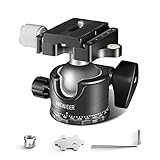
The NEEWER GM36 has the strongest review volume in this group, with a 4.5 average from 1,798 reviews. It lists a 36mm low-profile metal body, a 33-pound capacity, and a 12.38-ounce or 310g item weight.
I see it as the known-quantity compact choice rather than the maximum-capacity choice. Its lower center of gravity, CNC-machined aluminum body, 38mm Arca-type quick-release plate, and three lock knobs make its stated specification set clear.
The GM36 fits photographers who want established feedback
Review volume does not certify a head for every heavy optic, but nearly 1.8k reviews give more context than the smaller pools elsewhere. The GM36 supplies 360-degree rotation with a panning scale, a U-shaped notch for 90-degree tilt, and a 3/8-inch bottom thread with a supplied adapter.
The GM36 needs a wider safety margin for long lenses
Its 33-pound stated limit is well below the 55mm heads, so I would not make it the automatic choice for a very heavy camera and lens combination. Its low profile can help for ground-level photography, but protect the unsealed ball and clamp from mud or sand before fine adjustment.
8. SIRUI AM-40 Offers Damping Memory but Mixed Feedback
SIRUI AM-40 Low Profile Ball Head, Professional Heavy Duty 40mm Tripod Ball Head, 360° Panoramic CNC Aluminium Alloy Tripod Head for DSLR Camera, Camcorder, Quick Release Plate, Max Load 55lbs/25KG
40mm ball
55 lb stated capacity
Damping memory
Six-year warranty
Pros
- 40mm ball
- 55 lb stated capacity
- Damping memory
- Pan base scale
- Six-year warranty
Cons
- 3.7 rating from 46 reviews
- No water-resistance rating
The SIRUI AM-40 combines a 40mm ball, a 55-pound stated maximum, a low-gravity design, and a damping knob with a memory adjustment button. It is listed at 0.5kg and has a six-year manufacturer warranty, both of which make it worth considering.
I rank it last because the available rating is 3.7 from 46 reviews, and the product analysis records mixed feedback. That does not prove a problem in every unit, but it asks for more caution than the higher-rated choices in this group.
The AM-40 suits users who prioritize adjustable resistance
The memory adjustment button is intended to retain a preferred damping setting after the head is unlocked. Its 360-degree panning base has engraved index marks, the U-shaped notch supports 90-degree tilt, and the plate uses a 1/4-inch screw with a 3/8-inch female base thread.
The AM-40 deserves a close initial inspection
There is a meaningful gap between its 55-pound stated capacity and 3.7 average rating. The analysis reports 14% one-star reviews and 33% combined one- and two-star reviews, so I would inspect lock action, clamp fit, and smoothness early; no water resistance is listed.
The Right Heavy-Optics Ball Head Starts with a System Check
A ball head does not carry an optic in isolation. The strongest choice is one whose clamp, plate, tripod platform, legs, and operating style suit the gear, particularly when a lens puts its weight far in front of the ball.
- Weigh the ready-to-shoot rig. Include the camera, lens, collar or foot, plate, finder, battery, and scope adapter. Compare that total with the maker’s stated maximum, leaving meaningful margin rather than selecting a head at the edge of its claim.
- Check leverage as well as mass. A long telephoto lens creates turning force that a compact ball head can handle less comfortably than its total-weight figure suggests. For 800mm-class optics or tracking birds in motion, a gimbal can be the more natural support type.
- Confirm the plate standard and safety stop. Arca-Swiss is a common dovetail format, but widths, clamp tolerances, and safety-stop screws vary. The XILETU adds Picatinny compatibility; test the exact plate rather than assuming every Arca-style combination fits.
- Choose the release action you will check every time. A lever clamp can speed changes, while a knob clamp supports slower incremental adjustment. Seat the plate fully, set the tension, and pull-check it before taking your hand off a heavy lens.
- Set drag before unlocking a front-heavy lens. Damping controls on the CH55, KB55, and AM-40 can slow a sudden flop. Hold the lens, loosen the main lock gradually, and test the setting with the actual rig attached.
- Match the form to shooting height. Low-profile heads can reduce the center of gravity. At ground level, however, keep the ball, clamp, and base away from soil and sand that can affect movement and lock security.
- Plan for cold and wet conditions. Every product here is listed without water resistance. Operate controls slowly in cold weather, keep moisture out of the clamp, and complete a low-height lock check after a temperature change.
The most useful comparison is capacity versus control, not capacity alone. If filming sports is part of your work, our coverage of camera support equipment for hockey shot speed trackers can help with building a stable capture setup.
For wildlife photography, a ball head is best when the subject is relatively stationary and you need quick reframing from a stable tripod. For continuous movement, a gimbal often has better balance and tracking behavior, while a geared head can help with tiny static adjustments.
The FAQ Answers the Most Important Heavy-Optics Questions
What ball head can hold heavy lenses?
A ball head for a heavy lens should have a stated load rating comfortably above the complete ready-to-shoot rig, a secure clamp that matches the plate, and enough ball size for the lens leverage. In this list, the WEYLLAN CH55 and ARTCISE KB55 have the highest published 88-pound claims, but the full tripod system and a low-height lock check still matter.
Which tripod head is best for wildlife photography?
A ball head suits stationary wildlife work when you need quick composition changes. A gimbal is often the better type for a large telephoto lens and moving subjects because it balances the lens for smoother tracking; use a ball head when compactness and all-angle positioning matter more.
Are higher-specification ball heads worth choosing for heavy optics?
They can be worth choosing when the extra specification means a larger ball, a more secure clamp, adjustable drag, a longer warranty, or enough margin for a front-heavy rig. Do not choose by stated capacity alone because brands do not use one shared load-rating test and the tripod, plate, and lens foot also affect safety.
How do I choose a ball head for a heavy camera?
First weigh the complete camera and lens setup, then select a head with meaningful margin over that total. Next confirm plate and clamp fit, evaluate long-lens leverage, set drag with the rig attached, and test the locked system near the ground before using it at full height.
The Final Choice Depends on Clamp Security and Real-World Margin
For the best ball heads for heavy optics in 2026, I would start with the WEYLLAN CH55 when the 55mm ball, 88-pound stated capacity, damping adjustment, and M-LOK-to-Arca plate fit the rest of the rig. The ARTCISE KB55 is the comparable 55mm alternative when three included plates and micrometer drag match the setup, while the NEEWER GM36 is the compact option with the deepest review pool.
Make the final decision with the actual camera, lens, plate, and tripod in hand. If sports coverage is part of your use case, our list of sports photography gear for smart hockey training pucks offers another route into a practical recording setup.