
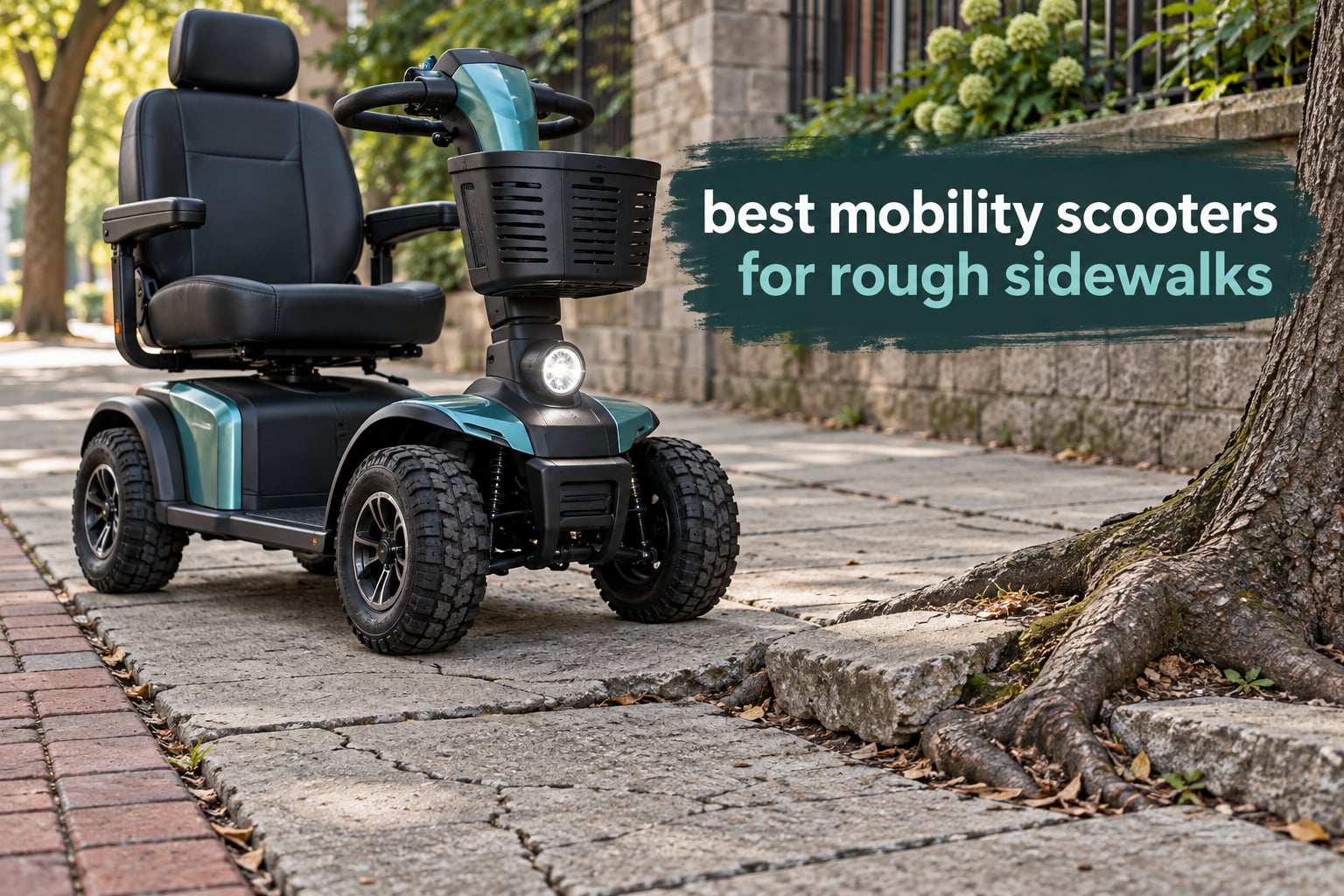
Most mobility scooters are built for carpet, not concrete. That gap only shows up the day you meet a sidewalk that has heaved, a tree root pushing through the slab, or a curb cut that drops two inches faster than the frame expects. A standard indoor scooter has small hard wheels, a short gap under the chassis and almost no suspension, so a single lifted wheel becomes a tip-over risk. For someone who cannot walk far, that risk is the difference between reaching the mailbox and staying inside.
That is what this guide is for. I spent weeks going through spec sheets, warranty terms and owner reviews for ten of the most capable mobility scooters for rough sidewalks currently on the market, then sorted them by the thing that actually matters on broken pavement: ground clearance, tire width and type, suspension travel, low-speed torque, and how wide the thing is when you meet a narrow walkway.
Every scooter below is written for real neighborhood use. Cracked concrete, brick and cobblestone, gravel driveways, grass strips and curb cuts, not mountain trails. I also left out the fastest models on the market on purpose, because 15 mph is a liability in a four-foot walkway, and several of the biggest names in this category are marketed that way. If you want the full outdoor picture, our off-road mobility scooter roundup goes deeper on trail-capable machines.
Table of Contents
Top 3 Picks for Rough Sidewalks in 2026
These three cover the widest range of real sidewalk problems. The first is the most-reviewed scooter in the group and the safest all-round answer, the second is the highest-rated with real owner feedback, and the third has the most terrain hardware in its price bracket.
Mobicyc MS09 PLUS Heavy-Duty
- 4 inch ground clearance
- 10 inch all-terrain tires
- removable lithium battery

Best Mobility Scooters for Rough Sidewalks in 2026
Here is the full lineup at a glance. The four-wheel heavy-duty machines dominate the middle, the two units with the highest published ground clearance are the ones that roll over cracks rather than catching on them, and the lightest option trades terrain ability for transport. If your sidewalk is smooth but cracked rather than genuinely broken, jump to the quick picks further down and save yourself the research.
| Product | Specifications | Action |
|---|---|---|
| Mbxcooter MS20 4-Wheel Scooter |
|
Check Latest Price |
| LAGTOM 1000W Fat Tire Scooter |
|
Check Latest Price |
 VEVOR LUNAR 4-Wheel 1000W VEVOR LUNAR 4-Wheel 1000W |
|
Check Latest Price |
 VEVOR VISTA-1 3-Wheel 1000W VEVOR VISTA-1 3-Wheel 1000W |
|
Check Latest Price |
 Ecomobi MS02 MAX 1000W Ecomobi MS02 MAX 1000W |
|
Check Latest Price |
| Mobicyc MS09 PLUS |
|
Check Latest Price |
 Dvsripa 1000W 4-Wheel Dvsripa 1000W 4-Wheel |
|
Check Latest Price |
 Rascal Conquest 4-Wheel 10 Inch Rascal Conquest 4-Wheel 10 Inch |
|
Check Latest Price |
 NeoTamarix 1000W 4-Wheel NeoTamarix 1000W 4-Wheel |
|
Check Latest Price |
 SKRT 800W 4-Wheel Fat Tire SKRT 800W 4-Wheel Fat Tire |
|
Check Latest Price |
1. Mbxcooter MS20 4-Wheel Scooter – Best Overall for Rough Sidewalks
20Miles Mobility Scooter for Seniors/Adults,All Terrain Mobility Scooter
350W motor
300 lbs capacity
7 MPH
20-35 mile range
81.5 lbs
Pros
- Disassembles into four parts for car transport
- Swiveling side-release seat
- Detachable lithium battery
- Stable four-wheel base with anti-tip wheels
- Dual baskets for shopping
Cons
- Rudimentary suspension over cobblestone
- Very wide turning radius
- 81.5 lbs is a two-person lift for most riders
The MS20 is the scooter I keep coming back to for neighborhood pavement, and the reason is the evidence rather than the spec sheet. It carries 297 reviews averaging 4.5 stars, which is more real owner feedback than anything else in this roundup, and across those reviews the most repeated word is stable. Riders describe full days at theme parks, museums and around their own blocks without a single tipping incident.
Underneath that, the hardware is deliberately modest. A 350W motor, a 7 MPH top speed, a 300 pound capacity and a 15 degree maximum slope. Battery options give 20, 35 or 45 miles of range depending on whether you fit the 18, 30 or 40 amp-hour pack, and the lithium chemistry keeps the whole thing at 81.5 pounds.
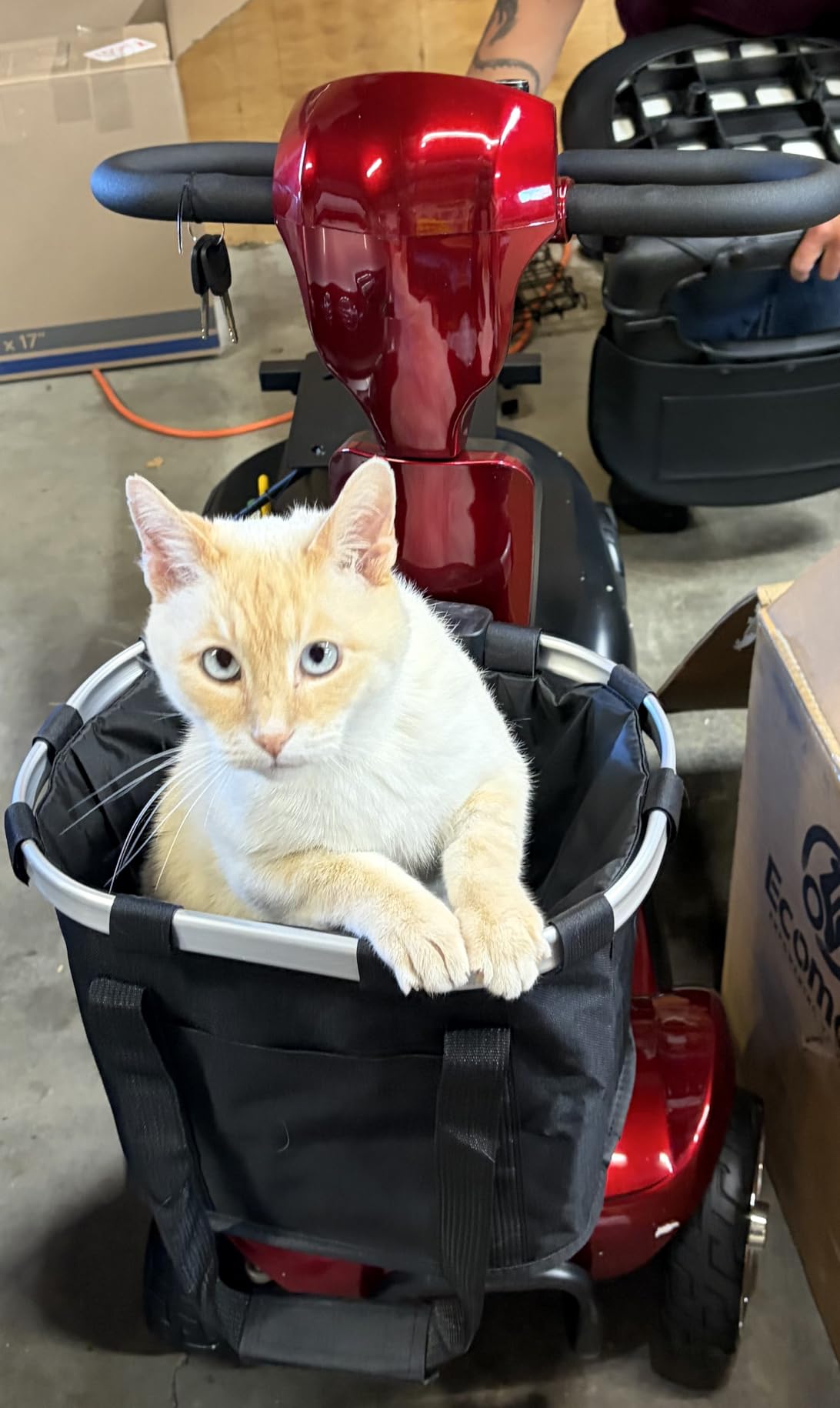
What separates it from a folding travel scooter is the chassis. Four wheels, a reinforced frame, a front anti-collision bar and rear anti-tip wheels mean a lifted front caster has somewhere to go other than over. The top speed of 7 MPH is also the single most underrated spec in this entire list for sidewalk use, because it is fast enough to feel free and slow enough to stop in the space you have.
The compromises are honest ones. Suspension is basic, so cobblestone and choppy sections arrive as noise in the frame rather than being absorbed. The turning radius is wide, which makes tight hallways and store aisles a three-point-turn affair. And at 81.5 pounds it is not a solo lift into a car trunk.
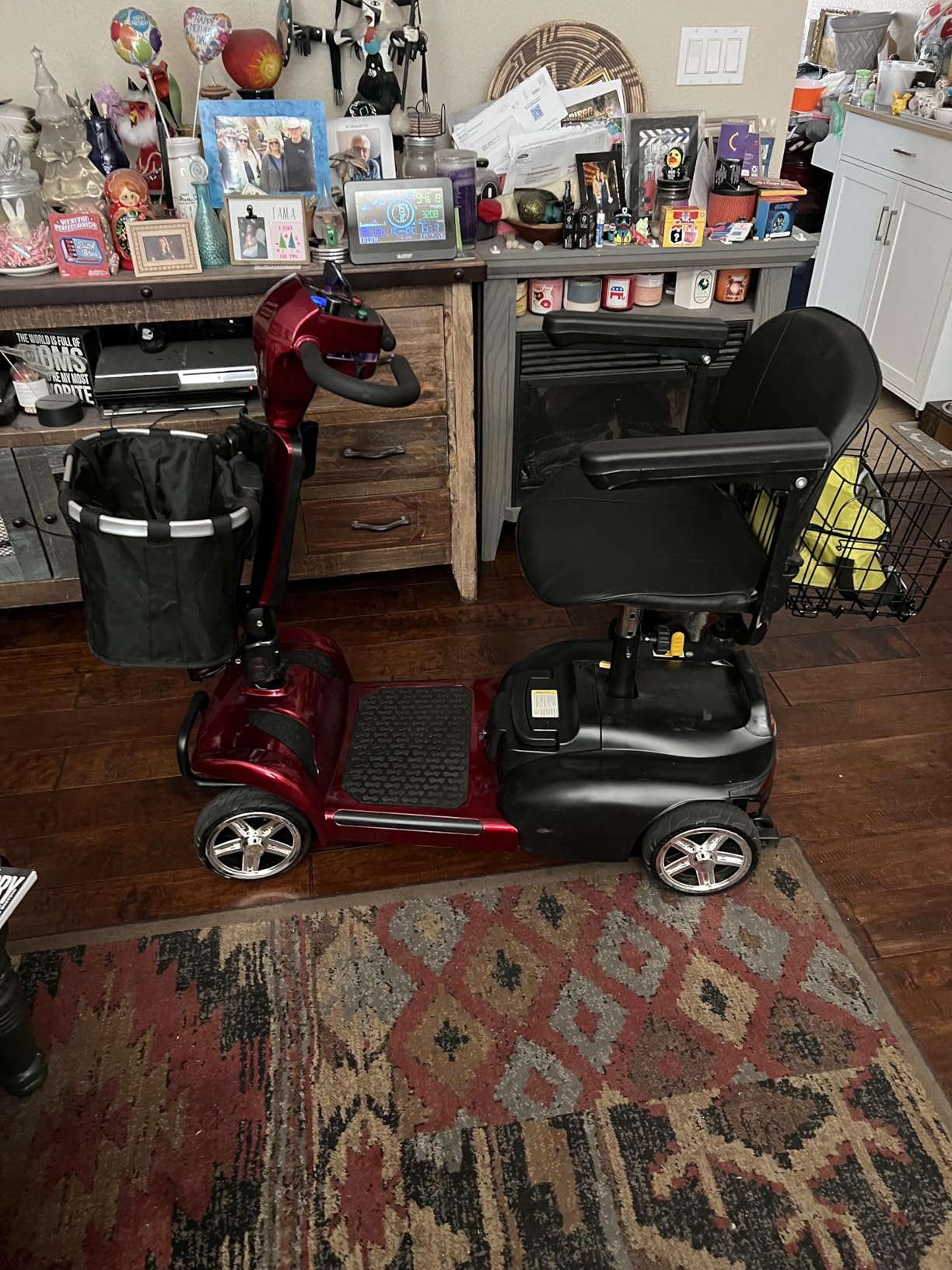
Will it fit through your door and into your car?
At 51.2 by 18.7 by 39.3 inches and 81.5 pounds, this is one of the few heavy-stability scooters in the list that genuinely disassembles into manageable pieces. Four parts, foldable tiller, detachable seat and baskets. It is the pick I would make for anyone whose route is cracked pavement but whose storage is a small apartment.
How it handles a heaving sidewalk
Four wheels plus anti-tip wheels mean the frame stays planted when a slab lifts unevenly, and 7 MPH is a speed you can steer out of trouble at. The one thing you will feel is every defect, because the suspension does very little. If your pavement is cobblestone or brick rather than cracked concrete, look at the LAGTOM or the Dvsripa instead.
2. LAGTOM 1000W Fat Tire Scooter – Best for Broken Pavement
Heavy Duty 4 Wheel Mobility Scooters for Seniors & Adults 500lbs Capacity – Electric Powered Chair – 1000W All Terrain Fast Mobility Scooter for Travel w/Long Range Battery Remote Key
1000W motor
500 lbs capacity
16 inch fat tires
60V 20Ah
275 lbs
Pros
- Fat tires plus rear shocks take broken concrete and grass well
- 500 lbs capacity
- Reclining captain's seat with safety belt
- Key fob remote with anti-theft alarm
- Arrives nearly fully assembled
Cons
- 275 lbs is a two-person lift
- Long wheelbase needs room to turn
- 15 MPH top speed is faster than most riders want
This is the scooter I would put on a street where the concrete has genuinely failed. The combination that does the work is simple: 16 inch fat tires, two rear shock absorbers and a 1000W motor on a 60V 20Ah battery. Those tires have a much larger contact patch than a standard 10 or 12 inch wheel, which is what stops a lifted caster from skittering sideways on broken edges.
Owners consistently name those same two features when they describe rough or loose surfaces, and the 4.6 average across 173 reviews is backed by an 85 percent five-star share. The drive end is genuinely strong. The speed control dial runs from 1 to 15 MPH, so the torque is available at walking pace even though the ceiling is high.
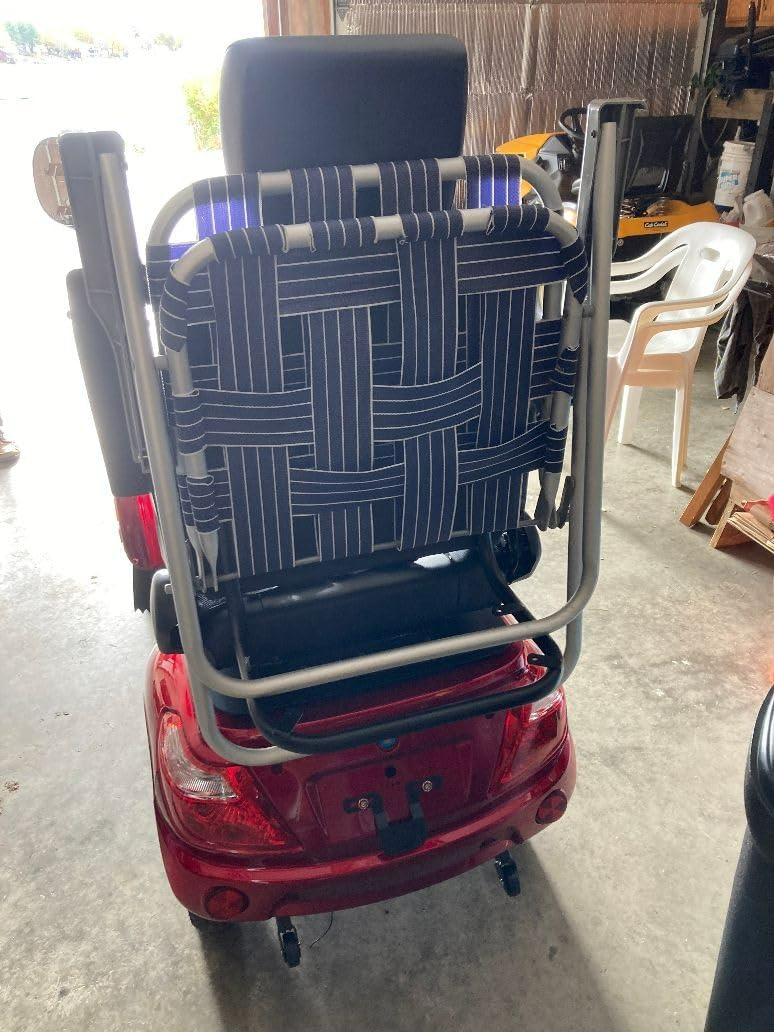
Comfort is better here than the price tier suggests. A deluxe reclining captain’s seat with folding armrests and a safety belt makes a long loop genuinely bearable, and the storage is unusually complete: a locking glove compartment, a rear basket and an under-seat compartment, plus a USB charger and cup holder. The keychain remote handles ignition, locking and the horn.
Two details worth planning around. The scooter is 275 pounds and 62.6 by 27 by 42.1 inches, so loading it into a vehicle needs a second person or a ramp. And the three-speed control tops out at 15 MPH, which several reviewers explicitly recommend dialling down for pavement use. We agree.
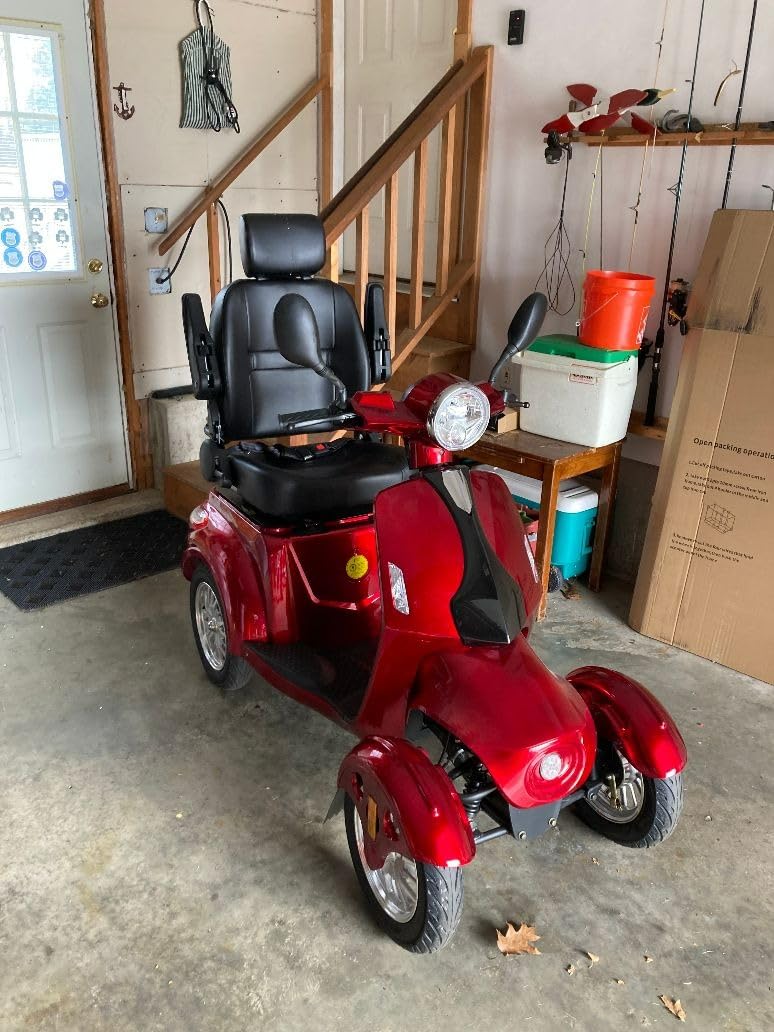
What the fat tires actually solve
Wider tires at lower pressure spread the load over a bigger area, so a heaving slab or a gravel driveway does not punch a hole in your route. The rear shock absorbers take the vertical hit that would otherwise travel straight into your spine over brick and cobblestone. Together they are the reason this one is rated 4.6 across 173 owners on broken ground.
Where it becomes impractical
Transport and indoor maneuvering. A 27 inch width and long wheelbase make it a poor fit for narrow apartment hallways, and 275 pounds ends any conversation about lifting it into a sedan alone. If you need a car-based routine and broken pavement, the four-part MS20 above is a better trade.
3. VEVOR LUNAR 4-Wheel 1000W – Best for Long Neighborhood Loops
VEVOR Heavy Duty 4-Wheel Mobility Scooter, Powerful 1000W Brushless Motor, 500 lbs Capacity, 21.5 Miles Long Range, All Terrain Mobility Scooter with Lockable Trunk for Seniors & Adults
1000W brushless
500 lbs capacity
21.5 mile range
20 degree climb
257.94 lbs
Pros
- Strongest published spec set in the group
- 16 inch tubeless tires on spring suspension
- Front and rear disc brakes
- Large lockable trunk plus front basket
- Full lighting and mirrors with an anti-theft alarm
Cons
- Highest one-star share at 17 percent
- 257.94 lbs is impractical to load alone
- Three-speed design tops out at 15 MPH
On paper this is the most capable machine here. A 1000W brushless motor, a 20 degree climb rating, four 16 inch rugged tubeless tires on spring suspension, a 60V 20Ah battery good for up to 21.5 miles, and a reinforced frame rated to 500 pounds. If your route is a long loop past park paths and gravel verges rather than a single block, the range figure is the headline.
The ride hardware is right for the job. Sixteen-inch tubeless tires run at lower pressure than solid wheels, which is exactly what you want over cracked concrete, and spring suspension at all four corners takes the vertical shock out of heaving slabs. Tubeless also removes the puncture failure that a hard sidewalk spike would otherwise cause.
Braking is the other quiet strength. Front and rear disc brakes give predictable stopping on a downgrade, and the 360-degree lighting package, rearview mirrors, anti-tip wheel, protective bumpers and anti-theft alarm cover the visibility and security issues that outdoor use actually creates. Storage is generous too: under-seat space, a large front basket and a lockable rear trunk.
Why is the rating only 4.0 with 198 reviews? The distribution explains it. Seventeen percent of ratings are one-star, the highest share in this group, and that pattern usually points at delivery, assembly or early component failures rather than ride quality. At 257.94 pounds it is also among the heaviest units here, and the three-speed control tops out at 15 MPH.
How far you will really get
The published figure is up to 21.5 miles, and that assumes flat, smooth, hard surfaces at a steady pace. Add hills, grass, gravel and cold weather and treat the real number as meaningfully lower. Our rule of thumb for this whole category is to plan on roughly half the advertised figure once the route stops being pavement.
What to check before ordering
Ask the seller about parts availability and the assembly process, because the complaint pattern on this listing is concentrated in setup rather than riding. Confirm the 66.1 by 26.4 by 46.1 inch footprint clears your doorway and your elevator, and settle the loading question early if you plan to put it in a vehicle.
4. VEVOR VISTA-1 3-Wheel 1000W – Best for Sand, Mud and Grass
VEVOR Heavy Duty 3-Wheel Mobility Scooters for Seniors & Adults, 500lbs Capacity, 21.5 Miles 3-Speed Long Range, 1000W All Terrain Electric Recreational Scooter Wheelchair, 20° Max Climbing Capacity
1000W brushless
500 lbs capacity
20 degree climb
solid deep-tread tires
222.67 lbs
Pros
- Solid never-inflate tires remove puncture risk
- Front and rear spring suspension
- 500 lbs capacity with a 20 degree climb rating
- Dashboard reports speed and mileage in real time
- Full safety package with a seat belt and reverse alarm
Cons
- Three-wheel layout is less stable on uneven sloped ground
- 18 percent one-star share
- 222.67 lbs is a two-person load
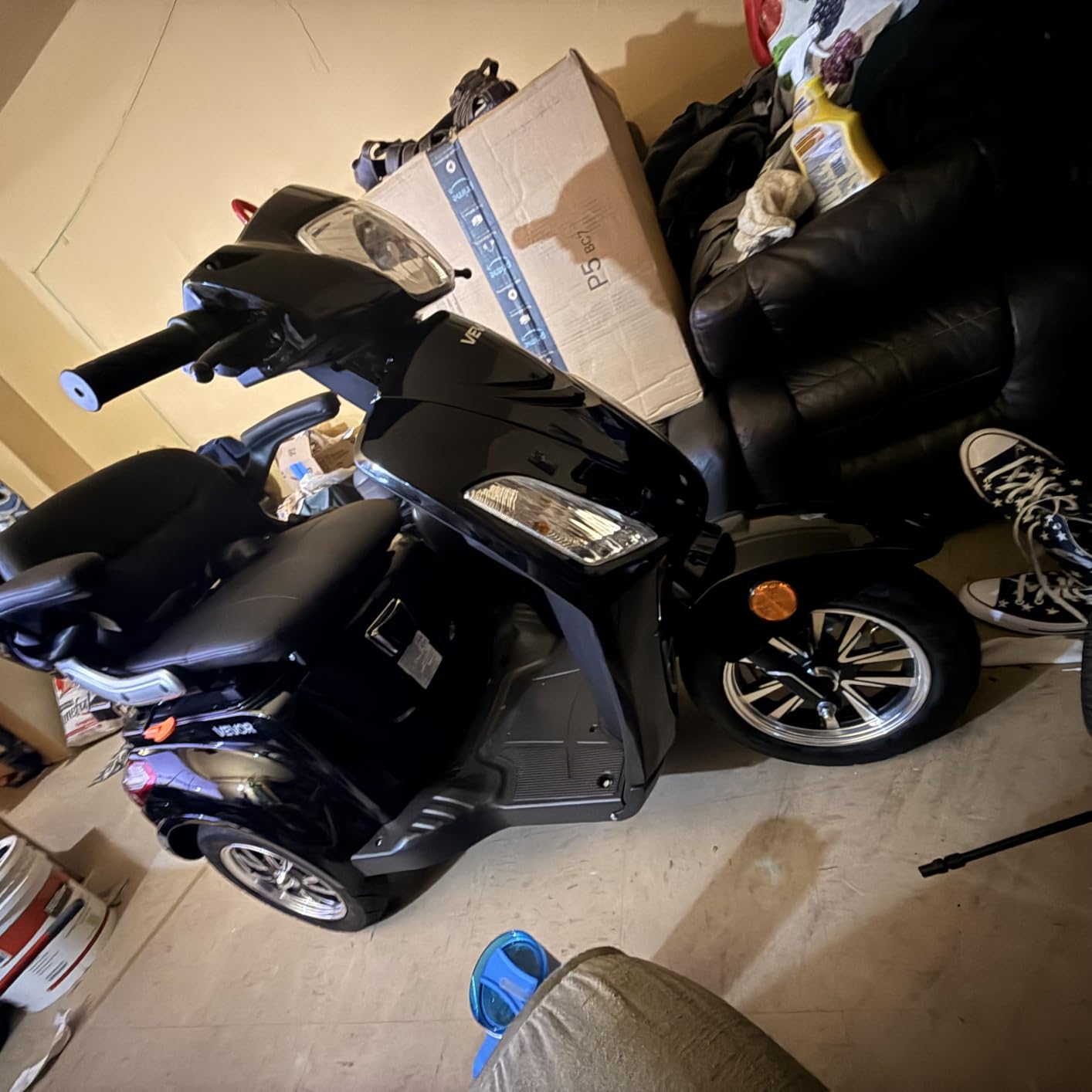
The VISTA-1 is the three-wheel option, and the reason to choose it over its four-wheel sibling is tire type. Its deep-tread, no-inflation tires never need air and never puncture, which on a route full of broken glass, gravel spikes and thorny grass strips is a genuine advantage over the tubeless setup on the LUNAR.
Suspension is fitted at both ends and reviewers confirm it absorbs the shock over sand, grass, mud and speed bumps. The 1000W brushless motor carries a 500 pound rating and a 20 degree maximum climb, and three adjustable speed modes sit behind a dashboard that reports speed, mileage and battery status in real time.
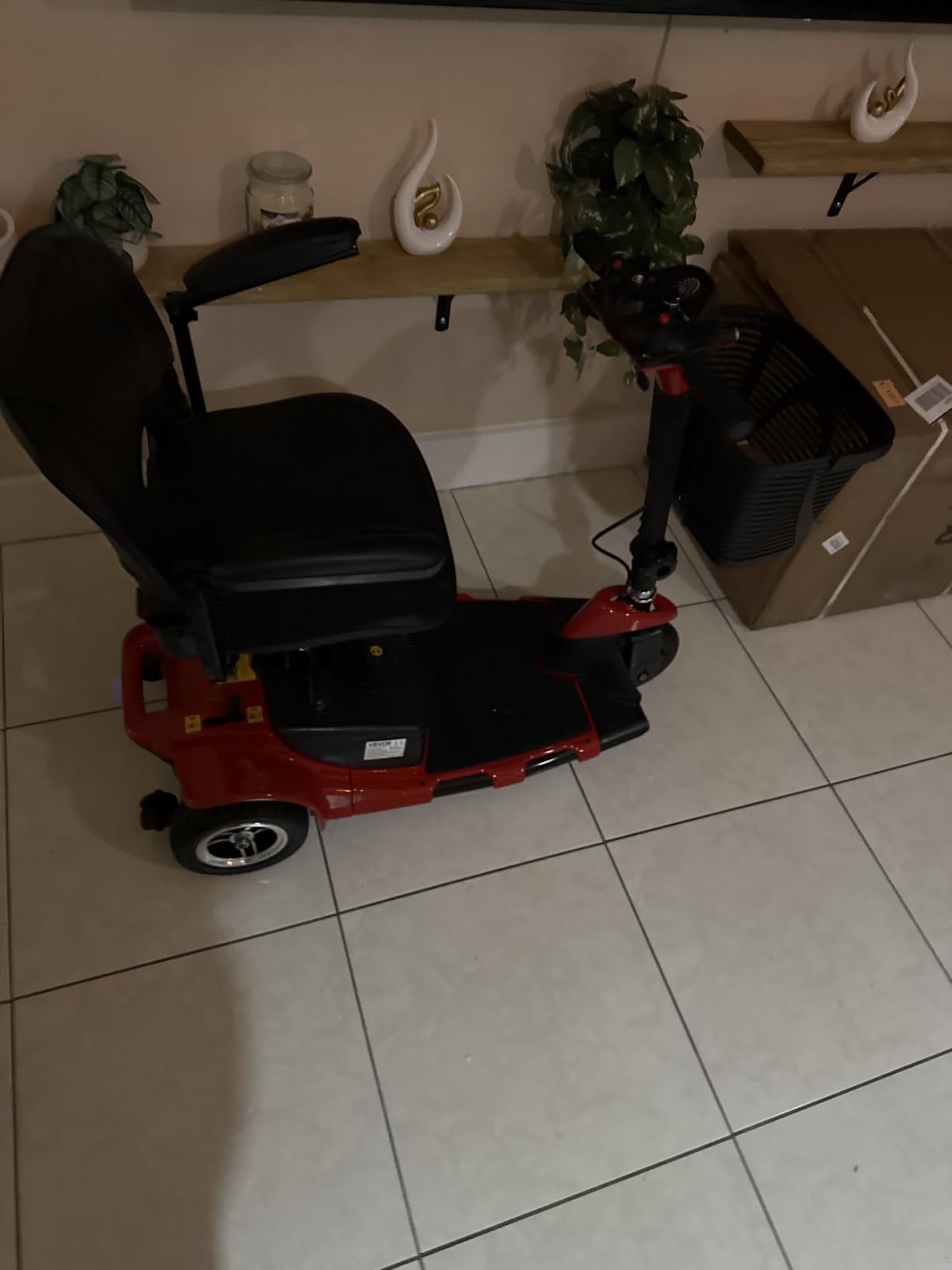
The safety package is unusually complete for this tier: dual front and rear brakes, an anti-tip rear wheel, full lighting, rearview mirrors, a seat belt, an anti-theft alarm remote and a reverse alarm that beeps when you back up toward someone. That last one is not standard, and it matters in a parking bay.
The 3-wheel layout is the decision point. A single front wheel turns tighter in an aisle, but on uneven or sloped broken ground a three-wheel chassis has a smaller stability base than a four-wheel one, and 222.67 pounds makes uncrating a two-person job. The 4.0 average across 52 reviews is also held back by an 18 percent one-star group, the same setup-and-component pattern seen elsewhere in this category.
Why a three-wheel changes the risk profile
A four-wheel base resists tipping in all four directions. A three-wheel base resists it mainly forward and backward, so a caster that catches a root or a lifted slab edge in a crosswind or on a side slope is the scenario that concerns riders most. If your sidewalk damage is mostly vertical rather than lateral, the trade is worth it for the tire advantage.
What the solid tires give up
Never-flat tires ride harder than air-filled ones. Over brick and cobblestone you will feel more of the surface, and the suspension does the absorbing rather than the tire. If your pavement is rough but flat, an air-filled tubeless tire on the LUNAR will feel more composed; if your route is grass, mud and debris, this one is the better tool.
5. Ecomobi MS02 MAX 1000W – Best for Rural Lanes and Farm Roads
Ecomobi 32 Miles Heavy-Duty 1000W MobilityScooter for Seniors & Adults
4.3 inch ground clearance
1000W motor
32 mile range
13.78 inch pneumatic rears
265 lbs
Pros
- Highest published ground clearance in this roundup
- 32 mile range confirmed by owners
- 20 degree climb handles rural roads and fields
- Arrives fully assembled on a steel frame
- Turn signals with mirrors and a seat belt
Cons
- Poor turning radius is the most common complaint
- 265 lbs needs two people to uncrate
- Some owners report a bumpy ride and a charger that stays red
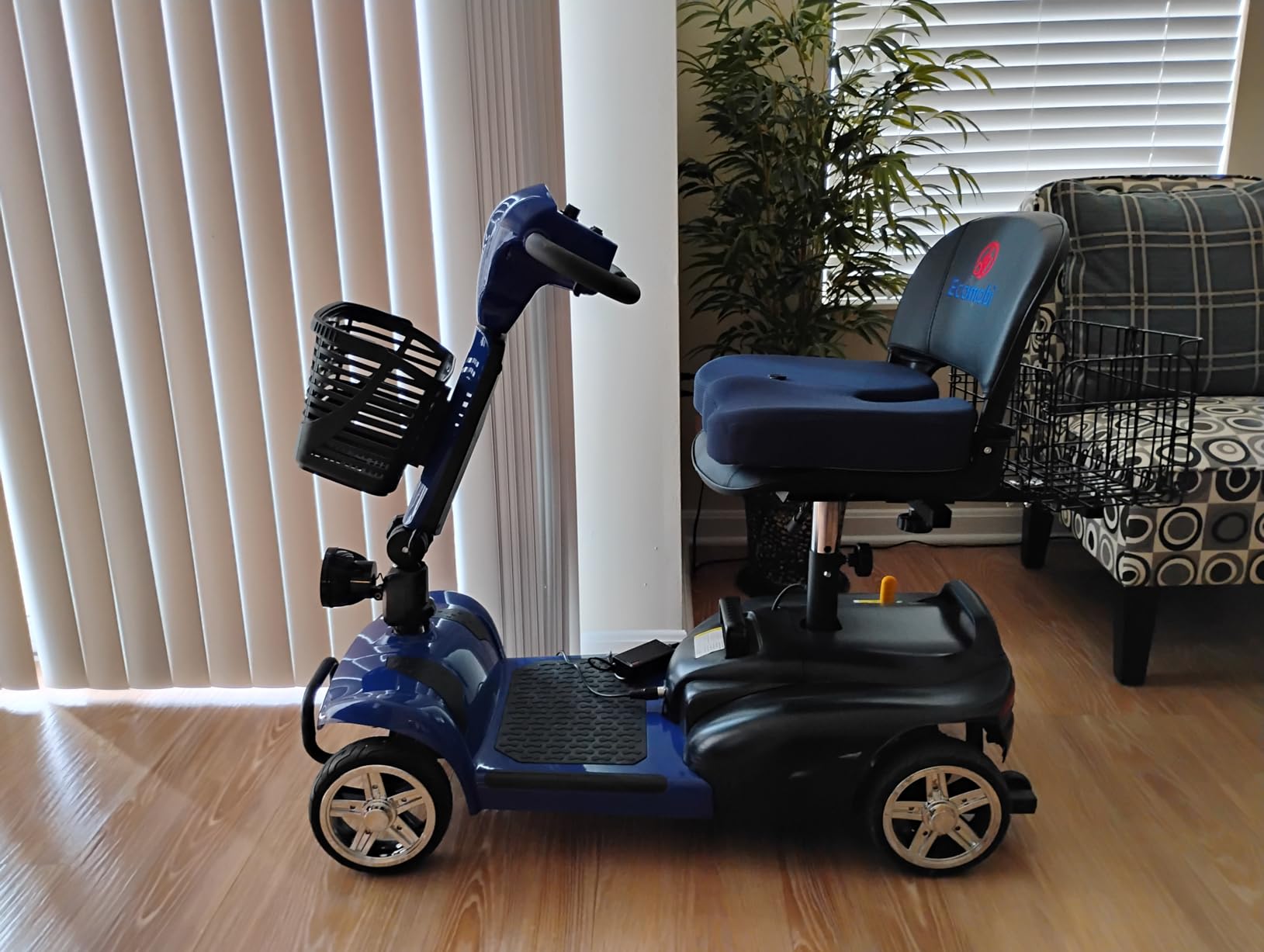
The MS02 MAX publishes the highest ground clearance figure in this roundup at 4.3 inches, and it is the only spec on the list that directly answers the question of whether a front wheel clears a lifted slab edge. Add 13.78 inch pneumatic rear wheels and a suspension system, and this is the scooter I would pick for a route that leaves the pavement entirely.
Owners back the headline claims. One reviewer covered roughly 10 miles on a partial charge, and a 280 pound rider reports that steep hills and grassy fields are no problem for the 1000W motor and its 20 degree climb rating. The 960Wh battery is the reason the published range reaches 32 miles.
It arrives fully assembled on a steel shipping frame, so there is no build step, and comfort is adjustable six ways including the seat cushion. Bluetooth stereo and a USB charging port get repeated mentions as welcome extras, and the company proactively checks in with customers after delivery.
Two drawbacks dominate the negative reviews. The 54 inch wheelbase produces a turning radius several buyers describe as requiring three-point turns, which is a real problem in a narrow walkway. And at 265 pounds, getting it off the frame and into a vehicle takes one or two people. A few owners also report a bumpy ride on uneven ground and a charger that keeps showing red long after the battery is full.
What ground clearance buys you on a broken sidewalk
Clearance is the gap between the underside of the frame and the ground. When a slab heaves upward or a root breaks through, a low frame catches it and the chassis stops dead, which is what throws a scooter off line. A 4.3 inch gap lets the frame pass over smaller defects instead, and the pneumatic rear tires then supply the compliance.
Where the wide stance costs you
The same long wheelbase that carries a heavy battery well and keeps the ride stable makes this the least maneuverable scooter here. At 26.7 inches wide and 54.3 inches long, plan your route around it: measure doorways, elevator cabins and the narrowest section of your usual sidewalk before you commit.
6. Mobicyc MS09 PLUS – Top Rated, Best Clearance-to-Price Balance
MobiCyc Heavy Duty Mobility Scooter for Adults & Seniors, 500W Motor, 20/30 Miles Long Range, 450 LBS Capacity, Removable Lithium Battery, 10″ All-Terrain Tires, with Windshield & Suspension
4 inch ground clearance
500W motor
450 lbs capacity
10 inch all-terrain tires
Pros
- Highest rating in the group with 95 percent five-star
- 4 inch ground clearance and 10 inch tires
- Removable lithium battery plus a folding design
- 360 degree swivel seat with adjustable tiller
- Daytime running lights with night mode and turn signals
Cons
- Seat height is fixed and a 350 lb reviewer wanted more
- 500W motor trails the 1000W heavy-duty units
- Listing is recent so long-term durability is unproven
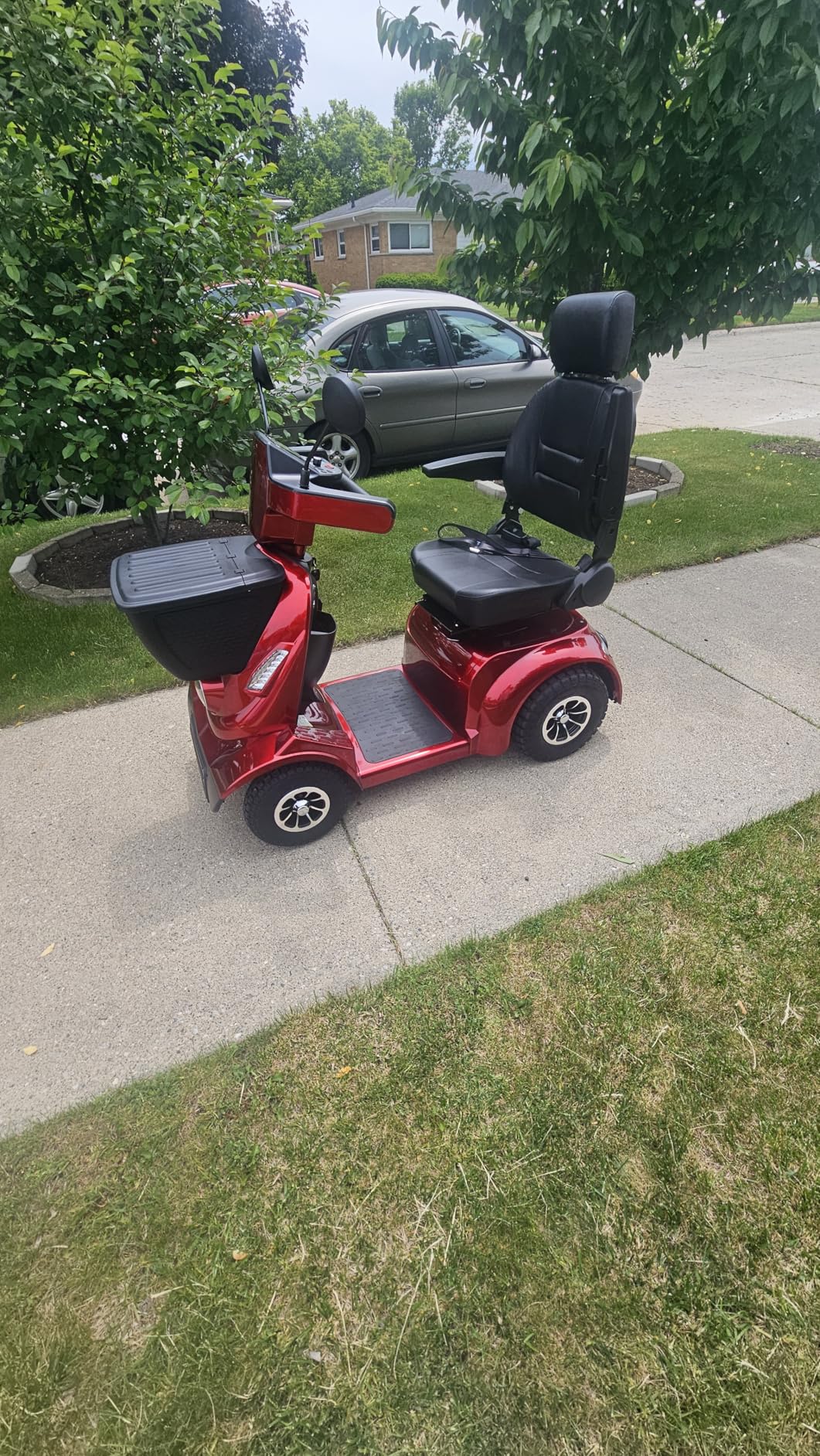
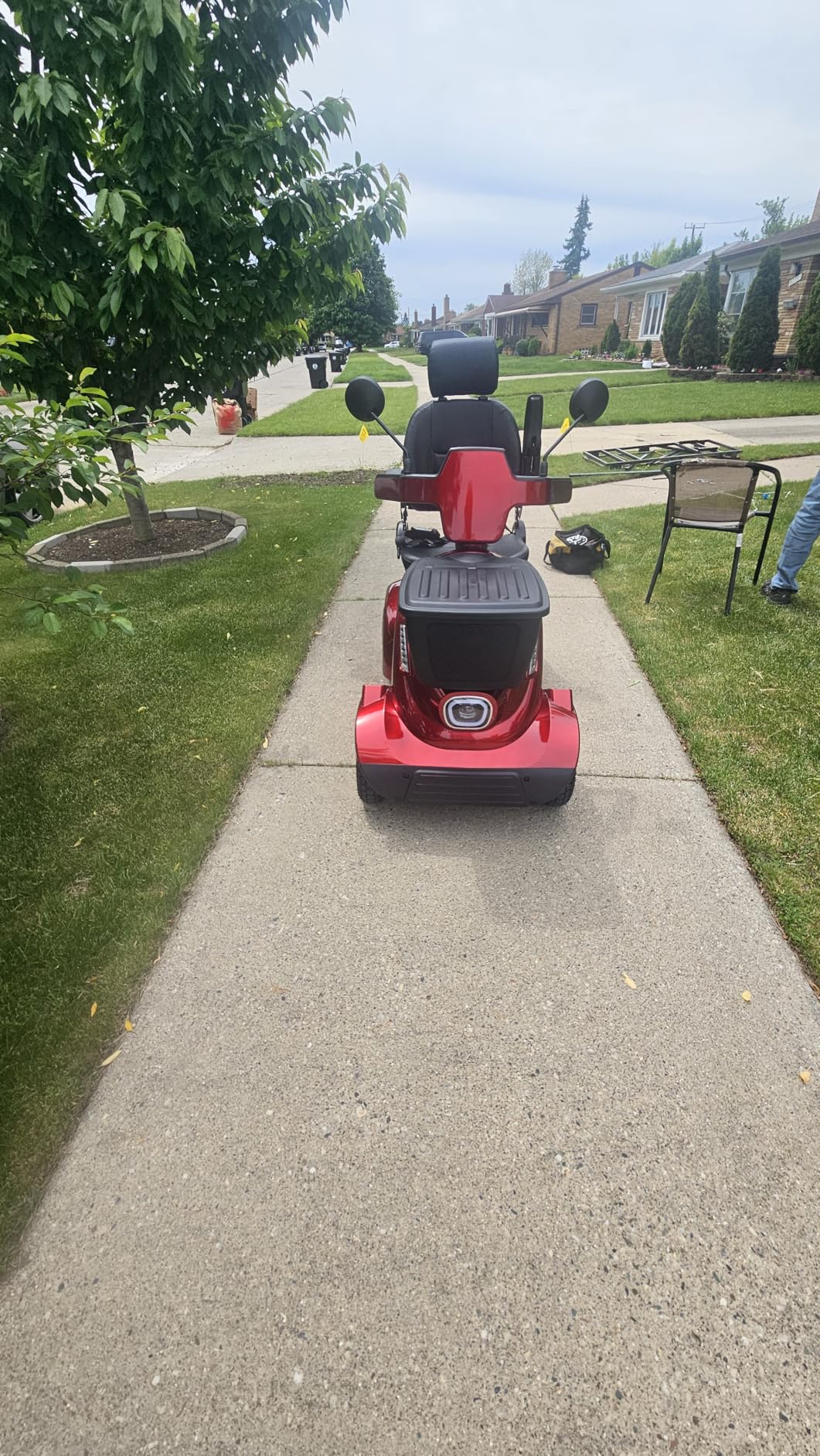
On the numbers, this is the most efficient package here. A 500W motor paired with a 35 amp-hour removable lithium battery and a 450 pound capacity, on 10 inch all-terrain tires with 4 inches of ground clearance, produces a scooter that clears cracks and grass without the 250-pound-plus bulk of the true heavy-duty units. That ratio is why it earns our top-rated badge.
The review record is the strongest in the roundup: 4.9 stars with 95 percent five-star, 4 percent four-star and 1 percent one-star across 58 verified purchases. Buyers repeatedly cite the 10 inch tires and 4 inch clearance for handling grass, gravel and uneven ground, and a 350 pound reviewer reports the shocks are comfortable at their weight.
Transport is the sleeper feature. It folds and disassembles to fit most SUV trunks, the battery is removable so you do not have to bring the whole scooter indoors to charge, and there is a push mode if the battery dies. The 360 degree swivel seat helps riders with spinal issues get in and out, and a front windshield with integrated storage, a rear basket and a cane holder cover the practical clutter.
Two cautions. The seat height is fixed, and one 350 pound reviewer wanted roughly 2 more inches, which matters if you are short. And the listing launched in June 2026, so most reviews are first impressions rather than long-term durability reports. Buyers also note that Mobicyc shares a support team with Ecomobi.

Who it fits best
Riders who want genuine clearance and long range without a 250-pound-plus machine, and who need to move the scooter in a car. The 450 pound capacity covers most riders, and the 30 mile published range is the highest in this roundup for a scooter light enough to fold. It is also a strong indoor-outdoor hybrid for small apartments.
Where it falls short
Steep grades and heavy riders. A 500W motor with a 450 pound rating will not have the reserve of a 1000W machine on a sustained 20 degree climb with two people aboard, and the fixed seat height is a genuine problem for shorter riders. Check your inseam against the seat before ordering rather than after.
7. Dvsripa 1000W 4-Wheel – Best for Steep Hills
Dvsripa 1000W All Terrain Mobility Scooter for Seniors,Heavy-Duty 4 Wheel Mobility Scooters Mobility Scooter,Handicap Scooters for Adults with 3-Speed Travel Long
25 degree max slope
1000W brushless
all-terrain pneumatic tires
four-wheel suspension
Pros
- 25 degree climb rating that is the steepest here
- Four-wheel suspension plus dual rear shock absorbers
- Most adjustable seat with rotation and headrest
- US service center in Delaware with a 1-year warranty
- LED lighting and electromagnetic braking
Cons
- Only 27 reviews
- the smallest sample here
- 336 pound packaged weight
- 11 percent one-star share
The Dvsripa is built around one number: a 25 degree maximum slope rating, the steepest climb figure in this roundup by five degrees. If your route runs uphill from the sidewalk to the front door, or along a lane with a real grade, that spec is the reason this scooter exists. The 1000W brushless motor sits on a 48V 20Ah battery with a 3-speed control running from 1 to 10 MPH.
The terrain hardware is the most aggressive in the group. Large all-terrain pneumatic tires, four-wheel suspension and dual rear shock absorbers are listed for grass, gravel, dirt, snow, sand and uneven pavement. Pneumatic tires on all-terrain tread are the most forgiving combination here over cracked concrete, because the sidewall absorbs impacts the frame would otherwise feel.
The seat is the most adjustable in the roundup: forward, backward, left, right, rotation, backrest angle, handlebar and headrest height, over a thickened leather cushion with high-density foam. That matters more than spec sheets admit, because a poor seat turns a two-mile loop into an endurance test. Lighting is full LED with high and low beams, turn signals, rear lights, a seat belt and electromagnetic braking, all reported on a large LCD dashboard.
And it is one of only two here with a US service center, in Delaware, backed by a 1-year warranty with free replacement parts excluding the motor. The drawback is evidence: 27 reviews is the smallest sample in the roundup, and the 336 pound packaged weight makes uncrating a real job. An 11 percent one-star share suggests a minority of the machines have problems.
When the incline rating matters
Climb ratings only mean something when the load matches. A 25 degree rating is achievable with a single rider near the capacity limit; add a passenger, a full grocery run or a wet surface and the usable grade drops. If your incline is real, note the 3-speed control caps out at 10 MPH rather than the 15 MPH common on rivals.
What to verify before buying
With only 27 reviews, ask the seller directly about parts supply and the service center process, and confirm the packaged dimensions clear your delivery route. The listed 52 by 33.5 by 27.6 inch figure is the packaged size, so treat it as a floor for your delivery planning rather than the assembled footprint.
8. Rascal Conquest 4-Wheel – Best Warranty and Service
Rascal Conquest 4-Wheel Heavy-Duty Outdoor Mobility Scooter, Long-Range Battery-Powered Electric Travel, 350lb Capacity, Battery Included
FDA Class II medical device
350 lbs capacity
6 MPH
51.75 inch turning radius
158 lbs
Pros
- Only FDA Class II listed unit here with a 3-year frame warranty
- Turns far tighter than long-wheelbase heavy-duty models
- One owner had a technician visit his home to fix alignment and a tire
- Alloy steel frame with regenerative and electromechanical brakes
Cons
- 10 inch mag wheels and no suspension
- 350 lb capacity is the lowest here
- Under-seat battery cables are not explained in the instructions
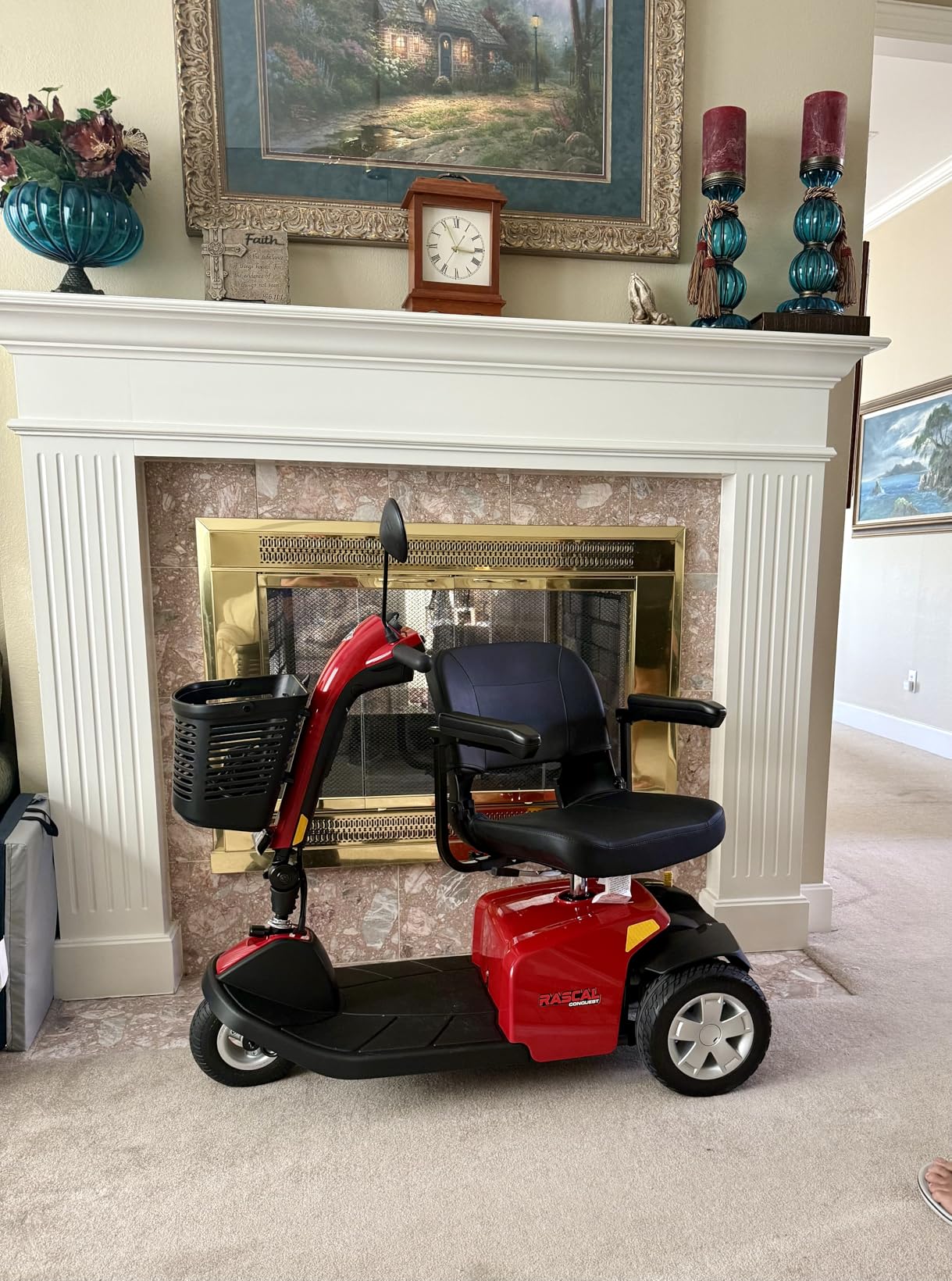
This is the durability and service story rather than the off-road one. The Conquest is the only scooter in this roundup listed as an FDA Class II medical device, and it carries a 3-year structural frame warranty, 2 years on drivetrain and electrical, and 6 months on the battery. Owners with older scooters describe it as a step up in build quality from what they had before.
Two practical numbers set it apart from the heavy-duty units. The turning radius is 51.75 inches, far tighter than the long-wheelbase 1000W machines, and the whole thing weighs 158 pounds with an alloy steel frame and 46.97 by 23.78 by 35.5 inch dimensions. For a narrow walkway or a small apartment, that is a real advantage no other pick here matches.
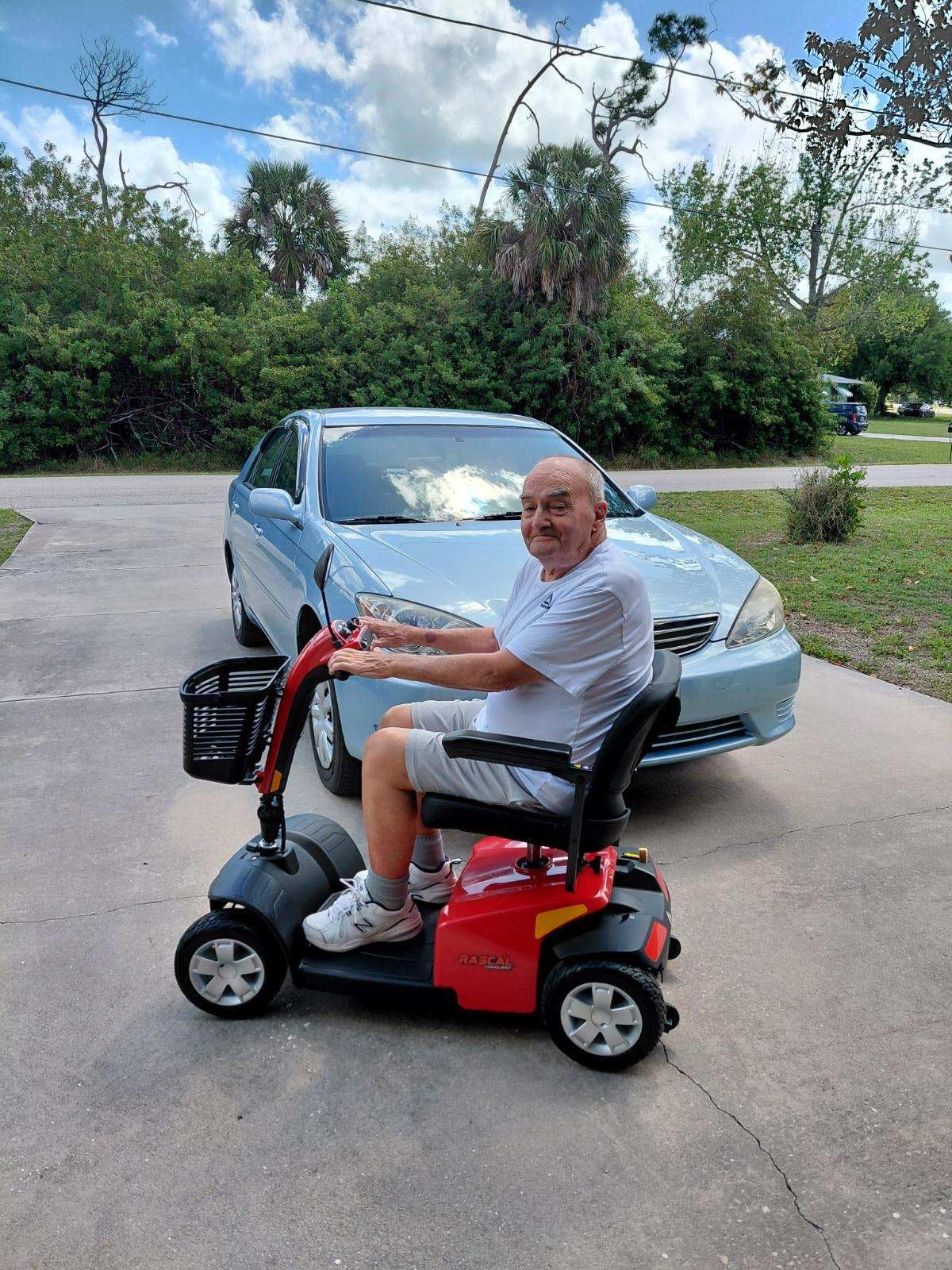
Support is the part people remember. One reviewer had a technician sent to their home to correct a wheel alignment issue and replace a tire. It arrives charged with about 30 minutes of assembly, and the feature list is sensible rather than showy: regenerative and electromechanical brakes, adjustable seat height, armrest position and steering tiller, a swivel seat for transfers, a front basket, a rearview mirror and a high-intensity LED headlight.
It is also the least capable on genuinely broken pavement. The 10 inch mag wheels have no suspension, so a lifted caster passes straight into the frame. Capacity is 350 pounds, the lowest here, and one piece is too heavy for an older adult to lift alone despite the portable framing. The under-seat battery connection cables are not covered in the instructions, a common setup stumbling block.
Why the medical listing and warranty matter
Class II listing means the device has been through a regulatory review process and must meet defined controls for manufacturing and labeling, which is not true of every scooter sold online. A 3-year frame warranty also tells you the manufacturer expects the chassis to outlast several battery cycles. For a primary mobility device, that is worth more than another 5 miles of claimed range.
Where it stops short
Broken pavement is exactly what mag wheels and no suspension cannot absorb. Its 6 MPH top speed is safe and adequate, and its 16.9 mile average battery life is realistic rather than headline, but if your route heaves, you will feel it. Pick it for a paved but narrow route with a serviceable frame, not for brick and gravel.
9. NeoTamarix 1000W 4-Wheel – Best for Riders up to 500 lbs
1000W Heavy Duty Mobility Scooter for Adults & Seniors, 500lbs Capacity & 25-34 Miles Long Range, 15.5 mph Max Speed, 4-Wheel Black All Terrain Electric Scooter with Lockable Trunk & 20° Hill Climb
1000W motor
500 lbs capacity
25-34 mile range
20 degree incline
374.79 lbs
Pros
- 500 lb capacity on a reinforced frame
- 25-34 mile published range
- 20 degree incline handling
- Arrives 95 percent assembled
- Lockable rear trunk
Cons
- Only 15 reviews
- the smallest sample in the roundup
- 374.79 lbs is the heaviest listed weight
- Launched March 2026 with no long-term history
The NeoTamarix exists for a specific situation: a rider near or above 400 pounds who still needs a long range. Its 500 pound capacity on a reinforced frame, 1000W motor, 60V 20Ah battery and published 25 to 34 mile range make it one of the few units here that can carry a heavy rider and still complete a full day of neighborhood errands.
Incline handling is rated to 20 degrees, and three speed modes cover 6.2, 9.3 and 15.5 mph. The seat adjusts for front and back position, backrest angle and armrests, and the lighting package covers integrated headlights and turn signals. The lockable rear trunk is a rarity at this tier and matters if you leave the scooter outside a shop.
Assembly is the friendliest part. It arrives 95 percent assembled, with only the rearview mirrors and the rear trunk still to fit, which avoids the terse-instruction problem that frustrates buyers of smaller machines.
Now the caution, and it is a real one. The 5.0 star rating rests on 15 reviews, all five-star, and no long-term durability data exists because the product launched in March 2026. At 374.79 pounds it is the heaviest listed weight in this roundup, and at 65 by 27 by 57 inches it is one of the largest, so uncrating is realistically a two-person job with a planned delivery route.
Weight capacity headroom
Set your target at least 15 to 20 percent above your own weight plus your usual cargo. A 500 pound rating for a 420 pound rider leaves room for a passenger or a heavy grocery run, whereas a 500 pound rating for a 300 pound rider is far more capacity than the route will ever demand.
How to buy a lightly reviewed scooter
Look for a warranty period, a US service contact and a parts policy before you look at the rating. A 5.0 average across 15 reviews tells you early buyers were happy, not that the unit will still be running in five years. Confirm the delivery path clears your doorways at 65 by 27 by 57 inches.
10. SKRT 800W 4-Wheel Fat Tire – Best for Seat Comfort
Super Large Heavy Duty Mobility Scooter, 4 Wheel 800W Electric Scooter
800W brushless
500 lbs capacity
25 mile range
fat tires with dual rear shocks
243 lbs
Pros
- Thick leather seat and backrest owners describe as genuinely well padded
- 800W brushless with a 20 degree slope rating
- Fat tires and dual rear shock absorbers
- Comes fully assembled
- Remote key with horn and turn signals plus a parking brake
Cons
- No owner's manual in the box
- Broken or missing anti-rollover parts on arrival
- 243 lbs needs two people to unbox
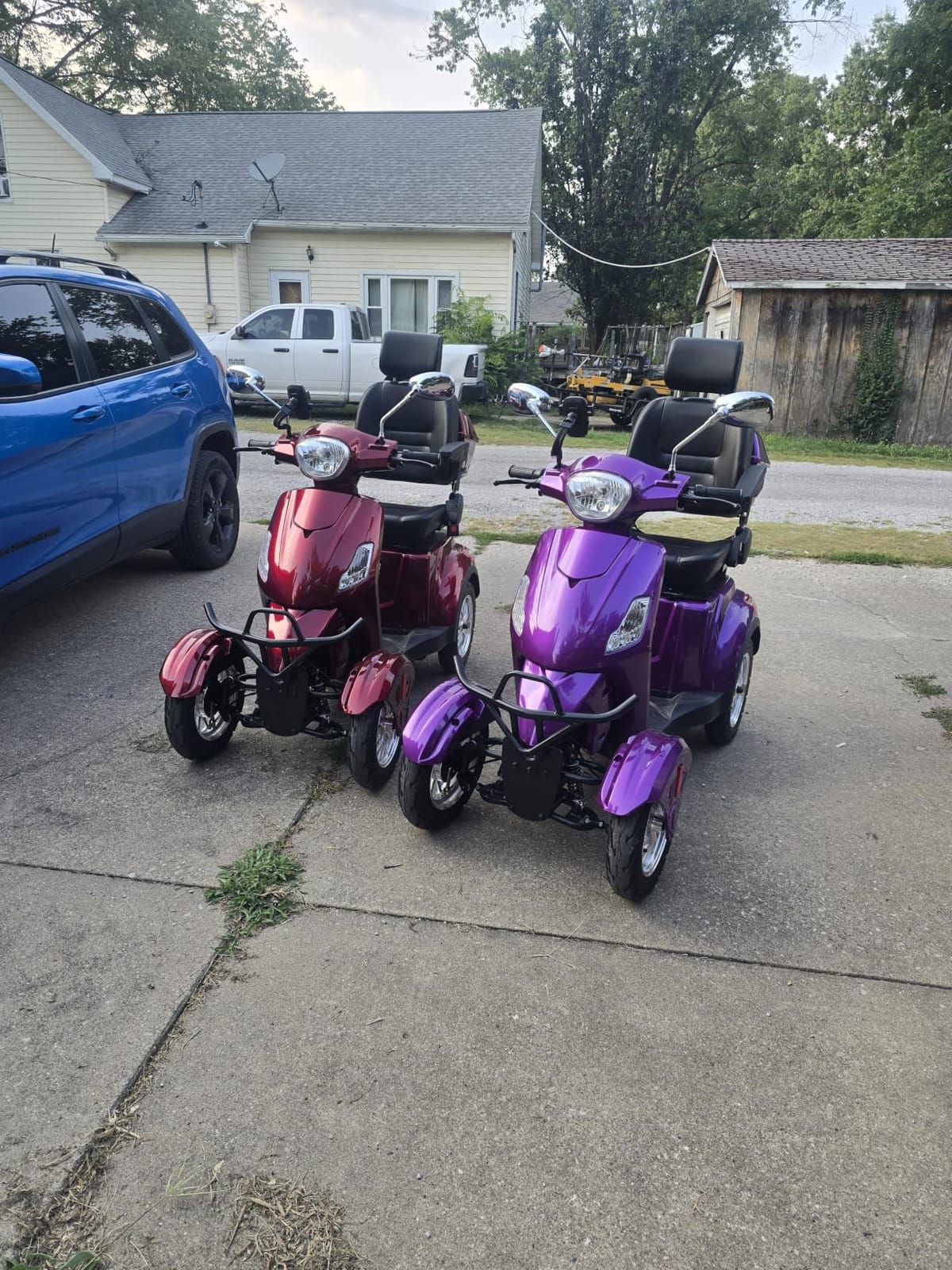
The SKRT wins on one specific thing: sitting in it. Owners single out the thickened leather seat and backrest as well padded over long rides, and that matters more than any motor figure when the route is a two-mile loop. The backrest angle and the padded adjustable armrests are both handled properly, and one repeat buyer has now bought three units for family members.
Underneath, the hardware is solid rather than exceptional. An 800W brushless motor handles slopes up to 20 degrees, fat tires work with two rear shock absorbers for sand, snow, grass and muddy roads, and the published range reaches 25 miles on a charge. The variable speed dial spans 1 to 15 mph, so low-speed control is available even though the ceiling is high.
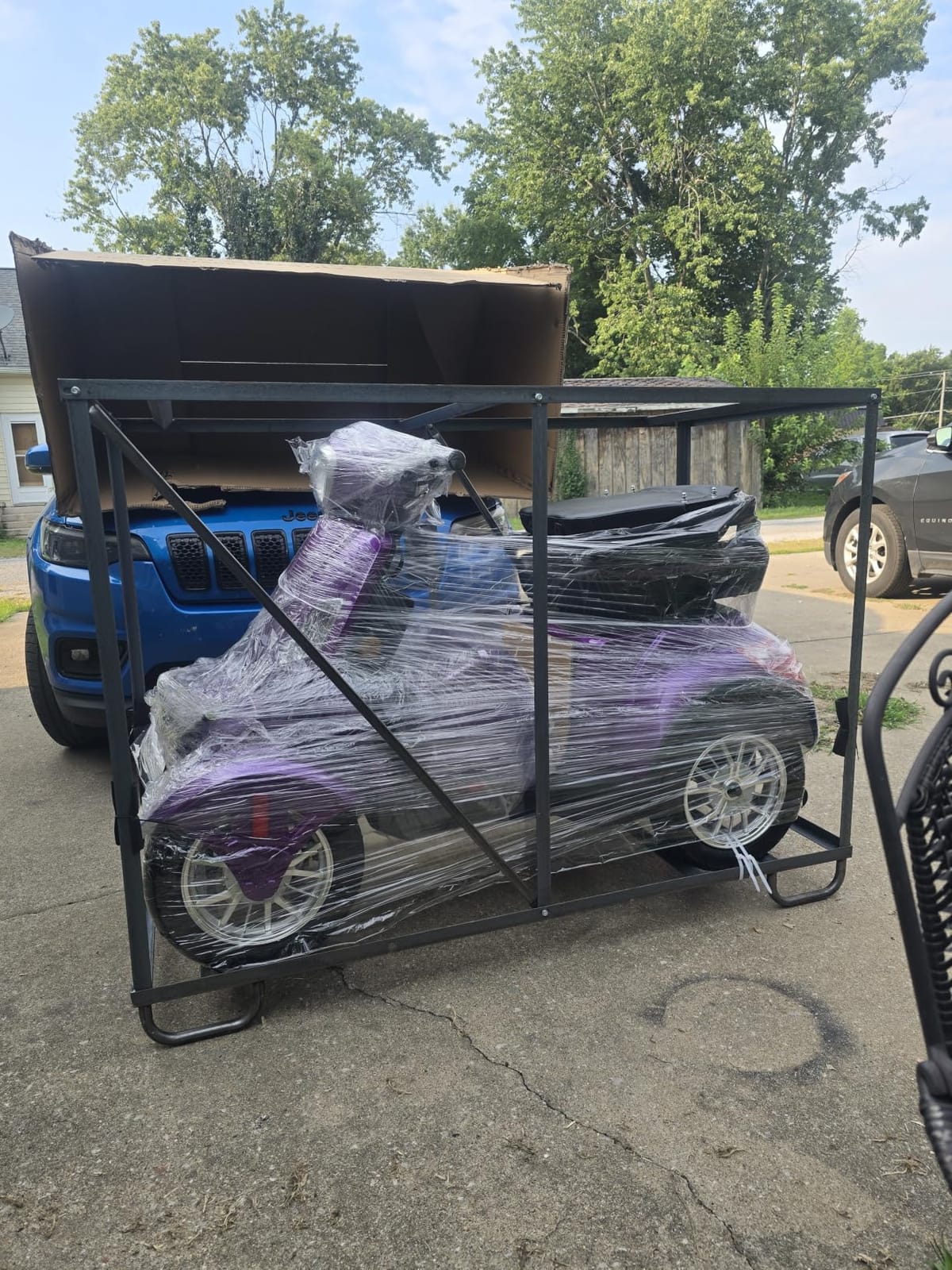
The feature set is complete for the tier: high and low beam headlight, rear running and brake lights, horn, LCD monitor, front and rear brakes with a parking brake, rearview mirrors, turn signals, two storage areas and a remote key. It arrives fully assembled on a metal frame with only the storage box to fit.
The friction is documentation and packaging, not riding. Several buyers received no owner’s manual in the box and had to request one, one unit arrived with broken rear anti-rollover wheels, and the storage box threaded posts were overtightened from the factory. At 243 pounds it needs two people to remove from the packaging, and return shipping on a machine this heavy is effectively prohibitive.
Why seat comfort decides this one
Rough pavement transmits every impact through the frame, and the seat is where a rider feels the cumulative effect over distance. A well-padded seat with adjustable back angle and armrest support is the difference between a trip you look forward to and one you shorten. That is why this 800W unit outranks several 1000W rivals for everyday neighborhood use.
What to check on arrival
Photograph the anti-rollover wheels, the storage box posts and the included hardware before you assemble anything, and request the manual from the seller in writing. On a 243 pound scooter, a return is expensive enough that inspection at the door is worth the two minutes.
What Actually Makes a Scooter Handle a Broken Sidewalk
Five things decide whether a scooter rolls over a defect or stops on it. Ground clearance of roughly 3.8 inches or more is the first threshold, because a heaving slab or a broken tree root lifts a wheel and a low frame catches underneath. Tire width and type come next: wide pneumatic or tubeless tires at lower pressure deform around an edge instead of skittering across it.
Third is suspension travel. A frame that moves vertically absorbs the impact, while a rigid frame sends it straight into your spine and, at speed, into a loss of control. Fourth is continuous torque at low speed, not peak wattage, because climbing ability is what keeps the drive wheels gripping through the moment the front wheel is airborne.
Fifth is weight capacity headroom. Set your target 15 to 20 percent above your own weight plus your usual cargo, and never load a scooter to its rating. Turning radius and overall width are the sixth item and the one most buyers ignore, and on a four-foot sidewalk it matters as much as tire size.
3-Wheel vs 4-Wheel on Uneven Pavement
A four-wheel base resists tipping in every direction, which is why most of this roundup is four-wheel. A three-wheel chassis turns tighter in an aisle and is easier to steer through a shop, but its stability base is narrower, so a caster that catches a root on a side slope is the failure mode riders worry about most. Community discussion on mobility scooter forums has surfaced tipping as the single largest recurring fear among users on uneven ground, and the geometry is why.
Choose three wheels when your route is tight and mostly flat, and you value maneuverability and never-flat tires over lateral stability. Choose four wheels when the surface is broken, sloped or uncertain. On any surface that genuinely fails, the extra wheel is worth more than the tighter turn.
How to Buy: 7 Things to Check Before You Spend
Ground clearance, tire type, suspension, motor torque, weight capacity, physical footprint and parts support. That order matters because the first five decide whether the scooter can do the job, and the last two decide whether it fits your life.
Measure before you order. Compare the listed dimensions against your narrowest doorway, your elevator cabin and the tightest section of your usual sidewalk. Check the turning radius, not just the width, because a long wheelbase means a wide circle even on a narrow frame. For transport, check whether it disassembles into pieces one person can lift, and read our folding mobility scooter guide if car transport is part of your plan.
Be skeptical of top speed on a sidewalk. Anything above about 8 mph is faster than a walking pace and faster than most riders can stop in the space available. Several of the 1000W scooters in this roundup top out at 15 mph, and reviewers themselves recommend dialling them down. Top speed is not a quality signal in this category.
Treat published range as a pavement number. On mixed ground with hills, grass, gravel and cold weather, plan on roughly half the advertised figure. That derating rule matters more than the headline number when you are choosing between a 25 mile scooter and a 32 mile one.
Ask three questions before you pay: who services this brand and where, how long is the frame warranty, and how are spare parts supplied. The Rascal and the Dvsripa score well here, with a 3-year frame warranty and a US service center respectively. White-label units with a short warranty and no service contact are the ones that generate frustration in the review data.
Finally, consider renting or borrowing before you buy. A rental supplier lets you test a model on your actual sidewalk for a week, which tells you more than any spec sheet. Our mobility scooter guide for older adults covers seat height and fit, which is the most repeated sizing complaint from riders who are shorter than average.
This is general product information, not medical advice. If you have balance concerns, pain with prolonged sitting or a planned increase in your daily distance, talk to an occupational therapist or clinician before choosing, and check the local rules that apply where you ride.
How to Ride One Safely Over Cracked Concrete
Slow down before the defect, not at it. Most tip-over reports involve a caster catching an edge that the rider approached too fast to correct. Drop to your lowest speed setting a full body length before the crack, tree root or curb cut, and keep both hands on the tiller.
Cross a long crack at an angle rather than square. Meeting an edge straight-on loads both front wheels at once and can stop the scooter abruptly. A diagonal approach lets one wheel ride up and over while the other stays in contact, which keeps the frame moving.
Keep your elbows slightly bent rather than locked straight out. A fully extended arm loses steering precision the instant a wheel drops, and bent arms let your body absorb the bump instead of your arms taking it.
Lean back very slightly on inclines and accelerate before you reach a crest, not after. On a downhill, hold the lowest speed setting and apply the parking brake before stopping on any slope, because these machines are heavy and will keep rolling.
Brake early in the rain and after frost. Pneumatic and tubeless tires lose a meaningful share of their grip on wet leaves and winter salt, and painted curb cuts are the most slippery surface most riders meet all week.
Who Should Not Buy a Heavy-Duty Outdoor Scooter
If your route is smooth pavement and your only rough section is a driveway apron, a heavy-duty outdoor scooter is the wrong purchase. You will carry 250 to 375 pounds of machine for capability you never use, and you will lose the indoor maneuverability that makes a smaller scooter easier to live with. A compact four-wheel with a swivel seat handles that brief.
Three-wheel layouts are also the wrong answer for anyone who cannot recover from a lean or who uses a scooter as a transfer aid on a slope. The tipping fear that dominates community discussion is not hypothetical, and geometry is the reason.
And if you need a vehicle-based transport routine with no help at the other end, a 300 pound machine defeats the purpose. Choose something that disassembles into pieces one person can lift, even if that means a smaller tire and less clearance. Our guide to three-wheel scooters for indoor use covers the geometry in more detail.
Frequently Asked Questions
What is the best mobility scooter for rough terrain?
The best mobility scooter for rough terrain is a heavy-duty four-wheel model with wide pneumatic or tubeless tires, real ground clearance of about 4 inches or more, suspension at all four corners, and a high-torque motor that delivers low-speed control rather than just a high top speed. In our roundup the LAGTOM 1000W stands out for 16 inch fat tires and dual rear shock absorbers, while the Ecomobi MS02 MAX publishes the highest ground clearance figure at 4.3 inches.
Can you use a mobility scooter on the sidewalk?
Yes, mobility scooters are designed to be used on sidewalks and other pedestrian surfaces, and they are classified as mobility devices rather than vehicles. The practical constraint is speed. Anything much above walking pace is unsafe in a walkway that is often only four feet wide, so riders should use the lowest speed setting that feels safe and check local rules, which vary by area.
What ground clearance does a mobility scooter need for sidewalks?
For cracked concrete, brick and cobblestone, aim for roughly 3.8 inches of ground clearance or more. That figure lets the frame pass over a lifted slab edge or a broken tree root instead of catching underneath it and stopping the scooter dead. Indoor-oriented scooters typically sit well below that, which is why they feel every defect and pose a tip-over risk on uneven pavement.
Should I get a 3 wheel or 4 wheel mobility scooter for uneven ground?
For uneven ground, choose four wheels. A four-wheel base resists tipping in every direction, while a three-wheel chassis has a narrower stability base and relies on the rider recovering from a lean. Three wheels do turn tighter in indoor aisles and pair well with never-flat tires, so they suit flat, tight routes rather than broken pavement.
Can mobility scooters go up steep hills?
Yes, within the incline rating of the specific model. In this roundup the climb ratings run from 15 to 25 degrees, and ratings assume a single rider near the capacity limit. Adding a passenger, a heavy cargo load or a wet surface reduces the usable grade, so build in margin and use the lowest speed setting that still clears the hill.
How long does a mobility scooter battery last on rough ground?
Rough ground cuts real range well below the published figure. Published ranges assume flat, smooth, hard surfaces at a steady pace, so on routes with hills, grass, gravel or cold weather plan on roughly half the advertised distance. A 21.5 mile claim is realistically a shorter ride once broken pavement is involved, which is why battery size matters less than route planning.
Conclusion: The Best Mobility Scooters for Rough Sidewalks
For most people on broken concrete, the Mbxcooter MS20 is the answer: four wheels, anti-tip wheels, a 7 MPH top speed that is safe in a walkway, and 297 reviews backing it up. When the pavement is genuinely failing, move up to the LAGTOM 1000W with its 16 inch fat tires and rear shocks, or the Ecomobi MS02 MAX if ground clearance is the deciding factor at 4.3 inches.
Match the machine to the route rather than the marketing. Grass, mud and sand call for solid tires and a 1000W motor. Steep grades call for a high climb rating. Narrow hallways and car transport call for something that disassembles. And a smooth route with a serviceable brand behind it points to the Rascal Conquest, with its medical listing and 3-year frame warranty.
Whichever you choose, test it on your own sidewalk before you commit. Ten minutes over the worst section of your route will tell you more than any spec sheet. Our outdoor mobility scooter roundup covers the next tier up for park trails and gravel drives, and this guide will be updated again in 2026.