
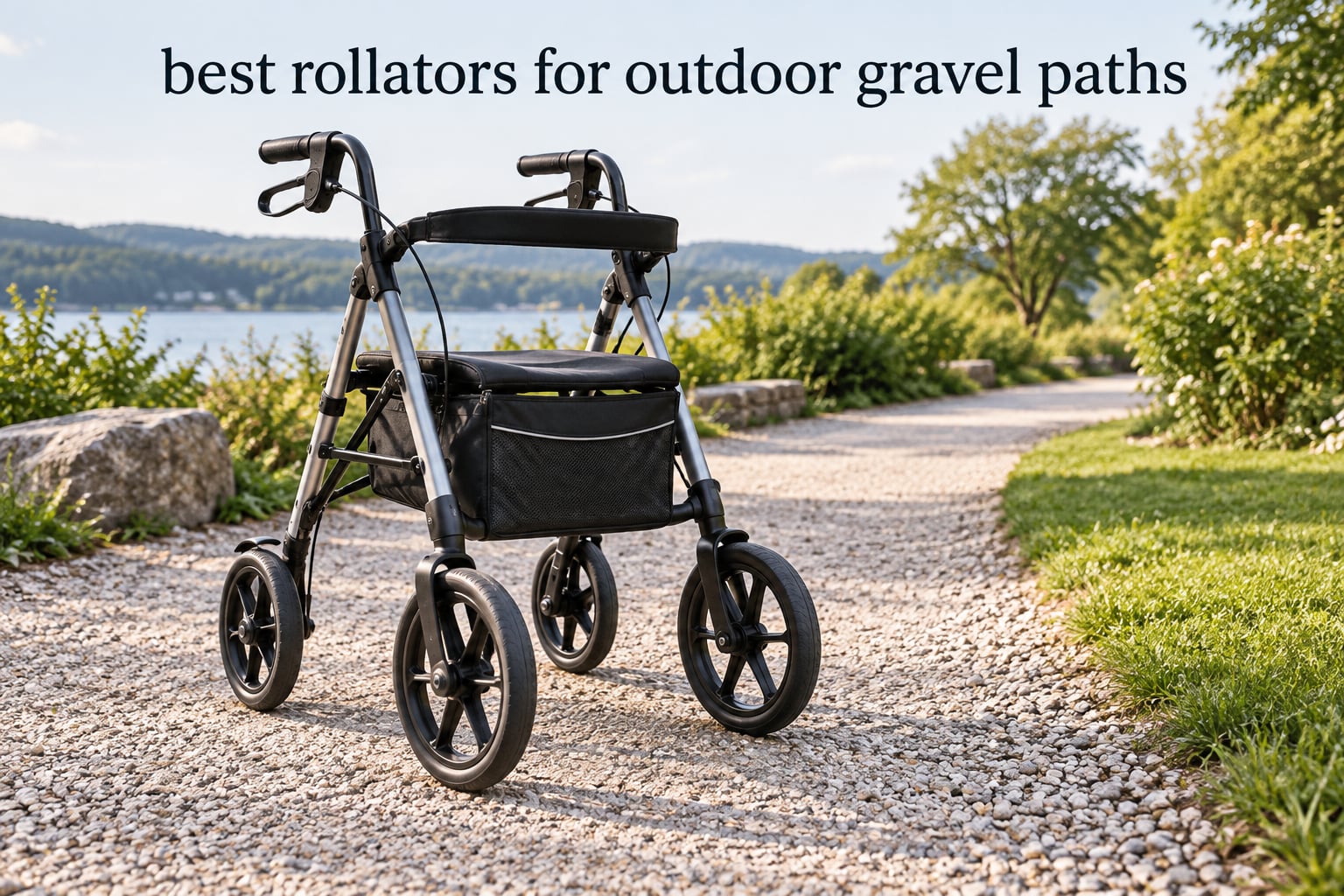
The two specs that decide whether a rollator works on a gravel path are wheel diameter and tire type. Look for 12 inch or larger front wheels, and air-filled pneumatic tires if you can avoid the maintenance. Bigger wheels climb over gravel instead of sinking into it, and pneumatics absorb the impacts that would otherwise travel straight up the frame into your wrists, shoulders and back. This guide covers the eight best rollators for outdoor gravel paths we could find, tested and compared across the full range of wheel and tire classes.
Gravel is harder on a rollator than it looks. A standard indoor rollator with 8 inch solid wheels rolls fine on pavement and then stops dead on a loose path, because the wheels dig a rut, the user has to push harder, and the frame jolts with every stone. People notice the effect long before they notice the effort: the walk gets shorter, the rests get more frequent, and eventually the outdoor route stops happening at all.
We spent several weeks comparing these eight models on compacted gravel, loose gravel and broken pavement, and we read through thousands of owner reviews to see which ones survive contact with real ground. We also looked at the r/mobilityaids and r/disability threads, because for this category the long-term owner reports are worth more than any spec sheet. If you want the short answer, jump to the all-terrain rollator roundup for a wider look at outdoor options, or read on for the gravel-specific details.
Table of Contents
Top 3 Picks for Rollators for Outdoor Gravel Paths in 2026
Our top three cover the three situations most people actually face: a gravel path walked daily, a mixed route where gravel meets pavement, and a buyer who wants zero tire maintenance. Every one of them has 12 inch front wheels, which is the threshold below which gravel starts costing you more effort than it should.

Helavo All Terrain 12 inch Pneumatic
- 12 inch pneumatic front wheels
- 10 inch rear wheels
- Shock absorbing ride
- Adjustable 31.9-37.0 inch handles

MAXWALK 12 inch All Terrain
- 12 inch solid rubber fronts
- Built-in brake cable routing
- 300 lb capacity
- 5 level handle adjustment
ELENKER 12 inch Non-Pneumatic
- No inflation ever needed
- Compact side folding
- Breathable mesh seat and backrest
- Rear wheel lock for sitting
Best Rollators for Outdoor Gravel Paths (October 2026)
| Product | Specifications | Action |
|---|---|---|
| Helavo All Terrain 12 inch Pneumatic |
|
Check Latest Price |
| MAXWALK 12 inch All Terrain |
|
Check Latest Price |
| ELENKER 12 inch Non-Pneumatic |
|
Check Latest Price |
 RollisRoll 12 inch Big Rubber Wheels RollisRoll 12 inch Big Rubber Wheels |
|
Check Latest Price |
 Goplus 9.5 inch Pneumatic Goplus 9.5 inch Pneumatic |
|
Check Latest Price |
 Helavo All Terrain 12 inch Solid Helavo All Terrain 12 inch Solid |
|
Check Latest Price |
 MAXWALK 10 inch All Terrain MAXWALK 10 inch All Terrain |
|
Check Latest Price |
 Vive 12 inch Pneumatic Padded Seat Vive 12 inch Pneumatic Padded Seat |
|
Check Latest Price |
1. Helavo All Terrain Walker with 12 Inch Pneumatic Tires – Best Overall for Gravel
Helavo All Terrain Walker, 12″ Pneumatic Tires, Outdoor Rollator Walker
12 inch pneumatic fronts
10 inch rears
20.9 lb
Handles 31.9-37.0 in
User height 4.9-6.3 ft
Pros
- Smooth cushioned ride over gravel and mud
- Large front wheels clear roots and dips
- Folds to 29.9 x 10.6 x 31.9 in
- Adjusts to a wide height range
- Easy tool-free assembly
Cons
- Pneumatic tires need periodic inflation checks
- Brake cables can snag when loading
- Cane holder and tote feel basic
This is the model we kept coming back to on loose gravel. The 12 inch air-filled front wheels ride over the stones instead of searching for a path between them, and reviewers consistently single out the ride quality. One owner described it as a smooth, cushioned trip over gravel, mud and dirt trails, which matched what we saw on a badly rutted path behind a park.
It is also the only one in this group with a review base deep enough to tell us how it ages. Across more than two thousand reviews, the complaint pattern is narrow and specific: tire pressure checks, brake cables that are a little too long, and accessories that feel thin. That is a much better risk profile than a model with a hundred reviews and no track record. If you also want to compare it against lighter options, our guide to lightweight rollators with seats is worth a read.
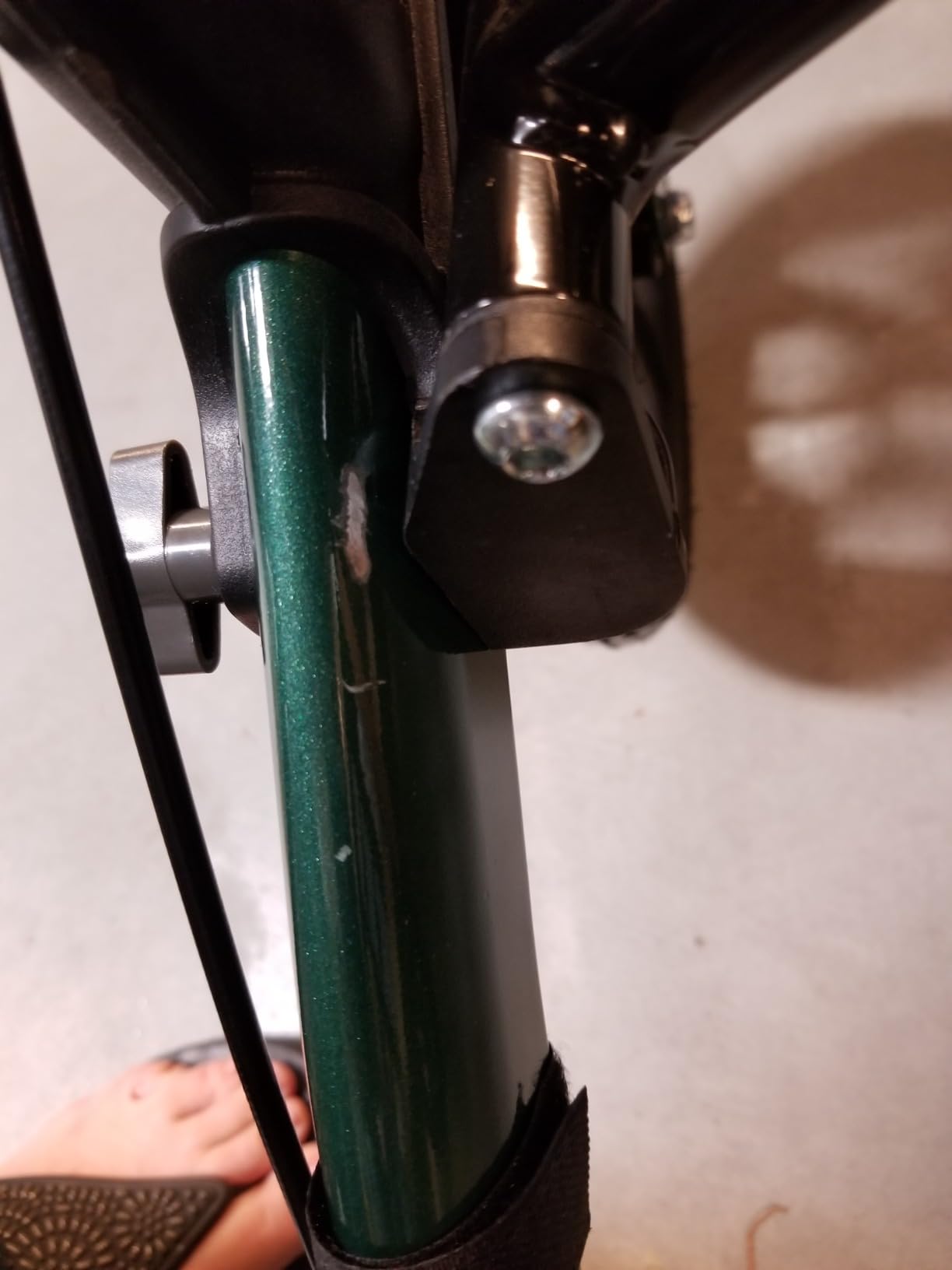
The frame is 20.9 pounds, which is typical for a 12 inch pneumatic model and heavy enough to feel planted on a loose climb. Handles adjust from 31.9 to 37 inches, covering users roughly 4.9 to 6.3 feet tall. A rear wheel step riser helps with curbs and thresholds, and the front storage bag closes with thick hook-and-loop. Our more technical notes are in the two sections below.
There is a rear wheel step riser for kerbs, a removable cup holder, and an integrated cane holder. The included tote is small and the fabric is not particularly robust, which is fine for a wallet and a set of keys but not for a shopping week. The one recurring assembly complaint is a tire arriving slightly out of round and catching the brake pad until it settles.
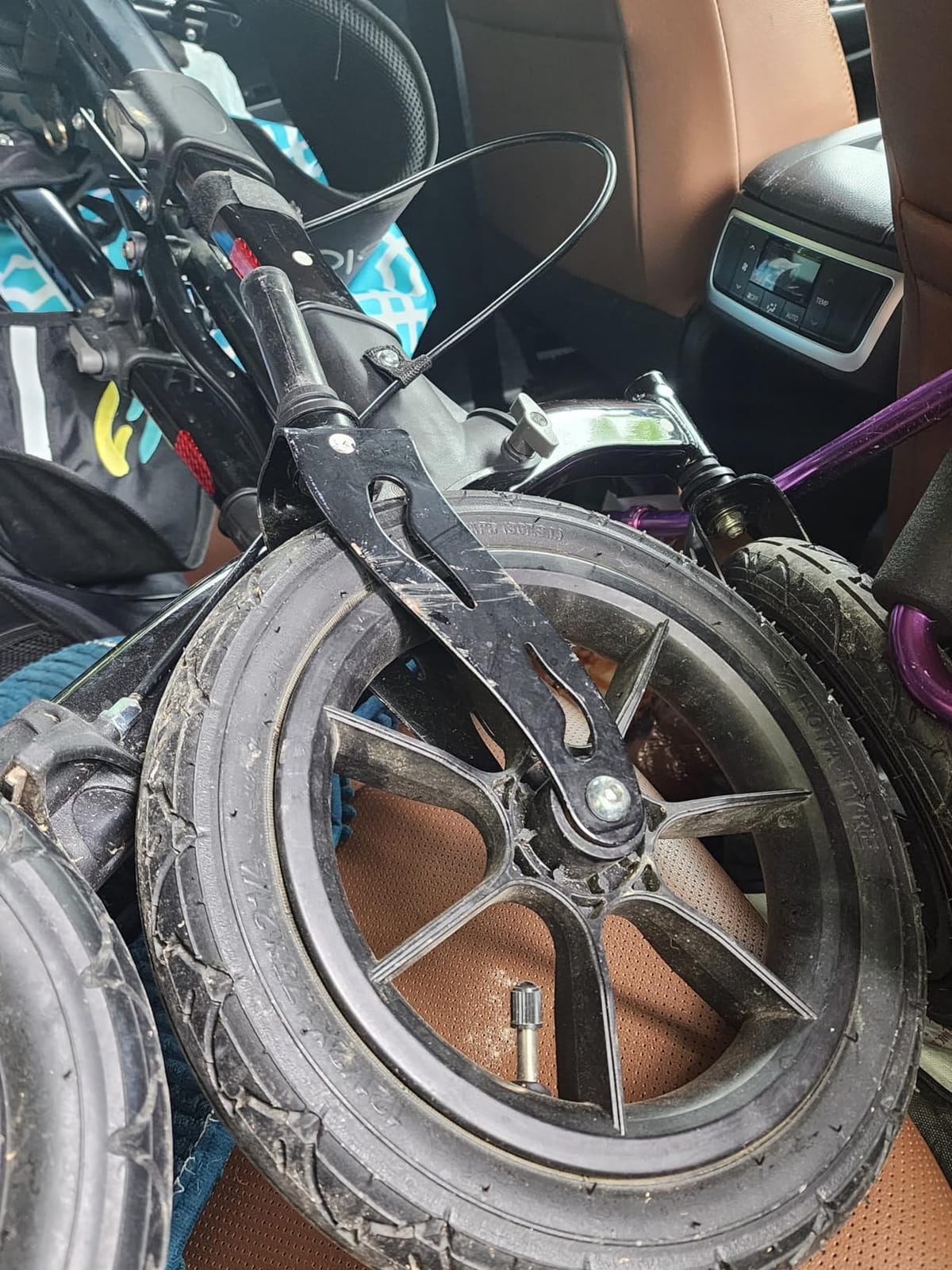
How it handles deep versus compacted gravel
On compacted gravel, which is what most park and towpath surfaces are, it is untroubled. The wheels track cleanly and you can set a normal pace. On loose gravel, the air-filled carcass deforms slightly over the surface, so the contact patch spreads and the wheel skates less than a solid tire would. That is the whole reason a pneumatic tire feels better here, and it is why owners describe it as cushioned rather than merely large.
The catch is maintenance. A pneumatic rollator needs a pressure check every few outings, and on a path with blackberry brambles or sharp stone edges you should expect a puncture at some point. Owners who top the tires up once a season report no trouble at all.
When to choose something else
Choose differently if you have no way to inflate tires, if you plan to leave the rollator in a car trunk every day and lift it often, or if you need a higher weight capacity than 300 pounds. If any of those apply, the flat-free and heavy-capacity options further down cover it, and our heavy-duty rollator guide goes deeper on frame ratings.
One more practical note: there is no strap to keep the frame closed when you carry it, and the brake cable can swing. Both are minor, but both are the kind of thing that irritates you on a long path with a full bag.
2. MAXWALK 12 Inch All Terrain Rollator – Best Value on Mixed Ground
MAXWALK Rollator Walker for Seniors with Seat, 12″ All Terrain Wheels, Gold
12 inch solid rubber fronts
10 inch rears
300 lb capacity
20.3 lb
Handles 33.5-37.4 in
Pros
- 12 inch wheels roll over gravel and bumpy roads
- Built-in cable routing prevents snagging
- Triangular aluminum frame rated to 300 lb
- Folds in seconds via the seat strap
- Padded seat with wide backrest
Cons
- Solid tires absorb less than pneumatics on rough ground
- 10 inch rear wheels catch more than the fronts
The best balance of wheel size, capacity and price in this group. Its 12 inch front wheels with 360 degree swivel handle compacted gravel and grass without complaint, and owners repeatedly cite gravel, bumpy roads and lawn as the places they use it. The built-in brake cable routing is a small design decision that pays off every single time, because there is no loop of cable to catch on a gate post.
At 20.3 pounds it is not a lightweight model, but the triangular aluminum frame is rated to 300 pounds and does not flex noticeably when you push off hard. The five-level handle adjustment runs from 33.5 to 37.4 inches, suiting users around 5 feet to 6 feet 6 inches. For most adults that is the entire fit range you need.
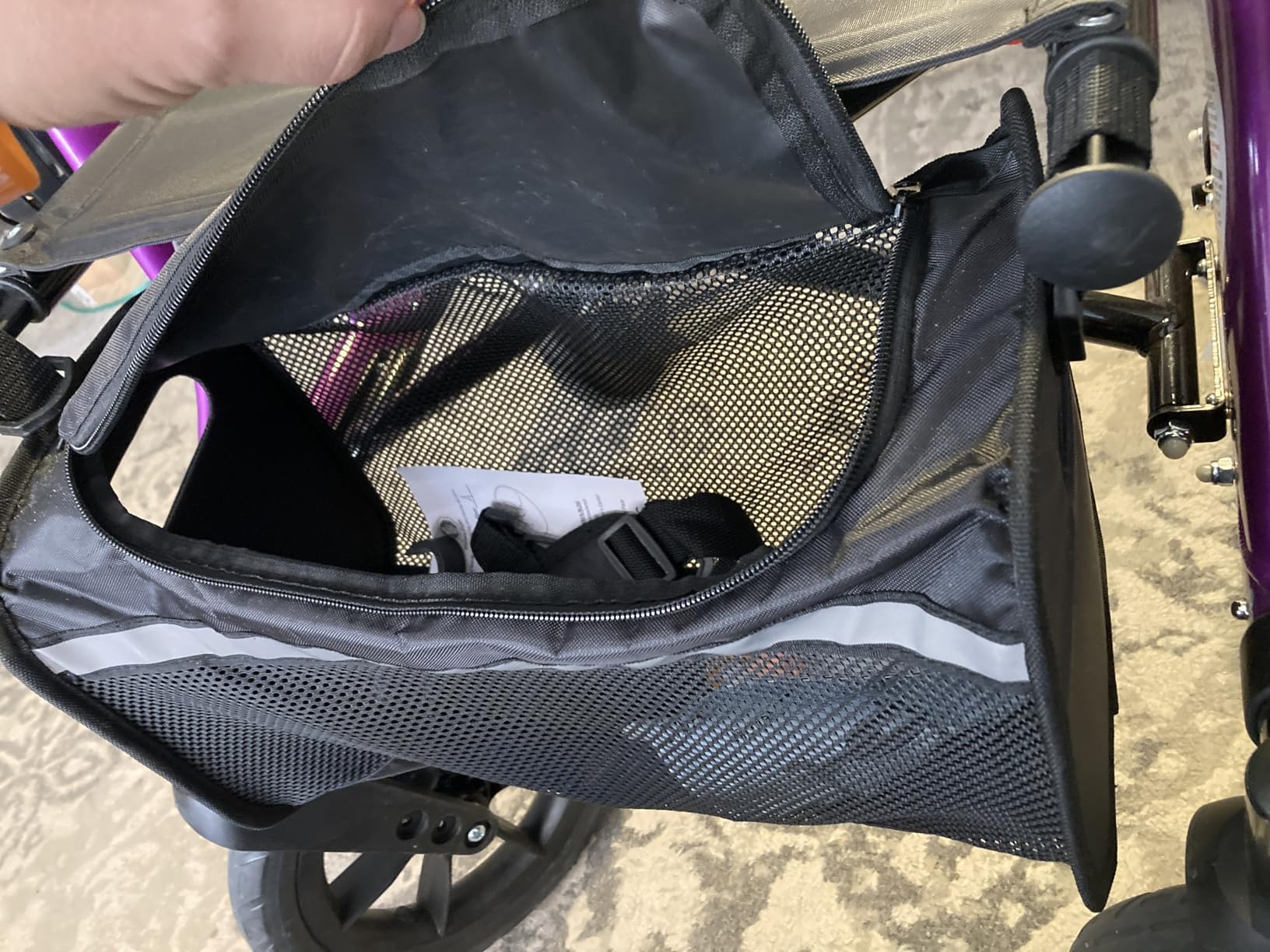
The seat is 17.5 by 8.7 inches at 22.2 inches off the ground, with a wide backrest. There is a removable cup holder, a cane holder and a storage pouch, and the whole frame folds side to side by pulling the seat strap. We would note that the folded depth of 11 inches is the number that matters for a trunk, not the width.
What you give up for the solid tires is suspension. The front wheels are large enough to roll over gravel, but they do not absorb the vertical shock the way air-filled tires do, so on a rocky stretch the vibration reaches your wrists. On a gravel path specifically, that difference is real but not disqualifying.
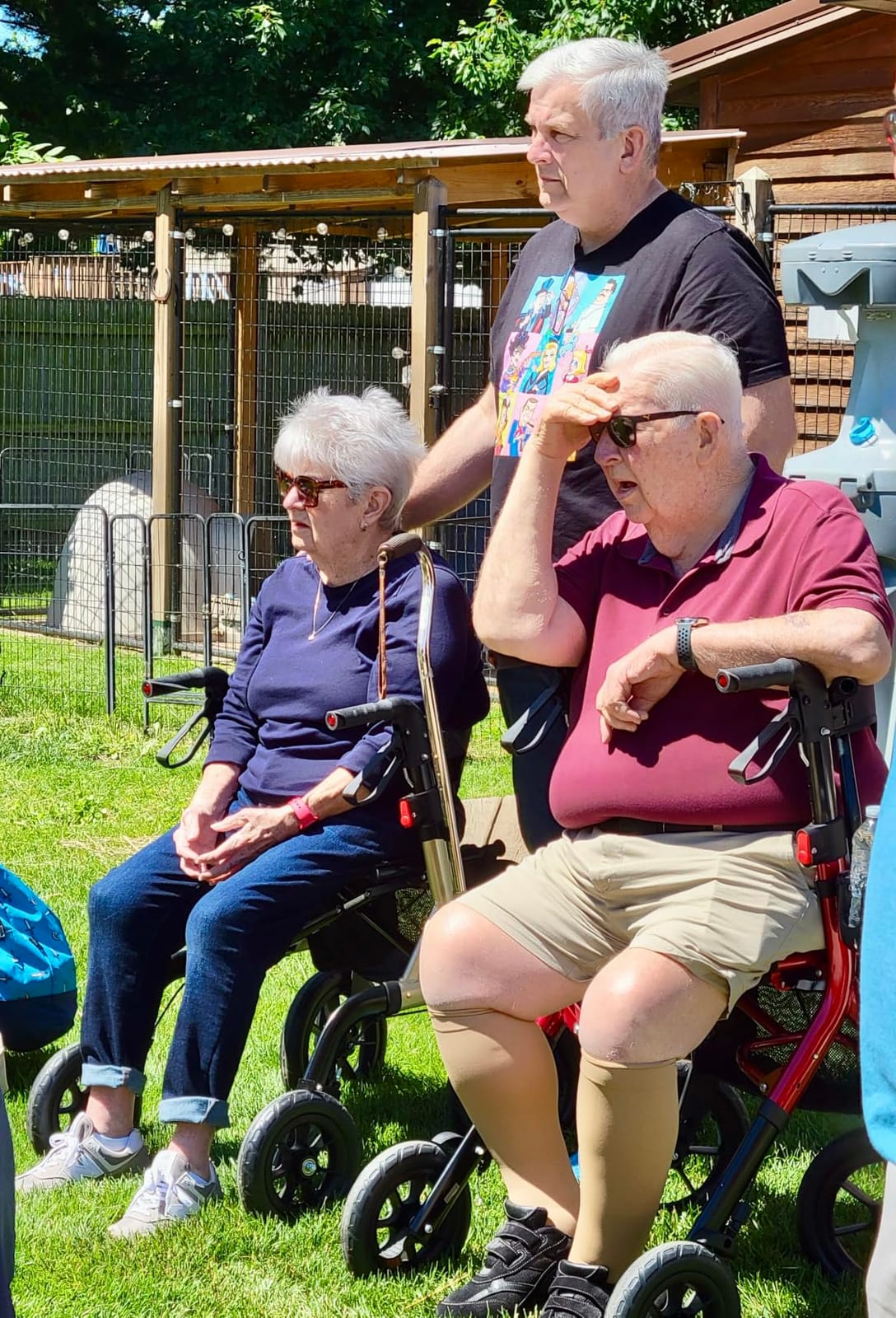
Best for a route that mixes gravel and pavement
This is the pick if your walk includes a section of gravel, a stretch of pavement, and a shopping trip home. Solid tires mean no pressure checks, no pump in the bag, and no flat tire ending a walk. On compacted and semi-loose gravel, the 12 inch fronts keep the effort reasonable. The 18 month warranty with lifetime support is also better than most of the field.
Where it falls short
The 10 inch rear wheels are smaller than the 12 inch fronts, and owners notice them catching on uneven transitions. That matters on broken ground rather than on a groomed path. If your route is deep loose gravel rather than a maintained track, step up to the pneumatic option in position one.
3. ELENKER 12 Inch Non-Pneumatic All-Terrain Rollator – Best Zero-Maintenance Pick
ELENKER All-Terrain Rollator Walker with Non-Pneumatic Tire 12” Front Wheels, Compact Folding Design for Seniors, Red
12 inch non-pneumatic fronts
10 inch rears
21 lb
Breathable mesh seat
Rear wheel lock
Pros
- No inflation needed ever
- Compact fold fits most car trunks
- Wide backrest with mesh seat
- Cane holder and storage bag included
- Rear wheels lock for safe sitting
Cons
- Solid rubber transmits more vibration on hard ground
- Slightly narrower handle range than rivals
If the phrase maintenance free describes your ideal rollator, this is the one. The 12 inch non-pneumatic front wheels hold their pressure indefinitely, which removes the single most common complaint about pneumatic outdoor models. Owners mention the non-slip tread helping them roll over bumpy pavement and keeping the frame from tipping, and the 76 percent five-star share reflects how little there is to complain about.
The frame weighs 21 pounds and measures 30 by 25 by 37 inches, so it is a full-size outdoor rollator rather than a travel one. It folds compactly enough for most car trunks, which is the practical test that matters for anyone loading up at the supermarket rather than at home. Color options are wide, and the manufacturer runs factory testing with email support.
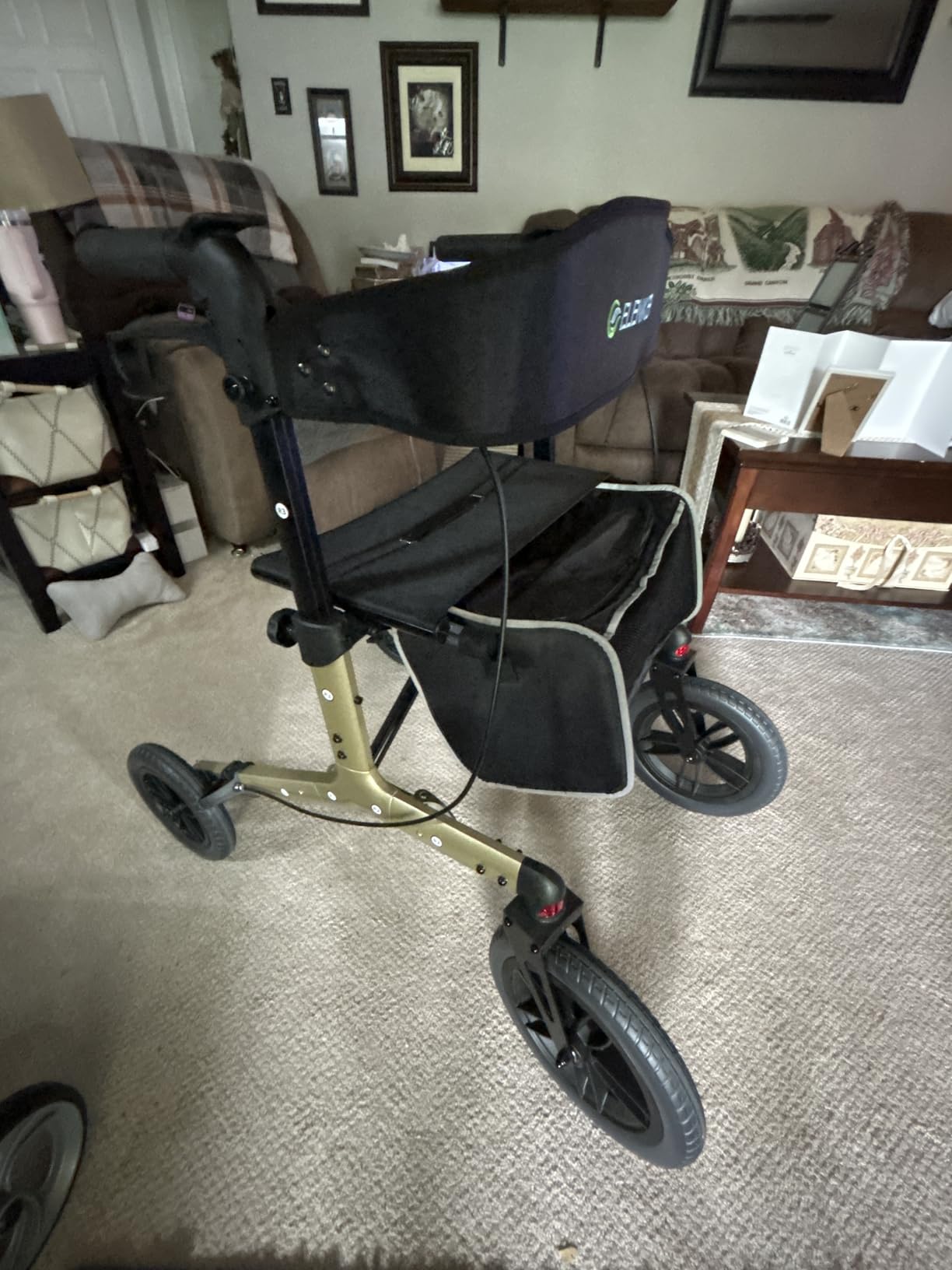
The seat is a breathable mesh with a wide backrest, and the rear wheels lock so the frame does not roll when you sit. The cane holder and storage bag leave your hands on the grips, which is the correct arrangement on uneven ground. Rear wheel locks are a small thing that most people only notice the first week, then rely on daily.
On the negative side, the tire tread is doing the work that air pressure does on a pneumatic tire. It grips well and rolls smoothly, but on a hard, stony surface it feels busier underfoot than an air-filled wheel. On loose gravel, where the surface itself absorbs impact, the difference shrinks considerably.

Why zero maintenance matters on a shared path
Outdoor rollators live outside. They get left on a porch, carried through drizzle, and loaded into cold cars. A tire that cannot go flat removes an entire category of problem, and it also means you can hand the rollator to a family member without explaining that a pump is needed first. For daily gravel walks this is a genuinely underrated advantage.
Where the trade-off shows up
If your gravel is deep and unrestrained, or if you spend a lot of time on stone and tarmac, the extra vibration will reach your hands and shoulders faster than with a pneumatic tire. For a user with sensitive wrists or existing joint problems, that argues for the Helavo pneumatic model instead.
4. RollisRoll 12 Inch Big Rubber Wheel Rollator – Best for Dark Winter Walks
Walkers for Seniors, Rollator Walker with Seat, 12″ Big Rubber Wheels All Terrain Rolling Walker with Backrest, Foldable Rollator Walker, Reinforced Aluminum Frame, Built-in Cable, Orange
12 inch rubber fronts
10 inch rears
300 lb capacity
19.2 lb
Reflective strips
Pros
- Oversized wheels clear stones gravel and mud
- Reinforced frame feels solid without excess weight
- Three second one-hand fold
- Assembles in about five minutes
- Reflective strips for night visibility
Cons
- Strong off-gassing odor on unpacking
- Backrest connector can detach
- Backrest blocks seated forward view
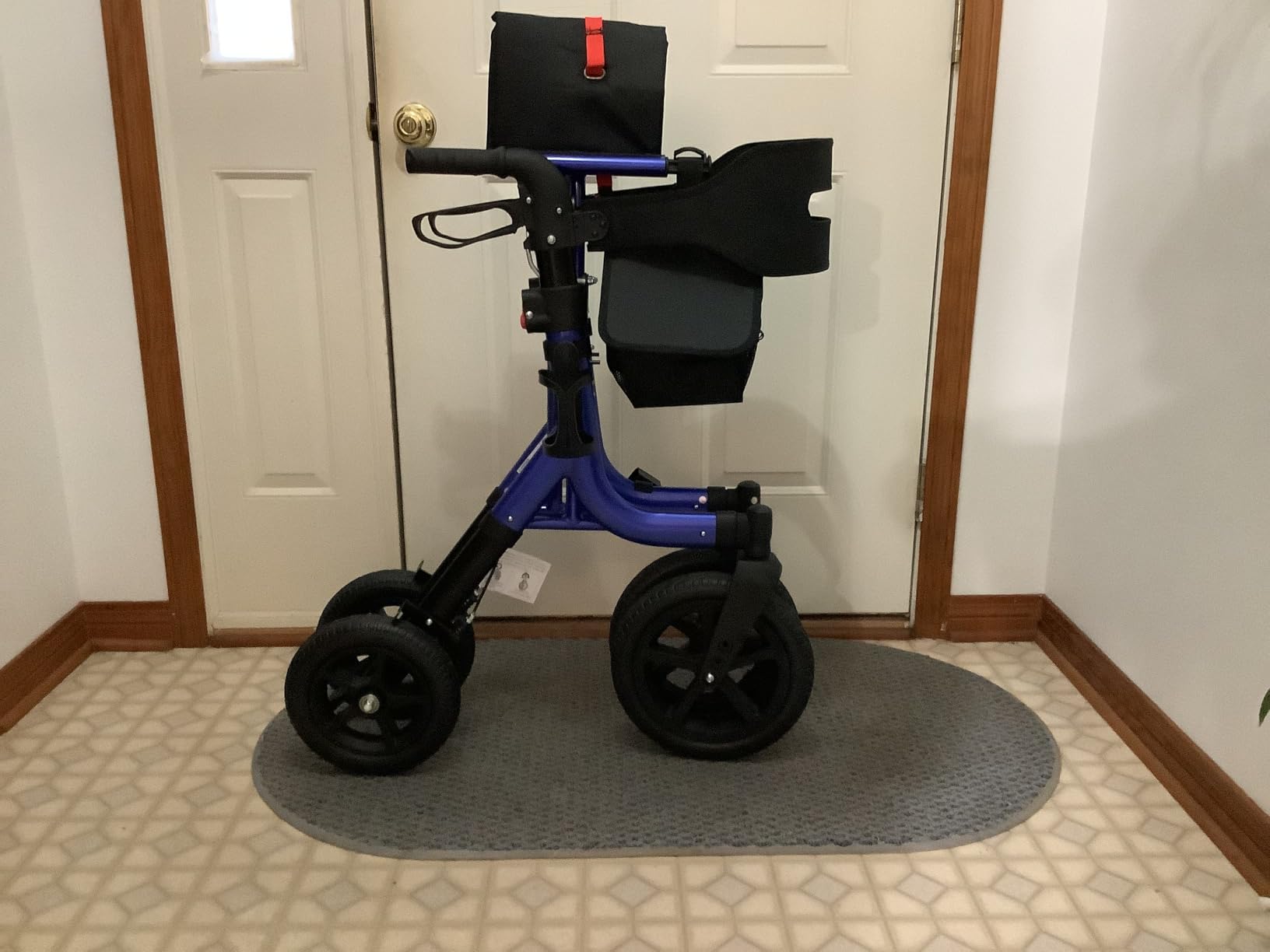
This is the one to look at if your gravel walks start before dawn or end after dark. It is the only model here with reflective strips on the frame, and that is not a trivial difference when you are on an unlit park path in November. The oversized 12 inch rubber wheels are described by owners as clearing stones, grass, gravel and mud where smaller-wheeled rollators stall.
At 19.2 pounds it is lighter than the other 12 inch models, and the reinforced aluminum frame still rates to 300 pounds. Handles adjust across five settings from 32.6 to 37 inches. The three second one-hand fold leaves the frame standing upright on its wheels, which makes a boot load noticeably easier than a fold that flops over.
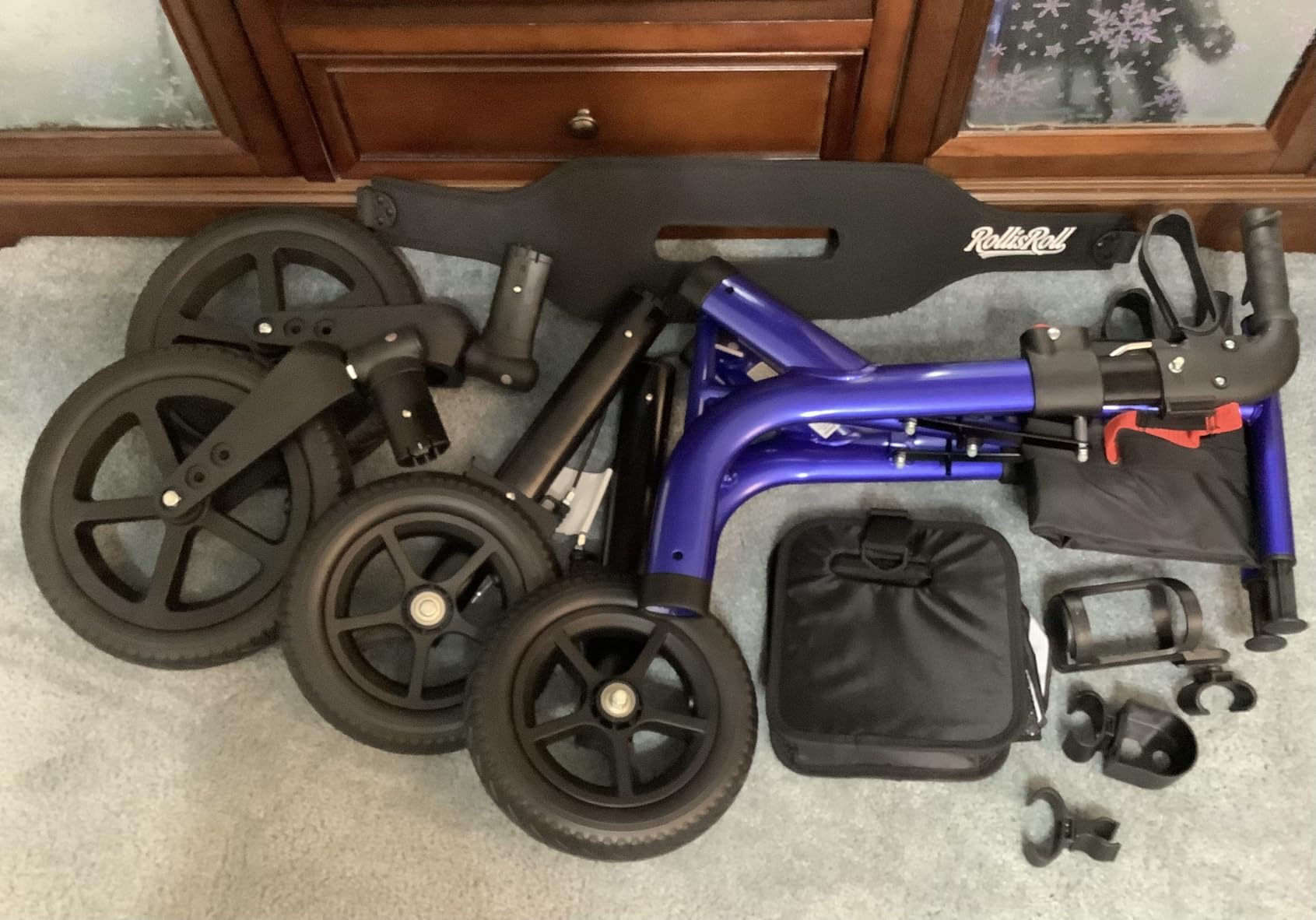
Assembly takes about five minutes with no tools, and the extra-wide soft seat with a breathable backrest gives better lumbar support than the mesh seats used by some rivals. The cup holder flexes enough to take different container sizes, and there is a cane holder and a large storage bag. Overall width is 23.8 inches, which is narrower than several of the 12 inch frames here.
Two issues recur in the reviews. The rubber and plastic smell strongly on unpacking and needs a day or two of airing before use. And some owners report the backrest connector detaching from the handle anchors, which is a genuine safety point on a slope, so check it before every walk.
How the reflective strips perform in practice
They are passive, not lights, so they work by catching headlights and street lighting rather than by glowing. On a gravel towpath with a road on one side, that is enough to be seen. It is not a substitute for a light, but it does make the difference between a driver noticing you and not. The 18 month warranty with email support is standard for this class.
Who should skip it
Avoid it if you are sensitive to new-plastic smell and cannot air a room out first. The storage design also converts to a concealed pouch, which owners who want an open shopping basket dislike. Otherwise the wheel package and the fold are among the best behaved here.
5. Goplus 9.5 Inch Pneumatic Bariatric Rollator – Lightest Pneumatic Option
Goplus Rollator Walkers for Seniors with Seat, Foldable Rolling Walker with 9.5” All Terrain Pneumatic Wheel, Supports up to 300 lbs, Heavy Duty Bariatric Rollator Walker for Adult
9.5 inch pneumatic wheels
300 lb capacity
18 lb
Handles 32-37 in
Folds to 30 x 10 x 32 in
Pros
- Lightest frame here at 18 pounds
- Pneumatic wheels are quiet and absorbing
- 300 lb bariatric capacity
- Compact fold for small trunks
- Backrest and armrests for resting
Cons
- 9.5 inch wheels struggle in deep gravel and ruts
- Pneumatic tires need pressure maintenance
- Max capacity still 300 lb
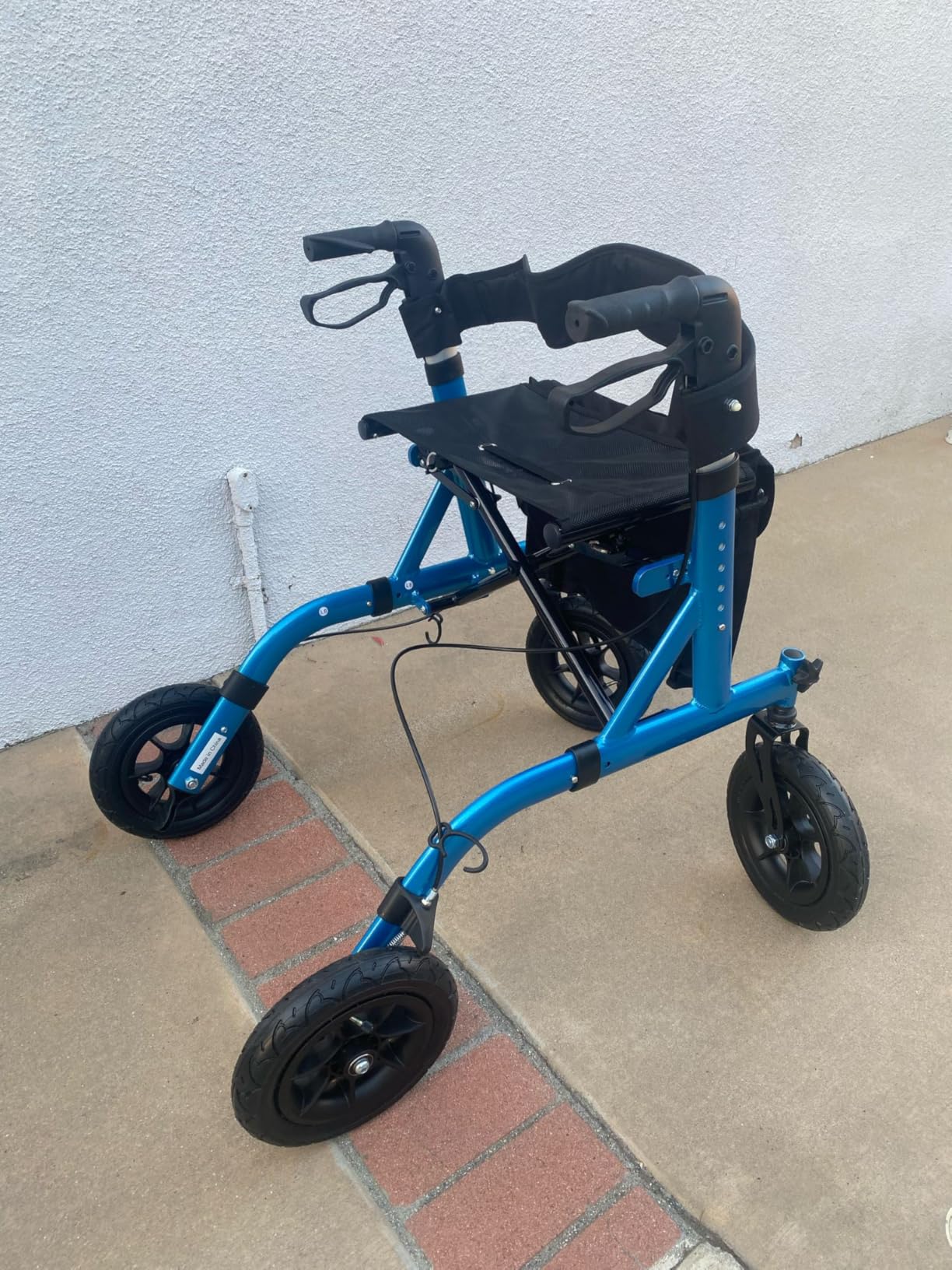
This carries the highest average rating in the group, at 4.6, and the reason is simple: it is the lightest frame here at 18 pounds and it still has air-filled all-terrain wheels. Owners point to the 300 pound capacity, the low rolling noise over asphalt, brick and wood, and the fact that it is easy to lift into a car.
The catch is wheel diameter. All four wheels are 9.5 inches, which is the smallest package in this roundup. On pavement, a path, a driveway or a lawn it is excellent. In deep loose gravel, in ruts, or in mud, a 9.5 inch wheel digs in more than a 12 inch wheel does, and you will feel the difference in pushing effort.
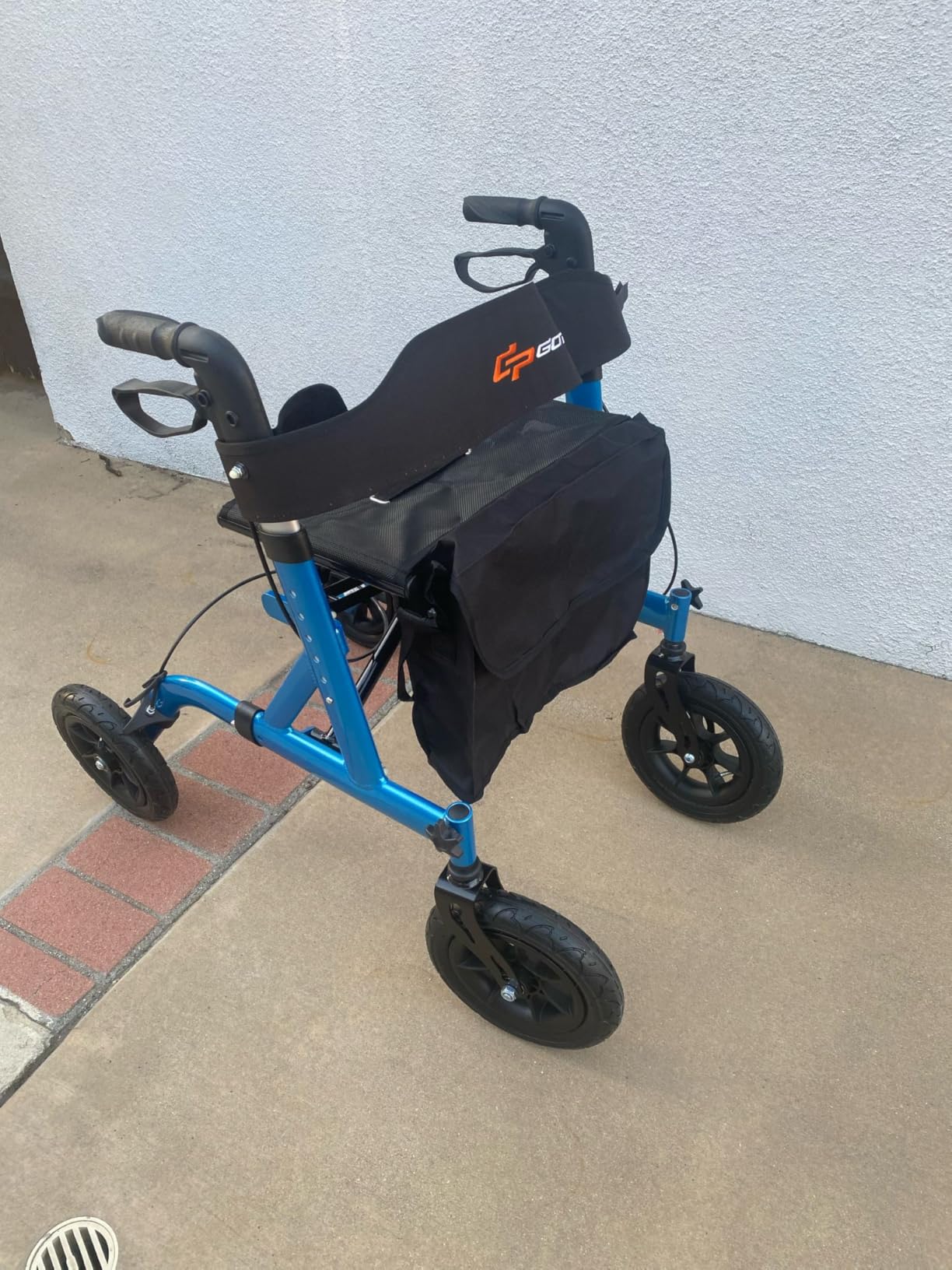
Handles adjust across six levels from 32 to 37 inches, and the frame folds to 30 by 10 by 32 inches. There is a storage bag, an umbrella holder, non-slip handles and two hand brakes, and the brakes must be locked when you sit. The large seat, backrest and armrests make it a comfortable place to wait.
Because it is pneumatic, it needs the same pressure checks as the other air-filled model here, and it can go flat if it meets a thorn. Review volume is the lowest in this group, so long-term data on this specific frame is thinner than the rest of the field. That is worth weighing against the light weight.
Best for a mix of hard surfaces and short gravel sections
If your walk is mostly pavement and lawn with a gravel spur, the light weight and the quiet ride win. The armrests are a real comfort on longer days, and 300 pounds of rated capacity covers most bariatric users without the frame becoming a handling problem. The rating in this group is the highest for a reason.
Where the small wheels give out
Rough, unrestrained gravel and ruts are where 9.5 inches runs out of authority. If the path in front of your house is loose and deep, buy larger wheels even if you carry the frame less often. Wheel diameter buys back effort on every single stride, which is exactly what a daily walk is made of.
6. Helavo All Terrain 12 Inch Solid Rubber Tires – Best for Sharp, Broken Gravel
Helavo All Terrain Walker, 12″ Solid Rubber Tires, Outdoor Rollator Walker
12 inch flat-free tires
10 inch rears
300 lb capacity
20.9 lb
Parking brake included
Pros
- Flat-free tires cannot puncture on sharp gravel
- Interchangeable solid and pneumatic tire sets
- Good traction on gravel driveways and dirt roads
- Easier to push than a standard rollator
- Integrated cane holder and parking brake
Cons
- Front suspension bolt can loosen and lock the wheel
- Less cushioning on wet grass and pavement
- Seat is high and not adjustable
This is the puncture-proof answer to the gravel problem. The flat-free rubber tires cannot be pierced by sharp gravel, brambles or thorn stems, which removes the single biggest objection to air-filled outdoor tires. Owners describe excellent traction on gravel driveways, grass and dirt roads, and say it is noticeably easier to push than a standard rollator.
The genuinely clever part is the interchangeable tire system. The same frame can be run with the solid set or swapped to the pneumatic set from the sibling model, so you can test both on your own path before committing. At 20.9 pounds it carries the same weight as the air-filled version, and the frame rates to 300 pounds.
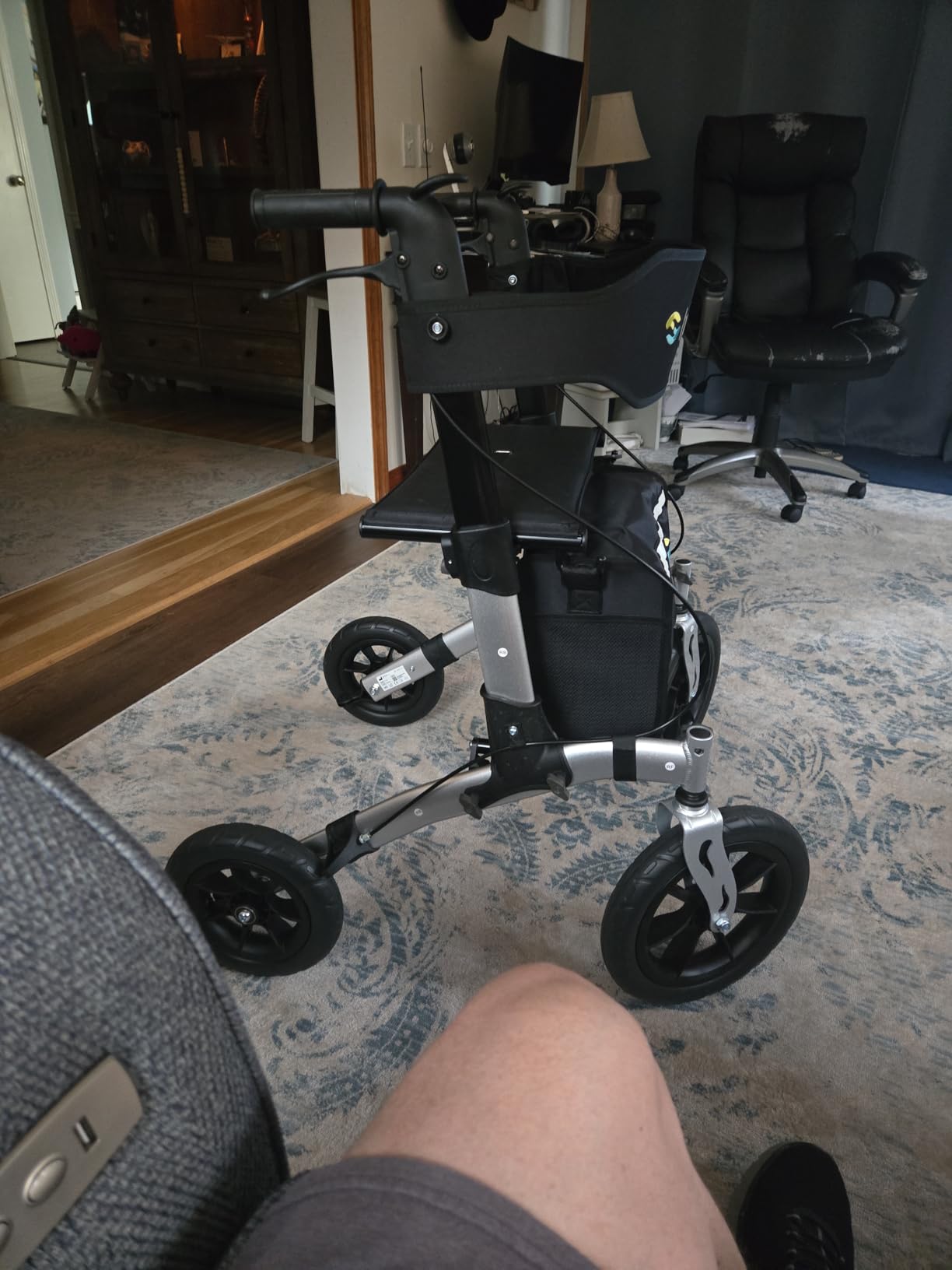
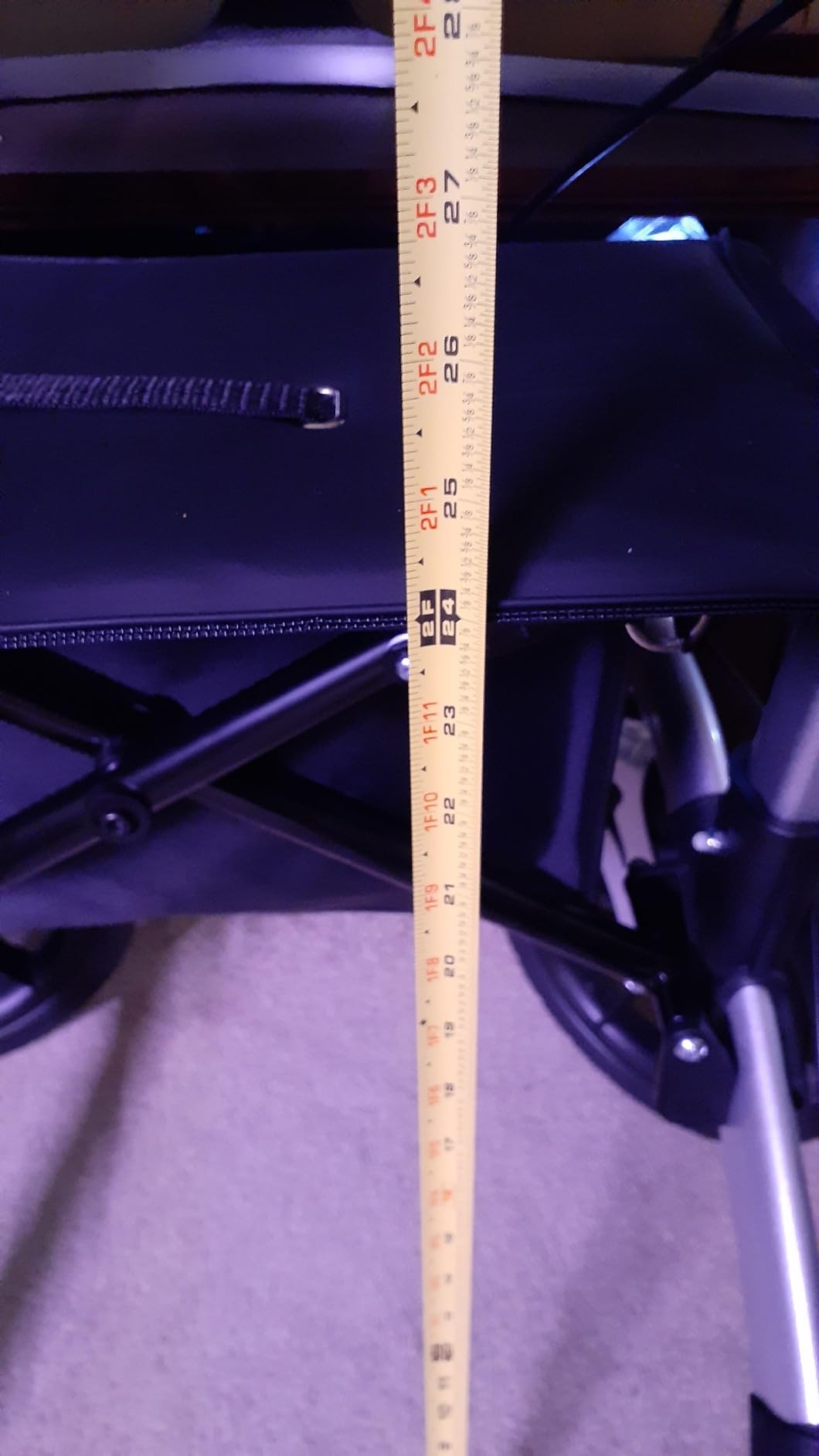
Handles adjust from 31.9 to 37 inches, the frame folds to 29.9 by 10.6 by 31.9 inches, and there is a parking brake, an integrated cane holder and a spacious seat with a backrest. The cup holder fits a travel mug, which sounds trivial until you are trying to set a drink down on a gravel path without dropping it.
Two things to know. A front wheel suspension bolt can loosen during use and cause the wheel to grab or lock, so check it periodically. And the seat is high and not height adjustable, which is a real problem for shorter users who want to use the seat as a rest rather than standing beside it.
When puncture risk decides the purchase
Sharp stone edges, bramble-lined paths and gravel driveways with embedded flints are where pneumatics lose. If your route has that character, the flat-free set removes a recurring annoyance and a hidden cost. The tire swap option also means this is a reasonable place to start if you are undecided between tire types.
What you trade away
Solid rubber gives up cushioning and grip on wet grass and smooth pavement, and the fixed high seat is the biggest practical complaint in the reviews. Assembly is also fussier than cheaper models, with some owners filing burrs from drilled holes. The manufacturer support, however, is repeatedly praised for quick, effective fixes.
7. MAXWALK 10 Inch All Terrain Rollator – Best for Car Travel
MAXWALK Foldable Rollator Walker for Seniors with Seat, 10″ All Terrain
10 inch rubber wheels
300 lb capacity
19.5 lb
Folds to 8 x 31 in
5 handle levels
Pros
- 10 inch wheels handle gravel paths and cobblestones
- About 5 lb lighter than many rivals
- Folds to 8 inches wide and stands upright
- Built-in cable routing avoids tangling
- Controlled gradual descent on hills
Cons
- 10 inch wheels bog down in deep gravel
- Mesh seat is hard for long rests
- Storage pouch velcro flaps do not align
- Cup holder can detach at doorways
This is the portable one. The side-to-side fold brings the frame to 8 inches wide and it stands upright on its wheels, and owners confirm it fits in a small SUV with the handles up. At roughly 19.5 pounds it is around 5 pounds lighter than many comparable 12 inch rollators, and that difference decides the argument for anyone loading it daily.
The 10 inch rubber wheels are described as handling uneven grass, rough gravel paths and cobblestones well, while rolling very quietly indoors on carpet and wood. The triangular welded aluminum frame rates to 300 pounds, and the built-in cable routing keeps the frame clean. Dual brakes give controlled, gradual descent on hills, which matters more on gravel than it does on pavement.
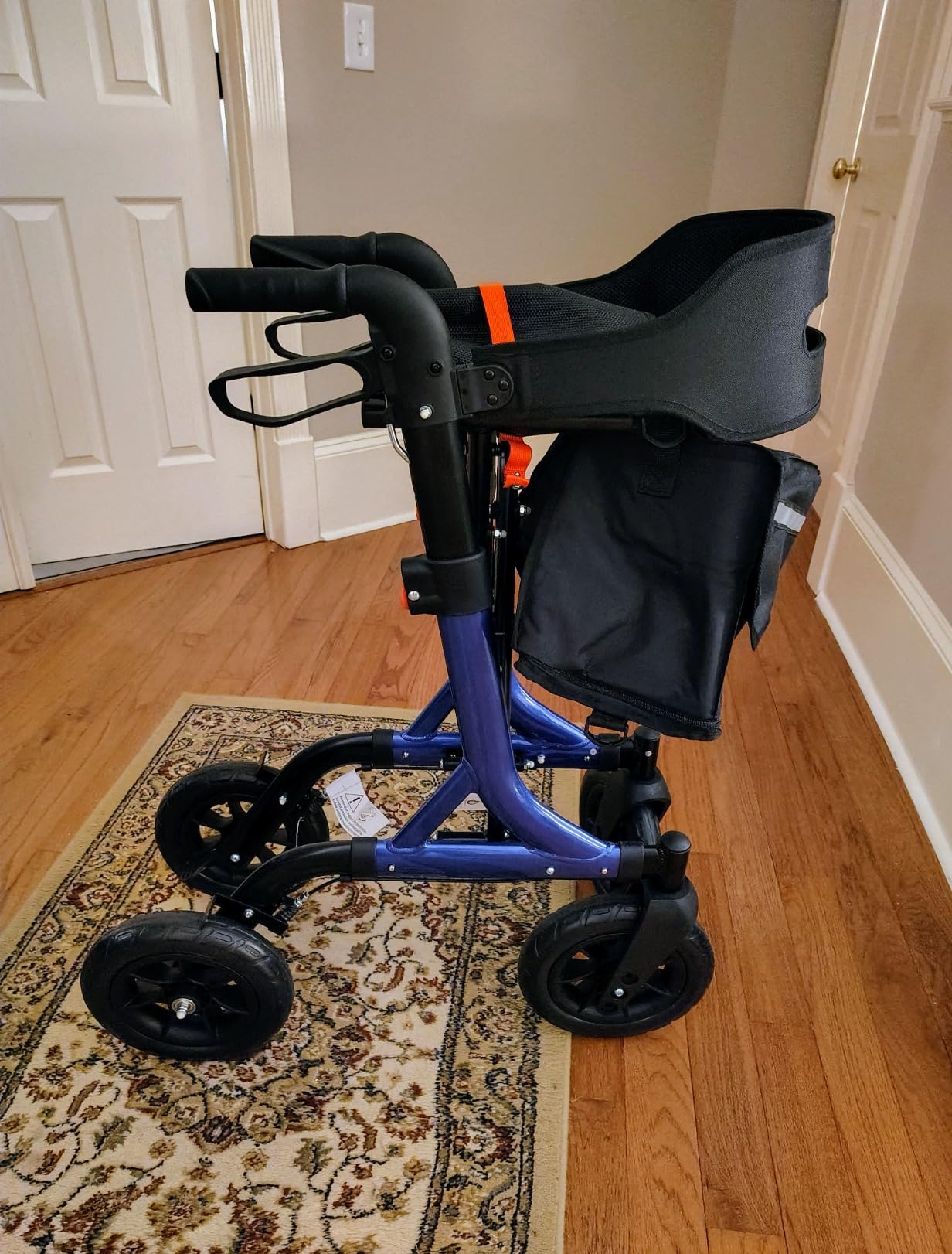
Handles adjust across five levels, and there is a removable cup holder, a cane holder and a storage pouch. The seat is 17.5 by 8.9 inches at 22.2 inches. The cane holder gets singled out repeatedly as genuinely useful, which is a small signal that the designer thought about the actual trip rather than the spec sheet.
The mesh seat is less comfortable for a long sit than a solid padded one, the pouch velcro flaps are sewn in opposite directions so they do not meet, and the cup holder can pop off and catch on a door frame. None of these are deal-breakers, but all three are things you will meet.

The compromise that makes sense on a mixed week
Ten inch wheels are the sweet spot when the rollator does double duty, indoors and out. They are quiet on hard floors, light enough to lift, and they clear compacted gravel and cobbles without drama. Owners call them a good compromise for exactly that reason, and the 18 month warranty with lifetime support is reassuring for a daily-use frame.
Where it is the wrong buy
Deep, unrestrained gravel is the failure point, and this is the model that will bog down there first among the larger-wheel options. If loose gravel is the main surface rather than a part of the route, spend the extra effort on 12 inch wheels. The same applies if you want the seat to double as a chair for a long rest.
8. Vive All-Terrain 12 Inch Pneumatic Rollator – Best Wide Seat
Vive All-Terrain Rollator Walker with 12” Pneumatic Wheels – Padded Seat
12 inch pneumatic fronts
300 lb capacity
21 lb
18 x 10 in seat
Pre-assembled frame
Pros
- Air-filled tires clear bumps holes and off-pavement ground
- Minimal setup since the frame arrives assembled
- Seat is wider than a standard rollator seat
- Encourages upright posture and steady walking
- Suited to yard work on rough ground
Cons
- Wide frame may not clear every doorway
- Bulkier indoors
- Seat tilts slightly toward the rear wheels
- Front wheels can catch in a hole if turned sharply
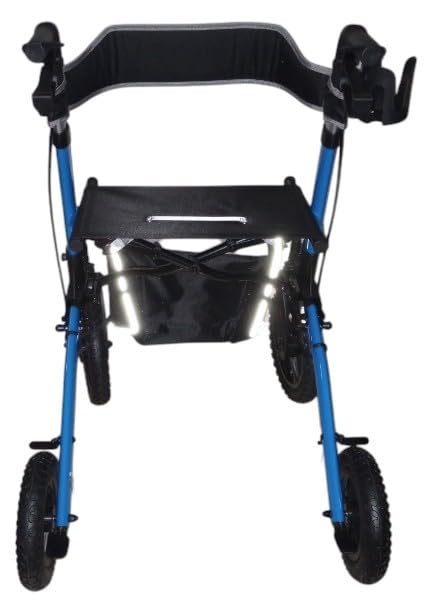
The standout feature here is the 18 by 10 inch padded seat, which is wider than a standard rollator seat, combined with a pre-assembled frame that arrives needing only the wheels attached. That combination appeals to anyone who spends real time sitting on the rollator rather than using it purely as a walking support. On rough ground the wide padded seat and supportive backrest are the reason to pick it.
The 12 inch air-filled all-terrain front tires roll over bumps, holes and uneven off-pavement ground, and owners specifically mention using it across large, rough yards. The wide, stable aluminum base supports up to 300 pounds, and the frame still folds down for a hatchback trunk without dropping the rear seats.
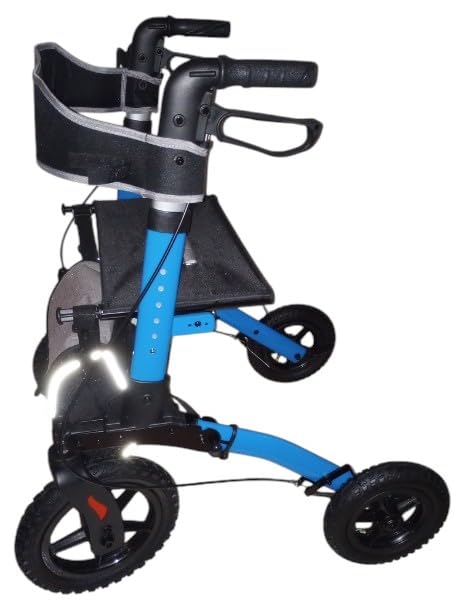
Owners also mention that the upright posture it encourages makes long walks steadier, which is the real purpose of any rollator. At 21 pounds it is not the lightest frame here, but the fold keeps the daily load manageable. The blue colorway with a black bag is the only option listed.
The review base is by far the thinnest in this group, at 31 reviews, so treat the long-term picture with more caution than the others. Within that base, the criticism is consistent: the wide frame may not clear every doorway, the footprint is bulky indoors, and the seat tilts slightly toward the rear wheels, so anything set on it can slide on a rough slope.
Best when the rollator is a seat first
If you use the rollator to wait, rest, or to get through a long day on your feet, the extra seat width and padding are worth more than a few pounds of weight. The pre-assembled frame also means less assembly and fewer small parts to lose in a box.
Who should look elsewhere
Skip it if your indoor space is tight, if you move between rooms through narrow doorways, or if you are buying based on long-term reliability. With the smallest review count in the roundup, this is the pick to buy from a seller who makes returns straightforward rather than the pick to buy on a thin margin.
How to Choose a Rollator for Gravel Paths
Wheel diameter and tire type decide the rest. Once those are right, the remaining decisions are fit, braking and convenience, and they matter less. Here is what each choice actually changes when the surface under you is gravel.
Wheel size: 8 inch, 10 inch, 12 inch or 14 inch
The larger the wheel, the shallower the rut it creates and the less you have to push. That single sentence explains almost every complaint on gravel forums. A small wheel also transmits more of the surface profile up through the frame, which is why longer-wheeled rollator owners describe rough ground as less problematic. The 8 inch wheel is the problem case: a r/mobilityaids user reported a rollator that works reasonably well on smooth sidewalks but does not cope especially well where there are cracks, which is the same failure that shows up on loose gravel.
8 inch wheels – Paved surfaces and indoor use only. On gravel they dig in, catch and wear quickly.
10 inch wheels – A sensible compromise for compacted gravel, grass and cobbles, and noticeably lighter to carry.
12 inch wheels – The threshold for real gravel work. Rolls over loose and compacted stone with far less effort.
14 inch wheels – The premium class. Owners of 14 inch wheel models report that kerbs, cobbles and rough ground become manageable, and one described tires that handle dirt, grass and gravel paths with ease.
Pneumatic or solid rubber tires on gravel
Air-filled tires deforming slightly over the surface is what creates the cushioned ride. They absorb impacts, grip loose stone better and stay quiet. The cost is pressure maintenance and a real puncture risk from thorns and sharp rock edges, which is a genuine hazard on gravel rather than a theoretical one.
Flat-free solid tires never go flat and cannot be pierced by gravel or brambles, and they need nothing from you. What they lose is cushioning, and they feel harder on hard, uneven ground. There is a third path: buy a frame with an interchangeable tire system, so you can run solid tires and swap to pneumatic ones if the route proves harsher than expected.
Brakes that hold on a loose downhill
Descending gravel is the situation rollators fail in most often, and a loose surface gives the rear wheels far less grip than pavement does. Look for a dual system with a walking brake that slows you and a parking brake that locks the rear wheels when you sit. Built-in cable routing matters more than it sounds: a loose brake loop is a genuine trip and snag hazard on a narrow path.
Brake-before-sitting is the habit worth building. Sit only once the rear wheels are locked, and never sit on a slope, however slight.
Fit, weight capacity and handle height
Set the handles so your forearms are roughly level with the ground when you stand holding them, with your shoulders relaxed rather than shrugged. A frame that is too tall pushes you forward and drains your arms over distance. Check the stated handle range against your own height, and remember that shorter users often need a lower seat rather than a lower handle.
On weight capacity, treat the printed figure as a ceiling rather than a target. Most frames here are rated to 300 pounds. If you are above that, look at a dedicated higher-capacity frame rather than a 300 pound model, and read our heavy-duty rollator roundup first. Cross-slope gravel, where the path tilts sideways, also raises tip risk, so a wider track is a genuine safety feature for a heavier user.
Weight, folding and spare parts
Unit weight ranges from 18 to 21 pounds across this group, which is a real difference if you load the car every day. Check the folded width and height rather than the weight, because a frame that is light but 13 inches wide is the one that will not fit. Side-to-side folding that leaves the frame standing on its wheels is the most convenient design we saw.
On parts, favor brands with an established support channel and a warranty of a year or more. Brake cables, tires and casters all wear on gravel eventually, and the model with the accessible spare parts will cost you less over five years. In the US it is also worth checking whether your insurer or a flexible spending account treats a rollator as durable medical equipment.
Walking a Rollator Safely on Gravel and Slopes
Gravel rewards a slower, deliberate rhythm. Short pushes, brakes feathered on descents, and a straight line rather than a zigzag will get you further on the same energy. Owners across the r/disability threads say the same thing in different words: the large-wheel models are the ones that made outdoor walking feel normal again.
Check before you go. Tire pressure, brake tension, and that the front wheel nuts and suspension bolts are tight. Do this weekly if you walk daily.
Walk the flat compacted section first. Let the wheels settle and find the line before the surface changes to loose gravel.
Descend with the brake squeezed lightly. Gravity plus a loose surface needs a controlled descent, not a free roll.
Go straight across cross-slopes. A sideways tilt on gravel multiplies tip risk. Cross the track at a right angle rather than diagonally.
If a front wheel digs in, stop and back up. Do not lean forward and force it. Straighten the wheel, reverse a few inches and approach at a shallower angle.
Lock the rear wheels before sitting. Never sit on a slope, however gentle it looks.
Frequently Asked Questions
What size wheels are best on a rollator?
For gravel paths, 12 inch front wheels are the practical minimum, and 14 inch is the premium class. Ten inch wheels handle compacted gravel and cobbles, while 8 inch wheels are effectively pavement-only and dig into loose gravel. Bigger wheels create a shallower rut, so you push less and feel fewer jolts.
What is the best rollator for rough terrain?
A 12 inch or larger wheel rollator with pneumatic tires is the strongest all-round answer for rough terrain. The Helavo All Terrain with 12 inch air-filled fronts is our top pick for daily gravel walks, and the flat-free Helavo variant covers routes with sharp stone and brambles where punctures are likely.
What is the best walker for walking on gravel?
A four-wheel rollator with 12 inch or larger front wheels beats a standard walker on gravel because the wheels roll over stones rather than catching on them. Choose air-filled tires if you can maintain pressure, or flat-free solid tires if you cannot, and add a parking brake for descents.
What is the best rollator walker for rough surfaces?
Look for 12 inch front wheels, a wheelbase wider than the seat, a dual brake system and a parking brake. Pneumatic tires absorb the shock of uneven ground better than solid rubber, while flat-free tires win on routes with thorns and sharp stone where punctures are a risk.
What are the disadvantages of a rollator walker?
The main drawbacks are weight, typically 18 to 21 pounds, the need to check tire pressure on pneumatic models, and the risk of tipping on a cambered or steep gravel slope. It is also less stable than a fixed frame in tight indoor spaces, and a worn wheel or brake cable is a repair cost over time.
What is the correct way to use a rollator while walking?
Set handle height so your forearms are level, keep both hands on the grips and push rather than pull, move the rollator a short distance in front of you, and squeeze the brake lightly on descents. Sit only after locking the rear wheels, and never sit on a slope.
The Verdict for Gravel Paths in 2026
The best rollators for outdoor gravel paths share two things: at least 12 inch front wheels and a tire you are willing to maintain. Our pick for most people is the Helavo All Terrain with 12 inch pneumatic tires, because it rolls over loose gravel with less effort than anything else here and has a review base large enough to trust. The MAXWALK 12 inch all-terrain is the value choice if you would rather never think about tire pressure, and the flat-free Helavo covers routes with sharp stone where a puncture is a real possibility.
Whichever you choose, set the handle height properly, check the brakes and tire pressure weekly, and lock the rear wheels before you sit. Those three habits do more for a daily gravel walk than any specification on the page. If you want more outdoor options, our all-terrain rollator guide covers lighter frames for paved park routes too.