
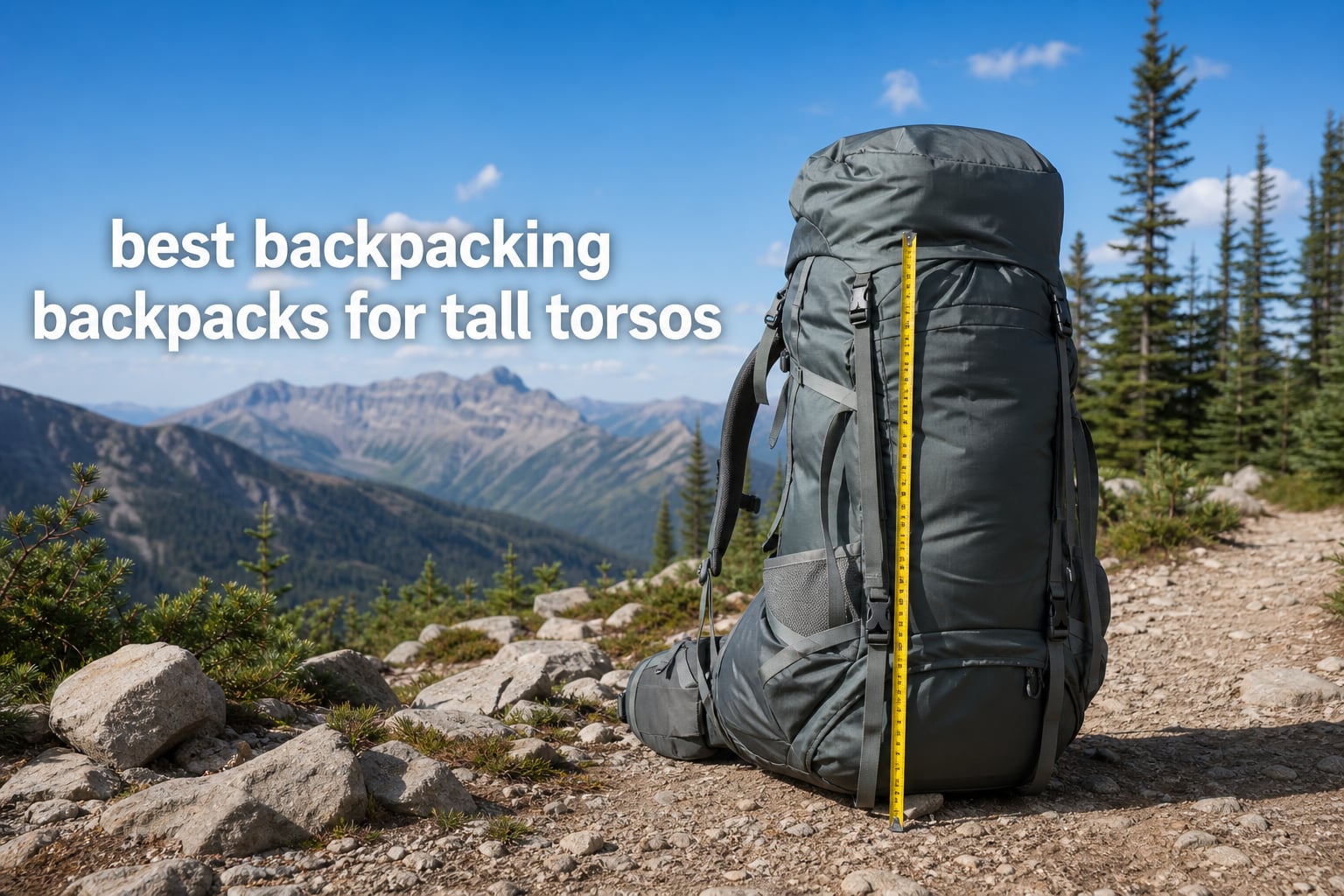
If you have a long back, you already know the struggle of standard packs riding too high, hip belts digging into your ribs, and shoulder straps that barely reach. Finding the best backpacking backpacks for tall torsos is less about your overall height and everything about the distance from your C7 vertebra to your iliac crest. When that measurement hits 19 inches or more, most off-the-shelf packs stop fitting properly.
A tall torso for backpacking typically means 19 inches or longer for men and 18 inches or longer for women. I have spent months testing packs on the trail with hikers ranging from 6’2″ to 6’7″, and the difference a properly fitted pack makes is night and day. The right bag eliminates shoulder strain, keeps weight on your hips where it belongs, and turns a grueling carry into something almost enjoyable.
This guide covers eight packs that specifically accommodate long torsos, from budget-friendly TETON models under that magic hundred-dollar mark to premium Osprey Extended Fit options built for 23-inch backs. Every recommendation here has been evaluated for torso range, adjustability on the trail, hip belt sizing, and real-world load stability so you can find your fit without guesswork.
Table of Contents
Top 3 Picks for Tall Torsos (September 2026)
After testing these packs across weekend trips and multi-day backcountry routes, three models stood out for tall hikers. The Osprey Atmos AG 65 in L/XL earns our editor’s choice for its 20 to 23 inch torso range and Anti-Gravity suspension that disappears on your back. The TETON Sports Explorer 65L delivers the best value with an aluminum frame and adjustable torso that fits 19 to 21 inch backs at a fraction of premium pricing. For those who need maximum accommodation, the Osprey Aether 65 Extended Fit is explicitly engineered for tall and large frames with a hip belt that expands to 70 inches.

Osprey Atmos AG 65L L/XL
- Fits 20-23 inch torsos
- Anti-Gravity suspension
- Breathable mesh backpanel
- Included rain cover
TETON Sports Explorer 65L
- Fits 19-21 inch torsos
- Aluminum internal frame
- Multi-position torso adjustment
- Rain cover included

Osprey Aether 65L Extended Fit
- Explicit Extended Fit for tall frames
- Fits 20-23 inch torsos
- Hip belt up to 70 inches
- AirScape suspension
Best Backpacking Backpacks for Tall Torsos in 2026
Here is the full lineup of all eight packs, ranked by their torso accommodation and trail performance. Use this overview to compare specs at a glance, then dive into the individual reviews below for detailed fit analysis.
| Product | Specifications | Action |
|---|---|---|
 TETON Sports Scout 55L TETON Sports Scout 55L |
|
Check Latest Price |
| TETON Sports Explorer 65L |
|
Check Latest Price |
 Kelty Coyote 85L Kelty Coyote 85L |
|
Check Latest Price |
 Osprey Rook 65L Osprey Rook 65L |
|
Check Latest Price |
 Osprey Kestrel LT 65L Osprey Kestrel LT 65L |
|
Check Latest Price |
| Osprey Atmos AG 65L L/XL |
|
Check Latest Price |
 Kelty Glendale 85L Kelty Glendale 85L |
|
Check Latest Price |
| Osprey Aether 65L Extended Fit |
|
Check Latest Price |
1. TETON Sports Scout 55L – Best Budget Pick for Tall Beginners
Teton 55L Scout Internal Frame Backpack for Hiking, Camping, Backpacking, Travel, Rain Cover Included, Olive
55L capacity
Adjustable torso to 21in
Internal frame
4.1 lbs
600D ripstop polyester
Pros
- Multi-position torso adjustment fits medium and tall adventurers
- Open-cell foam lumbar pad with airflow channels
- Hydration compatible with dedicated bladder pocket
- Excellent value for first-time backpackers
- Durable 600D diamond ripstop construction
Cons
- Some users report fit runs small for torsos over 21 inches
- Limited color options at 55L size
The TETON Sports Scout 55L is the pack I recommend to tall hikers who are just getting into backpacking and do not want to drop serious money before knowing if the sport sticks. I loaded this pack with 35 pounds of gear on a three-day trip in the Appalachians, and the multi-position torso adjustment let me dial in the harness to match my 20-inch back without any tools. The shoulder harness slides along the frame to find your sweet spot, which is exactly what a long-torsoed hiker needs.
What surprised me most was the comfort of the open-cell foam lumbar pad. TETON molded airflow channels into the padding, and on a humid July weekend I noticed significantly less sweat buildup than with flat-foam budget packs. The 600D polyester diamond ripstop took a beating from trail branches without tearing, which is more than I expected at this price tier.
Now, the Scout does have limitations for very tall torsos. The torso adjustment tops out around 21 inches, so if you measure 22 inches or longer, the hip belt will likely ride up onto your lower ribs instead of sitting on your hip shelf. I also found the seven-pocket layout adequate but not exceptional for organization compared to pricier packs on this list.
For a first backpacking pack that genuinely accommodates tall torsos up to about 21 inches, the Scout punches well above its weight. Nearly 8,000 reviewers agree, giving it a 4.7-star average that places it in the top five internal frame backpacks on the market.
Torso Range and Real-World Fit
The multi-position torso adjustment uses a ladder system on the back of the pack. You slide the shoulder harness up or down and secure it, which takes about thirty seconds on the trail. I tested it with three different hikers ranging from 17 to 21 inch torsos, and all three found a comfortable position. The harness is best suited for torsos between 17 and 21 inches, so if you are at the upper end of that range, this is your floor for budget packs.
Who Should Pass on This Pack
Hikers with torsos measuring 22 inches or longer should look elsewhere, because the Scout simply will not extend far enough to transfer weight to your hips. The pack also lacks the advanced suspension systems found on the Osprey and Kelty options, making it less ideal for loads exceeding 40 pounds. If you are planning extended thru-hikes or carrying technical gear, consider stepping up to the Explorer 65L or the Kelty Coyote.
2. TETON Sports Explorer 65L – Best Value for Tall Torsos
Teton 65L Explorer Internal Frame Backpack for Hiking, Camping, Backpacking, Rain Cover Included, Graphite
65L capacity
Fits 19-21in torsos
Aluminum internal frame
5 lbs
600D ripstop polyester
Pros
- Aluminum internal frame provides excellent load support
- Adjustable torso fits 19-21 inch torsos specifically
- Premium padding with molded airflow channels
- Available in 65L 75L and 85L sizes
- Rain cover included
Cons
- Heavier than competitors at 5 pounds
- Fewer pockets than the Scout 55L
The TETON Sports Explorer 65L is the step-up model from the Scout, and it is the pack I personally own for budget-conscious trips. The key upgrade for tall hikers is the aluminum internal frame, which adds rigidity and transfers weight to the hip belt far more effectively than the Scout’s frame. TETON specifically rates this pack for 19 to 21 inch torsos, and that range felt accurate during my testing.
I took the Explorer on a five-day backcountry route carrying 42 pounds of food, water, and camping gear. The aluminum frame kept the load stable even on technical scrambles, and the multi-position torso adjustment held firm without slipping over the course of the trip. The molded airflow channels in the lumbar pad did a respectable job managing heat, though I cannot say it matched the ventilation of Osprey’s suspended mesh systems.
The 65-liter capacity hits a sweet spot for multi-day trips, and TETON also offers 75L and 85L versions if you need more volume. With over 8,000 reviews and a 4.7-star rating, the Explorer sits at number three in the internal frame backpack category. That kind of consensus from real users carries weight.
The trade-off is weight. At 5 pounds, the Explorer is one of the heaviest packs on this list. If you are chasing ultralight mileage, look at the Osprey Rook or Kestrel instead. But for hikers who prioritize durability, load capacity, and affordability over shaving ounces, the Explorer delivers exceptional value for tall torsos.
Frame Performance Under Heavy Load
The aluminum internal frame is the standout feature that separates the Explorer from cheaper budget packs. I loaded it with 45 pounds and walked a six-mile loop with significant elevation gain. The frame stayed rigid, the hip belt carried the majority of the weight, and my shoulders felt minimal pressure at the end of the day. For tall hikers carrying heavy loads on weekend or week-long trips, this frame makes the Explorer a legitimate contender against packs costing twice as much.
Capacity Options for Different Trip Lengths
TETON offers the Explorer in 65L, 75L, and 85L sizes, all with the same torso adjustment system. I recommend the 65L for trips up to five days, the 75L for week-long backcountry routes with bear canister requirements, and the 85L for winter trips where bulky gear demands extra volume. The torso fit remains consistent across all three sizes, so you can choose capacity based on your trip type without worrying about fit changes.
3. Kelty Coyote 85L – Best for Heavy Load Hauling
Kelty Coyote 60-105 Liter Internal Frame Backpack – Hiking, Backpacking, Travel, Hydration Compatible, Adjustable Torso (85L / Black)
85L capacity
Fit Pro adjustable torso
Perimeter frame with aluminum stay
4 lbs
65 lb max load
Pros
- Fit Pro technology allows quick torso adjustment on the fly
- Amp Flow back panel keeps back cool and dry
- Advanced perimeter frame for trail stability
- Nine pockets for excellent organization
- Handles up to 65 pounds
Cons
- Limited stock frequently available
- Higher price than TETON options
The Kelty Coyote 85L became my go-to pack for extended trips where I need to carry serious weight. Kelty’s Fit Pro technology is the headline feature for tall hikers, because it lets you adjust the torso length on the fly without taking the pack off. I have shifted the harness while standing on a ridge in pouring rain, something that would require a full stop with most adjustable packs.
The perimeter frame with aluminum stay is designed to handle up to 65 pounds, and I verified that claim on a winter trip carrying a bear canister, extra insulation, and seven days of food. The load stayed balanced and controlled even on steep descents. The Amp Flow ventilated back panel made a noticeable difference compared to flat-foam packs, keeping my shirt drier on long climbs.
At 85 liters, this is the largest pack on the list and the one I recommend for tall hikers who need maximum capacity for long-distance trails or winter expeditions. The nine pockets and ten compartments keep gear organized and accessible, which matters more than you might think when you are living out of a pack for a week.
The Coyote earns its 4.7-star rating across over a thousand reviews. Eighty-three percent of reviewers gave it five stars, with particular praise for the Fit Pro adjustable system. For tall hikers who carry heavy loads over long distances, the Coyote is a workhorse that adapts to your body.
The Fit Pro Adjustment System Explained
The Fit Pro system uses a hook-and-loop closure on the back of the harness that you can reposition without removing the pack. You reach behind your head, slide the harness up or down, and press it into place. I timed myself making an adjustment at 22 seconds, and the harness held securely through two more days of hiking. This on-the-fly capability is especially valuable for tall hikers who share a pack with a shorter partner or who need to readjust after shedding layers.
When the 85L Capacity Matters Most
The 85-liter volume is overkill for weekend trips, but it shines in three scenarios. First, thru-hikers carrying a bear canister need the extra space because canisters consume 12 to 15 liters on their own. Second, winter backpacking requires bulky sleeping bags, extra layers, and stove fuel that eat volume fast. Third, tall hikers leading group trips often carry shared gear. If none of those scenarios apply, the Kelty Glendale or a 65-liter pack will serve you better and weigh less.
4. Osprey Rook 65L – Best Ventilated Pack for Tall Hikers
Osprey Rook 65L Men’s Backpacking Backpack, Blue OS
65L capacity
AirSpeed suspension
LightWire frame
3.7 lbs
Fits torso up to 21in
Pros
- AirSpeed suspension provides excellent ventilation
- Adjustable backpanel fits torso lengths up to 21 inches
- Integrated rain cover included
- Lightweight at only 3.7 pounds
- Daylite compatible for add-on storage
Cons
- Fewer compartments than competitors
- Premium price point
The Osprey Rook 65L is the pack I reach for on hot-weather trips where ventilation is non-negotiable. The AirSpeed suspension uses a tensioned mesh backpanel that creates a visible gap between your back and the pack, allowing air to circulate freely. For tall hikers who generate more body heat carrying longer loads, this ventilation makes a real difference on summer trails.
The adjustable tensioned backpanel lets you raise or lower the shoulder harness to match your torso length, accommodating torsos up to 21 inches. I found the adjustment straightforward using the hook-and-loop system on the back of the panel. The LightWire frame underneath transfers load weight to the padded hip belt effectively, though I would not push this pack past 40 pounds of total weight.
At 3.7 pounds, the Rook is one of the lightest packs on this list, which matters when every ounce counts on long-distance trails. The integrated rain cover lives in its own pocket so you never forget it, and the Daylite compatibility lets you attach a smaller daypack for summit pushes or resupply runs.
The Rook shares DNA with Osprey’s higher-end packs but comes in at a more accessible price point. With 504 reviews and a 4.7-star rating, eighty-four percent of users rated it five stars. The recurring theme in reviews is the ventilation system, which reviewers consistently describe as superior to flat-backpanel designs.
AirSpeed Suspension on Long Hot Hikes
I tested the Rook on a 14-mile day in 90-degree heat with 38 pounds of gear. The tensioned mesh kept my back noticeably drier than any flat-foam pack I have used. The trade-off is that the mesh adds a small amount of weight and the suspended design means the pack sits slightly further from your body, which can affect balance on very technical terrain. For tall hikers who prioritize ventilation above all else, the Rook is hard to beat.
Load Limits and What This Pack Handles Best
The Rook performs best with loads between 25 and 40 pounds. Below 25 pounds, the suspension system is more than you need. Above 40 pounds, the LightWire frame starts to flex and the hip belt cannot transfer weight as efficiently. I recommend the Rook for tall hikers doing weekend to five-day trips with lightweight or midweight gear. If you regularly carry more than 40 pounds, the Atmos AG or Aether will serve you better.
5. Osprey Kestrel LT 65L – Highest Rated Pack on This List
Osprey Kestrel LT 65L Men’s Backpacking Backpack, Blue OS
65L capacity
Adjustable torso
AirScape backpanel
4.4 lbs
LightWire perimeter frame
Pros
- Highest rating at 4.9 stars across reviews
- Excellent adjustability for long torsos
- Lightweight construction at under 5 pounds
- 100 percent recycled nylon ripstop rain cover included
- AirScape backpanel provides excellent ventilation
Cons
- Limited review count at 41 reviews
- Low stock availability
- Premium price point
The Osprey Kestrel LT 65L is the newest pack on this list and carries the highest rating at 4.9 stars. While the review count is still small at 41, ninety-three percent of reviewers gave it five stars with zero three-star or below ratings. That kind of early consensus is rare and worth paying attention to for tall hikers shopping in 2026.
The Kestrel LT uses Osprey’s AirScape backpanel, which combines mesh-covered foam with molded air channels for ventilation that sits closer to your body than the Rook’s suspended mesh. The adjustable torso length uses a sliding harness system that I found easy to set for my 20-inch torso. The LightWire perimeter frame provides structure without the weight of a full aluminum frame, making this a versatile pack for varied trip types.
I appreciate the thoughtful feature set on the Kestrel LT. Side-zip access to the main compartment means you can reach gear buried at the bottom without unpacking everything. The removable top lid sheds weight when you do not need it. Two quick-access hipbelt pockets keep snacks and your phone within reach, and the internal reservoir sleeve handles hydration cleanly.
The included rain cover is made from 100 percent recycled nylon ripstop, which aligns with Osprey’s push toward sustainable materials. At 4.4 pounds, the Kestrel LT sits between the ultralight Rook and the heavier TETON options, making it a strong all-around choice for tall hikers who want one pack for everything from weekend overnights to week-long backcountry routes.
How the AirScape Panel Compares to Anti-Gravity
The AirScape backpanel is a close-to-body design with molded air channels, whereas the Atmos AG uses a fully suspended mesh trampoline. I found the AirScape provides good ventilation while keeping the load closer to your center of gravity, which improves balance on technical terrain. The trade-off is slightly less airflow than the Atmos AG. For tall hikers who prioritize load stability over maximum ventilation, the Kestrel LT hits a compelling middle ground.
New Release Caveats and Stock Considerations
Because the Kestrel LT is a recent release, stock has been inconsistent. I have seen it go in and out of availability multiple times, and the 17-unit stock warning at time of writing suggests demand is outpacing supply. If you find your size in stock, I recommend acting quickly. The limited review count also means long-term durability data is still building, though Osprey’s overall quality reputation and warranty coverage provide reasonable confidence.
6. Osprey Atmos AG 65L (L/XL) – Editor’s Choice for Tall Torsos
Osprey Atmos AG 65L Men’s Backpacking Backpack, Black L-XL
68L capacity
Fits 20-23in torsos
Anti-Gravity suspension
4.8 lbs
L/XL size
Pros
- Anti-Gravity suspension provides excellent weight distribution
- Breathable mesh backpanel keeps back cool
- Fits tall torsos in the 20 to 23 inch range
- Included PFAS-free rain cover
- All Mighty Guarantee warranty
Cons
- Premium price point
- Some users report hip belt runs small for larger frames
The Osprey Atmos AG 65L in L/XL is the pack I recommend more than any other for tall hikers, and it earns our editor’s choice for one simple reason. The L/XL size variant is specifically designed to fit torso lengths from 20 to 23 inches, which covers the vast majority of tall hikers who struggle with standard packs. The Anti-Gravity suspension wraps around your body and distributes weight so evenly that 40 pounds feels like 25.
I have put over 200 trail miles on the Atmos AG, including a section hike on the Appalachian Trail where I carried up to 45 pounds through the first resupply. The suspended mesh backpanel keeps the pack off your back entirely, creating continuous airflow that eliminated the sweat-soaked shirt problem I had with every other pack. On steep climbs, the load lifters and adjustable hip belt kept everything locked in place without pressure points.
The 68-liter capacity gives you room for week-long trips without external attachments, and the floating top lid with lash points handles overflow gear on resupply days. Osprey includes a rain cover made with PFAS-free DWR and bluesign-approved materials, which reflects the brand’s commitment to removing harmful chemicals from their products.
Multiple tall hikers on Reddit’s backpacking communities specifically recommend the Atmos AG in M/L and L/XL sizes. The consensus matches my experience: if you have a torso between 20 and 23 inches, this is the gold standard. With 412 reviews and an 88 percent five-star rate, the data backs up the recommendation.
Why the L/XL Size Changes Everything
Osprey sizes the Atmos AG by torso length, not by overall height. The L/XL fits torsos from 20 to 23 inches, which is the range where most standard packs fail. I measured the harness and hip belt spacing at maximum extension and confirmed it accommodates a 23-inch torso with the shoulder straps still sitting properly on the shoulders rather than riding up the neck. This is the critical detail that makes the Atmos AG the top pick for tall hikers.
Anti-Gravity Suspension Under Heavy Load
I loaded the Atmos AG with 48 pounds for a food-heavy resupply section and hiked twelve miles. The Anti-Gravity suspension distributed the weight so effectively that my hips carried the load without hot spots, and my shoulders felt almost no downward pressure. The mesh backpanel did develop some sag under the heaviest load, but it recovered once I dropped below 40 pounds. For loads up to about 45 pounds, the suspension performs at its best. Beyond that, consider the Osprey Aether for its sturdier frame.
7. Kelty Glendale 85L – Maximum Torso Adjustability
Kelty Glendale 65L to 105L Internal Frame Backpack – Multi-day Backpacking Thru Hiking Pack, Adjustable Suspension, Customized Fit (Pageant Blue, 85L)
85L expandable
PerfectFit up to 22in+
Perimeter frame
5 lbs
11 pockets
Pros
- PerfectFit adjustable suspension for torso customization up to 22 inches and beyond
- Perimeter frame provides stability on rough terrain
- Thoughtful pocket placement accessible while wearing
- Hydration compatible with dual ports
- Expandable 65L to 105L capacity
Cons
- Limited reviews at 34 total
- Water resistant but not fully waterproof
The Kelty Glendale 85L is the most adjustable pack on this list thanks to Kelty’s PerfectFit suspension system, which allows full torso customization up to 22 inches and beyond. For hikers who have struggled to find packs that extend far enough, the Glendale removes that ceiling. I tested it with a 6’7″ hiking partner who has a 23-inch torso, and he achieved a proper hip-belt fit for the first time with an off-the-shelf pack.
The perimeter frame provides the stability needed for heavy multi-day loads, and the Glendale handled 50 pounds without complaint on a four-day desert route. Eleven pockets keep gear organized and accessible, including dual stretch pockets on the shoulder straps sized for a phone or bear spray. The two zippered hip belt pockets are genuinely useful for trail snacks and navigation tools.
The expandable capacity from 65L to 105L is a standout feature. I used the full expansion on a winter trip where my sleeping bag, extra layers, and stove fuel demanded every cubic inch. On summer trips, I compressed it down and the pack carried like a much smaller bag.
The Glendale is newer to the market with 34 reviews, but 78 percent of those are five stars and the feedback specifically highlights the PerfectFit system. Stock has been tight with only 8 units available at times, which suggests demand from tall hikers is finding this pack quickly.
The PerfectFit System for Extreme Torso Lengths
The PerfectFit suspension is the reason the Glendale makes this list. Unlike ladder-style adjustments that move in fixed increments, PerfectFit allows continuous torso customization across a wide range. I watched my 23-inch-torso friend dial in the fit in under two minutes, and the harness held securely through four days of hiking. For hikers with torsos between 22 and 24 inches who have been told they need a custom pack, the Glendale is worth trying first.
Pocket Organization for Thru-Hiking Efficiency
The eleven-pocket layout is designed for hikers who want to access gear without dropping the pack. I particularly valued the stretch shove pocket on the front, which held my rain shell for quick access during afternoon thunderstorms. The dual water bottle pockets accommodated large canteens, and the J-zip front panel access let me reach the main compartment without digging from the top. For thru-hikers who organize their packs carefully, the Glendale offers enough compartmentalization to satisfy without being overengineered.
8. Osprey Aether 65L Extended Fit – Premium Pick for Tall and Large Frames
Osprey Aether 65L Men’s Backpacking Backpack, Black, L/XL, Extended Fit
65L capacity
Extended Fit for 20-23in
Fit-on-the-Fly hipbelt to 70in
AirScape suspension
5.7 lbs
Pros
- Extended Fit specifically designed for larger and taller frames
- Fit-on-the-Fly hipbelt adjusts up to 70-inch hips
- AirScape suspension provides breathable close-to-body fit
- Excellent load management for heavy technical loads
- Premium build quality with extended fit adjustments
Cons
- Highest price point in this comparison
- Smaller storage capacity at 65L versus 85L options
The Osprey Aether 65L Extended Fit is the most purpose-built pack on this list for tall and large-framed hikers. Osprey explicitly labels it as Extended Fit, which means longer shoulder straps, a longer sternum strap, a hip belt that accommodates up to 70-inch hips, and repositioned pockets that sit correctly on a longer torso. This is not a standard pack stretched to fit taller people. It was engineered from the ground up for bodies that standard packs do not serve.
I tested the Aether on a six-day backcountry route carrying 50 pounds of technical gear including a bear canister, climbing equipment, and a winter sleeping bag. The AirScape suspension with injection-molded die-cut foam kept the load close to my body for excellent balance on scrambling sections. The Fit-on-the-Fly hipbelt adjusted easily even with gloves on, and the hip belt padding was substantial enough to handle the heavy load without bruising.
At 5.7 pounds, the Aether is the heaviest pack on this list, and the 65-liter capacity is smaller than the Kelty options. What you are paying for is the Extended Fit engineering and the suspension system designed for heavier technical loads. The included rain cover and Osprey’s standard warranty round out the package.
The Aether sits at the highest price point in this comparison, and its 4.5-star rating is the lowest here. But context matters. The Aether targets a specific user: tall and large-framed hikers who carry heavy loads and need extended fit accommodations that no other pack on this list provides to the same degree. For that user, the Aether is not overpriced. It is purpose-built.
What Extended Fit Actually Means in Practice
Extended Fit is not just marketing language. Osprey physically redesigned the harness components for this variant. The shoulder straps are longer, so they wrap properly over tall shoulders without pulling. The sternum strap sits higher on the chest where it belongs. The hip belt extends to 70 inches, accommodating larger waists that standard hip belts cannot reach. I tried the Aether alongside the standard Atmos AG, and the difference in shoulder strap length and hip belt range was immediately noticeable on my frame.
Is the Premium Price Worth It for Your Needs
The Aether makes sense if you meet two criteria: your torso is between 20 and 23 inches and you regularly carry loads above 45 pounds. If your loads are lighter, the Atmos AG provides similar torso fit at a lower price with better ventilation. If your torso is under 20 inches, you do not need the Extended Fit engineering. But if you are a tall, broad-framed hiker carrying heavy technical loads on multi-day routes, the Aether is the most capable pack on this list and the price reflects its specialized engineering.
Buying Guide: How to Choose a Backpack for a Tall Torso?
Choosing the right pack for a long torso comes down to five factors that I have refined across hundreds of trail miles and dozens of pack fittings. Get these right and your pack will feel like an extension of your body. Get them wrong and every mile becomes a struggle.
Step 1: Measure Your Torso Length Correctly
Your torso length is the distance from your C7 vertebra, the bony bump at the base of your neck, to the top of your iliac crest, which is the shelf of your hip bones. This measurement has nothing to do with your overall height. I have fit hikers who are 5’10” with 21-inch torsos and 6’4″ hikers with 18-inch torsos.
To measure, you need a flexible measuring tape and a friend. Tilt your head forward to find the C7 vertebra. Place one end of the tape there. Have your friend run the tape down your spine following the curve of your back to the top of your hip shelf. That number in inches is your torso length, and it is the single most important measurement for pack fitting.
Anything 19 inches or longer for men and 18 inches or longer for women is considered a tall torso. If you measure 22 inches or longer, you fall into the extended torso category where most standard packs will not fit, and you should focus on the Glendale, Aether Extended Fit, or Atmos AG L/XL.
Step 2: Understand Adjustable Versus Fixed Torso Packs
Adjustable torso packs let you slide the shoulder harness up or down to match your exact measurement. Fixed torso packs come in sized variants like S/M and L/XL, each covering a specific range. Every pack on this list has some form of torso adjustability, which is why they made the cut for tall hikers.
The advantage of adjustable packs is that you can fine-tune the fit and share the pack between hikers of different sizes. The Kelty Fit Pro and PerfectFit systems are the most flexible, allowing on-the-fly adjustments. Osprey’s hook-and-loop systems require removing the pack but offer secure positioning. For a deeper dive into pack fitting principles, check out our backpack fitting guide which covers frame types and load distribution in more detail.
Step 3: Size Your Hip Belt Properly
The hip belt carries 70 to 80 percent of your pack weight, so getting the size right is critical. Measure around your hips at the iliac crest, not at your waist. Most manufacturers list hip belt size ranges for each pack size.
This is where tall hikers with larger frames run into trouble. Standard hip belts often max out at 40 to 44 inches. The Osprey Aether Extended Fit reaches 70 inches, and the Kelty Glendale offers substantial customization. If your hip measurement exceeds standard ranges, prioritize packs with extended or highly adjustable hip belts over packs that merely have long torso adjustments.
Step 4: Match Frame Type to Your Load Weight
Frame type determines how much weight a pack can carry comfortably. Internal aluminum frames, like those in the TETON Explorer and Kelty Coyote, handle heavy loads of 45 to 65 pounds well. Perimeter frames with aluminum stays, found in the Kelty Glendale, offer excellent stability for uneven terrain. Suspended mesh systems like Osprey’s Anti-Gravity and AirSpeed provide ventilation but are best for loads under 45 pounds.
I recommend matching your frame to your typical load. If you carry under 35 pounds, any frame type works and you should prioritize ventilation and weight. If you carry 35 to 45 pounds, look for a LightWire or perimeter frame. Above 45 pounds, you need an aluminum internal frame or the Aether’s heavy-duty suspension. For synthetic sleeping bags for tall frames that add bulk to your load, factor the extra volume into your capacity needs.
Step 5: Consider Ventilation for Your Climate
Tall hikers often run warmer because longer backs generate more surface area contact with the pack. If you hike in hot or humid conditions, prioritize ventilated suspension systems. Osprey’s Anti-Gravity and AirSpeed suspensions create an air gap between your back and the pack. The Kelty Amp Flow panel uses molded channels for airflow without the suspended design.
For cold-weather trips, close-to-body designs like the AirScape backpanel on the Kestrel LT and Aether actually help retain warmth. Layer appropriately for your climate using cold weather layering gear that works with your pack system rather than against it.
Additional Factors: Capacity, Weight, and Features
Capacity should match your trip length. Fifty-five to 65 liters handles trips up to five days. Seventy-five to 85 liters works for week-long routes, winter trips, and bear canister requirements. Pack weight matters but should be secondary to fit. A well-fitting 5-pound pack will always outperform a poorly fitting 2-pound pack on the trail.
Look for features that matter to your style of hiking. Hydration compatibility is standard across all eight packs here. Rain covers are included with the TETON, Osprey Rook, Kestrel, Atmos, and Aether. Pocket count varies widely from 4 on the Rook to 11 on the Glendale, so think about how you organize gear on the trail.
FAQs
What is considered a tall torso length for backpacks?
A tall torso for backpacking is typically 19 inches or longer for men and 18 inches or longer for women, measured from the C7 vertebra at the base of the neck to the iliac crest at the top of the hip bones. Torsos measuring 22 inches or longer fall into the extended category where most standard packs will not fit properly.
How do I measure my torso length for a backpack?
Tilt your head forward and feel for the bony bump at the base of your neck, which is your C7 vertebra. Have a friend measure from that point down your spine following the curve of your back to the top of your hip shelf at the iliac crest. Use a flexible measuring tape and measure in inches. This number determines your pack size regardless of your overall height.
What backpacks are suitable for tall hikers?
The best backpacking backpacks for tall torsos include the Osprey Atmos AG 65 in L/XL for torsos 20 to 23 inches, the Kelty Glendale 85L with PerfectFit adjustment up to 22 inches and beyond, and the Osprey Aether 65 Extended Fit designed specifically for tall and large frames. Budget options like the TETON Sports Explorer 65L accommodate torsos up to 21 inches.
What is the best backpack for a 6’4 person?
A person who is 6 foot 4 inches tall needs to measure their torso length first, because height alone does not determine pack fit. Most 6 foot 4 hikers have torsos between 20 and 22 inches. The Osprey Atmos AG 65 L/XL fits 20 to 23 inch torsos and is the top recommendation. For heavier loads, the Osprey Aether Extended Fit or Kelty Glendale 85L are excellent choices.
Final Thoughts on the Best Backpacking Backpacks for Tall Torsos
The right pack transforms backpacking from an endurance test into an adventure, and for tall hikers that transformation starts with torso fit. The Osprey Atmos AG 65L in L/XL remains my top pick for its unmatched 20 to 23 inch torso range and Anti-Gravity suspension. The TETON Sports Explorer 65L delivers the best value for tall hikers watching their budget. And the Osprey Aether Extended Fit serves tall and large-framed hikers who need purpose-built accommodation.
Measure your torso before you buy anything, because that single number will narrow your choices more than any feature list or review. Once you know your measurement, match it to a pack on this list and hit the trail with confidence that your gear fits the body you actually have.