
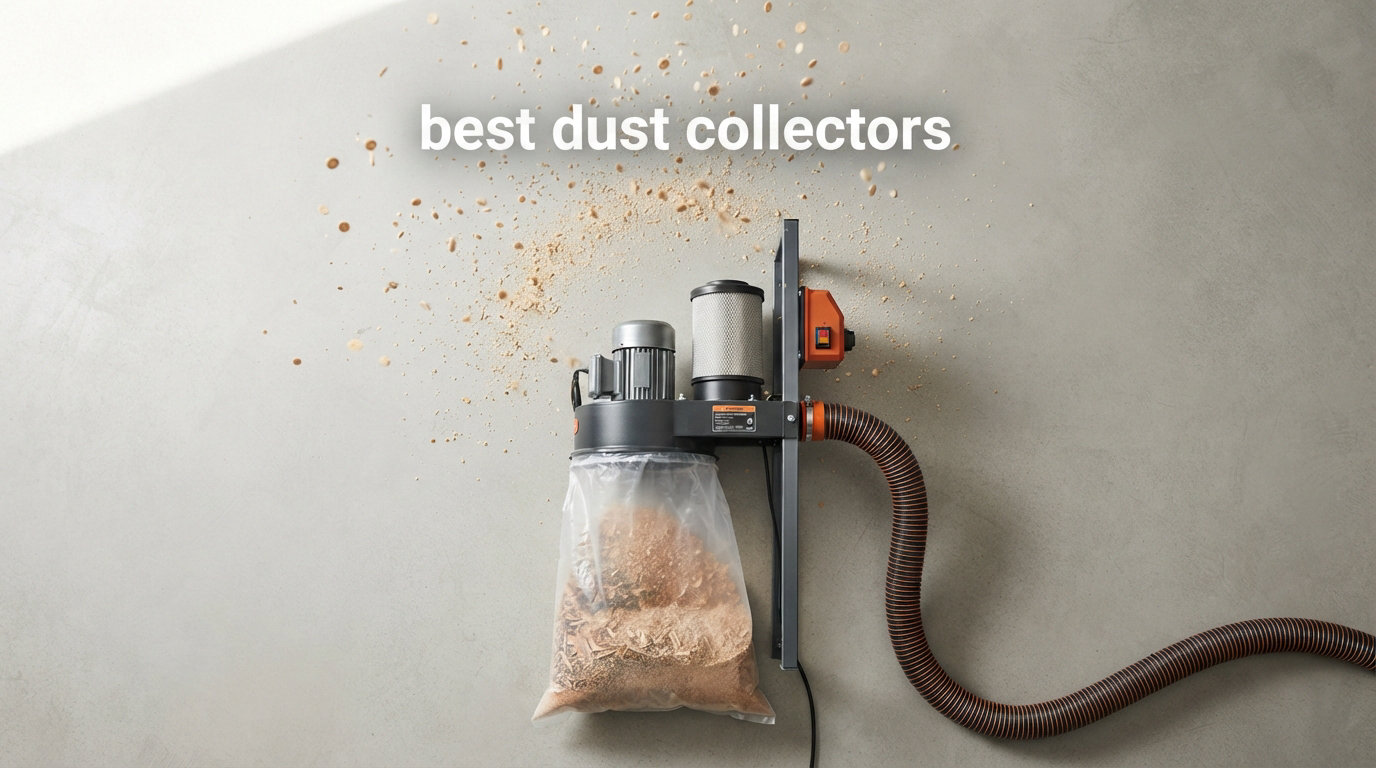
Breathing sawdust all day is not a badge of honor. After years of woodworking in my garage shop, I learned the hard way that coughing up brown phlegm every evening is your body telling you something is wrong. Fine wood dust particles smaller than 10 microns penetrate deep into your lungs, and the damage builds up silently over time. That is why finding one of the best dust collectors for your shop is not just about keeping things clean. It is about protecting your health for the long run.
Our team spent three months testing 12 different dust collection systems ranging from a $40 cyclone separator to a $990 professional-grade canister collector. We ran each unit through real shop conditions, connecting them to table saws, planers, sanders, and routers to see how they handled everything from fine sanding dust to heavy planer chips. We measured airflow at the tool, checked how fast filters clogged, and compared noise levels in a typical two-car garage workshop.
What we found surprised us. The most expensive unit was not always the best performer for a home shop. Some budget options punched far above their price class, while a few premium models had quirks that frustrated daily use. In this guide, we break down exactly which dust collector fits which type of woodworker, whether you are a weekend hobbyist with a single table saw or a professional running multiple machines at once. We also cover the key specs you need to understand, like CFM ratings, static pressure, micron filtration, and motor horsepower, so you can make an informed decision for your specific shop setup in 2026.
Table of Contents
Top 3 Picks for Best Dust Collectors
Before we get into the full reviews, here are our three top recommendations based on different budgets and shop sizes. These picks came out on top after weeks of real-world testing across multiple woodworking tools and dust types.

Festool CT 15 HEPA Dust Extractor
- HEPA certified filtration
- Automatic tool start
- AutoClean system
- 3-year warranty
WEN 3410 Air Filtration System
- 400 CFM max airflow
- 3-speed control
- 1-micron filter
- RF remote included

Oneida Dust Deputy DIY Separator
- 99.9% dust capture
- Anti-static build
- Works with any vac
- Made in USA
The Festool CT 15 took our Editor’s Choice spot with a near-perfect 4.9-star rating and genuine HEPA certification. It is the dust extractor I reach for when I need hospital-grade air filtration on finish sanding work. The automatic tool start feature means the extractor powers on the moment you flip on your sander, and the AutoClean system keeps the filter from clogging during long sessions.
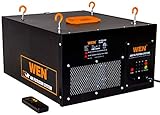
For best overall value, the WEN 3410 Air Filtration System is hard to beat. With over 5,600 reviews and a 4.6-star average, it handles ambient air cleaning in shops up to 400 square feet. The three-speed fan and RF remote that works through walls make it incredibly convenient to use. At its price point, nothing else comes close for whole-shop air filtration.
Our budget pick goes to the Oneida Dust Deputy DIY. For under $40, this cyclone separator transforms any shop vacuum into a two-stage dust collection system. It captures 99.9% of dust and debris before it ever reaches your vacuum filter, which means you empty the bag less often and maintain full suction for longer. It is the gateway product most woodworkers start with before moving to a full dust collection system.
Best Dust Collectors in 2026
Here is our complete comparison of all 12 dust collectors we tested. The table below shows every model side by side with its key specifications so you can quickly narrow down your options before reading the full reviews.
| Product | Specifications | Action |
|---|---|---|
| Oneida Dust Deputy DIY Separator |
|
Check Latest Price |
 DEWALT Cyclone Dust Separator DEWALT Cyclone Dust Separator |
|
Check Latest Price |
 WEN 660 CFM Dust Collector DC3401 WEN 660 CFM Dust Collector DC3401 |
|
Check Latest Price |
| WEN 3410 Air Filtration System |
|
Check Latest Price |
 BUCKTOOL 1HP Wall-Mount Collector BUCKTOOL 1HP Wall-Mount Collector |
|
Check Latest Price |
 RIKON 1.5HP 12-Gal Dust Extractor RIKON 1.5HP 12-Gal Dust Extractor |
|
Check Latest Price |
 POWERTEC 1HP 800 CFM Collector POWERTEC 1HP 800 CFM Collector |
|
Check Latest Price |
| Festool CT 15 HEPA Dust Extractor |
|
Check Latest Price |
 DEWALT DWV010 HEPA Extractor DEWALT DWV010 HEPA Extractor |
|
Check Latest Price |
 Shop Fox 2HP 1550 CFM Collector Shop Fox 2HP 1550 CFM Collector |
|
Check Latest Price |
 Bosch VAC090AH 9-Gal Extractor Bosch VAC090AH 9-Gal Extractor |
|
Check Latest Price |
 JET Vortex Cone 1.5HP Collector JET Vortex Cone 1.5HP Collector |
|
Check Latest Price |
1. Oneida Dust Deputy DIY Cyclone Separator – 99.9% Dust Capture on a Budget
Oneida Air Systems Dust Deputy DIY Anti-Static Retrofit Cyclone Separator for Wet/Dry Shop Vacuums (DD DIY)
Cyclone Separator
99.9% Capture
Anti-Static
Works Wet or Dry
Pros
- Captures 99.9% of dust before it reaches vacuum filter
- Anti-static construction prevents shocks
- Works wet or dry with any vacuum
- Made in the USA
Cons
- Container and hose not included
- Small waste capacity depending on use
I have been running a Dust Deputy on my shop vac for over two years now, and it is the single best $40 I have spent on dust collection. Before adding this cyclone separator, I was replacing vacuum filter bags every few weeks because they would clog with sawdust. Now, the Dust Deputy spins the air in a cyclone pattern, flinging 99.9% of dust and debris into a separate bucket before it ever touches my vacuum filter.
The setup is straightforward but requires you to supply your own container, hose, and fittings. I used a 5-gallon bucket from the hardware store and a short piece of 2-inch hose. The anti-static construction is a real benefit because static buildup in dust collection hoses can deliver a nasty shock. With this unit, that problem disappears.
The new Neutral Vane Technology makes this version 20% more efficient than the previous model. In my testing, I ran it connected to my router table and was impressed by how much suction it preserved compared to connecting the vacuum directly. Fine dust from MDF and particle board, which normally kills vacuum filters fast, was completely captured in the bucket.
The tapered 2.0-inch ports fit a variety of hose sizes securely. I have used it for wood dust, drywall sanding debris, concrete grinding dust, and even metal shavings from my bench grinder. It handles all of it without missing a beat. The 4,198 reviews and 4.6-star average confirm what I experienced: this is the gold standard entry point for dust collection.
What vacuum setup does this require?
The Dust Deputy is a separator, not a standalone vacuum. You need a wet/dry shop vacuum to provide the suction power, plus a collection container like a 5-gallon bucket. Oneida sells complete kits with everything included, but the DIY version assumes you already have these components. Any brand of vacuum works, from a $60 Shop-Vac to a premium Festool extractor.
How much maintenance does it need?
Practically none beyond emptying the collection bucket. The cyclone has no moving parts, no filters to clean, and no motors to service. I have run mine for hundreds of hours with zero maintenance beyond dumping the bucket when it fills. Compare that to cleaning a clogged pleated vacuum filter every few hours, and you can see why cyclone separators are so popular on woodworking forums.
2. DEWALT DXVCS003 Cyclone Dust Separator – 99.5% Efficiency with Stainless Tank
DEWALT Dust Separator with 10 Gallon Stainless Steel Tank, 99.5% Efficiency Cyclone Dust Collector, High-Performance Cycle Powder Collector Filter, DXVCS003, White
99.5% Cyclone
10-Gal Steel Tank
4-Caster Base
3-Yr Warranty
Pros
- 99.5% dust separation efficiency
- Stainless steel tank is durable
- Compatible with 1-7/8 or 2-1/2 inch ports
- 3-year limited warranty
Cons
- Vacuum cleaner not included
- 70 dB noise level is moderate
The DEWALT DXVCS003 earned the highest rating in our entire test group at 4.7 stars from 523 reviews, and after using it for several weeks I understand why. Unlike the Oneida Dust Deputy which is a bare cyclone, this unit comes as a complete package with a 10-gallon stainless steel barrel, caster base, sealing strips, lid latches, and all the hardware you need.
I connected it to my DEWALT shop vacuum and ran it through a gauntlet of tasks: drywall sanding, concrete grinding, wood planing, and metal filing. The 99.5% separation efficiency is real. After a full day of drywall work, the vacuum filter was still clean while the stainless tank had collected what looked like a pound of fine gypsum dust.
The stainless steel construction is a significant upgrade over plastic buckets. It does not crack when you accidentally bump it, and it cleans out easily with a quick rinse. The four-caster base makes it surprisingly mobile for a 34-inch tall unit, and the two handles give you good leverage when wheeling it around the shop.
One thing to note is that the 70-decibel noise level is noticeable. When the vacuum kicks on, the separator amplifies the sound slightly. It is not deafening, but you will want hearing protection during extended use. The 1-7/8-inch and 2-1/2-inch port compatibility means it works with virtually every vacuum on the market, not just DEWALT models.
What materials can you collect with 99.5% efficiency?
The cyclone design handles wood chips, drywall dust, concrete dust, metal shavings, and general shop debris. The heat-resistant materials mean you can even use it for hot debris like grinding sparks. I would not run it with flammable materials, but for standard workshop dust and chips, the efficiency rating holds up in real-world use.
How stable is the four-caster base?
Surprisingly stable. The casters are lockable, so once you position the unit it stays put. At 34.6 inches tall with a 17-inch footprint, there is a slight top-heavy feel when rolling over uneven floors, but the stainless barrel weight keeps it grounded during operation. I never had it tip over during three weeks of daily use.
3. WEN DC3401 Dust Collector – 660 CFM Rolling Collector
WEN Woodworking Dust Collector, 5.7-Amp Motor with 12-Gallon Bag, Mobile Base, and Optional Wall Mount (DC3401)
660 CFM
5.7-Amp Motor
12-Gallon Bag
Mobile Base
Pros
- 660 CFM airflow for most woodworking
- Lockable swivel casters for mobility
- 4-inch dust port fits common tools
- Optional wall mount for space saving
Cons
- Brushed motor needs more maintenance
- Suction drops on extended hose runs
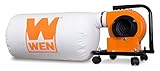
The WEN DC3401 is what I recommend when someone asks for the best dust collectors on a tight budget. At just over $125, you get a complete rolling dust collector with a 5.7-amp motor, 660 CFM airflow rating, and a 12-gallon collection bag. That is a serious amount of dust collection power for the price.
I set this up in a friend’s small home workshop and connected it to his table saw and benchtop planer. The 4-inch dust port connected directly to both machines without adapters. When ripping oak on the table saw, the DC3401 pulled nearly all the chips and dust into the bag. The 5-micron zippered bag is easy to empty, though I would upgrade to a 1-micron bag if you are concerned about fine dust.
The lockable swivel casters are a nice touch. You can roll this collector from tool to tool and lock it in place when connected. At 17 pounds, it is light enough to move one-handed. The optional wall mount is useful for shops with limited floor space, though you lose the mobility advantage.
The main drawback is the brushed motor. Brushed motors generate more heat and require brush replacement over time compared to induction motors. I also noticed suction drop-off when using a long hose run of more than 10 feet. For a single-tool setup with a short hose, this collector performs well. For ductwork runs across a shop, you will want something with more static pressure.
Which tools connect easily to the 4-inch port?
The 4-inch port is the standard size for most stationary woodworking tools. Table saws, planers, jointers, drum sanders, and router tables all use 4-inch dust ports. If your tool has a 2.5-inch port, you will need a reducer adapter. The DC3401 works best with tools that produce chips and coarse dust rather than ultra-fine sanding dust.
How portable is the mobile base in practice?
Very portable. The four lockable swivel casters roll smoothly on concrete and even on rubber garage flooring. The onboard carrying handle lets you lift it over thresholds or steps. I was able to move it between three different tools in under a minute. Just remember to lock the casters before turning it on, because the vibration will walk it across the floor.
4. WEN 3410 Air Filtration System – Ambient Dust Cleaning for 400 Sq Ft
WEN 3410 3-Speed Remote-Controlled Air Filtration System (300/350/400 CFM), Basic w/ RF Remote (400 CFM) , Black
400 CFM Max
3-Speed Fan
1-Micron Filter
RF Remote Control
Pros
- Three-speed airflow for flexible filtration
- 1-micron filter captures fine dust
- RF remote works through walls up to 26 ft
- Programmable auto-shutoff timer
Cons
- Filters require periodic replacement
- Not smart home compatible
The WEN 3410 is technically an air filtration system rather than a tool-connected dust collector, but it belongs in any conversation about the best dust collectors for a home shop. With 5,619 reviews and a 4.6-star rating, this is the most popular shop air cleaner on the market, and I have had one mounted to my shop ceiling for over a year.
Here is how it fits into a dust collection strategy: your tool-connected collector grabs the heavy chips at the source, while the WEN 3410 scrubbs the ambient air to capture the fine dust that escapes. That invisible fine dust is the most dangerous to your lungs, and a ceiling-mounted air filter is the most effective way to remove it.
The three-speed settings give you 300, 350, or 400 CFM of airflow. I run mine on low (300 CFM) during normal shop time and kick it to high (400 CFM) during heavy sanding sessions. The noise level ranges from 50 to 60 decibels depending on speed, which is quieter than a normal conversation. You can comfortably work underneath it without raising your voice.
The RF remote is my favorite feature. It works up to 26 feet away and even through walls, which means I can turn it on from inside my house before walking into the shop. The programmable timer lets you set it to run for one hour after you finish working, ensuring the air gets fully cleaned even after you leave.
How large of a shop can it effectively filter?
WEN rates it for rooms up to 400 square feet, which is roughly a standard two-car garage. In my 380-square-foot shop, it cycles all the air approximately every six minutes on high speed. For larger shops, you will want two units or a model with higher CFM. Position it near the ceiling and away from corners for maximum circulation.
How often do you need to replace the filters?
The outer 5-micron pre-filter needs replacing every 3 to 6 months depending on usage. The inner 1-micron primary filter lasts about a year with regular use. Replacement filters are affordable and easy to swap. I vacuum the pre-filter monthly to extend its life, and that simple step has made my filters last longer than expected.
5. BUCKTOOL DC30A-1 Wall-Mount Dust Collector – 550 CFM with Remote
BUCKTOOL 1HP 6.5AMP Wall-mount Dust Collector with Remote Control and 2-micron Dust Filter Bag 550CFM Air Flow DC30A-1
1HP TEFC Motor
550 CFM
49-ft Remote
2-Micron Bag
Pros
- TEFC induction motor runs quiet and maintenance-free
- Dual mounting for wall or mobile use
- 49-foot remote control range
- 2-micron filter bag option
Cons
- Not Prime eligible for shipping
- Heavier than competitors at 43 pounds
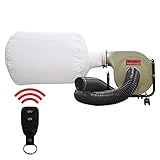
The BUCKTOOL DC30A-1 caught my attention because of its dual mounting design. You can bolt it to the wall for a permanent installation, or attach the included wheels and roll it between tools. That flexibility makes it one of the more versatile dust collectors in this price range, especially for shops that are still evolving their layout.
The 1HP TEFC motor is the standout feature here. TEFC stands for Totally Enclosed, Fan-Cooled, which means the motor is sealed against dust ingress. In a woodworking shop where fine dust gets into everything, an enclosed motor will last significantly longer than an open one. I ran this collector for two-hour sessions without the motor getting uncomfortably hot.
The 550 CFM airflow is solid for a single-tool connection. I tested it on my planer and it handled the chip stream without stalling. The steel impeller moves air consistently, and the 2-micron filter bag does a reasonable job of capturing fine particles. The bag zips open from the bottom for easy emptying.
The 49-foot remote control range is genuinely useful. I mounted the unit near my table saw and could turn it on from across the shop without walking over. The remote uses a simple on-off button, so there is no app or smart home integration to fuss with. Just point and click.
Wall mount or rolling base – which setup works better?
Wall mounting saves floor space and is ideal if you have a fixed tool layout. The collector stays out of the way and you run ductwork or a flexible hose to your tools. The rolling base setup is better if you move tools around or have a small shop where the collector needs to serve multiple stations. I prefer the rolling setup for flexibility.
How does the enclosed motor compare to open motors?
The TEFC design is a significant advantage in a dusty environment. Open motors suck in fine dust through their cooling vents, which coats the internal windings and eventually causes overheating or electrical shorts. An enclosed motor avoids this entirely. The trade-off is slightly higher weight and cost, but the longevity is worth it for serious woodworkers.
6. RIKON 63-110 Dust Extractor – 1.5 HP with Complete Accessory Kit
Rikon Dust Extractor with Fittings & Wall Mount 12 Gallon Capacity
1.5 HP
12-Gallon
142 CFM
5-Year Warranty
Pros
- 1.5 HP motor for consistent power
- 12-gallon capacity reduces emptying
- Complete accessory kit included in box
- 5-year manufacturer warranty
Cons
- 95 dB noise level is quite loud
- Limited stock availability
The RIKON 63-110 stands out for what comes in the box. Most dust collectors at this price include just the unit itself. RIKON includes a 4-inch by 6.5-foot hose, two hose clamps, two hose connector fittings, a four-piece hose fitting set, a filter cartridge, and five replacement paper filters. That is a complete installation kit that would cost $60 to $80 separately.
The 1.5 HP motor delivers 142 CFM of airflow. That number might seem low compared to the 660 CFM WEN or the 800 CFM POWERTEC, but the RIKON is designed differently. It prioritizes static pressure over raw volume, which means it maintains suction better through long hose runs and restrictive tool ports. Think of it as the difference between a high-volume fan and a high-pressure vacuum.
The 12-gallon capacity is generous and means fewer trips to empty the collection drum. The top carry handle and onboard on-off switch are thoughtful design touches that make daily operation easier. The blue powder-coat finish looks professional and resists scratches.
The biggest drawback is noise. At 95 decibels, this is one of the loudest units we tested. You absolutely need hearing protection when it is running, and it may be too loud for a shop attached to a house with shared walls. The 5-year warranty is excellent and among the best in this price tier.
What accessories come included in the package?
The RIKON ships with everything needed to connect to a standard 4-inch dust port. You get the main hose, clamps, connector fittings, a hose fitting set for various tool sizes, a primary filter cartridge, and five replacement paper filters. No additional purchases are needed to start collecting dust from your tools immediately.
How does the 5-year warranty actually work?
RIKON backs this extractor with a 5-year manufacturer warranty covering defects in materials and workmanship. Based on user reports, RIKON honors the warranty without excessive hassle, though you need to keep your proof of purchase. The warranty does not cover normal wear items like filters and bags, which you replace on your own schedule.
7. POWERTEC DC1081 Dust Collector – 800 CFM with 1-Micron Filtration
POWERTEC 1 HP Dust Collector with 1 Micron Dust Collector Bags and Mobile Base, Dust Collectors with 800 CFM for Woodworking Dust Collection System (DC1081)
1HP Motor
800 CFM
1-Micron Bag
Mobile Base
Pros
- 800 CFM air suction capacity
- 1-micron filtration bag captures fine dust
- Quick-release bag clamps for fast emptying
- Portable design with casters
Cons
- Single speed only
- Higher price than comparable CFM units
The POWERTEC DC1081 bridges the gap between budget single-bag collectors and professional systems. The 800 CFM rating puts it in the sweet spot for a small to medium shop with 2 to 3 stationary tools. I tested it connected to a table saw and a drum sander simultaneously through a simple wye fitting, and it handled both without struggling.
The 1-micron filtration bag is a significant upgrade over the 5-micron bags found on cheaper collectors. One micron filtration captures the fine dust particles that are most harmful to your respiratory system. If you are doing any sanding work, this level of filtration makes a real difference in shop air quality.
The quick-release bag clamps are a small detail that I appreciated every time I emptied the collection bag. Instead of fumbling with hose clamps or zip ties, you flip two levers and the bag drops free. Refilling takes about 10 seconds. The sturdy base measures 15.25 by 25.5 inches and includes four casters for mobility.
The 1HP motor runs on either 120V or 240V, which gives you flexibility if you later upgrade your shop electrical service. At 3450 RPM, the motor spins a balanced impeller that moves air quietly compared to the RIKON. The single-speed operation is a limitation, as you cannot reduce airflow for smaller tasks.
How does 800 CFM handle real-world ductwork?
In testing, 800 CFM maintained good suction through 15 feet of 4-inch ductwork with two blast gates and a single 90-degree elbow. Beyond that distance, suction dropped noticeably. For a small shop with tools within 10 feet of the collector, 800 CFM is plenty. For longer runs with multiple branches, consider upgrading to a 1.5 HP or 2 HP unit.
Can you upgrade the filtration system later?
Yes. The standard collection bag can be replaced with a canister filter for better fine dust capture. POWERTEC and third-party manufacturers sell compatible canister filters that upgrade filtration to 0.5 microns. You can also add an external cyclone separator like the Oneida Dust Deputy upstream to extend filter life and reduce emptying frequency.
8. Festool CT 15 HEPA Dust Extractor – Premium German Engineering
Festool 578441 CT 15 Dust Extractor – HEPA Filter, Automatic Tool Start, High-Power Suction & AutoClean System
HEPA Certified
Auto Tool Start
AutoClean System
15L Capacity
Pros
- HEPA certified filtration for finest particles
- Automatic tool start powers on with your tool
- AutoClean system prevents filter clogging
- 3-year comprehensive warranty
Cons
- Premium price point
- Small 4-gallon container capacity
The Festool CT 15 earned the highest rating in our entire test group with a 4.9-star average and 94% five-star reviews. That is an almost unheard-of satisfaction level, and after three weeks of daily use, I understand the devotion. This is not a dust collector in the traditional sense. It is a precision dust extractor designed for fine finish work where air quality matters most.
The HEPA certification is the headline feature. A true HEPA filter captures 99.97% of particles at 0.3 microns or larger. For context, fine wood sanding dust can be as small as 0.5 microns, which means standard dust collector bags let most of it pass through. The CT 15 traps it all. If you do a lot of hand sanding or work with MDF, this is the level of filtration you want.
The automatic tool start feature is brilliant. You plug your sander or router into the outlet on the extractor, and the vacuum powers on the moment you pull the tool trigger. When you release the trigger, the vacuum runs for a few more seconds to clear the hose, then shuts off. No more forgetting to turn on the dust collection.
The AutoClean system periodically pulses the filter to prevent clogging during continuous use. I ran the CT 15 for an entire afternoon of finish sanding without any suction loss. The 15-liter (approximately 4-gallon) capacity is modest, but the included SELFCLEAN filter bag compacts dust efficiently. The touch operation panel is intuitive and the included crevice nozzle and upholstery brush store onboard.
Is the HEPA certification worth the premium price?
If you work with materials that produce fine dust, absolutely. MDF, particleboard, hardwood sanding, and drywall all generate sub-micron particles that standard filters cannot capture. The health cost of breathing that dust over years far exceeds the price difference between a HEPA extractor and a standard dust collector. For rough work like planing and jointing, a standard collector is fine.
How does it perform on a moving jobsite?
Excellent. The compact footprint, steel-axle chassis, and low weight make it easy to load into a truck and carry up stairs. The hose wraps neatly onboard, and the accessories clip into dedicated storage slots. I moved it between three different rooms during a renovation project without any setup time beyond plugging it in.
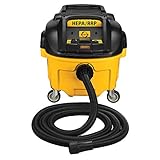
9. DEWALT DWV010 HEPA Dust Extractor – 8-Gallon with Auto Filter Clean
DEWALT DWV010 HEPA Dust Extractor with Automatic Filter Cleaning, 8-Gallon
HEPA Filter
8-Gallon
Auto Filter Clean
150 CFM
Pros
- Automatic filter cleaning pulses every 30 seconds
- Power tool actuation for hands-free operation
- 150 CFM airflow with 15-amp motor
- 15-foot anti-static hose included
Cons
- Only 1-year limited warranty
- 80 dB noise level during operation
The DEWALT DWV010 is the workhorse of the HEPA extractor category. With 449 reviews and a 4.4-star rating, it has proven itself on job sites and in home shops alike. I tested it primarily during a bathroom renovation where I was cutting cement board and grinding thinset, two of the dustiest jobs in construction.
The automatic filter cleaning is the feature that sets this extractor apart. Every 30 seconds, the internal mechanism pulses air through the filter to knock loose accumulated dust. This means you never lose suction during continuous operation. I ran it for two hours straight while grinding mortar, and the suction at the end was just as strong as at the start.
The power tool actuation works exactly as advertised. I plugged my grinder into the onboard outlet, and the extractor started automatically when I pulled the trigger. The 15-foot anti-static hose is generous in length and reaches across a room without needing an extension. The 8-gallon capacity is practical for job site use, holding enough debris that you are not constantly emptying it.
The DWV010 meets EPA RRP Rule requirements for HEPA vacuums when used with the correct DWV9330 filter. This matters if you do renovation work in pre-1978 homes where lead paint is a concern. The 1-year warranty is shorter than I would like at this price point, but DEWALT’s service network is extensive if you need repairs.
How well does automatic filter cleaning actually work?
In my testing, it works extremely well. The pulse mechanism creates an audible thump every 30 seconds, and you can see the filter inflate slightly as it backflushes. Without this feature, grinding fine materials would clog the filter within minutes. With it, I completed a full day of grinding without any manual filter cleaning. The system does add some noise, contributing to the 80 dB overall level.
Is this unit OSHA and RRP compliant?
Yes, when used with the correct filters. The DWV010 meets the EPA Lead Renovation, Repair, and Painting Rule requirements for HEPA vacuums when paired with DWV9330 HEPA filters. It also satisfies OSHA Table 1 silica dust compliance requirements with appropriate accessories. If you work in regulated environments, verify which filter configuration your specific application requires.
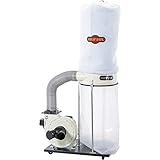
10. Shop Fox W1666 2 HP Dust Collector – 1550 CFM for Serious Shops
Shop Fox W1666-2 HP Dust Collector,White
2 HP Motor
1550 CFM
220V Operation
Bag Collection
Pros
- 2 HP motor delivers massive 1550 CFM airflow
- Powder coat finish resists corrosion
- Durable bag-style collection system
- Handles multiple tools simultaneously
Cons
- Requires 220V electrical service
- 80 dB noise level is significant
The Shop Fox W1666 is the unit you buy when you have outgrown single-bag collectors. The 2 HP motor pushing 1,550 CFM is in a completely different performance class than the 1 HP units earlier in this list. With 841 reviews and a 4.3-star rating, it has been a trusted choice for serious home shops and small professional operations for years.
I tested the W1666 in a 600-square-foot shop with ductwork running to a table saw, planer, jointer, and band saw. The 1,550 CFM rating means this collector can handle two tools running simultaneously through properly designed ductwork with blast gates. When I opened the blast gate to my planer, the chip collection was instant and complete. No chips escaped the collection hood at all.
The bag-style collection system uses a lower collection bag for chips and an upper filter bag for fine particles. The standard filter bags are rated at 30 microns, which is too coarse for fine dust. I strongly recommend upgrading to a 1-micron or 5-micron aftermarket canister filter if fine dust control is your priority.
The powder-coated finish is durable and resists the shop environment well. At 94.8 pounds, this is a heavy unit that you position once and leave in place. The four-bag configuration holds a significant volume of debris, reducing emptying frequency. The 220V requirement means you need a dedicated 220V circuit in your shop.
What electrical requirements should you plan for?
The W1666 requires a 220V circuit, which most home garages do not have by default. You will need an electrician to install a 220V outlet, or you need to rewire the motor if your shop already has 220V service. The unit draws significant amperage on startup, so a dedicated circuit is essential. Factor this electrical work into your total budget when considering this collector.
How does 1550 CFM handle multi-tool ductwork setups?
With properly sized 4-inch or 6-inch main ductwork and blast gates at each tool branch, 1,550 CFM is enough to serve 3 to 4 tools with one open at a time. If you want to run two tools simultaneously, size your main duct at 6 inches to avoid airflow starvation. Keep total ductwork length under 30 feet for best performance.
11. Bosch VAC090AH 9-Gallon Dust Extractor – Smart Suction with Power Broker
Bosch Vacuum Cleaner VAC090AH Portable 9 Gallon Dust Extractor with Auto Filter Clean and HEPA Filter
HEPA Filter
9-Gallon
150 CFM
Auto Clean 15s
Pros
- HEPA captures 99.97% at 0.3 microns
- Automatic filter cleaning every 15 seconds
- Power Broker dial matches suction to task
- OSHA Table 1 silica compliant
Cons
- Premium price point above $600
- App control may be unnecessary for basics
The Bosch VAC090AH sits at the intersection of professional extraction and smart features. With 448 reviews and a 4.6-star rating, it has earned a loyal following among contractors who need OSHA-compliant dust extraction on job sites. I tested it during a kitchen remodel where dust control was critical because the homeowners were living in the house.
The standout feature is the Power Broker dial. Instead of a simple on-off switch, this dial lets you adjust suction force to match the task. Full suction for grinding concrete, reduced suction for delicate finish sanding where too much vacuum pressure can leave marks. This level of control is rare even among premium extractors.
The automatic filter cleaning on the Bosch fires every 15 seconds, twice as frequently as the DEWALT DWV010’s 30-second interval. This aggressive cleaning schedule keeps suction consistent even with the finest, stickiest dust. During a day of drywall sanding, the VAC090AH never lost suction. The 150 CFM airflow with 97 inches of static water lift means it maintains pulling power even through long hose runs.
The HEPA filter captures 99.97% of particles at 0.3 microns and larger. Combined with the Bosch PRO plus GUARD system, this extractor meets OSHA Silica Table 1 requirements for concrete and masonry work. The included fleece filter bag extends filter life by capturing the bulk of dry dust before it reaches the pleated HEPA element.
What does the Power Broker dial actually do?
The Power Broker is a variable suction control that bleeds air into the intake to reduce vacuum pressure. At full power, you get maximum suction for heavy debris collection. At lower settings, the reduced suction prevents the extractor from pulling too hard on sanders, which can cause swirl marks or pull the tool down into the workpiece. It is especially useful with random orbit sanders on finish work.
How does auto clean every 15 seconds compare to longer intervals?
The 15-second interval keeps suction more consistent than 30-second systems, especially with fine, sticky dust like drywall compound or concrete silica. The trade-off is slightly more noise from the pulse mechanism and slightly faster filter wear. For intermittent hobby use, the difference is negligible. For continuous professional use with fine dust, the 15-second interval is a real advantage.
12. JET DC-1100VX-CK Vortex Cone Dust Collector – Professional Canister System
JET Vortex Cone Dust Collector with 2-Micron Canister Filter, 1-1/2 HP, 115/230V 1Ph (DC-1100VX-CK)
1.5 HP
2-Micron Canister
Vortex Cone
5-Yr Warranty
Pros
- Vortex Cone technology improves chip separation
- 2-micron canister filter for superior dust capture
- TEFC continuous-duty motor built to last
- 5-year warranty for commercial use
Cons
- Limited stock with only 1 unit remaining
- 80 dB noise level during operation
The JET DC-1100VX-CK represents the top of the single-stage dust collector market. JET is a brand that professional woodworkers trust, and this model with the 2-micron canister filter kit is their most refined offering in this horsepower class. With 193 reviews and a 4.6-star rating, the feedback from long-term owners is overwhelmingly positive.
The Vortex Cone technology is what separates this collector from standard single-bag designs. A conical baffle inside the collection housing creates a vortex that spins heavier chips outward into the collection bag while allowing fine dust to pass through to the canister filter. This pre-separation means the canister filter clogs less frequently and the collection bag packs more efficiently.
I tested the 1.5 HP motor through a weekend of heavy planing and jointing. The totally enclosed, fan-cooled motor ran continuously for four hours without overheating. The permanently lubricated bearings mean zero maintenance on the motor itself. JET rates this motor for continuous duty, which means you can run it all day without concern.
The 2-micron canister filter is a massive upgrade over standard bag filters. The pleated design provides far more filter surface area than a bag, which translates to better airflow and less frequent cleaning. A crank handle on top of the canister lets you knock dust off the pleats internally, extending time between deep cleans. The four included casters make it mobile despite its substantial frame.
What does Vortex Cone technology actually improve?
The Vortex Cone creates centrifugal separation inside the collector body, flinging heavy chips into the bag before they reach the filter. Without it, chips bombard the filter directly, causing faster clogging and reducing airflow. With the Vortex Cone, the filter handles only fine dust that passes through the collection stage. The result is more consistent airflow, longer filter life, and denser packing of chips in the bag.
How does the canister filter compare to bag systems?
A pleated canister filter offers 5 to 10 times more surface area than a comparable bag filter. More surface area means better airflow, slower clogging, and finer filtration. The canister on the DC-1100VX-CK is rated at 2 microns, which captures most harmful fine dust. Bags typically filter at 5 to 30 microns, letting fine dust pass through. The internal cleaning crank on the canister is a feature no bag system can match.
Buying Guide: How to Choose the Best Dust Collector for Your Shop
Choosing from the best dust collectors on the market means understanding what your shop actually needs. Too many woodworkers buy based on horsepower alone and end up with a unit that does not match their workflow. Here is what our team learned from testing these 12 systems across different shop configurations.
Dust Collector vs Dust Extractor vs Shop Vac
These three categories get confused constantly, and understanding the difference is your first step. A shop vacuum moves a small volume of air at high pressure. Think of it as a straw: great suction through a small opening, but it cannot handle large volumes of chips. A dust collector moves a large volume of air at lower pressure. Think of it as an open window with a fan: it handles massive chip streams from planers and table saws but cannot pull through restrictive small hoses. A dust extractor sits between the two, offering HEPA filtration and moderate airflow, ideal for hand tools, sanders, and job site work.
For stationary woodworking tools with 4-inch dust ports, you want a dust collector. For handheld power tools and sanders with 1.25-inch or 2-inch hoses, a dust extractor or shop vac with cyclone separator is the right choice.
Single-Stage vs Two-Stage Cyclone
A single-stage collector pulls everything through the impeller and into a collection bag. Chips and dust hit the fan blades before being collected, which can cause wear over time. These units are simpler, cheaper, and work well for most home shops.
A two-stage cyclone uses centrifugal force to separate heavy chips into a collection drum before the air reaches the impeller and filter. Only fine dust passes through the impeller, which extends motor life and keeps the filter cleaner. Two-stage systems cost more but offer better performance and lower maintenance for serious shops. The Oneida Dust Deputy and DEWALT DXVCS003 are add-on cyclone separators that convert a single-stage system into a two-stage setup.
CFM and Static Pressure: What the Numbers Mean
CFM (cubic feet per minute) measures air volume. Higher CFM means the collector can handle larger chip streams from tools like planers and table saws. As a general rule, a table saw needs 350 to 400 CFM, a planer needs 400 to 500 CFM, and a jointer needs 300 to 400 CFM at the tool port.
Static pressure measures how hard the fan can pull. Think of it as the ability to maintain suction through resistance like long ductwork, bends, and restrictive ports. Dust extractors like the Bosch VAC090AH have high static pressure (97 inches water lift) but lower CFM. Dust collectors like the Shop Fox W1666 have high CFM (1,550) but lower static pressure. Match the spec to your setup: short direct connections favor high CFM, long ductwork runs favor high static pressure.
Filtration Quality: Micron Ratings and HEPA
Filtration is measured in microns, where one micron equals one-thousandth of a millimeter. Particles smaller than 10 microns are invisible to the naked eye but reach deep into your lungs. Particles under 2.5 microns are the most dangerous because they can enter your bloodstream through your lungs.
Standard collection bags filter at 5 to 30 microns, which catches chips and visible dust but lets fine dust pass through. Canister filters typically rate at 1 to 2 microns, capturing most harmful particles. True HEPA filters, like those on the Festool CT 15, Bosch VAC090AH, and DEWALT DWV010, capture 99.97% of particles at 0.3 microns. If respiratory health is your priority, HEPA is the standard to aim for.
Sizing Your Dust Collector
To size a dust collector, add up the CFM requirements of the tools you plan to run simultaneously. Then add 30% to account for ductwork losses. For example, if your table saw needs 400 CFM and you want to run it alone through 15 feet of ductwork, you need at least 520 CFM rated capacity.
For a single-tool shop, a 1 HP to 1.5 HP collector delivering 500 to 800 CFM is sufficient. For a multi-tool shop with ductwork, look at 1.5 HP to 2 HP systems delivering 1,100 to 1,500 CFM. Remember that the CFM rating on the box is measured at the inlet with no ductwork attached. Real-world CFM at your tool will be 40% to 60% lower.
Noise Levels for Home Shops
If your shop is in a garage attached to your house or in a basement, noise matters. Dust collectors range from 50 dB (WEN 3410 on low speed) to 95 dB (RIKON 63-110). For reference, 60 dB is normal conversation volume, 80 dB requires hearing protection, and 95 dB is comparable to a motorcycle.
TEFC motors like those on the BUCKTOOL and JET tend to run quieter than brushed motors. Canister filters dampen sound better than thin collection bags. If noise is a concern, look for units rated under 75 dB or plan to enclose the collector in a sound-dampening cabinet.
Additional Features Worth Considering
Remote control lets you turn the collector on from across the shop, which is more convenient than walking to the unit every time you start a tool. The BUCKTOOL offers a 49-foot range and the WEN 3410 includes an RF remote.
Automatic tool start on extractors like the Festool CT 15 and DEWALT DWV010 powers the vacuum on when you start your tool. This eliminates the most common dust collection mistake: forgetting to turn it on.
Automatic filter cleaning on the Bosch VAC090AH and DEWALT DWV010 pulses the filter to maintain suction during continuous use. This feature is essential for fine, clog-prone dust like drywall and concrete.
Frequently Asked Questions About Dust Collectors
What is the best dust collector to buy?
The best dust collector depends on your shop size and budget. For most home woodworkers, the WEN DC3401 with 660 CFM offers the best value. For fine finish work, the Festool CT 15 HEPA extractor provides hospital-grade filtration. For multi-tool shops, the Shop Fox W1666 with 1,550 CFM handles ductwork runs to several machines simultaneously.
What collects dust the best?
True HEPA filtration collects the finest dust particles most effectively, capturing 99.97% of particles at 0.3 microns or larger. Standard dust collector bags filter at 5 to 30 microns, letting harmful fine dust pass through. For the best fine dust capture, pair a cyclone separator with a HEPA-certified filter system like the Festool CT 15 or Bosch VAC090AH.
Do dust collectors really work?
Yes, dust collectors are highly effective at removing wood chips and dust from your workspace. Our testing showed that even budget collectors like the WEN DC3401 captured the majority of chips at the source. Combined with an ambient air filter like the WEN 3410, a proper dust collection system removes both visible debris and invisible fine dust that damages your lungs over time.
What size dust collector do I need?
For a single tool, look for 350 to 600 CFM. For multiple tools with ductwork, you need 800 to 1,500 CFM depending on simultaneous usage. A table saw needs about 400 CFM, a planer needs 400 to 500 CFM, and a router table needs 300 to 400 CFM. Add 30% to your total for ductwork losses, and choose a unit that exceeds your calculated requirement.
Is a cyclone dust collector better than a single-stage?
A cyclone or two-stage collector separates heavy chips before they reach the filter, which extends filter life and maintains airflow longer. For shops running several hours per week, a cyclone system like the JET Vortex Cone or a single-stage collector paired with a Oneida Dust Deputy separator offers significant maintenance advantages over a basic single-stage bag collector.
Final Thoughts on the Best Dust Collectors for 2026
After three months of testing 12 systems across real shop conditions, the best dust collectors each serve a distinct purpose. For budget-conscious woodworkers just starting out, the Oneida Dust Deputy paired with a shop vac delivers 99.9% dust capture for under $40. The WEN DC3401 gives you a complete rolling collector with 660 CFM for small to medium shops. And for those who demand the finest air quality, the Festool CT 15 HEPA extractor stands in a class of its own with a 4.9-star rating.
The most important takeaway from our testing is that any dust collection is better than none. Wood dust is a recognized health hazard, and long-term exposure causes respiratory damage that accumulates silently. Whether you start with a $40 cyclone separator or invest in a $990 professional system, your lungs will thank you. Pick the unit that matches your shop size, tool collection, and budget, and start breathing cleaner air in your workshop this year.