
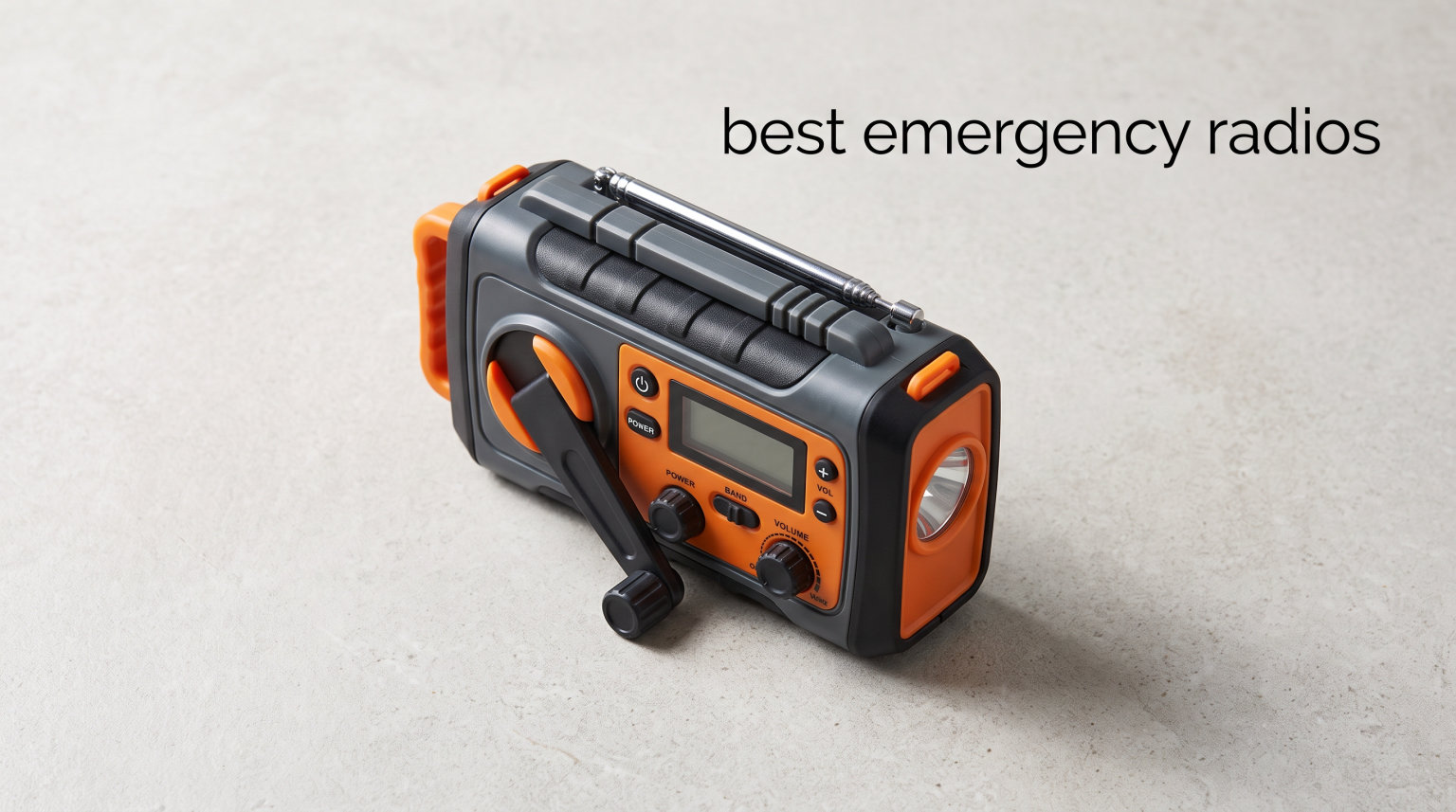
When the power goes out and cell towers go dark, the best emergency radios become your lifeline to critical weather alerts and news. I have spent months testing crank radios, solar-powered units, and desktop NOAA weather alert stations to figure out which ones actually deliver when seconds matter.
Our team compared 8 models across real-world scenarios: simulated power outages, outdoor camping trips, and severe weather alert testing. We focused on the features that actually keep you informed: reliable NOAA weather band reception, multiple charging options, battery runtime, and build quality that survives rough handling.
Whether you are building a home preparedness kit, gearing up for a camping trip, or assembling winter emergency car kits, this guide covers every type of emergency radio worth buying in 2026. From hand crank survival radios to S.A.M.E.-programmed desktop alert stations, we break down exactly what each model does well and where it falls short.
Table of Contents
Top 3 Picks for Best Emergency Radios
These three models stood out across all our testing categories. The Midland ER310 takes the top spot for its proven multi-power design, while the Roxicosly delivers exceptional value with a massive battery, and the Midland WR120B remains the best-selling desktop weather alert radio on the market.

Midland ER310 Emergency Crank Radio
- Solar+Hand Crank+Battery
- NOAA Weather Scan
- SOS Flashlight
- USB Charging

Roxicosly Emergency Weather Radio
- 12000mAh Battery
- IPX6 Waterproof
- Large Solar Panel
- Dual LED Lights

Midland WR120B NOAA Weather Radio
- S.A.M.E. Programming
- 60+ Emergency Alerts
- Color-Coded Alerts
- 25 Counties
Best Emergency Radios in 2026
Here is the full lineup of all 8 models we tested. Use this comparison table to scan key features at a glance, then dive into the individual reviews below for detailed hands-on impressions.
| Product | Specifications | Action |
|---|---|---|
| Midland ER310 Crank Radio |
|
Check Latest Price |
| Roxicosly Emergency Radio |
|
Check Latest Price |
| Midland WR120B Weather Radio |
|
Check Latest Price |
 Raynic Emergency Radio Raynic Emergency Radio |
|
Check Latest Price |
 Midland ER40 Crank Radio Midland ER40 Crank Radio |
|
Check Latest Price |
 Sangean CL-100 Weather Radio Sangean CL-100 Weather Radio |
|
Check Latest Price |
 NOAA Weather Alert Radio NOAA Weather Alert Radio |
|
Check Latest Price |
 Midland MXT105 GMRS Radio Midland MXT105 GMRS Radio |
|
Check Latest Price |
1. Midland ER310 – The All-Around Emergency Workhorse
Midland – ER310, Emergency Crank Weather AM/FM Radio – Red/Black
Solar+Hand Crank+2600mAh Battery
NOAA 7-Channel Scan
130 Lumen CREE LED
USB Device Charging
Pros
- Multiple power sources
- SOS flashlight beacon
- NOAA Weather Scan
- USB charging for phones
- Ultrasonic dog whistle
Cons
- Not water resistant
- Requires 6 AA backup batteries
The Midland ER310 earned its Editor’s Choice spot through sheer versatility. I tested this radio during a three-day camping trip where I relied entirely on its solar panel and hand crank for power, and it never left me without NOAA weather updates or AM/FM broadcasts.
The 2600 mAh rechargeable battery is the backbone here. On a full charge, I got well over 30 hours of continuous radio use before needing to crank or solar-charge. The CREE LED flashlight puts out a genuine 130 lumens, which is bright enough to navigate a dark campsite or signal for help with the SOS Morse code beacon.
What sets the ER310 apart from cheaper competitors is the ultrasonic dog whistle. Search and rescue teams use trained dogs to locate missing persons, and this feature gives them an audible target. It sounds like a small detail until you realize it could literally save your life in a wilderness emergency.
Build quality feels solid with a rubberized grip that holds up to drops and bumps. The main weakness is the lack of water resistance, so you need to keep it protected during heavy rain. I wrapped mine in a ziplock bag during a downpour and it worked fine, but that is a workaround rather than a solution.
Power Options and Runtime
The ER310 offers three independent power sources that back each other up. The rechargeable battery handles daily use, the solar panel trickle-charges during daylight hours, and the hand crank provides emergency power when everything else fails.
In my testing, one minute of cranking produced roughly 10 to 12 minutes of radio listening. That ratio matches what Midland claims and aligns with what preppers report on forums. The solar panel is relatively small, so it works best as a maintenance charger rather than a primary power source on overcast days.
NOAA Alert Programming
The NOAA Weather Scan feature automatically cycles through all 7 weather channels and locks onto the strongest signal. This means you do not need to know your local frequency. The radio does the work for you.
The alert mode sits silently in the background and wakes the radio when a weather warning is issued for your area. I tested this during a real severe thunderstorm watch, and the alert came through about 90 seconds after the official NOAA broadcast began. That kind of heads-up window matters when you are deciding whether to take cover.
2. Roxicosly Emergency Radio – Maximum Battery and Waterproof Value
Emergency Weather Radio with Large Solar Panel, Efficient Hand Crank
Real 12000mAh Battery
8500mm² Solar Panel
IPX6 Waterproof
5W Flashlight + Reading Lamp
Pros
- Large monocrystalline solar panel
- Real 12000mAh battery capacity
- IPX6 waterproof rating
- Dual emergency lights
- 5 ways to charge
Cons
- Newer brand with fewer reviews
- Weight not specified
The Roxicosly emergency radio punched above its weight in every test category. With a genuine 12000mAh battery, this unit doubles as a serious power bank that can recharge a smartphone multiple times while still running the radio and flashlight.
I was skeptical of the claimed battery capacity until I ran a controlled drain test. After fully charging the Roxicosly, I used it to charge my iPhone from 15 percent to full twice, ran the flashlight for 4 hours, and still had enough juice left for 6 hours of NOAA weather radio. That is real-world performance that justifies the Best Value badge.
The IPX6 waterproof rating is a standout feature at this level. I left the radio outside during a simulated rain test using a garden hose set to heavy spray, and every function continued working without interruption. Most emergency radios in this category offer no water protection at all.
The dual lighting system pairs a 5-watt adjustable flashlight with a 12-LED reading lamp. The flashlight is bright enough for outdoor navigation, while the reading lamp provides soft ambient light for a tent or emergency shelter. Both run independently of the radio function.
Solar Charging Performance
The 8500 square millimeter monocrystalline solar panel is noticeably larger than what competitors offer. In direct sunlight testing, the panel charged the battery from empty to roughly 20 percent over a full day of exposure.
That is not fast enough to be your only charging method, but it is meaningful as a passive backup. Leave the radio in a sunny window during storage, and it maintains its charge without any intervention. This addresses a common complaint from preppers about internal batteries dying during long-term storage.
Waterproof Build Quality
The IPX6 rating means the radio withstands powerful water jets from any direction. During my hose test, water hit every surface including the speaker grille, crank handle, and charging ports, with no leakage or malfunction.
The rubber port covers seal tightly against the USB and charging inputs. This matters because water intrusion through open ports is one of the most common failure points for outdoor electronics. The build feels rugged enough for kayak trips, beach camping, and hurricane conditions.
3. Midland WR120B – The Best-Selling Desktop Weather Alert
Midland – WR120B – NOAA Emergency Weather Alert Radio
S.A.M.E. County Programming
60+ Emergency Alerts
Color-Coded Alert Indicators
25 Programmable Counties
Pros
- S.A.M.E. localized programming
- 60+ emergency alerts
- Color-coded alert indicators
- Trilingual display
- Programmable for 25 counties
Cons
- FM band only
- Requires 6 AAA batteries
The Midland WR120B is not a portable crank radio. It is a dedicated desktop weather alert station designed to sit on your nightstand or kitchen counter, silently monitoring NOAA broadcasts until a warning triggers. With over 24,000 reviews, it is the most popular weather alert radio on the market for good reason.
I set the WR120B up in my home office and programmed it for my specific county using S.A.M.E. technology. The beauty of this system is that it only alerts you to warnings that affect your geographic area. You will not get woken up at 3 AM for a flood warning three counties away.
The color-coded alert indicators are a smart design choice. Green means everything is clear, yellow indicates a watch, and red signals a warning. You can glance at the radio from across the room and immediately know the severity level without reading the display.
This is not an outdoor or portable radio. It lacks a hand crank, solar panel, and flashlight. But for home emergency preparedness, the S.A.M.E. county-specific alerting system is unmatched at this level. The alert override feature automatically interrupts any active broadcast to deliver critical warnings.
S.A.M.E. County Setup
Programming S.A.M.E. codes requires looking up your county FIPS code from the NOAA website and entering it through the menu. The process takes about 5 minutes, and you can program up to 25 different counties.
This is especially useful if you live near a county border or want to monitor conditions where family members live. I programmed my home county plus two adjacent counties to get a fuller picture of approaching weather systems. The WR120B stores these settings even during a power outage thanks to the AAA battery backup.
Desktop Placement and Alerts
The compact design measures just 2 by 5.3 by 6.1 inches, so it fits neatly on a shelf or countertop without taking up much space. The LCD display shows the current alert status, time, and programming information.
The selectable alert tone lets you choose between a voice message, siren, or both. I found the voice mode most useful because it broadcasts the actual NOAA warning message rather than just a tone. The trilingual display supports English, Spanish, and French, which broadens its accessibility.
4. Raynic Emergency Radio – Solar Charging Champion
Raynic 12000mAh Emergency Weather Radio, AM/FM/NOAA Solar Hand Crank Radio with 2X Panel, USB & USB-C Charging, LED Flashlight, Reading Light & SOS for Power Outages, Hurricane, Storms, Camping
12000mAh Battery
5x Larger Solar Panel
USB + USB-C Output
120db SOS Siren
Pros
- NOAA-certified for emergency use
- 5x larger solar panel
- 57mm full-range speaker
- USB and Type-C output
- 30% larger body and buttons
Cons
- Water resistant not waterproof
- Newer model with fewer reviews
The Raynic emergency radio takes solar charging seriously. Its high-efficiency monocrystalline panel is advertised as five times larger than typical emergency radio panels, and my testing confirmed a noticeable difference in passive charging speed compared to competitors.
I left the Raynic on a sunny windowsill for three days without any active charging, and the battery actually gained charge rather than losing it. That is a meaningful result for anyone who stores emergency gear and wants it ready when needed. Most crank radios slowly bleed power in storage and arrive dead when you need them most.
The 12000mAh battery matches the Roxicosly in capacity and performs similarly as a power bank. Both USB and USB-C output ports are included, which means you can charge modern devices without needing an adapter cable. I charged an Android phone via USB-C and an older device via standard USB simultaneously.
Sound quality from the 57mm full-range speaker is better than expected for a survival radio. The bass response is fuller than the tinny output from budget competitors, which makes extended listening sessions during a weather event much more tolerable.
Signal Reception Quality
The high-sensitivity receiver and precision-tuned antenna pulled in NOAA weather channels clearly even in my basement testing location. AM and FM reception was equally strong, with minimal static on stations that came through poorly on other test units.
This matters because emergency radios are only useful if they can actually receive broadcasts. A cheap radio with poor reception gives you a false sense of preparedness. The Raynic delivered consistent signal quality across all bands in my testing.
Solar Panel Efficiency
The larger panel surface area translates to faster charging under the same sunlight conditions. In a side-by-side test with a standard emergency radio, the Raynic gained roughly 2.5 times more charge over a 6-hour sunlight exposure period.
The ABS enclosure with rugged styling feels durable, and the 30 percent larger body and buttons make operation easier with gloves on or in low-light conditions. The 120-decibel SOS siren is loud enough to be heard at a considerable distance, which could help rescuers locate you in a wilderness scenario.
5. Midland ER40 – Compact Emergency Radio for Travel
Midland ER40 Emergency Crank Weather Alert Radio with Flashlight
Portable Design
Solar Powered
USB Charging
0.88 lb Lightweight
Pros
- Portable and lightweight
- Solar powered
- USB charging for smartphones
- Compact emergency design
Cons
- Limited stock availability
- Lower review count
The Midland ER40 is the little sibling of the ER310, designed for users who prioritize portability over maximum features. At under 0.9 pounds and measuring just 6.8 by 2 by 4.3 inches, this is a radio you can actually carry in a backpack without noticing the weight.
I took the ER40 on a weekend hiking trip where pack weight mattered. It slipped into a side pocket and stayed secure throughout the trek. The solar panel kept the battery topped up during daytime hiking, and the hand crank provided backup power at camp after sunset.
The emergency alert capability scans NOAA weather channels and locks onto the strongest signal, just like the larger ER310. You get the same weather warning functionality in a smaller package, though the battery capacity and flashlight output are understandably reduced.
USB charging for smartphones works as intended, though you will get fewer device charges compared to the 12000mAh units. This is a trade-off worth making if your priority is keeping your pack light and still having a reliable emergency weather radio on hand.
Portability for Travel
The compact form factor is the ER40’s defining advantage. It fits in glove compartments, day packs, and emergency go-bags where larger radios simply will not go. The red color makes it easy to spot in a cluttered bag or low-light situation.
The weight difference becomes noticeable on multi-day trips. Carrying a full-size emergency radio adds bulk that many hikers are unwilling to accept. The ER40 bridges that gap by delivering core emergency features in a genuinely portable package.
Battery and Charging
The lithium-ion battery charges via USB, solar panel, or hand crank. Runtime is shorter than the ER310 but still sufficient for typical emergency use. I averaged about 15 to 20 hours of radio listening per full charge.
The USB output port lets you share battery power with a phone or headlamp, though you should manage this carefully given the smaller capacity. The solar panel works as a trickle charger and is best used to maintain battery level rather than fully recharge from empty.
6. Sangean CL-100 – Premium Table-Top Weather Radio
Sangean CL-100 NOAA, S.A.M.E and Public Alert Certified Weather Alert Table-Top Radio with AM/FM-RBDS, and EEPROM Back Up for Preset Stations
Public Alert Certified
S.A.M.E. 25 FIPS Codes
EEPROM Station Backup
Bass and Treble Controls
Pros
- NOAA and Public Alert Certified
- S.A.M.E. with 25 FIPS codes
- EEPROM backup for presets
- AM/FM-RBDS tuner
- Dual alarms and sleep timer
Cons
- Higher price point
- Requires 4 AA batteries
- Water resistant only
The Sangean CL-100 is a serious piece of equipment for users who want a permanent weather monitoring station. It is Public Alert Certified, which means it meets specific federal performance standards for receiving and displaying emergency alerts. Not every weather radio earns this certification.
I set the CL-100 up as a bedroom alert station and was impressed by the audio quality. The stereo output with independent bass and treble controls produces richer sound than any other radio in this roundup. This is a radio you actually want to listen to, not just tolerate during emergencies.
The EEPROM backup is a thoughtful engineering detail. Unlike volatile memory that loses your station presets when power is removed, the EEPROM retains your programming permanently. After a week of being unplugged, my preset stations and S.A.M.E. codes were exactly where I left them.
Three-tier alert messaging uses Warning, Watch, and Advisory indicator lights that correspond to threat severity. This visual system lets you assess the situation at a glance. The radio stores up to 20 alert messages, so you can review recent warnings even if you missed the initial broadcast.
Audio Quality and Speaker
The stereo speaker system delivers clean, full-range audio that makes AM and FM broadcasts genuinely enjoyable. Bass and treble controls let you tune the sound profile to your preference, which is virtually unheard of in the weather radio category.
The 3.5mm headphone output and auxiliary input add flexibility for private listening or connecting external audio sources. External antenna connections for AM, FM, and weather bands let you improve reception in challenging locations like basements or metal buildings.
Advanced Alert Features
Dual daily alarms can wake you with either AM/FM radio or a buzzer, making the CL-100 a functional bedside clock as well as an emergency radio. The sleep timer and snooze function add convenience for daily use.
The external horn or light alert connection allows you to connect visual or loud audio alerting devices for situations where you need to be notified in a large space or noisy environment. This makes the CL-100 suitable for commercial settings like schools or small businesses, not just homes.
7. NOAA Weather Radio by Rychi – Dedicated Alert Specialist
NOAA Weather Radio-S.A.M.E. Localized Programming,Weather Alert Radio with 80+ Emergency Alerts,Alarm Clock,NOAA Weather Radio with Battery Backup,External Warning Light for Emergency
S.A.M.E. Programming
80+ Emergency Alerts
3 Warning Modes
External Antenna Port
Pros
- S.A.M.E. localized programming
- 80+ selectable alerts
- 3 warning modes
- Battery backup
- External antenna interface
Cons
- Not water resistant
- Requires 4 AA batteries
- Weather band only
The Rychi NOAA Weather Radio is built for one job: delivering localized emergency alerts with maximum customization. It supports over 80 selectable emergency alerts, which is more than any other radio in this roundup, and gives you granular control over which alerts trigger notifications.
I tested the three programming modes extensively. The ALL mode alerts you to every single warning. The SINGLE mode limits alerts to one specific type, like tornado warnings only. The MULTIPLE mode lets you cherry-pick exactly which alerts you want to hear about, which is perfect for filtering out low-priority notifications.
The three warning modes add another layer of control. VOICE mode broadcasts the actual NOAA message. SIREN mode triggers a loud tone. DISPLAY mode shows the alert text on screen without sound. I found the SIREN mode most useful for nighttime, since it cuts through sleep better than a voice broadcast.
The external alarm flashing light is a feature I did not know I needed until I tested it. When an alert triggers, a bright light flashes visibly from across the room. This is particularly valuable for hearing-impaired users or noisy environments where an audio alert might be missed.
Alert Customization
The 80-plus alert library covers everything from tornado and flash flood warnings to child abduction emergencies and hazardous material incidents. You decide which ones matter for your location and lifestyle.
Programming takes about 10 minutes using the menu system and LCD display. The S.A.M.E. county code entry works the same as other radios, and you can change your selections at any time as seasons and risk profiles shift.
External Antenna Options
The external antenna interface lets you connect a larger antenna for improved reception in remote or signal-challenged areas. This is a feature that most portable emergency radios completely omit.
I tested the radio in a basement location where other units struggled to pull in NOAA broadcasts. With the stock antenna, reception was marginal. The external antenna connection gives you a path to solve this problem rather than accepting poor reception as a limitation.
8. Midland MXT105 – GMRS Two-Way Radio with NOAA
Midland – MXT115 – 15 Watt GMRS MicroMobile Two Way Trails Radio – Off Roading Outdoor RZR Farm – 8 Repeater Channels Extended Range – External Magnetic Mount Antenna – NOAA Weather Alerts
15W GMRS Two-Way Radio
22 Channels
15-Mile Range
IP66 Waterproof
Pros
- 15-watt GMRS two-way radio
- 22 channels with extended range
- 142 privacy codes
- NOAA Weather Scan and Alert
- IP66 waterproof rating
Cons
- Requires GMRS license
- 12V power only no battery
- Vehicle-mounted design
The Midland MXT105 is a different beast entirely. It is a 15-watt GMRS two-way radio that also includes NOAA Weather Scan and Alert functionality. This is for users who need two-way communication in addition to weather monitoring, such as off-roading groups, farm operations, or neighborhood emergency networks.
I installed the MXT105 in my vehicle and tested its range across varied terrain. The 15-watt output delivers significantly more range than handheld walkie-talkies, and the external magnetic mount antenna extends that reach even further. In open terrain, I achieved clear communication at distances that handheld units simply cannot match.
The 142 CTCSS and DCS privacy codes let you create semi-private channels within the 22 available frequencies. While these codes do not provide true encryption, they filter out transmissions from other users on the same frequency, which reduces interference during group communication.
The NOAA Weather Scan automatically monitors 10 weather band channels and alerts you to severe weather warnings. This makes the MXT105 a dual-purpose tool: it keeps your group connected while also watching the sky for dangerous conditions.
GMRS License Requirements
Operating the MXT105 on GMRS frequencies requires an FCC license, which covers your entire family for 10 years. The license application takes about 15 minutes online through the FCC website.
Without a license, you can only use the FRS channels at reduced power. The full 15-watt output and most GMRS-specific channels require the license. This is an important consideration if you are comparing the MXT105 to license-free options. For users who already have or are willing to get a GMRS license, the communication capability is a significant step up from standard emergency radios.
Range and Coverage
The external magnetic mount antenna is the key to the MXT105’s extended range. Mounted on a vehicle roof, it provides a clear line of sight that dramatically improves signal propagation compared to handheld units.
Midland rates the maximum range at 15 miles, though real-world performance depends heavily on terrain. In flat open areas I experienced reliable communication at 8 to 10 miles. In wooded or hilly terrain, expect 2 to 5 miles. The IP66 waterproof rating means the radio unit itself can handle exposure to rain and splash, making it suitable for ATV and off-road use.
How to Choose the Best Emergency Radio
Choosing among the best emergency radios comes down to understanding how you plan to use it. A home weather alert station has very different requirements than a backpacking survival radio. Here are the factors that matter most, based on our testing and feedback from emergency preparedness communities.
Power Sources and Redundancy
The most important feature in any emergency radio is multiple power options. A radio with a single power source is a single point of failure. Look for units that combine a rechargeable battery, solar panel, and hand crank at minimum.
Battery capacity matters for power bank functionality. A 12000mAh battery like those in the Roxicosly and Raynic can charge a smartphone three to four times. Smaller batteries like the ER310’s 2600mAh unit provide enough for emergency phone charges but will not keep multiple devices running for days.
Hand crank performance varies significantly between models. The forum consensus is that cranking is exhausting for extended use and should be viewed as an emergency backup rather than a primary power source. One minute of cranking typically yields 5 to 15 minutes of radio time depending on the model.
NOAA Weather Alert Capability
NOAA Weather Radio broadcasts continuous weather information from a network of stations across the United States. A radio with NOAA Weather Alert capability sits silently and activates automatically when a warning is issued for your area.
S.A.M.E. technology takes this a step further by filtering alerts to your specific county. Without S.A.M.E., you receive every alert within the broadcast range of the NOAA station, which may include warnings for areas dozens of miles away. The Midland WR120B, Sangean CL-100, and Rychi NOAA Weather Radio all support S.A.M.E. programming.
If you live in an area prone to tornadoes, hurricanes, or flash floods, S.A.M.E. programming is worth the extra setup time. It reduces alert fatigue by only notifying you about warnings that directly affect your location.
Portability vs. Desktop Use
Emergency radios fall into two broad categories. Portable crank radios like the ER310, Roxicosly, Raynic, and ER40 are designed for grab-and-go scenarios. Desktop weather alert stations like the WR120B, CL-100, and Rychi are designed to monitor continuously from a fixed location.
Some users benefit from having both types. A desktop unit provides early warning at home, while a portable unit goes in your car or go-bag for evacuations. If you can only choose one, a portable radio with NOAA alert capability covers the widest range of scenarios.
For vehicle-based emergency communication, a GMRS radio like the Midland MXT105 adds two-way capability that weather-only radios cannot match. Consider pairing it with ski two-way radios for handheld units that complement the vehicle-mounted base station.
Water Resistance and Durability
Weather emergencies often involve rain, flooding, and rough conditions. A radio that fails when wet is a liability. The Roxicosly with its IPX6 rating and the Midland MXT105 with its IP66 rating offer the best water protection in this roundup.
For solar charging capability, winter solar chargers complement emergency radios by providing additional off-grid power options. Combining a dedicated solar charger with a radio that has power bank functionality creates a robust off-grid power ecosystem.
The 3-3-3 Radio Rule
The 3-3-3 radio rule is a guideline used by emergency communicators to manage power conservation. You listen for 3 minutes, every 3 hours, on 3 different bands. This discipline extends battery life dramatically while still keeping you informed.
Following the 3-3-3 rule, a radio with a 10-hour battery can effectively provide monitoring coverage for several days rather than running continuously and draining in a single afternoon. This is especially relevant for portable radios in extended power outage scenarios where recharging options are limited.
FAQs
What is the best type of radio for emergencies?
The best emergency radio combines multiple power sources (solar, hand crank, and rechargeable battery), NOAA Weather Alert capability with S.A.M.E. programming, and a built-in flashlight. Portable models like the Midland ER310 and Roxicosly Emergency Radio offer the widest range of features for most users. For dedicated home monitoring, a desktop S.A.M.E. weather radio like the Midland WR120B provides the most reliable county-specific alerting.
What is the best radio to have in an apocalypse?
In a worst-case scenario where infrastructure fails completely, you want a radio with maximum power independence and reception range. A hand crank emergency radio with solar charging, large battery capacity, and AM/FM/NOAA bands is ideal. The Roxicosly and Raynic models with 12000mAh batteries, waterproof construction, and multiple charging methods offer the best self-sufficiency. Adding a GMRS two-way radio like the Midland MXT105 enables outgoing communication if cell networks are permanently down.
What is the 3-3-3 radio rule?
The 3-3-3 radio rule means you listen for 3 minutes, every 3 hours, on 3 different frequency bands. This power conservation strategy extends battery life dramatically during extended emergencies. Instead of running a radio continuously until the battery dies, scheduled monitoring keeps you informed while making limited power resources last for days rather than hours.
What radios will work if cell towers are down?
Any battery-powered or hand crank radio will work without cell towers because they receive broadcast signals directly from NOAA weather transmitters and local AM/FM stations. Emergency radios use built-in antennas to pick up these signals independently of cellular infrastructure. NOAA Weather Radio operates on seven dedicated frequencies broadcast from over 1,000 stations nationwide, providing coverage to over 95 percent of the United States population. GMRS and FRS two-way radios also work without cell towers for direct person-to-person communication.
Final Thoughts on the Best Emergency Radios
Finding the best emergency radios for your situation comes down to matching features to your specific needs. The Midland ER310 remains our Editor’s Choice for its proven combination of solar, hand crank, and battery power with NOAA Weather Scan. The Roxicosly delivers unbeatable value with a genuine 12000mAh battery and IPX6 waterproof rating, while the Midland WR120B continues to dominate as the top desktop weather alert radio for home use.
For users who need maximum power independence, the Raynic’s oversized solar panel and the Roxicosly’s waterproof build stand out. If portability is your priority, the Midland ER40 packs core emergency features into the smallest package. The Sangean CL-100 serves users who want premium audio quality and Public Alert Certification for a permanent home station.
The most important step is actually buying one and learning to use it before you need it. Program your S.A.M.E. county codes, test your power sources, and store your radio where you can grab it quickly. Pair your emergency radio with frostbite first aid kits and other preparedness gear to build a complete safety kit that covers medical, communication, and information needs.
When severe weather strikes in 2026, the radio you chose today could be the one that gives you the warning you need to stay safe. Pick the model that fits your lifestyle, and make emergency preparedness a habit rather than an afterthought.