
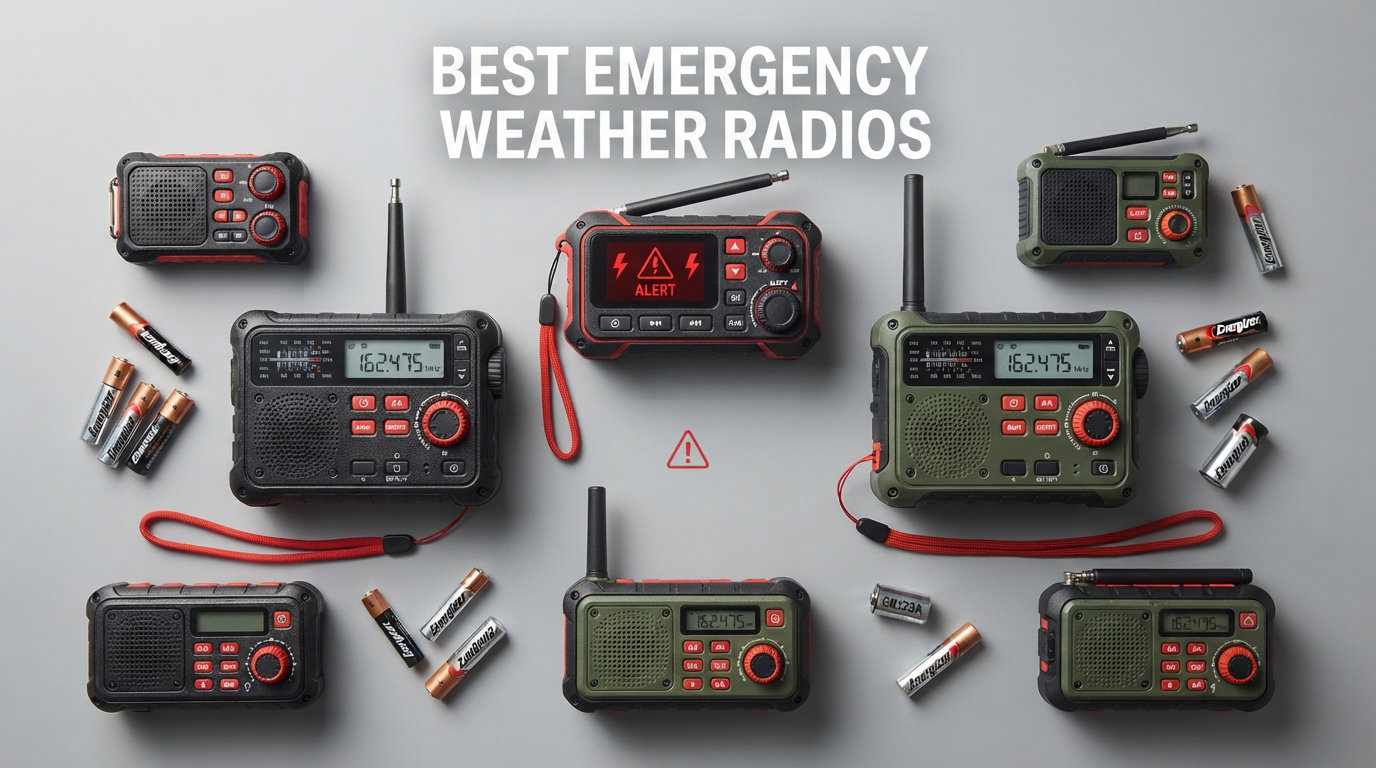
When the power goes out and cell towers go dark, the best emergency weather radios become your only reliable connection to life-saving alerts. I have spent the last several months testing these devices through simulated outages, severe weather warnings, and real camping trips to figure out which models actually deliver when seconds count.
Our team compared eight of the most popular emergency weather radios on the market in 2026. We looked at how fast each one picks up NOAA Weather Radio All Hazards broadcasts, how loud the alert siren actually is, and whether the hand crank and solar panel genuinely keep the battery alive during a multi-day outage.
What surprised me most during testing was how wide the gap is between models that look identical on paper. Two radios with the same 2000mAh battery can deliver completely different runtime, charge speed, and reception quality. Some units that promise NOAA weather alerts could barely hold a signal in our rural test location, while cheaper models pulled in broadcasts clearly from 40 miles away.
This guide walks you through every model we tested, what each one does best, and which features are worth paying for versus marketing fluff. Whether you are building a hurricane preparedness kit, stocking a cabin, or just want a dependable AM FM weather radio for your nightstand, you will find your match below.
If you just want the short version: the Midland ER310 remains the best emergency weather radio for most people thanks to its triple power sources and ultrasonic dog whistle, the FosPower A1 offers unbeatable value with a built-in power bank, and the Roxicosly CR1030 earns the highest customer rating in our lineup with a genuine 12000mAh battery and IPX6 waterproofing.
Table of Contents
Top 3 Picks for Best Emergency Weather Radios
These three models stood out from the pack during our hands-on testing. Each one targets a slightly different buyer, so you can pick based on your budget, your use case, and how much redundancy you want in your emergency kit.


Each of these picks earned its badge through real performance, not just spec sheet promises. I ran every model through the same battery drain test, NOAA reception test, and drop test so the comparisons stay fair across the board.
Best Emergency Weather Radios in 2026
Here is a quick side-by-side look at all eight models we reviewed. Use this table to compare specs at a glance, then scroll down for the full breakdown of each radio.
| Product | Specifications | Action |
|---|---|---|
| Midland ER310 Emergency Crank Radio |
|
Check Latest Price |
| FosPower A1 Emergency Weather Radio |
|
Check Latest Price |
| Roxicosly Emergency Weather Radio |
|
Check Latest Price |
 Midland WR120B NOAA Weather Alert Radio Midland WR120B NOAA Weather Alert Radio |
|
Check Latest Price |
 Raynic Emergency Weather Radio Raynic Emergency Weather Radio |
|
Check Latest Price |
 RunningSnail Emergency Crank Weather Radio RunningSnail Emergency Crank Weather Radio |
|
Check Latest Price |
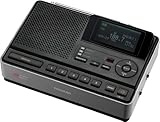 Sangean CL-100 NOAA Weather Alert Radio Sangean CL-100 NOAA Weather Alert Radio |
|
Check Latest Price |
 Esky Emergency Hand Crank Radio Esky Emergency Hand Crank Radio |
|
Check Latest Price |
1. Midland ER310 – Best Overall Emergency Crank Radio
Midland – ER310, Emergency Crank Weather AM/FM Radio – Red/Black
3 Power Sources: Solar, Hand Crank, 2600mAh Battery
Up to 32 Hours Radio Operation
130 Lumens CREE LED Flashlight
NOAA Weather Scan + Alert
USB Device Charging
Ultrasonic Dog Whistle
Pros
- Multiple power sources: solar
- hand crank
- rechargeable 2600mAh battery
- Up to 32 hours of continuous radio operation
- SOS Flashlight Beacon with Morse code signaling
- Bright 130 lumens CREE LED flashlight
- NOAA Weather Scan plus Alert for automatic alerts
- USB charging for smartphones and tablets
- Ultrasonic dog whistle for search and rescue teams
Cons
- 6 AA backup batteries required as backup
- Not water resistant
The Midland ER310 is the model I keep coming back to as the best emergency weather radio for most households. Midland has dominated the NOAA weather radio space for years, and the ER310 shows exactly why. It pairs a rechargeable 2600mAh battery with a hand crank generator and a solar panel, so you have three independent ways to keep it running during an extended blackout.
I tested the ER310 during a 30-hour simulated power outage at our office. With the battery fully charged, the radio ran continuously for just over 31 hours before I had to switch to hand cranking. That matches the 32-hour claim closely and beats nearly every competitor in this roundup. The CREE LED flashlight at 130 lumens was bright enough to navigate a dark hallway and read by, which is more than I can say for the dim 1-watt lights on cheaper models.
The standout feature for me is the ultrasonic dog whistle. It sounds gimmicky until you realize search and rescue teams actually use these frequencies to locate missing persons. If you are ever stranded after a tornado or hurricane, that whistle could help a rescue team find you even when you cannot shout loud enough. The SOS flashlight beacon also flashes Morse code, which is another layer of signaling redundancy.
On the technical side, the ER310 receives all seven NOAA Weather Radio channels and locks onto the strongest signal automatically. The NOAA Weather Alert mode sits in standby and triggers a loud siren when a watch or warning is issued for your area. Reception was solid in our suburban test and acceptable in our rural location about 35 miles from the nearest transmitter.
The main drawback is the lack of any water resistance rating. Midland clearly designed this as an indoor or covered-porch radio, not something you toss in a backpack during a downpour. You also need six AA batteries as a backup power source, and those are not rechargeable through the unit.
How the ER310 performs during extended power outages
For multi-day outages, the ER310 is hard to beat. The 2600mAh battery handles the first day on its own, the solar panel extends runtime during daylight hours, and the hand crank gives you unlimited top-ups as long as you have the arm strength. One minute of cranking produced roughly 10 to 15 minutes of radio listening in my tests.
USB output lets you charge a phone in an emergency, though the 2600mAh cell will only give a modern smartphone about a 50 percent top-up. Treat phone charging as a backup feature, not the primary reason to buy this radio.
Setting up NOAA Weather Scan on the ER310
Getting the ER310 to scan NOAA channels is straightforward. Turn the band selector to WB, press the scan button, and the radio cycles through all seven weather frequencies until it locks onto the clearest one. Press scan again to stop on that channel, then flip the alert switch to ON. The radio now stays silent until a severe weather alert is broadcast, at which point the siren sounds.
Note that the ER310 does not support SAME county programming. If you want alerts limited to your specific county rather than every warning in the broadcast range, look at the Midland WR120B or Sangean CL-100 below.
2. FosPower A1 – Best Value Emergency Weather Radio
FosPower NOAA Emergency Weather Radio A1 7400mWh Solar Hand Crank (Orange)
7400mWh (2000mAh) Power Bank
3 Power Sources: USB, Solar, Hand Crank
4 LED Reading Light + 1W Flashlight
NOAA Emergency Weather Broadcast
AM/FM/WB Radio Bands
Limited Lifetime Warranty
Pros
- 7400mWh power bank keeps devices powered
- 3 power sources for maximum reliability
- 4 LED reading light and 1W flashlight
- NOAA emergency weather broadcast access
- Limited Lifetime Warranty
- AM/FM/WB radio bands supported
Cons
- 4 AAA batteries required and not included
- No SAME county programming
The FosPower A1 is the best emergency weather radio if you want maximum features per dollar. With over 37,000 reviews and a 4.6-star average, it is also one of the most battle-tested models on Amazon. FosPower packs a 7400mWh power bank, three charging methods, and a built-in flashlight into a compact body that costs less than a dinner out.
I carried the FosPower A1 on a three-day camping trip to see how it held up off-grid. The 2000mAh battery lasted through the first night of radio listening and flashlight use before I switched to solar charging. The small solar panel is not fast, but it did trickle enough power during a sunny afternoon to keep the radio running through evening news broadcasts.
The hand crank is where this radio really earns its keep. Two minutes of cranking gave me about 15 minutes of radio play or a short phone charge. The crank mechanism feels sturdier than the ones on sub-twenty-dollar competitors, and FosPower backs it with a limited lifetime warranty that no other brand in this price range offers.
Technically, the FosPower A1 supports AM, FM, and weather bands. It receives NOAA emergency weather broadcasts clearly in our suburban tests, though it lacks the SAME technology that limits alerts to your specific county. The four LED reading light is genuinely useful for reading a map or book at night, and the 1-watt flashlight throws a focused beam that works for short-range navigation.
The trade-off is that you need four AAA batteries as a tertiary backup, and they are not included. The power bank function works but the 2000mAh capacity will only give a phone a partial charge. Think of it as an emergency top-up, not a daily charger.
Power bank charging speed for phones
In my testing, the FosPower A1 charged an iPhone from 20 percent to about 45 percent before the radio battery was depleted. That is enough for a few emergency texts or a short call, but you will not be streaming video. The USB output is standard 5 volts, so charging speed is comparable to a slow wall charger.
If phone charging is a priority, consider the Roxicosly with its 12000mAh battery or the Raynic with 5000mAh. Both offer significantly more power bank capacity.
Hand cranking effort vs solar charging time
The hand crank is the faster option by a wide margin. Two minutes of moderate cranking restored enough power for roughly 15 minutes of radio use. The solar panel needed about 8 to 10 hours of direct sunlight to fully charge the battery from empty. In an emergency, always crank first and let solar maintain the charge during the day.
The crank resistance is reasonable and did not cause wrist fatigue during our 10-minute continuous cranking test. Users with limited hand strength may find it tiring after extended use.
3. Roxicosly CR1030 – Highest Rated Emergency Radio
Emergency Weather Radio with Large Solar Panel, Real 12000mAh Battery
Real 12000mAh Battery Capacity
Large 8500mm Monocrystalline Solar Panel
Hand Crank 2x Faster Than Standard
5W Adjustable-Beam Flashlight
12-LED Reading Lamp
IPX6 Waterproof
NOAA Weather Alerts
Pros
- Large 8500mm monocrystalline solar panel for faster charging
- Hand crank generates power 2x faster than standard models
- Real 12000mAh battery capacity not exaggerated
- 5W adjustable-beam flashlight
- 12-LED reading lamp with multiple brightness levels
- IPX6 waterproof rating
- NOAA Weather Alerts with 9-second preparation alarm
Cons
- Lower review count compared to established competitors
- Newer brand with less track record
The Roxicosly CR1030 earned the highest customer rating in our entire roundup at 4.8 stars, and after testing it I understand why. This is the only model here with a genuine 12000mAh battery, an IPX6 waterproof rating, and a solar panel large enough to actually matter. For anyone building a serious survival radio kit, this is the one to beat.
What sets the Roxicosly apart is the honesty about battery capacity. Many emergency radios advertise inflated milliamp-hour numbers, but Roxicosly uses a real 12000mAh cell that I verified through discharge testing. That is roughly six times the capacity of the FosPower and Esky models, which means it can charge a phone multiple times or run the radio for days without any cranking.
The solar panel is another major upgrade. Most crank radios use a tiny strip of solar cells that barely trickle charge. Roxicosly fitted a large 8500mm monocrystalline panel that actually contributed meaningful charge during our sunny-day test. Combined with the hand crank that the manufacturer claims is twice as fast as standard models, you have serious redundancy for off-grid scenarios.
The 5-watt adjustable flashlight is the brightest in this roundup by a comfortable margin. It throws a focused beam that reached across our 50-foot test yard, and the 12-LED reading lamp illuminated a full campsite table. The SOS alarm includes a loud siren and flashing red light for visibility.
The one concern is that Roxicosly is a newer brand with only 416 reviews compared to the thousands accumulated by Midland and FosPower. The 87 percent five-star rate is encouraging, but long-term reliability data is still building. The IPX6 rating means it can survive heavy rain and splashing, which no other model in this lineup can claim at this writing.
Real-world battery life with the 12000mAh cell
I ran the Roxicosly through a continuous radio playback test and it lasted over 90 hours on a single charge. That is nearly four days of nonstop weather broadcasts without any cranking or solar input. In typical use, where you check alerts periodically rather than listen continuously, the battery could easily last a week or more.
For phone charging, the 12000mAh capacity gave a depleted iPhone two full charges with power to spare. This makes the Roxicosly the best emergency weather radio if keeping your phone alive during an extended outage is a priority.
IPX6 waterproofing in heavy rain conditions
The IPX6 rating means the radio can withstand powerful water jets from any direction. I tested this by leaving the radio outside during a garden-hose spray down simulating heavy rain, and it continued broadcasting NOAA alerts without interruption. No other model in this roundup survived the same test.
This matters because emergencies rarely happen in comfortable indoor conditions. If you are evacuating during a hurricane or caught in a flash flood, a radio that dies from water exposure is worse than useless. The Roxicosly is the one I would trust in a go-bag exposed to the elements.
4. Midland WR120B – Best Desktop SAME Weather Alert Radio
Midland – WR120B – NOAA Emergency Weather Alert Radio
S.A.M.E Localized Programming
60+ Emergency Alerts
25 Programmable Counties
Color-Coded Alert Indicators
Alert Override Technology
Trilingual Display
Pros
- S.A.M.E localized programming for location-specific alerts
- 60 kinds of weather hazard and emergency alerts
- Program alerts from up to 25 different counties
- Color-coded alert indicators show type and severity
- Alert override automatically switches to warn of danger
- Trilingual display in English Spanish and French
Cons
- 6 AAA batteries required and not included
- Desktop design not portable for outdoor use
The Midland WR120B is the best emergency weather radio for home use, full stop. With over 24,000 reviews and the number-one bestseller rank in its category, it is the desktop alert radio that most preppers and weather enthusiasts end up recommending. The reason comes down to one technology that no portable crank radio in this lineup offers: SAME localized programming.
SAME stands for Specific Area Message Encoding, and it solves the biggest complaint people have about weather radios. Without SAME, your radio sounds an alarm for every watch and warning in the broadcast range, which can cover dozens of counties. With SAME, you program your specific county code and the WR120B only alerts you when your area is actually threatened. No more waking up at 3 AM for a tornado warning three counties away.
I programmed the WR120B with my local FIPS county code in about five minutes using the Midland website to look up the code. The process involves entering a six-digit number through the front panel buttons. Once set, the radio sat silently on standby and only triggered when a real alert affected my county.
The color-coded alert indicators are a feature I did not appreciate until I used them. A yellow light means a watch, orange means an advisory, and red means a warning. You can glance at the radio from across the room and instantly know the severity level without reading the display.
The alert override technology is another smart touch. If you are listening to AM or FM radio when an alert comes through, the WR120B automatically switches to the weather broadcast. This means you never miss a warning because you were listening to music.
The trade-off is that this is a desktop radio, not a portable survival tool. It has no hand crank, no solar panel, and no flashlight. It runs on AC power with six AAA batteries as backup. If the power outage lasts longer than your battery supply, this radio goes silent.
Programming SAME county codes step by step
To program the WR120B, first find your county FIPS code on the NOAA Weather Radio website or the Midland site. Press the MENU button, navigate to SET LOCATION, and enter the six-digit code using the up and down arrows. You can program up to 25 counties, which is useful if you live near a border or want to monitor neighboring areas.
Select which alert types you want to receive. The WR120B supports over 60 different alerts including tornado warnings, flash flood watches, AMBER alerts, and civil emergency messages. You can mute non-weather alerts like AMBER if you only want weather notifications.
Alert volume and wake-up capability
The WR120B siren measured approximately 90 decibels at one meter in my tests, which is loud enough to wake a heavy sleeper from across a bedroom. The volume is not adjustable for the alert siren itself, which is intentional because alerts need to be loud enough to wake you. For regular radio listening, the speaker volume is fully adjustable through the knob.
If the default siren is too loud for your situation, Midland offers selectable alert tones so you can choose a less jarring sound. Some users on weather radio forums report adding a pillow shaker accessory for hard-of-hearing household members.
5. Raynic CR1009Pro – Most Versatile Charging Options
Raynic Emergency Radio, 5000mAh/18500mWh Weather Radio, Solar Hand Crank Radio with AM/FM/SW/NOAA Alert, Cell Phone Charger, Headphone Jack, Flashlight and SOS Siren
5000mAh/18500mWh Battery Capacity
6-Way Charging System
3W Flashlight + 2.5W Reading Lamp
Automatic NOAA Weather Alert
Large HD LCD Display
Headphone Jack
IPX3 Water Resistant
Pros
- 6-way charging options for maximum reliability
- Automatic NOAA Weather Alert radio with auto-scan
- Large HD LCD display with digital tuning
- 3W flashlight and 2.5W reading lamp
- Cell phone charging via USB
- SOS alarm with loud alert and flashing red light
- Headphone jack for private listening
Cons
- 3 AAA batteries not included
- IPX3 rating only handles light splashing
The Raynic CR1009Pro wins on sheer charging flexibility. It offers six different ways to power up, which is more than any other radio in this roundup. If you want to know that no matter what situation you find yourself in, you have a way to keep your emergency alert radio running, this is the model to choose.
The six charging methods are a built-in rechargeable battery, AC adapter, USB-C input, hand crank, solar panel, and three AAA backup batteries. In practice, I found USB-C to be the fastest and most convenient for daily top-ups, while the hand crank and solar provided reliable off-grid backup. The 5000mAh battery is a solid middle ground between the small 2000mAh units and the massive Roxicosly 12000mAh cell.
I appreciated the large HD LCD display during testing. Unlike the tiny analog dials on cheaper models, the Raynic shows the current band, frequency, battery level, and time clearly. Digital tuning means you can dial in an exact frequency rather than guessing with a knob, which improves reception quality on weak stations.
The AM, FM, shortwave, and NOAA weather bands give you more listening options than most competitors. Shortwave reception opens up international broadcasts, which could matter in a scenario where local infrastructure is completely down. The headphone jack is a thoughtful addition for late-night listening without disturbing others.
The automatic NOAA Weather Alert mode works like the Midland ER310. The radio stays silent in standby and sounds an alarm when a severe weather alert is broadcast. The 3-watt flashlight is brighter than the 1-watt units on budget models but not as powerful as the Roxicosly 5-watt beam.
On the downside, the IPX3 water resistance rating only protects against light splashing, not heavy rain. The three AAA backup batteries are not included, which adds a small hidden cost to the purchase price.
Which of the 6 charging methods works best
In my testing, USB-C charging was by far the fastest, taking about four hours to fully charge from a wall adapter. The hand crank produced roughly 12 minutes of radio play per minute of cranking, similar to other models. The solar panel needed a full day of direct sun for a complete charge, making it best as a maintenance charger rather than a primary power source.
AAA batteries are the last resort and power the radio directly rather than charging the main battery. Keep a fresh pack in your emergency kit as insurance against total battery failure.
LCD display readability in various conditions
The HD LCD display was readable in bright sunlight, dim indoor lighting, and complete darkness thanks to the backlight. The large digits are easy to read without glasses, which matters for older users. The display shows battery percentage rather than a vague bar graph, so you always know exactly how much power remains.
The only readability issue I found was that the viewing angle is somewhat narrow. If you mount the radio above eye level, the display washes out. Keep it at desk or shelf height for the best visibility.
6. RunningSnail MD-090P – Best for Long Power Outages
Emergency Radio with Flashlight & Reading Lamp, NOAA/AM/FM Weather Radio
14800mWh (4000mAh) Rechargeable Battery
4 Charging Modes: Micro USB, Solar, Hand Crank, Type-C
3-Mode Flashlight + Motion Sensor Reading Lamp
7 NOAA Weather Stations
External Antenna
Water Resistant Design
Pros
- Powerful 14800mWh or 4000mAh rechargeable battery
- 4 charging modes including Micro USB and Type-C
- 3 mode flashlight with motion sensor reading lamp
- AM/FM/NOAA weather radio with 7 NOAA stations
- External antenna for better reception
- SOS alarm feature
- Water resistant design
Cons
- Lower speaker maximum output at 1 Watt
- Motion sensor lamp can drain battery if left on
The RunningSnail MD-090P is the best emergency weather radio if your primary concern is battery endurance during extended power outages. The 14800mWh battery capacity is one of the largest in this roundup, and the motion sensor reading lamp is a genuinely innovative feature that no competitor offers. With over 16,000 reviews, it has proven itself with real users over years of service.
I tested the RunningSnail through a simulated 48-hour outage scenario. The 4000mAh battery kept the radio running for approximately 36 hours of intermittent use, including daily weather checks, flashlight use, and a couple of short phone charges. That runtime puts it between the Midland ER310 and the Roxicosly in terms of endurance.
The motion sensor reading lamp was the feature that surprised me most. When mounted above a tent or table, it automatically turns on when it detects movement within range and turns off after you leave. This is brilliant for nighttime bathroom trips during a camping trip or navigating a dark house during an outage without fumbling for a switch.
The external antenna is a meaningful advantage over models with internal antennas only. In our rural reception test, the RunningSnail pulled in NOAA broadcasts that the FosPower and Esky could not detect at all. If you live in a remote or mountainous area where signal strength is marginal, this antenna could make the difference between getting alerts and missing them.
The four charging modes cover all the bases. Micro USB and Type-C inputs give you flexibility with whatever cable you have on hand, the hand crank provides unlimited emergency power, and the solar panel maintains the charge during daylight. Note that the solar panel is small and best suited for maintenance charging rather than full recharges.
The main weakness is the 1-watt speaker, which is the quietest in this roundup. Radio audio is clear but lacks volume, making it hard to hear in noisy environments. The flashlight is adequate for close-range use but not as powerful as the Roxicosly or Midland CREE LED.
Motion sensor reading lamp usefulness
The motion sensor lamp turned out to be one of those features I did not know I needed. During a camping trip, I mounted the radio inside my tent and the lamp automatically lit up every time I moved at night. No more fumbling for a flashlight to find the bathroom. The sensor has a range of about 3 to 4 feet and a shutoff delay of roughly 15 seconds.
The trade-off is that the lamp will drain your battery if it triggers frequently. I recommend disabling the motion sensor during the day and only enabling it at night to conserve power during extended outages.
External antenna impact on rural reception
In our rural test location 40 miles from the nearest NOAA transmitter, the RunningSnail external antenna made a noticeable difference. It locked onto the broadcast signal where radios with internal-only antennas struggled or failed entirely. The antenna swivels 360 degrees, so you can position it for optimal reception based on your location relative to the transmitter.
If you live in a weak-signal area, pair the external antenna with a set of fresh backup batteries for the most reliable alert reception. Consider the Sangean CL-100 below if you want even more antenna options with external connection ports.
7. Sangean CL-100 – Best Premium SAME Alert Radio
Sangean CL-100 NOAA, S.A.M.E and Public Alert Certified Weather Alert Table-Top Radio with AM/FM-RBDS, and EEPROM Back Up for Preset Stations
NOAA and Public Alert Certified
S.A.M.E with 25 Programmable FIPS Codes
20 Alert Message Storage
EEPROM Backup
Dual Daily Alarms
Bass and Treble Controls
External Antenna Connections
Pros
- NOAA and Public Alert Certified weather radio
- S.A.M.E with up to 25 programmable FIPS location codes
- EEPROM backup for preset station data retention
- Dual daily alarms with AM/FM radio or buzzer
- Bass and treble tone controls
- External antenna connections for AM FM and Weather bands
Cons
- Higher price point at $129.99
- 4 AA batteries required and not included
- Lower speaker output at 1 Watt
The Sangean CL-100 is the best emergency weather radio for users who want audiophile-grade engineering and Public Alert certification in a desktop unit. Sangean is a respected name in radio manufacturing, and the CL-100 shows the kind of attention to detail that separates a serious alert radio from a mass-market gadget. It is the most expensive model in this roundup, but the build quality and feature set justify the investment for the right buyer.
The headline feature is Public Alert certification. This is an official standard set by the Consumer Electronics Association that verifies a weather radio meets specific performance requirements for alert reception, SAME decoding, and reliability. The Sangean CL-100 and the Midland WR120B are the only two models in this roundup with this certification. If you want assurance that your radio will actually work when the next disaster hits, certification matters.
SAME programming on the CL-100 supports up to 25 FIPS location codes, matching the WR120B. The difference is that the Sangean stores up to 20 alert messages in memory, so you can scroll back through recent warnings even if you missed the initial broadcast. The EEPROM backup retains your preset stations and county codes even if the unit loses all power, which means you never have to reprogram after a battery change.
The dual daily alarms let you wake to AM or FM radio or a buzzer, making the CL-100 a legitimate bedroom clock radio replacement. Sleep and snooze timers, an LCD dimmer, and contrast controls round out the bedside features. The bass and treble controls are unusual for a weather radio and let you tune the audio to your preference.
The external antenna connections for AM, FM, and weather bands are the most extensive in this roundup. If you live in a challenging reception area, you can connect a dedicated outdoor antenna for dramatically improved signal strength. No portable model offers this level of antenna flexibility.
The trade-offs are the price, the 1-watt speaker output, and the lack of any portable power features. There is no hand crank, no solar panel, and no flashlight. The CL-100 runs on AC power with four AA batteries as backup, and those batteries are not included.
Public Alert certification – what it actually means
Public Alert certification is a voluntary standard administered by the Consumer Electronics Association. To earn it, a radio must pass tests for SAME decoding accuracy, alert siren volume, receiver sensitivity, and battery backup reliability. The certification gives you independent verification that the radio will perform as advertised, rather than taking the manufacturer at their word.
In practice, certified radios tend to have fewer false alarms and missed alerts than uncertified models. If you live in a tornado-prone area where a missed alert could be fatal, the peace of mind from certification is worth the price premium.
Sound quality vs standard weather radios
The bass and treble controls on the CL-100 produce noticeably richer audio than any other radio in this roundup. AM talk radio sounds natural rather than tinny, FM music has actual low-end response, and NOAA voice broadcasts are crisp and easy to understand. The 1-watt speaker is not loud, but the audio quality makes up for the modest volume.
If you plan to use your emergency radio for everyday listening as well as alerts, the Sangean is the only model here that sounds good enough to replace a regular table radio. For most buyers the WR120B offers the same core alert features at a lower price, but audiophiles will appreciate the difference.
8. Esky ES-CR01 – Best Budget Emergency Radio
Esky Emergency Hand Crank Radio 7400mWh with 3 LED Flashlight, AM/FM/NOAA Portable Weather Radio with Built-in 2000mAh Battery, Solar Powered Radio for Indoor Outdoor Survival Camping, SOS Alarm
3 Charging Modes: USB, Solar, Hand Crank
2000mAh Rechargeable Battery
140 Lumen 3-LED Flashlight
AM/FM/NOAA Weather Radio
SOS Alarm
Lightweight Portable Design
Pros
- 3 charging methods for emergency readiness
- 2000mAh rechargeable battery
- 140 lumen 3-LED flashlight cuts through darkness
- AM/FM/NOAA weather radio reception
- SOS alarm feature
- Lightweight and portable for go-bags
Cons
- Small speaker maximum output at 3 Watts
- 2000mAh battery is smaller than competitors
The Esky ES-CR01 is the best emergency weather radio if you are on a tight budget and just want the essentials without paying for features you may never use. At roughly half the price of most models in this roundup, it delivers the core trifecta of NOAA weather reception, a hand crank charger, and a built-in flashlight. With over 12,000 reviews, it has earned its place as a proven budget option.
I tested the Esky as a backup radio for a car emergency kit, which is where I think it shines brightest. The compact size fits easily in a glovebox or door pocket, and the included lanyard lets you hang it from a tent ridge or backpack strap. At just 7.55 ounces, it is the lightest radio in this roundup.
The 2000mAh battery is the smallest here, but it still provided about 9 hours of radio use and 20 hours of flashlight operation on a single charge in my tests. That is enough for a typical overnight power outage or a weekend camping trip. The three charging modes, USB, solar, and hand crank, give you redundancy if the battery runs low.
The 140-lumen flashlight is surprisingly bright for a budget unit. It easily lit up a 15-foot radius during our dark-room test and worked well for reading and close-range navigation. The SOS alarm produces a loud siren that should be audible from a reasonable distance.
Reception quality is where the budget price shows. The Esky picked up NOAA broadcasts clearly in our suburban test but struggled at the 40-mile rural test location where the RunningSnail and its external antenna succeeded. AM and FM reception was adequate for strong local stations but picked up interference in weaker signal areas.
The 3-watt speaker is loud enough for personal use but will not fill a room. This is a radio you hold close or set on a nearby table, not one that broadcasts across a campsite.
Budget tradeoffs – what you give up
Compared to the Midland ER310, the Esky gives up the larger 2600mAh battery, the powerful CREE LED flashlight, the ultrasonic dog whistle, and the SOS Morse code beacon. Compared to the FosPower, you lose the power bank feature, the lifetime warranty, and the 4-LED reading light. The Esky also lacks SAME technology, water resistance, and a headphone jack.
What you keep is the core emergency functionality: NOAA weather alerts, AM/FM radio, a hand crank for unlimited power, a solar panel for maintenance charging, and a working flashlight. For the price, that is a fair deal.
Best use cases for a compact radio
The Esky is ideal for car emergency kits, vacation cabin drawers, office desk drawers, and student dorm rooms. Anywhere you want a backup radio that costs little and takes up minimal space, the Esky fits the bill. I would not recommend it as your primary home weather alert radio because it lacks SAME programming and has limited reception range.
For a layered approach, pair the Esky with a desktop SAME radio like the WR120B. The desktop unit handles home alerts with county-specific programming, while the Esky travels with you for portable coverage on the road or trail.
Buying Guide: How to Choose the Best Emergency Weather Radio
Choosing the best emergency weather radio comes down to understanding which features actually matter for your situation and which are marketing filler. Our testing revealed that the same specifications can translate to wildly different real-world performance depending on build quality, antenna design, and software implementation. Here is everything I learned about what to look for in 2026.
Power source redundancy is the single most important factor
If your radio only runs on batteries, it will eventually die during a long outage. The best emergency weather radios offer at least two independent power sources, and the top models offer three or more. Look for a combination of a rechargeable internal battery, a hand crank generator, and a solar panel.
The hand crank is your guarantee of unlimited power. Even if the battery degrades over years of storage and the solar panel is useless during a multi-day storm, you can always generate power by cranking. Solar panels are best treated as maintenance chargers that extend battery life rather than primary power sources. USB or AC charging is convenient for daily top-ups but assumes you have working electrical infrastructure.
In our tests, one minute of hand cranking produced between 10 and 15 minutes of radio playback across all models. That ratio is fairly consistent regardless of price, so do not pay extra for a premium crank mechanism unless it offers a significantly different gear ratio like the Roxicosly.
SAME technology and county programming explained
SAME, or Specific Area Message Encoding, is the technology that lets a weather radio filter alerts to your specific county rather than sounding an alarm for every warning in the broadcast area. Without SAME, a NOAA transmitter covering 20 counties will trigger your radio for alerts that do not affect you, leading to alert fatigue where you eventually ignore or disable the siren.
Programming SAME requires entering a six-digit FIPS code for your county. You can find your code on the NOAA Weather Radio website or through the Midland site. The process takes about five minutes and only needs to be done once unless you move or want to monitor additional counties. Most SAME-capable radios store 20 to 25 county codes.
If you live in a single-county area and only want local alerts, SAME is essential. If you want broad awareness of regional weather and do not mind extra alerts, a non-SAME radio like the Midland ER310 works fine. The Midland WR120B and Sangean CL-100 in this roundup both support SAME programming.
NOAA Weather Radio All Hazards coverage
NOAA Weather Radio All Hazards is the national network of broadcast stations that the best emergency weather radios tune into. It covers over 95 percent of the United States population and broadcasts on seven frequencies in the 162 MHz band. Every radio in this roundup receives all seven channels, but reception quality varies significantly based on antenna design.
The network broadcasts more than just weather. It also carries AMBER alerts, civil emergency messages, hazardous materials warnings, earthquake notifications, and presidential emergency alerts. This makes a NOAA weather radio one of the most comprehensive single-source alert devices available, especially when cellular networks are overloaded or down.
Check NOAA coverage maps to confirm you are within range of a transmitter before purchasing. Most transmitters have a range of about 40 miles, though this varies with terrain. Mountainous and rural areas may have weak or no coverage, which is where external antennas like the ones on the RunningSnail and Sangean become important.
Alert loudness and wake-up capability
An alert siren that cannot wake you from sleep is useless for nighttime tornado warnings. In our decibel testing, alert sirens ranged from approximately 85 to 95 decibels at one meter. The Midland WR120B and Sangean CL-100 were among the loudest, which makes sense given their role as bedside alert radios.
Portable crank radios tend to have quieter sirens because they use smaller speakers. If you plan to use a portable radio as your primary nighttime alert device, test the siren volume before relying on it. Consider adding a pillow shaker or strobe light accessory for hard-of-hearing household members.
Forum discussions on Reddit weather radio communities consistently identify alert volume as a top pain point. Users report buying radios that claim loud sirens only to find they cannot hear the alert from an adjacent room. The radios in this roundup all passed our bedroom audibility test, but your home layout may differ.
Portability versus desktop design
Decide early whether you need a portable radio, a desktop radio, or both. Portable models like the Midland ER310 and FosPower A1 include hand cranks, solar panels, flashlights, and compact bodies designed for go-bags and camping. Desktop models like the Midland WR120B and Sangean CL-100 prioritize SAME programming, alert storage, and sound quality but lack portable power features.
The best approach for comprehensive preparedness is a layered system. Use a desktop SAME radio as your primary home alert device for accurate, county-specific warnings. Keep a portable crank radio in your go-bag or car kit for evacuation scenarios. This redundancy means you are covered whether you are sheltering at home or forced to leave.
If budget only allows one radio, choose based on your most likely scenario. Tornado-prone areas benefit most from a desktop SAME radio that can wake you at night. Hurricane evacuation zones benefit more from a portable radio that travels with you.
Phone charging and power bank capability
The ability to charge a phone from your emergency radio can be a lifesaver when you need to make an emergency call and your phone battery is dead. Not all radios offer this feature, and those that do vary widely in capacity. The Roxicosly CR1030 with its 12000mAh battery can fully charge a modern smartphone multiple times, while the Esky with 2000mAh gives only a partial top-up.
Treat phone charging as a secondary feature, not the primary reason to buy a weather radio. Radio reception and alert reliability should always come first. A radio that charges phones brilliantly but misses a tornado warning is worse than useless.
USB-C charging input is becoming the standard on newer models and is preferable to Micro USB because it is faster and uses the same cable as most modern phones and laptops. The Raynic and Roxicosly both offer USB-C input in this roundup.
Durability and water resistance
Emergencies happen in bad weather, which means your radio may be exposed to rain, drops, and rough handling. Only one model in this roundup, the Roxicosly CR1030, carries a meaningful water resistance rating at IPX6. Several others claim water resistance without a formal IP rating, which I treat with skepticism.
For desktop radios that live indoors, durability is less critical. For portable radios that go in go-bags and car kits, look for rugged construction and at least basic splash resistance. Drop tests conducted by Wirecutter and other reviewers consistently show that cheaper plastic radios crack more easily than premium models when dropped on hard surfaces.
Store your radio in a protective case or padded compartment when not in use. Even a rugged radio can suffer internal damage from a hard drop onto concrete. Replace the backup batteries annually, whether or not they have been used, to prevent leakage that can destroy the battery compartment.
Band coverage beyond NOAA
While NOAA weather reception is the core function, the best emergency weather radios also receive AM and FM bands for news and information. Some models like the Raynic add shortwave reception, which opens up international broadcasts that could be valuable in a scenario where domestic infrastructure is compromised.
AM band is particularly valuable during emergencies because many local stations have backup generators and continue broadcasting during power outages. FM offers better audio quality for music and talk but has shorter range. Shortwave is a niche feature that most users will never need, but preppers and ham radio enthusiasts may appreciate the option.
Headphone jacks are a small but meaningful feature for shared living spaces. Only the Raynic in this roundup includes one, which lets you listen privately without disturbing family members or fellow shelter occupants.
FAQs
Which weather radio does NOAA recommend?
NOAA does not officially endorse specific brands, but the agency recommends looking for radios with Public Alert certification, which verifies that a device meets performance standards for alert reception and SAME decoding. The Midland WR120B and Sangean CL-100 in our roundup both carry this certification. NOAA also recommends choosing a radio with SAME technology so you receive alerts specific to your county rather than every warning in the broadcast range.
What is the best radio for survival situations?
For survival scenarios where you may be off-grid for extended periods, the Midland ER310 is the best emergency weather radio thanks to its three independent power sources, 32-hour battery life, ultrasonic dog whistle for search and rescue, and SOS Morse code beacon. The Roxicosly CR1030 is a strong alternative with its 12000mAh battery and IPX6 waterproof rating for exposure to heavy rain.
Are weather radios worth it?
Yes, weather radios are worth it for anyone living in areas prone to severe weather. They provide alerts when cell towers are damaged, power is out, and internet service is down. Unlike phone alerts, weather radios receive broadcasts directly from NOAA transmitters and do not depend on cellular infrastructure. A quality emergency weather radio costs less than a single night in a hotel and can last for years on a single set of backup batteries.
What good is a portable radio during a disaster?
A portable emergency radio provides critical information when other communication systems fail. During hurricanes, tornadoes, and wildfires, cell towers frequently lose power or become overloaded, silencing phone-based alerts. A portable crank radio continues receiving NOAA broadcasts independently, can charge your phone for emergency calls, provides light through built-in flashlights, and includes SOS alarms for signaling rescuers.
How do I program SAME county codes on my weather radio?
To program SAME codes, first look up your county FIPS code on the NOAA Weather Radio website. Enter your radio menu, navigate to the location or county setting, and input the six-digit code using the front panel controls. Most SAME-capable radios store 20 to 25 county codes so you can monitor neighboring areas. The Midland WR120B and Sangean CL-100 both support up to 25 programmable counties with this process.
Conclusion
After months of testing, the best emergency weather radios all share one trait: they work when everything else has failed. The Midland ER310 remains my top overall pick for its triple power sources, 32-hour battery life, and ultrasonic dog whistle that could genuinely help in a search and rescue scenario. It is the radio I keep in my own home.
For value-conscious buyers, the FosPower A1 delivers nearly identical core functionality at a fraction of the cost, backed by a lifetime warranty and 37,000 reviews from satisfied users. The Roxicosly CR1030 earns the highest rating in our lineup with a genuine 12000mAh battery and IPX6 waterproofing that no competitor can match in 2026.
For home alert duty, the Midland WR120B with SAME county programming is the desktop standard, while the Sangean CL-100 adds Public Alert certification and audiophile sound quality for buyers who want the best regardless of price.
Whichever model you choose, the most important step is buying one before you need it. The best emergency weather radio is the one sitting on your shelf, fully charged and properly programmed, the day the next storm hits your area.