
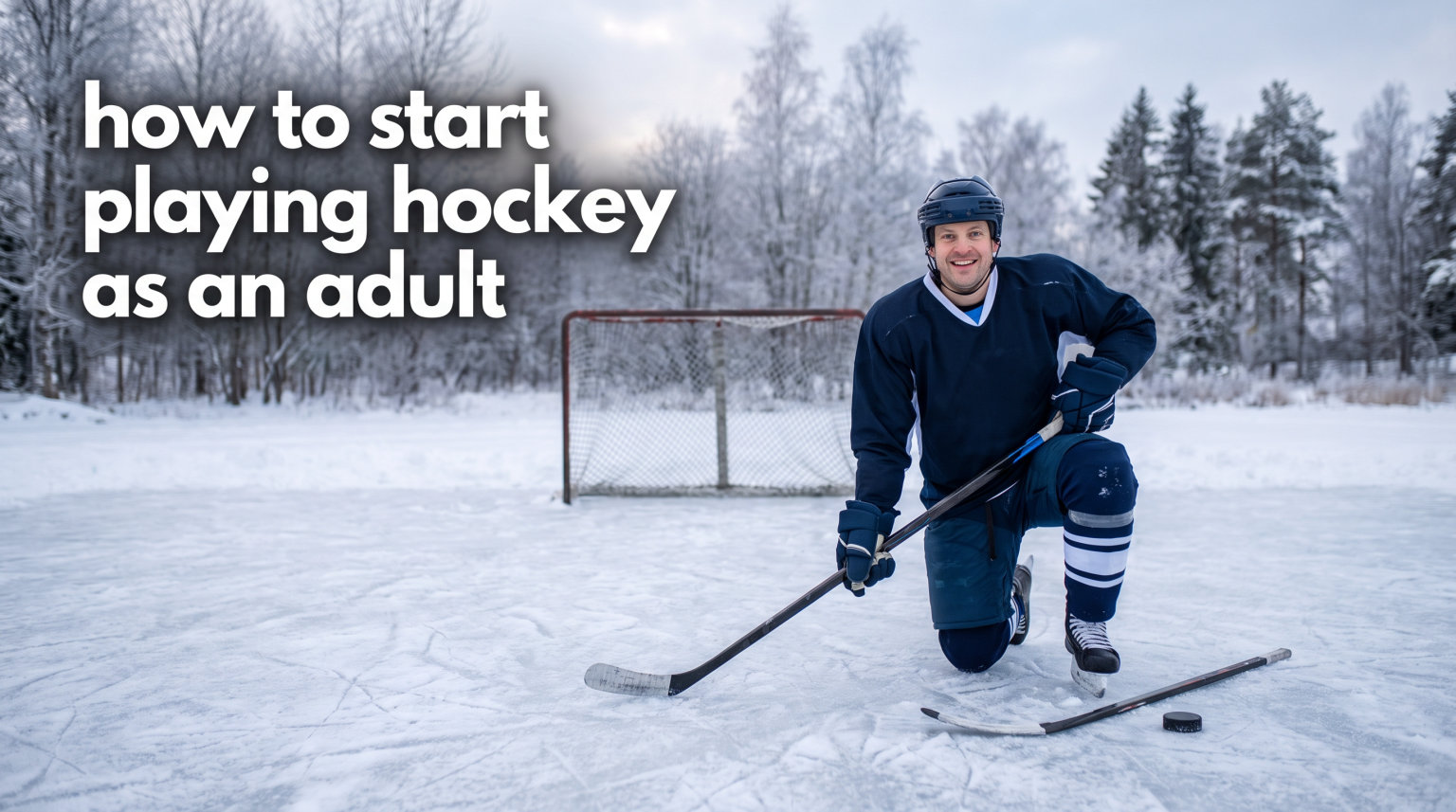
It does not matter if you are 20, 30, 40, or beyond. You can learn how to start playing hockey as an adult and join one of the fastest-growing sports communities in North America. I have seen adults lace up for the first time in their 50s and fall in love with the game just as quickly as those who started at 18. The adult hockey community is welcoming, patient, and excited to welcome new players who bring energy and enthusiasm to the ice.
If you have been wondering whether you are too old to start, let me give you a straight answer: you are not. Adults are the fastest-growing segment of hockey players, and rinks across the country have responded by creating programs specifically designed for beginners. This guide will walk you through everything you need to know, from conquering your fear of falling to scoring your first goal in a league game.
Table of Contents
Learn to Skate First – Why Skating Is the Foundation
Before you dream of slapshots and between-the-legs passes, you need to master one skill that will determine your success more than any other: skating. Skating is not optional in hockey. It is the sport. I cannot stress this enough. You can have the best stickhandling hands in the world, but if you cannot stop, turn, or chase down a loose puck, you will struggle to keep up with even the most casual adult league.
The good news is that adult learn-to-skate programs exist everywhere there is an ice rink, and many of them are specifically designed for people who want to eventually play hockey, not just skate recreationally. Look for “Adult Learn to Skate” programs that specifically mention hockey fundamentals. These programs teach you how to fall safely, glide on one foot, stop in both directions, and skate backward. Those skills might sound basic, but they are the exact building blocks you need.
Most adults need somewhere between six months and a year of regular skating practice before they feel comfortable enough to join a learn-to-play hockey program. This timeline varies widely based on natural athletic ability, how often you practice, and whether you have any background in sports that use similar mechanics like rollerblading or figure skating. The key is to resist the urge to rush onto the ice with a puck before you can confidently move in all directions.
What to Expect in Learn-to-Skate Sessions
Your first few sessions will feel awkward, and that is completely normal. You might feel like a baby deer learning to walk, and honestly, that comparison is not far off. Adult learn-to-skate classes typically run for 30 to 45 minutes and include a warm-up, basic stroke technique, balance exercises, and plenty of time for practice. Instructors understand that adults are learning alongside children in many cases, and they do not expect you to look graceful. They expect you to show up.
One thing I recommend is investing in a good pair of skates rather than renting from the rink. Rental skates are often dull, poorly fitted, and can actually make learning harder because your feet hurt and you cannot feel the ice properly. When you are ready to buy, visit a local hockey shop where staff can fit you properly. This brings me to another important point: do not cheap out on your helmet. Your brain is worth far more than the $50 you might save on a cheaper model.
Find the Right Hockey Program for Adults
Once you have spent several months building your skating foundation, it is time to find a program that will teach you how to actually play hockey. This is where many adults get overwhelmed because there are several different types of programs, and understanding the difference can save you time and frustration.
Learn to Play Programs
Learn to Play programs are structured courses designed specifically for adult beginners who have never played hockey before. They typically run for eight to twelve weeks and cover the fundamentals: stickhandling, passing, shooting, and basic team concepts. Many of these programs are offered through NHL team community foundations, local rinks, and hockey associations. They often include some equipment rental and are coached by experienced instructors who understand that adults learn differently than children.
One popular example is the Kraken Community Iceplex Adult Learn to Play program, which recommends that participants complete an Adult Learn to Skate program first before enrolling. This prerequisite ensures that instructors can focus on teaching hockey skills rather than spending most of the time helping students stay upright. Most Learn to Play programs cost between $200 and $500 for the full session, which is significantly cheaper than private lessons.
Adult Hockey Leagues
Adult hockey leagues are recreational leagues organized by local hockey associations. They offer different divisions based on skill level, from absolute beginner (often called “D” or “novice”) to highly competitive (often called “A” or ” elite”). Most leagues require you to register with USA Hockey, the national governing body for amateur hockey in the United States, before you can play in any organized game. USA Hockey membership costs around $50 per year and provides liability insurance coverage that protects both you and the league.
The beauty of adult hockey leagues is that everyone was once a beginner. Even the most skilled players in your local league started exactly where you are now. Recreational divisions are specifically designed to be low-pressure environments where the focus is on exercise, social connection, and having fun rather than winning at all costs. If you can find a league with a “jock and jill” division, that typically means co-ed play that welcomes players of all skill levels.
Pickup Hockey and Stick and Puck
Pickup hockey refers to informal games where players drop in without committing to a full season. These games are typically less structured and may have varying skill levels on the ice at any given time. Stick and puck sessions are open practice times where you can work on your individual skills without the pressure of a game. Both options are excellent for beginners who want ice time but are not yet ready for league competition.
Get the Essential Hockey Equipment
Equipment is where many adult beginners feel overwhelmed. Hockey has a reputation for being expensive, and yes, the costs add up quickly if you buy everything new at retail prices. However, you do not need top-of-the-line gear to start playing. Here is what you actually need to get on the ice safely.
Must-Have Equipment for Adult Beginners
Your helmet with a full cage or visor is non-negotiable. This is the most important piece of equipment because a head injury can change your life. Buy a helmet that fits properly and is certified for hockey use. Skates come next, and these should be fitted at a hockey shop rather than bought online. Your skates affect everything from your ability to balance to whether you develop shin bruises from poorly fitting boots.
You will also need gloves to protect your hands, shin guards that fit under your pants, elbow pads, shoulder pads, and a chest protector. Hockey pants (also called breezers) cover your hips and thighs. A stick is essential, and for beginners, I recommend something inexpensive while you are learning because you will likely break a few as your technique improves. Many stores sell “starter kits” that bundle the essential protective equipment together at a discount.
Equipment Rental vs Buying: What Makes Sense for Beginners
Some rinks offer equipment rental programs specifically for adult beginners. This is an excellent option if you want to try hockey before committing hundreds of dollars to gear you might not stick with. Rental programs through Hockey Finder and similar services allow you to rent skates, helmets, and pads for a fraction of the cost of buying new. You can typically rent for a full season for what it would cost to buy budget equipment.
However, buying makes more sense if you are committed to playing beyond your first season. Used equipment can be found at play it again sports stores, online marketplaces, and community swap groups. Many adult players upgrade their sticks every season anyway, so quality used gear is readily available. The one item I strongly recommend buying new regardless of your budget approach is your helmet. You never know how a used helmet was stored, and a compromised helmet may not protect you properly in a fall.
Master the Basic Hockey Skills
Once you are enrolled in a Learn to Play program or have access to regular ice time, you need to focus on the skills that will make you an effective player. There are five fundamental skills that every hockey player must develop, and you should prioritize them in the order I list them here.
Stopping
Stopping is the most important skill for your safety and the safety of others on the ice. I cannot tell you how many beginner injuries I have seen that could have been avoided if the player had learned to stop properly. The snowplow stop and the T-stop are the two foundational stopping techniques that will serve you well in game situations. Practice these until they become automatic responses rather than conscious decisions.
Forward and Backward Skating
Being able to skate forward confidently at varying speeds is obviously essential. Backward skating is what allows you to play defense, cover opponents, and move efficiently without turning to look where you are going. Work on both directions equally because many adult beginners favor their strong side and neglect backward skating, which creates a significant weakness in their game.
Passing and Receiving
Passing might seem simple, but proper passing technique requires hand-eye coordination, timing, and understanding of where your teammate will be rather than where they are. Practice passing with a partner, focusing on receiving the puck smoothly on your stick before attempting to make a return pass. The “give and go” is one of the most basic yet effective passing plays in hockey, and it requires both players to understand timing.
Shooting Fundamentals
You do not need a cannon of a shot to be effective in adult hockey. Most recreational goals are scored with wrist shots and snap shots that prioritize accuracy over velocity. Focus on getting the blade of your stick square to the puck and following through toward your target. Spending time shooting on an empty net during stick and puck sessions will help you develop muscle memory for good technique.
Stickhandling and Puck Control
Stickhandling is about keeping the puck close to your body while moving, protecting it from defenders, and maintaining control during tight situations. Practice dribbling the puck through cones or obstacles during dry land training (off-ice stickhandling work) to build hand coordination. The better your stickhandling, the more confident you will feel when pressured by an opponent.
Join Your First Hockey Game
The moment you have been working toward is finally here: your first actual hockey game. This is where all your practice comes together, and also where many adult beginners feel the most nervous. I want to tell you something that might help with that nerves: everyone in your beginner league was exactly where you are now, and no one expects you to look like an NHL player.
Starting in a Beginner League vs Pickup
I recommend starting in a structured beginner league rather than jumping into pickup games. Beginner leagues have skill caps and drafts that balance teams, ensuring you play with and against people at a similar level. Pickup games can be unpredictable, with skill levels varying wildly from shift to shift. A structured league also provides a consistent schedule, teammates you will recognize, and coaches or coordinators who can offer guidance.
What to Expect in Your First Adult Hockey Game
Your first game will likely be a little chaotic. Players will be out of position, passes will miss their targets, and goals will be scored on both ends. That is normal and expected in adult recreational hockey. The game operates under similar rules to professional hockey, but the enforcement is more relaxed in recreational leagues. The pace is also slower than what you see on TV, which makes it easier for beginners to keep up.
Finding a Buddy to Learn With
One of the most common pieces of advice from adult hockey players who started as beginners is to find a friend to learn with. Having a buddy makes the experience more enjoyable, keeps you accountable to showing up, and gives you a built-in practice partner. Many adult beginners recruit a friend or significant other to start the journey together, and those pairs often become lifelong hockey buddies.
Overcoming First-Game Nerves
It is completely normal to feel nervous before your first game. Your heart will race, your palms might sweat, and you might wonder what you got yourself into. Here is what I tell people: that nervousness is just excitement wearing a different outfit. Channel that energy into focus, and remember that the hardest part is showing up. Once you get your first shift under your belt, the nerves typically fade quickly.
The 5 Basic Rules of Hockey Every Beginner Should Know
Understanding the basic rules will help you feel more confident on the ice and allow you to focus on your skills rather than wondering what just got called. Here are the five essential rules that every adult beginner should know.
The Offside Rule
A player cannot enter the offensive zone (the area behind the opponent’s blue line) before the puck enters that zone. If you are caught offside, play is stopped and faceoff is reset outside the zone. This rule exists to prevent cherry-picking and ensures that attackers must wait for the puck to create legitimate scoring opportunities.
The Icing Rule
Icing is called when a player shoots the puck from behind the center red line across the opponent’s goal line without it being touched by any other player. When icing is called, play is stopped and a faceoff occurs in the offending team’s zone. Icing is not permitted in adult recreational leagues to encourage cycling and offensive play rather than simply clearing the puck down the ice.
Penalties and Power Plays
When a player commits a minor penalty like tripping, slashing, or holding, they must sit in the penalty box for two minutes while their team plays with one fewer player. This situation is called a power play for the team with the extra player. In recreational leagues, penalties are called less frequently than in professional hockey, but they still happen regularly enough that understanding power plays is important.
Puck Handling Rules
The puck must be touched only with your stick. Using your hands, foot, or any other body part to control the puck results in a stoppage of play. You also cannot kick the puck into the net or use any part of your body to intentionally direct it into the goal.
High Sticking
High sticking occurs when a player’s stick makes contact with an opponent above the shoulders. This results in a minor penalty in most cases. Accidental high sticks (where the follow-through of a shot hits an opponent) are typically not penalized unless the contact is deemed dangerous. When a player is injured due to high sticking, a double minor penalty may be assessed.
How Much Does It Cost to Start Playing Hockey as an Adult?
I would be doing you a disservice if I did not address the cost of starting hockey. This sport is not cheap, but it is more accessible than many people realize. Here is a realistic breakdown of what you can expect to spend in your first year.
Initial equipment for a beginner typically ranges from $500 to $1,500 depending on whether you buy new or used, and whether you purchase individual items or starter kits. Skates usually cost between $100 and $300 for a quality pair that will last several seasons. A complete set of protective gear runs $200 to $500. Sticks cost $50 to $150, and beginners should expect to break at least one per season as their technique improves.
Program fees for Learn to Play courses typically cost $200 to $500 for an eight to twelve week session. USA Hockey membership is approximately $50 per year. League registration varies widely by location but generally runs $500 to $1,500 per season depending on how many games are included and whether ice time is provided. Some leagues charge extra for jersey rental or referee fees.
The total first-year cost for a committed adult beginner typically falls between $1,500 and $3,500. This sounds like a lot, but consider that hockey equipment lasts multiple years when properly maintained, and many adult players continue playing into their 60s and beyond once they are established in the sport. If cost is a barrier, look for community programs that offer scholarships, equipment libraries, or sliding scale fees.
FAQs
Is 20 too late to start ice hockey?
No, 20 is not too late to start ice hockey. Many adults begin playing in their 20s, 30s, and even 40s or older. The key is finding a beginner-friendly program where everyone is learning the fundamentals together.
Is 30 too old to play hockey?
No, 30 is not too old to play hockey. Countless adults start playing in their 30s every year. Adult hockey leagues have divisions specifically for beginners, ensuring a low-pressure environment where everyone is at a similar skill level.
Is 40 too old to play hockey?
No, 40 is not too old to play hockey. Many players start in their 40s and play well into their 50s in recreational leagues. Starting at 40 means you will likely play in the 40+ or 45+ divisions where pace is appropriate for adult beginners.
What are the 5 basic rules of hockey?
The 5 basic rules every hockey player should know are: 1) No offside – you cannot enter the offensive zone before the puck. 2) No icing – you cannot shoot the puck from behind the center line to the opponent’s goal. 3) Minor penalties result in the other team getting a power play. 4) You can only control the puck with your stick. 5) High sticking results in penalties.
How much does it cost to start playing hockey as an adult?
Starting hockey as an adult typically costs between $500-1,500 for initial equipment and program fees. This includes skates ($100-300), protective gear ($200-500), stick ($50-150), and program fees ($200-500 per season). Many rinks offer equipment rental programs to help reduce upfront costs.
Conclusion: Your First Step Into Hockey Starts Today
Learning how to start playing hockey as an adult is one of the most rewarding athletic journeys you will ever undertake. The sport offers something rare: a community of adults who play together week after week, celebrate each other’s improvements, and genuinely want to see new players succeed. I have watched strangers become lifelong friends over the course of a single hockey season, and that transformation happens because everyone in adult hockey remembers what it felt like to be exactly where you are now.
The path forward is clear. Find a local learn-to-skate program, commit to getting on the ice regularly, and give yourself permission to be a beginner. You will fall. You will struggle with stopping. You will probably whiff on your first dozen passing attempts. That is not failure. That is the process. Every single skilled adult hockey player you see on the ice went through exactly the same thing, and they will welcome you into the community with open arms.
So what are you waiting for? That local rink you have been driving past probably offers exactly the program you need to get started. Make one phone call or send one email today. The hardest part of learning how to start playing hockey as an adult is making the decision to begin. You have already done that by reading this guide. Now it is time to lace up your skates and get on the ice.