
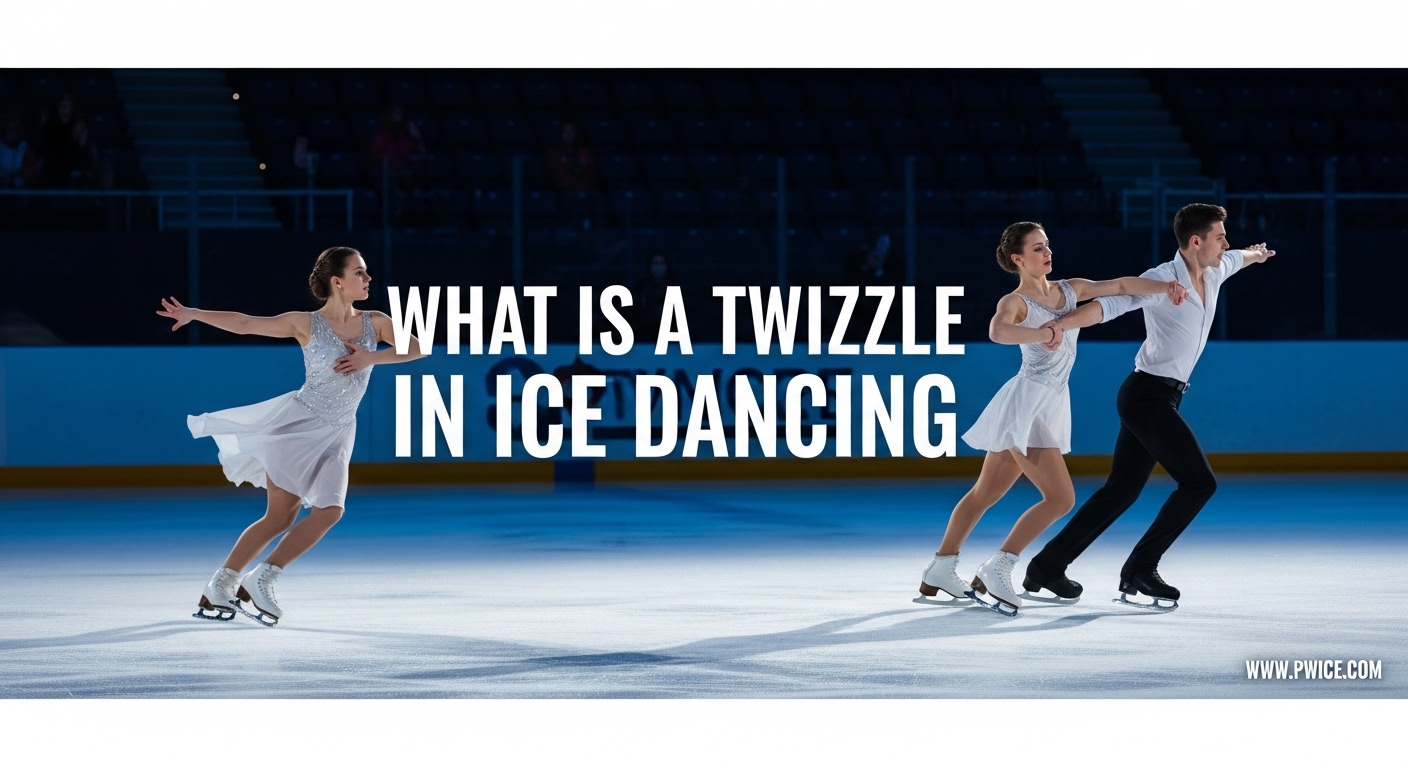
A twizzle is a multirotational, one-foot turn that moves continuously across the ice in figure skating. The International Skating Union (ISU) defines a twizzle as “a traveling turn on one foot with one or more rotations which is quickly rotated with a continuous (uninterrupted) action.” This element appears in ice dance programs, step sequences, and even single skating routines.
Unlike stationary spins that rotate in place, twizzles travel across the ice while the skater completes multiple rotations. Partners in ice dance perform them side-by-side, either simultaneously in synchronized sets or one after another in sequential patterns. The element demands precise timing, speed matching, and identical technique between partners.
Many skaters and coaches consider twizzles one of the most technically demanding elements in ice dancing. Alex Shibutani famously called them “the quads of ice dance” because they combine high risk with technical complexity and can make or break competition performances.
Table of Contents
What Is a Twizzle in Ice Dancing
A twizzle in ice dancing is a traveling turn performed on one foot with continuous rotation across the ice surface. The skater maintains an uninterrupted action on the blade’s rocker while completing one or more full rotations.
The ISU technical handbook specifically describes a twizzle as having continuous, uninterrupted action. This means the rotation cannot pause or stop mid-sequence. The skater must maintain flow and momentum throughout the entire element.
The term “twizzle” has an interesting origin. It derives from the word “twist,” meaning to rotate or wind around. The name captures the winding, rotational nature of the movement. While the exact date when the term entered figure skating vocabulary is not well-documented, it has been the official term for this element in ISU communications for decades.
In competition, twizzles appear as required elements in both the Rhythm Dance and Free Dance segments. Teams must perform sets of twizzles with specific entry edges and rotation counts to earn base values and level features from judges. The element showcases a team’s technical skill, speed, and synchronization.
Twizzles differ from simple three-turns in their rotational complexity. A three-turn involves a single half-rotation to change direction. A twizzle completes full rotations while traveling, making it significantly more challenging to execute properly.
Twizzle vs Spin: What Makes Them Different
Many viewers confuse twizzles with spins because both involve rotation on one foot. However, these elements differ in fundamental ways that affect how skaters execute them and how judges score them.
The primary difference is movement. A twizzle travels continuously across the ice while rotating. A spin remains essentially stationary, with the skater rotating around a fixed point on the ice. This traveling aspect makes twizzles unique among rotational elements.
Blade usage also separates these elements. Twizzles use the blade’s rocker, the curved portion of the blade that allows for turns and changes of direction. The skater shifts weight between the ball and heel of the blade while rotating. Spins, by contrast, typically use the toe pick for upright spins or various blade positions for different spin variations.
Rotation speed and control differ significantly between the two elements. Twizzles require controlled speed that maintains the traveling pattern across the ice. The skater must gather and control directional force while rotating. Spins can involve accelerating rotation speed through tightening positions.
Body position requirements also vary. Twizzles typically maintain a more open, free position with the non-skating leg extended. Spins often involve specific positions such as camel, sit, or scratch positions that affect the spin’s character and speed.
In competition scoring, twizzles count as step sequence elements or feature elements in ice dance. Spins appear as standalone elements with their own base values and requirements. Understanding these distinctions helps fans appreciate the technical demands ice dancers face.
The Four Types of Twizzle Entry Edges
Ice dancers can enter twizzles from four different edges, each creating distinct movement patterns and difficulty levels. Understanding these entry types helps explain why some twizzle sequences appear more complex than others.
Forward Inside Edge Twizzles: The skater enters traveling forward on the inside edge of the skating foot. This entry is generally considered the most basic and often serves as the foundation for learning twizzle technique. The skater rotates toward the inside of the circle created by the edge.
Forward Outside Edge Twizzles: The skater enters traveling forward on the outside edge. This entry requires careful balance because the rotation moves away from the body’s center. Many skaters find this entry more challenging than the forward inside edge.
Backward Inside Edge Twizzles: The skater enters traveling backward on the inside edge. Backward entries demand strong backward skating skills and confidence. The skater must maintain backward flow while initiating rotation on the inside edge.
Backward Outside Edge Twizzles: The skater enters traveling backward on the outside edge. This is often considered the most difficult entry because it combines backward movement with outside edge balance. Many ice dance teams save their backward outside twizzles for the end of a sequence when they have established rhythm and speed.
Elite ice dancers perform sequences combining multiple entry edges. A typical twizzle set might include forward inside, forward outside, then backward inside entries to demonstrate versatility and technical range. Higher-level twizzle sequences earn more points under the ISU judging system.
Edge quality matters significantly in competition. Judges look for clean edges without sub-pivoting or scratching. A clean edge shows the blade tracing a smooth arc on the ice without visible interruption or correction.
How to Perform a Twizzle: Step-by-Step Guide
Learning twizzles requires patience, practice, and attention to technical details. The following breakdown helps beginners understand the mechanics, though working with a qualified coach remains essential for proper learning.
Step 1: Establish Speed and Edge
Begin with sufficient speed across the ice. Choose your entry edge, typically starting with a forward inside edge as this offers the most stable platform for learning. Hold the edge for several beats to establish rhythm and balance before initiating rotation.
Step 2: Position Your Body
Maintain a tight, compact body position with a locked core. Keep your shoulders level and aligned over your hips. The free leg should extend naturally, neither too high nor dragging on the ice. Your arms should help with balance without swinging wildly.
Step 3: Initiate the Rotation
Begin rotating while maintaining pressure on the skating foot. The rotation should start from your core and transfer through the blade to the ice. Keep the motion continuous and uninterrupted from the moment you begin.
Step 4: Transfer Weight on the Blade
This is the critical technical element many beginners miss. As you rotate, shift your weight from the ball of the blade toward the heel. The continuous blade rocker allows the rotation to flow. Forum discussions among skaters consistently identify this weight transfer as the most challenging aspect to master.
Step 5: Control Rotation Speed
Avoid spinning too quickly. Many beginners try to force rapid rotation, which leads to losing balance or falling out of the twizzle. Let the blade and edge control the speed naturally. Proper technique creates appropriate rotation speed without forcing it.
Step 6: Exit Smoothly
Complete your intended rotation count and exit onto the next edge cleanly. The exit should flow naturally from the rotation without checking or stopping abruptly. Maintain your speed and body line as you transition to the next movement.
Common Mistakes and How to Fix Them
Falling out of twizzles: This usually results from improper weight distribution or trying to rotate too fast. Focus on the ball-to-heel weight transfer and let the blade do the work.
Spinning too fast: Opening your body position slightly can slow rotation. Avoid pulling your arms in tightly, which accelerates rotation like a scratch spin.
Leaning too far: Keep your shoulders aligned over your hips. Leaning forward or backward throws off your blade’s contact with the ice and disrupts the clean edge.
Shoulder alignment issues: Uneven shoulders create torque that fights against the rotation direction. Check your shoulder position in a mirror or on video.
Bad side difficulties: Most skaters find one direction significantly harder than the other. Practice your bad side more frequently, starting with just single rotations before attempting multiples.
Why Are Twizzles So Difficult
Twizzles earn their reputation as one of figure skating’s most challenging elements for several interconnected reasons. Understanding these challenges helps explain why even elite Olympic champions occasionally make twizzle errors in competition.
The first major difficulty is the combination of traveling and rotating simultaneously. Skaters must maintain directional movement across the ice while completing full rotations. This dual demand requires managing multiple physical forces at once.
Balance on a single skating foot during continuous rotation tests a skater’s proprioception and edge control. Unlike stationary spins where skaters can find and hold a balance point, twizzles constantly shift the skater’s center of mass as they travel. Small errors compound quickly.
The continuous, uninterrupted action requirement means skaters cannot pause to correct mistakes mid-sequence. Once a twizzle begins, it must complete without stopping or checking. This creates high stakes for each attempt.
In ice dance, partner synchronization adds another layer of complexity. Both partners must execute identical technique while maintaining close proximity and matching speeds. Partners must feel each other’s blade sounds and movement patterns to stay synchronized.
Alex Shibutani’s description of twizzles as “the quads of ice dance” captures their role in competition. Like quadruple jumps in singles skating, twizzles represent a high-risk, high-reward element. Perfect twizzles earn significant points. Errors cost teams dearly in their technical scores.
Even professional ice dancers make twizzle mistakes under pressure. The element demands such precise technique that competition nerves, ice conditions, or momentary lapses in concentration can disrupt execution.
Synchronized vs Sequential Twizzles in Competition
Ice dance teams perform twizzles in two distinct patterns during competition. Understanding these patterns helps viewers appreciate the technical requirements judges evaluate.
Synchronized Twizzles (SyTw): Both partners perform their twizzles simultaneously, side-by-side. Partners maintain close proximity while executing identical entries, rotations, and exits. Judges assess how well the partners match each other’s speed, rotation timing, and body positions throughout the sequence.
Sequential Twizzles (SeTw): Partners perform twizzles one after another rather than simultaneously. One partner completes their twizzle set, then the other follows with their set. Sequential patterns allow partners to showcase individual technique while still requiring matching quality and characteristics.
The ISU judging system evaluates twizzle sequences based on several criteria. Base value depends on the number of twizzles performed and their rotation counts. Level features add additional points for difficult variations such as changes of edge, changes of direction, or difficult positions.
Clean edges form the foundation of good twizzle scoring. Judges look for visible, continuous edges without sub-pivoting, scratching, or visible correction. Each twizzle in a set must show proper technique to earn full credit.
Partnership synchronization in synchronized sets requires extraordinary practice. Strong teams develop muscle memory that allows them to self-correct mid-sequence if they detect minor timing differences. The best ice dancers make synchronization look effortless despite the technical complexity involved.
Famous Twizzle Performances to Study
Studying elite ice dancers helps learners understand what exceptional twizzle technique looks like. Several teams have become particularly known for their twizzle quality and consistency.
Gabriella Papadakis and Guillaume Cizeron set the standard for modern twizzle excellence. The French ice dancers are four-time world champions and Olympic gold medalists. Their twizzles demonstrate perfect unison, speed, and flow. The Olympics.com website features their demonstration video explaining how to execute perfect twizzles.
Meryl Davis and Charlie White brought American ice dance to new heights with their technical precision. Their twizzle sequences in programs like “Scheherazade” showcased exceptional speed and synchronization that helped them win Olympic gold in 2014.
Maia and Alex Shibutani earned recognition for consistent, high-quality twizzle execution. Alex’s comment about twizzles being “the quads of ice dance” reflects his deep understanding of the element’s importance and difficulty.
Forum discussions among skating enthusiasts frequently cite Evgenia Lopareva and Geoffrey Brissaud and Loicia Demougeot and Theo le Mercier as having particularly beautiful twizzles. Fans appreciate their aesthetically pleasing positions and fast, clean rotation.
Not all twizzle moments are positive. Reddit discussions reference “infamous twizzle” moments where even elite teams made visible errors during major competitions. These moments demonstrate that twizzles remain challenging even at the highest levels of the sport.
Sit twizzles represent a rare variation occasionally seen in competition. These involve performing the twizzle in a sitting position, similar to a sit spin. Forum discussions note that sit twizzles are extraordinarily difficult, offer no extra scoring points, and appear less elegant than upright twizzles. This explains why few teams attempt them despite the technical challenge.
Frequently Asked Questions
What are the twizzles in ice dancing?
Why are they called twizzles?
Are twizzles hard?
How to do a twizzle in ice skating?
What is the difference between a twizzle and a three-turn?
Conclusion
A twizzle in ice dancing is a multirotational, one-foot turn that travels continuously across the ice. The ISU defines it as a traveling turn with uninterrupted action, distinguishing it from stationary spins and simpler turns.
Understanding what is a twizzle in ice dancing opens appreciation for one of figure skating’s most demanding technical elements. From the four entry edges to the weight transfer mechanics, twizzles reward dedicated practice with beautiful, flowing movement across the ice.
Whether you are a competitive ice dancer, a recreational skater, or a fan watching Olympic competition, recognizing quality twizzle technique enhances your connection to this beautiful sport.