
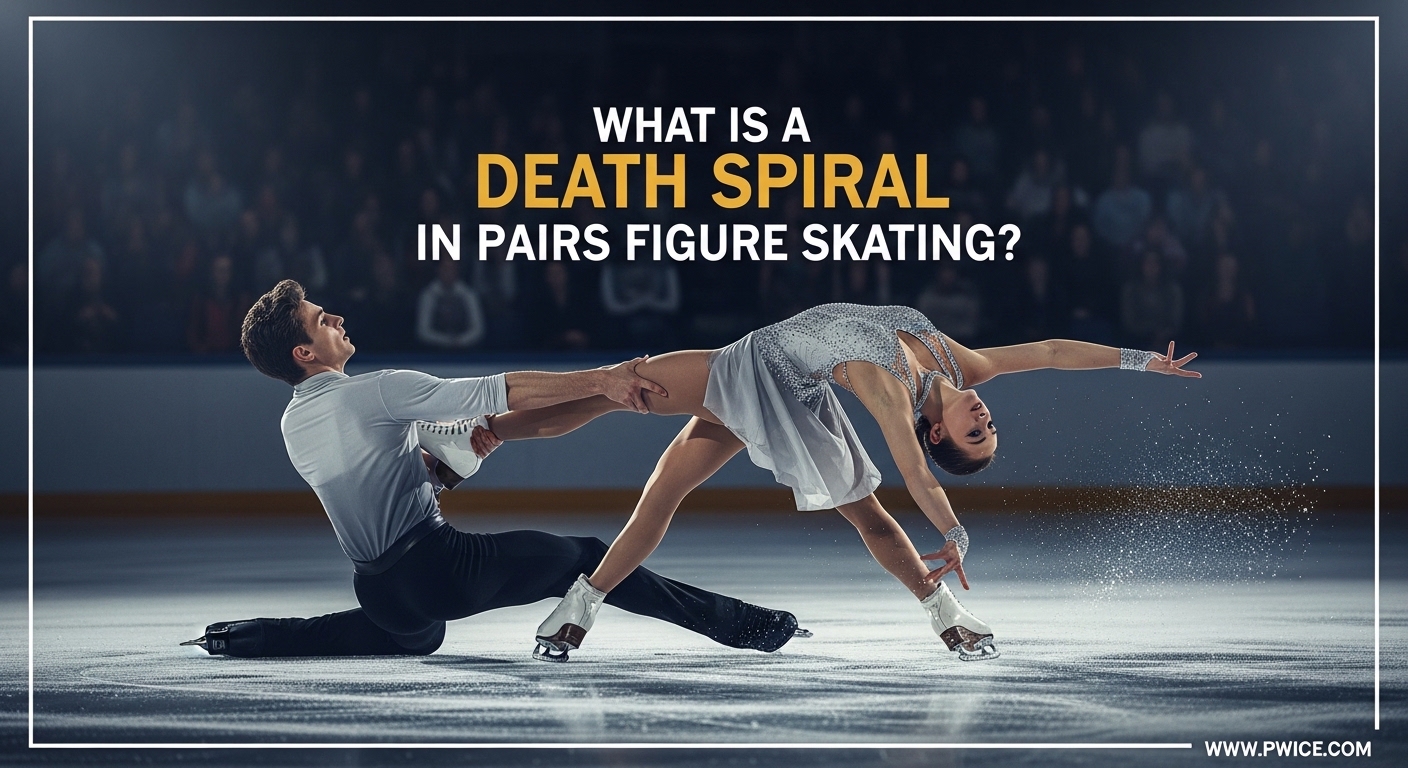
A death spiral is a circular move in figure skating involving two partners in the discipline of pair skating. The male partner lowers the female partner while she arches backward toward the ice, gliding on one foot with her head almost touching the surface as she rotates around him.
I’ve watched hundreds of pair skating programs over the years, and the death spiral never fails to captivate audiences. There’s something inherently dramatic about watching a skater lean backward until her head is mere inches from the ice, held only by her partner’s grip and the centrifugal force of their rotation.
This element has been a staple of competitive pair skating since the 2026 season, demonstrating trust, precision, and technical mastery between partners. Whether you’re a new fan watching the Olympics or an aspiring pair skater learning the basics, understanding the death spiral enhances your appreciation of this beautiful sport.
Table of Contents
What Is a Death Spiral in Pairs Figure Skating?
A death spiral is one of the most visually striking elements in pair skating. It combines physics, trust, and athletic precision into a single breathtaking movement that lasts only seconds but leaves a lasting impression.
The element consists of several key components working together. The male partner establishes a pivot position on his toe pick while the female partner glides on one foot, leaning backward into a deep arch. As she circles around him, her head comes within inches of the ice surface, creating the dramatic spiral that gives this element its name.
The Male Partner’s Role
The male partner serves as the anchor point for the entire element. He establishes a pivot position by planting his toe pick into the ice while maintaining balance on the edge of his other skate. This creates a stable center around which the female partner can rotate.
Throughout the death spiral, he must maintain steady pressure on his toe pick while providing consistent support through his arm and hand hold. Any wavering in his position affects the female partner’s ability to maintain her lean and complete the required revolutions.
The Female Partner’s Role
The female partner performs the more visually dramatic portion of the element. She glides on a single skating edge while leaning backward, arching her spine until her head is nearly parallel to the ice surface. Her free leg extends behind her, creating a long, elegant line.
She maintains this position while circling around her partner, completing the required revolutions before executing a controlled exit. The position requires exceptional core strength, flexibility, and trust in her partner’s stability.
The Physics Behind the Movement
The death spiral relies on centripetal force to maintain the female partner’s position. As she rotates around her partner, centrifugal force pushes her outward while her lean and his hold keep her in the circular path. This delicate balance allows her to maintain the dramatic arched position without falling.
The speed of rotation, the angle of her lean, and the distance from the pivot point all interact to create a stable system. When executed correctly, the element appears effortless despite the complex physics at work.
The Four Types of Death Spirals
The International Skating Union recognizes four distinct types of death spirals, each defined by the edge the female partner uses and her direction of travel. These range from relatively accessible to extraordinarily difficult.
Understanding the differences between these types helps viewers appreciate the technical difficulty on display during competitions. Not all death spirals are created equal, and the type a pair chooses reveals much about their skill level and competitive strategy.
1. Backward Outside Death Spiral (Easiest)
The backward outside death spiral serves as the foundation for all other variations. The female partner travels backward on her outside edge while arching backward around her partner. This was the original death spiral invented in 1928.
Most pairs learn this type first because the physics work most naturally in this configuration. The outside edge provides stability, and the backward motion aligns well with the centrifugal forces generated during rotation. You’ll see this type in virtually every competitive pair skating program.
2. Forward Inside Death Spiral
The forward inside death spiral requires the female partner to travel forward on her inside edge. This reverses the typical direction of travel and requires her to maintain the arched position while moving toward her partner rather than away.
This type demands greater control and timing because the natural momentum works against the required body position. Pairs attempting this variation demonstrate intermediate technical skill and a willingness to push beyond the most basic execution.
3. Backward Inside Death Spiral
The backward inside death spiral combines backward travel with an inside edge, creating a more complex balance challenge. The female partner must maintain her arch while the inside edge pulls her differently than an outside edge would.
This type appears less frequently in competition because it offers less visual distinction from the backward outside version while being technically more difficult to execute cleanly. However, pairs looking to maximize difficulty points may include this variation.
4. Forward Outside Death Spiral (Hardest)
The forward outside death spiral represents the pinnacle of difficulty in this element category. The female partner travels forward on her outside edge while arching backward, a combination that works against the natural physics of the movement.
Very few pairs attempt this type in competition because the risk of error outweighs the potential reward for most teams. When executed successfully, however, it demonstrates exceptional technical mastery and receives high difficulty marks from judges.
Death Spiral Comparison
Each death spiral type offers different challenges and visual effects. The backward outside remains the standard, while the forward outside represents the ultimate test. Pairs choose their death spiral type based on their strengths, the program’s choreography, and the difficulty points they need.
The ISU assigns different base values to each type, reflecting their relative difficulty. Understanding these distinctions helps viewers recognize when pairs are attempting something truly exceptional versus executing a standard element.
How to Execute a Death Spiral In 2026?
Executing a death spiral requires precise timing, physical strength, and complete trust between partners. While this guide provides an overview, actual learning should always happen under the supervision of qualified pair skating coaches.
Step 1: Entry Preparation
The pair establishes their initial positions with the male partner setting his pivot point. He typically begins on a curve that will lead naturally into the circular motion of the death spiral. The female partner positions herself to enter on the appropriate edge for the chosen death spiral type.
Partners establish their hand hold before entry, usually with the male partner’s right hand holding the female partner’s right hand. This cross-handed grip allows for the most natural arm extension during the element.
Step 2: Establishing the Pivot
The male partner plants his toe pick firmly into the ice while maintaining his balance on the edge of his other skate. This pivot position becomes the center point around which the female partner will rotate. The stability of this position determines the success of the entire element.
He must maintain steady pressure on the toe pick throughout the element, resisting the pull of his partner’s weight and the centrifugal force of her rotation. Any shift in his position creates immediate problems for the female partner’s balance.
Step 3: The Female Partner’s Lean
As the male partner establishes his pivot, the female partner begins her lean backward onto the chosen edge. She extends her free leg behind her and arches her back, lowering her head toward the ice surface. Her arm extends fully to maintain connection with her partner.
The lean must be aggressive enough to create the dramatic spiral position but controlled enough to maintain balance. She relies on her partner’s stability and the centripetal force of the rotation to hold her in position.
Step 4: Maintaining the Spiral
Once established, the death spiral must be maintained through at least one complete revolution to be considered valid. During this phase, both partners must hold their positions with minimal adjustment. The female partner circles around her partner while maintaining her arched position.
For higher difficulty levels, pairs may attempt additional revolutions, difficult entries, or challenging exits. Each additional element increases the technical value but also the risk of errors.
Step 5: Controlled Exit
Exiting the death spiral requires as much control as entering it. The female partner gradually reduces her lean and brings her head up while the male partner releases pressure on his toe pick. They typically exit into a glide position or directly into another element.
A clean exit is essential for earning positive Grades of Execution from judges. Many pairs practice exits extensively because a fall or stumble at this point negates much of the element’s value.
Common Mistakes to Avoid
Even elite pairs make mistakes with death spirals. The male partner’s pivot may shift during rotation, causing instability. The female partner might not achieve sufficient lean, resulting in a shallow spiral that lacks visual impact. Rushed entries often lead to poor positions that cannot be maintained.
Timing issues between partners create awkward transitions into and out of the element. Insufficient speed reduces the centrifugal force needed to maintain the female partner’s position. These mistakes appear even at high levels of competition.
ISU Rules and Requirements
The International Skating Union governs all aspects of death spiral execution in competitive figure skating. Their Technical Panel Handbook specifies exactly what constitutes a valid death spiral and how judges evaluate the element.
Minimum Requirements
To be considered valid, a death spiral must meet several minimum requirements. The female partner must achieve a position where her body forms a clear arch with her head close to the ice surface. The pair must complete at least one full revolution in the proper death spiral position.
The male partner must maintain his pivot position throughout the element. Both partners must show controlled entry and exit without visible hesitation or correction during the spiral phase.
Levels of Difficulty
The ISU recognizes four levels of difficulty for death spirals, from Level 1 (base) to Level 4 (most difficult). Higher levels require additional features beyond the basic element. These may include difficult entries, extra revolutions, changes of position, or complex exits.
Pairs must clearly demonstrate these additional features to receive credit for higher levels. The technical panel evaluates each death spiral in real-time, assigning the appropriate level based on visible criteria.
Grade of Execution (GOE)
Beyond the base value determined by type and level, judges award a Grade of Execution ranging from -5 to +5. Positive GOE reflects excellent execution, speed, ice coverage, and position quality. Negative GOE indicates errors, falls, or poorly executed elements.
A perfectly executed death spiral with excellent positions, good speed, and clean entry and exit can earn significant bonus points through positive GOE. Conversely, a fall or major error results in negative marks that reduce the element’s value.
Hand Hold Variations
The ISU distinguishes between one-handed and two-handed death spirals. Historically, all death spirals used two-handed holds for stability. The one-handed variation, popularized by Canadian pair Suzanne Morrow and Wallace Diestelmeyer at the 1948 Olympics, has become standard in modern pair skating.
Today, most competitive pairs perform one-handed death spirals because they demonstrate greater trust and allow more freedom in the female partner’s arm position. Two-handed death spirals still appear occasionally, particularly at lower competitive levels.
History and Origin of the Death Spiral
The death spiral has a rich history spanning nearly a century of figure skating evolution. From its invention in the 1920s to its current form as a required competitive element, it has undergone significant transformation while maintaining its essential dramatic character.
The 1928 Invention
German pair skaters Charlotte Oelschlägel and Curt Neumann invented the backward outside death spiral in 1928. This original version used a two-handed hold and established the basic pattern that all subsequent variations would follow. Oelschlägel, who also performed in ice shows, brought theatrical flair to the element.
The element quickly spread through the skating world as pairs recognized its visual impact. By the 1930s, death spirals appeared regularly in international competition, though they remained optional elements rather than requirements.
The 1948 Olympic Innovation
The death spiral transformed forever at the 1948 Winter Olympics in St. Moritz. Canadian pair Suzanne Morrow and Wallace Diestelmeyer introduced the one-handed death spiral during their bronze medal-winning performance. This innovation was as significant to pair skating as the Fosbury flop later became to high jumping.
The one-handed hold demonstrated a new level of trust and freedom between partners. It allowed the female partner greater extension and created cleaner lines in the element. Within years, most elite pairs had adopted this innovation.
Evolution into a Required Element
As pair skating developed standardized rules, the death spiral became a required element in competitive programs. The ISU specification of exactly which type of death spiral pairs must perform in the short program changes periodically, keeping the element fresh and challenging.
Today’s death spirals feature higher difficulty levels, more complex variations, and greater speed than those of previous generations. Modern pairs training facilities with video analysis and sports science support have pushed the technical boundaries of what was once a simple circular element.
Why Is It Called a Death Spiral?
The name “death spiral” originates from the element’s dramatic visual appearance rather than any actual danger. When the female partner arches backward with her head nearly touching the ice, the position resembles a spiral descending toward a fatal endpoint.
The dramatic terminology fits the theatrical nature of figure skating. Skating has a history of evocative names for its elements, from the “axel” to the “twizzle.” The death spiral’s name captures the tension and danger that audiences perceive, even though properly executed death spirals are controlled and safe.
Some skating historians suggest the name may also reference the spiral’s resemblance to the path of a falling leaf or other natural spirals. Regardless of its exact origin, the name has persisted for nearly a century and continues to intrigue new generations of skating fans.
Frequently Asked Questions
What is the hardest death spiral?
The forward outside death spiral is considered the hardest type. The female partner travels forward on her outside edge while arching backward, working against the natural physics of the movement. Very few pairs attempt this variation in competition due to its extreme difficulty.
What is the easiest death spiral?
The backward outside death spiral is the easiest and most common type. It was the original death spiral invented in 1928, and the physics work most naturally in this configuration. The outside edge provides stability, making it the standard choice for learning pairs.
Can ice dancers do death spirals?
No, death spirals are exclusive to pair skating. Ice dancing has different required elements and does not include death spirals in their competition format. The disciplines have distinct rule sets governed by the ISU, with death spirals reserved specifically for pair skating programs.
Why do some skaters bend to press their face into one leg before the death spiral?
This position is a difficult entry variation that adds technical value to the death spiral. The female partner demonstrates exceptional flexibility by bringing her head toward her skating leg before arching backward into the spiral position. It signals high skill level and can increase the element’s difficulty level.
What makes a death spiral ‘good’ vs ‘bad’?
A good death spiral features deep lean with the head close to the ice, clean entry and exit, good speed throughout, and maintained positions without visible corrections. A poor execution shows shallow lean, hesitation, loss of balance, or falls. Judges award positive GOE for excellent execution and negative GOE for errors.
Conclusion
The death spiral represents everything that makes pair skating compelling: trust, athleticism, artistry, and the illusion of danger within a framework of control. From its invention in 1928 to its current status as a required competitive element, it has evolved while maintaining its essential dramatic character.
Now that you understand what a death spiral is in pairs figure skating, you can appreciate the technical skill on display when you watch competitions. Notice the edge choices, the depth of the female partner’s lean, the stability of the male partner’s pivot. Each death spiral tells a story of partnership and precision.
Whether you’re watching the Olympics, a Grand Prix event, or a local competition, the death spiral remains one of figure skating’s most captivating elements. The next time you see a pair execute this move, you’ll understand exactly what makes it special.