
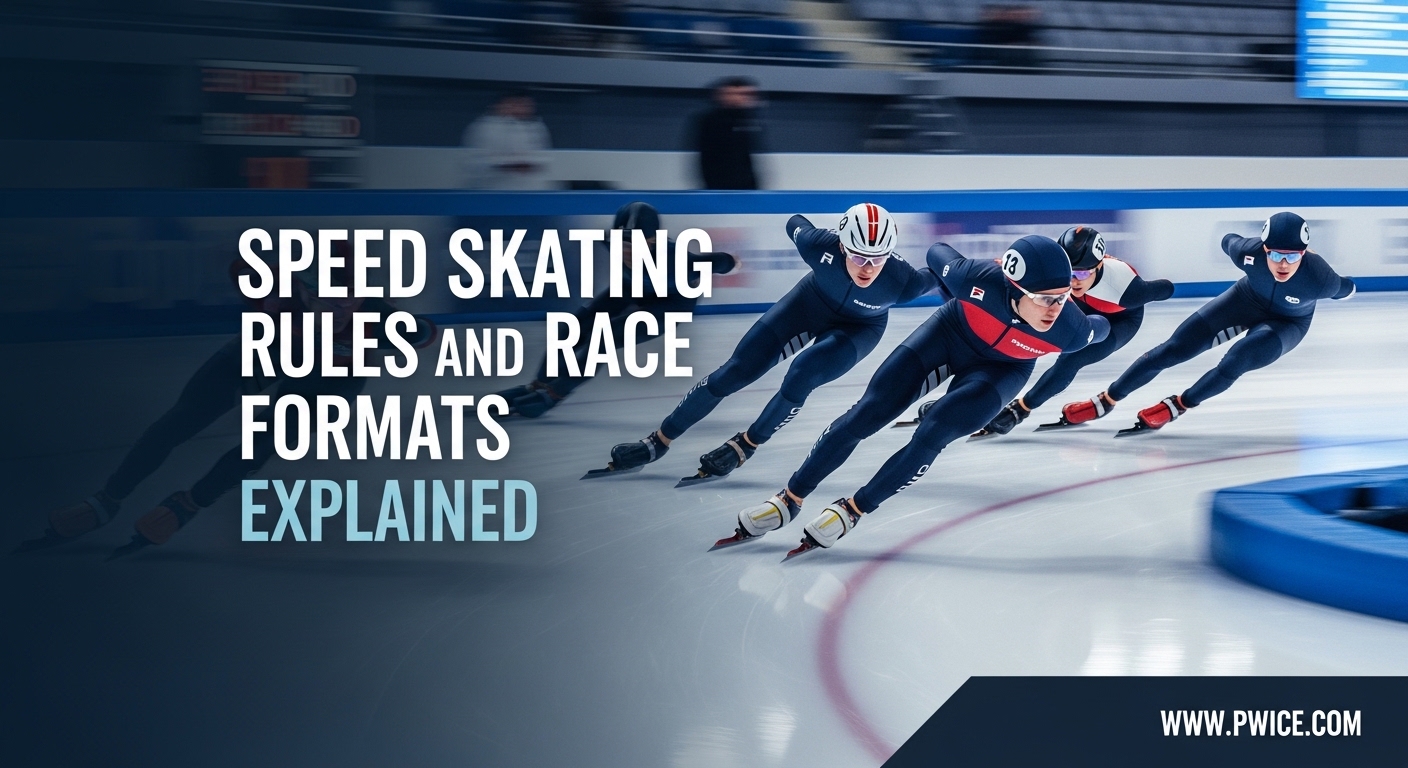
Speed skating rules and race formats explained properly can transform you from a confused spectator into an informed fan who truly appreciates the strategy and athleticism on display. With the 2026 Winter Olympics approaching in Milano Cortina, understanding these rules will help you enjoy every race to its fullest.
I have spent years following competitive speed skating, from local meets to World Championships, and the nuances of the sport are fascinating. This guide covers everything you need to know about long track, short track, mass start, and team pursuit formats.
Table of Contents
Long Track vs Short Track: The Two Disciplines
The most important distinction in speed skating is between long track and short track. These are entirely different sports with separate rulebooks, track sizes, and racing formats. Understanding the difference is essential before diving into specific rules.
Track Dimensions and Layout
Long track speed skating uses a 400-meter oval, similar to an athletics running track. Two competition lanes exist: an inner lane and an outer lane. The track surface is ice, and skaters race counterclockwise around the oval.
Short track speed skating uses a much smaller 111-meter track inside a hockey rink. The tighter turns and shorter straightaways create completely different racing dynamics. This format originated as a mass participation sport and evolved into a competitive discipline.
Competition Format Differences
In long track, skaters race against the clock in pairs, with each skater in their own lane. Short track features 4-6 skaters racing simultaneously in direct competition, similar to track cycling or running races.
Long track emphasizes pure speed and technique over multiple laps. Short track combines speed with strategy, passing, and tactical positioning because competitors share the same track space.
Equipment Variations
Long track blades are longer, typically 16-18 inches, designed for stability at high speeds on the straightaways. The boots are lower-cut to allow maximum ankle flexibility.
Short track blades are shorter, around 12-14 inches, with more curvature for navigating tight corners. The boots are higher-cut for better ankle support during aggressive cornering.
Speed Skating Race Formats Explained
The International Skating Union (ISU) governs competitive speed skating and recognizes multiple race formats. Each format has distinct rules, strategies, and appeal to different types of athletes.
Classical Distance Events
Classical distances are the traditional time-trial events where skaters race in pairs against the clock. Long track features 14 Olympic events: 500m, 1000m, 1500m, 3000m (women only), 5000m, and 10000m (men only).
Short track includes 9 Olympic events across individual and relay formats: 500m, 1000m, 1500m, and 3000m relay for women; 500m, 1000m, 1500m, and 5000m relay for men. Mixed team relay debuted recently.
Mass Start Format
Mass start combines elements of both disciplines. Multiple skaters (typically 16-24) race together on the 400m long track for 16 laps. Points are awarded at intermediate sprints and the final sprint.
This format was added to the Olympics in 2018 to bring more excitement and unpredictability to long track racing. It rewards tactical awareness and sprinting ability over pure time-trial speed.
Team Pursuit Format
Team pursuit features two teams of three skaters each starting at opposite sides of the track. Teams race against the clock while trying to catch the opposing team. The race ends when the third skater crosses the finish line.
Distances are 8 laps (3200m) for men and 6 laps (2400m) for women. Teams use drafting techniques similar to cycling, with the lead skater pulling for the team before dropping back.
Classical Distance Rules and Starting Procedures
Classical distance races follow strict protocols established by the ISU. Every detail, from starting positions to lane changes, is precisely regulated to ensure fair competition.
The Standing Start Protocol
Races begin from a standing start, signaled by a starting gun. Skaters position themselves behind the starting line with both skates on the ice. Movement before the gun results in a false start.
Each skater has two attempts. A first false start earns a warning. A second false start by the same skater results in immediate disqualification. This rule prevents skaters from trying to anticipate the start.
Lane Assignments and Armbands
Skaters wear colored armbands to indicate their assigned lane. The skater in the inner lane wears a white armband. The skater in the outer lane wears a red armband.
Lane assignments are determined by draw or seeding based on previous results. Higher-ranked skaters typically get advantageous lane draws depending on the specific competition format.
Lane Change Rules
The most critical rule in classical speed skating governs lane changes. Skaters must switch lanes each lap at the crossover straight. The skater moving from inner to outer lane has the right of way.
The crossover point is precisely marked on the track. Skaters must complete the lane change before entering the next curve. Failure to change lanes properly can result in disqualification.
At the crossover, the skater in the inner lane moves to the outer lane, and vice versa. This ensures both skaters cover exactly the same distance over the course of the race.
False Start Regulations
A false start occurs when a skater moves before the starting gun fires. Officials monitor starts using sensors and video replay. Even minor pre-movement triggers a violation.
After a false start, skaters return to the starting line and restart. The offending skater receives a warning card. A second violation by any skater results in disqualification.
Mass Start Speed Skating Rules
Mass start introduces completely different dynamics to speed skating. With multiple competitors on the track simultaneously, the rules focus on safety, fairness, and creating exciting racing.
Race Distance and Structure
Standard mass start races cover 16 laps of the 400m track, totaling 6400 meters. This distance balances endurance and sprinting abilities. Some competitions use variations, but 16 laps is the Olympic standard.
Races begin with a rolling start rather than a standing start. Skaters line up across the track and accelerate together when the starting gun fires. This prevents the chaos of a sprint from a standstill.
Points System Explained
The mass start points system determines the winner. Points are awarded at intermediate sprints and the final sprint. The skater with the most points wins, regardless of finish time.
Four intermediate sprints occur during the race, typically after laps 4, 8, 12, and 16. The first three skaters across the line at each intermediate sprint earn 3, 2, and 1 points respectively.
The final sprint offers significantly more points: 60 for first place, 40 for second, and 20 for third. This structure ensures the race remains competitive until the very end.
Winning Conditions
If skaters are tied on points, the final sprint result breaks the tie. The winner is the skater with the highest point total, not necessarily the first across the finish line. Strategic skaters may target intermediate sprints rather than the final sprint.
Skaters who finish outside the points positions still complete the race. Their finishing time is recorded for ranking purposes, but only points determine the official results.
Team Pursuit Rules and Format
Team pursuit brings teamwork and strategy to speed skating. Three skaters must work together to achieve the fastest possible time while managing their collective energy.
Starting Procedure
Two teams start simultaneously at opposite sides of the track. Each team of three skaters lines up one behind the other. The lead skater sets the pace while teammates draft behind.
Teams use a coordinated start with all three skaters beginning together. Timing begins when the first skater crosses the starting line.
Race Distances
Men race 8 laps covering 3200 meters. Women race 6 laps covering 2400 meters. These distances were established based on physiological research about optimal team pursuit racing.
The third skater’s time determines the team’s official result. Teams often sacrifice one skater who pulls the entire race, then drops out before the finish to let the two stronger skaters complete.
Knockout Format and Finals
Team pursuit uses a knockout format in major championships. Teams compete in heats, with winners advancing. The fastest teams from qualifying rounds receive seeding advantages.
The A final determines gold and silver medals between the two fastest teams. The B final determines bronze between the third and fourth fastest teams. This structure ensures exciting finals with meaningful outcomes.
Winning Criteria
A team wins by either completing the distance faster or by catching the opposing team. If a team catches their opponents, the race ends immediately with the catching team declared the winner.
If teams finish without catching each other, the third skater’s time determines the result. Teams must finish with at least two skaters to post an official time.
Short Track Speed Skating Rules In 2026
Short track operates under different rules than long track due to the multi-competitor format. The focus shifts from pure time-trial racing to tactical positioning and safe passing.
Track Specifications
The 111-meter track fits inside a standard hockey rink. Curves are extremely tight with a radius of about 8 meters. The straightaways are just 28.85 meters long.
A blue line marks the track boundary in the straights. Skaters must stay on or inside this line during races. Going outside the track boundary results in penalties.
Race Formats and Heats
Individual races feature 4-6 skaters depending on the competition level. Olympic events typically have 4 skaters per heat. Relay races have 4 team members with substitutions during the race.
Competitions progress through qualifying rounds, quarter-finals, semi-finals, and finals. Skaters advance based on finishing position rather than time, making every heat competitive.
Passing and Right of Way
A skater ahead at the entry to a turn has the right of way. Passing skaters must do so without contact. Any contact that affects another skater’s position can result in penalties.
The skater in front can choose any racing line. However, deliberate blocking or swerving to impede overtaking skaters is illegal and will result in penalties.
Relay Race Format
Relay teams have 4 members but only 2-3 race at any time. Skaters exchange by pushing teammates from behind. The exchange zone is marked on the track.
Teams complete 27 laps for women’s 3000m relay and 45 laps for men’s 5000m relay. The final two laps must be completed by the same skater who receives the bell lap signal.
Common Violations and Disqualifications
Understanding what leads to disqualification helps viewers appreciate why races sometimes end controversially. Officials enforce rules strictly to maintain fair competition.
Crossing the Line
In long track, cutting across the inner line of the track results in disqualification. Skaters must stay within their designated lane until the crossover zone. Crossing early shortens the distance traveled.
In short track, going outside the track boundary (crossing the blue line in the straights or the block markers in the turns) results in penalties. Skaters receive warnings or disqualification depending on the violation.
Interference and Impeding
Any deliberate contact that impedes another skater results in penalties. This includes pushing, blocking, or swerving into another skater’s path. Even accidental contact that significantly affects another skater can be penalized.
In short track, the lead skater cannot deliberately obstruct overtaking attempts. However, they can choose their racing line. The distinction between choosing a line and blocking requires judgment by officials.
False Starts
A second false start by any skater in a race results in immediate disqualification. Skaters must remain stationary until the starting gun fires. Even slight movements can trigger sensors and result in warnings.
Equipment Violations
Blades must meet strict length and curvature specifications. Boot modifications that provide unfair advantages are prohibited. Officials inspect equipment before major competitions.
Clothing must meet aerodynamic standards without providing propulsion assistance. Suits are inspected for illegal materials or construction that might enhance performance beyond aerodynamics.
Timing and Scoring Systems
Modern speed skating relies on precise electronic timing. The difference between gold and silver medals often comes down to thousandths of a second.
Automatic Timekeeping
Electronic sensors at the finish line record times automatically. Transponders on skaters’ ankles trigger timing when crossing the line. This system provides accuracy to 1/1000th of a second.
Timing begins when the starting gun fires. The clock stops when the skater’s skate blade crosses the finish line. Photo finish cameras provide backup verification for close races.
Manual Backup Timing
Hand timing serves as a backup to electronic systems. Three timekeepers operate stopwatches for each race. If electronic timing fails, manual times determine results.
Manual timing is accurate to 1/100th of a second. This slight difference matters at elite levels where races are often decided by thousandths.
Photo Finish Procedures
Cameras capture 1000 frames per second at the finish line. Officials review these images to determine finishing order in close races. The front of the skate blade determines the finish time.
In team pursuit, photo finish determines when the third skater crosses. This precise measurement ensures fair results in events often decided by hundredths of a second.
Tie-Breaking Rules
If two skaters post identical times, both advance in qualifying rounds. In finals, ties are broken by considering previous round times. If still tied, a skate-off may be held.
For championship standings and records, ties stand. Both skaters share the ranking or record. This reflects the precision of modern timing and the reality of identical performances.
History and Evolution of Speed Skating Rules
Understanding how rules evolved helps explain current regulations. The sport has transformed dramatically from its origins to modern Olympic competition.
Speed skating originated in the Netherlands during the 13th century. Early competitions used frozen canals with natural ice. Rules were informal and races were often simple point-to-point events.
The International Skating Union formed in 1892 to standardize rules. Early regulations focused on basic safety and fair competition. The 400-meter standard track emerged in the early 20th century.
Timing technology transformed the sport. Hand timing gave way to electric eyes in the 1960s. Modern electronic systems achieved 1/1000th second accuracy by the 1990s, necessitating rule updates about tie-breaking.
Mass start and team pursuit were recent additions to Olympic programs. These formats were introduced to increase spectator appeal while maintaining competitive integrity. Rule adjustments continue as the sport evolves.
Frequently Asked Questions
What are the different types of speed skating races?
Speed skating has three main race types: classical distances (time-trial format with two skaters racing in lanes), mass start (multiple skaters racing together with points awarded at sprints), and team pursuit (teams of three racing against each other on opposite sides of the track). Additionally, short track speed skating is a separate discipline with 4-6 skaters racing simultaneously on a smaller 111m track.
What is the format for speed skating competition?
Classical speed skating competitions use a time-trial format where skaters race in pairs against the clock. Each skater completes the distance in their assigned lane, switching lanes at the crossover straight each lap. The skater with the fastest time wins. Major competitions include qualifying rounds, with the fastest times advancing to final rounds where medals are determined.
What are the basic rules of speed skating?
Basic speed skating rules include: races begin from a standing start signaled by a gun; skaters must switch lanes at the crossover point each lap; the skater moving from inner to outer lane has right of way; skaters wear white armbands for inner lane and red for outer lane; a second false start results in disqualification; and winners are determined by electronic timing to 1/1000th second accuracy.
What is the difference between speed skating final A and B?
In knockout format competitions like team pursuit, the A final features the two fastest teams competing for gold and silver medals. The B final features the third and fourth fastest teams competing for the bronze medal. This structure ensures that teams eliminated in semi-finals still have meaningful final races with medals at stake, rather than just racing for placement.
Conclusion
Speed skating rules and race formats explained in this guide should prepare you to enjoy the sport at the 2026 Winter Olympics and beyond. From the precision of classical time trials to the strategy of mass starts and team pursuit, each format offers unique excitement.
The distinction between long track and short track remains fundamental. Understanding lane change rules, starting procedures, and points systems transforms viewing from passive watching into active appreciation. You will notice details casual viewers miss.
Whether you watch the elegant efficiency of a 5000m time trial or the tactical chaos of a mass start sprint, you now understand what makes speed skating one of the most compelling Winter Olympic sports.