
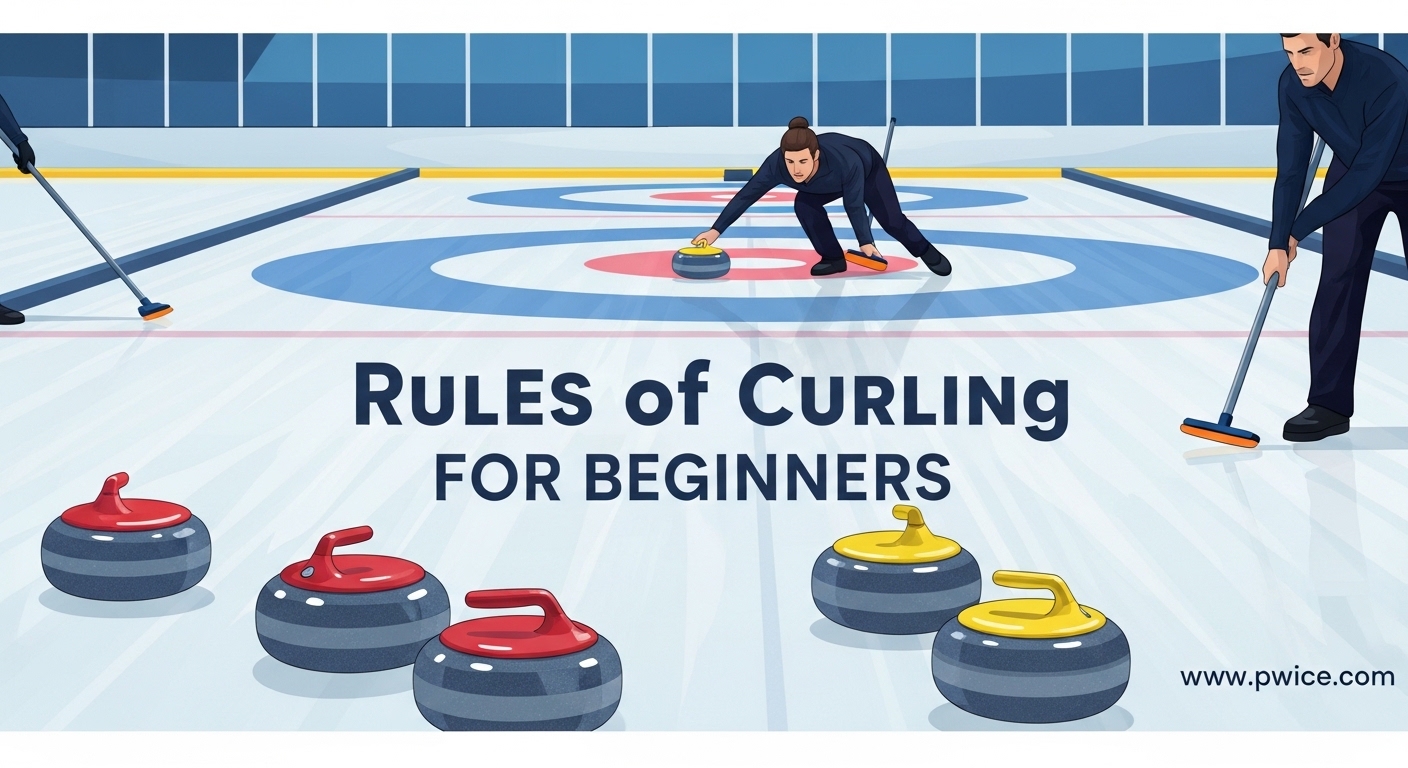
Have you ever watched the Winter Olympics and found yourself mesmerized by athletes sliding heavy stones across ice while teammates frantically sweep the surface? I had the same experience during the 2026 Olympics, and it sparked my curiosity about this fascinating sport. The rules of curling for beginners are actually much simpler than they appear on television, and this guide will walk you through everything you need to understand the game.
Curling is a strategic ice sport where two teams slide 44-pound granite stones toward a circular target called the house, scoring points by placing stones closer to the center than opponents. What makes curling unique is the combination of physical skill, tactical thinking, and the famous Spirit of Curling that emphasizes sportsmanship and honesty. Whether you want to understand what you are watching on TV or try curling yourself at a local club, this guide covers all the essential rules and concepts you need to know.
Our team researched the sport extensively, talked to club curlers, and analyzed the official regulations from World Curling Federation and USA Curling to bring you accurate, beginner-friendly explanations. By the end of this guide, you will understand exactly how scoring works, what each player does, and how to get started if you want to try curling yourself.
Table of Contents
What Is Curling?
Curling originated in Scotland during the 16th century, where people played on frozen ponds and lochs using flat stones. The sport evolved significantly over centuries, with standardized rules emerging in the 1800s and the first World Curling Championships held in 1959. Curling became an official Olympic sport at the 1998 Nagano Winter Olympics, bringing international attention to this centuries-old game.
At its core, curling is like a combination of shuffleboard, bowling, and chess played on ice. Two teams take turns sliding heavy granite stones down a specially prepared ice sheet toward a target area. The stones curl or curve as they travel due to the rotation imparted by the thrower, hence the sport’s name. Teams use brooms to sweep the ice in front of the stone, which reduces friction and allows the stone to travel farther and straighter.
A traditional curling match consists of multiple ends, similar to innings in baseball. Each team throws eight stones per end, alternating with their opponents. After all sixteen stones are thrown, the end is scored based on which team’s stones are closest to the center of the target. Most recreational games last eight ends, while championship and Olympic matches typically run ten ends.
How Scoring Works in Curling
The objective in curling is straightforward: score more points than your opponent by placing your stones closer to the center of the house. Only one team scores per end, which confuses many beginners who expect both teams to score like in bowling or archery. Understanding this fundamental principle makes everything else about curling much clearer.
After all sixteen stones are thrown in an end, officials or players determine which stone is closest to the button, which is the center of the target. The team that owns that closest stone scores one point. They also score one additional point for every other stone they have closer to the button than their opponent’s nearest stone. This means a team can score anywhere from one to eight points in a single end, though scores of one to three points are most common.
The House and Target Zones
The house is the circular target at each end of the ice sheet, consisting of four concentric rings. From outside to inside, these are the 12-foot ring, 8-foot ring, 4-foot ring, and the button at the center. The rings are purely visual aids to help players gauge distance; a stone counts the same whether it sits on the outer edge or touches the button, as long as it is closer than any opponent stone.
A stone must at least touch the outer 12-foot ring to be eligible to score. Stones that stop outside the house are removed from play after the end concludes. The tee line runs through the center of the house perpendicular to the length of the sheet, dividing the house into scoring and non-scoring areas for certain strategic situations.
Scoring Examples
Imagine the red team has three stones in the house while the yellow team has two. If red’s closest stone sits three feet from the button, and yellow’s closest stone sits four feet away, red scores one point. However, if red’s second stone sits at three and a half feet, and their third stone sits at three and three-quarter feet, both closer than yellow’s nearest, red would score three points total.
A blank end occurs when neither team has any stones in the house, or when the closest stones are equidistant from the button. No points are scored, and the team with the hammer keeps it for the next end. Blank ends are often intentional strategic moves when a team cannot score multiple points and wants to retain the last-stone advantage.
Understanding the Scoreboard
Curling scoreboards can be confusing because there are two different formats. The traditional scoreboard displays cumulative scores after each end, similar to most sports. The baseball-style scoreboard, which you will often see on television, shows which team scored in each numbered end and how many points they earned.
On a baseball-style board, you will see columns numbered 1 through 10 representing ends. The team that scores in an end hangs that number on their row and records the points earned. The blank spaces tell you which ends were blank, and you can track the running total by adding up each row. Most clubs use traditional scoreboards, so beginners should familiarize themselves with both systems.
Team Positions and Roles
Traditional curling teams consist of four players, each with specific responsibilities that rotate through the game. Understanding these roles helps make sense of the action and prepares you if you decide to join a league. Every position requires different skills, and many players specialize in particular roles while being capable of filling any spot when needed.
The Lead
The lead throws the first two stones for their team each end and typically delivers stones with specific weights and trajectories called for by the skip. Lead players need excellent delivery technique and consistency, as their stones establish the foundation for the end’s strategy. After delivering their stones, leads sweep for their teammates during the middle portion of the end.
Leads often throw guards, which are stones placed in front of the house to protect scoring stones or block opponent paths. Accuracy matters more than power for leads, as their shots set up the tactical framework that the rest of the team builds upon. Many beginner curlers start as leads because the position emphasizes fundamentals over complex strategy calls.
The Second
The second throws the team’s third and fourth stones of the end, building on the foundation established by the lead. Seconds must be versatile players capable of throwing guards, draws to the house, and occasionally takeout shots that remove opponent stones. Their stones often determine whether the end develops into an offensive or defensive situation.
Sweeping duties for seconds vary by team preference, but they typically handle significant sweeping responsibilities during the middle of the end. Seconds need strong communication skills because they receive strategy calls from the skip while also providing information about stone behavior back to the skip for future shots.
The Third (Vice)
The third, also called the vice-skip, throws the team’s fifth and sixth stones. This position requires excellent tactical understanding because the third often needs to make crucial shots that set up the final two stones. When the skip throws their stones, the third moves to the hack area and assumes the skip’s duties, calling strategy and holding the broom as a target.
The vice-skip also participates in determining the score at the end of each end. Both teams’ thirds measure or visually confirm which stones count and remove them from play in a specific order. This responsibility requires honesty and good judgment, embodying the Spirit of Curling that governs the sport.
The Skip
The skip is the team captain, strategist, and typically the most experienced player. They throw the final two stones of each end, which often determine the outcome. Skips spend most of the end at the far end of the sheet, directing strategy, calling shots for their teammates, and holding the broom as a target for stone delivery.
Skip players need comprehensive knowledge of ice conditions, opponent tendencies, and complex tactical situations. They decide whether to play aggressively for multiple points or defensively to limit opponent scoring. The skip’s ability to read the ice and make precise calls separates good teams from great ones, and beginners should watch how experienced skips manage games to accelerate their learning.
Team Communication
Effective curling teams communicate constantly throughout each end. The skip provides the initial call indicating what type of shot, where to aim, and how much weight (speed) to throw. Sweepers watch the stone’s path and communicate with the skip about whether it is running too heavy or light, allowing the skip to adjust the call if needed.
Standard communication includes calling line, which tells sweepers whether the stone is on the correct path, and weight, which indicates whether the stone has sufficient speed to reach its target. Experienced teams develop their own shorthand and signals for common situations, but clear, calm communication remains essential at every skill level.
The Equipment and Playing Surface
Understanding curling equipment helps beginners appreciate the sport’s unique challenges and prepares them for their first experience on the ice. Most curling clubs provide all necessary equipment for new members and Learn to Curl participants, so beginners do not need to invest in gear immediately.
The Curling Stone
Curling stones are made from dense granite, typically sourced from specific quarries in Scotland or Wales that produce stone with ideal properties. Each stone weighs between 38 and 44 pounds, with a maximum circumference of 36 inches. The bottom of the stone is concave, creating a narrow running surface that reduces friction while allowing the stone to curl as it travels down the ice.
Each stone has a handle on top that players grip during delivery. The handle allows the thrower to impart rotation, typically between one and three full turns, which causes the stone to curl in the direction of rotation. Handle colors identify which team owns each stone, with each team using eight identically colored rocks during a game.
Brooms and Brushes
Curlers use brooms, also called brushes, for two primary purposes: sweeping the ice in front of stones and providing a target for delivery. Modern brooms feature synthetic brush heads that are more effective and consistent than traditional straw brooms. The sweeping motion slightly warms the ice and reduces friction, allowing stones to travel several feet farther while also reducing the amount of curl.
Sweepers must use proper technique to be effective, applying downward pressure while moving the brush rapidly back and forth across the stone’s path. Beginners often underestimate how physically demanding sweeping can be, especially during intense competitive moments. Most clubs provide brooms for new curlers, though many players eventually purchase their own to match their height and sweeping style.
The Sheet Layout
A curling sheet is a long, narrow strip of prepared ice approximately 150 feet long and 15 feet wide. Two targets called houses sit at opposite ends, with each team shooting toward one house per end. The ice surface is not smooth like hockey ice but has a pebbled texture created by spraying tiny water droplets across the surface, which helps the stone glide and curl predictably.
Several important lines mark the sheet. The tee line runs through the center of each house. The hog line sits 21 feet in front of each house, and stones must completely cross this line to remain in play. The back line forms the rear boundary of the house; stones that completely cross the back line are removed from play. The center line runs the length of the sheet and serves as a reference for many shots.
Delivery Equipment
Curlers wear special shoes designed for the sport. One shoe, called the slider, has a smooth sole that allows the delivery foot to glide across the ice during the throwing motion. The other shoe, called the gripper, has a rubbery sole that provides traction for stability and sweeping. Many beginners start with slip-on sliders that fit over regular shoes, which clubs typically provide.
The hack is a foothold at each end of the sheet that provides a stable starting point for delivery. Players place one foot in the hack and use it to push off into the slide. Beginners often use delivery sticks, also called cue sticks, which allow players to deliver stones while standing rather than sliding. This accommodation makes curling accessible to people who might struggle with the traditional sliding delivery.
Basic Rules of Play
Now that you understand the equipment and layout, let us explore the fundamental rules that govern actual gameplay. These rules determine how stones are thrown, when sweeping is allowed, and what happens when violations occur. Understanding these mechanics makes watching curling significantly more enjoyable and prepares you for your first game.
What Is an End?
An end is the basic unit of curling, similar to an inning in baseball. During each end, both teams throw all eight of their stones, alternating throws. A complete end involves sixteen stone deliveries and typically takes 15 to 20 minutes to complete. Games consist of a predetermined number of ends, usually eight for recreational play and ten for competitive matches.
Teams alternate which end of the sheet they play from, shooting toward the house at the opposite end. After completing an end, players walk to the other end of the sheet and begin the next end shooting back toward where they came from. This alternation ensures both teams experience ice conditions from both directions, which can vary significantly due to temperature, humidity, and wear patterns.
The Hammer and Last Stone Advantage
The hammer refers to the advantage of throwing the last stone of an end, which provides significant strategic value. The team with the hammer has the final opportunity to score or prevent the opponent from scoring. In most situations, having the hammer is advantageous, though teams sometimes choose to blank an end to retain the hammer for the following end rather than score a single point.
The hammer alternates between teams each end in recreational play, with the team that did not score in the previous end receiving the hammer. If an end is blank, the team that had the hammer retains it. In championship play, the hammer is determined by a coin toss before the game, with the winner choosing either the hammer or the stone color. Mixed doubles uses a different system for determining last stone, which we will cover later.
Throwing Order and Delivery
Teams alternate throws throughout the end, with the leads from each team throwing their two stones first, followed by seconds, thirds, and finally the skips. This alternating pattern means a player from one team throws, then a player from the opposing team throws, continuing back and forth until all sixteen stones are delivered.
Players must release the stone before the near hog line, and the stone must completely cross the far hog line to remain in play. Stones that fail to cross the far hog line are removed from play immediately. Players also cannot touch a moving stone with their body or equipment, which would constitute a burned stone violation that we will discuss shortly.
The Free Guard Zone Rule
The free guard zone rule, also called the five-rock rule, is a relatively recent innovation that has dramatically changed curling strategy. The rule protects guard stones thrown in the first portion of an end from being removed by the opposing team. This protection encourages more aggressive, offensive play and creates more exciting games with higher scores.
Under the five-rock rule, no stone in the free guard zone, which is the area between the hog line and the house, can be removed from play until five stones have been thrown in the end. This means the first four stones, regardless of which team throws them, cannot be taken out if they sit in the free guard zone. After the fifth stone is thrown, all stones become valid targets for takeout shots.
This rule prevents the previously common strategy of blank ends and low-scoring games that resulted from teams immediately removing all opponent guards. Beginners should understand this rule because it affects shot selection, especially in the early part of each end when teams build offensive positions.
Sweeping Rules and Restrictions
Sweeping is one of the most visually distinctive aspects of curling, but it operates under specific regulations that affect how and when it can be used. A team may sweep their own stone from the tee line back to where it was released, which can be up to 40 feet of sweeping distance. Beyond the tee line, only one player from the delivering team may sweep, while the opposing skip may also sweep behind the tee line.
Sweepers must be positioned so they do not touch the stone with their broom or body. Accidental contact typically results in the stone being removed from play under the burned stone rule. Sweeping can add significant distance to a stone, often 6 to 10 additional feet, and can also reduce the amount of curl by up to half.
Sweeping is not allowed once a stone reaches the far tee line, at which point the stone must continue on its own momentum and path. This restriction prevents teams from influencing stones that are already in scoring position. Understanding when sweeping helps and when it is prohibited helps beginners appreciate the tactical decisions teams make during tense moments.
Common Violations and Penalties
Curling is largely self-officiated, relying on the Spirit of Curling and player honesty to maintain fair play. However, specific violations carry automatic penalties that players must enforce. Understanding these common infractions helps beginners avoid embarrassing mistakes and recognize when violations occur during games they watch.
A burned stone occurs when a moving stone is touched by a player, their broom, or any foreign object. The non-offending team has three options: remove the stone from play, leave all stones where they stop, or place the stones where they estimate they would have ended up without the infraction. Most teams choose to remove the burned stone.
A hog line violation occurs when a player fails to release a stone before the near hog line. The stone is removed from play immediately. Similarly, stones that fail to cross the far hog line or that completely cross the back line of the house are removed from play. These rules ensure all stones in play are legitimate scoring threats.
Common Beginner Mistakes to Avoid
After talking to club curlers and reviewing forum discussions, I noticed several mistakes that beginners consistently make. Avoiding these common errors will help you progress faster and enjoy your early curling experiences more fully.
Many beginners sweep too early or too late, missing the window where sweeping is most effective. Sweeping should begin as soon as the stone is released and continue until the stone crosses the tee line. Sweeping behind the tee line is not allowed for the delivering team, so communicate clearly with your sweepers about when to stop.
New curlers often confuse the different lines on the ice, leading to thrown stones that violate the hog line or miss the house entirely. Take time before your first game to walk the sheet and identify the hog lines, tee lines, and back lines. Understanding the boundaries helps with both throwing and strategy discussions.
Beginners sometimes struggle with the social etiquette of curling. Remember that broomstacking, the tradition of sitting down with opponents after a game for conversation and refreshments, is an essential part of curling culture. Win or lose, showing respect for your opponents and maintaining the Spirit of Curling matters more than the final score.
Essential Curling Terminology
Curling has its own vocabulary that can confuse newcomers. Understanding these terms will help you follow games, participate in conversations at the club, and accelerate your learning. Here are the essential terms organized by category for easier reference.
Shot Types
A draw is a shot designed to stop somewhere within the house without hitting other stones. Draws require precise weight control and are fundamental scoring shots. A takeout is a shot intended to remove an opponent’s stone from play by hitting it and driving it out of the scoring area.
A guard is a stone placed in front of the house, typically in the free guard zone, that protects scoring stones behind it. A peel is a hard takeout that removes a guard and often continues out of play itself. The raise is an advanced shot where one stone is played to bump another stone forward, sometimes into scoring position.
Playing Terms
Weight refers to the speed or momentum of a stone. Heavy means too much speed, while light means insufficient speed to reach the target. Line refers to the path or trajectory a stone takes down the ice. Good line means the stone is traveling on the intended path.
Curl describes the curved path a stone takes due to the rotation imparted during delivery. Handle refers to the rotation or turn given to a stone, specifically whether it has an in-turn or out-turn rotation. The hack is the foothold used for delivering stones, and the slider is the slippery sole on the delivery shoe.
Game Terms
An end is the completion of sixteen stone deliveries, after which scoring is determined. A blank end occurs when no points are scored, typically intentional to retain the hammer. An eight-ender is the rare and celebrated achievement of scoring all eight points in a single end.
A bonspiel is a curling tournament or competition. Broomstacking refers to the social tradition of sitting with opponents after a game, originally done by stacking brooms to indicate the match was complete and it was time for refreshments. The hammer is the last stone advantage in an end.
Spirit of Curling and Etiquette
The Spirit of Curling is a unique aspect of the sport that emphasizes sportsmanship, honesty, and respect. Unlike most competitive sports, curling is self-officiated at most levels, with players calling their own fouls and honestly reporting whether their stone was closer to the button.
Key etiquette includes shaking hands with opponents before and after each game, calling your own violations immediately, complimenting opponents on good shots, and never celebrating an opponent’s mistake. Broomstacking after the game is not optional in true curling culture; it is an essential part of the experience that builds the community that makes curling special.
How to Get Started with Curling
One of the most common questions beginners ask is how they can try curling themselves. The good news is that curling is one of the most accessible sports for newcomers, with clubs across the country offering introductory programs specifically designed for people who have never stepped on curling ice.
Finding Local Clubs
The best way to start curling is to find a local club through USA Curling’s club finder or World Curling Federation resources for international readers. Most metropolitan areas have at least one dedicated curling facility, and many regions have multiple clubs with different focuses and culture. Some clubs operate year-round, while others are seasonal depending on their location.
Many ice hockey rinks also host curling programs during off-peak hours. These programs might be less formal than dedicated curling clubs but provide excellent entry points for beginners. Call your local ice facilities and ask if they host curling or know of nearby clubs.
Learn to Curl Sessions
Nearly every curling club offers Learn to Curl sessions, which are beginner-specific classes that teach the fundamentals in a welcoming environment. These sessions typically last two to three hours and cover safety, equipment, basic delivery technique, sweeping, and simple rules. They cost between $25 and $50, which usually includes all necessary equipment.
Our research shows that Learn to Curl participants consistently rate these experiences highly, praising the patient instruction and supportive atmosphere. Instructors are used to working with complete beginners and expect that most participants will need time to become comfortable with the sliding delivery. Do not worry about looking foolish; everyone starts somewhere, and curlers remember their own first shaky steps on the ice.
What to Wear and Bring
Wear loose, comfortable clothing that allows you to stretch and move freely. The delivery motion requires lunging and sliding, so tight jeans or restrictive clothing will hinder your movement. Dress in layers, as curling facilities are kept cold to preserve the ice, though you will warm up once you start playing.
Bring clean, flat-soled athletic shoes to wear on the ice. The shoes you wear for delivery must be completely clean with no dirt, rocks, or debris that could damage the playing surface. Most clubs provide grippers to cover your shoes and sliders for delivery. Leave jewelry and watches in the locker room, as they can interfere with delivery or get lost.
What to Expect at Your First Game
Your first curling experience will likely begin with off-ice instruction about safety, etiquette, and basic concepts. Instructors will demonstrate the proper delivery motion before you step onto the ice. Most beginners start with delivery sticks or foot-to-foot delivery methods before attempting the full slide delivery.
Expect to fall. Everyone falls when learning to curl, and it is completely normal. Instructors teach how to fall safely, and the worst that usually happens is a wet backside and some bruised pride. Experienced curlers at the club will offer encouragement and tips, as the community thrives on bringing new people into the sport.
After some basic delivery practice, you will likely play a short game with other beginners. Do not worry about strategy or scoring; focus on getting comfortable with the motion and enjoying the experience. The goal of your first session is to have fun and decide whether you want to continue learning.
Costs and Membership Options
Initial Learn to Curl sessions are affordable, typically $25 to $50 for a two to three hour class. If you decide to continue, club membership costs vary significantly by region and facility quality. Recreational leagues might cost $150 to $300 per season, which usually includes several months of weekly games plus practice time.
Most clubs provide all necessary equipment for beginners, including brooms, sliders, and grippers. As you progress, you may want to purchase personal equipment, starting with curling shoes at $100 to $200 and a personal broom at $50 to $150. These investments are not necessary until you decide curling is a sport you want to pursue seriously.
Mixed Doubles: The Olympic Alternative
While traditional four-person curling remains the dominant format, mixed doubles has grown rapidly since becoming an Olympic sport in 2018. This two-person variation offers faster games and different strategic challenges that many viewers find exciting.
Mixed doubles teams consist of one male and one female player. Each team throws five stones per end instead of eight, with one player throwing the first and last stones while their partner throws the middle three. Games last eight ends and typically conclude in about 90 minutes, compared to the two and a half hours or more for traditional games.
The most significant rule difference involves the positioned stones. Before each end begins, one stone from each team is placed in specific positions: one at the back of the four-foot circle and one as a guard in front of the house. These pre-placed stones create immediate tactical situations and eliminate the blank-end strategy that sometimes slows traditional games.
Mixed doubles also features the power play option, which each team can use once per game. When a team declares a power play, their positioned stones are moved to the side of the sheet instead of the center, creating different angles and opportunities for scoring multiple points. This rule adds another strategic layer that distinguishes mixed doubles from traditional curling.
Rules of Curling for Beginners: Frequently Asked Questions
What are the major rules of curling?
The major rules of curling include: teams alternate throwing eight stones each toward the house, only the team with the stone closest to the button scores, stones must completely cross the hog line to remain in play, sweeping is allowed until the tee line, the free guard zone protects early guards from being removed, and the Spirit of Curling requires self-officiating and sportsmanship.
What is the mercy rule in curling?
Most recreational curling leagues have a mercy rule that ends the game early if one team leads by a large margin after a certain number of ends, typically seven or more points after five ends. However, competitive and championship play usually does not have mercy rules, and games continue for the full eight or ten ends regardless of the score.
How does scoring work in curling?
Only one team scores per end. The team with the stone closest to the button scores one point, plus one additional point for each stone closer to the button than the opponent’s nearest stone. Stones must touch the 12-foot ring to score. A blank end occurs when neither team has stones in the house, and no points are awarded.
What is the 5 stone rule in curling?
The five stone rule, also called the free guard zone rule, protects guard stones in the area between the hog line and the house. No stone in this zone can be removed from play until five stones have been thrown in the end. This rule encourages offensive play by preventing teams from immediately taking out all opponent guards.
Why do curlers sweep the ice?
Curlers sweep to reduce friction on the ice in front of the moving stone. Sweeping slightly warms the ice and creates a thin film of water that allows the stone to travel farther and straighter. Effective sweeping can add 6 to 10 feet to a stone’s distance and significantly reduce the amount of curl.
How long does a curling game last?
Recreational curling games with eight ends typically last about two hours. Competitive ten-end games last two and a half to three hours. Mixed doubles games, which are eight ends with five stones per team, last about 90 minutes. Championship games may include extra ends if tied, extending play time.
How many players are on a curling team?
Traditional curling teams have four players: the lead who throws first, the second, the third (also called vice-skip), and the skip who throws last and directs strategy. Mixed doubles, an Olympic format, uses teams of two players, one male and one female, with each throwing five stones per end.
What does the skip do in curling?
The skip is the team captain and strategist who throws the final two stones of each end. They direct the game by calling shots for teammates, holding the broom as a target for delivery, and determining overall strategy. The skip must have excellent knowledge of ice conditions and tactical situations.
What is burning a stone?
Burning a stone occurs when a moving stone is touched by a player, their broom, or any foreign object. The non-offending team then chooses whether to remove the stone from play, leave stones where they stop, or place them where they would have ended without the infraction. Most teams choose removal.
Can anyone try curling?
Yes, curling is one of the most accessible sports for beginners of all ages and abilities. Most clubs offer Learn to Curl sessions specifically for newcomers. Delivery sticks allow people who cannot perform the sliding delivery to participate while standing. The sport accommodates players from youth to senior ages.
Conclusion
The rules of curling for beginners are straightforward once you understand the core concepts: slide stones toward the house, sweep to influence their path, score points by getting closer to the button than your opponents, and conduct yourself with the honesty and respect that defines the Spirit of Curling. This ancient Scottish sport has evolved into a modern Olympic competition while maintaining the community values that make it special.
Whether you are watching the 2026 Olympics, attending a local bonspiel, or preparing for your first Learn to Curl session, you now have the knowledge to understand and appreciate the game. The combination of physical skill, strategic thinking, and sportsmanship creates an experience unlike any other sport. The curling community welcomes newcomers enthusiastically, knowing that everyone who tries curling helps grow this wonderful sport.
Your next step is simple: find a local club, sign up for a Learn to Curl session, and experience curling for yourself. Bring loose clothing, clean shoes, and an open mind. Be prepared to fall, laugh, and discover why curlers describe their sport as chess on ice with a community that feels like family. The ice is waiting.