
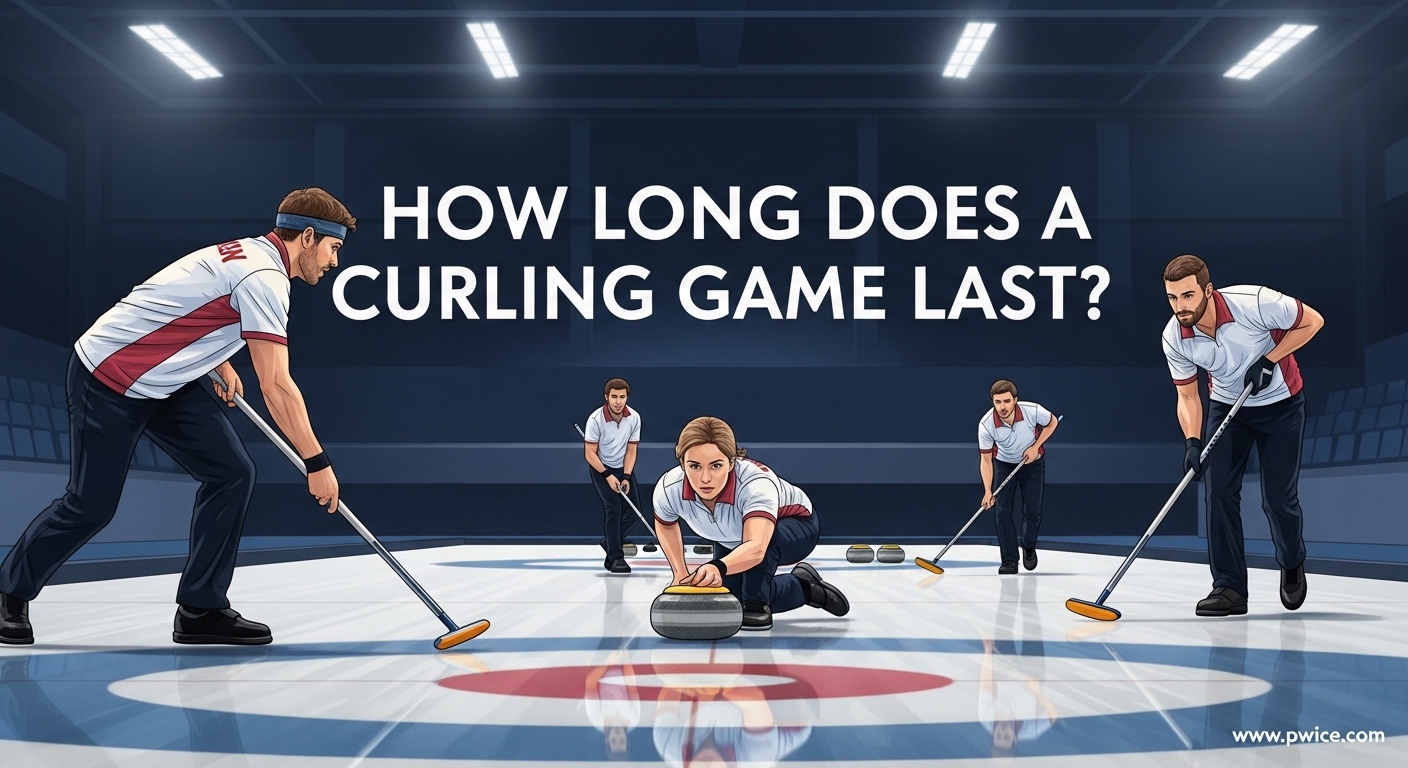
A typical curling game lasts approximately two hours for an eight-end club match, while championship or Olympic games usually run closer to 2.5 to 3 hours for ten ends. Mixed Doubles curling, a faster-paced format, typically completes in about 90 minutes.
Several factors influence exactly how long you’ll spend at the rink. The number of ends, the level of play, and whether officials are tracking “thinking time” all affect the total duration. Whether you’re planning to watch your first match or trying out curling yourself, understanding the timing helps you prepare for the experience.
Table of Contents
Quick Overview: Curling Game Duration by Format
Here’s a fast comparison of how long different types of curling games take:
| Format | Number of Ends | Approximate Duration | Thinking Time |
|---|---|---|---|
| Club/Recreational | 8 ends | 1.5 – 2 hours | Informal pace |
| Championship (Team) | 10 ends | 2.5 – 3 hours | 38 minutes per team |
| Olympic (Team) | 10 ends | 2.5 – 3 hours | 38 minutes per team |
| Mixed Doubles | 8 ends | 90 minutes | 22 minutes per team |
| Wheelchair Curling | 8 ends | 2 – 2.5 hours | 38 minutes per team |
How Long Does a Curling Game Last? The Complete Breakdown
The question “how long does a curling game last” doesn’t have a single answer. Duration varies significantly based on the competition level and format. Let me break down what you can expect from each type of game.
Club and Recreational Games: The 8-End Standard
Most curling clubs schedule two-hour time slots for league play. Within this window, teams typically play eight ends. I’ve found that experienced teams often finish in about 90 minutes, while newer players may use the full two hours.
At the club level, timing is usually informal. There are no official clocks counting “thinking time.” Instead, teams rely on etiquette and awareness of the schedule. Most clubs book multiple games on the same sheet of ice throughout an evening, so finishing on time matters.
Some clubs enforce a “bell rule” to keep games moving. When a bell sounds at a predetermined time (usually 1 hour and 45 minutes into the slot), teams complete the current end and play one more. This prevents games from running over and delaying the next teams.
Championship and Olympic Games: The 10-End Format
Elite-level curling follows the 10-end format used at World Championships and the Olympic Games. These games typically last between 2.5 and 3 hours. The official timing system keeps matches on schedule while allowing for strategic depth.
According to the World Curling Federation, men’s and women’s team events allocate 38 minutes of “thinking time” per team for a 10-end game. Each team also receives one 60-second timeout. The clock runs between shots, pausing only during stone delivery and when officials intervene.
Olympic broadcasts often span longer than the actual game time due to commercials, analysis, and breaks between ends. If you’re watching on television, plan for about 3 to 3.5 hours of coverage for a complete match.
Mixed Doubles: The Faster Format
Mixed Doubles curling was added to the Olympic program in 2018 and offers a condensed version of the sport. Games consist of eight ends rather than ten, and each team throws only five stones per end instead of eight.
The thinking time allocation for Mixed Doubles is 22 minutes per team for an eight-end game. Each team may call one 90-second timeout. This format typically wraps up in about 90 minutes, making it ideal for television broadcasts and shorter tournament schedules.
Wheelchair Curling Timing
Wheelchair curling follows an eight-end format similar to club play but with championship-level timing rules. Teams receive 38 minutes of thinking time per game, which is the same allocation as 10-end able-bodied championship games.
Games typically run 2 to 2.5 hours. The longer thinking time per end reflects the additional considerations wheelchair curlers face regarding positioning and delivery mechanics.
Curling Basics: Understanding Ends
To understand curling game duration, you first need to understand what an “end” is. An end is similar to an inning in baseball – it’s a complete round of play where both teams throw all their stones.
What Happens During an End?
During each end, teams alternate throwing stones. In traditional team curling (four players per side), each player throws two stones, for a total of eight stones per team per end. The sequence goes back and forth until all 16 stones have been delivered.
After all stones are thrown, the vice-skip from each team determines the score. Only one team can score per end. The team with the stone closest to the button (center of the house) scores one point, plus additional points for each stone closer to the button than the opponent’s nearest stone.
Why End Count Affects Game Length
An eight-end game has 20% fewer ends than a ten-end game, directly reducing playing time by roughly the same proportion. However, the time savings isn’t perfectly linear because earlier ends often move faster than later ones.
As the game progresses, strategy becomes more complex. Teams have more stones in play, and each shot carries greater consequence. The final ends of a close game can take significantly longer as teams deliberate over critical decisions.
Understanding Thinking Time (2026)
Championship curling uses a timing system called “thinking time” that fundamentally shapes how long games last. Unlike sports with a running game clock, curling clocks only run while teams are deciding their next move.
How Thinking Time Works
When a team’s stone stops moving, their thinking time clock starts. When the next player begins their delivery motion, the clock pauses. This system rewards quick, decisive play and penalizes excessive deliberation.
Here’s the thinking time allocation by format:
| Format | Ends | Thinking Time Per Team |
|---|---|---|
| Men’s/Women’s Team (Championship) | 10 | 38 minutes |
| Mixed Doubles | 8 | 22 minutes |
| Wheelchair Curling | 8 | 38 minutes |
What Happens If You Run Out of Time?
If a team exhausts their thinking time before completing all ends, they must finish each remaining stone within a strict delivery window. According to NBC Olympics coverage, teams that run out of time must deliver their remaining stones within four minutes and thirty seconds of when the previous stone came to rest.
This penalty puts enormous pressure on the offending team. They must rush every remaining shot, which usually leads to mistakes and often costs them the game.
Timeouts and Their Impact
Teams may call timeouts to consult with their coach or discuss strategy. In championship team play, each team receives one 60-second timeout per game. Mixed Doubles allows one 90-second timeout per team.
When a timeout is called, the thinking time clock pauses. The game clock stops for the duration of the timeout, so timeouts don’t directly reduce available thinking time. However, they do extend the overall real-world duration of the match.
Factors That Affect Game Length
Beyond the official format rules, several practical factors influence how long you’ll spend at the curling rink.
Team Experience Level
Experienced teams play faster. They communicate efficiently, recognize situations quickly, and deliver stones with confidence. Newer curlers often take longer to read the ice, discuss strategy, and execute shots.
At my local club, I’ve noticed that teams with several seasons under their belts consistently finish 15-20 minutes faster than beginner-heavy squads. This difference adds up over a season and affects how smoothly club schedules run.
Strategy Complexity
Not all ends are created equal. An end where teams are simply drawing to the house moves quickly. An end with multiple stones in play, guards, and tactical maneuvering takes significantly longer.
Blank ends – where no points are scored because all stones miss the house or are removed – move faster than ends with multiple stones counting. High-scoring ends with four or more points take the longest because of the stone removal and measurement process.
Extra Ends
If a game is tied after the scheduled number of ends, teams play extra ends until one team wins. Each extra end typically takes 10-15 minutes, extending the total game duration accordingly.
In championship play, extra ends follow the same thinking time rules. Teams continue using whatever time remains from their original allocation. This can create tense situations where a team must win quickly before their clock expires.
Technical Issues and Delays
Occasional delays occur due to stone measurement disputes, ice maintenance, equipment issues, or player injuries. While officials work to minimize these interruptions, they can add 5-15 minutes to a game’s duration.
Club Level Timing Etiquette
One insight from curling forums that most articles miss: recreational curling has its own unwritten timing rules that matter as much as official regulations.
Respecting the Schedule
At most clubs, ice time is booked in tight windows. If your game runs over, the next teams are left waiting on the benches. Experienced curlers value prompt pace of play as a courtesy to fellow members.
The Reddit curling community frequently discusses pace-of-play concerns. One common frustration: teams that engage in lengthy consultations between every shot, even when the situation is straightforward. While strategy discussion is part of the game, excessive deliberation creates bottlenecks.
Tips for Maintaining Good Pace
Here are practical ways to keep your club games moving:
Discuss strategy while opponents are shooting, not while you’re holding up play. Have your next player ready to deliver as soon as the previous stone stops. Skip the lengthy analysis for obvious shots – trust your instincts on straightforward calls.
Keep your pre-delivery routine consistent and reasonable. The full ceremonial approach you see on television isn’t necessary for club play. Find a routine that prepares you without slowing the game.
Communicating With Your Team
Good teams develop shorthand for strategy discussions. Instead of debating every option extensively, experienced teammates often communicate with brief exchanges: “Guard?” “Draw?” “Hit?” The skip provides the target, and the player delivers.
This efficiency comes with practice, but new teams can accelerate the learning process by establishing clear roles and communication patterns early.
FAQ: Common Questions About Curling Game Duration
How long is an average curling game?
An average curling game lasts about 2 hours for recreational 8-end play, 2.5 to 3 hours for championship 10-end games, and approximately 90 minutes for Mixed Doubles matches. Olympic and World Championship games typically run closer to 3 hours including breaks.
Does curling always go 10 ends?
No, curling does not always go 10 ends. Club and recreational games typically play 8 ends, which takes about 2 hours. Championship and Olympic games use the 10-end format. Games can also end early if one team concedes because the score gap is too large to overcome.
How long does it take to play 6 ends of curling?
A 6-end curling game typically takes 75 to 90 minutes at club level. Many beginner leagues and learn-to-curl programs use the 6-end format to introduce new players to the sport without the time commitment of a full 8-end game.
Are curling games timed?
Championship and Olympic curling games are timed using a thinking time system. Men’s and women’s team events allow 38 minutes per team for 10-end games. Mixed Doubles allows 22 minutes per team for 8-end games. Club and recreational games are typically untimed and rely on schedule slots of approximately 2 hours.
What happens if you run out of time in curling?
If a team runs out of thinking time, they must deliver each remaining stone within 4 minutes and 30 seconds of when the previous stone came to rest. This penalty creates enormous time pressure and usually leads to mistakes that cost the offending team the game.
When does a curling match end?
A curling match ends when one of three conditions occurs: all scheduled ends are completed, one team concedes because they cannot overcome the score deficit, or one team runs out of stones that could affect the outcome. In championship play, if tied after regulation, extra ends are played until one team wins.
Conclusion
So, how long does a curling game last? The answer depends on where you’re watching and what level of play you’re seeing. For most people trying curling at their local club, expect to spend about two hours on the ice for an eight-end game. If you’re watching the Olympics or World Championships on television, plan for a 2.5 to 3-hour commitment.
The beauty of curling is that despite these time differences, the core experience remains the same. Whether you’re playing a casual club match or watching elite athletes compete for gold, you’ll experience the strategic depth, social camaraderie, and unique challenge that makes curling one of the most fascinating sports on ice.
If you’re curious about trying curling yourself, contact your local club about a learn-to-curl session. Many clubs offer beginner programs that use shorter 6-end formats, giving you a taste of the sport without a major time investment. Once you experience the satisfaction of delivering your first stone, you might find that two hours on the ice passes faster than you’d expect.