
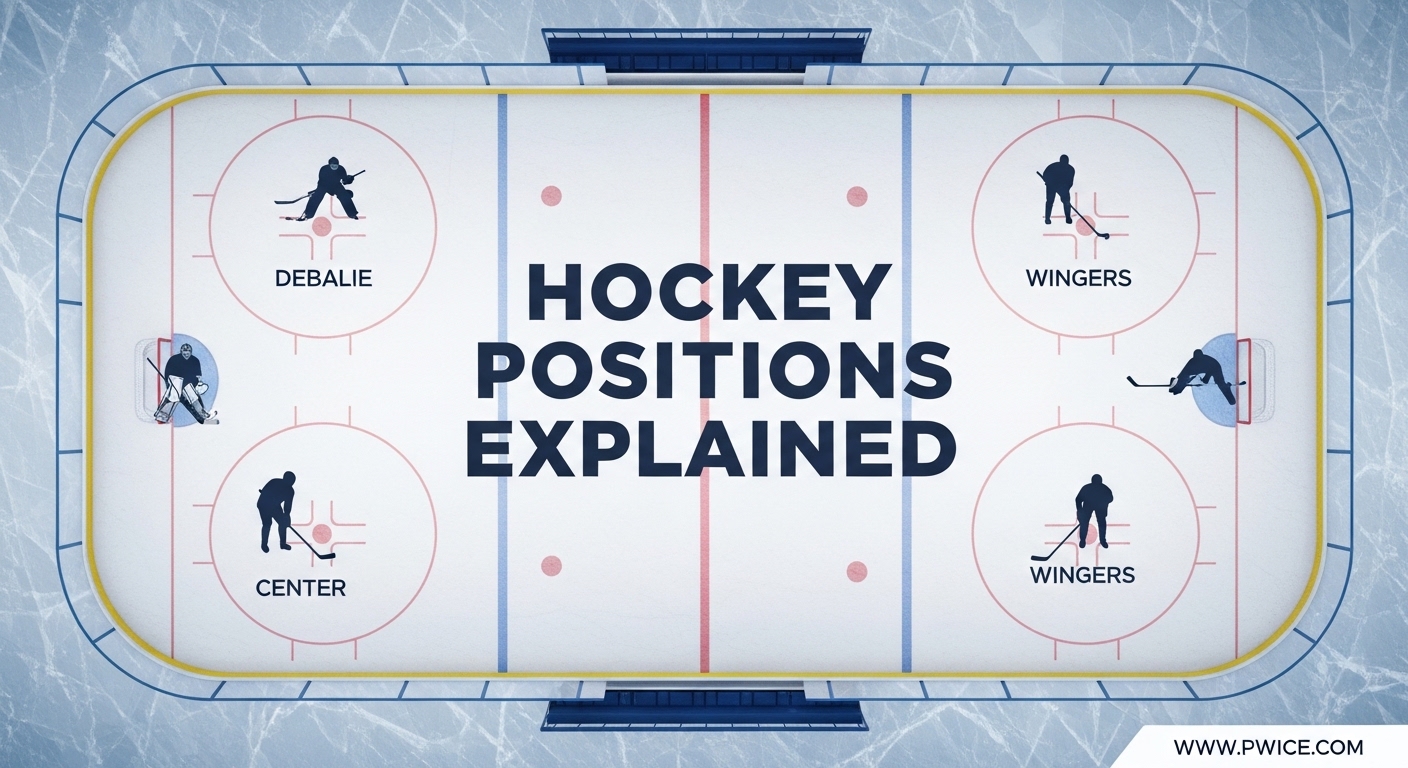
Hockey positions explained starts with a simple truth: each of the six players on the ice has a unique role that contributes to team success. Every hockey team fields three forwards (Center, Left Wing, Right Wing), two defensemen, and one goalie when playing at full strength. Understanding these positions helps you choose where to play, appreciate the strategy as a fan, or coach youth hockey with confidence.
I have played hockey for over 15 years at various levels, from youth leagues to adult recreational hockey. I have tried every position except goalie (that equipment is expensive and I like skating too much). What I have learned is that each position demands different skills, mental approaches, and physical attributes. Some positions suit beginners better than others, and the right choice can make your hockey experience much more enjoyable.
This guide breaks down every hockey position in detail. You will learn what each player does, the skills required, and which position might be right for you as a beginner. We will also cover how positions work together during different game situations.
Table of Contents
The 6 Hockey Positions on Ice: A Quick Overview
At any given moment during full-strength play, six players from each team compete on the ice. These players divide into three categories based on their primary responsibilities.
The Forwards (3 Players)
Forwards focus on scoring goals and creating offensive opportunities. The three forward positions are:
- Center: The playmaker who takes faceoffs and orchestrates offense
- Left Wing: Positioned on the left side, focuses on scoring and forechecking
- Right Wing: Positioned on the right side, mirrors left wing responsibilities
The Defensemen (2 Players)
Defensemen focus on preventing the other team from scoring and helping transition the puck to offense. The two defensive positions are:
- Left Defense: Covers the left side of the defensive zone
- Right Defense: Covers the right side of the defensive zone
The Goalie (1 Player)
The goalie stands in front of the net and prevents the puck from entering the goal. This position requires specialized equipment and completely different skills from the five skaters.
Center: The Playmaker and Faceoff Specialist
The center position serves as the backbone of both offensive and defensive play in hockey. Centers play in the middle of the ice and are involved in nearly every aspect of the game. They take faceoffs, set up plays, and provide support to both wingers and defensemen throughout the game.
Primary Responsibilities of a Center
The center has more responsibilities than any other skater on the ice. Every faceoff starts with the center battling for puck possession in one of the nine faceoff circles. After winning or losing the draw, centers must immediately transition to either offensive or defensive mode depending on the situation.
Offensively, centers act as the primary playmakers. They carry the puck through the neutral zone, set up plays in the offensive zone, and support both wingers along the boards and in front of the net. Centers often find themselves in the “slot” area between the faceoff circles, which is the most dangerous scoring area on the ice.
Defensively, centers backcheck hard to break up opposing rushes. They support the defensemen in front of the net and help transition the puck back to offense through quick breakouts. A good center never stops moving, constantly rotating between the offensive and defensive zones to support teammates.
Key Skills Every Center Needs
Playing center requires the most well-rounded skill set of any hockey position. Centers need exceptional hockey IQ to read plays and anticipate where the puck will go. They must possess strong passing vision to find open teammates in traffic. Faceoff technique demands practice and study of opponents’ tendencies.
Physical demands on centers are significant. They skate more than any other position, often covering 3 to 5 miles per game at the NHL level. Centers need strong two-way skating ability, quick acceleration for faceoffs, and endurance to maintain high energy throughout three periods.
Famous Centers to Study
Wayne Gretzky revolutionized the center position with his vision and playmaking ability, recording 2,857 career points that still stands as the NHL record. Sidney Crosby exemplifies the modern two-way center with his faceoff dominance and relentless work ethic. Connor McDavid showcases the speed and skill that define elite centers in 2026.
Left Wing and Right Wing: The Scorers and Forecheckers
Wingers play on the outer edges of the ice formation, focusing primarily on scoring goals and pressuring the opposing defense. The left wing plays the left side, while the right wing plays the right side. Although their core responsibilities are similar, each wing has unique considerations based on their shooting hand and positioning.
Winger Responsibilities on Offense
Wingers are primarily responsible for scoring goals and creating offensive pressure. In the offensive zone, wingers position themselves along the boards and in front of the net looking for scoring opportunities. They receive passes from the center or defensemen and look to shoot or make quick plays to the net.
Forechecking represents a key winger responsibility. When the opposing team has the puck in their own zone, wingers pressure the defensemen to force turnovers. An effective forecheck can create scoring chances and keep the puck in the offensive zone for extended periods. Wingers must read when to be aggressive and when to hold their position.
Defensive Duties for Wingers
While wingers focus on offense, they still have important defensive responsibilities. Backchecking requires wingers to skate hard back to their own zone when the opposing team transitions to offense. Wingers must cover the point (defensemen at the blue line) and prevent easy shots from the perimeter.
In the defensive zone, wingers typically cover the defensemen at the point while staying aware of passing lanes. They must be ready to break out quickly when the defensemen gain possession, providing outlets for passes along the boards.
Left Wing vs Right Wing: What Is the Difference?
The main difference between left and right wing involves shooting handedness and positioning preferences. Right-handed shooters often play left wing because it allows them to receive passes on their forehand and shoot quickly toward the net. Left-handed shooters often play right wing for the same reason.
However, many successful wingers play on their off-wing intentionally. Playing the opposite side opens up one-timer opportunities from the faceoff circle, a common power play strategy. Alex Ovechkin, one of the greatest goal scorers in NHL history, plays left wing as a right-handed shooter to take advantage of his powerful one-timer from the left circle.
Key Skills for Wingers
Wingers need strong shooting skills and the ability to finish scoring chances. Speed helps win races to loose pucks and beat defensemen on the outside. Board battles require strength and determination to win puck possession along the walls. Wingers also need good communication to coordinate with their linemates during line changes and zone coverage.
Defensemen: The Last Line Before the Goalie
Defensemen serve as the critical link between the forwards and the goalie, responsible for preventing scoring chances and starting offensive transitions. They play behind the forwards and focus on protecting their own net first while contributing to offense second. A strong defensive corps can make the difference between a winning and losing team.
Core Defensive Responsibilities
The primary job of defensemen is preventing the opposing team from scoring. In the defensive zone, they guard the area in front of the net known as the “crease” or “house.” They battle opposing forwards for position, block shots, and clear the puck from dangerous areas. Defensemen must read plays quickly to anticipate where the puck will go.
Gap control defines good defensive play. Defensemen must maintain proper spacing between themselves and attacking forwards, close enough to take away time and space but far enough to prevent being beaten by speed. This skill takes years to master and separates average defensemen from elite ones.
Offensive Contributions from Defensemen
Modern defensemen contribute significantly to offense. They start breakouts by passing or skating the puck out of the defensive zone. At the offensive blue line, defensemen take shots from the point and keep pucks alive by pinching down the boards to maintain offensive zone pressure.
Pinching requires good judgment. When a defenseman pinches, they move down the boards to keep a puck in the offensive zone. If they win the battle, the offense continues. If they lose, they must rely on their partner to cover for them, creating a temporary 2-on-1 for the other team. Smart defensemen know when to pinch and when to stay back.
The Blue Line and Zone Entry Defense
Defensemen control the blue line, which serves as the border between the neutral zone and the offensive zone. Standing up at the blue line means defensemen challenge forwards trying to enter the zone, attempting to break up the play before the offense gains the zone with control. This aggressive tactic can create turnovers but risks being beaten wide if mistimed.
Defensive zone coverage involves several systems, but the most common assigns each defenseman to cover one side of the net. Left defense covers the left side, right defense covers the right side. They work together to clear the front of the net and move the puck up to the forwards.
Physical Demands of Playing Defense
Defense requires physical play more than forward positions. Defensemen use body positioning and stick checks to separate opponents from the puck. Shot blocking demands courage, as defensemen routinely throw themselves in front of 90+ mile per hour pucks to protect their goalie. Strong skating backwards is essential, as defensemen spend much of the game retreating while reading the play.
Goalie: The Netminder and Game Changer
The goalie stands alone as the most specialized and unique position in hockey. While skaters move freely around the ice, goalies remain primarily in the crease, focused entirely on preventing the puck from entering the net. This position demands different skills, equipment, and a mental approach unlike any other in sports.
What Goalies Do During a Game
Goalies track the puck constantly, positioning themselves to cut down the angle between the shooter and the net. They use leg pads, gloves, blockers, and sticks to stop shots from all angles. Beyond stopping the initial shot, goalies control rebounds to prevent second-chance opportunities for the opposing team.
Playing the puck outside the crease has become an important goalie skill in 2026. Goalies who can handle the puck well act as a third defenseman, stopping dump-ins and starting quick breakouts. However, the NHL trapezoid rule limits where goalies can play the puck behind the net, keeping them within a defined zone to prevent interference with defensive play.
The Mental Game of Goaltending
Mental toughness separates good goalies from great ones. Goalies face immense pressure as the last line of defense. A single mistake often results in a goal against the team. Bouncing back from goals allowed requires resilience and short memory. Many goalies develop pre-shot routines to stay focused during the chaotic action of a hockey game.
The position also brings isolation. While skaters share shifts with linemates, goalies typically play the entire game alone. This solitude requires self-reliance and the ability to stay mentally engaged even when the puck is at the other end of the ice.
Goalie Equipment Requirements
Goalie equipment differs completely from skater gear. Leg pads protect the lower body while allowing flexibility to drop into the butterfly position. The catching glove catches high shots, while the blocker both protects the hand and can direct pucks away from the net. A chest protector, mask, and throat guard provide vital protection from flying pucks and sticks.
The cost of goalie equipment represents a significant barrier for beginners. A full set of new goalie gear can cost $3,000 to $5,000 or more, compared to $500 to $1,000 for skater equipment. Many youth goalies start with used or borrowed equipment to manage these costs.
Why Goalie Is Considered the Hardest Position
Goalie consistently ranks as the hardest position in hockey due to the unique skills required and the immense pressure involved. The position demands lightning-fast reflexes, exceptional flexibility, and the ability to read plays before they develop. Goalies must master multiple save techniques including the butterfly, standing saves, and paddle-down desperation stops.
Learning to play goalie from scratch takes years of dedicated practice. Most goalies who reach competitive levels started specifically in the position at a young age. The combination of physical demands, mental pressure, and specialized technique makes goaltending the most challenging hockey position to master.
How Positions Work Together: Formations and Zones
Understanding individual positions matters, but hockey truly works as a team sport when all six players coordinate their movements. The standard formation, called the 2-1-2, organizes players for both offensive and defensive situations. Learning how positions interact helps players read the game and make better decisions.
The 2-1-2 Formation Explained
The 2-1-2 formation describes how players position themselves in the offensive zone. The two defensemen remain at the point near the blue line, ready to shoot or defend against breakouts. The center plays in the middle of the ice between the faceoff circles. The two wingers position themselves along the boards or near the net depending on the play.
This formation provides offensive balance while maintaining defensive responsibility. If the other team gains possession, the defensemen are already in position to defend against a rush. The center can drop back to support while the wingers pressure the puck carrier.
Rink Zones and Position Responsibilities
The hockey rink divides into three zones defined by the blue lines and red line. The offensive zone lies between the opponent’s blue line and their goal line. The defensive zone sits between your blue line and your goal line. The neutral zone spans the middle of the ice between the two blue lines.
Each zone changes position priorities. In the offensive zone, forwards focus on scoring while defensemen support from the point. In the defensive zone, everyone prioritizes protecting the net. The neutral zone involves transition play, with defensemen starting breakouts and forwards positioning for passes.
Special Teams: Power Play and Penalty Kill
When one team takes a penalty, both teams change their formations. The power play team adds an extra forward or defenseman, creating a 5-on-4 advantage. Power play formations often use a diamond or umbrella setup to create shooting lanes from the point and side circles.
The penalty kill team removes one skater, playing with three forwards/defensemen and a goalie. They focus on blocking shots, clearing the puck, and preventing the power play team from setting up. Penalty killers sacrifice offense entirely to prevent goals during the disadvantage.
Which Hockey Position Should You Play? A Beginner’s Guide
Choosing your first hockey position can feel overwhelming. I remember standing in the locker room before my first game wondering where I would fit best. After playing multiple positions over the years and talking with coaches at various levels, I have developed a clear framework for helping beginners find their ideal position.
Position Difficulty Ranking: Easiest to Hardest
For beginners learning hockey, the positions range from relatively straightforward to extremely challenging. Here is the difficulty ranking based on learning curve, physical demands, and mental complexity:
1. Wing (Easiest for Beginners)
Wing represents the best entry point for most new hockey players. The position has clear responsibilities focused on offense. You stay on your side of the ice, support the center, and shoot when opportunities arise. Defensive duties are simpler than other positions, primarily involving backchecking and covering the point. Many coaches recommend starting at wing to learn basic hockey sense before moving to more complex positions.
2. Defense (Moderate Challenge)
Defense sits in the middle of the difficulty spectrum. The position requires strong backward skating and good positioning, which takes time to develop. Defensemen must read plays quickly and make decisions under pressure. While physically demanding, the defensive responsibilities are more defined than center duties. Players who enjoy physical play and have good hockey sense often thrive on defense.
3. Center (Challenging)
Center demands the most complete skill set of any skater position. You must win faceoffs, support both wingers, backcheck through the middle, and transition the puck constantly. The position requires exceptional conditioning since you skate more than any other player. Centers need strong hockey IQ to make split-second decisions in all three zones. Most players try other positions before attempting center at competitive levels.
4. Goalie (Most Difficult)
Goalie stands apart as the most challenging position to master. The unique movements, specialized equipment, and mental pressure create a steep learning curve. Goalies face 20 to 40 shots per game, with every mistake potentially costing a goal. The position requires years of dedicated training to develop proper technique. Most beginner goalies struggle significantly in their first season before skills start to click.
Self-Assessment: Which Position Fits You?
Consider these questions when choosing your position:
- Do you enjoy scoring goals and playing offense? Consider wing.
- Are you a strong skater with good endurance? Center might suit you.
- Do you prefer physical play and defensive responsibility? Try defense.
- Do you have quick reflexes and mental resilience? Goalie could be your position.
- Are you completely new to hockey? Start at wing to learn the basics.
Where Should You Put Your Weakest Player?
Coaches at youth and recreational levels often face this dilemma. The consensus among experienced coaches places weaker players at wing rather than defense or center. Wing allows players to contribute offensively while minimizing defensive exposure. They can focus on their side of the ice without the constant transitions that center requires.
Never put a beginner at goalie unless they specifically want to play there and have proper equipment. Defense requires too much responsibility for the team’s overall performance. Start weak players at wing and help them develop confidence before moving them to more demanding positions.
Youth Hockey Position Recommendations
Youth hockey programs should rotate young players through multiple positions during their development years. Many associations have rules requiring kids to play different positions before a certain age. This rotation helps players understand the whole game and discover which position they enjoy most.
For kids under 10, focus on fun and basic skills rather than rigid position assignments. Let them try everything including goalie (with proper equipment). As they enter competitive levels around 11 to 12 years old, they can start specializing in positions that match their skills and interests.
Frequently Asked Questions About Hockey Positions
What are the different positions in hockey and what do they do?
Hockey has six positions on the ice: three forwards (Center, Left Wing, Right Wing), two defensemen, and one goalie. Forwards focus on scoring and offensive pressure. The center takes faceoffs and plays as the main playmaker. Wingers play on the sides and focus on scoring and forechecking. Defensemen guard their own zone, block shots, and start offensive transitions. The goalie prevents the puck from entering the net and serves as the last line of defense.
What’s the hardest position to play in hockey?
Goalie is considered the hardest position in hockey due to specialized equipment, unique movements, and extreme mental pressure. Among skaters, center is the most challenging because it requires the most complete skill set including faceoffs, playmaking, and constant transitions between offense and defense. The difficulty ranking from easiest to hardest is: Wing → Defense → Center → Goalie.
Why can’t you wear 69 in the NHL?
The NHL officially prohibits players from wearing jersey number 69. While the league has never publicly stated the official reason, the decision relates to the number’s sexual connotations. The NHL has maintained this informal ban for decades. The highest number officially allowed is 98, with 99 retired league-wide for Wayne Gretzky.
Where do you put your weakest player in hockey?
The weakest player on a hockey team should play wing, specifically right wing for right-handed shooters or left wing for left-handed shooters. Wing has the simplest responsibilities and allows beginners to focus on basic skills without the defensive pressure of playing center or defense. Never place a beginner at goalie unless they have proper equipment and specifically want to play the position.
Conclusion: Finding Your Place on the Ice
Hockey positions explained comes down to understanding six unique roles that work together as a team. Whether you are drawn to the offensive creativity of wing, the all-around challenge of center, the physicality of defense, or the specialized pressure of goalie, there is a position that matches your skills and personality.
My advice for beginners: start at wing to learn the game, then experiment with other positions as you gain experience. Do not worry about choosing the “right” position immediately. Some of the best players I know switched positions multiple times before finding their fit. The beauty of hockey lies in its versatility. Every position matters, and every player contributes to the team’s success.
Lace up your skates, step onto the ice, and discover where you belong in this fast, thrilling sport. Whether you are a beginner taking your first strides or a parent guiding a young player, understanding hockey positions is your first step toward truly appreciating the greatest game on ice.