
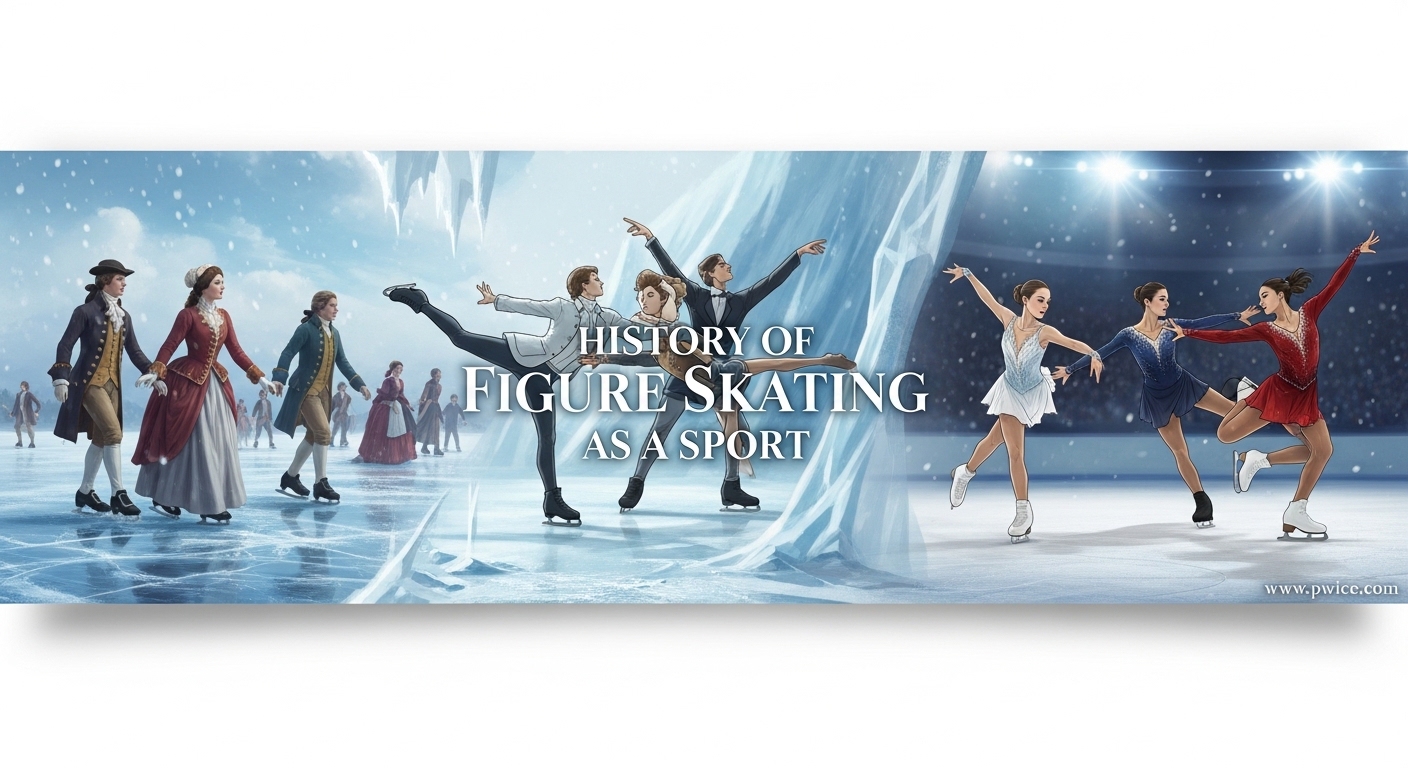
The history of figure skating as a sport stretches back over 5,000 years, making it one of humanity’s oldest physical pursuits. What began as a practical means of winter transportation in ancient Scandinavia evolved into an elegant Olympic sport that captivates millions today. Understanding the history of figure skating reveals how bone skates, steel blades, and eventually ice rinks transformed a survival necessity into an art form.
In this guide, we trace figure skating’s journey from 3000 BC to 2026. We will explore ancient bone skates, the Dutch innovation that changed everything, the American showman who revolutionized the sport, and the Olympic moments that defined generations. Our team spent weeks researching archaeological records, historical treatises, and competition archives to bring you this complete picture.
Whether you are a casual fan watching Olympic highlights or a student researching winter sports history, this article covers everything you need to know. Let us step onto the ice and glide through time.
Table of Contents
Ancient Origins: From Bone Skates to Steel Blades
Archaeological evidence places the earliest ice skates at approximately 3000 BC in what is now Scandinavia and Russia. Excavations around Lake Onega in Russia uncovered bone skates made from horse or cow ribs, flatened and pierced with holes for leather straps. These primitive skates allowed people to travel across frozen lakes and rivers during harsh winters.
The bone skate design remained remarkably consistent for millennia. The wearer stood on these bone runners and propelled themselves across ice using a pointed stick or pole. This method was purely functional. People needed to hunt, trade, and communicate across frozen landscapes. There was no artistic element yet, only survival.
The Dutch Revolution: Steel Blades Change Everything
The transformation from transportation to recreation began in the Netherlands during the 13th and 14th centuries. Dutch craftsmen began attaching metal blades made of iron and later steel to wooden platforms with leather straps. These early metal skates gave users far greater control than bone skates ever could.
By the 1500s, skating had become a popular winter pastime among Dutch citizens of all social classes. Paintings from this era depict people skating on frozen canals throughout Holland. The Dutch developed techniques for turning and stopping that went beyond simple straight-line travel. This represented the first step toward figure skating as we recognize it today.
The word “skate” itself derives from the Dutch word “schaats,” which comes from the Old Frisian word for the leg bone originally used as runners. When English visitors observed Dutch skating in the 1600s, they brought both the activity and the terminology back to Britain.
From Bones to Blades: Technical Evolution
The technical leap from bone to metal cannot be overstated. Bone skates had no edges. Users simply slid along the ice surface. Steel blades introduced edges, which allowed skaters to grip the ice and execute curves, turns, and eventually the intricate patterns that gave figure skating its name.
This evolution happened gradually. Early metal blades were flat strips of iron. It took centuries before craftsmen developed the hollow-ground blade with two distinct edges that modern skaters use. That hollow-ground design, which creates two sharp edges separated by a concave groove, arrived in the 1800s and enabled the precise footwork we associate with figure skating today.
Development in Europe: The Birth of Figure Skating as a Sport
The modern sport of figure skating took shape in 18th-century Britain. In 1772, British artillery lieutenant Robert Jones published “A Treatise on Skating,” the first instructional book on figure skating. This publication marked the moment when skating transformed from informal recreation into a technical discipline with defined methods and standards.
Jones described various movements including circles, turns, and figures performed on the ice. His work established the foundation for what would eventually become compulsory figures, a competitive element that dominated the sport for over 150 years.
The Edinburgh Skating Club: Organized Competition Begins
The Edinburgh Skating Club, founded in Scotland in 1744, represents the earliest organized skating club with formal membership requirements. To join, prospective members had to demonstrate proficiency by performing specific moves on the ice. This made it effectively the first figure skating organization in history.
Club members skated on a frozen pond in Edinburgh’s Queen’s Park. Their activities included races and demonstrations of technical skill. The club established rules, organized competitions, and maintained standards. This organizational structure spread throughout Britain and eventually across Europe.
By the early 1800s, skating clubs existed in London and other major British cities. These clubs developed increasingly complex patterns and figures that members were expected to master. The social aspect of skating remained important, but technical excellence now carried prestige and recognition.
The Vienna School and European Continental Style
While Britain developed the technical foundation, Vienna became the center of figure skating’s artistic evolution. In the mid-1800s, Viennese skaters began incorporating dance movements, ballet positions, and musical expression into their skating. This approach became known as the Vienna School.
The Vienna School emphasized elegance, flow, and connection to music. Skaters performed to waltzes and other compositions, moving with the rhythm rather than simply executing technical patterns. This artistic approach would eventually merge with British technical precision to create modern figure skating.
Austrian skaters developed the counter-turn and bracket turns that remain fundamental elements today. They also pioneered the three-turn, a movement that changes direction while maintaining flow across the ice. These technical innovations combined with artistic expression set the stage for figure skating’s golden age.
Jackson Haines: The American Showman Who Changed Everything
No single figure influenced modern figure skating more than Jackson Haines, an American ballet master and entertainer who arrived in Europe in the 1860s. Haines approached skating as a theatrical performance rather than a technical demonstration. He introduced elements that seemed revolutionary at the time.
Haines performed in Vienna in 1865 wearing a costume that shocked traditionalists. Rather than the formal attire of the era, he wore a simple black velvet outfit that allowed freedom of movement. More importantly, he attached his blades directly to his boots rather than strapping them on, giving him unprecedented control and stability.
His performances included spins, jumps, and dance movements executed to music. Audiences had never seen anything like it. Haines toured extensively across Europe and Russia, spreading his innovative style. In Russia, he became particularly influential, helping establish the Russian skating tradition that would later dominate the sport.
Haines died in 1879 at age 35, but his influence persisted. The Vienna School incorporated many of his innovations. The concept of skating as performance art rather than purely technical demonstration became established. Every modern figure skater performs in the tradition Jackson Haines initiated.
The International Skating Union Is Founded
As figure skating grew internationally, the need for standardized rules became apparent. In 1892, representatives from several European countries met in the Netherlands and established the International Skating Union (ISU). This organization would govern competitive figure skating for the next century and beyond.
The ISU initially focused on speed skating, but quickly expanded to include figure skating competitions. They established definitions for acceptable movements, competition formats, and judging criteria. This standardization allowed international competitions to function fairly and consistently.
The ISU organized the first World Figure Skating Championships in 1896 in Saint Petersburg, Russia. Only men competed initially. The first World Championship for ladies took place in 1906 in Davos, Switzerland. Pair skating championships began in 1908 in Saint Petersburg.
Olympic History: Figure Skating at the Games
Figure skating made Olympic history in 1908 at the Summer Games in London. This seems surprising today, but winter sports were not yet organized into separate Olympic events. Figure skating became the first winter sport added to the Olympic program, predating the first Winter Olympics by 16 years.
The 1908 London Games featured four figure skating events: men’s singles, ladies’ singles, pair skating, and special figures. British skater Madge Syers made history by becoming the first Olympic champion in ladies’ figure skating. She also competed against men in the all-around event, finishing second and demonstrating that women belonged in competitive skating.
The First Winter Olympics: Chamonix 1924
The first official Winter Olympic Games took place in Chamonix, France, in 1924. Figure skating was included alongside ice hockey, bobsleigh, curling, and other winter sports. Austrian skater Herma Planck-Szabo won the ladies’ singles gold. Austrian skater Willy Bockl took silver in men’s singles.
The 1924 Games established the pattern for Olympic figure skating that continues today. Singles and pairs competitions formed the core program. These events would remain essentially unchanged for decades, providing continuity and tradition that fans appreciated.
Expansion and Evolution of Olympic Events
Ice dancing joined the Olympic program in 1976 at Innsbruck, Austria. This addition recognized the distinct discipline that had developed from ballroom dancing on ice. British pair Jayne Torvill and Christopher Dean would later revolutionize ice dancing with their iconic 1984 performance to Ravel’s Bolero.
The team event, the most recent addition, debuted at the 2014 Sochi Games. This competition combines results from men’s singles, ladies’ singles, pairs, and ice dancing to determine a national champion. It recognizes figure skating as both an individual and team sport.
Throughout Olympic history, figure skating has produced some of the Games’ most memorable moments. The 1980 Lake Placid Games saw American Linda Fratianne win silver. The 1992 Albertville Games featured the famous Battle of the Carmens between Kristi Yamaguchi and Midori Ito. The 1998 Nagano Games brought the Tonya Harding-Nancy Kerrigan saga to its Olympic conclusion.
The Cold War Era and Political Drama
Figure skating became a Cold War battleground as Soviet skaters emerged as dominant forces starting in the 1960s. The political tension between Western and Eastern bloc skaters added drama to competitions. Judging controversies often carried geopolitical overtones.
The 1972 Sapporo Games featured the legendary showdown between Austrian Beatrix Schuba, who excelled at compulsory figures, and American Janet Lynn, who performed free skating with unprecedented grace. Schuba won gold, but Lynn’s skating inspired changes that would eventually eliminate compulsory figures from competition.
The 1988 Calgary Games produced one of history’s greatest free skates when Canadian Brian Orser landed two triple axels to challenge American Brian Boitano. Boitano’s technically superior performance won the gold, but the rivalry captivated audiences worldwide.
Judging Scandals and System Changes
The 2002 Salt Lake City Games erupted in scandal when French judge Marie-Reine Le Gougne admitted she had been pressured to favor Russian pair Elena Berezhnaya and Anton Sikharulidze over Canadian pair Jamie Sale and David Pelletier. The resulting investigation revealed systematic judging problems.
The International Olympic Committee and ISU responded by awarding duplicate gold medals to the Canadian pair. More importantly, the scandal accelerated changes to the judging system that had been debated for years. Within two years, the old 6.0 system would be replaced entirely.
Key Pioneers Who Shaped the Sport In 2026
Individual innovators have driven figure skating’s evolution throughout its history. These pioneers developed new techniques, changed competitive standards, and inspired generations of skaters who followed. Their contributions created the sport we recognize today.
Jackson Haines: The Father of Figure Skating
Mentioned earlier, Jackson Haines deserves recognition as the single most influential figure in skating history. Born in 1840 in New York City, Haines combined his training as a dancer and actor with skating to create something entirely new. He introduced the concept of skating to music, wearing costumes appropriate to the performance, and treating ice as a stage rather than a testing ground.
Haines spent years touring Europe and Russia, teaching his methods and performing for royalty. The Russian Imperial family became enthusiastic supporters, helping establish skating’s popularity in that country. Haines died relatively young, but his innovations outlived him by centuries.
Ulrich Salchow: The Champion Who Defined an Era
Swedish skater Ulrich Salchow dominated competitive figure skating from 1897 to 1911, winning ten World Championships. His competitive record stood unmatched for generations. More importantly, he invented the jump that bears his name, the salchow, which remains a staple of competitive skating today.
Salchow’s jump revolutionized figure skating technique. Before his innovation, jumps were simple hops. The salchow introduced the concept of taking off from one foot, rotating in the air, and landing on the other foot backward. This became the template for all subsequent jump innovations.
Besides competitive success, Salchow served as president of the International Skating Union and worked to standardize rules and judging. His influence extended beyond his own performances to shape the institutional framework of the sport.
Axel Paulsen: The Jump Innovator
Norwegian skater Axel Paulsen gave his name to the most difficult jump in figure skating: the axel. First performed in 1882, the axel remains the only jump that takes off forward and lands backward, requiring an extra half rotation compared to other jumps. A double axel requires two and a half rotations in the air.
Paulsen was primarily a speed skater who also performed figure skating exhibitions. His jump innovation happened almost accidentally during a competition in Vienna. The axel took decades to become standard in competition, but now no competitive program is complete without at least one axel attempt.
Madge Syers: Breaking Gender Barriers
British skater Florence Madeline “Madge” Syers changed figure skating forever by proving women could compete at the highest levels. In 1902, she entered the World Championships, which were officially open to men only. She finished second, causing the ISU to ban women from competing against men, but she had made her point.
Syers won the first Olympic ladies’ figure skating competition in 1908 and the first official World Championship for ladies in 1906. Her success forced the skating world to create separate competitive categories for women. Without her determination, women’s figure skating might have developed decades later than it did.
Sonja Henie: The Queen of Ice
Norwegian-American skater Sonja Henie transformed figure skating from athletic competition to popular entertainment. Between 1927 and 1936, she won ten World Championships and three Olympic gold medals. Her competitive dominance was unprecedented, but her cultural impact was even greater.
Henie introduced short skirts to figure skating, allowing greater freedom of movement and creating a more visually appealing aesthetic. She incorporated dance choreography and theatrical flair into her programs. After retiring from competition, she starred in Hollywood films that brought figure skating to millions of viewers who had never seen competitive ice skating.
Her influence persists in every aspect of modern skating. The emphasis on appearance, costume, and entertainment value that defines contemporary figure skating began with Sonja Henie.
Dick Button: American Pioneer
American skater Dick Button pushed technical boundaries throughout the late 1940s and 1950s. In 1948, he became the first skater to land a double axel in competition. He won Olympic gold in 1948 and 1952, becoming the first American man to dominate international skating.
Button worked with coach Gustav Lussi to develop rigorous training methods that emphasized athletic conditioning alongside skating skill. This approach transformed figure skating from an elegant pastime into a demanding sport requiring peak physical fitness. American skaters have followed this model ever since.
After retiring, Button became a television commentator, educating American audiences about figure skating for decades. His voice defined the sport for generations of viewers.
Peggy Fleming: Post-Tragedy Triumph
The entire United States figure skating team died in a 1961 plane crash while traveling to the World Championships in Prague. Among the losses were coaches, officials, and the entire national team. American figure skating was devastated.
Peggy Fleming emerged from this tragedy to rebuild American skating. She won Olympic gold in 1968 with a performance that emphasized grace and artistry over technical difficulty. Her victory demonstrated that American skating could recover and thrive again. She became one of the most beloved figures in American Olympic history.
The Modern Era: From Compulsory Figures to IJS
Figure skating underwent revolutionary changes between 1990 and 2026. The sport transformed from an activity defined by tracing precise circles on ice to one emphasizing athletic jumps and spins. Understanding this transition explains much about contemporary figure skating.
The Era of Compulsory Figures
For most of figure skating’s competitive history, compulsory figures determined champions. Skaters traced specific patterns on the ice, including circles, figure eights, and turns. Judges examined the tracings left in the ice to assess accuracy. This component could comprise up to 60% of the total score.
Compulsory figures required immense patience and precision. Skaters spent hours daily practicing the same patterns. The skill was undeniably difficult but visually unexciting for audiences. As television broadcasting became important, the disconnect between competitive requirements and entertainment value grew problematic.
The Decline and Elimination of Compulsory Figures
By the 1980s, pressure mounted to reduce compulsory figures’ importance. The 1990 World Championships were the last to include them as a separate phase of competition. After 1990, figures were gradually reduced in scoring weight until the ISU eliminated them entirely in 1990 for singles skating and 1991 for pairs.
This elimination transformed figure skating. Athletes who had built careers on figures, like Beatrix Schuba, would not have succeeded under the new system. Younger skaters focused entirely on jumps and free skating. The sport became more athletic and more entertaining for viewers, but lost some of its technical precision heritage.
Some skating traditionalists lamented the loss. Figures had developed balance, edge control, and discipline. Without them, many skaters showed deteriorated basic skating skills even as they landed more difficult jumps. The debate about figures’ value continues among skating historians.
The 6.0 System and Its Limitations
From the early 20th century through 2004, figure skating used the 6.0 judging system. Each judge awarded two marks: one for technical merit and one for presentation, each on a scale from 0.0 to 6.0. The famous “perfect 6.0” represented the pinnacle of skating achievement.
Ranking was determined by ordinals. The skater with the most first-place ordinals won. This system was simple and understood by audiences worldwide. However, it had significant flaws. Judges could manipulate results through strategic placement. Small technical differences were difficult to distinguish. The system encouraged conservative skating to avoid mistakes rather than ambitious programs.
The International Judging System (IJS) Revolution
Following the 2002 judging scandal, the ISU implemented the International Judging System, also called the Code of Points, beginning with the 2004-2005 season. This system fundamentally changed how skating was judged, trained, and performed.
Under IJS, each element receives a base value depending on difficulty. A technical panel identifies each element attempted. Judges award a Grade of Execution score from -5 to +5 for each element. Program components including skating skills, transitions, performance, composition, and interpretation receive separate scores.
The IJS provides detailed feedback and makes judges accountable for their marks. However, it also made skating more difficult for casual fans to understand. The simple 6.0 was gone, replaced by complex numbers that require explanation. Controversies about technical panel decisions and component scoring continue today.
The Technical Explosion in Singles Skating
The elimination of compulsory figures and introduction of IJS created a technical arms race in singles skating. Skaters began attempting quadruple jumps, previously considered nearly impossible. Russian skater Artur Dmitriev landed the first quadruple toe loop in 1988, opening a new frontier.
By 2026, quadruple jumps are standard for elite male skaters. American Nathan Chen won the 2022 Olympic gold medal with five quadruple jumps in his free skate. Female skaters have also advanced technically, with Russian skaters landing quadruple jumps in competition.
This technical progression raised questions about sustainability and injury risk. The physical demands of repeated quadruple jumps take tremendous tolls on skaters’ bodies. Some coaches and officials worry that athleticism is overtaking artistry in the sport’s balance.
Synchronized Skating: The New Discipline
Synchronized skating, formerly called precision skating, emerged as an organized discipline in the 1950s and has grown significantly since. Teams of 16 skaters perform choreographed routines together, emphasizing formations, unison, and teamwork rather than individual jumps.
Though not yet an Olympic discipline, synchronized skating holds World Championships and has strong participation particularly in the United States, Finland, and Sweden. The discipline appeals to skaters who love performance and teamwork but may not have the jumping ability for singles competition.
The ISU continues pushing for synchronized skating’s inclusion in the Olympic program. Supporters argue it represents the team element missing from Olympic figure skating. Opponents worry about adding events to an already crowded program.
Figure Skating Today and Tomorrow
Figure skating in 2026 balances tradition with innovation. The sport honors its history through required elements and competition formats while constantly pushing technical boundaries. Professional skating shows tour worldwide, bringing Olympic-caliber performances to cities that never host competitions.
Climate change threatens the sport’s future. Outdoor ice rinks become less reliable as winters warm. Artificial ice provides alternatives but at environmental cost. The skating community increasingly grapples with sustainability questions alongside competitive ones.
The history of figure skating shows a sport constantly evolving. From bone skates to quadruple jumps, from transportation necessity to Olympic art form, figure skating reflects human creativity and athletic ambition. What began as survival in ancient winters has become one of humanity’s most beautiful competitive expressions.
Frequently Asked Questions
How did figure skating become a sport?
Figure skating evolved from practical ice transportation in ancient Scandinavia around 3000 BC into a recreational activity in the Netherlands during the 13th century. The modern sport developed in 18th-century Britain when Robert Jones published the first instructional book in 1772. Organized competitions began with the Edinburgh Skating Club in 1744, and the International Skating Union formalized rules in 1892.
Is figure skating one of the oldest sports?
Yes, figure skating is among the oldest human physical activities, with archaeological evidence of bone skates dating to 3000 BC. However, as an organized competitive sport, it developed much later in the 18th and 19th centuries. It is the oldest sport in the Winter Olympic program, having debuted at the 1908 Summer Games.
What is the forbidden move in ice skating?
The backflip is banned in competitive figure skating under ISU rules. Terry Kubicka performed a backflip at the 1976 Olympics, after which the move was prohibited for safety reasons. While other jumps involve rotating while airborne, the backflip involves a complete backward somersault, which officials considered too dangerous.
When was figure skating invented?
The earliest ice skates date to approximately 3000 BC in Scandinavia and Russia. These were made from animal bones strapped to feet for winter transportation. The modern sport emerged in the 1700s with steel-bladed skates and organized clubs. Figure skating became an Olympic sport in 1908.
Why was compulsory figures removed from competition?
Compulsory figures were eliminated because they were visually unexciting for television audiences while comprising up to 60% of competition scores. The ISU reduced their importance gradually until eliminating them entirely in 1990. The change reflected pressure to make skating more entertaining for viewers and more athletic in character.
Conclusion
The history of figure skating as a sport spans over 5,000 years, from primitive bone skates in ancient Scandinavia to the quadruple jumps of 2026. Throughout this journey, innovators like Jackson Haines, Sonja Henie, and Dick Button transformed a practical winter transportation method into one of the world’s most beloved Olympic sports.
Understanding figure skating’s history enriches appreciation for every performance. When you watch Olympic skaters today, you see the culmination of centuries of innovation. The steel blades that enable triple axels trace back to Dutch craftsmen in the 1300s. The theatrical presentation that captivates audiences began with an American dancer performing in Vienna in 1865.
Figure skating continues evolving. New jumps emerge, judging systems adapt, and skaters push athletic boundaries further each season. Yet the core appeal remains unchanged: the beauty of human movement across ice, the combination of power and grace, the artistry forged from centuries of tradition.
We hope this guide has answered your questions about how figure skating became a sport. Whether you are a new fan discovering the magic of Olympic skating or a longtime enthusiast exploring the sport’s rich heritage, the history of figure skating offers endless fascination. The ice awaits.