
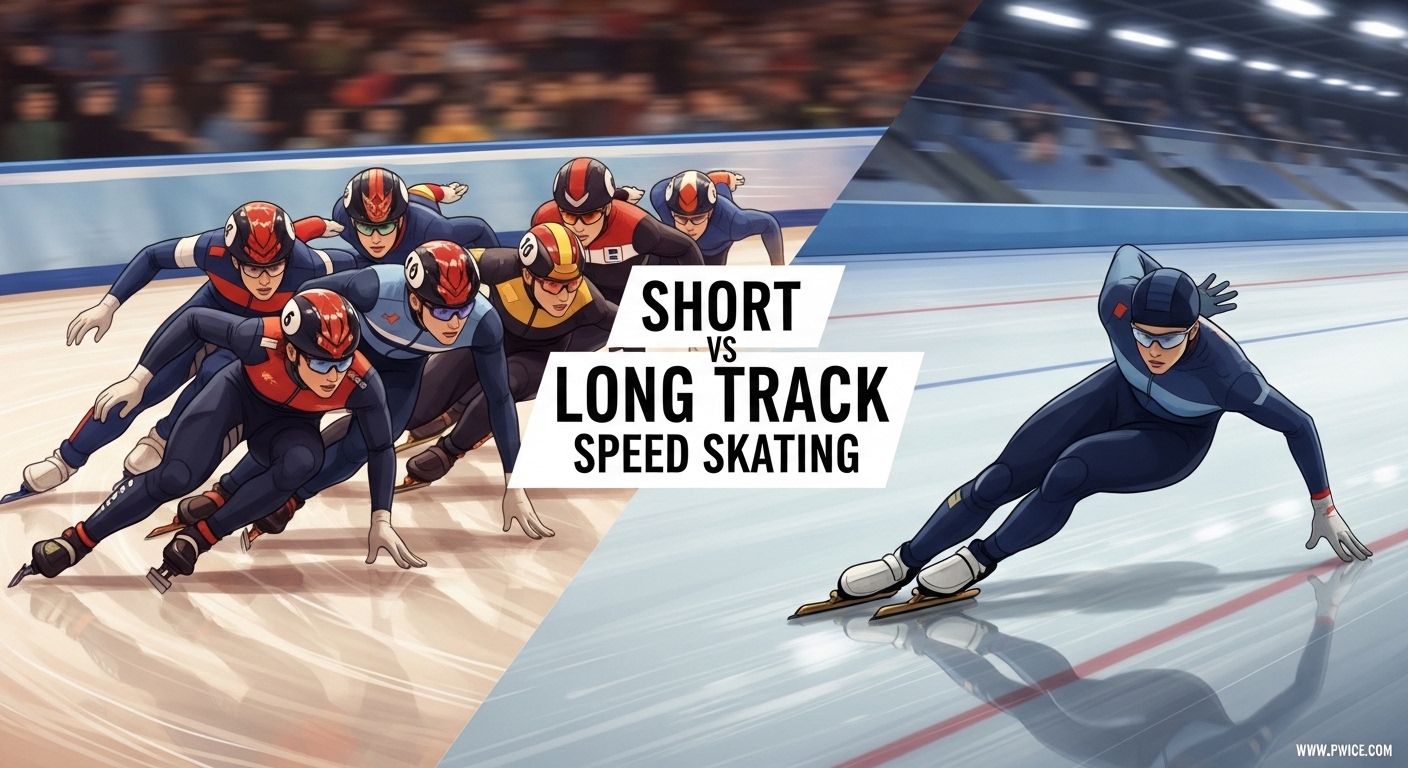
When you watch speed skating at the 2026 Milano Cortina Winter Olympics, you might notice two completely different competitions happening on ice. One features skaters racing alone against the clock on a massive oval. The other shows pack racing with elbows flying and dramatic crashes around impossibly tight turns.
These are short track vs long track speed skating. Same ice, same blades, entirely different sports. Our team spent weeks analyzing both disciplines to break down exactly what separates them. Whether you are a curious Olympic viewer or considering strapping on skates yourself, this guide explains every key difference.
Table of Contents
Quick Answer: The Core Differences Between Short Track and Long Track Speed Skating
The difference between short track and long track speed skating comes down to four main elements: track size, race format, equipment, and strategy. Short track uses a 111.12-meter oval with pack-style racing where 4-6 skaters compete simultaneously for position. Long track runs on a 400-meter oval with time trial format where two skaters race against the clock in separate lanes.
Short track skaters wear helmets and use shorter, fixed blades for tight cornering at high G-forces. Long track skaters skip the helmets and use clap skates with hinged blades that extend their push phase for maximum straight-line speed.
Track and Oval Size: 111.12 Meters vs 400 Meters
The most obvious difference is the track itself. A short track oval measures exactly 111.12 meters around. A long track oval stretches 400 meters, matching an Olympic athletics track in length.
This size difference changes everything about how athletes skate. Short track squeezes the action into corners that feel impossibly tight. Skaters hit up to 3Gs of force in turns, comparable to what astronauts experience during space shuttle launch.
Long track gives athletes room to build speed. They spend far more time in the straightaways where aerodynamics matter most. The 400-meter oval lets them settle into sustainable speeds and manage their energy across longer distances.
Lap Math: How Many Laps Per Race?
The track size determines lap counts for each distance. In short track, a 500m race requires 4.5 laps around the 111.12m oval. A 1500m race runs 13.5 laps. The half-lap finishes add tactical complexity as skaters jockey for the inside line on the final turn.
Long track simplifies the math. A 500m race is 1.25 laps. A 1500m race runs 3.75 laps. The 5000m distance covers 12.5 laps. The extra distance per lap means fewer cornering interruptions and more sustained speed.
Equipment Differences: Clap Skates, Blade Length, and Helmets
The gear looks similar at first glance. Look closer and you will spot major differences in blades, boots, and protective equipment.
Clap Skates vs Fixed Blades
Long track skaters use clap skates with a hinge mechanism at the toe. The blade detaches from the boot heel on each push, extending the glide phase and adding precious centimeters to every stride. This innovation alone improved world records by several seconds when introduced in the late 1990s.
Short track skaters use fixed blades without the clap mechanism. The blade stays flat against the boot at all times. They need this stability for the tight corners where hinged blades would create control problems.
Blade Length Specifications
Blade lengths differ significantly between disciplines. Short track blades run 30-45 centimeters depending on the skater’s height and preference. Shorter blades provide tighter turning radius and better maneuverability in pack situations.
Long track blades extend 40-55 centimeters. The extra length maximizes glide efficiency on long straightaways. World record speeds reach over 60 km/h in the 500m sprint, requiring every possible advantage in blade surface area.
Boot Design and Safety Gear
Boot construction varies too. Short track boots offer more ankle flexibility and lower cuts for the agility needed in pack racing. Long track boots prioritize rigidity and high ankle support for transferring maximum power through each stroke.
Helmets tell the story of risk. Short track mandates helmets because crashes are common and dangerous at these speeds. Long track rarely sees helmet use because athletes skate in separate lanes with no contact risk.
Short track skaters also wear neck guards, knee pads, and cut-resistant suits. The full body aerodynamic suits in long track prioritize speed over protection.
Race Format: Pack Racing vs Time Trial
One sport is a battle against the clock. The other is a battle against every other skater on the ice.
Short Track: Pack-Style Racing
Short track runs heats with 4-6 skaters racing simultaneously. The first two across the finish line advance. Tactics matter as much as raw speed. Skaters draft behind leaders, wait for passing opportunities, and occasionally cause or avoid crashes that reshape races.
The relay format adds another layer. Teams of four skaters complete 18 laps for women or 27 laps for men. A touch exchange replaces baton passes, creating chaotic moments where multiple teams converge at high speeds.
Long Track: Time Trial Format
Long track pairs two skaters on the ice simultaneously, each in their own lane. They race against the clock, not directly against each other. The inner lane skater wears a white armband, the outer lane a red one. They switch lanes once per lap to equalize the distance.
The mass start event mixes formats slightly. Multiple skaters start together, but the race still rewards time and points over pure finishing position. The team pursuit puts two teams of three skaters head-to-head, with the final time determined when the third skater crosses the line.
Olympic Events at 2026 Milano Cortina
The 2026 Winter Olympics in Milano Cortina feature 14 long track events and 9 short track events. This difference reflects the additional distances and team formats in long track.
Long Track Events (14 Total)
Men and women each compete in seven events: 500m, 1000m, 1500m, 3000m (women only), 5000m, 10000m (men only), and mass start. Team pursuit adds a seventh event for each gender. The mass start made its Olympic debut at PyeongChang 2018, bringing pack racing elements to the traditionally individual sport.
Short Track Events (9 Total)
Men and women each race in four individual events: 500m, 1000m, 1500m, and the 2000m mixed team relay. The mixed relay debuted at Beijing 2022 and returns for Milano Cortina 2026. Relay races require different endurance and tactical skills than individual sprints.
Technique and Strategy: Body Position, Cornering, and Energy
Success in each discipline demands different physical approaches and mental strategies.
Short Track: Agility and Tactics
Short track cornering involves the hand-on-ice technique. Skaters place their left hand on the ice surface through turns to maintain balance against extreme G-forces. Body position stays low and compact, with tucked arms minimizing drag while allowing quick directional changes.
Energy conservation matters enormously. Skaters must decide when to lead (spending more energy fighting air resistance) versus when to draft behind others. The final two laps often decide races, making strategic patience as important as explosive finishing speed.
Long Track: Aerodynamics and Pacing
Long track emphasizes pure efficiency. The tucked arm position keeps both arms behind the back, creating the smallest possible wind profile. Head position stays fixed and low, with minimal upper body movement.
Pacing strategy is individual. Elite skaters negative split races, running the second half faster than the first. Others maintain even lap times throughout. The absence of pack dynamics means races unfold as personal battles against time and fatigue.
Side-by-Side Comparison: Short Track vs Long Track
This table summarizes the key differences between the two disciplines:
| Feature | Short Track Speed Skating | Long Track Speed Skating |
|---|---|---|
| Track Size | 111.12 meters | 400 meters |
| Race Format | Pack racing (4-6 skaters) | Time trial (2 skaters, separate lanes) |
| Blade Length | 30-45 cm (fixed blades) | 40-55 cm (clap skates with hinge) |
| Helmet Required | Yes, mandatory | No, rarely worn |
| Boot Cut | Lower cut for agility | Higher cut for stability |
| Cornering Force | Up to 3Gs | Lower G-force |
| World Record 500m | 39.505 seconds (Wu Dajing) | 33.61 seconds (Pavel Kulizhnikov) |
| Olympic Events 2026 | 9 events | 14 events |
| Dominant Countries | South Korea, China, Netherlands | Netherlands, Norway, Japan |
Which Discipline Should Beginners Try First?
If you are considering speed skating, your body type and personality might guide your choice. Neither discipline is objectively easier, but they reward different attributes.
Height and Body Type Considerations
Short track favors shorter athletes with lower centers of gravity. Valérie Maltais of Canada stands 1.63m and has won medals in both disciplines. The 1.72m Viktor Ahn dominated short track with compact power. Short track corners demand the agility and cornering balance that shorter frames provide.
Long track rewards height and long levers. Sven Kramer of the Netherlands stands 1.87m. Longer legs generate more power per stroke and glide farther on each push. The straightaways allow taller skaters to maximize their stride length without cornering compromises.
Safety and Risk Tolerance
Short track carries higher injury risk. Pack racing creates collision opportunities at 50+ km/h. The 2018 Olympics saw multiple crashes in relay events. Helmets and protective gear are mandatory for good reason.
Long track offers a safer entry point. Skaters control their own space and rarely contact others. Falls happen but usually involve individual balance rather than multi-skater pileups.
Skill Transfer Between Disciplines
Some athletes compete in both. The technical demands differ enough that crossovers are rare at the elite level. The cardiovascular base and ice comfort transfer between disciplines. Cornering technique, pacing strategy, and equipment handling require separate training.
Canadian skater Valérie Maltais won long track bronze at the 2022 World Championships after a short track career. Latvian skater Haralds Silovs competed in both at the same 2018 Olympics, a rare feat.
Frequently Asked Questions
Is short track speed skating different from long track?
Yes, they are completely different Olympic disciplines. Short track uses a 111.12-meter oval with pack racing where 4-6 skaters compete simultaneously. Long track uses a 400-meter oval with time trial format where two skaters race in separate lanes against the clock. The equipment differs too, with short track requiring helmets and using fixed blades, while long track uses clap skates with hinged blades.
Do short track speed skates clap?
No, short track skates do not have the clap mechanism. Short track skaters use fixed blades that remain flat against the boot at all times. The clap skate hinge mechanism is exclusive to long track, where the blade detaches from the heel to extend the push phase. Short track needs fixed blades for stability during tight cornering and pack racing maneuvers.
What is short track speed skating?
Short track speed skating is an Olympic ice racing discipline where multiple skaters compete simultaneously on a 111.12-meter oval. Races typically feature 4-6 skaters in pack-style competition, with the first finishers advancing through heats to finals. The sport emphasizes tight cornering, tactical positioning, drafting, and explosive finishing speed. It includes individual events at 500m, 1000m, and 1500m, plus relay races.
Is short track speed skating harder?
Neither discipline is objectively harder, but they present different challenges. Short track requires superior cornering skill at 3Gs of force, tactical awareness for pack positioning, and quick decision-making. Long track demands raw aerobic capacity, perfect pacing strategy, and aerodynamic efficiency. Short track has higher injury risk from crashes, while long track requires sustaining painful speeds for longer durations. Athletes tend to specialize based on body type and preference.
How many laps is 500m in short track speed skating?
A 500m race in short track speed skating covers 4.5 laps of the 111.12-meter oval. Skaters complete four full laps plus half of a fifth lap to reach the finish line. The half-lap finish adds tactical complexity, as skaters must position themselves for the final corner knowing they only have half a lap remaining to sprint.
Why are Koreans so good at short track speed skating?
South Korea dominates short track through a combination of cultural emphasis, early talent identification, and world-class training infrastructure. The sport receives significant national attention and funding, with specialized academies developing young skaters. Korean coaches pioneered many modern training techniques and cornering strategies. The success creates a self-reinforcing cycle where young athletes see short track as a viable path to national stardom. Other strong nations include China, Canada, and the Netherlands.
Conclusion: Understanding the Difference Between Short Track and Long Track Speed Skating
The difference between short track and long track speed skating extends far beyond track dimensions. These are fundamentally different sports requiring distinct skills, equipment, and strategies. Short track delivers pack racing drama with tactical brilliance and physical courage. Long track showcases pure speed against the clock with perfect technique and endurance.
Both disciplines will captivate audiences at the 2026 Milano Cortina Winter Olympics. Understanding these differences lets you appreciate the unique demands each athlete faces. Whether you prefer the tactical chess of short track or the raw speed pursuit of long track, you now have the knowledge to enjoy every race with deeper insight.
For aspiring skaters, consider your body type, risk tolerance, and whether you prefer competing against others directly or racing the clock. Either path leads to one of winter sport’s most demanding and rewarding pursuits.