
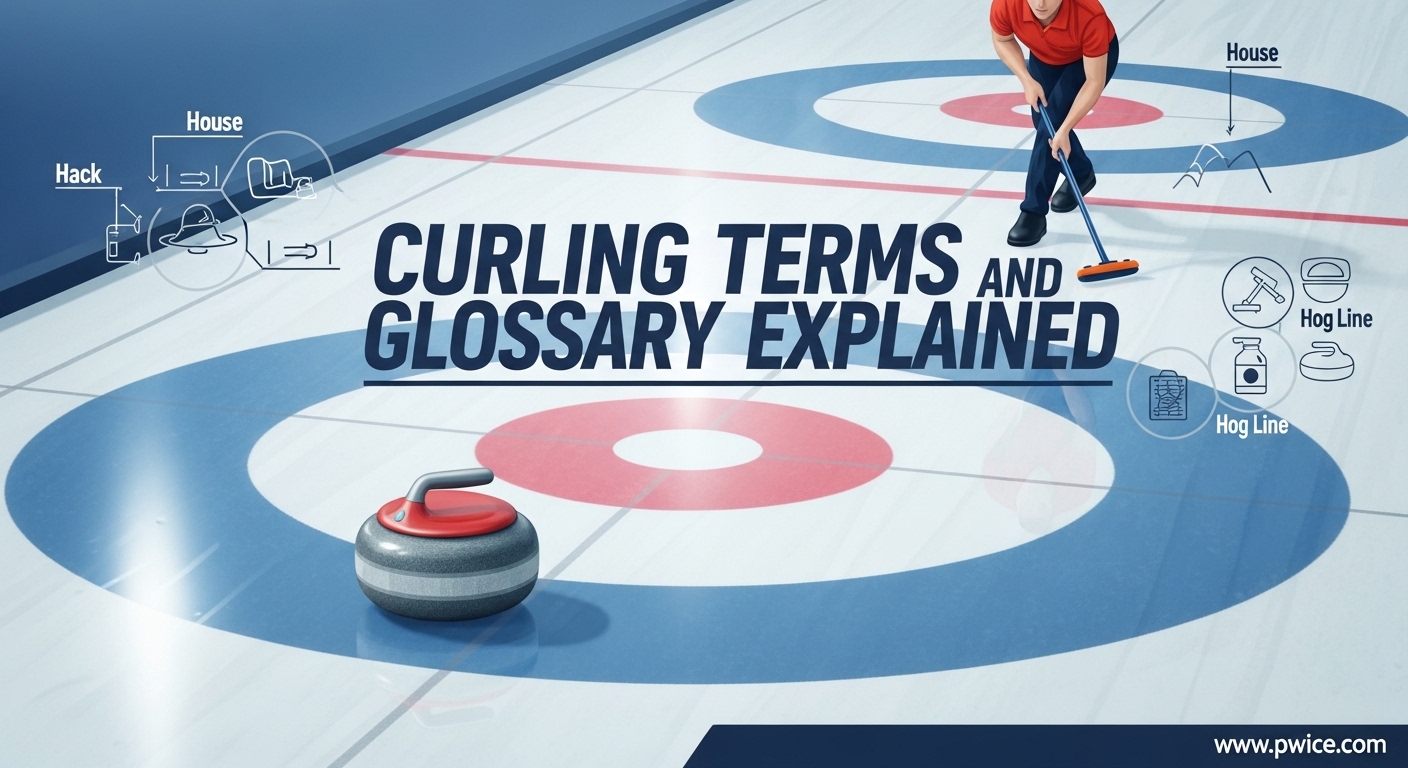
Watching curling during the Olympics can feel like listening to a foreign language. The commentators throw around terms like “bonspiel,” “hack weight,” and “the roaring game” while stones glide down the ice and sweepers frantically brush the surface. I remember my first time watching a match and wondering why everyone kept shouting numbers at each other.
This curling terms and glossary explained guide solves that problem. I have compiled every essential term you need to understand broadcasts, follow team conversations, and appreciate the strategy behind this fascinating sport. Whether you are catching the Winter Olympics or attending your first local bonspiel, these definitions will transform confusing jargon into clear understanding.
Inside this complete A-Z reference, you will find 90-plus curling terms organized alphabetically with pronunciation guides for Scottish-origin words. I have also included a quick reference section for absolute beginners, explanations of the weight calling system that confuses so many new fans, and a special section on curling cliches you will hear from commentators.
Table of Contents
Quick Reference: 25 Essential Curling Terms
Before diving into the complete glossary, here are the most important terms organized by category. Bookmark this section and return whenever you need a fast reminder during a match.
The Ice and Playing Surface
Sheet: The ice surface where curling takes place, approximately 150 feet long and 15 feet wide.
House: The circular scoring area at each end of the sheet, consisting of four concentric rings.
Button: The center of the house, the smallest circle where you want your stones to finish.
Hog Line: The line 33 feet in front of each house. Stones must completely cross this line to remain in play.
Tee Line: The line passing through the center of the house, perpendicular to the center line.
Centre Line: The line running the length of the sheet through the center of both houses.
Back Line: The line at the back of the house. Stones completely over this line are removed from play.
Pebble: The tiny droplets of frozen water sprayed on the ice that create the texture stones ride on.
Equipment Terms
Stone: Also called a “rock,” the 42-pound granite object players slide down the ice.
Broom: The brush used by sweepers to reduce friction and influence stone trajectory.
Handle: The colored plastic piece attached to the stone that the thrower grips during delivery.
Slider: The smooth sole on one shoe that allows the thrower to glide during delivery.
Gripper: The rubber sole on the non-sliding shoe that provides traction on the ice.
Hack: The foothold at each end of the sheet where the thrower pushes off from when delivering a stone.
Team Positions
Skip: The team captain who calls shots, usually throws the last two stones, and directs strategy.
Lead: The player who throws the first two stones of each end for their team.
Second: The player who throws the third and fourth stones of each end.
Third: Also called the vice-skip, this player throws the fifth and sixth stones and takes over when the skip is throwing.
Front End: The lead and second players who throw the first four stones.
Back End: The third and skip who throw the final four stones.
Scoring Terms
End: Similar to an inning in baseball, one complete round where both teams throw eight stones.
Hammer: The advantage of throwing the last stone in an end, which provides a strategic edge.
Shot Rock: The stone currently closest to the button at any point during play.
Counter: Any stone in the house that counts toward the score.
Steal: Scoring when your team does not have the hammer, achieved by getting stones closer to the button.
Blank End: An end where no points are scored, usually intentional when a team with hammer wants to keep it for the next end.
Shot Types
Draw: A shot intended to stop in the house without hitting other stones.
Takeout: A shot designed to remove an opponent’s stone from play.
Guard: A stone placed in front of the house to protect another stone from being hit.
Freeze: A draw shot that stops touching an opponent’s stone, making it difficult to remove.
Peel: A powerful takeout shot that removes a guard and rolls the shooter out of play.
Complete A-Z Curling Glossary
The following comprehensive glossary includes every significant term in curling organized alphabetically. Each definition includes pronunciation guides for terms with Scottish origins and cross-references to related concepts.
A
Across the Face: Hitting a stone on the side opposite to the direction it is curling.
Alternate: A fifth team member who can substitute for any player during a game or tournament.
Anti-Freeze: A difficult shot that prevents a stone from freezing against another stone.
Arena Ice: Ice created in a multi-purpose arena rather than a dedicated curling facility, often with different playing characteristics.
B
Back 4 / Back 8 / Back 12: A stone positioned in the back portion of the 4-foot, 8-foot, or 12-foot ring respectively.
Back Board: The end wall of the curling facility behind each house.
Back End: The third and skip positions, who throw the final four stones of an end.
Backing: Stones behind the tee line that can be used as backing for runback shots.
Barrier Weight: A weight call indicating the stone should stop near the barrier (board) at the side of the sheet.
Besom: An old-fashioned broom made from natural materials, rarely used in modern curling.
Blank End: An end in which no points are scored. Teams often blank intentionally to keep the hammer for the next end.
Blasting: A powerful shot intended to remove multiple stones from play.
Biter: A stone just touching the outer edge of the 12-foot ring, technically counting as in the house.
Bonspiel: (BAHN-shpeel) A curling tournament or competition, typically spanning multiple days.
Boating: When a stone slides too far down the ice, usually due to excessive weight.
Board Weight: A takeout weight call indicating the stone should reach the boards on the far side of the sheet.
Brier: (BRY-er) The Canadian Men’s National Curling Championship, one of the most prestigious events in the sport.
Bump: A gentle takeout that moves another stone a short distance.
Bumper Weight: A weight call between hack weight and board weight, indicating the stone should hit the bumpers (cushions).
Burned Rock: A stone touched by a player or equipment while in motion, which must be removed from play according to the rules.
Button: The center circle of the house, four feet in diameter, representing the ideal target for scoring.
C
Calling the Shot: When the skip determines the desired outcome and indicates where the thrower should aim.
Cashspiel: A tournament where teams compete for prize money rather than just trophies.
Centre Guard: A guard positioned directly on the center line in front of the house.
Centre Line: The line running the length of the sheet through the middle of both houses.
Chip: A light takeout that removes a small piece of a stone or moves it slightly.
Christmas Tree: A formation of guards stacked in a vertical line, resembling a Christmas tree shape.
Clean: A call to sweep lightly to maintain the stone’s path without dramatically changing it.
Club: A local curling organization or facility where people play regularly.
Come-Around: A draw shot that curls around a guard to reach the house.
Control Weight: A firm weight call for a takeout that offers precise control over the stone’s final position.
Corner Guard: A guard positioned off the center line, usually in one of the corners of the sheet in front of the house.
Counter: Any stone in the house that counts toward the score at the conclusion of an end.
Coverage: Having stones in multiple positions to provide strategic options.
Curl: The sideways movement of a stone caused by the rotation (turn) imparted during delivery and the ice surface.
Curler: Any person who plays the sport of curling.
D
Dead Buried: A stone completely surrounded by other stones and impossible to remove with a direct hit.
Delivery: The act of sliding a stone down the ice from the hack to the house.
Deuce: Scoring two points in a single end.
Dish: A condition of the ice where the surface curves slightly, affecting stone paths.
Double Takeout: A shot that removes two opponent’s stones with one throw.
Drag: The effect when a stone picks up debris from the ice, causing it to curl less or slow down.
Draw: A shot intended to come to rest in the house without making contact with other stones.
Draw Weight: The weight (speed) required for a stone to stop in the house, lighter than takeout weight.
Ducky: A very easy shot with a high success probability, often used to describe a straightforward opportunity.
E
Easy: A call to sweepers to reduce their sweeping intensity or stop sweeping entirely.
Eight-Ender: Scoring eight points in a single end by having all eight stones closer to the button than any opponent stones. Extremely rare and celebrated.
End: A portion of a curling game where each team throws eight stones. A typical game consists of eight or ten ends.
Extra End: An additional end played when the score is tied after the regulation number of ends.
Eye on the Hog: An electronic system used to detect hog line violations during major competitions.
F
Fall: The sideways movement of a stone caused by ice conditions rather than the handle rotation.
Firm Weight: A weight call indicating a stronger takeout throw than normal weight.
Finish: The final few feet of a stone’s travel where sweepers can have the most effect on its position.
Flash: A complete miss where the thrown stone passes by the target without making contact.
Force: When the team with hammer scores only one point, forced by the opposing team’s defensive play.
Fourth: The player who throws the seventh and eighth stones, usually the skip.
Free Guard Zone: The area between the hog line and the house where guards cannot be removed by the opposing team until the fifth stone of the end.
Freeze: A draw shot that comes to rest touching or extremely close to an opponent’s stone, making it difficult to remove.
Front End: The lead and second players who throw the first four stones of an end.
Front-House Weight: A weight call for a draw that should stop in the front portion of the house.
Frost: A condition where moisture on the ice causes stones to behave unpredictably.
Fun Spiel: A casual, social curling event focused on enjoyment rather than serious competition.
G
Game Clock: The timing system that tracks each team’s total thinking time during a game.
Granite: The type of stone, specifically blue hone granite from Ailsa Craig in Scotland or Welsh granite, used to make curling stones.
Guard: A stone placed in front of the house, usually between the hog line and the house, to protect stones behind it.
H
Hack: The foothold at each end of the sheet where the thrower begins their delivery.
Hack Weight: A takeout weight call indicating the stone should travel with enough speed to hit the hack at the far end.
Hammer: The advantage of throwing the last stone in an end, which provides a strategic advantage in scoring.
Handle: The colored plastic piece attached to the top of the stone that players grip during delivery. Also refers to the turn or rotation given to a stone.
Handshake: The traditional gesture exchanged between teams before and after a game, symbolizing sportsmanship.
Hard: A sweeping call indicating maximum sweeping effort is required.
Heavy: A stone delivered with more weight (speed) than intended, often resulting in traveling too far.
Heavy Ice: Ice conditions that produce less curl than usual, requiring more turn to achieve the same lateral movement.
High Side: The side of the sheet where a stone would need to travel uphill due to ice conditions.
Hit: A shot designed to strike another stone, either to remove it or move it to a different position.
Hit and Roll: A takeout shot where the shooter hits a target stone and then rolls to a new position.
Hit and Stay: A takeout where the shooter hits a target stone and remains in the position of the removed stone.
Hog Line: The line located 33 feet in front of each house. A stone must completely cross this line to remain in play.
Hogged Rock: A stone that fails to completely cross the hog line and is removed from play.
House: The circular scoring area at each end of the sheet, consisting of four concentric rings: 12-foot, 8-foot, 4-foot, and the button.
Hurry: A call for sweepers to sweep immediately, often used as “hurry hard.”
Hurry Hard: The most famous curling call, instructing sweepers to sweep with maximum intensity immediately.
I
Ice: The playing surface, carefully prepared with specific temperature and pebble conditions.
Icmaker: The person responsible for preparing and maintaining the curling ice surface.
In-Off: A shot where a stone hits another stone and then glances off into a different position.
In-Turn: A delivery where the stone rotates clockwise for a right-handed thrower or counter-clockwise for a left-handed thrower, causing the stone to curl inward.
Inside: The direction toward the center line of the sheet.
J
Jam: When a stone cannot be removed because other stones are blocking its path out of the house.
K
Keen Ice: Fast ice conditions that produce more curl than usual and require less weight to reach the house.
Kizzle Kazzle: A slang term for a completely missed shot or chaotic situation on the ice.
L
Lead: The player who throws the first two stones for their team in each end.
Lie Shot: Having the stone closest to the button, essentially holding the advantage for scoring.
Light: A stone delivered with less weight (speed) than intended, often failing to reach the target.
Line: The intended path a stone will travel down the sheet.
Long Guard: A guard positioned far from the house, usually near the hog line.
Losing the Handle: When a stone wobbles or fails to maintain its intended rotation during delivery.
Low Side: The side of the sheet where a stone would travel downhill due to ice conditions.
LSFE: Last Stone First End, the team that throws last in the opening end.
M
Mate: A teammate or fellow curler, used in some regions as a general term for team members.
Measure Stick: A specialized measuring device used to determine which stone is closer to the button when the difference cannot be determined by eye.
N
Narrow: A stone traveling closer to the center line than intended, requiring sweepers to widen its path.
Negative Ice: Ice conditions where the normal curl patterns are reversed or behave unexpectedly.
Never: A call indicating a stone should not be swept at all.
No Handle: A delivery with no rotation, resulting in a stone that travels straight without curling.
Normal Weight: A standard takeout weight for removing stones from play.
Nose: The front edge of a stone as it travels down the ice.
O
Off the Broom: When a stone does not follow the intended path indicated by the skip’s broom.
On the Broom: When a stone follows exactly the path indicated by the skip’s broom placement.
Open: A situation where the path to a target stone is not blocked by guards.
Out of Stones: When a team has delivered all eight of their stones for the current end.
Outside: The direction away from the center line, toward the sides of the sheet.
Out-Turn: A delivery where the stone rotates counter-clockwise for a right-handed thrower or clockwise for a left-handed thrower, causing the stone to curl outward.
P
Pebbled Ice: The textured surface created by spraying tiny water droplets on the ice, allowing stones to glide and curl.
Pebble: The small frozen water droplets that create the textured surface of curling ice.
Peel: A powerful takeout shot designed to remove a guard and roll the shooter out of play.
Peel Weight: Maximum weight used for peels, stronger than normal takeout weight.
Pick: When a stone unexpectedly travels straight or changes direction due to debris on the ice.
Picking: The phenomenon of a stone deviating from its expected path due to debris or ice imperfections.
Pin: The exact center point of the house, also called the tee.
Playdowns: Qualifying competitions where teams compete to earn spots in larger tournaments.
Port: A small gap between stones through which another stone can be played.
Power Play: A rule in mixed doubles where teams can position their stones in advantageous starting positions once per game.
Promote: A shot that moves another stone forward to a new position without removing it.
Promote Takeout: A shot that moves another stone forward to take out a third stone.
R
Raise: A shot that moves another stone forward to a new position by hitting it.
Raise Takeout: A shot that raises one stone into another to remove it from play.
Reading the Ice: Analyzing ice conditions including speed, curl, and fall to determine optimal shot strategy.
Reverse Handle: A delivery where the stone’s rotation is opposite to what would normally produce curl in the intended direction.
Rings: The four concentric circles of the house: 12-foot, 8-foot, 4-foot, and the button.
Rink: A team of curlers or the building where curling is played.
Rock: Another term for a curling stone, derived from the sport’s Scottish origins.
Roll: The movement of a stone after making contact with another stone.
Rotation: The spin imparted to a stone during delivery that causes it to curl.
Rub: When a stone makes slight contact with another stone, changing its path.
Runback: A shot that hits a stone in play, using it to hit another stone further down the ice.
Running Surface: The polished bottom of a curling stone that contacts the ice.
S
Scraper: A tool used to level and prepare the ice surface before pebbling.
Scotties: (SKAH-teez) The Canadian Women’s National Curling Championship, officially called the Scotties Tournament of Hearts.
Second: The player who throws the third and fourth stones for their team in each end.
Second Shot: The stone second-closest to the button at the conclusion of an end.
Sheet: The ice playing surface, approximately 146 to 150 feet long and 14 feet 2 inches to 15 feet 7 inches wide.
Sheepskin: A traditional material used for sliders before modern synthetic materials.
Shooter: The stone that has just been thrown and is in motion or has just come to rest.
Shot Rock: The stone closest to the button at any point during play, determining which team will score.
Skip: The team captain who calls shots, directs strategy, and usually throws the last two stones.
Slide: The movement of the thrower as they deliver the stone from the hack.
Slider: The smooth, low-friction sole attached to the sliding shoe.
Soft Release: A delivery with minimal initial rotation, allowing the stone to settle into its turn gradually.
Spiel: (SHEE-pel or SPEEL) A curling tournament or competition.
Spinner: A stone delivered with excessive rotation, causing unpredictable behavior.
Split: A situation where two stones are positioned side by side.
Stacking the Brooms: Also called broomstacking, the social tradition of teams sitting together after a game to share drinks and conversation.
Steal: Scoring in an end when your team does not have the hammer.
Straight Handle: A delivery with minimal rotation, resulting in a stone that curls very little.
Straight Ice: Ice conditions where stones curl less than normal.
Strike Weight: Heavy weight used for takeouts, similar to peel weight.
Sweep: The act of brushing the ice in front of a moving stone to reduce friction and influence its path.
Sweeping: The coordinated action of two team members brushing the ice to guide the stone.
Swingy Ice: Ice conditions where stones curl more than normal.
T
Takeout: A shot designed to remove an opponent’s stone from play by hitting it.
Takeout Weight: The weight (speed) required for a stone to remove another stone from play.
Tap Back: A light takeout that moves a stone a very short distance backward.
Tee: The exact center point of the house, marked by the intersection of the center line and tee line.
Tee Line: The line passing through the tee (center of the house) perpendicular to the center line.
Third: Also called the vice-skip, the player who throws the fifth and sixth stones and acts as skip when the skip is throwing.
Third Shot: The stone third-closest to the button at the conclusion of an end.
Thinking Time: The amount of time each team has to plan and deliver shots, tracked by the game clock.
Thick: Hitting a stone on the side toward which it is curling, resulting in a fuller hit.
Thin: Hitting a stone on the side away from which it is curling, resulting in a glancing hit.
Tight: A stone traveling closer to a guard or another stone than intended.
Tick: A light shot designed to move a guard just enough to open a path to the house.
Time: Refers to the remaining thinking time on the game clock.
Top 4 / Top 8 / Top 12: A stone positioned in the front portion of the 4-foot, 8-foot, or 12-foot ring respectively.
Triple Takeout: A shot that removes three opponent’s stones with one throw, a rare and skillful achievement.
True Mixed: A mixed curling format with specific rules about which gender throws which stones.
U
Up: A sweeping call indicating the stone needs to be swept to travel further or maintain its speed.
V
Vice-Skip: The third player who acts as skip when the skip is delivering stones, also called the mate.
W
Weight: The velocity or speed of a stone as it travels down the ice, crucial for shot success.
Wick: A shot that barely touches another stone, resulting in a small deflection.
Whoa: A sweeping call telling sweepers to stop sweeping immediately.
Wide: A stone traveling farther from the center line than intended.
Wobbler: A stone delivered with poor technique that wobbles rather than sliding smoothly.
Wrecked Shot: A shot ruined when the stone makes unintended contact with another stone.
Curling Cliches and Common Phrases
Every sport has its cliches, and curling is no exception. During Olympic broadcasts and competitive matches, you will hear commentators and players use colorful phrases that have become part of the sport’s culture. These expressions add personality to broadcasts and reveal the unique character of curling.
Commentator Cliches
“We’re just on the wrong side of the inch.” Teams use this when stones keep finishing barely too far from the button or just missing perfect placement. It acknowledges that curling margins are razor-thin.
“One miss can turn an end around.” Commentators say this to emphasize how a single mistake can completely change the strategic situation, transforming a potential multi-point end into a steal.
“We’re guarding for our lives.” Teams say this when protecting a narrow lead late in a game, placing multiple guards to defend against the opponent’s hammer.
“We swept that one to the bitter end.” References the moment when sweepers follow a stone all the way through the house, exhausting themselves to maximize its distance.
“Chess on ice.” The most common metaphor for curling, emphasizing the strategic thinking and planning several shots ahead that define the sport.
“The roaring game.” The traditional nickname for curling, originating from the sound stones make as they travel down the ice.
Team Communication Slang
“Hard” means sweep with maximum intensity. You will hear skips shout this when a stone needs extra weight or curl correction.
“Off” tells sweepers to stop sweeping immediately. This call requires instant reaction as even a fraction of a second can affect stone placement.
“Up” indicates sweepers should resume or increase sweeping to help the stone travel further.
“Never” means do not sweep this stone at all, often called when the stone is already traveling with perfect weight.
“Clean” instructs sweepers to sweep lightly to maintain the stone’s current path without dramatically altering it.
Social and Cultural Terms
Broomstacking refers to the tradition of teams sitting together after a game, often literally stacking their brooms, to share drinks and socialize. This practice embodies curling’s emphasis on sportsmanship and community.
Chroming the rock is slang for delivering a stone with excessive polish or flashiness rather than solid fundamentals.
Anti-freeze describes a player who performs exceptionally well under pressure, the opposite of someone who “freezes up.”
Understanding Weight Calls and the Number System
One of the most confusing aspects for new curling fans is the weight calling system. During broadcasts, you will hear skips call out numbers and terms that determine how hard the thrower should deliver each stone. Understanding this system transforms random numbers into strategic communication.
Traditional Weight Descriptors
Teams use a progression of terms to indicate takeout weight. Hack weight means the stone should stop near the hack at the far end, requiring significant velocity. Board weight indicates the stone should reach the side boards. Bumper weight falls between hack and board, hitting the cushion area. Control weight and normal weight indicate standard takeout velocity, while firm weight suggests a stronger throw. For maximum power, teams call peel weight or strike weight.
Draw shots use different terminology. Front-house weight should stop in the front portion of the house, while back-house weight targets the rear rings. Back 4, 8, or 12 specify landing in particular rings at the back of the house, while top 4, 8, or 12 indicate front positions.
The Number System Explained
Many teams use a numerical system where numbers correspond to specific target areas. Numbers 1 through 3 typically represent guards at various positions in front of the house, with 1 being the highest guard and 3 being the tightest. Numbers 4 through 6 represent draws into the house at different depths. Numbers 7 through 10 indicate progressively heavier takeout weights.
Some modern teams have moved to split-time calling, using stopwatch measurements of how long stones take to travel between the hog lines. A call of “14” means 14 seconds between hog lines, which translates to a specific weight regardless of ice conditions. This system provides more consistency than traditional descriptors that vary based on ice speed.
What Does 14 Mean in Curling?
When you hear a skip call “14” during a broadcast, they are using the split-time system. This means the stone should take approximately 14 seconds to travel from one hog line to the other. On typical competition ice, a 14-second split corresponds to draw weight that stops in the house. Faster times like 13 seconds indicate heavier weight, while slower times like 15 seconds mean lighter draws. Teams calibrate these numbers during practice to match their specific ice conditions.
How to Use This Glossary While Watching Curling In 2026?
Now that you have this comprehensive reference, here is how to put it into practice during Olympic broadcasts, local tournaments, or your first visit to a curling club.
For Olympic Viewing
Keep this glossary open on a second screen or printed nearby. When you hear an unfamiliar term, pause and look it up immediately while the context is fresh. Pay special attention to the weight calling system, as commentators will often explain what a skip’s numbers mean. Watch how the front end communicates with the back end between shots, and notice when the skip steps into the house to call line while the vice-skip holds the broom for the thrower.
Understanding the Flow
Each end follows a predictable pattern. The lead throws first, establishing either guards or draws depending on the game situation. The second continues building the end’s structure. The third begins introducing more complex shots like come-arounds or runbacks. The skip delivers the final stones, usually attempting difficult draws or takeouts with maximum pressure. Recognizing this rhythm helps you anticipate what terminology you will hear next.
During the final ends of close games, listen for strategic terms like “freeze,” “peel,” and “double takeout.” These indicate high-pressure situations where every shot carries enormous consequence. The hammer becomes the central strategic factor, with teams without hammer desperately trying to force the opponent to take only one point.
Learning by Position
If you find the full terminology overwhelming, focus on learning terms associated with one position at a time. Start with lead terminology like “long guard” and “centre guard.” Then progress to second-level concepts. This layered approach builds your understanding progressively rather than attempting to absorb everything simultaneously.
Frequently Asked Questions
What are some terms used in curling?
What does 14 mean in curling?
What is the rule of 5 in curling?
What is a score in curling called?
What is a bonspiel in curling?
What does hammer mean in curling?
Conclusion
This curling terms and glossary explained guide has covered over 90 essential terms that will transform your understanding of the sport. From basic equipment like the hack and handle to complex strategic concepts like the free guard zone and split-time calling, you now have the vocabulary to follow any curling broadcast with confidence.
The beauty of curling lies in its combination of physical skill and strategic depth. Every term in this glossary represents a tool that players use to communicate, plan, and execute their way to victory. Whether you are watching the Olympics, attending your first bonspiel, or simply appreciating the roaring game from home, these definitions will enhance your appreciation of this unique sport.
Keep this guide bookmarked for quick reference during major events. Return to the quick reference section when you need fast reminders, dive into the A-Z glossary for detailed definitions, and review the curling cliches section to understand what commentators really mean. Curling terminology may seem overwhelming at first, but with this comprehensive resource, you are now equipped to enjoy every end.