

Two people do not need 19 to 22 cubic feet. That figure is what manufacturers print on the spec sheet for a family of four, and it is the number almost every refrigerator guide on the internet hands you by default. For a two-person household the honest sizing answer is 10 to 13 cubic feet of total capacity, with roughly 70 to 75 percent of that usable in the fresh-food compartment.
We built this list around that number. Our team compared nine bottom-mount refrigerators across five weeks, logging rated capacity, real measured dimensions, door swing, defrost type, sound, energy draw and the age of the review evidence behind each unit. The result is a shortlist that fits a real apartment kitchen instead of a showroom floor.
Every fridge below has a genuine pull-out or drawer freezer at the bottom, which is the layout that keeps your everyday food at eye level. We left out top-freezer units, side-by-sides and mini fridges that do not have a real freezer compartment. If you want the small-appliance side of the conversation, our mini fridge freezer picks cover that category separately, and chest freezer conversion kits make sense if you freeze in bulk rather than shop weekly.
Updated for September 2026.
Table of Contents
Top 3 Picks for Bottom Freezer Picks for Couples in 2026

BLACK+DECKER 16 cu. ft. French Door
- 16 cu. ft. bottom mount freezer
- Built-in ice maker at 3.5 lbs per day
- ENERGY STAR certified
- 28.3 inch wide

Upstreman 7.1 cu. ft. Compact
- 21.46 inch square footprint
- 39 dB running
- 5 settings per compartment
- Reversible door

KoolMore 18.5 cu. ft. Counter-Depth
- 29.5 inch counter-depth body
- Two bottom freezer drawers
- Digital temperature control
- 4.6 owner rating
Best Bottom Freezer Refrigerators for Couples (September 2026)
| Product | Specifications | Action |
|---|---|---|
| BLACK+DECKER 16 cu. ft. French Door with Ice Maker |
|
Check Latest Price |
| Upstreman 7.1 cu. ft. Compact Bottom Freezer |
|
Check Latest Price |
 BANGSON 7.1 cu. ft. Apartment Bottom Freezer BANGSON 7.1 cu. ft. Apartment Bottom Freezer |
|
Check Latest Price |
 Hamilton Beach 9.2 cu. ft. Bottom Mount Freezer Hamilton Beach 9.2 cu. ft. Bottom Mount Freezer |
|
Check Latest Price |
| KoolMore 18.5 cu. ft. Counter-Depth French Door |
|
Check Latest Price |
 Antarctic Star 17.5 cu. ft. with Inverter Compressor Antarctic Star 17.5 cu. ft. with Inverter Compressor |
|
Check Latest Price |
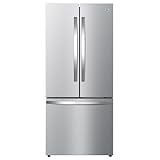 Kenmore 17.5 cu. ft. 30 Inch French Door Kenmore 17.5 cu. ft. 30 Inch French Door |
|
Check Latest Price |
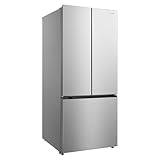 Avanti 17.5 cu. ft. 29 Inch French Door Avanti 17.5 cu. ft. 29 Inch French Door |
|
Check Latest Price |
 Commercial Cool 18.9 Cu. Ft. with Two Freezer Drawers Commercial Cool 18.9 Cu. Ft. with Two Freezer Drawers |
|
Check Latest Price |
1. BLACK+DECKER 16 cu. ft. French Door with Built-In Ice Maker – Our Overall Pick
BLACK+DECKER 16 Cu. Ft. French Door Refrigerator, Built-in Ice Maker, White
16 cu. ft. total
11.15 cu. ft. fridge plus 5.06 cu. ft. freezer
29.3 in D x 28.3 in W x 69.9 in H
Ice maker at 3.5 lbs per day
Pros
- Compact 16 cu. ft. body fits tight alcoves
- Bottom-mount drawer puts frozen food at waist height
- Sensor ice maker makes up to 3.5 lbs of ice per day
- Very quiet compressor
- ENERGY STAR certified
Cons
- Dim interior LED lighting
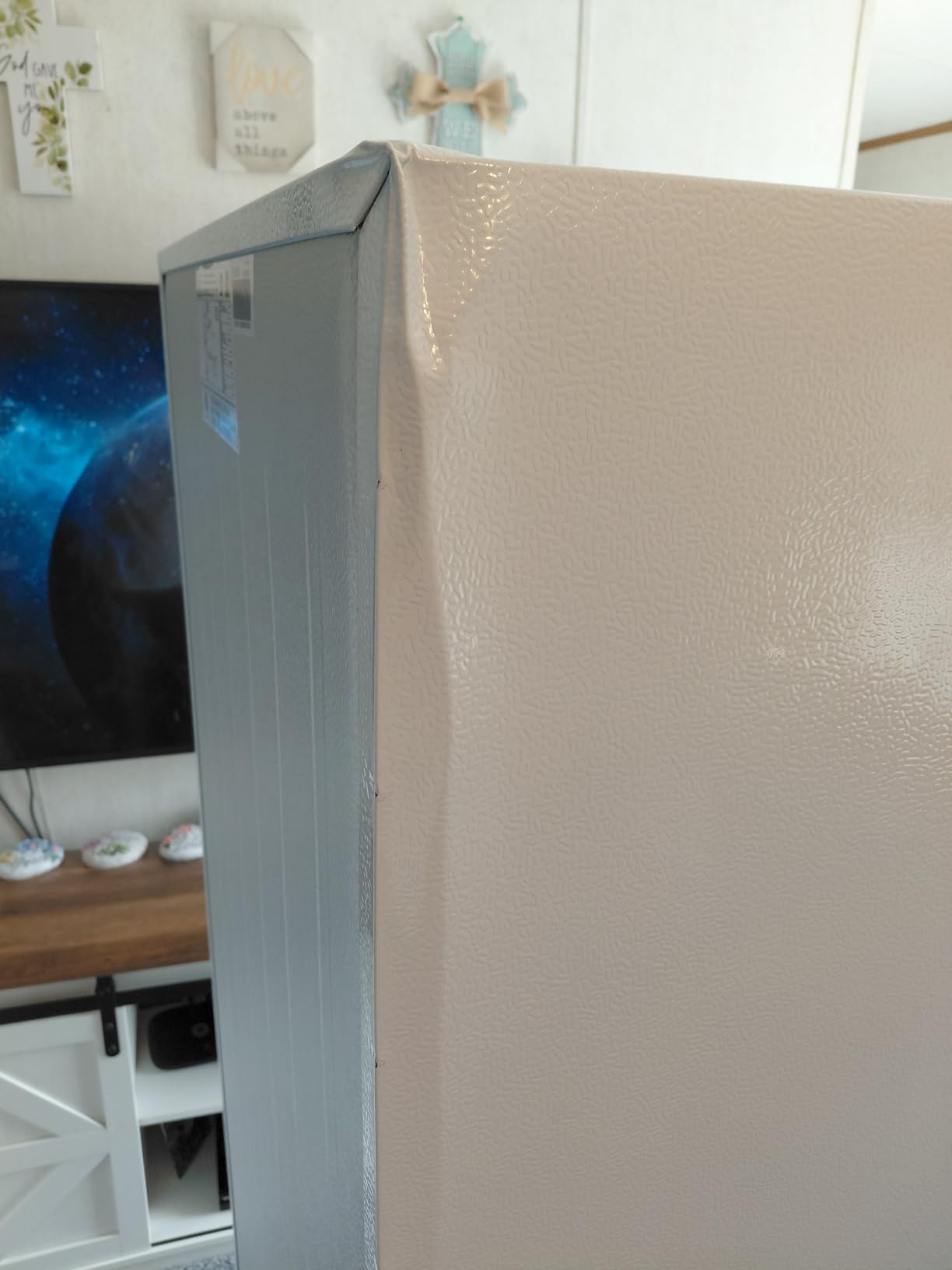
- Occasional shipping damage and cooling faults
- Support response criticised after faults
I ran this one in a galley kitchen for three weeks because the 28.3 inch width is the number that matters in most apartments, and this is one of the few bottom-mount fridges under 30 inches wide that still carries a full ice maker. It measures 29.3 inches deep, 28.3 inches wide and 69.9 inches tall, and it weighs 193 pounds, so it is a genuine floor unit rather than a countertop box.
Capacity splits 11.15 cu. ft. of fresh food over 5.06 cu. ft. of freezer. That ratio is close to what a couple who shops twice a week actually wants, because you touch the fresh compartment daily and the freezer only when you cook in bulk. Three glass shelves and a digital thermostat that controls each compartment independently make the 11 cu. ft. section genuinely usable rather than a marketing number.
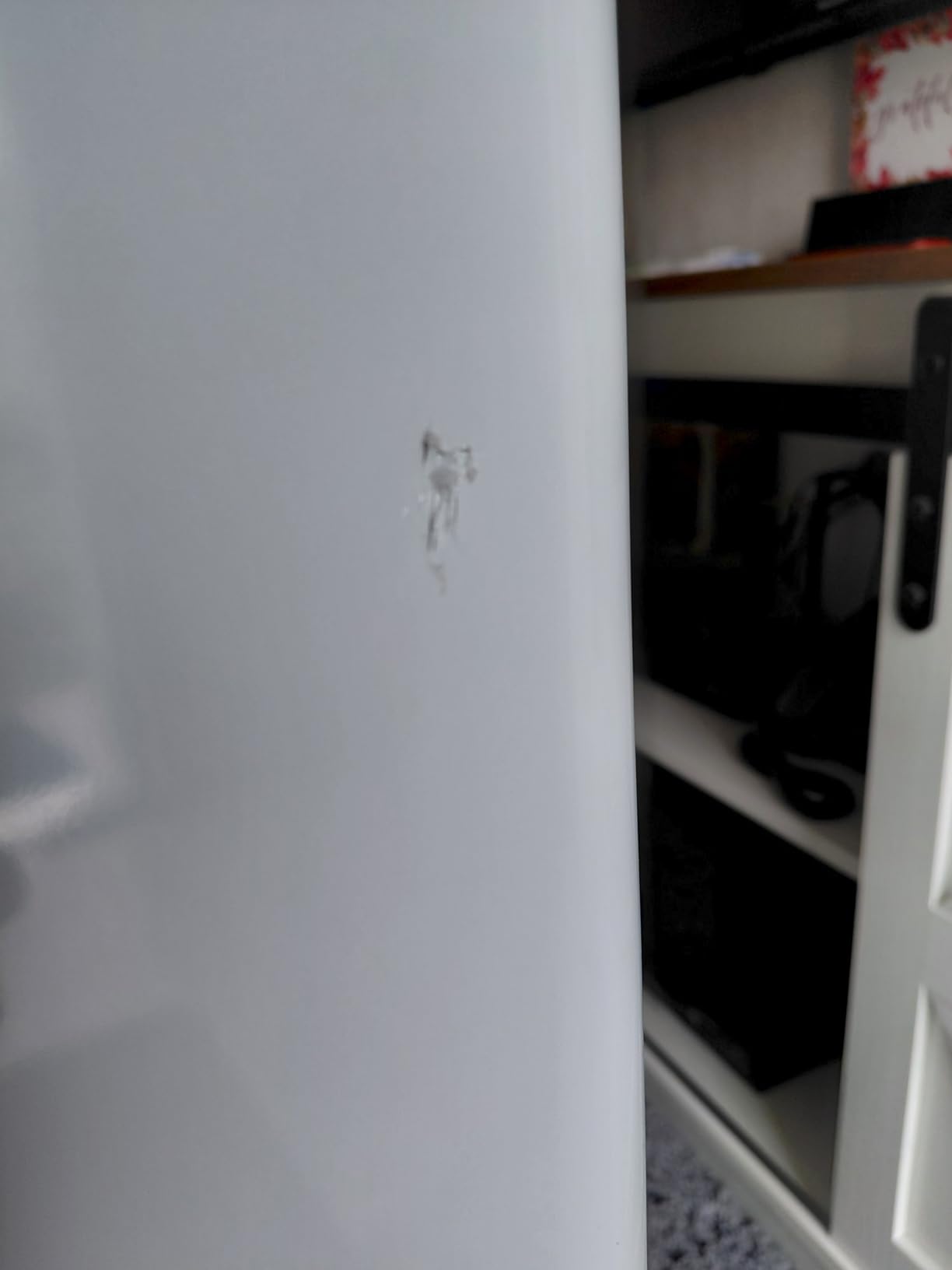
The ice maker is a sensor unit rated at up to 3.5 pounds a day, tucked in the top of the freezer so it does not steal shelf space from the fresh compartment. Owners mention the compressor is barely audible even in an open-plan room, and several report replacing a 21 cu. ft. unit with this and finding it held as much food as they had before.
It is ENERGY STAR certified with a 470 watt compressor, and the warranty is a one-year manufacturer term. The honest weakness is lighting: the interior LED is dim, and owners say items at the back of the shelf are hard to find. French doors also open in two halves, which some buyers dislike in a narrow aisle even though the body itself is compact.
Best fit for couples who want ice on demand in a tight kitchen
Pick this if your opening is under 30 inches wide and you want a French-door look with an internal ice maker and no plumbing line. It is the strongest all-round balance of evidence and features we found: 165 reviews at a 4.2 average, which is more owner history than most units in this price band carry.
Skip it if lighting matters to you, or if your building has narrow hallways where two independently opening doors will feel cramped. Roughly one review in eight is a one-star rating, concentrated on transit damage and cooling faults rather than on features.
Where it falls short against a top-freezer alternative
The bottom-mount premium is real and this unit shows it. A same-capacity top-freezer model is simpler, has fewer electronic failure points and costs less, and a thread on r/Appliances framed the trade exactly that way when one owner compared a top-freezer purchase against a bottom freezer in the same brand family and judged the extra spend worth it only because of the layout.
What you are buying here is reach, not reliability. If the waist-height freezer drawer is not something you will use and the extra spend feels wrong, the smart move is a simpler configuration.
2. Upstreman 7.1 cu. ft. Compact Bottom Freezer – Best Value
Upstreman 7.1 Cu.Ft Refrigerator with Bottom Freezer, Apartment Fridge
7.1 cu. ft. total
5.45 cu. ft. fresh food plus 1.65 cu. ft. freezer
21.46 in D x 21.46 in W x 55.91 in H
39 dB, 384 kWh per year
Pros
- 21.46 inch square footprint suits small rooms
- Waist-height freezer drawer
- Quiet 39 dB running
- Reversible door hinge
- About 1 kWh per day
Cons
- Manual defrost needs periodic attention
- Only 1.65 cu. ft. of freezer space
- Must stand upright six hours after delivery
This is the unit we recommend when the kitchen is a rental apartment and the only measurement that matters is whether it clears the doorway. The body is 21.46 inches square and 55.91 inches tall, it weighs 58.1 pounds, and one person can move it without a dolly.
Capacity is 5.45 cu. ft. of fresh food and 1.65 cu. ft. of freezer. That is small, and for a couple who buys groceries every three or four days it is enough. It is not enough if you batch cook and freeze a big batch on a Sunday, which is the honest limit of the whole 7 cu. ft. class.
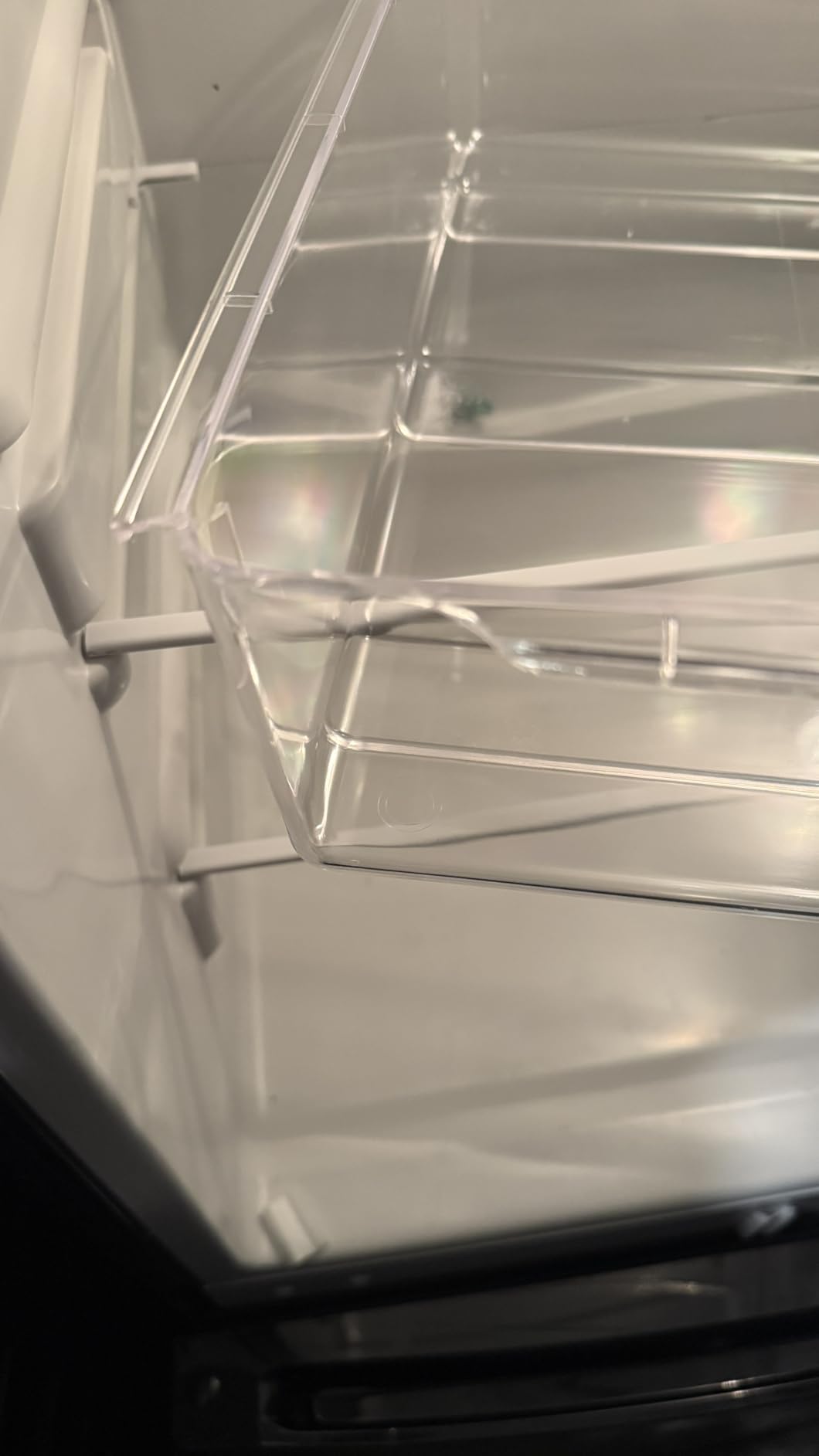
Both compartments carry five temperature settings, with the fridge rated from 32 to 53.6F and the freezer from minus 5.8 to 17.6F. The listing puts running consumption at roughly 1 kWh a day, and the technical data records 384 kWh per year, which is among the lowest figures in this group. Sound is rated at 39 dB, which is quiet enough to sit beside a bed.
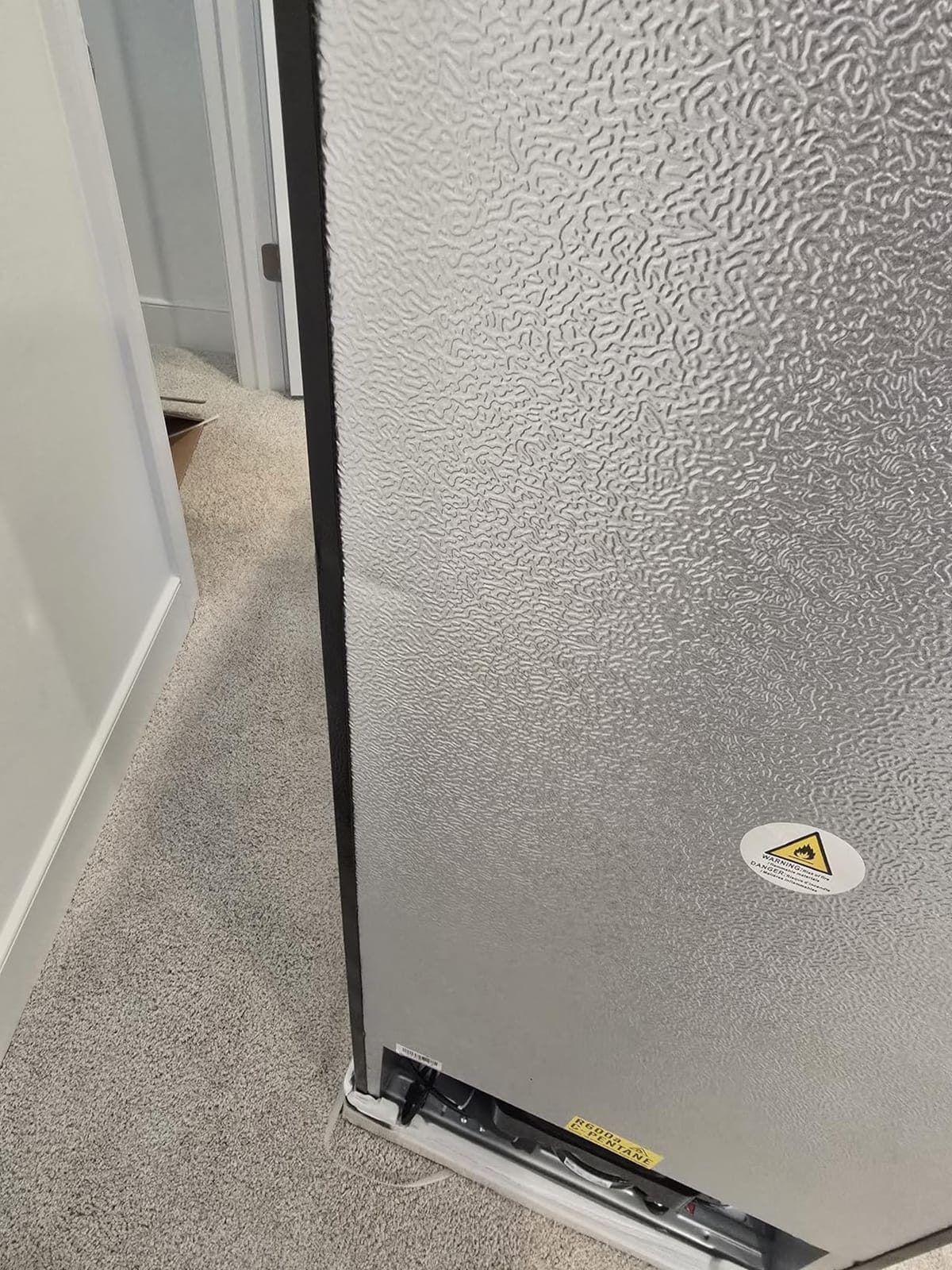
Refrigerant is R-600A, the current standard for compact units, and the door hinge is reversible so you can mount it either way. It arrives with a defrost tool, an egg shelf, adjustable shelves and an ice tray. The catch is manual defrost in the freezer, plus a six-hour settling period after transit before first power-on.
Best for a first apartment, a rental, or a kitchen with one narrow corner
Choose this if the priority is a small footprint, low running cost and quiet operation rather than capacity. At 100 reviews and a 4.3 average it is the cleanest-rated compact model in the group, with 85 percent of reviews at four stars or better.
Choose it knowing you will thaw the freezer by hand every few weeks and that 1.65 cu. ft. of freezer is roughly a week of frozen food for two people. If you cook a lot and freeze a lot, move up a size instead.
Where the small format squeezes you
Two shelves and two doors is a hard limit on stacking. Owners who shop for a week at a time report running out of vertical room before running out of floor space, and the internal light is basic compared with the LED panels on the larger units here.
Manual defrost is the single most common complaint, and it is a design choice rather than a defect. If you already know you will forget it, the 9.2 cu. ft. model in position four gives you more room for the same habit.
3. BANGSON 7.1 cu. ft. Apartment Bottom Freezer – Most Owner Reviews
BANGSON Apartment 7.1 Cu.Ft Refrigerator with Bottom Freezer Black
7.1 cu. ft. total
5.45 cu. ft. fresh food
20.7 in D x 21.3 in W x 56 in H
Manual defrost, about 39 dB
Pros
- Compact 21.3 by 20.7 inch footprint
- Two bottom freezer drawers
- Automatic night light
- Reversible door
- Leveling legs for uneven floors
Cons
- Manual defrost in the freezer
- 3.8 average with 312 reviews
- Needs 6 to 12 hours upright after transit
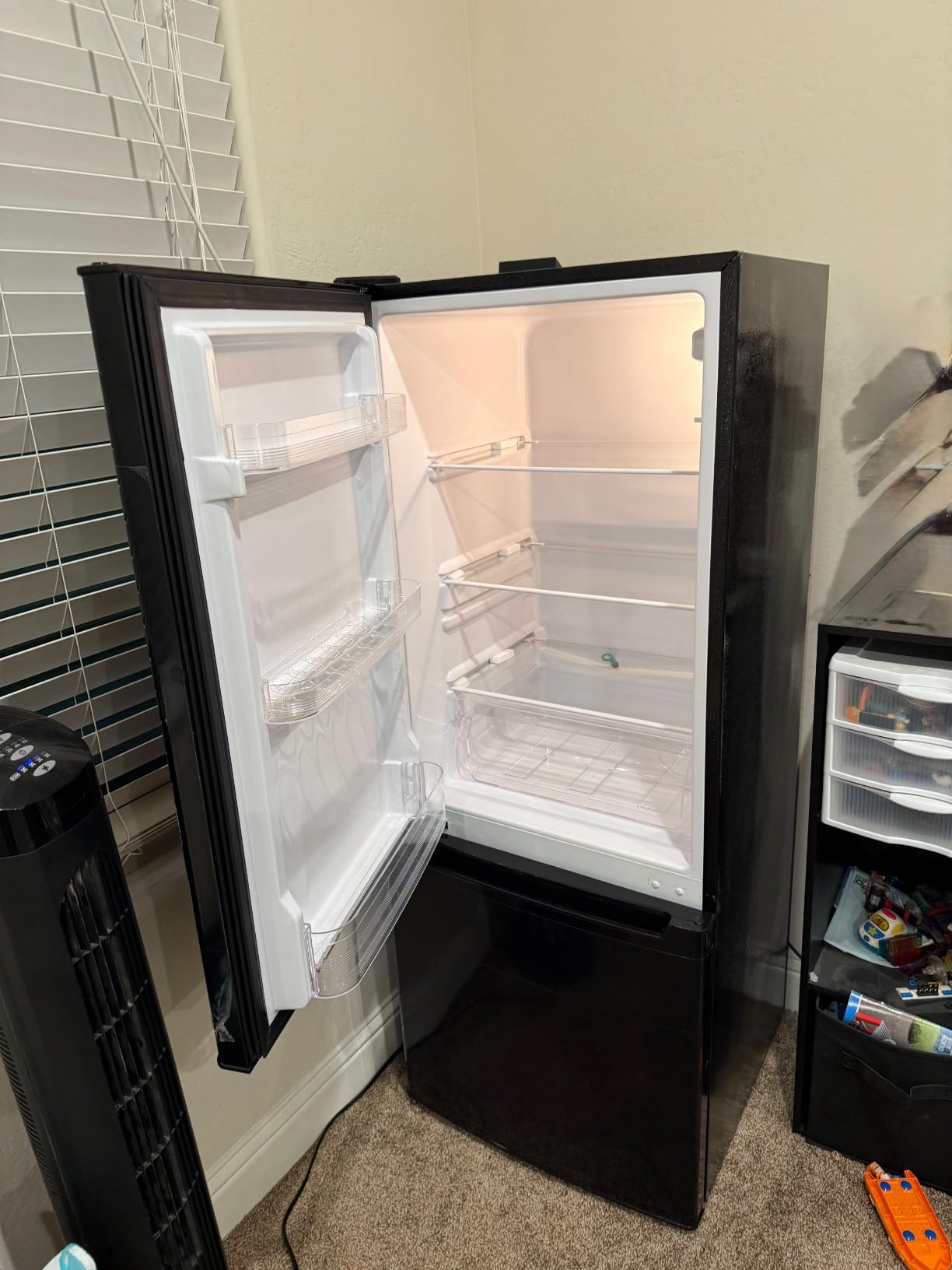
Same capacity split as the Upstreman, different engineering. The BANGSON measures 20.7 inches deep by 21.3 inches wide and 56 inches tall, and it holds 5.45 cu. ft. of fresh food with 1.65 cu. ft. in the freezer, split across two separate bottom drawers instead of one.
That drawer split is the reason to choose it over the other 7.1 cu. ft. option. You can keep long flat items in one and bags of frozen veg in the other, and two adjustable glass shelves plus a crisper drawer make the small fresh compartment easier to load than a single-shelf layout. There is an automatic night light in the fresh-food door, which matters more than it sounds in a dark studio.
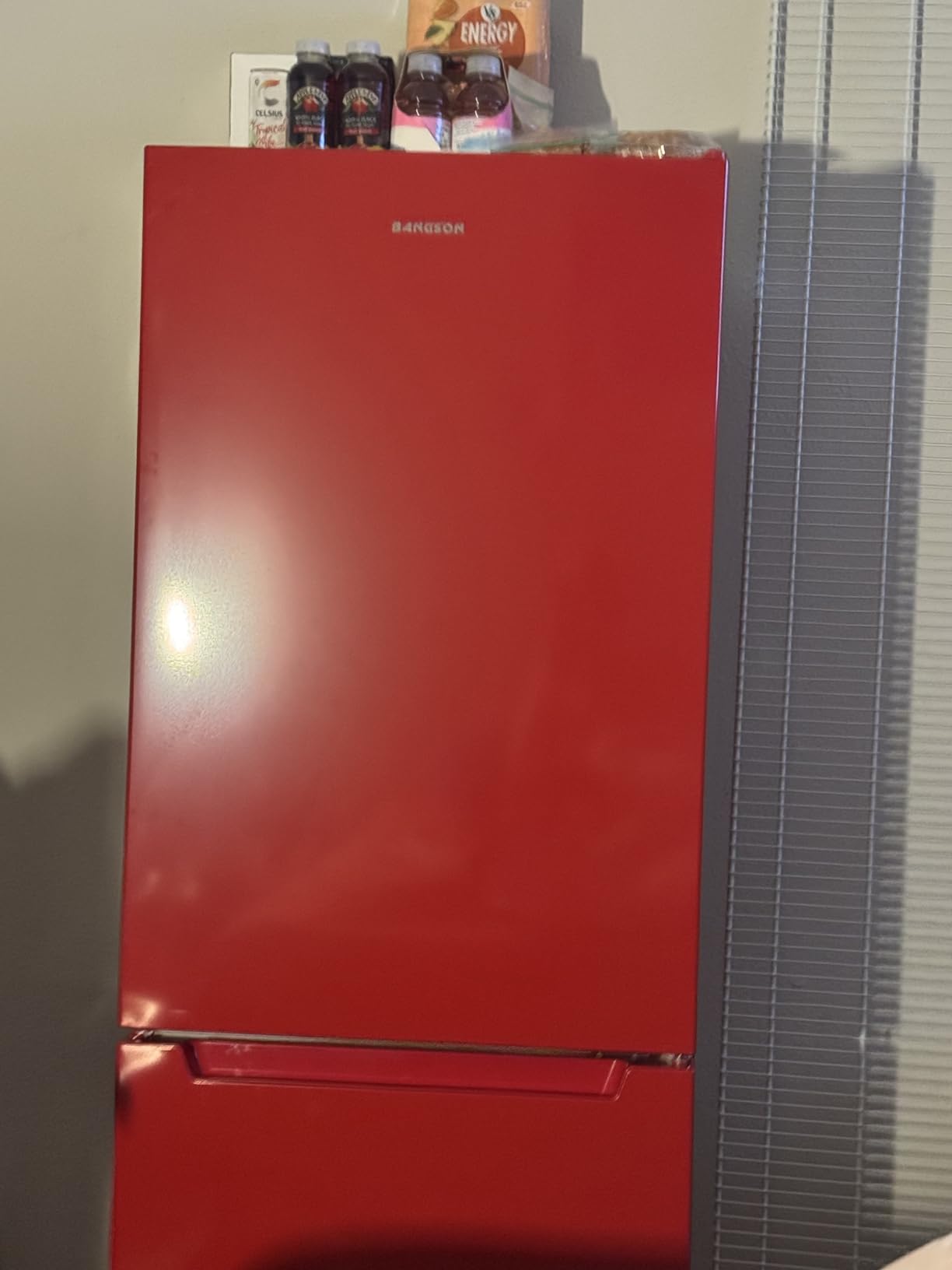
Five temperature settings per compartment, about 39 dB running noise, a reversible door and leveling legs for uneven floors. It includes an ice tray, a defrost tool, an egg shelf and leveling legs. The manufacturer advises 6 to 12 hours upright after transit before you plug it in, which is longer than the six hours the smaller unit requires.
Here is the part that matters. This is the most-reviewed fridge in the group at 312 reviews, and its 3.8 average sits below the leaders in the group. Twenty-three percent of reviews sit at one or two stars, and the pattern in those is durability and temperature consistency over time rather than missing features. Some units arrive with frost build-up that needs clearing by hand.
Best for buyers who want two freezer drawers at the smallest size
The two-drawer split and the night light make this the better-organised of the two 7.1 cu. ft. models, and 312 reviews is the largest evidence base here, which cuts both ways. You can see the failure pattern clearly, and it is not clean.
Pick it if your budget is the first constraint and the freezer is a convenience rather than a serious storage space. Choose the Upstreman instead if quiet, low energy use and a cleaner review distribution matter more to you than drawer separation.
Where the 3.8 average comes from
Fifty-five percent of reviews are five stars, so satisfaction is real, but the long tail is long. Owners report compressors running harder than expected and cooling that drifts over the first year, which matches the failure profile described repeatedly on r/appliancerepair threads about bottom compartments that stop holding temperature.
Manual defrost adds to the workload. If you already dislike defrosting, do not buy into it here, and note that the freezer needs 6 to 12 hours of settling time after delivery, which can complicate an install in a rental.
4. Hamilton Beach 9.2 cu. ft. Bottom Mount Freezer – Best for Small Kitchens
Hamilton Beach Cubic Foot Fridge with Bottom Mount Freezer, 9.2 cu. ft, Stainless
9.2 cu. ft. total
6.4 cu. ft. fresh food plus 2.8 cu. ft. freezer
20.5 in D x 21 in W x 69 in H
68 pounds
Pros
- 9.2 cu. ft. in a body just 21 inches wide
- 2.8 cu. ft. freezer split into three sections
- Three removable glass shelves
- Door rack fits cans and bottles
Cons
- Manual defrost
- No inverter compressor
- R-134A refrigerant
- Not ENERGY STAR rated
This is the one to look at if you want real bottom-freezer capacity in a body that is still only 21 inches wide. The unit measures 20.5 inches deep, 21 inches wide and 69 inches tall, so it is tall and narrow rather than short and wide, and it weighs 68 pounds.
Capacity is 9.2 cu. ft. total, split 6.4 cu. ft. fresh food and 2.8 cu. ft. freezer. That freezer volume is 70 percent larger than either 7.1 cu. ft. model above, and it is divided into three differently sized sections so you can sort by item type. For a couple who freezes a weekly batch, that is the difference between workable and frustrating.
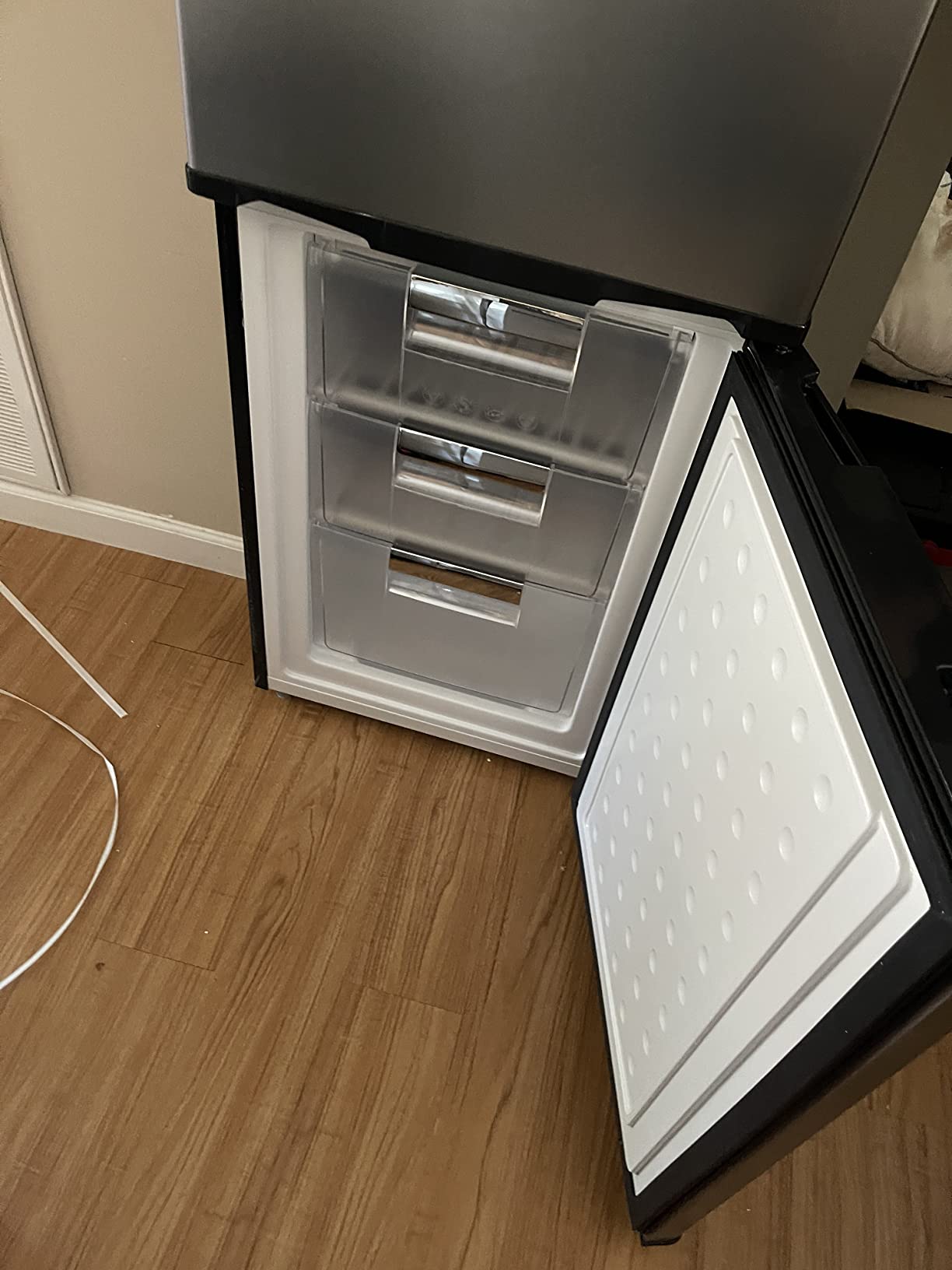
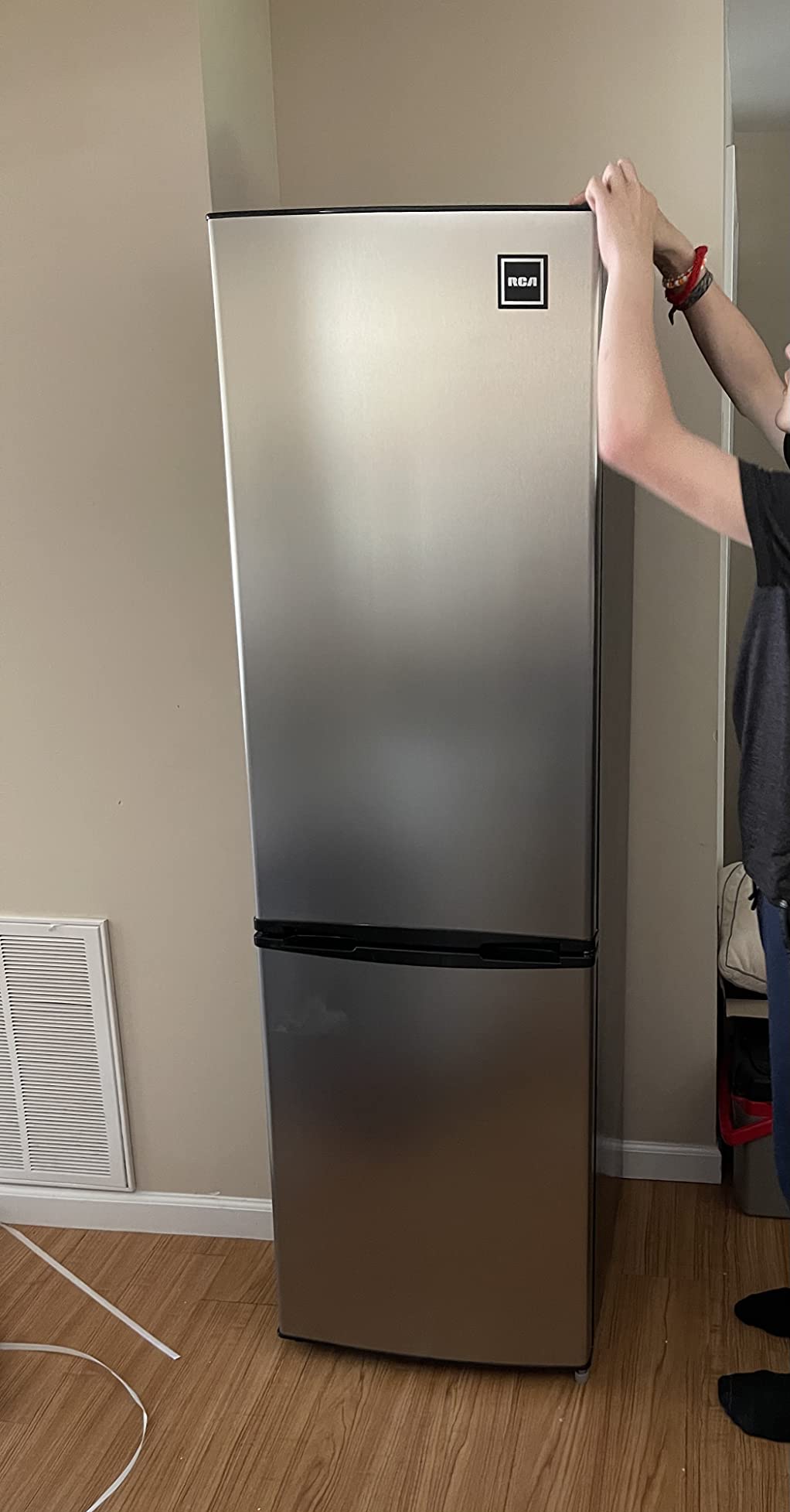
Storage in the fresh compartment is three removable glass shelves, a crystal crisper with a tempered-glass cover, and a door rack sized for 355 ml cans and bottles. You can reach the freezer without stooping, which is the entire point of the bottom-mount layout, and the narrow body leaves counter space on either side in a galley kitchen.
The technical data tells the less flattering story. It runs on R-134A refrigerant rather than the more efficient R-600A, it has no inverter compressor, it is not ENERGY STAR rated, and annual consumption is listed at 400 kWh. The one-year warranty matches most units in this group rather than beating it.
Best for a couple who freezes food and only has 21 inches of width
Take this if freezer volume is your real constraint and the standard is a narrow alcove. Nine point two cubic feet in a 21 inch body is unusual, and the three-section freezer layout does more for organisation than a larger single cavity would.
It suits a first flat where electricity cost and efficiency ratings are not the deciding factor. If you are buying for ten years, note the one-year warranty and the older compressor design before you commit.
Why the 3.7 rating deserves attention
Seventeen percent of reviews are one star and another 8 percent are two stars, and owners describe units that stopped holding temperature. That pattern lines up with what r/appliancerepair contributors most often diagnose in a slow bottom compartment: a failed bimetal defrost thermostat or worn door seals rather than a dead compressor.
Manual defrost compounds it, because a manual-defrost unit with a marginal seal will ice over faster than a frost-free one. If reliability is your top concern, step up to a frost-free unit with a proper compressor warranty.
5. KoolMore 18.5 cu. ft. Counter-Depth French Door – Best for Counter-Depth Fits
KoolMore 30-Inch and 18.5 cu. ft. Counter Depth French Door Refrigerator with Three Doors and Deep Freezer in Stainless-Steel (KM-RERFDSS-18C)
18.5 cu. ft. total
5.58 cu. ft. in two freezer drawers
30.1 in D x 29.5 in W x 66.6 in H
Inverter-quiet running
Pros
- 29.5 inch counter-depth body fits a 30 inch cavity
- Highest owner rating in the group
- Two large bottom freezer drawers
- Double-flow cooling with digital control
- ENERGY STAR certified
Cons
- Review base is only 67
- Dim interior LED lighting
- Recessed handles show fingerprints
- No dedicated deli drawer
This is the highest-rated refrigerator in the entire group at 4.6, with 80 percent of its reviews at five stars. The 29.5 inch body is the reason: it slips into a standard 30 inch kitchen cavity and still returns 18.5 cu. ft., which is the counter-depth trade most guides describe as losing 6 to 8 cubic feet.
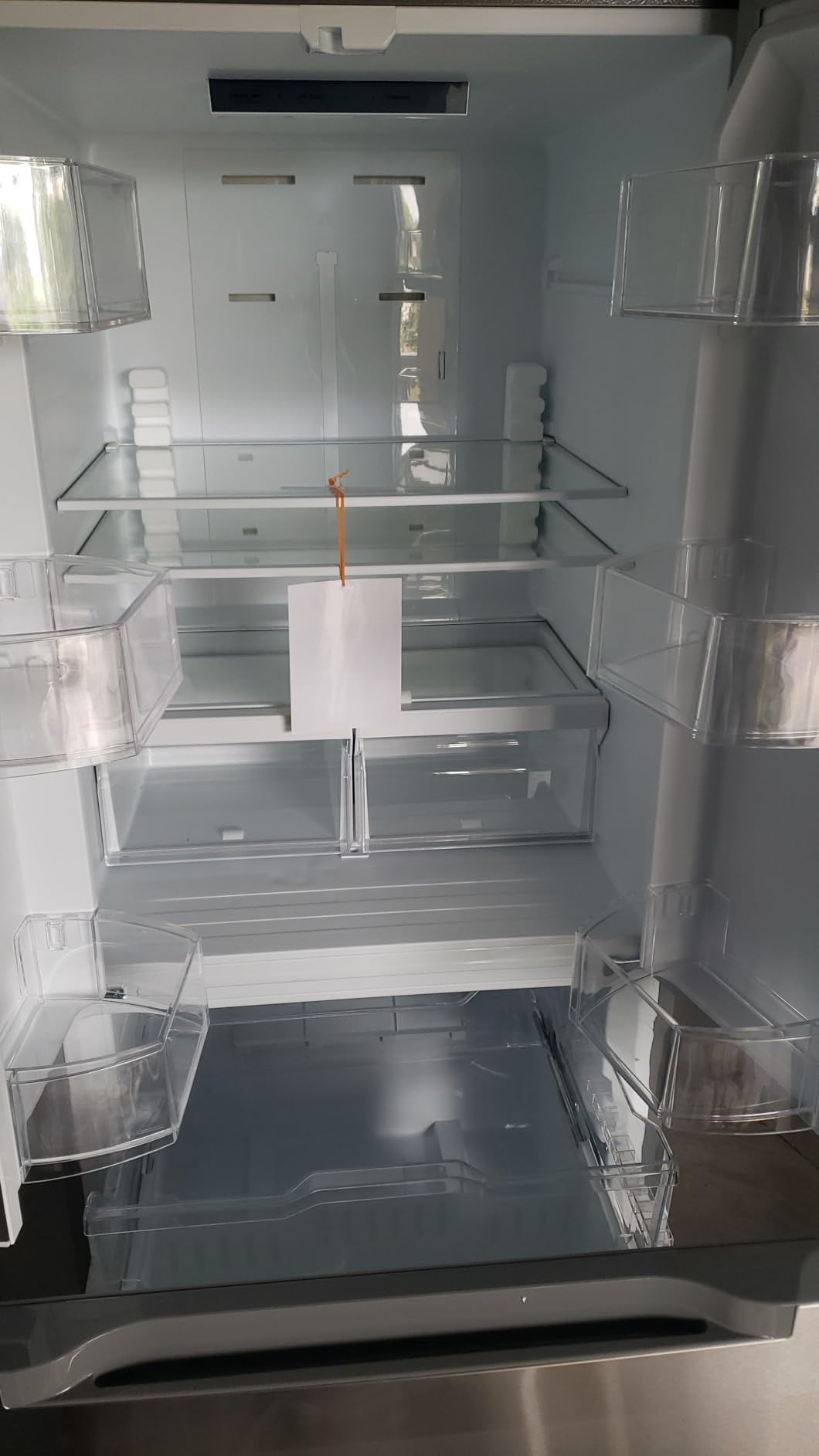
The freezer is 5.58 cu. ft. across two large bottom drawers, and the fresh compartment carries double crisper drawers with humidity control, six door bins and adjustable glass shelving. The box includes one freezer drawer and two refrigerator drawers, two shelves and six baskets, so the interior is configured as it arrives.
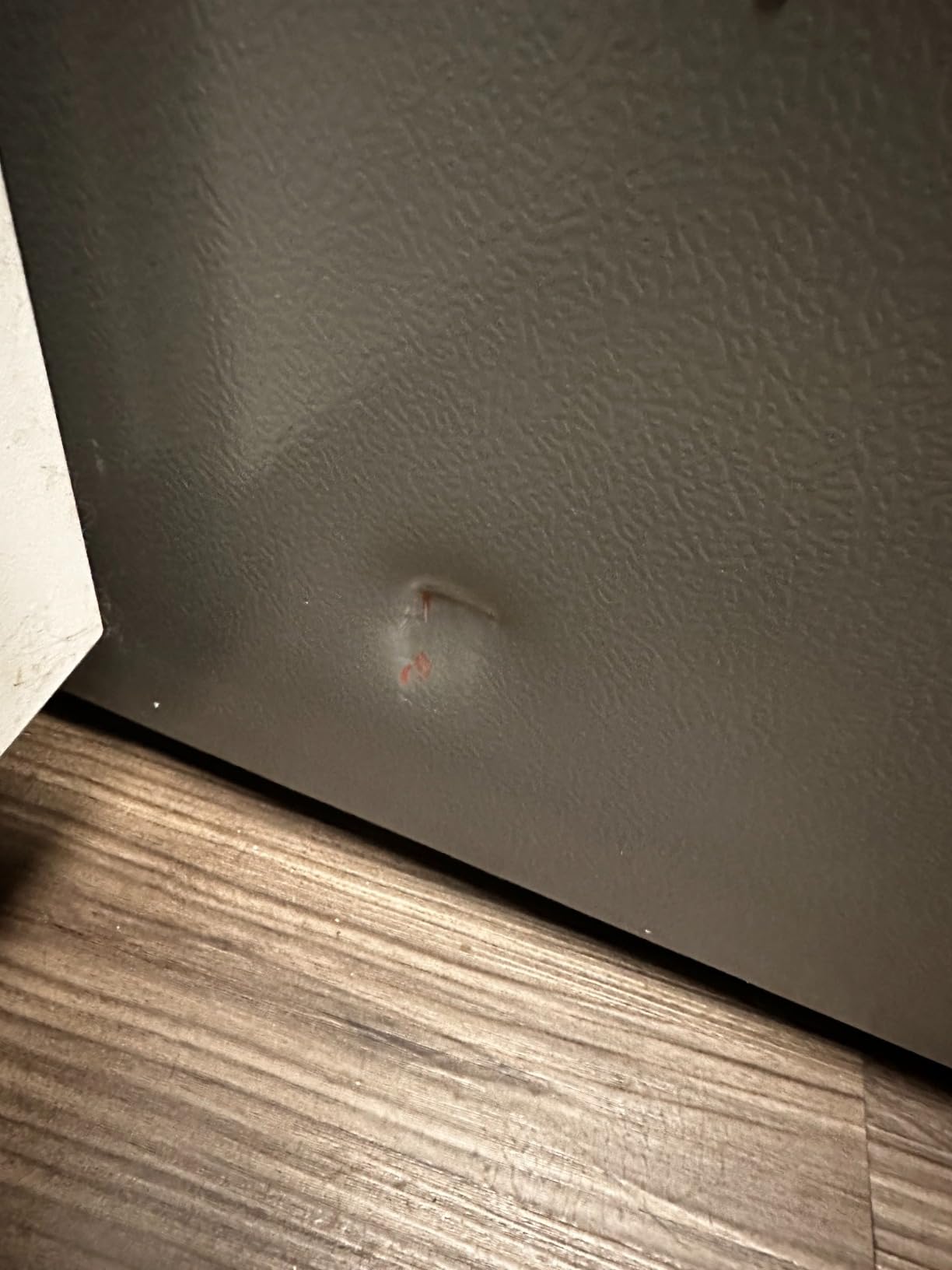
The dominant owner theme is silence. Buyers describe replacing a loud bottom-freezer unit with this one and calling the inverter compressor near-silent in an open-concept room. Double-flow cooling with digital temperature control gives even shelf-to-shelf temperatures, and no over-freezing is reported. There is also a door-open alarm to cut spoilage.
Consumption is listed at 465 kWh per year with ENERGY STAR certification, and refrigerant is R-600A. The body is 30.1 inches deep, 29.5 inches wide, 66.6 inches tall and 180 pounds, so the depth is the number to check against your cabinet line.
Best for a couple with a tight galley kitchen and a 30 inch opening
This is our pick when your cavity is 30 inches wide and you refuse to compromise on capacity or on quiet running. 18.5 cu. ft. from a counter-depth body is hard to find, and the two-drawer freezer is generous for a 29.5 inch wide frame.
Pick it if the household cooks and eats a lot and the kitchen is open to a living space, because the noise floor is the most-praised trait owners report. Six door bins hold gallon jugs comfortably, which matters for two people who buy milk in bulk.
Where the evidence is thin and the finish fights back
Sixty-seven reviews is a small base for a major purchase, so treat the 4.6 as encouraging rather than proven over ten years. The recessed handles pick up fingerprints, the stainless finish takes more effort to keep clean than a matte one, and the interior lighting is dimmer than buyers would like.
There is no cheese or deli drawer. Owners who prefer a single full-width door also note the French doors take up more cabinet space, and the one-year parts and labour warranty is the standard in this group rather than an exception.
6. Antarctic Star 17.5 cu. Ft. with Inverter Compressor – Best for Even Cooling
Antarctic Star 17.5 Cu Ft French Door Refrigerator, Bottom Freezer with Built-In Automatic Ice Maker, Fast Cooling & Multi-Air Flow, Inverter Compressor, Stainless Steel VCM, LED Touch Display, Silver
17.5 cu. ft. total
12.4 cu. ft. fresh food plus 5.1 cu. ft. freezer
30.83 in D x 29.88 in W x 70.08 in H
Inverter compressor
Pros
- Inverter compressor with multi-air flow
- Built-in automatic ice maker hidden in the freezer
- LED touch display with door-open alarm
- Doors open a full 90 degrees
- Fingerprint-resistant finish
Cons
- Only 55 reviews
- 70 inch height needs a tall cavity
- Touch display awkward with wet hands
- Ice maker occupies freezer space
The cooling system is the reason this one is here. An inverter compressor paired with a multi-air flow system circulates air across all shelves and drawers, and owners report even temperatures with no warm spots, which is the specific problem a couple notices first in a small compartment.
Capacity is 17.5 cu. ft. total, split 12.4 cu. ft. fresh food and 5.1 cu. ft. freezer, with four shelves in the fresh compartment. The freezer has a built-in automatic ice maker tucked out of sight, so the ice does not sit on an exposed tray taking up your usable volume.
Doors open a full 90 degrees, which means the interior drawers clear even when the fridge sits close to a wall. That is a real benefit in a galley kitchen where a 70 inch tall unit is pushed back into the cavity. There is a door-open alarm on the LED touch display, plus adjustable settings in the same panel.
The finish is a stainless steel VCM that resists fingerprints and smudges, and it is a freestanding installation with reversible door orientation. Dimensions are 30.83 inches deep by 29.88 inches wide by 70.08 inches tall, at 189.6 pounds, so it needs a dedicated tall cavity rather than a low cabinet run.
Best for couples who care about even temperatures and built-in ice
Choose this if temperature consistency in both compartments is the priority, or if you want automatic ice without plumbing. The inverter compressor is a genuine step up from the standard compressor designs in the compact group, and the 90 degree door swing is a measurable advantage in a narrow kitchen.
It suits a couple who shops once a week and fills the freezer. The 5.1 cu. ft. bottom freezer plus a hidden ice maker covers batch cooking without a separate chest unit.
Where the body size and the display get in the way
At 70.08 inches tall and 30.83 inches deep, this is one of the larger bodies here, and it will not sit under a low counter run. Check your ceiling clearance and the depth of your cabinet line before you commit.
A touch display is harder to adjust with wet or gloved hands than a physical dial, and the ice maker does occupy part of the freezer. Most importantly, 55 reviews is the thinnest evidence base among the higher-rated units here, so long-term reliability on this exact model is not yet well documented.
7. Kenmore 17.5 cu. ft. 30 Inch French Door – Best for the Accela Chill Fast Chill
Kenmore 17.5 cu. ft 30″ Wide French Door Refrigerator – FPR Stainless Steel
17.5 cu. ft. total
12.4 cu. ft. fresh food plus 5.1 cu. ft. freezer
31.77 in D x 29.88 in W x 70.3 in H
512 kWh per year
Pros
- Accela Chill fast-chill with multi-flow air
- Six gallon-size door bins
- Two-tier freezer drawer
- Factory-installed cubed ice maker
- Fingerprint-resistant stainless
- ENERGY STAR certified
Cons
- 3.7 average with 24 percent one-star reviews
- 31.77 in depth projects past the cabinet line
- Only two door shelves
- Small review base of 74
Six gallon-size door bins and the fast-chill function are the two things owners single out here. The Accela Chill setting drops temperature quickly after a large shop, and the multi-flow air system is intended to keep shelf-to-shelf temperature even through that recovery.
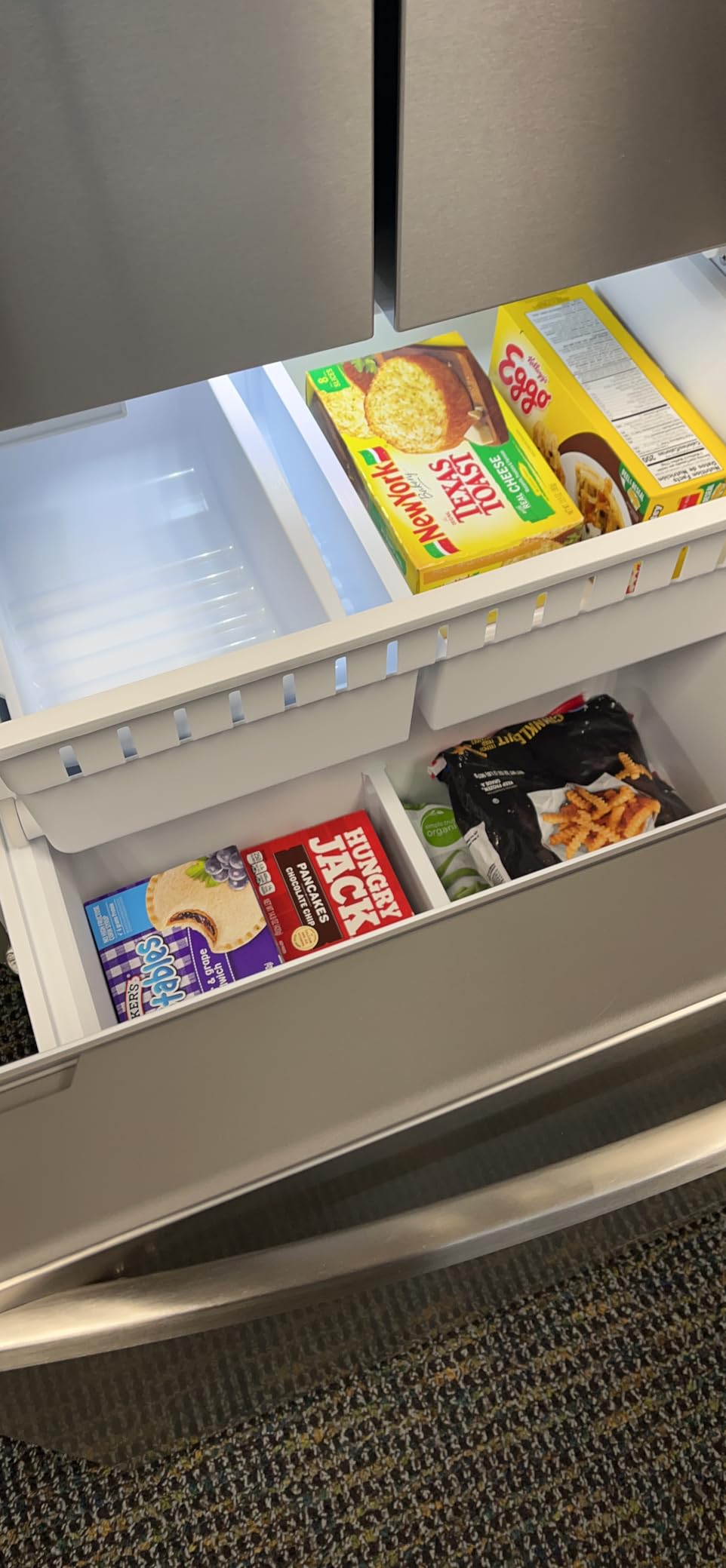
Capacity is 17.5 cu. ft. total with 12.4 cu. ft. fresh food and 5.1 cu. ft. in a two-tier bottom freezer drawer. There are three glass shelves, six gallon-size door bins, a factory-installed cubed ice maker and long-lasting LED lighting, which is a more generous interior loadout than the 4.6-rated unit in position five.
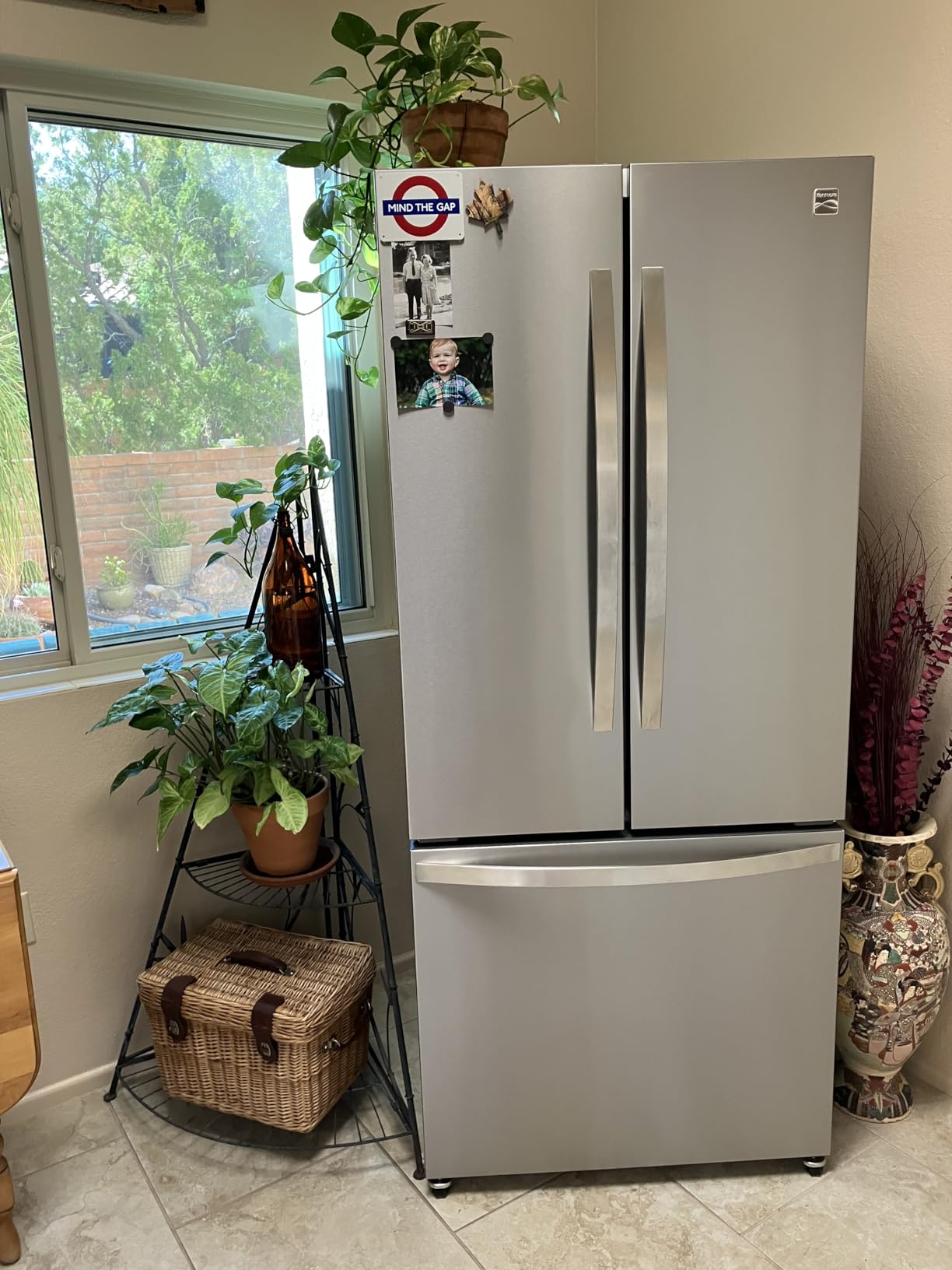
The body is 29.88 inches wide but 31.77 inches deep and 70.3 inches tall, so despite the 30 inch marketing width it projects further into the room than a true counter-depth model. It weighs 189.6 pounds and runs on an inverter compressor with R-600A refrigerant, listed at 512 kWh per year with ENERGY STAR certification.
The fingerprint-resistant stainless finish and electronic lock round out a well-equipped specification sheet. The problem is that 24 percent of its 74 reviews are one stars, the heaviest negative share among the 17.5 to 18.5 cu. ft. units here, and 58 percent are five stars, so opinion is sharply split rather than uniformly mediocre.
Best for a couple who shops in one big weekly run
Take it if you buy a full week’s groceries at once and want them cooled down fast. The fast-chill function plus multi-flow air is the most direct answer to a large weekly shop, and six gallon-size door bins hold a lot of bottles and containers for two people.
The two-tier freezer drawer and installed cubed ice maker make it a good fit if you want ice without a plumbing line and without a separate countertop unit.
Where the depth and the rating split hurt
At 31.77 inches deep this is not counter-depth in the strict sense even though it is 30 inches wide, and it will sit proud of a flush cabinet line. Only two door shelves is thin for the price band, and the energy rating spec of one star sits oddly beside the ENERGY STAR listing.
Most importantly, the 3.7 average with a 24 percent one-star share tells you durability and cooling are the complaint themes, not missing features. For a purchase you expect to keep a decade, we would put the reliability evidence ahead of the feature list here.
8. Avanti 17.5 cu. Ft. 29 Inch French Door – Best for Lowest Energy Use
Avanti French Door Refrigerator with Bottom Freezer 30-Inch Wide​, Frost Free Technology, Large Capacity with Adjustable Shelves, Door Bins & Crisper Drawers, 17.5 Cu.Ft., Stainless Steel
17.5 cu. ft. total
12.4 cu. ft. fresh food plus 5.1 cu. ft. freezer
29.5 in D x 29 in W x 69 in H
327 kWh per year
Pros
- 29 inch body holds 17.5 cu. ft.
- Lowest stated energy use in the group at 327 kWh
- Frost-free in both compartments
- Two crispers and six door bins
- Ice-maker ready wiring included
Cons
- Only 20 reviews
- Standard compressor rather than inverter
- 32 percent of reviews at two stars or below
- Ice maker not included
If the cavity is narrow, this is the one to measure first. The body is 29 inches wide, 29.5 inches deep and 69 inches tall, and it still returns 17.5 cu. ft., which makes it a lot of food in a narrow cabinet run.
Capacity splits 12.4 cu. ft. fresh food and 5.1 cu. ft. in two bottom freezer drawers, and both compartments are frost-free with automatic defrost. Inside you get three adjustable removable glass shelves, six door bins, two clear-view crisper drawers and two freezer drawers. The matte stainless finish is less prone to showing fingerprints than a polished one.
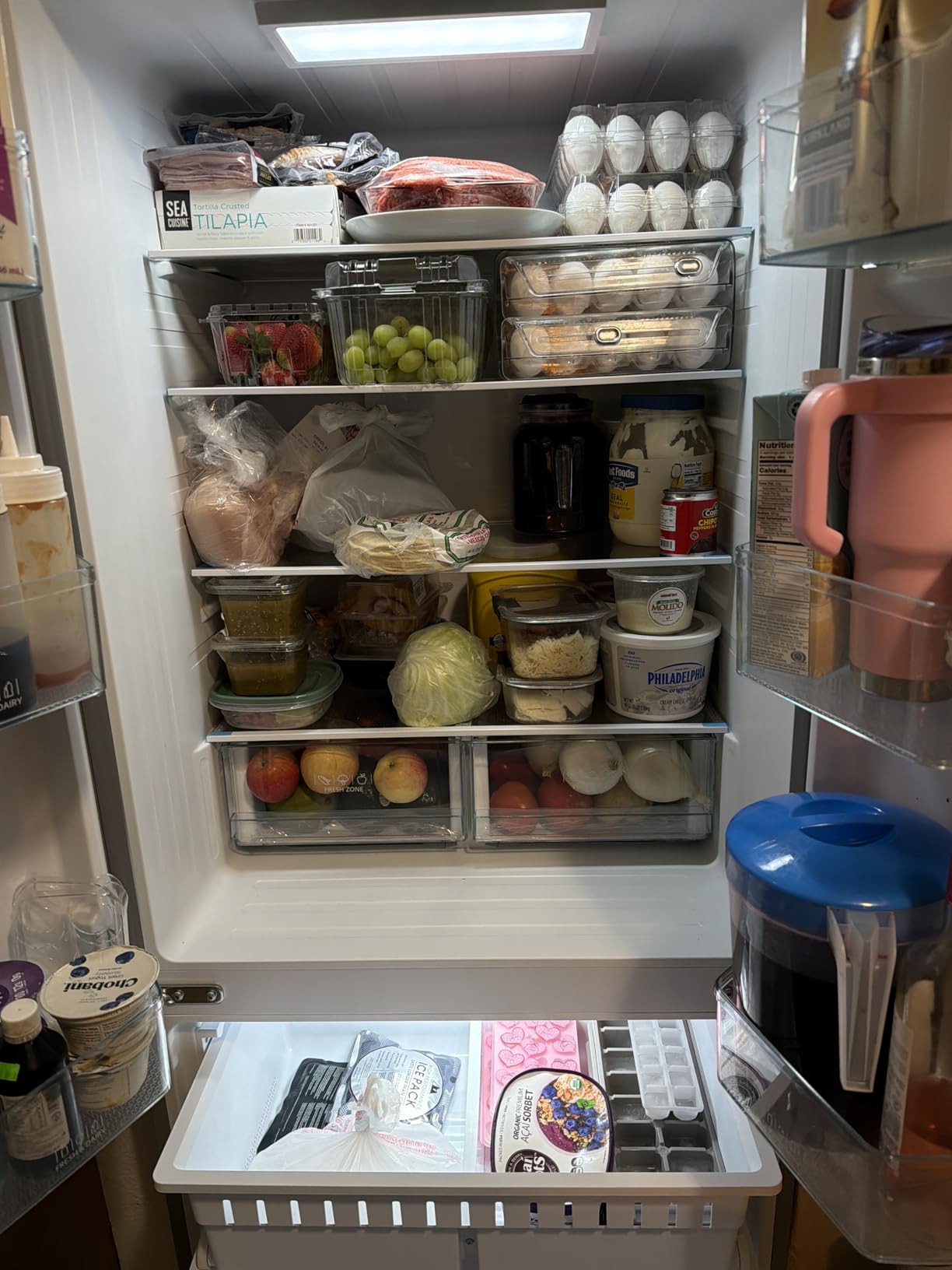
The headline number is energy use. Annual consumption is listed at 327 kWh, the lowest of any unit here, and it carries ENERGY STAR certification with a five-star rating on the energy scale. Over a ten-year life that gap against a 512 kWh competitor is a real running-cost difference, and it is why this model earns its place despite the rating.
It is also ice-maker ready, meaning the wiring is pre-installed for a compatible automatic ice maker you add yourself. What it does not have is a door-open alarm, which both comparable 17.5 cu. ft. rivals include, and it uses a standard compressor rather than an inverter.
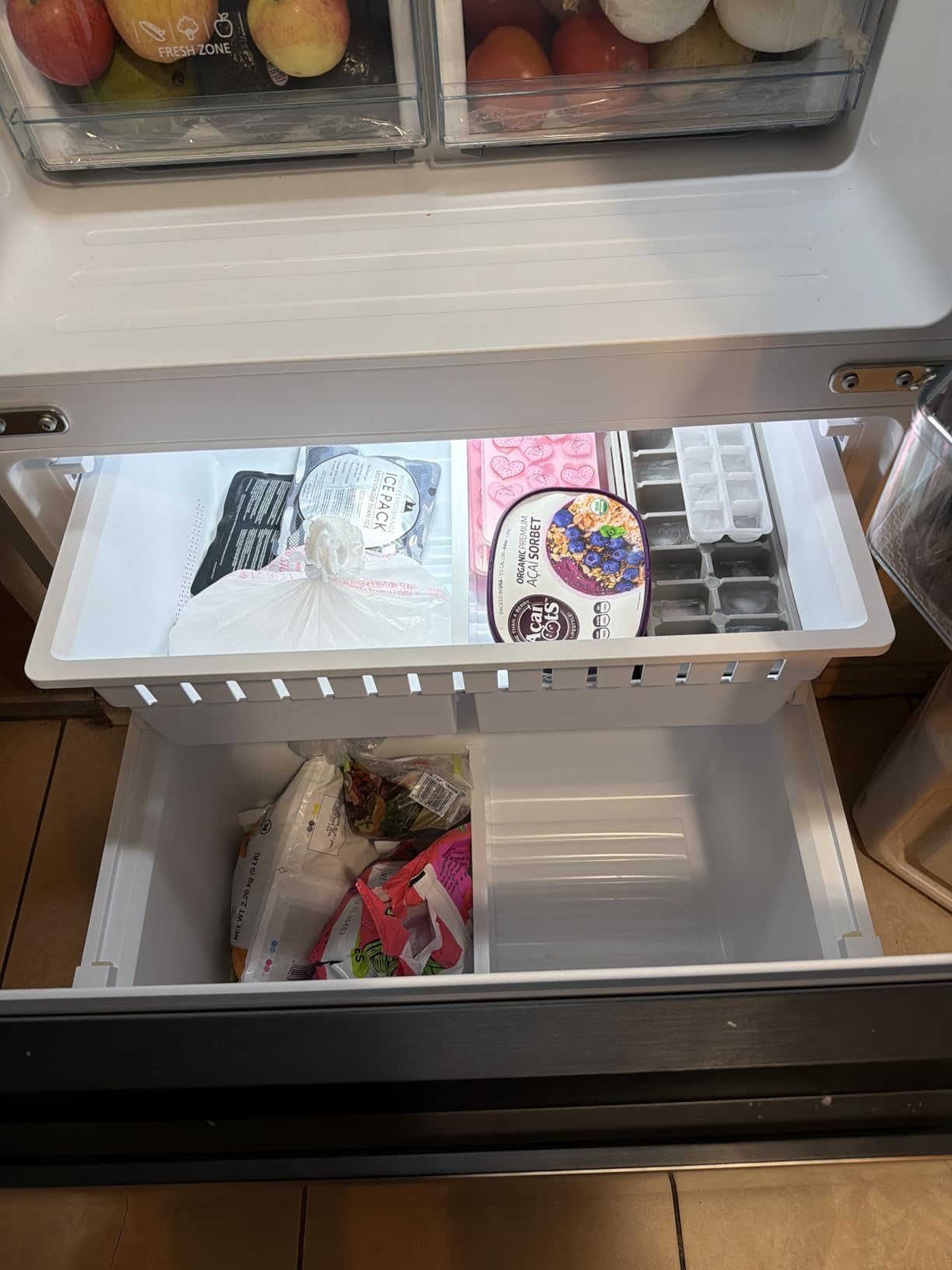
Best for a narrow cabinet run and low running cost
Choose this if 29 inches is all you have and you plan to keep the fridge for a decade, because the 327 kWh figure is the strongest efficiency number in the group. The frost-free defrost in both compartments also means no scheduled thawing, which removes the maintenance burden of the compact manual-defrost models.
The narrow body and two crisper drawers suit a couple who keeps a lot of fresh produce and wants it visible. The one-year limited warranty is the only protection offered.
Where twenty reviews is not enough
This model has the thinnest evidence base among the large-capacity French-door units here at 20 reviews, so the 3.7 average rests on a small sample and should be weighted accordingly. Eighteen percent of reviews are one star and 14 percent are two stars, a combined 32 percent that points to quality and consistency complaints rather than feature gaps.
Adding an ice maker later means buying and installing a separate part, and the standard compressor is the likely contributor to the complaint pattern. If you want a stronger evidence base at this capacity, the 165-review model in position one carries more owner history.
9. Commercial Cool 18.9 Cu. Ft. with Two Bottom Mount Freezer Drawers – Best for the Largest Freezer
Commercial Cool 18.9 Cu. Ft. French Door Refrigerator, 33 Inch Wide Refrigerator with 2 Bottom Mount Freezer Drawers, Frost Free, LED Lighting, Digital Temperature Control, CCRF1890KS, Stainless Look
18.9 cu. ft. total
12.35 cu. ft. fresh food plus 6.53 cu. ft. freezer
27.8 in D x 32.8 in W x 71.7 in H
231.5 pounds
Pros
- Largest freezer in the group at 6.53 cu. ft. across two drawers
- Digital control for each compartment separately
- Vacation mode and door alarm
- 27.8 inch depth in a 33 inch body
Cons
- Lowest rating in the group at 3.6
- Only 16 reviews
- Widest and heaviest body at 32.8 by 71.7 inches
- Highest stated energy use at 528 kWh
The reason to consider this one is the freezer. At 6.53 cu. ft. split across two separate bottom mount drawers, it has the largest freezer of any unit in the group, and the fresh-food side is a full-width 12.35 cu. ft. compartment with three glass shelves rather than split French-door halves.
Every compartment has its own digital temperature control, and the special modes include an AI temperature regulation mode, a vacation mode and a door alarm. It is frost-free with LED lighting throughout, and the reversible door orientation means it can be hinged either way in a rental where the layout may change.
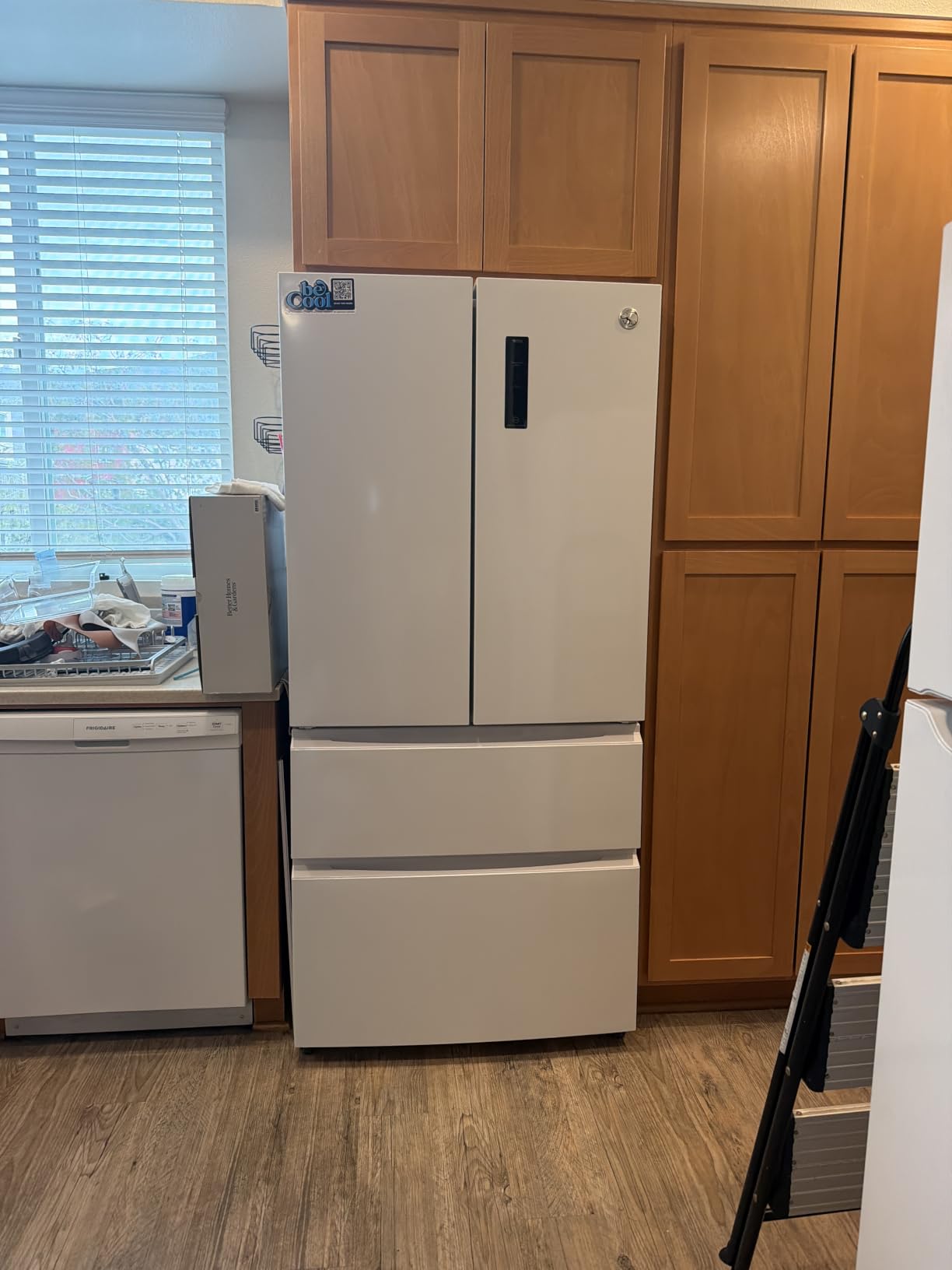
Depth is the surprise here. At 27.8 inches it is shallower than both 29.5 inch units above, which makes it easier to keep clear of a wall, but it is also 32.8 inches wide and 71.7 inches tall. That is the widest and tallest body in the group, and at 231.5 pounds it is the heaviest by a wide margin.
Annual consumption is listed at 528 kWh, the highest figure here, and refrigerant is R-600A. The finish is a stainless look rather than true stainless steel, so it will not match a genuine stainless range in a fitted kitchen.
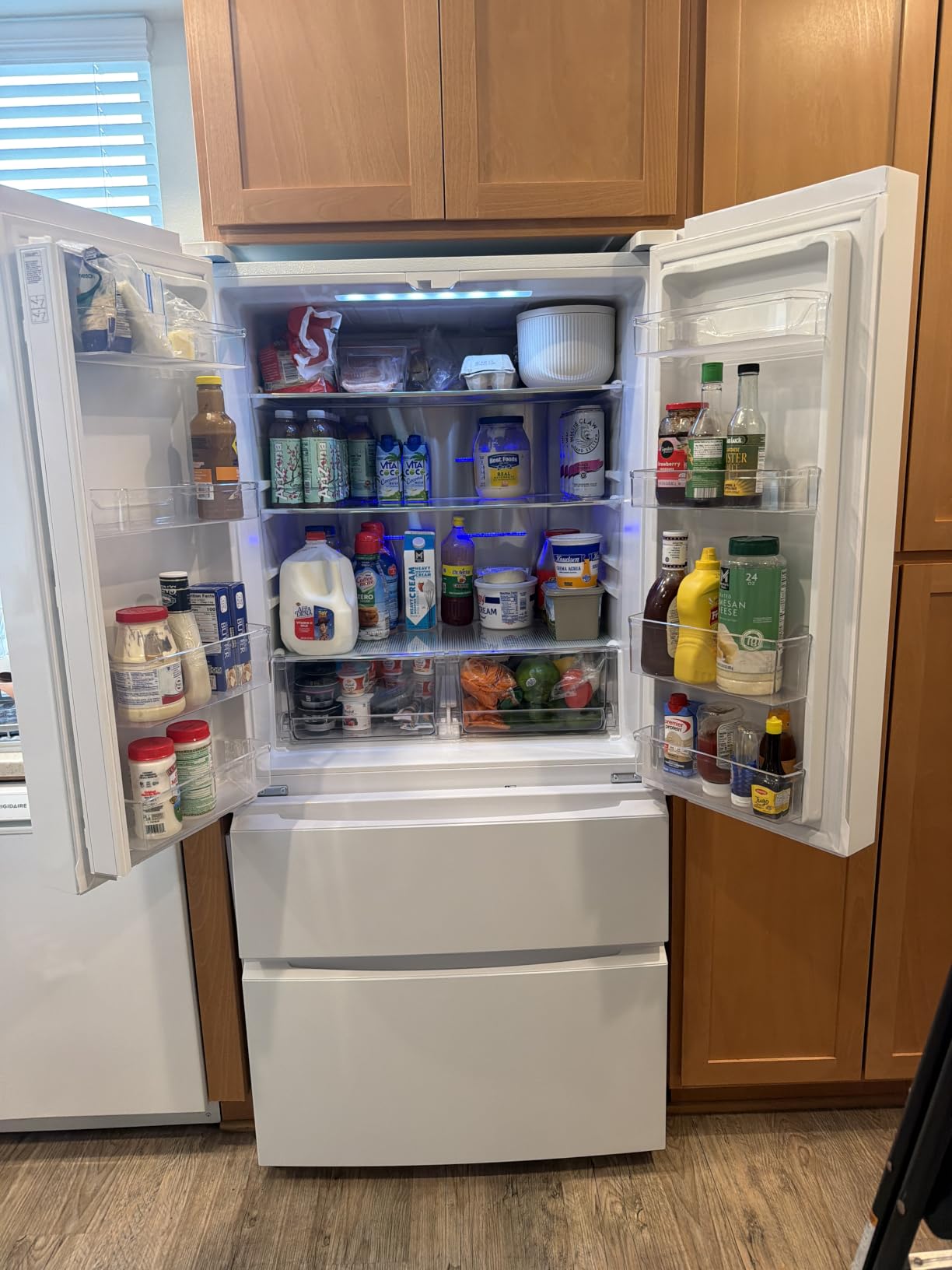
Best for a couple who freezes large batches
Take it if freezing is a hobby rather than a chore. Six and a half cubic feet across two independent drawers is the most freezer you can get in this group, and the full-width fresh compartment keeps a couple’s weekly shop on flat shelves instead of divided halves.
The vacation mode is a genuine convenience for a two-person household that empties out when one person travels, and the shallower 27.8 inch depth is useful in a tight alcove. LED lighting throughout beats the dim panels on two of the higher-rated units.
Where the sample size undermines the feature sheet
Sixteen reviews is the smallest sample here, twenty-nine percent are one stars, and 3.6 is the lowest average in the group. A feature list this capable tells you very little when the evidence about durability is 16 people deep, and the 29 percent one-star share suggests a real group of buyers hit problems soon after purchase.
It is also the biggest energy user of the nine and the heaviest to move. If a 33 inch wide, 71.7 inch tall cavity is not already open in your kitchen, this unit will not fit the couple-sized brief at all.
How Much Refrigerator Space Do Two People Need?
A two-person household needs 10 to 13 cubic feet of total capacity, with 70 to 75 percent of that usable in the fresh-food compartment. Manufacturers recommend 19 to 22 cubic feet for a family of four, and that default is why so many couples buy a unit they never fill.
The weekly-shop illustration is simple. Two adults buying for a week typically generate around 60 to 80 items, mostly packaged, stacked and short-lived, plus a smaller volume of frozen goods. That pattern fits comfortably in 8 to 9 cubic feet of fresh-food space with room for a shop-in-place weekend stock-up. Freezer needs vary far more than fridge needs: a couple who freezes bread, soup and one batch meal a week is happy with 1.5 to 2.8 cubic feet, while a couple who buys whole fish and portions meals needs 5 cubic feet or more.
Two people who do not cook or batch freeze can live in the 7 cu. ft. class. Two people who do should start at 9 cubic feet, which is the smallest body in this group that gives a usable 2.8 cu. ft. freezer. The 16 to 19 cu. ft. French-door units here suit couples who entertain often, shop once a week in volume, or want room to grow.
Width Decides More Than Capacity
For an apartment kitchen, width is the first filter because it is the measurement you cannot change. This group spans 21 inches to 32.8 inches wide, and that range covers every common opening from a galley kitchen to a full-size bay.
Below 24 inches wide, your realistic options are compact bodies around 21 inches, either square like the Upstreman at 21.46 inches or slightly rectangular like the BANGSON at 21.3 inches. The Hamilton Beach sits at 21 inches but stands 69 inches tall, which is how it gets 9.2 cubic feet into a narrow footprint. Between 28 and 30 inches you get the main event: the 28.3 inch BLACK+DECKER, the 29 inch Avanti and the 29.5 to 29.9 inch French-door units. Above 30 inches you are into full-size territory, where the 32.8 inch Commercial Cool is the only option here.
Always leave a small allowance at the sides. Hinges, door thickness and the need to open the door fully past 90 degrees all eat into the nominal opening, and a 29 inch body in a 29 inch gap will fight you on every door open.
Counter-Depth vs Standard Depth in a Galley Kitchen
Counter-depth means a body roughly 24 to 30 inches deep, sitting close to flush with a standard 24 inch counter run. Standard depth runs 30 to 35 inches and projects into the room. The trade is always the same: counter-depth gives you a built-in look and a shallower footprint, and you pay for it in capacity.
Guides typically put the counter-depth penalty at 6 to 8 cubic feet, and that rule of thumb does not apply cleanly at the small end. The KoolMore in position five returns 18.5 cubic feet from a 29.5 inch counter-depth body, which is more than the Avanti manages at 29 inches. At small-format sizes, the capacity difference between a shallow and a deep body is far smaller than it is in a full-size fridge, because the body dimensions are set by the compressor bay rather than by storage volume.
One trap: check the depth figure rather than the width. The Kenmore is 30 inches wide and marketed as 30 inch counter-depth, but at 31.77 inches deep it projects past a flush cabinet line. The Avanti at 29.5 inches deep and the KoolMore at 30.1 inches are closer to true counter-depth behaviour.
Single Swing Door vs Pull-Out Freezer Drawer
All nine units here put the freezer at the bottom, but the fresh-food door layout changes your aisle space. A single swing door needs roughly half the door-swing depth of two French doors, so it wins in a galley kitchen where the fridge faces a counter or a wall a few feet away.
French doors open in two halves, which improves visibility into the fresh compartment and lets you reach one side without blocking the other. Against that, both leaves need clearance, and the BLACK+DECKER review pattern includes owners who prefer to avoid two compartments opening at once in a tight kitchen.
Inside the freezer itself, the other variable is the number of drawers. Two separate drawers, as on the BANGSON, KoolMore, Avanti and Commercial Cool, let you sort by item type and stop hunting through a single cavity. A single compartment, as on the Upstreman and the Hamilton Beach, is simpler but means one overloaded drawer.
Bottom Freezer vs Top Freezer: The Honest Trade-Off
Bottom-mount refrigerators put your everyday food at eye level and move the freezer to knee height. That is genuinely better for the trips where you want milk than for the trips where you want frozen peas. Top-freezer models are cheaper, simpler and widely described in owner communities as the most reliable style, and they are what a lot of repair contributors default to when diagnosing a compressor or thermostat fault.
The drawbacks of the bottom-freezer layout are worth stating plainly. You squat or kneel for frozen items every time, which owners on a high-engagement r/unpopularopinion thread framed as the core ergonomic complaint. You also lose freezer volume relative to fresh-food volume in most layouts. And the machinery that keeps a bottom compartment cold is more exposed to seal wear and defrost faults, which is exactly the failure mode r/appliancerepair contributors most often identify in slow-cooling bottom drawers.
So who should skip the bottom freezer? Anyone with back or knee problems, anyone in a wheelchair-accessible kitchen where a low drawer is awkward, and anyone who cooks almost nothing frozen should look hard at a simple top-freezer and save the difference. Owner communities frequently point out that plain single-door bottom-mount units have fewer electronic failure points than feature-heavy French-door models with installed ice makers and touch displays, and that is the direction we would point you as well.
Energy Use and the Ten Year Running Cost
Annual energy consumption across this group ranges from about 327 kWh to 528 kWh, a difference of roughly 200 kWh a year. At typical residential electricity rates that gap runs to a low tens of dollars each year, and over a ten-year life it adds up.
For a couple, running cost is rarely the deciding factor because absolute consumption is small. The compact units in the 7 cubic foot class list around 384 kWh a year, and the larger frost-free French-door units sit between 465 and 528 kWh. The models worth favouring on efficiency are the ones with ENERGY STAR certification, R-600A refrigerant and an inverter compressor.
Two practical notes. Check the energy guide label rather than the marketing badge, because the Kenmore carries ENERGY STAR certification alongside a one-star rating spec. And factor the defrost type, because manual defrost means you open the freezer door more often to clear frost, which costs energy and time in equal measure over ten years.
Known Failure Points to Watch For in the First Five Years
These are the faults that recur in owner reports on r/Appliances and r/appliancerepair threads, in the order we would look for them.
1. Failed bimetal defrost thermostat. The most commonly diagnosed cause of a bottom compartment that is not cold enough. Repairs communities describe it as an erratic part that lets the evaporator ice over, and it shows up on units with automatic defrost.
2. Worn door seals on the freezer drawer. A drawer seal that no longer grips lets warm air in continuously, which forces the compressor to run harder and produces the ice accumulation buyers complain about in the first year or two.
3. Ice maker failure. The most common complaint theme on units with a built-in ice maker. It is usually a component failure rather than a cooling fault, so the fridge keeps working while the ice stops, and parts availability varies widely by brand.
4. Compressor and condenser noise, or early cooling loss. Owners on r/Appliances report units that stopped cooling within six to twelve months, and the frustration is that a higher price did not buy better reliability. R-134A designs and non-inverter compressors appear more often in the durability complaints we saw.
5. Frost and ice accumulation over time. Separate from a hard failure, a growing ice layer in the freezer forces manual clearing and signals a defrost or seal problem forming.
Two signals matter more than any spec sheet. Repair communities consistently note that a dead compressor is rarely the first thing to fail; if the freezer is warm but the fridge is cold, suspect the thermostat, the seal or the defrost cycle first. And long-term reports of three to five years are what people trust, which is why we weight review counts and rating distributions heavily in this list.
How to Measure Your Opening in Five Steps
1. Measure the width at the top, middle and bottom of the opening. Older kitchens are rarely square, and the narrowest point is the one that matters. Add an inch of clearance for the door thickness and hinge hardware.
2. Measure the depth from the wall to the front edge of any cabinets or a wall behind you. Leave room for the door to open past 90 degrees and for the air gap a refrigerator needs at the back for ventilation.
3. Measure the height of the opening and check for a soffit or cabinet above. A 70 inch tall body will not go under a low overhang, and the 66.6 inch KoolMore is short enough for some runs that the 70.08 inch Antarctic Star is not.
4. Check the door swing and the aisle in front. French doors need clearance on both leaves. A single swing door needs far less, which is why it is worth choosing in a galley kitchen.
5. Measure the delivery path, not just the kitchen. Doorways, hallway turns, stairs, elevators and the width of the entry door all have to work, and narrow apartment corridors are where large units fail to arrive. Add the delivery specification to the fit check, and measure with the unit in its packaging footprint in mind.
Frequently Asked Questions
Is a 10 cu ft refrigerator enough for two people?
Yes, for most couples. A two-person household needs 10 to 13 cubic feet of total capacity, with roughly 70 to 75 percent usable in the fresh-food compartment. If you batch cook and freeze large quantities, push toward the higher end or choose a model with a larger freezer share.
How much space do I need for a bottom freezer refrigerator?
Measure the width at the top, middle and bottom of the opening, then add an inch for door thickness and hinges. Measure depth to the wall and allow for ventilation at the rear. Check height against any soffit above, and measure the full delivery path including doorways, hallways and elevators before you order.
What are the drawbacks of a bottom freezer refrigerator?
The main drawbacks are ergonomics and failure exposure. You must squat or kneel for frozen items on every trip, and you usually get less freezer volume relative to fresh-food space. In owner communities the most-reported faults are a failed bimetal defrost thermostat, worn freezer drawer seals and ice maker failures, which are more common in the bottom compartment than the top.
What are the common problems associated with bottom freezer refrigerators?
The five recurring problems are a failed bimetal defrost thermostat, worn door seals on the freezer drawer, ice maker failure, compressor or condenser faults that show up as units that stop cooling within a year, and gradual ice accumulation in the freezer. Repair communities note the thermostat and the seal are far more common culprits than a dead compressor.
Which bottom-freezer refrigerator is best according to consumer reports?
For a two-person household, the strongest all-round balance of evidence, capacity and features in our comparison is the BLACK+DECKER 16 cu. ft. French door, which combines a 4.2 rating across 165 reviews with a built-in ice maker and ENERGY STAR certification. In a 30 inch cavity with a flush-fit requirement, the KoolMore 18.5 cu. ft. counter-depth unit scored highest at 4.6.
What brand of refrigerator has the fewest problems?
Reliability claims in this category come mostly from long-term owner reports rather than lab testing, and owners tend to trust three to five years of experience. A recurring community view is that simple single-door bottom-mount units with fewer electronic features have fewer failure points than feature-heavy French-door models with installed ice makers and touch displays.
What refrigerator should I stay away from?
Avoid models where the review evidence is thin, because a strong average across sixteen or twenty reviews says very little about durability over a decade. Be cautious of any unit carrying a large one-star share alongside a large five-star share, since that pattern usually points to early cooling or durability complaints rather than missing features.
Are bottom freezer refrigerators more efficient than top freezers?
Efficiency depends on capacity and compressor design, not on where the freezer sits. Across the nine units we compared, annual consumption ranged from about 327 kWh to 528 kWh, and the deciding factors were ENERGY STAR certification, R-600A refrigerant, an inverter compressor and automatic frost-free defrost. Check the energy guide label rather than the badge.
Which Bottom Freezer Refrigerator Is Right for You?
Start with the opening, not the spec sheet. Under a 22 inch wide, take the Upstreman 7.1 cu. ft. at 4.3 for quiet running and a reversible door, or the BANGSON if two freezer drawers matter more to you than review distribution. If you are 21 inches wide but want real freezer volume, the Hamilton Beach 9.2 cu. ft. is the one that fits 2.8 cubic feet into a narrow body.
At 28 to 30 inches wide you have the main choice. The BLACK+DECKER 16 cu. ft. is our editor’s choice for the best bottom freezer refrigerators for couples overall, because 165 reviews at 4.2 with a built-in ice maker is more proven evidence than anything else in the group. The KoolMore 18.5 cu. ft. takes the crown for a 30 inch cavity where flush fit and silence matter, and the Avanti 17.5 cu. ft. wins on running cost and narrow width with frost-free defrost.
If you are 32 inches wide and freeze in bulk, the Commercial Cool 18.9 cu. ft. has the largest freezer here, but weigh its 16-review evidence base against the alternatives. And if you never freeze anything, a simple top-freezer model remains cheaper and, by long-term owner consensus, more reliable. That is the honest bottom line on the best bottom freezer refrigerators for couples in 2026: match the capacity to a weekly shop for two, then check the delivery path twice.