
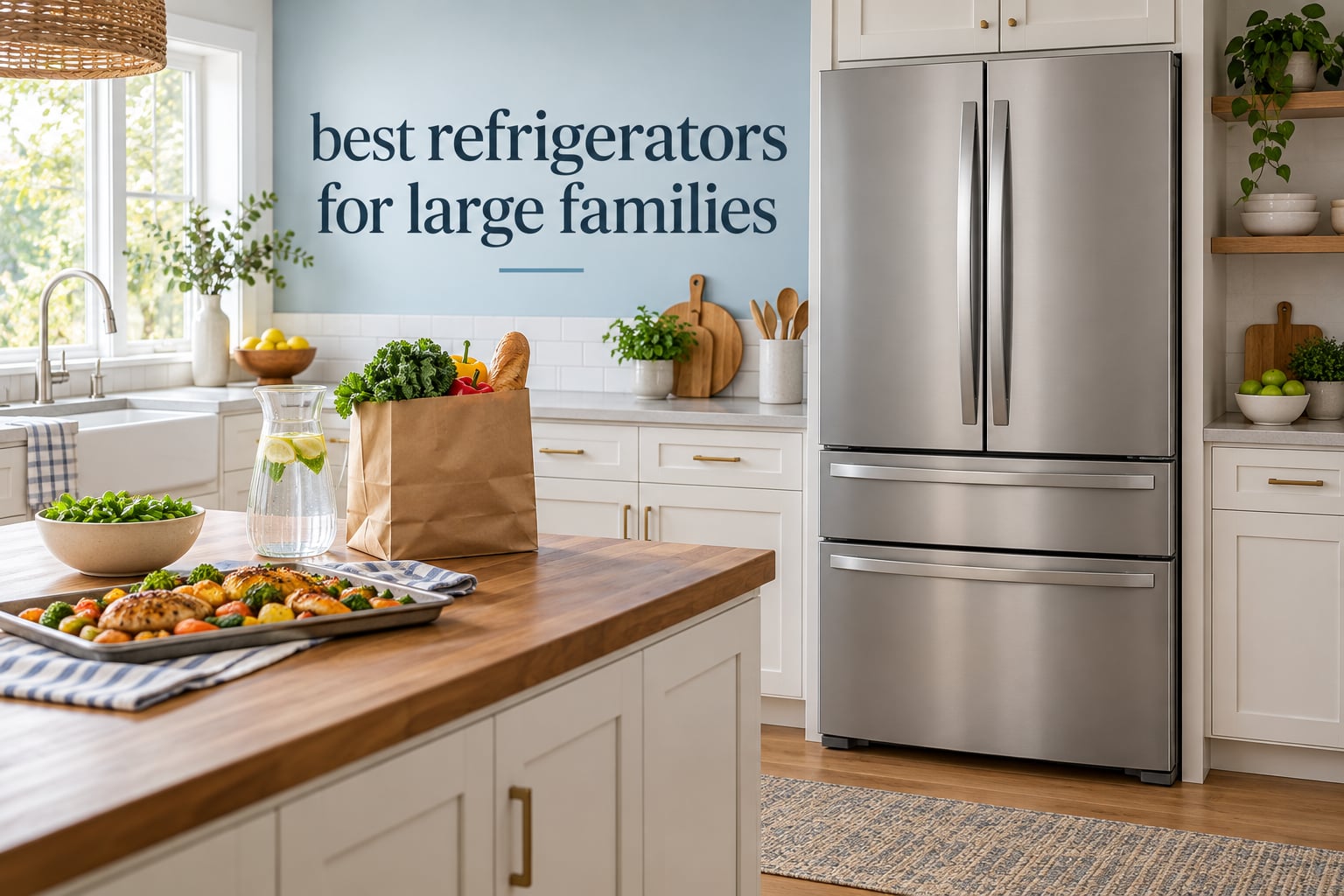
A household of five to seven needs 25 to 30 cubic feet of refrigerator, and the layout that delivers that space usefully is a French door or four-door model with full-width shelves. Those wide shelves fit a sheet pan, put snacks at kid height and keep most of the food where you can see it without bending.
That is the short answer to the best refrigerators for large families question, and it is the standard we applied to every refrigerator below. We compared 10 large family refrigerators on measured total capacity, the split between fresh food and freezer, shelf width, fit, ice and water configuration, energy use, warranty length and how much written owner feedback exists for each model.
Two numbers do most of the work when you are shopping. Capacity in cubic feet tells you how much food fits. Shelf width tells you whether you can actually get it in there, and it is the one shoppers skip until the fridge is already installed. A 28 cu. ft. side-by-side loses real capacity to narrow column shelves, while a 26 cu. ft. French door holds a full sheet pan flat.
We updated this guide for 2026 and pulled current spec sheets and owner review patterns for all ten models, since capacity claims, dispenser designs and reliability records shift as models cycle. If you are also short on cooking capacity, our picks for large countertop microwaves for big families pair well with a full-size refrigerator.
Table of Contents
Top 3 Picks for Large Families in 2026


The GE Profile is the pick we would put in a house with five or six people. The LG four-door is the one to buy when seven people genuinely need 29.6 cu. ft., and the Kenmore top mount is the value and reliability answer.
All 10 Large Family Refrigerators at a Glance in 2026
| Product | Specifications | Action |
|---|---|---|
| GE Profile PVD28BYNFS 4-Door French Door |
|
Check Latest Price |
 GE GYE22GYNFS Counter Depth French Door GE GYE22GYNFS Counter Depth French Door |
|
Check Latest Price |
 Samsung RF28R7201SR/AA 4-Door Smart French Door Samsung RF28R7201SR/AA 4-Door Smart French Door |
|
Check Latest Price |
 Kenmore 28.6 cu. Ft. French Door Kenmore 28.6 cu. Ft. French Door |
|
Check Latest Price |
 Kenmore 25 cu. Ft. 33-Inch Top Mount Kenmore 25 cu. Ft. 33-Inch Top Mount |
|
Check Latest Price |
| LG LF30S8210S 4-Door French Door |
|
Check Latest Price |
 Sharp SJF2955KS French Door Sharp SJF2955KS French Door |
|
Check Latest Price |
 Kenmore 29 cu. Ft. Side-by-Side Kenmore 29 cu. Ft. Side-by-Side |
|
Check Latest Price |
 Samsung RS27T5561SR/AA Family Hub Side-by-Side Samsung RS27T5561SR/AA Family Hub Side-by-Side |
|
Check Latest Price |
 LG LF24Z6530S Counter Depth MAX French Door LG LF24Z6530S Counter Depth MAX French Door |
|
Check Latest Price |
Household size drives the capacity target more than any other factor. Five people cooking most nights need 25 to 28 cu. ft., six people need 28 to 30, and seven or more should look at 30 cu. ft. and above or run a second unit.
1. GE Profile PVD28BYNFS 4-Door French Door: Best Overall for Large Families
GE Profile PVD28BYNFS 36″ 4-Door French Door Refrigerator with 27.6 cu. ft. Total Capacity in Fingerprint Resistant Stainless Steel
27.9 cu. ft. total
15.7 cu. ft. fresh food
8.57 cu. ft. freezer
722 kWh per year
Pros
- Convertible middle drawer with multiple temperature zones
- Door-in-Door access cuts main door openings
- Fingerprint resistant stainless finish
- Freezer capacity runs ahead of expectations
Cons
- Less door shelf space than earlier GE models
- Door-in-Door shelves sit about 5 degrees warmer
- Ice bin is small for a fridge this size
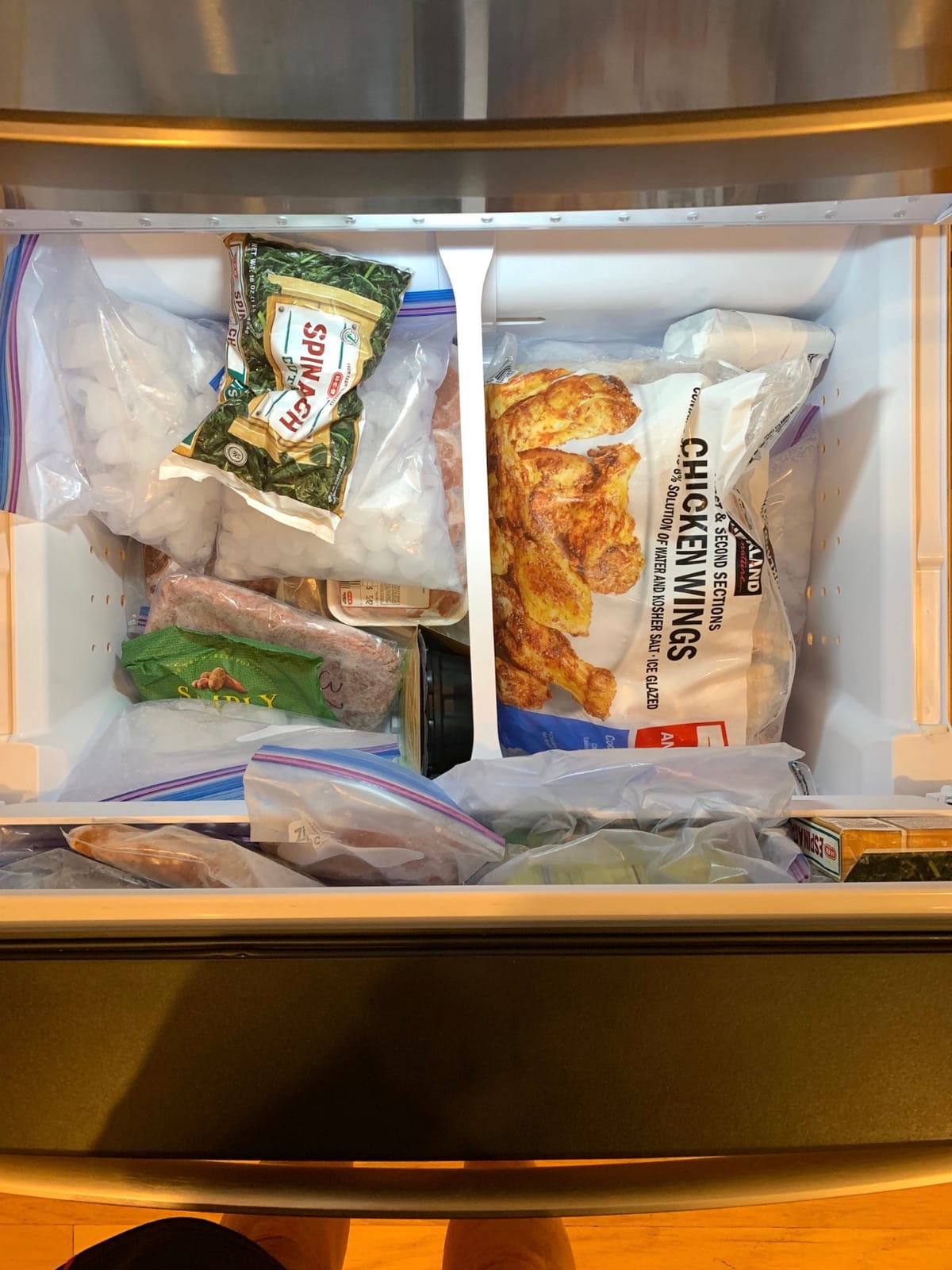
This is the refrigerator we keep coming back to for a family of five or six. At 27.9 cu. ft. it splits into 15.7 cu. ft. of fresh food and 8.57 cu. ft. of freezer, and the four-door layout puts a convertible middle drawer between them that can run as a fridge zone or a freezer zone depending on what you bought that week.
The wide fresh-food shelves are the reason it wins. A sheet pan sits flat on a glass shelf, which means a Sunday of batch cooking does not turn into a Tetris puzzle. Four shelves and six door bins give you somewhere to put condiments, lunch bags and the two bottles of milk that a family of six actually goes through.
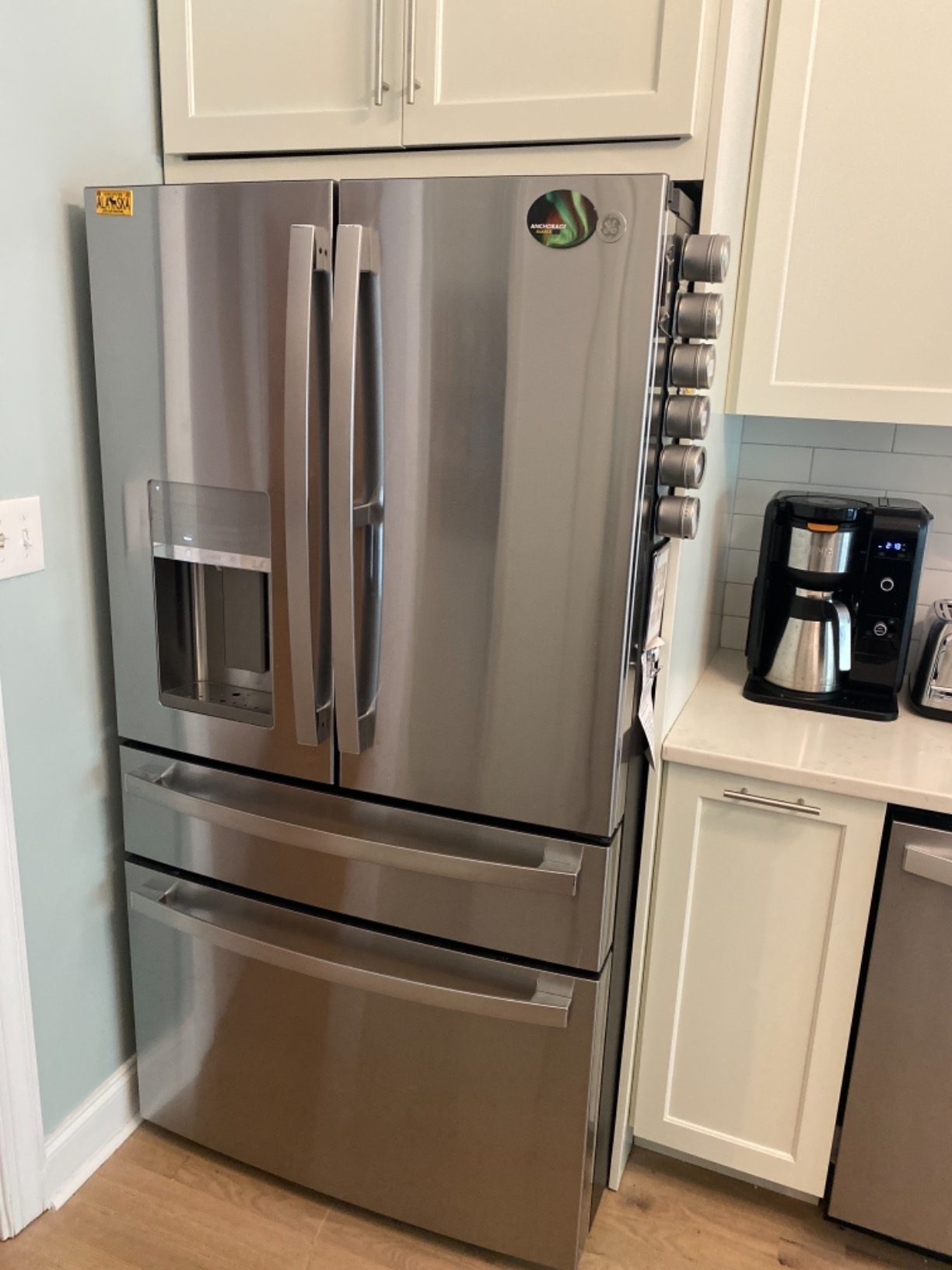
The Door-in-Door compartment is the feature owners mention most, and for a busy kitchen it is genuinely useful. Snacks, drinks and the stuff the kids graze on live in the outer door, so a quick trip does not swing the main doors wide and dump the cold air in the room.
It draws 722 kWh per year and is ENERGY STAR certified, which puts it mid-pack for the group rather than at either extreme. The Kenmore top mount below runs on roughly 425 kWh per year, so if energy use is your main concern this is not the unit to pick.
Who this refrigerator works for
It suits a household of five or six that cooks most nights and does a weekly shop. The convertible middle drawer is the tiebreaker in a family that splits food between raw meat prep and kid snacks in the same week, and the app-controlled LED lighting means you can check the shelves without opening a door.
At 36.75 inches wide and 69.88 inches tall it needs a real 36 inch opening, and depth with the doors open reaches 48.38 inches, so plan the walkway before it arrives. It weighs 388 pounds, so measure the route in, not just the opening.
Where it disappoints
Door bin space is the most common complaint, with narrower fixed shelves on one door than on the previous generation. The Door-in-Door zone also runs about 5 degrees warmer than the main compartment, so it suits drinks and snacks but not the fresh produce you want to keep cold.
The ice bin is small for a refrigerator this size, which matters more than usual for a family. A small number of reviews also report cooling system failure around a year and a half, and leveling the doors after delivery takes real time.
2. GE GYE22GYNFS Counter Depth French Door: Best for Narrow Kitchens
GE GYE22GYNFS 36″ French Door Counter Depth Refrigerator with 22.1 cu. ft. Total Capacity Space Saving Ice Maker Showcase LED Lighting in Stainless Steel
22.1 cu. ft. total
Counter depth at 31.25 inches
665 kWh per year
ENERGY STAR qualified
Pros
- Counter depth body gives a built-in look in a narrow kitchen
- Showcase LED lighting shows contents clearly
- Matte finish resists fingerprints and smudges
- ENERGY STAR qualified and ADA compliant
Cons
- 22.1 cu. ft. is the smallest capacity here
- Thin written review base for the model
- Hot gas defrost rather than a fan system
This is the fit-first pick. At 31.25 inches deep it stops roughly where your counter ends instead of protruding into the walkway, and at 35.75 inches wide it still fits a standard 36 inch opening, which is unusual for a counter depth unit.
The catch is the 22.1 cu. ft. total, split into 14.92 cu. ft. fresh and 7.16 cu. ft. freezer. That is below the band a family of six needs, so treat this as the right answer for a family of four in a tight kitchen, or as a second unit alongside a freezer you already own.

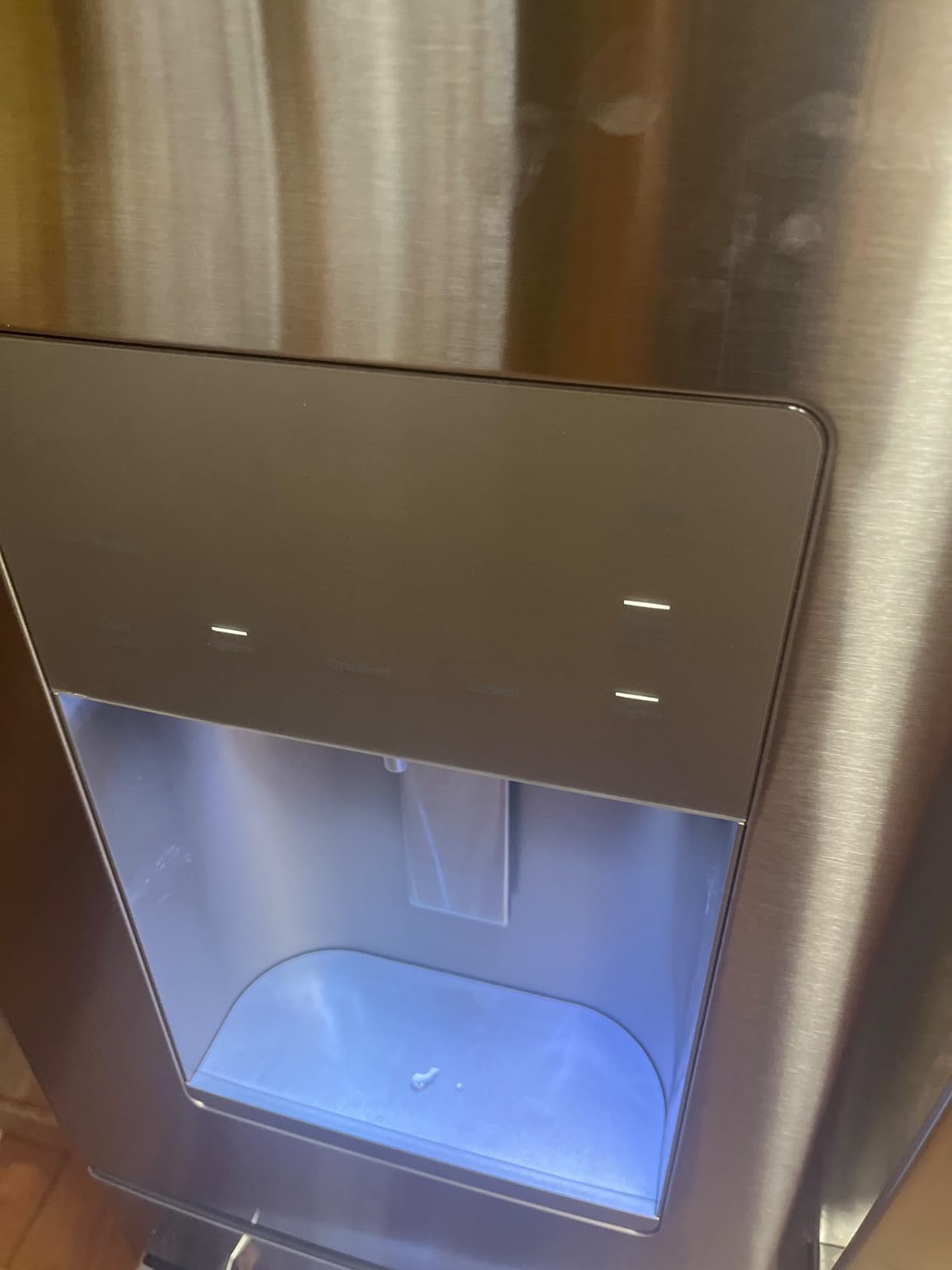
What owners do respond to is the Showcase LED lighting and the easy-care matte surface. The anti-bacterial filter is listed among the features, and the space-saving ice maker keeps ice without eating a shelf.
Energy use is 665 kWh per year and it is ENERGY STAR qualified and ADA compliant, so it checks the efficiency boxes most families care about. It is also hot gas defrost rather than a fan-assisted system, which is one fewer motor to hear.
Who this refrigerator works for
It fits a family of four, or a family of five who shop twice a week, in a kitchen where depth is the constraint rather than budget. The counter depth body also makes a 36 inch opening look intentional rather than crowded, which matters in an open-plan room.
Six door shelves and five interior shelves give more organization than the capacity number suggests, and the 43.37 inch door-open depth is the shortest here, so a galley kitchen can still walk past it.
Where it disappoints
22.1 cu. ft. is the smallest capacity in this roundup, and the counter depth decision costs roughly 5 cu. ft. against a comparable standard depth model. That is exactly the trade-off owners complain about in forums: buying counter depth for the look, then running out of room for the weekly shop.
Review volume is also thin, at 27 written reviews, so the record here leans on the spec sheet more than on owner reports. If your family genuinely needs 28 cu. ft. or more, skip this one.
3. Samsung RF28R7201SR/AA 4-Door Smart French Door: Best Smart Features
Samsung 28 Cu. Ft. 4-Door French Door Smart Refrigerator with FlexZone Drawer, Stainless Steel, RF28R7201SR/AA
28 cu. ft. total
19.7 cu. ft. fresh food
8.3 cu. ft. freezer
755 kWh per year
Pros
- FlexZone drawer with four temperature settings and a Smart Divider
- Twin Cooling Plus separates fridge and freezer air
- Recessed handles give a flat built-in look
- Energy tracking against a monthly bill target
Cons
- Ice maker failures are the most reported complaint
- Reported as noticeably noisy with clunking sounds
- Smart setup requires a phone and app
Capacity is the headline here. At 28 cu. ft. with 19.7 cu. ft. of fresh food, this is one of the roomiest fresh-food compartments in the group, and the FlexZone drawer switches between four temperature settings with an adjustable Smart Divider inside it.
For a family that meal preps, a drawer that can run as a fridge, a meat zone or a freezer zone is the feature that gets used daily. Twin Cooling Plus keeps the fridge and freezer air circulating separately, which is the mechanism behind the fresher produce owners report.
The flat panel doors with recessed handles give the built-in look without the cost of a panel-ready cabinet, and the external dispenser pours filtered water plus cubed and crushed ice. SmartThings AI Energy mode tracks consumption against a monthly bill target, which is more useful than it sounds if you have ever wondered where the electricity went.
Warranty is the strongest in the group for the compressor: 10 years parts and 5 years labor on the digital inverter compressor, 5 years on the sealed refrigeration system and 1 year parts and labor on the appliance itself. At 755 kWh per year it is the second highest draw here.
Who this refrigerator works for
It suits a family of five or six that wants a large fresh food section and enjoys the smart controls. The 29.38 inch depth is the shallowest of the 36 inch French doors in this list, so it also works in a kitchen with a shallower run of cabinetry.
Five glass shelves and six door bins hold a full shop, and at 317.5 pounds it is lighter to maneuver than the GE Profile at 388 pounds when you are moving it through a tight hallway.
Where it disappoints
The ice maker is the weak point. Ice maker reliability is the single most common complaint in the reviews, and owner threads on r/Appliances carry a long-running complaint about Samsung French door ice makers that stop producing or stop defrosting after a few years of use.
Owners also report noticeable noise, including clunking, and frustration with how warranty claims on ice maker failures are handled. If reliable ice matters more to your household than smart features, look at the simpler models below instead.
4. Kenmore 28.6 cu. Ft. French Door: Best for Bulk Shoppers
Kenmore 28.6 cu. ft. 36″ Wide French Door Refrigerator, FPR Stainless Steel
28.6 cu. ft. total
10 cu. ft. freezer
740 kWh per year
Counter depth body
Pros
- Largest fresh food split in a 36 inch body
- Accela Chill cools a big shop quickly
- NSF-certified filter with up to 3 lbs. of ice per day
- Setup reported as quick and straightforward
Cons
- Body is counter depth despite the 28.6 cu. ft. rating
- One report of early mechanical failure with costly service
- Some delivery units arrived with dents or missing brackets
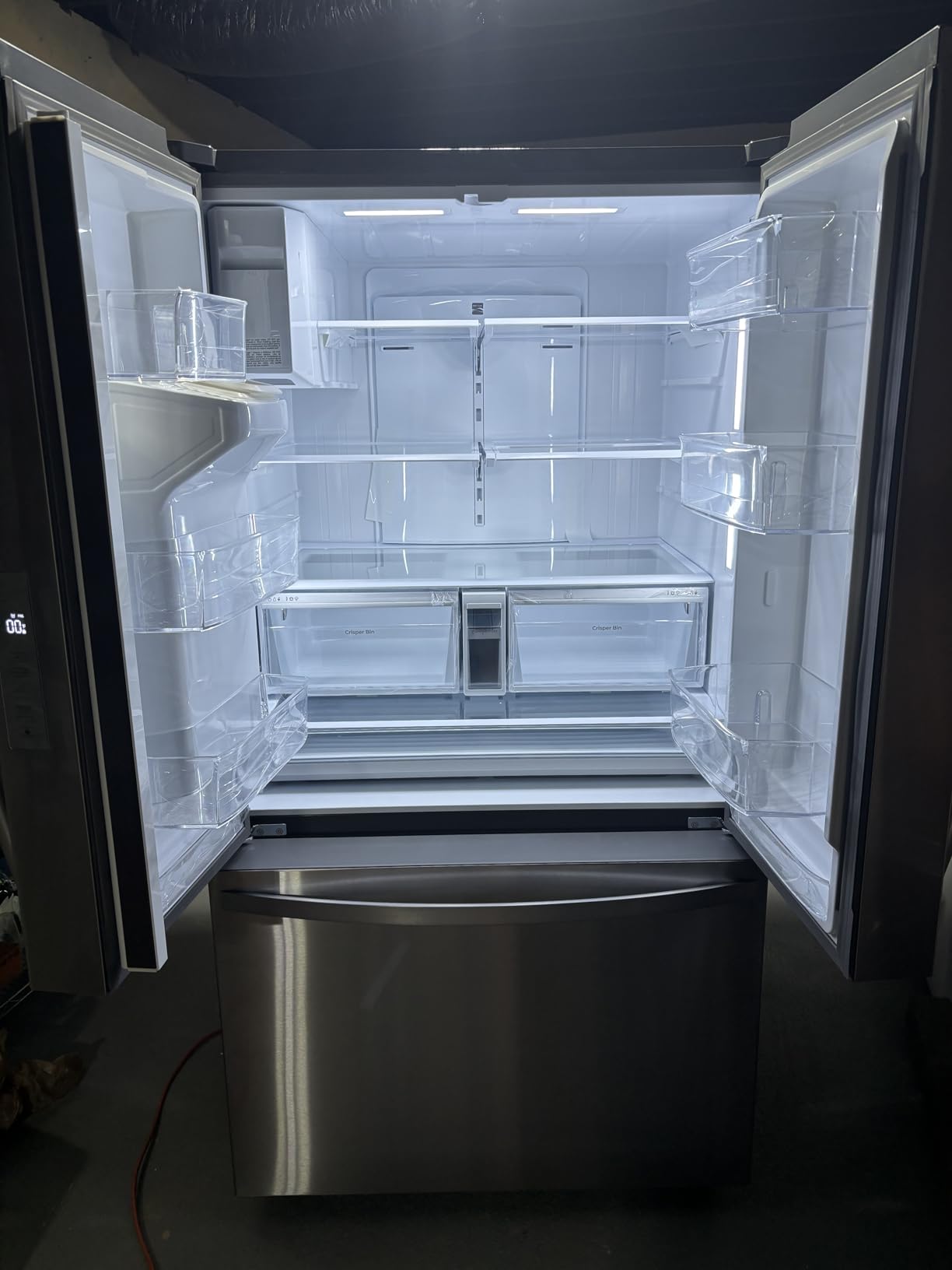
This is the one to buy when your family shops once a week and cooks from the freezer twice a week. At 28.6 cu. ft. it holds 18.6 cu. ft. of fresh food and a full 10 cu. ft. freezer, and that 10 cu. ft. freezer is the largest on a single-drawer French door in this list.
The dual evaporators and Multi-Flow Air System push air to every shelf, and Accela Chill drops the temperature fast after a big shop, so you are not waiting an hour before putting the groceries away. The inverter compressor runs quietly, which matters in an open kitchen.
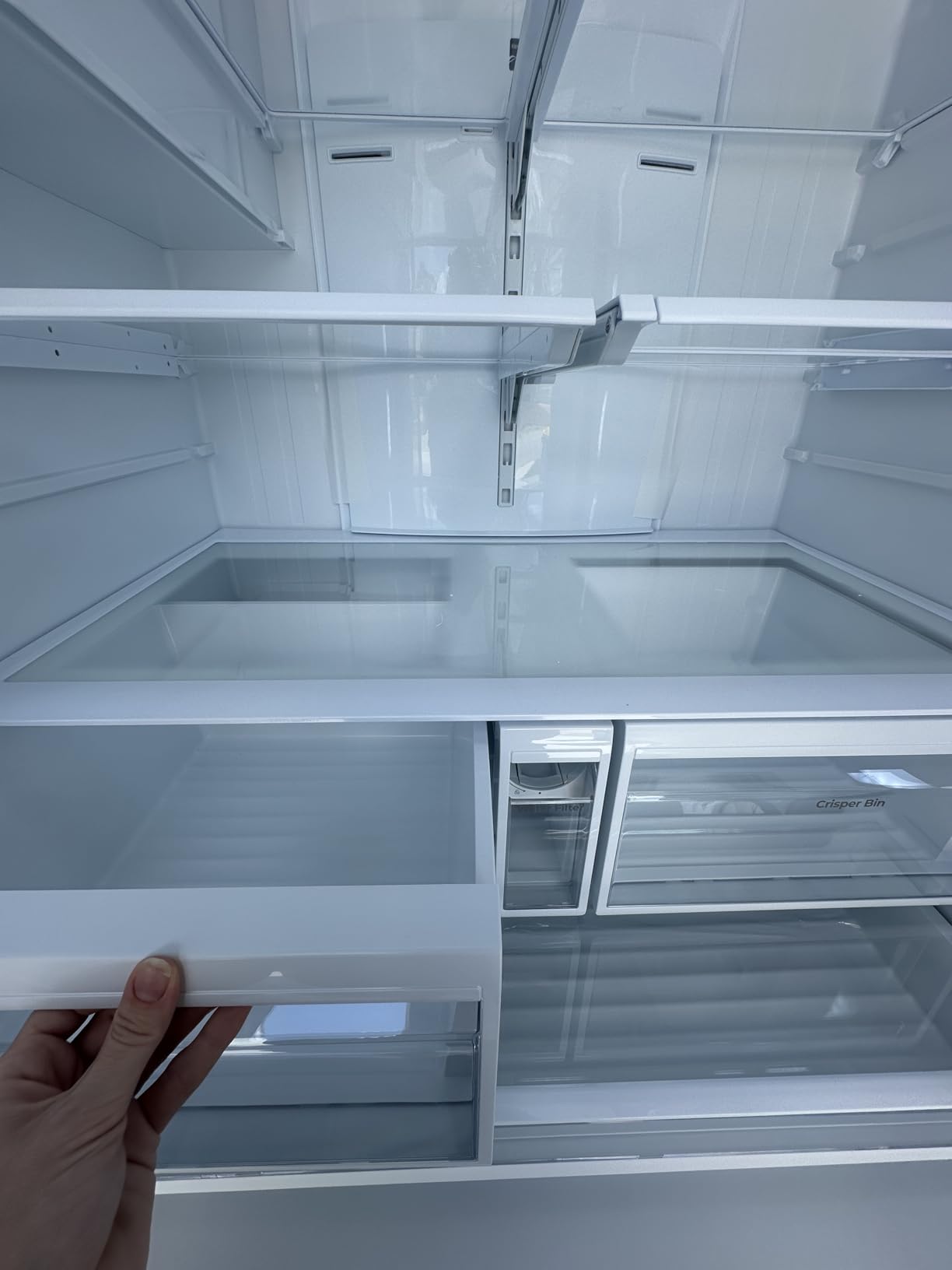
The front dispenser is the feature owners praise most, with an NSF-certified filter and up to 3 lbs. of cubed or crushed ice per day. The water filter is easy to reach for maintenance, and the humidity-controlled crispers plus a foldable sliding shelf handle the mix of bulk produce and tall bottles.
The freezer is laid out as two large lower bins and two generous upper bins plus a drawer, which is more flexible than a single deep basket. It is ENERGY STAR certified at 740 kWh per year, and at 337.3 pounds it sits in the middle of the weight range here.
Who this refrigerator works for
It fits a family of five or six that does one large shop a week and cooks in batches. The foldable sliding shelf creates vertical space for tall items when you need it, and the 10 cu. ft. freezer holds a month of frozen meals for a busy household.
Setup being straightforward matters more than it sounds. A family that cannot have a dead fridge in the kitchen for days benefits from a unit owners report going in quickly, and the model is ENERGY STAR certified with a one year appliance warranty.
Where it disappoints
The body is counter depth even though the capacity rating is 28.6 cu. ft., at 35.93 inches deep. That is impressive packing, but it means you should confirm the measurement before you order rather than assuming a standard depth 36 inch body.
One review reports the unit failing after under two years with expensive service or replacement as the outcome, and a couple of deliveries arrived with dents or missing door bin brackets. It is also a three-door model with two door shelves listed, so check the bin layout against what your family actually needs.
5. Kenmore 25 cu. Ft. 33-Inch Top Mount: Best Value
Kenmore 25 cu. ft. 33″ Wide Top Mount Refrigerator – FPR Stainless Steel
25 cu. ft. total
425 kWh per year
33 inch wide
One year appliance warranty
Pros
- Least complex unit here with no dispenser to break
- Quiet inverter compressor and quick cooling
- Easy to move at 211.6 pounds
- Reversible hinges and full-width glass shelves
Cons
- No water or ice dispenser included
- Push-button temperature control instead of a digital panel
- Doors are not self-closing
This is the reliability answer. There is no dispenser, no ice maker, no screen and no app, which means the two most common refrigerator failure points simply do not exist on this unit. For a family that has been through a broken ice maker, that is the feature that matters.
It still gives you 25 cu. ft. in a 33 inch wide footprint, split into 18.5 cu. ft. fresh and 6.5 cu. ft. freezer. The fresh food section is larger than several of the 28 cu. ft. French doors here, and the spill-proof adjustable glass shelves span the full width of each compartment.
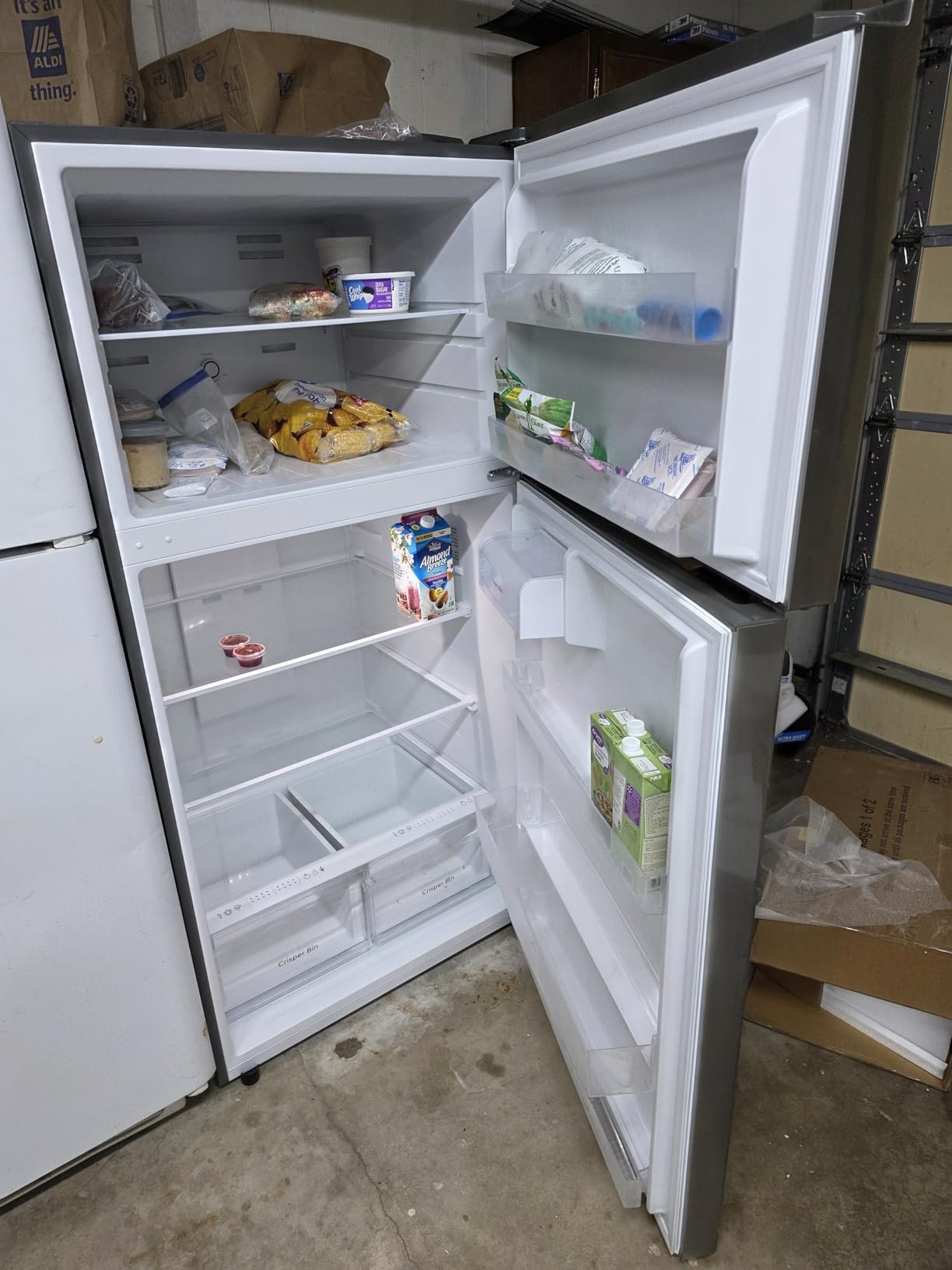
Energy use is 425 kWh per year, less than half of several picks above, and it is ENERGY STAR certified with a quiet inverter compressor. Four gallon door bins and two full-width freezer door bins plus humidity-controlled crispers cover most of what a family of five actually stores.
Hinges are reversible for either swing, and at 211.6 pounds it is by far the easiest to move into a house, which matters if you are not paying for a white glove delivery crew. Several owners use it as a garage or secondary unit for exactly that reason, and our camper refrigerator picks cover the portable end of that market.
Who this refrigerator works for
It suits a family of four or five who want the simplest working refrigerator they can find. Reversible hinges make it a good fit for a kitchen where the old unit swung the other way, and the 32.68 inch width fits inside a 33 inch opening without a fight.
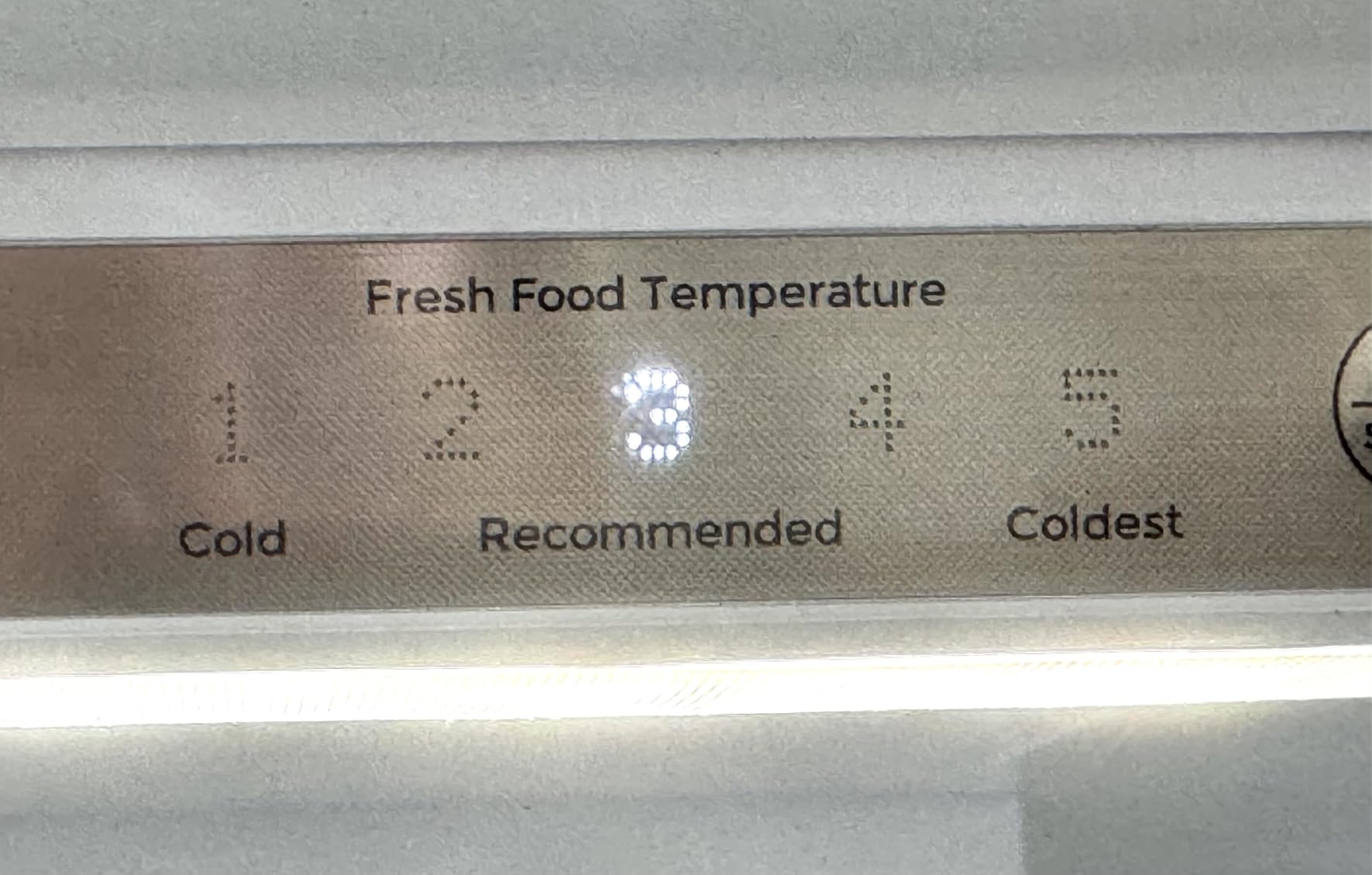
If your household is older or your kitchen opens straight into a living space, the quiet inverter compressor is a real benefit. LED lighting, a covered dairy compartment and five simple temperature settings cover the basics without a learning curve.
Where it disappoints
No water or ice dispenser is included, and hookups are provided only if you add one later. In a family of six that goes through a lot of water, an ice maker you can install yourself is a genuine gap, and this is where the bigger French doors pull ahead.
The controls are push-button rather than a digital panel, the doors are not self-closing, and one review reports the freezer not reaching its rated temperature. The deep freezer also makes smaller items easy to lose track of at the back.
6. LG LF30S8210S 4-Door French Door: Largest Capacity
LG LF30S8210S 29.6 Cu. Ft. Stainless 4-Door French Door Refrigerator
29.6 cu. ft. total
18 cu. ft. fresh food
8.4 cu. ft. freezer
709 kWh per year
Pros
- Biggest capacity in the roundout
- Convertible middle drawer switches between fridge and freezer
- Bright LED lighting reaches the back of the shelves
- Delivery teams reported as careful and on time
Cons
- Bottom freezer drawer reported as flimsy and wiggly
- Wire shelving rather than glass
- One report of door seal failure under two years
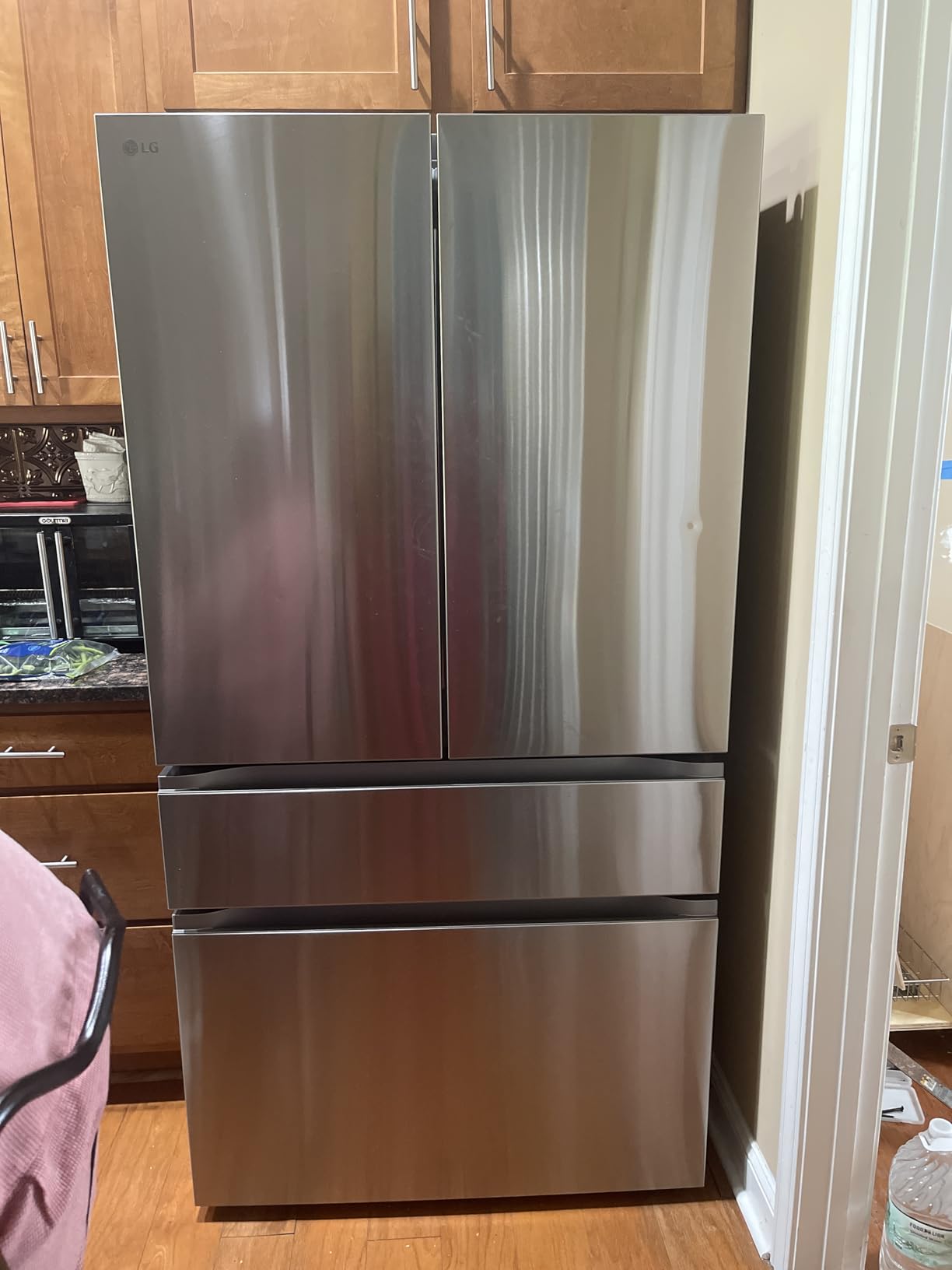
If seven people live in your house, this is the pick. At 29.6 cu. ft. it is the largest refrigerator here, with 18 cu. ft. of fresh food and 8.4 cu. ft. of freezer, and owners describe the step up as bigger than the paper numbers suggest.
The four-door layout puts a convertible middle drawer between the fresh food section and the freezer, switching between refrigerator and freezer temperatures. That is the same idea as the FlexZone drawer on the Samsung four-door, and in a household of seven it is the difference between flexible and cramped.
Multi-Air Flow cooling and the smart features are present, and at 709 kWh per year it is ENERGY STAR certified and more efficient than most units in this class. The depth is 32.25 inches, which is shallower than most 36 inch French doors and useful when the counter run is tight.
Owners also mention the purchase experience, with a delivery team that arrived on time, brought it in carefully and hauled away the old refrigerator. At 291 pounds it is lighter than the GE Profile and the Kenmore 28.6, which matters on a staircase.
Who this refrigerator works for
It suits a household of six or seven, or a family of five that runs a garage fridge and wants one unit to do both jobs. The 35.75 inch width and 70.25 inch height fit a 36 inch opening, and the shallow depth helps in a narrow kitchen.
Smart features and bright LED lighting that reaches the back of the shelves suit a household where someone is always looking for something. The stainless finish is described as holding up well, with the unit arriving free of dents and scratches.
Where it disappoints
The large bottom freezer drawer is reported as flimsy and wiggly side to side, which is a poor look in a premium four-door unit and the most repeated complaint in the reviews. Shelves are wire rather than glass, so a tall open bottle can tip more easily.
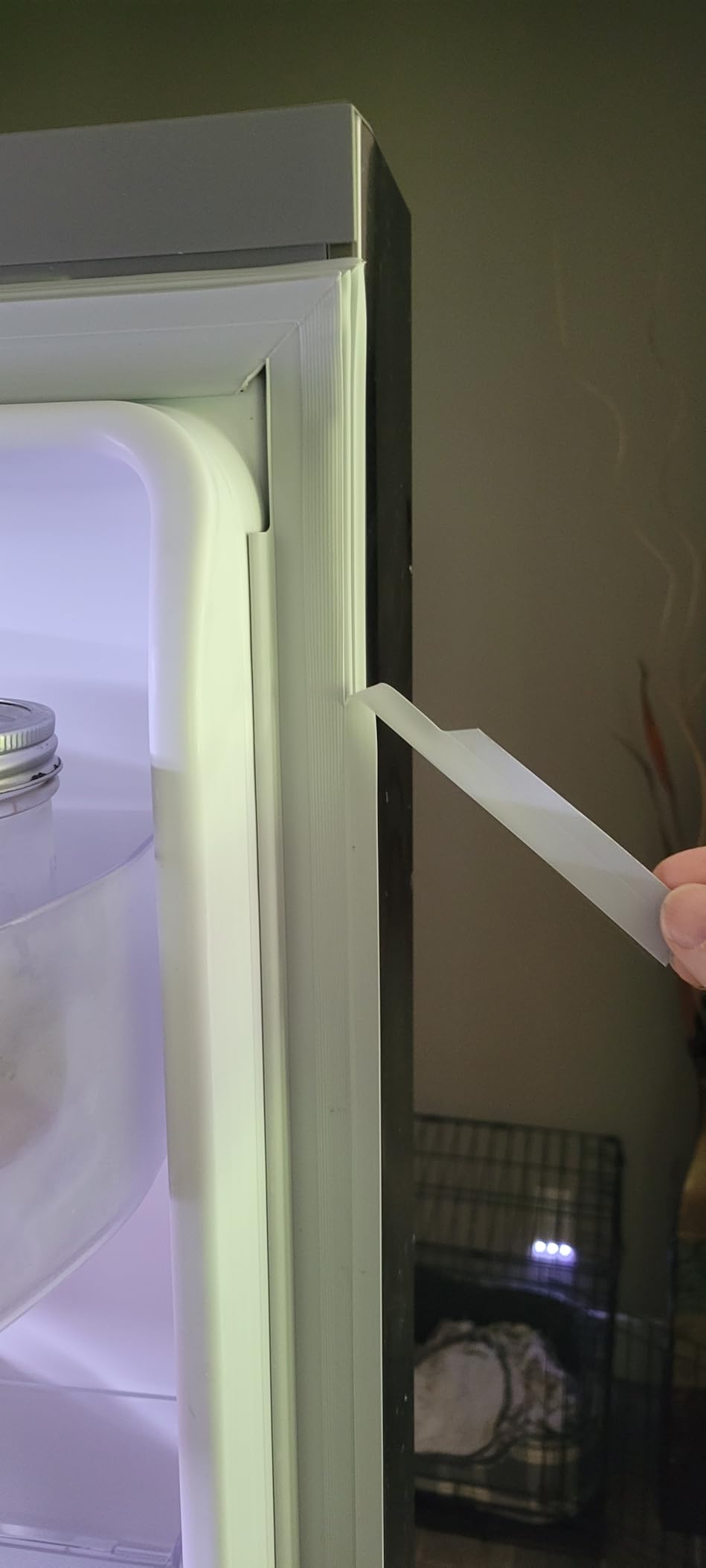
One reviewer reports door seals falling apart in under two years with costly replacement, and review volume is low, so long-term reliability data is thin. The rotary scroll compressor and one year warranty are fine, but they are not the extended coverages some rivals offer.
7. Sharp SJF2955KS French Door: Best Ice Output
Sharp SJF2955KS 28.9 cu.ft. Standard Depth 36 in. French Door Refrigerator
28.9 cu. ft. total
10.4 cu. ft. freezer
Dual ice makers at 6.9 lbs. per day
740 kWh per year
Pros
- Highest daily ice output of any pick here
- 10.4 cu. ft. freezer is among the largest
- Chill-Boost and Freezer-Boost speed recovery after a big shop
- Five white LED interior lights for visibility
Cons
- No written customer review text was available for this listing
- Very small review base of 11
- Fingerprint resistant exterior is not covered separately
Ice is the reason this refrigerator is on the list. The dual ice makers are rated at up to 6.9 lbs. per day, which is more than double what most units in this class produce, and a family that fills coolers, hosts barbecues or freezes things in summer will feel that difference immediately.
Beyond the ice, the 28.9 cu. ft. capacity splits into 18.5 cu. ft. fresh and a roomy 10.4 cu. ft. freezer. That freezer is the second largest here, which pairs well with the ice output for a household that cooks big batches on weekends.
Chill-Boost and Freezer-Boost modes drop the temperature quickly after a large shop, and the Advanced Cooling Plus system handles the rest. Five premium white LED lights make the interior easy to see, and the exterior is fingerprint resistant stainless. The door carries an ice and water dispenser for a household that expects to use it every day.
It is 740 kWh per year, a standard depth body at 36.1 inches deep and 35.8 inches wide, 69.9 inches tall, with a one year limited warranty. Note that this listing is not marked ENERGY STAR certified, unlike most units in this roundup.
Who this refrigerator works for
It suits a family of six that uses ice heavily, whether for drinks, for a cooler, or for a house where kids fill cups constantly. The large freezer and the boost modes also suit a household that buys a full shop once a week and wants everything frozen fast.
Standard depth at 36.1 inches means you get the full capacity without trading depth for looks, and the 35.8 inch width fits a standard opening. At 352 pounds it is heavy, so plan the delivery route.
Where it disappoints
The honest limitation is evidence. No individual written review text was returned for this listing, so everything above comes from the spec sheet rather than owner reports, and the review base of 11 is small. We cannot tell you how it behaves after year three.
Dual ice makers mean two systems to service, and through-door ice and water hardware is the most commonly reported repair category in French door refrigerators generally. Buyers who prioritize low repair risk over ice volume should read the reliability section below before choosing this one.
8. Kenmore 29 cu. Ft. Side-by-Side: Best Side-by-Side
Kenmore 29 cu. ft. 36″ Wide Side-by-Side Refrigerator – FPR Stainless Steel
29 cu. ft. total
18.6 cu. ft. fresh food
10.4 cu. ft. freezer
731 kWh per year
Pros
- 29 cu. ft. in a standard 36 inch width
- Seven glass shelves with edge-to-edge shelves
- Space-saving ice maker keeps a freezer shelf free
- Quiet inverter compressor
Cons
- Only 4 written reviews behind the rating
- Side-by-side door shelves are narrow for tall items
- 51 inch door-open depth
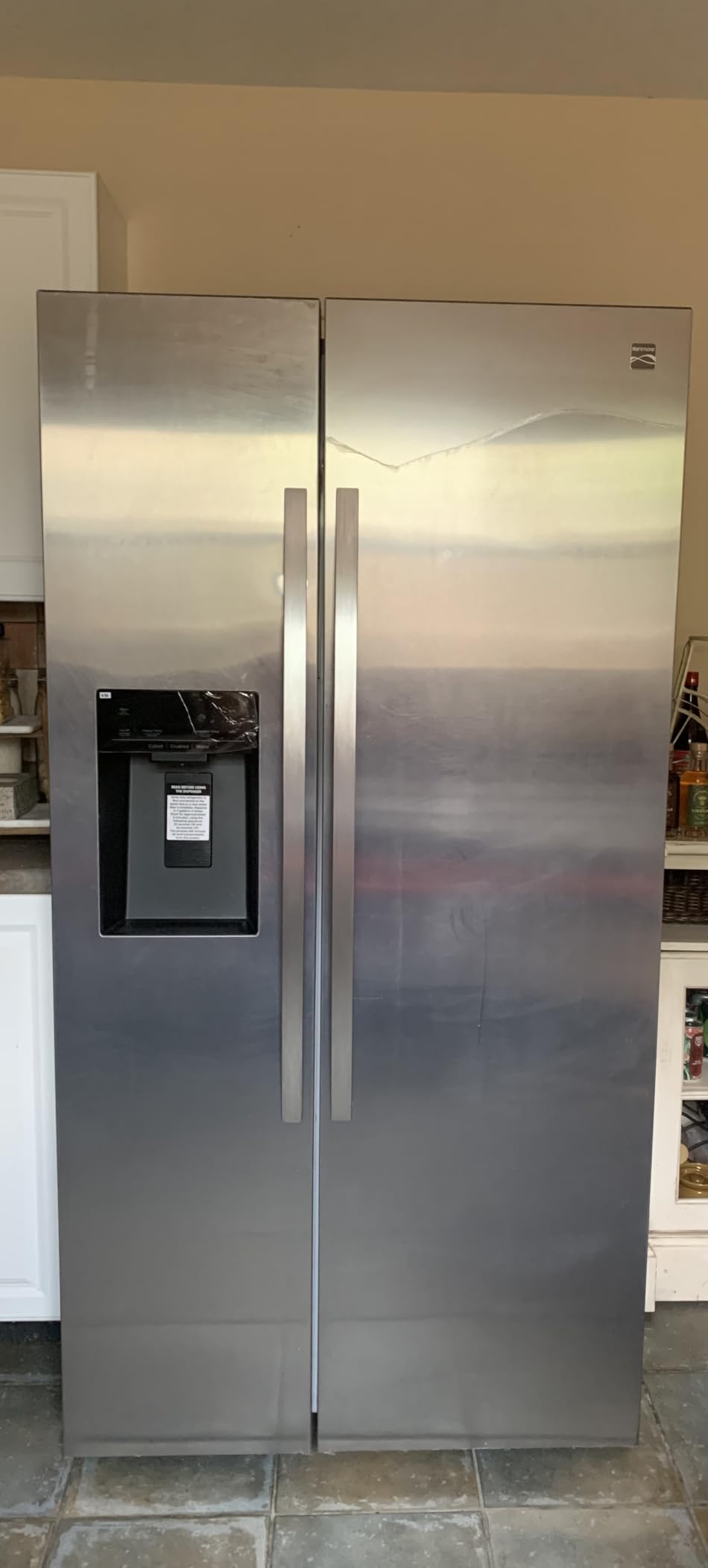
Side-by-side is the layout that fits the most volume into a given width, and this one carries 29 cu. ft. in a standard 36 inch body, split into 18.6 cu. ft. fresh and 10.4 cu. ft. freezer. That is the same fresh food volume as the 28.6 cu. ft. Kenmore French door, in a shallower cabinet.
There are seven glass shelves and four gallon-size door bins, and the edge-to-edge shelves mean less wasted air between the shelf edge and the cabinet wall. The space-saving ice maker tucks into the freezer door so it does not claim a shelf, and the external dispenser produces up to 3 lbs. of ice per day.
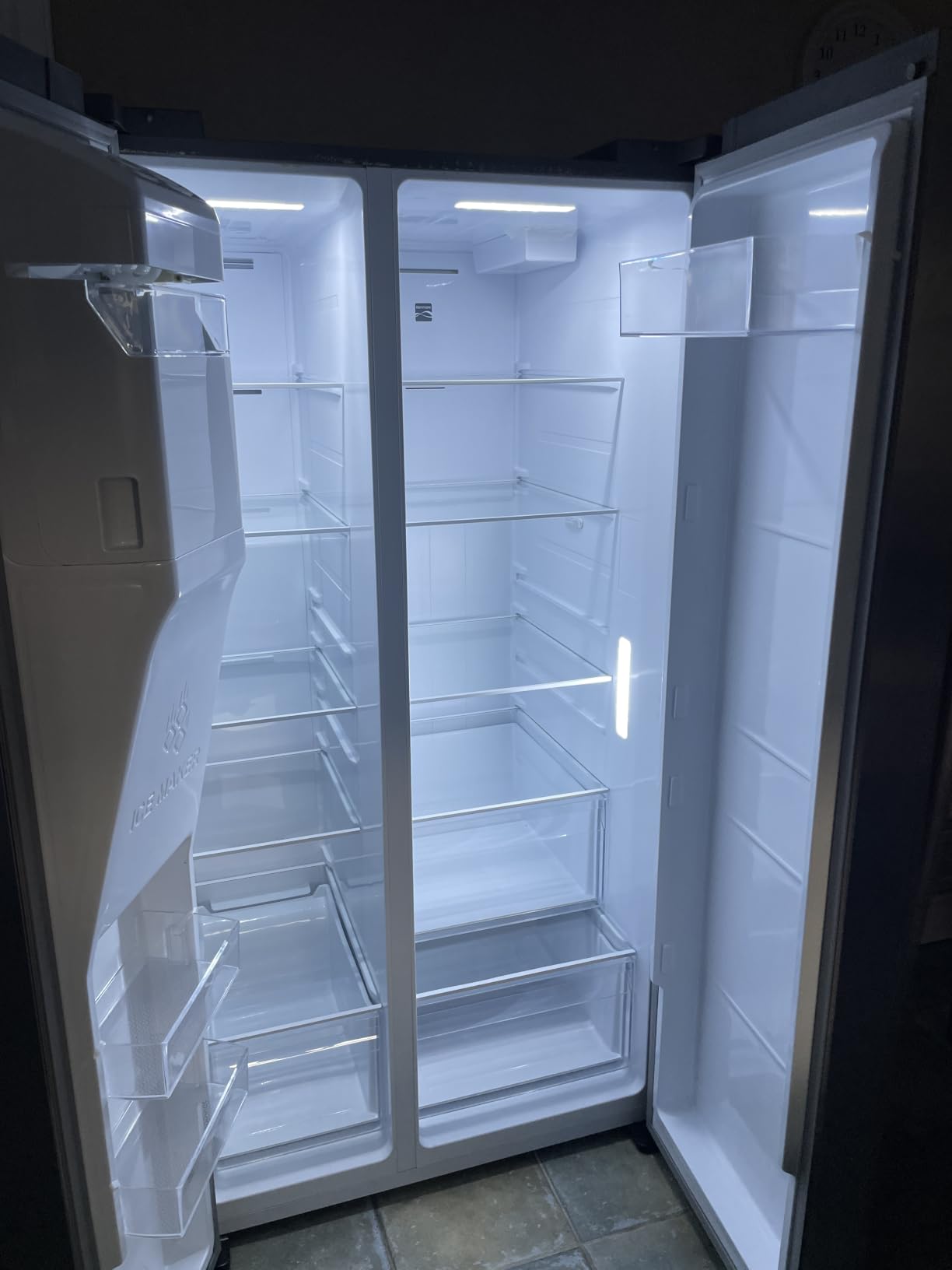
Accela Chill and Accela Freeze handle a large shop, Multi-Flow Air System moves air through the whole cabinet, and the inverter compressor keeps it quiet. Enhanced LED lighting on the ceiling and sides illuminates the full interior rather than one corner.
It is a fingerprint resistant stainless finish, 731 kWh per year, 69.96 inches tall, 35.75 inches wide, and it carries a one year appliance warranty. The depth with the door open is 51 inches, the widest figure in this roundup.
Who this refrigerator works for
It suits a family of six that wants maximum volume in a 36 inch footprint and does not cook sheet-pan casseroles. A side-by-side keeps frozen food at eye level, which is genuinely easier for kids to reach than a bottom drawer, and both doors open to full width.
If you want the most fresh food volume without going past 36 inches, this is the configuration to look at first. The glass shelves and quiet inverter compressor suit an open-plan kitchen where noise travels.
Where it disappoints
Side-by-side shelves are narrow columns, and a sheet pan does not fit on one. That is the layout’s core compromise, and it is why a family of five who bakes will feel the 29 cu. ft. rating is misleading.
The 4.7 rating rests on only four written reviews, so treat it as a promising score rather than a proven one. At 51 inches with the doors open you also need a genuinely wide walkway in front of it.
9. Samsung RS27T5561SR/AA Family Hub Side-by-Side: Best Connected Side-by-Side
Samsung 26.7 Cu. Ft. Large Capacity Side-By-Side Refrigerator with Family Hub, Stainless Steel, RS27T5561SR/AA
26.7 cu. ft. total
17.2 cu. ft. fresh food
9.5 cu. ft. freezer
691 kWh per year
Pros
- Redesigned interior holds about 10% more groceries
- Indoor icemaker does not consume a shelf
- Alexa built in with app control
- Shallow 33.5 inch depth
Cons
- Side-by-side narrows the door shelves for tall items
- Only 10 written reviews behind the rating
- Touch screen needs power and a working network
If your family is already living inside a smart home, this is the side-by-side that connects. Alexa is built in, the app controls the settings remotely, and the Family Hub functions are the reason this layout costs more than a conventional side-by-side of the same size.
The interior was redesigned to hold about 10% more groceries than earlier versions, and Multivent technology distributes cooling across every shelf rather than a single cold spot. The indoor icemaker is built into the freezer column, so it does not give up a shelf the way a portable ice maker does.
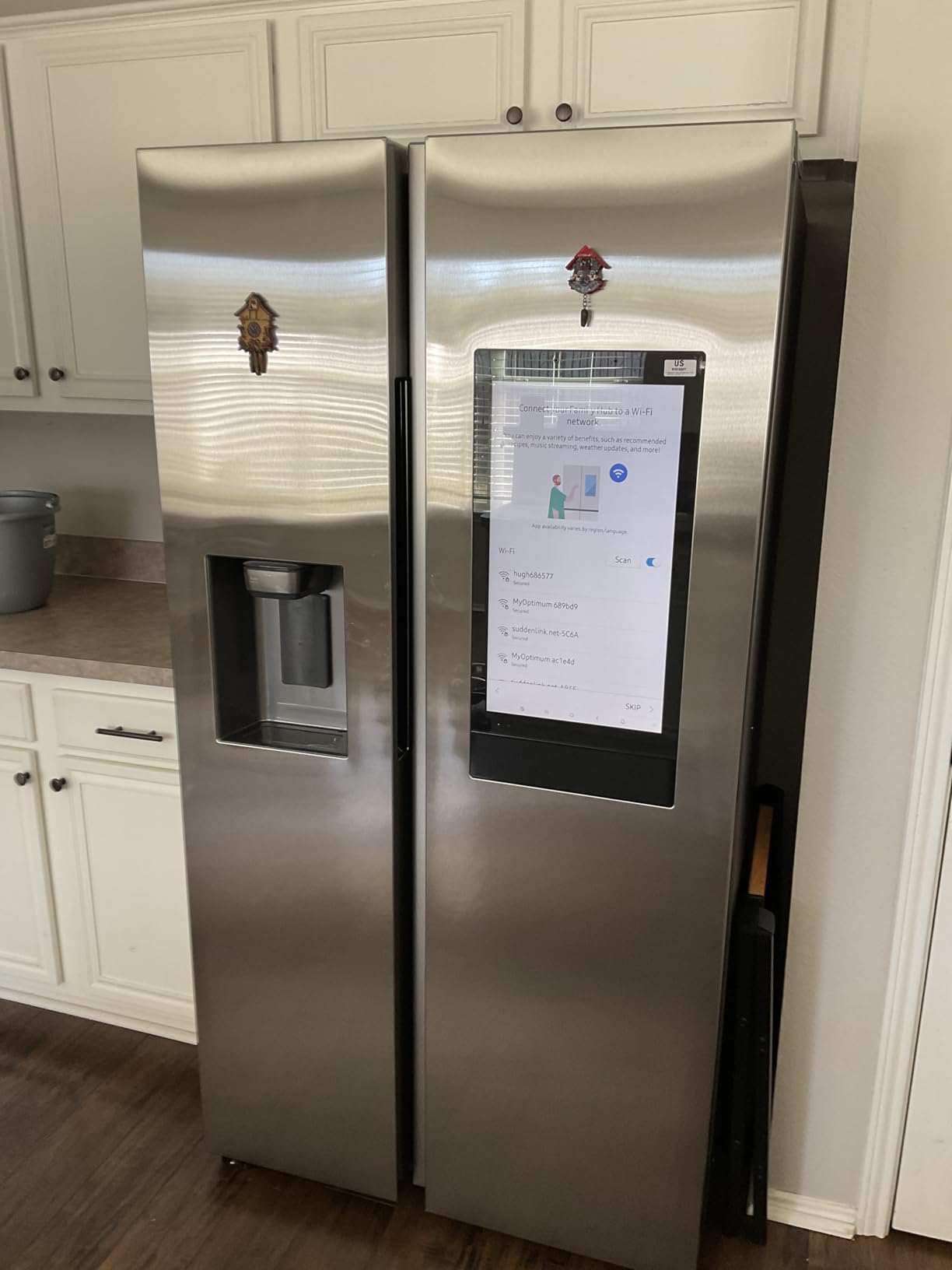
Capacity is 26.7 cu. ft. with 17.2 cu. ft. fresh and 9.5 cu. ft. freezer, at 691 kWh per year. It carries an ENERGY STAR Emerging Technology Award, and the flat panel doors with recessed handles blend into cabinetry.
Warranty is the second strongest in the group: 5 years parts and labor on the sealed refrigeration system, 10 years parts and 5 years labor on the digital inverter compressor, and a fingerprint resistant finish that cuts cleaning in a family kitchen.
Who this refrigerator works for
It suits a family of five or six that wants a large freezer column for batch cooking, plus smart controls they will actually use. At 33.5 inches deep it is the shallowest body in this roundup, which works in a kitchen where a standard depth unit would block the walkway.
The indoor icemaker arrangement is worth a look even if you skip the smart features, since it keeps the freezer shelves free. Flat panel doors suit a kitchen where the fridge should visually recede rather than dominate.
Where it disappoints
The side-by-side layout narrows the door shelves, which limits tall bottles and bulky items, and the narrow fresh food shelves will not take a sheet pan. That is the same constraint as the other side-by-side here.
Review volume is thin at 10 written reviews, so the record is limited, and no individual review text was returned for this listing. A touch screen also needs power and a connection, and it is a component that does nothing useful when either fails.
10. LG LF24Z6530S Counter Depth MAX French Door: Best Counter Depth with Craft Ice
LG 24 cu. ft. Counter Depth MAX Zero Clearance 3-Door French Door Refrigerator with Craft Ice in PrintProof Stainless Steel LF24Z6530S
24 cu. ft. counter depth
Dual ice makers with Craft Ice
Zero clearance hinges
One year warranty
Pros
- Zero clearance hinges let the doors open flush against a wall
- Thin door design widens usable interior space
- Craft Ice with dual ice makers for a family
- Counter depth body keeps the walkway clear
Cons
- 24 cu. ft. is the second smallest capacity here
- Only 7 written reviews and no review text returned
- Counter depth still costs about 5 cu. ft.
The zero clearance hinges are the practical headline. On most counter depth refrigerators the doors need room to swing past the cabinet, and this one is designed to sit flush against a wall, which is what makes a tight galley kitchen workable.
Craft Ice runs with dual ice makers, so you get two ice types from one unit, and the thin door design pushes the usable interior space up on a 24 cu. ft. footprint. In a family that drinks a lot of water, ice you make at home removes one plumbing dependency from the shopping list.

The PrintProof stainless finish is treated to resist fingerprints, which matters more on a counter depth unit because the doors sit in a high traffic walkway. It is a three-door French door layout with a counter depth body, weighing 313 pounds.
It carries a one year manufacturer warranty, and it is the smallest capacity in this roundup at 24 cu. ft., just under the 25 cu. ft. threshold we use for a family of five. Treat it as a family of four pick, or a secondary unit.
Who this refrigerator works for
It fits a family of four, or a family of five who shop in small batches, in a kitchen where a standard depth unit would block a walkway or a wall. The flush-opening hinges make it one of the few counter depth options that works in a truly narrow space.
If ice is a daily need and you would rather not run a water line for it, dual ice makers cover a lot. The counter depth body also keeps the fridge visually integrated with cabinetry.
Where it disappoints
24 cu. ft. is the second smallest capacity here, and going counter depth costs roughly 5 cu. ft. against a standard depth model of the same width. For a family of six, that trade is usually the wrong one.
Only 7 written reviews were available and no individual review text came back for this listing, so the owner experience is largely undocumented. The dimensions listed in the source appear transposed, so confirm the fit with the manufacturer before ordering.
How Big a Refrigerator Does a Large Family Need?
Capacity is a function of how many people eat from the refrigerator and how often you shop. A household of two needs about 20 to 22 cu. ft., three to four people need 22 to 25, five to six need 25 to 28, and seven or more need 28 to 32.
- 1 to 2 people: 20 to 22 cu. ft., with a top mount or bottom freezer layout.
- 3 to 4 people: 22 to 25 cu. ft., with a counter depth French door.
- 5 to 6 people: 25 to 28 cu. ft., with a standard depth French door or four-door.
- 7 or more: 28 to 32 cu. ft., with a four-door or full-size side-by-side.
The number on the box is total internal volume, not usable volume. Door bins, the ice maker housing, wall liners and the evaporator coil eat into the space you can actually stack food in, and a family of six shopping weekly will feel a 26 cu. ft. unit sooner than the spec suggests.
A useful test: if your weekly shop fills more than four standard grocery bags, you are at the point where the wide shelves matter more than the extra two cubic feet. Sheet pans, gallon milk jugs and a full week of lunch boxes for several people are what a large family refrigerator is actually for.
Counter depth bodies trade roughly 5 cu. ft. of capacity for about 5 inches less depth. That is a reasonable deal in a galley kitchen or an open-plan room, and a bad one if the reason you are shopping is that your current fridge cannot hold a week of food.
French Door vs Side-by-Side vs Top Mount for a Big Kitchen
French door models put a wide fresh food section above a pull-out freezer drawer, and the shelves span the cabinet. That full-width shelf is the honest reason French door won the layout war for families: it is the only mainstream option where a sheet pan lies flat.
Side-by-side models split the cabinet into two vertical columns. They squeeze more volume into a given width and keep frozen food at eye level, but the shelves are narrow, so tall bottles and sheet pans both struggle. Owners on r/Appliances consistently describe the door compartments and shelf variety as the reason they keep one.
Top mount freezers put the fridge at eye level and the freezer at the bottom, with the narrowest shelves of all. The Kenmore 25 cu. ft. model shows the appeal: nothing to break, less energy, less money. The cost is the loss of wide shelves and any in-door ice or water.
Ice, Water and Reliability: What Actually Breaks
The most repeated repair complaint in owner forums is the through-door ice maker. Owner threads describe a Samsung French door ice maker that broke twice and stopped defrosting, alongside reports of French door compressors giving out at about the four-year mark in other brands.
Configuration advice outranks brand advice in those discussions. The prevailing recommendation is to buy the simplest refrigerator you can: an internal ice maker or none, an internal dispenser or no dispenser, and a conventional compressor with cheap, widely available parts. Serviceability, not features, is what owners in a r/Appliances budget thread actually recommended.
That points to a straightforward rule for a large family. If you need through-door ice for a household of six, accept that the dispenser is a service item, and check what the warranty covers for it. If you can manage with an internal ice maker, you give up a door bin and remove the most common repair point.
Energy use is the other running cost worth planning for. The units here range from about 425 kWh per year on the Kenmore top mount to 755 kWh per year on the Samsung four-door, and a family that opens a door twenty times a day pays for every extra degree of draw.
Measurement and Fit Checklist Before You Order
Fit is the mistake that is hardest to undo, so measure before you commit. Work through this list in order, with a tape measure and the spec sheet of the exact model you plan to buy.
- Check the opening width. Standard openings are 36 inches, but some kitchens are 33 inches or 30 inches, and the unit’s own width matters more than the opening size.
- Measure the height with the hinges and the top hinge cover in place, not the height of the cabinet. A model that is 70.25 inches tall will not clear a 69.5 inch opening.
- Measure the cabinet depth, then add the door depth and handles. Standard depth French doors run 35 to 36 inches deep; counter depth runs about 31 inches.
- Check the door swing at 90 degrees. If the open door does not clear the wall, dishwasher or adjacent cabinet, the refrigerator will not work in that spot.
- Confirm the walkway clearance. Depth with the door open reaches 48 inches on several models here and 51 inches on the side-by-sides, and that space has to be walkable.
- Locate the water line. A through-door dispenser needs a line within reach, and moving one is a plumber’s job, not an installer task.
- Verify the outlet, the floor and the route. Units here weigh between 211 and 388 pounds, and a tight staircase decides the delivery quote.
For a second unit rather than a replacement, our guides to camping refrigerators and outdoor refrigerators cover the portable options a garage or basement needs.
Frequently Asked Questions
How many cubic feet of refrigerator does a large family need?
A household of five or six needs 25 to 28 cu. ft. of total capacity, and seven or more needs 28 to 32 cu. ft. Three to four people can get by with 22 to 25 cu. ft. Aim for a French door or four-door layout, because those are the only mainstream options with shelves wide enough to hold a sheet pan flat.
Which refrigerator is best for a 6 member family?
For six people, we would start with a 27 to 29 cu. ft. French door or four-door model with a convertible middle drawer and a full-width glass shelf. Our top pick in this roundup is the GE Profile PVD28BYNFS at 27.9 cu. ft., while the LG LF30S8210S at 29.6 cu. ft. is the larger option if seven people share the kitchen.
Is a side-by-side refrigerator more reliable than a French door refrigerator?
Not inherently. Reliability depends on the ice and water configuration and the compressor more than the layout. A side-by-side with an internal icemaker has fewer service points than a French door with a through-door dispenser, and a French door with no dispenser is the most serviceable of all.
What is the most common problem with French door refrigerators?
Through-door ice and water dispensers are the most frequently reported repair item, with freezing and defrost failures after a few years of use. A second category is cooling system failure around the four-year mark. Simple configurations with internal ice or no dispenser remove most of that risk.
Is counter depth worth the capacity loss for a large family?
Usually not for a family of six. Counter depth bodies cost roughly 5 cu. ft., dropping a nominal 28 cu. ft. standard depth model to 22 or 23 cu. ft. It is worth it in a galley kitchen or open-plan room where a 36 inch deep body would block the walkway, but not if capacity is your reason for shopping.
What refrigerator brand should large families stay away from?
The recurring complaints point at through-door ice makers rather than whole brands, and owner threads single out Samsung ice makers for freezing and failure after a few years, plus reported clunking and difficult warranty handling. If you want the lowest repair risk, choose a conventional compressor, a long compressor warranty and no in-door dispenser instead of picking around brands.
Our Verdict for Large Family Refrigerators in 2026
The GE Profile PVD28BYNFS is the best refrigerator for large families in 2026. Its 27.9 cu. ft. splits into a wide fresh food section that takes a sheet pan flat, a convertible middle drawer and a Door-in-Door that keeps the main doors shut through the day.
Shop the Kenmore 25 cu. Ft. 33-Inch Top Mount if simplicity and running costs matter more than ice, and the LG LF30S8210S if seven people genuinely need 29.6 cu. ft. Measure the opening first, because a refrigerator that does not fit is the one problem you cannot fix later.