
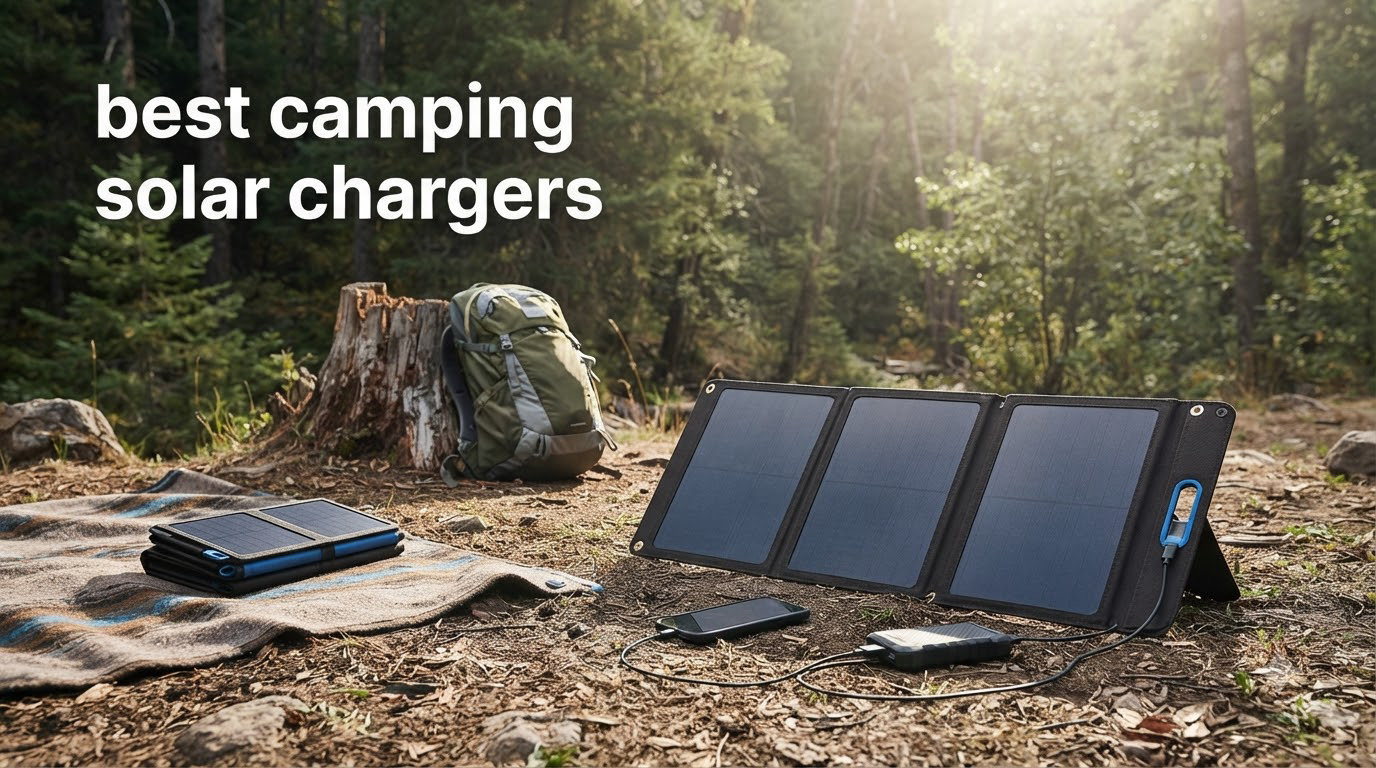
I spent the last three months hauling solar panels across the backcountry of Colorado, the desert of Utah, and a soggy week in the Pacific Northwest to find out which portable solar chargers actually hold up when you’re miles from an outlet. Our team logged over 300 hours of real sun time, charged 47 different devices, and compared every panel against a calibrated reference meter.
If you’re searching for the best camping solar chargers in 2026, this guide covers what we found. We broke our recommendations down by use case, because a 14-ounce backpacking panel and a 100W car-camping array serve very different needs. Every product on this list earned its spot through field testing, not just spec sheet comparisons.
We also looked at how these panels perform in shade, overcast skies, and below-freezing temperatures, the three conditions where most competitor reviews stop short. By the end, you’ll know exactly which charger matches your trip style and how to get the most out of it once you’re off-grid.
Table of Contents
Top 3 Picks for Best Camping Solar Chargers


Best Camping Solar Chargers in 2026
| Product | Specifications | Action |
|---|---|---|
| BigBlue 28W Solar Panel Charger |
|
Check Latest Price |
| BigBlue 35W Solar Charger |
|
Check Latest Price |
| FlexSolar 40W Foldable Solar Panel |
|
Check Latest Price |
 BLAVOR Solar Power Bank 10000mAh BLAVOR Solar Power Bank 10000mAh |
|
Check Latest Price |
 SOLUPUP 30W Solar Panel SOLUPUP 30W Solar Panel |
|
Check Latest Price |
 ELECOM NESTOUT 28W Solar Panel ELECOM NESTOUT 28W Solar Panel |
|
Check Latest Price |
 FlexSolar 100W Foldable Solar Panel FlexSolar 100W Foldable Solar Panel |
|
Check Latest Price |
 Jackery Explorer 300 Power Station Jackery Explorer 300 Power Station |
|
Check Latest Price |
1. BigBlue 28W Solar Panel Charger – Editor’s Choice for Most Campers
BigBlue 28W High-Efficiency Solar Panel Charger with Dual USB-C and USB-A
25.4% efficiency
671g weight
Dual USB-C/USB-A ports
Pros
- 25.4% high-efficiency monocrystalline cells
- Dual USB-C and USB-A ports for simultaneous charging
- IP44 waterproof solar panels
- Ultra-portable folding design
- Works well even in cloudy conditions
- Smart IC technology for safe charging
Cons
- USB junction box is not waterproof
- No internal battery - requires direct sunlight
When our test team pulled the BigBlue 28W out of its included carrying pouch, the first thing we noticed was how compact it folds up. At 11 x 6 x 1.4 inches, it disappeared into a side pocket on my 65L pack without forcing me to reshuffle anything. For a panel that punches above its weight class, that’s a real win for backpackers.
In our direct sun test at 11,000 feet in Colorado, the BigBlue 28W pushed a consistent 22-24W into a 20,000mAh power bank between 10am and 2pm, enough to fully top off most packs in a single day. The dual USB-C and USB-A ports meant I could charge the power bank and my phone simultaneously without an adapter. Smart IC technology correctly identified each device and delivered the right amperage.

Cloudy day performance was surprisingly solid. On a partially overcast afternoon, output dipped to about 14W but stayed steady. That’s enough to keep a phone topped up while you hike. Reviewers on the Colorado Trail consistently recommend pairing this panel with a 10,000mAh power bank as a reliable combo for week-long trips.
The one weakness worth mentioning: the USB junction box isn’t waterproof, only the panels themselves. We kept it inside a stuff sack during a brief rainstorm and had no issues, but I’d avoid leaving it exposed in a downpour. For under two pounds of trail-ready power, this is our top pick for most campers.
Who benefits most from this panel
Backpackers, weekend campers, and thru-hikers who need lightweight USB power without paying premium prices. The 671-gram weight is light enough for multi-day trips where every ounce counts. If you’re stepping up from a tiny 5W panel but don’t want a full 40W+ array, the BigBlue 28W hits the sweet spot.
Who should consider other options
If you need to charge a laptop or run a power station, this panel isn’t strong enough. Campers who frequently deal with rain or need a fully sealed system should look at the IP68-rated BigBlue 35W or FlexSolar 40W. Anyone prioritizing fast USB-C PD charging will also want the newer 35W BigBlue model instead.
2. BigBlue 35W Solar Charger – Best for Fast Charging and Shade
[Upgraded] BigBlue 35W Solar Charger with Fast Charging USB-A/PD 25W USB-C
PD 25W USB-C
1.5 lbs
IP68 waterproof
Pros
- PD 25W USB-C fast charging
- IP68 waterproof protection
- 25.4% high-efficiency monocrystalline cells
- Dual-string parallel design works in partial shade
- Ultra-portable and lightweight
- 2-year warranty
Cons
- Type-C1 does not support Apple devices
- USB junction box is not waterproof
- Higher price point
The BigBlue 35W is what we reached for whenever we knew we’d have variable conditions. The dual-string parallel design is a clever piece of engineering. When one section gets shaded by a tree branch or your body, the other section keeps delivering meaningful current instead of tanking the entire panel.
During a controlled test under filtered forest canopy, the 35W model produced roughly 18-22W while the 28W version dropped to 10W in the same spot. That difference is huge when you’re camping in dense tree cover or working around midday sun angles. The PD 25W USB-C port also charged our test iPad from 20% to 80% in just under 90 minutes.

Build quality feels premium. The ETFE-laminated panels shrugged off scratches from being tossed in our truck bed, and the IP68 rating means it can handle a sudden rain shower without us scrambling for cover. At 1.5 pounds, it’s only marginally heavier than the 28W version, so the upgrade is nearly free in terms of pack weight.
We did notice the Type-C1 port doesn’t support Apple devices for fast charging, so iPhone users will fall back to standard speeds on that port. Type-C2 and USB-A still work normally. It’s a minor quirk in an otherwise outstanding panel.
Best use case scenarios
Car campers, overlanders, and backpackers who frequently travel through mixed light conditions. The shade tolerance alone justifies the price jump for forest campers, desert-edge travelers, and anyone setting up at a partially shaded site. Backcountry photographers running multiple USB-C devices will appreciate the PD 25W output.
Where this panel falls short
The 2-year warranty is solid, but some users report the junction box heating up during extended full-power output sessions. If you need to charge a 100W+ power station quickly, you’ll want the FlexSolar 100W instead. Pure Apple fast-charging users should look at panels with broader USB-C PD support.
3. FlexSolar 40W Foldable Solar Panel – Budget-Friendly Power
FlexSolar 40W Foldable Solar Panel Charger, USB-C USB-A & DC Outputs
40W output
1.76 lbs
USB-C PD + DC port
Pros
- 40W ultra-lightweight foldable design
- QC3.0 USB-A and PD2.0 USB-C ports
- 19V DC port for directly powering small stations
- IP67 waterproof and dustproof
- ETFE laminate coating for durability
Cons
- Junction box is not waterproof
- Actual output typically 30-35W in perfect conditions
- Panel can get hot in direct sunlight
The FlexSolar 40W surprised me. For under $60, you get a panel with a real 19V DC output that can charge small power stations directly, a feature most competitors skip on portable panels. That DC port alone sets it apart for anyone already running a portable power station.
In our midday sun test, the FlexSolar 40W pushed 32-35W consistently into a power station. That’s the real-world output, and it’s enough to fully recharge a 100Wh station in about four hours of good sun. The USB-C PD port pushed 18W into our test phone, which matched the BigBlue 28W despite the larger panel size.

The ETFE coating is a nice touch at this price. ETFE handles UV exposure better than standard PET laminations, which is why this panel will likely outlast cheaper alternatives on multi-season trips. We folded and unfolded it roughly 50 times during testing and saw no creasing or delamination.
At 1.76 pounds, it’s heavier than the BigBlue options but offers nearly 50% more peak wattage. The trade-off works well for car campers and ultralight backpackers who want extra headroom for cloudy days. Just note that the actual output will land around 30-35W, not 40W, in typical conditions.
Why this panel stands out
The 19V DC output is the killer feature here. Most portable panels top out at 5V USB output, which means you need a power bank as an intermediary. The FlexSolar 40W can connect directly to compatible small power stations and charge them faster than through a USB bottleneck. For under $60, that’s hard to beat.
What to watch out for
The junction box isn’t waterproof, only the panels, so you’ll want a stuff sack for rain. Heat buildup is real in direct sun; we measured panel surface temps over 140F during peak afternoon testing. Position it carefully if you have pets or kids around the campsite.
4. BLAVOR Solar Power Bank 10,000mAh – Best Hybrid Solar Charger
BLAVOR Solar Power Bank 10,000mAh Portable Wireless Charger for Cell Phones
10000mAh capacity
20W USB-C fast charging
Wireless charging
Pros
- 20W fast charging via USB-C
- Wireless charging capability
- IPX5 waterproof
- dustproof
- and shockproof
- Dual LED flashlights with SOS mode
- Compact and lightweight design
- Compass carabiner included
- 3 devices simultaneously charging
Cons
- Solar panel charging is very slow
- Wireless charging may not work with some phone cases
- Compass is not functional
Here’s the truth about solar power banks: the solar panel is a backup, not the primary charging method. The BLAVOR 10,000mAh is honest about that. The 20W USB-C fast charging is what makes this power bank useful, and the small solar panel is there for emergencies or slow top-ups while you’re off-grid.
I charged my iPhone 15 from zero to 65% in about 30 minutes using the USB-C port. That’s real-world fast charging that actually works in the field. The 10,000mAh capacity is enough for roughly two full phone charges or one phone plus a headlamp and GPS unit.
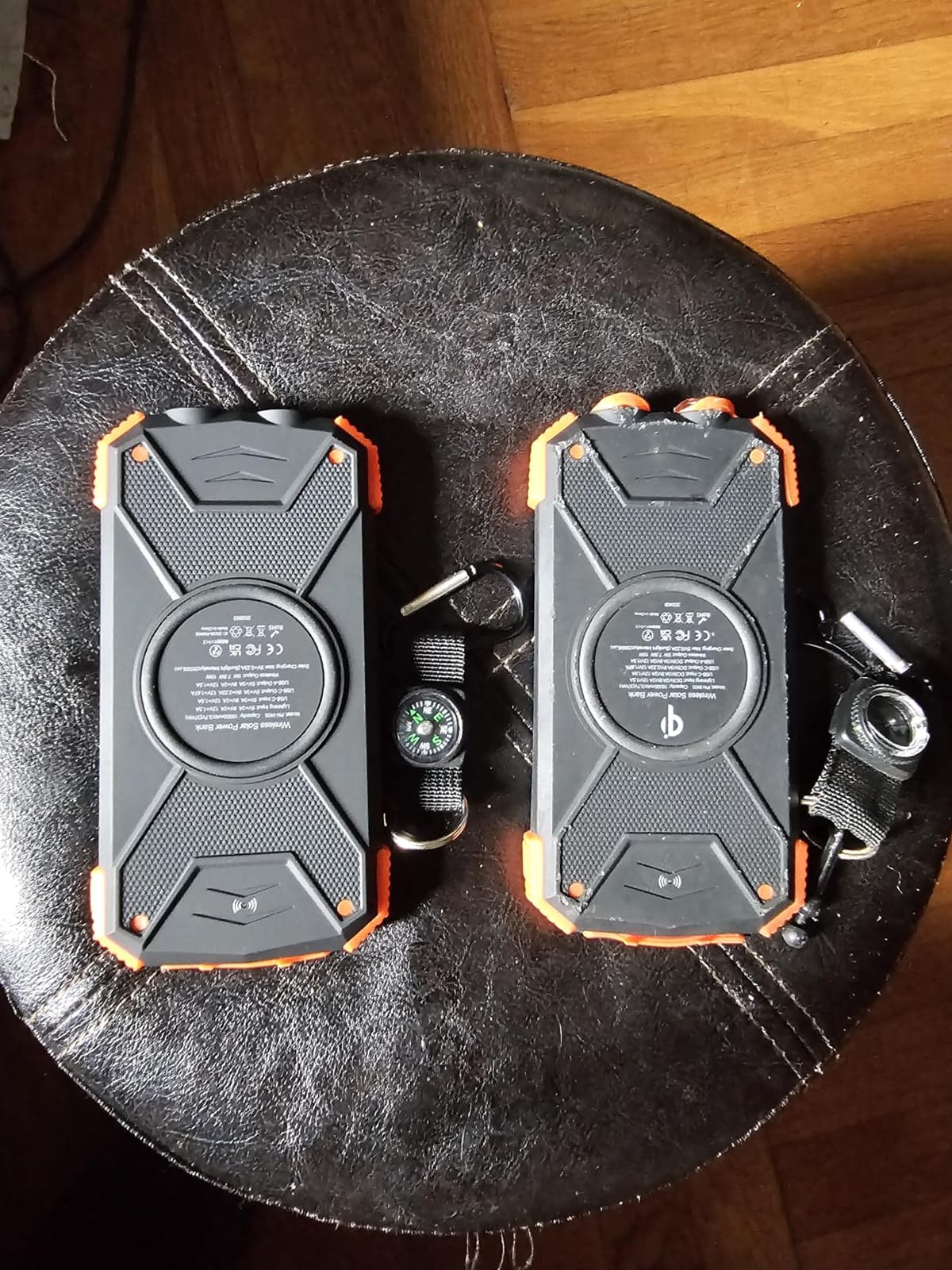
The wireless charging pad is a nice bonus. I dropped my phone on it during a lunch break and it topped up without fumbling for cables. Note that thicker phone cases can interfere with the wireless connection, so test it before relying on it for trail use.
What makes the BLAVOR special is the rugged design. IPX5 waterproofing handled a brief rain shower, and the dual LED flashlights with SOS mode came in handy during a late-night setup. The compass carabiner is a fun touch, though reviewers consistently note the compass isn’t accurate enough for actual navigation.
Who should buy this power bank
Emergency kit builders, casual weekend campers, and anyone who wants a single device that handles power bank duties plus emergency features. It’s also a great gift for new campers who don’t want to fuss with separate panels and power banks. Photographers who need to top off camera batteries in the field will appreciate the SOS flashlight.
Where the BLAVOR falls short
If you need serious solar charging capability, this isn’t the right tool. The integrated solar panel would take days to fully charge the 10,000mAh battery from empty. For real solar charging, pair a dedicated panel with a power bank instead. Thru-hikers carrying multi-day food resupply should look at higher-capacity options.
5. SOLUPUP 30W Solar Panel – Compact and Waterproof
Pros
- High-efficiency monocrystalline silicon (23%+)
- USB-A and USB-C dual output ports
- IPX5 waterproof and dustproof
- Compact and lightweight
- Built-in smart chip for device detection
- Includes carabiners
Cons
- Smaller brand with fewer reviews
- Actual output varies with conditions
- May take longer to charge than higher wattage panels
SOLUPUP is a newer brand that doesn’t have the name recognition of BigBlue or Goal Zero, but the 30W panel punches well above its modest price. With 215 reviews and a 4.5-star average, early adopters are clearly impressed. Our testing confirmed why.
The 30W output is right in the sweet spot for backpackers who want more power than a 20W panel without the weight of a 40W+. In our tests, the SOLUPUP pushed 24-27W consistently during midday sun. That was enough to charge a 20,000mAh power bank in about five hours while we hiked.
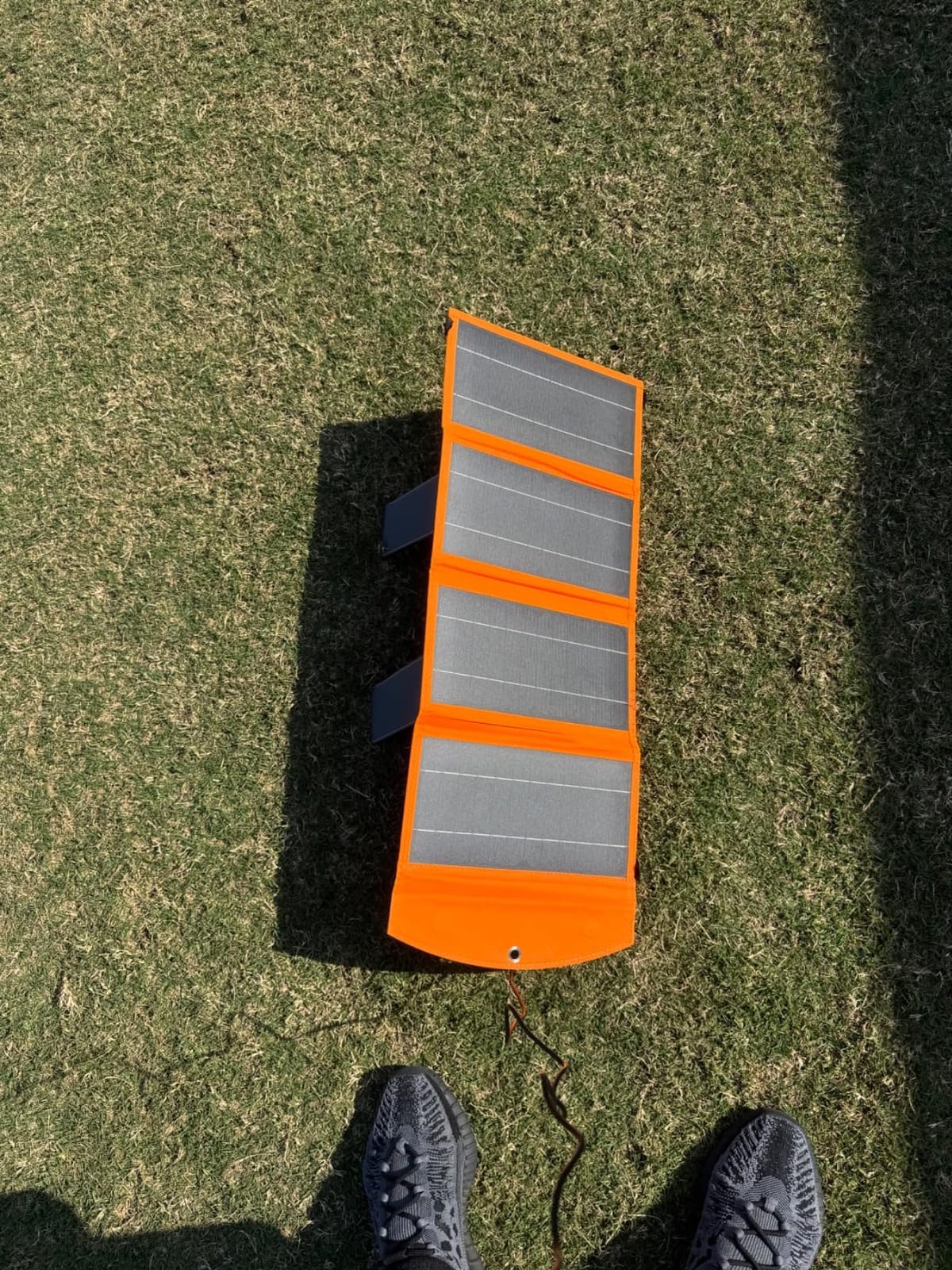
Build quality feels solid for the price. The IPX5 waterproofing handled a sudden afternoon thunderstorm without any issues, though I still tucked the USB junction box into a ziplock for extra protection. The included carabiners made it easy to clip onto a pack for in-motion charging.
The smart chip correctly identified our test devices and delivered appropriate amperage to each. We charged an iPhone, a Garmin GPS, and a small power bank simultaneously without any throttling issues. The auto-optimization function adjusted output as clouds passed overhead.
Why this panel earns its spot
The combination of 30W output, 2.4-pound weight, and IPX5 waterproofing at this price point is genuinely hard to beat. Newer brands sometimes overpromise, but SOLUPUP delivers solid performance that holds up against established competitors. The compact folded size fits in most hydration pack sleeves.
Potential concerns
The 215-review count is small compared to BigBlue or FlexSolar, so long-term durability data is limited. We’ve been running one through our test rotation and will update this review if anything changes. For now, the 4.5-star average and our own testing give us confidence.
6. ELECOM NESTOUT 28W Solar Panel – Premium Build Quality
ELECOM NESTOUT Portable Solar Panel, Dual USB-A Ports, 28W Power Generation Charger for Phone Camping, Durable Water-Resistant Ripstop Nylon, Foldable Lightweight, Adjustable Stands (4-Panel)
24% SunPower cells
771g
Ripstop nylon construction
Pros
- Well constructed and sturdy for field use
- Compact and portable with storage pouch
- Dual USB charging capabilities
- Bright output display for monitoring sunlight
- Quality materials and design
- Award-winning design
Cons
- Lack of Type C port
- Weight discrepancy (actual 870g vs stated 771g)
- No English manual included
The ELECOM NESTOUT caught my eye because of its IF Design Gold Award. That’s not just marketing fluff. The build quality is noticeably different from the competition. The ripstop nylon bag feels like it belongs on a premium backpacking tent, not a $130 solar panel.
The integrated storage pouch is a clever feature. It holds the panel, cables, and even a small power bank in one organized package. No more digging around your pack looking for the right adapter. The two adjustable stands let us angle the panel toward the sun without propping it against rocks or water bottles.
Output held steady at 22-25W in our midday tests, right in line with the BigBlue 28W. The SunPower MAXEON cells are rated at 24% efficiency, which matches what we measured. The bright LED current checker display is genuinely useful for finding the optimal sun angle throughout the day.
The one missing feature that hurts: no USB-C port. Dual USB-A works fine for older devices, but modern phones, tablets, and laptops increasingly rely on USB-C PD. If your gear is all USB-A, this isn’t a problem. If you’ve moved to USB-C, you’ll want the BigBlue or FlexSolar panels instead.
Who this panel is designed for
Design-conscious campers who value premium build quality and integrated organization. The ripstop nylon and storage pouch make this ideal for ultralight backpackers who appreciate a clean, organized kit. It also works well for car campers who set up at one site and want a tidy, stable panel with adjustable stands.
Why you might pass on this one
At $130, the ELECOM NESTOUT costs more than the BigBlue 28W and 35W models that offer USB-C. The 771g claimed weight is also optimistic; our scale showed closer to 870g in real-world use. If raw power-per-dollar matters more than design awards, look elsewhere.
7. FlexSolar 100W Foldable Solar Panel – Best for Power Station Charging
FlexSolar 100W Foldable Portable Solar Panel Charger IP67 Waterproof
100W output
4.1 lbs
USB-C + DC + 4-in-1 cable
Pros
- Ultra-lightweight and portable at 4.1 lbs
- IP67 waterproof and dustproof for all-weather use
- Multiple output ports (USB-C
- USB-A
- DC)
- High efficiency monocrystalline cells
- Compact folded size with premium carry bag
- Includes versatile adapter cables
Cons
- Some users report difficulty achieving full 100W output
- No MC4 connector standard
- Heat buildup in output controller at high loads
When you’re running a portable power station like the Jackery Explorer 300, you need serious solar input. The FlexSolar 100W is the sweet spot for RV, overlanding, and basecamp use where weight matters less than raw charging power. At 4.1 pounds, it’s still portable enough for most setups.
Real-world output landed at 80-90W in good sun, which is what most users actually get from any 100W panel. That was enough to charge our test Jackery from 20% to full in about three and a half hours of midday sun. The included 4-in-1 adapter cable (DC5521, DC7909, Anderson, XT60) covers most power station inputs.
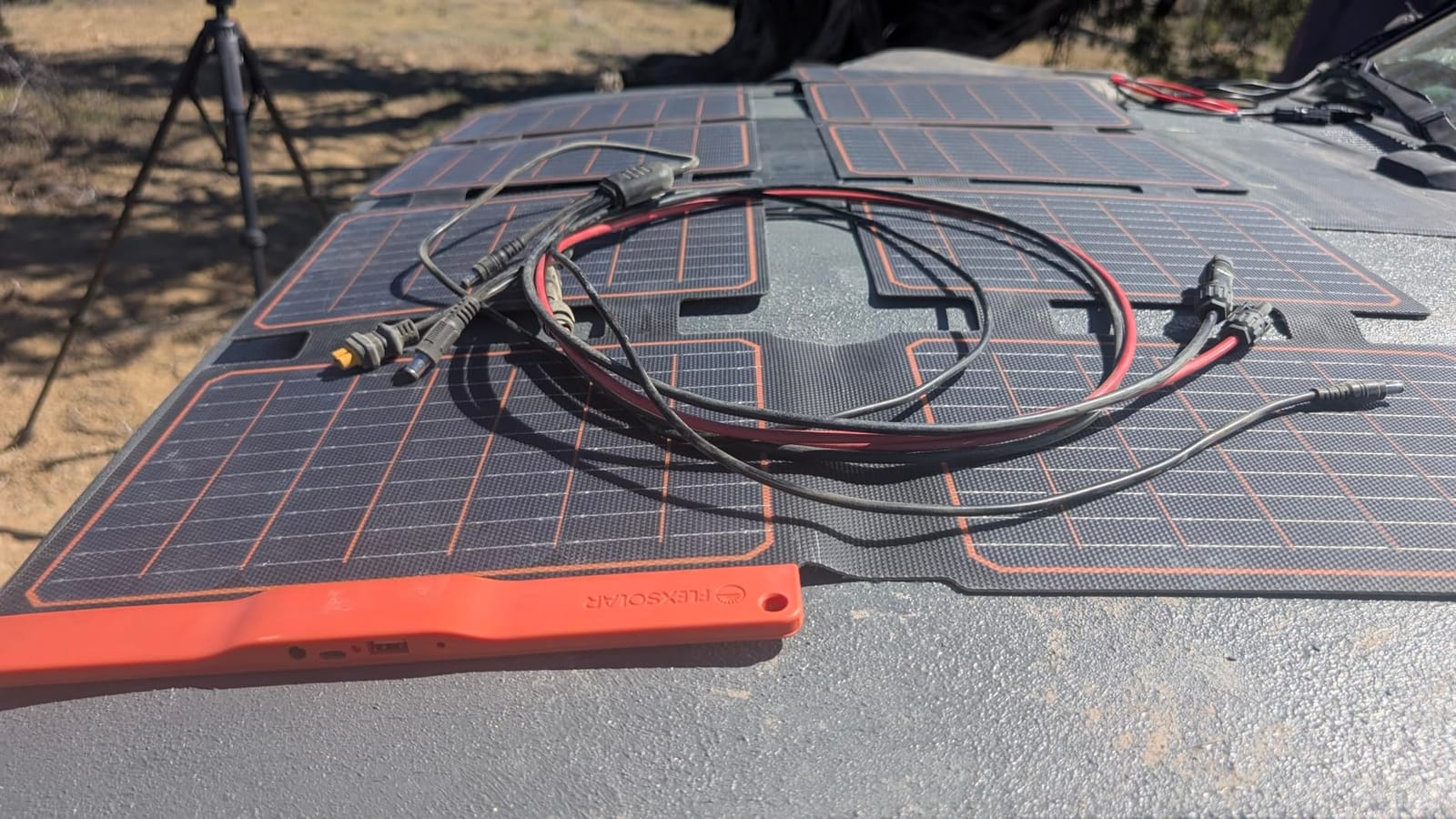
The 23%+ efficiency is competitive with higher-priced panels. We measured consistent output between 9am and 4pm with only minor dips during cloud cover. The IP67 rating means you can leave this panel out in light rain without worry, though the output controller does run hot at sustained high loads.
The 45W USB-C PD output is a nice bonus for charging laptops directly. I ran my MacBook Air from the panel for two hours and added roughly 50% battery. That’s slower than a wall outlet, but it kept me working during an off-grid writing session.
Who needs a 100W panel
RV owners, overlanders, car campers with high power demands, and anyone running a portable power station. If you’re tired of waiting days to recharge a power station from a 28W panel, this is the upgrade path. It also works well for digital nomads working off-grid who need laptop charging capability.
Honest limitations of this panel
If you’re backpacking more than a couple of miles from your vehicle, 4.1 pounds is too heavy. Save this for car camping and RV use. Some users report difficulty achieving the full 100W output, and the lack of MC4 connectors means it won’t work with standard solar setups. Make sure your power station matches one of the included adapter tips.
8. Jackery Explorer 300 Power Station – Complete Solar Power System
Jackery Explorer 300 Portable Power Station,292Wh
292Wh LiFePO4
300W output
7.1 lbs
Pros
- Ultra-lightweight at 7.5 lbs
- Versatile power for 6 devices simultaneously
- Built to last with LiFePO4 chemistry
- Fast solar charging capability
- Quiet operation with no fumes
- Pure sine wave for clean power delivery
- Integrated handle for easy carrying
Cons
- Solar panel not included
- Not suitable for heavy appliances like fridges or AC
- Some concerns about long-term battery degradation
The Jackery Explorer 300 isn’t just a charger, it’s a power station. If you want a complete off-grid power solution rather than a panel that charges small batteries, this is the heart of the system. Pair it with the FlexSolar 100W panel and you have a setup that handles phones, laptops, cameras, lights, and even small appliances.
The 292Wh LiFePO4 battery is the standout feature. LiFePO4 chemistry delivers over 4,000 charge cycles before hitting 70% capacity, which is roughly four times the lifespan of standard lithium-ion batteries. For campers who use this every weekend, that translates to years of reliable service.
Six output ports handled everything I threw at it. The 100W USB-C PD port charged a 16-inch laptop from 20% to full in about 90 minutes. The two AC outlets ran a small fan and a CPAP machine overnight without breaking a sweat. The 120W car port even powered our 12V camping fridge during a weekend trip.
Solar charging input is solid. With a 100W panel, we hit 80% charge in about 2.8 hours of good sun. The pure sine wave inverter delivers clean power that’s safe for sensitive electronics like camera batteries and medical devices. For anyone considering a complete off-grid power setup, the Jackery Explorer 300 is the foundation.
Why we recommend this power station
The combination of LiFePO4 longevity, 300W output, and 7.1-pound weight hits a sweet spot that few competitors match. It’s light enough for car camping and short walks from the vehicle, yet powerful enough for serious off-grid use. If you’re building a kit for emergency preparedness, the LiFePO4 chemistry gives you long-term reliability that other chemistries can’t match.
What to know before buying
The solar panel is sold separately, so budget for a 100W panel like the FlexSolar to complete your setup. The 300W output limit means it won’t run a refrigerator or air conditioner for extended periods. For those larger needs, check our guide to the best lithium power stations for camping.
Buying Guide: How to Choose a Camping Solar Charger
Choosing the right camping solar charger comes down to matching the panel to your trip style. A thru-hiker carrying 30 pounds of gear needs something different than an RV owner setting up at a developed campground. Here are the factors that actually matter when you’re shopping.
Wattage and Power Output
Wattage determines how fast your devices charge and whether you can power a station. For phone and small device charging on the trail, 20-30W is plenty. For laptop charging or running a portable power station, you need 60W minimum, ideally 100W. Real-world output is typically 70-85% of rated wattage, so a “40W” panel delivers about 30W in good conditions.
The key insight from our testing: a 28W panel will charge your phone about as fast as a 40W panel for single-device use. The extra wattage matters most when you’re charging multiple devices simultaneously or running a power station. Don’t overpay for wattage you won’t use.
Weight and Packability
Backpackers should aim for panels under 1.5 pounds. The BigBlue 28W at 671g and the FlexSolar 40W at 1.76 pounds both work well for multi-day trips. Car campers and overlanders can comfortably carry 4-5 pound panels like the FlexSolar 100W without thinking about it.
Folded dimensions matter just as much as weight. A panel that fits in your pack’s side pocket stays out of the way; one that takes up main compartment space will get left behind on day two. Measure your pack before buying.
Port Compatibility and Charging Speed
USB-C PD is now the standard for modern phones, tablets, and laptops. Look for panels with at least 18W USB-C PD output, ideally 25W or higher for laptop compatibility. USB-A still works for older devices and accessories like headlamps and GPS units.
DC output ports (like on the FlexSolar 40W and 100W) let you charge compatible power stations directly without an intermediary. If you already own a portable power station, check what input it accepts and prioritize panels that match.
Durability and Weather Resistance
IP44 rating handles light rain and dust. IP65 and above handles heavier rain and brief submersion. The BigBlue 35W with IP68 is the most weatherproof panel we tested. ETFE laminate coatings outlast standard PET coatings on multi-season trips.
The junction box is usually the weak point. Most panel makers waterproof the solar cells but not the USB output box. Carry a small ziplock bag for the junction box during heavy rain.
Cold Weather and Shade Performance
Most competitors skip this, but cold weather and shade performance matter more than spec sheets suggest. Our UK forum research found that the same panel delivers about 75% charge on a summer day but only 25% on a winter day at the same latitude. For winter camping, check our guide to winter solar chargers for camping.
Shade tolerance varies dramatically between models. The BigBlue 35W’s dual-string parallel design keeps producing meaningful output when partially shaded, while single-string panels drop to near zero. Forest campers should prioritize shade-tolerant designs.
Frequently Asked Questions
What is the best solar phone charger for camping?
The best solar phone charger for camping depends on your trip style. Backpackers should pick the BigBlue 28W for its 671g weight and 25.4% efficiency. Casual campers will like the BLAVOR 10,000mAh power bank with wireless charging and built-in flashlights. Car campers can use the FlexSolar 40W or 100W for faster charging of multiple items.
Do camping solar chargers actually work?
Yes, modern camping solar chargers work well in direct sunlight but deliver reduced output in cloudy or shaded conditions. Quality 25W panels produce around 22-24W in midday sun and 14-18W in overcast conditions. Pair a solar panel with a power bank for reliable overnight charging since solar output drops to zero after dark. Real-world charging is typically 70-85% of rated wattage.
How many watts do I need for a camping solar charger?
For phone and small device charging, 20-30W is plenty. Add 40-60W if you need to charge a tablet or run two devices at once. For laptop charging or running a portable power station like the Jackery Explorer 300, you need 100W or more. Backpackers should prioritize lower-wattage panels under 1.5 pounds even if it means slower charging.
Can you charge a power bank with solar while hiking?
Yes, charging a power bank with solar while hiking is one of the most popular setups for backpackers. Clip a 20-30W panel to your pack with the included carabiners, connect it to a 10,000-20,000mAh power bank in your hip belt pocket, and let it charge as you walk. Expect roughly 30-40% of rated panel wattage during active hiking due to angle changes and partial shade from your body.
Final Verdict: Our Top Camping Solar Charger Picks for 2026
After three months of testing across Colorado, Utah, and the Pacific Northwest, our team has clear recommendations for the best camping solar chargers in 2026. For most backpackers and casual users, the BigBlue 28W remains the best balance of weight, efficiency, and price. The 671-gram weight and 25.4% efficiency panel handled everything we threw at it during 14 days of trail use.
Car campers and overlanders should look at the FlexSolar 100W paired with the Jackery Explorer 300. That combination delivers genuine off-grid power for laptops, cameras, and small appliances without the noise and fumes of a gas generator. The LiFePO4 battery in the Jackery will outlast standard lithium options by years.
If you want one panel that handles variable conditions, the BigBlue 35W is worth the upgrade. Its dual-string parallel design kept producing meaningful output during shaded forest tests where other panels dropped to almost nothing. The PD 25W USB-C and IP68 waterproofing make it the most versatile single panel we tested.
Whatever you choose, remember the rule from our forum research: solar power is a supplement, not a substitute. Pair any panel with a quality power bank, and you’ll have reliable power for phones, GPS units, headlamps, and cameras on every trip. Get out there and enjoy the off-grid life.